


A Measurement Framework for the Fourth Mission of Universities

Abstract
1. Introduction
2. Literature Review
2.1. The Conceptual Frame of Universities’ Fourth Mission
2.2. Operationalization Pathways for University Missions
3. Research Design and Methodology
4. Model Proposal
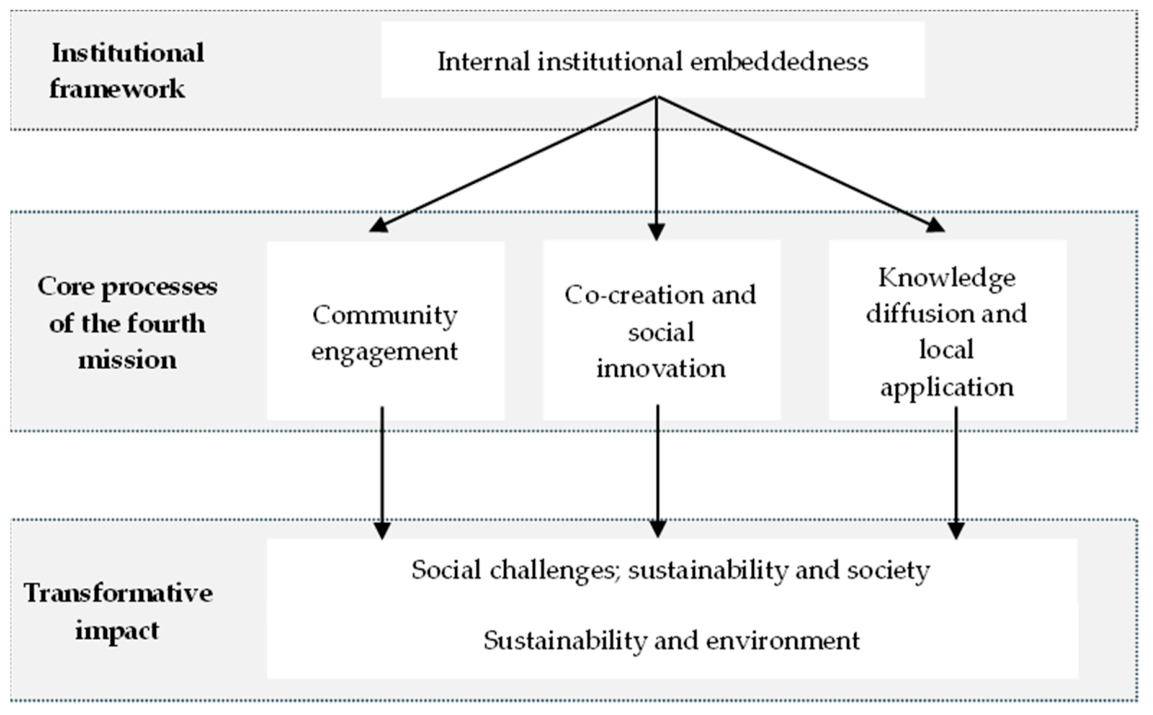
4.1. Institutional Framework and Strategic Embeddedness
4.2. Core Processes of the Fourth Mission
4.3. Transformative Impact
4.4. Illustrative Pilot Application of the Proposed Framework
5. Conclusions
Author Contributions
Funding
Institutional Review Board Statement
Informed Consent Statement
Data Availability Statement
Acknowledgments
Conflicts of Interest
Abbreviations
| HEI | Higher Education Institution |
| NGO | Non-governmental Organization |
| SDGs | Sustainable Development Goals |
| UCE | University Community Engagement |
| TEFCE | Towards a European Framework for Community Engagement in Higher Education |
| HHR | Department of Humanities and Human Resources |
| SNE | Department of Special Needs Education |
| ISC | Department of International Studies and Communication |
| SSS | Department of Social Studies and Sociology |
| EP | Department of Education and Psychology |
| METH | Department of Methodology |
References
- Akolgo-Azupogo, H., Bardy, R., & Rubens, A. (2018). Leapfrogging to the fourth mission in higher education. A new Ghanaian college creates sustainability approaches and community engagement. In K. Kassel, & I. Rimanoczy (Eds.), Developing a sustainability mindset in management education (pp. 297–319). Routledge. [Google Scholar]
- Arthur, J. (2017). The first modern university: The university of Birmingham. British Journal of Educational Studies, 65(2), 183–200. [Google Scholar] [CrossRef]
- Bardy, R., Rubens, A., & Eberle, P. (2017). Building intellectual capital for sustainable development: Combining local wisdom and advanced knowledge. Electronic Journal of Knowledge Management, 15(3), 159–169. [Google Scholar]
- Batra, S., Orban, J., Zhang, H., Guterbock, T. M., Butler, L. A., Bogucki, C., & Chen, C. (2022). Analysis of social mission commitment at dental, medical, and nursing schools in the US. JAMA Network Open, 5(5), e2210900. [Google Scholar] [CrossRef]
- Baty, P., & Banette, D. (2026). World university rankings 2026: Methodology. Available online: https://www.timeshighereducation.com/world-university-rankings/methodology (accessed on 18 March 2026).
- Biloslavo, R., & Schaebs, D. S. (2025). Joint sustainability reports (JSRs) to promote the third mission of universities. Sustainability, 17(21), 9587. [Google Scholar] [CrossRef]
- Bogedain, A., & Hamm, R. (2020). Strengthening local economy—An example of higher education institutions’ engagement in ‘co-creation for sustainability’. Region, 7(2), 9–27. [Google Scholar] [CrossRef]
- Borodiyenko, O., Malykhina, Y., Spryndys, S., Kamenska, I., & Bokshyts, O. (2023). Ukrainian universities as clusters of regional socioeconomic development: Inspirations from European experience. Financial and Credit Activity: Problems of Theory and Practice, 3(50), 447–456. [Google Scholar]
- Cantaragiu, R., Păunescu, C., & Hadad, S. (2014). The social impact of university entrepreneurship in Romania: Is the institutional discourse replicated or adapted? Management & Marketing, 9(4), 403–422. [Google Scholar]
- Carayannis, E. G., Barth, T. D., & Campbell, D. F. (2012). The quintuple helix innovation model: Global warming as a challenge and driver for innovation. Journal of Innovation and Entrepreneurship, 1(1), 2. [Google Scholar] [CrossRef]
- Christiansen, S. H., Du, X., & Guerra, A. O. P. d. C. (2024). Middle management leadership experiences of a mission-driven innovation university strategy. Education Sciences, 14(6), 609. [Google Scholar] [CrossRef]
- Corrall, S., Schlak, T., & Bracke, P. (2022). Renewing and revitalising the social mission of higher education. In T. Schlak, S. Corrall, & P. Bracke (Eds.), The social future of academic libraries: New perspectives on communities, networks, and engagement (pp. 59–90). Facet. [Google Scholar]
- Council of the European Union. (2022). Council recommendation on learning for the green transition and sustainable development. Available online: https://education.ec.europa.eu/news/learning-for-the-green-transition-and-sustainable-development (accessed on 25 April 2026).
- Council of the European Union. (2023). Council recommendation on common values, inclusive education and the European dimension of teaching. Available online: https://education.ec.europa.eu/focus-topics/improving-quality/inclusive-education/common-values (accessed on 25 April 2026).
- Covelli, F. A., Mahoney, D. A., Batra, S., Beard, K. V., Campbell, L. A., & Pittman, P. P. (2022). Driving toward a culture shift: Case studies of social mission in nursing education. Journal of Professional Nursing, 42, 225–230. [Google Scholar] [CrossRef] [PubMed]
- Čajka, P., Čajková, A., & Krpálek, P. (2023). The role of universities as the institutional drivers of innovation at the regional level. Terra Economicus, 21(1), 94–107. [Google Scholar] [CrossRef]
- D’Ambrosi, L., Martino, V., & Brescia, P. (2024). University fourth mission and social impact. Ethic imperative and relational challenges in the context of high education in Italy. In E. Oliveira, & G. Gonçalves (Eds.), Ethics and society challenges in organisational and public communication (pp. 99–134). LabCom Books. [Google Scholar]
- European Commission. (2025). The European universities alliances in action. Available online: https://education.ec.europa.eu/education-levels/higher-education/european-universities-initiative/about (accessed on 25 April 2026).
- European Union. (2017). A renewed EU agenda for higher education. Available online: https://eur-lex.europa.eu/EN/legal-content/summary/a-renewed-eu-agenda-for-higher-education.html?fromSummary=15 (accessed on 25 April 2026).
- Farnell, T., & Ćulum, B. I. (2021). Towards a European framework for community engagement in higher education (Chapter 20). In B. Hall, & R. Tandon (Eds.), Socially responsible higher education, international perspectives on knowledge democracy (pp. 253–264). Brill Sense. [Google Scholar]
- Farnell, T., & Šćukanec, N. (2018). Mapping existing tools for assessing community engagement in higher education. In P. S. Benneworth, B. Ćulum, T. Farnell, F. Kaiser, M. Seeber, N. Šćukanec, H. Vossensteyn, & D. Westerheijden (Eds.), Mapping and critical synthesis of current state-of-the-art on community engagement in higher education. Institute for the Development of Education. [Google Scholar]
- Filep, B., Tamándl, L., Rámháp, S., & Kovács, Z. (2012, May 10–11). The economical and social impact of Széchenyi István University (Győr, Hungary) on regional development. 7th International Scientific Conference on Business and Management, Vilnius, Lithuania. [Google Scholar]
- Furco, A. (1999). Self-assessment rubric for the institutionalization of service-learning in higher education. Service Learning General, 127, 1–19. [Google Scholar]
- Gál, Z. (2016). Egyetem és város. Educatio, 25(2), 220–233. [Google Scholar]
- Gregán, O. G., Kovács, S., & Gabnai, Z. (2024). The role of intrapreneurs in driving entrepreneurial transformation in universities: A bibliographic analysis between 1990 and 2024. Administrative Sciences, 14(12), 327. [Google Scholar] [CrossRef]
- Gunasekara, C. (2006). Reframing the role of universities in the development of regional innovation systems. Journal of Technology Transfer, 31(1), 101–113. [Google Scholar] [CrossRef]
- Henderson, M. C., Green, C., & Chen, C. (2021). What does it mean for medical school admissions to be socially accountable? AMA Journal of Ethics, 23(12), 965–974. [Google Scholar]
- Holland, B. (1997). Analyzing institutional commitment to service: A model of key organizational factors. Michigan Journal of Community Service Learning, 4(1), 30–41. [Google Scholar]
- Hollander, E. L., Saltmarsh, J., & Zlotkowski, E. (2002). Indicators of engagement. In M. E. Kenny, L. A. K. Simon, K. Kiley-Brabeck, & R. M. Lerner (Eds.), Learning to serve (pp. 31–49). Springer. [Google Scholar]
- Huang, Y., Jiang, L., & Zhai, R. (2025). Reconciling teaching and research tensions: A sustainability framework for expert teacher development in research intensive universities. Sustainability, 17(15), 7113. [Google Scholar] [CrossRef]
- Koltói, L., Dombi, A., & Kiss, P. (2015). What do conscious citizens see?—Role of higher education in setting social priorities. In J. Berács, J. Iwanska, G. Kováts, & L. Matei (Eds.), Central European higher education cooperation conference proceedings (pp. 100–113). Corvinus University of Budapest Digital Press. [Google Scholar]
- Lukovics, M., & Zuti, B. (2015). New functions of universities in century XXI towards “Fourth Generation” universities. Transition Studies Review, 22(2), 33–48. [Google Scholar]
- Málovics, G. (2025). Harmadik misszió és (versus) egyetemi közösségi szerepvállalás (EKSZ): Az EKSZ, mint a térbeli igazságosságot és fenntarthatóságot támogató egyetemi gyakorlat. Tér és Társadalom, 39(4), 63–87. [Google Scholar] [CrossRef]
- Morawska-Jancelewicz, J. (2022). The role of universities in social innovation within quadruple/quintuple helix model: Practical implications from Polish experience. Journal of the Knowledge Economy, 13, 2230–2271. [Google Scholar] [CrossRef]
- Natário, M. M. S., & Oliveira, P. (2025). How higher education institutions may catalyse regional innovation ecosystems: The case of polytechnics in Portugal. Industry and Higher Education, 39(3), 365–376. [Google Scholar] [CrossRef]
- Ocupa-Cabrera, H. G., Meneses-La-Riva, M. E., Fernández-Bedoya, V. H., & Suyo-Vega, J. A. (2025). Mentoring and university social responsibility: A systematic review of strategies and impacts in higher education. Frontiers in Education, 10, 1625433. [Google Scholar] [CrossRef]
- Olo, D. D. P., Correia, L. C., & Rego, C. (2021). Higher education institutions and development: Missions, models, and challenges. Journal of Social Studies Education Research, 12(2), 1–25. [Google Scholar]
- Page, M. J., McKenzie, J. E., Bossuyt, P. M., Boutron, I., Hoffmann, T. C., Mulrow, C. D., Shamseer, L., Tetzlaff, J. M., Akl, E. A., Brennan, S. E., Chou, R., Glanville, J., Grimshaw, J. M., Hróbjartsson, A., Lalu, M. M., Li, T., Loder, E. W., Mayo-Wilson, E., McDonald, S., … Moher, D. (2021). The PRISMA 2020 statement: An updated guideline for reporting systematic reviews. BMJ, 372, n71. [Google Scholar] [CrossRef]
- Pelagallo, F., Pellegrini, M. M., Giannitelli, R., & Sartini, P. (2021). University and social innovation: The case of an urban regeneration in the municipality of Rome. International Journal of Public Sector Performance Management, 7(2), 264–286. [Google Scholar] [CrossRef]
- Platonova, R. I., Levchenkova, T. V., Shkurko, N. S., Cherkashina, A. G., Kolodeznikova, S. I., & Lukina, T. N. (2016). Regional educational institutions with in modern system of education. International Electronic Journal of Mathematics Education, 11(8), 2937–2948. [Google Scholar]
- Rinaldi, C., Cavicchi, A., Spigarelli, F., Lacchè, L., & Rubens, A. (2018). Universities and smart specialisation strategy: From third mission to sustainable development co-creation. International Journal of Sustainability in Higher Education, 19(1), 67–84. [Google Scholar] [CrossRef]
- Severino-González, P., Medina-Giacomozzi, A., Calderón-Morales, W., Ramírez-Molina, R., Rebolledo-Aburto, G., Sarmiento-Peralta, G., & Dote Pardo, J. S. (2025). Mental health and university social responsibility: Evidence, trends and challenges for inclusion. Mental Health and Social Inclusion. Ahead-of-print. [CrossRef]
- Sitku, K. (2019). Vidéki egyetemek harmadik missziós tevékenysége: A társadalmi tudásmegosztás hatásai. Iskolakultúra, 29(8), 17–35. [Google Scholar] [CrossRef]
- Siwinski, W. (2017). Academic rankings—Where are they heading? Educational Studies Moscow, 1, 158–166. [Google Scholar] [CrossRef]
- Stoliaryk, O., Korniat, V., & Hertsyuk, D. (2024). Strengthening social responsibility: Ukrainian universities’ third mission amidst war. New Educational Review, 76(2), 51–62. [Google Scholar] [CrossRef]
- Thomas, E., Pugh, R., Soetanto, D., & Jack, S. L. (2023). Beyond ambidexterity: Universities and their changing roles in driving regional development in challenging times. Journal of Technology Transfer, 48, 2054–2073. [Google Scholar] [CrossRef]
- Tierney, W. M., Auzenne, D., Cook, L., Jones, B. L., Mackert, M., Paydarfar, D., Ding, X., Woods, J. M., & Kahlon, M. (2021). Importance of community impact as the fourth academic mission: A qualitative study. Population Health Management, 24(5), 610–615. [Google Scholar] [CrossRef]
- Times Higher Education. (2025). University impact rankings 2025. Available online: https://www.timeshighereducation.com/impactrankings (accessed on 18 March 2026).
- Tomasi, S., Cavicchi, A., Aleffi, C., Paviotti, G., Ferrara, C., Baldoni, F., & Passarini, P. (2021). Civic universities and bottom-up approaches to boost local development of rural areas: The case of the University of Macerata. Agricultural Economics, 9(1), 15. [Google Scholar]
- Tryma, K. (2021). The analysis of students’ opinions about the social responsibility of Ukrainian universities. Journal of Education Culture and Society, 12(4), 527–538. [Google Scholar] [CrossRef]
- Zagirniak, D., Khovrak, I., & Perevozniuk, V. (2018). The convergence of the systems of education at Scottish and Ukrainian universities in the context of ethic leadership. International Journal of Engineering and Technology, 7(4), 550–556. [Google Scholar] [CrossRef]

| Dimension | Third Mission | Fourth Mission |
|---|---|---|
| Primary orientation | Economic and innovation-oriented contribution | Societal, ethical and sustainability-oriented contribution |
| Main objective | Utilization of knowledge and research results for economic development | Co-creation of public value and transformative responses to societal and environmental challenges |
| Dominant activities | Technology transfer, innovation support, entrepreneurship, spin-offs, industry cooperation | Community engagement, social responsibility, ethical leadership, sustainability, inclusion, social innovation |
| Role of society | Society is mainly a beneficiary | Society is an active participant |
| Knowledge flow | Primarily university-to-economy | Participatory and co-creative |
| Typical partners | Firms, industry actors, innovation agencies | Civil society, communities, public institutions, local stakeholders |
| Disciplinary affinity | More closely linked to technological, natural science, business and engineering fields | Particularly relevant for social sciences, humanities, education, and health related fields |
| Measurement focus | Outputs such as patents, licenses, spin-offs | Sustainability embeddedness and societal impact |
| University model | Entrepreneurial university | Embedded civic university |
| Literature Evidence | Proposed Indicators | Main Source |
|---|---|---|
| The importance of supporting institutional implementation of mission-driven innovation strategies | 1.1 Strategic integration | (Holland, 1997; Furco, 1999; Hollander et al., 2002; Christiansen et al., 2024) |
| Mission-oriented institutional change depends on supportive organizational environments, revised evaluation and recognition mechanisms | 1.2 Organizational support | (Holland, 1997; Furco, 1999; Farnell & Ćulum, 2021; Huang et al., 2025) |
| 1.3 Incentives and recognition | ||
| Engagement-oriented missions become institutionalized through teaching, curricula, student involvement | 1.4 Curricula integration | (Holland, 1997; Furco, 1999; Hollander et al., 2002; Farnell & Ćulum, 2021; Morawska-Jancelewicz, 2022; Ocupa-Cabrera et al., 2025) |
| 1.5 Student engagement | ||
| Community engagement emphasizes long-term collaboration, and external stakeholder involvement | 2.1 Long-term partnerships | (Holland, 1997; Hollander et al., 2002) |
| 2.2 Participation | ||
| 2.3 Capacity building | ||
| Fourth mission-oriented research has societal relevance, and stakeholder-driven problem definition | 3.1 Societal challenge-oriented research | (Holland, 1997; Farnell & Ćulum, 2021; Morawska-Jancelewicz, 2022) |
| 3.2 Co-definition of problems | ||
| 3.3 Participatory research | ||
| Regional and local engagement is as a central topic, local actors, local community, local economy are main keywords | 4.1 Knowledge localization | (Platonova et al., 2016; Arthur, 2017; Bogedain & Hamm, 2020; Thomas et al., 2023; Natário & Oliveira, 2025) |
| 4.2 Local knowledge production | ||
| 4.3 Knowledge accessibility | ||
| A distinct part of the literature links the social mission of higher education mainly to promoting health equity and addressing broader social inequalities | 5.1 Social inequalities, inclusiveness | (Henderson et al., 2021; Batra et al., 2022; Covelli et al., 2022; Severino-González et al., 2025) |
| 5.2 Health and well-being | ||
| Sustainability-oriented approaches frame universities as actors contributing to SDG-related activities | 6.1 Environmental sustainability orientation | (Rinaldi et al., 2018; Bogedain & Hamm, 2020; Pelagallo et al., 2021; Morawska-Jancelewicz, 2022; Natário & Oliveira, 2025) |
| 6.2 Environmental awareness | ||
| 6.3 Local environmental action |
| Dimension | Sub-Dimension | Observable Indicator | Evidence, Measurement |
|---|---|---|---|
| 1. Internal institutional embeddedness | 1.1 Strategic integration | Fourth mission in strategy | Explicit reference to fourth mission related activities and goals in institutional mission statements, strategic plans, policy documents or development plans |
| 1.2 Organizational support | Dedicated structure | Units, coordinators, programs | |
| Funding | Financial resources separated | ||
| 1.3 Incentives and recognition | Reward systems | Awards, promotion for fourth mission related activities | |
| 1.4 Curricula integration | Community-based and sustainability education | Number/existence of courses with the involvement of communities/SDG related topics | |
| New teaching methods | New teaching methods | ||
| 1.5 Student engagement | Student involvement structures | Volunteering, student-led initiatives, support systems | |
| 2. Community engagement | 2.1 Long-term partnerships | Diversity of partners (Quintuple Helix) | Evidence of repeated, continuous or multi-year cooperation with external stakeholders, such as renewed agreements, recurring joint projects, long-term partnership programs |
| Stability of partnerships | Evidence of continuous, repeated collaborations | ||
| 2.2 Participation (engagement level) | Stakeholder involvement in university processes | External actors involved in teaching, research, program design | |
| 2.3 Capacity building | Community training programs | Training, workshops, skills development for communities | |
| Open university activities | Public events, conferences, lifelong learning (e.g., senior university) | ||
| 3. Co-creation and social innovation (research) | 3.1 Societal challenge-oriented research | Research addressing social/sustainability issues | Research projects, research groups, publications explicitly addressing social challenges, sustainability, inclusion, health, well-being, regional development or environmental issues |
| 3.2 Co-definition of problems | Joint problem identification | Evidence that external stakeholders participate in defining research problems, project objectives | |
| 3.3 Participatory research | Co-creation in research processes | Participatory/action/community-based research approaches | |
| Joint use of results | Shared ownership or co-implementation of outcomes | ||
| 4. Knowledge diffusion and local application | 4.1 Knowledge localization | Adaptation of international knowledge to local context | Mobility outcomes, local adaptation of global knowledge |
| 4.2 Local knowledge production | Local-topic publications and events | Conferences, conference presentations, publications addressing regional issues | |
| 4.3 Knowledge accessibility | Open access and public dissemination | Publicly available research outputs, open access publications, policy briefs, community reports, public lectures, podcasts, webinars, workshops or other knowledge-sharing formats accessible to non-academic audiences | |
| 5. Social challenges; sustainability and society | 5.1 Social inequalities, inclusiveness | Programs targeting disadvantaged groups | Presence of initiatives addressing inclusion, equal access, vulnerable groups |
| Accessibility improvement | Measures aimed at widening participation and improving access to education, services or university resources for underrepresented, disadvantaged or vulnerable groups | ||
| 5.2 Health and well-being | Community health initiatives | Health-related programs, partnerships, outreach activities | |
| Mental health support | Institutional- or community-level mental health and well-being programs, counselling services, prevention initiatives, resilience-building activities, peer-support schemes or partnerships with health/social service providers | ||
| 6. Sustainability and environment | 6.1 Environmental sustainability orientation | SDG-related activities and projects | Explicit SDG integration in programs/projects |
| 6.2 Environmental awareness | Awareness-raising activities | Educational-, public- or community-oriented events, campaigns, workshops, trainings or outreach programs aimed at raising awareness of environmental sustainability, climate change, biodiversity, circular economy or responsible resource use | |
| 6.3 Local environmental action | Regional ecological initiatives | Local environmental partnerships and actions |
| Sustainable Development Goals (SDGs) | HHR | SNE | ISC | SSS | EP | METH | Total |
|---|---|---|---|---|---|---|---|
| 1. No poverty | 0 | 0 | 3 | 5 | 0 | 0 | 8 |
| 2. Zero hunger | 0 | 0 | 3 | 0 | 0 | 0 | 3 |
| 3. Good health and well-being | 0 | 0 | 0 | 2 | 0 | 5 | 7 |
| 4. Quality education | 21 | 8 | 11 | 1 | 34 | 6 | 81 |
| 5. Gender equality | 1 | 0 | 3 | 0 | 0 | 0 | 4 |
| 6. Clean water and sanitation | 0 | 0 | 3 | 0 | 0 | 0 | 3 |
| 7. Affordable and clean energy | 1 | 0 | 0 | 1 | 2 | 0 | 4 |
| 8. Decent work and economic growth | 9 | 2 | 11 | 2 | 5 | 1 | 30 |
| 9. Industry, innovation and infrastructure | 10 | 0 | 7 | 2 | 7 | 0 | 26 |
| 10. Reduced inequalities | 3 | 1 | 7 | 1 | 0 | 0 | 12 |
| 11. Sustainable cities and communities | 4 | 0 | 3 | 4 | 0 | 0 | 11 |
| 12. Responsible consumption and production | 8 | 0 | 14 | 6 | 4 | 0 | 32 |
| 13. Climate action | 1 | 0 | 3 | 1 | 0 | 0 | 5 |
| 14. Life below water | 0 | 0 | 1 | 0 | 0 | 0 | 1 |
| 15. Life on land | 0 | 0 | 1 | 0 | 0 | 0 | 1 |
| 16. Peace, justice, and strong institutions | 6 | 0 | 8 | 5 | 1 | 0 | 20 |
| 17. Partnerships for the goals | 7 | 0 | 8 | 0 | 2 | 0 | 17 |
| Total per faculty | 71 | 11 | 86 | 30 | 55 | 12 | 265 |
Disclaimer/Publisher’s Note: The statements, opinions and data contained in all publications are solely those of the individual author(s) and contributor(s) and not of MDPI and/or the editor(s). MDPI and/or the editor(s) disclaim responsibility for any injury to people or property resulting from any ideas, methods, instructions or products referred to in the content. |
© 2026 by the authors. Licensee MDPI, Basel, Switzerland. This article is an open access article distributed under the terms and conditions of the Creative Commons Attribution (CC BY) license.
Share and Cite
Pálffy, Z.; Horváth, Z.; Ablonczy-Mihályka, L. A Measurement Framework for the Fourth Mission of Universities. Educ. Sci. 2026, 16, 758. https://doi.org/10.3390/educsci16050758
Pálffy Z, Horváth Z, Ablonczy-Mihályka L. A Measurement Framework for the Fourth Mission of Universities. Education Sciences. 2026; 16(5):758. https://doi.org/10.3390/educsci16050758
Chicago/Turabian StylePálffy, Zsuzsanna, Zoltán Horváth, and Lívia Ablonczy-Mihályka. 2026. "A Measurement Framework for the Fourth Mission of Universities" Education Sciences 16, no. 5: 758. https://doi.org/10.3390/educsci16050758
APA StylePálffy, Z., Horváth, Z., & Ablonczy-Mihályka, L. (2026). A Measurement Framework for the Fourth Mission of Universities. Education Sciences, 16(5), 758. https://doi.org/10.3390/educsci16050758

