1. Introduction
According to the
European Commission (
2024), education is currently moving away from a perspective focused solely on academic achievement. Instead, a more comprehensive view is emerging, recognizing that children and adolescents need a balance of cognitive and social- emotional competencies to succeed both in school and, more broadly, in life.
Research indicates that well-being, academic learning, and social and emotional learning are intrinsically interconnected and mutually reinforcing: students with stronger social-emotional competencies tend to demonstrate higher academic performance (
Arciniegas-Romero et al., 2025;
Bazzano et al., 2023;
Butvilas et al., 2022;
Butvilas & Kovaitė, 2022;
European Commission, 2024). Numerous studies have shown that the development of social-emotional competencies is essential for children’s adaptation to societal demands, enabling them to respond effectively to the complex challenges associated with growth and development (
Butvilas & Kovaitė, 2022;
Cavioni et al., 2024;
Dimitrellou et al., 2025;
Durlak et al., 2011;
Merrell, 2008;
Odak et al., 2023).
Despite this body of evidence, approaches across countries remain uneven and fragmented, and social and emotional learning has yet to become a widespread educational practice. Accordingly, one of the
European Commission’s (
2024) key recommendations is to integrate social and emotional education into school curricula, beginning in the early years of education.
Considering this literature, the present article aims to present the design, implementation, and evaluation of a program intended to promote social-emotional competencies through mindfulness practices, developed with students in primary education (1st Cycle of Basic Education) in a school cluster in Portugal. The article is structured as follows: it begins with a review of the literature, followed by a description of the methodological procedures, the presentation and discussion of the program and its results, and a final section outlining the conclusions.
2. Literature Review
Social competencies may be defined as a set of behavioral and cognitive characteristics related to an individual’s ability to interact effectively with others, monitor cognitive processes, and regulate behavior to manage social tasks and everyday challenges (
Odak et al., 2023). These competencies involve the acquisition of knowledge, attitudes, and skills necessary to establish and maintain healthy, meaningful interpersonal relationships (
Butvilas & Kovaitė, 2022;
Cavioni et al., 2024;
European Commission, 2024;
Merrell, 2008;
Odak et al., 2023). The literature refutes the notion that these competencies are purely innate or dispositional attributes. Rather, they are described as an evolving construct that develops through social interactions and learning experiences across the lifespan, particularly through observation and imitation of behaviors arising from an individual’s interaction with the social environment from birth, as well as through targeted interventions (
Hassani, 2024;
Odak et al., 2023).
In addition to social competencies, which are more directly associated with interpersonal functioning, emotions also play a significant role because they correspond to internal affective states (
Damásio, 2000). This gives rise to the concept of emotional competencies. Emotional competencies are defined as an individual’s capacity to monitor and regulate their own emotions and cognitive processes to deal appropriately with everyday tasks and challenges (
Butvilas et al., 2022;
Butvilas & Kovaitė, 2022). This concept is closely linked to emotional intelligence, described as the ability to recognize, use, and regulate emotions effectively and productively, thereby supporting appropriate adaptation to environmental demands and the effective resolution of situations (
Espinoza et al., 2022;
Goleman, 2012b;
Muñoz-Oliver et al., 2022;
Odak et al., 2023). There is, therefore, an intrinsic connection between social and emotional competencies, insofar as the social dimension relates to the construction of positive relationships with others, within which emotion regulation is essential (
Butvilas et al., 2022;
Butvilas & Kovaitė, 2022;
Merrell & Gueldner, 2010). The literature suggests that emotional competencies underpin social competencies; for example, if a student is unable to recognize how they feel (emotional), they are more likely to struggle to adjust their behavior in ways that support effective collaboration within a group (social) (
Dimitrellou et al., 2025;
Odak et al., 2023).
According to the Collaborative for Academic, Social, and Emotional Learning (CASEL) (
Collaborative for Academic, Social and Emotional Learning, 2013), socio-emotional competencies may be organized into three domains: (i) intrapersonal: self-awareness and self-regulation; (ii) interpersonal: social awareness and relationship skills; and (iii) behavioral/ethical: responsible decision-making. Social and emotional learning aims to help children to recognize and express their emotions and feelings, thereby engaging affective dimensions in the learning process. It is equally essential that they understand emotions and impulses to manage them constructively, combining mindfulness practice with social and emotional learning (
Hawkins, 2019). In contemporary psychology, mindfulness is regarded as an approach that seeks to enhance awareness and foster adaptive responses to mental processes associated with emotional distress and maladaptive behaviors (
Carvalho & Marques-Pinto, 2019;
Milaré et al., 2025).
Emotional illiteracy represents a significant issue among children and young people, often more concerning than academic underachievement itself. Indeed, such illiteracy, understood as the lack of skills to recognize, understand, and manage one’s own emotions and those of others, may constitute a predictive factor contributing to academic failure (
Butvilas et al., 2022;
Butvilas & Kovaitė, 2022;
European Commission, 2024). Early intervention in the development of social-emotional competencies can foster optimism, reduce stress, enhance resilience, and decrease externalizing behaviors (
Campos, 2019). Furthermore, several studies indicate that the healthy development of social-emotional competencies in early childhood provides a strong foundation for academic achievement (
Arciniegas-Romero et al., 2025;
Bazzano et al., 2023;
Butvilas et al., 2022;
Butvilas & Kovaitė, 2022;
European Commission, 2024). Research also highlights the importance of promoting emotional literacy to address gaps in social-emotional education, helping students move beyond “automatic pilot” states toward a more mindful awareness of their emotions (
Butvilas & Kovaitė, 2022;
Milaré et al., 2025).
In this regard, there is evidence that social-emotional competencies such as self-awareness, self-regulation, empathy, and active listening can be learned and refined by children and young people and should therefore be regarded as key mechanisms for fostering cooperation and conflict resolution. Schools are identified as ideal settings for this work, as these competencies can be systematically developed and applied through structured educational programs (
Espinoza et al., 2022;
European Commission, 2024;
Muñoz-Oliver et al., 2022). Various scholars suggest that such competencies can be nurtured from early childhood, with parents playing a crucial role as emotional mentors (
Bazzano et al., 2023;
European Commission, 2024;
Goleman, 2012a). Moreover, studies indicate that family involvement in social-emotional education programs can enhance outcomes by creating supportive environments both at school and at home (
Talvio & Lonka, 2021).
However, social-emotional interventions should not be limited to early childhood; rather, they should accompany development across the lifespan and be revisited at different ages in ways appropriate to individuals’ levels of understanding and capacity. There is a growing perspective advocating for school curricula that cultivate “emotionally literate students”, who are capable of recognizing how activities affect them and of managing their emotional responses (
Dimitrellou et al., 2025). Evidence from intervention programs demonstrates that these competencies are malleable and respond positively to explicit instruction and deliberate practice in both school and family contexts (
Dimitrellou et al., 2025;
Espinoza et al., 2022). This underscores the importance of systematically integrating social-emotional education into school curricula in a contextualized manner tailored to the specific needs of children and young people (
Ansari & Rizvi, 2023;
Dimitrellou et al., 2025;
Monzón González, 2024).
In recent years, the development of mindfulness-based practices and programs in educational contexts has increased, with evidence of favorable outcomes. For instance, recent programs such as Kind Mind in Germany have demonstrated positive effects on young children’s social-emotional competencies (
Jansen et al., 2025). In Denmark, Klassens Tid (“class time”) has been implemented for several decades among students ages 6 to 16 and is considered a fundamental component of the curriculum. It is dedicated to dialogue, listening, and conflict resolution, with the aim of strengthening empathy, respect, and social cohesion among students (
Lalomia & Cascales-Martinez, 2023). In Portugal, MindUp and MindSerena are two examples of programs designed to promote social-emotional competencies through mindfulness practices. The former aims to develop social-emotional competencies aligned with the CASEL framework (
Collaborative for Academic, Social and Emotional Learning, 2003), combined with mindfulness practice (
Sampaio de Carvalho, 2020). It comprises three levels, ranging from preschool education to the eighth grade, with weekly classroom sessions and the inclusion of a three-minute contemplative practice conducted three times a day (
Sampaio de Carvalho, 2020). The MindSerena program, in turn, is a social-emotional learning intervention for teachers and students in grades 6 to 8, grounded in mindfulness principles and scientific approaches. It seeks to enhance attentional capacity, reduce anxiety, increase bodily and emotional self-awareness, improve interpersonal relationships, and strengthen executive functioning associated with academic success (
Pereira, 2019). The program consists of one introductory session and seven intervention sessions, each lasting 45 min, delivered in the classroom by teachers or trained professionals (
Pereira, 2019).
Acceptance of such programs has generally been high, and their continued integration into school curricula and family-based interventions has been recommended (
European Commission, 2024;
Jackman et al., 2019;
May et al., 2016;
Milaré et al., 2025;
Santos et al., 2020). However,
Jackman et al. (
2019) note that the implementation of mindfulness programs may encounter challenges at multiple levels, including limited time, integration into the school routine, teacher turnover, inadequate training for some teachers, and parental involvement. Although evidence supports the benefits of mindfulness, outcomes may vary (
Dunning et al., 2022;
Gómez-Olmedo et al., 2020). Some studies report modest yet positive effects on social-emotional competencies, suggesting the need for more comprehensive and targeted interventions (
Filipe et al., 2021). Further research is required to optimize these interventions and to better understand their long-term impacts (
Berti & Cigala, 2022;
Campos, 2019;
Dunning et al., 2022;
Gómez-Olmedo et al., 2020;
Jansen et al., 2025;
Kay et al., 2025;
Kil & Antonacci, 2020;
Milaré et al., 2025;
B. Ng & Kong, 2023;
H. H. Ng et al., 2023;
Trautwein et al., 2020).
Within this context, considering: (a) the existing evidence regarding the relevance of implementing social-emotional competency programs through mindfulness practices; (b) knowledge of different intervention programs; and (c) research findings highlighting the need for further development and investigation in this field, the present doctoral study emerged. Among its various phases, it involved the design and implementation of the Sentir@Ser program, aimed at promoting social-emotional competencies through mindfulness practices among primary school students (1st Cycle of Basic Education). The design of this program was informed by the literature review, existing programs, and findings from the initial phase of the study, specifically the analysis of parents’ and teachers’ perceptions. The following sections present the methodology adopted, the procedures used for program implementation, and selected results.
3. Materials and Methods
The present study aimed, in an initial phase, to design a program to promote social-emotional competencies through mindfulness practices and, in a subsequent phase, to implement and evaluate its effects within a school cluster located in Alto Alentejo, in inland Portugal, involving all students in primary education (1st Cycle of Basic Education). The program was delivered by the mindfulness facilitator who also developed it.
The study adopted a mixed-methods design. For the quantitative component, an assessment protocol was administered at two time points, pretest and posttest, to students, parents/guardians, and teachers. The protocol administered to students included the Positive and Negative Affect Scale for Children (PANAS-C) (
Sampaio de Carvalho & Marques-Pinto, 2012a), the Child and Adolescent Mindfulness Measure (CAMM) (
Cunha et al., 2013), and the Self-Compassion Scale (
Sampaio de Carvalho & Marques-Pinto, 2012b). The protocol administered to parents included the Home and Community Social Behavior Scale (HCSBS) (
Raimundo et al., 2009) and the Emotion Regulation Scale (
Alves & Cruz, 2013). Teachers completed the School Social Behavior Scales-2 (SSBS-2) (
Raimundo et al., 2012). Authorization to use all instruments was obtained from the authors of the Portuguese versions.
To comply with authorization procedures and ethical requirements for research in school settings, as defined by the Portuguese Ministry of Education, the study proposal was submitted for review and approval to the Directorate-General for Education through the Monitoring System for Surveys in School Contexts. Data collection was also approved by the board of the school cluster in which the study was conducted. Parents/guardians received an informed consent form through which they could authorize or decline their child’s participation. Participation was voluntary, and no exclusion criteria were applied.
The scales were administered to students in classroom groups by the researcher, who also served as the program facilitator. Students were assured that their responses would remain anonymous and confidential and were informed that there were no right or wrong answers. To ensure comprehension, all items were read aloud, and students responded in writing simultaneously, item by item.
Quantitative data from the pretest and posttest assessments administered to students, parents, and teachers were analyzed using the Statistical Package for the Social Sciences (version 29, IBM Corp., Armonk, NY, USA). Descriptive statistics (means and standard deviations) were calculated according to variables such as gender, grade level, and family structure. Correlational analyses between the scales were conducted using Pearson’s correlation coefficient.
When interpreting the PANAS-C results, it is important to consider the instrument’s scoring procedure. For the Positive PANAS subscale (minimum score = 15; maximum score = 75), higher scores indicate higher levels of positive affect, associated with general well-being and positive engagement with the environment. For the Negative PANAS subscale (minimum score = 15; maximum score = 75), higher scores reflect higher levels of negative affect, associated with general emotional distress and manifested in negative emotional states such as anger, guilt, or anxiety.
When interpreting the Self-Compassion Scale subscales, it is important to note that higher levels of self-compassion are reflected in higher scores on the Self-kindness, Common Humanity, and Mindfulness subscales, and in lower scores on Self-judgement, Isolation, and Over-identification subscales.
When interpreting the data obtained through the CAMM, it is important to consider its scoring procedure, according to which lower scores indicate higher levels of mindfulness-related competencies. The total score on the scale ranges from 0 to 40.
To complement the evaluation of the program’s effectiveness, qualitative methods were also employed. Individual interviews were conducted with parents/guardians, including both mothers and fathers, approximately midway through the implementation of the Sentir@Ser program, after the tenth session. In addition, to assess parental and family involvement in promoting social-emotional competencies through mindfulness practices, data were collected through written records documenting participation in the “Home Challenges” activities.
Within the broader context of the research, this article highlights the following objectives: (i) to evaluate the effects of the Sentir@Ser program, designed to promote social-emotional competencies through mindfulness practices in primary school students, on students’ affect (positive and negative), self-compassion, and mindfulness-related competencies; and (ii) to examine whether these effects vary according to gender, grade level, and family structure. Derived from these objectives, the following hypotheses were formulated:
H1. Participation in the Sentir@Ser program, which promotes social-emotional competencies through mindfulness practices, is expected to result in higher levels of positive affect, self-compassion, and mindfulness-related competencies, as well as lower levels of negative affect among primary school students.
H2. The effects of the Sentir@Ser program on students’ outcomes (affect, self-compassion, and mindfulness-related competencies) are expected to vary according to gender, grade level, and family structure.
In line with these objectives, the results presented in this article focus on the description of the program’s design and implementation, as well as on the discussion of data collected from students.
4. Results
4.1. Participant Characteristics
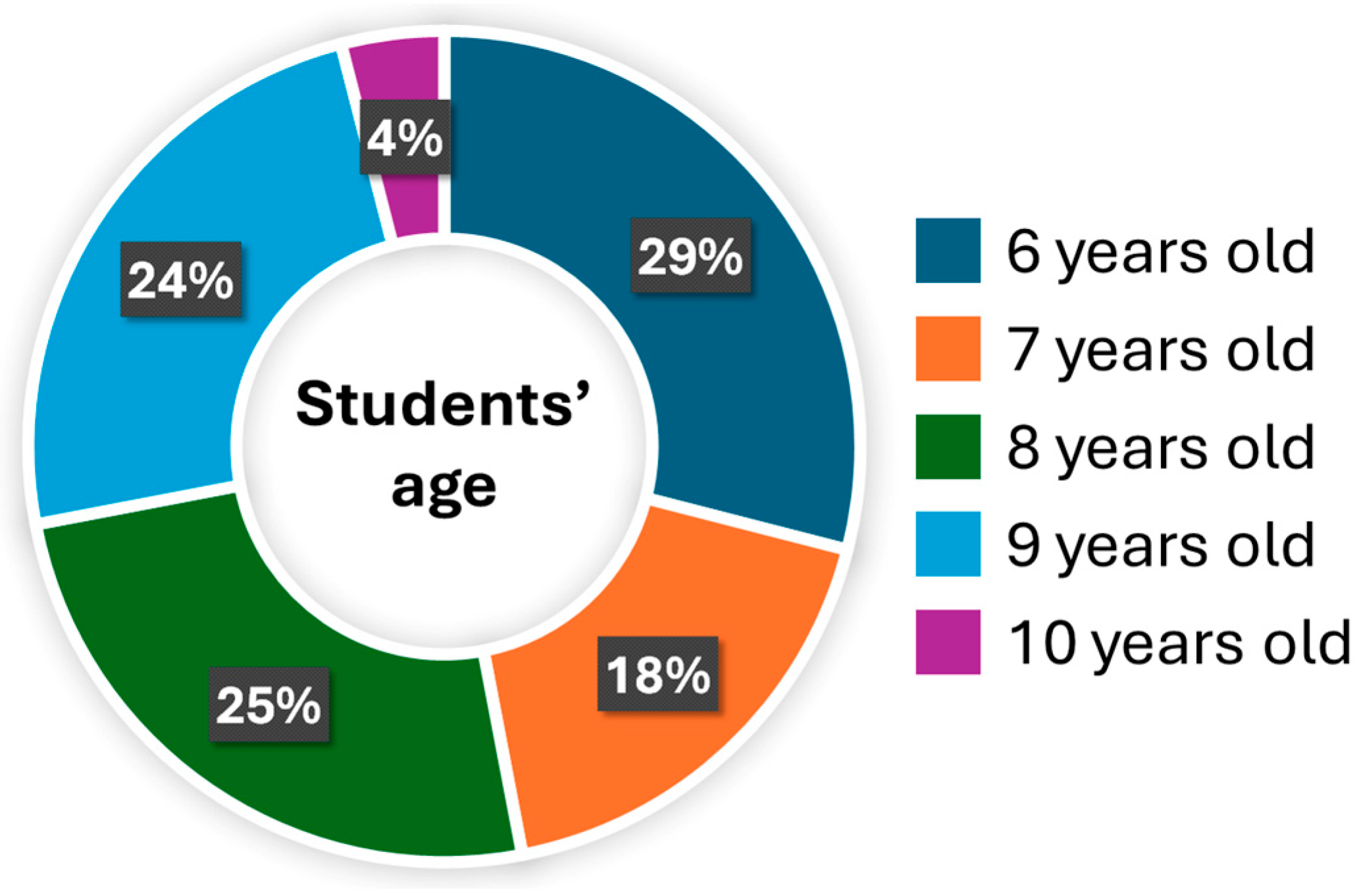
A total of 72 primary school students (1st Cycle of Basic Education) participated in the study, distributed across four classes, one from each grade level: 23 students in grade 1 (31.9%), 14 in grade 2 (19.4%), 19 in grade 3 (26.4%), and 16 in grade 4 (22.2%). Of the total sample, 41 participants were female (56.9%), and 31 were male (43.1%).
Participants ranged in age from 6 to 10 years, as shown in
Figure 1.
Regarding family structure, most students (69.4%) lived with both parents and sibling(s). An additional 18.1% lived with both parents and no siblings, 9.7% lived with one parent, and 2.8% lived with one parent and a stepparent.
4.2. Design and Implementation of the Sentir@Ser Program
The Sentir@Ser program was developed as part of the first author’s doctoral research. Its design was grounded in the literature on social-emotional learning and mindfulness, as well as in findings from a preliminary phase of the study, which included an analysis of parents’ and teachers’ perceptions of the promotion of these competencies through mindfulness-based practices. The program also took into account the educational context and the specific needs of the school cluster in which it was implemented. It was reviewed and approved by the research supervisors and the director of the school cluster. The program was first implemented during the 2021–2022 academic year.
The program comprises 20 structured sessions, each lasting 60 min, and is grounded in the core domains of Social and Emotional Learning (SEL): self-awareness, self-regulation, social awareness, interpersonal relationships, and responsible decision-making (
Collaborative for Academic, Social and Emotional Learning, 2003). In alignment with these domains, activities were developed around the following subthemes: identity, communication, emotions, autonomy, protection, violence, interaction and belonging, values, choices, challenges and loss.
Each session systematically incorporates mindfulness practices and techniques, including moments of focus and centering (e.g., the “Tibetan singing bowl” and conscious breathing), emotional validation (“How do I feel now?”), gratitude exercises, and recentering practices (e.g., body scan, meditation, guided visualization, awareness exercises, and mantras).
The themes addressed are distributed across the 20 sessions of the program, as presented in
Table 1.
Except for the first session, all sessions follow a consistent sequence: entry into the classroom; focus/centering; “How do I feel?” (beginning); gratitude; activity; reflection; “How do I feel?” (end); focus/centering; and Home Challenges, when applicable.
The active involvement of parents or other close family members in social-emotional learning activities and mindfulness practices is a key objective of the program. Accordingly, Home Challenges are proposed in 10 of the 20 sessions on an alternating basis. These consist of suggested family-based activities related to the social-emotional learning domains addressed in previous sessions. The aim is to foster parental and family engagement in children’s school activities while also equipping parents with tools to support the development of these competencies at home. Home Challenges are introduced to students during the session and communicated to parents through appropriate channels. In the present study, they were shared through the Google Classroom platform. Parents were invited to provide feedback on each activity, such as photographs, videos, or written reflections.
The program was implemented in the classroom as part of the Sentir@Ser enrichment activity and delivered by the researcher. Weekly 60-min sessions were conducted in accordance with the planned structure of the program. It should be noted that enrichment activities are implemented as a complement to the regular curriculum and do not replace any curricular classes. Although participation was optional, all students in this study were enrolled in the activity by their parents or legal guardians. Therefore, the program did not involve the replacement of instructional time in core subjects.
4.3. Effects of the Program
The results from the pretest and posttest assessments administered to students are presented below in the following order: PANAS-C, Self-Compassion Scale, CAMM, and correlational analyses between the scales.
4.3.1. PANAS-C
At pretest, the total PANAS-C scores indicated that students in the sample demonstrated moderate levels of both positive affect [42.24 ± 18.1; mean (M) ± standard deviation] and negative affect (48.79 ± 13.7). Notably, mean scores were slightly higher for negative affect than for positive affect.
Following the implementation of the Sentir@Ser program, posttest PANAS-C scores revealed improvements in students’ perceptions of positive affect (62.1 ± 14.5), along with a reduction in negative affect (23.94 ± 8.7). These findings indicate that the program had a positive impact, both in increasing positive affect (pretest M = 42.24 vs. posttest M = 62.1) and by decreasing negative affect (pretest M = 48.79 vs. posttest M = 23.94).
To examine gender differences, total PANAS-C scores were analyzed separately for female and male students. Overall, a positive impact of the Sentir@Ser program was observed in both groups. Both girls and boys showed an increase in positive affect (girls: M = 45.4 at pretest vs. M = 62.7 at posttest; boys: M = 37.8 at pretest vs. M = 61.2 at posttest), as well as a decrease in negative affect (girls: M = 49.4 at pretest vs. M = 22.8 at posttest; boys: M = 47.9 at pretest vs. M = 25.4 at posttest).
Total PANAS-C scores were also analyzed by grade level to examine differences across educational levels. Overall, implementation of the Sentir@Ser program had a positive impact across all grade levels, with increases in positive affect and reductions in negative affect, as shown in
Table 2. It is also noteworthy that, in both the pretest and posttest assessments, students in higher grade levels tended to report higher levels of positive affect.
Additionally, total PANAS-C scores were analyzed according to family structure to examine potential differences across family structures. Overall, a positive impact of the Sentir@Ser program was observed regardless of family structure, as shown in
Table 3.
4.3.2. Self-Compassion Scale
Overall, improvements were observed across the subscales following implementation of the Sentir@Ser program, as shown in
Table 4.
When the Self-Compassion Scale scores were analyzed by gender, grade level, and family structure (
Table 5), improvements were observed across all subscales, meaning an increase in self-compassion among students following implementation of the Sentir@Ser program, regardless of gender, grade level, or family structure.
4.3.3. Child and Adolescent Mindfulness Measure (CAMM)
Overall, posttest CAMM scores following the implementation of the Sentir@Ser program indicate an improvement in students’ mindfulness-related competencies (pretest: M = 22.5 vs. posttest: M = 19.4).
Regarding gender differences, both female (pretest: M = 21.07 vs. posttest: M = 18.49) and male students (pretest: M = 24.39 vs. posttest: M = 20.07) showed improvement following implementation of the program. It is also noteworthy that, at both pretest and posttest, girls demonstrated higher levels of mindfulness-related competencies than boys.
When the data were analyzed by grade level, improvements in mindfulness-related competencies were observed across all grade levels except Grade 1. It is also notable that, prior to implementation of the program, Grade 1 students demonstrated the highest levels of mindfulness-related competencies; however, following the intervention, Grade 2 students exhibited the highest levels (
Table 6).
Analysis of scores according to family structure also revealed improvements in mindfulness-related competencies following implementation of the Sentir@Ser program, regardless of family structure (
Table 7). Notably, students living with one parent demonstrated the greatest improvement in mindfulness-related competencies (pretest: M = 25.0 vs. posttest: M = 15.7). In contrast, students living with one parent and a stepparent showed the lowest levels of mindfulness-related competencies at both pretest and posttest (M = 27.0 and 25.0, respectively).
4.3.4. Correlation Analysis Among Scales
Regarding PANAS-C, Pearson’s correlation analysis revealed a moderate, negative, and statistically significant relationship between positive affect and negative affect (
r = −0.327,
p < 0.001). This indicates that higher levels of positive affect were associated with lower levels of negative affect among students (
Table 8).
Regarding the correlation between affect and mindfulness-related competencies, a moderate, positive, and statistically significant correlation was found between Positive Affect (PANAS-C) and CAMM scores (
r = 0.333,
p < 0.001). In contrast, a weak negative correlation was observed between Negative Affect (PANAS-C) and CAMM scores (
r = −0.215), which did not reach statistical significance (
p > 0.05) (
Table 9).
Because lower CAMM scores indicate higher mindfulness-related competencies, the positive correlation between Positive Affect and CAMM scores suggests that higher levels of positive affect were associated with higher CAMM scores, that is, lower levels of mindfulness-related competencies. The negative correlation between Negative Affect and CAMM scores suggests the opposite pattern, although this relationship was not statistically significant. These findings should therefore be interpreted with caution.
The correlation analysis between the subscales of the Self-Compassion Scale is presented in
Table 10.
The Self-kindness subscale showed significant negative correlations with Self-judgement (r = −0.285), Isolation (r = −0.314), and Over-identification (r = −0.259), indicating that higher levels of self-kindness were associated with lower levels of self-judgement, social isolation, and over-identification. In contrast, Self-kindness was positively correlated with Common Humanity (r = 0.490). Self-judgement showed a significant negative association with Common Humanity (r = −0.395). However, correlations between Self-judgement and the Isolation, Mindfulness, and Over-identification subscales did not reach statistical significance (p > 0.05). Common Humanity demonstrated a strong positive correlation with Over-identification (r = 0.623), while no significant relationships were observed with Mindfulness or Isolation. Isolation showed a significant negative correlation with Mindfulness (r = −0.254), whereas its correlations with Self-judgement, Common Humanity, and Over-identification were not statistically significant (p > 0.05).
5. Discussion
The results suggest improvements in children’s social-emotional competencies, reflected in increased positive affect, decreased negative affect, enhanced mindfulness-related competencies, and higher levels of self-compassion. These findings are consistent with recent studies demonstrating the beneficial effects of social-emotional learning programs that incorporate mindfulness practices in school settings (
Crompton et al., 2024;
Crooks et al., 2020;
Filipe et al., 2021;
Flook et al., 2025;
Henriksen & Gruber, 2024;
Milaré et al., 2025).
Regarding affect, as assessed by the PANAS-C, implementation of the program was associated with increased positive affect and reduced negative affect. These results suggest that the intervention may have supported the development of more adaptive emotion regulation strategies, promoting more positive emotional experiences alongside better management of negative states. This pattern is consistent with research indicating that mindfulness-based social-emotional programs can enhance emotion regulation and psychological well-being in children (
Bazzano et al., 2023;
García-Rubio et al., 2023;
Kim et al., 2025;
Milaré et al., 2025). Across gender, grade level, and family structure, a consistent pattern emerged, with increases in positive affect and reductions in negative affect following the intervention. Notably, girls, who initially reported higher levels of negative affect, showed a more pronounced reduction and ultimately reported lower levels than boys at posttest. One possible explanation for this finding lies in gender differences in emotional awareness and regulation, as girls tend to report greater sensitivity to internal emotional states and may be more responsive to interventions targeting these processes (
Chaplin, 2015;
Garber et al., 2025). This finding aligns with previous studies suggesting that mindfulness-based interventions may be particularly effective in improving internalizing emotional indicators, especially among girls (
Chaplin, 2015;
Garber et al., 2025;
Kang et al., 2018).
Results from the Self-Compassion Scale indicated increases in self-kindness, common humanity, and mindfulness, along with reductions in self-judgement and isolation. Together, these changes suggest that students developed a more compassionate and less self-critical relationship with themselves, which represents an important protective factor for psychological well-being. However, the pattern for over-identification was less clear, as scores increased slightly overall and decreased only among Grade 1 students. This result suggests that not all dimensions of self-compassion changed in the same way and that this subscale may warrant closer attention in future research. Notably, children living with one parent and a stepparent showed particularly marked improvements across several subscales, although these findings should be interpreted cautiously given the likely small size of this subgroup. Previous research indicates that mindfulness-based social-emotional programs can promote self-compassion, particularly when they foster emotion regulation and reflection on internal experiences (
Neff & Germer, 2017;
Razza et al., 2025;
Trautwein et al., 2020). Higher levels of self-compassion have, in turn, been associated with greater self-esteem and more favorable psychological adjustment (
Filipe et al., 2021;
Levantini et al., 2025).
Regarding mindfulness-related competencies, CAMM results indicate overall improvement following implementation of the program, suggesting an enhanced ability to attend to present-moment experiences in a conscious and nonjudgemental manner. These findings are consistent with literature demonstrating that mindfulness-based school interventions can positively impact social-emotional competencies, attention, and self-regulation (
Jansen et al., 2025;
Pereira, 2019;
Sampaio de Carvalho, 2020).
In terms of gender, both girls and boys showed improvement, although girls consistently demonstrated higher levels of mindfulness at both time points. This pattern is consistent with research indicating that girls tend to exhibit greater emotional awareness and more frequent use of adaptive regulation strategies (
Chaplin, 2015;
Garber et al., 2025). Nevertheless, improvements across both groups suggest that such programs may be beneficial regardless of gender.
Across grade levels, improvements in mindfulness-related competencies were observed in nearly all grades, except for Grade 1 students. This pattern may be explained by developmental factors, as mindfulness practices require cognitive and metacognitive abilities, such as attentional monitoring and reflection, that develop progressively during childhood (
Diamond, 2013;
Dimitrellou et al., 2025). In addition, younger children may have a more limited capacity to fully understand, internalize, and accurately report abstract constructs such as mindfulness, which may influence self-report outcomes in the early years of primary school (
Borgers et al., 2000). This may also be compounded by increased familiarity with the assessment format at posttest, as repeated exposure to questionnaires can enhance children’s comprehension and response consistency over time (
Borgers et al., 2000;
de Leeuw, 2011). Although social-emotional competencies should be fostered from early childhood (
Bazzano et al., 2023;
European Commission, 2024;
Goleman, 2012a), intervention effects may vary with age and are often more consistent among older children, who typically demonstrate more advanced cognitive and emotional regulation skills (
Dunning et al., 2022;
Durlak et al., 2011). This pattern may also reflect differences in engagement with the intervention, as well as developmental differences in children’s capacity to participate in structured mindfulness activities and to reflect on their experiences in classroom-based settings. Furthermore, the observed differences between Grade 1 and Grade 2 students may reflect a combination of developmental progression and contextual factors, such as classroom dynamics and levels of engagement with the program. Previous research highlights that implementation variables, including pedagogical context, facilitator training, and participant engagement, can significantly influence intervention outcomes (
Jackman et al., 2019;
Monsillion et al., 2023).
Regarding family structure, improvements in mindfulness-related competencies were observed across all groups, with particularly pronounced gains among students living with one parent.
Correlational analyses revealed a moderate, negative, and statistically significant relationship between positive and negative affect (
r = −0.327,
p < 0.001), indicating that higher positive affect was associated with lower negative affect. This finding aligns with literature suggesting that positive emotional experiences function as protective factors that support psychological and academic adjustment (
Butvilas et al., 2022;
Butvilas & Kovaitė, 2022;
Espinoza et al., 2022;
Muñoz-Oliver et al., 2022).
A moderate, positive, and statistically significant correlation was also found between positive affect and CAMM scores (r = 0.333, p < 0.001). However, this finding should be interpreted cautiously because lower CAMM scores indicate higher mindfulness-related competencies. Strictly speaking, the positive coefficient suggests that higher positive affect was associated with higher CAMM scores, that is, with lower mindfulness-related competencies. Although a negative correlation was observed between negative affect and CAMM scores, this relationship was not statistically significant (r = −0.215, p > 0.05), indicating that mindfulness may be more strongly associated with the promotion of positive emotional states than with the reduction of negative affect.
Analysis of the Self-Compassion Scale subscales revealed patterns partly consistent with
Neff’s (
2003) model. Self-kindness was negatively correlated with self-judgement and isolation and positively correlated with common humanity, indicating that more compassionate self-relating was associated with reduced self-judgement and greater psychological integration (
Neff & Germer, 2017). However, self-kindness was negatively, not positively, correlated with over-identification, which is theoretically coherent because greater self-kindness would be expected to coincide with less over-identification.
A strong positive correlation between Common Humanity and Over-identification (
r = 0.623,
p < 0.01) suggests that recognizing difficulties as part of the shared human experience may support a more cohesive self-concept. Additionally, the negative association between Isolation and Mindfulness, together with the positive association between Mindfulness and Over-identification, further highlights the complexity of the relationships among these constructs. Overall, these findings support evidence that mindfulness and self-compassion are closely related and jointly contribute to the development of social-emotional competencies (
Neff & Germer, 2017;
Razza et al., 2025;
Trautwein et al., 2020).
Despite these promising findings, the literature indicates variability in the effects of mindfulness-based interventions in school settings. Outcomes may be modest or moderated by factors such as intervention duration, intensity, and participant characteristics (
Dunning et al., 2022;
Gómez-Olmedo et al., 2020;
Jackman et al., 2019). Accordingly, the present findings should be interpreted with caution.
6. Conclusions
Overall, the findings of this study address the research question guiding this work. The results suggest that the Sentir@Ser program was associated with improvements in students’ social-emotional competencies, as reflected in increased positive affect, reduced negative affect, enhanced self-compassion, and improved mindfulness-related competencies. In addition, some variation in these effects was observed according to gender, grade level, and family structure, although these differences should be interpreted with caution. Taken together, these findings highlight the potential of mindfulness-based social-emotional programs as a valuable approach to promoting the development of social-emotional competencies in primary school students.
Several limitations should be acknowledged. Group differences were analyzed using descriptive statistics, which limits the robustness of the conclusions regarding the moderating role of gender, grade level, and family structure. Future studies using more robust inferential approaches would be beneficial to clarify the moderating role of these variables. Additionally, research would benefit from larger and more diverse samples to enhance generalizability, as well as from the inclusion of control groups and more robust experimental designs. Longitudinal studies would also be valuable for assessing the sustainability of observed effects.
Due to space constraints, results from parents and teachers are not reported here.
In summary, the findings suggest that the Sentir@Ser program is a promising intervention for promoting social-emotional competencies among primary school students. These results contribute to the growing body of evidence supporting the implementation of structured social-emotional programs in school settings, particularly from the early years of education.




 ,
,