The CO-SPACE Model: Developing an Analytical Framework for Interdisciplinary Student Collaboration




Abstract
1. Introduction
1.1. The Complex Nature of Interdisciplinarity
1.2. Space: A New Way of Grasping Interdisciplinary Collaboration in Education
How can Löw’s concept of relational space inspire the analysis of interdisciplinary collaboration and does the concept bring new aspects to the field?
2. Theory
2.1. Relational Space as a Concept
2.2. Relational Space in Education
2.2.1. Institutions
2.2.2. Social Goods
2.2.3. People
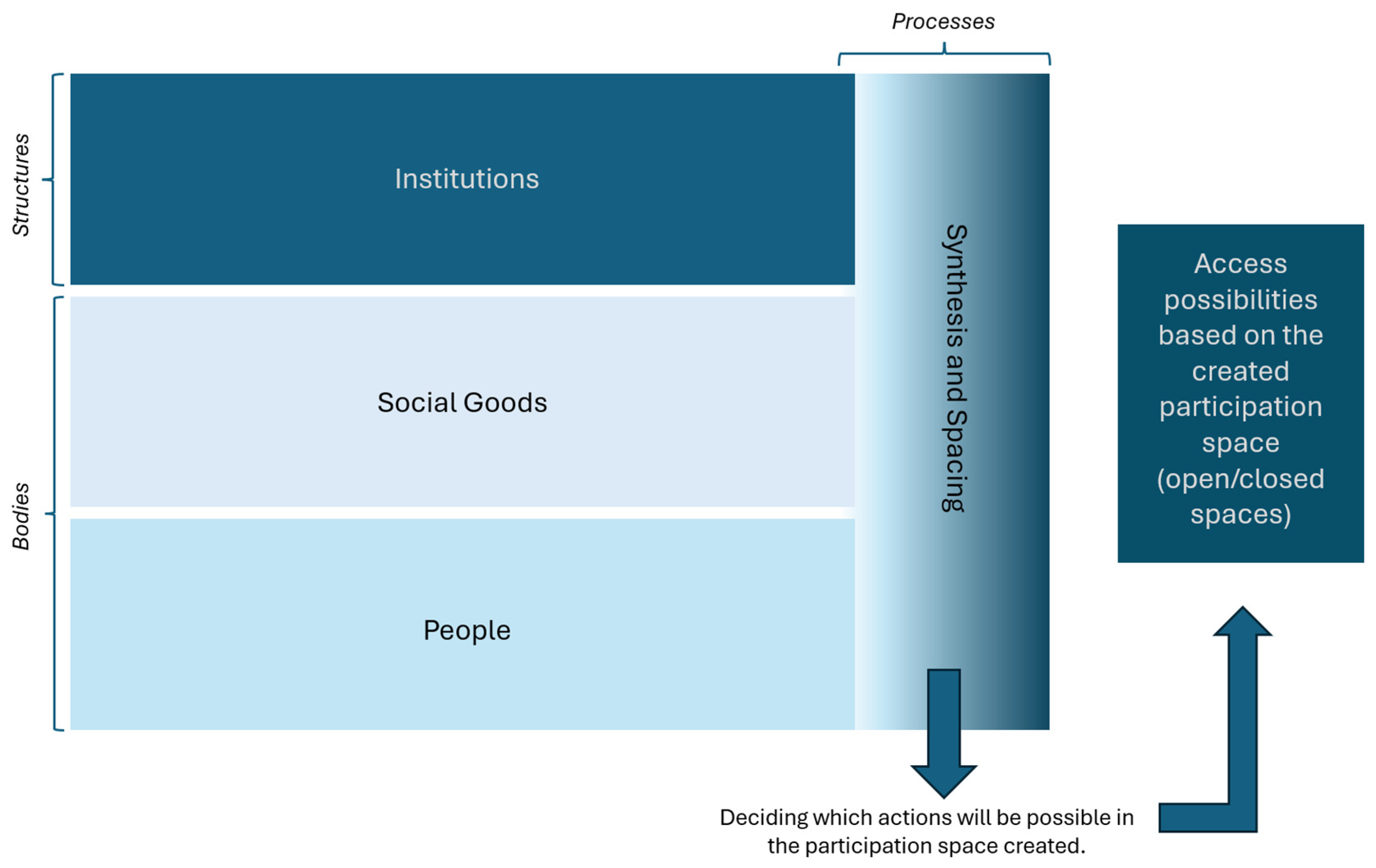
2.2.4. Synthesis and Spacing
2.2.5. Access Possibilities
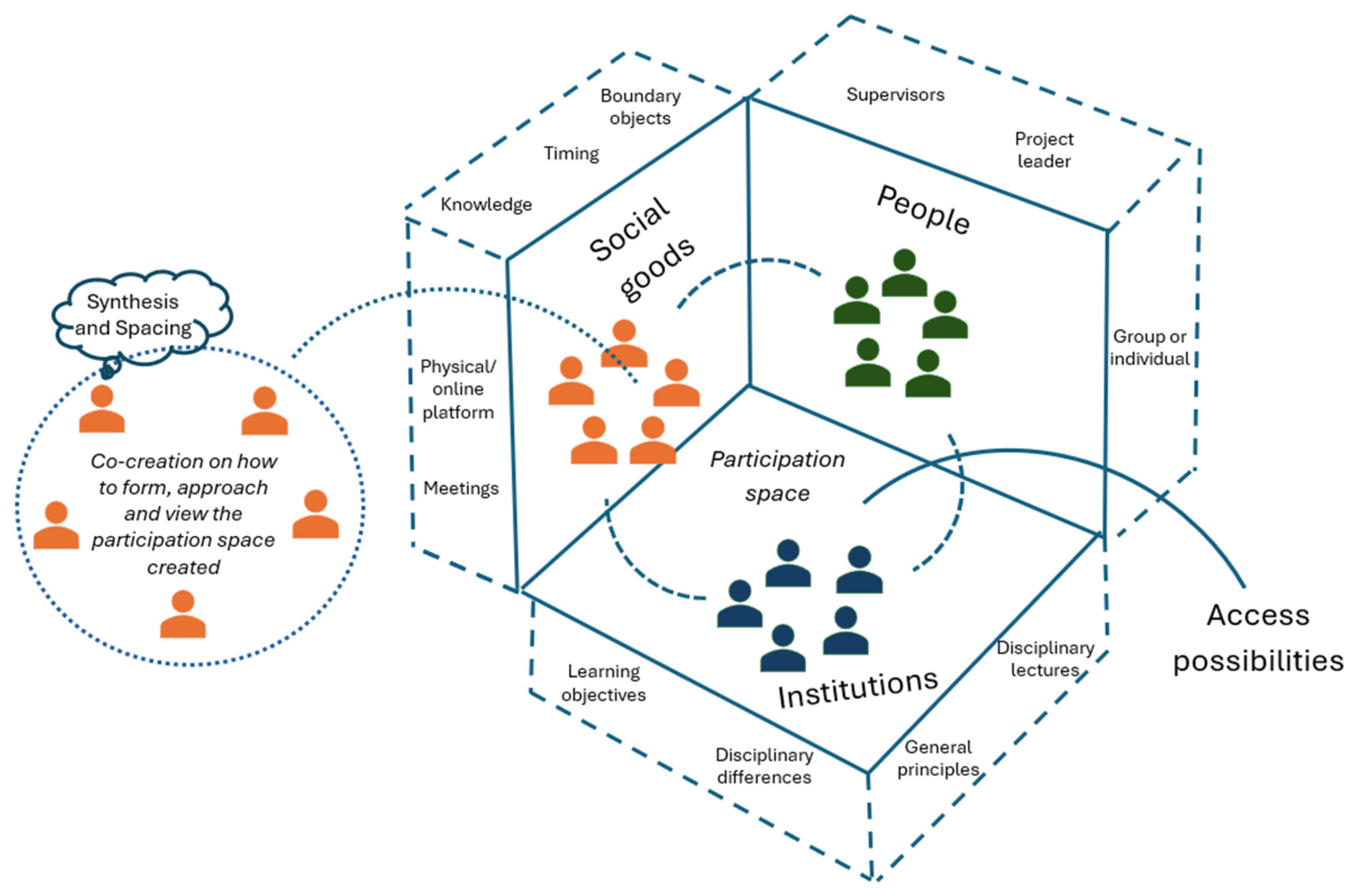
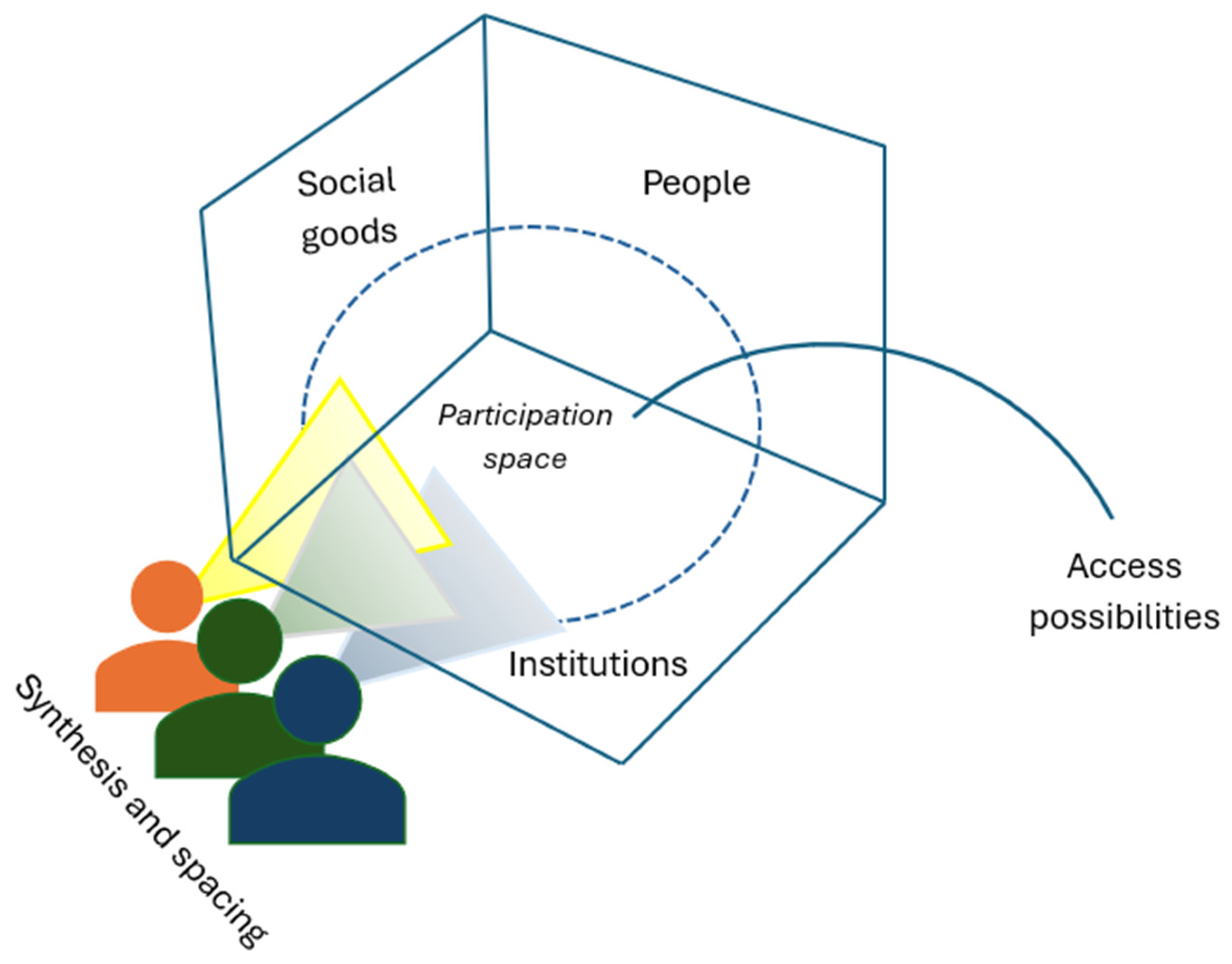
2.3. Conceptualizing Relational Space as a Way of Looking at Interdisciplinary Collaboration in Education
3. Methods
3.1. Context
3.2. Case
3.3. Data
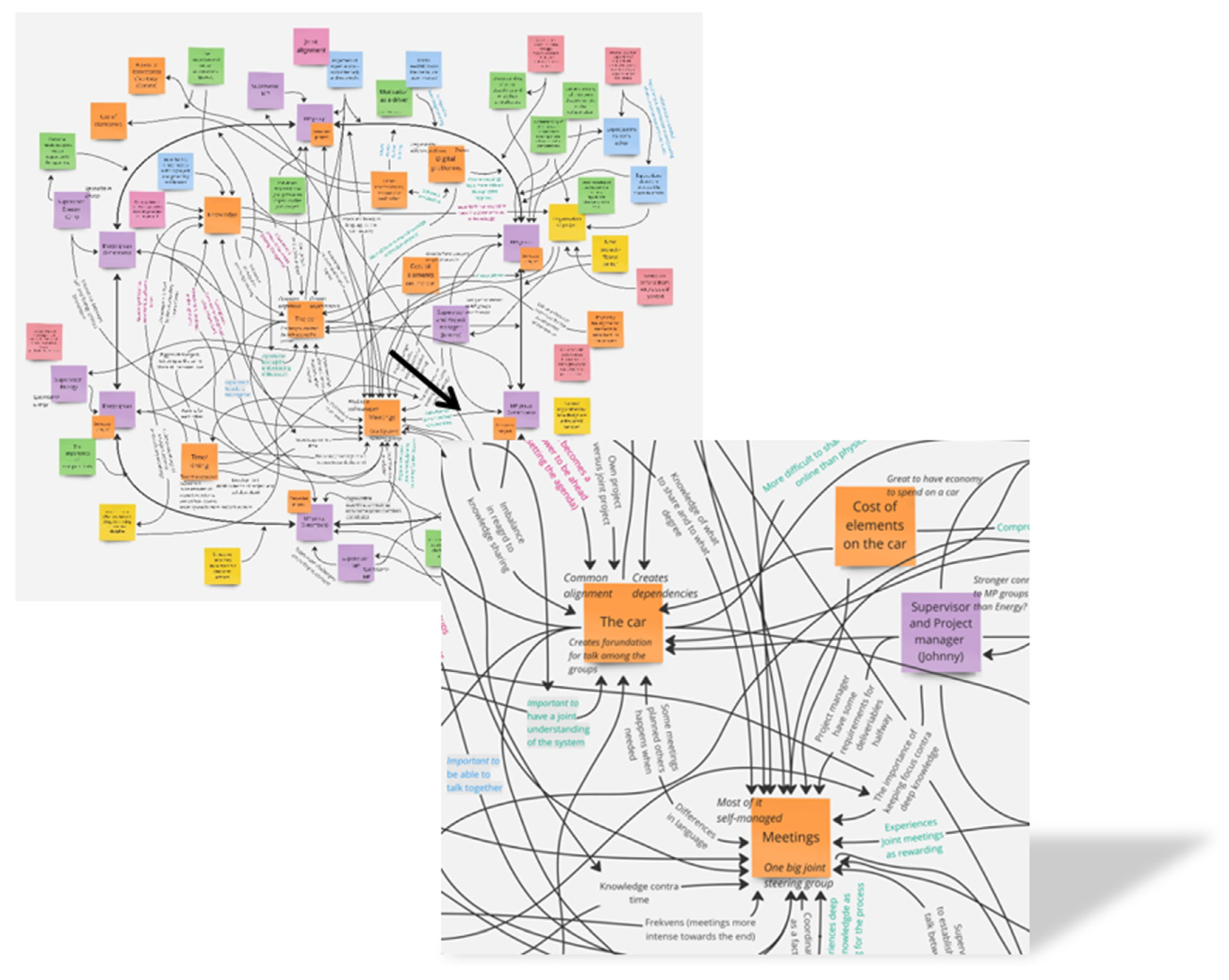
3.4. Data Analysis
4. Results
4.1. Analyzing leadENG Through the Lens of Relational Space
4.1.1. Institutional Structures
Also, later in the process, a student articulates the following about their possibilities for action:“But we didn’t know if we were allowed to participate in the beginning. It was something our semester coordinator chose, so if there were a lot of applicants, some would be cut out”.
As Löw stresses in her work, structures are essential for actions to happen as they guide students in regard to expectations and formalities in the project work. These quotes demonstrate that the institutional structures form and guide students at different stages in the project period, creating boundaries, and maybe even barriers, for students in regard to how and when different actions are possible.“It was also important that they got their objectives and projects fulfilled. Therefore, we said that they could just write that this is what they would like, but this was unfortunately not something they could be allowed to fulfill”.
Another student highlights:“… First of all, you need to learn how to make a project, and how it functions to work in disciplinary groups. This, before getting the possibility to work in a bigger collaborative context as this”.
“So, before beginning the actual project, there needs to be clarity about all regulations and so, so everyone knows about the same things”.
Another student explains about the time pressure:“People [from the other groups] have been waiting on us, and we just haven’t had the time to do it”.
Time becomes an institutional structure pushing the students in several ways. This is not unusual for the students as time is a factor in disciplinary projects as well. However, in the interdisciplinary context, the analysis shows that time, in interplay with the cross-collaborative space, shapes situations in which students place themselves and others in roles that allow them to either exert pressure or experience being pushed, particularly in relation to perceptions of falling behind other groups.“… So, they were also really much under time pressure in regard to some simulations, and they didn’t have that much knowledge about how to have that build. So, I said that if they could give me the wanted gearing then I could make a proposal for them. And then we made some changes to that along the way because I started making it too big… but I also said that they had to accept that this was a quick fix because we also were under time pressure in our group…”
This articulation shows not only that the exams become an ongoing present actor throughout the project influencing the space in one way or another but it also stresses the interesting notion of the exams becoming an establishing dependency among the students, moving focus from dependencies only established through a shared boundary object, as in this case, the production of a car.“It is not just one exam this depends on. It is like 6 exams that are dependent on our work”.
Seen from the literature, it is important to be aware of your competences and limitations in an interdisciplinary context, and knowing when and to what degree you should ask for help or support with one or more tasks related to the problem or project in focus (Lattuca et al., 2012). This is of course to produce the best possible outcome, but also in regard to the placement of one another in the participation space. Having misaligned understandings or beliefs about each other’s disciplinary qualities and competences may ultimately end in some groups becoming disappointed about other groups’ work, developing a misbelief in one another that in the end pushes the groups further away from each other, or in a worst-case scenario, entirely out of the collaborative space.“So, we could achieve more, because we were more groups collaborating on it. We had some different skills that made a car seem realistic and buildable. We wouldn’t be able to build a car ourselves as an [name of the discipline] group. We wouldn’t have the knowledge and competence to do so”.
This again points back to the direct institutional structures of learning objectives:“And they maybe had some expectations to us, that we couldn’t fulfill, and we had some to them that they couldn’t fulfill either. And then, there could of course also be the other case where we could surprise them with some things that they didn’t expect us to be able to do”.
“… we are completely different places. We would have liked to build something smart and fancy, not something that looked like a racecar. You could have done something that fulfilled your learning objectives to a higher degree, where the others were a bit more interested in what the sustainability concept is. We should probably recycle the entire car instead of building our own. There, we were in different places in terms of which part of the curriculum could be accomplished”.
4.1.2. People
Following Löw’s notion about people having just as much influence on the spatial establishment as material elements, this quote exemplifies how the project manager forms the placing of groups in the participation space with some groups knowing more than others. This is likely not intentional but simply because of the closer disciplinary distance to some of the groups, underpinning the importance of educators being actively aware of their influence and role in the created participation space.“Yeah, it was also rather chaotic because it seemed as if [name of project manager], now he seems as the head of the leadENG project, and it seemed like [the other discipline] knew more than we did. They had more information… There were different specifications and so on, on the car, and some expectations that [the other discipline] were informed about… And some time went by before we had the first Wednesday meeting, so in that time we were less informed in regard to what we needed to prepare for. You can say, it would have helped if we had the same information from the beginning”.
Also, supervisors help students to know where to be in the process at a certain time. Midway through the semester, each group had a status seminar, and this seminar was used as a milestone for achieving certain elements on the car set by the supervisor. This also aligns with the notion of supervisors being the “brokers” (Wenger, 1998) for establishing common ground and understanding among the groups. By helping the groups to move forward and securely progress at a certain pace, the supervisors help groups to keep up more or less the same momentum without having some falling way behind the others. One student says:“… there are some disciplinary things that, at least in the context of connection to the car have been completely or very difficult to understand. But certainly, also processes of calculating backwards. And doing this and that to understand how we should calculate [disciplinary] consumption, etc. It has been very confusing for me…”
“… but then our supervisor said that maybe we should start by talking to the other groups about how much they actually were able to drag out of [element on the car] and how fast it would be able to go…”
Also, more directly one group talks about the interdisciplinary collaboration where one student articulates:“It depends on which group we talk about. That’s for sure. For some groups, we have had a lot of contact, but there are also groups we barely have talked to”.
These statements exemplify the influence and importance of ongoing alignment and compromises keeping a fruitful and accurate collaborative participation space. Students need to see the need for interdisciplinary collaboration, not just having a boundary object stating this on a piece of paper.“We had a lot of collaboration with the group from [discipline], because we needed to talk about how fast this [element on the car] should go, and how we had it all fit together between the two groups. I almost think that we are the only ones that have had a fair amount of collaboration with [discipline]. It has been exciting and difficult”.
Here, it is also indicated that adjustment of language becomes of importance in the participation space and that communication in general may be a challenge. A thing highlighted as smoothing for entering the collaborative space in regard to alignment and knowledge sharing was relations outside collaborative work, e.g., familial ties:“So, we had made this gearing… where we could get it down to approximately 35 km/h, but then we just had to talk to [another group], that showed to have completely different numbers than what we have calculated with, because they were able to drag more out of it. So, we figured out that we needed to put on a chain and also that our gearing was completely off. So yeah, but then we became a little better together, and got to talk about what we actually were going to do and from there what each group should be in charge of… It was also a bit challenging to talk to them getting the right numbers out… In the end we succeeded with this, so you need to have compromises with one another”.
Löw also underpins this positive influence of being more familiar to one another, leaving less space between the participating parties (or in this case the groups) when wanting to create a fruitful participation space (Löw, 2016). Further, as stated several times in the literature as well (National Academy of Sciences et al., 2005; Klausen, 2014), good communication is a key factor for achieving good collaboration and progression in the participation space:“… So, it also makes it a bit easier, that my brother is a group member in one of the other groups”.
“I also think it is much about communication… there is something with the fact that we don’t know the people from the other groups that well. So, we had to figure out how to communicate with the others in the best way. And when we finally cracked that, then I actually think it became quite good”.
Another way of placing the groups in the space is through a sense of shared responsibility, as one student articulates:“… maybe saying that the others are specialists is a bit too much. But they have worked with something that we haven’t, and we have achieved things that they haven’t been part of. And when we join this, we can gather the pieces into one”.
How students perceive and interpret both their own but also other groups (or even people and social goods in general) and their position in the participation space is a recurrent topic throughout this analysis. Depending on how students synthesize and understand the experiences they have in the space, their following actions and positioning will be influenced by this. One student explains how they position themselves in regard to the other groups:“Well, if we don’t do anything, then it is not just ourselves it will affect. It is also all the others”.
Table 3 summarizes key findings related to Löw’s concept of people.“I almost only listened at the [specification on the car] group [presenting at the meetings] as they are the ones we collaborate with… [the other group] were not that important, also because they had said that they wouldn’t use it on the back, so that I knew I could disregard. So, when I heard from the two groups, I spent the remaining time just sitting there wishing for it [the meeting] to be done. I had gotten the knowledge I needed and used enough time on that”.
4.1.3. Social Goods
To this comment, another group member supplements:“…If we have had the physical space, it would have been much better I think”.
This student highlights the importance of having online platforms to share ideas and knowledge related to the overarching leadENG project across the groups as well. Several students articulate in the interviews that online platforms are good for quick updates and informal meetings among a few of the participating groups. A place to get a fast answer to a question or a message, though for more in-depth communication and knowledge sharing online platforms were challenging. The students viewed a combination of the physical group rooms and online platforms as fruitful for the collaboration.“I also think so. But on the contrary, so is Teams [digital platform] a good place for sharing documents so everyone got them. For instance, budget have always been shared in a shared folder, drawings of the car have always been there as well”.
Another student also points out:“But all [disciplinary] groups connected to the production of the car were located at the same place, whereas we were located in a completely different building. It would have been better to be near the others”.
Students feel they get better possibilities for collaboration among the groups when being placed close to one another. Students articulate that having opportunities to see when other groups were available (possibly because of windows in the group room doors) and talking to one another gave better, easier access to communicate and collaborate, missing in the online space where contact was much harder. One student explains about the online space:“… being back at campus, then we could just walk around joining the other group rooms. It was smart that we could see each other, asking questions like “how did you think of doing this here?” it was definitely better”.
The online platform risks becoming a restricted space for collaboration where the separated online group rooms create more isolated/non-transparent barriers between the groups.“… even though we agreed upon the terms that we could just join each other’s group rooms, it wasn’t that easy in reality. You couldn’t just choose a group room and join it, if they were in an important meeting or something, so each time we had to write on their channel first. This was much easier in the physical group rooms where we could look into the room and see if they were available…”
Another student underlines the importance of meetings for product integration:“… we had more of that kind of meetings where we talked about how we collected the shared ensembles, where we had some preparation, we all met and discussed at the meetings. But apart from that, most meetings were some where we just went into the other group rooms either online or physical”.
A student from another group also emphasized the degree of integration among the groups:“So, it was just like if we had a working task where you thought something was missing. For instance, this with the gearing. We need to calculate how big a sprocket we need for our chain drive. We do not know that much about [specific element on the car], so then we had a meeting with the [specification on the car] group. They gave us some data, some empirical evidence about the [the specific element on the car] we have chosen. And then we can do our part”.
Combining the different meetings with the earlier mentioned aspect of physical and online spaces, the participation space starts forming various smaller “sub-spaces”, all with different aims, norms and structures. Bringing in the analysis of social goods seems to unfold a more nuanced picture of the space established among the students. The overall participation space we try to manage and guide seems to be a system of several sub-spaces where groups and/or individuals move in and out of both the overall established participation space and the continually emerging sub-spaces, creating a situation where the space(s) may be renegotiated several times throughout a project, all affecting the possibilities for collaboration, negotiation and access in the overall participation space.“There were a lot of things that needed to be integrated, there were our drawings, and they had to figure out how much space we would have [on the car] and there was also something about weight. There were suddenly a lot of things that needed to align”.
Another student also emphasizes the dependencies created among the groups in the system through the influence of the shared boundary object:“So, our task is to get the car running, the car that [other discipline] is building…”
This, though, also includes an understanding of compromises needed. For instance, one student talks about a situation where they wanted to have a specific gearing of the car, figuring out that this would give a diameter of the sprocket at one and a half meters, simply too big for the other groups to integrate in their work, thus compromising on this.“… we also have some responsibility not just for ourselves but also for the other groups doing this. The other groups are kind of dependent on what we are doing”.
Similarly, one student articulates the importance of having the spare parts of the car physically present in front of them, to be able to see dimensions and links between the elements of the car:“We were also lucky when we had to do statics and strength lab on our work. For this, we were able to get into our group rooms, because for these two things we especially needed a blackboard, so it was easier for us to agree on things in person instead of sitting with a computer mouse. It never becomes just as pretty as it does on a blackboard”.
Also access to laboratories was articulated by some students as essential for their work on the project:“We needed the spare parts [of the car] in hand, before being able to draw them, and get some calculations, we could use on our own product”.
Again, the physical aspect of having things or equipment closely located and accessible to students demonstrates a potentially important subject to consider in the planning and facilitation of interdisciplinary collaboration. This, at least for engineering students. Extending the analysis to consist of both human and non-human factors provides us with an understanding of spatial influence being more than facilitating collaboration across the participating groups. This analysis illustrates that attention must also be placed on physical decor and accessibility.“Because we haven’t been present at any laboratory making experiments, we ended up just getting data, for this work, motor data. But also in regard to the work on [specific part of the car]. Here, we had to ask [our supervisor] for help on how to analyze the data that we got from both [specific parts of the car] as we didn’t do any of the experiments ourselves”.
Following the line of understanding structures and actions as intertwined elements, time not only exemplifies how institutional structures influence students’ actions but also that these actions feed into the existing institutional structures.“It has also had a bit of an advantage. We were the ones that could decide the agenda. We have chosen this and this, and then the rest of you just have to adjust to this”.
Also, elements of having general knowledge about project writing, management and collaboration are, as mentioned earlier, stated as significant. Students underpin the importance of having the same amount of knowledge from the beginning, securing the overall direction of the project. Knowledge then seems to become a power in the space. It seems like an influential player, either getting enough knowledge or the right knowledge.“… It has been hard to communicate things, being sure that he [a student from another group] understands the things we are explaining and vice versa”.
This quote indicates that time and knowledge are central aspects to consider. They seem to change in both character and power throughout the project period, with deep knowledge being particularly important in the beginning, whereas time and timing are of essence at the end of the project period.“But we also got some knowledge out of it. Where we could see, if we made a [specific element on the car], then we would get another ground clearance than we expected. So, this was something we got out of it in the beginning in regard to what they were doing. But then, the longer we got into the project, we just wanted to see their 3D drawing… to see if that aligned with ours…”
5. Discussion
5.1. New Aspects to Interdisciplinary Collaboration in Education
5.2. How to Grasp Relational Space in an Educational Context
5.3. The Complexity of Creating Dependencies
5.4. Interrelations as an Important Indicator
5.5. Maneuvering in an Educational Institutionalized Space
5.6. Limitations to This Study
6. Conclusions and Future Work
Author Contributions
Funding
Institutional Review Board Statement
Informed Consent Statement
Data Availability Statement
Conflicts of Interest
Appendix A. Interview Guide
| Preliminary Questions |
| Try and tell us about your participation in the X project? What did you work with? |
| Why did you choose to participate in the X project? |
| What did you expect of the process before you started? |
| Experiences participating in a narrow interdisciplinary project |
| How were your experiences participating in the X project? (What functioned well/what did not?) |
| How was the project structured? (What functioned well/what did not?) |
| How did you experience the interdisciplinary collaboration among the groups? (Degree of collaboration) |
| How did you manage the collaboration among the groups? (How many meetings/timing) |
| What type of knowledge have you shared among the groups? (Difficulties in understanding each other) |
| Can you try and tell us how (and if) the process has been different from your ordinary semester projects? |
| Retrospective reflections |
| Have you gained a better understanding of your own disciplinary contributions? |
| What have you learned being part of X? |
| What do you think should be done to improve X further? |
References
- Askehave, I., Prehn, H. L., Pedersen, J., & Pedersen, M. T. (2015). PBL: Problem-based learning. Aalborg University. [Google Scholar]
- Barry, A., Born, G., & Weszkalnys, G. (2008). Logics of interdisciplinarity. Economy and Society, 37(1), 20–49. [Google Scholar] [CrossRef]
- Beddoes, K. (2020). Interdisciplinary teamwork artefacts and practices: A typology for promoting successful teamwork in engineering education. Australasian Journal of Engineering Education, 25(2), 133–141. [Google Scholar] [CrossRef]
- Bertel, L. B., Winther, M., Routhe, H. W., & Kolmos, A. (2022). Framing and facilitating complex problem-solving competences in interdisciplinary megaprojects: An institutional strategy to educate for sustainable development. International Journal of Sustainability in Higher Education, 23(5), 1173–1191. [Google Scholar] [CrossRef]
- Borrego, M., & Newswander, L. K. (2008). Characteristics of successful cross-disciplinary engineering education collaborations. Journal of Engineering Education, 97(2), 123–134. [Google Scholar] [CrossRef]
- Braßler, M., & Block, M. (2017). Interdisciplinary teamwork on sustainable development—The top ten strategies based on experience of student initiated projects. In W. L. Filho, U. M. Azeiteiro, F. Alves, & P. Molthan-Hill (Eds.), Handbook of theory and practice of sustainable development in higher education (World Sustainability Series). Springer International Publishing. [Google Scholar] [CrossRef]
- Brungs, L., Kötter-Lange, K., Kottmeier, J., Poersch, R., & Schweizer-Ries, P. (2021). How to foster fruitful collaborations—The Impact of sustainability science. International Journal of Energy Production and Management, 6(4), 347–358. [Google Scholar] [CrossRef]
- Conley, V. A. (2012). Spatial ecologies: Urban sites, state and world-space in French cultural theory (Contemporary French and Francophone Cultures 21). Liverpool University Press. [Google Scholar]
- De Graaff, E., & Kolmos, A. (2007). Management of change: Implementation of problem-based and project-based learning in engineering. BRILL. [Google Scholar] [CrossRef]
- Everett, M. C. (2016). Interdisciplinary studies: A site for bridging the skills divide. Journal of Effective Teaching, 16(2), 20–31. [Google Scholar]
- Feng, X., Sundman, J., Aarnio, H., Taka, M., Keskinen, M., & Varis, O. (2025). Towards transformative learning: Students’ disorienting dilemmas and coping strategies in interdisciplinary problem-based learning. European Journal of Engineering Education, 50(2), 428–450. [Google Scholar] [CrossRef]
- Fiske, J. (1990). Introduction to communication studies (2nd ed.; Studies in Culture and Communication). Routledge. [Google Scholar]
- Frickel, S., Albert, M., & Prainsack, B. (2017). Investigating interdisciplinary collaboration: Theory and practice across disciplines. The American Campus, Rutgers University Press. [Google Scholar]
- Fritz, L., & Binder, C. (2018). Participation as relational space: A critical approach to analysing participation in sustainability research. Sustainability, 10(8), 2853. [Google Scholar] [CrossRef]
- Harvey, D. (2006). Space as a keyword. In David harvey: A critical reader (Antipode Book Series). Blackwell Production. [Google Scholar]
- Jensen, A. A., Stentoft, D., & Ravn, O. (Eds.). (2019). Interdisciplinarity and problem-based learning in higher education: Research and perspectives from Aalborg University (Vol. 18, Innovation and Change in Professional Education). Springer International Publishing. [Google Scholar] [CrossRef]
- Klaassen, R. G. (2018). Interdisciplinary education: A case study. European Journal of Engineering Education, 43(6), 842–859. [Google Scholar] [CrossRef]
- Klausen, S. H. (2014). Transfer and cohesion in interdisciplinary education. Nordidactica—Journal of Humanities and Social Science Education, 2014(1), 1–20. [Google Scholar]
- Klein, J. T. (2005). Interdisciplinary teamwork: The dynamics of collaboration and integration. In Interdisciplinary collaboration, An emerging cognitive science (1st ed., Vol. 2005). Psychology Press. [Google Scholar]
- Klein, J. T. (2014). Communication and collaboration in interdisciplinary research. In M. O’Rourke, S. Crowley, S. Eigenbrode, & J. Wulfhorst (Eds.), Enhancing communication & collaboration in interdisciplinary research. SAGE Publications, Inc. [Google Scholar] [CrossRef]
- Kolmos, A., Holgaard, J. E., & Routhe, H. W. (2025). Understanding and designing variation in interdisciplinary problem-based projects in engineering education. Education Sciences, 15(2), 138. [Google Scholar] [CrossRef]
- Kolmos, A., Holgaard, J. E., Routhe, H. W., Winther, M., & Bertel, L. (2024). Interdisciplinary project types in engineering education. European Journal of Engineering Education, 49(2), 257–282. [Google Scholar] [CrossRef]
- Lattuca, L., Knight, D., & Bergom, I. (2012, June 10–13). Developing a measure of interdisciplinary competence for engineers. 119th ASEE Annual Conference & Exposition Proceedings, San Antonio, TX, USA. [Google Scholar] [CrossRef]
- Lautamäki, S., & Saarikoski, L. (2020). Interdisciplinary teamwork as a basis for innovation competences development. In Engaging engineering education. SEFI 48th annual conference. European Society for Engineering Education (SEFI). [Google Scholar] [CrossRef]
- Löw, M. (2016). The sociology of space: Materiality, social structures, and action (Cultural Sociology). Palgrave Macmillan US. [Google Scholar] [CrossRef]
- Massey, D. B. (2012). For space (1st ed., reprinted). Sage. [Google Scholar]
- National Academy of Sciences, National Academy of Engineering & Committee on Science, Engineering, and Public Policy (Eds.). (2005). Facilitating interdisciplinary research. The National Academies Press. [Google Scholar]
- Norton, L. S., Sonetti, G., & Sarrica, M. (2023). Crossing borders, building new ones, or shifting boundaries? Shared narratives and individual paths towards inter/transdisciplinarity in research centres for urban sustainability. Sustainability Science, 18(3), 1199–1213. [Google Scholar] [CrossRef]
- Routhe, H., Winther, M., Holgaard, J., & Kolmos, A. (2022, June 26–29). Interdisciplinary problem-based projects for first-year engineering students. 129th ASEE Annual Conference and Exposition: Excellence Through Diversity, Minneapolis, MN, USA. [Google Scholar]
- Routhe, H. W., Bertel, L. B., Winther, M., Kolmos, A., Münzberger, P., & Andersen, J. (2021). Interdisciplinary megaprojects in blended problem-based learning environments: Student perspectives. In M. E. Auer, & D. Centea (Eds.), Visions and concepts for education 4.0 (Vol. 1314, Advances in Intelligent Systems and Computing). Springer International Publishing. [Google Scholar] [CrossRef]
- Scott, W. R. (1999). Institutions and organizations (Nachdr. Foundations for Organizational Science). Sage. [Google Scholar]
- Stock, P., & Burton, R. J. F. (2011). Defining terms for integrated (Multi-inter-trans-disciplinary) sustainability research. Sustainability, 3(8), 1090–1113. [Google Scholar] [CrossRef]
- Van Den Beemt, A., MacLeod, M., Van der Veen, J., Van de Ven, A., van Baalen, S., Klaassen, R., & Boon, M. (2020). Interdisciplinary engineering education: A review of vision, teaching, and support. Journal of Engineering Education, 109(3), 508–555. [Google Scholar] [CrossRef]
- Von Wehrden, H., Guimarães, M. H., Bina, O., Varanda, M., Lang, D. J., John, B., Gralla, F., Alexander, D., Raines, D., White, A., & Lawrence, R. J. (2019). Interdisciplinary and transdisciplinary research: Finding the common ground of multi-faceted concepts. Sustainability Science, 14(3), 875–888. [Google Scholar] [CrossRef]
- Wenger, E. (1998). Communities of practice: Learning, meaning, and identity (1st ed.). Cambridge University Press. [Google Scholar] [CrossRef]
- Winther, M., Bertel, L. B., Worm, H. R., Kolmos, A., Andersen, J., & Münzberger, P. (2020, September 9–10). AAU megaprojects: An educational strategy for sustainable development. 2020 International Conference on Sustainable Development (ICSD), Rome, Italy. [Google Scholar]




| Year | Semester | Study Program | Project | Sub Project | Data Collection | Number of Students |
|---|---|---|---|---|---|---|
| leadENG | ||||||
| 21 | 2. Semester | Materials and Production | Small Electrical vehicle I | Rare wheel suspension system and drive shaft | Semi structured focus group interviews Observations for background information Access to collaborative Teams channel | 5 students |
| 21 | 2. Semester | Materials and Production | Brake system | 5 students | ||
| 21 | 2. Semester | Energy | Propulsion design | 5 students | ||
| Element from Löws Theory | Key Elements from Data | (Re)figuration of the Participation Space Based on Spacing and Synthesis | Access Possibilities |
|---|---|---|---|
| Institutions (Structures) | Institutional norms/rules/ Regulations - Disciplinary differences - PBL principles - Exams |
| - Criteria from AAU - Alignment (or mutual understanding) of languages, approaches and understandings - Agreed recognizable structures - Agreement about the balance between deep knowledge, project management and collaboration in the time given - A good understanding of one’s own disciplinary competences and starting point - The degree of helping out/letting students experience and finding the way in the space themselves by supervisors and coordinators |
| Organization of the project - Supervisors’ role - Self-management - Time |
| ||
| Connection to other disciplinary courses |
|
| Element from Löws Theory | Key Elements from Data | (Re)figuration of the Participation Space Based on Spacing and Synthesis | Access Possibilities |
|---|---|---|---|
| People (Bodies) | Project Manager |
| - Others’ perception of your belonging in the room (experience of dependencies) - Supervisors as brokers between the groups - Clear separation between project functions (supervisors, project managers etc.) or better alignment. - Equal knowledge information from project managers and supervisors across the groups |
| Groups |
| ||
| Supervisors |
|
| Element from Löws Theory | Sub Element | Key Elements from Data | (Re)figuration of the Participation Space Based on Spacing and Synthesis | Access Possibilities |
|---|---|---|---|---|
| Social Goods (Bodies) | Material | The influence of a boundary crossing object |
| - The importance and influence of the product - Dependencies are created by the product/experience of dependencies based on the product - Product determines the degree of interdisciplinarity in the system - The importance of physical parts to work on - The importance of physical spaces for collaboration - Project development and how student groups follow each other regarding development (some may get in front of others) - Participation in meetings - Knowledge/Lack of knowledge between participants places the groups in a certain way (pushes one another further away or get closer to one another) - Knowledge is power (set the scene by knowing more/acting like you know more) - Becomes a power to be in front of the others - Common language creates common ground |
| Accessibility to facilities |
| |||
| Physical vs. online platforms for collaboration - Digital platforms like MS Teams, Messenger etc. - Group rooms Meetings |
| |||
| Immaterial | The influence of timing |
| ||
| Knowledge |
|
Disclaimer/Publisher’s Note: The statements, opinions and data contained in all publications are solely those of the individual author(s) and contributor(s) and not of MDPI and/or the editor(s). MDPI and/or the editor(s) disclaim responsibility for any injury to people or property resulting from any ideas, methods, instructions or products referred to in the content. |
© 2026 by the authors. Licensee MDPI, Basel, Switzerland. This article is an open access article distributed under the terms and conditions of the Creative Commons Attribution (CC BY) license.
Share and Cite
Winther, M.; Bertel, L.B.; Holgaard, J.E. The CO-SPACE Model: Developing an Analytical Framework for Interdisciplinary Student Collaboration. Educ. Sci. 2026, 16, 747. https://doi.org/10.3390/educsci16050747
Winther M, Bertel LB, Holgaard JE. The CO-SPACE Model: Developing an Analytical Framework for Interdisciplinary Student Collaboration. Education Sciences. 2026; 16(5):747. https://doi.org/10.3390/educsci16050747
Chicago/Turabian StyleWinther, Maiken, Lykke Brogaard Bertel, and Jette Egelund Holgaard. 2026. "The CO-SPACE Model: Developing an Analytical Framework for Interdisciplinary Student Collaboration" Education Sciences 16, no. 5: 747. https://doi.org/10.3390/educsci16050747
APA StyleWinther, M., Bertel, L. B., & Holgaard, J. E. (2026). The CO-SPACE Model: Developing an Analytical Framework for Interdisciplinary Student Collaboration. Education Sciences, 16(5), 747. https://doi.org/10.3390/educsci16050747