Article

Combining Active Learning Methodologies in a STEM-Related Course: A Case Study

1
Computer Engineering Department, Miguel Hernández University, 03202 Elche, Spain
2
Mathematics and Computer Science Department, University of the Balearic Islands, 07022 Palma, Spain
*
Author to whom correspondence should be addressed.
Educ. Sci. 2026, 16(5), 740; https://doi.org/10.3390/educsci16050740

Submission received: 8 April 2026 / Revised: 1 May 2026 / Accepted: 3 May 2026 / Published: 8 May 2026
(This article belongs to the Section STEM Education)

Abstract

Active learning methodologies have been widely reported to improve academic performance in STEM education. This paper presents a case study on the implementation of a combination of such methodologies in a college course devoted to computer networking fundamentals. The study begins in 2018, when the course was taught in a traditional manner, namely through lectures and written exams. From that point onward, different active learning methodologies were gradually introduced in both teaching and assessment, leading to an overall enhancement of academic performance. Regarding the former, classes are now delivered according to the flipped classroom methodology. With respect to the latter, assessment consists of a weighted combination of seven types of activities, including individual self-learning exams, team-based problem sets, individual computer-based exams, team-based escape rooms, project-based learning, case-based learning, and challenge-based learning. The results obtained over a six-year period reveal a significant improvement in three different ratios: the Attend-to-Register ratio, the Pass-to-Register ratio, and the Pass-to-Attend ratio. Additionally, feedback provided by students positively evaluates the combination of active learning methodologies implemented in the course.

1. Introduction

Education 4.0 has emerged as a paradigm aligned with the Fourth Industrial Revolution, promoting the integration of digital technologies, innovative pedagogies, and competency-based learning approaches to prepare students for rapidly evolving professional environments (Hernández-de-Menéndez et al., 2021; Ramírez-Montoya et al., 2022). The main goal of Education 4.0 is to provide students with the knowledge, skills, attitudes, and competences required to get adapted to the rapidly evolving digital society, with technological changes occurring ever at a fast pace (Mukul & Büyüközkan, 2023). Therefore, learners must develop key concepts to keep up with the ever-changing technology landscape, where self-learning, problem-solving, leadership, or critical thinking are some of the most essential (Matsumoto-Royo et al., 2021). All those features need to be integrated into the learning to learn paradigm, where the development of learning strategies plays a crucial role to reduce the adaptation time to get used to the new upcoming technological environments (Lansdell & Kording, 2019). Hence, self-learning environments should be introduced to learners so as to be able to deal with new ever-growing technological paradigms (Pacheco-Velázquez et al., 2024).
Focusing on self-learning, active learning may be seen as a good way to get it, as it represents a paradigm shift regarding to the way in which the learning process takes place (González-Pérez & Ramírez-Montoya, 2022). In fact, active learning methods provide learners with the active role in their education process, whereas instructors take the role of dynamizers of the learning process, thus supporting the students’ leading role (Pinto et al., 2021). Different active learning methodologies have been described in the literature, which have been applied from primary to higher education, as well as in all educational areas, such as humanities, social sciences, medical sciences, or STEM (Patiño et al., 2023).
A common active learning methodology is the flipped classroom, which shifts content delivery outside the classroom to enable interactive in-class activities (Ni et al., 2023). Another widely used approach is the educational escape room, where participants collaboratively solve subject-related puzzles and challenges within a limited time to achieve a specific learning objective (González-Yubero et al., 2023). Additionally, X-based learning refers to a family of student-centered pedagogical approaches, where “X” represents a specific method, such as project, problem, inquiry, or case, that emphasize learning through active engagement with tasks, challenges, or real-world contexts rather than passive reception of information (Bou-Saad & Llorens-García, 2024).
Recent studies in the literature have recently been published where the benefits of combining different active learning methodologies are highlighted. In this sense, Manas et al. (2024) presented a case study where problem-based learning and case-based learning were combined in dental education in Vocational Education and Training (VET), where improvements in academic understanding and application were spotted. Likewise, Johnsen et al. (2024) carried out a case study combining problem-based learning and team-based learning in medical education at college level, where longitudinal integrated clerkships were applied, resulting in enhanced learning outcomes. On the other hand, Chang et al. (2022) described a case study where problem-based learning was combined with collaboration-based learning in computer programming at college level, where a rise in the learning outcomes was found. Similarly, Wanglang et al. (2024) proposed a case study where game-based learning and design-based learning were combined in block-based programming in primary education, where the evaluation on computational thinking and creativity was significantly high.
Focusing on STEM education in the last year, there are some studies claiming an increase in academic performance and student motivation when applying a combination of active learning methodologies. In this sense, Díaz-Lauzurica and Moreno-Salinas (2025) presented a study in VET-level computer science courses where project-based learning, design thinking, flipped classroom, and gamification were implemented. Moreover, de Pedro et al. (2025) reported a study in university-level environmental engineering where project-based learning and interactive platforms such as Kahoot! and Edpuzzle were used. Besides, Paiva et al. (2025) examined first-year students across various STEM disciplines in higher education, applying the flipped classroom model alongside dialogic teaching, in which discussions between instructors and students were guided by open-ended questions. Furthermore, Jongsma (2026) presented a doctoral dissertation on the benefits of applying various active learning methodologies in higher STEM education.
In this context, the approach adopted in the present case study integrates several of these methodologies into a holistic framework aimed at achieving effective and meaningful learning outcomes (Bogacka & Pikon, 2017). Indeed, STEM-related subjects are particularly well suited to active learning techniques due to their inherently practical nature (Mikhailidi & Tskhvediani, 2026). Accordingly, the research question addressed in this study is whether deploying a combination of active learning methodologies in a course focused on computer networking fundamentals can increase students’ involvement in self-directed learning, leading to improve performance compared with a previously traditionally taught course in the STEM field at college level, while also achieving a high level of engagement (Campos-Junior & Zanin-Bagatini, 2025).
The organization of the remaining of the paper is as follows: Section 2 outlines the related work, Section 3 describes the method, Section 4 displays the results, Section 5 presents the discussion, and Section 6 draws the final conclusions.

2. Related Work

The first subsection provides an overview of the Education X.0 paradigm, the second outlines the active learning methodologies used in the course proposed, and the third examines the effects of combining these methodologies.

2.1. Overview on the Education X.0 Paradigm

The implementation of the Industry 4.0 paradigm is bringing many improvements to society, where some of those are related to Education 4.0 (Haderer & Ciolacu, 2022). Basically, education trends have been undergoing transformation regarding educational practices, skillsets, and competences being used in different historic periods, and teaching and learning methodologies have been adapting according to the level of development of society (Tikhonova & Raitskaya, 2023).
It is quite commonly assumed for both the literature and the general public that there is a relationship between Education X.0 and Web X.0. However, some authors claim that there is neither concrete evidence nor direct connection between web versions and educational advancements, whilst there is a lack of universal agreement in the definitions of Web X.0 paradigms. Nonetheless, it happens that the time periods where the same version of both paradigms took place are pretty close, whilst it appears that the first three versions of an education paradigm seem to rely on the features provided by the corresponding web paradigm. Additionally, some of the articles indeed assuming this relationship are Keats and Schmidt for the case of Education 1.0 and Web 1.0 (Keats & Schmidt, 2007), Raddaoui for the case of Education 2.0 and Web 2.0 (Raddaoui, 2016), or Atabekova et al. for the case of Education 3.0 and Web 3.0 (Atabekova et al., 2015).
Looking back to previous moments in history, traditional education is commonly referred to as traditional learning, which is based on classroom lectures, where the key point is the repetition and memorization of delivered information (Abunamous et al., 2022). This has been the classic model of learning from ancient times until the arrival of the internet.
In the last decade of the 20th century, HTTP protocol was designed, which led to the appearance of Web 1.0. It was based on HTML code, with poor graphics, and provided a one way communication model (Aghaei et al., 2012). In this context, Education 1.0 was developed, where the knowledge was provided by teachers, although students could get information through ebooks and websites (Huk, 2021).
In the first decade of the 21st century, Web 2.0 allowed for interactivity and personalization of web content, which provided a two way communication model (Gerstein, 2014). Hence, with the rise of broadband internet connections and the capabilities of Web 2.0, Education 2.0 came into play by making possible an online experience regarding teaching and learning, as well as synchronous and asynchronous communications (Tirziu & Vrabie, 2015).
In the second decade of the 21st century, Web 3.0 drove web content to a higher level by enhancing the way it is processed, which is commonly known as semantic web (Allison & Kendrick, 2015). Therefore, the increase of internet speed and the features of Web 3.0 led to Education 3.0, which boosted education with interactivity, self-learning and personalization (Twyman, 2014).
Hence, up to that point, it appears that each advance in the version of Web X.0 has brought a new paradigm in education, called Education X.0 (Demartini & Benussi, 2017). However, Web 4.0 has not yet been defined in 2025, although according to the European Commission, it may include “advanced artificial and ambient intelligence, internet of things (IoT), trusted blockchain transactions, virtual worlds and XR capabilities, digital and real objects and environments fully integrated with each other, enabling truly intuitive, immersive experiences, and seemlessly blending of the physical and digital worlds” (European Commission, 2023).
In other words, Web 4.0 specifications are expected to be released in the coming years, aiming at merging experiences in the real and virtual environments so as to extend the way we perceive reality. Web 4.0 is also known as symbiotic web as both human and machines will be able to interconnect and interact in a symbiotic manner (Liu et al., 2023). This is expected to evolve into the Symbionet decentralized network for Web 5.0, also called Symbionet web, leading to a new approach to virtual reality which will bring emotional and cognitive experiences (Algosaibi et al., 2017). That whole concept may be labeled as “phygital experience”, which helps virtually represent physicality (Duy et al., 2020).
In summary, Table 1 portrays the main features of each Web X.0 paradigm described.
Therefore, as Web 4.0 is still to be defined, the concept of Education 4.0 does not derive from Web 4.0, but from Industry 4.0, as a learning approach emerged out of the need for an education framework to align and synchronize with the expectations of this current industrial revolution (Sharma et al., 2022). Actually, Salmon stated that the key concepts in the upcoming Education 4.0 paradigm are basically the massive ubiquitous connectivity, along with the symbiosis between humans and machines so as to enhance the teaching–learning process (Salmon, 2019).
Some of the main features related to Education 4.0 are referred to flexibility in learning, learner autonomy and pedagogical transformations, taking into consideration the technology, infrastructure, culture and knowledge of management practices (Rautela et al., 2023). Other important characteristics are student-centered teaching, tailor-made learning paths and access to a range of heterogeneous educational resources (Gueye & Expósito, 2023). Furthermore, the principles of Education 4.0 could be implemented according to different approaches, such as by combining synchronous and asynchronous lessons, as well as on-site and online students, along with different types of technologies, devices and even languages, thus achieving a high degree of customization according to any combination among all those options (Rienties et al., 2023).
The changes in each paradigm need a redefinition of the roles and responsibilities of the stakeholders in the education field (Lea, 2020). Hence, with respect to the adoption of Education 4.0, the characteristics of students, teachers and school managers need to be readapted accordingly. On the one hand, regarding students, the main qualities expected include skills related to cooperation, communication, technology and learning, along with personal characteristics. On the other hand, concerning teachers and school managers, the most adequate features include skills related to technology, guidance and lifelong learning, as well as soft skills (Himmetoglu et al., 2020).
Additionally, it is to be said that Education 4.0, as well as the rest of 4.0 areas derived from Industry 4.0, such as Work 4.0, Society 4.0 or Retail 4.0, contributes to the paradigm of digitalization and are supported through the rise of new technologies related to information and communication in order to achieve smart environments (Mekacher, 2022). This way, Education 4.0 allows the development of disruptive solutions in the education field, such as advanced learning analytics in order to better track the individual learning process of each student (Gueye & Expósito, 2024), the implementation of virtual learning environments as a service (Kanso et al., 2024), the incorporation of generative artificial intelligence to enrich the learning process (Peláez-Sánchez et al., 2024), or the integration of Large Language Models like ChatGPT in the education process (Campo et al., 2026).

2.2. Outline on the Common Active Learning Methodologies Used

The case study presented herein applies different active learning methodologies in a STEM-related course. On the one hand, the instructional approach used for delivering the lectures is the flipped classroom. On the other hand, the assessment approach combines project-based learning, challenge-based learning, problem-based learning, case-based learning, individual computer-based exams, and team-based escape rooms.
Regarding the instructional methodology, flipped classroom is widely recognized as a pedagogical model that enables the integration of active learning in STEM education by shifting content acquisition outside the classroom and dedicating in-class time to higher-order activities. Meta-analyses across STEM disciplines consistently report positive effects on student performance compared to traditional lecturing, with effect sizes ranging from small to moderate depending on implementation (Gong et al., 2024). This approach supports deeper engagement by promoting problem-solving, collaboration, and application-based learning during class time, which aligns with constructivist theories of learning (Li et al., 2021). Empirical studies further show improvements in retention, problem-solving ability, and soft skills such as teamwork and time management when flipped classroom models are combined with active learning strategies (Castillo-Cruz et al., 2025).
With respect to the assessment methodologies, project-based learning (PBL) is a well-established active learning approach in STEM that emphasizes student-centered inquiry, authentic problem solving, and the development of transferable skills. Research shows that PBL enhances conceptual understanding and long-term knowledge retention by engaging students in complex, real-world tasks that require integration of theory and practice (Aji & Khan, 2019). In STEM contexts, PBL has been linked to improved motivation, collaboration, and critical thinking, as well as better alignment with professional competencies required in engineering and scientific disciplines. Studies such as Krajcik and Blumenfeld (2006) and Bell (2010) highlight that structured project work fosters deeper learning by situating knowledge within meaningful contexts and promoting learner autonomy.
Besides, problem-based learning (PrBL) is a widely adopted active learning methodology in STEM education that centers on students collaboratively solving complex, ill-structured problems, thereby promoting self-directed learning and critical thinking. The literature consistently reports that PrBL enhances both conceptual understanding and the development of higher-order cognitive skills compared to traditional lecture-based approaches. For example, a meta-analysis by Renkl and Atkinson (2010) found that while students in PrBL environments may acquire slightly less factual knowledge, they demonstrate significantly better application of knowledge and long-term retention. Similarly, Strobel and van Barneveld (2009) showed that PrBL is particularly effective in engineering education, leading to stronger skill development and comparable or superior academic performance over time. More recent studies, such as Yew and Goh (2016), highlight that PrBL fosters self-regulated learning, intrinsic motivation, and collaborative competencies by engaging students in iterative inquiry processes. Overall, the evidence suggests that PrBL is especially valuable in STEM contexts where the ability to apply knowledge to real-world problems is a key learning objective.
Also, challenge-based learning (ChBL) extends inquiry-based and problem-based paradigms by engaging students in addressing real-world, open-ended challenges with societal relevance. Literature indicates that ChBL promotes interdisciplinary thinking, creativity, and engagement by positioning learners as active problem-solvers who must define, investigate, and implement solutions (Schutte et al., 2025). In STEM education, CBL has been shown to enhance motivation and foster innovation skills by connecting academic content with authentic challenges. Johnson et al. (2009) and Nichols et al. (2016) demonstrate that ChBL environments encourage collaboration and iterative learning processes, leading to improved problem-solving competencies and deeper conceptual understanding.
Likewise, case-based learning (CBL) is an active learning methodology that engages students in the analysis of real or realistic scenarios, encouraging the application of theoretical knowledge to practical situations. In STEM education, CBL has been shown to improve critical thinking, decision-making, and problem-solving skills by situating learning within authentic contexts. Research indicates that students exposed to case-based approaches demonstrate higher levels of engagement and a better ability to transfer knowledge to new situations compared to traditional instruction. For example, Thistlethwaite et al. (2012) found that CBL enhances student participation and promotes deeper understanding through discussion and reflection. Similarly, Kulak and Newton (2014) report that case-based instruction in science education improves conceptual understanding and fosters collaborative learning environments. Additionally, Herreid (2007) highlights that the narrative structure of cases helps students connect abstract concepts with real-world applications, thereby enhancing retention and motivation. Overall, the literature supports CBL as an effective strategy for developing both disciplinary knowledge and transferable skills in STEM contexts.
Moreover, computer-based assessments (CBAs) are increasingly used in STEM education due to their scalability, objectivity, and ability to provide immediate feedback. Research shows that CBAs can enhance learning outcomes by enabling adaptive testing, automated grading, and frequent formative assessment opportunities. These systems support self-regulated learning by allowing students to monitor their progress and identify knowledge gaps (Syahbrudin et al., 2024). Studies such as Faniran and Faloye (2024) and Shute and Rahimi (2017) highlight that well-designed CBAs improve assessment reliability and can measure higher-order skills when incorporating simulations and interactive problem-solving tasks. In STEM contexts, CBAs are particularly effective for evaluating procedural knowledge and conceptual understanding at scale.
Furthermore, team-based educational escape rooms (EERs) represent an emerging form of gamified, team-based active learning and assessment (Lim & Gepp, 2025). They combine elements of problem-solving, collaboration, and time-constrained challenges to create immersive learning experiences (Stieha et al., 2024). Research indicates that escape rooms in STEM education enhance student engagement, teamwork, and motivation while reinforcing conceptual understanding through experiential learning. Studies such as Veldkamp et al. (2020) and Makri et al. (2021) show that escape room activities foster communication skills and promote the application of knowledge in dynamic contexts. Additionally, they provide an alternative assessment format that captures transversal competencies such as collaboration and decision-making, which are often underrepresented in traditional exams (Blanco et al., 2023).

2.3. Combining Active Learning Methodologies

The combination of multiple active learning methodologies has been increasingly explored in higher education, particularly in STEM contexts, as a means to enhance student engagement and academic performance (Trout et al., 2019). Studies have shown that integrating approaches such as flipped classroom, problem-based learning, and collaborative learning can produce synergistic effects, leading to deeper conceptual understanding and improved learning outcomes compared to isolated implementations (Castañeda-Rincón et al., 2024). In particular, research highlights that the extent and variety of active methodologies employed are positively associated with improved student evaluations and perceived teaching effectiveness (Beimel et al., 2024). Similarly, systematic reviews have reported that the combined use of active and innovative methodologies, often supported by digital tools, enhances not only academic performance but also motivation and social learning processes among university students (Lara-Lara et al., 2023). Furthermore, the integration of multiple strategies, including cooperative, problem-based, and case-based learning, has been identified as a common practice in higher education, fostering student-centered environments and promoting higher-order cognitive skills (Idoiaga-Mondragón et al., 2024). Overall, the literature suggests that combining active learning methodologies can generate cumulative pedagogical benefits, although the effectiveness of each individual approach may vary depending on the educational context and implementation design (Sinnayah et al., 2019).
A growing body of literature has explored the combined use of multiple active learning methodologies in STEM education, showing that hybrid approaches often yield stronger outcomes than single-method implementations. For instance, Freeman et al. (2014) conducted a large meta-analysis demonstrating that active learning strategies, particularly when combined (e.g., peer instruction, collaborative problem solving, and formative assessment), reduce failure rates by 55% and significantly improve exam performance. Similarly, Theobald et al. (2020) found that integrated active learning approaches not only enhance overall achievement but also help close performance gaps for underrepresented students in STEM. Studies combining flipped classroom with project-based or challenge-based learning report increased student engagement, deeper conceptual understanding, and improved teamwork skills, as shown in research by Martínez-Jiménez and Ruiz-Jiménez (2020). Furthermore, integrated designs that include gamification elements (e.g., escape rooms) alongside traditional and digital assessments have been linked to higher motivation and knowledge retention (López-Pernas et al., 2019). Overall, the literature suggests that blending complementary active learning methodologies creates synergistic effects, fostering both cognitive gains and transversal skill development.

3. Materials and Methods

We run a college course on computer networking fundamentals since 2018 to 2023, which falls within the STEM field. Regarding the academic profile of the participants and the instructional context, the course was primarily taken by undergraduate students in their second year, with the majority of participants consistently belonging to this academic level across the different years analyzed. Minor variations in the proportion of students from higher academic years did occur, although these were not substantial enough to meaningfully alter the overall cohort composition. Likewise, minor variations in student demographics were observed, with ages ranging from 19 to 25 years, a small proportion of international students, and a predominantly male population, even though these variations did not have a noticeable impact on the overall demographic profile.
Concerning instruction, the course was delivered by the same lead instructor throughout all years, with a consistent structure in teaching support. Similarly, the teaching assistants involved remained stable, and they followed common guidelines to ensure uniformity in facilitation and assessment. It should be acknowledged that variations in students’ academic level could potentially influence learning outcomes. However, given the relative stability of the cohort composition and instructional team, we believe that such effects are limited in this study.
Initially, in 2018, the course was taught in a traditional manner, with lectures used to deliver the fundamental concepts and written exams serving as the primary evaluation method. However, in 2019, we adopted an innovative educational approach within the active learning paradigm. As a result, we introduced various methodologies into the classroom, progressively modifying both class organization and student assessment. Consequently, the course got redesigned according to the flipped classroom paradigm, in which the learning process was structured into three stages: pre-class, in-class, and post-class.
Regarding the pre-class stage, we prepared a series of videos in which the theoretical content was presented, allowing students to watch explanations provided by the instructors on the topics assigned to each class session. Alternatively, students could study these topics using the recommended bibliographic resources, namely the course textbooks. With respect to the in-class stage, class time was devoted to clarifying doubts and solving problems proposed by the instructors. As for the post-class stage, in addition to reviewing the materials and solving problems independently, students completed a couple of assessment activities for each teaching unit.
The first assessment activity was a self-study computer-based exam, completed individually. Each student could take the exam up to five times, with the highest score ultimately recorded as the final grade for that activity. This approach encouraged students to make multiple attempts in order to achieve the best possible result, regardless of their previous scores, thereby promoting greater engagement with the material compared to traditional learning environments. It should be noted that each exam consisted of ten questions randomly selected from a pool of 500 questions. Consequently, the probability of receiving the same question in two consecutive exams was only 2%, which could be considered a low-probability event.
With regard to the question banks used in the different assessment activities, it should be noted that the same pools of questions were consistently used in the corresponding exams across all years, ensuring comparability between cohorts. These question banks were designed to assess the same learning objectives and difficulty levels, allowing us to reliably evaluate improvements in student knowledge over time. It should also be noted that these question banks were used not only in the individual evaluation exams, but also in the tests embedded within the escape rooms, enabling students to progress through the activity.
The second assessment activity was group-based, in which students were organized into groups of five to solve a set of 30 problems, following a problem-based learning approach. To prevent students from simply dividing the problems among themselves, solving them individually, and then compiling the solutions before submission, we required graphical evidence of group collaboration. This evidence could consist of a group photograph with a timestamp if the students met in person, or alternatively, a timestamped screenshot if the meeting took place online.
After each teaching unit was delivered, the subsequent session began with a checkpoint exam. It was a computer-based test consisting of 40 multiple-choice questions, which students had to complete within 30 min. Each question offered four possible answers and could have either a single correct answer or multiple correct answers, as specified in the question. Additionally, the questions could address either theoretical concepts or straightforward problem-solving tasks, with a comparable level of difficulty across both types.
Once the exam time had ended, the next teaching unit was delivered during the remainder of the class session. This approach was followed until 2023, when a dedicated session was introduced to include both the individual checkpoint exam and an educational escape room conducted as a group-based assessment. This way, after the individual exam was completed, students were randomly assigned to groups of three and required to complete the entire sequence of challenges, culminating in the resolution of a final metapuzzle (Nicholson, 2015). They were given the remainder of the session to complete the activity, and their scores depended on the time taken to complete the task.
The puzzles in the escape room were designed to be aligned with the knowledge and skills acquired during the corresponding teaching unit. This way, the better prepared a student was, the greater their likelihood of achieving strong performance not only in the escape room but also in the checkpoint exam (Taraldsen et al., 2020). Consequently, the intrinsic gamification and motivational aspects of the escape room were expected to act as a driver for enhancing academic performance (Kam et al., 2026).
All these assessment activities were repeated for each of the teaching units, with the final grades calculated as the average scores for each type of activity. In addition, three seminars were conducted throughout the course, each assessed through the completion of a specific activity. Each seminar was delivered over three sessions and involved up to three different courses. Consequently, one session was held on-site, while the remaining two were conducted online.
The first seminar was introduced in 2020 and was assessed using a project-based learning approach, in which students were organized into teams of four and were required to develop a project using a network simulator, following specific guidelines.
The second seminar was set up in 2021 and was evaluated through a challenge-based learning approach. In this case, students attended a seminar on creativity in the engineering field and were required to develop their own solutions to the proposed tasks on an individual basis.
The third seminar was deployed in 2022 and was rated using a case-based learning approach, where students worked in pairs to analyze realistic scenarios and apply the knowledge and skills acquired during the course to develop feasible solutions.
Table 2 summarizes the main features of the seven assessment activities within the weighted grading system in 2023, along with the corresponding weights in the overall course grade. It can be observed that the weights assigned to individual and team-based activities are balanced, accounting for 50% each. Furthermore, the sessions dedicated to the on-site exam and the escape room for each teaching unit contribute to half of the overall grade. Additionally, it should be noted that the course follows the Spanish grading system (Polytechnic University of Valencia, 2026), in which scores range from 0 to 10, with 5 as the minimum passing grade.
With respect to class organization, it should be noted that each class session lasted 2 h. On a typical day, the course followed a flipped classroom structure in which students engaged with instructional materials (e.g., videos and readings) prior to class. Class time was then dedicated to active learning activities, including problem-solving tasks, group discussions, and collaborative exercises aligned with the learning objectives of the unit. The session usually concluded with reflections to consolidate understanding and provide feedback. However, focusing on the final sessions of each teaching unit in 2023, which were dedicated to evaluation activities, the first 30 min were allocated to the individual checkpoint exam, followed by approximately 10 min to form and organize the random groups participating in the escape room. Consequently, around 75 min remained for the escape room activity, which we consider sufficient time to complete the three paths that comprised it, leaving the final 5 min to confirm the grades for each team.
Finally, it should be noted that anonymized data from the courses conducted between 2018 and 2023 were collected from consenting adult participants solely for statistical purposes, ensuring that no individual can be identified (Voigt & von dem Bussche, 2024).

3.1. Multilinear Escape Room

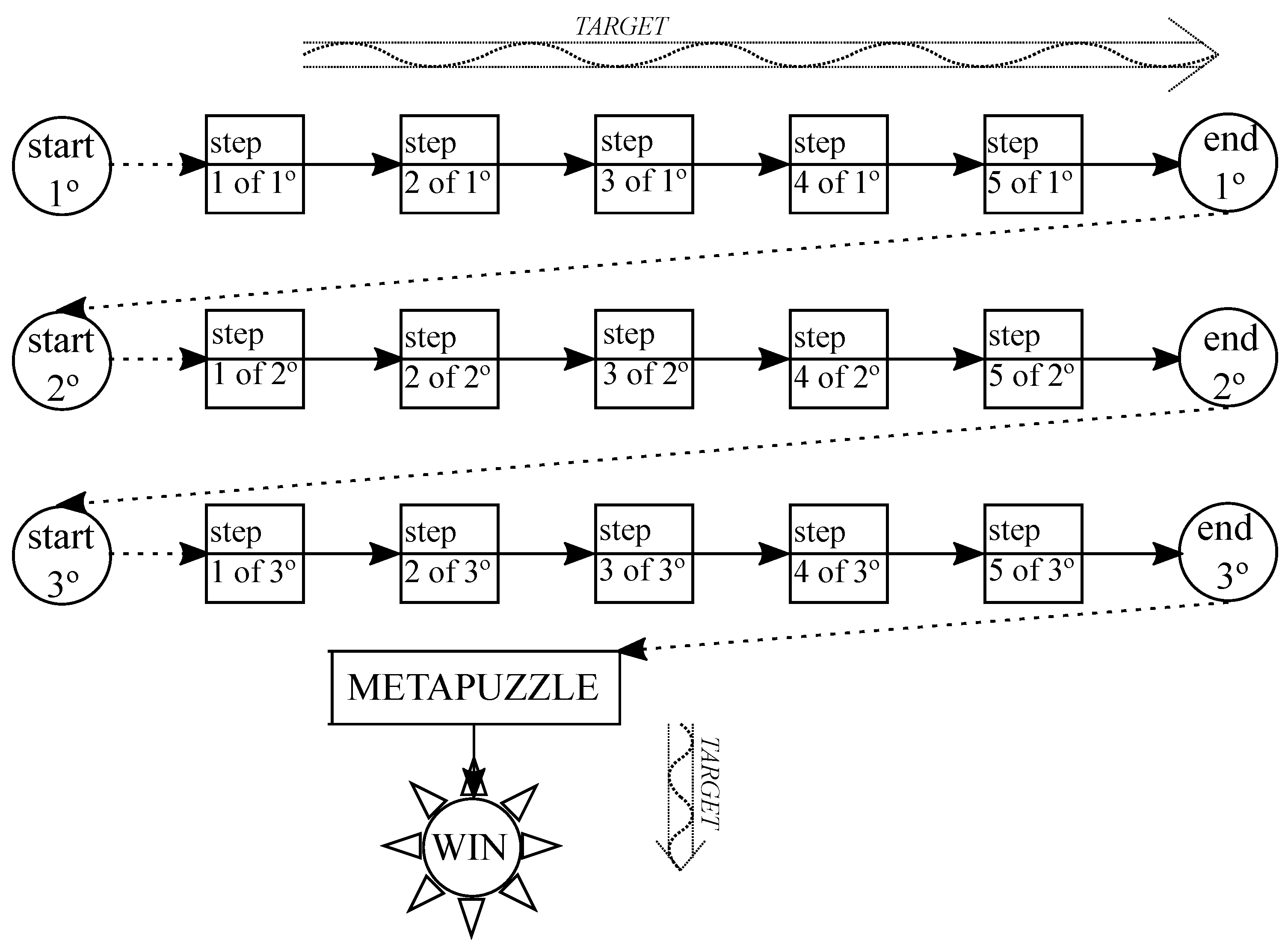
The educational escape room was the last methodology implemented in the course, introduced in 2023. Its aim was to provide a group-based assessment to complement the individual exam conducted at the end of each teaching unit. The structure of the proposed escape room is illustrated in Figure 1, where it can be observed that the layout follows a multilinear design. Specifically, it consists of three independent branches, each composed of five cells that must be completed sequentially along a linear path. It should be noted that solid lines indicate the path segments advanced based on the scores obtained in the tests, whereas dashed lines represent segments that are traversed automatically, and dotted lines indicate the direction toward the target of each branch.
The progression through the escape room depends on the scores obtained in a sequence of team-based computer exams, each consisting of 10 questions. Scores below 6 do not result in any advancement, whereas a score of 6 allows progression by one cell. A score of 7 enables advancement by two cells, 8 by three cells, 9 by four cells, and 10 by five cells.
Each branch is independent of the others; therefore, progression is constrained within a branch, and any excess movement places the team at the first position of the subsequent branch. Once the third branch has been cleared, a final metapuzzle must be solved to complete the escape room.
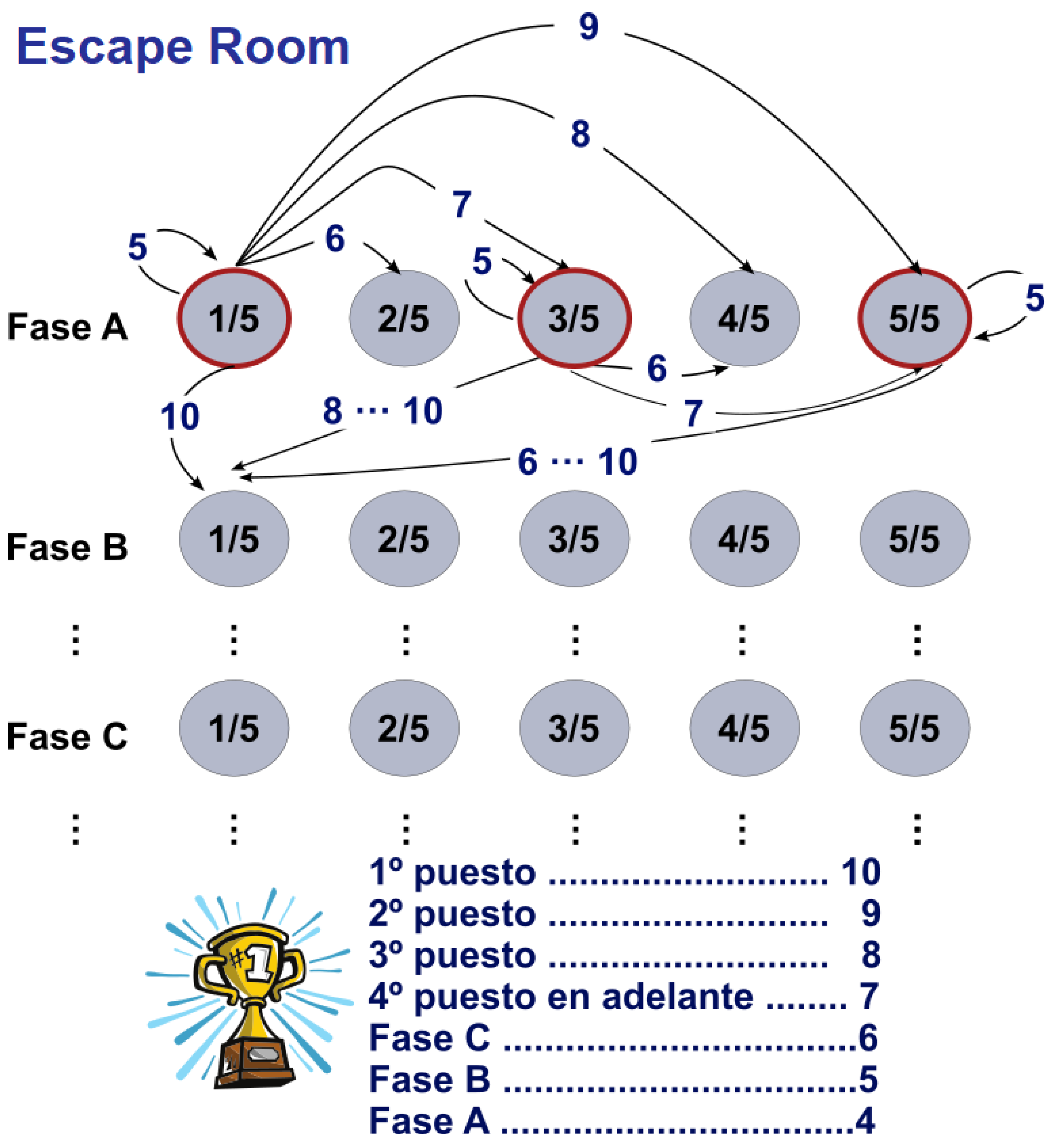
The scoring system for this activity assigns 10 points to all members of the first team to complete the escape room, 9 points to the second team, and 8 points to the third team. Teams that complete the activity before the end of the session receive 7 points. Teams remaining in the third, second, and first branches at the end of the session receive 6, 5, and 4 points, respectively. Figure 2 summarizes all the features described.

3.2. Confounders and Limitations

Several potential confounding factors may have influenced the observed outcomes. First, student cohort characteristics, such as prior knowledge, motivation, and academic background, may vary across academic years and affect performance independently of the teaching methodology. Second, differences in instructor experience and teaching style could introduce variability in the implementation of active learning and flipped classroom strategies. Third, external factors such as workload from other courses, access to resources, or students’ familiarity with digital tools may also impact engagement and achievement. Additionally, the possibility of collaboration outside the intended framework, such as sharing answers across groups or exam attempts, could influence assessment results, particularly in activities allowing multiple attempts or group work.
This study presents several limitations that should be acknowledged. The absence of a control group following a strictly traditional methodology limits the ability to attribute improvements solely to the implemented pedagogical approaches. Moreover, the reliance on course-specific assessments may restrict the generalizability of the findings to other subjects or educational contexts. The grading system, including multiple attempts and group-based activities, may also introduce biases in the evaluation of individual learning outcomes. Furthermore, the measurement of performance is primarily quantitative and may not fully capture deeper learning or long-term knowledge retention. Finally, the study is conducted within a single institutional and cultural context (Spain), which may limit the transferability of the results to different educational systems.

4. Results

The distribution of scores obtained in the first course run in 2018 was lower than expected, where traditional lecture-based teaching and written exams were used. This observation prompted the progressive implementation of active learning methodologies to make the course more engaging for students in subsequent editions of the course. Accordingly, in 2019, the flipped classroom model was introduced, along with off-site and on-site computer-based exams and problem-based learning activities. In 2020, the project-based learning seminar was implemented, followed by the challenge-based learning seminar in 2021 and the case-based learning seminar in 2022. Finally, in 2023, the educational escape room was designed.
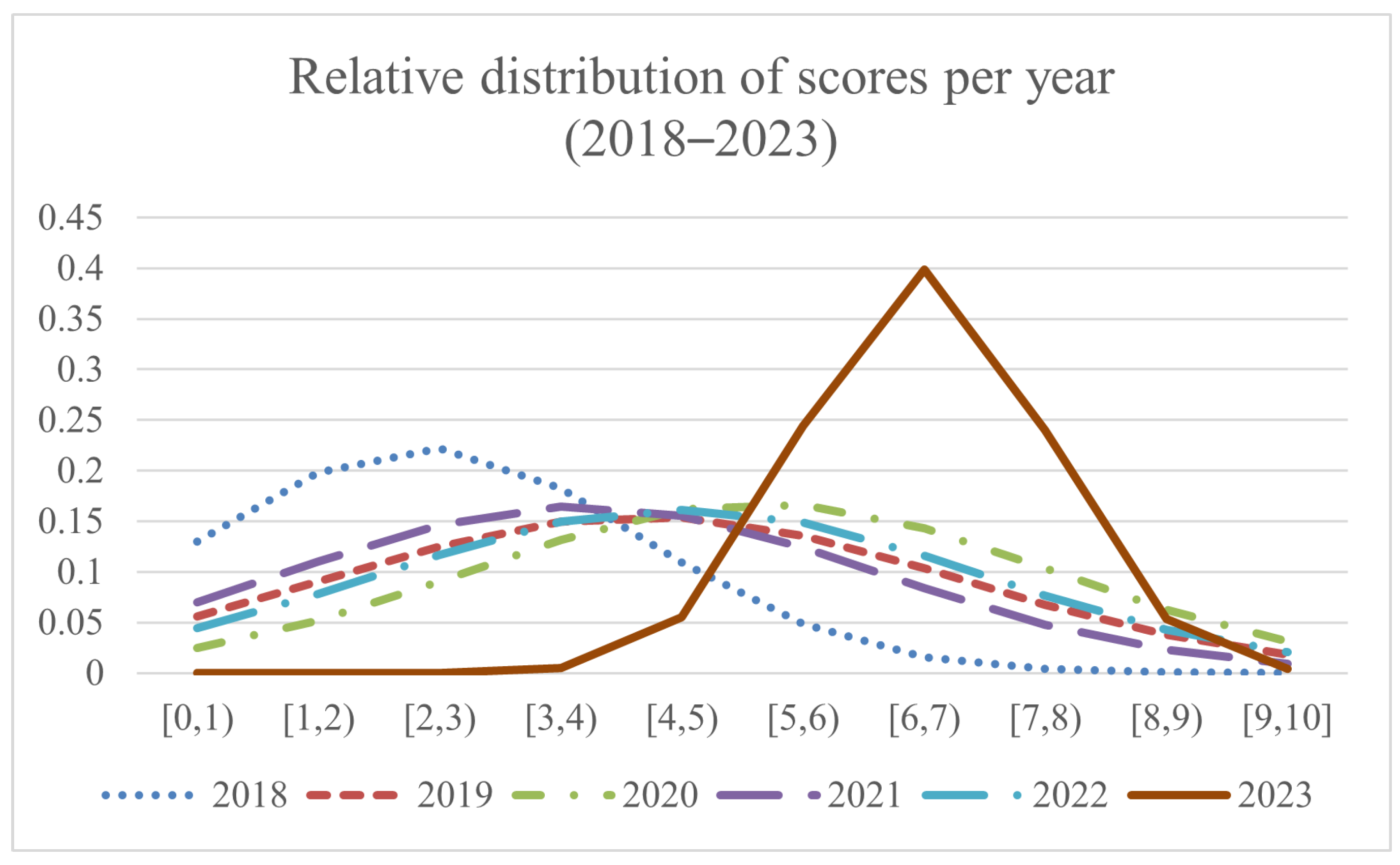
Figure 3 displays the relative distribution of scores per year, ranging from 2018 to 2023. In 2018, the mode was 2 out of 10, with most values concentrated between 0 and 4 out of 10, indicating a positively skewed distribution with negative kurtosis. Between 2019 and 2022 the mode ranged from 3 to 5 out of 10, with all distributions exhibiting slight positive skewness and noticeable negative kurtosis. In contrast, in 2023, the mode increased to 6 out of 10, and the distribution showed slight negative skewness and positive kurtosis.
The first remarkable change in the distribution can be observed between 2018 and 2019, following the implementation of the active learning paradigm. Focusing on the outcomes in these years, Table 3 exhibits the most relevant descriptive statistics. The measures of central tendency, namely mode, median and mode, are relatively similar within each particular year. On the other hand, the measures of dispersion in both years are similar and relatively high, indicating that the outcomes are widely distributed around the mean. Moreover, the values of skewness and kurtosis support the conclusions drawn from the graphical analysis. In addition, the measures of central tendency are consistent with a positively skewed distribution, as indicated by the relationship mode < median < mean.
With respect to the inferential statistics for the outcomes in 2018 and 2019, a p-value of 0.001 was obtained at a significance level of 0.05, suggesting that the differences reported in 2019 are statistically significant. This corresponds to an effect size of 0.82, calculated through the Cohen’s d, thus yielding a needed sample size of 24, assuming a statistical power of 0.80. Considering that the actual sample size was 30, this suggests that the study had sufficient power to detect the observed effect size, even though further research should be required with a larger population to confirm these findings.
The second significant change in the distribution can be observed between 2022 and 2023, after the implementation of the escape room. Focusing on the results obtained in these years, Table 4 presents the most relevant descriptive statistics. The measures of central tendency, namely mode, median and mode, are quite similar in each year. In contrast, the measures of dispersion in 2022 are comparatively high, indicating that the outcomes are widely spread around the mean. Conversely, in 2023, the dispersion is lower, suggesting that the outcomes are more closely clustered around the mean. Furthermore, the values of skewness and kurtosis support the conclusions drawn from the graphical analysis. Additionally, the measures of central tendency in 2022 are consistent with a positively skewed distribution, as indicated by the relationship mode < median < mean, whereas in 2023 they follow the opposite pattern, corresponding to a negatively skewed distribution.
Regarding inferential statistics for the outcomes in 2022 and 2023, a p-value of 0.0001 was obtained at a significance level of 0.05, suggesting that the differences observed in 2023 are statistically significant. This corresponds to an effect size of 1.03, calculated using Cohen’s d, which in turn yields a required sample size of 15, assuming a statistical power of 0.80. Given that the actual sample size was 30, this suggests that the study had sufficient power to detect the observed effect size. However, further research should be conducted with a larger population to confirm these findings.
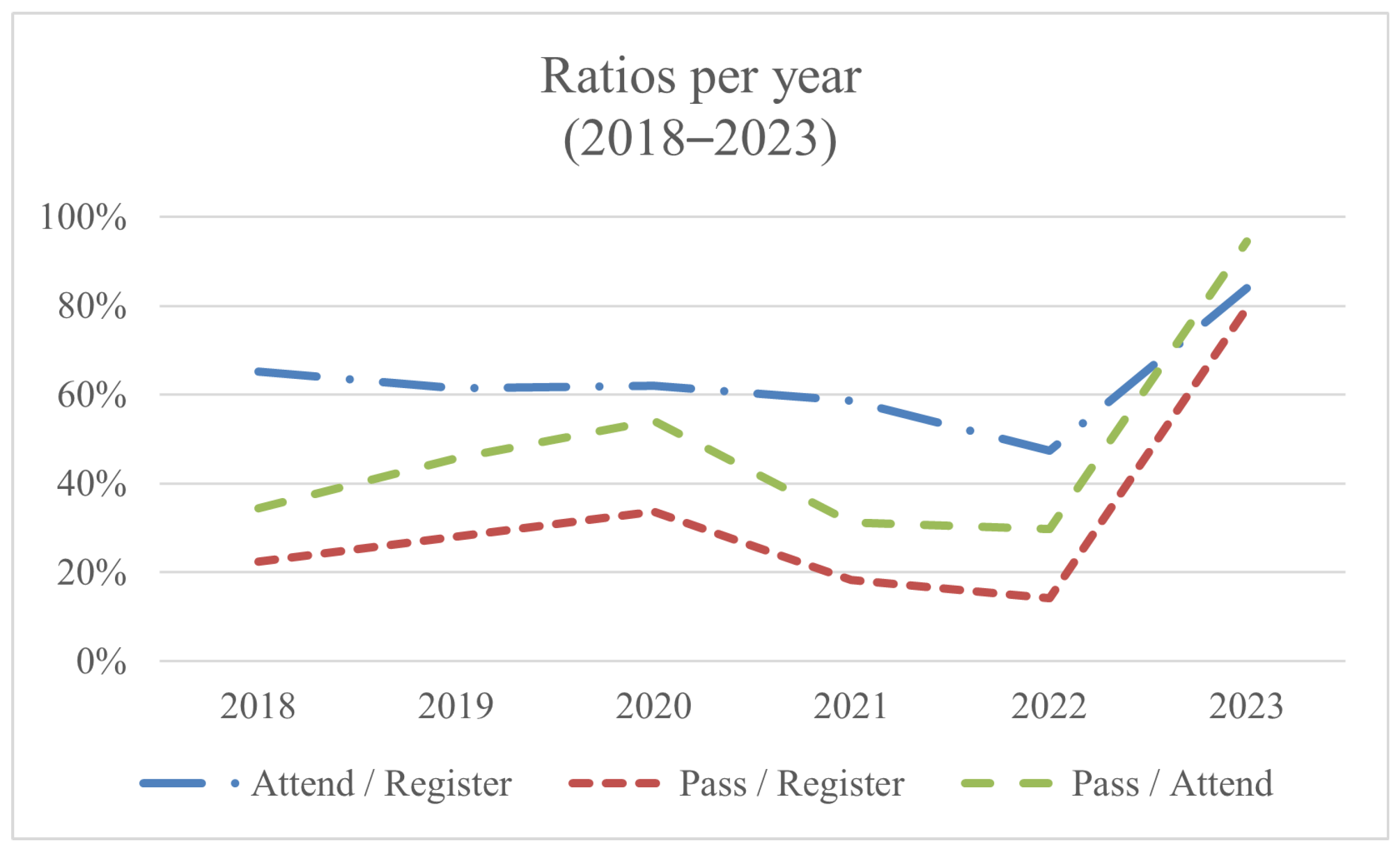
On the other hand, Figure 4 displays the ratios per year ranging from 2018 to 2023 with respect to the number of students registered in the course, the number of students attending the exam sessions dedicated to the individual on-site exam (considering the average attendance across all exam sessions), and the number of students who passed the course.
Specifically, the Attend/Register ratio stands for the quotient of the number of students attending the exam sessions and number of registered students. The Pass/Register ratio accounts for the quotient of the number of students who passed the course and the number of registered students. Finally, the Pass/Attend ratio represents the quotient of the number of students who passed the course and the number of students attending the exam sessions.
All three ratios remain relatively stable over the years, with Attend/Register being the highest, followed by Pass/Attend, and Pass/Register as the lowest. Furthermore, the separation among them is fairly consistent across years. However, in 2023, all three ratios experienced a notable increase, and the differences between them narrowed, with Pass/Attend becoming slightly higher than the others.

5. Discussion

According to the curves shown in Figure 3, which depict the relative distribution of scores from 2018 to 2023, three distinct contexts can be identified: 2018, the period 2019–2022, and 2023. The first context corresponds to 2018, when traditional lecture-based teaching and written exams were used. This year exhibits the lowest performance among the six years under study. The second context includes the years from 2019 to 2022, during which the flipped classroom model was adopted and various active learning methodologies were progressively introduced to compute the overall score for each student. These years show a clear improvement compared to 2018, although no single active learning technique appears to provide a distinct advantage over the others.
The third context corresponds to 2023, when the educational escape room was introduced as an additional active learning methodology, while maintaining the previously implemented approaches. This year demonstrates a notable improvement over previous outcomes. This suggests that the escape room may have contributed to the observed increase in academic performance, although causality cannot be definitively established, as it was implemented for the first time in that year. Additionally, based on informal verbal feedback collected from students, the competitive nature of the escape room appeared to enhance their motivation, encouraging them to study more thoroughly and perform better across the different assessment activities, which may partly explain the observed increase in scores.
The results displayed in Table 3 compare the descriptive statistics between the first and second contexts. A clear increase in measures of central tendency is observed, while measures of dispersion remain relatively high. These values support the observation that a significant improvement in academic performance occurred following the implementation of the active learning paradigm, even though no substantial change in score dispersion was observed. These conclusions are further reinforced by the inferential statistics, which also indicate a significant improvement in academic performance.
Similarly, the results presented in Table 4 compare the descriptive statistics between the second and third contexts, showing a clear increase in measures of central tendency. In contrast, the measures of dispersion exhibit a notable decrease in variability in 2023, indicating that the scores are more closely clustered around the mean. These findings support the observation that a significant improvement in academic performance was achieved following the implementation of the escape room. These conclusions are further supported by the inferential statistics, which suggest that the inclusion of the escape room in the assessment strategy had a measurable impact.
From an educational perspective, these results highlight the potential benefits of progressively integrating active learning methodologies into STEM courses. The observed improvements in measures of central tendency, together with the reduction in score dispersion in 2023, suggest not only higher overall performance but also a more homogeneous level of achievement among students. This may indicate that the combination of methodologies, particularly the inclusion of the escape room, supported a broader range of learners in achieving the intended learning outcomes (Roig et al., 2023). The gamified and collaborative nature of the escape room likely fostered increased motivation, engagement, and deeper interaction with the course content, aligning with constructivist learning principles (Ugo et al., 2025). Moreover, the structured progression of methodologies over the years appears to have created a cumulative effect, where each pedagogical innovation contributed incrementally to enhancing student learning, even though not all active learning methodologies had the same impact. These findings reinforce the value of designing learning environments that actively involve students and promote both individual accountability and collaborative problem-solving.
On the other hand, the graphs of the three ratios shown in Figure 4 suggest that the most notable change is associated with the introduction of the escape room in 2023 in the weighted grading system. In fact, it appears to have been the main driver influencing the observed rates in 2023. In order to facilitate the interpretation of these graphs, it should be noted that the number of registered students remained relatively constant during the six-year period from 2018 to 2023. In addition, the escape room was implemented within a dedicated evaluation session, in which the individual exam was conducted first, followed by the escape room activity. Therefore, only students attending the exam were able to participate in the escape room.
Taking this all into consideration, the increase in the Attend-to-Register ratio in 2023 may be attributed to students’ interest in participating in the escape room, which appears to have encouraged higher attendance despite a similar number of registered students. Furthermore, the rise in the Pass-to-Attend ratio in 2023 may be associated with improved student preparation, potentially driven by the intrinsic gamification component of the escape room (Kim et al., 2024). This factor appears to have contributed to a higher proportion of students passing among those attending. Additionally, the increase in the Pass-to-Register ratio in 2023 may be a direct consequence of these factors, resulting in a greater number of students passing the course while maintaining a similar number of registered students. Consequently, these findings suggest that the introduction of the escape room may well have contributed to an improvement in academic performance (Morgan et al., 2025).
The results obtained are consistent with findings reported in the literature, which suggest improvements in academic performance and success rates in STEM-related courses following the introduction of active learning methodologies. (Hacisalihoglu et al., 2018; Nurbavliyev et al., 2022). Furthermore, these results align with recent studies indicating that active learning methodologies may lead to increased performance and engagement across different areas and educational levels (Walker & McComas, 2026; Rezai et al., 2025; NasirpourOsgoei & Obembe, 2025; Costa & Reis, 2025).
Finally, the results obtained allow us to respond to the research question in a positive way, as the implementation of a combination of active learning methodologies in a STEM-related course led to a significant improvement in academic performance compared to previous editions of the same course. Additionally, according to the feedback collected, the deployment of an educational escape room as an active assessment tool appears to have been a key factor in enhancing student engagement by fostering self-directed learning.
On the other hand, additional discussion on the scalability of this active learning approach is warranted, as it represents a key consideration for broader adoption. While the present study was conducted with a relatively small cohort (n = 30), the proposed design was intentionally structured in a modular and flexible manner to facilitate implementation in larger class settings. In particular, the flipped classroom component scales naturally, as pre-class content (e.g., videos, readings, quizzes) can be distributed to large numbers of students through Learning Management Systems (LMSs) without increasing instructor workload. For in-class activities, strategies such as structured group work, peer instruction, and the use of teaching assistants can help maintain active engagement even in large cohorts.
Similarly, project-, challenge- and case-based components can be organized around teams with clearly defined roles and milestones, supported by digital collaboration tools to streamline monitoring and feedback. The computer-based individual assessment is inherently scalable due to automation, while the escape room activity can be adapted through parallel sessions, digital formats, or station-based rotations. Overall, although logistical complexity increases with class size, the combination of technology support, careful instructional design, and distributed facilitation enables the proposed approach to be realistically extended to larger university contexts.
With respect to the broader impact of the proposed methodology on STEM retention and student progression, it should be noted that, while the primary focus of this study was on short-term learning outcomes and student performance within the course, we acknowledge the relevance of examining longer-term effects such as retention and graduation rates. At present, we have not conducted a longitudinal analysis that would allow us to draw definitive conclusions about the impact of this redesigned course on students’ persistence in STEM programs. However, preliminary observations suggest positive trends in student engagement and course completion rates, which are often associated in the literature with improved retention. Additionally, informal tracking of subsequent academic performance indicates that many students who completed the course continued successfully in related STEM subjects, although this evidence is not yet systematic. We recognize that a more rigorous longitudinal study would be required to substantiate these effects, and this represents a valuable direction for future research.
Furthermore, while the escape room may have contributed to the observed improvement in academic performance, it represents only one component within a broader set of active learning activities implemented throughout the course. In addition to this activity, students engaged in project-based, challenge-based, and collaborative in-class and out-of-class exercises designed to reinforce key concepts and promote active engagement. Therefore, the observed improvement cannot be attributed solely to the escape room activity, as it was implemented within a broader active learning framework that collectively supports student engagement and understanding. While the escape room may have acted as a strong motivational and integrative experience, thus reinforcing concepts through collaboration and problem-solving, it is likely that its effect was amplified by the complementary methodologies used throughout the course. Therefore, the results should be interpreted as the outcome of the combined instructional design rather than the impact of a single activity in isolation.

6. Conclusions

In this paper, the impact of progressively integrating active learning methodologies into a STEM-related course over several academic years is examined. The results indicate a clear improvement in academic performance, particularly following the transition from traditional teaching approaches to a more student-centered learning environment. The analysis of both descriptive and inferential statistics supports the conclusion that the implementation of active learning strategies has contributed to higher levels of student achievement compared to previous course editions.
Furthermore, the findings suggest that the combination of multiple active learning methodologies yields a cumulative effect, enhancing not only performance but also engagement. Among the different approaches introduced, the educational escape room appears to have played a particularly relevant role, coinciding with a notable increase in both participation and success rates. The gamified and collaborative nature of this activity may have fostered motivation and encouraged self-directed learning, thereby supporting a broader range of students in achieving the intended learning outcomes.
Despite these positive results, some limitations should be acknowledged. The study is based on a single course and institutional context, which may limit the generalizability of the findings. Additionally, although the results suggest a strong association between the implemented methodologies and improved performance, causal relationships cannot be definitively established. Future research should consider larger and more diverse samples, as well as controlled experimental designs, to further investigate the effectiveness of combining active learning methodologies and to better understand their impact across different educational settings.

Author Contributions

Conceptualization, P.J.R. and S.A.; Formal analysis, P.J.R. and S.A.; Supervision, P.J.R., S.A., K.G., C.B. and C.J.; Validation, P.J.R. All authors have read and agreed to the published version of the manuscript.

Funding

This research received no external funding.

Institutional Review Board Statement

This study was conducted in accordance with the Declaration of Helsinki. No approval by the Institutional Ethics Committee was necessary, as all data were collected anonymously from capable, consenting adults. The data are not traceable to participating individuals. The procedure complies with the general data protection regulation (GDPR).

Informed Consent Statement

Informed consent was obtained from all subjects involved in the study.

Data Availability Statement

The datasets used and analyzed during the current study are available from the corresponding author on reasonable request.

Conflicts of Interest

The authors declare no conflicts of interest.

Abbreviations

The following abbreviations are used in this manuscript:
CBAComputer-Based Assessment
CBLCase-Based Learning
ChBLChallenge-Based Learning
DEERDigital Educational Escape Room
EEREducational Escape Room
ICTInformation and Communication Technologies
IPInternet Protocol
ITInformation Technology
LMSLearning Management System
PBLProject-Based Learning
PrBLProblem-Based Learning
SDLself-directed learning
STEMScience, Technology, Engineering, Mathematics
TBLTeam-Based Learning
VETVocational Education and Training

References

  1. Abunamous, M. O., Boudouaia, A., Jebril, M., Diafi, S., & Zreik, M. (2022). The decay of traditional education: A case study under COVID-19. Information & Communications Technology in Education, 9(1), 2082116. [Google Scholar]
  2. Aghaei, S., Nematbakhsh, M. A., & Farsani, H. K. (2012). Evolution of the world wide web: From Web 1.0 to Web 4.0. International Journal of Web & Semantic Technology (IJWesT), 3(1), 3101. [Google Scholar]
  3. Aji, C. A., & Khan, M. J. (2019). The impact of active learning on students’ academic performance. Open Journal of Social Sciences, 7(3), 204–211. [Google Scholar] [CrossRef]
  4. Algosaibi, A. A., Albahli, S., Khasawneh, S. F., & Melton, A. (2017). Web evolution—The shift from information publishing to reasoning. International Journal of Artificial Intelligence and Applications (IJAIA), 8(6), 11–28. [Google Scholar] [CrossRef]
  5. Allison, M., & Kendrick, L. M. (2015). Toward education 3.0: Pedagogical affordances and implications of social software and the semantic web. New Directions for Teaching & Learning, 2015(144), 109–119. [Google Scholar][Green Version]
  6. Atabekova, A., Belousov, A., & Shoustikova, T. (2015). Web 3.0-based non-formal learning to meet the third millennium education requirements: University students’ perceptions. Procedia-Social and Behavioral Sciences, 214, 511–519. [Google Scholar] [CrossRef][Green Version]
  7. Beimel, D., Tsoury, A., & Barnett-Itzhaki, Z. (2024). The impact of extent and variety in active learning methods across online and face-to-face education on students’ course evaluations. Frontiers in Education, 9, 1432054. [Google Scholar] [CrossRef]
  8. Bell, S. (2010). Project-based learning for the 21st century: Skills for the future. The Clearing House: A Journal of Educational Strategies, Issues and Ideas, 83, 39–43. [Google Scholar] [CrossRef]
  9. Blanco, C., Almarza, M., Massana, J., Alonso-Peralta, F., & Martinez, E. (2023, November 13–15). Digital escape rooms as a way to increase academic performance and student’s motivation. 16th Annual International Conference of Education, Research and Innovation (ICERI 2023), Seville, Spain. [Google Scholar]
  10. Bogacka, M., & Pikon, K. (2017, April 25–28). Work in progress: Combining active learning methods in engineering education. 2017 IEEE Global Engineering Education Conference (EDUCON), Athens, Greece. [Google Scholar]
  11. Bou-Saad, R. E., & Llorens-García, A. (2024, October 23–25). An educational STEM model for the Arab region based on X-based learning, employing ICT. 12th International Conference on Technological Ecosystems for Enhancing Multiculturality (TEEM 2024) (pp. 1303–1311), Alicante, Spain. [Google Scholar]
  12. Campo, L., Delgado, N., Etxabe-Urbieta, J. M., Kanso, H., & Gueye, M. L. (2026). Relationship between the use of ChatGPT and plagiarism in higher education: The influence of gender, age and previous academic results. Innovative Higher Education, 51, 513–532. [Google Scholar] [CrossRef]
  13. Campos-Junior, H., & Zanin-Bagatini, F. (2025). A blend of active learning methodologies: Creating a student-focused ecosystem. Marketing Education Review, 36(1), 72–84. [Google Scholar] [CrossRef]
  14. Castañeda-Rincón, S. A., Moreno-Gudino, H., & Gil-Herrera, R. J. (2024). Robotics for inclusive education: Combining active methodologies in a classroom. Contemporary Educational Technology, 16(3), ep522. [Google Scholar] [CrossRef] [PubMed]
  15. Castillo-Cruz, B., González-Espada, W., Vedrine-Pauléus, J., & Casillas-Martínez, L. (2025). Incorporating active learning and inclusive practices in a flipped environment: Findings from introductory chemistry at a hispanic serving institution. Journal of Chemical Education, 102, 3346–3354. [Google Scholar] [CrossRef] [PubMed]
  16. Chang, Y. H., Yan, Y. C., & Lu, Y. T. (2022). Effects of combining different collaborative learning strategies with problem-based learning in a flipped classroom on program language learning. Sustainability, 14(9), 5282. [Google Scholar] [CrossRef]
  17. Costa, L. M. G., & Reis, M. J. C. S. (2025). Motivational teaching techniques in secondary and higher education: A systematic review of active learning methodologies. Digital, 5(3), 40. [Google Scholar] [CrossRef]
  18. Demartini, C., & Benussi, L. (2017). Do Web 4.0 and Industry 4.0 imply Education X.0? IT Professional, 19(3), 4–7. [Google Scholar] [CrossRef]
  19. de Pedro, Z. M., Álvarez-Montero, A., Casas, J. A., & Muñoz, M. (2025). Active learning in environmental engineering: Combining interactive platforms and project-based approaches to boost engagement and academic performance. Education for Chemical Engineers, 53, 161–170. [Google Scholar] [CrossRef]
  20. Díaz-Lauzurica, B., & Moreno-Salinas, D. (2025). Active learning methodologies for increasing the interest and engagement in computer science subjects in vocational education and training. Education Sciences, 15(8), 1017. [Google Scholar] [CrossRef]
  21. Duy, N. T., Mondal, S. R., Van, N. T. T., Dzung, P. T., Minh, D. X. H., & Das, S. (2020). A study on the role of Web 4.0 and 5.0 in the sustainable tourism ecosystem of Ho Chi Minh City, Vietnam. Sustainability, 12(17), 7140. [Google Scholar] [CrossRef]
  22. European Commission. (2023). Communication from the commission to the European parliament, the council, the European economic and social committee and the committee of the regions. An EU initiative on Web 4.0 and virtual worlds: A head start in the next technological transition. Available online: https://digital-strategy.ec.europa.eu/en/library/eu-initiative-virtual-worlds-head-start-next-technological-transition (accessed on 15 March 2026).
  23. Faniran, V. T., & Faloye, S. T. (2024, May 20–24). Computer-based assessments in higher education: Challenges and remediations. IST-Africa 2024 Conference, Dublin, Ireland. [Google Scholar]
  24. Freeman, S., Eddy, S. L., McDonough, M., Smith, M. K., Okoroafor, N., Jordt, H., & Wenderoth, M. P. (2014). Active learning increases student performance in science, engineering, and mathematics. Proceedings of the National Academy of Sciences of the United States of America, 111(23), 8410–8415. [Google Scholar] [CrossRef]
  25. Gerstein, J. (2014). Moving from Education 1.0 through Education 2.0 towards Education 3.0. Available online: https://api.semanticscholar.org/CorpusID:150995522 (accessed on 15 March 2026).
  26. Gong, J., Cai, S., & Cheng, M. (2024). Exploring the effectiveness of flipped classroom on STEM student achievement: A meta-analysis. Technology, Knowledge and Learning, 29, 1129–1150. [Google Scholar] [CrossRef]
  27. González-Pérez, L. I., & Ramírez-Montoya, M. S. (2022). Components of Education 4.0 in 21st century skills frameworks: Systematic review. Sustainability, 14(3), 1493. [Google Scholar] [CrossRef]
  28. González-Yubero, S., Mauri, M., Cardoso, M. J., & Palomera, R. (2023). Learning through challenges and enigmas: Educational escape room as a predictive experience of motivation in university students. Sustainability, 15(17), 13001. [Google Scholar] [CrossRef]
  29. Gueye, M. L., & Expósito, E. (2023). Education 4.0: Proposal of a model for autonomous management of learning processes. Lecture Notes in Computer Science, 13821, 106–117. [Google Scholar]
  30. Gueye, M. L., & Expósito, E. (2024). Hybrid course instructional design for better practice of learning analytics. Interactive Learning Environments, 33(1), 420–439. [Google Scholar] [CrossRef]
  31. Hacisalihoglu, G., Stephens, D., Johnson, L., & Edington, M. (2018). The use of an active learning approach in a SCALE-UP learning space improves academic performance in undergraduate General Biology. PLoS ONE, 13(5), e0197916. [Google Scholar] [CrossRef]
  32. Haderer, B., & Ciolacu, L. (2022). Education 4.0: Artificial intelligence assisted task- and time planning system. Procedia Computer Science, 200, 1328–1337. [Google Scholar] [CrossRef]
  33. Hernández-de-Menéndez, M., Morales-Menendez, R., Escobar, C. A., & McGovern, M. (2021). The core components of Education 4.0 in higher education: Three case studies in engineering education. Computers & Electrical Engineering, 93, 107278. [Google Scholar]
  34. Herreid, C. F. (2007). Start with a story: The case study method of teaching college science. NSTA Press. [Google Scholar]
  35. Himmetoglu, B., Aydug, D., & Bayrak, C. (2020). Education 4.0: Defining the teacher, the student, and the school manager aspects of the revolution. The Turkish Online Journal of Distance Education, 21, 12–28. [Google Scholar] [CrossRef]
  36. Huk, T. (2021). From Education 1.0 to Education 4.0—Challenges for the contemporary school. The New Educational Review, 66, 36–46. [Google Scholar] [CrossRef]
  37. Idoiaga-Mondragón, N., Beloki, N., Yarritu, I., Zarrazquin, I., & Artano, K. (2024). Active methodologies in higher education: Reasons to use them (or not) from the voices of faculty teaching staff. Higher Education, 88, 919–937. [Google Scholar] [CrossRef]
  38. Johnsen, I. S., Gynnild, V., & Lillebo, B. (2024). Combining problem-based learning and team-based learning in a longitudinal integrated clerkship: How do students spend their self-study time? The Clinical Teacher, 22(1), e70008. [Google Scholar] [CrossRef] [PubMed]
  39. Johnson, L. F., Smith, R. S., Smythe, J. T., & Varon, R. K. (2009). Challenge-based learning: An approach for our time. The New Media Consortium. [Google Scholar]
  40. Jongsma, M. V. (2026). Constructing learning together: The social and technological conditions for active learning in STEM education [Ph.D. thesis, Vrije Universiteit Amsterdam]. Available online: https://research.vu.nl/en/publications/constructing-learning-together-the-social-and-technological-condi/ (accessed on 7 April 2026).
  41. Kam, M., Clune, M., Jowsey, T., & Singleton, R. (2026). Embracing `gameful learning’ with escape room games in higher education. Higher Education Research & Development, 1–20. [Google Scholar] [CrossRef]
  42. Kanso, H., Arnould, P., & Expósito, E. (2024, November 6–8). EVA: Virtual learning environments as a service (VLEaaS) in higher education. 21st International Conference on Information Technology Based Higher Education and Training (ITHET), Paris, France. [Google Scholar]
  43. Keats, D., & Schmidt, J. P. (2007). The genesis and emergence of Education 3.0 in higher education and its potential for Africa. First Monday, 12(3–5), 1625. [Google Scholar] [CrossRef]
  44. Kim, C., Na, H., Zhang, N., & Bai, C. (2024). Escape rooms for education: A meta-analysis. International Journal of Instruction, 17(4), 219–234. [Google Scholar] [CrossRef]
  45. Krajcik, J., & Blumenfeld, P. (2006). 19. Project-based learning. In The Cambridge handbook of the learning sciences (pp. 317–333). Cambridge University Press. [Google Scholar]
  46. Kulak, V., & Newton, G. (2014). A guide to using case-based learning in biochemistry education. Biochemistry and Molecular Biology Education, 42(6), 457–473. [Google Scholar] [CrossRef]
  47. Lansdell, B. J., & Kording, K. P. (2019). Towards learning-to-learn. Current Opinion in Behavioral Sciences, 29, 45–50. [Google Scholar] [CrossRef]
  48. Lara-Lara, F., Santos-Villalba, M. J., Berral-Ortiz, B., & Martínez-Domingo, J. A. (2023). Inclusive active methodologies in Spanish higher education during the pandemic. Societies, 13(2), 29. [Google Scholar] [CrossRef]
  49. Lea, Q. T. (2020). Orientation for an Education 4.0: A new vision for future education in Vietnam. International Journal of Innovation, Creativity and Change, 11(3), 513–526. Available online: https://www.ijicc.net/images/vol11iss3/11340_Lea_2020_E_R.pdf (accessed on 15 March 2026).
  50. Li, R., Lund, A., & Nordsteien, A. (2021). The link between flipped and active learning: A scoping review. Teaching in Higher Education, 28(8), 1993–2027. [Google Scholar] [CrossRef]
  51. Lim, I., & Gepp, A. (2025). Design, implementation, and student feedback on a numerical-themed escape room for a data analytics subject. Interactive Technology and Smart Education, 23(1), 80–96. [Google Scholar] [CrossRef]
  52. Liu, W., Fu, Y., & Liu, Q. (2023). Metadata as a methodological commons: From aboutness description to cognitive modeling. Data Intelligence, 5(1), 289–302. [Google Scholar] [CrossRef]
  53. López-Pernas, S., Gordillo, A., Barra, E., & Quemada, J. (2019). Analyzing learning effectiveness and students’ perceptions of an educational escape room in a programming course in higher education. IEEE Access, 7, 184221–184234. [Google Scholar] [CrossRef]
  54. Makri, A., Vlachopoulos, D., & Martina, R. A. (2021). Digital escape rooms as innovative pedagogical tools in education: A systematic literature review. Sustainability, 13(8), 4587. [Google Scholar] [CrossRef]
  55. Manas, A., Ismail, P. M. S., Mohan, R., Madiraju, G. S., Mulla, M., Mulla, M., & Babaji, P. (2024). The role of combined Problem-Based Learning (PBL) and Case-Based Learning (CBL) teaching methodologies in dental education. Journal of Education and Health Promotion, 13, 417. [Google Scholar] [CrossRef]
  56. Martínez-Jiménez, R., & Ruiz-Jiménez, M. C. (2020). Improving students’ satisfaction and learning performance using flipped classroom. The International Journal of Management Education, 18(3), 100422. [Google Scholar] [CrossRef]
  57. Matsumoto-Royo, K., Ramírez-Montoya, M. S., & Conget, P. (2021). Opportunities to develop lifelong learning tendencies in practice-based teacher education: Getting ready for education 4.0. Future Internet, 13(11), 292. [Google Scholar] [CrossRef]
  58. Mekacher, L. (2022). Education 4.0: Hybrid learning and microlearning in a smart environment. PUPIL: International Journal of Teaching, Education and Learning, 6(1), 127–141. [Google Scholar] [CrossRef]
  59. Mikhailidi, A., & Tskhvediani, G. (2026). Applied active learning in STEM using a strategic session in an occupational health and safety course. Frontiers in Education, 11, 1719714. [Google Scholar] [CrossRef]
  60. Morgan, N., Yaqoob, M., & Jones, M. A. (2025). Using digital escape rooms to enhance data analysis skills and student experience in a higher education human physiology module. Current Research in Physiology, 8, 100165. [Google Scholar] [CrossRef]
  61. Mukul, E., & Büyüközkan, G. (2023). Digital transformation in education: A systematic review of education 4.0. Technological Forecasting and Social Change, 194, 122664. [Google Scholar] [CrossRef]
  62. NasirpourOsgoei, S. N., & Obembe, D. (2025). Enhancing academic performance through attendance and recognition: An active learning approach in UK higher education. Innovations in Education and Teaching International, 1–16. [Google Scholar] [CrossRef]
  63. Ni, A., Cheung, A. C. K., & Shi, J. (2023). The impact of flipped classroom teaching on college English language learning: A meta-analysis. International Journal of Educational Research, 121, 102230. [Google Scholar] [CrossRef]
  64. Nichols, M., Cator, K., & Torres, M. (2016). Challenge based learning guide. Digital Promise. [Google Scholar]
  65. Nicholson, S. (2015). Peeking behind the locked door: A survey of escape room facilities. Available online: http://scottnicholson.com/pubs/erfacwhite.pdf (accessed on 15 March 2026).
  66. Nurbavliyev, O., Kaymak, S., & Sydykov, B. (2022). The effect of active learning method on students’ academic success, motivation and attitude towards mathematics. Journal of Language and Linguistic Studies, 18(2), 701–713. Available online: https://www.jlls.org/index.php/jlls/article/view/4409 (accessed on 15 March 2026).
  67. Pacheco-Velázquez, E., Rodés-Paragarino, V., Glasserman-Morales, L. D., & Carlos-Arroyo, M. (2024). Playing to learn: Developing self-directed learning skills through serious games. Journal of International Education in Business, 17(3), 416–430. [Google Scholar] [CrossRef]
  68. Paiva, H. M., Hayashi, V., Santoro, F. M., Paiva, J. P. L. M., & Garcia, M. (2025, April 22–25). Active learning in STEM education: An approach combining flipped classroom and dialogic teaching. 2025 IEEE Global Engineering Education Conference (EDUCON), London, UK. [Google Scholar]
  69. Patiño, A., Ramírez-Montoya, M. S., & Buenestado-Fernández, M. (2023). Active learning and education 4.0 for complex thinking training: Analysis of two case studies in open education. Smart Learning Environments, 10, 8. [Google Scholar] [CrossRef]
  70. Peláez-Sánchez, I. C., Velarde-Camaqui, D., & Glasserman-Morales, L. D. (2024). The impact of large language models on higher education: Exploring the connection between AI and Education 4.0. Frontiers in Education, 9, 1392091. [Google Scholar] [CrossRef]
  71. Pinto, R., Baía-Reis, A., Cónego, L., & Gonçalves, G. (2021, July 1–2). New pedagogical approaches to shaping the next generation of portuguese manufacturing professionals. 11th Conference on Learning Factories (CLF 2021), Graz, Austria. [Google Scholar]
  72. Polytechnic University of Valencia. (2026). Spanish grading system. Available online: https://www.upv.es/entidades/OPII/infoweb/pi/info/1147768normali.html (accessed on 15 March 2026).
  73. Raddaoui, A. H. (2016). Traditional Asian education and Education 2.0: How close is the fit? Research Result: Theoretical and Applied Linguistics, 2(2), 78–89. [Google Scholar] [CrossRef]
  74. Ramírez-Montoya, M. S., Castillo-Martínez, I. M., Sanabria-Z, J., & Miranda, J. (2022). Complex thinking in the framework of Education 4.0 and open innovation—A systematic literature review. Journal of Open Innovation: Technology, Market, and Complexity, 8(1), 4. [Google Scholar] [CrossRef]
  75. Rautela, S., Sharma, A., & Panackal, N. (2023). Collaborative Online International Learning (COIL): A study of enablers using total interpretive structural modelling and MICMAC analysis. International Journal of Education Sciences, 41(1–3), 15–28. Available online: http://krepublishers.com/02-Journals/IJES/IJES-41-0-000-23-Web/IJES-41-1-3-000-23-Abst-PDF/IJES-41-1-3-015-23-1273-Panackal-N/IJES-41-1-3-015-23-1273-Panackal-N-Tx[3].pdf (accessed on 15 March 2026).
  76. Renkl, A., & Atkinson, R. K. (2010). Structuring the transition from example study to problem solving in cognitive skill acquisition: A cognitive load perspective. Educational Psychologist, 38(1), 15–22. [Google Scholar] [CrossRef]
  77. Rezai, A., Ahmadi, R., Ashkani, P., & Hosseini, G. H. (2025). Implementing active learning approach to promote motivation, reduce anxiety, and shape positive attitudes: A case study of EFL learners. Acta Psychologica, 253, 104704. [Google Scholar] [CrossRef]
  78. Rienties, B., Ferguson, R., Gonda, D., Hajdin, G., Herodotou, C., Iniesto, F., Llorens-García, A., Muccini, H., Sargent, J., Virkus, S., & Isidori, M. V. (2023). Education 4.0 in higher education and computer science: A systematic review. Computer Applications in Engineering Education, 31(5), 1339–1357. [Google Scholar] [CrossRef]
  79. Roig, P. J., Alcaraz, S., Gilly, K., Bernad, C., & Juiz, C. (2023). Using escape rooms as evaluation tool in active learning contexts. Education Sciences, 13(6), 535. [Google Scholar] [CrossRef]
  80. Salmon, G. (2019). May the fourth be with you: Creating Education 4.0. Journal of Learning for Development, 6(2), 95–115. [Google Scholar] [CrossRef]
  81. Schutte, B. G., Bayram, D., Vennix, J., & van der Veen, J. (2025). Exploring the implementation of challenge-based learning for sustainability education in Dutch secondary education: Teachers’ experiences. Environmental Education Research, 31(6), 1166–1192. [Google Scholar] [CrossRef]
  82. Sharma, A., Panackal, N., & Rautela, S. (2022). Creating Education 4.0: A summative perspective. International Journal of Educational Sciences, 38(1–3), 39–54. Available online: http://krepublishers.com/02-Journals/IJES/IJES-38-0-000-22-Web/IJES-38-1-3-000-22-Abst-PDF/IJES-38-1-3-038-22-1237-Sharma-A/IJES-38-1-3-38-22-1237-Sharma-A-Tx[6].pdf (accessed on 15 March 2026). [CrossRef]
  83. Shute, V. J., & Rahimi, S. (2017). Review of computer-based assessment for learning in elementary and secondary education. Journal of Computer Assisted Learning, 33(1), 1–19. [Google Scholar] [CrossRef]
  84. Sinnayah, P., Rathner, J. A., Loton, D., Klein, R., & Hartley, P. (2019). A combination of active learning strategies improves student academic outcomes in first-year paramedic bioscience. Advances in Physiology Education, 43(2), 233–240. [Google Scholar] [CrossRef] [PubMed]
  85. Stieha, V., Earl, B., Hagens, H., Haynes, M., Ulappa, A., Bond, L., & Oxford, J. T. (2024). An exploration of the relationship between active learning and student motivation in STEM: A mixed methods study. Advances in Physiology Education, 48(3), 621–638. [Google Scholar] [CrossRef]
  86. Strobel, J., & van Barneveld, A. (2009). When is PBL more effective? A meta-synthesis of meta-analyses comparing PBL to conventional classrooms. Interdisciplinary Journal of Problem-based Learning, 3(1), 4. [Google Scholar] [CrossRef]
  87. Syahbrudin, J., Istiyono, E., Khairudin, M., Anggraini, A., Wusqo, I. U., Mariam, M., & Muflihan, Y. (2024). Computer-based assessment research trends and future directions: A bibliometric analysis. Contemporary Educational Technology, 17(1), ep554. [Google Scholar] [CrossRef] [PubMed]
  88. Taraldsen, L. H., Haara, F. O., Lysne, M. S., Jensen, P. R., & Jenssen, E. S. (2020). A review on use of escape rooms in education—Touching the void. Education Inquiry, 13(2), 169–184. [Google Scholar] [CrossRef]
  89. Theobald, E. J., Hill, M. J., Tran, E., Agrawal, S., Arroyo, E. N., Behling, S., Chambwe, N., Cintrón, D. L., Cooper, J. D., Dunster, G., Grummer, J. A., Hennessey, K., Hsiao, J., Iranon, N., Jones, L., Jordt, H., Keller, M., Lacey, M. E., Littlefield, C. E., … Freeman, S. (2020). Active learning narrows achievement gaps for underrepresented students in undergraduate science, technology, engineering, and math. Proceedings of the National Academy of Sciences (PNAS), 117(12), 6476–6483. [Google Scholar] [CrossRef] [PubMed]
  90. Thistlethwaite, J. E., Davies, D., Ekeocha, S., Kidd, J. M., MacDougall, C., Matthews, P., Purkis, J., & Clay, D. (2012). The effectiveness of case-based learning in health professional education. A BEME systematic review: BEME Guide No. 23. Medical Teacher, 34(6), 421–444. [Google Scholar] [CrossRef] [PubMed]
  91. Tikhonova, E., & Raitskaya, L. (2023). Education 4.0: The concept, skills, and research. Journal of Language and Education, 9(1), 5–11. [Google Scholar] [CrossRef]
  92. Tirziu, A. M., & Vrabie, C. (2015). Education 2.0: E-learning methods. Procedia-Social and Behavioral Sciences, 186, 376–380. [Google Scholar] [CrossRef]
  93. Trout, J. J., Murphy, C., & Vukicevich, M. (2019). Combining active learning techniques and service learning in a section of physics I with calculus course. The Physics Teacher, 57(2), 109–111. [Google Scholar] [CrossRef]
  94. Twyman, J. (2014). Envisioning education 3.0: The fusion of behavior analysis, learning science and technology. Mexican Journal of Behavior Analysis, 40(2), 20–38. [Google Scholar] [CrossRef]
  95. Ugo, C. C., López-Pernas, S., Gordillo, A., & Tukiainen, M. (2025). Escape rooms for learning programming: A systematic literature review. Review of Education, 13(3), e70123. [Google Scholar] [CrossRef]
  96. Veldkamp, A., van de Grint, L., Kinppels, M. C., & van Joolingen, W. R. (2020). Escape education: A systematic review on escape rooms in education. Educational Research Review, 31, 100364. [Google Scholar] [CrossRef]
  97. Voigt, P., & von dem Bussche, A. (2024). The EU General Data Protection Regulation (GDPR). A practical guide. Springer Nature. [Google Scholar]
  98. Walker, K. I., & McComas, W. F. (2026). The impact of active learning instruction on student performance in a large university physiology class. Active Learning in Higher Education. [Google Scholar] [CrossRef]
  99. Wanglang, C., Sraubon, K., & Piriyasurawong, P. (2024). Combining game-based learning with design thinking using block-based programming to enhance computational thinking and creative game for primary students. Higher Education Studies, 14(2), 137–147. [Google Scholar] [CrossRef]
  100. Yew, E. H. J., & Goh, K. (2016). Problem-based learning: An overview of its process and impact on learning. Health Professions Education, 2(2), 75–79. [Google Scholar] [CrossRef]
Figure 1. Structure of the escape room proposed.
Education 16 00740 g001
Figure 2. Rules of the escape room proposed.
Education 16 00740 g002
Figure 3. Relative distribution of scores per year.
Education 16 00740 g003
Figure 4. Ratios per year.
Education 16 00740 g004
Table 1. Outline of features of Web X.0.
Canonical
Name
Common
Name
Approximated
Period
Features
of the Web
Web 1.0Static WebLast decade
of 20th century
Read-Only
Web 2.0Dynamic WebFirst decade
of 21th century
Read-Write
Web 3.0Semantic WebSecond decade
of 21th century
Read-Write-Execute
Web 4.0Symbiotic WebExpected in the
third decade
of 21th century
Read-Write-Execute-
Concurrency
Web 5.0Fusion WebExpected in the
fourth decade
of 21th century
Read-Write-Execute-
Concurrency-Fusion
Table 2. Main features of the seven assessment activities.
ActivityPeriodicityCardinalityLocationTimingWeight
Self-study computer-based examEach teaching unitIndividualOff-siteAsynchronous10%
Problem-based learningEach teaching unitTeam-basedOff-siteAsynchronous10%
On-site computer-based examEach teaching unitIndividualOn-siteSynchronous30%
Educational escape roomEach teaching unitTeam-basedOn-siteSynchronous20%
Project-based learningStandalone seminarTeam-basedBlendedBichronous10%
Challenge-based learningStandalone seminarIndividualBlendedBichronous10%
Case-based learningStandalone seminarTeam-basedBlendedBichronous10%
Table 3. Descriptive statistics for student outcomes in 2018 and 2019.
ModeMedianMeanStd. Dev.Coeff. Var.SkewnessKurtosis
2018[2, 3)2.552.871.790.620.81−0.14
2019[4, 5)4.504.682.580.550.14−0.32
Table 4. Descriptive statistics for student outcomes in 2022 and 2023.
ModeMedianMeanStd. Dev.Coeff. Var.SkewnessKurtosis
2022[4, 5)4.754.872.420.490.11−0.34
2023[6, 7)6.826.611.010.16−0.431.08
Disclaimer/Publisher’s Note: The statements, opinions and data contained in all publications are solely those of the individual author(s) and contributor(s) and not of MDPI and/or the editor(s). MDPI and/or the editor(s) disclaim responsibility for any injury to people or property resulting from any ideas, methods, instructions or products referred to in the content.