Article

Teaching Sustainability: Educational Approaches in Light of Sustainability Science

1
UNESCO Chair on Education in Sustainability and Global Citizenship, University of Teacher Education Lucerne, 6003 Lucerne, Switzerland
2
Faculty of Natural and Social Sciences, Heidelberg University of Education, 69120 Heidelberg, Germany
3
Institute of Weiterbildung und Dienstleistungen, Bern University of Teacher Education, 3012 Bern, Switzerland
*
Author to whom correspondence should be addressed.
Educ. Sci. 2026, 16(5), 702; https://doi.org/10.3390/educsci16050702
Submission received: 2 February 2026 / Revised: 7 April 2026 / Accepted: 22 April 2026 / Published: 30 April 2026

Abstract

In the face of intensifying socio-ecological crises, there is a growing debate about how processes of societal transformation can be shaped. Education for Sustainable Development (ESD), particularly in its transformative orientation (ESD 3), is widely regarded as a key lever in this context. While ESD 3 gets increasingly differentiated in educational theory, its disciplinary grounding remains insufficiently specified. This article addresses this gap by examining which structural characteristics of sustainability issues must be exhibited to enable individual and societal transformation. Drawing on Integral Sustainability Science, sustainability-related transformation processes are differentiated along internal (the meaning-making and culture domain) and external dimensions (the behavior and systems domain), integrating both factual systemic interrelations and normative perspectives of meaning and interpretation. On this basis, sustainability issues are characterized by internal and external complexity as well as controversiality. These features are brought together in the 3C Framework for Sustainable Learning and extended by the dimension of individual and collective contingency. As societal transformation unfolds through social negotiation processes under conditions of (double) contingency, transformative education aims to foster a deeper understanding of sustainability issues and to enable learners to perceive themselves as part of societal transformation processes and to participate in collective negotiations under conditions of uncertainty.

1. Introduction

In the existing discourse on Education for Sustainable Development (ESD), the distinction between instrumental (ESD 1) and emancipatory (ESD 2) approaches has been predominant, functioning as complementary yet tension-laden points of reference for theory and practice. Against the backdrop of intensifying socio-ecological crises and a critically transformative sustainability debate, however, it is increasingly evident that this heuristic addresses central challenges only partially, such as the processual nature of societal transformation, non-dualistic human–nature relations, the handling of normative controversies, and the significance of emotional experiences in learning processes (Pettig & Singer-Brodowski, 2025). Pettig and Singer-Brodowski (2025), therefore, propose a third perspective: transformative ESD 3, understood as “learning in relation with a changing world”. This perspective connects educational processes to questions of socio-ecological justice and opens learning spaces in which learners can explore their own patterns of thinking and acting, their situatedness, and alternative futures. While this conception is becoming increasingly delineated in educational theory, its factual grounding remains underdetermined (Wilhelm & Rinaldi, 2023). The present article addresses this gap. Building on the current discussion of the transformative approach of ESD 3 (Pettig & Singer-Brodowski, 2025), we propose a structure of sustainability-related content that integrates sustainability science as a central disciplinary reference, thereby bridging educational–theoretical profiling and its educational implementation. In doing so, sustainability issues are both treated as thematic fields and conceptualized as structurally characterized learning objects. This structure is synthesized in the 3C Framework for Sustainable Learning (3C-FSL), which captures sustainability issues in terms of their interrelated dimensions of complexity, controversiality, and contingency. The development of this framework builds on and extends the concept of double complexity (Bögeholz & Barkmann, 2005; Eggert & Bögeholz, 2006; Mehren et al., 2015; Ohl, 2013, 2018), which has been used to describe the factual and normative challenges of sustainability-related topics, by incorporating a stronger consideration of controversiality and contingency. In particular, the sociologically grounded concept of double contingency (Luhmann, 1984) is used to conceptualize transformative learning processes as fundamentally relational, uncertain, and dependent on reciprocal expectations within social interactions (Billi et al., 2024). Drawing on Integral Sustainability Science (Shrivastava et al., 2020), we further propose a systematic integration of interior and exterior dimensions of learning. This approach connects subjective experiences, emotions, and processes of meaning-making with the structural and material conditions of socio-ecological realities. In doing so, it seeks to overcome dualistic perspectives and to foreground the relational constitution of learning processes.

2. Transformative Sustainability Education

2.1. Societal Transformation

Earth Overshoot Day marks the date in the calendar year on which humanity’s use of natural resources exceeds the Earth’s regenerative capacity for that year. While Earth Overshoot Day initially fell on 29 December 1971, it has steadily shifted earlier over recent decades and most recently occurred on 24 July 2025 (Planetary Footprint Network, 2025). This indicates that planetary boundaries have been exceeded increasingly earlier in the year since the 1970s. Consequences such as the ongoing loss of biodiversity and climate change show that ecological systems are coming under growing pressure (IPCC, 2023; United Nations Environment Programme [UNEP], 2019) and that essential ecosystem services are being constrained. These developments represent ecological and societal challenges, as they fundamentally call into question existing ways of life, social structures, and individual capacities for action.
Simultaneously, these developments reveal profound inequalities. While a comparatively small share of the world’s population—primarily in the Global North—contributes disproportionately to planetary pressures through resource-intensive lifestyles, overconsumption, and high levels of material affluence, populations in the Global South, as well as socially disadvantaged groups, are often most strongly affected by the ecological and social consequences and have fewer opportunities for adaptation and agency (Li et al., 2025). The social, economic, and political system into which a person is born decisively shapes their scope for action from the very beginning. Life trajectories and opportunities for participation are shaped by structural conditions at global and local levels.
Against this backdrop, questions of justice—and thus of the fair use of limited ecological room for maneuver—are increasingly coming into focus. Gupta et al. (2023) conceptualize the “safe and just corridor” as a safe and just space for living, situated within the tension between ecological sustainability and social justice. For “a good life” (O’Neill et al., 2018) to be possible within this safe and just corridor, societal transformation that connects changes across multiple levels is required. This includes structural and political conditions as well as changes in social practices and individual patterns of action. Such an interplay allows the fundamental drivers of Earth system change to be addressed effectively (Gupta et al., 2024).

2.2. Role of Science and Education in Societal Transformation

Against this backdrop, the question arises of how people can be enabled to engage critically and reflexively in shaping socio-ecological transformation processes, rather than merely remaining addressees of political decisions. In debates on sustainability and transformation, both science and education are considered key societal levers (e.g., WBGU, 2011). While sustainability science examines the conditions under which socio-ecological change can succeed at the societal level (e.g., Clark et al., 2016; Clark & Harley, 2020; Gupta et al., 2023, 2024; Jasanoff, 2004; Hakkarainen & Lazurko, 2025; Pohl & Hadorn, 2007; Raworth, 2012, 2017, 2018; Rockström et al., 2023, 2024; Shrivastava et al., 2020; Wiek et al., 2011), education is understood as a mediating instance that translates scientific knowledge—such as knowledge on safe and just Earth System Boundaries and the vision of a just world on a safe planet (Gupta et al., 2024)—into learning and experiential spaces, thereby linking individual educational processes with collective transformation (Rieckmann, 2018; WBGU, 2011; Wintersteiner et al., 2023). In this way, learners are enabled to develop independent judgments, based on scientific knowledge and normative reflection, when confronted with complex and controversial problem situations (Detjen et al., 2012; Detjen, 2013; Dittmer et al., 2016; Sander, 2017; Ulrich-Riedhammer, 2018) to make decisions and to participate actively in societal discourse (Kremer & Schmidt, 2025; Pettig, 2021; Rehm et al., 2026; Schmid et al., in press).

2.3. Transformative Education

Such considerations are taken up within the educational–theoretical framework of Education for Sustainable Development (ESD). UNESCO’s (2021) Roadmap describes ESD as a holistic, lifelong, and transformative learning process, making it compatible with Mezirow’s (2000) concept of transformative learning. Mezirow describes transformations in learned patterns of thinking, feeling, and acting, as well as in societal guiding principles, norms, and values. Transformative learning typically begins with crisis-like experiences that unsettle existing frames of reference and initiate processes of deconstruction, reconstruction, and the integration of new meaning perspectives (Pettig, 2021).
Within the discourse on ESD, this understanding is conceptualized as ESD 3, or transformative education, extending beyond ESD 1 and ESD 2. ESD 1 primarily aims to impart expert knowledge to promote informed skills and individual sustainable behavior. It is grounded in a fundamentally calculable vision of the future. In contrast, ESD 2 places greater emphasis on “building capacity to think critically about [and beyond] what experts say and to test sustainable development ideas” (Vare & Scott, 2007, p. 194) and brings uncertainty as well as controversy into focus (Vare & Scott, 2007). This differentiation points to a shift from controllable learning objectives toward more open-ended educational processes. Vare (2014, p. 104) succinctly expresses this development by distinguishing between ESD 1, which “teaches”, and ESD 2, which “builds capacity”. In contrast, he refers to ESD 3 as a form of education that cannot be “made” but only enabled through appropriate learning environments and conditions. Drawing on recent work by Pettig and Singer-Brodowski (2025), learning in this sense is understood as “learning in relation with a changing world” within societal transformation processes.
ESD 3 places participatory processes at its core, enabling learners to engage in the collective negotiation of uncertain futures under conditions of profound socio-ecological crises. Within ESD 3, visions of sustainable development are not fixed endpoints but open, contested, and negotiable conceptions in which individual and societal change are inseparably intertwined (Pettig & Ohl, 2023b; Pettig & Singer-Brodowski, 2025). Learners are enabled to develop genuinely political and ethical processes of judgment and decision making, bringing reflective ethical and moral judgment to the fore. Given that ESD—particularly in the sense of ESD 1—often operates with strong normative prescriptions (e.g., “sustainable behavior” as an unquestioned educational goal), educational arrangements integrating the perspective of ESD 2 are required. This entails learning settings in which normative prescriptions are critically scrutinized, implicit value assumptions are revealed, and alternative orientations are rendered conceivable (Dittmer et al., 2016; Rehm et al., 2026). Moreover, transformative education within the ESD 3 approach presupposes spaces for negotiating societally normative goals, enabling learners to experiment with transformation processes in which their self-determination is recognized and fostered. It seeks to stimulate awareness and develop competencies that enable learners to reflect on societal transformation processes and actively participate in shaping them (Kremer & Schmidt, 2025; Rehm et al., 2026; Schmid et al., in press).

2.4. Contribution of Sustainability Science to Transformative Education

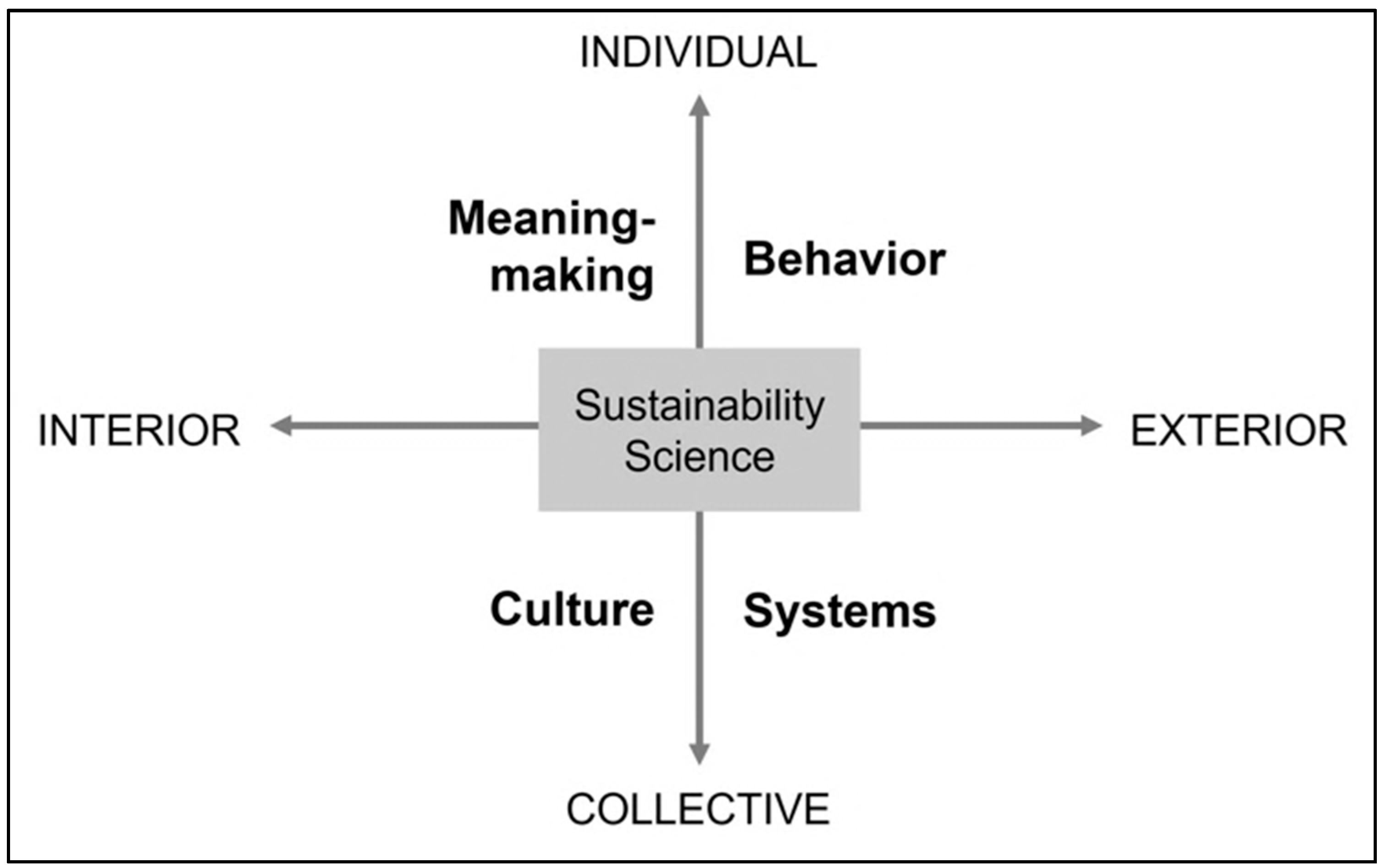
The transformative perspective inherent in ESD 3 can be further specified by drawing on sustainability science. To this end, Shrivastava et al. (2020) built on the integral framework developed by Wilber (1996) and adapted it to sustainability science. Societal transformation is not understood as a one-dimensional process but as the interplay of different epistemic and action-oriented levels, differentiated along two axes: between the individual and the collective, and between interior and exterior dimensions (see Figure 1).
At the individual level, the meaning-making perspective addresses internal processes of meaning attribution shaped by beliefs, values, and worldviews (Shrivastava et al., 2020). Crisis-like experiences in sustainability contexts—such as recognizing contradictions between individual lifestyles and planetary boundaries—may generate irritations that lead to a revision of existing frames of interpretation and a redefinition of personal responsibilities and possibilities for action (Mezirow, 2000; Pettig, 2021). Emotions such as grief, anger, despair, and hope are expressions of these engagement processes (Shrivastava et al., 2020). Accordingly, Pettig and Singer-Brodowski (2025) describe emotions as an integral component of ESD 3, shaping learners’ subjective experiences when engaging with socio-ecological crises.
In contrast, the behavior perspective focuses on psychological influencing factors—such as intrinsic motivation or moral disengagement—that affect individual, outward-oriented action. This perspective emphasizes “the need for a more critical engagement with the social structures and systems in which sustainability measures are enacted” (Shrivastava et al., 2020, p. 333). At the collective level, the culture perspective brings norms, shared values, and interpretative patterns into focus, showing how these are strongly shaped by societal narratives of human–nature relations. “The current narrative that humans are a special, privileged species destined to dominate over nature is deeply flawed, and it has contributed to a fascination with techno-fixes, such as geoengineering” (Shrivastava et al., 2020, p. 333). Pettig and Singer-Brodowski (2025) similarly identify, within the context of ESD 3, an epistemological shift away from a dualistic human–nature view toward an understanding of learning as relationally embedded in more-than-human worlds. At the collective level, the systems perspective addresses institutional, economic, and ecological structures as well as their interrelations (Shrivastava et al., 2020).
According to the Integral Sustainability Science framework, socio-ecological transformation can only be shaped in a viable way if all four perspectives are systematically considered. While earlier sustainability debates tended to emphasize systemic structures (Purvis et al., 2019), an integral approach extends this focus to dimensions crucial for learning, negotiation, and processes of change (Shrivastava et al., 2020). Analogously, in the educational context, this highlights that transformative approaches do not aim solely to transmit action-oriented knowledge, reflect critically on it, or promote behavioral change, and are therefore not restricted to the exterior dimension, as is the case with approaches such as ESD 1. Rather, they address the processual nature of societal transformation, non-dualistic understandings of human–nature relations, and the significance of emotional experiences in learning processes. ESD 3 is thus characterized by the interlinking of processes of meaning making and interpretation (interior), with external structural contexts related to societal transformation processes (exterior; Schmid et al., in press). Kremer and Schmidt (2025, p. 8) note that ESD 3 extends beyond the development of skills, abilities, and knowledge by including an action-oriented component aimed at transforming learners’ self- and worldviews. In the context of sustainability, this involves fostering autonomous individuals who can identify power dynamics and narratives, such as human–nature relations, reflect on them from multiple perspectives, and actively transform them.

2.5. Getting Concrete

Drawing on Integral Sustainability Science (Shrivastava et al., 2020), learning in ESD 3 is conceptualized as a systematic integration of interior and exterior dimensions. Knowledge construction, therefore, does not function as an end in itself or as a merely cumulative increase. Rather, transformative education aims to generate “an understanding of different options for action and solution approaches” (WBGU, 2011, p. 352).
Against this backdrop, the question gains new contours: how can knowledge construction in ESD 3 be designed in terms of content so that learners develop a well-founded understanding of different options for action and can assess them in light of conflicting values, interests, and visions of the future, thereby being prepared to actively co-shape societal transformation processes? It is striking, however, that many conceptualizations remain vague regarding the requirements this entails for learning arrangements. To specify such requirements, it is necessary to further delineate the content of sustainability. Only with reference to its structural configuration can it be determined which forms of knowledge and which situations transformative learning in the sense of ESD 3 can draw upon. For this reason, this article addresses the following research question:
  • What structure of sustainability-related content enables, in the sense of ESD 3, individual and societal change?
The perspective of transformative ESD (ESD 3), which understands learning as “learning in relation with a changing world” (Pettig & Singer-Brodowski, 2025), suggests that sustainability should not be conceived as a static catalog of topics. Instead, sustainability is understood as an expression of complex, controversial, and deeply transformative societal negotiation processes. Accordingly, the analysis next turns to the structure of sustainability-related questions, focusing on sustainability issues, their double complexity—understood as the interlinking of factual and normative dimensions—and their controversial and transformative character.
First, this perspective allows the substantive requirements that transformative education places on sustainability knowledge to be clearly specified. Second, it reveals criteria for how such issues need to be designed as “worthwhile problem cases” to trigger crisis-like irritations and stimulate transformative learning (Pettig, 2021). Third, it illustrates how such objects can open learning opportunities in which students can experiment with their decision-making competence when confronted with conflicting visions of the future. Against this background, the following section, “Sustainability Education between Complexity, Controversiality and Contingency”, elaborates on the specific character of sustainability-related content across complexity, controversiality, and contingency and brings these dimensions together as the 3C Framework for Sustainable Learning.

3. Sustainability Education Between Complexity, Controversiality, and Contingency

3.1. Sustainability Issues

Building on the original definition of sustainable development formulated by the World Commission on Environment and Development (WCED) in the Brundtland Report, Our Common Future, sustainable development can be understood as a process that aims to meet the needs of the present generation without compromising the ability of future generations to meet their own needs (WCED, 1987, p. 36). At the international level, the achievement of sustainability as the goal of sustainable development has been further elaborated, notably through the adoption of the 2030 Agenda. Through its 17 Sustainable Development Goals (SDGs), it provides a global framework that integrates ecological, economic, and social dimensions. Implementing the SDGs is associated with a wide range of challenges that unfold across different spatial levels and affect both global dynamics and local contexts (Allen et al., 2018).
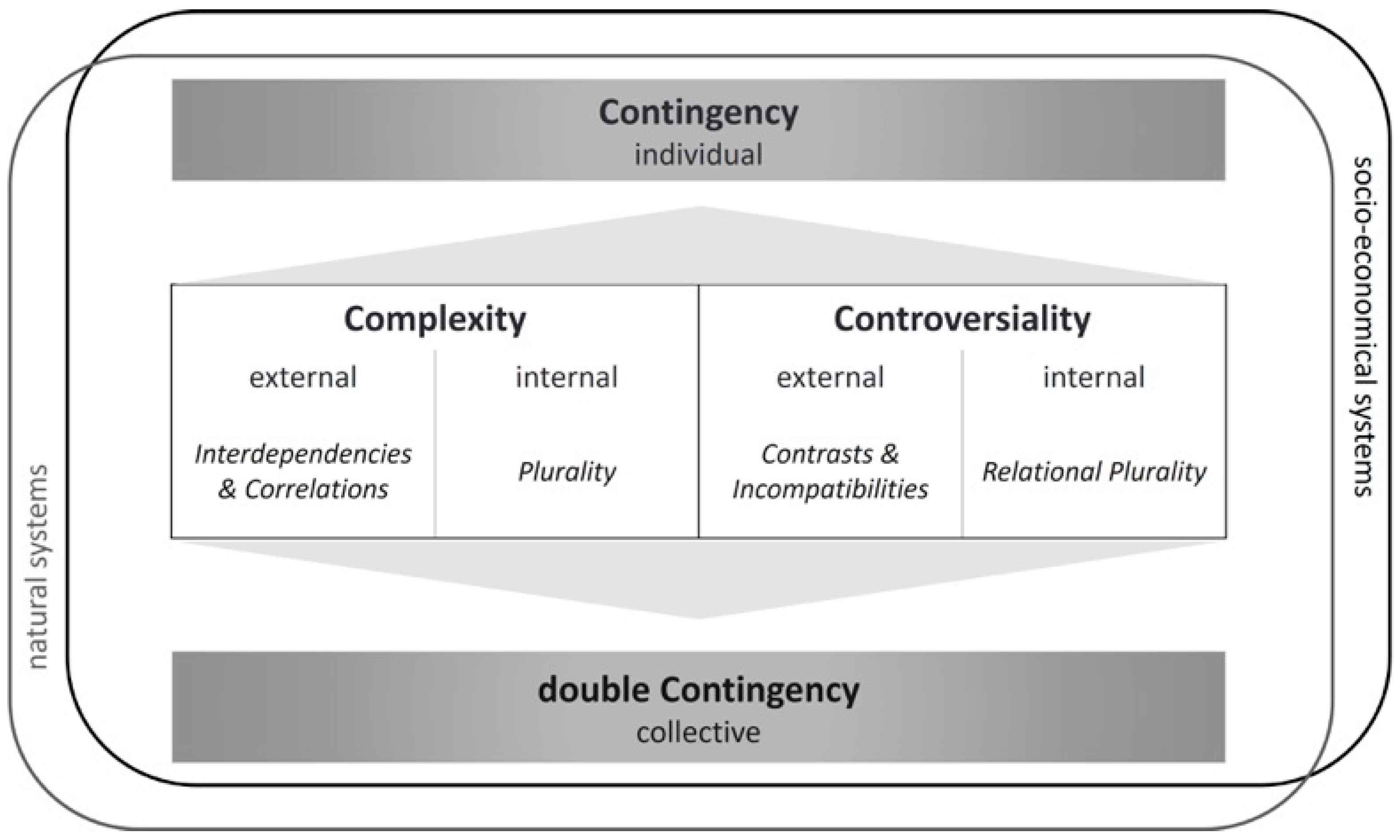
In the educational context, this means that sustainability issues interweave questions of ecological carrying capacities, economic structures, and social justice. Sustainability is thus understood as a field of tension between natural and socio-economic systems (see Figure 2; Clark & Harley, 2020; Haddad & Solomon, 2024; Longo et al., 2025; Tretter et al., 2019; WCED, 1987; Wilhelm & Kalcsics, 2023; Wilhelm & Rinaldi, 2023), manifesting at both local and global levels. This perspective aligns with the concept of critical global citizenship education (Andreotti, 2006; Dang, 2025), which cautions against unreflective universalization of Western notions of development and sustainability and instead aims to reveal global power relations, asymmetric attributions of responsibility, and unequal interdependencies. These considerations give rise to multilayered interrelations and interactions whose dynamics are only partially—or not at all—predictable and are shaped by influencing factors that are not fully known. Sustainability-related transformations rarely proceed linearly and are instead characterized by feedback loops, tipping points, and open, contingent future pathways (e.g., Clark & Harley, 2020; Grundmann, 2020).
Purely factual analyses are insufficient for addressing sustainability-related challenges; beyond this, it is also necessary to recognize them as moral problems (Dittmer et al., 2016). Addressing these problems therefore depends on political and societal negotiation processes in which different interests and value orientations intersect. These considerations provide a basis for further differentiating sustainability issues as complex, controversial, and contingent objects of learning.

3.2. Expanding Educational Approaches: Complexity and Controversiality

In addressing sustainability as both a factual and normative problem field, the concept of the double complexity of sustainability has become particularly established within geography education. It serves as an analytical framework for describing sustainability-related teaching topics and refers to the complexity of both underlying factual matters and societal normative negotiation processes (Bögeholz & Barkmann, 2005; Eggert & Bögeholz, 2006; Mehren et al., 2015; Ohl, 2013, 2018). This indicates that sustainability is constituted not only through interdependencies and correlations within the factual dimension (see Figure 2), but also as a moral problem situation that is inherently value-based (Bögeholz & Barkmann, 2005; Eggert & Bögeholz, 2006; Mehren et al., 2015; Ohl, 2013, 2018).
Within Integral Sustainability Science (Shrivastava et al., 2020), these two dimensions of complexity can be assigned to different levels: factual complexity relates to the exterior level, while value-based complexity is associated with the interior level. This assignment forms the conceptual basis for distinguishing between external and internal complexity (see Figure 2).
Ohl (2013) links double complexity to controversies, understood as disagreements involving at least two mutually incompatible positions. In this regard, Ohl (2013, 2018) distinguishes between controversies in the factual domain, which arise from divergent scientific perspectives, and controversies in the value domain, which describe conflicting views of what may be considered “good” or “right” action in the context of sustainability (Ohl, 2013, 2018). In the following, we refer to the conflict potential underlying such controversies as controversiality. Addressing societal transformation requires, as Daengeli and Kalcsics (2026) argue, recognizing and negotiating systemic drivers of unsustainability, divergent future visions, ethical dilemmas, and societal goal conflicts. Against this backdrop, controversiality becomes a central feature of sustainability-related issues. In the factual dimension, such controversialities are evident, among other things, in the concept of the safe and just corridor (Gupta et al., 2023, 2024), which illustrates the tension between claims to economic growth as a basis for societal stability and the protection of limited natural resources (Gupta et al., 2023, 2024; Raworth, 2012, 2017, 2018; Rockström et al., 2023, 2024). Martin (2015) conceptualizes this conflict potential as a Wachstumsdilemma (growth dilemma) that structurally complicates action-oriented guidance toward a “good life” (O’Neill et al., 2018).
Further factual contradictions arise in land use between the cultivation of energy crops and food production. These contradictions not only affect agricultural land-use systems, but also confront consumption decisions with conflicting demands, such as those between climate protection goals (using biofuels instead of conventional fuels) and the social and ecological consequences of biomass production (Martin, 2015). Controversiality in the factual dimension can thus be understood as an expression of system-immanent contrasts and incompatibilities (see Figure 2) that may arise from limited resources. Within Integral Sustainability Science (Shrivastava et al., 2020), this form of controversiality is assigned to the exterior level. Accordingly, we refer to these dimensions as external controversiality (see Figure 2).
In contrast, the interior level (Shrivastava et al., 2020) foregrounds the normative justificatory contexts of sustainability-related issues. Justificatory grounds underlying factual matters (Martin, 2015) constitute internal complexity (see Figure 2), without any initial weighting of these justifications (Bögeholz & Barkmann, 2005). Internal complexity becomes particularly relevant when different justifications are related to one another and are expressed as antinomies of norms and values or as tensions between divergent interests and power positions (Mehren et al., 2015). In this context, the differing weighting of the ecological, economic, and social dimensions of sustainability also gains significance, as normative orientations can lead to different judgments regarding which goals should be prioritized (Martin, 2015).
While value-based internal complexity describes the plurality (see Figure 2) of existing value references, interests, and normative orientations, internal controversiality refers to their relationship to one another, that is, to questions of mutual weighting, prioritization, and justification. Internal controversiality presupposes an interpersonal level: moral questions only become controversial when different intersubjectively justified judgments encounter one another and are negotiated within a horizon of shared justificatory claims. Ulrich-Riedhammer (2018) emphasizes the importance of intersubjectively shareable judgments for ethical reasoning, in which justifiable and addressable positions, rather than idiosyncratic subjective opinions, come to the fore. In this sense, we understand internal controversiality as relational plurality (see Figure 2), in which different normative references do not stand side by side in isolation, but enter tension-filled relations with one another.
This perspective is compatible with the distinction proposed by Mende and Müller (2020) between additive and reflexive multiperspectivity: while additive multiperspectivity primarily describes the juxtaposition of different political positions, reflexive multiperspectivity focuses on the relational interplay between these positions. For the pedagogical structuring of learning opportunities, double controversiality requires more than merely juxtaposing different perspectives (internal complexity). Crucially, it also requires making the tensions and oppositions in justificatory claims (internal controversiality) explicit objects of shared processes of judgment and negotiation.
Controversiality is given particular significance within ESD 3 approaches, as it is understood as both a driver and a touchstone of societal transformation processes. In their proposal to further develop ESD 1 and ESD 2 toward ESD 3, Pettig and Singer-Brodowski (2025) address which topics should be treated as controversial in educational settings and draw on corresponding criteria of distinction. They identify three criteria that render sustainability-related topics controversial: (1) social, (2) political, and (3) epistemic criterion.
The social criterion (1) is fulfilled when an issue is visibly contested within society, for example, in public debates on the socially just design of the heat transition or the distribution of the costs of climate protection measures. The political criterion (2) refers to topics that are controversial when they are subject to differing and ambivalent positions in the political public sphere, for instance, in disputes over legislative proposals on CO2 budgets, the designation of protected areas, or the regulation of corporations in the Global South. The epistemic criterion (3) is met when different positions on a given issue can be articulated that are rationally and, where possible, empirically supported, for example, concerning the effectiveness of specific climate mitigation instruments or the assessment of technologies such as carbon capture and storage.
For the structuring of sustainability-related learning opportunities, this implies that not every divergent opinion must automatically be treated as an equally legitimate controversy. For example, the denial of anthropogenic climate change can be identified as a violation of the epistemic criterion, given the scientific consensus, and addressed through a more directive approach (e.g., ESD 1). In contrast, questions concerning the equitable shaping of transformation pathways—such as who bears which burdens or which forms of a “good life” should be pursued within planetary boundaries—can be productively addressed as open, controversial negotiation issues within ESD 2 and ESD 3. From the perspective of a reflexive, transformation-oriented ESD, this clarifies that sustainability-related topics are inherently controversial in the classroom, the grounds on which they should be addressed as controversial in educational contexts, and where the normative limits of pluralism should be drawn.

3.3. Expanding Educational Approaches: Contingency

The shift within sustainability science from a primarily explanatory orientation toward a transformation-oriented one (Clark et al., 2016; Shrivastava et al., 2020; Stirling, 2014) has led to an understanding of knowledge about sustainability problems not merely as descriptive or evaluative, but as enabling capacity for action under real conditions of interior complexity and controversiality. Against this backdrop, the question of transformative knowledge (Künkel & Ragnarsdottir, 2022) has increasingly come into focus, along with how it can be pedagogically mediated. Transformative knowledge can be understood neither as secured factual knowledge nor as a normatively unambiguous guide to action. Rather, it emerges within open, conflictual, and normatively plural social processes. We argue that the sociological concept of contingency, or double contingency (see Figure 2), provides a key theoretical perspective for capturing this specific logic of transformative knowledge and making it productive for a contemporary pedagogy of sustainability science.
In sustainability science, transformative knowledge refers to a form of knowledge that goes beyond system explanations and goal definitions and explicitly supports societal capacity for change (Clark et al., 2016; Pohl, 2022; Pohl & Hadorn, 2007; Wiek et al., 2011). It encompasses knowledge about actor constellations, institutional dynamics, power relations, and communication processes, that is, the social conditions under which transformations actually take place. Transformative knowledge is therefore often conceptualized as actionable or usable knowledge (e.g., Hakkarainen & Lazurko, 2025). Crucially, this knowledge is not regarded as context-independent or transferable, but as situational, provisional, and co-produced (Jasanoff, 2004). More recent contributions further emphasize that transformative knowledge is inseparably linked to normative questions and political negotiations and therefore cannot be separated from uncertainty and controversiality (Gupta et al., 2024; Stirling, 2014). This clarifies that transformative knowledge is not knowledge despite uncertainty, but knowledge under conditions of uncertainty, an insight that can be theoretically specified through the concept of contingency.
From a sociological and educational–theoretical perspective, the concept of contingency denotes the fundamental openness of reality: social states, actions, and developments are neither necessary nor impossible, but could be otherwise. Contingency thus refers to the non-determination of meanings, options for action, and visions of the future, and marks a central distinction from deterministic or teleological understandings of society and education (Joas, 1996; Luhmann, 1984). In sociological systems theory, contingency constitutes a basic category for describing society. Luhmann (1984) interprets contingency not as a deficit of knowledge or control, but as a constitutive feature of social reality: societal processes are inherently open because they are based on communication, the continuation of which cannot be unambiguously determined. Contingency therefore denotes the structural possibility of being otherwise, even under conditions of stable institutions (Blatterer, 2024).
When this understanding is applied to educational processes, contingency can initially be located at the individual level (see Figure 2). Learning unfolds as engagement with open problem situations, competing interpretations, and decision-making demands that cannot be resolved unequivocally. In learning arrangements oriented toward transformative ESD, learners encounter contingency, particularly when sustainability-related questions cannot be answered through secured knowledge but instead involve normative weighing, uncertainty, and goal conflicts, that is, interior and exterior controversiality (Pettig & Ohl, 2023a; Stirling, 2014). Contingency at the individual level thus implies that learners recognize that (a) sustainability-related action could be otherwise, (b) decisions can be justified but not ultimately grounded, and (c) responsibility is assumed out of uncertainty, not certainty.
At the same time, current critiques of ESD note that contingency at the individual level is often addressed in a truncated way. Pettig (2021) demonstrates how sustainability is framed in many educational discourses as a utopian ideal of feasibility, the realization of which is primarily attributed to the individual. Responsibility for sustainable transformation is thus addressed mainly through individual behavior, such as mobility or consumption, while societal, economic, and political structural conditions remain largely unaddressed (Pettig, 2021). This individualization of responsibility for sustainability implies agency without systematically reflecting the structural limitations of individual action (Wilhelm & Rinaldi, 2023).
Related to this is a further, widely criticized tendency to reduce sustainability-related educational processes to a focus on symptoms. Kehren and Winkler (2019, p. 379) argue that such a symptom-oriented focus obscures the complex societal causes of sustainability crises and instead promotes simplified solutions and individualized responsibilities while failing to fundamentally question the underlying premises of neoliberal growth ideology. Although contingency is addressed in these approaches, it remains limited to individual decision uncertainty and is not captured in its deeper social structures.
This limitation becomes evident when sustainability-related decisions are embedded in social contexts and thus extend to a collective level (see Figure 2). At this point, contingency condenses into a genuinely social structure that can be described as double contingency (Luhmann, 1984; Parsons, 1951). Sustainability-related learning is therefore confronted with the openness of one’s own decisions as well as with the openness of collective negotiation processes, in which outcomes depend on the actions of other actors. Double contingency refers to the fact that societal transformations are neither fully plannable nor controllable, but unfold through social interactions under conditions of uncertainty, uncertain expectations, and mutual dependence (Bähr et al., 2024).
This perspective aligns with current discourses in sustainability science, in which transformation is explicitly described as a paradoxical process. Pettig and Singer-Brodowski (2025) note that sustainability crises must be addressed simultaneously at the individual and societal levels, with transformation always implying the emergence of something new, unforeseen, and emergent. Transformation therefore cannot be planned linearly, but unfolds in open social processes whose outcomes remain fundamentally contingent.
Accordingly, Schmid et al. (in press) also argue that transformation pathways cannot be understood exclusively from an individual perspective. To adequately capture their complexity and controversiality, they must also be analyzed as societal negotiation processes. Double contingency provides a central analytical frame of reference in this regard, as it systematically reveals the mutual dependence of actors, structures, and expectations.
A sustainability education oriented toward double contingency therefore abandons the notion that education can directly produce sustainable behavior. Instead, agency is understood as relational and contingent: whether and how learners act depends fundamentally on social contexts, institutional frameworks, and the actions of other actors. In this sense, the concept of ESD 3 emphasizes the necessity of understanding learning as a relational process within a changing world (Pettig & Singer-Brodowski, 2025). Transformative knowledge does not emerge through instruction but through participation in open social processes in which uncertainty, emotions, and normative tensions are integral elements.

3.4. “Unk City” as an Example of Sustainability-Related Complexity, Controversiality, and Contingency in Pedagogical Practice

The simulation game Unk City described below is designed for use particularly in Grades 5 and 6 and thus directly addresses pedagogical practice. By means of a real-world-related simulation of urban development, central challenges of sustainable development become tangible for students at this age and are translated into collaborative processes of negotiation and decision-making.
The structural characteristics of sustainability-related content discussed so far—complexity, controversiality, and contingency—can be illustrated using the simulation game Unk City, which was developed as part of the study Unterricht zu Nachhaltigkeit: complex, kontrovers, emotional “Unkke” (Teaching Sustainability: Complex, Controversial, Emotional; Theiler et al., 2026). The simulation game aims to design a city so that a “good life” is possible for all. To this end, the learning group is divided into seven districts, each of which pursues different focal areas, such as housing, food production, or employment. Throughout the game, learners are confronted with limited ecological resources as well as socially and economically unequal starting conditions. They are faced with the fundamental question of how life within the safe and just corridor (Gupta et al., 2023, 2024) can be organized. In Unk City, sustainability does not appear as a predefined end state; instead, it becomes tangible as the provisional outcome of ongoing decisions, trade-offs, and negotiation processes.
The external complexity of the learning object becomes evident in the simulation game through the manifold interdependencies between natural environmental conditions and socio-economic developments. Decisions in one domain, such as investments in economic growth or housing, affect other domains and generate causal relations, for example, in the form of increasing environmental pressures. External complexity is further intensified by external controversiality, as the city’s socio-economic development is accompanied by rising environmental pressures, thus giving rise to a system-immanent contradiction within the safe and just corridor (Gupta et al., 2023, 2024). Drawing on the Planetary Boundaries concept from sustainability science (Gupta et al., 2023, 2024; Rockström et al., 2023, 2024), Unk City also incorporates the Doughnut model from economics (Raworth, 2012, 2017, 2018) and is guided by the Apfelring mit Biss model adapted for educational contexts (Rehm et al., 2026). All three models visualize the tension between planetary boundaries and the minimum social requirements for a good life.
Concurrently, Unk City exhibits internal complexity, as learners are confronted with diverse value orientations, normative priorities, and claims to justice that emerge within the simulation game. These orientations become evident, for example, in capitalist guiding ideas such as the accumulation of material wealth, as well as in ecological interests, such as the protection of natural life-support systems. When this plurality of normative reference points is brought into relation with one another, it may give rise to a field of internal controversiality. Addressing this controversiality requires explicit engagement with the underlying value assumptions and justificatory grounds of different actors and thus follows the understanding of reflexive multiperspectivity (see Mende & Müller, 2020). This can be observed, for instance, when district representatives in Unk City move beyond merely exchanging positions and instead scrutinize and weigh the justificatory grounds of their priorities, such as safeguarding prosperity versus ecological limits on pressure.
Within the simulation game Unk City, questions of a good life in the city are shaped by both external and internal complexity as well as external and internal controversiality. On this basis, learners can make reflective decisions about the city as a whole and derive corresponding courses of action, consistent with the aims of ESD 3. Crucially, learning does not remain confined to analytical reflection. Instead, it enables learners to engage collectively with a complex and controversial system, including its inherent and partly contradictory perspectives, and to explore possible courses of action through practice.
The ongoing need to make decisions about the future development of Unk City repeatedly confronts learners with both individual and collective contingency. In this process, they recognize that decisions do not arise solely from individual knowledge or moral conviction, but depend on the expectations, interests, and actions of other actors. As a result, the outcomes of collective negotiation processes remain open and not fully controllable, even when all participants act based on reasoned arguments. Transformation thus appears as a fundamentally social process whose course and outcomes remain contingent.

4. Conclusions and Outlook: Educational Perspectives and Research Needs

We argue that sustainability content in transformative education (ESD 3) should not be treated as a thematic field but as a set of specifically structured sustainability issues. These sustainability issues are situated within a field of tension between natural and socio-economic systems as well as between global and local reference levels. Conceptually, they are characterized by three interrelated facets: external and internal complexity, external and internal controversiality, and individual and collective contingency (see Figure 2). To understand transformative processes, we therefore extend the concept of double complexity to include controversiality and contingency. In doing so, the 3C Framework for Sustainable Learning goes beyond existing approaches that primarily focus on complexity by explicitly integrating contingency as a constitutive dimension of sustainability issues, thereby enabling a process-oriented perspective on societal transformation. On the one hand, this emphasizes the need to engage with, negotiate, and critically reflect on controversial sustainability issues as socio-ecologically embedded conflicts (e.g., Daengeli & Kalcsics, 2026); on the other hand, it incorporates double contingency as a sociologically grounded analytical lens, thereby avoiding a narrow focus on the analysis of complexity and controversiality and instead foregrounding processes of societal transformation. From a pedagogical perspective, this raises the question of how teachers can approach sustainability issues in ways that do justice to their complexity, controversiality, and contingency. Possible guiding questions include the following:
  • External complexity: What interdependencies and correlations characterize the issue within the field of tension between natural and socio-economic systems?
  • External controversiality: Which contrasts and incompatibilities are inherent in the issue?
  • Internal complexity: Which values, interests, norms, and perspectives are involved?
  • Internal controversiality: Which values, interests, and perspectives come into conflict with one another?
  • Contingency (individual and collective): To what extent can situations of individual and collective contingency be made experientially accessible and open to reflection in learning processes?
Drawing on Integral Sustainability Science (Shrivastava et al., 2020), the 3C Framework for Sustainable Learning shows that enabling processes of change requires sustainability-related knowledge integrating both factual (exterior) and normative (interior) dimensions. Only by linking these two dimensions can reflective judgment and decision-making occur in ways that reflect the transformative character of sustainability issues. Accordingly, it is not sufficient to solely identify or analyze the internal and external complexity and controversiality of sustainability issues; rather, their implications for fundamental changes in societal practices, structures, and orientations must also be addressed.
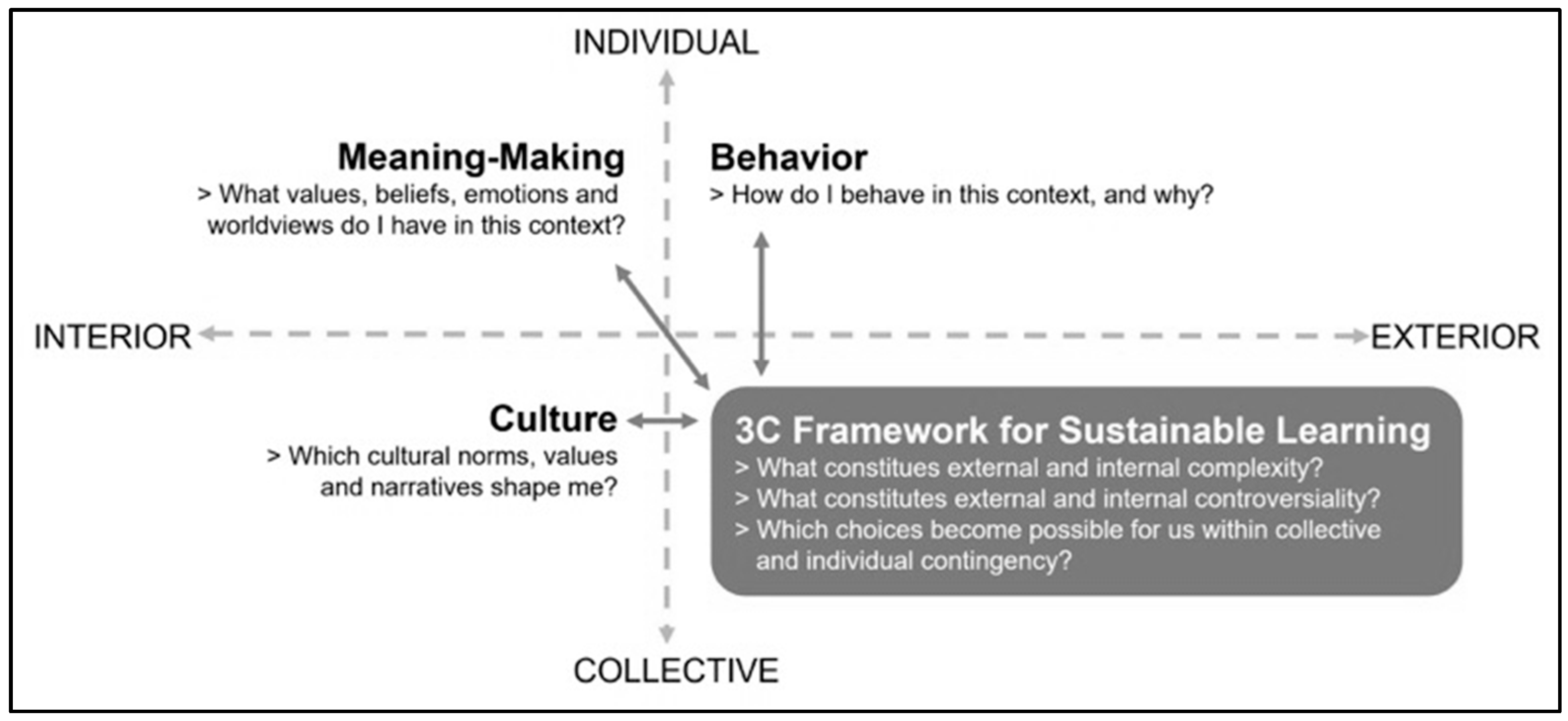
These decision-making and transformation processes do not take place under stable or clearly determinable conditions, but under conditions of contingency. Particularly in the context of societal negotiation processes, double contingency must be assumed, since decisions are always made with an awareness of the possible decisions of other actors. Sustainability-related options for action are therefore neither unambiguously given nor conclusively justifiable; instead, they remain fundamentally open, uncertain, and conflictual. Against this background, it becomes clear that transformative education aims to enable learners to develop a deeper understanding of sustainability issues as well as empower them to perceive themselves as part of societal transformation processes. Crucially, learning processes should address individual contingency and, above all, in the sense of ESD 3, collective contingency, encouraging learners to reflect on their own positioning within the problem spaces presented (see Figure 3, Systems). Learners should therefore have the opportunity to explore their values, beliefs, and worldviews (see Figure 3, Meaning-Making) in the context of societal transformation processes, to question their cultural imprints—such as their understanding of human–nature relations (see Figure 3, Culture)—and to critically analyze their motivations for action or inaction (see Figure 3, Behavior). Meanwhile, ESD 3 requires learning settings that render the real conditions of societal negotiation processes experiential, for example, via simulation games, so that double contingency is both discussed and actively experienced.
Transformative education is thus characterized by enabling learners to experiment with decision making under conditions of uncertainty, to adopt the perspectives of different actors, to reflect on the consequences of alternative courses of action, and to interpret and manage the emotions triggered in the process. Sustainability becomes experiential only through the integration of knowledge construction, (self-)reflection, and the practical exploration of action. It emerges as an open and shapeable transformation process in which active participation and co-shaping can be practiced. ESD 3 does not aim for learners to solve current sustainability problems but to develop and test their capacity for active, reflective engagement in societal transformation processes.
ESD 3 therefore places high demands on instructional design and teachers’ professional competencies. This raises follow-up questions that go beyond the scope of this article:
  • How can learning settings be designed to address the specific structure of sustainability content so that learners can engage in decision-making under conditions of double contingency, complexity, and controversiality?
  • What concrete implications does ESD 3 have for teachers’ professional competencies, particularly for pre-service and in-service teacher education?
In this context, ongoing work at the UNESCO Chair on Education in Sustainability and Global Citizenship (Lucerne) builds on the 3C Framework for Sustainable Learning and ESD 3, as outlined in this article, to develop models that address (1) students’ learning in sustainability, (2) teachers’ professional competencies, and (3) the design of sustainability-oriented learning environments. Moreover, we have only implicitly addressed the role of uncertainty as a constitutive component of sustainability (Lazarus & Funtowicz, 2023). Future research should further investigate and differentiate the relationship between uncertainty and learners’ emotions.

Author Contributions

Conceptualization, M.B., R.T., R.G., M.R. and M.W.; writing—original draft preparation, M.B.; writing—review and editing, M.B., M.R. and M.W.; visualization, M.B.; supervision, M.R. and M.W.; project administration, R.T.; funding acquisition, M.W. All authors have read and agreed to the published version of the manuscript.

Funding

This research is funded by Swiss National Science Foundation (SNSF), grant number 100019_220044/1.

Institutional Review Board Statement

Not applicable.

Data Availability Statement

No new data were created or analyzed in this study.

Acknowledgments

We are grateful for the careful proofreading and all those who engaged in discussions with us on the 3C-FSL. During the preparation of this manuscript, the author(s) used ChatGPT (GPT-5.3) for the purposes of translation. The authors have reviewed and edited the output and take full responsibility for the content of this publication.

Conflicts of Interest

The authors declare no conflicts of interest. The funders had no role in the design of the study; in the collection, analyses, or interpretation of data; in the writing of the manuscript; or in the decision to publish the results.

Abbreviations

The following abbreviations are used in this manuscript:
3C-FSL3C Framework for Sustainable Learning
ESDEducation for Sustainable Development
SDGsSustainable Development Goals
UnkkeUnterricht zu Nachhaltigkeit: complex, kontrovers, emotional (Sustainability Education: Complex, Controversial, Emotional)
WCEDWorld Commission on Environment and Development

References

  1. Allen, C., Metternicht, G., & Wiedmann, T. (2018). Initial progress in implementing the Sustainable Development Goals (SDGs): A review of evidence from countries. Sustainability Science, 13(5), 1453–1467. [Google Scholar] [CrossRef] [Scilit]
  2. Andreotti, V. (2006). Soft versus critical global citizenship education. Policy & Practice—A Development Education Review, 3, 40–51. [Google Scholar]
  3. Bähr, I., Bonnet, A., Bracker da Ponte, E., Gebhard, U., Krieger, C., Lübke, B., & Sting, W. (2024). Uncertainty in subject matter education—Constitutive element and fruitful instructional strategy? Zeitschrift für Bildungsforschung, 14, 375–395. [Google Scholar] [CrossRef] [Scilit]
  4. Billi, M., Zurbriggen, C., Urquiza, A., & Allendes, A. (2024). Transition in action: Toward a social theory of the governance of transitions. Frontiers in Sociology, 9, 1206050. [Google Scholar] [CrossRef] [Scilit] [PubMed]
  5. Blatterer, H. (2024). From systems to forms: Reconstructing Niklas Luhmann’s approach to relationships. Thesis Eleven, 182(1), 75–93. [Google Scholar] [CrossRef] [Scilit]
  6. Bögeholz, S., & Barkmann, J. (2005). Rational choice and beyond: Handlungsorientierte kompetenzen für den umgang mit faktischer und ethischer komplexität. In R. Klee, & A. Sandmann (Eds.), Lehr- und lernforschung in der biologiedidaktik. Band 2 (pp. 211–224). StudienVerlag. [Google Scholar]
  7. Clark, W. C., & Harley, A. G. (2020). Sustainability science: Toward a synthesis. Annual Review of Environment and Resources, 45(1), 331–386. [Google Scholar] [CrossRef] [Scilit]
  8. Clark, W. C., van Kerkhoff, L., Lebel, L., & Gallopin, G. C. (2016). Crafting usable knowledge for sustainable development. Proceedings of the National Academy of Sciences of the United States of America, 113(17), 4570–4578. [Google Scholar] [CrossRef] [Scilit] [PubMed]
  9. Daengeli, M., & Kalcsics, K. (2026). Warum müssen, wie wollen und wie können wir uns anpassen? Grundzüge einer politischen Nachhaltigkeitsbildung in der Lehrer:innenbildung. Beiträge zur Lehrerinnen- und Lehrerbildung, 44(1), 22–32. [Google Scholar] [CrossRef] [Scilit]
  10. Dang, J. (2025). Daoist insights into the cognitive domain of global citizenship education: A case study of global poverty. TAO, 1(2), 100021. [Google Scholar] [CrossRef] [Scilit]
  11. Detjen, J. (2013). Politische bildung: Geschichte und gegenwart in deutschland. Oldenbourg Wissenschaftsverlag Verlag. [Google Scholar]
  12. Detjen, J., Massing, P., Richter, D., & Weisseno, G. (2012). Politikkompetenz: Ein modell. Springer. [Google Scholar]
  13. Dittmer, A., Gebhard, U., Höttecke, D., & Menthe, J. (2016). Ethisches bewerten im naturwissenschaftlichen unterricht: Theoretische bezugspunkte. Zeitschrift für Didaktik der Naturwissenschaften (ZfDN), 22, 97–108. [Google Scholar] [CrossRef] [Scilit]
  14. Eggert, S., & Bögeholz, S. (2006). Göttinger modell der bewertungskompetenz: Teilkompetenz “Bewerten, Entscheiden und Reflektieren” für gestaltungsaufgaben nachhaltiger entwicklung. Zeitschrift für Didaktik der Naturwissenschaften (ZfDN), 12, 177–197. [Google Scholar] [CrossRef]
  15. Grundmann, S. S. (2020). Politik und ethik in der demokratie: Zur theorie und praxis erfolgreichen scheiterns im politikmanagement. Springer. [Google Scholar]
  16. Gupta, J., Bai, X., Liverman, D. M., Rockström, J., Qin, D., Stewart-Koster, B., Rocha, J. B., Jacobson, L., Abrams, J. F., Andersen, L. S., Armstrong McKay, D. I., Bala, G., Bunn, S. E., Ciobanu, D., DeClerck, F., Ebi, K. L., Gifford, L., Gordon, C., Hasan, S., … Gentile, G. (2024). A just world on a safe planet: A lancet planetary health–earth commission report on earth-system boundaries, translations, and transformations. The Lancet Planetary Health, 8(10), e813–e873. [Google Scholar] [CrossRef] [Scilit]
  17. Gupta, J., Prodani, K., Bai, X., Gifford, L., Lenton, T. M., Otto, I., Pereira, L., Rammelt, C., Scholtens, J., & Tàbara, J. D. (2023). Earth system boundaries and earth system justice: Sharing the ecospace. Environmental Politics, 33(7), 1286–1305. [Google Scholar] [CrossRef] [Scilit]
  18. Haddad, B. M., & Solomon, B. D. (2024). Ecological economics as the science of sustainability and transformation: Integrating entropy, sustainable scale, and justice. PLoS Sustainability and Transformation, 3(2). [Google Scholar] [CrossRef] [Scilit]
  19. Hakkarainen, V., & Lazurko, A. (2025). Entanglements of knowledge and action in sustainability science: Reclaiming reflexivity to embrace the uncomfortable. Sustainability Science, 20, 1979–1990. [Google Scholar] [CrossRef] [Scilit]
  20. IPCC. (2023). Climate change 2023: Synthesis report. IPCC. [Google Scholar] [CrossRef] [Scilit]
  21. Jasanoff, S. (2004). States of knowledge: The co-production of science and social order. Routledge. [Google Scholar]
  22. Joas, H. (1996). Die kreativität des handelns. Suhrkamp. [Google Scholar]
  23. Kehren, Y., & Winkler, C. (2019). Nachhaltigkeit als bildungsprozess und bildungsauftrag. In W. Leal Filho (Ed.), Aktuelle ansätze und umsetzung der UN-nachhaltigkeitsziele (pp. 373–391). Springer. [Google Scholar]
  24. Kremer, K., & Schmidt, E. (2025). Bildung für nachhaltige entwicklung und klimawandel. In D. Höttecke, S. Heinicke, H. Martens, A. Nehring, & T. Rabe (Eds.), Handbuch klimabildung (pp. 3–20). Springer. [Google Scholar]
  25. Künkel, P., & Ragnarsdottir, K. V. (Eds.). (2022). Transformation literacy. Springer. [Google Scholar] [CrossRef] [Scilit]
  26. Lazarus, M. D., & Funtowicz, S. (2023). Learning together: Facing the challenges of sustainability transitions by engaging uncertainty tolerance and post-normal science. Sustain Earth Reviews, 6, 18. [Google Scholar] [CrossRef] [Scilit]
  27. Li, W., Wei, Y., Chen, L., Chen, Z., Li, M., Chen, W., Yang, K., Xu, D., & Zhao, Q. (2025). Multiple environmental inequalities between Global South and Global North in over 10,000 urban centers. npj Urban Sustainability, 5, 111. [Google Scholar] [CrossRef] [Scilit]
  28. Longo, S. B., Isgren, E., & Carolan, M. (2025). Critical sustainability science: Advancing sustainability transformations. Sustainability Science, 20, 1903–1917. [Google Scholar] [CrossRef] [Scilit]
  29. Luhmann, N. (1984). Soziale systeme: Grundriß einer allgemeinen theorie. Suhrkamp. [Google Scholar]
  30. Martin, A. (2015). Gegensätze der Nachhaltigkeit (pp. 2–30). Working papers of the chair for innovation research and technology management, No. 4-1. Chemnitz University of Technology. Available online: https://www.econstor.eu/handle/10419/111060 (accessed on 6 March 2022).
  31. Mehren, M., Mehren, R., Ohl, U., & Riesenberger, C. (2015). Die doppelte komplexität geographischer themen: Eine lohnenswerte herausforderung für schüler und lehrer. Geographie Aktuell & Schule, 37(216), 4–11. [Google Scholar]
  32. Mende, J., & Müller, S. (2020). Einfach komplex? Die übersetzung politikwissenschaftlicher komplexität in die gesellschaft. Zeitschrift für Politikwissenschaft, 30, 379–399. [Google Scholar] [CrossRef] [Scilit]
  33. Mezirow, J. (2000). Learning to think like an adult: Core concepts of transformation theory. In J. Mezirow, & Associates (Eds.), Learning as transformation. Critical perspectives on a theory in progress (pp. 3–34). Jossey-Bass. [Google Scholar]
  34. Ohl, U. (2013). Komplexität und kontroversität: Herausforderungen des geographieunterrichts mit hohem bildungswert. Praxis Geographie, 3, 4–8. [Google Scholar]
  35. Ohl, U. (2018). Herausforderungen und wege eines systematischen umgangs mit komplexen themen in der schulischen nachhaltigkeitsbildung. In T. Pyhel (Ed.), Zwischen ohnmacht und zuversicht? Vom umgang mit komplexität in der nachhaltigkeitskommunikation (pp. 131–146). Oekom. [Google Scholar]
  36. O’Neill, D. W., Fanning, A. L., Lamb, W. F., & Steinberger, J. K. (2018). A good life for all within planetary boundaries. Nature Sustainability, 1, 88–95. [Google Scholar] [CrossRef] [Scilit]
  37. Parsons, T. (1951). The social system. Free Press. [Google Scholar]
  38. Pettig, F. (2021). Transformative lernangebote kritisch-reflexiv gestalten: Fachdidaktische orientierungen einer emanzipatorischen BNE. GW-Unterricht, 44(2), 5–17. [Google Scholar] [CrossRef] [Scilit]
  39. Pettig, F., & Ohl, U. (2023a). Dealing with uncertainty in a transformative education for sustainability. In O. Muñiz Solari, & G. Schrüfer (Eds.), Understanding sustainability with pedagogical practice (pp. 29–40). Springer. [Google Scholar] [CrossRef] [Scilit]
  40. Pettig, F., & Ohl, U. (2023b). Transformatives lernen für einen sozial-ökologischen wandel: Facetten eines zukunftsfähigen geographieunterrichts. Praxis Geographie, 46(1), 4–9. [Google Scholar]
  41. Pettig, F., & Singer-Brodowski, M. (2025). Learning in relation with a changing world: Thinking beyond ESD 1 and ESD 2 towards ESD 3. Journal of Education for Sustainable Development, 18(2), 176–201. [Google Scholar] [CrossRef] [Scilit]
  42. Planetary Footprint Network. (2025). Past earth overshoot days. Available online: https://overshoot.footprintnetwork.org/newsroom/past-earth-overshoot-days/ (accessed on 1 December 2025).
  43. Pohl, C. (2022). Three types of knowledge tool. td-net toolbox for co-producing knowledge. Swiss Academies of Arts and Sciences. [Google Scholar] [CrossRef]
  44. Pohl, C., & Hadorn, G. H. (2007). Principles for designing transdisciplinary research—Proposed by the Swiss Academies of Arts and Sciences. Oekom Verlag. [Google Scholar]
  45. Purvis, B., Mao, Y., & Robinson, D. (2019). Three pillars of sustainability: In search of conceptual origins. Sustainability Science, 14, 681–695. [Google Scholar] [CrossRef] [Scilit]
  46. Raworth, K. (2012). A safe and just space for humanity: Can we live within the doughnut? Oxfam Discussion Paper. Oxfam International. [Google Scholar] [CrossRef] [Scilit]
  47. Raworth, K. (2017). A Doughnut for the anthropocene: Humanity’s compass in the 21st century. The Lancet Planetary Health, 1(2), e48–e49. [Google Scholar] [CrossRef] [Scilit] [PubMed]
  48. Raworth, K. (2018). Doughnut economics: Seven ways to think like a 21st-century economist. Penguin Books. [Google Scholar]
  49. Rehm, M., Hermann, M., Kalcsics, K., Rinaldi, S., Schmid, F., & Wilhelm, M. (2026). Der apfelring mit biss: Auf dem weg zu einer transformativen bildung in nachhaltiger entwicklung. Die Deutsche Schule, 26(1), 10–20. [Google Scholar] [CrossRef] [Scilit]
  50. Rieckmann, M. (2018). Die bedeutung von bildung für nachhaltige entwicklung für das erreichen der sustainable development goals (SDGs). Zeitschrift für Internationale Bildungsforschung und Entwicklungspädagogik (ZEP), 41(2), 4–10. [Google Scholar] [CrossRef] [Scilit]
  51. Rockström, J., Donges, J. F., Fetzer, I., Martin, M. A., Wang-Erlandsson, L., & Richardson, K. (2024). Planetary boundaries guide humanity’s future on earth. Nature Reviews Earth & Environment, 5, 773–788. [Google Scholar] [CrossRef] [Scilit]
  52. Rockström, J., Gupta, J., Qin, D., Lade, S., Abrams, J. F., Andersen, L. S., Armstrong McKay, D. I., Bai, X., Bala, G., Bunn, S. E., & Ciobanu, D. (2023). Safe and just earth system boundaries. Nature, 619, 102–111. [Google Scholar] [CrossRef] [Scilit]
  53. Sander, H. (2017). Orientierungen von jugendlichen beim urteilen und entscheiden in kontexten nachhaltiger entwicklung: Eine rekonstruktive perspektive auf bewertungskompetenz in der didaktik der naturwissenschaft. Logos. Available online: http://www.logos-verlag.de/ebooks/OA/978-3-8325-4434-8.pdf (accessed on 21 April 2026).
  54. Schmid, F., Rehm, M., & Rinaldi, S. (in press). Ternary complexity of global issues: A consolidated conceptual framework for addressing global issues in education. Prospects.
  55. Shrivastava, P., Stafford Smith, M., O’Brien, K., & Zsolnai, L. (2020). Transforming sustainability science to generate positive social and environmental change globally. One Earth, 2(4), 329–340. [Google Scholar] [CrossRef] [Scilit]
  56. Stirling, A. (2014). Transformative approaches to sustainability science. Environmental Science & Policy, 39, 1–8. [Google Scholar]
  57. Theiler, R., Budmiger, M., Grob, R., Rehm, M., & Wilhelm, M. (2026). Komplex, kontrovers, emotional: Planspiele im Unterricht zu Nachhaltigkeit: Entwicklungsprozess und theoretische Fundierung des Planspiels Unk City. Itdb, 1, 25–41. [Google Scholar] [CrossRef]
  58. Tretter, F., Simon, K. H., & Glaeser, B. (2019). Humanökologie und nachhaltigkeitswissenschaft: Unterschiede und gemeinsamkeiten, optionen für synergien. GAIA, 28(2), 174–176. [Google Scholar] [CrossRef] [Scilit]
  59. Ulrich-Riedhammer, E. M. (2018). Die ethische brille aufsetzen: Zur frage der förderung ethischen urteilens im geographieunterricht. Zeitschrift für Geographiedidaktik/Journal of Geography Education, 46(4), 7–32. [Google Scholar] [CrossRef]
  60. UNESCO. (2021). Bildung für nachhaltige entwicklung: Eine roadmap. UNESCO. [Google Scholar]
  61. United Nations Environment Programme [UNEP]. (2019). Global environment outlook: GEO-6: Healthy planet, healthy people. Available online: https://wedocs.unep.org/handle/20.500.11822/27539 (accessed on 3 November 2025).
  62. Vare, P. (2014). Are there inherent contradictions in attempting to implement education for sustainable development in schools? [Doctor of Education thesis, University of Bath]. [Google Scholar]
  63. Vare, P., & Scott, W. (2007). Learning for a change: Exploring the relationship between education and sustainable development. SAGE Publications, 1(2), 191–198. [Google Scholar] [CrossRef] [Scilit]
  64. WBGU. (2011). World in transition: A social contract for sustainability. WBGU. [Google Scholar]
  65. WCED. (1987). Our common future. World commission on environment and development. Oxford University Press. [Google Scholar]
  66. Wiek, A., Withycombe, L., & Redman, C. (2011). Key competencies in sustainability. Sustainability Science, 6, 203–218. [Google Scholar] [CrossRef] [Scilit]
  67. Wilber, K. (1996). A brief history of everything. Shambala Publications. [Google Scholar]
  68. Wilhelm, M., & Kalcsics, K. (2023). Diskussion einer didaktik der nachhaltigkeitswissenschaft. Auf der Suche nach einer professionskompetenz zu BNE. Journal für LehrerInnenbildung, 23(3), 16–25. [Google Scholar] [CrossRef] [Scilit]
  69. Wilhelm, M., & Rinaldi, S. (2023). Pädagogische hochschulen als leitinstitutionen auf dem weg zu einer didaktik der nachhaltigkeitswissenschaft: Fünf thesen zu bildung in nachhaltiger entwicklung. In P. Tremp (Ed.), Nachdenken über lehrerinnen- und lehrerbildung. Anregungen zur weiterentwicklung der pädagogischen hochschulen in der deutschsprachigen schweiz. Aus Anlass des 20-jahre-jubiläums der pädagogischen hochschule luzern (pp. 136–145). Pädagogische Hochschule Luzern. [Google Scholar] [CrossRef]
  70. Wintersteiner, W., Glettler, C., Grobbauer, H., Peterlini, H. K., Rauch, F., & Steiner, R. (2023). Transformative bildung: Ein weg zur nachhaltigkeit? Magazin Erwachsenenbildung.at, 49, 9–18. [Google Scholar] [CrossRef]
Figure 1. Integral Sustainability Science, adapted from Shrivastava et al. (2020, p. 333).
Education 16 00702 g001
Figure 2. The 3C Framework for Sustainable Learning (3C-FSL).
Education 16 00702 g002
Figure 3. Addressing sustainability issues in ESD 3.
Education 16 00702 g003
Disclaimer/Publisher’s Note: The statements, opinions and data contained in all publications are solely those of the individual author(s) and contributor(s) and not of MDPI and/or the editor(s). MDPI and/or the editor(s) disclaim responsibility for any injury to people or property resulting from any ideas, methods, instructions or products referred to in the content.