1. Introduction
Artifacts are physical and conceptual constructions, formed within human activity, which support communication, intersubjective knowledge building, and mediation between people (
Trausan-Matu & Slotta, 2021). An artifact, as a material object, can provide insights into people’s internal processes, behavior, and sociocultural practices (
Flick, 2006). When a researcher invites research participants to construct an artifact within a research encounter—physically, analytically, conceptually, or imaginatively—the artifact produced is then considered data. The purpose of such
artifact construction, as a research method, is to think creatively and expansively about the research topic, freed from the constraints of words alone. Illuminating unique dimensions of meaning, artifacts have long been employed in social research to make visible internal processes for analysis (
Denzin & Lincoln, 2018) and, over the past two decades, increasing numbers of researchers have been employing artifact construction and visual research methods as part of their methodological repertoires (
Martikainen & Hakoköngäs, 2023). Few have leveraged artifact construction in understanding the complexities of academic leadership and the depths of wellbeing; few have employed artifact construction in research sites beyond culturally ‘western’ ones.
The study upon which this paper reports took place with ten women academic leaders at a university in Saudi Arabia, where women’s employment has significantly increased with the national development initiative Vision 2030. Women have been making gains in leadership across various industries (
Iqbal et al., 2026). Updates to labor laws include some favorable to women, and numbers of women in decision-making roles are rising, including in the Shura Council (Majlis al-Shura), the country’s formative advisory body (
Alanazi & Alkouatli, 2023). Yet further research is needed on women’s leadership formation and how it relates to wellbeing. This interpretive study was guided by the research question: “How do Saudi women in academic leadership positions describe cultivating and maintaining wellbeing?” The Saudi women academic leaders articulated unique sources of establishing wellbeing (reported in
Alanazi & Alkouatli, 2023), processes of maintaining wellbeing, and expressions evidencing wellbeing. This paper asks how artifact construction, as a visual method within semi-structured interviews, generated new insights on the research question. The research participants were invited to draw or diagram their senses of wellbeing, defined, at the confluence of physical, mental, and social–emotional health, as the ability to self-actualize, cope with life stresses, work productively, and contribute to community (
WHO, 2022).
The next section describes the research context, the paper’s rationale, and a brief overview of the original study.
Section 2 provides the contextualizing literature on the evolution of visual methods and sensitizing concepts compiled into an integrated conceptual framework that came to bear on artifact construction as a method.
Section 3 describes the methodology, with a particular focus on artifact construction.
Section 4 presents the results of artifact construction—thematic findings in four exemplary artifacts—to explore how the method can provide new insights on wellbeing amongst these Saudi academic leaders.
Section 5 discusses the findings vis-à-vis the affordances and constraints of artifact construction as the method employed empirically in this cultural and historical moment.
1.1. Research Context
Women are at the forefront of rapid sociocultural change in contemporary Saudi Arabia (
Alghamdi et al., 2022). Their propulsion into the labor force is central to the country’s strategic development agenda towards economic, social, cultural, and environmental sustainability and diversity (
Alshuwaikhat & Mohammed, 2017). The rapid change is bringing both opportunities and challenges, including in universities where women are attaining leadership positions. How do these leaders maintain life balance and stay well? Of the few studies that have inquired into this topic in this context,
Iqbal et al. (
2026) argued that Vision 2030 has been a positive moderating force for Saudi women, aiding in reducing barriers, amplifying opportunities, and supporting accomplishments in ways that ultimately enable more women to access and thrive in leadership roles.
Abuzahera (
2025) examined some impacts of Vision 2030 on women’s psychosocial wellbeing and suggested that increases in workforce participation and leadership opportunities have contributed to positive mental health and self-esteem. However, these are experienced variably across different demographic groups, and persistent cultural and economic barriers may limit reform effectiveness. Within the wellbeing literature, although some researchers claim to have identified “common elements of wellbeing that transcend countries and cultures” (
Rath & Harter, 2010, p. 1), optimal levels and expressions of wellbeing are likely to vary across individuals and cultures (
Diener et al., 2018).
1.2. Study Overview
This study took place at a large public Saudi university for women in 2022, six years after the initiation of Vision 2030. Inclusion criteria included that a participant must be a Saudi woman of any age holding an academic leadership position. The study was designed in recognition that the weight of professional responsibility for women in leadership positions might heighten the awareness and necessity of maintaining work–home balance and possibly wellbeing. This study’s topical rationale was to explore Saudi women leaders’ wellbeing at a time of sociocultural change (reported in
Alanazi & Alkouatli, 2023). The study’s second rationale, the focus of this paper, was methodological: most research on wellbeing has been conducted through quantitative instruments designed for use with Western populations (
Abdel-Khalek, 2010), which may not be optimal in understanding culturally specific iterations. More nuanced data from non-Western contexts is required for a fuller picture of wellbeing (
Fave et al., 2011). Given that the two researchers are Canadian and Saudi Arabian, respectively, and the research participants are Saudi women of an age range spanning two decades, this study required a methodology able to capture the nuances of an intimate topic across cultures, languages, and generations. We employed the visual method of artifact construction within semi-structured interviewing to illuminate implicit aspects of women’s wellbeing beyond words alone. Without privileging one mode of sense-making over others,
Brice (
2024) noted that using drawing (and other forms of artifact construction), “enables research to engage simultaneously with the discursive, performative, material, and affective dimensions of perceptual processes” (p. 211). As such, this method promised to hold potential in capturing complexity at the conceptual intersection of wellbeing and female academic leadership.
2. Literature Review: Evolution of a Method, Sensitizing Concepts on Wellbeing, and Methodological Responses
Artifact construction is situated within the broader vista of visual research methods, defined as using visual materials as part of the process of generating evidence in exploring research questions (
Rose, 2014). The proliferation of visual research methods over the past couple of decades in social science research is characterized by some large themes as well as some critiques. While some suggest that visual research methods have proliferated due to the increasing importance of visual images in culture and society, others assert that visual research methods are themselves contributing to the evolution of contemporary visual culture (
Rose, 2014). Visual methods aim to expand research focus beyond verbal data, are used to stimulate dialog, and, as tangible materials, may aid understanding and expression within a research encounter (
Nind & Vinha, 2016). For example, using graphics in artifact-mediated interviews improved verbal interactions and enriched data with less-communicative research participants (
Bahn & Barratt-Pugh, 2013). Participants who select or construct an artifact with which to mediate interviews become experts in the research encounter and may feel more confident and freer in expressing themselves (
Pauwels, 2015). In research with student teachers and mentors,
Jones and Worrall (
2025) used artifacts as a research tool in interviews and focus groups, finding that “artefacts became a metaphor for the participants’ experiences which allowed them to talk freely and with real insight often articulating in a metacognitive way” (p. 104). Using simple artifacts enabled the participants to more comprehensively explore the complex nature of mentor–mentee relationships.
In this study, artifact construction is a type of subjective drawing, defined by
Martikainen et al. (
2024) as inviting participants to “map, explore, and express their experiences, feelings, and thoughts” related to the research question (p. 909). Without requiring technical skills or complicated tools, this research method is a “low-threshold, arts-based method” (p. 909) suitable for a participatory approach.
Nind and Vinha (
2016) employed stimulus materials, including pictures, stories, and other artifacts that were sometimes created outside the research encounter and sometimes generated emergently within, in their inclusive research with people with learning disabilities. In the context of human geography research,
Brice (
2024) defined drawing as “a number of techniques and practices that combine observation with graphic expression” and as a “generative mode of enquiry which unsettles and interrogates the spatio-temporal ‘field’ of research” (p. 218).
Martikainen and Hakoköngäs (
2023) described unique affordances of drawing as research method, specifically stating:
[T]he drawing method is especially fruitful in the analysis of objectification process (how something abstract is made tangible); cognitive polyphasia (the idea of the simultaneous existence of diverse and contradicting social representations); and the different levels of analysis in which social representations become observable: ontogenesis (individual level), micro-genesis (social interaction level), and sociogenesis (societal level).
(p. 981)
In other words, drawing, as one type of artifact construction, is a multi-dimensional method honoring emotion and embodiment along with cognition. Participants are co-analysts whereby the artifacts they construct serve to mediate their own subsequent meaning-making. Finally,
Martikainen et al. (
2024) noted that employing drawing as a method deepened conversation and sense-making; it also enabled multimodal meaning construction, whereby participants mapped, reflected upon, and concretized their perceptions and experiences.
Critiques of artifact construction include that not every research participant can (or desires to) engage in artifact construction for myriad reasons (
Lyon, 2020;
Martikainen & Hakoköngäs, 2023). Similarly,
Nind and Vinha (
2016) reported that the use of stimulus materials within focus groups “could not make everything accessible to everyone all of the time” (p. 23). While some scholars uphold the “universality and democracy of drawing as an activity that propels researchers to turn to it for insights into human experience, perceptions and behaviour” (
Lyon, 2020, p. 3), drawing specifically, and artifact construction more generally, is clearly not universal for all.
2.1. Integrated Conceptual Framework of Sensitizing Concepts on Wellbeing
As analytical frameworks need to be applied in processes of analyzing, interpretating, and deriving meaning from participant artifacts (
Lyon, 2020), in this study, we constructed an integrated conceptual framework of sensitizing concepts on wellbeing drawn from the sociological and psychological literature to understand contextual dimensions of wellbeing and leadership amongst Saudi academic leaders. The first broad sensitizing concept is drawn from ecological systems theory (
Bronfenbrenner, 1981,
1994): the developmental perspective of the human being as a dynamic, developing person; in interaction with other people and processes; and situated within a dynamic, developing society. Ecological systems theory was a useful framework to illuminate the dynamic construct of wellbeing amongst adult women at a time of cultural change; it informed our interview questions and our analysis of the resulting data.
From here, we indexed two types of wellbeing described in the literature—hedonic as subjective and eudaimonic as psychological—as conceptual anchor points for our analysis. Both hedonic and eudaimonic approaches to wellbeing have roots in Greek philosophy, whereby hedonic wellbeing is concerned with happiness and eudaimonic wellbeing as centered around human potential (
Ryan & Deci, 2001;
Ryff et al., 2021). Hedonic wellbeing refers to happiness and pleasure in life that has developed into the study of subjective wellbeing, characterized by life satisfaction, positive affect, and low negative affect (
Diener et al., 2018). Subjective wellbeing is often assessed via self-reports of happiness, life satisfaction, (high) positive affect, and (low) negative affect (
Schneider & Schimmack, 2014). Eudaimonic wellbeing refers to full growth and development towards “personal excellence as realization of one’s unique talents and capacities” (
Ryff et al., 2021) and has developed into the study of psychological wellbeing featuring six theoretically derived dimensions: self-acceptance, autonomy, personal growth, environmental mastery, positive relationships, and purpose in life (
Ryff, 2018). Psychological wellbeing is viewed as a complex combination of various psychological and personality characteristics in terms of “what it means to be mentally healthy, fully developed, purposefully engaged, self-actualized, fully functioning, and mature” (
Ryff, 2018, p. 242). A succinct description of these two valences of wellbeing was posited by
Ryan and Deci (
2001) as:
“the hedonic approach, which focuses on happiness and defines well-being in terms of pleasure attainment and pain avoidance; and the eudaimonic approach, which focuses on meaning and self-realization and defines well-being in terms of the degree to which a person is fully functioning.”
(p. 141)
Empirical understandings of wellbeing have evolved over the past decades and, together, subjective and psychological wellbeing include broad dimensions of health—mental, physical, and social–emotional, which are uniquely culturally expressed—and both were important conceptual groundings for this study. Importantly, the purpose of the study was not to measure these constructs; rather, we employed their definitions as sensitizing concepts in analyzing the participants’ perspectives in both the oral interview and visual artifact data.
Finally, aspects of religiosity and spirituality, and their impacts on wellbeing and leadership, were sensitizing concepts important given this study’s Islamic sociocultural context. Religiosity is often considered as participation within an organized religious structure and spirituality as personal experiences of sacredness, yet both “include the subjective feelings, thoughts, experiences, and behaviors that arise from a search for the sacred” (
Emmons, 2006, p. 129). While research suggests that extremism may be linked to poor mental health (
Bhui et al., 2020), religious participation has been linked to wellbeing primarily via the pathways of social support and life purpose; spirituality may offer “a unique set of resources for living” (
Pargament & Mahoney, 2021, p. 14). In specifically Muslim contexts,
Koenig and Al Shohaib (
2014) described the protective effects of religious practices, development of virtues, and social connections on physical and mental health.
Abdel-Khalek (
2019) found religiosity to be associated with happiness, mental and physical health, self-esteem, and optimism in some Arab–Muslim contexts. These studies are pertinent in considering Saudi women leaders’ senses of wellbeing because Islam is interwoven into the country’s institutions (
Al-Bakr et al., 2017) and within Vision 2030.
Iterations of all the sensitizing concepts appeared in the data and, in sum, the integrated conceptual framework centered a specific definition of wellbeing:
Wellbeing is found where the pace of the self’s journey feels right. One is not striding too far ahead or dawdling too far behind. Wellbeing is a peaceful becoming, an experience where ‘I can’ and ‘I am’ are in harmony.
As bi-cultural researchers exploring wellbeing in a Saudi Arabian sociocultural context, we needed an interpretive framework to guide the study design to be inclusive of the broad onto-epistemic perspectives of the participants, as well as ourselves, and one that would capture the nuances of holistic human development across the lifespan. We assembled the sensitizing concepts described here into an integrated framework that was crucial for analyzing the data, centrally including the artifacts the women leaders constructed.
2.2. Methodological Responses to Sensitizing Concepts
A focus on abstraction, including emphasis on theory and verbal data, can create a “methods gap” and, additionally, “abstract theory places demands on methodological development” (
Nind & Vinha, 2016, p. 22). Therefore, each of this study’s sensitizing concepts required a methodological response. These responses were important for our data analysis in action and for this paper’s focus on artifact construction as a pertinent method. As can be seen in
Table 1 below, each sensitizing concept was tied to a methodological response and, together, justified the selection of artifact construction as a method embedded within semi-structured interviews. Artifact construction is clear in each methodological response. Our methodological inquiry logic is detailed in the
Appendix A: Inquiry Matrix for Semi-Structured Interviews.
3. Method: Artifact Construction
This study’s research participants were Saudi women in middle and senior academic leadership positions. After obtaining ethical approval, we began a process of snowball sampling. All person and place names were anonymized with pseudonyms; positions, departments, and colleges were unidentified in the transcribed data. Details are as follows:
Research Participants:
A total of 10 urban, Saudi women academic leaders, aged 30–55 years old;
Departments: Business, Computer Science, Education, English Literature, Linguistics, and Translation;
Positions: 2 Department Heads, 1 Center Director, 3 Vice Deans, 3 Deans, and 1 Vice President.
Data Collection Methods:
Semi-structured interviews (9 English, 1 Arabic), recorded and transcribed. Total: 10.
Artifact construction: 5 hand drawings; 1 computer-generated diagram; and 2 photos. Total artifacts: 8.
Analysis:
We invited participants to construct an artifact within the semi-structured interview. The Inquiry Matrix for Semi-Structured Interviews (see
Appendix A) indicates the location of the Artifact Construction Questions within the arc of the interview and details the type and flow of questions by which we engaged the participants. We elaborated the research question in relation to the interpretive framework, then we articulated interview questions and probing questions aiming to elicit deeper and more expansive participant responses.
After establishing rapport and posing the first questions for approximately 20–30 min, we provided a blank piece of paper and some pens, asking: “Can you draw how you see wellbeing? How do aspects of your life contribute to your wellbeing? Where is wellbeing situated within the dimensions of your life?” (see
Appendix A). As we provided the tools, we asked each participant clearly whether she wished to construct an artifact, described that it would be anonymous, and stated that she could decide later to withdraw the artifact from the study. While drawing-as-method is often understood as “drawing lines to form the contours of objects, people, and environments” (
Martikainen & Hakoköngäs, 2023, p. 987), and we provided the tools to do so, we kept our invitation open so the women might feel free to express themselves however they wished.
Lyon (
2020) encouraged researchers to “take into account impressions of participant behaviour whilst drawing, your own influence as the researcher and the circumstances in which drawings are made” (p. 22). Embedding artifact construction within semi-structured interviews made such reflexive accounting possible for the researchers and constructive flexibility possible for the participants.
In inquiring into how the participants constructed and maintained wellbeing, we were inquiring into both sources of strength
and stress. Therefore, and in line with recent recommendations, we were prepared for the fact that constructing an artifact, just like engaging with other types of methods, can trigger participants’ emotions and memories of experiences (
Martikainen & Hakoköngäs, 2023). We provided participants with the contact information of the IRB chairperson on the informed consent form, and we kept on hand the contact information for the university’s directorate of counseling and wellness support for faculty in case any of our participants exhibited distress (although none of them did).
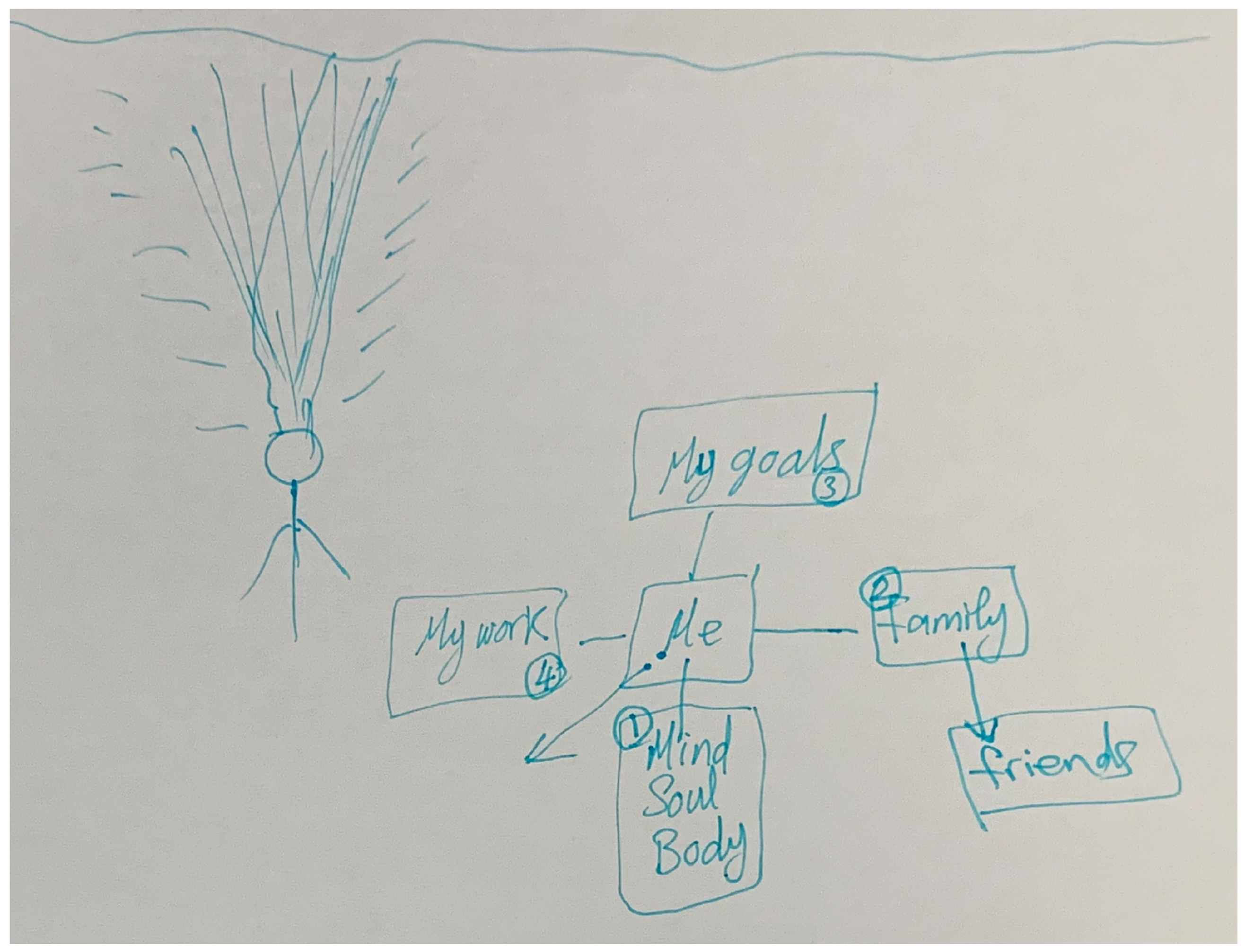
The uptake of artifact construction was uneven: some participants eagerly diagramed their ideas; others wrote text; others stared at the blank page, ignored the invitation, and never constructed an artifact at all. The process was sometimes slow and plodding, other times sudden and illuminating. For example, after being invited to draw wellbeing, Nour immediately and enthusiastically drew light, saying, “So I imagine this kind of light connecting between me and Allah. […] Light is a… I love light!” After we discussed the concept of light for a couple of minutes, Nour drew the rest of her diagram, starting with the word ‘me’ in a box: “So it’s me, where I want to give it, for example, first myself, my mind, my soul, my body. Then my family; let’s say achieving my goals, personal goals.” Here, Nour’s light was the starting point, followed by herself, then her family, then her goals. Rather than ‘me’ being a selfish orientation, however, Nour described light as a resource enabling her to give to the people around her: “where I want to give it.” This theme of self and social development continued through Nour’s interview, where she interleaved the artifact with her words, and was echoed by the other participants, who described their own wellbeing as generative of wellbeing in the people around them. Nour’s artifact construction exemplified this generativity.
We were interested not only in what the participants constructed but also how. Therefore, we noted what participants said and did after being invited to construct. Did they start immediately or was there a pause? What did they do first? Some asked for help getting started: Mariam began her diagram, saying: “Okay. This is me. And these are the circles—I don’t know what I’m doing! [laughing].” As she worked, a series of interlocking circles as social worlds emerged, within which she identified sources of strength and stress. In this case, Mariam expanded upon our invitation inspired by ecological systems theory to map her sources of strength within her various life contexts. Sometimes, the women annotated their process orally; sometimes they constructed in silence. After construction, each participant then discussed her artifact, and we collaboratively examined it live, which transformed the semi-structured interview into an artifact-mediated interview. This is an important aspect of the methodology that aims to optimize the verbal and visual together and, simultaneously, guard against researcher mis- or over-interpretation.
In the end, five out of ten participants drew a diagram. The artifacts were, in most cases, simply drawn representations of an important aspect of wellbeing from the participants’ perspectives. One participant sent digital images after the interview, considered as artifacts in their own right, to triangulate her hand-drawn artifact.
Artifact Analysis
To maintain rigor throughout the study, we kept written and oral analytic memos on the research process, comprising the interviews and the artifact construction. Given our different cultural standpoints, which added dimensionality to our analyses of both data sources, we helped each other reflect on our differing positionalities. We analyzed the artifacts independently, first using thematic analysis, described by
Braun and Clarke (
2022) as a systematic approach to searching for themes and patterns in the data. Our unit of analysis was the participants’ illustrations of wellbeing in their artifacts, which were mediated by their words. After independent analysis, we then collaboratively considered how the artifacts extended, illuminated, or diverged from the themes originally discerned in the interview data.
Analyzing the artifact data relative to the study’s integrated conceptual framework enabled recognition of hedonic, eudaimonic, religious, and spiritual dimensions of wellbeing. Importantly, ecological systems theory illuminated the concentric circles of the participants’ lived contexts, described by
Bronfenbrenner (
1994) as “five socially organized subsystems that help support and guide human growth” (p. 37). These subsystems appeared in all of the artifacts in various ways, with the participants identifying variegations of personal, social, and professional sites and sources of wellbeing. The integrated conceptual framework was also useful in our interviews as a systematic way to probe into where the participants described the strengths and stressors as featuring in their lives.
We also noted potential aspects of wellbeing that were
not drawn. For example, wellbeing in professional life was only tangentially mentioned in
Figure 1 as ‘achievements’ and ‘successes.’ Other people (centrally, family) featured in all the artifacts except one (
Figure 2 Artifact 2. Annie’s balance). Of
Martikainen and Hakoköngäs’ (
2023) three levels of social analysis—ontogenesis (individual level), micro-genesis (social interaction level), and sociogenesis (societal level) (p. 981)—the last level was not present in this study’s participant artifacts, which is interesting given that Saudi Arabia is socioculturally characterized by “large traditional family bonds” as well as religious and tribal ties (
Al Mutair et al., 2021, p. 1070). Drawing can be used to produce both realistic and abstract images (
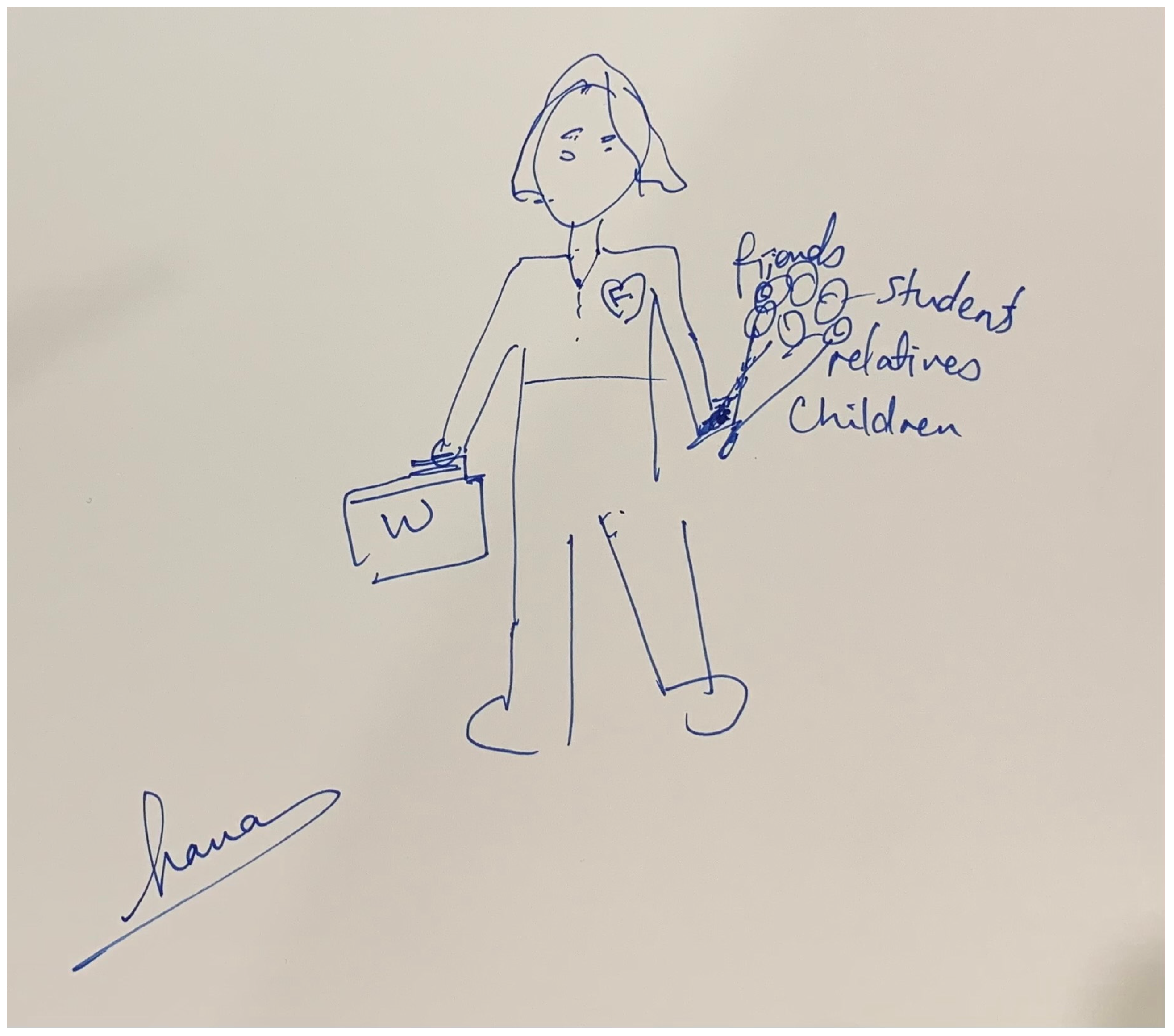
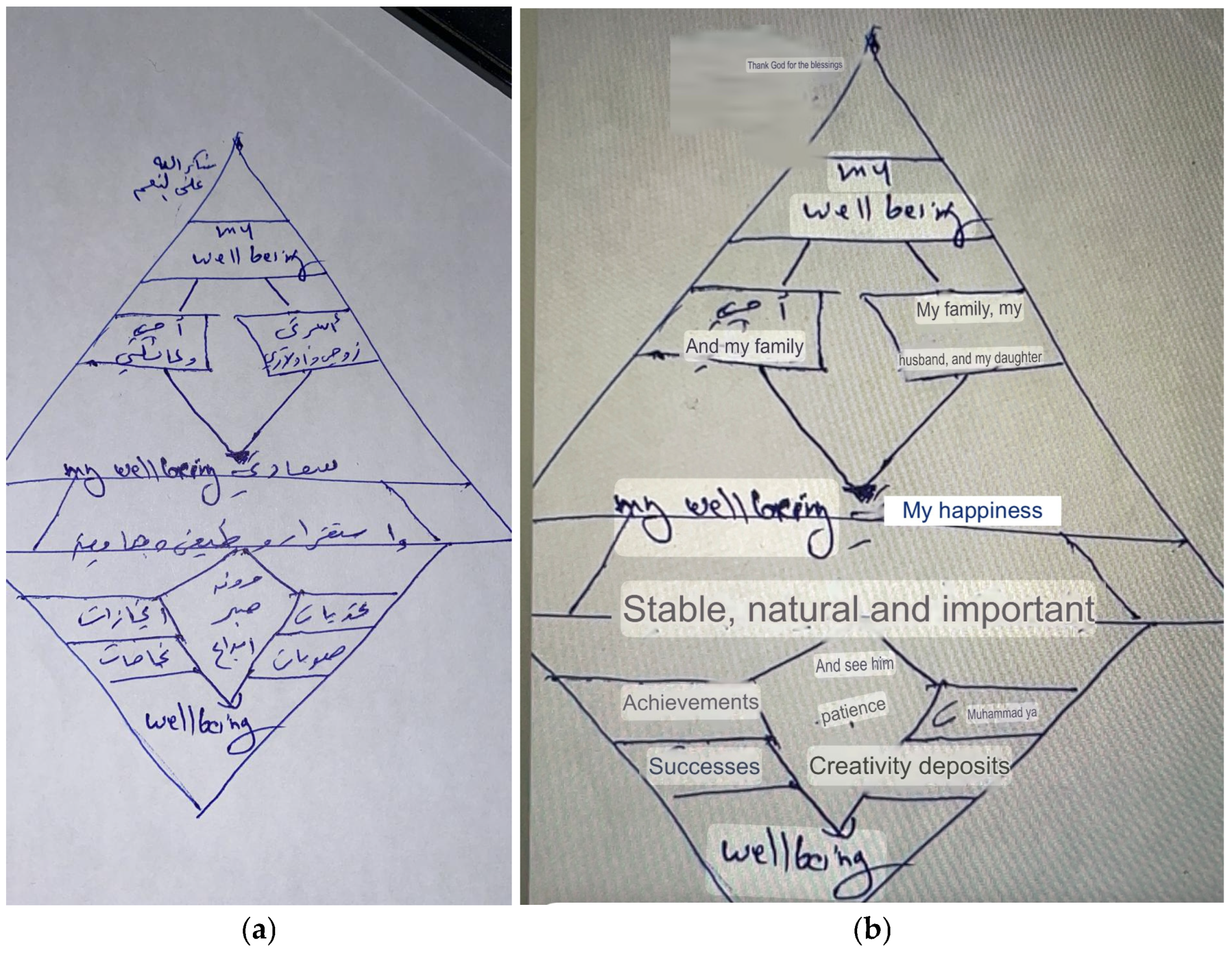
Lyon, 2020), and this was the case in the diagrams our participants produced. Two of the four below tend towards more ‘realistic’ representations (
Figure 3 and
Figure 4); two tend towards being more abstract (
Figure 1 and
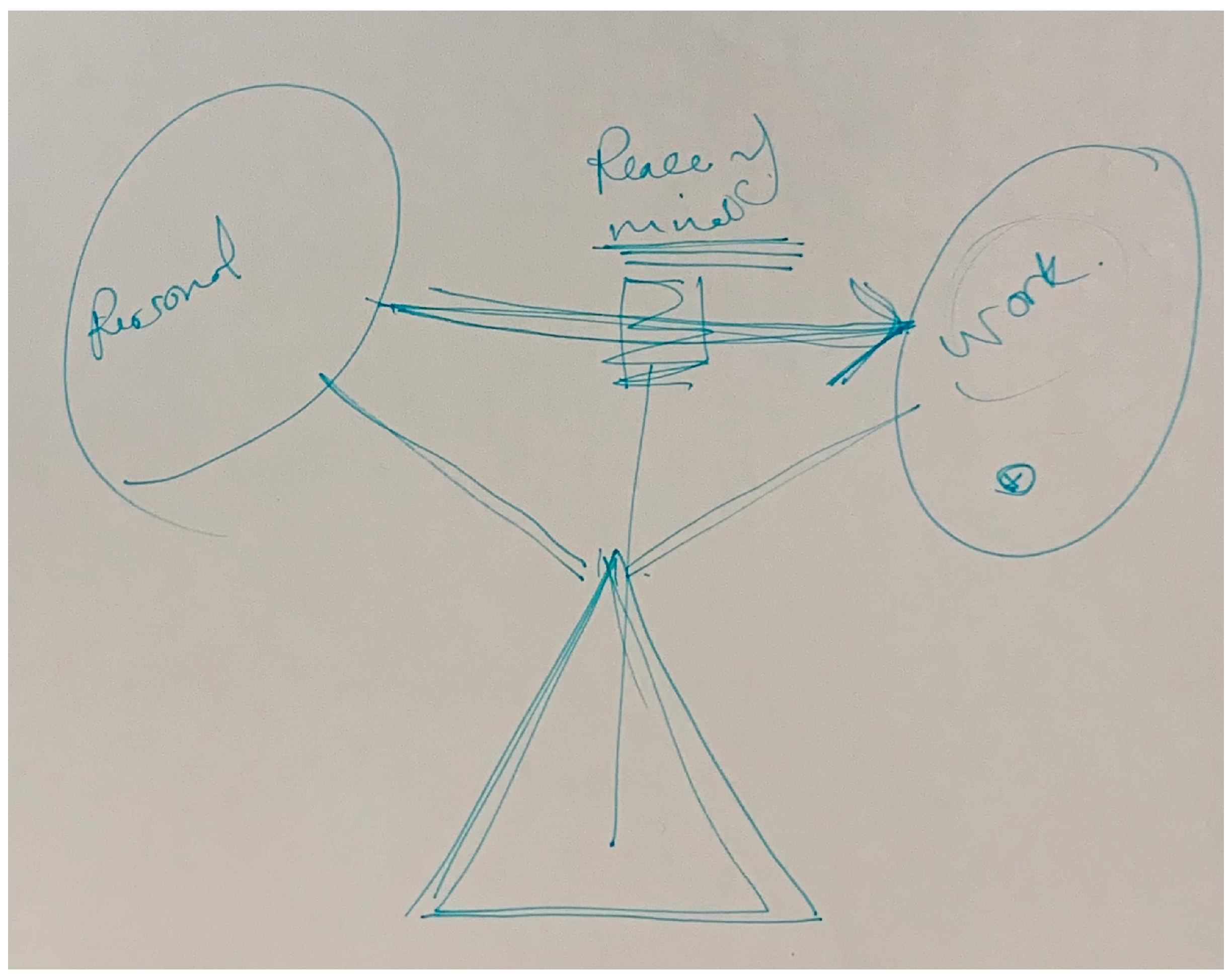
Figure 2, respectively).
Finally, of the corpus of artifacts, four were selected for deeper analysis and consideration in this paper as ‘exemplary’ by the following criteria: 1. The artifact was constructed by the participant within the interview itself, not photographs or images that some participants sent later and were thus not discussed in the interviews. 2. The participant employed the artifact to actively mediate the interview with the researchers, and thus made deeper meanings regarding her own wellbeing. 3. The participant herself described the artifact as complete. One computer-generated image and one hand-drawn diagram were not completed by participants and therefore not included in this paper’s analysis.
4. Thematic Findings in Four Exemplary Artifacts
Four artifacts extended the three thematic sources of wellbeing identified in the original study (see
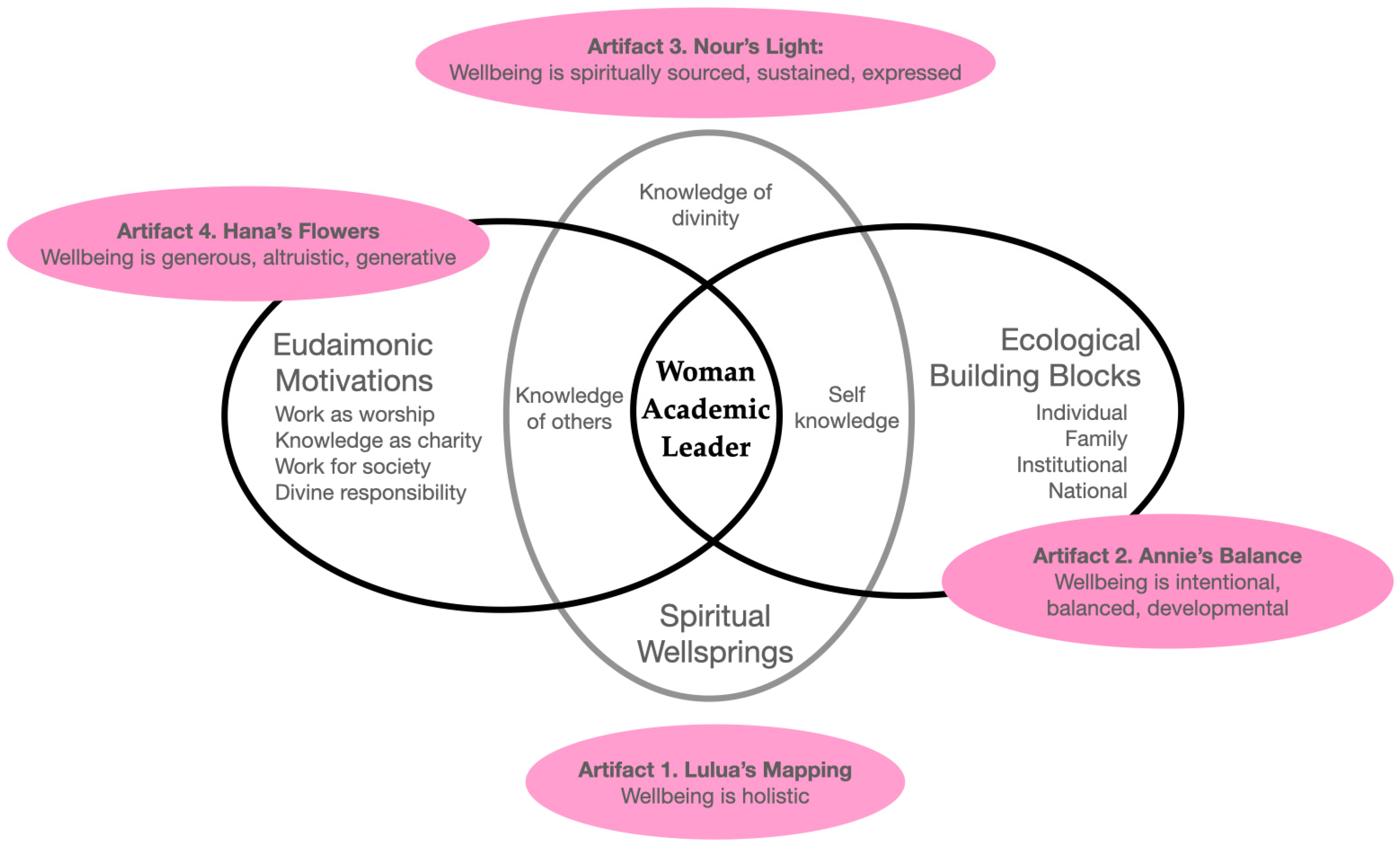
Alanazi & Alkouatli, 2023), thus illustrating the utility of artifact construction as a data collection method. This section demonstrates how unique thematic findings were derived from the artifacts themselves. In the study’s first theme, Ecological Building Blocks are the basic requirements to live well, starting with an individual woman, then radiating across the concentric domains of her life. The second theme, Spiritual Wellsprings, is characterized by women’s references to the deeper spiritual sources from which they drew intrinsic wellness, “at the center of my wellbeing” and “a source” (p. 8). The third theme, Eudaimonic Motivations, centered working for a meaningful life purpose: community goals, cultural change, destiny, and a divine responsibility to self, others, and country. The artifacts were analyzed in relation to these themes, as well as independently, in relation to the original sensitizing concepts and illuminations on the research question: “How do Saudi women in academic leadership positions describe cultivating and maintaining wellbeing?” Each artifact highlighted a dimension of wellbeing—sometimes collecting dimensions together—and these dimensions were often echoed by other participants. Together, they added new angles onto the interview data.
4.1. Artifact 1: Lulua’s Mapping: Wellbeing Is Holistic
Lulua’s artifact (
Figure 1) illustrates the interconnectedness of spiritual, hedonic, and eudaimonic wellbeing; all three types play a role in her wellbeing. With spirituality at the top, representing Lulua’s gratitude for the blessings she identified in her life, hedonic wellbeing appears in the two sides of her family: her husband/immediate family and mother/extended family. Eudaimonic wellbeing expresses her vision and offerings to the community. Other participants also described this triangulated holistic wellbeing, whereby time spent laughing with friends helped balance the stressors of aging parents and co-workers with outdated mindsets. In a quintessential expression of hedonic wellbeing, Hana said: “I come back home happy inside because I went out and I laughed.” But Hana also drew flowers representing her eudaimonic offerings to her community, suggesting connection between the two types of wellbeing. Islamically inspired eudaimonic activities provided specific methods by which the participants variously contributed to their communities. For example, Annie described the importance of the “zakat of knowledge,” referring to the purification of one’s knowledge by sharing it generously. Others too understood their leadership positions as unique responsibilities: “Allah chose you for something” (Yamna), “Build on it” (Yamna), and “Focus on what’s beyond yourself” (Sara). Lulua’s artifact illustrates that sources of wellbeing are holistic across types of wellbeing and life domains.
4.2. Artifact 2: Annie’s Balance: Wellbeing Is Intentional, Balanced, and Developmental
Annie drew deliberate cultivation of peace of mind in representing a balance between her personal and work lives: “If I have a peace of mind, this is going to create a balance on everything else” (
Figure 2). Wellbeing is intentional and balanced, requiring effort to establish and maintain. This study’s participants were embedded in a collectivist culture where family is paramount as part of a larger tribal structure, posing questions of how to balance family demands with their own self-actualization in leadership. Some of the participants were adept at balancing. Hana described being responsible for her husband and children, but also: “Part of wellbeing is: ‘Think of yourself.’ You have to find the balance and don’t feel guilty when you give yourself time for yourself.” Articulations of autonomy were significant in the data record, disrupting common stereotypes about Saudi women as central to a collectivist culture. Yamna described charting her own course as sustaining her wellbeing: “Reading lots. Looking at other people:
I created my own story.” Similarly, Annie crafted a healthy work environment by interviewing her potential bosses when being offered a promotion, and even turning down promotions: “Control the things that you can manage,” she said. “This is the way that you can create balance.” Where Annie described wellbeing as developmental, Hana echoed this perspective, saying: “In the last few years I’ve been working on myself, self-development.” Yamna said: “When I’m stressed out, when I’m having bad times, I take any type of training. It could be making a cake. […] It expands the horizon and you feel, ‘Okay, it’s not a vice-dean world!” Developing aspects of herself beyond leadership skills and the professional domain contributed to Yamna’s wellbeing. Annie’s artifact illuminates that wellbeing requires a unique type of work that is intentional, balanced, and developmental.
4.3. Artifact 3: Nour’s Light: Wellbeing Is Spiritually Sourced, Sustained, and Expressed
Nour’s process of constructing an artifact was ongoing throughout the interview; she kept returning to it. She started by drawing herself with light radiating from her head: “So, I imagine this kind of light connecting between me and Allah [God].” The main theme in Nour’s artifact was tapping into spiritual abundance. Spirituality was evidenced in all the study’s themes, but in Nour’s artifact, spirituality was central to wellbeing—spiritually sourced, sustained, and expressed. Annie described reading the Qur’an every day for wellbeing; Najiyah described recalling divine attributes as a type of cognitive reframing: “It makes your vision clearer. It helps you see things as they really are.” Nour’s artifact exemplified these spiritual practices of wellbeing as rooted in “a sense that Allah is with me. I emphasize it, affirm it—Allah maiyi, Allah maiyi [Allah is with me.]” Spirituality reciprocally enabled other processes of wellbeing: self-knowledge, seeing and building one’s strengths, and understanding oneself within a process of lifelong self-development, along with knowledge of, and empathetic generosity towards, others. Nour’s artifact illustrated the central importance of spirituality in wellbeing amongst these Saudi women leaders.
4.4. Artifact 4: Hana’s Flowers: Wellbeing Is Generous, Altruistic, and Generative
As Hana started drawing, she annotated: “Let’s say this is me. I will be holding a briefcase. This is my work. So, I can put it aside whenever I want,” a perspective expressing wellbeing in itself as related to the autonomy of being able to put work aside. But Hana continued, drawing flowers: “I’m holding a bouquet of flowers. Flowers. I like to give a lot. Flowers for friends, students, relatives, even my children.” For Hana, offering flowers represented wellbeing. She said, “I always feel a bit sad when people say, ‘Okay, what’s in it for me?’ all the time.” Instead, she paraphrased a traditional saying: “Do something good and throw it in the sea!” She explained that this means: “Do it without asking for something back!” So, for Hana, her flowers exemplified altruistic giving as a central process of cultivating and maintaining wellbeing. Of course, such giving is also an expression of being well. Yamna also described wellbeing as centering generosity, enacted by establishing an “open circle” around herself: “All of the drivers of the neighborhood, they like to come to our house, because we give them coffee […] just doing simple things can create so much happiness for other people”—and oneself. These leaders centered happiness expressed in a unique Saudi cultural context, including by being grateful and by giving generously as sustaining and expressing eudaimonic wellbeing: “Gratefulness is the most important thing” (Yamna). Recognizing abundance and reciprocating through generosity, symbolized by Hana’s flowers, is a source, process, and expression of wellbeing.
4.5. Summary of Artifacts
The esoteric nature of wellbeing, the complexities of leadership, and the cross-cultural nature of the research encounters inspired the method of artifact construction within the semi-structured interviews as a more expansive way to capture data beyond words alone. Inviting women leaders to draw conceptions of wellbeing was intended to invite freedom in tapping into emotion as well as cognition and, thus, to invite dimensionality. These intentions were realized in half of the ten women we interviewed. Each artifact illuminated a unique aspect of the research question: “How do Saudi women in academic leadership positions describe cultivating and maintaining wellbeing?” Artifact 1—wellbeing is holistic—illustrates the interweaving of hedonic and eudaimonic wellbeing and the positioning of God, self, family, and others in a hierarchy of being well. Artifact 2—wellbeing is intentional, balanced, and developmental—illuminates the centrality and precarity of balance in processes of cultivating and maintaining wellbeing. Artifact 3—wellbeing is spiritually sourced, sustained, and expressed—illustrates that spirituality plays a central role in wellbeing. Artifact 4—wellbeing is generous and generative—animates abundance as both a process and a product of wellbeing. As such, the artifacts extend upon the themes generated via analysis of the verbal data, as evidenced in
Figure 5 below.
5. Discussion
For some of the participants, artifact construction exploring wellbeing and leadership in a changing Saudi Arabia seemed to extend their expressions beyond the normative constraints of an interview. They robustly engaged in constructing an artifact expressing intimate and contextual aspects of wellbeing. For others, the method was inert: they did not take up the invitation and preferred to talk instead. The uneven uptake of the method in this study constitutes a limitation that is echoed in the literature on visual research methods, including that some people may not be comfortable with drawing; doubt their drawing skills (
Martikainen & Hakoköngäs, 2023); or even contend that artifact construction is too school-like or child-like (
Lyon, 2020). We wondered if participants with more exposure to artistic and constructive pedagogies during their earlier schooling might be more comfortable with artifact construction; however, exploration of such educational and cultural factors is beyond the scope of this study.
Previous researchers have pointed out that participants’
behavior during processes of drawing may be noteworthy, and videotaping the process could be beneficial (e.g.,
Lyon, 2020). We employed audio rather than video recordings. While this may be a limitation of the study, we found that the participants’
verbal annotations during artifact construction were useful because they illuminated the conceptual struggles of identifying aspects of wellbeing and then visually representing those aspects on a blank page. Verbal elucidation of the visual is required to deepen and diversify the researcher’s understandings (
Martikainen et al., 2024), which is why embedding artifact construction within semi-structured interviewing is methodologically important.
Despite the limitations of artifact construction as a research method and the limitations of this study in particular, there are two salient take-home ideas: first, artifacts constructed by research participants are more than just visual complements to verbal data and, second, artifacts uniquely reflect sensitizing concepts. These ideas are briefly discussed below.
5.1. More than Just a Visual Complement
In analyzing the artifacts in relation to the interview data, the artifacts clearly offer more than just a visual complement to the research story. They methodologically tap into the research questions differently than verbal methods alone.
Figure 5 illustrates how the artifacts expanded the meaning of the study’s original themes. Artifact 1. Lulua’s Mapping depicts wellbeing as holistic and interconnected, tying together the three original themes. Artifact 2. Annie’s Balance builds upon the important subjectivity of the woman at the center of the personal and professional spheres. Artifact 3. Nour’s Light illustrates wellbeing as an illuminative process encompassing her along with her personal and professional lives. Artifact 4. Hana’s Flowers suggests generativity and generosity are central to wellbeing. The participants constructed these key points in their artifacts, and they broaden the understanding of women leaders’ wellbeing in this cultural context. But these key points were not always the first things the woman drew; they sometimes emerged gradually. Nour drew spiritual light first, with herself and her social dimensions following. But Hanna’s flowers came last. In each case, recognition of the importance of these key points was constructed in dialog between researcher and participant, as an important collaborative process of meaning-making on three levels of analytic interpretation: the artifact maker, the artifact itself, and the researcher (
Rose, 2014). Participants who took up the invitation to construct an artifact seemed to enjoy the complex process of representing wellbeing on a blank page, bringing important new aspects of the research question into focus. As such, rather than considering participants’ artifacts as representational constructions OR communication tools (
Rose, 2014), in this study they were both.
5.2. Uniquely Reflecting the Sensitizing Concepts
The artifacts diversely reflect the sensitizing concepts of this study’s integrated conceptual framework. Each sensitizing concept offered unique angles of meaning on the women’s perspectives of their own wellbeing and they showed up differently in the artifacts the women constructed. Returning to
Table 1, we added three columns detailing the analytic lens, thematic findings, and evidence in the artifacts of the sensitizing concepts.
Table 2 below depicts this intricate relationship between the conceptual, methodological, and empirical.
6. Implications and Concluding Thoughts
While semi-structured interviewing made three themes visible, artifact construction extended the themes and highlighted connections between theme dimensions and original sensitizing concepts. Taken together, some implications can be articulated. First, as emotionally valanced cognitive constructs, the artifacts made visible the
models of wellbeing that the women were actualizing in their daily lives. Depicting herself as juxtaposed with others, each woman either drew herself in the center of a diagram or drew a diagram from her first-person perspective. Second, potentially generative sources of women’s wellbeing intrinsically exist within a culture that centers social connections, spirituality, and gratitude perspectives, especially when framed by institutional support. As such, artifact construction made visible important aspects of the integrated conceptual framework. These two implications echo the literature on the efficacy of drawing as artifact construction, including that it motivates reflection, deepens meaning-making, and encourages discussion (e.g.,
Martikainen et al., 2024). Third, beyond the mere transmission of mental images onto white paper, artifact construction is a complex process of assembling meaning in real time, employing emotion and embodiment along with cognition. Here, “the visual and kinesthetic qualities of the process contribute to the image and its contents” (
Martikainen & Hakoköngäs, 2023, p. 995).
Brice (
2024) similarly noted: “Expressing thought as a material process, drawing unravels the binary logics of both mind/body and interior/exterior dualities, turning ideas of the (artist-)self inside-out” (p. 215). Building upon this, we noted that to be able to visually express wellbeing in a few key factors, a participant must have
analytic access to her processes of sourcing, maintaining, and expressing wellbeing in the first place. Not all the participants did or wanted to. It is possible that artifact construction necessitates taking a meta-perspective on one’s own intimate ontological positioning vis-à-vis the research topic, in this case, the esoteric concept of wellbeing. How a person’s reflexive analytic access relates to leadership is a question for further research.
Finally, artifact construction revealed a unique aspect of itself that constitutes a fourth, tentative implication that is related to the other implications: the method may have benefits beyond its empirical yield. The women leaders’ artifacts chimed with a classic definition of an artifact as crystallized imagination and as a catalyst for thinking anew (
Vygotsky, 2004). Artifact construction itself might invite expression of an analytic process already in progress; it might nudge a person to share the results of that analytic process in new ways, expanding vistas of meaning, or it might even trigger the analytic process itself. This catalytic implication requires further research and constitutes this paper’s final frontier: beyond
researching wellbeing, the efficacy of artifact construction is worthy of further exploration in
fostering wellbeing by inviting meta-analysis of the processes of establishing, sustaining, and expressing wellbeing. These implications manifest the fact that the efforts of visual research methods “are not confined to the visible world, as they intimately relate to visualizing the invisible and the (in)conceivable” (
Pauwels & Mannay, 2020, p. 3). Visual methods make visible the intimate and the invisible. And so, this paper ends with a question: How might artifact construction be employed in designing programs to both research and enhance wellbeing in professional educational leadership contexts in Saudi Arabia and beyond?