Educator–GenAI Partnership Model for Assessment Design to Foster Higher-Order Thinking

 , ,
, ,  ,
,  , and
, and
Abstract
1. Introduction
1.1. Urgent Need Meets Reality
1.2. Contribution and Outline
- By placing GenAI in parallel with the educator, this model acknowledges the technology’s substantial influence on assessment design while upholding the educator’s role as the primary authority.
- By utilizing process-driven checkpoints and feedback loops, the model ensures that HOT-based assessment design remains transparent and measurable, even when GenAI is integrated into the assignment design workflow.
2. Theoretical Background
2.1. Higher-Order Thinking (HOT)
2.2. Constructive Alignment
2.3. Human Oversight for Pedagogical Authority
3. Related Works
3.1. Authentic Assessment and HOT in GenAI Era
3.2. Integrating GenAI While Preserving Academic Integrity in Assessment
3.3. The Implementation Gaps
3.4. The Need for Cohesive Design Frameworks
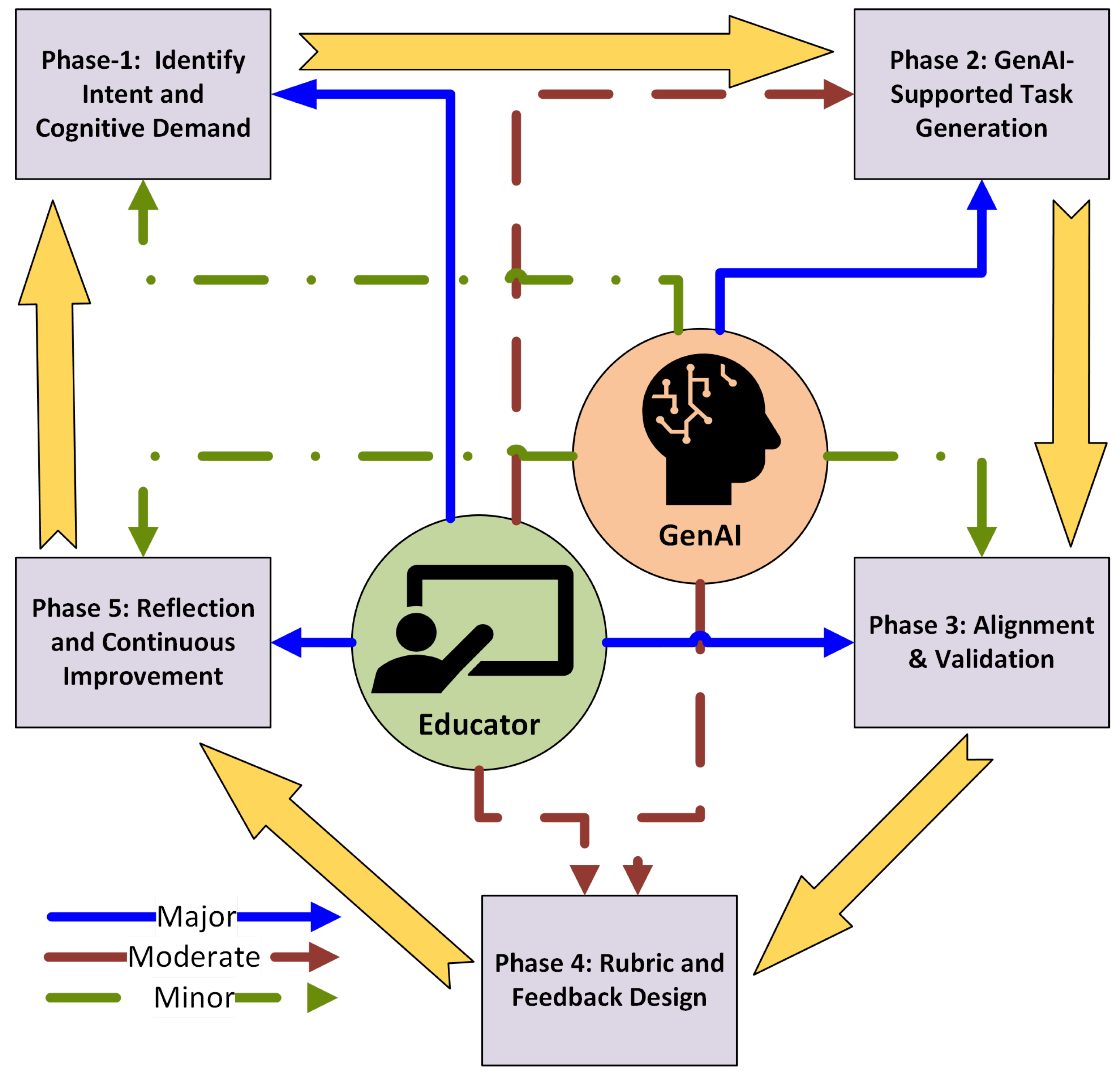
4. Educator–GenAI Partnership Model
- AI Literacy and Ethical Transparency: The model emphasizes that educators must develop AI literacy through professional development to critically evaluate and effectively integrate GenAI tools. This includes adhering to institutional and professional ethical guidelines, ensuring ethical AI use, transparency, and proper attribution (Ilieva et al., 2025; Xia et al., 2024). All GenAI-assisted tasks should be fully disclosed to stakeholders (faculty, students, institutions) to maintain trust and accountability (Clark, 2025).
- Structured Alignment and Oversight: Educators must adopt structured oversight strategies when using GenAI-generated content to maintain pedagogical authority, including systematic review and refinement of tasks, rubrics, and feedback before implementation (Bannister et al., 2025; Nguyen et al., 2025). Additionally, all GenAI-assisted outputs should explicitly align with course learning outcomes and Bloom’s higher-order cognitive levels, following the principles of constructive alignment.
- Continuous Monitoring and Adaptability: Educators must implement a continuous monitoring process to analyze student performance data and GenAI-generated outputs, identifying gaps or unintended consequences in assessment effectiveness. This process should also include proactive strategies to adapt to evolving GenAI technologies, ensuring that teaching practices, assessment methods, and oversight remain current and effective (Australian Curriculum, Assessment and Reporting Authority [ACARA], 2012; Su & Yang, 2023).
4.1. Phase 1: Identify Intent and Cognitive Demand
- Educator Role (Major): Determine assessment intent, discipline-specific cognitive demands, and precisely define the target HOT skills (e.g., analysis, evaluation, creation) aligned with the specific learning outcomes. This involves selecting the appropriate assessment format (e.g., authentic scenarios, performance-based tasks) to guide subsequent GenAI-supported task generation.
- GenAI Role (Minor): Suggest and refine appropriate action verbs corresponding to the target Bloom’s level, propose performance indicators, or provide exemplar outcomes aligned with the higher-order cognitive skills identified by the educator.
- Outcome: A set of refined structured prompts incorporating the precise HOT level, suitable action verbs, assessment format, and learning context and outcome.
Structuring Effective Prompts
4.2. Phase 2: GenAI-Supported Task Generation
- Educator Role (Moderate): Select suitable GenAI tools based upon university recommendation and/or personal experience. The educator’s primary action is structuring prompt, inputting the specific, pre-defined constraints from Phase 1 (target HOT level, learning outcomes, assessment format, and contextual details) into the selected tool to enforce content and structure. Revise the prompt and perform the task generation if required.
- GenAI Role (Major): Generate multiple drafts of assessment materials rapidly, such as detailed scenario narratives, complex datasets, simulated documents, or nuanced problem descriptions, aligned with the chosen HOT assessment format (e.g., authentic case study or inquiry-based problem set). In this role, GenAI acts as an engine for acceleration and diversification, producing qualitative assessments in significantly less time.
- Outcome: A set of potential assessment task drafts that are ready for critical human evaluation in the next phase, successfully designed to elicit analysis, synthesis, and evaluation skills.
4.3. Phase 3: Alignment and Validation
- Mapping to the learning outcomes: Educators map the tasks created with the intended learning outcomes, and expected competencies.
- Successful elicitation of the target Bloom’s level: Educators evaluate that the task created has effectively prompted learners to demonstrate the specific cognitive skill intended, aligning accurately with the desired level of Bloom’s taxonomy.
- Demonstration of authenticity (real-world complexity and contextual judgment): Educators evaluate the complexity of the task and contextual settings.
- Measure AI-solvability using tool: Educators assess the assessment task’s AI-solvability, ensuring that its complexity and contextual nuance require genuine HOT skills from the student, thereby mitigating the risk to academic integrity and AI-misuse.
- Educator Role (Major): Critically evaluate tasks to ensure constructive alignment and remove bias and factual inaccuracies. Check AI-solvability with suitable and available tools to maintain academic integrity.
- GenAI Role (Minor): Offer revisions, alternative phrasing, or complexity adjustments upon the educator’s request to quickly rectify identified issues (during the four criteria analysis for alignment and validation) to maintain academic integrity, authenticity, and complexity.
- Outcome: A validated and contextually aligned assessment, confirmed to require genuine higher-order cognitive effort from the student.
4.4. Phase 4: Rubric and Feedback Design
- Educator Role (Moderate): Calibrate rubric criteria and descriptors to ensure clarity, fairness, and validity, focusing on criteria that explicitly capture higher-order cognitive performance indicators.
- GenAI Role (Moderate): Generate initial rubric templates (e.g., criteria, levels of achievement) and draft specific, targeted formative feedback suggestions aligned with potential student performance outcomes.
- Outcome: A validated rubric that explicitly captures higher-order cognitive performance indicators and provides a foundation for efficient and high-quality formative feedback.
4.5. Phase 5: Reflection and Continuous Improvement
- Educator Role (Major): Collect feedback, analyze student responses, and refine future assessments, focusing on the relationship between the GenAI-assisted task complexity and student HOT performance.
- GenAI Role (Minor): Summarize large qualitative (e.g., student survey comments) and quantitative (e.g., grade distribution) feedback data or suggest iterative improvements based on educator reflection notes and performance summaries.
- Outcome: Design of feedback parameters to continuously enhance assessment design for deeper learning engagement, ensuring that the model leads to iterative improvement in the educator’s assessment practice.
5. Implementation Considerations and Limitations
5.1. Implementation Considerations
5.1.1. Educator AI Literacy and Prompt Engineering Competency
5.1.2. Defining Clear Human–GenAI Boundaries
5.1.3. Institutional Infrastructure and Data Governance
5.1.4. Evaluation of Model’s Effectiveness
5.2. Limitations
6. Conclusions and Future Works
Supplementary Materials
Author Contributions
Funding
Institutional Review Board Statement
Informed Consent Statement
Data Availability Statement
Conflicts of Interest
References
- Akbar, M. S. (2025). Beyond detection: Designing AI-resilient assessments with automated feedback tool to foster critical thinking. arXiv, arXiv:2503.23622. [Google Scholar] [CrossRef] [Scilit]
- American Educational Research Association, American Psychological Association & National Council on Measurement in Education. (2014). Standards for educational and psychological testing. American Educational Research Association. [Google Scholar]
- Anderson, L. W., & Krathwohl, D. R. (Eds.). (2001). A taxonomy for learning, teaching, and assessing: A revision of bloom’s taxonomy of educational objectives. Longman. [Google Scholar]
- Association of Pacific Rim Universities [APRU]. (2025). Generative AI in higher education: Current practices and ways forward (Whitepaper). Association of Pacific Rim Universities. Available online: https://www.apru.org/wp-content/uploads/2025/01/APRU-Generative-AI-in-Higher-Education-Whitepaper_Jan-2025.pdf (accessed on 15 April 2026).
- Australian Curriculum, Assessment and Reporting Authority [ACARA]. (2012). Curriculum development process (version 6). Available online: https://www.acara.edu.au/curriculum/history-of-the-australian-curriculum/development-of-australian-curriculum (accessed on 15 April 2026).
- Babai Shishavan, H. (2024). AI in higher education: Guidelines on assessment design from Australian universities. In T. Cochrane, V. Narayan, E. Bone, C. Deneen, M. Saligari, K. Tregloan, & R. Vanderburg (Eds.), Proceedings ascilite 2024 melbourne: Navigating the terrain: Emerging frontiers in learning spaces, pedagogies, and technologies (pp. 118–126). ASCILITE. [Google Scholar] [CrossRef] [Scilit]
- Bannister, P., Urbieta, A. S., & Alvira, N. B. (2025). Appraising higher education assessment validity: Development of the PANDORA GenAI susceptibility rubric. Journal of Applied Learning and Teaching, 8(1), 41–55. [Google Scholar] [CrossRef] [Scilit]
- Bellas, F., Ooge, J., Roddeck, L., Rashheed, H. A., Skenduli, M. P., Masdoum, F., Zainuddin, N. b., Gori, J. N., Costello, E., Kralj, L., & Dcosta, D. T. (2025). Explainable ai in education: Fostering human oversight and shared responsibility. Available online: https://data.europa.eu/doi/10.2797/6780469 (accessed on 15 April 2026). [CrossRef]
- Biggs, J., Tang, C., & Kennedy, G. (2022). Teaching for quality learning at university 5e. McGraw-Hill Education (UK). [Google Scholar]
- Bittle, K., & El-Gayar, O. (2025). Generative AI and academic integrity in higher education: A systematic review and research agenda. Information, 16(4), 296. [Google Scholar] [CrossRef] [Scilit]
- Borge, M., Smith, B. K., & Aldemir, T. (2024). Using generative AI as a simulation to support higher-order thinking. International Journal of Computer-Supported Collaborative Learning, 19(4), 479–532. [Google Scholar] [CrossRef] [Scilit]
- Bouckaert, M. (2023). The assessment of students’ creative and critical thinking skills in higher education across oecd countries: A review of policies and related practices (Tech. Rep. No. 293). Organisation for Economic Co-Operation and Development. Available online: https://one.oecd.org/document/EDU/WKP(2023)8/en/pdf (accessed on 15 April 2026).
- Brookhart, S. M. (2010). How to assess higher-order thinking skills in your classroom. ASCD. [Google Scholar]
- Brown, T. B., Mann, B., Ryder, N., Subbiah, M., Kaplan, J., Dhariwal, P., Neelakantan, A., Shyam, P., Sastry, G., Askell, A., & Agarwal, S. (2020). Language models are few-shot learners. In Advances in neural information processing systems. Curran Associates, Inc. [Google Scholar]
- Caspari-Sadeghi, S. (2026). AI literacy for teacher educators: A holistic curriculum for capacity-building in higher education. Frontiers in Education, 11, 1745768. [Google Scholar] [CrossRef] [Scilit]
- Clark, L. A. (2025). Reframing bloom’s for the age of AI: A white paper for future-ready educators (White Paper). Anthology. Available online: https://backstage.anthology.com/sites/default/files/2025-09/ReframingBloomsForTheAgeOfAI_WhitePaper_v1.pdf (accessed on 15 April 2026).
- Corbin, T., Dawson, P., & Liu, D. (2025). Talk is cheap: Why structural assessment changes are needed for a time of GenAI. Assessment & Evaluation in Higher Education, 50(7), 1087–1097. [Google Scholar] [CrossRef] [Scilit]
- Cui, Y., Meng, Y., & Tang, L. (2025). Reconsidering teacher assessment literacy in GenAI-enhanced environments: A scoping review. Teaching and Teacher Education, 165, 105163. [Google Scholar] [CrossRef] [Scilit]
- Fernández-Sánchez, A., Lorenzo-Castiñeiras, J. J., & Sánchez-Bello, A. (2025). Navigating the future of pedagogy: The integration of AI tools in developing educational assessment rubrics. European Journal of Education, 60(1), e12826. [Google Scholar] [CrossRef] [Scilit]
- Gonsalves, C. (2025). Contextual assessment design in the age of generative AI. Journal of Learning Development in Higher Education. [Google Scholar] [CrossRef] [Scilit]
- Hau, D. (2025). Beyond the loop: Reclaiming pedagogy in an AI age. UNESCO Ideas Lab. Available online: https://www.unesco.org/en/articles/beyond-loop-reclaiming-pedagogy-ai-age (accessed on 15 April 2026).
- Holloman, T. K., Lee, W. C., London, J. S., Hawkins Ash, C. D., & Watford, B. A. (2021). The assessment cycle: Insights from a systematic literature review on broadening participation in engineering and computer science. Journal of Engineering Education, 110(4), 1027–1048. [Google Scholar] [CrossRef] [Scilit]
- Huang, X., Jen, F.-L., Lian, Y., & Jiao, J. (2024). Can generative Al really empower teachers’ professional practices? A quasi-experiment on human-GenAl collaborative rubric design. In International conference on technology in education (pp. 124–133). Springer. [Google Scholar] [CrossRef] [Scilit]
- Hugging Face. (2024). Prompt engineering. Available online: https://huggingface.co/docs/transformers/en/tasks/prompting (accessed on 16 March 2026).
- Ilieva, G., Yankova, T., Ruseva, M., & Kabaivanov, S. (2025). A framework for generative AI-driven assessment in higher education. Information, 16(6), 472. [Google Scholar] [CrossRef] [Scilit]
- Jackson, J. (2025). Higher order prompting: Applying bloom’s revised taxonomy to the use of large language models in higher education. Studies in Technology Enhanced Learning, 4(1), 1–26. [Google Scholar] [CrossRef] [Scilit]
- Kadel, R., Mishra, B. K., Shailendra, S., Abid, S., Rani, M., & Mahato, S. P. (2024). Crafting tomorrow’s evaluations: Assessment design strategies in the era of generative AI. In 2024 international symposium on educational technology (ISET) (pp. 13–17). IEEE. [Google Scholar] [CrossRef] [Scilit]
- Kadel, R., Shailendra, S., & Saxena, U. R. (2025). Navigating the new landscape: A conceptual model for project-based assessment (PBA) in the age of GenAI. In 2025 world engineering education forum—Global engineering deans council (WEEF-GEDC) (pp. 1–9). GEDC. [Google Scholar] [CrossRef] [Scilit]
- Kumar, R., Gulwani, D., & Singh, S. (2025). Automated analysis of learning outcomes and exam questions based on bloom’s taxonomy. arXiv, arXiv:2511.10903. [Google Scholar] [CrossRef] [Scilit]
- Kwan, P., Kadel, R., Memon, T. D., & Hashmi, S. S. (2025). Reimagining flipped learning via bloom’s taxonomy and student–teacher–GenAI interactions. Education Sciences, 15(4), 465. [Google Scholar] [CrossRef] [Scilit]
- Lee, A. V. Y., Teo, C. L., & Tan, S. C. (2024). Prompt engineering for knowledge creation: Using Chain-of-thought to support students’ improvable ideas. AI, 5(3), 1446–1461. [Google Scholar] [CrossRef] [Scilit]
- Lee, C. C., & Low, M. Y. H. (2024). Using genAI in education: The case for critical thinking. Frontiers in Artificial Intelligence, 7, 1452131. [Google Scholar] [CrossRef] [Scilit]
- Lee, J., Hung, J.-T., Soylu, M. Y., Popescu, D., Cui, C. Z., Grigoryan, G., Joyner, D. A., & Harmon, S. W. (2025). Socratic mind: Impact of a novel GenAI-powered assessment tool on student learning and higher-order thinking. arXiv, arXiv:2509.16262. [Google Scholar] [CrossRef] [Scilit]
- Levy, D., & Pérez Albertos, A. (2025). Simple AI tips for designing courses. In HBP education’s must reads: Effective course design—Ideas to enrich and evolve your syllabus (Originally published in Inspiring Minds, pp. 31–37). Harvard Business School Publishing. Available online: https://hbsp.harvard.edu/inspiring-minds/simple-ai-tips-designing-courses (accessed on 15 April 2026).
- Li, F., Yan, X., Su, H., Shen, R., & Mao, G. (2025). An assessment of human–AI interaction capability in the generative AI era: The influence of critical thinking. Journal of Intelligence, 13(6), 62. [Google Scholar] [CrossRef] [Scilit]
- Lodge, J. M., Bearman, M., Dawson, P., Gniel, H., Harper, R., Liu, D., McLean, J., & Ucnik, L. (2025). Enacting assessment reform in a time of artificial intelligence. Tertiary Education Quality and Standards Agency (TEQSA), Australian Government. Available online: https://www.teqsa.gov.au/sites/default/files/2025-09/enacting-assessment-reform-in-a-time-of-artificial-intelligence.pdf (accessed on 15 April 2026).
- Lodge, J. M., Howard, S., Bearman, M., & Dawson, P. (2023). Assessment reform for the age of artificial intelligence. Tertiary Education Quality and Standards Agency. Available online: https://www.teqsa.gov.au/guides-resources/resources/corporate-publications/assessment-reform-age-artificial-intelligence (accessed on 15 April 2026).
- Lubbe, A., Marais, E., & Kruger, D. (2025). Cultivating independent thinkers: The triad of artificial intelligence, bloom’s taxonomy and critical thinking in assessment pedagogy. Education and Information Technologies, 30, 17589–17622. [Google Scholar] [CrossRef] [Scilit]
- Mazza, A., El Makkaoui, K., Ouahbi, I., & Maleh, Y. (2025). Automating educational assessment with AI: Leveraging bloom’s taxonomy and transformer models for question classification. In 2025 international conference on circuit, systems and communication (ICCSC) (pp. 1–5). IEEE. [Google Scholar] [CrossRef] [Scilit]
- McGowan, B. (2025). From prompt to practice: Using AI to build better assessment rubrics with SOLO taxonomy. Ulster University. [Google Scholar] [CrossRef]
- Messick, S. (1995). Validity of psychological assessment: Validation of inferences from persons’ responses and performances as scientific inquiry into score meaning. American Psychologist, 50(9), 741. [Google Scholar] [CrossRef]
- Morgan, F. (2025). Gen AI and the essay: Evaluating task specificity and rubric alignment (Tech. Rep.). The University of Melbourne. Available online: https://www.teqsa.gov.au/sites/default/files/2025-06/gen-AI-and-the-essay-evaluating-task-specificity-UoM.pdf (accessed on 15 April 2026).
- Mpolomoka, D. L. (2025). Utilizing artificial intelligence for assessment in higher education. Pedagogical Research, 10(3), em0243. [Google Scholar] [CrossRef] [Scilit] [PubMed]
- Nguyen, A., Duong, A. T., Nguyen, D. T. B., Lai, V. T. T., & Dang, B. (2025). Guidelines for learning design and assessment for generative artificial intelligence-integrated education: A unified view. Information and Learning Sciences, 126(7/8), 491–512. [Google Scholar] [CrossRef] [Scilit]
- OECD. (2026). OECD digital education outlook 2026. Organisation for Economic Co-Operation and Development (OECD) Publishing. [Google Scholar] [CrossRef] [Scilit]
- Ogunleye, B., Zakariyyah, K. I., Ajao, O., Olayinka, O., & Sharma, H. (2024). Higher education assessment practice in the era of generative AI tools. Journal of Applied Learning and Teaching, 7(1), 28. [Google Scholar] [CrossRef] [Scilit]
- Oiva-Córdova, L. M., Alvarez-Icaza, I., & George-Reyes, C. E. (2025). Evaluation of generative AI use to foster critical thinking in higher education. IEEE Revista Iberoamericana de Tecnologias del Aprendizaje, 20, 237–243. [Google Scholar] [CrossRef] [Scilit]
- Pan, Y. (2025). Leveraging generative AI powered rubric-indexed feedback as a formative assessment strategy for enhancing medical English education. Discover Computing, 28(1), 284. [Google Scholar] [CrossRef] [Scilit]
- Rana, V., Verhoeven, B., & Sharma, M. (2025). Generative AI in design thinking pedagogy: Enhancing creativity, critical thinking, and ethical reasoning in higher education. Journal of University Teaching and Learning Practice, 22(4), 1–22. [Google Scholar] [CrossRef] [Scilit]
- Reyna, J. (2025). Future-proofing academia: Integrating generative AI for innovative learning and assessment in higher education. In T. Bastiaens (Ed.), Proceedings of edmedia 2025 (pp. 418–423). Association for the Advancement of Computing in Education (AACE). Available online: https://www.learntechlib.org/p/226169 (accessed on 15 April 2026).
- Salinas-Navarro, D. E., Vilalta-Perdomo, E., Michel-Villarreal, R., & Montesinos, L. (2024). Designing experiential learning activities with generative artificial intelligence tools for authentic assessment. Interactive Technology and Smart Education, 21(4), 708–734. [Google Scholar] [CrossRef] [Scilit]
- Shailendra, S., Kadel, R., & Sharma, A. (2024). Framework for adoption of generative artificial intelligence (GenAI) in education. IEEE Transactions on Education, 67(5), 777–785. [Google Scholar] [CrossRef] [Scilit]
- Sharma, A., Shailendra, S., & Kadel, R. (2025, February 21–23). Experiences with content development and assessment design in the era of GenAI. 2025 6th International Conference on Computer Science, Engineering, and Education (CSEE) (pp. 1–5), Nanjing, China. [Google Scholar] [CrossRef] [Scilit]
- Sterz, S., Baum, K., Biewer, S., Hermanns, H., Lauber-Rönsberg, A., Meinel, P., & Langer, M. (2024). On the quest for effectiveness in human oversight: Interdisciplinary perspectives. In Proceedings of the 2024 ACM conference on fairness, accountability, and transparency (pp. 2495–2507). ACM. [Google Scholar] [CrossRef] [Scilit]
- Su, J., & Yang, W. (2023). Unlocking the power of ChatGPT: A framework for applying generative AI in education. ECNU Review of Education, 6(3), 355–366. [Google Scholar] [CrossRef] [Scilit]
- Thanh, B. N., Vo, D. T. H., Nhat, M. N., Pham, T. T. T., Trung, H. T., & Xuan, S. H. (2023). Race with the machines: Assessing the capability of generative AI in solving authentic assessments. Australasian Journal of Educational Technology, 39(5), 59–81. [Google Scholar] [CrossRef] [Scilit]
- Wei, J., Wang, X., Schuurmans, D., Bosma, M., Xia, F., Chi, E., Le, Q. V., & Zhou, D. (2022). Chain-of-thought prompting elicits reasoning in large language models. Advances in Neural Information Processing Systems, 35, 24824–24837. [Google Scholar] [CrossRef] [Scilit]
- Weng, X., Qi, X., Gu, M., Rajaram, K., & Chiu, T. K. (2024). Assessment and learning outcomes for generative AI in higher education: A scoping review on current research status and trends. Australasian Journal of Educational Technology, 40(6), 37–55. [Google Scholar] [CrossRef] [Scilit]
- Whitham, R., Stockton, G., Richards, D., Lindley, J., Jacobs, N., & Coulton, P. (2023). Implications of generative AI on learning and assessment in higher education and design research practice. Available online: https://api.semanticscholar.org/CorpusID:271194224 (accessed on 15 April 2026).
- Xia, Q., Weng, X., Ouyang, F., Lin, T. J., & Chiu, T. K. (2024). A scoping review on how generative artificial intelligence transforms assessment in higher education. International Journal of Educational Technology in Higher Education, 21(1), 40. [Google Scholar] [CrossRef] [Scilit]
- Yusuf, A., Pervin, N., & Román-González, M. (2024). Generative AI and the future of higher education: A threat to academic integrity or reformation? Evidence from multicultural perspectives. International Journal of Educational Technology in Higher Education, 21(1), 21. [Google Scholar] [CrossRef] [Scilit]
- Zhao, J., Chapman, E., & Sabet, P. G. (2024). Generative AI and educational assessments: A systematic review. Education Research and Perspectives, 51, 124–155. [Google Scholar] [CrossRef] [Scilit]


| Ref. | Features Covered | Limitations & Solution |
|---|---|---|
| (Ilieva et al., 2025) | AI literacy, ethics, oversight, & outcome alignment. | Limited task-level design guidance. Addressed in Section 4.1, Section 4.2 and Section 4.4. |
| (Xia et al., 2024) | AI literacy, human-AI interaction, & assessment transformation trends. | Lacks design workflow. Address in the whole model design Section 4. |
| (Bannister et al., 2025) | Transparency, structured oversight, monitoring strategy. | Not a full framework, just a diagnostic tool. Address in the whole model Section 4. |
| (Nguyen et al., 2025) | Ethics, policy guidance, HOT alignment. | Limited operational details. Address in the whole model Section 4. |
| (Kadel et al., 2025) | Processed-based integrity, supervisor oversight. | Limited diversity of contexts. Address in the whole model Section 4. |
| (Clark, 2025) | AI cognitive demands. | Lacks governance mechanisms. Address in the whole model Section 4. |
| (Corbin et al., 2025) | Structural integrity critique. | Lacks constructive design. Address in the whole model Section 4. |
| (J. Lee et al., 2025) | Instructor-controlled GenAI assessment, monitoring strategy. | Example case presented, lack of model. Address in the whole model Section 4.2. |
| Contribution | Explanation |
|---|---|
| Major | Indicates primary responsibility and significant influence on the process. The role is essential for decision-making, task validation, and ensuring alignment with pedagogical and ethical standards. Example: Educator defining learning outcomes and critically evaluating assessment alignment. |
| Moderate | Represents a shared responsibility or substantial supportive role. The contribution complements the major role by providing significant enhancements, suggestions, or structural outputs under supervision. Example: GenAI generating rubric skeletons; Educator calibrating rubric descriptors. |
| Minor | Indicates minimal involvement, often limited to optional assistance or quick refinements. The role is not critical, but adds value through automation, linguistic suggestions, or data summarization. Example: GenAI offering quick edits during pedagogical refinement or suggesting appropriate action verbs. |
| Phase | Higher-Order Thinking (HOT) | Constructive Alignment | Human Oversight |
|---|---|---|---|
| Phase 1 | Educator
| Educator
| Educator
|
| Phase 2 | GenAI
| Educator
| Educator
|
| Phase 3 | Educator
| Educator
| Educator
|
| Phase 4 | Educator
| GenAI
| Educator
|
| Phase 5 | Educator
| Educator
| Educator
|
Disclaimer/Publisher’s Note: The statements, opinions and data contained in all publications are solely those of the individual author(s) and contributor(s) and not of MDPI and/or the editor(s). MDPI and/or the editor(s) disclaim responsibility for any injury to people or property resulting from any ideas, methods, instructions or products referred to in the content. |
© 2026 by the authors. Licensee MDPI, Basel, Switzerland. This article is an open access article distributed under the terms and conditions of the Creative Commons Attribution (CC BY) license.
Share and Cite
Kadel, R.; Zou, Z.; Shailendra, S.; Saxena, U.R.; Sharma, A.; Tahidul, I.M. Educator–GenAI Partnership Model for Assessment Design to Foster Higher-Order Thinking. Educ. Sci. 2026, 16, 672. https://doi.org/10.3390/educsci16050672
Kadel R, Zou Z, Shailendra S, Saxena UR, Sharma A, Tahidul IM. Educator–GenAI Partnership Model for Assessment Design to Foster Higher-Order Thinking. Education Sciences. 2026; 16(5):672. https://doi.org/10.3390/educsci16050672
Chicago/Turabian StyleKadel, Rajan, Zhao Zou, Samar Shailendra, Urvashi Rahul Saxena, Aakanksha Sharma, and Islam Mohammad Tahidul. 2026. "Educator–GenAI Partnership Model for Assessment Design to Foster Higher-Order Thinking" Education Sciences 16, no. 5: 672. https://doi.org/10.3390/educsci16050672
APA StyleKadel, R., Zou, Z., Shailendra, S., Saxena, U. R., Sharma, A., & Tahidul, I. M. (2026). Educator–GenAI Partnership Model for Assessment Design to Foster Higher-Order Thinking. Education Sciences, 16(5), 672. https://doi.org/10.3390/educsci16050672