1. Introduction
Over the past two decades, computational thinking (CT) has emerged as a central concept in educational research and curriculum development. Far from being limited to discipline-specific technical skills, CT constitutes a cross-disciplinary cognitive ability that supports logical reasoning, problem-solving, and conceptual understanding across diverse learning domains (
Grover & Pea, 2018). This perspective is reflected in
Wing’s (
2011) influential definition of CT as “the thought processes involved in formulating problems and their solutions so that the solutions are represented in a form that can be effectively carried out by an information-processing agent,” positioning CT as both a cognitive and practical capacity essential for 21st-century learning.
The increasing attention to CT has prompted growing academic discussion regarding its conceptual foundations, particularly in relation to its conceptualization as a cognitive construct (
Kafai et al., 2020), emphasizing the underlying mental processes involved in algorithmic reasoning and problem-solving. This view aligns with developmental theories, particularly
Piaget’s (
1964) model of cognitive development, which frames learning as a progression of cognitive capacities. From this perspective, CT is understood not as a single, uniform skill but as a multifaceted system composed of interrelated concepts—such as sequences, loops, and conditionals—that develop alongside broader aspects of children’s cognitive growth.
Despite the growing scholarly attention to CT, there remains a limited understanding of how it develops during the early years of formal education. Previous reviews highlight the diversity of instructional approaches and emphasize the need to align content with children’s cognitive capacities at different developmental stages (
Hsu et al., 2018). More recent research reinforces this perspective, underscoring the importance of early CT experiences and the need for age-appropriate pedagogical strategies (
Yang et al., 2024;
Román-González & Pérez-González, 2024).
In line with this cognitive conceptualization, CT is increasingly framed as a cross-disciplinary competence that supports structured problem-solving across domains (
Grover & Pea, 2018). In the present study, CT is operationalized through programming-related constructs, focusing specifically on sequences, loops, and conditionals. This approach is consistent with the cognitive orientation described by
Kafai et al. (
2020) and emphasizes students’ ability to recognize and apply fundamental computational structures rather than engage with programming syntax.
In light of this conceptualization, the present study examines how key CT concepts—sequences, loops, and conditionals—emerge and evolve during the early years of formal education. Focusing on students in Grades 1 to 3, the study employs the Greek adaptation of the validated Beginners Computational Thinking Test (BCTt) to trace conceptual progression across early primary schooling. By adopting a developmental lens, the study aims to provide empirically grounded insights into age-related patterns in CT acquisition and inform the design of pedagogical strategies aligned with young learners’ cognitive profiles.
4. Results
4.1. Computational Thinking Performance Overview
4.1.1. Total Computational Thinking Score and Grade-Level Differences
We began our analysis by calculating descriptive statistics to provide a general overview of students’ overall performance in CT across grade levels (see
Table 1). Our results indicated a steady and gradual increase in total CT scores as students progressed through the primary grades. Specifically, students in Grade 1 achieved an average score of 12.44 (SD = 6.22), those in Grade 2 scored slightly higher with a mean of 13.49 (SD = 5.96), while students in Grade 3 reached a considerably higher mean of 16.35 (SD = 5.03).
In addition to examining differences in average scores, we also explored the variability of total CT scores within each grade level to examine score variability across grade levels. Our findings revealed a gradual reduction in standard deviation from Grade 1 to Grade 3, suggesting that older students not only achieved higher scores but also exhibited lower variability. This pattern suggests a gradual convergence in performance across grade levels.
To examine grade-level differences in total CT scores, we conducted Welch’s ANOVA due to violations of the homogeneity of variances. The analysis revealed a statistically significant effect of grade level, Welch’s F(2, 331.74) = 23.69, p < 0.001, with a moderate effect size (ω2 = 0.08). Post hoc comparisons using the Games–Howell procedure indicated that Grade 3 students scored significantly higher than those in Grade 1 (mean difference = 3.91, 95% CI [2.46, 5.36], p < 0.001) and Grade 2 (mean difference = 2.86, 95% CI [1.48, 4.24], p < 0.001).
4.1.2. Computational Thinking Concepts Scores
We next examined students’ performance across the three core CT concepts assessed in the study: sequences, loops, and conditionals. As shown in
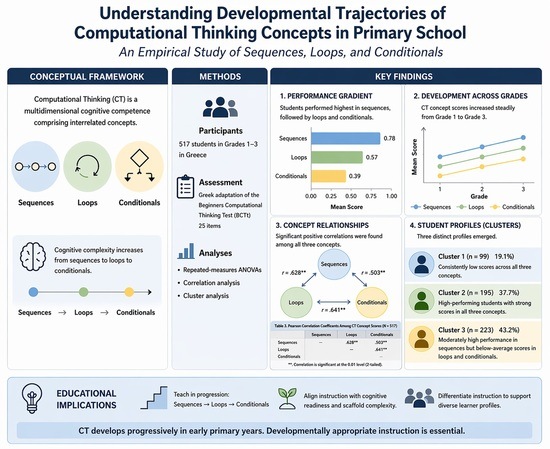
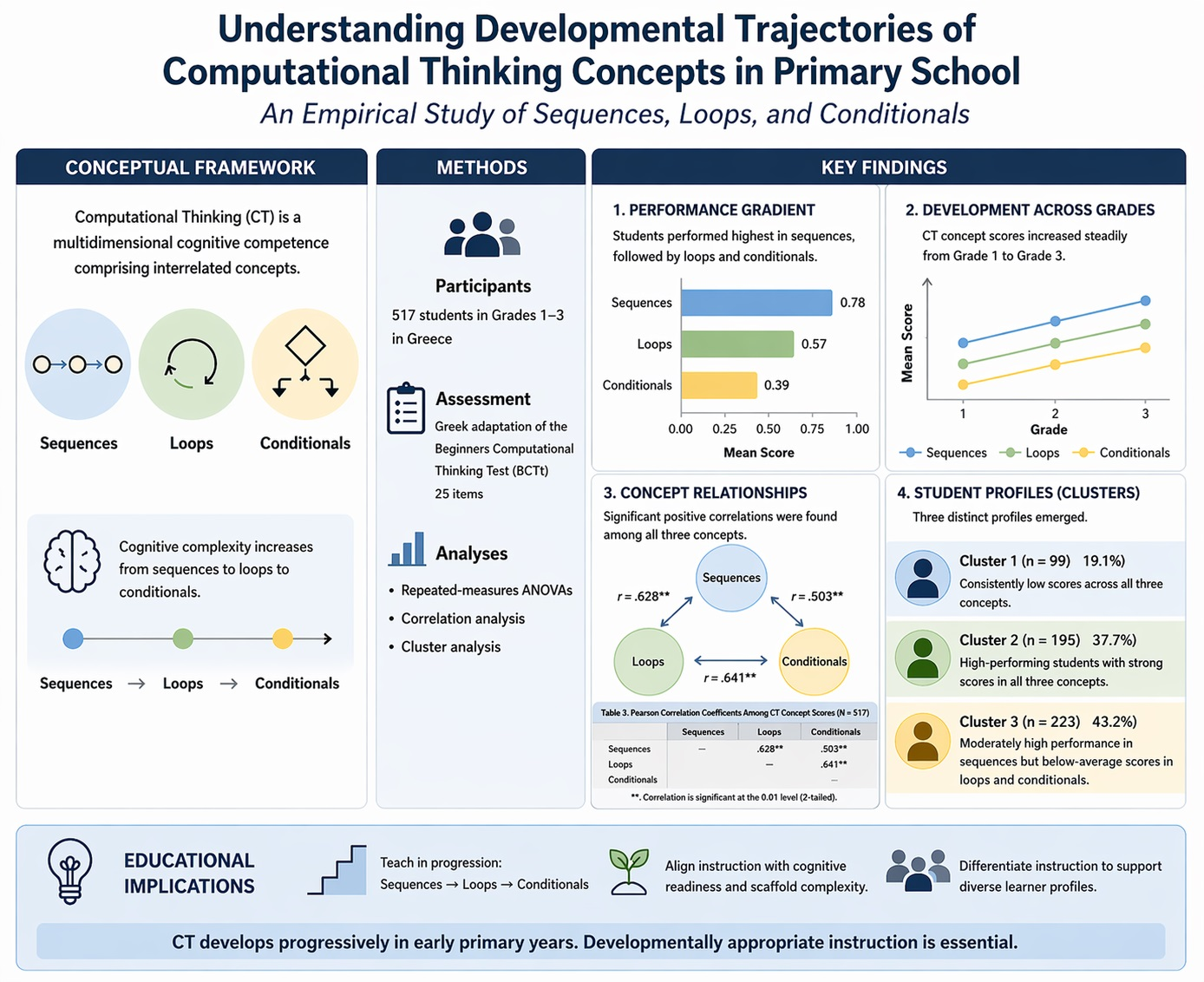
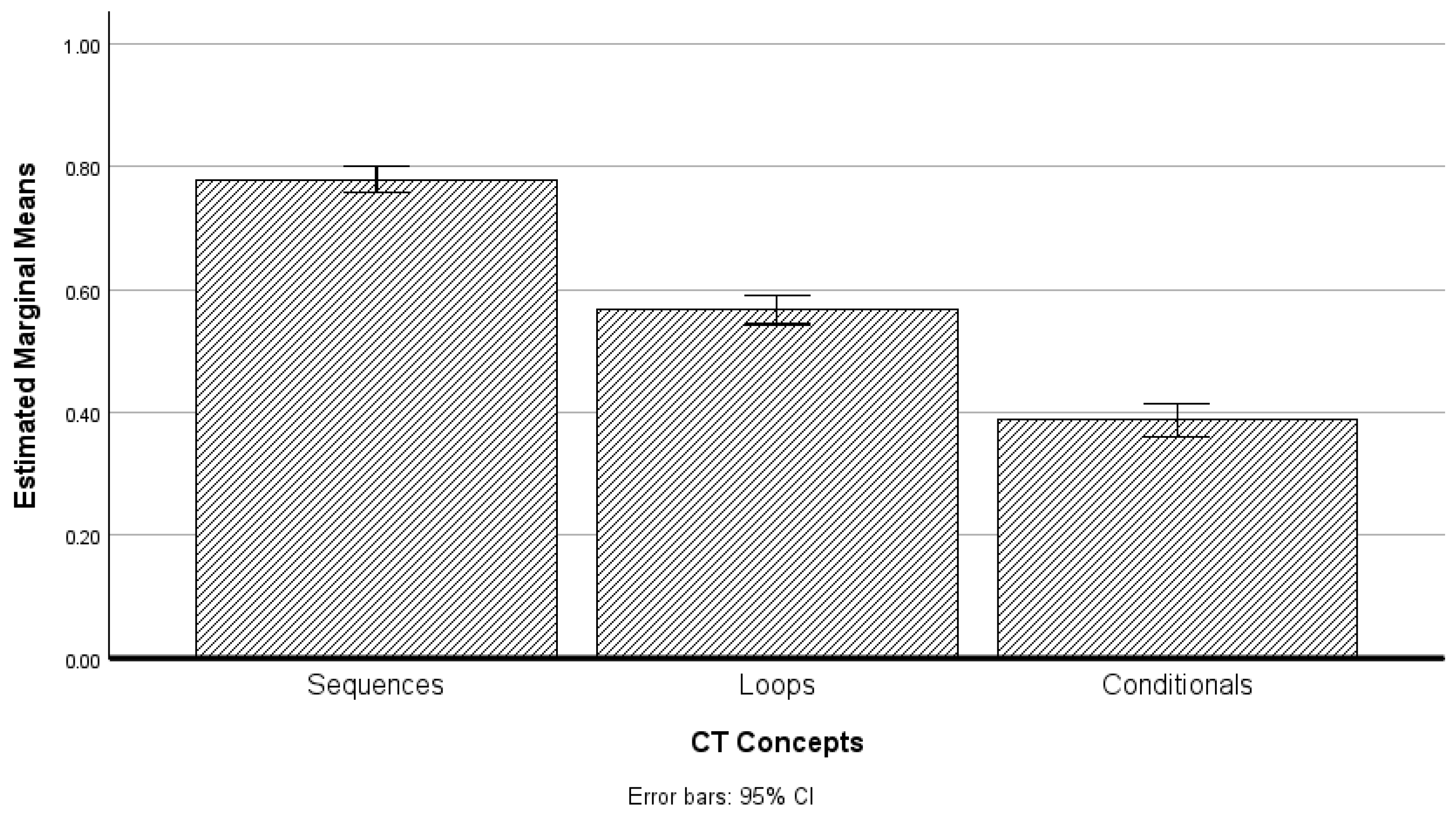
Table 2, students achieved the highest average scores in sequences (M = 0.78, SD = 0.25), followed by loops (M = 0.57, SD = 0.27), while conditionals received the lowest scores overall (M = 0.39, SD = 0.31). These descriptive results suggest differences in average performance across CT concepts.
To better understand these differences, we also examined the distribution of scores for each concept using skewness and kurtosis values. Sequence scores exhibited a pronounced negative skew (skewness = −1.13), indicating that scores were concentrated toward the higher end of the scale. In terms of kurtosis, sequences showed a slightly peaked distribution (kurtosis = 0.40), indicating a modest concentration of scores around the mean. Loop and conditional scores were more symmetrically distributed, with skewness values of −0.30 and 0.20, respectively. These two concepts also displayed flatter distributions (kurtosis = −0.65 for loops and −1.18 for conditionals), indicating greater variability and wider score dispersion.
4.2. Inferential Analyses
4.2.1. Concept-Level Differences
As presented in
Section 4.1.2, we observed substantial variation in students’ performance across the three CT concepts. The highest mean score was found in sequences (M = 0.78, SD = 0.25), followed by loops (M = 0.57, SD = 0.27), while the lowest performance was recorded in conditionals (M = 0.39, SD = 0.31). To evaluate the significance of these differences, we conducted a one-way repeated measures ANOVA.
Before interpreting the results, we tested the assumption of sphericity using Mauchly’s test, which indicated a significant violation, χ2(2) = 40.04, p < 0.001. We therefore applied the Greenhouse–Geisser correction (ε = 0.93) to adjust the degrees of freedom. The ANOVA revealed a significant main effect of CT concept, F(1.86, 960.18) = 624.28, p < 0.001, with a large effect size (ηp2 = 0.55). These results indicate that a substantial proportion of the variance in students’ performance was explained by differences among the CT concepts.
Pairwise comparisons showed that performance in sequences was significantly higher than in loops (mean difference = 0.21, 95% CI [0.19, 0.24], p < 0.001) and conditionals (mean difference = 0.39, 95% CI [0.36, 0.42], p < 0.001). Additionally, performance in loops was significantly higher than in conditionals (mean difference = 0.18, 95% CI [0.15, 0.21], p < 0.001).
Overall, these findings reveal a clear performance gradient among the three CT concepts. As illustrated in
Figure 1, students demonstrated the strongest performance in sequences and the weakest in conditionals, with loops occupying an intermediate position.
4.2.2. Within-Grade Comparisons
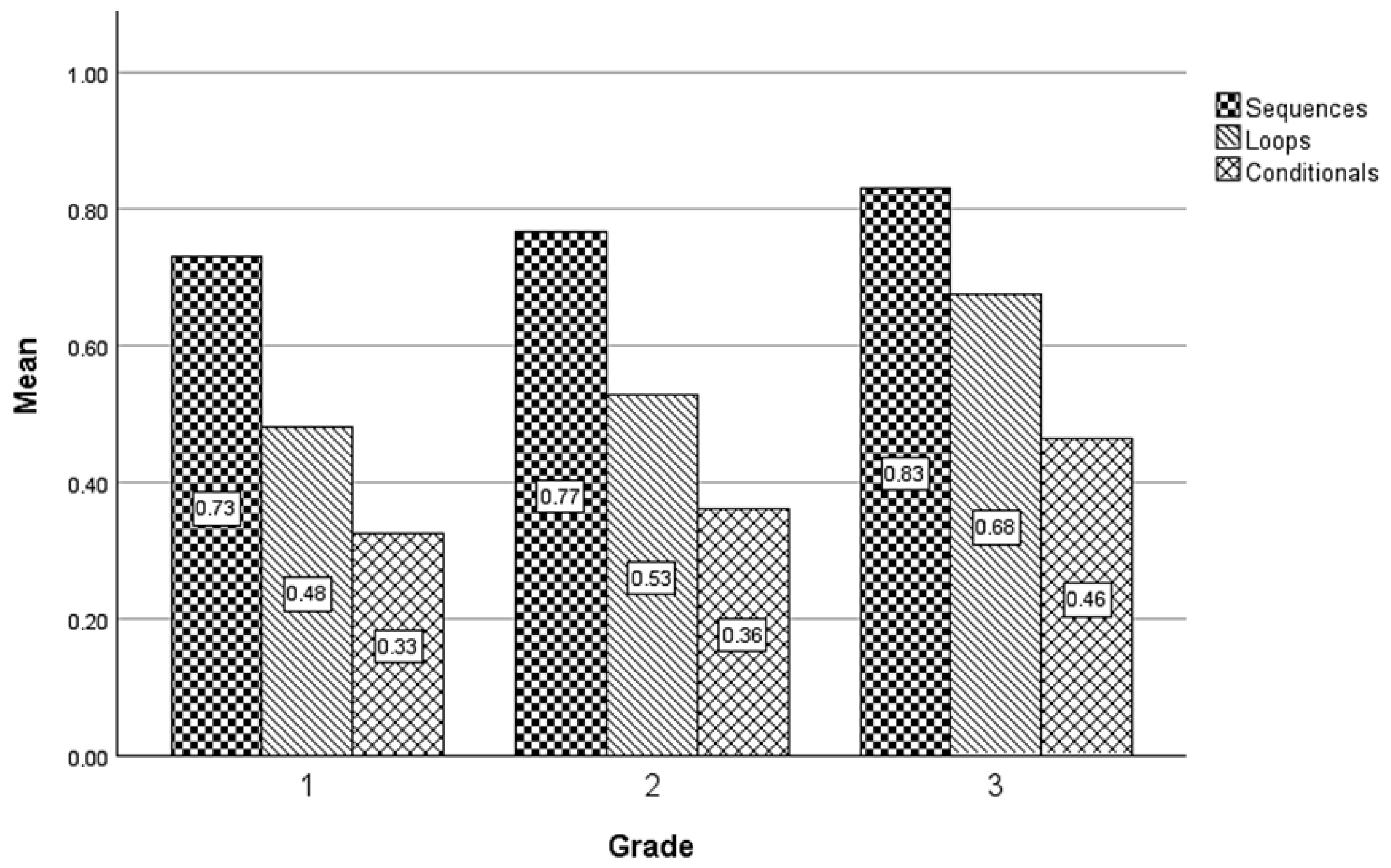
To investigate whether students’ performance differed significantly across the three CT concepts within each grade level, we conducted separate one-way repeated measures ANOVAs for Grades 1, 2, and 3. In each analysis, we treated students’ scores across sequences, loops, and conditionals as related measures, and we tested all relevant assumptions, applying corrections where necessary. As shown in
Figure 2, students across all grade levels demonstrated the highest mean scores in sequences, followed by loops, and then conditionals. This consistent performance pattern was statistically confirmed in all three grades through repeated measures ANOVAs and Bonferroni-adjusted pairwise comparisons (
p < 0.001 in all cases).
In Grade 1, we found that students performed highest in sequences (M = 0.73, SD = 0.27), followed by loops (M = 0.48, SD = 0.27), and lowest in conditionals (M = 0.33, SD = 0.30). The repeated measures ANOVA with Greenhouse–Geisser correction indicated a statistically significant difference among the three concepts, F(1.81, 288.33) = 234.01, p < 0.001, with a large effect size (ηp2 = 0.60). Post hoc comparisons confirmed significantly better performance in sequences over loops (mean difference = 0.25, 95% CI [0.21, 0.29], p < 0.001) and conditionals (mean difference = 0.41, 95% CI [0.35, 0.46], p < 0.001), and also in loops over conditionals (mean difference = 0.16, 95% CI [0.11, 0.20], p < 0.001).
In Grade 2, the same trend persisted, with mean scores of 0.77 for sequences (SD = 0.26), 0.53 for loops (SD = 0.27), and 0.36 for conditionals (SD = 0.30). The repeated measures ANOVA revealed a significant effect of concept, F(1.87, 320.10) = 247.16, p < 0.001, with a large effect size (ηp2 = 0.59). Bonferroni-adjusted comparisons again showed higher performance in sequences compared to loops (mean difference = 0.24, 95% CI [0.20, 0.28], p < 0.001) and conditionals (mean difference = 0.41, 95% CI [0.36, 0.46], p < 0.001), as well as in loops over conditionals (mean difference = 0.17, 95% CI [0.13, 0.21], p < 0.001).
In Grade 3, students achieved the highest scores in sequences (M = 0.83, SD = 0.22), followed by loops (M = 0.68, SD = 0.23), and then conditionals (M = 0.46, SD = 0.31). The repeated measures ANOVA again yielded a significant effect of concept, F(1.81, 332.81) = 172.37, p < 0.001, accompanied by a large effect size (ηp2 = 0.48). Post hoc analyses revealed that sequences significantly outperformed loops (mean difference = 0.16, 95% CI [0.12, 0.20], p < 0.001) and conditionals (mean difference = 0.37, 95% CI [0.32, 0.42], p < 0.001), while loops also exceeded conditionals (mean difference = 0.21, 95% CI [0.16, 0.26], p < 0.001).
4.2.3. Between-Grades Differences
To assess whether the grade-related patterns observed in the total CT scores (
Section 4.1.1) were also evident within individual CT concepts, we conducted separate one-way ANOVAs for sequences, loops, and conditionals. As descriptive statistics by grade level were presented in
Section 4.2.2, we focus here exclusively on the inferential findings.
For the sequences concept, Levene’s test indicated a violation of the homogeneity of variances assumption. We therefore applied Welch’s ANOVA, which revealed a statistically significant effect of grade level, Welch’s F(2, 332.04) = 7.84, p < 0.001. The effect size was small (ω2 = 0.02), indicating modest but meaningful differences across grades. Post hoc comparisons using the Games–Howell procedure showed that Grade 3 students scored significantly higher than those in Grade 1 (mean difference = 0.10, 95% CI [0.04, 0.16], p < 0.001) and Grade 2 (mean difference = 0.06, 95% CI [0.01, 0.13], p = 0.028). No significant difference was found between Grades 1 and 2 (p = 0.424).
For loops, Welch’s ANOVA again revealed a significant grade-level effect, Welch’s F(2, 332.71) = 30.09, p < 0.001. The effect size was moderate (ω2 = 0.09), suggesting substantial differences among grades. Post hoc Games–Howell comparisons indicated that Grade 3 students outperformed those in Grade 1 (mean difference = 0.19, 95% CI [0.13, 0.26], p < 0.001) and Grade 2 (mean difference = 0.15, 95% CI [0.09, 0.21], p < 0.001), with no significant difference observed between Grades 1 and 2 (p = 0.241).
For conditionals, Levene’s test confirmed homogeneity of variances, allowing us to proceed with a standard one-way ANOVA. The analysis indicated a significant grade-level effect, F(2, 514) = 9.82, p < 0.001, with small-to-moderate effect size (ω2 = 0.03). Tukey HSD post hoc tests showed that Grade 3 students scored significantly higher than those in Grade 1 (mean difference = 0.14, 95% CI [0.06, 0.22], p < 0.001) and Grade 2 (mean difference = 0.10, 95% CI [0.03, 0.18], p = 0.005), while the difference between Grades 1 and 2 was not significant (p = 0.522).
4.3. Correlational Analyses
We conducted a series of Pearson correlation analyses to investigate the interrelationships among the three CT concepts assessed in the present study: sequences, loops, and conditionals. Our objective was to determine the extent to which students’ performance in one concept was associated with their performance in the others, thereby shedding light on the structural cohesion of CT skills at the primary education level.
As a first step, we examined correlations within the full sample (N = 517), as presented in
Table 3. All pairwise relationships were found to be statistically significant and positive (
p < 0.001), indicating that students who performed well in one CT domain tended to perform well in the others. Based on conventional benchmarks for interpreting correlation strength (
Cohen, 1988), the correlation between loops and conditionals (r = 0.64) and between sequences and loops (r = 0.63) can be considered strong, while the correlation between sequences and conditionals (r = 0.50) falls within the moderate-to-strong range. These findings suggest a considerable degree of interconnectedness among the three CT constructs, reinforcing the notion that CT domains may develop in parallel during early schooling.
To further explore the relationships among CT concepts, we conducted separate Pearson correlation analyses for each grade level, as presented in
Table 4. In Grade 1 (n = 160), all correlations among scores for sequences, loops, and conditionals were statistically significant and positive (
p < 0.001). The strongest association emerged between loops and conditionals (r = 0.70), followed by sequences and loops (r = 0.69), while the correlation between sequences and conditionals, although comparatively lower, remained substantial (r = 0.55). This pattern indicates moderate to strong conceptual relationships, with loops continuing to play a central role.
In Grade 2 (n = 172), we observed statistically significant and positive correlations among all three CT concept scores (p < 0.001). The strongest relationship was found between loops and conditionals (r = 0.68), followed by sequences and loops (r = 0.64). The correlation between sequences and conditionals was also moderate to strong (r = 0.53). This pattern closely mirrors that observed in Grade 1, with loops and conditionals showing the strongest association, followed by sequences and loops, and sequences and conditionals.
In Grade 3 (n = 185), we found statistically significant and positive correlations among all three CT concept scores (p < 0.001). The strongest association was observed between loops and conditionals (r = 0.49), followed closely by sequences and loops (r = 0.49), while the correlation between sequences and conditionals was slightly lower but still meaningful (r = 0.39). Although the correlations in Grade 3 were slightly lower than in earlier grades, they remained statistically significant and fell within the moderate-to-strong range, suggesting continued interconnection among CT domains, although the relative strength of associations was lower than in earlier grades.
4.4. Cluster Analysis
To investigate whether distinct profiles of CT performance could be identified among students, we conducted K-means cluster analyses using standardized (z-scored) scores for sequences, loops, and conditionals. We explored K-means solutions with two, three, and four clusters to identify patterns of conceptual performance.
The two-cluster solution yielded a clear dichotomy between high- and low-performing students across all three CT domains. Although statistically distinct and balanced in size, this solution offered limited insight into the diversity of performance patterns present in the sample. The four-cluster solution provided more nuanced profiles—differentiating, for example, between students showing general underperformance and those with specific conceptual difficulties—but introduced smaller subgroups that were less interpretable and unevenly distributed. As a result, we selected the three-cluster solution for further analysis, as it provided a meaningful balance between interpretability, conceptual differentiation, and group size, while also ensuring adequate separation among clusters and sufficient representation of students within each profile. The resulting clusters reflected three distinct student profiles:
Cluster 1 (n = 99) included students with consistently low scores across all three concepts, indicating overall lower performance across CT domains.
Cluster 2 (n = 195) consisted of high-performing students who demonstrated strong scores in sequences, loops, and conditionals.
Cluster 3 (n = 223) comprised students with moderately high performance in sequences but below-average scores in loops and conditionals, suggesting a foundational understanding of CT with difficulties in more complex constructs.
To further characterize the identified profiles, cluster centroids based on standardized concept scores are presented in
Table 5. Cluster 1 demonstrated consistently below-average performance across all CT concepts (z = −1.61 to −1.00), Cluster 2 demonstrated consistently high performance (z = 0.68 to 1.02), and Cluster 3 showed relatively stronger performance in sequences (z = 0.13) compared to loops and conditionals (z = −0.17 and −0.45). Distances between cluster centers ranged from 1.86 to 3.70, indicating clear differentiation among clusters in the multidimensional performance space.
Cluster differentiation was further supported by significant between-cluster differences across all CT concepts, as indicated by descriptive one-way ANOVA results: sequences, F(2, 514) = 546.30,
p < 0.001; loops, F(2, 514) = 346.73,
p < 0.001; and conditionals, F(2, 514) = 534.79,
p < 0.001. To examine whether cluster membership merely reflected grade-level differences, we analyzed the distribution of grade levels within each cluster (
Table 6). Although cluster membership was significantly associated with grade level, χ
2(4) = 20.22,
p < 0.001, all three clusters included students from Grades 1, 2, and 3. This indicates that the identified profiles capture within-grade variability and are not reducible solely to age-related progression.
The clustering solution was re-estimated using alternative initial seeds, yielding highly comparable cluster assignments across alternative initializations, supporting the stability of the three-cluster solution.
5. Discussion
This study examined how early primary school students performed across three foundational CT concepts—sequences, loops, and conditionals—and explored their interrelations and performance profiles. Overall, the findings revealed a consistent pattern in which sequences were the strongest-performing concept, followed by loops and then conditionals. This gradient suggests that these constructs differ in their relative accessibility, with sequencing likely benefiting from its alignment with familiar step-by-step reasoning, while loops and conditionals place greater demands on abstraction and rule-based thinking. This is further reflected in the distribution of sequence scores, which exhibited negative skewness, indicating that a substantial proportion of students performed at the higher end of the scale. As a result, reduced score variability may have limited the sensitivity of the ANOVA to detect differences related to this construct. These findings align with prior research identifying sequencing as an early-accessible construct and highlighting iteration and conditional reasoning as more cognitively demanding for young learners (
Elkin et al., 2016;
Sullivan & Bers, 2016;
Zeng et al., 2023). Similarly, sequencing has been conceptualized as a foundational “springboard” for the development of more complex computational structures (
Luo et al., 2022), while loops and conditionals have been characterized as progressively more challenging constructs in early CT development (
Zhang & Nouri, 2019). From a practical perspective, the observed effect sizes indicate that the differences among CT concepts are not only statistically significant but also educationally meaningful. The consistently higher performance in sequences compared to loops and conditionals suggests that students may require more structured instructional support when transitioning to more complex constructs. For teachers, this implies the need to introduce loops and conditionals gradually, using scaffolding strategies that build on students’ existing understanding of sequencing. For curriculum designers, the magnitude of these differences supports the sequencing of CT content in a way that aligns with learners’ cognitive readiness, ensuring that more abstract concepts are introduced only after foundational procedural understanding has been established.
This conceptual ordering remained stable within each grade, indicating that the relative structure of CT performance was consistent across early primary education. Although older students generally demonstrated stronger overall performance, this consistency suggests that the relationships among the examined constructs are preserved across grade levels. This pattern supports the interpretation that sequences, loops, and conditionals represent distinguishable yet developmentally related components of CT competence. Previous studies have similarly reported that foundational procedural structures tend to be acquired earlier, while more abstract forms of reasoning continue to develop over time (
de Ruiter & Bers, 2022;
Román-González et al., 2017). From a cognitive developmental perspective, this pattern is consistent with theoretical accounts emphasizing the gradual emergence of abstract reasoning capacities during middle childhood (
Piaget, 1964), particularly for constructs such as iteration and conditional logic (
Jiang & Wong, 2021). However, the present findings suggest that such improvements may not be uniform across all learners, further supporting the need to consider individual variability in developmental trajectories.
Differences between grades were more pronounced for loops and conditionals than for sequences, suggesting that more complex CT constructs continue to develop throughout early primary education. This pattern is consistent with empirical evidence showing that performance in iteration and conditional reasoning improves with age and cognitive maturity, while sequencing tends to stabilize earlier (
An, 2022;
Zapata-Cáceres et al., 2020). Similarly,
Román-González et al. (
2017) and
H. S. Kim et al. (
2021) documented progressive improvements in CT performance across grade levels, particularly in constructs involving abstraction and algorithmic reasoning. At the same time, the relatively modest differences observed between adjacent grades highlight that development may occur gradually rather than in discrete stages, and that individual variability remains substantial during this period (
Fagerlund et al., 2021). The absence of statistically significant differences between Grades 1 and 2 further supports this interpretation, suggesting that the development of foundational CT concepts may follow a gradual progression during the early stages of primary education, with more pronounced differentiation emerging in later grades.
The correlation analyses further indicated that performance across CT concepts was positively associated, suggesting that these constructs share common cognitive foundations. This finding is consistent with research linking CT performance to broader cognitive abilities, including fluid reasoning, working memory, and general problem-solving (
Román-González et al., 2017;
Tsarava et al., 2022). The observed associations support the interpretation that CT competence involves overlapping cognitive processes rather than fully independent skills. At the same time, the somewhat weaker associations observed in the higher grade may reflect emerging differentiation as students develop more specific conceptual strengths and weaknesses. This interpretation aligns with developmental perspectives suggesting that cognitive abilities may initially appear more unified and become more differentiated with increasing experience and cognitive maturation (
Gerosa et al., 2021;
Piaget, 1964), although further longitudinal research is needed to clarify this process in the context of CT.
A particularly noteworthy finding concerns the observed decline in the correlation between sequences and loops across grade levels. This pattern may indicate that, as students progress, these concepts become increasingly differentiated rather than being processed as part of a unified skill set. In the earlier grades, sequences and loops may rely on similar underlying cognitive processes, such as procedural ordering and pattern recognition. However, with increasing experience and cognitive maturation, loops may require more specialized reasoning related to iteration and control structures, leading to a gradual decoupling from basic sequencing skills. This trend provides further support for the view that CT development involves a shift from more integrated to more differentiated cognitive representations over time.
The cluster analysis provided additional insight into the heterogeneity of student performance, revealing distinct profiles characterized by differences in overall performance and conceptual emphasis. In addition to broadly low- and high-performing groups, a distinct profile emerged characterized by relatively strong sequencing alongside weaker loops and conditionals. This pattern suggests that some students may develop competence in concrete procedural structures while still encountering difficulty with more abstract constructs. Similar variability in developmental trajectories has been documented in longitudinal and person-centered research, which highlights that CT development does not follow a uniform pathway but instead reflects diverse patterns shaped by cognitive and contextual factors (
Cheng et al., 2025). The presence of these profiles across all grades further indicates that differences in conceptual understanding exist not only between age groups but also within them, reinforcing the importance of considering individual variability in early CT development. Notably, the distribution of students in Cluster 3 across all grade levels suggests that difficulties with more complex constructs, such as loops and conditionals, are not confined to younger learners but may persist across early primary education, indicating variability in individual developmental trajectories.
From an instructional perspective, these profiles suggest the need for differentiated teaching approaches. In particular, students in Cluster 3, who demonstrate relatively strong sequencing skills but weaker performance in loops and conditionals, may benefit from targeted scaffolding that explicitly supports the transition from linear to more complex control structures. This could involve the use of visual representations, step-by-step decomposition of iterative processes, and guided practice with conditional reasoning tasks. More broadly, the identification of distinct learner profiles highlights the importance of adapting instruction not only to students’ overall performance levels but also to their specific conceptual strengths and difficulties.
Despite its contributions, this study has several limitations. The sample was drawn from a single geographic region, which may restrict the generalizability of the findings to other contexts with different curricular or technological conditions. Although the Attica region includes a diverse mix of urban, suburban, and socioeconomically varied school settings, it may not fully reflect the educational characteristics of other regions in Greece, particularly rural or less resourced areas. As such, caution is warranted when generalizing the findings beyond similar educational contexts. The cross-sectional design does not allow causal or developmental inferences at the individual level. Although the BCTt demonstrated satisfactory reliability, formal measurement invariance across grades was not tested, and therefore, potential differences in how items function across grade levels cannot be fully ruled out, so some observed grade differences may partly reflect variations in item functioning. In addition, the multiple-choice format limits insight into students’ reasoning processes, and school- and class-level identifiers were not retained, preventing multilevel analyses. Given the nested structure of the data, this may have affected the estimation of standard errors and associated p-values and should therefore be considered when interpreting the results. Finally, missing responses were not systematically logged, restricting more detailed analysis of test-taking behavior. Future research should address these issues through longitudinal, multilevel, and process-oriented designs.
Future research should also employ longitudinal and multilevel designs to trace individual developmental trajectories and better account for contextual influences. The use of mixed-methods approaches, such as think-aloud protocols and performance-based assessments, would also help illuminate the reasoning processes underlying students’ engagement with more complex constructs like loops and conditionals. Expanding sampling across regions and systematically incorporating classroom- and school-level factors would further strengthen the generalizability and explanatory depth of future findings.
6. Conclusions
This study examined how foundational computational thinking concepts—sequences, loops, and conditionals—develop and interrelate during the early years of primary education. The findings indicate that students’ understanding of these concepts follows a structured pattern, with simpler procedural structures appearing more accessible and more complex constructs presenting greater challenges. At the same time, the observed relationships among concepts and the identification of distinct performance profiles suggest that computational thinking is not a uniform ability but a differentiated competence that develops progressively. These results support the view of computational thinking as a cognitively grounded and developmentally contingent construct, reinforcing the importance of examining its emergence through a developmental lens rather than treating it as a single, static skill.
Within the broader educational context, these findings underscore the importance of developmentally aligned instructional and assessment practices that recognize both shared progression patterns and individual variability among learners. While the study provides meaningful insights, its scope is constrained by its cross-sectional design, regional sampling, and reliance on structured assessment formats, highlighting the need for further research using longitudinal, multi-regional, and process-oriented approaches. Future investigations should examine how computational thinking evolves over time and how instructional, cognitive, and contextual factors interact to support or constrain its development. By clarifying how foundational computational concepts emerge in early schooling, this study contributes to ongoing efforts to design educational practices that support coherent and equitable computational thinking development during the formative stages of education.