1. Introduction
Academic socialisation is a central concept in higher education research, referring to the process through which students acquire the linguistic, epistemic, and normative conditions of membership in scholarly communities. Within teacher education, this process is closely intertwined with professional identity formation and the development of reflective pedagogical practice. Rather than representing a single transition, academic socialisation is understood as a gradual process in which students learn how to formulate problems and participate legitimately in academic discourse (
Weidman et al., 2001;
Austin, 2002;
Gardiner-Shires & Kloepfer, 2023). In this sense, academic socialisation involves not only the acquisition of competencies but also the shaping of professional and academic identities. Research on graduate socialisation further highlights the importance of institutional support networks and relational infrastructures in shaping students’ academic integration (
Lehnen, 2021), reinforcing the view that academic socialisation extends beyond curricular requirements to encompass broader organisational environments.
A substantial body of research approaches this process through curricular structures, learning environments, and formal assessment mechanisms (
Gardner, 2007;
Golde, 1998). These perspectives, however, tend to focus on later stages of academic work—such as thesis writing or doctoral education—while paying limited attention to earlier discursive decision points where academic participation and professional positioning already begin to take form.
Discursive approaches emphasise that academic socialisation becomes visible even in the earliest forms of scholarly expression. Academic genres—including the formulation of titles—are not merely technical elements but learned conditions of participation in disciplinary communities (
Swales, 1990;
Hyland, 2012). Through such genres, teacher education students gradually learn which pedagogical problems are considered researchable and how professional experience can be reframed within academic discourse.
Within this interpretive framework, the thesis can be conceptualised as a significant threshold experience in teacher education. Drawing on the concept of liminality (
Turner, 2017), threshold situations describe transitional points at which students move between learner, practitioner, and emerging researcher identities (
Meyer & Land, 2003;
Land et al., 2010;
Land & Meyer, 2024). In teacher education programmes, the thesis often functions as a research-based learning practice through which professional knowledge becomes subject to analytical reflection (
Eklund, 2019;
Eklund et al., 2025).
At the same time, the thesis is not solely the outcome of an individual student’s autonomous decision-making. Topic selection and title formulation typically emerge within the interaction between student and supervisor, where disciplinary norms, institutional expectations, and implicit standards of academic legitimacy are negotiated. Research on thesis supervision highlights that supervisors mobilise a broad repertoire of sometimes conflicting roles, acting simultaneously as mentors, gatekeepers, evaluators, and disciplinary representatives (
Ädel et al., 2024). These roles shape not only the research process but also the framing of the research problem itself.
Furthermore, recent empirical work suggests that supervision practices can influence the epistemic orientation and overall character of student theses, thereby shaping their academic outcomes (
Mårtensson & Söderström, 2026). From this perspective, thesis titles cannot be interpreted as purely individual expressions of professional interest; rather, they should be understood as interactionally produced and institutionally mediated discursive artefacts.
The present study therefore treats the archived thesis title not as an isolated personal choice, but as an institutionally ratified formulation emerging from a structured supervisory context within teacher education.
One of the most condensed and empirically accessible traces of this transition is the thesis title. Titles represent the most standardised and publicly visible element of student research, where thematic orientation, epistemic stance, and emerging professional identity intersect. From a genre-theoretical perspective, titles not only describe a topic but also perform acts of positioning within academic and professional communities (
Swales, 1990;
Hyland, 2004). Although thesis titles may evolve during the research process, the present study analyses the officially registered and archived titles approved at the point of successful defence. These titles therefore represent institutionally validated and discursively stabilised formulations rather than provisional working versions.
This study argues that early phases of academic and professional identity formation in teacher education can be examined through the longitudinal analysis of thesis titles. Building on a thesis title analysis approach that integrates document analysis with discourse analytic sensitivity, the study draws on a corpus of 2311 titles produced between 1989 and 2024 within the teacher education programmes of the University of Dunaújváros, Hungary. The analysed institutional context represents a professionally oriented teacher education environment with a strong vocational and engineering teacher training tradition extending over more than five decades. This long-standing institutional profile provides a particularly rich setting for examining how professional and academic norms intersect in thesis work.
At the same time, the analytical framework developed in this study is not confined to vocational teacher education. The four dimensions of analysis—thematic orientation, professional–academic positioning, discursive abstraction, and student role construction—are conceptually applicable to other teacher education contexts, including general subject teacher education. The present findings, however, reflect their configuration within a historically vocationally embedded institutional setting. The corpus consists exclusively of officially defended and institutionally archived titles, ensuring consistency and comparability across the thirty-five-year period. Rather than evaluating thesis quality, the analysis explores how teacher education programmes implicitly shape legitimate problem framings, discursive practices, and student positioning.
The Hungarian context provides a particularly relevant setting for longitudinal investigation. The period under study spans substantial structural transformations affecting higher education and teacher education, including the post-socialist restructuring of universities after 1989, the implementation of the Bologna system in the mid-2000s, and subsequent reforms influencing teacher education and vocational training. These transformations form an important background for interpreting shifts in thematic orientation and academic positioning within thesis titles.
The article first outlines the historical and institutional embeddedness of the thesis, then presents the methodological framework and analytical dimensions. The results examine thematic structures, orientations, discursive abstraction, and patterns of student positioning over time, followed by a discussion of implications for teacher education research and professional identity development.
By foregrounding teacher education as a professional field where academic and practice-based identities intersect, the study contributes to understanding how future teachers negotiate scholarly positioning already at the stage of thesis title formulation. Through its longitudinal design, the study therefore asks how thesis titles reflect changing patterns of professional and academic identity formation in teacher education over time.
3. Methodology
3.1. Empirical Corpus
The empirical basis of the study consists of 2311 thesis titles produced between 1989 and 2024 within the teacher education programmes of a single higher education institution. The institution has maintained a stable profile in professionally oriented teacher education, with a particular emphasis on engineering teacher education and related vocational teacher training pathways. Throughout the period examined, the institution operated as a research-informed but professionally oriented teacher education provider. The dataset comprises the complete list of thesis titles produced during the period; consequently, the analysis is based on a full corpus rather than on a sample. Titles were retrieved from the institution’s official archival records and electronic administrative databases. Earlier titles were manually digitised from printed catalogues, while more recent titles were extracted from digital study administration systems. Only officially submitted and archived thesis titles were included; draft or withdrawn titles were excluded.
The extended time span allows thesis titles to be interpreted not as isolated or static utterances but as an evolving institutional practice within teacher education. The period under investigation encompasses several structural transformations affecting both higher education and teacher education, rendering the dataset particularly suitable for examining long-term patterns and shifts in professional and academic socialisation. These include the post-1989 systemic transition, the introduction of the Bologna two-cycle structure in 2006–2007, and the reintroduction of undivided teacher education programmes after 2013. Each reform reshaped programme structures and the positioning of research-based components within teacher education.
The analysis is limited exclusively to the textual form of thesis titles. The full content of the theses, their methodological designs, empirical materials, or assessment outcomes do not form part of the study. During data processing, all personal and institutional identifiers were removed; the analysis was conducted at an anonymised and aggregated level. Thesis titles are analysed as anonymised institutional records rather than as individually attributed intellectual products. For reasons of data protection and ethical consideration, titles are cited without author names and are not reproduced as a complete corpus in an appendix.
3.2. Analytical Approach
The study adopts a thesis title analysis approach that combines document analysis with discourse analytic sensitivity. Thesis titles are treated as institutionally governed academic utterances that condense legitimate thematic domains, problem-framing practices, and linguistic conventions within teacher education.
The analysis does not focus on students’ individual research competencies, motivations, or learning processes—topics addressed by other strands of research (e.g.,
Henttonen et al., 2023;
Hansford & Maxwell, 1993). Instead, it concentrates on recurring thematic and discursive patterns observable at the level of titles and interprets these as indicators of professional and academic socialisation in teacher education.
The approach adopts a clearly delimited empirical focus and is explicitly theory-driven. Rather than reconstructing complete research processes, the analysis concentrates on a clearly identifiable institutional site: the point at which student teachers are required to align their topic choices and problem formulations with institutionally legitimised academic and professional norms.
As analytical units, titles are both highly normative and widely accessible. Their normative character derives from institutional regulation, as titles must be formally approved and institutionally archived. At the same time, their textual standardisation makes them comparable across cohorts and time periods. This dual characteristic renders thesis titles particularly suitable for longitudinal institutional analysis, as they provide stable yet context-sensitive traces of academic and professional positioning. The analytical focus on titles does not imply interpretive arbitrariness. Rather, it reflects a methodological decision to examine a formally stabilised and institutionally validated textual layer that mediates between individual student agency and organisational expectations.
3.3. Analytical Dimensions and Coding Principles
Thesis titles were analysed along four interrelated analytical dimensions derived from the theoretical framework of professional and academic socialisation in teacher education.
The first dimension concerns thematic orientation and examines which problem domains are designated as legitimate objects of inquiry (e.g., pedagogical practices, learner characteristics, institutional processes, or broader educational issues).
The second dimension captures professional versus academic orientation and focuses on whether titles imply practical intervention, development, and application, or adopt an analytical, interpretive, or investigative logic. This dimension directly reflects the dual positioning of teacher education between professional practice and academic knowledge production.
The third dimension addresses discursive abstraction and captures the degree of conceptual condensation, abstraction, and impersonal analytical language in titles. Abstraction is interpreted not as a stylistic feature but as an indicator of the appropriation of institutionally legitimised forms of academic problem construction.
The fourth dimension concerns student positioning and examines which role conceptions are implied in titles: positioning students as practising teachers, reflective practitioners, or analytically oriented researchers. This dimension identifies institutionally legitimised role patterns rather than individual intentions.
Coding was conducted by a three-member research team consisting of the two authors and one research assistant. Prior to full-corpus analysis, a pilot phase was carried out on approximately 15% of the titles. During this phase, the analytical dimensions were applied independently in order to assess their clarity and internal coherence. Differences in coding were discussed collectively, and category definitions were refined accordingly.
Following this calibration phase, the full corpus was coded using the agreed analytical framework. Ambiguous cases were revisited iteratively, and category boundaries were refined through repeated comparison across time periods. Analytical consistency was maintained through regular team discussions and cross-checking of coded titles.
Titles were organised in a structured database that enabled systematic categorisation and longitudinal comparison. The purpose of coding was not mechanical classification but the identification of stable, interpretable patterns across the 35-year period.
To illustrate the application of the analytical dimensions, two contrasting examples from the corpus may be considered. The title “Project Design for CAD Modelling Using 3D Printing Technology” (2016; authorial translation) was coded as follows: (1) thematic orientation: subject-specific pedagogical practice within vocational engineering education; (2) professional–academic orientation: predominantly practice-oriented, with a developmental logic implied by the notion of “project design”; (3) discursive abstraction: medium, as the formulation refers to a structured pedagogical activity rather than to a single classroom episode; and (4) student positioning: practitioner-oriented, foregrounding applied professional competence.
By contrast, the title “The Hidden Curriculum” (1999; authorial translation) was coded as: (1) thematic orientation: broader educational theory; (2) professional–academic orientation: predominantly analytical; (3) discursive abstraction: high, due to the exclusive use of a conceptual category without contextual specification; and (4) student positioning: analytically oriented researcher.
The comparison of these two titles illustrates how the analytical dimensions capture variation in thematic scope, abstraction, and professional positioning. In cases where titles contained both developmental and analytical elements, coding decisions were reached through collective deliberation to ensure consistency across the corpus.
The four analytical dimensions were applied in an integrated manner rather than as isolated variables. Individual titles were interpreted through the combined configuration of these dimensions, which also made it possible to identify transitional or liminal positions between professional practice and academic discourse.
Table 1 summarises the analytical dimensions and their operational interpretation in the analysis.
The analytical themes presented in
Section 4 emerged from recurring constellations of coded dimensions rather than from individual titles. Longitudinal comparison enabled the identification of stable configurations and shifts in their relative proportions across reform periods. Interpretive claims in the results section are therefore grounded in aggregated coding patterns across the corpus.
3.4. Interpretive Boundaries
The study does not evaluate the scientific quality of individual theses, their methodological robustness, or students’ personal competencies. Instead, it focuses on discursive patterns observable at the level of officially registered thesis titles. The findings therefore reflect institutionally mediated traces of professional and academic socialisation rather than comprehensive reconstructions of individual learning trajectories.
By restricting the analysis to thesis titles, the study isolates a formally stabilised institutional moment within teacher education: the point at which curricular expectations, disciplinary norms, and professional orientations converge in a publicly validated textual formulation. While this focus necessarily captures only one layer of the socialisation process, it provides a consistent and comparable analytical surface across time.
The corpus derives primarily from engineering teacher education within a single institutional context. Although teacher education programmes vary internationally and across institutional types, the analytical framework developed here addresses broader processes of professional–academic positioning. The transferability of findings should therefore be understood at the level of conceptual patterns rather than institutional replication.
4. Results
4.1. The Thematic Structure of Thesis Titles (1989–2024)
The thematic analysis of the 2311 thesis titles indicates that the range of problems legitimised within teacher education remains strongly anchored in professional practice throughout the entire period under study, while both thematic focus and modes of formulation undergo noticeable shifts over time. The thematic structure does not display a linear developmental trajectory; rather, it reveals the coexistence of partially overlapping patterns. The illustrative titles presented in this section were selected as typical cases representing dominant coded configurations within each period rather than as extreme or exceptional examples.
In the early phase of the corpus (1989–1995), the vast majority of titles exhibit a direct professional and methodological focus. These titles typically refer to specific curricular units, technological processes, or clearly delimited professional operations and are organised around the logic of teaching and instruction. The formulations are predominantly descriptive, and pedagogical activity is presented primarily as transmissible professional content. Representative examples include:
“Teaching–learning processes of the topic ‘Liquid forming’” (1989);
“Teaching the CONVO AS 316 type arc-cutting machine” (1989);
“Instructional strategies for the topic ‘Making a shirt blouse’” (1989);
“Practical instructional processes of the topic ‘Riveted joints’” (1989).
A shared feature of these titles is that they construe the function of the thesis as the structured transmission of professional knowledge. Problem formulation is concrete and instrumental, while research as an analytical activity remains implicit. Student positioning is constructed primarily as that of a practising professional or instructor.
From the second half of the 1990s onwards, a gradual thematic shift becomes observable. Alongside professional and methodological orientations, titles increasingly address pedagogical, educational, and learner-related phenomena. Teaching is no longer framed solely as a technical process but also appears in educational and social contexts. An illustrative example is: “The educational work of the class teacher: value transmission and community building” (1995).
This shift in focus does not entail the abandonment of practice orientation; rather, it can be interpreted as a conceptual extension of it.
From the 2000s onwards, and particularly after 2010, thematic diversification becomes more pronounced. An increasing proportion of titles refer to educational processes, pedagogical roles, learner characteristics, or institutional contexts, and frequently imply an analytical or interpretive stance. This transformation does not signify the disappearance of earlier thematic domains but their stratification: professional and methodological foci remain present throughout the period, yet increasingly co-occur with other problem types.
This diversification becomes visible in titles such as “Pedagogical Conflict Situations in …” (2014), “ICT-Supported Pedagogical Assessment” (2013), or “The Value Orientation of Secondary School Students” (2002), which signal analytical engagement with educational processes, learner characteristics, and institutional contexts. At the same time, development-oriented titles such as “Implementation of SAP Training at Bombardier TH Ltd.” (2013) or “Design of a Programming Theory Module” (2003) illustrate the continued presence of professionally focused themes.
Overall, the thematic structure cannot be described as a simple shift from “professional” to “academic” orientations. Instead, multiple thematic patterns coexist, differing in the extent to which they are linked to immediate professional practice or to reflective interpretations of education. This plural presence reflects a distinctive feature of teacher education, in which the thesis simultaneously serves to consolidate professional competencies and to introduce students to academic modes of thinking.
4.2. Proportions and Hybridisation of Academic and Professional Orientations
The analysis of thesis titles shows that topic choices in teacher education reflect not only thematic differences but also what types of knowledge students consider legitimate and how they position themselves at the boundary of the professional and academic fields. Based on the longitudinal analysis of 2311 titles, professional and academic orientations do not appear as mutually exclusive stages but form time-dependent patterns in their proportions and relations.
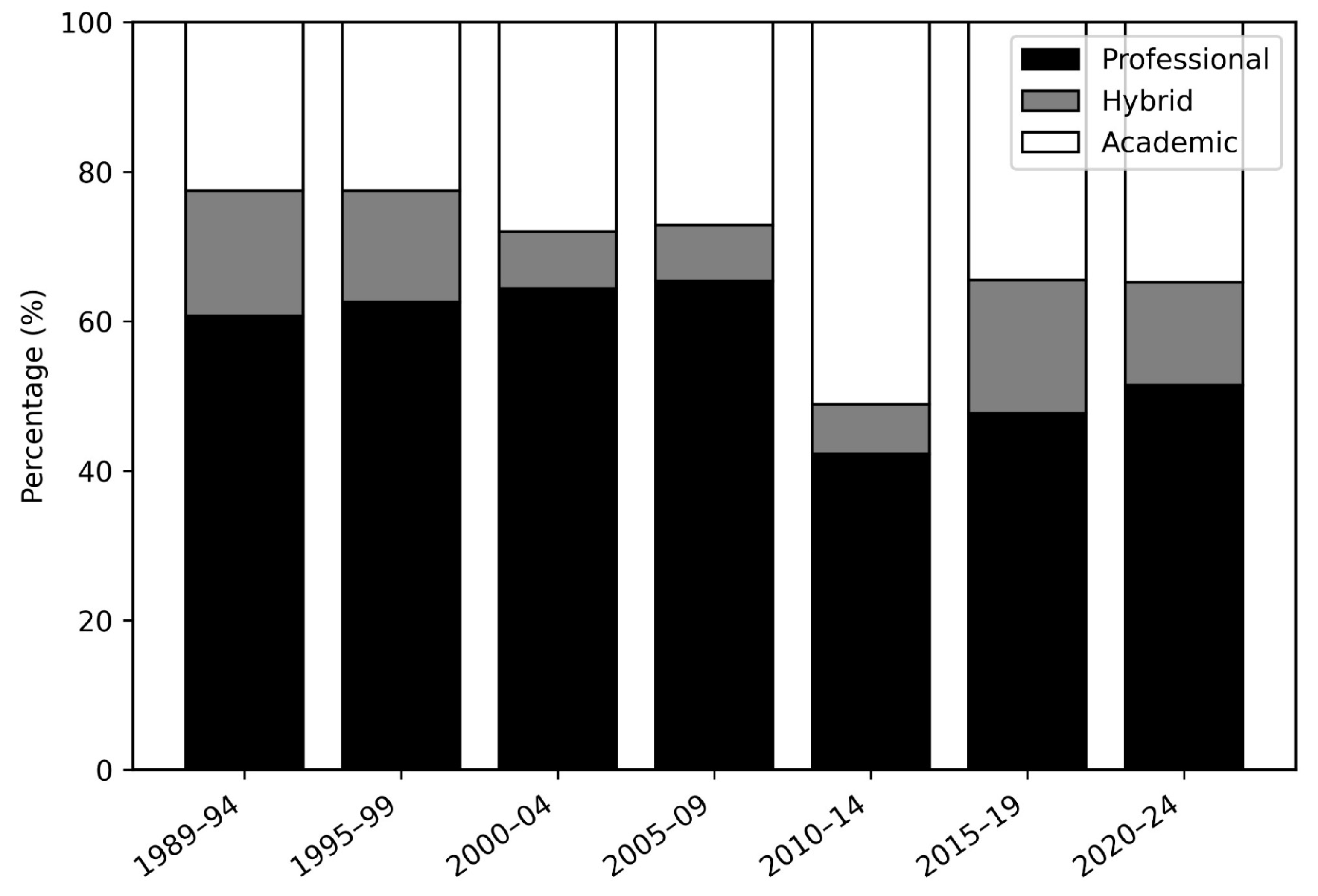
The time-series distribution of orientations (
Figure 1) indicates that in the early period (1989–1995) the vast majority of titles display a professional orientation. These are characterised by action-centred and development-oriented language, in which problems appear as instructional tasks or methodological challenges. Procedural verbs and constructions such as teaching, designing, and applying dominate, framing the thesis as a tool for transmitting professional knowledge.
Within this orientation, students implicitly position themselves as practising teachers or professionals; professional experience functions as a legitimate source of knowledge rather than as an object of reflection. Linguistic markers of academic analysis are rare and remain marginal.
From the second half of the 1990s onwards, a gradual shift towards academic orientation becomes visible. Titles increasingly contain analytic and interpretive constructions (e.g., analysis, examination, evaluation, relationships), which frame pedagogical practice as an object of scientific inquiry. In parallel, student positioning moves from participant roles towards that of a reflective observer.
At the same time, the longitudinal data show that the strengthening of academic orientation does not entail the disappearance of professional focus. After 2010, hybrid titles became increasingly frequent, combining concrete professional contexts with academic problematisation through abstract conceptual frameworks.
In the overall distribution, professional orientation remains dominant: 77.2% of titles are primarily action- and development-centred, 20.7% are academically oriented, and 2.1% display a hybrid orientation. These proportions indicate that although academic language becomes more prominent over time, the legitimate thesis discourse in teacher education continues to be structured primarily by professional practice.
Overall, the development of orientations suggests that academic socialisation in teacher education is not a single shift from practice to theory but a gradually hybridising process. Thesis titles function as sensitive empirical indicators of how students learn the linguistic and conceptual conditions of belonging to the academic field under the dual demands of professional relevance and academic legitimacy.
4.3. Discursive Abstraction as an Indicator of Academic Socialisation
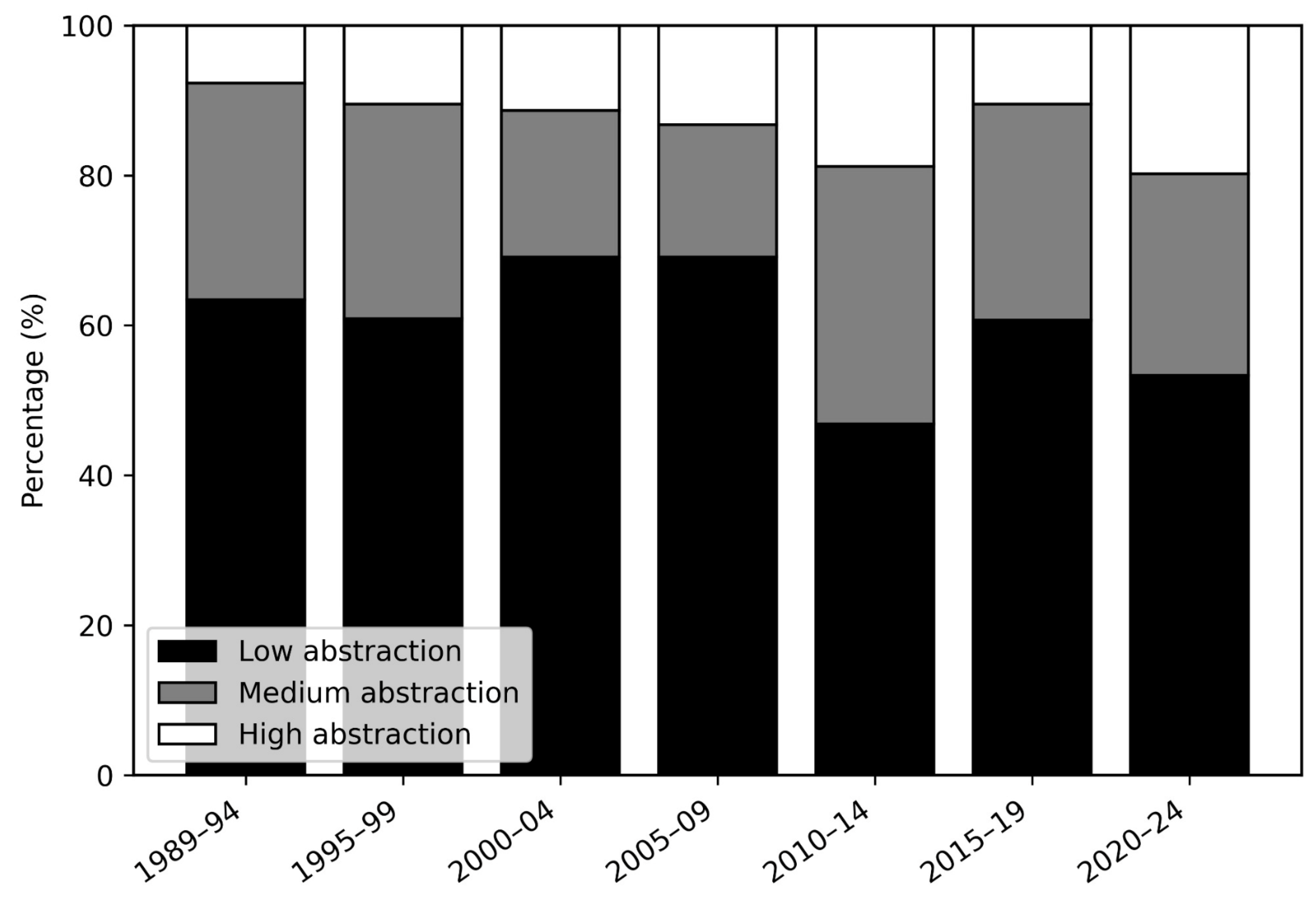
The degree of abstraction in thesis titles is not merely a stylistic feature but an empirical sign of how far students adopt institutionally legitimised forms of academic problem construction. The longitudinal analysis of 2311 titles (1989–2024) reveals a consistent pattern: increasing abstraction is accompanied by a shift in student positioning from direct professional action towards analytic and interpretive academic discourse.
Figure 2 presents the time-series distribution of abstraction levels and shows that the relative weight of concrete, task- and activity-oriented formulations decreases, while abstract and analytic framings become more salient. The visualisation supports the interpretive analysis by illustrating how expectations of institutionally legitimised academic language accumulate within the normative genre of title formulation.
In the early phase of the corpus (1989–1995), the linguistic and conceptual structure of titles is closely tied to concrete teaching and training activities. Theses typically focus on the planning or implementation of clearly defined instructional tasks; abstract framing remains marginal, and students implicitly appear as acting teachers. This is reflected in titles such as:
In these cases, problem formulation is strongly context-bound, professional knowledge is articulated primarily at the level of application, and terms implying analysis or interpretation are rare.
From the late 1990s onwards, an increasing number of titles employ conceptual and linguistic solutions that frame pedagogical practice as an object of analysis. Structures implying investigation, assessment, or role interpretation become more frequent, for example:
“Comparative study of achievement motivation in a vocational secondary school across grade levels” (1999).
“The role and possible applications of group work in the teaching–learning process of vocational subjects” (1995).
Here, emphasis shifts from the direct execution of educational activity towards its functions and consequences, and a reflective observer position emerges.
After 2010, abstraction is realised through institutional, systemic, and more theoretical concepts. Titles increasingly move beyond specific curricular units and interpret pedagogical practice in broader contexts, such as:
“Experiences of quality assurance development work in vocational education” (2010).
“Mobile communication and social diffusion” (2012).
“E-learning-based instruction and assessment in adult education” (2012).
In these cases, professional practice is repositioned through abstract conceptual frameworks, not detached from practice but reconstructed as a theoretical problem.
The growth of discursive abstraction is therefore not a linguistic ‘development’ but an indicator of entry into the academic community. Already at the beginning of the research process, the thesis title creates pressure towards institutionally legitimised scientific framing. Accordingly, abstraction becomes an empirically observable trace of the transformation of professional experience into scientific knowledge.
Overall, discursive abstraction in thesis titles suggests that academic socialisation begins not at the final stage of thesis writing but already at the moment of topic selection and title formulation. Titles thus function as condensed, institutionally regulated documents of students’ professional and academic identity formation.
4.4. Student Positioning and Role Construction in the Academic Field
Thesis titles register not only thematic and discursive choices but also implicit student role constructions. Through title formulation, students signal from which position and in what relation they speak about their topic. These positioning patterns are closely linked to the orientation shifts described in
Section 4.2: the strengthening of analytic language coincides with the more frequent construction of observer and researcher roles.
In the early period (1989–1995), student positioning predominantly reflects an internal, participatory role. Pedagogical practice and its reflection are rarely separated; teaching and training activities themselves become the object of the thesis, and students appear implicitly as acting practitioners, for example:
Here, students present themselves as active participants rather than reflective observers, and the thesis primarily demonstrates professional competence.
From the late 1990s and throughout the 2000s, external and analytic positioning becomes more frequent. Titles separate the object of analysis from the analyst, and pedagogical practice appears as an object of inquiry. Student roles shift from actors to observers, as illustrated by:
After 2010, positioning becomes more differentiated. Many titles construct hybrid roles combining concrete educational contexts with analytic perspectives, such as:
These titles portray students as intermediary actors who transform professional experience into an object of scientific reflection. This pattern corresponds to the structural characteristics of teacher education, where students belong simultaneously to professional communities and enter the academic field.
Overall, student positioning is not static but time-dependent and responsive to institutional expectations and academic norms. Thesis titles function as empirically accessible indicators of how students learn legitimate positions of academic voice.
4.5. Discursive Turning Points and Non-Linear Patterns in Thesis Titles (1989–2024)
Longitudinal analysis reveals not only gradual shifts but also discursive turning points, stagnations, and reversals. These non-linear patterns indicate that the internalisation of academic norms is uneven and not irreversible.
At the beginning of the 2000s, despite the emergence of analytic and abstract formulations, many titles return to detailed descriptions of concrete instructional tasks, such as:
These titles lack analytic or reflexive framing and resemble early professional orientations rather than the academic style of the same period. This pattern reflects parallel normative logics rather than regression.
A similar turning point appears in the early 2010s. Although abstract academic language becomes widespread, explicitly normative and development-oriented titles persist:
Here, the thesis does not investigate phenomena but formulates desirable pedagogical states. Students adopt a normative or developmental role that diverges from academic reflexivity, indicating that professional–normative approaches remain available even within academically oriented contexts.
These discursive turning points show that professional and academic expectation systems in teacher education are neither unified nor hierarchically ordered. In title formulation, students simultaneously align with practical pedagogical contexts, curricular requirements, and academic discourse norms. Thesis titles thus condense this normative multiplicity.
Overall, the presence of discursive breaks suggests that socialisation in teacher education is not a linear modernisation process. Fluctuations and parallel logics reveal ongoing competition and renegotiation between professional and academic norms as students seek institutionally legitimate positions.
4.6. Hybrid Thesis Titles as Threshold Phenomena Between Professional and Academic Socialisation
A stable group of titles cannot be fully classified as either professional or academic. These hybrid titles do not represent immature formulations but reveal structural intersections of professional and academic socialisation in teacher education.
Hybrid titles define their object within concrete professional or institutional contexts while employing analytic or investigative framing. Their discursive structure is dual: they maintain reference to professional practice while conforming to academic norms. This pattern appears not as isolated cases but as recurring configurations, for example:
“Analysis of a first-year dressmaking technical drawing textbook” (1990).
“Methodological analysis of teaching surface turning” (1993).
“Analysis of basic metalworking practice in automotive training” (1994).
Linguistically, hybridity is realised through the combination of concrete professional referents with academic action nouns or verbs (e.g., analysis, examination, evaluation). Professional context remains salient, but problem formulation shifts from execution to interpretation. Professional experience thus becomes an object of inquiry rather than an end in itself.
This duality implies a change in student positioning. Students are no longer only practising teachers, yet not fully autonomous researchers. They occupy an intermediate role in which professional experience is reflexively reframed as a scientific object.
Across the corpus, hybrid titles are not confined to later periods. Although more frequent over time, they already appear in the early 1990s, indicating that they are not simple indicators of linear “academic maturity” but reflect the coexistence of parallel normative systems in teacher education.
Empirically, hybrid titles are analytically productive because they resist simple categorisation. They are neither anomalies nor exceptions but stable patterns in which professional practice and academic analysis presuppose each other.
These patterns suggest that the thesis functions as an institutionally embedded threshold in teacher education. In title formulation, students adopt a position in which professional experience becomes legitimate only through scientific interpretation. This transition marks a critical point in professional and academic socialisation.
Overall, hybrid thesis titles show that socialisation in teacher education is not organised dichotomously along “professional” and “academic” poles. Instead, many titles occupy a liminal space where students simultaneously learn to interpret professional experience scientifically and to adopt the norms of academic belonging. This intermediate position should be understood not as temporary but as a structural feature of teacher education. These patterns suggest that thesis titles operate not merely as descriptive labels but as discursive entry points into professional teacher identity formation.
5. Discussion
This study demonstrates that thesis titles function as early discursive sites through which professional and academic identities are negotiated in teacher education. From a teacher education perspective, they reflect how students position themselves between practitioner experience and research-informed pedagogical reflection.
Patterns of thematic organisation, shifts in orientation, levels of discursive abstraction, and the presence of hybrid titles jointly indicate that the thesis in teacher education operates as a structural threshold between professional experience and academic knowledge production. Importantly, this threshold becomes visible already at the stage of topic selection and title formulation, well before the completion of the thesis itself, supporting conceptualisations of academic socialisation as a gradual process of positional change (
Weidman et al., 2001;
Meyer & Land, 2003;
Land & Meyer, 2024;
Gardiner-Shires & Kloepfer, 2023).
Professionally oriented titles construct pedagogical practice as legitimate knowledge in its own right, whereas academically oriented titles reframe practice as an object of analysis. Hybrid titles make visible the movement between these two logics and suggest that professional and academic identities in teacher education are not mutually exclusive but mutually constitutive. Academic socialisation thus involves the recontextualisation rather than the replacement of professional orientation. For teacher educators, these findings highlight the importance of making academic positioning explicit within thesis supervision and programme design.
Discursive breaks and reversals further indicate that the internalisation of academic norms is neither linear nor irreversible. Divergent and sometimes competing institutional expectations become visible at the level of thesis titles, rendering them particularly sensitive indicators of how such norms are translated into student-level discursive choices.
Methodologically, the study contributes to higher education research by positioning thesis titles as an independent empirical source for analysing socialisation processes. As highly normative yet large-scale textual units, titles enable the examination of long-term, institutionally embedded dynamics without evaluating individual student performance.
The increasing presence of hybrid and analytically framed titles suggests that students are already engaging in reflective positioning between professional practice and academic discourse at the stage of topic formulation. For teacher educators, this points to the importance of supervision practices that explicitly support students in articulating practice-based experience within analytical and research-informed frames. Rather than treating thesis writing as a final assessment task, programmes may consider the title formulation phase as a pedagogical moment where academic identity formation becomes visible and can be intentionally scaffolded.
Overall, the findings suggest that the thesis is not only an academic product but also a socialisation event: an institutionally regulated practice in which students are first required to articulate professional experience in accordance with academic discourse norms. Thesis titles thus constitute condensed empirical traces of professional and academic identity formation processes. These patterns suggest that thesis supervision in teacher education may benefit from explicitly addressing students’ positioning between professional practice and academic discourse. While the empirical material derives from a vocationally embedded teacher education context, the analytical framework may support comparative investigations across diverse teacher education models.
6. Limitations and Methodological Considerations
The study relies on a deliberately minimalist methodological approach based on the longitudinal analysis of thesis titles. While this allows for the examination of a large corpus across an extended period, it does not provide insight into the full content, methodological quality, or scientific merit of the theses. From a teacher education perspective, this methodological choice prioritises discursive indicators over evaluative measures.
Accordingly, the study does not address individual students’ research competencies or performance. Thesis titles are treated not as performance indicators but as discursive indicators capturing which problems, conceptual frameworks, and positions become institutionally legitimate.
The analysis therefore targets structural and institutionally mediated patterns of socialisation rather than individual achievement. Title analysis does not replace content analysis of theses but operates at a different analytical level, focusing on the point at which students must already align topic choices with academic norms.
A further limitation is that the data derive from a single national and institutional context. Although tensions between professional and academic socialisation are internationally recognisable, programme structures and institutional regulation may shape the observed patterns. Nevertheless, the size of the corpus and the extended time span allow for conclusions that speak to more general mechanisms in professional higher education.
Finally, the study does not aim to assess the “correctness” or “success” of thesis titles. Treating titles as a normative genre enables a focus on the institutional expectations that structure legitimate topics, language use, and problem framing in higher education. This focus aligns with discourse-oriented approaches that treat academic genres as early sites of socialisation. Rather than limiting the analysis, this focused scope enables a fine-grained view of early academic socialisation as it becomes visible in academic genres.
7. Conclusions
Taken together, the findings extend existing research on academic socialisation by showing that identity formation becomes visible already at the level of thesis title formulation within teacher education.
The longitudinal analysis of 2311 thesis titles shows that the thesis—particularly its title—functions as an early, institutionally regulated threshold into the academic field rather than merely a formal endpoint of study.
The findings indicate that professional and academic orientations in teacher education operate as parallel and shifting normative systems rather than mutually exclusive alternatives. Thematic changes, orientation shifts, discursive breaks, and hybrid constructions reveal how students navigate these norms while constructing legitimate positions within higher education.
A central contribution of the study is the empirical demonstration that academic socialisation begins at the level of topic selection and title formulation. Thesis titles emerge as condensed discursive sites where institutional expectations and student identity formation intersect.
Methodologically, the study expands the toolkit of higher education research by highlighting thesis titles as a large-scale longitudinal data source. This approach is particularly relevant in teacher education, where professional practice and academic knowledge are structurally intertwined.
Overall, the findings suggest that the thesis functions not only as an academic product but as a socialisation event in which students are first required to articulate professional experience within the norms of academic discourse. Analysing thesis titles thus contributes to understanding how professional and academic identities are formed in teacher education and how research-based teacher education practices may be scaffolded through thesis supervision.