From Online Video-Based Professional Development to Differentiated Teaching: A Case Study of Mathematics Teacher


Abstract
1. Introduction
2. Literature Review
2.1. Effective Use of Video in TPD
2.2. Characteristics of Effective Mathematics Teaching
2.3. DI in Mathematics Education
3. Model for Integrating Video-Based TPD and DI
- Instructional impact: Mathematics teachers with higher self-efficacy are more likely to experiment with DI, trust their instructional decisions, and persist in refining DI practices even when faced with challenges (Coles & Brown, 2021; Mellroth et al., 2021). Increased confidence in instructional decision-making is also consistent with research showing that reflective, design-oriented professional learning can support shifts in teachers’ professional identity (Lambert et al., 2021).
- Instructional impact: Mathematics teachers with strong self-evaluation skills are better able to articulate and implement differentiation strategies, leading to more intentional modifications in lesson design, scaffolding approaches, and formative assessment practices. Through reflective processes and collaborative inquiry, teachers refine their instructional decisions to better support diverse learners (Herner-Patnode & Lee, 2021; Mellroth et al., 2021).
- Instructional impact: As mathematics teachers deepen their knowledge of teaching mathematics, they are more likely to implement structured and purposeful differentiation, ensuring that instructional materials and learning activities align with students’ diverse needs and levels of understanding (Coles & Brown, 2021; Langelaan et al., 2024). Design-oriented professional learning may further support this process by positioning teachers as active designers of instruction rather than passive implementers (Lambert et al., 2021).
- Instructional impact: Mathematics teachers are more likely to incorporate student-led learning, collaborative problem-solving, and individualised support structures into their lesson plans as instructional beliefs change. Studies on reflective and empathy-driven professional learning show how such processes can disrupt deficit-oriented beliefs and support more inclusive instructional practices (Fitzgerald et al., 2021; Lambert et al., 2021).
Research Focus
- (a)
- How does participation in an online video-based TPD influence a mathematics teacher’s cognition regarding DI?
- (b)
- How does participation in an online video-based TPD influence changes in the teacher’s practice, particularly with respect to DI?
4. Methods
4.1. Study Design
4.2. Study Context
4.3. Description of the TPD
4.4. Participant
4.5. Data Collection
4.6. Data Analysis
4.6.1. Classroom Observations
- Not Implemented (NI): The teaching practice was absent or inconsistently applied.
- Emerging Implementation (EI): The teaching practice was present but inconsistently or partially integrated.
- Fully Implemented (FI): The teaching practice was consistently and effectively integrated into instruction.
4.6.2. Thematic Analysis of Interview Data
- teacher self-efficacy: gaining confidence in ability to help students learn; affirming choices made in own practice; gaining in interpretive self-confidence over time;
- teacher self-evaluation: aid on reflection/critique on own practice; critiquing own performance; recognising when something learnt previously was not applied, but should have been; identifying directions for improvement;
- knowledge of teaching: learning new techniques; observing others’ practice (both exemplary and warranting improvement); noticing events not apparent during teaching; sharing and developing pedagogical content knowledge; collaborative reflection (highlighting one is not alone in their struggles);
- challenging beliefs: positively disrupting beliefs of practice; contrasting espoused philosophy and beliefs with reality.
4.6.3. Integration of Quantitative and Qualitative Data
- TOF ratings related to differentiation and feedback were interpreted together with the teacher’s descriptions of designing project-based differentiated tasks.
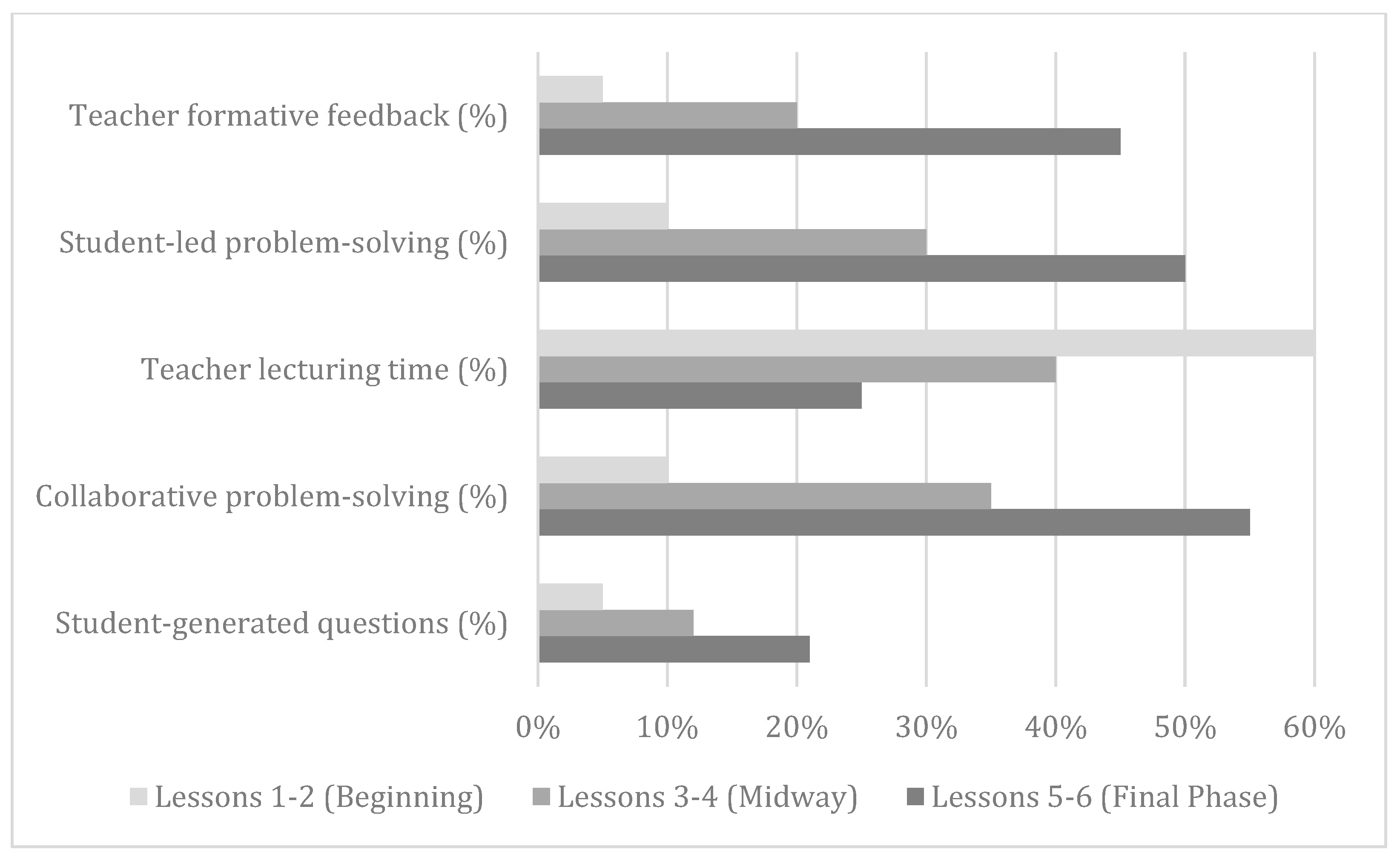
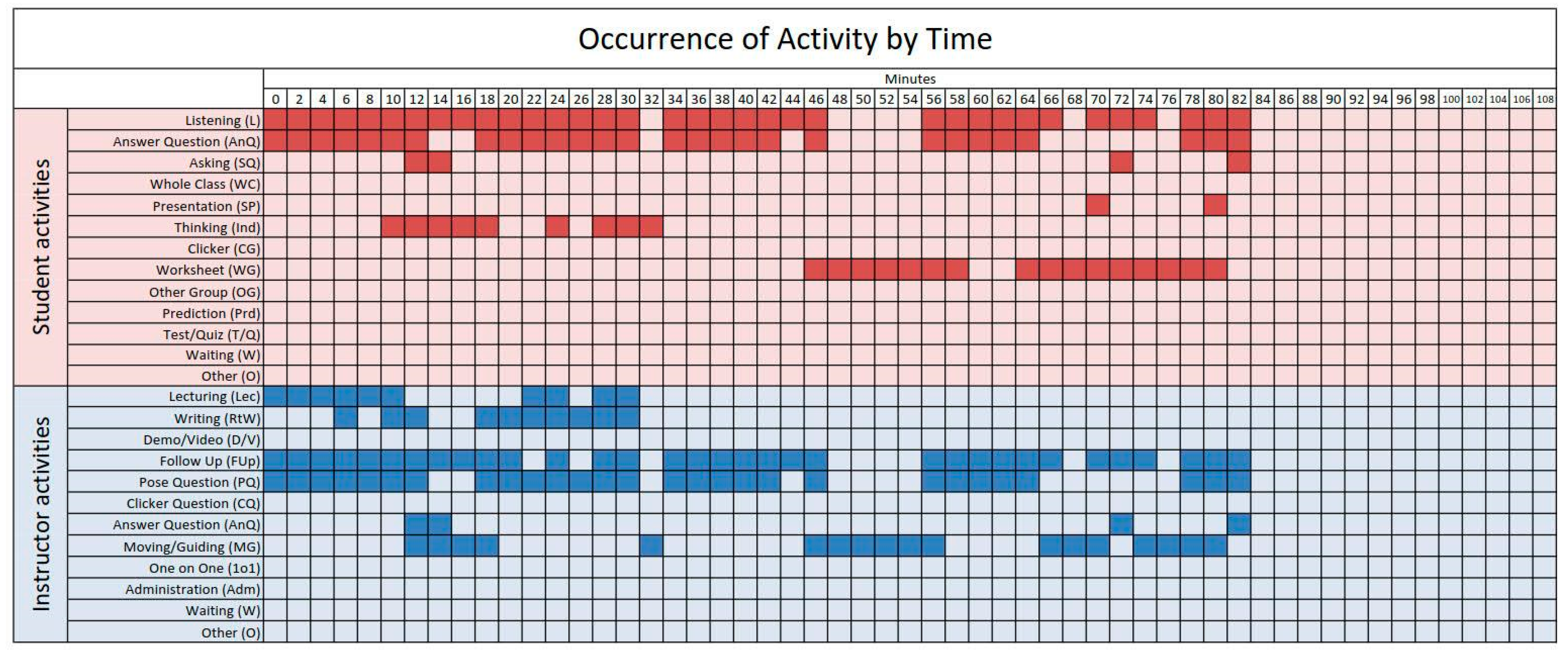
- COPUS frequencies (e.g., increased group work and questioning) were examined alongside qualitative themes of student-centred instruction and reflective decision-making.
5. Results
5.1. Changes in Teacher Cognition
5.1.1. Self-Efficacy: Strengthening Confidence in Teaching and Differentiation
“I would prepare materials for hours, trying to engage students at different levels, but in the end, only some students were working while others were disengaged. It felt like my effort was wasted.”
“I started to notice some things that I had not noticed before, and I started to analyse them on the fly. (…) This started happening after seeing the videos and engaging in the discussions.”
“This program helped me build myself up, regaining lost self-confidence, restoring my enthusiasm, and transforming me into a person who encourages other colleagues.”
5.1.2. Self-Evaluation: Developing Reflective Teaching Practices
“I started noticing things I hadn’t even realised before. Watching and discussing videos made me rethink my teaching approach and refine my lessons.”
5.1.3. Knowledge of Teaching: Expanding Pedagogical Content Knowledge
5.1.4. Challenging Beliefs: Transitioning to a Student-Centred Learning Approach
“How to present a mathematical concept to a student so they understand it? In what way? To simplify it to their level? How to approach a low-achieving student, how to approach someone who has already solved a certain task, to motivate them to think ahead?”
“I used to start lessons in a way that (…) I would present some kind of a problem from everyday life. […] Now they [students] literally have to discover new knowledge in order to solve the problem they encountered.”
5.2. Changes in Teacher Practice
5.2.1. Mathematical Tasks
- Assistants had to sketch geometric solids, identifying relevant dimensions, and calculating surface area and volume.
- Architects were responsible for reviewing the calculations of their peers, checking for errors, and making necessary corrections.
- Agency owner analysed construction feasibility and material costs, applying more advanced mathematical reasoning.
“Before the [DI] project, it didn’t matter what grade they got in math or how well they studied. Throughout the project, they realised that good results contributed to the overall success of the entire team. Since they felt personal and collective responsibility for their team’s success, the students constantly assisted one another”.
5.2.2. Scaffolding and Enrichment
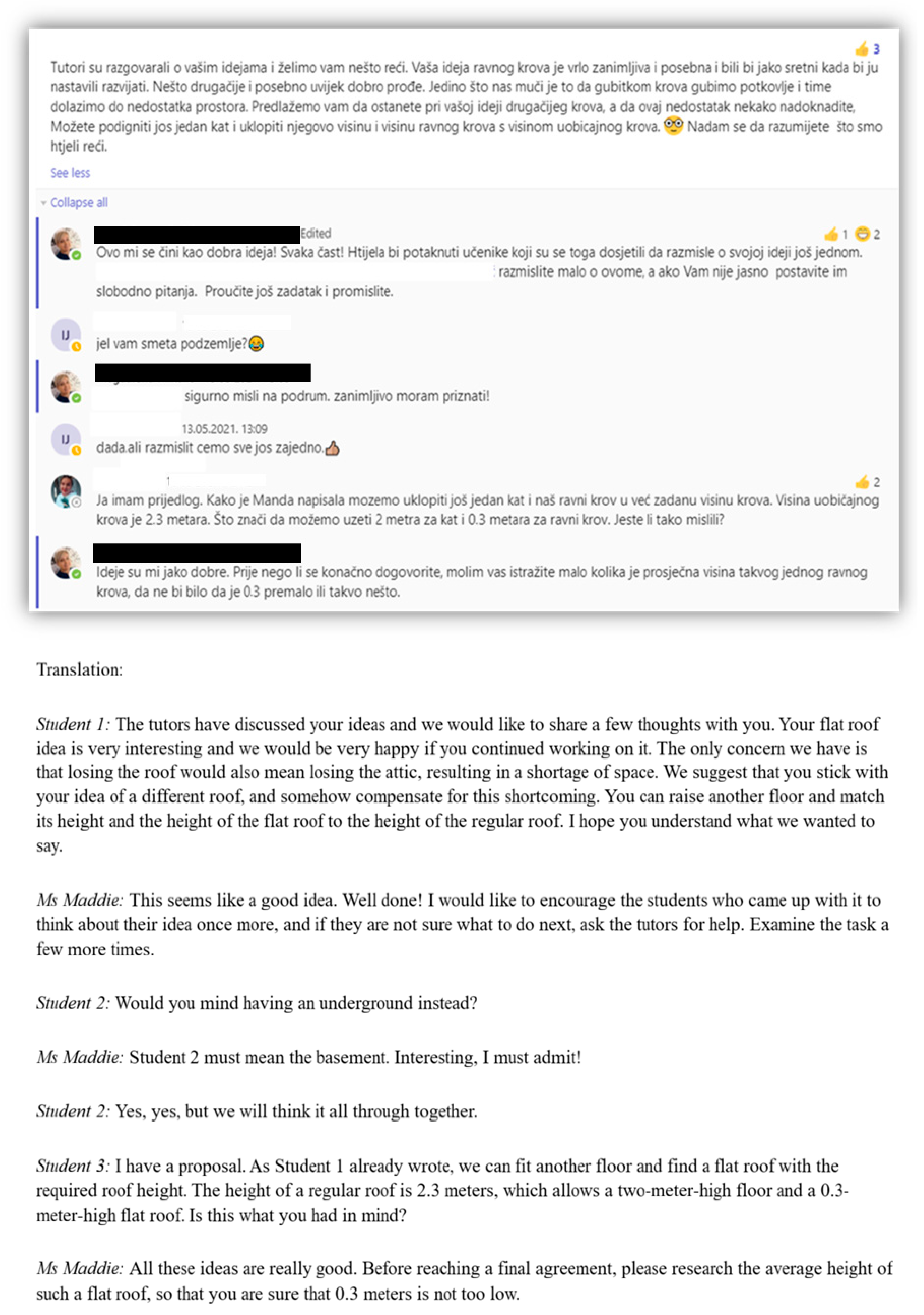
“I attempted to encourage them to seek my assistance less frequently so they could learn to support each other’s learning. As a result, they became more independent in their learning. Even though I provided them with pre-made materials, they still needed to do their own research and come up with original answers.”
“[TPD] was a huge help to me. But what really helped me was learning to work with weaker students (…), to look for and create materials for students who are struggling.”
5.3. Impact on Student Engagement
“Students became more engaged and motivated, and since they worked in a way that allowed everybody to contribute to the project, each one of them felt responsible for the team’s success […] they pushed themselves to learn something in order to solve a specific problem.”
6. Discussion
6.1. How Did Video-Based TPD Influence Teacher Cognition?
6.2. How Did Video-Based TPD Influence Teaching Practice?
6.3. Digital Tools and Cognitive and Instructional Change
6.4. Limitations of the Study
7. Conclusions
Author Contributions
Funding
Institutional Review Board Statement
Informed Consent Statement
Data Availability Statement
Conflicts of Interest
References
- Avalos, B. (2011). Teacher professional development in teaching and teacher education over ten years. Teaching and Teacher Education, 27(1), 10–20. [Google Scholar] [CrossRef] [Scilit]
- Bardy, C., Holzäpfel, L., & Leuders, T. (2021). Adaptive tasks for differentiated instruction: Mathematics teachers’ perspectives on supporting diverse learners. Mathematics Teacher Education and Development, 23(3), 112–130. [Google Scholar]
- Berg, D. A. G., Ingram, N., Asil, M., Ward, J., & Smith, J. K. (2025). Self-efficacy in teaching mathematics and the use of effective pedagogical practices in New Zealand primary schools. Journal of Mathematics Teacher Education, 28, 129–149. [Google Scholar] [CrossRef] [Scilit]
- Bezinović, P., Marušić, I., & Ristić Dedić, Z. (2012). Opažanje i unapređivanje školske nastave [Observing and improving school teaching]. Education and Teacher Training Agency. [Google Scholar]
- Bobis, J., Russo, J., Downton, A., Feng, M., Livy, S., McCormick, M., & Sullivan, P. (2021). Instructional moves that increase chances of engaging all students in learning mathematics. Mathematics, 9(6), 582. [Google Scholar] [CrossRef] [Scilit]
- Borko, H. (2004). Professional development and teacher learning: Mapping the terrain. Educational Researcher, 33(8), 3–15. [Google Scholar] [CrossRef] [Scilit]
- Borko, H., Koellner, K., Jacobs, J., & Seago, N. (2011). Using video representations of teaching in practice-based professional development programs. ZDM Mathematics Education, 43(1), 175–187. [Google Scholar] [CrossRef] [Scilit]
- Calleja, J. (2022). Changes in mathematics teachers’ self-reported beliefs and practices over the course of a blended continuing professional development programme. Mathematics Education Research Journal, 34(1), 835–861. [Google Scholar] [CrossRef] [Scilit]
- Chapman, O. (2015). Reflective awareness in mathematics teachers’ learning and teaching. Eurasia Journal of Mathematics, Science & Technology Education, 11(2), 313–324. [Google Scholar] [CrossRef] [Scilit]
- Coles, A., & Brown, L. (2021). Differentiation from an advanced standpoint: Outcomes of mathematics teachers’ action research studies aimed at raising attainment. Mathematics Teacher Education and Development, 23(3), 166–181. [Google Scholar]
- de Jong, T., & Lazonder, A. (2014). The guided discovery learning principle in multimedia learning. In R. Mayer (Ed.), The Cambridge handbook of multimedia learning (pp. 371–390). Cambridge University Press. [Google Scholar] [CrossRef] [Scilit]
- Desimone, L. M. (2009). Improving impact studies of teachers’ professional development: Toward better conceptualizations and measures. Educational Researcher, 38(3), 181–199. [Google Scholar] [CrossRef] [Scilit]
- Filipov, M. (2023). Stručno usavršavanje učitelja matematike i biologije uz primjenu videozapisa nastave [Professional development of mathematics and biology teachers using classroom video recordings] [Doctoral dissertation, Josip Juraj Strossmayer University of Osijek, Faculty of Humanities and Social Sciences]. Available online: https://urn.nsk.hr/urn:nbn:hr:142:441254 (accessed on 29 March 2026).
- Fitzgerald, L., Hunter, J., & Hunter, R. (2021). Shifting teacher practices in relation to grouping: Gap gazing or strengths-focused approaches. Mathematics Teacher Education and Development, 23(3), 97–110. [Google Scholar]
- Gaudin, C., & Chaliès, S. (2015). Video viewing in teacher education and professional development: A literature review. Educational Research Review, 16, 41–67. [Google Scholar] [CrossRef] [Scilit]
- Graham, S., Kiuhara, S. A., & MacKay, M. (2020). The effects of writing on learning in science, social studies, and mathematics: A meta-analysis. Review of Educational Research, 90(2), 179–226. [Google Scholar] [CrossRef] [Scilit]
- Hattie, J. (2009). Visible learning: A synthesis of 800+ meta-analyses on achievement. Routledge. [Google Scholar]
- Hattie, J. (2012). Visible learning for teachers: Maximizing impact on learning. Routledge/Taylor & Francis Group. [Google Scholar] [CrossRef] [Scilit]
- Hemmeter, M. L., Snyder, P., Kinder, K., & Artman, K. (2011). Impact of performance feedback delivered via electronic mail on preschool teachers’ use of descriptive praise. Early Childhood Research Quarterly, 26, 96–109. [Google Scholar] [CrossRef] [Scilit]
- Herner-Patnode, L., & Lee, D. (2021). Developing pre-service teachers’ differentiated instruction competencies through teacher education programs. Mathematics Teacher Education and Development, 23(3), 45–62. [Google Scholar]
- Hobbiss, M., Sims, S., & Allen, R. (2021). Habit formation limits growth in teacher effectiveness: A review of converging evidence from neuroscience and social science. Review of Education, 9, 3–23. [Google Scholar] [CrossRef] [Scilit]
- Hunter, J., Hunter, R., & Anthony, G. (2019). Shifting towards equity: Challenging teacher views about student capability in mathematics. Mathematics Education Research Journal, 32(1), 37–55. [Google Scholar] [CrossRef] [Scilit]
- Jager, L., Denessen, E., Cillessen, A. H. N., & Meijer, P. C. (2022). Capturing instructional differentiation in educational research: Investigating opportunities and challenges. Educational Research, 64(2), 224–241. [Google Scholar] [CrossRef] [Scilit]
- Kang, H., & van Es, E. A. (2019). Articulating design principles for productive use of video in preservice education. Journal of Teacher Education, 70(3), 237–250. [Google Scholar] [CrossRef] [Scilit]
- Kennedy, M. B. (2016). How does professional development improve teaching? Review of Educational Research, 86(4), 945–980. [Google Scholar] [CrossRef] [Scilit]
- Kiemer, K., Gröschner, A., Pehmer, A.-K., & Seidel, T. (2014). Teacher learning and student outcomes in the context of classroom discourse. Findings from a video-based teacher professional development programme. Form@re—Open Journal Per La Formazione in Rete, 14(2), 51–62. [Google Scholar] [CrossRef] [Scilit]
- Koellner, K., Seago, N., & Jacobs, J. (2018). Representations of practice to support teacher instruction: Video case mathematics professional development. In O. Buchbinder, & S. Kuntze (Eds.), Mathematics teachers engaging with representations of practice: A dynamically evolving field (pp. 9–22). Springer. [Google Scholar] [CrossRef] [Scilit]
- Koellner, K., Seago, N., Riske, A., Placa, N., & Carlson, D. L. (2024). Teachers’ perceptions and uptake of professional development overtime. International Journal of Educational Research Open, 6, 100308. [Google Scholar] [CrossRef] [Scilit]
- Krille, C. (2020). Teachers’ participation in professional development. Springer Nature. [Google Scholar] [CrossRef] [Scilit]
- Küçükuncular, A., & Ertugan, A. (2025). Teaching in the AI era: Sustainable digital education through ethical integration and teacher empowerment. Sustainability, 17(16), 7405. [Google Scholar] [CrossRef] [Scilit]
- Lambert, R., Imm, K., Schuck, R., Choi, S., & McNiff, A. (2021). “UDL is the what, design thinking is the how”: Designing for differentiation in mathematics. Mathematics Teacher Education and Development, 23(3), 54–77. [Google Scholar]
- Langelaan, B. N., Gaikhorst, L., Smets, W., & Oostdam, R. J. (2024). Differentiating instruction: Understanding the key elements for successful teacher preparation and development. Teaching and Teacher Education, 140, 104464. [Google Scholar] [CrossRef] [Scilit]
- Le Fevre, D., Timperley, H., & Ell, F. (2016). Curriculum and pedagogy: The future of teacher professional learning and the development of adaptive expertise. In D. Wyse, L. Hayward, & J. Pandya (Eds.), The SAGE handbook of curriculum, pedagogy and assessment (Vol. 2, pp. 309–324). Sage. [Google Scholar] [CrossRef] [Scilit]
- Leikin, R., & Stanger, O. (2011). Teachers’ images of gifted students and the roles assigned to them in heterogeneous mathematics classes. In B. Sriraman, & K. H. Lee (Eds.), The elements of creativity and giftedness in mathematics (pp. 103–118). Sense Publisher. [Google Scholar] [CrossRef] [Scilit]
- Leuders, T., & Prediger, S. (2016). Flexibel differenzieren und fokussiert fördern im Mathematikunterricht [Flexible differentiation and focused support in mathematics teaching]. Cornelsen Scriptor. [Google Scholar]
- Linde, I., Sarva, E., & Daniela, L. (2023). The impact of an online professional development course on teachers’ comprehension and self-efficacy in developing students’ self-regulated learning skills. Sustainability, 15(12), 9408. [Google Scholar] [CrossRef] [Scilit]
- Lunn Brownlee, J., Ferguson, L. E., & Ryan, M. (2017). Changing teachers’ epistemic cognition: A new conceptual framework for epistemic reflexivity. Educational Psychologist, 52(4), 242–252. [Google Scholar] [CrossRef] [Scilit]
- Major, L., & Watson, S. (2018). Using video to support in-service teacher professional development: The state of the field, limitations and possibilities. Technology, Pedagogy and Education, 27(1), 49–68. [Google Scholar] [CrossRef] [Scilit]
- Marsh, B., & Mitchell, N. (2014). The role of video in teacher professional development. Teacher Development, 18(3), 403–417. [Google Scholar] [CrossRef] [Scilit]
- Mellroth, E. (2018). Harnessing teachers’ perspectives: Recognizing mathematically highly able pupils and orchestrating teaching for them in diverse classrooms [Doctoral thesis, Karlstad University]. Available online: http://kau.diva-portal.org/ (accessed on 6 December 2025).
- Mellroth, E., Bergwall, A., & Nilsson, P. (2021). Task design for differentiated instruction in mixed-ability mathematics classrooms: Manifestations of contradictions in a professional learning community. Mathematics Teacher Education and Development, 23(3), 78–96. [Google Scholar]
- Meutstege, K., Van Geel, M., & Visscher, A. J. (2023). Evidence-based design of a teacher professional development program for differentiated instruction: A whole-task approach. Education Sciences, 13(10), 985. [Google Scholar] [CrossRef] [Scilit]
- Mhlolo, M. K. (2017). Regular classroom teachers’ recognition and support of the creative potential of mildly gifted mathematics learners. ZDM—Mathematics Education, 49(1), 81–94. [Google Scholar] [CrossRef] [Scilit]
- Mills, A. J., Durepos, G., & Wiebe, E. (2010). Encyclopedia of case study research. Sage Publications. [Google Scholar]
- NCTM [National Council of Teachers of Mathematics]. (2014). Principles to actions: Ensuring mathematical success for all. National Council of Teachers of Mathematics. [Google Scholar]
- OECD. (2023). OECD digital education outlook 2023: Towards an effective digital education ecosystem. OECD Publishing. [Google Scholar] [CrossRef] [Scilit]
- Parsons, S. A., Vaughn, M., Scales, R. Q., Gallagher, M. A., Parsons, A. W., Davis, S. G., Pierczynski, M., & Allen, M. (2018). Teachers’ instructional adaptations: A research synthesis. Review of Educational Research, 88(2), 205–242. [Google Scholar] [CrossRef] [Scilit]
- Praetorius, A., Klieme, E., Herbert, B., & Pinger, P. (2018). Generic dimensions of teaching quality: The German framework of three basic dimensions. ZDM Mathematics Education, 50(3), 407–426. [Google Scholar] [CrossRef] [Scilit]
- Prast, E. J., van de Weijer-Bergsma, E., Kroesbergena, E. H., & Van Luit, J. (2015). Readiness-based differentiation in primary school mathematics: Expert recommendations and teacher self-assessment. Frontline Learning Research, 3(2), 90–116. [Google Scholar] [CrossRef]
- Saldaña, J. (2003). Longitudinal qualitative research: Analyzing change through time. AltaMira Press. [Google Scholar]
- Selwyn, N. (2024). Digital degrowth: Toward radically sustainable education technology. Learning, Media and Technology, 49(2), 186–199. [Google Scholar] [CrossRef] [Scilit]
- Shayshon, B., Gal, H., Tesler, B., & Ko, E. (2014). Teaching mathematically talented students: A cross-cultural study about their teachers’ views. Educational Studies in Mathematics, 87(3), 409–438. [Google Scholar] [CrossRef] [Scilit]
- Sherin, M. G., & Han, S. Y. (2004). Teacher learning in the context of a video club. Teaching and Teacher Education, 20(2), 163–183. [Google Scholar] [CrossRef] [Scilit]
- Sims, S., Fletcher-Wood, H., O’Mara-Eves, A., Cottingham, S., Stansfield, C., Goodrich, J. M., Van Herwegen, J., & Anders, J. (2023). Effective teacher professional development: New theory and a meta-analytic test. Review of Educational Research, 95, 213–254. [Google Scholar] [CrossRef] [Scilit]
- Smit, R., & Humpert, W. (2012). Differentiated instruction in small schools. Teaching and Teacher Education, 28, 1152–1162. [Google Scholar] [CrossRef] [Scilit]
- Smith, M., Steele, M., & Raith, M. L. (2017). Taking action: Implementing effective mathematics teaching practices in grades 6–8. National Council of Teachers of Mathematics. [Google Scholar]
- Smith, M. K., Jones, F. H. M., Gilbert, S. L., & Wieman, C. E. (2013). The classroom observation protocol for undergraduate STEM (COPUS): A new instrument to characterize university STEM classroom practices. CBE—Life Sciences Education, 12(4), 618–627. [Google Scholar] [CrossRef] [Scilit] [PubMed]
- Stake, R. E. (2008). Qualitative case studies. In N. K. Denzin, & Y. S. Lincoln (Eds.), Strategies of qualitative inquiry (3rd ed., pp. 119–149). Sage Publications. [Google Scholar]
- Tomlinson, C. A. (2017). How to differentiate instruction in mixed-ability classrooms. ASCD. [Google Scholar]
- Tomlinson, C. A., Brighton, C. M., Hertberg, H. L., Callahan, C. M., Moon, T. R., Brimijoin, K., Conover, L. A., & Reynolds, T. D. (2003). Differentiating instruction in response to student readiness, interest, and learning profile in academically diverse classrooms: A review of literature. Journal for the Education of the Gifted, 27(2–3), 119–145. [Google Scholar] [CrossRef] [Scilit]
- UNESCO. (2024). Transforming education towards SDG 4: Report of a global survey on country actions to transform education. UNESCO. [Google Scholar] [CrossRef] [Scilit]
- van der Linden, S., van der Meij, J., & McKenney, S. (2021). Teacher video coaching, from design features to student impacts: A systematic literature review. Review of Educational Research, 92(1), 114–165. [Google Scholar] [CrossRef] [Scilit]
- Van Geel, M., Keuning, T., Frerejean, J., Dolmans, D., van Merrinboer, J., & Visscher, A. J. (2019). Capturing the complexity of differentiated instruction. School Effectiveness and School Improvement, 30(1), 51–67. [Google Scholar] [CrossRef] [Scilit]
- Whipple, K. A. (2012). Differentiated instruction: A survey study of teacher understanding and implementation in a southeast Massachusetts school district [Doctoral Dissertation, Northeastern University]. Available online: https://repository.library.northeastern.edu/files/neu:1180/fulltext.pdf (accessed on 20 January 2026).
- Xiao, B., & Tobin, J. (2018). The use of video as a tool for reflection with preservice teachers. Journal of Early Childhood Teacher Education, 39(4), 328–345. [Google Scholar] [CrossRef] [Scilit]
- Yin, R. (2014). Case study research: Design and methods (5th ed.). Sage Publications. [Google Scholar]



| Prior experience with DI |
|
| TPD focused on DI |
|
| Excerpt from Interview | Code | Theme |
|---|---|---|
| This program helped me build myself up, regaining lost self-confidence. | Confidence, empowering | Teacher’s self-efficacy |
| I started noticing some things that I hadn’t even noticed before. | Reflection on own practice | Teacher’s self-evaluation |
| TOF Dimension | Lessons 1–2 (Beginning) | Lessons 3–4 (Midway) | Lessons 5–6 (Final Phase) |
|---|---|---|---|
| Clear instructional delivery | NI (unclear instructions) | EI (partially structured) | FI (well-structured, clear transitions) |
| Differentiated task design | NI (uniform tasks) | EI (limited adaptation, for struggling students) | FI (adaptive tasks, tiered tasks) |
| Student engagement strategies | NI (mostly passive) | EI (some structured engagement) | FI (active student-led learning) |
| TOF Dimension | Lessons 1–2 (Beginning) | Lessons 3–4 (Midway) | Lessons 5–6 (Final Phase) |
|---|---|---|---|
| Differentiation strategies | NI (no strategies) | EI (limited adoption) | FI (various strategies) |
| Use of formative feedback | NI (minimal feedback, general comments) | EI (inconsistent feedback, some input) | FI (targeted formative feedback) |
| TOF Dimension | Lessons 1–2 (Beginning) | Lessons 3–4 (Midway) | Lessons 5–6 (Final Phase) |
|---|---|---|---|
| Student collaboration | NI (individual work, limited interaction) | EI (more frequent peer discussions) | FI (core aspect of instruction) |
| Scaffolding for struggling students | NI (no scaffolding) | EI (occasional support) | FI (structured and embedded) |
| Metacognitive skills | NI (not detected) | EI (emerging thought-provoking questions and critical reflection) | FI (students actively engaged in self-reflection, explain their reasoning) |
Disclaimer/Publisher’s Note: The statements, opinions and data contained in all publications are solely those of the individual author(s) and contributor(s) and not of MDPI and/or the editor(s). MDPI and/or the editor(s) disclaim responsibility for any injury to people or property resulting from any ideas, methods, instructions or products referred to in the content. |
© 2026 by the authors. Licensee MDPI, Basel, Switzerland. This article is an open access article distributed under the terms and conditions of the Creative Commons Attribution (CC BY) license.
Share and Cite
Filipov, M.; Jukić Matić, L. From Online Video-Based Professional Development to Differentiated Teaching: A Case Study of Mathematics Teacher. Educ. Sci. 2026, 16, 546. https://doi.org/10.3390/educsci16040546
Filipov M, Jukić Matić L. From Online Video-Based Professional Development to Differentiated Teaching: A Case Study of Mathematics Teacher. Education Sciences. 2026; 16(4):546. https://doi.org/10.3390/educsci16040546
Chicago/Turabian StyleFilipov, Mia, and Ljerka Jukić Matić. 2026. "From Online Video-Based Professional Development to Differentiated Teaching: A Case Study of Mathematics Teacher" Education Sciences 16, no. 4: 546. https://doi.org/10.3390/educsci16040546
APA StyleFilipov, M., & Jukić Matić, L. (2026). From Online Video-Based Professional Development to Differentiated Teaching: A Case Study of Mathematics Teacher. Education Sciences, 16(4), 546. https://doi.org/10.3390/educsci16040546