1. Introduction
Quality of life is generally understood as the subjective perception individuals construct regarding their overall well-being, resulting from the interaction between physical, psychological, social, and environmental factors. This construct is particularly important in childhood and adolescence because these developmental stages involve significant cognitive, emotional, and social transformations. Assessing quality of life in school-aged populations therefore provides important indicators of emotional adjustment, health, and adaptation to educational contexts (
Rocha et al., 2024;
Tsai, 2024). Empirical evidence consistently shows that higher levels of quality of life are associated with more positive patterns of health, psychological well-being, and school participation (
Befus et al., 2023;
Rajmil et al., 2013).
Within this framework, standardized instruments designed to assess health-related quality of life (HRQoL) in children and adolescents have become increasingly important in both research and educational practice (e.g., the Pediatric Quality of Life Inventory, PedsQL, from
Varni et al., 2001). Among these instruments, the KIDSCREEN measures—particularly KIDSCREEN-27—have been widely used in international research due to their multidimensional structure and strong psychometric properties (
Gaspar & Matos, 2008). These instruments assess key domains of youth well-being, including physical well-being, psychological well-being, autonomy and relationships with parents, peer social support, and the perception of the school environment, allowing comparisons across different cultural and educational contexts.
Research in Portugal has also contributed to the understanding of HRQoL in childhood and adolescence. Using the KIDSCREEN framework,
Gaspar et al. (
2012) demonstrated that children’s quality of life results from the interaction of multiple dimensions, including physical health, psychological functioning, and social relationships. Their findings highlighted the central role of psychological variables—such as emotional well-being, perceived competence, and self-esteem—as predictors of overall quality of life.
Recent studies have further underscored the importance of assessing HRQoL in school-aged populations. Longitudinal studies have shown that emotional difficulties and mental health problems can reciprocally influence perceived quality of life over time, while also illustrating how sensitive these instruments are in detecting changes in psychological functioning (
Wirtz et al., 2025). Intervention studies also indicate that structured health education programs can promote improvements in well-being, personal development, and perceived quality of life among children and adolescents (
Leung et al., 2025). Similarly, large-scale cross-sectional studies have shown that lower HRQoL levels are associated with emotional, psychosocial, and behavioral difficulties (
Khader et al., 2024). Taken together, this body of evidence highlights the importance of instruments such as KIDSCREEN-27 for monitoring well-being and supporting the development of educational and health policies aimed at improving children’s and adolescents’ quality of life.
Research shows that contextual and social–emotional factors play a decisive role in how students adapt to the demands of school and learning environments (
Rocha et al., 2024).
Lombardi et al. (
2019) demonstrated that a positive school climate—characterized by supportive relationships with teachers and peers, perceived safety, and constructive interactions—contributes to higher levels of subjective well-being and school engagement. These findings reinforce the idea that educational processes need to be analyzed with an integrative perspective in which emotional, relational, and contextual factors are closely linked to students’ development and learning outcomes.
Within this broader framework, the study of quality of life in gifted students has been the focus of increasing attention. Gifted students often present distinctive cognitive, emotional, and social characteristics that may influence how they experience well-being and school adjustment. Although high intellectual ability is frequently associated with positive academic outcomes, the recent literature suggests that giftedness is not necessarily a protective factor for psychological well-being. On the contrary, some studies indicate that gifted students may experience specific vulnerabilities, including perfectionism, social adjustment difficulties, feelings of difference, and challenges related to identity development (
Cross, 2024;
Findik & Afat, 2023).
Research has also highlighted how important self-perception and social competence are in shaping gifted students’ well-being.
Jung (
2024) showed that both social competence and psychological adjustment may vary depending on how students understand and integrate their giftedness into their personal and academic identity. In addition, the systematic review by
Nannings et al. (
2025) demonstrated that gifted students may face particular social–emotional challenges throughout their education, including anxiety management, performance pressure, self-regulation difficulties, and social integration in academically demanding environments.
Borges et al. (
2011) argued that the widespread assumption that gifted students systematically present adjustment problems lacked empirical support, instead highlighting the diversity of developmental pathways seen in this population. Consequently, understanding gifted students’ quality of life requires a multidimensional perspective that considers cognitive, emotional, relational, and contextual factors.
More recent research has also explored additional dimensions that may influence well-being in this population. For example,
Baş and Çolak Sivri (
2025) found that gifted children presented a higher prevalence of hyperacusis, which may be associated with lower perceived quality of life across physical, emotional, social, and academic domains. These findings suggest that heightened sensory sensitivity may represent an additional factor influencing gifted students’ well-being and should therefore be considered in both educational and psychological contexts.
Given these considerations, examining gifted students’ quality of life becomes particularly important in understanding their educational and developmental experiences. However, empirical evidence comparing gifted and non-gifted students in this domain remains limited in several national contexts. In the Portuguese context, research on health-related quality of life in children and adolescents has been primarily conducted with general populations, with limited attention to students with high intellectual abilities (
Matos et al., 2012). Moreover, although international studies have explored the socio-emotional characteristics of gifted students, comparative evidence examining differences in perceived quality of life between gifted and non-gifted students remains scarce. This gap is particularly evident in Portugal, where studies integrating giftedness within a multidimensional quality-of-life framework are still limited.
The present study therefore aimed to examine the perceived quality of life of Portuguese gifted students, compared to their non-gifted peers, using the KIDSCREEN-27 instrument. More specifically, the study analyzed potential differences across five dimensions: physical well-being, psychological well-being, autonomy and parent relationships, peer social support, and school environment. In addition, the study explored whether gender may contribute to explaining possible differences between the groups.
Based on the previous literature suggesting that gifted students may experience specific social–emotional challenges, we hypothesized that gifted students will report lower scores than their non-gifted peers in physical well-being, autonomy and parent relationships, peer social support, and school environment, whereas no significant differences are expected in psychological well-being.
2. Materials and Methods
2.1. Participants
Participants were recruited from two different educational contexts. Gifted students were previously identified through the National Association for the Study and Intervention in Giftedness (ANEIS) and were enrolled in the Enrichment Program in Domains of Aptitude, Interests, and Socialization (PEDAIS), a structured educational program aimed at supporting the development of students with high abilities. This program promotes students’ cognitive, creative, and social development through enrichment activities designed to stimulate advanced skills, personal interests, and social interaction.
The program is based on a multidimensional understanding of giftedness, encompassing both academic giftedness—typically reflected in high intellectual ability and academic performance—and productive and creative giftedness, which involves the development of original ideas and the practical application of knowledge (
Reis & Renzulli, 2018). Consequently, the selection of gifted participants reflects a specific subgroup of Portuguese gifted students who were receiving educational enrichment support through programs promoted by ANEIS.
Various studies continue to maintain that an IQ of 130 or above is a widely accepted criterion for considering giftedness (e.g.,
Fernández et al., 2017). This index is used to identify and select students for intervention programs, recognizing their potential and uniqueness. Furthermore, consideration of giftedness must go beyond IQ and incorporate factors such as creativity, commitment to the task (motivation), social and emotional aspects, etc.
The students without a diagnosis of giftedness were selected from a Portuguese school located near the ANEIS environment. They were selected by the school’s management and the Psychology and Guidance Service (SPO) after administration of the instruments indicated below. The comparison group consisted of students who had not been previously identified as gifted and were selected by school management and the Psychology and Guidance Service (SPO), based on school-based screening procedures. However, these students were not subjected to the same comprehensive multidimensional identification protocol used for the gifted group. Therefore, the comparison group should be interpreted as a non-identified group rather than definitively non-gifted.
The final sample consisted of 102 students who were 10–15 years old (M = 11.88; SD = 1.56), in the 2nd and 3rd cycles of Portuguese compulsory education (5th–9th grades). Participants were matched at the group level rather than individually, ensuring comparable distributions between gifted (GS) and non-gifted students (Non-GS) in terms of gender and educational cycle (
Table 1). Although no additional matching variables were formally controlled, efforts were made to select participants from similar educational contexts, thereby reducing potential contextual variability between groups.
In the identification process prior to this study, the selected Portuguese participants had been assessed using a variety of psycho-pedagogical evaluation instruments. Although an IQ score of 130 or higher is commonly used as an initial criterion for identifying high intellectual ability, the present study adopted a multidimensional perspective of giftedness. In line with contemporary models of giftedness, the identification procedures used by ANEIS consider multiple sources of information, including cognitive ability tests, creativity assessments, and behavioral characteristics related to motivation, leadership, and learning. This approach reflects a broader understanding of giftedness that goes beyond purely psychometric indicators.
The assessment involved the WISC-III Wechsler Intelligence Scale for Children and Raven’s Progressive Matrices (CPM-P), which were used, considering an IQ of 130 or higher for gifted students, which placed them in the top percentile, generally the highest 2% compared to the general population. Creativity was measured using the Torrance Test of Creative Thinking (TTCT), an instrument that assesses fluency, originality, flexibility, and elaboration, placing the most capable students in the top percentile. In addition, interests, characteristics, and abilities were analyzed using questionnaires from the Battery of Instruments for Signaling Gifted and Talented Students (BISAST/T), with versions for students, teachers/caregivers, and families (
Almeida et al., 2002), also considering the top percentile. The students’ learning characteristics, leadership, creativity, and motivation were assessed using the Scale for Assessing the Behavioral Characteristics of Gifted Students (EACCAS), adapted to the Portuguese population (
Pereira, 1998), taking into account the top percentile. According to
Pfeiffer (
2015), a high percentile (usually 95 or above) is often used as a criterion for identifying giftedness, which is consistent with the practice of considering multiple criteria in addition to IQ to identify gifted students.
2.2. Instrument
The instrument used in this study was the Kidscreen-27 scale (
Gaspar & Matos, 2008. This is a tool that is widely used to assess quality of life in children and adolescents. Validated for the Portuguese population, the scale exhibits moderate to high levels of internal consistency across the entire scale (α = 0.89) and a satisfactory factorial structure that explains 56% of the variance (
Gaspar & Matos, 2008). This abbreviated version of the Kidscreen-52 allows analysis of five dimensions through 27 items: physical well-being (5 items; activity level, physical endurance, and perception of health), psychological well-being (7 items; perception of emotions and life satisfaction), autonomy and relationships with parents (7 items; quality of relationships with parents or other caregivers and level of autonomy), social support and peer group (4 items; quality of relationships and interactions with peers), and school environment (4 items; cognitive and learning skills, quality of relationships with teachers, and feelings about the school environment). Cronbach’s alpha index in this study was 0.81, indicating high internal consistency of the measurements. In the present study, the internal consistency of the KIDSCREEN-27 dimensions showed adequate reliability: physical well-being (α = 0.83), psychological well-being (α = 0.80), autonomy and parent relationships (α = 0.84), peer social support (α = 0.85), and school environment (α = 0.82).
2.3. Procedure
The study was granted ethics approval by the Technical-Scientific Council of the Higher Institute of Educational Sciences of the Douro (ISCE Douro), in Portugal (approval code AR.130922). Before the instrument was applied, informed consent was sought from the institutions and the participants’ families. All collected data was anonymous and confidential. The questionnaire was administered collectively, following standardized instructions, under the supervision of members of the research team. Completion time was approximately 10–15 min, and no financial or material incentives were provided.
2.4. Data Analysis
Descriptive statistics (mean and standard deviation) were calculated for the samples. Following that, a MANOVA was performed to determine whether there were differences between the two groups of participants, with group membership (GS/non-GS) and gender (male/female) as the independent variables, and well-being factors as the dependent variable. Given that both Levene’s test and Box’s M test yielded significant results, Pillai’s trace was chosen for the MANOVA test due to its robustness. Although Box’s M and Levene’s tests indicated violations of homogeneity assumptions, Pillai’s Trace was selected because it is the most robust multivariate statistic in the presence of unequal covariance matrices, especially when sample sizes between groups are similar. SPSS software version 29.0 (IBM Corporation, Armonk, NY, USA) was used to perform the statistical analysis.
3. Results
A MANOVA test was performed to determine differences in well-being among participants, considering group and gender variables.
Table 2 shows the means and standard deviations obtained on the Kidscreen-27 scale.
To determine whether there were statistically significant differences in quality of life according to gender, different statistical indices were calculated. First, the Box test for equality of covariance matrices was statistically significant (Box M = 29.78; F = 1.88;
p = 0.020), indicating that the assumption of equality of covariance matrices was not met. Levene’s test for homoscedasticity for all dimensions of the Kidscreen-27 instrument gave the following results (
Table 3):
Similarly, Levene’s test showed significant results for several dimensions, suggesting violations of the homogeneity of variances assumption. Given the statistically significant results from both Box’s M (
p = 0.020) and Levene’s test (statistical significance in the dimensions of physical well-being, autonomy, parent relationship, peer social support, and school environment), Pillai’s Trace was applied as the multivariate test statistic due to its robustness to violations of these assumptions. The results of which are shown below (
Table 4):
As
Table 4 shows, there were significant results in the group and in the group vs. gender interaction.
Table 5 shows the univariate values for each of the quality-of-life dimensions for these variables:
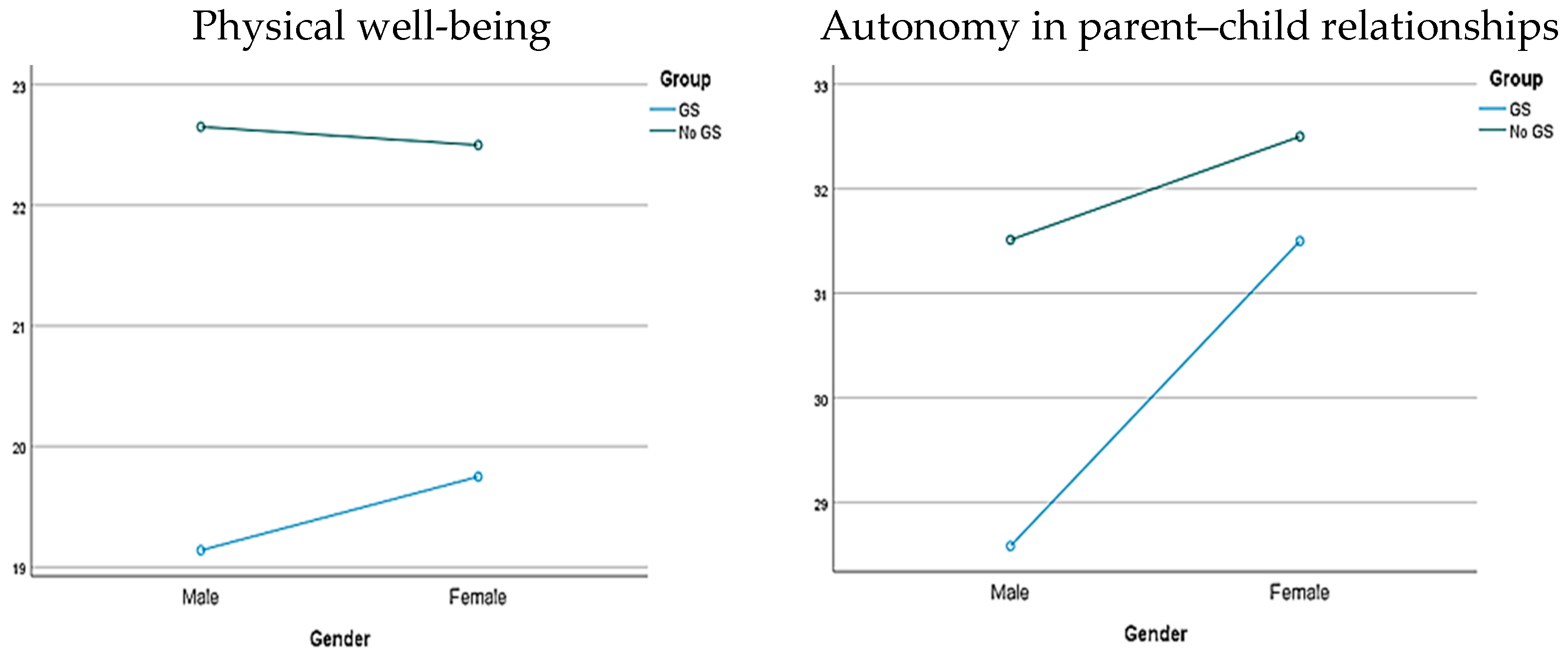
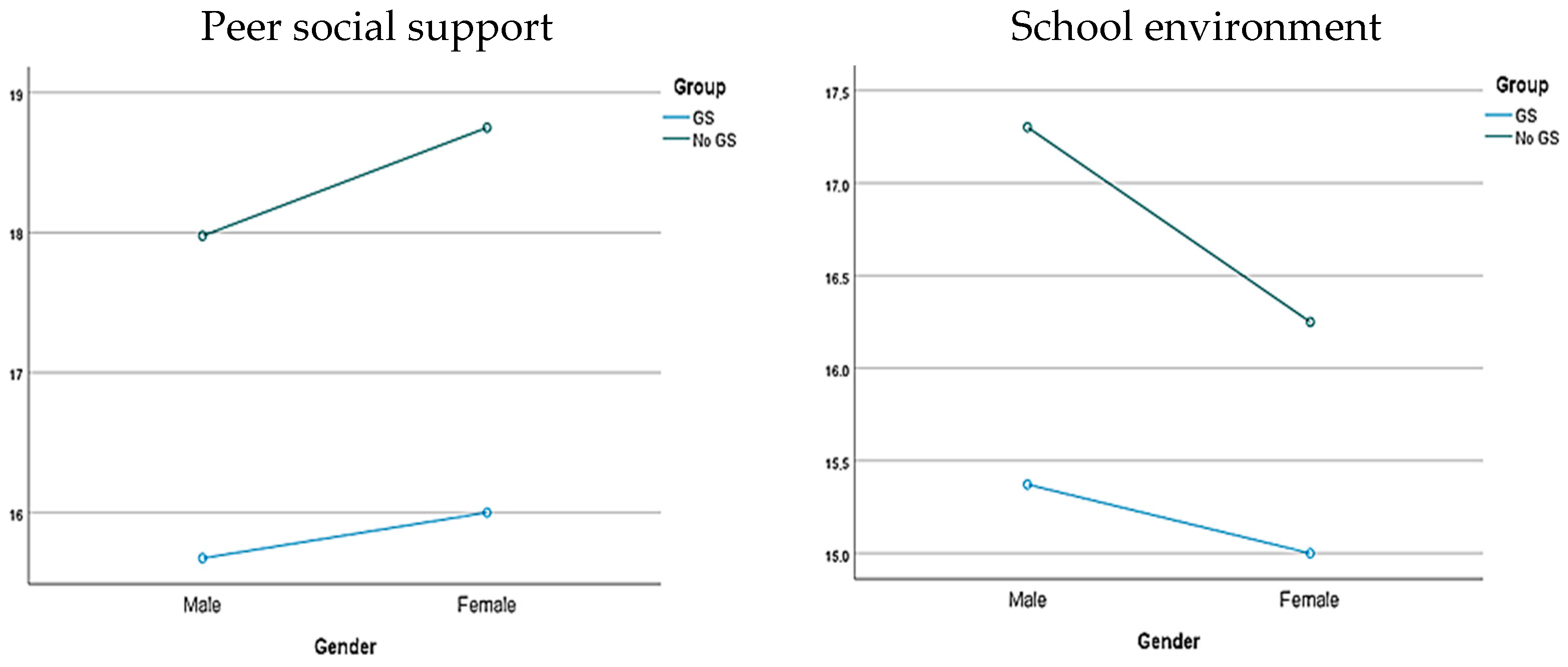
Univariate analyses for the group effect revealed significant differences between gifted and non-gifted students in several dimensions of quality of life. Specifically, gifted students reported lower levels of physical well-being (F(1,95) = 28.75,
p < 0.001, η
2p = 0.225; mean difference = −3.39, 95% CI [−4.66, −2.12]), autonomy and parent relationships (F(1,95) = 9.09,
p = 0.003, η
2p = 0.084; mean difference = −2.62, 95% CI [−4.38, −0.86]), peer social support (F(1,95) = 15.11,
p < 0.001, η
2p = 0.132; mean difference = −2.39, 95% CI [−3.61, −1.17]), and school environment (F(1,95) = 8.07,
p = 0.005, η
2p = 0.075; mean difference = −1.82, 95% CI [−3.11, −0.53]). According to conventional benchmarks (
Cohen, 1988), the effect size was large for physical well-being and moderate for the remaining dimensions.
A graphical representation of these differences is shown in
Figure 1:
As
Figure 1 shows, gifted students generally reported lower scores than non-gifted students across several quality-of-life dimensions, with differences varying slightly according to gender.
4. Discussion
The results of this study provide empirical evidence about how a giftedness diagnosis influences quality of life in Portuguese students who are 10–15 years old (5th–8th grades). Through a matched sample methodological design, significant differences were identified between the GS and non-GS groups in this sample in the dimensions of physical well-being, autonomy, parent relationship, peer social support, and school environment, while gender did not demonstrate significance in quality of life. Overall, this pattern of results is broadly consistent with the recent literature on well-being and psychosocial factors associated with giftedness (
Bergold et al., 2015;
Kroesbergen et al., 2015).
The statistically significant differences between GS and non-GS groups in this sample in various dimensions of quality of life suggest that giftedness does not guarantee greater well-being and may be associated with specific vulnerabilities. Previous studies have indicated that gifted students tend to experience academic stress, social isolation, and heightened emotional sensitivity, factors that can impact their subjective perception of well-being (
Algaba-Mesa & Fernández-Marcos, 2021;
Eren et al., 2018;
Pollet & Schnell, 2017;
Reis & Renzulli, 2018).
More specifically, our data show that students identified as gifted reported lower levels of physical well-being than their non-gifted peers, a finding that may be associated with lifestyle patterns emphasizing cognitive or academic engagement over physical activities (
Infantes-Paniagua et al., 2022), and that many have a profile characterized by high emotional sensitivity and perfectionism (
Sainz & Campos, 2025). It is also important to note that the literature has described cognitive and emotional overactivation as a factor that may be related to experiences of fatigue and lower energy levels, negatively affecting self-perceived well-being (
Eren et al., 2018).
The differences found in autonomy in parent–child relationships, peer social support, and the school environment are among the most important findings. Gifted students tended to perceive lower levels of social support and more limited identification with their school environment, in line with the findings from
García-Perales and Jiménez-Fernández (
2022), who warned that challenges remain in the educational response to this group, despite the positive developments in the decade between 2009/2010 and 2019/2020. This social distance may also reflect differences in students’ abilities, interests, and talents, highlighting the need for a wide range of teaching and educational resources, time, and skills in order to respond appropriately to these students’ needs (
Reis & Renzulli, 2018).
At the institutional level, the data suggest that the quality of the school environment may be associated with students’ perceived well-being. In fact, according to
Ravens-Sieberer et al. (
2014), the educational climate, relationships with teachers, and the perception of school support are predictors of quality of life in children and adolescents. In the case of gifted students, poor teacher training regarding their specific needs may contribute to experiences of demotivation or feelings of being misunderstood in the classroom (
Martínez-Izaguirre et al., 2024).
Similarly, various international studies have confirmed that levels of well-being increase significantly when educational environments implement academic and social–emotional enrichment programs (
Serna et al., 2024). Programs such as PEDAIS from the National Association for the Study and Intervention in Giftedness (ANEIS) stand out, offering a multidimensional intervention model for students with giftedness (
Rocha et al., 2015). An additional aspect that should be considered when interpreting these findings relates to the characteristics of the sample, which consisted of gifted students enrolled in a structured enrichment program, and therefore may not be generalizable to all gifted populations. All students identified as gifted were participants in the PEDAIS enrichment program. Participation in enrichment programs may influence how students perceive their own abilities and their position within the school context. Increased awareness of their cognitive abilities and potential differences from peers may encourage social comparisons that could affect how students evaluate dimensions such as peer support, autonomy, or the school environment. Therefore, some of the observed differences between groups may reflect not only the condition of giftedness itself but also contextual factors associated with participation in enrichment programs.
Gender did not show significant effects on quality of life, which is consistent with previous research (
Bergold et al., 2015;
Findik & Afat, 2023). Those authors noted that differences in well-being between gifted boys and girls tended to be minimal or insignificant when variables such as life satisfaction, self-concept, or overall perception of well-being are analyzed. Although we saw statistically significant interaction effects between group and gender in four dimensions of quality of life—higher scores for non-gifted boys in physical well-being and school environment and for non-gifted girls in autonomy in relation to parents and peer social support, as well as lower scores for gifted boys in physical well-being, autonomy in relation to parents, and peer social support, and for gifted girls in school environment. The interaction between group and gender demonstrated very large effect sizes. This pattern reflects the contrasting distribution of scores across groups when gender is considered. In general, non-gifted male students tended to report higher levels of physical well-being and school environment, whereas non-gifted female students reported higher levels of autonomy and peer social support. In contrast, gifted students—particularly boys—tended to report lower scores across several dimensions. These findings should be interpreted with caution. The subgroup of gifted female students in the sample was relatively small, which limits the statistical reliability of these comparisons. Therefore, these interaction patterns should be considered exploratory and interpreted as preliminary indications rather than definitive conclusions.
In relation to educational and psychosocial implications, the results point to the need to design comprehensive educational strategies that address the physical, emotional, and social dimensions of gifted students. In this regard, enrichment programs, such as the aforementioned PEDAIS, could be an effective way to promote balance between cognitive and social–emotional development (
Rocha et al., 2015). Educational institutions must move toward inclusive models of care, with teachers trained in detection, support, and curricular differentiation (
García-Perales & Jiménez-Fernández, 2022).
Furthermore, family involvement stands out as an essential aspect, as recent studies show that parenting styles based on support and autonomy are associated with higher levels of well-being in gifted students (
Papadopoulos, 2021), reinforcing the importance of including psychoeducational and family counseling programs (
Renati et al., 2022).
It is also important to consider that participation in the PEDAIS enrichment program may have influenced gifted students’ perceptions of their quality of life. Engagement in such programmes may increase self-awareness and promote social comparison processes, which can affect how students evaluate dimensions such as peer relationships, autonomy, and school experience. Therefore, some of the differences observed between groups may reflect not only giftedness itself but also contextual influences associated with participation in enrichment programmes.
Several limitations should be considered when interpreting these conclusions. First, the gifted participants were recruited from an enrichment program, which may introduce a potential selection bias and limit the generalizability of the findings. Second, the study did not include control variables such as socioeconomic status, which could also influence students’ perceptions of quality of life. Finally, the relatively small size of some subgroups—particularly gifted female students—limits the statistical power of certain comparisons. Therefore, the results should be interpreted with caution and understood as exploratory evidence within the context of the present sample.
These limitations open several avenues for future research. First, studies should aim to include larger, more diverse samples of gifted students recruited from multiple contexts beyond enrichment programs, such as regular school settings or community-based identification processes. This would help reduce potential selection bias and improve the generalizability of the findings across different educational and sociocultural contexts. In addition, incorporating relevant control variables—particularly socioeconomic status and other contextual factors—would allow for a more comprehensive understanding of the determinants of students’ perceived quality of life. Future research would also benefit from increasing the representation of underrepresented subgroups, especially gifted female students, in order to enhance the statistical power of comparative analyses and provide a more nuanced understanding of gender-related patterns within the gifted population. Expanding sample sizes would therefore allow for more robust conclusions and greater capacity for generalization and extrapolation. Moreover, longitudinal research designs could offer valuable insights into how quality of life changes across the different stages of gifted students’ schooling. Such approaches would help clarify whether the patterns we observed represent stable characteristics or developmental changes influenced by educational experiences and contextual conditions. Finally, further investigation into the relationships between specific emotional characteristics frequently associated with giftedness—such as heightened sensitivity or perfectionism—and indicators of quality of life may contribute to identifying distinct profiles within the gifted population. A deeper understanding of these interactions could inform more tailored educational and psychological interventions aimed at supporting gifted students’ well-being.
The findings of this study have several practical implications. For educators, they highlight the importance of adopting differentiated and inclusive practices that address not only cognitive development but also students’ socio-emotional well-being, including peer relationships and school belonging. For families, the results underscore the relevance of supportive parenting practices and active collaboration with schools in monitoring students’ adjustment and well-being. For policymakers, the findings reinforce the need to conceptualize giftedness as a multidimensional phenomenon, requiring integrated educational responses that combine academic challenge with psychological and social support, including enrichment programmes and teacher training.
5. Conclusions
The findings of this study indicate that, within the sample of 10–15-year-old Portuguese students attending an enrichment program, those identified as GS tended to report lower perceptions of quality of life across several dimensions than non-GS peers, while gender did not show a significant association with quality of life. In this sample, the GS group reported lower scores in the dimensions of physical well-being, autonomy and relationship with parents, peer social support, and school environment, highlighting specific needs that cannot be understood solely on the basis of their cognitive potential. These results are consistent with the recent literature, suggesting that giftedness does not necessarily correspond to higher levels of perceived well-being and may coexist with emotional, social, or contextual challenges.
On a theoretical level, this study contributes to consolidating a multidimensional conception of giftedness, emphasizing the interaction between cognitive, social–emotional, and contextual factors in explaining student well-being. From a methodological point of view, the use of a paired sampling design and internationally validated instruments—in this case KIDSCREEN-27—strengthens the methodological consistency of the analysis, allowing for a rigorous analysis of differences between groups and their interpretation in light of widely recognized quality of life indicators.
The practical implications are equally important. The results point to a need to implement enrichment programs that simultaneously promote cognitive, emotional, and social development, integrating components of self-regulation, social–emotional skills, anxiety management, and the promotion of healthy lifestyles. The creation of peer support networks, training teachers to identify and respond to the specific needs of gifted students, and the systematic involvement of families in guidance and monitoring processes may be considered as strategies for mitigating social isolation and strengthening these students’ well-being.
In terms of educational policies, there is a growing need to consider giftedness as a dynamic, multidimensional phenomenon that requires coordinated responses from schools, families, and specialized support structures. The adoption of humanistic, inclusive perspectives in educating gifted individuals, geared toward promoting quality of life, should be a central focus of policies aimed at this population.
Given the cross-sectional nature of the present study, causal inferences cannot be drawn. Future longitudinal research is needed to examine the developmental trajectories of quality of life in gifted students and to clarify the directionality and potential causal mechanisms underlying the observed differences.
In summary, the results of this study suggest that students identified as gifted within this sample represent a heterogeneous group whose needs go beyond the cognitive dimension, requiring educational and psychoeducational responses that promote their well-being, their overall development, and their full participation in school contexts.