1. Introduction
Modern healthcare increasingly relies upon collaborative practice across discipline-specific boundaries to enhance safe and effective patient care. Graduates are required to possess strong interprofessional communication and feedback skills in addition to clinical expertise. There have been calls for a shift toward authentic learning experiences that mirror the realities of clinical teamwork, arguing that traditional classroom-based teaching alone is insufficient preparation for the complexities of modern healthcare (
Pershing & Fuchs, 2013). In response, initiatives such as the Interprofessional Education Collaborative have sought to embed interdisciplinary learning into health curricula, reflecting a growing consensus that students learn most effectively when their education is situated within realistic, practice-based contexts (
World Health Organization, n.d.;
van Diggele et al., 2020).
Authentic learning, defined as the acquisition of knowledge and skills in contexts that reflect their real-world application, has emerged as a key pedagogical approach in health professions’ education (
Chabeli et al., 2021). It encourages learners to engage actively with meaningful problems and tasks, fostering a deeper understanding and professional confidence. Closely aligned with this approach is situated learning theory, which conceptualises learning as a social process that occurs through participation in communities of practice (
Lave & Wenger, 1991). Both authentic and workplace-based learning environments offer distinctive benefits for interprofessional learning, providing students with opportunities to negotiate professional roles and collaborate within real or simulated clinical contexts (
Straub et al., 2023). Study into interprofessional feedback has shown that learners’ perceptions of credibility and interprofessional dynamics shape how feedback is interpreted and used, highlighting the need for structured opportunities to practise these skills during training (
Coelho et al., 2022).
Within health education, these frameworks help explain how professional knowledge, values, and identities are co-constructed through engagement in authentic, field-based activities (
O’Brien & Battista, 2020). Authentic learning environments contain real-world complexity that presents both opportunities for educators to design activities highly applicable to future work needs, as well as challenges which could overwhelm learners due to their complexity. This “authenticity dilemma” (
Nachtigall et al., 2024) reflects the tension between striving for authenticity in educational experiences whilst balancing the need for instructional support.
A critical component of situated learning is the exchange of feedback. Student feedback interactions—whether with educators, supervisors, or peers—mediate learning by prompting reflection and guiding performance. Increasingly, educators have emphasised the importance of developing students’ feedback literacy: the understandings, capacities, and dispositions required to interpret and use feedback effectively (
Carless & Boud, 2018). High levels of feedback literacy are associated with improved learning outcomes and are considered essential for both lifelong learning and professional growth (
Carless & Boud, 2018). However, students often struggle to engage productively with feedback, particularly when they lack opportunities to practise giving and receiving feedback in meaningful contexts.
Interprofessional education (IPE) offers a rich environment for cultivating feedback literacy. When students learn with, from, and about peers in other disciplines (
World Health Organization, n.d.), they gain insight into alternate professions, develop communication skills, and an additional sense of belonging within the healthcare community. IPE has also been shown to strengthen competencies in teamwork and role clarity, which underpin effective feedback processes (
Patel et al., 2025). Peer-to-peer feedback in interprofessional settings is valuable to challenge assumptions, highlight discipline-specific language, and encourage deeper reflection (
Bogossian et al., 2023). Beyond educational benefits, the ability to engage in constructive interprofessional feedback is increasingly recognised as an important workplace skill. Effective collaboration and communication among health professionals has been shown to reduce errors, improve patient safety and deliver quality care (
McCaffrey et al., 2012;
O’Daniel & Rosenstein, 2008). Authentic learning experiences show great potential by simulating real-world interprofessional interactions to expose students to the complexities of workplace dynamics. The opportunity to develop skills in navigating feedback conversations without the comfort of pre-existing relationships whilst still training can help create clinicians with confidence in cross-disciplinary communication, a capability that is essential for minimising patient harm and promoting coordinated, team-based care (
Manser, 2009).
Despite the clear benefits of authentic interprofessional learning, and situated workplace learning, limited evidence exists linking these experiences to the development of feedback literacy. This study explores this gap by examining how a co-designed interprofessional peer-to-peer feedback process implemented within a community-based paediatric health screening programme supports the development of feedback literacy skills in health profession students.
2. Materials and Methods
2.1. Study Design
This qualitative study utilises an exploratory design informed by Action Research principles and situated learning theory. Action research offers an effective way to evaluate, reflect, and improve upon practice; and is often utilised in healthcare and education settings (
Koshy et al., 2011) to guide cyclical processes of planning, acting, observing/evaluating and reflecting. Situated learning theory emphasises the importance of authentic, context-embedded participation in learning. Using these frameworks, data collection was designed to enable observation of students’ authentic participation within a community-based paediatric screening programme, and support iterative reflection on peer-to-peer feedback practices. Using these theoretically aligned approaches, this study aimed to understand and enhance interprofessional peer-to-peer feedback among healthcare students participating in an established situated learning environment.
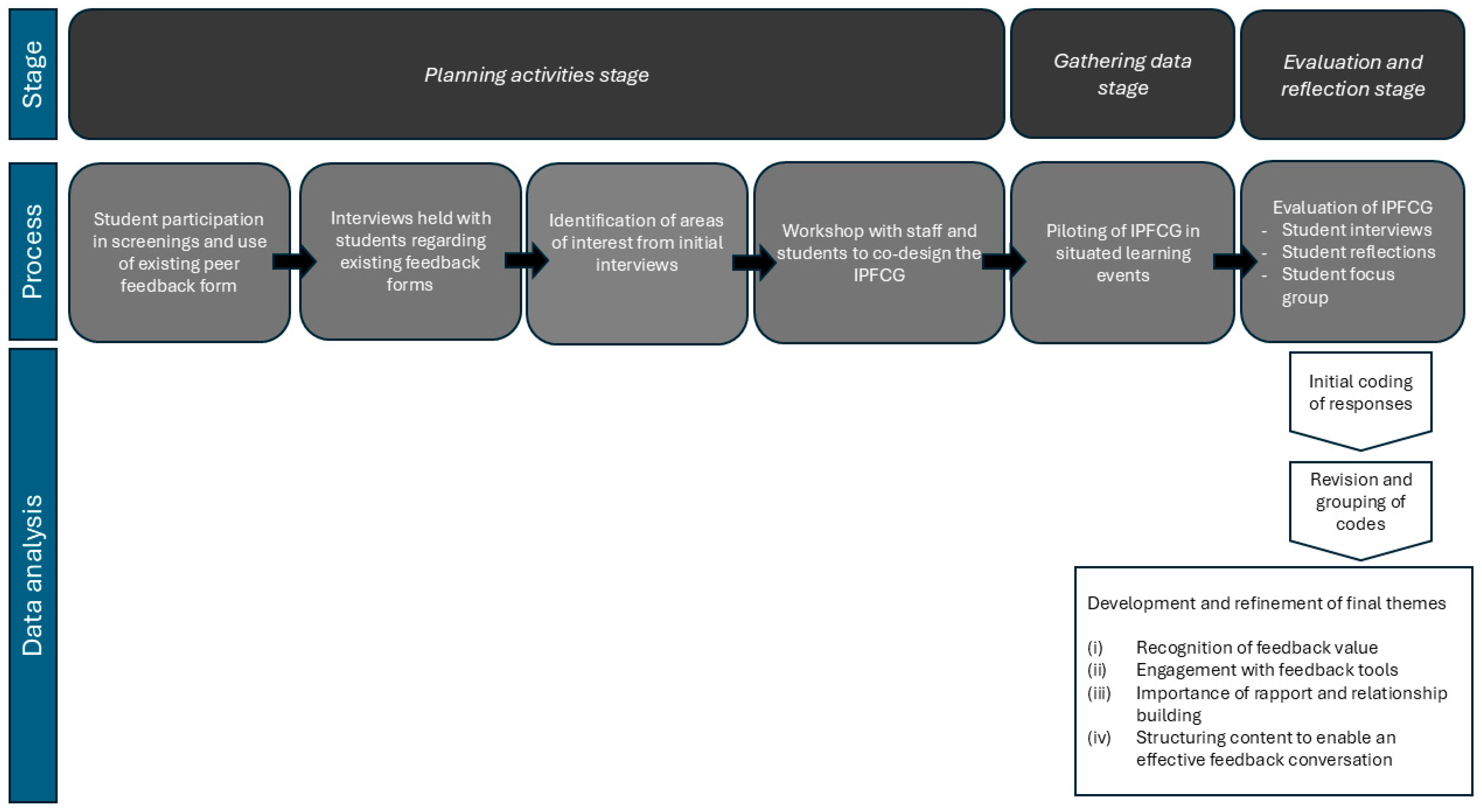
During the Action Research
planning activities stage, students used a pre-existing feedback form to deliver peer-to-peer feedback during an interprofessional paediatric screening activity, and then provided feedback on the use of the form via individual interviews (March–May 2023). Within a co-design workshop, students and educators used this anonymised data to examine strengths and areas for development with the existing feedback form, and aligned improvements with the Feedback Mark 2 framework (
Boud & Molloy, 2013) and principles from the Westerveld framework for interprofessional feedback dialogues (
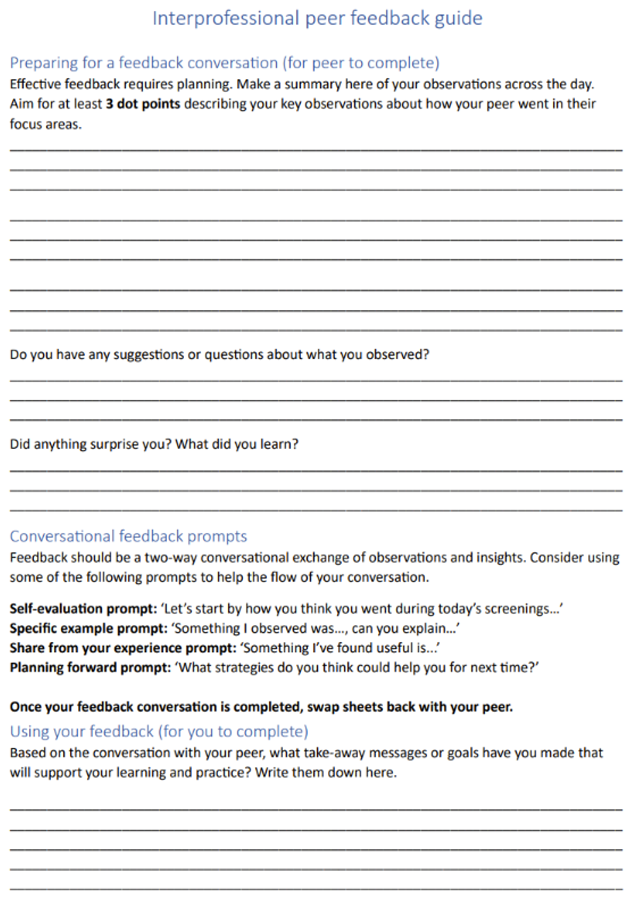
Tielemans et al., 2023). A number of assets were created, and a new process developed to enhance implementation. Assets included videos and a new feedback form. Three one-minute video vignettes incorporated discipline-specific leads describing (i) the importance of peer feedback; (ii) what interprofessional feedback may additionally offer; and (iii) how to use the new interprofessional peer feedback form. The new feedback form included options for feedback performance evaluation and a designated written area for discussion with the interprofessional peer. A separate area was included for the interprofessional peer to complete observations and plan the feedback conversation. The new process was termed the Interprofessional Feedback Conversation Guide (IPFCG), and incorporated the interprofessional student group watching the videos at the beginning of the paediatric screening day before completing the forms within interprofessional pairs. Following paediatric screening activities, protected time allowed each pair to participate in the structured feedback conversation using the new form, with the process completed by returning the form to the student for their personal reflection.
The gathering data stage of the Action Research approach used the IPFCG with a new group of interprofessional students during paediatric screening activities within the same authentic situated learning opportunities (August–October 2023). This was followed with the evaluation and reflection stage to examine the feasibility and perceived value of the new process.
2.2. Setting and Participants
The study was conducted within a long-standing community-based paediatric health screening programme coordinated by The University of Melbourne, Australia. The program involves interprofessional student teams from audiology, optometry, and physiotherapy who provide free health screenings for children in collaboration with volunteer community partner organisations. Screenings are held during the academic teaching semesters (March–May and August–October) at community venues across metropolitan Melbourne, Victoria.
Participants were postgraduate coursework students enrolled in the Master of Clinical Audiology, Doctor of Optometry, or Doctor of Physiotherapy programmes, who undertook the paediatric screening placement in 2023. All students had access to online learning modules for enhancing feedback literacy as part of their coursework programmes. The online learning modules were designed to familiarise students with different forms and sources of feedback for learning, and to raise awareness of how feedback can be used in workplace learning. Students were encouraged to work through these modules prior to participating in their screening placement; however, there was no method for tracking completion of the modules. Educators who supervised or supported the screening program were also invited to participate in the planning activities stage workshop; however, the primary analytic focus remained on the student experience.
2.3. Recruitment and Sampling
Eligible audiology, optometry, and physiotherapy students were invited to participate via an email distributed by investigators from a discipline other than their own. This approach was taken to reduce the risk of coercion in the recruitment process, aligning with guidance on ethically appropriate research practices related to power differentials (
Lyons et al., 2024). Participation was voluntary and independent to course assessment. In the
planning activities stage, a sample of convenience was used, whilst for the
gathering data stage, purposive sampling was used to reflect recent student situated learning experience. When providing feedback regarding use of the IPFCG, students could choose one or more modes of participation: a short online interview, submission of a written reflection, and/or focus group.
2.4. Data Collection
Data collection methods were designed to capture a range of perspectives on interprofessional feedback, and—consistent with the participatory ethos of Action Research and the authentic, context-embedded focus of situated learning—participants were offered flexibility in how they contributed, whilst ensuring all participation modes addressed the same core prompts. This flexible design had methodological implications, managed through a consistent analytic framework applied across all data types to maintain coherence and comparability.
Interviews: Participants engaged in a semi-structured online interview (≤20 min) via Microsoft Teams, which was recorded and transcribed verbatim using Otter AI, with researchers confirming and editing the transcript for accuracy.
Reflections: Participants uploaded reflective statements, originally prepared as part of their coursework portfolios, to a secure research portal for inclusion in the study.
Focus group: Participants explored the student experience of implementing the IPFCG during the paediatric screening activities.
2.5. Data Analysis
All qualitative data were imported into NVivo for management and analysis. A reflexive thematic analysis informed by Braun and Clarke’s methodology (
Braun & Clarke, 2006), using repeated reading and inductive coding of interviews, written reflections, and group discussions from both the
planning activities and
gathering data stages was undertaken. The analysis proceeded through three iterative cycles: (1) initial coding within each phase across all available data sources; (2) team-based review and refinement of code patterns; and (3) comparison of themes between participants in the
planning activities and
gathering data stages to examine possible associations. Regular team discussions and researcher reflexivity informed the interpretation of data and refinement of themes. Educator data were used primarily to contextualise interpretations. This process ensured that interpretive claims were grounded in the broader dataset from the
gathering data stage, whilst recognising the foundational role of data from the
planning activities stage.
Figure 1 illustrates the methodological process.
2.6. Ethical Considerations
The study received approval from the University of Melbourne Human Research Ethics Committee (2023-25469-38826-2). All participants provided informed consent prior to participation. Participation was incentivised by gift cards as recognition and compensation for student time. Data were de-identified prior to analysis and securely stored on password-protected university servers.
3. Results
Findings are presented in line with the Action Research stages described in the Materials and Methods Section. Early insights from the planning activities stage served primarily to inform co-design of the IPFCG, whereas the gathering data stage provides the main analytic base of the study.
3.1. Planning Activities Stage: Exploring Existing Feedback Practices
Four students consented to participate in the planning activities stage, contributing data through interviews (three students; one audiology and two optometry) and a written reflection (one audiology student). Given the small sample size, participant insights from the planning activities stage were used to inform co-design of the feedback process rather than to generate transferable findings. Analysis of these data revealed a tension between the perceived value of the interprofessional screening placement and students’ sense of preparedness for engaging in peer-to-peer feedback conversations. Four areas of interest emerged: (i) value of the interprofessional environment, (ii) limited preparedness and feedback quality concerns, (iii) emotional and relational dynamics, and (iv) informality and emergent feedback skills. These early observations are explored more fully in the gathering data stage.
3.1.1. Value of the Interprofessional Environment
When discussing the benefits of the screening placement, participants appreciated being ‘extended further’ through this style of learning. They valued opportunities for increasing independent practice, gaining external validation from peers from other professions, and enhancing interprofessional awareness in an “informal and relaxed” environment.
“I think that I was excited for a new experience, because we haven’t had much experience with working with people from other disciplines” Victoria (Planning activities stage; interview student)
“I liked having the independence of not having a supervisor watching me” Emile (Planning activities stage; interview student)
By observing their interprofessional peer, participants also reported learning more about what another profession did within a professional context.
“I knew kids like to play with balls, and throw, but I didn’t realise they could actually measure something from that and see how the kids were developmentally progressing” Emile (Planning activities stage; interview student)
3.1.2. Limited Preparedness and Feedback Quality Concerns
When discussing feedback processes between interprofessional peers, participants suggested that greater support for peer-to-peer feedback conversations was needed. Students shared concerns about their ability to provide “quality feedback that would be helpful”. Feedback was noted as lacking in depth, and that “there was no constructive criticism because they didn’t know what to criticise”.
“It was all positive, like a little bit generic as well. And I noticed the feedback I gave to the physio student was very generic. In that like, Oh, that was great that you got the kid to, like, want to pick up the ball after he said, no.” Emile (Planning activities stage; interview student)
Participants also described a sense of “winging it”, noting either a lack of purposeful planning or even “planning ahead” to make best use of feedback encounters, in both receiving and providing feedback.
3.1.3. Emotional and Relational Dynamics
When discussing the benefits and challenges of peer feedback opportunities, a number of interactional behaviours emerged. Benefits included peer confirmation as a potential source of external validation.
“I think it increased my confidence […] Communicating with this patient and when they also said it back, it was like, OK, I actually am good at it” Victoria (Planning activities stage; interview student)
Self-adjustment and resetting of expectations to reflect concern for the feelings of the other person was discussed.
“[…] I felt I didn’t want to be too direct or sound too demanding. I think it was moreso a concern about like professionalism and not wanting, wanting, to make sure that I was being respectful and not, you know, sort of commanding someone or saying we should do this; this way” Teagan (Planning activities stage; interview student)
An awareness of disciplinary boundaries emerged as a potential limitation in relating feedback to one another, despite the common activity of playing a game with preschool children.
“But we do a lot of like game simulation with kids, but […] obviously they’re not audiology students, so they can’t give us like specific feedback” Emile (Planning activities stage; interview student)
3.1.4. Informality and Emergent Feedback Skills
Feedback interactions were noted to be often informal with a small amount of detail.
“[…] It was like, very informal and it wasn’t a long conversation. It was only a few sentences, maybe about things we observed […]” Emile (Planning activities stage; interview student)
Despite this, some students demonstrated strong feedback skills, such as providing feedback “on the go”.
“So, I think it was very much like on, like on the go, that sort of thing. […] I’d say goodbye to the kid and parent, and then we’d be walking back to the room and as we’re walking back together, we’d be having that conversation, touching base a bit and have that feedback” Teagan (Planning activities stage; interview student)
3.2. Planning Activities Stage: Creation of Assets and Process to Develop the Interprofessional Feedback Conversation Guide
In response to the planning activities stage findings, the acting cycle within our Action Research principles occurred via a workshop involving academic staff (
n = 3, one from each discipline), students (
n = 2, one optometry and one audiology student) and a facilitator to co-design assets and processes to develop the Interprofessional Feedback Conversation Guide (IPFCG) (see
Appendix A).
3.3. Gathering Data Stage: The IPFCG in Practice
Across August–October, 2023, the IPFCG was provided to 96 students from a mix of audiology, optometry and physiotherapy disciplines during eight situated learning events. Twenty-five students consented to participate in the gathering data stage; with 19 students completing written reflections (nine audiology, six optometry, four physiotherapy), two completing interviews (one audiology, one optometry), three engaging in an interprofessional student focus group (one student from each discipline), and one audiology student not engaging further in the process. The gathering data stage provides the main evidential base for the study, with the themes presented here drawing primarily on this broader dataset. Themes raised from student participation were: (i) recognition of feedback value, (ii) engagement with feedback tools, (iii) importance of rapport and relationship building, and (iv) structuring content to enable an effective feedback conversation.
3.3.1. Recognition of Feedback Value
Participants expressed consistent appreciation for feedback received from an interprofessional peer, external to their own discipline.
“It was good to hear from a peer who doesn’t know anything about my field but have a health background” Rex (Gathering data stage; written reflection student)
This broader perspective prompted deeper reflection, helping students recogise their own progress.
“Providing another student feedback also allowed me to reflect on my own progress throughout the day—especially noticing things that I felt I had improved on” Fahri (Gathering data stage; interview student)
The value of collaborative discussion was also highlighted, with participants emphasising helpful processes within the dialogue and shared analysis, versus a simple evaluation exchange.
“The biggest benefit I got was from discussing and analysing the approaches from the other discipline, and talking together rather than examining each other.” Jing (Gathering data stage; written reflection student)
Participant reflections recognised that feedback from another discipline could uncover blind spots and offer advice that crosses disciplinary boundaries.
“It sheds light on areas that I need to work on and provides me with valuable advice that works across disciplines. Interprofessional feedback helps me identify problems that I don’t easily see within the framework of my discipline” Celine (Gathering data stage; written reflection student)
3.3.2. Engagement with Feedback Tools
Students demonstrated active engagement with the IPFCG, with one participant strongly describing its importance.
“…used this [IPFCG] like the bible” Kai (Gathering data stage; written reflection student)
There was also general appreciation for the structured IPFCG peer-to-peer feedback conversation process. Several participants noted that using the guide and dedicated time helped them to improve their participation in feedback conversations and reinforced the importance of developing feedback skills.
“As a giver, learning to give feedback and be comfortable giving feedback is an important skill to develop.” Susan (Gathering data stage; written reflection student)
However, not all students engaged with the resource to the same extent. Some reported limited engagement, indicating that IPFCG orientation may need further consideration.
“We have this video…we watched it on double speed” Derek (Gathering data stage; interview student)
3.3.3. Importance of Rapport and Relationship Building
A recurring theme was the importance of building rapport between students from different disciplines.
“Building rapport with my peer at the beginning of the day would make it easier for each of us to open up and share feedback with one another” Celine (Gathering data stage; written reflection student)
“It was very nice to see and learn more from someone outside of the discipline. Having a peer’s feedback is a lot less pressure than a supervisor. It’s scary to give negative feedback because you don’t want to be mean!” Kai (Gathering data stage; written reflection student)
A lack of familiarity with one another was reported as a barrier to meaningful feedback, with one participant noting:
“Sometimes it was awkward to provide feedback without sounding condescending”. And, “Didn’t receive as much feedback as I would have liked, perhaps if the peer is being too nice/considerate” Rohini (Gathering data stage; written reflection student)
Students suggested that structured introductions or team-building activities at the start of the placement day could help foster trust and openness.
3.3.4. Structuring Content to Enable an Effective Feedback Conversation
Students highlighted the value of having a framework to guide peer-to-peer feedback conversations. The IPFCG was seen as helpful to both collect information of value from their interprofessional peer, as well as to prompt more thoughtful and constructive dialogue.
“And it is always good to have a sit down and have a chat about things, but […] if you don’t, if you’re not noting down as you go, then you can tend to like overlook stuff and then towards the end it becomes more generalised feedback rather than specific feedback” Fahri (Gathering data stage; interview student)
“OK, […] lets fill in the form […] and sort of worked through one by one, the things that they wanted to work on. […] if we noticed something specific, we mentioned those just outside of those couple of things. So, as I say, they wanted to work on their integration of results. So, those are the things I mainly focused on, and it […] felt I guess, loosely structured in the way it worked, which I think was good because it sort of let us organically make conversation” Derek (Gathering data stage; interview student)
However, this sentiment was not universal, with some still reporting difficulty with the depth and specificity of the IPFCG requiring additional dedicated time within the programme.
“There’s a lot of writing to do. More time should be spent on a conversation” Mark (Gathering data stage; written reflection student)
“Dedicated time to give feedback!” Nancy (Gathering data stage; written reflection student)
This suggests further refinement of the IPFCG may be beneficial to better operationalise the process within a situated learning session.
4. Discussion
This study explores how feedback literacy can be developed through authentic interprofessional peer-to-peer feedback situated within a community-based paediatric health screening programme. Our aim was to understand and enhance interprofessional feedback practices among healthcare students, with a focus on developing a structured approach to guide these interactions. Through an exploratory Action Research qualitative design, and authentic and situated learning theory, we sought to examine the effectiveness of a co-designed Interprofessional Feedback Conversation Guide (IPFCG) in fostering feedback literacy within an authentic, situated learning environment.
Across the
planning activities and
gathering data stages of the Action Research approach, students recognised the value of interprofessional feedback and the authenticity of the screening placement as a learning environment. The co-designed IPFCG served as a practical and engaging tool that provided structure for feedback conversations, and alongside priming video activities with protected time for interprofessional peer exchange, supported the development of feedback literacy beyond informal and emergent feedback skills. In the
planning activities stage, students reported key implementation challenges of limited preparedness, and relational issues such as the need to build stronger rapport within student dyads. These challenges align with barriers to interprofessional dialogues described in the literature (
Tielemans et al., 2023). Overall, these findings emphasise the importance of protected time for enabling preparedness, rapport building, and embedding well-designed, structured, situated feedback processes within authentic learning contexts to support professional growth.
Our results reflect the importance of authentic learning experiences in preparing healthcare students for the complexities of professional practice (
Nisbet et al., 2016). The community-based setting provides a rich environment for students to engage in meaningful interprofessional interactions, aligning with the assertion that feedback literacy is best developed through situated, authentic contexts (
Noble et al., 2020). Students recognised the unique value of receiving feedback from peers outside their discipline, and the opportunities for the professional knowledge transfer between disciplines. These findings reinforce that feedback literacy is not simply a cognitive skill but a socially mediated practice, to be cultivated through active participation in authentic, situated learning environments where learners engage in real-world tasks with peers. This aligns with broader work emphasising that well-designed interprofessional learning activities require intentional scaffolding, co-design and alignment with authentic workplace practices to support meaningful learner participation (
Versluis et al., 2025).
Interprofessional clinical student experiences have been shown to improve student learning outcomes (
Prestes Vargas et al., 2025). Hesitancy in some students to provide or receive interdisciplinary feedback due to a lack of discipline-specific knowledge is consistent with previous research suggesting that clinical educators can feel unprepared when supervising interdisciplinary students. Clinical educators have previously reported improvements to their confidence levels following specific training (
Anderson et al., 2009), highlighting the importance of structured learning and operational processes in interdisciplinary student collaborations.
Our findings offer new insights into how students negotiate interprofessional peer feedback within an authentic service context, highlighting the ways that real-world responsibility and relational safety shape feedback practices in situ. We also demonstrate that a structured conversation process like the IPFCG can meaningfully support feedback literacy by providing shared language, reducing uncertainty, and enabling more confident engagement across traditional disciplinary boundaries. These contributions extend existing understandings of interprofessional learning by showing how authentic settings and structured scaffolds interact to facilitate productive feedback interactions and inform the design of future interprofessional education initiatives.
While our study provides valuable insights, it is not without limitations. The relatively small sample size may limit the generalisability of our findings. However, we align with recommendations in qualitative health research to justify sample size in relation to the study purpose and analytic depth (
Vasileiou et al., 2018). Accordingly, we treated the
planning activities stage data as formative rather than using it to support interpretive claims (which were drawn primarily from our larger dataset in the
gathering data stage). Conducting the study within a single institution, and using sampling approaches that aligned with student engagement (convenience sampling during the
planning activities stage), or focused on students who had engaged with the IPFCG on placement (purposive sampling during the
gathering data stage) poses additional limitations to the generalisability of our findings. These pragmatic approaches may not fully capture the diversity of different learning experiences in interprofessional learning contexts. Future research could explore a wider range of situated learning settings as well as the long-term impact of these experiences on students’ professional practice and ongoing feedback literacy development. Longitudinal studies tracking students from their educational programmes into early career practice could provide valuable insights into the lasting effects of such initiatives.
Should these findings from our exploratory study be replicated, effective methods for broader implementation would be required. Investigations into how to scale and integrate such authentic learning experiences more broadly across health sciences curricula (
Nisbet et al., 2013) could include exploring the use of technology to facilitate interprofessional feedback in virtual or hybrid learning environments. This may potentially expand the reach and impact of such initiatives for participants and students, where authentic in-person learning experiences are unavailable. Additionally, technology-enabled virtual student meetups (e.g., Avatar-based meetings) (
Gomes de Siqueira et al., 2021) prior to interprofessional placements could help address the reported need to build rapport between students to further enhance peer-to-peer feedback.
This study suggests that students do recognise and value the benefits of interprofessional peer-to-peer feedback within authentic, situated learning contexts. Integrating well-designed interprofessional experiences into curricula can enhance student engagement and support the development of crucial team-based skills for future practice. This aligns with the view that authentic learning environments are “information rich environments”, yet learners need guidance to recognise and synthesise these cues as meaningful feedback within their practice (
Noble et al., 2020). As health profession education continues to evolve to meet the needs of an increasingly complex and collaborative healthcare environment, the power and promise of authentic, situated, interprofessional learning experiences offer future students the necessary skillset to communicate effectively in the workplace to ensure safe and effective patient care.



 ,
,