1. Introduction
In recent years, international organizations have noted the impact of equity issues in education across all fields (
OECD, 2018;
World Bank, 2018) and that the most productive educational systems are ones that merge equity and excellence in their policies and practices (
Parker et al., 2018;
Sahlberg, 2021). However, implementing workshops and courses on equity and inclusivity typically requires appropriate training or professional development within a supportive system. In mathematics, there have been similar calls to merge equity and excellence with regard to the teaching preparation of graduate teaching assistants (GTAs), as GTAs are heavily involved with lower-level large enrollment courses (
Deshler et al., 2015;
Olarte et al., 2024;
Selinski & Milbourne, 2015). Even looking outside of mathematics, the literature is clear that most GTAs would benefit from more professional development (PD), but most of their teaching opportunities are structured to serve the needs of the institution rather than provide a high-quality experience for the GTAs (
Austin, 2002;
McLeod et al., 2025;
Oleson & Hora, 2014). While a focus on logistical elements and department structures is necessary, pedagogical development is also essential to serve student needs and promote student success in the classroom.
Given shifts in the increased existence of programs fostering pedagogical growth for GTAs (
Braley et al., 2023), we aim to provide insight into the design of impactful PD activities that promote GTAs’ abilities to implement equitable and inclusive teaching practices. At the moment, there are few studies that report on the effectiveness of Diversity, Equity, and Inclusion (DEI) PD for mathematics GTAs and what the GTAs find effective about such PD. Therefore, we address this gap in the literature by examining GTA perspectives. As such, our research questions were as follows.
What curricular aspects of a DEI PD do GTAs notice and reflect on?
From the GTAs’ perspective, what curricular aspects of a PD were effective in helping them shift their teaching?
We focus our efforts on the GTAs’ perspective to establish a foundation for building successful PD programs for GTAs. Focusing on the GTAs’ point of view is appropriate since one of the main concerns regarding PD for teaching is how to support new educators in understanding DEI issues. Therefore, gaining an understanding of what the GTAs recall from their PD experience is a valuable asset to leverage in creating an effective PD program.
2. Literature Review
2.1. Research on Diversity, Equity, and Inclusion Training
In recent years, advancing Diversity, Equity, and Inclusion has been a significant priority in higher education. Although many institutions explicitly state their support of DEI,
Cumming et al. (
2023) found that only 21% of the 83 universities polled met their goals for meeting their DEI action plan. This finding indicates that despite being actively engaged in advancing DEI, there is still much to learn about effective DEI initiatives, including professional development.
Although studies on DEI training are steadily growing, PD researchers are still investigating the efficacy of such training (
Wang et al., 2024). In their review of existing studies on DEI training, Wang et al. indicate that DEI PD research is still in an early phase, and thus, we need to continue learning about effective versus ineffective aspects of DEI training. Despite this gap in the literature, many researchers agree upon several recommendations for what DEI training should include. For example, multi-session trainings where skills can be practiced and developed over time are likely more effective than single-sessions (
Rawski & Conroy, 2020;
Willis & Schram, 2022). Additionally, there is not a singular solution that will work for every institution, so attention to the local context is imperative (
Cumming et al., 2023). However, as work in DEI PD is still nascent, none of these works identify specific curricular or content design with feedback from the GTAs. Therefore, our research will build upon these findings by adding knowledge to what makes DEI training effective (from the GTAs’ perspective).
Although the amount of research on the impact of DEI training is somewhat sparse, the preliminary findings on DEI PD indicate positive outcomes for most participants. For example,
Harrison-Bernard et al. (
2020) employed a DEI PD for faculty members. They observed that their participants had increased recognition of their unconscious biases and learned methods to help overcome them. Similarly,
H. J. Kim et al. (
2023) report that their inclusion of DEI-focused pedagogy into their faculty PD programs led to increased usage of pedagogical practices that align with Universal Design for Learning principles. While these results are promising, there is still a lack of knowledge about how to design curriculum that will resonate with GTAs in DEI PD. With this in mind, this paper aims to provide insight into curricular design that support a GTA PD program focused on DEI. Based on the themes we identified from the GTAs, we share guidance and theoretical implications that institutions can leverage when considering DEI training.
2.2. Research on Effective Professional Development
Compared to the research on DEI training, there is significantly more known about effective PD. Research scholars agree that effective PD involves longitudinal development (
Bates & Morgan, 2018;
Zimmerman & May, 2003), active learning tasks that are participant-centered (
Lauer et al., 2013;
Hunzicker, 2011), and alignment with the needs of the local context (
Bayar, 2014;
Darling-Hammond et al., 2017). In their review of the literature,
Sadera et al. (
2024) further confirm that key aspects of sustainable GTA PD include GTAs receiving ongoing pedagogical and departmental training and having opportunities to develop their teacher identity.
Within our field of mathematics education, there is still a critical need for increased attention to GTA training in teaching undergraduate mathematics (
Ellis, 2014;
Meyer et al., 2025;
Olarte et al., 2024). Numerous studies indicate that GTAs enter graduate studies with nascent ideas about the teaching and learning of mathematics (
M. Kim, 2013;
Kung, 2010;
Park & Rizzolo, 2025) and are not always able to consider or implement more advanced pedagogical strategies in their first year of teaching (
Beisiegel & Simmt, 2012;
Miller, 2018). However, when involved in an ongoing and productive PD, GTAs evidenced a rich knowledge of strategies to support student learning and higher-order teaching methods (
Ghalichi et al., 2023;
Porter et al., 2000). We build off of these studies in an effort to focus on both pedagogical and DEI PD for GTAs in an effort to uncover what design aspects are effective. In particular, our PD involves multiple cohorts engaged in 1–2 years of DEI PD and one of our contributions is considering how to effectively center participants as part of the design process of the PD.
2.3. Research on DEI Training for Graduate Students
Most academic departments generally do not offer DEI training and instead rely upon graduate colleges to offer DEI training for graduate students (
Perez et al., 2020). As a result, more is known about graduate students from across disciplines and their (a) reactions to DEI training, (b) thoughts and beliefs about DEI, systems of oppression, and marginalization, and (c) means to support diverse undergraduate students. For instance, many GTAs across disciplines want to advocate for students with disabilities but lack knowledge about effectively accommodating them (
McCallister et al., 2014;
Palacios, 2022). There is much to learn from PD implemented across disciplines; however, such PD is often more general and not situated within discipline-specific contexts. This implies that the content of these PD courses is important and that subject-specific content should be considered (
Barr & Wright, 2019). Nevertheless, each discipline has unique challenges related to DEI. For example, in the social sciences, there are often issues of research teams being diverse but not inclusive (
Allen, 2023), such as senior White researchers leveraging a younger person’s identities to speak for or gain access to a population and then not crediting their contribution to the research (
Hattery et al., 2022). Therefore, specific to social scientists, a productive PD would likely discuss handling power dynamics and reflexivity statements (
Secules et al., 2021).
While not as much of a focus in the past, recently, researchers have found that “equity and diversity in the classroom” is becoming a more common topic in mathematics GTAs’ preparation for teaching (
Braley et al., 2023, p. 1046). However, the activities and ideas that these PDs include or emphasize are generally unknown. In part, this is because evaluation of mathematics GTA PD has been limited (
Bookman et al., 2024), which is likely exacerbated by the limitations placed on the faculty who provide such PD. Specifically, at least 65% of mathematics GTA PD providers are teaching faculty or in temporary positions, and thus not as likely to conduct longitudinal research on the effectiveness of PD as if they were research faculty (
Yee et al., 2024). Moreover, GTA PD providers are not likely to be researchers in the fields of mathematics education or DEI, which suggests further uncertainty in the design of mathematics GTA PD across higher education contexts. Therefore, as research faculty providing DEI PD for GTAs, we present our findings in an effort to provide more data on an underreported area of research.
Recent studies suggest that mathematics instructors’ conceptions of equity and reflections on equitable teaching primarily focus on supporting academic success and closing achievement gaps and rarely address issues of power and identity (
Gutiérrez, 2009;
Yu et al., 2024,
2026). Hence, a productive PD program for GTAs needs to foreground conversations about critical dimensions of equitable mathematics instruction (
Gutiérrez, 2009,
2011), systems of oppression, and how the identities of students and teachers impact the mathematics classroom. Therefore, one goal of our study is to investigate how the content design of certain PD activities (i.e., content that is subject-specific and underscores issues of power and identity) catalyzes shifts in GTAs’ understanding of DEI issues in relation to mathematics education.
3. Theoretical Framing
Before diving into the aspects of the study, it is important to mention our perspective on what
Diversity,
Equity, and
Inclusion entail. We recognize that there is no singular, agreed-upon definition for each of these widely used terms. In part, a range of definitions arises from diverse individuals or groups working with these ideas in various contexts. While we do not assert one proper definition for these terms, we provide working definitions to better convey some of the conceptualizations and assumptions that impacted the design of our PD program as well as how we examined our data. We leverage the work of (e.g.,
Gutiérrez, 2009,
2011,
2018) as a guide in considering the terms
Diversity,
Equity, and
Inclusion in educational contexts.
Diversity: The variety within a group of people. Variety is broadly conceived to include social identities, interests, experiences, etc.
Equity: True equity is the inability to predict differences in excellence and experiences based on one’s identity (e.g., race, gender, ability, class, etc.).
Inclusion: A deep sense of belonging that is intertwined with one’s empowerment to participate as a trusted member of a group.
We clarify that we are not leveraging these definitions as a way of viewing our data. Since this manuscript primarily focuses on GTAs’ feedback about the program, the PD is the backdrop to our data. Therefore, we elucidate our perspective on how we approached and framed the curriculum of our PD program.
For example, in our program we have lessons that focus on expanding students’ understanding of “diversity” by having them understand how students from specific backgrounds (according to race, gender, ability, class, etc.) experience mathematics unequally, whether that is due to societal bias, such as the perception that males can be “math people” and how women and minorities are pushed out of mathematics (
Ceci & Williams, 2009;
Grunspan et al., 2016). The goal of these activities is to support the GTAs in developing a sense of Diversity, Equity, and Inclusion aligned with our working definitions, by expanding their knowledge of the issues in education as well as deeply understanding how issues of race, gender, intersectionality, etc., play a significant role in education. For more on how we leverage these details in our PD see
Pilgrim et al. (
2025) or
Yu et al. (
2026).
Because we are interested in the effectiveness of the design of our PD program, we draw on a curricular development framework to make sense of the design aspects GTAs noticed and found effective. We use the word “curriculum” to refer to the overall design for a course and how the content is leveraged as an outline for how the learning outcomes will be achieved. According to
Wiggins and McTighe (
2005), curriculum takes standards and content, and transforms it into a blueprint for how to effectively teach and catalyze learning. Therefore, curriculum is more than a simple list of ideas and topics (the “Input/Content”). Rather it is an outline of how to achieve the desired student performance (“Outputs”) by describing the appropriate activities and pedagogical strategies (“Processes/Metholodogy”) that will enhance the likeliness of these desired results. Essentially then, curricular development includes (1) Input/Content (the substance of the course), (2) Processes/Methodology (how the substance is delivered), and (3) Outputs/Learning Outcomes (the results). We leverage these three categories (Input, Processes, and Outputs) when examining how the GTAs responded to feedback regarding the PD.
4. Materials and Methods
At each of our respective institutions, we employed a PD program for mathematics GTAs to support them in using active learning techniques and teaching equitably. While there are differences in the implementation of our respective PD programs that were necessary for implementation at each campus, we had a shared goal of developing equitable and inclusive teaching practices for our GTAs and structured our courses aligned with the literature (
Pilgrim et al., 2025). For example, at one university, GTAs were enrolled in the PD program for one year (due to the needs and constraints of that university and length of time graduate students served as GTAs), which entailed a Pre-Fall Orientation, a Teaching Seminar, and the Intro to Active Learning & Equity course. At the other two universities, GTAs were enrolled for two years, which entailed a Pre-Fall Orientation, a Teaching Seminar, the Intro to Active Learning & Equity course, the Advanced Active Learning & Equity course, and an optional additional semester to engage as a peer mentor for newer GTAs. While the structure of the PD remained mostly the same across the three institutions, we note that some of the content differed across each context, depending on what each instructor believed the GTAs would benefit the most from.
The participants in our study consisted of the GTAs at each institution for a total of 56 GTAs: 15 at Beta University, 19 at Epsilon University, and 22 at Gamma University. A breakdown of the context at each university is presented in
Table 1. GTAs were recruited into the research study at the start of their graduate career, starting with a Pre-Fall Orientation, with most of the GTAs having just completed their bachelor’s degree and only a few having previous teaching experience.
We note that each institution handled individual details of the PD differently due to the unique constraints at each university. For example, since Epsilon University GTAs were mostly Masters students who were only in the program for one year, they did not participate in the Advanced Active Learning & Equity nor had the opportunity to formally mentor other students. This was in contrast with the other two universities who had more time to work with and support GTAs in their professional development for teaching. Despite these differences, the primary similarities in the courses that were taken across all three institutions were significant. The Teaching Seminar and Intro to Active Learning & Equity were each one term courses which met for either 1 or 2 h a week. Each meeting was typically focused around one major DEI or pedagogical issue such as Meritocracy, Access Needs, “What would you do if…”, or Mathematical Microaggressions. The meeting usually involved active engagement such as responding to vignettes, taking the Implicit Association Test (
Greenwald et al., 1998), or experiencing systematic biases through a discovery activity. Additionally, there was time set aside to discuss the activity and how they were related to the GTAs teaching.
We designed these courses (as well as the Pre-Fall Orientation and Advanced Course) such that approximately 50% of the course materials (e.g., assignments and activities) were to be used across all institutions and the rest were up to the instructor to decide on what their GTAs needed. For example, the Mobile Activity (
Schniedewind & Davidson, 1983) with a shared slide deck was employed at each university during one of the sessions. The shared slide deck involved common discussion questions so that each university had the same content to report on for this study. The activities that we report on here in this paper primarily focus on the common activities (there were exit tickets specifically for those activities). For more information regarding the overall design or content of the PD refer to
Pilgrim et al. (
2025).
To assess the effectiveness of the PD, we collected data from surveys, interviews, exit tickets, and PD artifacts from the shared events and courses (i.e., Orientation, Teaching Seminar, and Intro to Active Learning & Equity).
Table 2 summarizes what each of these data sources entailed and when they were collected. This research was conducted with human subjects approval under the jurisdiction of of San Diego State University’s Research Support Services and is part of protocol number HS-2021-0185-SMT.
Data from each of these sources were de-identified and then compiled into a master spreadsheet. The analysis of these data sources involved what
Braun and Clarke (
2006) refer to as a mix of inductive and deductive coding, where the analysis is primarily driven by what is in the data, and then the data was compared to a series of ideas (existing literature). This method aligned with our research goals, since we endeavored to understand what aspects of a PD program resonate with the GTAs from their perspective. To analyze the data, the three authors individually did an initial pass of one institution’s set of data by tagging excerpts with low-inference descriptors (
R. B. Johnson, 1997). Low-inference descriptors are short notes that summarize the data in a non-judgmental way, where the researcher avoids inferring too much from the data. After the initial pass, each author individually attempted to group their descriptors into themes by conducting thematic analysis (
Braun & Clarke, 2006). Then the authors met to discuss and reconcile their low-inference descriptors and preliminary themes. The team made the themes inductively by grouping similar low-inference descriptors together and then came up with a code that captured the grouping. While the precise definition of these codes changed, we ultimately started and ended up with the same four codes. After discussing the initial codes, the authors agreed upon four themes that captured a majority of the GTAs overall feedback. We note that the themes each author came up with individually were similar to the final four themes, and the discussion was mainly about edge cases or clarifying terminology. Additionally, while these four codes did not cover every single type of comment from the GTAs, they were the only themes that emerged from a significant portion of the data. While each of the four codes had 40+ individual pieces of data tagged with them, all other types of codes had 5 or less emerge from our low-inference descriptors. Finally, the authors revisited their data with these four themes in mind, where any piece of data was examined by at least two of the authors. As we revisited our data, no new themes emerged; that is to say that the four themes adequately captured the range of feedback from the GTAs and therefore reached theoretical saturation.
As part of the post-analysis, we leveraged the curricular design framework to compare our codes to existing literature (deductive analysis). We discovered that our four codes situated appropriately within the dimensions of Input/Content, Processes/Methodology, and (3) Outputs/Learning Outcomes. We note that in comparison to how this framework is normally utilized (in framing the construction of curricular design), we employ the framework by analyzing specific aspects that GTAs are commenting on in relation to each of these dimensions. For example, if a GTA commented on enjoying the group aspect of the PD since it offered them extra perspectives on a topic, we considered that as commenting on the Processes/Methodology portion of the PD.
As a note, due to the variation across institutions (e.g., when and in what form the data were collected) and some of the data being anonymized, we are unable to give a precise count of codes from individual GTAs. From our de-anonymized data though, we report that each of the four themes that we identified showed up from at least 20 of our 56 GTAs. We also stress that each of the four themes consistently emerged across institutions and cohorts, and that no one institution had one code significantly more than another institution. We also clarify that these themes are not exclusive of each other and that oftentimes a single excerpt from a GTA included multiple themes.
5. Results
Based on our analysis, we identified four themes related to effective design aspects of our PD program focused on equitable and inclusive teaching practices for mathematics GTAs: (a) Concrete Ideas and Examples Connected to Theory; (b) Community and Collaboration; (c) Awareness through Discovery; Concrete Ideas and Examples Connected to Theory; and (d) Practicality and Actionable Takeaways. These four codes each align with one of the three curricular design dimensions appropriately as such:
Content: Concrete Ideas and Examples Connected to Theory.
Processes: Community and Collaboration.
Processes: Awareness through Discovery.
Outcomes: Practicality and Actionable Takeaways.
In this section, we describe each theme, providing illustrative excerpts from GTAs across institutions, cohorts, and data sources.
5.1. Concrete Ideas and Examples Connected to Theory
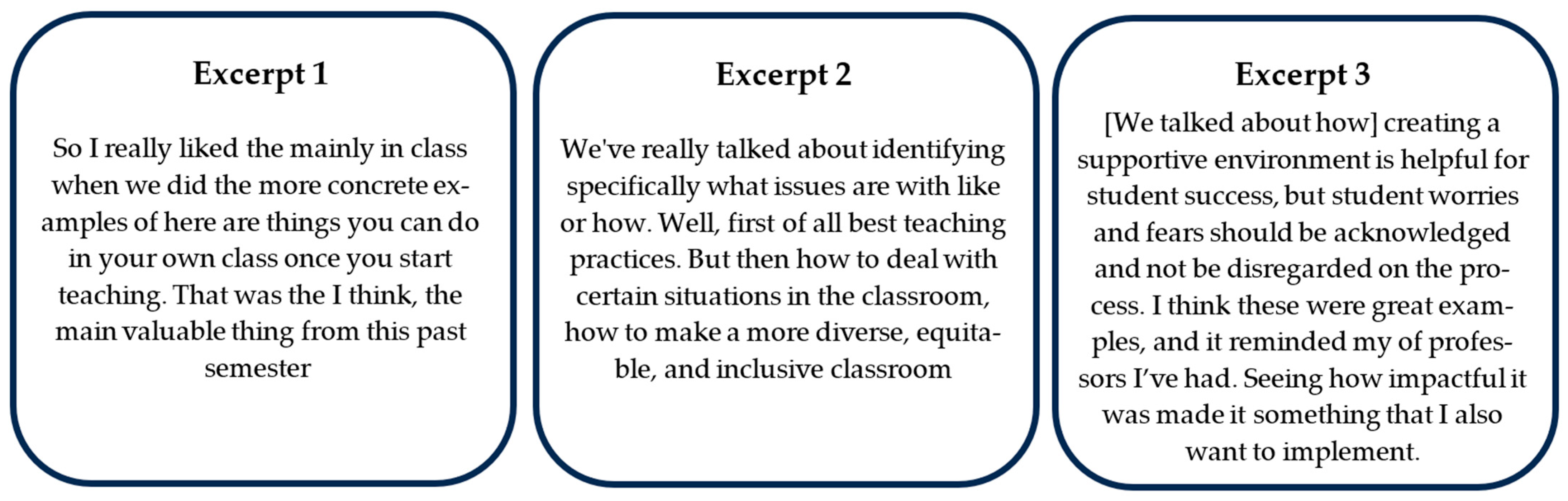
In relation to the Content of the PD, many GTAs indicated that being exposed to specific examples supported them in understanding complicated issues related to equity and equitable teaching practices. While theory was not absent from nor concealed within the PD, we found that activities that centered conversations around
Concrete Ideas and Examples Connected to Theory were consistently desired and favored in the PD (
Figure 1). Many GTAs explicitly expressed enjoyment that the PD involved “more concrete examples”, “identifying specifically what issues”, and how there were “great examples.” The GTAs consistently framed shifts to their thinking or teaching in relation to these examples; they repeatedly used the terms “concrete ideas”, “examples”, “specifics”, and “tangibles” when talking about the PD activities. To these GTAs, examples elucidated clear connections between a pedagogical idea and how it related to their classroom.
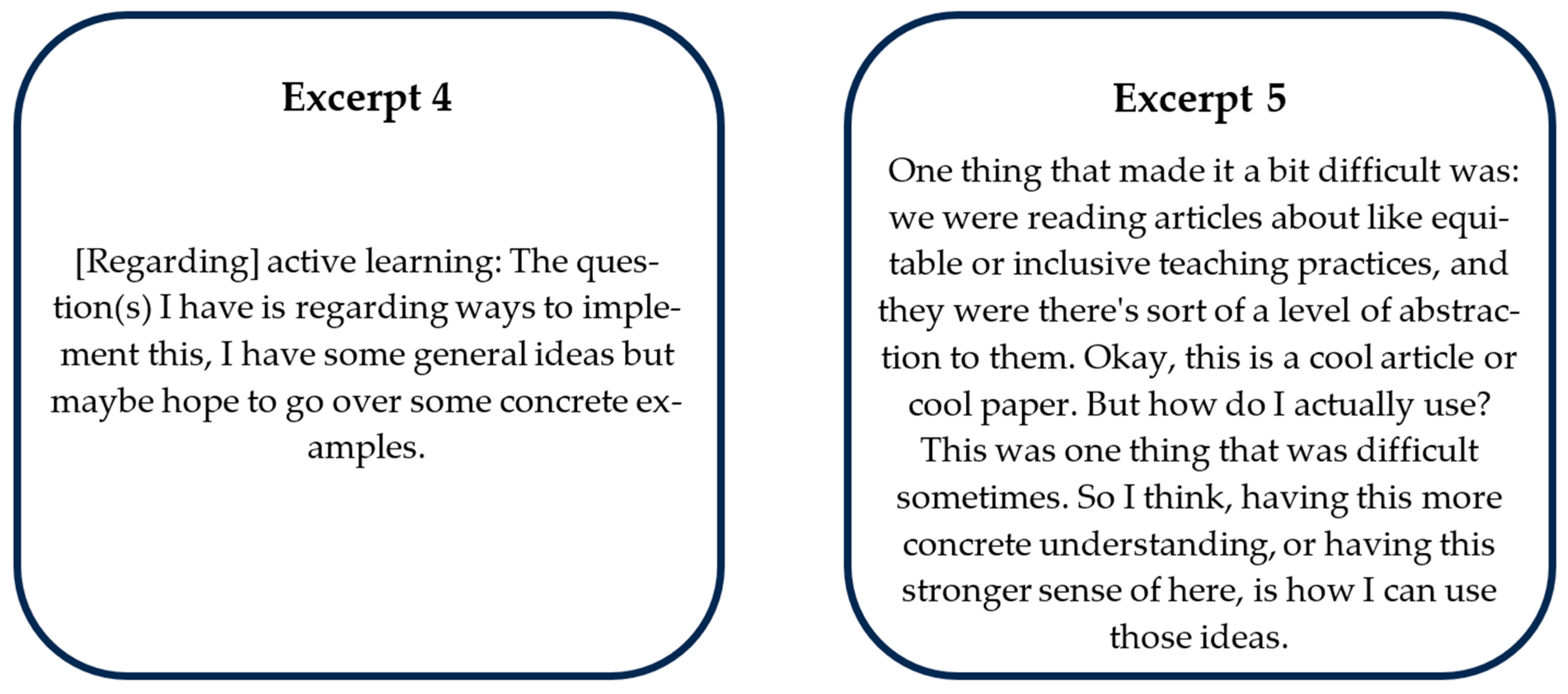
Echoing the favorability of having concrete examples, GTAs also felt that some of the PD activities did not have enough examples, and they often remarked how abstract or difficult it was to connect theory to their current roles (
Figure 2). While the GTAs did not usually find the theory or general ideas unrelatable to their courses, there was a repeated sentiment that they wanted more “concrete examples” since they only got a sense of the general idea of the topic [Excerpt 14]. Even when articles talked about equitable or inclusive teaching practices, sometimes the GTAs felt that they were not completely connected to their own teaching and that they wanted “more concrete understanding” [Excerpt 15]. This was a common sentiment in the earlier design stages of the PD course, where GTAs indicated areas of improvement such as “provide more explicit examples of common concerns and possible solutions, or of educators actively using effective strategies”. We find this in alignment with our first theme since their concerns voiced a desire that the content of the PD should involve specific examples connected to the larger abstract pedagogical theories.
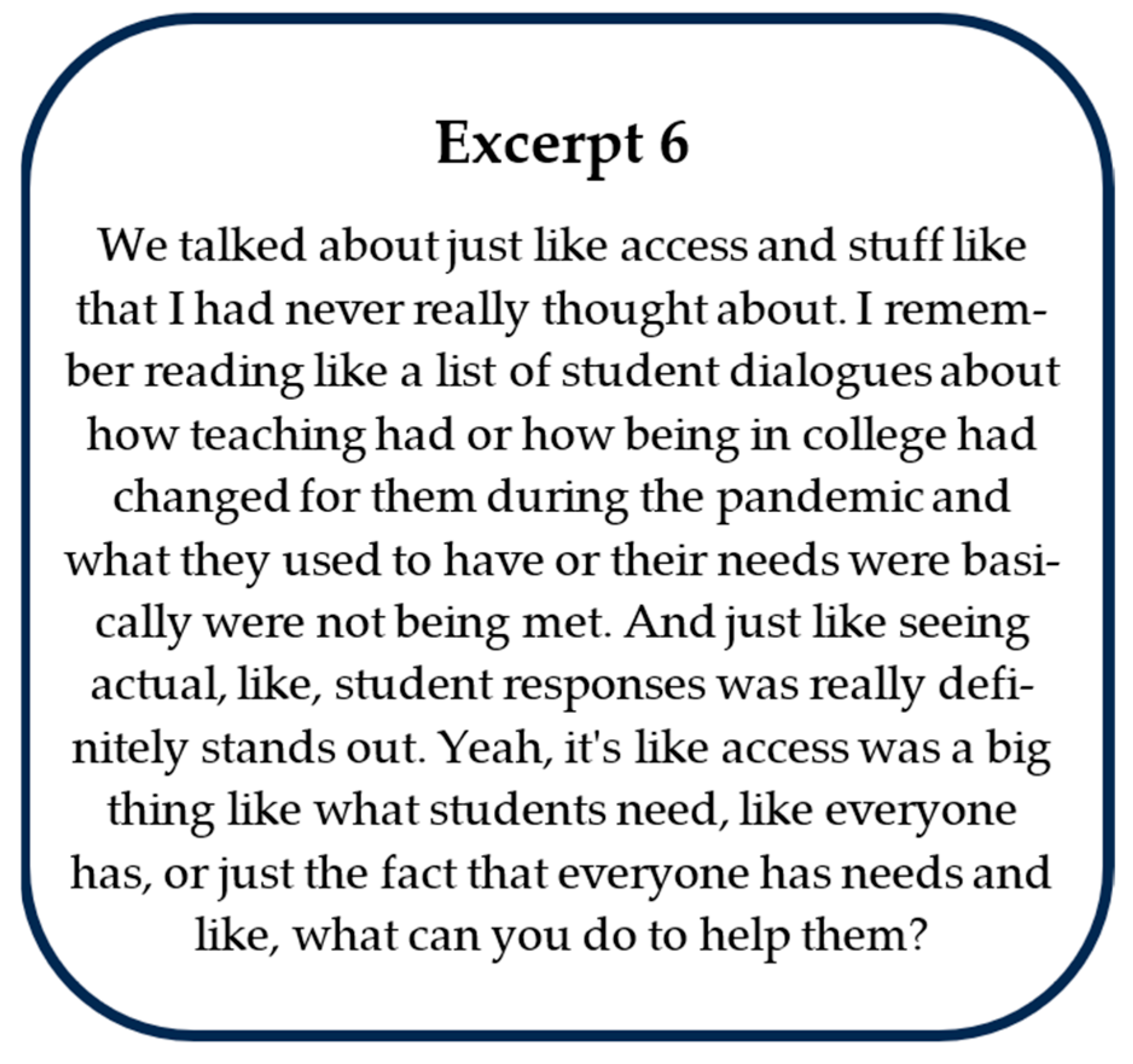
GTAs also referred to specific examples of activities during their end-of-year interviews or surveys about the class. In these end-of-year interviews, the GTAs were asked what they thought had an impact on them throughout the PD course. Many of the GTAs talked at length about a particular activity they recalled and indicated their appreciation for “actual examples”. For example, on the end-of-term surveys, several of the GTAs reported that they recalled a specific example and how it “stuck with them” or “opened their eyes” to new perspectives. In a different example, one GTA mentioned how reading narratives from actual disabled students (as opposed to strictly hypothetical ones) helped them better understand the issues they undergo (
Figure 3). This GTA indicated that “seeing actual, like, student responses” stood out to them and aided them in understanding the “big thing” or idea of access. Outside of these illustrative excerpts, we noticed similar responses from other GTAs discussing activities that involved a variety of examples, and also noted responses like Excerpts 4 and 5 with activities that lacked specifics. Altogether, there was a repeated theme across GTA responses that having the content of the course involve concrete examples helped them process ideas of equity and inclusion.
5.2. Community and Collaboration
The next theme we consistently noticed across institutions, cohorts, and data sources was that GTAs appreciated activities in which they worked in Community and Collaboration with their peers. In comparison to the content of the course, these comments involved the Processes aspect of curricular design. The GTAs feedback was less focused on the substance of the PD and instead contained information about the methods that catalyzed their learning. Across the institutions, there was consistent positive feedback about “being able to talk to other people in the program” and that the meetings were “important to me because we all got to share our stories with what we were doing.” We also note that there was never any negative feedback about being in community when learning about these DEI topics, in fact there was feedback indicating how they wished there was more time to share and learn from one another.
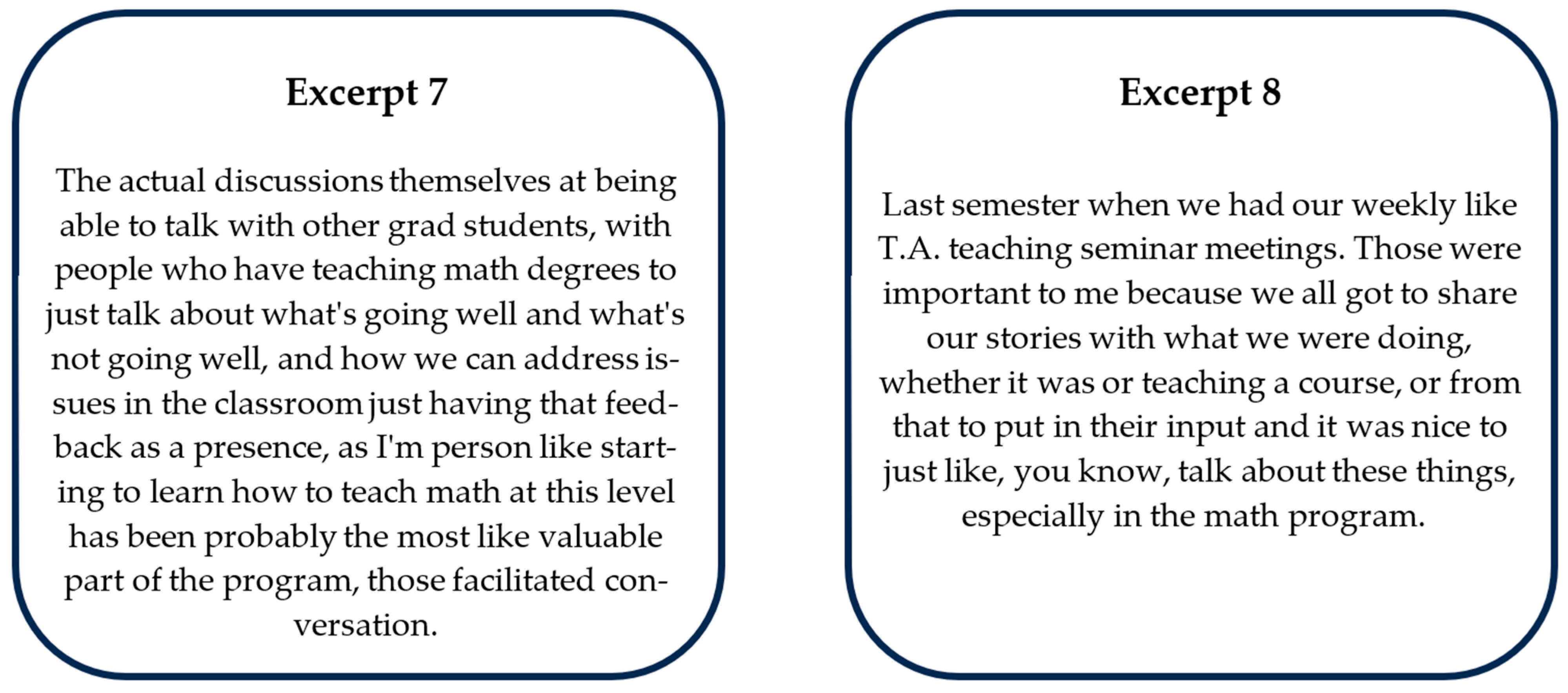
As a demonstrative example, when responding to an interview question about how the PD has helped them thus far, GTAs explicitly mentioned their appreciation of being able to talk to others who were in similar positions as they were (
Figure 4). The GTAs stated how useful it was to have the space to “talk with other grad students,” whereas another GTA remarked about how important it was to them to share and listen to everyone’s stories. These GTAs specifically valued having a space to talk about the courses they were teaching, and as Excerpt 8 seems to indicate, is perhaps missing from the weekly routine “in the math program.” This finding aligns with current research on PD for teachers. Since cohorts of GTAs often teach the same classes, GTAs have an organic interest in forming a Community of Practice (CoP) around teaching in their respective disciplines. As a CoP, the GTAs share their teaching experiences and support one another in navigating pedagogical challenges. These kinds of interactions within a CoP have been consistently observed as being effective in promoting pedagogical development in new teachers (
K. G. Johnson et al., 2021;
Quaisley, 2023;
Townley, 2020;
Tseng & Kuo, 2014). Therefore, from both the literature and our data, an important process of curricular design for DEI PD involves intentional opportunities to collaborate.
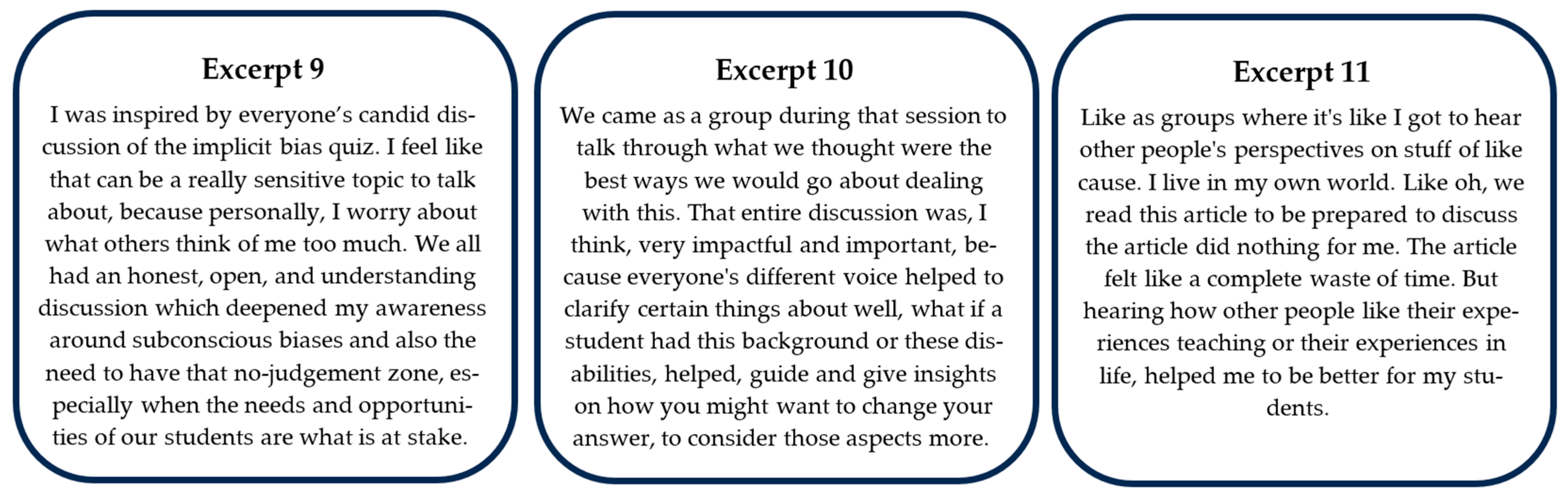
Not only was it useful for the GTAs to share about their teaching experiences, many of them also noted that certain equity topics were easier to learn about due to having more perspectives in a safe environment (
Figure 5). In their reflection journal, one GTA wrote about their participation with the Implicit Association Test (
Greenwald et al., 1998), where each of the GTAs took the test, which was followed up by a facilitated discussion about their experience taking the test and the implications of implicit bias in the classroom [Excerpt 9]. They emphasized how inspiring it was to have a “candid” discussion with their fellow GTAs, as doing so both “deepened their awareness around subconscious biases” and sparked an appreciation for the necessity of conversing in an “honest,” “open,” and “no-judgement zone”. Another GTA wrote about how having multiple voices provided insight into different students’ backgrounds and how to properly accommodate everyone [Excerpt 10]. Another GTA talked about how reading an article (about a DEI-related topic) was not very useful to them in itself, but after getting to “hear other people’s perspective” on the topic, they felt better equipped to help their students [Excerpt 11]. We note that across these 5 excerpts, along with a myriad of responses from other GTAs, these answers were consistently framed around the community aspect of the PD. For example, in Excerpt 10, there was a constant repetition of how the community aspect was important as the GTA mentions “we came as a group”, “that entire discussion”, and “because everyone’s different voice”, and that as a result of this collaborative environment, they gained insight into how to consider aspects of students’ backgrounds, needs, and educational opportunities. The community aspect of these PD activities motivated the GTAs to learn about new perspectives. Further, a PD activity without the space to collaborate might not support GTAs enough for them to develop new perspectives about teaching, e.g., reading an article without a connecting discussion of GTAs’ experiences may be “a complete waste of time” [Excerpt 11].
5.3. Awareness Through Discovery
Another theme related to the Process dimension involved comments about how they came to understand an idea based on the design of the activities. While collaborating with their peers encouraged reflection and understanding, PD activities that emphasized discovery similarly catalyzed a deep awareness and understanding of student experiences, educational contexts and structures, and the implications of certain teaching practices. We found that GTAs vividly recollect activities that involve discovery, illumination of different perspectives, or a form of novelty, and as a result, remember the lessons they learned from these activities. Based on our experience and conversations with other practitioners of PD, we recognize that simply telling GTAs to “do group work in their classes” by giving them a long list of teaching practices to read is ineffective in shifting their pedagogy. Consider instead the following as an opportunity to experience this
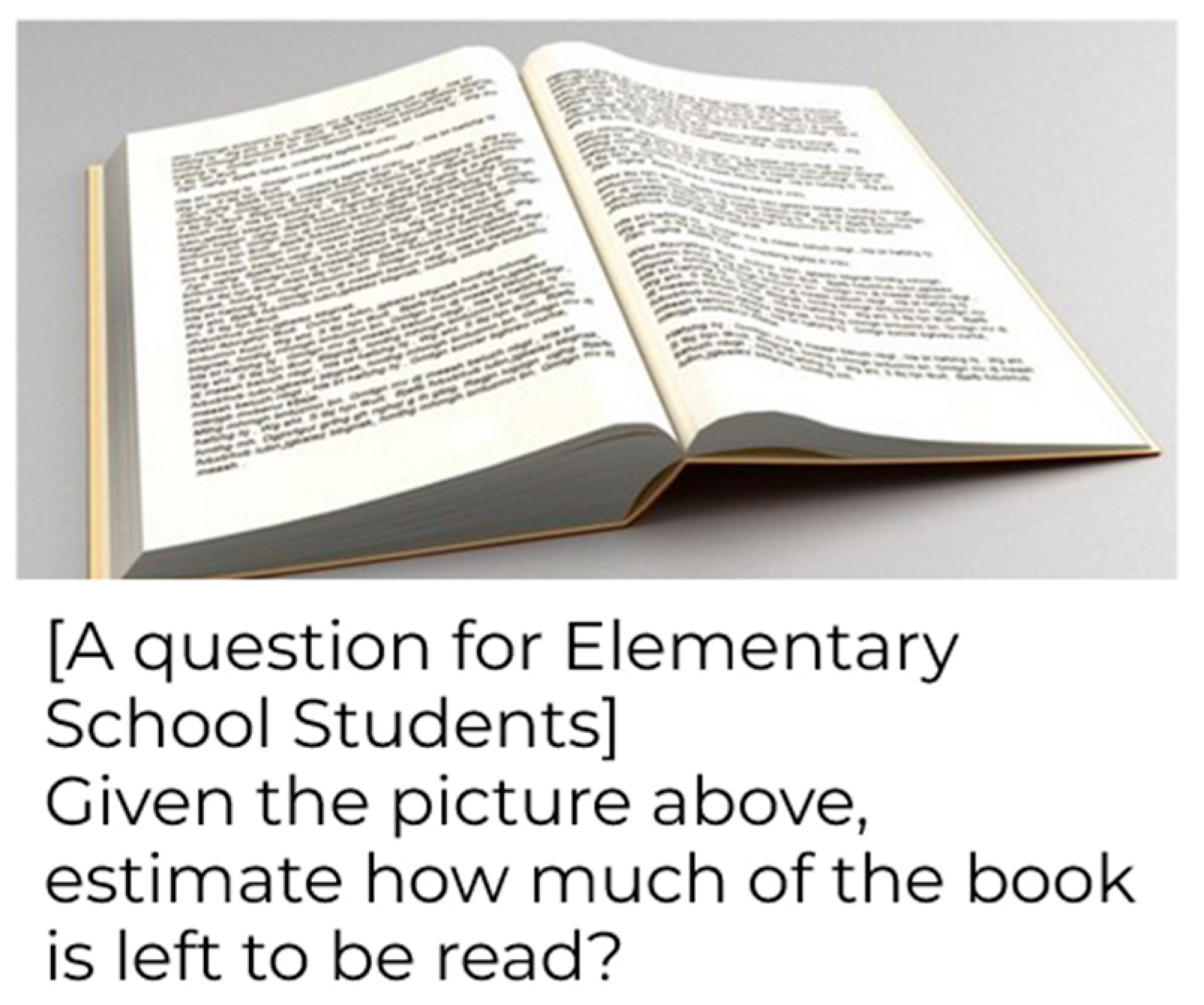
Awareness Through Discovery through a mathematics exercise: How would you answer the question in
Figure 6?
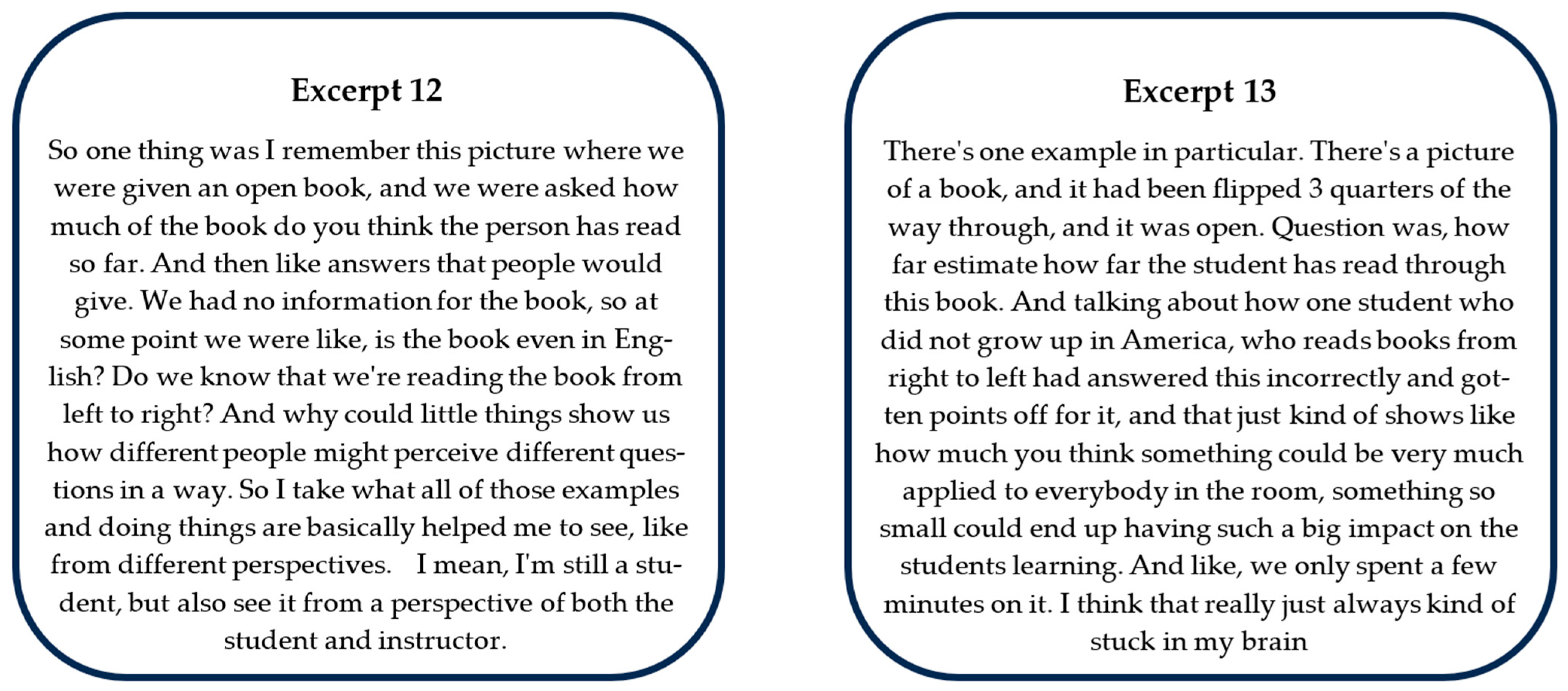
In this Reading a Book Problem, the GTAs typically answered the question in a normative way because of their accustomization to reading left to right. They thought it was a fairly straightforward question except for the ambiguity present in the phrase “how much” (e.g., is the answer a number of pages or a fraction of the book’s pages?). However, after they shared their responses, they were informed that some elementary school students with international backgrounds answered this question (either in terms of the number of pages or a fraction of the book’s pages) incorrectly due to their cultural influence of reading right to left. Upon knowing this information, they were surprised and realized how even an “objective” subject such as mathematics can be perceived from different student perspectives (
Figure 7). At the end of the semester, many GTAs recalled this activity weeks after they engaged with it, stating how it “just always kind of stuck in my brain.” GTAs recounted the example with great detail, indicating that the activity illuminated novel insight and persisted in their mind and ongoing reflections on teaching and learning later in the semester. The Reading a Book Problem was designed to generate surprise and intrigue surrounding problematic assumptions and assessments that many GTAs in the U.S. are not likely to immediately identify. Indeed, engaging GTAs in a situation that they thought “very much applied to everybody in the room” and then realizing that assumption was not inherently true helped make the takeaways of the activity more memorable. These GTAs discovered through engagement with the activity “how different people might perceive different questions,” which supported them in realizing that teachers need to continually consider how their teaching and assessments could have “such a big impact on students’ learning.”
GTAs also provided positive feedback on how other PD activities raised their awareness of specific concepts related to DEI (
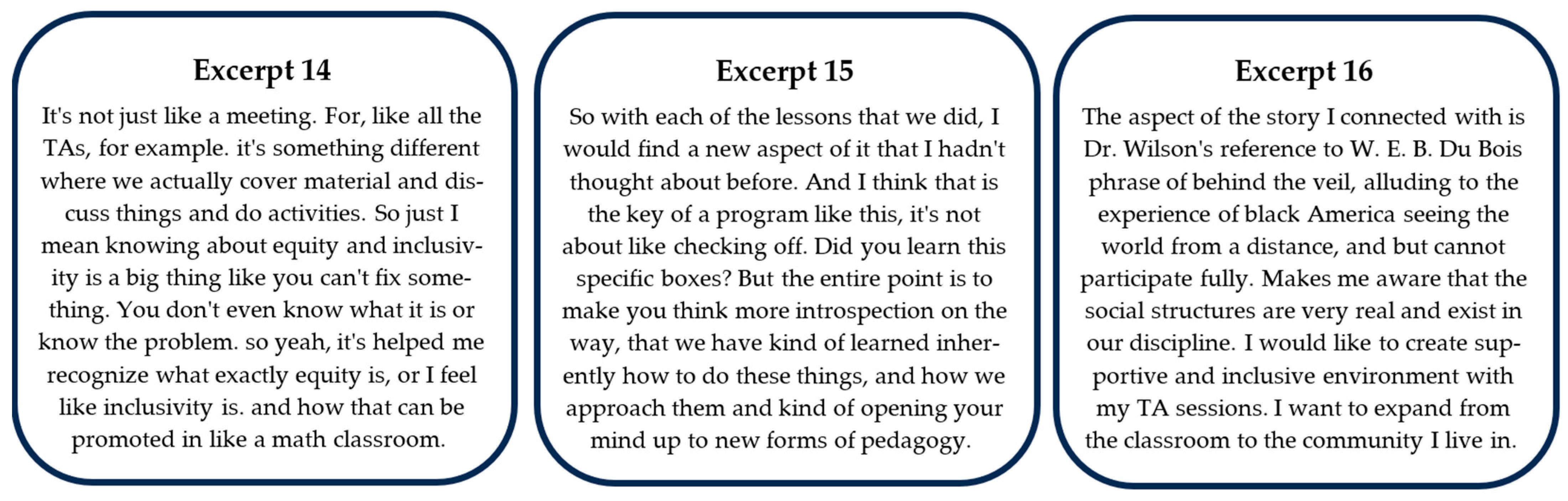
Figure 8). One GTA discussed how the PD helped them recognize “what exactly equity is” since the PD was “not just like a meeting,” but a space to “actually cover material and discuss things and do activities” (Excerpt 14). Similarly, another GTA highlighted how they would learn ideas they had not considered before because the PD engaged them in introspection and was not just about “checking off…specific boxes,” (Excerpt 15). When prompted to read about and reflect on the learning experiences of other mathematicians (e.g.,
Henrich et al., 2010), another GTA emphasized the importance of creating an “inclusive environment” and thought deeply about connecting to their own community within and beyond the classroom (Excerpt 16). In these excerpts, each of the GTAs mentioned how the PD activities illuminated new perspectives for them, as indicated by their choice of phrasing such as “it’s helped me recognize,” “I would find a new aspect that I hadn’t thought about before,” and “makes me aware.” Other GTAs made similar remarks indicating that engaging activities, as opposed to just reading articles or lecturing, supported them in understanding and being aware of key concepts, ideas, and points-of-view related to equity. We underscore that across these excerpts and other GTAs’ feedback captured with this code, the comments entailed how the content was delivered (i.e., the process or methodology) over the actual content itself.
5.4. Practicality and Actionable Takeaways
The last theme we noticed across a majority of GTA responses was how they appreciated when PD activities focused on
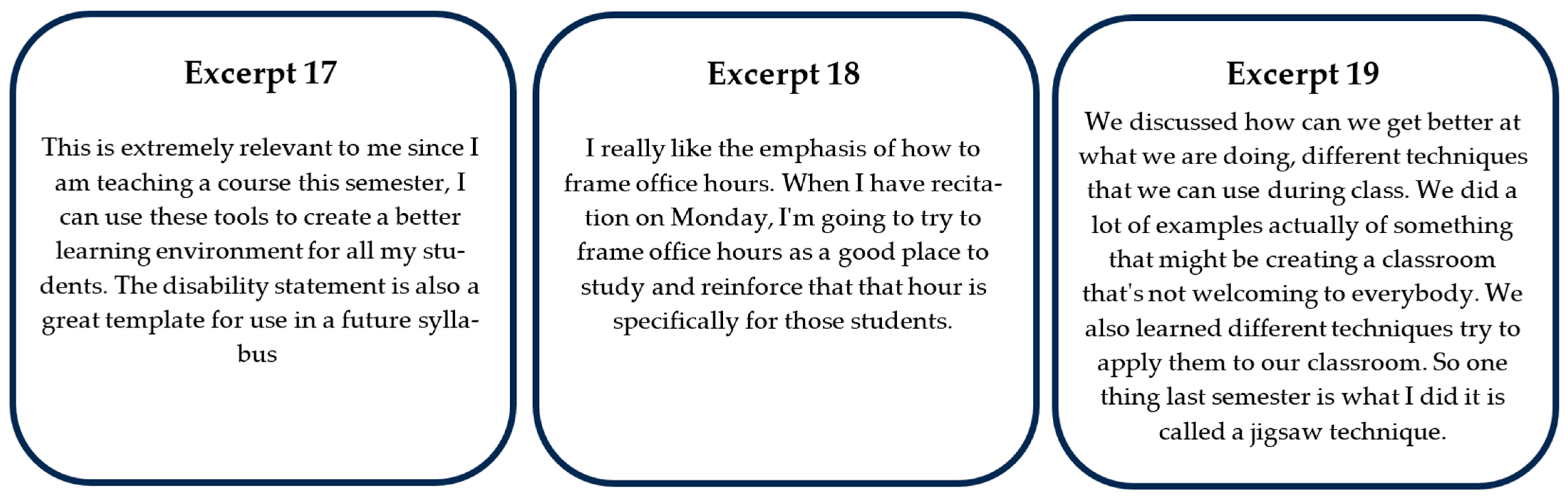
Practicality and Actionable Takeaways. This theme involved comments about the desired Outcomes of the PD. What distinguishes this theme from the first theme regarding concrete examples connected to theory, is that GTAs are expressing the practicality of enacting and/or positive intentions to enact equitable teaching practices for themselves as GTAs, as opposed to appreciating teaching practices or ideas related to equity in the abstract, but not necessarily explicitly indicating an interest in applying ideas to their own classrooms, now or in the future. In other words, the comments captured with this code were about what we hoped our GTAs would take away from the PD, rather than if they just found the content memorable. Oftentimes, GTAs shared positive feedback on activities that were relevant to their position as a GTA leading a recitation or their own course (
Figure 9). In their responses to interview questions or surveys, GTAs frequently mentioned when the PD supported them in teaching their course, such as how to create a disability statement [Excerpt 17], framing office hours as student hours [Excerpt 18], and specific active learning techniques, such as the Jigsaw method [Excerpt 19]. These GTAs usually mentioned these activities in conjunction to being “extremely relevant,” since they were teaching “this semester” [Excerpt 17] or because it was something they could actually implement immediately. We noticed that many GTAs voiced their positive feedback of the PD, employing phrasing about activities, like “apply them to our classroom” [Excerpt 19], “something they could do right now”, or “I can try this out in my class tomorrow.” These GTAs appreciated the clear connection between pedagogical theories and explicit discussion of actionable moves they could take as educators in their roles, either immediately or in the near future.
Conversely, GTAs also expressed a desire for clarity regarding how to incorporate a particular idea in their classroom. There was considerable feedback about how they wished the PD would involve more opportunities for them to practice so that they could “be more prepared if the issue came up” or that they had difficulty seeing the connection between the content and its application. Again, these GTAs were discussing what they wanted to be able to do as a result of going through the PD and is thus related to the Outcome aspect of the curriculum.
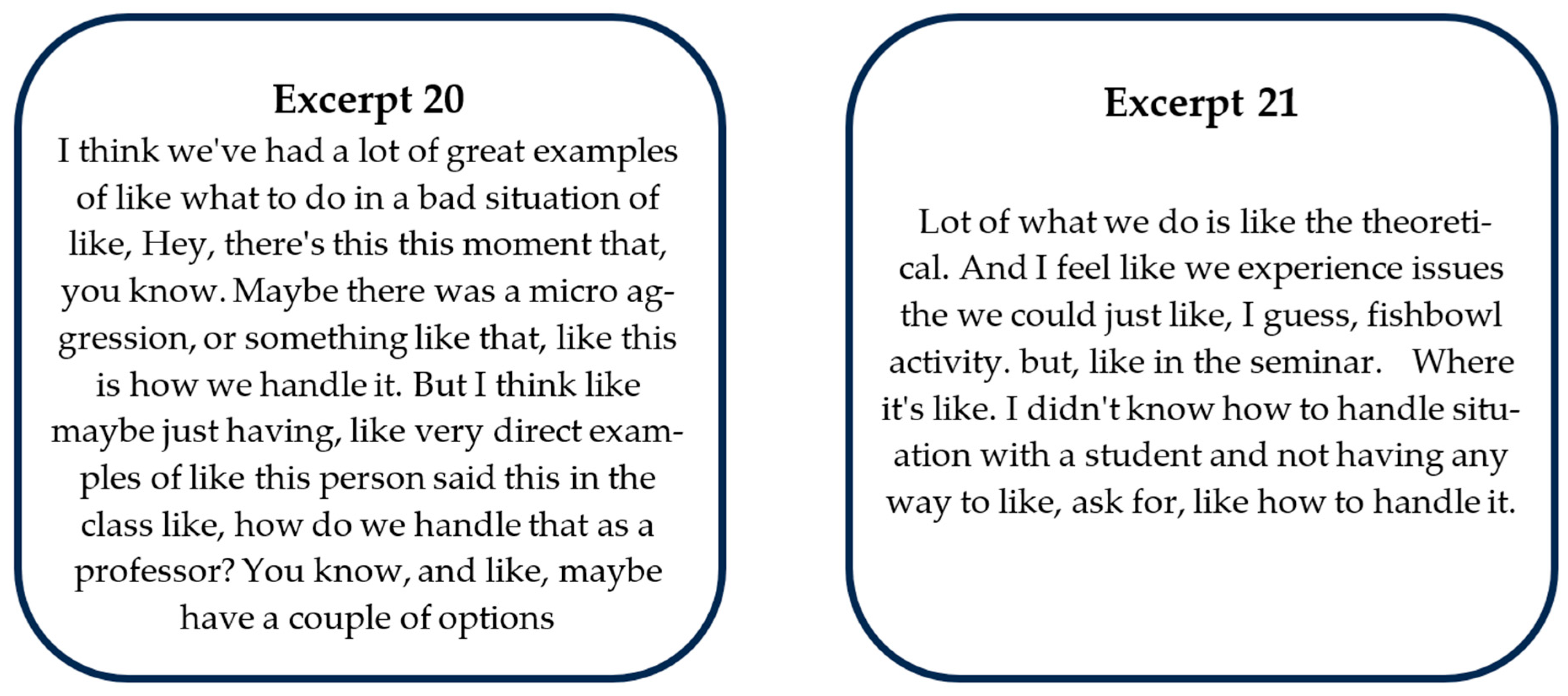
For example, Excerpts 4 and 5 indicated the lingering question of “how do I actually use” these equitable and inclusive ideas in the classroom. Similarly, GTAs mentioned when activities lacked explicit discussion about “how do we handle that as a professor” or “how to handle a situation” (
Figure 10). We note even when there were “great examples” connected to pedagogical theory, the GTAs still wanted more “direct examples” and to talk about “a couple of options” to address those situations [Excerpt 20]. We noticed that in activities in which there were fewer direct conversations about applications to the classroom, there were more comments indicating that “what we do is like the theoretical” [Excerpt 21]. We take this to mean, not that theory is not useful or interesting to the GTAs, but rather that GTAs are primarily concerned with their current roles as teaching assistants versus their potential future roles as lecturers or professors. Overall, what we interpret from these comments is that PD activities should also provide tangible ways to shift GTAs’ teaching and interactions with students. In other words, the activities should not only meet GTAs where they are and provide immediately applicable teaching practices but also push them to try out those practices and grow in their teaching right now (
Lee, 2005;
Sims & Fletcher-Wood, 2021).
6. Discussion and Implications for PD
From our analysis of interviews, exit tickets, and PD artifacts, these four themes of (a) Concrete Ideas and Examples Connected to Theory; (b) Community and Collaboration; (c) Awareness through Discovery; and (d) Practicality and Actionable Takeaways, appeared in a significant number of GTA responses. We note that outside of these four identified themes, the only other recurring type of comment involved generic feedback such as “this PD was very helpful in helping me learn about equity.”
When we consider our research questions:
What curricular aspects of a PD focused on Diversity, Equity, and Inclusion (DEI) do GTAs notice and reflect on?
From the GTAs’ perspective, what curricular aspects of a PD were effective in helping them shift their teaching?
We observed that our GTAs comments were very much aligned with
Wiggins and McTighe (
2005) curricular framework design. In other words, from our perspective, our GTAs comments cleanly delineated into the categories of Inputs, Processes, and Outputs. We take this to mean that structuring a PD utilizing this curricular framework design will likely be productive for GTAs in developing their pedagogical practices and understanding of DEI issues. Therefore, one of our contributions to the literature are the specific qualities (our four codes/themes) of how to leverage that framework design.
We recognize that individually, these themes are not necessarily brand new to the literature on PD; however, our findings indicate how other PD programs might consider the design of their activities. Therefore, we discuss relevant literature to strengthen our claims as well as pertinent questions that can be considered when designing an activity for equity-based PD.
Many GTAs’ comments included positive discussion on how the content of the course utilized
Concrete Ideas and Examples Connected to Theory. Concrete examples help GTAs process complex ideas from theory by providing a mental anchor they can associate with these theoretical ideas. In alignment with the literature (
Carr, 1992;
Korthagen, 2017;
Meyer et al., 2025), these GTAs indicated that presentations on theory or blanket statements such as “students need accommodations” do not support GTAs in making significant shifts in their teaching. Instead, they need to experience and discover more about what that actually entails. Examples within the activities should highlight issues of marginalized populations and bring to light how their identities impact their educational experiences. Therefore, we suggest considering these questions when addressing whether a PD activity involves
Concrete Ideas and Examples Connected to Theory.
What kinds of examples are being utilized to help GTAs make connections to the material? Examples include:

Real narratives from students.

Sample problems.

Guest speakers.

Relevant content of GTAs’ area of study.
How are examples leveraged to have GTAs reflect on the topic or promote discussion?
What real-world contexts are employed? How much is the activity focused on theory? (e.g., Actual quotations from disabled students about their university experiences versus just saying that disabled students have access issues and therefore need accommodations).
Many of our GTAs indicated that being in
Community and Collaboration with their peers enabled them to hear from diverse perspectives and reflect on others’ experiences. GTAs have a unique composition of backgrounds and experiences; therefore, leveraging these assets provided the GTAs with opportunities to consider new ideas related to their teaching that they otherwise might not be aware of (Excerpts 7 & 8). Creating these Communities of Practice and hearing from diverse perspectives has been noted in the literature as being effective in enhancing pedagogical development and problem-solving (
Brownell et al., 2004;
Cavazos & Nixon, 2024;
Erickson, 1991).
When preparing an activity to support Community and Collaboration, consider the following questions:
What opportunities are there for GTAs to share and discuss their experiences and perspectives with each other?
Do activities and discussion questions allow for open-endedness (there is not necessarily one clear answer)? (e.g., “Here is a sample of student work; what do you think led the student to produce this type of response?” as opposed to “What did the student do wrong?”)
Across the various PD activities from the three universities, we consistently observed that GTAs appreciated activities involving
Awareness through Discovery. This theme focuses on how the activities should be set up in order to engage GTAs in reflecting on issues in DEI. In particular, the activities should underscore systemic bias and issues encountered by marginalized populations. We highlight this theme because the literature suggests that most equity efforts are focused around closing achievement gaps or access to educational resources (
Gutiérrez, 2009,
2011) and that GTAs’ ideas about equity rarely mention issues of race and gender in the classroom (
Yu et al., 2024,
2026).
With this in mind, we offer these questions regarding Awareness through Discovery to consider when implementing a PD around equity.
How does the activity promote thinking/reflection in GTAs, or are GTAs just being told the takeaways (Is there any experiential or self-discovery element?)
What new concepts are present in the activity that GTAs can name and identify in their context? Or are there known concepts being seen in a new or deeper way? For instance, are any of the following true?

GTAs are learning about a population that is unlike their own (especially those that are systematically marginalized).

GTAs are uncovering their biases or assumptions that they did not know they held.

GTAs are becoming more aware of barriers and access issues experienced by students.
Lastly, while activities should be engaging and involve specific examples, they should also focus on the Outcomes which involve
Practicality and Actionable Takeaways. In other words, the activities not only meet GTAs where they are and provide something immediately applicable but also push them to grow in their teaching (
Koellner et al., 2011;
Lee, 2005;
Sims & Fletcher-Wood, 2021). We have observed that our GTAs consistently recalled the activities that had clear ties to their current position or had actionable changes they could implement as part of their teaching. Promoting this design principle in an activity can be as simple as having a conversation around “So how is this related to your teaching, and what are things you might do differently now?” Therefore, we offer these questions regarding
Practicality and Actionable Takeaways.
We also highlight the implications for PD that focusing too much on asking GTAs to read theoretically dense articles is not useful to the GTAs, based on their repeated feedback against this type of activity. To our GTAs, there were no clear Outcomes for them to apply to their teaching situations. Therefore, having ideas from research made accessible for those not trained in mathematics education or equity research is more productive in shifting changes in pedagogy. In particular, emphasizing the Outcomes through concrete connections to practice and discussions with GTAs is what makes the reading effective, which therefore should be embedded in activity design.
7. Conclusions
Our goal with this manuscript is to provide the community with insight into what aspects of PD resonate with GTAs, as well as concrete tools for implementing GTA PD focused on equity and inclusivity.
Our unique contribution is the content, processes, and outcomes that GTAs found effective for DEI PD curriculum development, building on the framing provided by
Wiggins and McTighe (
2005). Based on current research, we do not have a coherent and robust theory regarding design principles for GTA PD, especially when the content centers on DEI teaching practices. Tailoring PD to address local contexts further complicates this issue. Our research contributes towards a theory for effective curricular development for DEI GTA PD. Specifically, such PD involves the following:
The Content (i.e., input) is both connected to theory and concrete.
The Processes of engaging with the content emphasizes community, collaboration, and discovery.
The Outcomes are increased awareness and immediately/directly practical and actionable takeaways.
While our results are indicative of design aspects that GTAs found impactful for DEI PD, we note that there are nuances to the implementation of these aspects. For example, our code about
Community and Collaboration involves more than just having GTAs be in the same PD course. These GTAs need to be in safe and brave spaces (
Arao & Clemens, 2023) in order to have authentic opportunities to share about deeply sensitive issues and collaborate on teaching. For instance, one GTA mentioned their appreciation for the community aspect of the PD and explicitly discussed the “candid conversations” where their peers were “honest, open, and understanding” in a “no-judgement zone.” Thus, these four themes should not be considered in a vacuum, but require careful implementation, as suggested by
Pilgrim et al. (
2025). Similarly, our fourth theme of
Practicality and Actionable Takeaways likely stood out due to our deliberate focus on having GTAs reflect on the implications of these issues for their teaching practices during the PD sessions. This is to say, simply interacting with the material might not be sufficient in catalyzing applications to their teaching. Instead, having repeated opportunities to practice, discuss, and actively reflect on the material is what our GTAs voiced in their feedback. This finding is similar to what
Beisiegel and Simmt (
2012) as well as
Miller (
2018) noted in that GTAs need a significant amount of time in order to shift their pedagogy. Ultimately, what is implied by our results and observations is that DEI PD likely requires a facilitator with expertise on these sensitive topics in order to maximize productive shifts in GTAs’ pedagogy and understanding.
Despite the positive outcomes of our research, we are careful to consider the limitations of our study. While our results are promising, the research and PD course was voluntary and therefore it is likely that those that participated in it were also GTAs that were receptive to learning about DEI issues and pedagogy. In spite of this, we are hopeful of our results given that the sentiment was shared across three different campuses with variations in the PD program due to institutional restraints. As researchers, we plan to continue observing our GTAs as they participate in the PD and evolve our PD program through our participants’ feedback. We also call for those that run PD programs to document and research their programs as the field currently lacks a critical mass of data on these PD programs.
Although the feedback from the GTAs indicates what aspects of a PD program focused on DEI would be effective for the GTAs, we are cognizant of the need to investigate multiple aspects of GTAs’ teaching and learning to teach in order to assess and ensure the advancement of DEI. Future studies should advance our knowledge on how PD focused around DEI issues transfer to shifts in GTAs’ teaching. For instance, we are currently exploring data related to observations of GTAs’ classrooms and observation debrief interviews in order to understand the extent to which the equitable and inclusive teaching practices discussed in PD are incorporated in GTAs’ plans for teaching and enactments of lessons in the classroom. At present, our preliminary analysis of over 1200 undergraduate surveys corresponding to nine GTAs at one institution indicates a positive shift in student experiences (
Quaisley et al., 2025). The surveys asked undergraduate students about their experience in the class as related to equity, inclusivity, accessibility, sense of belonging, collaboration with others, etc. Our analysis found a statistically significant improvement in aggregate student responses from the first term to the last term of an academic year. With these preliminary findings and feedback from the GTAs, together they signal shifts in our GTAs’ mindsets and practices for teaching. For example, during one of our PD sessions, we discussed shifting language such as “student hours” instead of “office hours” and “what questions do you have?” versus “do you have any questions?”, and observed that many of our GTAs seamlessly adopted these practices into their discourse with students in the classroom. Considered together, GTAs’ feedback and these preliminary survey results show promise of the impacts that our equity-oriented PD can have on student experiences.
There is still much to be learned about DEI training and graduate student PD. We agree with other researchers’ calls (e.g.,
Wang et al., 2024) for more longitudinal studies (both quantitative and qualitative) that investigate this intersection of advancing DEI efforts with GTAs. In mathematics, GTAs are heavily involved in undergraduate courses, and many end up choosing a teaching career (
Selinski & Milbourne, 2015), demonstrating their impact on higher education. Similarly, the
National Center for Science and Engineering Statistics (
2023) indicated that 33% of doctoral recipients, averaged across all fields, go into non-postdoc academic positions, which typically involve a teaching component. With such a significant proportion of GTAs impacting undergraduate education, advancing their ability to teach equitably and inclusively should be one area of focus when considering how to create long-term shifts in improving DEI efforts in higher education.
Author Contributions
Conceptualization, formal analysis, methodology, software, validation, visualization, writing—original draft preparation, and writing—review and editing, F.Y., M.E.P., and K.Q.; funding acquisition, investigation, project administration, resources, and supervision, M.E.P.; All authors have read and agreed to the published version of the manuscript.
Funding
This research was funded by the National Science Foundation under NSF EHR #2013590, 2013563, and 2013422.
Institutional Review Board Statement
The study was conducted in with human subjects approval under the jurisdiction of San Diego State University’s Research Support Services and is part of protocol number HS-2021-0185-SMT, 14 October 2021.
Informed Consent Statement
Informed consent was obtained from all subjects involved in the study.
Data Availability Statement
The data presented in this study are available on request from the authors due to restrictions based on the Institutional Review Board.
Acknowledgments
We would also like to thank the ELITE PD research team for their contributions to the PD. Other members of the research team include Mary Beisiegel, Rebecca Segal, Pablo Oliva Duran, Hayley Milbourne, Sezai Kocabas, Mariah Moschetti, and Blue Taylor.
Conflicts of Interest
The authors declare no conflicts of interest. The funders had no role in the design of the study; in the collection, analyses, or interpretation of data; in the writing of the manuscript; or in the decision to publish the results.
References
- Allen, B. J. (2023). Difference matters: Communicating social identity. Waveland Press. [Google Scholar]
- Arao, B., & Clemens, K. (2023). From safe spaces to brave spaces: A new way to frame dialogue around diversity and social justice. In The art of effective facilitation (pp. 135–150). Routledge. [Google Scholar]
- Austin, A. E. (2002). Preparing the next generation of faculty: Graduate school as socialization to the academic career. The Journal of Higher Education, 73(1), 94–122. [Google Scholar] [CrossRef]
- Barr, M., & Wright, P. (2019). Training graduate teaching assistants: What can the discipline offer? European Political Science, 18(1), 143–156. [Google Scholar] [CrossRef]
- Bates, C. C., & Morgan, D. N. (2018). Seven elements of effective professional development. The Reading Teacher, 71(5), 623–626. [Google Scholar] [CrossRef]
- Bayar, A. (2014). The components of effective professional development activities in terms of teachers’ perspective. Online Submission, 6(2), 319–327. [Google Scholar] [CrossRef]
- Beisiegel, M., & Simmt, E. (2012). Formation of mathematics graduate students’ mathematician-as-teacher identity. For the Learning of Mathematics, 32(1), 34–39. [Google Scholar]
- Bookman, J., Braley, E., & Clark, J. (2024, February 22–24). Assessing graduate student professional development for teaching: Needs and progress with PAC-math. Proceedings of the 26th Annual Conference on Research in Undergraduate Mathematics Education (pp. 1431–1432), Omaha, NE, USA. [Google Scholar]
- Braley, E., Bookman, J., Gehrtz, J., & Speer, N. (2023). A survey of programs preparing graduate students to teach undergraduate mathematics. In S. Cook, B. Katz, & D. MooreRusso (Eds.), Proceedings of the 25th annual conference on research in undergraduate mathematics education (pp. 1044–1050). AMS. [Google Scholar]
- Braun, V., & Clarke, V. (2006). Using thematic analysis in psychology. Qualitative Research in Psychology, 3(2), 77–101. [Google Scholar] [CrossRef]
- Brownell, M. T., Yeager, E. A., Sindelar, P. T., vanHover, S., & Riley, T. (2004). Teacher learning cohorts: A vehicle for supporting beginning teachers. Teacher Education and Special Education, 27(2), 174–189. [Google Scholar] [CrossRef]
- Carr, D. (1992). Practical enquiry, values and the problem of educational theory. Oxford Review of Education, 18(3), 241–251. [Google Scholar] [CrossRef]
- Cavazos, J. G., & Nixon, N. (2024). Greater than the sum of its parts: The role of minority and majority status in collaborative problem-solving communication. arXiv, arXiv:2403.04671. [Google Scholar] [CrossRef]
- Ceci, S. J., & Williams, W. M. (2009). The mathematics of sex: How biology and society conspire to limit talented women and girls. Oxford University Press. [Google Scholar]
- Cumming, T., Miller, M. D., & Leshchinskaya, I. (2023). DEI institutionalization: Measuring diversity, equity, and inclusion in postsecondary education. Change: The Magazine of Higher Learning, 55(1), 31–38. [Google Scholar] [CrossRef]
- Darling-Hammond, L., Hyler, M. E., & Gardner, M. (2017). Effective teacher professional development. Learning Policy Institute. [Google Scholar]
- Deshler, J. M., Hauk, S., & Speer, N. (2015). Professional development in teaching for mathematics graduate students. Notices of the AMS, 62(6), 638–643. [Google Scholar] [CrossRef]
- Ellis, J. (2014). Preparing future professors: Highlighting the importance of graduate student professional development programs in calculus instruction. North American Chapter of the International Group for the Psychology of Mathematics Education. [Google Scholar]
- Erickson, G. L. (1991). Collaborative inquiry and the professional development of science teachers. The Journal of Educational Thought (JET)/Revue de la Pensée Educative, 25, 228–245. [Google Scholar] [CrossRef]
- Ghalichi, N., Rogers, K. C., & Van Staaden, M. (2023). Reflecting on professional development opportunities: Links between conceptions of mathematics graduate teaching assistants and their self-efficacy. Journal of the Scholarship of Teaching and Learning, 23(2), 57–75. [Google Scholar] [CrossRef]
- Greenwald, A. G., McGhee, D. E., & Schwartz, J. L. (1998). Measuring individual differences in implicit cognition: The implicit association test. Journal of Personality and Social Psychology, 74(6), 1464. [Google Scholar] [CrossRef] [PubMed]
- Grunspan, D. Z., Eddy, S. L., Brownell, S. E., Wiggins, B. L., Crowe, A. J., & Goodreau, S. M. (2016). Males under-estimate academic performance of their female peers in undergraduate biology classrooms. PLoS ONE, 11(2), e0148405. [Google Scholar] [CrossRef]
- Gutiérrez, R. (2009). Framing equity: Helping students “play the game” and “change the game.”. Teaching for Excellence and Equity in Mathematics, 1(1), 4–8. [Google Scholar] [CrossRef]
- Gutiérrez, R. (2011). Context matters: How should we conceptualize equity in mathematics education? In B. Herbel-Eisenmann, J. Choppin, D. Wagner, & D. Pimm (Eds.), Equity in discourse for mathematics education: Theories, practices, and policies (pp. 17–33). Springer. [Google Scholar]
- Gutiérrez, R. (2018). The need to rehumanize mathematics. In M. Boston, & I. Goffney (Eds.), Annual perspectives in mathematics education: Rehumanizing mathematics for black, indigenous and Latinx students (pp. 1–10). National Council of Teachers of Mathematics. [Google Scholar]
- Harrison-Bernard, L. M., Augustus-Wallace, A. C., Souza-Smith, F. M., Tsien, F., Casey, G. P., & Gunaldo, T. P. (2020). Knowledge gains in a professional development workshop on diversity, equity, inclusion, and implicit bias in academia. Advances in Physiology Education, 44(3), 286–294. [Google Scholar] [CrossRef]
- Hattery, A. J., Smith, E., Magnuson, S., Monterrosa, A., Kafonek, K., Shaw, C., Mhonde, R. D., & Kanewske, L. C. (2022). Diversity, equity, and inclusion in research teams: The good, the bad, and the ugly. Race and Justice, 12(3), 505–530. [Google Scholar] [CrossRef]
- Henrich, A. K., Lawrence, E. D., Pons, M. A., & Taylor, D. G. (Eds.). (2010). Living proof: Stories of resilience along the mathematical journey. AMS; MAA Press. [Google Scholar]
- Hunzicker, J. (2011). Effective professional development for teachers: A checklist. Professional Development in Education, 37(2), 177–179. [Google Scholar] [CrossRef]
- Johnson, K. G., Jakopovic, P., & von Renesse, C. (2021). Supporting teaching and learning reform in college mathematics: Finding value in communities of practice. Journal for STEM Education Research, 4(3), 380–396. [Google Scholar] [CrossRef]
- Johnson, R. B. (1997). Examining the validity structure of qualitative research. Education, 118(2), 282. [Google Scholar]
- Kim, H. J., Kong, Y., & Tirotta-Esposito, R. (2023). Promoting diversity, equity, and inclusion: An examination of diversity-infused faculty professional development programs. Journal of Higher Education Theory and Practice, 23(11), 138. [Google Scholar] [CrossRef]
- Kim, M. (2013). A comparison of pedagogical practices and beliefs in international and domestic mathematics teaching assistants. Journal of International Students, 4(1), 74–88. [Google Scholar] [CrossRef]
- Koellner, K., Jacobs, J., & Borko, H. (2011). Mathematics professional development: Critical features for developing leadership skills and building teachers’ capacity. Mathematics Teacher Education and Development, 13(1), 115–136. [Google Scholar]
- Korthagen, F. (2017). Inconvenient truths about teacher learning: Towards professional development 3.0. Teachers and Teaching, 23(4), 387–405. [Google Scholar] [CrossRef]
- Kung, D. T. (2010). Teaching assistants learning how students think. In F. Hitt, D. Holton, & P. W. Thompson (Eds.), Research in collegiate mathematics education VII (pp. 143–169). American Mathematical Society. [Google Scholar]
- Lauer, P. A., Christopher, D. E., Firpo-Triplett, R., & Buchting, F. (2013). The impact of short-term professional development on participant outcomes: A review of the literature. Professional Development in Education, 40(2), 207–227. [Google Scholar] [CrossRef]
- Lee, H. J. (2005). Developing a professional development program model based on teachers’ needs. Professional Educator, 27, 39–49. [Google Scholar]
- McCallister, L., Wilson, K., & Baker, J. (2014). An examination of graduate students’ perceptions toward students with disabilities. The Journal of Faculty Development, 28(2), 19–26. [Google Scholar]
- McLeod, C. L., Almquist, C. B., Ess, M. P., Zhang, J., Schultz, H., Nguyen, T., Tran, K., & Hughes, M. (2025). Graduate teaching assistants (GTAs): Roles, perspectives, and prioritizing GTA workforce development pathways. Education Sciences, 15(7), 838. [Google Scholar] [CrossRef]
- Meyer, E. S., Green, J. L., Arnold, E. G., & Wickstrom, M. H. (2025). Understanding how and when graduate student instructors break through challenges with active learning. International Journal of Research in Undergraduate Mathematics Education, 11(2), 241–273. [Google Scholar] [CrossRef]
- Miller, E. R. (2018). High cognitive demand examples in precalculus: Examining the work and knowledge entailed in enactment [Unpublished doctoral dissertation, The University of Nebraska-Lincoln]. [Google Scholar]
- National Center for Science and Engineering Statistics. (2023). Doctorate Recipients from U.S. Universities: 2022. NSF 24-300. National Science Foundation. [Google Scholar]
- OECD. (2018). Equity in education: Breaking down barriers to social mobility. OECD. [Google Scholar]
- Olarte, T. R., Swartz, M., & Roberts, S. A. (2024). Mathematics graduate students’ teacher identity development: Examining roles within the teaching assistant position. Journal of Research in Science, Mathematics and Technology Education, 7(SI), 117–139. [Google Scholar] [CrossRef]
- Oleson, A., & Hora, M. T. (2014). Teaching the way they were taught? Revisiting the sources of teaching knowledge and the role of prior experience in shaping faculty teaching practices. Higher Education, 68, 29–45. [Google Scholar] [CrossRef]
- Palacios, Y. D. L. C. (2022). Graduate teaching assistants’ knowledge and attitudes toward students with disabilities in higher education [Unpublished doctoral dissertation, University of South Florida]. [Google Scholar]
- Park, J., & Rizzolo, D. (2025). Graduate teaching assistants’ perception of student difficulties and use in teaching. International Journal of Research in Undergraduate Mathematics Education, 11(2), 274–313. [Google Scholar] [CrossRef]
- Parker, P., Marsh, H., Jerrim, J., Guo, J., & Cicke, T. (2018). Inequity and excellence in academic performance: Evidence from 27 countries. American Educational Research Journal, 55(4), 836–858. [Google Scholar] [CrossRef]
- Perez, R. J., Robbins, C. K., Harris, L. W., Jr., & Montgomery, C. (2020). Exploring graduate students’ socialization to equity, diversity, and inclusion. Journal of Diversity in Higher Education, 13(2), 133–145. [Google Scholar] [CrossRef]
- Pilgrim, M. E., Quaisley, K., Yu, F., Beisiegel, M., Duran Oliva, P., Moschetti, M., & Segal, R. A. (2025). Guiding Principles for Equity-Oriented Professional Development for Mathematics Graduate Teaching Assistants. Notices of the AMS, 72(2), 164–171. [Google Scholar]
- Porter, A. C., Garet, M. S., Desimone, L., Yoon, K. S., & Birman, B. F. (2000). Does professional development change teaching practice? Results from a three-year study. Available online: https://eric.ed.gov/?id=ED455227 (accessed on 10 March 2025).
- Quaisley, K. (2023). Learning to teach prospective elementary teachers: A narrative inquiry of a newer mathematics content instructor [Unpublished doctoral dissertation, University of Nebraska-Lincoln]. [Google Scholar]
- Quaisley, K., Beisiegel, M., & Charalambous, C. Y. (2025). Exploring undergraduate student survey responses about engaging and inclusive experiences with ELITE PD MGTAs in their mathematics courses. In S. Cook, B. P. Katz, & K. Melhuish (Eds.), Proceedings of the 27th annual conference on research in undergraduate mathematics education, Alexandria, VA, USA (pp. 1339–1346). SIGMAA on RUME. [Google Scholar]
- Rawski, S. L., & Conroy, S. A. (2020). Beyond demographic identities and motivation to learn: The effect of organizational identification on diversity training outcomes. Journal of Organizational Behavior, 41(5), 461–478. [Google Scholar] [CrossRef]
- Sadera, E., Suonio, E. E., Chen, J. C. C., Herbert, R., Hsu, D., Bogdan, B., & Kool, B. (2024). Strategies and approaches for delivering sustainable training and professional development of graduate teaching assistants, teaching assistants, and tutors: A scoping review. Journal of Applied Research in Higher Education, 16(5), 2199–2215. [Google Scholar] [CrossRef]
- Sahlberg, P. (2021). Does the pandemic help us make education more equitable? Educational Research for Policy and Practice, 20(1), 11–18. [Google Scholar] [CrossRef]
- Schniedewind, N., & Davidson, E. (1983). Open minds to equality: A sourcebook of learning activities to promote race, sex, class, and age equity. Available online: https://cir.nii.ac.jp/crid/1970867909868496900 (accessed on 10 March 2025).
- Secules, S., McCall, C., Mejia, J. A., Beebe, C., Masters, A. S., L. Sánchez-Peña, M., & Svyantek, M. (2021). Positionality practices and dimensions of impact on equity research: A collaborative inquiry and call to the community. Journal of Engineering Education, 110(1), 19–43. [Google Scholar] [CrossRef]
- Selinski, N. E., & Milbourne, H. (2015). The institutional context. In D. Bressoud, V. Mesa, & C. Rasmussen (Eds.), Insights and recommendations from the MAA national study of college calculus (pp. 31–44). MAA Press. [Google Scholar]
- Sims, S., & Fletcher-Wood, H. (2021). Identifying the characteristics of effective teacher professional development: A critical review. School Effectiveness and School Improvement, 32(1), 47–63. [Google Scholar] [CrossRef]
- Townley, A. L. (2020). Leveraging communities of practice as professional learning communities in science, technology, engineering, math (STEM) education. Education Sciences, 10(8), 190. [Google Scholar] [CrossRef]
- Tseng, F. C., & Kuo, F. Y. (2014). A study of social participation and knowledge sharing in the teachers’ online professional community of practice. Computers & education, 72, 37–47. [Google Scholar]
- Wang, M. L., Gomes, A., Rosa, M., Copeland, P., & Santana, V. J. (2024). A systematic review of diversity, equity, and inclusion and antiracism training studies: Findings and future directions. Translational Behavioral Medicine, 14(3), 156–171. [Google Scholar] [CrossRef]
- Wiggins, G., & McTighe, J. (2005). Understanding by design. Association for Supervision and Curriculum Development. [Google Scholar]
- Willis, D. S., & Schram, L. N. (2022). Graduate student diversity, equity and inclusion professional development. Studies in Graduate and Postdoctoral Education, 14(1), 63–82. [Google Scholar] [CrossRef]
- World Bank. (2018). World development report 2018. Learning to realize education’s promise. The World Bank. [Google Scholar]
- Yee, S. P., Wang, J., Hauk, S., & Lopez_Gonzalez, T. (2024). National picture providers of collegiate professional development for teaching mathematics: Formats, topics, and activities. In S. Cook, B. Katz, & D. Moore-Russo (Eds.), Proceedings of the 26th annual conference on research in undergraduate mathematics education (pp. 519–527). National Science Foundation. [Google Scholar]
- Yu, F., Beisiegel, M., Milbourne, H., & Kocabas, S. (2026). Mathematics Graduate Teaching Assistants’ Conceptions of Equity and Equitable Teaching. International Journal of Research in Undergraduate Mathematics Education, 1–35. [Google Scholar] [CrossRef]
- Yu, F., Milbourne, H., Beisiegel, M., & ELITE PD Research Group. (2024). “Acknowledging students as humans first and students second”: Mathematics graduate teaching assistants’ conceptions of equity. In S. Cook, B. Katz, & D. Moore-Russo (Eds.), Proceedings of the 26th annual conference on research in undergraduate mathematics education (pp. 501–509). The Special Interest Group of the Mathematical Association of America (SIGMAA on RUME). [Google Scholar]
- Zimmerman, J. A., & May, J. J. (2003). Providing effective professional development: What’s holding us back? American Secondary Education, 31, 37–48. [Google Scholar]
| Disclaimer/Publisher’s Note: The statements, opinions and data contained in all publications are solely those of the individual author(s) and contributor(s) and not of MDPI and/or the editor(s). MDPI and/or the editor(s) disclaim responsibility for any injury to people or property resulting from any ideas, methods, instructions or products referred to in the content. |