1. Introduction
Artificial intelligence (AI) is rapidly transforming digital practices in education systems worldwide. AI-powered tools increasingly shape how students access information, practise skills, and regulate their own learning processes (
Kumar et al., 2024). These technologies enhance efficiency and scalability, yet they also introduce concerns related to sustainability, ethics, and the long-term resilience of educational systems (
Palsodkar et al., 2024).
In higher education, sustainability extends beyond environmental protection. It includes the capacity of learning systems to remain inclusive, adaptive, and ethically governed over time. Artificial intelligence (AI) is rapidly reshaping digital practices in education systems worldwide (
Salem & Khalil, 2026). AI-supported learning environments can increase computational demand, energy consumption, and reliance on digital infrastructures (
Zhou, 2024;
Zong & Guan, 2025).
At the same time, they raise challenges related to transparency, academic integrity, bias, and accountability. These developments position AI adoption not only as a technological issue but also as a sustainability concern within contemporary education (
W. Yang et al., 2025).
Green Artificial Intelligence (Green AI) has emerged as a response to these challenges. In computing research, Green AI prioritises energy-efficient model design, reduced computational cost, and transparent reporting of environmental impact (
Subrahmanyam, 2025;
Verdecchia et al., 2023). However, students typically do not observe system-level energy metrics or engineering efficiencies when using AI tools.
Consequently, this study does not attempt to measure the environmental performance of AI systems themselves. Instead, it operationalises Green AI at the behavioural level, focusing on how students use AI in ways that align with sustainability principles. These practices include verification-oriented use, avoidance of unnecessary iterative prompting, and adherence to institutional guidance on responsible AI engagement.
This behavioural perspective complements engineering-focused Green AI research by examining how sustainability principles are enacted by end-users rather than embedded solely in technical design. The study therefore distinguishes between model-level efficiency and user-level responsibility, avoiding conceptual conflation between environmental performance and responsible practice.
These issues are particularly relevant for Generation Z (Gen Z) students, who are currently studying in AI-mediated learning environments and are often characterised as digitally immersed learners (
Subrahmanyam, 2025;
Verdecchia et al., 2023). Their patterns of interaction with AI tools influence institutional sustainability efforts through digital literacy, self-directed learning behaviours, and responsible technology use (
Salem, 2026).
Recent scholarship has drawn attention to the environmental footprint of digital technologies and the growing energy demands of data-intensive infrastructures (
Ghouse et al., 2025;
Hananel et al., 2025). At the same time, empirical studies increasingly examine how university students integrate generative AI into everyday academic tasks such as drafting, problem-solving, and self-regulated learning (
Zhu et al., 2025;
Zięba, 2025;
Zong & Guan, 2025).
These studies show that students’ engagement with AI is shaped not only by perceived usefulness but also by ethical awareness, concerns about academic integrity, and the need to critically evaluate AI-generated outputs. As AI becomes embedded in routine educational practice, the central question shifts from whether students adopt AI to how they regulate its use responsibly (
Zhou, 2024).
Most prior research relies on technology acceptance models, particularly the Unified Theory of Acceptance and Use of Technology (UTAUT), to explain adoption behaviour. While useful for predicting acceptance, these models provide limited insight into responsibility-oriented use shaped by sustainability values, ethical norms, and awareness of AI limitations (
Alnajdi et al., 2025;
Majeed & Rasheed, 2025a;
Salem, 2025a).
Recent advances in generative AI further highlight this gap. AI systems may produce outputs that appear plausible yet are inaccurate or misleading, a phenomenon often described as hallucination (
Swain, 2024;
Varol & Coffee, 2025;
Orlova, 2021). Such risks underscore the importance of user awareness, verification practices, and institutional guidance for responsible AI engagement.
This study addresses this gap by redefining the outcome of interest from “intention to adopt AI” to Socially Responsible Intentions (SRI)—intentions to use AI in ways constrained by sustainability, verification, and accountability considerations. Rather than treating AI use as a simple acceptance decision, the study conceptualises responsible AI engagement as a form of post-adoption governance behaviour. It proposes that such intentions arise from a combination of sustainability-oriented value appraisal, perceived capability to enact responsible practices, social and institutional norms, and awareness of AI-related risks.
The research applies an extended UTAUT-based framework that integrates Sustainable Performance Value (SPV), Responsible Use Ease (RUE), Ethical Social Norms (ESN), Institutional Ethical Support (IES), Responsible AI Competence (RAC), AI Hallucination Awareness (AHA), and Green Digital Responsibility (GDR). These constructs collectively explain how students regulate the use of AI in alignment with sustainability and ethical expectations.
The study is based on a large sample of higher-education students enrolled and residing in Saudi Arabia, including both Saudi nationals and international students studying within the same institutional environment. The findings, therefore, represent behavioural relationships within a single higher-education context rather than cross-national comparisons. References to the Sustainable Development Goals (SDGs) are treated as indicators of contextual alignment rather than as measured outcomes.
By shifting the analytical lens from adoption to responsible engagement, this research contributes to understanding behavioural sustainability in AI-supported education. It examines how students enact sustainability principles through everyday AI interaction—verification-oriented, non-redundant, and accountable use—thereby framing “green digital footprint practices” as socially mediated expressions of sustainability rather than direct measures of technological efficiency.
2. Research Hypothesis and Literature Review
2.1. Sustainability-Aligned AI Use in the Context of Green AI Intentions Among Gen Z Students
Building on recent research on student adoption of artificial intelligence, this study shifts the focus from functional acceptance to responsibility-conditioned use (
Salem & Khalil, 2026;
Y. Yang et al., 2025;
Zhou, 2024). It conceptualises Socially Responsible Intentions (SRI) as learners’ intentions to use AI in ways that are consistent with verification, accountability, and reducing digital waste. Unlike general adoption intention, SRI reflects deliberate engagement with AI that aligns with academic integrity and sustainability-oriented practices. The model therefore combines (i) the instrumental appraisal logic of the Unified Theory of Acceptance and Use of Technology (UTAUT) and (ii) responsibility-based mechanisms derived from planned behaviour and pro-environmental norm frameworks.
Although SPV, AHA, and GDR all relate to responsible AI use, they represent analytically distinct mechanisms grounded in different theoretical traditions. Sustainable Performance Value (SPV) is an instrumental evaluation. It reflects a utilitarian judgement that the use of sustainability-aligned AI improves learning efficiency and resource effectiveness. SPV therefore operates through value-based appraisal consistent with expectancy-value reasoning and technology adoption logic (
Venkatesh et al., 2003;
Wigfield & Eccles, 2000).
In contrast, AI Hallucination Awareness (AHA) reflects epistemic risk literacy. It captures students’ understanding of AI fallibility and their ability to recognise when verification is required. AHA does not evaluate usefulness; it activates metacognitive monitoring, critical assessment, and calibrated reliance, which are central to self-regulated learning and risk-aware technology use (
Panadero, 2017;
Torres, 2025). Green Digital Responsibility (GDR) represents a normative–ethical orientation. It reflects internalised environmental responsibility and a willingness to minimise unnecessary digital consumption regardless of performance gains.
This technique aligns with value–belief–norm theory, in which pro-environmental behaviour is driven by moral obligation rather than instrumental benefits (
Schwartz et al., 2020;
Stern, 2000). Accordingly, SPV concerns perceived value, AHA concerns epistemic vigilance, and GDR concerns moral responsibility. Because they operate through value appraisal, cognitive risk awareness, and norm activation, respectively, the three constructs represent complementary but non-redundant pathways toward Socially Responsible Intentions.
Within this framework, Sustainable Performance Value (SPV) represents students’ evaluation of AI as beneficial for learning while supporting responsible digital practices (
Majeed & Rasheed, 2025b). Ethical Social Norms (ESN) capture perceived expectations regarding appropriate AI use from peers, instructors, and institutions (
Porto et al., 2025). Responsible Use Ease (RUE) and Responsible AI Competence (RAC) reflect perceived capability to apply AI responsibly (
Chang & Ke, 2024). Institutional Ethical Support (IES) comprises organisational guidance, including policies, training, and oversight, that enables ethical engagement with AI technologies (
Porto et al., 2025).
AI Hallucination Awareness (AHA) is defined as epistemic risk literacy. It refers to students’ awareness that AI systems may generate plausible yet inaccurate outputs that require verification, attribution, and cautious reliance (
Torres, 2025). Green Digital Responsibility (GDR) reflects personal norms concerning the environmental implications of digital practices, motivating students to minimise unnecessary digital consumption (
Salem & Khalil, 2026). This integration clarifies that the proposed predictors are not simple extensions of UTAUT but represent distinct explanatory mechanisms for sustainability-aligned AI use in higher education.
Generation Z, typically defined as individuals born between 1997 and 2012, has grown up with pervasive digital technologies. Although often described as digitally fluent, familiarity with technology does not ensure responsible use. In educational settings shaped by Industry 5.0 values, students evaluate AI not only for efficiency but also for ethical alignment and personal capability. Adoption is therefore increasingly linked to responsibility and sustainability rather than novelty alone (
Hananel et al., 2025;
Reid et al., 2023).
Moreover, SPV includes students’ perception that AI enhances learning outcomes while supporting efficient and responsible resource use. When students perceive clear educational value, they are more likely to engage with AI in constructive ways.
H1. SPV is positively associated with SRI toward the use of Green AI.
Likewise, RUE reflects the perceived simplicity of applying AI in an accountable and ethical manner. Even digitally experienced learners prefer tools that minimise cognitive effort and support transparent use practices.
H2. RUE is positively associated with SRI toward the use of Green AI.
Furthermore, ESN denotes shared expectations about appropriate AI behaviour within academic communities. Such norms shape perceptions of acceptable practice and encourage alignment with responsible standards.
H3. ESN is positively associated with SRI toward the use of Green AI.
The IES comprises policies, training, and technical guidance that signal institutional commitment to the responsible integration of AI. These structures reduce uncertainty and foster confidence in ethical use.
H4. IES is positively associated with SRI toward the use of Green AI.
2.2. Industry 5.0, Green AI, and the Green Digital Footprint
The concept of Green AI originates from work that distinguishes between computation-intensive “Red AI” and efficiency-oriented “Green AI,” which emphasises reducing energy consumption, computational cost, and carbon impact while maintaining model performance (
Schwartz et al., 2020). This foundational perspective defines Green AI primarily in terms of algorithm design, hardware utilisation, and reporting transparency regarding resource use.
However, in educational settings, students rarely control or observe these system-level parameters. The present study extends this foundation by examining how Green AI principles are enacted behaviourally by users. Rather than redefining Green AI, the study translates its efficiency logic into sustainability-aligned practices at the learner level, such as verification-oriented use, avoidance of redundant prompting, and mindful interaction with AI-supported learning tools.
The study interprets the use of sustainability-aligned AI as a form of socially responsible learning behaviour situated within the values of Industry 5.0. Students adopt AI not only to improve academic performance but also to engage in practices that reflect awareness of environmental and ethical implications (
Hammad et al., 2025).
A Green Digital Footprint describes patterns of AI use that avoid unnecessary computational activity while maintaining learning effectiveness. In educational contexts, this concept emphasises responsible interaction rather than technical optimisation of AI systems (
Bhambri et al., 2025;
Paalosmaa, 2025). Responsible AI Competence (RAC) refers to the ability to critically evaluate, apply, and monitor AI outputs (
Park et al., 2022). Greater competence enhances confidence and supports careful engagement with AI-supported learning tasks.
H5. Responsible AI Competence (RAC) is positively associated with Socially Responsible Intentions (SRI) toward the use of Green AI.
AI Hallucination Awareness (AHA) captures students’ understanding of AI limitations, including the possibility of inaccurate or fabricated outputs. This awareness encourages verification, careful attribution, and reflective use rather than uncritical reliance (
King, 2025;
Torres, 2025). Because the outcome of interest is responsible-use intention, higher awareness is expected to strengthen, not weaken, engagement.
H6. AI Hallucination Awareness (AHA) is positively associated with Socially Responsible Intentions (SRI) toward the use of Green AI.
Green Digital Responsibility (GDR) reflects concern for the environmental consequences of digital and AI technologies. Students who hold strong sustainability values are more likely to prefer practices aligned with resource efficiency and ethical use of technology (
Majeed & Rasheed, 2025b).
H7. Green Digital Responsibility (GDR) is positively associated with Socially Responsible Intentions (SRI) toward the use of Green AI.
In computing research, Green AI refers to the design and deployment of AI systems with improved computational efficiency and transparent reporting of energy or carbon costs. Students, however, rarely observe such system-level metrics. Consequently, this study operationalises Green AI at the user level as intentions to engage in sustainability-aligned practices—such as verification-oriented interaction and avoiding unnecessary iterative prompting—without redefining engineering-based Green AI.
3. Materials and Methods
3.1. Sample and Research Population
This research was conducted in a single host country, namely Saudi Arabia. References to “nine countries” refer to participants’ countries of origin rather than to separate institutional or national study sites. External validity is therefore interpreted as generalisation within a shared educational context rather than as evidence of cross-national differences.
The research sample comprised international students enrolled in universities across major regions of Saudi Arabia. These students represented diverse cultural, linguistic, and technological backgrounds but were all physically residing in the Kingdom during the data collection period. Although participants were from nine countries, the study was conducted within a single higher-education system. Consequently, the data does not support country-level institutional comparisons, and any cross-national interpretation should be approached cautiously.
National origin was treated solely as a demographic descriptor reflecting cultural diversity. It was not modelled as an institutional, policy, or country-level variable. The findings, therefore, describe behavioural relationships within a single higher-education ecosystem shaped by shared academic regulations, technological infrastructures, and governance frameworks.
During the 2024–2025 academic year, 304,372 international students were enrolled in Saudi universities, highlighting the Kingdom’s role as a regional hub for cross-cultural learning environments (Ministry of Education). From this population, a sample of 1159 students (544 male and 615 female) representing nine countries of origin was included in the study (see
Table 1).
Universities were selected to ensure variation in geographic location, institutional size, and sector. The sample included large public universities, medium-sized institutions, and private universities. Data collection occurred over an eight-month period (May–November 2025) in four waves separated by approximately three months. Because responses were gathered across temporally separated waves, measurement invariance of composites (MICOM) was assessed prior to pooling to ensure construct comparability over time, consistent with established PLS-SEM procedures. Each participant completed the survey once, resulting in a cross-sectional dataset suitable for structural modelling.
In addition to procedural safeguards, common method bias was examined statistically using Harman’s single-factor test and full collinearity variance inflation factors (VIFs). The results did not reveal a dominant single factor or problematic collinearity, suggesting that common method variance is unlikely to substantially influence the findings.
3.2. Instrument and Data Collection
Data was collected through an anonymous survey administered to higher education students. The survey examined predictors of Socially Responsible Intentions (SRI) related to the use of Green AI and the development of green digital footprints. Participation was voluntary, and confidentiality and anonymity were assured. The survey link was distributed through official institutional email channels. Students were informed that the study addressed responsible AI use and digital sustainability, which supported informed participation.
The questionnaire was available in Arabic and English. A forward–backward translation procedure, combined with a bilingual committee review, ensured semantic equivalence between the two versions. Student pretesting confirmed clarity and readability. The survey introduction included a standardised definition of “green digital footprint practices” in AI-supported learning. This definition emphasised responsible, verification-oriented, and non-wasteful use rather than the measurement of platform-level energy consumption.
In this study, sustainability-aligned AI use refers to user-level behavioural intentions, such as verifying outputs, applying calibrated reliance, avoiding unnecessary prompting, and complying with academic integrity guidance. It does not refer to engineering-level model efficiency, energy monitoring, or carbon accounting, which are typically not observable by students. Accordingly, the study does not measure technical performance indicators but instead focuses on behavioural, cognitive, and normative dimensions of responsible AI engagement.
Respondents were instructed to respond with reference to commonly accessible generative AI learning assistants, including LLM-based chat tools, AI-supported writing or problem-solving aids, and embedded AI features in educational platforms. No specific software brand was assumed. The study, therefore, captures behavioural interaction patterns with AI-enabled learning tools as a class of technologies.
The questionnaire included three sections; the first collected demographic information, such as gender, academic specialisation, and cultural context. The second section presented an informed consent statement. It explained the study’s purpose and ethical safeguards. The third section contained Likert-scale items measuring the study constructs. All measurement items were adapted from validated instruments. This ensured conceptual accuracy and reliability. Sustainable Performance Value (SPV) was measured using five items adapted from prior performance expectancy scales (
Alasmari & Alzahrani, 2025;
Gidage & Bhide, 2024). Responsible Use Ease (RUE) was measured using five items adapted from effort expectancy scales (
Akinyelu, 2024;
Alshebami et al., 2023).
To ensure cultural and linguistic suitability for the Saudi context, the questionnaire underwent expert validation. Thirteen bilingual specialists reviewed the items to assess content validity, cultural relevance, and conceptual clarity. Ten university students evaluated both language versions for readability. Minor wording adjustments were made. A pilot study with 23 participants confirmed satisfactory reliability across all constructs. All constructs were modelled as reflective latent variables, where indicators represent observable manifestations of underlying perceptions and intentions. This specification is consistent with prior UTAUT-based research in education and sustainability.
Data were analysed using Partial Least Squares Structural Equation Modelling (PLS-SEM). With a sample size of 1159, parameter estimates are considered stable for the proposed model complexity. PLS-SEM was selected because the study is prediction-oriented and aims to maximise explained variance and predictive relevance of SRI within a multi-construct behavioural framework.
The method accommodates complex models, supports predictive assessment (e.g., R2 and Q2), and is robust to non-normal data distributions. Although covariance-based SEM would also be feasible with this sample size, PLS-SEM better aligns with the study’s emphasis on prediction and exploration, and theoretical integration. Measurement invariance across temporally separated waves was assessed using MICOM before pooling, a step commonly implemented in the PLS-SEM workflow.
Measurement statistics were generated using SmartPLS, including outer loadings, composite reliability, average variance extracted (AVE), cross-loadings, and HTMT ratios. Indicators with values above 0.95 were examined for redundancy; no items required removal, supporting conceptual distinctiveness. Because the data were self-reported and collected from a single source, common method bias (CMB) was considered. Procedural safeguards included assurances of anonymity, neutral wording, separation of construct blocks, and clarification that there were no right or wrong answers.
Statistical assessment included Harman’s single-factor test and a full collinearity assessment using variance inflation factors (VIFs). The results did not indicate a dominant single factor, and VIF values remained below commonly accepted thresholds (e.g., <3.3), suggesting that CMB is unlikely to materially bias the structural estimates. However, these diagnostics cannot rule out method variance; therefore, the findings are interpreted conservatively as associative rather than causal relationships.
4. Results
Before pooling the four temporally separated data-collection waves into a single dataset, measurement invariance was examined using the Measurement Invariance of Composite Models (MICOM) procedure within the PLS-SEM framework. Establishing invariance ensured that the constructs retained the same meaning across waves and that combining responses collected at different times did not introduce measurement bias. The same indicators, questionnaire structure, data screening procedures, and estimation settings were applied consistently across all waves. A permutation-based assessment with 5000 permutations (two-tailed, α = 0.05) evaluated compositional equivalence, followed by tests of equality in composite means and variances (
Henseler et al., 2016).
Table 2 shows that configural and compositional invariance were achieved for all constructs, whereas equality of means and variances was not fully supported. This pattern indicates partial measurement invariance. Partial invariance is sufficient in PLS-SEM to justify pooling the datasets when the aim is to estimate structural relationships rather than compare groups over time. Accordingly, the integrated sample (n = 1159) was analysed while acknowledging that minor distributional differences across waves may reflect cohort variation rather than measurement inconsistency.
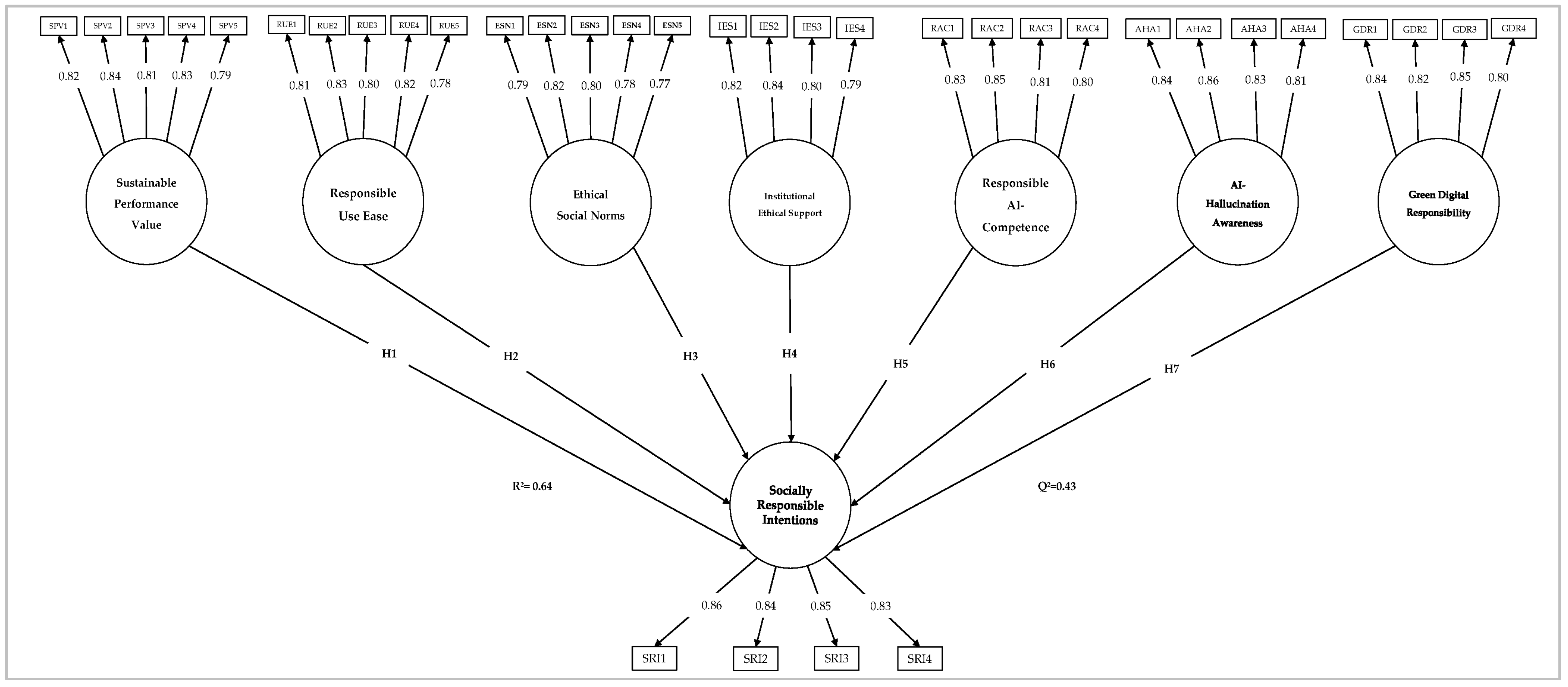
Moreover, indicator reliability is confirmed. All outer loadings range from 0.77 to 0.86, which exceeds the minimum threshold of 0.70. This shows that all indicators adequately represent their respective constructs. Convergent validity is also supported. AVE values range from 0.63 to 0.71, and all exceed the recommended cutoff of 0.50. Each construct explains more than half of the variance in its indicators. (See
Table 3 and
Figure 1).
Likewise, internal consistency is strong across all constructs. Composite Reliability (CR) values range from 0.88 to 0.92, and Cronbach’s alpha values range from 0.83 to 0.89. All values exceed the accepted threshold of 0.70, indicating reliable and non-redundant measurement. The results demonstrate excellent reliability and convergent validity. The measurement model is robust. It provides a solid foundation for assessing discriminant validity and for structural model analysis (
Hair et al., 2021). They support the use of the constructs to examine students’ Socially Responsible Intentions toward Green Digital Footprints and Sustainability-aligned AI use in the context of Green AI.
Table 4 presents the factor cross-loadings analysis conducted to assess discriminant validity within the PLS-SEM framework. Discriminate validity is established when each indicator loads more highly on its theoretically assigned latent construct than on any other construct in the model. As shown, all indicators demonstrate their highest loadings on their respective constructs, confirming that the constructs are empirically distinct. This result aligns with established methodological standards (
Leguina, 2015), and validates the discriminant validity of the measurement model.
Table 4 presents the cross-loading results for all measurement items. The results provide clear evidence of adequate discriminant validity among the study constructs. Each indicator loads more strongly on its intended latent construct than on all other constructs, satisfying the primary criterion for cross-loading assessment in PLS-SEM.
Additionally, for Sustainable Performance Value (SPV), item loadings range from 0.79 to 0.84. All cross-loadings on non-target constructs are substantially lower. This confirms clear construct separation. Responsible Use Ease (RUE) items show strong primary loadings (0.78–0.83) with weaker associations with other constructs. The constructs Ethical Social Norms (ESN) and Institutional Ethical Support (IES) also exhibit appropriate loadings. Each item loads highest on its corresponding construct. This confirms that these constructs are empirically distinct, despite their conceptual proximity.
Likewise, Responsible AI Competence (RAC) exhibits strong primary loadings (0.80–0.85). Cross-loadings on other constructs remain lower, supporting discriminant validity. The AI- and sustainability-oriented constructs, AI Hallucination Awareness (AHA) and Green Digital Responsibility (GDR), all indicators load highly on their respective constructs (0.81–0.86 for AHA; 0.80–0.85 for GDR). Cross-loadings on other constructs remain clearly below the primary loadings. This confirms the uniqueness of these dimensions.
Moreover, Socially Responsible Intentions (SRI) items exhibit the highest loadings on the SRI construct (0.83–0.86). Loadings on other constructs are noticeably lower. This reinforces SRI as a distinct outcome variable. The results in
Table 4 confirm satisfactory discriminant validity for all constructs. No indicator loads more strongly on another construct than on its own. These findings support proceeding with further discriminant validity assessment using the Fornell–Larcker criterion and the HTMT ratio, in line with established PLS-SEM guidelines.
Table 5 presents the discriminant validity results based on the Fornell–Larcker criterion. According to this criterion, discriminant validity is achieved when the square root of the Average Variance Extracted (AVE) for each construct is higher than its correlations with other constructs.
Additionally, the diagonal values for all constructs—SPV, RUE, ESN, IES, RAC, AHA, GDR, and SRI—are higher than the corresponding off-diagonal correlation values. This indicates that each construct explains more variance in its own indicators than in those of other constructs. Moderate correlations are observed, particularly between Sustainable Performance Value (SPV) and Socially Responsible Intentions (SRI), likewise, between AI Hallucination Awareness (AHA) and SRI. However, in all cases, the square roots of AVE remain higher than the inter-construct correlations. This confirms compliance with the Fornell–Larcker criterion.
The results demonstrate adequate discriminant validity for all constructs. Each construct is empirically distinct. Therefore, the measurement model is robust and suitable for subsequent structural model analysis.
Table 6 presents the Heterotrait–Monotrait (HTMT) ratio results used to assess discriminant validity. All HTMT values are below the conservative threshold of 0.85. The values range from 0.45 to 0.81, indicating adequate construct separation.
Moreover, as shown in
Table 6, the highest HTMT values are observed between Sustainable Performance Value (SPV) and Socially Responsible Intentions (SRI) (0.81) and between AI Hallucination Awareness (AHA) and SRI (0.80). These relationships are theoretically expected. Notably, both values remain within acceptable limits.
Additionally, lower HTMT values appear for several construct pairs. Examples include Ethical Social Norms (ESN) and Green Digital Responsibility (GDR) (0.46), Responsible AI Competence (RAC) and GDR (0.45), and GDR and SRI (0.48). These results further confirm construct distinctiveness.
Overall, the HTMT results demonstrate satisfactory discriminant validity for all construct pairs. The findings are consistent with the cross-loading analysis and the Fornell–Larcker criterion. Together, they confirm the robustness of the measurement model.
Table 7 presents the structural model estimates. The model explains 64% of the variance in Socially Responsible Intentions (R
2 = 0.64), indicating strong explanatory capacity. Predictive relevance is also substantial (Q
2 = 0.43), indicating meaningful out-of-sample predictive performance.
Sustainable Performance Value (SPV) shows a significant positive association with SRI (β = 0.34, p < 0.001), supporting H1. Students are more likely to form socially responsible intentions when they perceive clear educational and sustainability-related benefits. Responsible Use Ease (RUE) is also positively associated with SRI (β = 0.22, p < 0.001), supporting H2, indicating that ease of responsible AI use remains an important factor.
Ethical Social Norms (ESN) do not show a statistically significant association with SRI (β = 0.06, p = 0.109); therefore, H3 is not supported. This finding suggests that peer expectations alone may not strongly shape intentions to use responsible AI. Institutional Ethical Support (IES) has a modest but significant association with SRI (β = 0.10, p = 0.036), supporting H4 and indicating that institutional guidance contributes to, but does not dominate, behavioural intention.
Responsible AI Competence (RAC) demonstrates a strong positive association with SRI (β = 0.27, p < 0.001), supporting H5. Students with stronger competencies are more inclined toward responsible engagement. AI Hallucination Awareness (AHA) is also strongly associated with SRI (β = 0.31, p < 0.001), supporting H6 and highlighting the importance of risk awareness in shaping careful AI use. Green Digital Responsibility (GDR) shows a significant positive association with SRI (β = 0.25, p < 0.001), supporting H7 and indicating that sustainability values are meaningfully associated with responsible intentions. Overall, both technology-related and sustainability-oriented factors help explain students’ intentions to use AI socially responsibly.
Table 8 reports on structural model quality metrics. Effect-size estimates indicate that SPV (f
2 = 0.28), RAC (f
2 = 0.25), AHA (f
2 = 0.26), and GDR (f
2 = 0.24) exert comparatively stronger contributions to explaining SRI. Responsible Use Ease (RUE) shows a moderate contribution (f
2 = 0.15), while Institutional Ethical Support (IES) and Ethical Social Norms (ESN) exhibit smaller contributions (f
2 = 0.07 and 0.03, respectively). These values are interpreted as heuristic indicators and should be considered alongside standardised coefficients and theoretical relevance.
To examine the robustness of the structural relationships, a Multi-Group Analysis (MGA) was conducted across gender (male vs. female) and academic discipline (STEM vs. non-STEM). Establishing partial measurement invariance through MICOM enabled meaningful subgroup comparisons.
As shown in
Table 9, differences in the association between AI Hallucination Awareness (AHA) and SRI are not statistically significant across gender or academic discipline. This suggests that the influence of AI-risk awareness on responsible-use intentions is stable across these subpopulations and reflects a consistent behavioural relationship within the sampled institutional context.
Common method bias was examined using Harman’s single-factor test and full collinearity variance inflation factors (VIFs). The first factor accounted for less than 50% of the variance, and VIF values remained below recommended thresholds (e.g., <3.3). These results indicate that common method variance is unlikely to materially bias the estimated relationships, although it cannot be completely ruled out in a single-source survey design.
5. Discussion
This study integrates Green AI motivation, ethical governance, and AI-risk literacy to explain how Gen Z learners intend to regulate AI responsibly in higher education. By modelling AI Hallucination Awareness (AHA) as an enabling factor for verification routines, the study extends sustainability research from system-level efficiency to user-level behavioural governance.
Foundational Green AI research focuses on improving computational efficiency and reducing the environmental footprint of AI systems. This study examines a complementary dimension: how end-users apply sustainability principles when using AI in learning. Because the data are cross-sectional, the results indicate associations rather than causal effects. The model identifies statistical predictors of variance in Socially Responsible Intentions (SRI) within the sampled context, not causal mechanisms over time.
This distinction is important and shifts attention from adoption to post-adoption governance behaviour. In AI-enhanced learning, the key issue is not whether students will use AI. The issue is how they self-regulate their use in ways that are responsible, verification-oriented, and resource-aware. This form of regulation requires value-based judgement, competence, and risk awareness that go beyond standard UTAUT predictors.
In addition, country-of-origin diversity provides contextual heterogeneity, but it is not an explanatory factor in the model. Although participants were from multiple countries, they were studying in the same Saudi higher-education environment at the time of data collection. They were exposed to the same infrastructure, governance conditions, and digital learning systems. The model reflects behavioural regularities under shared institutional conditions rather than cross-national differences.
The results indicate that the use of sustainability-aligned AI depends primarily on value and capability factors, whereas social pressure plays a limited role. Sustainable Performance Value (SPV) suggests that students are more likely to form socially responsible intentions when they perceive clear learning and sustainability benefits. Responsible AI Competence (RAC) and AI Hallucination Awareness (AHA) also show strong associations with SRI. These results imply that the responsible use of AI requires capacity building. Students need skills to use AI effectively and safeguards to manage epistemic risk. Green Digital Responsibility (GDR) further indicates that environmental values shape how students evaluate the use of AI and commit to responsible practices.
These findings have practical implications for higher education institutions seeking to advance sustainability by embedding AI literacy and competence development into curricula. They can also clarify the ethical and environmental implications of AI use. Guidance on efficient, verification-oriented AI use can reduce unnecessary iterative prompting and overuse without compromising learning quality.
Importantly, the study indicates behavioural readiness rather than realised environmental outcomes. SRI captures intention-level orientation toward responsible AI practices, not verified reductions in energy use or digital resource consumption. The strongest predictors of SRI, SPV, RAC, AHA, and GDR indicate that sustainability is not achieved through access alone. It depends on students’ skills, values, and risk awareness (
Agarwal & Ojha, 2024;
Salem & Sobaih, 2023).
The positive association between AHA and SRI supports an interpretation of AHA as epistemic risk literacy rather than trust. Students who recognise the risk of hallucination are more likely to adopt responsible routines, such as verification, cross-checking, careful attribution, and cautious use, in high-stakes tasks. This mechanism aligns with the study outcome, which measures responsibility-conditioned intentions rather than uninformed adoption.
Institutions should therefore prioritise curriculum-integrated AI literacy and scaffolded skill development. AI tools should be presented within a sustainability and governance frame. This approach can improve the quality of adoption and support a balance between learning effectiveness and environmental responsibility, without implying increased trust in AI outputs.
SPV is the strongest predictor of SRI, indicating that students are primarily motivated by learning effectiveness, skill development, and readiness for Industry 5.0. In many disciplines, learning outcomes are closely tied to employability, so performance-related value can outweigh other drivers. The standardised effects also indicate meaningful practical differences, such as a one standard deviation increase in SPV is associated with a 0.34 SD increase in SRI, and a one standard deviation increase in AHA is associated with a 0.31 SD increase in SRI. With R2 = 0.64, these magnitudes suggest that value appraisal and risk literacy are not only statistically significant but also behaviourally consequential within the model’s explanatory scope.
At the same time, f2 benchmarks should be treated as heuristic. Larger effects are best interpreted by their relative contribution to explained variance and their governance relevance. Interventions that increase SPV (linking learning value with sustainability value) and AHA (verification and hallucination awareness training) are likely to yield stronger improvements in responsible-use intentions than interventions focused on secondary predictors such as Institutional Ethical Support (IES).
Responsible Use Ease (RUE) shows a significant but moderate association with SRI. Ease reduces initial friction, but once students have baseline digital fluency, perceived value tends to matter more than usability. Ethical Social Norms (ESN) are not significant. This pattern suggests that students’ responsible AI intentions are more self-driven than socially driven, especially in contexts where skill development and performance outcomes are central (
Alasmari & Alzahrani, 2025;
Hammad et al., 2025;
Kumar et al., 2024).
Institutional Ethical Support (IES) has a positive but modest effect. Institutional policies and guidance enable responsible use, but they do not appear to be the main driver of intention. Once a minimum level of support is available, students rely more on competence and personal values. RAC remains a strong predictor, reinforcing the role of capability in responsible AI engagement. AHA also remains among the strongest predictors, highlighting that risk awareness supports reflective use rather than discouraging engagement. GDR further supports the view that sustainability values function as intrinsic motivators in shaping intentions to use AI responsibly (
Alexander, 2025;
Bolón-Canedo et al., 2024;
Elshaer et al., 2025b;
Ghouse et al., 2025).
The results show a clear hierarchy of predictors. SPV, RAC, AHA, and GDR are the strongest drivers of SRI, while RUE and IES play secondary roles, and ESN contributes little. Responsible AI use in higher education is therefore more value-driven and competence-based than socially driven. This structure supports the inclusion of AI- and sustainability-oriented constructs to explain responsibility-conditioned AI-use intentions and indicates that institutional efforts should focus on AI literacy, competence building, and sustainability awareness to support meaningful and durable responsible use.
6. Conclusions
This study advances the discussion on educational sustainability by examining how students form intentions to use AI in responsible and sustainability-aligned ways. The findings show that such intentions are not primarily driven by social pressure. Instead, they are shaped by Sustainable Performance Value (SPV), Responsible AI Competence (RAC), AI Hallucination Awareness (AHA), and Green Digital Responsibility (GDR).
These results indicate that the use of socially responsible AI depends on students’ values, capabilities, and awareness rather than on peer influence. Ethical Social Norms (ESN) play a limited role, suggesting that responsible AI engagement is largely self-regulated. Sustainable AI adoption, therefore, requires more than providing access to technology. It requires developing users’ capacity to evaluate, manage, and apply AI critically.
To sustain AI-enhanced education, institutions should prioritise capacity building. AI literacy, critical verification practices, and responsible-use framing need to be embedded within curricula. Infrastructure and Responsible Use Ease (RUE) alone are insufficient to promote sustainability-aligned behaviour. Educational institutions and policymakers should emphasise competence development and explicitly link the use of AI to environmental and societal considerations. Such an approach is consistent with international policy calls for the responsible and human-centred integration of AI in education, including those highlighted by (
Rachmad, 2025).
The research design is cross-sectional and relies on self-reported data, reflecting statistical associations rather than causal effects or measured environmental outcomes. The study does not extend UTAUT by simply adding predictors, but reconceptualises the behavioural outcome by modelling responsibility-conditioned technology use distinct from technology acceptance. This shift emphasises the need for analytical models that explain how users regulate AI behaviour in contexts where AI is already widespread.
Furthermore, the study provides context-specific evidence from a globally diverse student population operating within a single national higher-education system. Country-of-origin diversity functions as a background trait that enhances contextual variation but does not significantly alter the structural relationships observed within this shared institutional framework.
7. Future Research Opportunities and Limitations
7.1. Research Limitations
This study measures intentions rather than observed behaviour. The findings, therefore, reflect motivational readiness and normative orientation rather than verified reductions in digital resource use. The well-established intention–behaviour gap in sustainability research indicates that expressed intentions do not always translate into actual practice. Firstly, the study relies on self-reported data collected from a single source. Although procedural and statistical assessments suggest that common method bias is unlikely to dominate the results, method variance cannot be completely excluded in a cross-sectional survey design.
Secondly, although participants represented nine national backgrounds, the research was conducted within a single host-country institutional environment. The design does not allow inference about national education systems, policy differences, or cultural effects because no country-level modelling was performed. The findings, therefore, describe behavioural relationships within one higher-education ecosystem rather than cross-national dynamics. Thirdly, representation across countries of origin was uneven. Larger shares from some groups and smaller shares from others may limit the representativeness of specific subpopulations. Because national origin was treated only as a demographic descriptor rather than as an analytical grouping variable, the unequal distribution does not support country-level comparisons and should be interpreted cautiously.
Moreover, country-of-origin diversity is not a substitute for institutional comparison. All participants were studied within the same Saudi Arabian higher-education context, which may limit generalizability to similar institutional settings. Finally, the study operationalises Green AI at the level of user behaviour rather than system performance. It does not measure energy consumption, computational efficiency, or model-level environmental impact. The results should therefore be interpreted as determinants of sustainability-aligned intentions and practices, not as evidence of the environmental performance of specific AI technologies or infrastructures.
7.2. Recommendations for Future Research
Building on these limitations, several directions can guide future empirical and theoretical development. Future studies should incorporate behavioural or system-generated usage data, longitudinal designs, or experimental approaches to examine how socially responsible AI-use intentions translate into observable practices over time. Research employing multi-country sampling frames is recommended to enable valid cross-national comparison, including balanced representation and formal measurement invariance testing before analysing cultural or policy-related differences.
The theoretical model can also be expanded by integrating additional constructs such as perceived ethical risk, trust in AI systems, institutional sustainability culture, or individual green values. These factors may deepen understanding of how the use of responsibility-oriented AI develops in educational environments. Further work should examine moderate influences, such as gender, academic discipline, prior AI experience, and digital literacy level, to identify contextual differences in sustainability-aligned AI engagement.
Finally, future research should examine post-adoption outcomes, including continued AI use, student satisfaction, learning outcomes, and measurable environmental and resource-efficiency impacts. Such investigations would provide a more comprehensive evaluation of how Green AI contributes to sustainable education and supports broader goals related to quality education, innovation, and climate responsibility.