Teaching Engagement and Technostress Among Primary and Secondary School Teachers: A Systematic Review

 ,
,  ,
,  , and
, and
Abstract
1. Introduction
- What is the relationship between teaching engagement and technostress among primary and secondary school teachers working in urban or rural contexts within the digital society?
2. Materials and Methods
2.1. Eligibility Criteria
2.2. Search Strategy
2.3. Study Selection Procedure
- (a)
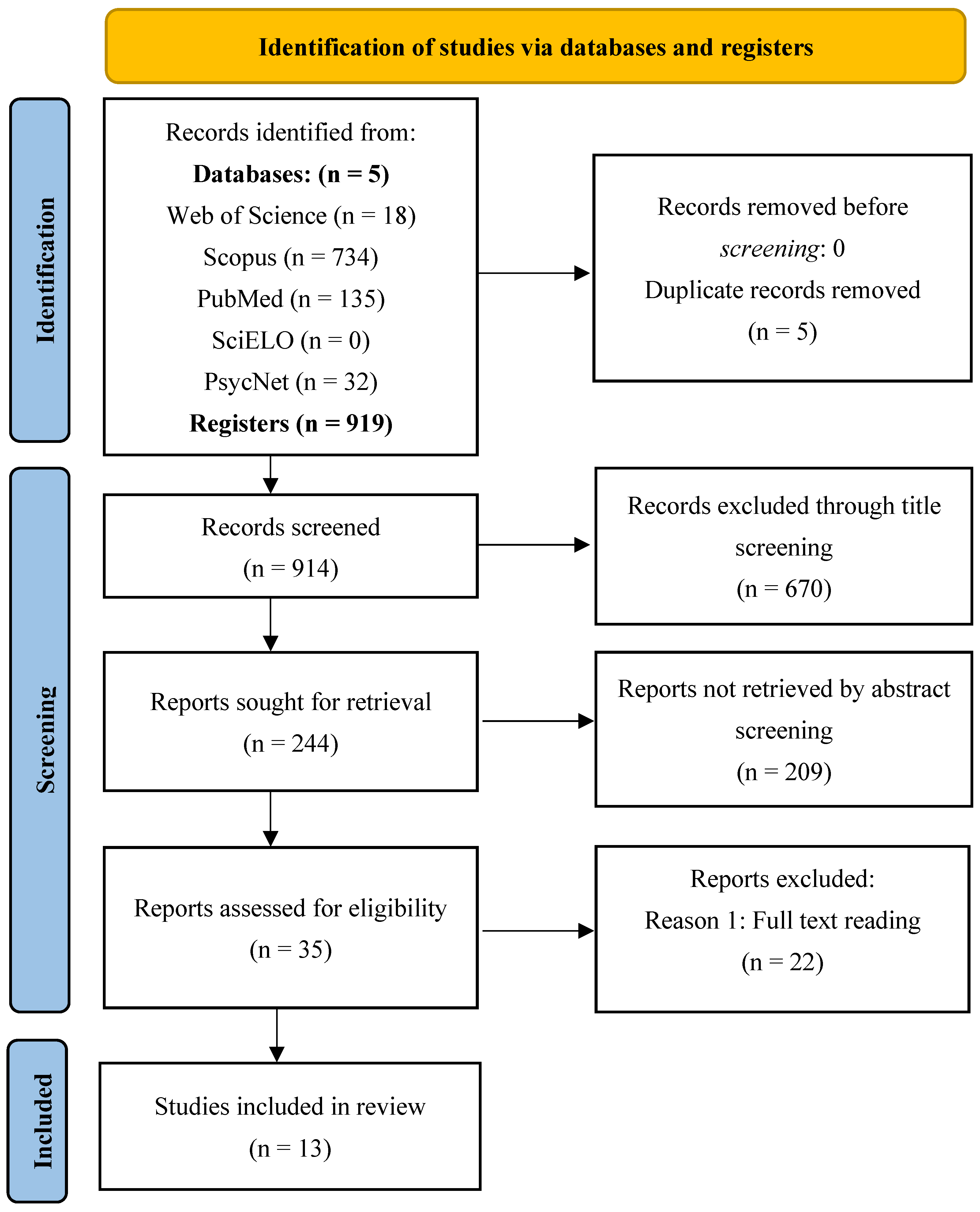
- Identification: The authors downloaded all records from each database and imported them into the Zotero bibliographic manager. This process automatically identified and removed any duplicates, which were then carefully reviewed by hand to ensure accuracy.
- (b)
- Screening: Two researchers independently reviewed the titles and abstracts, using the PEC criteria as a guide. Any records that were deemed irrelevant or that did not explore the relationship between engagement and technostress were excluded. To maintain rigor in this process, the researchers utilized the Rayyan platform.
- (c)
- Eligibility: The researchers performed a comprehensive review of the full texts of relevant studies. During this stage, they verified the methodological quality of the studies, confirmed that they used validated instruments, and ensured that the manuscripts clearly operationalized the constructs of engagement and technostress.
- (d)
- Final inclusion: The researchers reached consensus on the final set of studies included. When disagreements arose, they brought in a third expert evaluator to provide an independent perspective, ensuring that the decision-making process remained objective and fair.
2.4. Quality Assessment Tools
2.5. Analysis and Synthesis of Information
3. Results
3.1. Prevalence of Technostress and Its Relationship with Teaching Engagement
3.2. Protective Factors of Teaching Engagement in the Face of Technostress
3.3. Teaching Engagement as a Key Aspect of Teacher Well-Being and Performance
3.4. Assessment of Methodological and Scientific Quality
4. Discussion
Limitations
5. Conclusions
Author Contributions
Funding
Institutional Review Board Statement
Informed Consent Statement
Data Availability Statement
Conflicts of Interest
Appendix A. Search Strategy
| Database | Search Strategy | N | Search Date |
| Web of Science (WOS) | TS = (“teacher engagement” OR “work engagement”) AND TS = (“technostress” OR “techno-stress” OR “digital stress”) AND TS = (“primary school” OR “secondary school” OR “school teachers”) AND TS = (“rural” OR “urban”) | 18 | 15 December 2025 |
| Scopus | TITLE-ABS-KEY(“teacher engagement” OR “work engagement”) AND TITLE-ABS-KEY(“technostress” OR “techno-stress” OR “digital stress”) AND TITLE-ABS-KEY(“primary education” OR “secondary education” OR “school teachers”) AND TITLE-ABS-KEY(“rural” OR “urban”) | 734 | 15 December 2025 |
| SciELO | (“compromiso docente” OR “engagement docente” OR “work engagement”) AND (“tecnoestrés” OR “stress tecnológico” OR “tecnología digital”) AND (“educación primaria” OR “educación secundaria” OR “profesores de escuela”) AND (“rural” OR “urbano”) | 0 | 15 December 2025 |
| PsycInfo | (“teacher engagement” OR “work engagement”) AND (“technostress” OR “techno-stress” OR “digital stress”) AND (“primary school teachers” OR “secondary school teachers”) AND (“rural schools” OR “urban schools”) | 32 | 16 December 2025 |
| PubMed | (“teacher engagement”[Title/Abstract] OR “work engagement”[Title/Abstract]) AND (“technostress”[Title/Abstract] OR “techno-stress”[Title/Abstract] OR “digital stress”[Title/Abstract]) AND (“primary school”[Title/Abstract] OR “secondary school”[Title/Abstract] OR “school teachers”[Title/Abstract]) AND (“rural”[Title/Abstract] OR “urban”[Title/Abstract]) | 135 | 16 December 2025 |
References
- Abdulkareem, A. K., Ishola, A. A., Bello, M. L., & Adejumo, A. (2024). The dark side of digitalization: Examining the impact of digital overload on job autonomy and job satisfaction. Journal of Information, Communication and Ethics in Society, 22(3), 354–371. [Google Scholar] [CrossRef]
- Aktan, O., & Toraman, Ç. (2022). The relationship between technostress levels and job satisfaction of teachers within the COVID-19 period. Education and Information Technologies, 27(7), 10429–10453. [Google Scholar] [CrossRef]
- Alenezi, M., Wardat, S., & Akour, M. (2023). The need of integrating digital education in higher education: Challenges and opportunities. Sustainability, 15(6), 4782. [Google Scholar] [CrossRef]
- Ali, S., Rubab, A., Jamshed, K., Ahmed Sheikh, M., Jamshaid, S., & Eman, N. (2023). Impact of techno stress on work engagement with mediating role of workload and moderating role of computer self-efficacy. Journal of Xidian University, 17(2), 515–540. [Google Scholar]
- Al-Zu’bi, M., Al-Mseidin, K., Yaakob, M., Fauzee, M., Mahmood, M., Sohri, N., Al-Mawadieh, R., & Senathirajah, A. (2024). The impact of the school educational environment on primary school teachers’ commitment to educational quality. Discover Sustainability, 5(1), 449. [Google Scholar] [CrossRef]
- Araoz, E. G. E., Quispe-Aquise, J., Huamani-Mallgui, A. Y., Salas-Tincusi, E., Mamani-Calcina, B., & Jara-Rodríguez, F. (2023). Exploring the relationship between technostress and psychological well-being in basic education teachers: A cross-sectional study. Journal of Law and Sustainable Development, 11(2), e442. [Google Scholar] [CrossRef]
- Aruleba, K., & Jere, N. (2022). Exploring digital transforming challenges in rural areas of South Africa through a systematic review of empirical studies. Scientific African, 16, e01190. [Google Scholar] [CrossRef]
- Bakker, A. B., & Demerouti, E. (2007). The job demands-resources model: State of the art. Journal of Managerial Psychology, 22(3), 309–328. [Google Scholar] [CrossRef]
- Bakker, A. B., & Demerouti, E. (2017). Job demands-resources theory: Taking stock and looking forward. Journal of Occupational Health Psychology, 22(3), 273–285. [Google Scholar] [CrossRef] [PubMed]
- Beyranvand, S., & Mohamadi Zenouzagh, Z. (2021). Teacher immunity, technological pedagogical content knowledge, and teacher engagement: Contributing factors and relations. SN Social Sciences, 1(9), 241. [Google Scholar] [CrossRef]
- Bitar, N., & Davidovich, N. (2024). Transforming pedagogy: The digital revolution in higher education. Education Sciences, 14(8), 811. [Google Scholar] [CrossRef]
- Bourlakis, M., Nisar, T. M., & Prabhakar, G. (2023). How technostress may affect employee performance in educational work environments. Technological Forecasting and Social Change, 193, 122674. [Google Scholar] [CrossRef]
- Bucăţa, G., & Tileagă, C. (2024). Digital renaissance in education: Unveiling the transformative potential of digitization in educational institutions. Land Forces Academy Review, 29(1), 20–37. [Google Scholar] [CrossRef]
- Cacciamani, S., Cesareni, D., Fiorilli, C., & Ligorio, M. B. (2022). Teachers’ work engagement, burnout, and interest toward ICT training: School level differences. Education Sciences, 12(7), 493. [Google Scholar] [CrossRef]
- Cahapay, M. B., & Bangoc, N. F., II. (2021). Technostress, work performance, job satisfaction, and career commitment of teachers amid COVID-19 crisis in the Philippines. IJERI: International Journal of Educational Research and Innovation, 16, 260–275. [Google Scholar] [CrossRef]
- Cai, Y., Liu, P., Tang, R., & Bo, Y. (2023). Distributed leadership and teacher work engagement: The mediating role of teacher efficacy and the moderating role of interpersonal trust. Asia Pacific Education Review, 24(3), 383–397. [Google Scholar] [CrossRef]
- Cazan, A.-M., David, L. T., Truța, C., Maican, C. I., Henter, R., Năstasă, L. E., Nummela, N., Vesterinen, O., Rosnes, A. M., Tungland, T., Gudevold, E., Digernes, M., Unz, D., Witter, S., & Pavalache-Ilie, M. (2024). Technostress and time spent online. A cross-cultural comparison for teachers and students. Frontiers in Psychology, 15, 1377200. [Google Scholar] [CrossRef] [PubMed]
- Chen, B.-C., Wu, Y.-T., & Chuang, Y.-T. (2024). The impact of teachers’ perceived competence in information and communication technology usage, and workplace anxiety on well-being, as mediated by emotional exhaustion. Frontiers in Psychology, 15, 1404575. [Google Scholar] [CrossRef] [PubMed]
- De Clercq, M., Watt, H. M. G., & Richardson, P. W. (2022). Profiles of teachers’ striving and wellbeing: Evolution and relations with context factors, retention, and professional engagement. Journal of Educational Psychology, 114(3), 637–655. [Google Scholar] [CrossRef]
- Dekawanti, I., Asikin, I., Yudaningsih, N., Tamam, B., Nugraha, R. S., & Nurdin, D. (2025). The role of career development, technostress, and organisational commitment in shaping the work performance of elementary school teachers: Insights from partial least squares structural equation modeling (SEM-PLS) analysis. Perspectives in Education, 43(1), 172–190. [Google Scholar] [CrossRef]
- Demboski, G., Silva, R. C. D. S. D., & Costa, C. (2024). A formação docente como estratégia para prevenir o tecnoestresse e a violação de limites trabalho-família em professores da educação básica. Educação & Formação, 9, e13479. [Google Scholar] [CrossRef]
- Dilekçi, Ü., Limon, İ., Manap, A., Alkhulayfi, A. M. A., & Yıldırım, M. (2025). The association between teachers’ positive instructional emotions and job performance: Work engagement as a mediator. Acta Psychologica, 254, 104880. [Google Scholar] [CrossRef]
- Dutta, D., & Mishra, S. K. (2024). “Technology is killing me!”: The moderating effect of organization home-work interface on the linkage between technostress and stress at work. Information Technology & People, 37(6), 2203–2222. [Google Scholar] [CrossRef]
- Estrada-Muñoz, C., Castillo, D., Vega-Muñoz, A., & Boada-Grau, J. (2020). Teacher technostress in the Chilean school system. International Journal of Environmental Research and Public Health, 17(15), 5280. [Google Scholar] [CrossRef]
- Fan, S., Yu, Z., Zheng, X., & Gao, C. (2023). Relationship between psychological adaptability and work engagement of college teachers within smart teaching environments: The mediating role of digital information literacy self-efficacy. Frontiers in Psychology, 14, 1057158. [Google Scholar] [CrossRef]
- Fei, Y. Z., & Tien, L.-C. (2024). The influence of work values and work engagement on improving the work performance of young teachers in universities. Journal of Law and Sustainable Development, 12(2), e2585. [Google Scholar] [CrossRef]
- Feng, X., Guan, W., & Xu, E. (2025). Digital stress and professional compromise among inclusive preschool teachers in China: A chain mediation model based on negative automatic thoughts and career adaptability. Acta Psychologica, 258, 105261. [Google Scholar] [CrossRef] [PubMed]
- Fernández-Arias, P., Antón-Sancho, Á., Sánchez-Calvo, M., & Vergara, D. (2024). Teaching experience as a key factor in dealing with digital teaching stress. Education Sciences, 14(8), 809. [Google Scholar] [CrossRef]
- Gabbiadini, A., Paganin, G., & Simbula, S. (2023). Teaching after the pandemic: The role of technostress and organizational support on intentions to adopt remote teaching technologies. Acta Psychologica, 236, 103936. [Google Scholar] [CrossRef] [PubMed]
- Ghanizadeh, A., Hedeshi, E., & Jalili, M. (2025). Teacher professional development in the light of technostress, job commitment, and work engagement. Teacher Development, 1–20. [Google Scholar] [CrossRef]
- Han, J., Perron, B. E., Yin, H., & Liu, Y. (2021). Faculty stressors and their relations to teacher efficacy, engagement and teaching satisfaction. Higher Education Research & Development, 40(2), 247–262. [Google Scholar] [CrossRef]
- Hassan, N., Yaakob, S. A., Halif, M. M., Aziz, R. A., Majid, A. A., & Sumardi, N. A. (2019). The effects of technostress creators and organizational commitment among school teachers. Asian Journal of University Education, 15(3), 92–102. [Google Scholar] [CrossRef]
- Huang, R., Adarkwah, M. A., Liu, M., Hu, Y., Zhuang, R., & Chang, T. (2024). Digital pedagogy for sustainable education transformation: Enhancing learner-centred learning in the digital era. Frontiers of Digital Education, 1(4), 279–294. [Google Scholar] [CrossRef]
- Ibrahim, R. K., Al Marar, Y. A., Salman, M., Jehad, S., Hamza, M. G., Abouelnasr, A. S., Abdelaliem, S. M. F., Alahmedi, S. H., & Hendy, A. (2025). Impact of multiple educational technologies on well-being: The mediating role of digital cognitive load. BMC Nursing, 24(1), 1028. [Google Scholar] [CrossRef]
- Jesus, D., & Rebolo, F. (2023). Estresse e tecnoestresse docente: Os efeitos do ensino remoto emergencial em professores universitários brasileiros. Revista Internacional de Educação Superior, 10, e024040. [Google Scholar] [CrossRef]
- Khlaif, Z. N., Sanmugam, M., Joma, A. I., Odeh, A., & Barham, K. (2023). Factors influencing teacher’s technostress experienced in using emerging technology: A qualitative study. Technology, Knowledge and Learning, 28(2), 865–899. [Google Scholar] [CrossRef]
- Kocak, S., & Pawlowski, J. (2024). Development and evaluation of learning scenarios for technostress in schools. In R. Ferreira Mello, N. Rummel, I. Jivet, G. Pishtari, & J. A. Ruipérez Valiente (Eds.), Technology enhanced learning for inclusive and equitable quality education (pp. 193–207). Springer Nature Switzerland. [Google Scholar] [CrossRef]
- Kotherja, O., & Skilja, M. (2025). Teaching process and socio-psychological factors in the context of digitalisation. International Journal of Management and Human Sciences, 9(1), 78–88. [Google Scholar] [CrossRef]
- Lammassaari, H., Hietajärvi, L., Salmela-Aro, K., Hakkarainen, K., & Lonka, K. (2022). Exploring the relations among teachers’ epistemic theories, work engagement, burnout and the contemporary challenges of the teacher profession. Frontiers in Psychology, 13, 861437. [Google Scholar] [CrossRef] [PubMed]
- Lazareva, A., Zadorina, O., Rizak, G., & Kaminskyy, V. (2024). Adapting curricula to the needs of the modern digital society in Ukraine. Futurity Education, 4(3), 236–252. [Google Scholar] [CrossRef]
- Li, L., Li, L., Zhong, B., & Yang, Y. (2024). A scientometric analysis of technostress in education from 1991 to 2022. Education and Information Technologies, 29(17), 23155–23183. [Google Scholar] [CrossRef]
- Li, L., & Wang, X. (2021). Technostress inhibitors and creators and their impacts on university teachers’ work performance in higher education. Cognition, Technology & Work, 23(2), 315–330. [Google Scholar] [CrossRef]
- Lipscomb, S. T., Chandler, K. D., Abshire, C., Jaramillo, J., & Kothari, B. (2022). Early childhood teachers’ self-efficacy and professional support predict work engagement. Early Childhood Education Journal, 50(4), 675–685. [Google Scholar] [CrossRef] [PubMed]
- López-López, E., Tobón, S., & Juárez-Hernández, L. G. (2019). Escala para evaluar artículos científicos en ciencias sociales y humanas—EACSH. REICE. Revista Iberoamericana sobre Calidad, Eficacia y Cambio en Educación, 17(4), 111. [Google Scholar] [CrossRef]
- Lu, L., Wang, C., & Wang, Y. (2024). The contribution of teacher self-efficacy, resilience and emotion regulation to teachers’ well-being: Technology-enhanced teaching context. European Journal of Education, 59(4), e12755. [Google Scholar] [CrossRef]
- Marrinhas, D., Santos, V., Salvado, C., Pedrosa, D., & Pereira, A. (2023). Burnout and technostress during the COVID-19 pandemic: The perception of higher education teachers and researchers. Frontiers in Education, 8, 1144220. [Google Scholar] [CrossRef]
- Matsieli, M., & Mutula, S. (2024). COVID-19 and digital transformation in higher education institutions: Towards inclusive and equitable access to quality education. Education Sciences, 14(8), 819. [Google Scholar] [CrossRef]
- McAdams, D. P. (1992). The five-factor model in personality: A critical appraisal. Journal of Personality, 60(2), 329–361. [Google Scholar] [CrossRef] [PubMed]
- McAdams, D. P., & de St. Aubin, E. (1992). A theory of generativity and its assessment through self-report, behavioral acts, and narrative themes in autobiography. Journal of Personality and Social Psychology, 62(6), 1003–1015. [Google Scholar] [CrossRef]
- Mena-Guacas, A. F., López-Catalán, L., Bernal-Bravo, C., & Ballesteros-Regaña, C. (2025). Educational transformation through emerging technologies: Critical review of scientific impact on learning. Education Sciences, 15(3), 368. [Google Scholar] [CrossRef]
- Methley, A. M., Campbell, S., Chew-Graham, C., McNally, R., & Cheraghi-Sohi, S. (2014). PICO, PICOS and SPIDER: A comparison study of specificity and sensitivity in three search tools for qualitative systematic reviews. BMC Health Services Research, 14(1), 579. [Google Scholar] [CrossRef]
- Mhlongo, S., Mbatha, K., Ramatsetse, B., & Dlamini, R. (2023). Challenges, opportunities, and prospects of adopting and using smart digital technologies in learning environments: An iterative review. Heliyon, 9(6), e16348. [Google Scholar] [CrossRef]
- Moreira-Fontán, E., García-Señorán, M., Conde-Rodríguez, Á., & González, A. (2019). Teachers’ ICT-related self-efficacy, job resources, and positive emotions: Their structural relations with autonomous motivation and work engagement. Computers & Education, 134, 63–77. [Google Scholar] [CrossRef]
- Oduro, F., Parker, D., & Mensah, E. T. (2025). The role of teacher autonomy, school climate, and “perceptions of value & policy influence” in predicting lower secondary school teachers’ job satisfaction in South Africa. Leadership and Policy in Schools, 24(4), 753–772. [Google Scholar] [CrossRef]
- Oh, E. G., Kang, S. P., & Han, S. (2025). Exploring satisfaction of online teaching faculty from a job demands-resources model perspective: The mediating roles of emotional exhaustion and motivation. Journal of Computing in Higher Education, 37(3), 1243–1262. [Google Scholar] [CrossRef]
- Olanrewaju, G. S., Adebayo, S. B., Omotosho, A. Y., & Olajide, C. F. (2021). Left behind? The effects of digital gaps on e-learning in rural secondary schools and remote communities across Nigeria during the COVID19 pandemic. International Journal of Educational Research Open, 2, 100092. [Google Scholar] [CrossRef]
- Pace, F., Sciotto, G., Randazzo, N. A., & Macaluso, V. (2022). Teachers’ work-related well-being in times of COVID-19: The effects of technostress and online teaching. Social Sciences, 11(10), 453. [Google Scholar] [CrossRef]
- Page, M. J., McKenzie, J. E., Bossuyt, P. M., Boutron, I., Hoffmann, T. C., Mulrow, C. D., Shamseer, L., Tetzlaff, J. M., Akl, E. A., Brennan, S. E., Chou, R., Glanville, J., Grimshaw, J. M., Hróbjartsson, A., Lalu, M. M., Li, T., Loder, E. W., Mayo-Wilson, E., McDonald, S., … Moher, D. (2021). The PRISMA 2020 statement: An updated guideline for reporting systematic reviews. BMJ, 372, n71. [Google Scholar] [CrossRef]
- Pimenta, A., Ramos, D., Santos, G., Rodrigues, M. A., & Doiro, M. (2023). Psychosocial risks in teachers from Portugal and England on the way to Society 5.0. International Journal of Environmental Research and Public Health, 20(14), 6347. [Google Scholar] [CrossRef]
- Qin, K., Yu, Z., Cai, Q., Jiang, N., & Chung, K. S. (2025). How workplace telepressure fuels job burnout among educators: Mediated by work-related rumination and moderated by perceived organizational support. Behavioral Sciences, 15(8), 1109. [Google Scholar] [CrossRef]
- Radovan, M., & Radovan, D. M. (2024). Harmonizing pedagogy and technology: Insights into teaching approaches that foster sustainable motivation and efficiency in blended learning. Sustainability, 16(7), 2704. [Google Scholar] [CrossRef]
- Rahimi, R., & Oh, G. (2024). Rethinking the role of educators in the 21st century: Navigating globalization, technology, and pandemics. Journal of Marketing Analytics, 12(2), 182–197. [Google Scholar] [CrossRef]
- Rey-Merchán, M. D. C., & López-Arquillos, A. (2022). Occupational risk of technostress related to the use of ICT among teachers in Spain. Sustainability, 14(14), 8746. [Google Scholar] [CrossRef]
- Rodriguez-Barboza, J. R. (2023). Exploring technostress effects on job performance of higher education Peruvian English teachers. American Journal of Education and Technology, 2(3), 69–75. [Google Scholar] [CrossRef]
- Sandoval-Obando, E., Barros-Osorio, C., Castellanos-Alvarenga, L., Villalta Paucar, M., & Vega-Muñoz, A. (2025). Generativity and psychological well-being in primary and secondary teachers: A systematic review. Societies, 15(11), 320. [Google Scholar] [CrossRef]
- Schaufeli, W. (2021). Engaging leadership: How to promote work engagement? Frontiers in Psychology, 12, 754556. [Google Scholar] [CrossRef] [PubMed]
- Schaufeli, W., & Bakker, A. (2003). Utrecht work engagement scale. Occupational Health Psychology Unit, Utrecht University. [Google Scholar]
- Schaufeli, W., & Taris, T. (2014). A critical review of the job demands-resources model: Implications for improving work and health. In G. F. Bauer, & O. Hämmig (Eds.), Bridging occupational, organizational and public health: A transdisciplinary approach (pp. 43–68). Springer. [Google Scholar] [CrossRef]
- Schaufeli, W. B., Bakker, A. B., & Van Rhenen, W. (2009). How changes in job demands and resources predict burnout, work engagement, and sickness absenteeism. Journal of Organizational Behavior, 30(7), 893–917. [Google Scholar] [CrossRef]
- Shi, Q., Xu, X., Zhang, Y., & Hu, B. (2025). Research on psychological resilience, digital competence, and self-efficacy in online TCFL teachers. Behavioral Sciences, 15(3), 366. [Google Scholar] [CrossRef]
- Shu, K. (2022). Teachers’ commitment and self-efficacy as predictors of work engagement and well-being. Frontiers in Psychology, 13, 850204. [Google Scholar] [CrossRef] [PubMed]
- Siddiqui, S., Arif, I., & Hinduja, P. (2023). Technostress: A catalyst to leave the teaching profession—A survey designed to measure technostress among teachers in Pakistan during COVID-19 pandemic. E-Learning and Digital Media, 20(1), 53–79. [Google Scholar] [CrossRef]
- Solís, P., Lago-Urbano, R., & Real Castelao, S. (2023). Factors that impact the relationship between perceived organizational support and technostress in teachers. Behavioral Sciences, 13(5), 364. [Google Scholar] [CrossRef] [PubMed]
- Timotheou, S., Miliou, O., Dimitriadis, Y., Sobrino, S. V., Giannoutsou, N., Cachia, R., Monés, A. M., & Ioannou, A. (2023). Impacts of digital technologies on education and factors influencing schools’ digital capacity and transformation: A literature review. Education and Information Technologies, 28(6), 6695–6726. [Google Scholar] [CrossRef] [PubMed]
- Topchyan, R., & Woehler, C. (2021). Do teacher status, gender, and years of teaching experience impact job satisfaction and work engagement? Education and Urban Society, 53(2), 119–145. [Google Scholar] [CrossRef]
- Trenerry, B., Chng, S., Wang, Y., Suhaila, Z. S., Lim, S. S., Lu, H. Y., & Oh, P. H. (2021). Preparing workplaces for digital transformation: An integrative review and framework of multi-level factors. Frontiers in Psychology, 12, 620766. [Google Scholar] [CrossRef] [PubMed]
- Trillo, A., Bretones, F. D., Giuliano, R., & Manuti, A. (2024). Beyond occupational exhaustion: Exploring the influence of positive meaningful work on teachers’ psychoemotional well-being in the digital age. Humanities and Social Sciences Communications, 11(1), 348. [Google Scholar] [CrossRef]
- Tu, L., Rao, Z., Jiang, H., & Dai, L. (2025). Technostress, burnout, and job satisfaction: An empirical study of STEM teachers’ well-being and performance. Behavioral Sciences, 15(7), 992. [Google Scholar] [CrossRef]
- Valiao, A. (2025). Technostress and its impact on the job performance of teachers. Journal of Interdisciplinary Perspectives, 3(2), 352–361. [Google Scholar] [CrossRef]
- Wang, Q., & Yao, N. (2023). The impact of technostress creators on novice teachers’ job satisfaction. Journal of Education for Teaching, 49(1), 104–119. [Google Scholar] [CrossRef]
- Wang, Z., Zhang, L., Wang, X., Liu, L., & Lv, C. (2023). Navigating technostress in primary schools: A study on teacher experiences, school support, and health. Frontiers in Psychology, 14, 1267767. [Google Scholar] [CrossRef]
- Yang, D., Liu, J., Wang, H., Chen, P., Wang, C., & Metwally, A. H. S. (2025). Technostress among teachers: A systematic literature review and future research agenda. Computers in Human Behavior, 168, 108619. [Google Scholar] [CrossRef]
- Yang, X., & Du, J. (2024). The effect of teacher self-efficacy, online pedagogical and content knowledge, and emotion regulation on teacher digital burnout: A mediation model. BMC Psychology, 12(1), 51. [Google Scholar] [CrossRef]
- Zhao, Y. (2024). The impact of EFL teachers’ emotioncy level on their motivation and academic engagement. Learning and Motivation, 87, 101990. [Google Scholar] [CrossRef]
- Zhu, M., Huang, T., Ma, H., Liu, P., & Zhang, R. (2025). The impact of time poverty on teachers’ subjective well-being in the context of digital teaching: The mediating role of emotional exhaustion and the moderating role of social support. Education and Information Technologies, 30(7), 9787–9811. [Google Scholar] [CrossRef]
- Zivi, P., Malatesta, G., Mascia, M. L., Diana, M. G., Di Domenico, A., Penna, M. P., & Palmiero, M. (2025). Protective factors against technostress in secondary school teachers. Scientific Reports, 15(1), 35554. [Google Scholar] [CrossRef] [PubMed]
- Zou, Y., Kuek, F., Feng, W., & Cheng, X. (2025). Digital learning in the 21st century: Trends, challenges, and innovations in technology integration. Frontiers in Education, 10, 1562391. [Google Scholar] [CrossRef]



| Dimension | Operational Description |
|---|---|
| Population (P) | Primary or secondary school teachers, regardless of gender or professional specialty, who work in schools. The researchers made no distinction based on years of professional experience. |
| Exposure (E) | Studies that explicitly examine teaching engagement (manifested in the vigor, dedication, and absorption that individuals show in their teaching work) and technostress (manifested in technological anxiety, digital fatigue, resistance, or information overload), and that explore their conceptual or empirical relationship. |
| Context (C) | Educational establishments offering primary or secondary education, located in rural or urban settings, that were part of national school systems. The researchers made no distinction based on the educational establishment’s administrative affiliation (public, private, or subsidized). |
| Inclusion Criteria | Exclusion Criteria |
|---|---|
|
|
| Authors (Year) | Title | Country | Research Methodology/Design | Participants (N, Age, Gender) | Instruments for Data Collection | Main Findings |
|---|---|---|---|---|---|---|
| Zivi et al. (2025) | Protective factors against technostress in secondary school teachers | Italy | Quantitative/Cross-sectional design (observational-analytical). | N = 348, mean age = 44.6 years, range 24–68. Women = 286, men = 58, non-binary = 1, did not disclose gender = 3 |
| Mediation analyses revealed that maladaptive strategies had a direct effect on the experience of technostress creators, whereas adaptive strategies influenced it indirectly through self-efficacy in digital competencies. The management of maladaptive emotions was positively linked to increased levels of technostress creators, while adaptive emotion regulation showed a positive relationship with self-efficacy in digital competencies. Additionally, self-efficacy in digital competencies was found to have a negative relationship with the experience of technostress creators. |
| Ali et al. (2023) | Impact of Techno Stress on Work Engagement with Mediating Role of Workload and Moderating Role of Computer Self-Efficacy | Pakistan | Quantitative/Cross-sectional design. Mediation/moderation analysis using Structural Equation Modeling (SEM). | N = 169. Under 30 years old = 20; 31–35 years old = 109; 35–45 years old = 33; over 45 = 7. Women = 109, men = 60. |
| The research showed that teachers experienced technostress as they transitioned from traditional to online education. Technostress led to a greater workload, while computer self-efficacy helped individuals cope with it. However, professionals were highly committed to their teaching careers. The results indicate that workload does not affect work engagement. |
| Estrada-Muñoz et al. (2020) | Teacher Technostress in the Chilean School System | Chile | Quantitative/Cross-sectional design (observational-descriptive and analytical). | N = 428, mean age = 39.6 years, range 23–67. Women = 276, men = 152 |
| The findings indicated that 12% of the Chilean teachers involved in the study reported feeling techno-fatigued, while 13% experienced techno-anxiety, and 11% faced both issues. Male teachers demonstrated a higher prevalence of techno-anxiety and techno-fatigue compared to their female counterparts. The authors determined that the questionnaire used was a reliable instrument for assessing technostress, which prominently manifested as techno-anxiety and techno-fatigue among teachers in Chile. |
| Q. Wang and Yao (2023) | The Impact of Technostress Creators on Novice Teachers’ Job Satisfaction | China | Quantitative/Cross-sectional design. Regression analysis. | N = 304. Under 22 years old = 23; 23–26 years old = 247; 35–45 years old = 33; over 27 = 34. Women = 166, men = 138 |
| The findings exhibited that, for novice teachers: (a) The connections between various technostress creators and the appraisal results were not consistent; (b) The pursuit of technical assistance mediated the relationship between challenge appraisal and job satisfaction; and (c) Venting did not significantly mediate the effect of threat appraisal on job satisfaction. |
| Araoz et al. (2023) | Exploring the relationship between technostress and psychological well-being in basic education teachers: a cross-sectional study | Peru | Quantitative/Cross-sectional design (observational-analytical). | N = 169. 21–40 years old = 79; 41–64 years old = 90. Women = 71, men = 98 |
| Preliminary findings indicated that teachers had low levels of technostress and high levels of psychological well-being, with a significant inverse correlation between the two variables (r = −0.465, p < 0.05). Likewise, significant negative correlations were observed between technostress and the dimensions of well-being (acceptance, autonomy, relationships, and projects), and between psychological well-being and the dimensions of technostress (skepticism, fatigue, anxiety, and ineffectiveness), confirming an inverse and consistent relationship between higher levels of technostress and lower levels of psychological well-being in its multiple facets. |
| Trillo et al. (2024) | Beyond occupational exhaustion: exploring the influence of positive meaningful work on teachers’ psychoemotional well-being in the digital age | Spain | Quantitative/cross-sectional and non-experimental | N= 213, mean age = 38.68 years, range 23–61. Women = 63.6%, men = 36.4% |
| The findings revealed that engaging in meaningful, positive work was negatively correlated with emotional exhaustion, technological complexity, and conflicts between work and family. Additionally, this negative impact of meaningful positive work on work–family conflict was more pronounced among teachers with greater experience. |
| Moreira-Fontán et al. (2019) | Teachers’ ICT-related self-efficacy, job resources, and positive emotions: Their structural relations with autonomous motivation and work engagement | Spain | Quantitative/Cross-sectional design. Structural equation modeling (SEM). | N = 350, mean age = 48.40 years. Women = 54.9%, men = 39.7% |
| After testing the measurement model, the structural model indicated that all ICT-related variables significantly predicted autonomous motivation, explaining 26% of the variance. ICT-related variables and autonomous motivation explained 69% of the variation in work engagement. Emotional variables were also predicted by digital self-efficacy and institutional support. Autonomous motivation and emotional variables mediated the effects of digital self-efficacy and innovation support on work engagement. |
| Z. Wang et al. (2023) | Navigating Technostress in primary schools: A study on teacher experiences, school support, and health | China | Quantitative, non-experimental (observational), correlational, and cross-sectional design | N = 1172. Women = 941, men = 231 |
| The findings showed that teachers experienced moderate to high levels of technostress during the pandemic, with variations based on gender, age, and their specific responsibilities. Additionally, there was a positive correlation between technostress and both work–family conflict and health issues related to technology use. The degree of technology use directly impacted work–family conflicts and personal health, as well as indirectly influenced them through the effects of technostress. Support from schools played a moderating role in the indirect connection between technology use intensity and work–family issues and health problems; increased school support resulted in a reduced impact of technology use intensity on work–family conflicts and personal health due to the influence of technostress. |
| Cahapay and Bangoc (2021) | Technostress, Work Performance, Job Satisfaction, and Career Commitment of Teachers Amid COVID-19 Crisis in the Philippines | The Philippines | Quantitative/Cross-sectional design (observational-correlational). | N = 2272. Under 35 years old = 1071; 35–44 years old = 644; over 45 years old = 557. Women = 1849, men = 423 |
| The results showed that teachers experience moderate technostress, very high levels of work performance and job satisfaction, and a high level of career commitment. In addition, it was revealed that technostress and its four components differed significantly according to age, gender, marital status, and teaching experience. Finally, it was found that technostress has a significant negative relationship with work performance. |
| Demboski et al. (2024) | A formação docente como estratégia para prevenir o tecnoestresse e a violação de limites trabalho-família em professores da educação básica | Brazil | Quantitative/non-experimental, descriptive and correlational, cross-sectional. | N = 455. Women = 407, men = 48 |
| The results indicate that public school teachers had higher levels of technostress, while private school teachers had higher levels of inhibition of this technological stress. The findings of this study may help school administrators implement strategies such as flexible policies, support for digital self-monitoring, and training in the use of information and communication technologies to mitigate the effects of technological stress. |
| Pace et al. (2022) | Teachers’ Work-Related Well-Being in Times of COVID-19: The Effects of Technostress and Online Teaching | Italy | Quantitative/non-experimental, descriptive and correlational, cross-sectional. | N = 219. Mean age = 47.6 years, range 22–67 years. Women = 76.3%, men = 23.7% |
| The findings demonstrate negative correlations between technostress and job satisfaction, with this relationship varying depending on individuals’ perceptions of meaning. Examining factors associated with teachers’ perceptions of their jobs, both in general and throughout the pandemic, can aid in discovering new coping strategies and developing interventions for implementing innovative teaching methods. |
| Cacciamani et al. (2022) | Teachers’ Work Engagement, Burnout, and Interest toward ICT Training: School Level Differences | Italy | Quantitative/non-experimental (observational), correlational comparative. | N = 358, mean age = 49.25 years, range 32–66 years. Women = 88.3%, men = 11.7% |
| The findings indicated that: (a) elementary school teachers demonstrate greater job commitment and a stronger interest in ICT training than their counterparts in secondary schools; (b) burnout is a predictor of job commitment across all levels of education; (c) the interest in ICT training affects job commitment solely in elementary and secondary schools. The results were interpreted with attention to cultural and contextual factors. |
| Hassan et al. (2019) | The Effects of Technostress Creators and Organizational Commitment among School Teachers. | Malaysia | Quantitative/non-experimental, correlational, and cross-sectional. | N = 173. 20–30 years old = 53; 31–40 years old = 73; 41–50 years old = 38; over 51 years old = 9. Women = 129, men = 44. |
| The results revealed that two aspects of technostress creators, techno-uncertainty and techno-insecurity, positively and significantly impacted organizational commitment. Conversely, the other three elements, which include techno-overload, techno-intrusion, and techno-complexity, did not predict teachers’ commitment to the organization. Additionally, the findings suggested that a certain degree of technostress could enhance teachers’ commitment. |
| Authors | Zivi et al. (2025) | Ali et al. (2023) | Estrada-Muñoz et al. (2020) | Q. Wang and Yao (2023) | Araoz et al. (2023) | Trillo et al. (2024) | Moreira-Fontán et al. (2019) | Z. Wang et al. (2023) | Cahapay and Bangoc (2021) | Demboski et al. (2024) | Pace et al. (2022) | Cacciamani et al. (2022) | Hassan et al. (2019) |
|---|---|---|---|---|---|---|---|---|---|---|---|---|---|
| ITEM 1 | 5 | 5 | 5 | 5 | 5 | 5 | 5 | 5 | 4 | 5 | 5 | 5 | 5 |
| ITEM 2 | 5 | 5 | 5 | 5 | 5 | 5 | 5 | 5 | 5 | 5 | 5 | 5 | 5 |
| ITEM 3 | 5 | 4 | 5 | 5 | 5 | 5 | 5 | 5 | 5 | 4 | 5 | 5 | 5 |
| ITEM 4 | 5 | 4 | 5 | 5 | 5 | 1 | 5 | 5 | 5 | 5 | 4 | 5 | 4 |
| ITEM 5 | 5 | 4 | 5 | 5 | 5 | 5 | 5 | 5 | 5 | 5 | 5 | 5 | 4 |
| ITEM 6 | 5 | 4 | 5 | 5 | 5 | 5 | 5 | 5 | 5 | 5 | 5 | 5 | 4 |
| ITEM 7 | 5 | 4 | 5 | 5 | 5 | 4 | 5 | 5 | 5 | 4 | 5 | 5 | 4 |
| ITEM 8 | 5 | 4 | 4 | 4 | 4 | 4 | 4 | 4 | 5 | 5 | 5 | 5 | 5 |
| ITEM 9 | 5 | 4 | 5 | 5 | 4 | 4 | 5 | 4 | 5 | 5 | 4 | 4 | 3 |
| ITEM 10 | 5 | 5 | 5 | 5 | 5 | 4 | 5 | 4 | 5 | 4 | 4 | 4 | 4 |
| ITEM 11 | 5 | 5 | 5 | 5 | 5 | 5 | 5 | 5 | 4 | 5 | 5 | 5 | 5 |
| ITEM 12 | 5 | 5 | 5 | 5 | 5 | 5 | 5 | 5 | 5 | 5 | 5 | 5 | 5 |
| ITEM 13 | 5 | 5 | 5 | 5 | 5 | 5 | 5 | 5 | 5 | 5 | 5 | 4 | 5 |
| ITEM 14 | 5 | 5 | 5 | 5 | 4 | 5 | 5 | 5 | 4 | 5 | 5 | 5 | 5 |
| ITEM 15 | 5 | 5 | 5 | 5 | 5 | 5 | 5 | 5 | 5 | 4 | 5 | 5 | 5 |
| ITEM 16 | 5 | 5 | 5 | 5 | 4 | 5 | 5 | 5 | 4 | 4 | 5 | 5 | 4 |
| ITEM 17 | 5 | 4 | 4 | 5 | 5 | 5 | 5 | 5 | 5 | 5 | 4 | 4 | 5 |
| ITEM 18 | 5 | 4 | 5 | 5 | 5 | 5 | 5 | 5 | 5 | 5 | 5 | 5 | 4 |
| ITEM 19 | 1 | 1 | 1 | 1 | 1 | 1 | 1 | 1 | 1 | 1 | 1 | 1 | 1 |
| ITEM 20 | 5 | 3 | 5 | 5 | 5 | 5 | 5 | 5 | 5 | 5 | 5 | 5 | 5 |
| ITEM 21 | 5 | 4 | 5 | 5 | 5 | 5 | 5 | 5 | 5 | 5 | 5 | 5 | 5 |
| Total | 101/105 | 89/105 | 99/105 | 100/105 | 97/105 | 93/105 | 100/105 | 98/105 | 97/105 | 96/105 | 97/105 | 97/105 | 92/105 |
| % | 96.2% | 84.8% | 94.3% | 95.2% | 93.4% | 88.6% | 95.2% | 93.3% | 93.4% | 91.4% | 93.4% | 93.4% | 87.6% |
Disclaimer/Publisher’s Note: The statements, opinions and data contained in all publications are solely those of the individual author(s) and contributor(s) and not of MDPI and/or the editor(s). MDPI and/or the editor(s) disclaim responsibility for any injury to people or property resulting from any ideas, methods, instructions or products referred to in the content. |
© 2026 by the authors. Licensee MDPI, Basel, Switzerland. This article is an open access article distributed under the terms and conditions of the Creative Commons Attribution (CC BY) license.
Share and Cite
Sandoval-Obando, E.; Fuentes-Vilugrón, G.; Castellanos-Alvarenga, L.; Etchegaray-Pezo, P.; Lamas-Aicon, M. Teaching Engagement and Technostress Among Primary and Secondary School Teachers: A Systematic Review. Educ. Sci. 2026, 16, 422. https://doi.org/10.3390/educsci16030422
Sandoval-Obando E, Fuentes-Vilugrón G, Castellanos-Alvarenga L, Etchegaray-Pezo P, Lamas-Aicon M. Teaching Engagement and Technostress Among Primary and Secondary School Teachers: A Systematic Review. Education Sciences. 2026; 16(3):422. https://doi.org/10.3390/educsci16030422
Chicago/Turabian StyleSandoval-Obando, Eduardo, Gerardo Fuentes-Vilugrón, Luis Castellanos-Alvarenga, Paulo Etchegaray-Pezo, and Macarena Lamas-Aicon. 2026. "Teaching Engagement and Technostress Among Primary and Secondary School Teachers: A Systematic Review" Education Sciences 16, no. 3: 422. https://doi.org/10.3390/educsci16030422
APA StyleSandoval-Obando, E., Fuentes-Vilugrón, G., Castellanos-Alvarenga, L., Etchegaray-Pezo, P., & Lamas-Aicon, M. (2026). Teaching Engagement and Technostress Among Primary and Secondary School Teachers: A Systematic Review. Education Sciences, 16(3), 422. https://doi.org/10.3390/educsci16030422