Article

Tridimensional Acculturation and Academic Self-Concept of Minoritized Primary Students in Swiss Multicultural Classrooms: A Latent Profile Analysis


1
Institute for Diversity and Inclusive Education, University of Teacher Education Lucerne, 6003 Luzern, Switzerland
2
Institute for Educational Sciences, University of Basel, 4001 Basel, Switzerland
*
Author to whom correspondence should be addressed.
Educ. Sci. 2026, 16(3), 386; https://doi.org/10.3390/educsci16030386
Submission received: 16 December 2025 / Revised: 24 February 2026 / Accepted: 27 February 2026 / Published: 4 March 2026
(This article belongs to the Section Education and Psychology)

Abstract

Schools are increasingly shaped by societal change and growing cultural diversity, calling for refined approaches to understanding the acculturation of minoritized students. This study examined acculturation profiles among minoritized primary students (n = 736) in Switzerland, applying a tridimensional framework that incorporates a multicultural orientation, beyond heritage and majority orientation. Using a three-stage latent profile analysis, four distinct acculturation profiles emerged: Multiculturalists (33.3%), Heritage-oriented Multiculturalists (29.9%), Majority-oriented Multiculturalists (29.2%), and a smaller group of Assimilationists (7.6%). The number of parents born abroad, religious practice, Swiss citizenship, and socioeconomic status predicted students’ profile membership. Comparisons of academic self-concept showed that only Majority-oriented Multiculturalists differed from the other profiles. Our findings suggest that a high multicultural orientation may support students’ academic self-concept mainly when paired exclusively with a strong majority orientation. In contrast, our results demonstrate that a strong heritage orientation may be less favorably related to academic self-concept, even when paired with a high multicultural orientation. However, given the cross-sectional design, the results call for further longitudinal research. Nonetheless, the results of this study indicate a necessity for more differentiated acculturation frameworks that consider the multidimensionality of acculturation in contemporary culturally diverse classrooms.

1. Introduction

Global crises and economic globalization are among the central drivers of international migration movements and have a lasting impact on the social development of receiving countries (McAuliffe & Oucho, 2024). These migration trends directly affect the education system by contributing to the increasing cultural diversity within schools and classrooms. In the context of an increasingly diverse educational landscape, equity and inclusion have emerged as central tenets guiding efforts to enhance educational quality and fairness. These principles aim to create learning environments that ensure equal access, participation, and achievement for all learners, regardless of their socioeconomic background, migration status, ethnicity, or gender (Organisation for Economic Co-operation and Development, 2023a). However, research shows that students from immigrant backgrounds in many European countries tend to have lower academic achievement, be less engaged in school, and experience higher levels of stress and psychological strain than their non-immigrant peers (Dimitrova et al., 2016; Organisation for Economic Co-operation and Development, 2023c; Özdemir & Bayram Özdemir, 2020). These disparities are observed across diverse national contexts and are often attributed to a complex interplay of socioeconomic, linguistic, and institutional factors (Organisation for Economic Co-operation and Development, 2018). In Switzerland, where immigration levels are among the highest in Europe (Organisation for Economic Co-operation and Development, 2023b) and migration has shaped the country’s social fabric for decades (Lutz & Lavenex, 2024), educational inequalities linked to migration status remain a persistent challenge within the Swiss school system (Dueggeli et al., 2021; Erzinger et al., 2024; Makarova & Herzog, 2013; Schweizerische Koordinationsstelle für Bildungsforschung, 2023). These disparities in educational outcomes suggest that migration-related disadvantages are not attributable to inherent group characteristics. Rather, they are the result of processes that position certain students as socially subordinate within educational systems. Consequently, the term “minoritized” has gained preference over “minority” in referring to students from immigrant backgrounds, as it more clearly conveys that marginalization is a socially constructed and contextually produced position (Hutson & He, 2024).
As minoritized students pass processes of acculturation, it offers a framework for a more comprehensive understanding of variation in their school adjustment. Berry (1990) defines acculturation as behavioral and attitudinal changes resulting from ongoing contact between individuals or groups from different cultural backgrounds. Schools, as multicultural environments, are essential sites of acculturation, where minoritized students’ experiences and school adjustment are intricately connected (Lokhande & Reichle, 2019; Makarova & Sidler, 2023; Schachner et al., 2018; Veder & Horenczyk, 2016). Among various variables of school adjustment, academic self-concept represents a central dimension of sociocultural adjustment in school, as it reflects students’ perceptions of their competence and success in meeting academic demands (Marsh, 1990). For minoritized students, academic self-concept can be notably high, sometimes matching or surpassing that of majority students (Basarkod et al., 2022; Céspedes et al., 2020; Lilla et al., 2021; Lohbeck, 2024) despite systemic disadvantages in education, a phenomenon known as the “immigrant paradox” (Hernandez et al., 2012). This paradox highlights the potential academic strengths of minoritized students and prompts investigation into how acculturation relates to their academic self-concept, as already explored by Lilla et al. (2021) in German secondary schools. Their study builds upon Berry’s (1997) bidimensional acculturation model, a widely utilized framework in acculturation research (Sam, 2016). Nonetheless, the framework has been questioned within the literature, as it operates on the premise that acculturation occurs exclusively between two cultural contexts, a view that appears increasingly insufficient in contemporary superdiverse societies, where acculturation can be regarded as a more intricate and dynamic process between multiple cultural spheres (Doucerain et al., 2013; Ferguson et al., 2012; Haenni Hoti et al., 2017; Morris et al., 2015; Ozer & Schwartz, 2016; Schwartz et al., 2010).
The present study extends prior research by addressing two gaps in the existing literature. First, it focuses on primary school students’ acculturation experiences, unlike the study by Lilla et al. (2021). Second, an expanded conceptualization of acculturation, incorporating a three-dimensional approach with a multicultural orientation, characterized by students’ interest in interacting with peers from different cultural backgrounds, their positive attitudes toward cultural diversity, and their interest in languages, traditions, and countries of origin represented in their classroom, has to our knowledge not yet been applied to examine the direct relationship between profiles of acculturation and students’ academic self-concept.

1.1. Acculturation Theory

The process of acculturation unfolds when individuals or groups transition from their familiar cultural settings to a new cultural context, where they negotiate meanings and practices in light of both their cultural origins and the conditions of the new environment (Zick, 2010). In contemporary cross-cultural psychology, acculturation research is typically characterized by the differentiation of three interrelated components of acculturation: orientations, conditions, and outcomes (Arends-Tóth & van de Vijver, 2006).
Acculturation orientations are commonly conceptualized as a bidimensional construct reflecting individuals’ efforts to maintain their cultural heritage while engaging with the cultural context of the receiving society (Berry, 1990). The interplay of the different acculturation orientations, involving attitudinal, behavioral, and identity-related elements (Berry et al., 2006), yields four distinct acculturation strategies (Berry, 1997): integration reflects a balanced involvement in both cultural contexts, assimilation implies orientation towards the majority context only, separation denotes a primary orientation to the cultural context of heritage, and marginalization describes disengagement from both. Despite the considerable influence that Berry’s bidimensional model has exerted on the field of cross-cultural psychology (Sam, 2016), it has also been the subject of substantial criticism. Scholars argue that the model assumes relatively stable orientations and symmetrical relationships between heritage and majority populations, thus overlooking the heterogeneity and fluidity in individuals’ experiences (Schwartz et al., 2010). Others emphasize that acculturation unfolds as a situated and multidimensional process, in which individuals from immigrant backgrounds negotiate values, practices, and identifications across multiple and overlapping cultural spheres rather than moving linearly between two distinct cultural systems (Morris et al., 2015). Building on these arguments, Ozer and Schwartz (2016) note that “specifically, in some societies, a tridimensional or multidimensional model may be needed in cases where multiple cultural streams and/or complex globalization-based influences are present within a given context” (p. 2). In response to this critique, there have been efforts to extend Berry’s model. Ferguson et al. (2012) proposed a tridimensional acculturation model, showing that minoritized youth with Jamaican heritage in the U.S. orient themselves simultaneously toward the Jamaican heritage context, the American mainstream context, and the African American context. In a similar vein, Ozer and Schwartz (2016) demonstrated that young adults in the Ladakh region of India position themselves in relation to the local Ladakhi cultural context, the broader Indian national context, and global Western cultural streams. In response to the high cultural diversity in Swiss classrooms, Haenni Hoti et al. (2017) further introduced the concept of a multicultural acculturation orientation in schools, reflecting an openness to and engagement of minoritized students with multiple cultural groups.
Although acculturation operates at the individual level, it is fundamentally shaped by the specific context in which it occurs (Birman et al., 2014). Accordingly, acculturation conditions describe the contextual factors of an acculturation process. These include societal and group-level aspects, such as migration type, characteristics of the origin and host societies, and intergroup relations, as well as individual factors like personal resources, social position, and situational circumstances.
Acculturation outcomes are reflected in individuals’ adjustment to the demands of a new cultural context. Ward and Kennedy (1994) distinguish between psychological and sociocultural adjustment as two complementary dimensions of acculturation outcomes. Psychological adjustment refers to emotional well-being, life satisfaction, and the absence of stress or distress experienced during cultural transition, whereas sociocultural adjustment refers to the acquisition of social and cultural competencies that support successful interaction and functioning within the new cultural context.

1.2. Acculturation in the School Context

In acculturation research, school represents a central domain, where children and adolescents spend a substantial part of their daily lives and encounter key socialization processes. Schachner et al. (2018) propose a theoretical framework for understanding schools as acculturative contexts that considers both individual characteristics of students and contextual factors within the school environment. These contextual factors are conceptualized across three interrelated levels that contribute to how students acculturate and adjust within the school context. First, at the level of teachers, peers, and social interactions, teachers’ expectations, beliefs, and culturally responsive pedagogical approaches shape interactional experiences, while students’ encounters with bias and discrimination in classroom interactions may constrain acculturative processes and adjustment outcomes. Secondly, the classroom and school characteristics include the ethnic composition of the class and the broader diversity climate, the structure of opportunities for intergroup contact, perceptions of equality, and the recognition of cultural diversity within the school environment. Thirdly, educational and school policies constitute a more distal layer. Diversity-related policy approaches and structural arrangements (e.g., tracking) frame institutional conditions that can either facilitate or constrain acculturative processes and adjustment outcomes.
Empirical research on the acculturation of minoritized students in educational contexts has traditionally focused on acculturation orientations/strategies and their associated outcomes. Findings remain intricate and somewhat inconsistent, with only a limited number of studies explicitly highlighting the role of acculturation conditions. Some studies have demonstrated a correlation between an integration strategy and more favorable school adjustment outcomes, including higher levels of school engagement or well-being (Musso et al., 2015; Preusche & Göbel, 2022; Rabi et al., 2023). A systematic review by Sheikh and Anderson (2018) likewise concluded that integration strategies are generally associated with beneficial educational outcomes among refugee and asylum-seeking students. However, other scholars suggest that the benefits of integration strategies depend on specific contextual conditions, such as supportive and non-discriminatory school environments (Baysu et al., 2011; Makarova & Birman, 2016). In other research, assimilation strategies have been shown to be advantageous for school adjustment in several studies and have been discussed as possibly reflecting closer alignment with prevailing school norms and expectations (Makarova & Birman, 2015; Schachner et al., 2017a). Findings regarding separation strategies, by contrast, are mixed and appear to vary across national and social contexts. While some research indicates positive associations with aspects of school adjustment for specific student groups (Baumert et al., 2024; Hillekens et al., 2023), other studies report disadvantages, for instance, lower academic achievement (Guerra et al., 2019; Melkonian et al., 2019; Thürer et al., 2023). A multicultural orientation is related to better reading skills and higher educational aspirations among minoritized students, especially when combined with a majority orientation (Haenni Hoti et al., 2017).

Acculturation and Academic Self-Concept

One important component of school adjustment is academic self-concept. It is associated with a range of educational outcomes, such as school well-being, motivation, self-efficacy, and long-term educational attainment (Guay et al., 2004; Li et al., 2025; Schneider et al., 2022; Wang & Yu, 2023; Wu et al., 2021). The development of minoritized students’ academic self-concept may be understood as a specific aspect of sociocultural adjustment, as it refers to students’ beliefs about their own learning abilities and performance (Shavelson et al., 1976). According to the multidimensional and hierarchical model of self-concept, academic self-concept is embedded within global self-concept and includes subject-specific components, such as mathematics and verbal self-concept (Arens et al., 2021; K. H. Smith, 2019).
A study by Lilla et al. (2021), drawing on data from the German National Educational Panel Study (NEPS), identified differences in students’ academic self-concept across these profiles representing combinations of Berry’s (1997) heritage and majority orientations. Their analysis revealed that the association between acculturation and academic self-concept was not uniform but varied across different self-concept dimensions. Distinct patterns emerged for general, verbal, and mathematical self-concept depending on students’ acculturation profiles. Integrated students reported significantly lower levels of both general and verbal self-concept compared to non-immigrant peers, while no differences were observed in mathematical self-concept. Students classified as indifferent (marginalization) likewise showed no significant differences in general self-concept, but their verbal and mathematical self-concepts were significantly lower than those of majority students. Separated students demonstrated general and verbal self-concepts comparable to non-immigrant peers, yet their mathematical self-concept was significantly lower. In contrast, assimilated students displayed self-concept levels in all domains that were largely indistinguishable from those of the majority group. However, the authors caution that the observed effects were relatively small, suggesting that these associations should be interpreted with care and warrant further investigation.
Although Lilla et al. (2021) provide important evidence for the relationship between acculturation and academic self-concept, their findings focus on an adolescent sample of approximately 15-year-old students. Less is known about this relation during the primary school years. Although students can assess their academic abilities from a very early age (Marsh et al., 2002), they substantially refine these self-concepts over the course of primary school. Initially, overly positive assessments are gradually reevaluated as students gain school experience, and through feedback from social comparisons, students develop a more realistic and differentiated perception of their own academic abilities (Marsh, 1989). In the Swiss educational context, this developmental period is further shaped by institutional structures of early performance-based selection. Compulsory education comprises six years of primary school, followed by a transition into lower secondary education. Subsequently, students are allocated to different track types (e.g., vocational, intermediate, or academic programs) (Swiss Conference of Cantonal Ministers of Education, 2025). This allocation is based on academic performance, teacher recommendations, and, in some cases, entrance examinations (Swiss Economic Institute, 2015). Thus, primary students are repeatedly confronted with evaluations of their academic performance that carry concrete implications for subsequent educational pathways. Consequently, institutional selection mechanisms enable the provision of early and systematic feedback from teachers on academic performance, which has been demonstrated to exert a significant influence on students’ academic self-concept (Hübner et al., 2025; Keller, 2025; Möller & Pohlmann, 2010).
Within the Swiss school context, characterized by a highly federalized education system with strong local anchoring and substantial school autonomy, leading to diverse pedagogical approaches to address cultural diversity, one empirical study has examined acculturation processes during primary school. Haenni Hoti et al. (2019) focused on mutual acculturation processes between primary school students and their teachers. The study examined whether congruence between teachers’ and students’ acculturation orientations would benefit various aspects of students’ school adjustment. Yet, the findings showed that congruence between students’ heritage-oriented acculturation and teachers’ multicultural orientation, as perceived by students, was associated with a lower academic self-concept. While the study offers valuable insights into the central role of mutual acculturation in primary school, it also highlights the need to consider more differentiated frameworks of acculturation that allow for an openness towards and engagement with multiple cultural contexts. In this regard, further investigation is required to examine how students’ orientations within a tridimensional acculturation framework, including a multicultural orientation, coalesce into coherent acculturation profiles and how these are related to academic self-concept.

1.3. Multiculturalism

In increasingly diverse societies, highly influenced by transnational migration, such as Switzerland, the question of how to approach cultural diversity to foster social cohesion and improve intergroup relations is of paramount importance. This question has been addressed through different ideological frameworks, notably contrasting multiculturalism with color-blindness as opposing paradigms (Rosenthal & Levy, 2010). The concept of color-blindness is predicated on the notion that accentuating shared characteristics or treating individuals as discrete entities can engender equality and enhance intergroup relations. Consequently, color-blind approaches endeavor to avert the activation of stereotypes by diminishing the salience of group-based distinctions in social and institutional contexts. Nevertheless, this perspective has been the subject of criticism due to its potential to obscure persistent structural inequalities and group-specific experiences (Yi et al., 2023). While color-blindness seeks to reduce prejudice and discrimination by downplaying or avoiding attention to ethnic and cultural group memberships, multiculturalism proffers a contrasting perspective that situates the recognition of cultural diversity at the core of social life (Sasaki & Vorauer, 2013). It emphasizes the importance of acknowledging group-based identities, experiences, and resources, particularly those of marginalized groups, to cultivate inclusion and mutual respect. Thus, multiculturalism, in its promotion of cultural plurality over uniformity, aims to foster equitable relations and positive intergroup interactions, and it permits the coexistence of multiple cultural groups within a shared societal framework (Rosenthal & Levy, 2010). Multiculturalism, therefore, is not merely a descriptive characterization of a society comprising multiple cultural groups; it is also a normative perspective that advocates for cultural diversity. Accordingly, Berry and Ward (2016) conceptualize multiculturalism as an ideology “defined by an appreciation of diversity and support for cultural maintenance in conjunction with a recognized need for mutual accommodation that promotes equitable participation. In some societies, however, there is a common misconception that multiculturalism refers only to the presence of many independent cultural communities. (p. 447)”.
Within the school context, approaches addressing cultural diversity are increasingly conceptualized under the idea of the school diversity climate (Karataş et al., 2023; Schachner et al., 2021, 2019; Schwarzenthal et al., 2020). As a contextual condition of acculturation, the school diversity climate structures everyday practices in school related to cultural diversity and thus influences intergroup contact among students from various cultural backgrounds (Schachner et al., 2017b). Multiculturalism, as an approach to a school’s diversity climate, confers many advantages for students’ school adjustment. According to a comprehensive meta-analysis (Bardach et al., 2024), multiculturalism positively predicts students’ sense of school belonging, academic motivation, achievement, and intergroup attitudes. Despite this evidence underscoring the relevance of a multicultural diversity climate for students’ school adjustment, educational research has primarily examined multiculturalism at the contextual school level, while students’ individual attitudes toward cultural diversity have received comparatively little attention. Recent findings from the Netherlands (Vietze et al., 2026) have indicated that positive diversity attitudes within the peer group are associated with higher levels of school belonging among both minoritized and non-minoritized students. Furthermore, for minoritized students, the authors found a discrepancy between the school diversity climate and students’ attitudes toward diversity in the classroom. The two levels, therefore, cannot be inherently assumed to be interconnected and must be examined independently.

1.4. Research Questions

The present study investigates acculturation profiles among minoritized fifth- and sixth-grade students in Switzerland, resulting from majority, heritage, and multicultural orientations, reflecting an orientation toward different cultural groups and an active appreciation of cultural and linguistic diversity in the school context. The study additionally examines links to general academic self-concept. Sociodemographic and other background factors, such as language use and religious practice, are further included as predictors of profile membership. In light of the outlined conceptual framework and empirical gaps, the study examines the following research questions:
(1)
Which acculturation profiles can be identified among minoritized students based on their heritage, majority, and multicultural orientation? (RQ1)
(2)
Which sociodemographic and background factors predict students’ membership in the identified acculturation profiles? (RQ2)
(3)
How does the student’s general academic self-concept differ in acculturation profiles? (RQ3)

2. Materials and Methods

2.1. Participants

This study’s sample is a subset of the Swiss sample (n = 1084) from the binational Immigrant Children in India and Switzerland (ICHIS) study, supported by the Swiss National Science Foundation (SNSF). The Swiss sample of the ICHIS study involved students and their class teachers from 71 primary school classes in German-speaking Switzerland. Nineteen students were excluded due to careless responding, as identified by a Long-String Index. The analytical sample comprised 736 minoritized students, statistically defined as students from immigrant backgrounds having at least one parent born abroad (Organisation for Economic Co-operation and Development, 2019). Most participants were 11 years old (48.5%), followed by 12 years old (28.3%), 10 years old or younger (20.0%), and 13 years old or older (3.3%). Regarding gender, 50.1% identified as female, 47.7% as male, and 2.2% as “other gender.” Regarding immigrant status, 25.7% of the students were first-generation immigrants (born outside Switzerland), whereas 74.3% were born in Switzerland and are therefore second-generation immigrants. Moreover, 31.7% of the students had one parent born abroad, and 68.3% had both parents born abroad. A majority (71.1%) reported speaking German at home. Overall, the students in the sample were born in 67 countries, and their parents were born in 109 countries. The most frequently reported countries of birth among first-generation minoritized students were Italy (10.6%), Germany (6.6%), Ukraine (5.0%), Eritrea (4.6%), and Kosovo (4.0%). Parents’ countries of birth showed a similarly diverse pattern, with Kosovo (13.9%), Germany (8.3%), and Italy (6.9%) being the most frequently reported. Regarding religious affiliation, the majority of students reported Christianity (47.4%), followed by Islam (27.4%), while a considerable proportion reported no religious affiliation (19.4%); small proportions identified with Hinduism (3.3%) or Buddhism (1.5%). Detailed information on the countries of birth of minoritized first-generation students and parents, as well as on religious affiliation, is provided in the Supplementary Material (Tables S1–S3).

2.2. Procedure

Before collecting data, we received ethical approval from the University of Basel Ethics Committee in July 2024. Additional approval was granted by the educational authorities of five German-speaking Swiss cantons. After receiving their consent, teachers were invited to participate with their school classes through the respective school administrations. Participating teachers informed parents and students about the study. Written informed consent was obtained from the legal guardians of all participating children. Parents and children received written information outlining the study’s objectives, data protection procedures, data anonymization, and the voluntary nature of participation. Data was collected between September and December 2024. Students completed a paper-and-pencil questionnaire during a 90-min group administration session in their classrooms. Teachers completed their own questionnaire separately and were not present in the classroom during the student survey. The student questionnaire included demographics, psychological and physical health measures, school-related variables (e.g., teacher and peer relations, school satisfaction), religious practices, acculturation orientations, and family context (e.g., social relations, support, obligations, family structure, language usage). The teacher questionnaire covered teachers’ demographics and assessed structural school conditions (e.g., learning opportunities, materials, infrastructure).

2.3. Measures

The internal consistency of the scales was assessed using McDonald’s Omega (ω) rather than Cronbach’s Alpha, as Omega does not assume tau-equivalence and allows items to have different factor loadings. This approach provides a more accurate and robust estimate of reliability for complex psychological constructs (Dunn et al., 2014; McDonald, 2013). For each scale, McDonald’s Omega was computed based on a one-factor model estimated via maximum likelihood exploratory factor analysis (EFA) using the polychoric correlation matrix, which is appropriate for ordinal item responses (Holgado-Tello et al., 2010). To evaluate the stability of the reliability estimates, bootstrap resampling was conducted with 1000 replications, and 95% confidence intervals were derived from the empirical distribution of the bootstrapped Omega estimates (Chernick & LaBudde, 2011). The analyses were conducted using the R programming language within the RStudio environment (R version 4.4.3).

2.3.1. Academic Self-Concept

General academic self-concept was assessed with four items from the short version of the FDI 4–6-questionnaire developed by Venetz et al. (2014). Example items include “I learn new things very quickly” and “I do well in school.” Responses were recorded on a 4-point ordinal scale (1 = no, 2 = rather no, 3 = rather yes, 4 = yes). The scale showed good internal consistency (ω = 0.86, 95% CI [0.83, 0.88]).

2.3.2. Acculturation Orientations

Acculturation orientations were measured with measurement instruments from the Mutual Intercultural Relations in Plural Societies—Swiss Youth Survey (MIRIPS) (Haenni Hoti et al., 2017). All items were answered on a 4-point ordinal scale (1 = no, 2 = rather no, 3 = rather yes, 4 = yes). The multicultural orientation scale comprised five items (e.g., “During the break I am with children from different countries.”, “During the break I like to listen to languages I can’t speak.”) and showed acceptable internal consistency (ω = 0.75, 95% CI [0.72, 0.79]). The majority orientation scale consisted of four items (e.g., “During the break I am with Swiss children,” “At school I feel Swiss.”) with acceptable internal consistency (ω = 0.78, 95% CI [0.76, 0.81]). The heritage orientation scale also included four items (e.g., “During the break I am with children from my other country.”, “At school I feel like someone from my other country.”) and showed acceptable internal consistency (ω = 0.76, 95% CI [0.71, 0.80]).

2.3.3. Predictor Variables

The number of parents born abroad, immigrant generation, language use in family (German spoken at home or not), Swiss citizenship, gender, age, educational resources at home, and religious practice were included as predictor variables. Educational resources at home were measured with items adapted from PISA 2018 (Mang et al., 2021). Following Bourdieu’s (1986) concept of cultural capital, educational resources available at home can be considered indicators of a student’s socioeconomic status. The scale comprised four ordinal items referring to the number of musical instruments, electronic reading devices, computers, and books at home. Three items were answered on a 4-point ordinal scale (1 = none, 2 = one, 3 = two, 4 = three or more), while the number of books was assessed on a 5-point ordinal scale (1 = 0–10, 2 = 11–25, 3 = 26–100, 4 = 101–200, 5 = more than 200). Differences in response formats did not affect the reliability estimates, as polychoric correlations assume underlying continuous and standardized latent variables, making polychoric covariances and correlations equivalent (Gadermann et al., 2012). The scale showed acceptable internal consistency (ω = 0.76, 95% CI [0.72, 0.79]). We computed a standardized index by averaging z-standardized indicators for the analyses. Religious practice was assessed with a self-developed scale based on theoretical concepts by Glock (1962) and Huber et al. (2020). The scale comprised five items: “I believe in God/deities/something divine”; “God/something divine protects me/deities protect me”; “I pray to God/deities/something divine when I am sad”; “God/something divine gives me power/deities give me strength”; “I ask God/something divine/deities for help when I have problems”. Responses were recorded on a four-point ordinal scale (1 = no, 2 = rather no, 3 = rather yes, 4 = yes). The scale showed excellent internal consistency (ω = 0.98, 95% CI [0.97, 0.98]).

2.4. Data Analysis

To address all three research questions, we conducted a comprehensive multi-stage latent profile analysis (LPA) using the R programming language within the RStudio environment (R version 4.4.3), specifically utilizing the tidyLPA package (Rosenberg et al., 2018). This analysis included the identification of latent profiles as well as the examination of predictors for profile membership and academic self-concept as the distal outcome variable. Initially, we systematically organized the three acculturation orientation variables (multicultural, majority, and heritage orientation), the target variable, and the predictor variables into a distinct dataset. We used the mice package (van Buuren & Groothuis-Oudshoorn, 2011) to impute the few missing values within the orientation variables using the predictive mean matching technique. In the questionnaire, due to ethical considerations, a filter question was used to avoid “othering” by not presuming an affiliation with another country among all children from immigrant families. Consequently, we recoded missing values on the heritage-orientation items, reflecting structural missingness rather than nonresponse, to 1, indicating an absence of endorsement within the 1–4 scale, to allow inclusion in the LPA. Overall, the analytical dataset showed minimal missingness (<1%), well below the 5% threshold commonly regarded as unproblematic (Yeatts & Martin, 2015). Prior to the latent profile analysis, we visually inspected the acculturation orientation variables for potential outliers. We detected one apparent lower outlier in the multicultural orientation variable, whereas the other two orientation variables showed no irregularities. To increase the model’s robustness to this potential outlier, we estimated the Gaussian mixture model using Student-t components (Peel & McLachlan, 2000). Afterwards, we examined the model solutions of the latent profile analysis, following an analytic hierarchy process integrating several fit indices, including AIC, AWE, BIC, CLC, and KIC (Akogul & Erisoglu, 2017). After identifying the optimal profile solution, we used posterior probabilities (i.e., the estimated probabilities of profile membership for each student based on the latent profile model) to calculate weighted mean scores for each profile instead of relying on the most-likely class assignment, as proposed by Muthén and Clark (2009). We subsequently labeled Profiles based on their relative mean levels across these dimensions. As a next step, we applied a weighted multinomial logistic regression to identify key sociodemographic predictors of profile membership, using posterior probabilities as case weights to account for classification uncertainty. This approach approximates the three-step method proposed by Vermunt (2010) as implemented in Mplus. We then applied the Bolck–Croon–Hagenaars (BCH) method (Bolck et al., 2004) to obtain bias-corrected mean comparisons for each latent profile. Overall differences in academic self-concept between profiles were evaluated using Wald chi-square tests. Finally, we calculated Cohen’s d values for significant comparisons to quantify effect sizes (Cohen, 1988).

3. Results

3.1. Descriptive Analysis

Table 1 presents the means, standard deviations, and Pearson correlations among the study variables. The observed associations were generally small to moderate in magnitude (r = 0.11 to 0.39).

3.2. Latent Profile Analysis

We conducted a latent profile analysis as the first step to identify acculturation profiles (RQ1). Following recommendations by (Akogul & Erisoglu, 2017), we applied an analytic hierarchy process that jointly considered the information criteria AIC, AWE, BIC, CLC, BLRT, and KIC when comparing the model solutions. In addition, Entropy, as another diagnostic statistic, reflects the accuracy of classifying individuals into latent profiles, with values between 0.60 and 0.80 generally considered acceptable and values above 0.80 good (Weller et al., 2020). As shown in Table 2, the evaluation of model fit indices indicated that the four-profile solution provided the best representation of the data. This solution yielded lower AIC, CLC, and KIC values relative to models with fewer profiles, a significant bootstrapped likelihood ratio test (BLRT; p = 0.01), and moderate classification accuracy (entropy = 0.68). The BLRT for the five-profile solution was no longer significant (p = 0.34). BIC and AWE favored a more parsimonious solution. In line with the tridimensional conceptualization of acculturation, we retained this solution because it allowed for a more differentiated representation of theoretically meaningful acculturation patterns that would have been obscured in more parsimonious models. In addition, the average posterior profile assignment probabilities (0.72 to 0.96) indicated well-separated profiles (Nylund-Gibson & Choi, 2018).
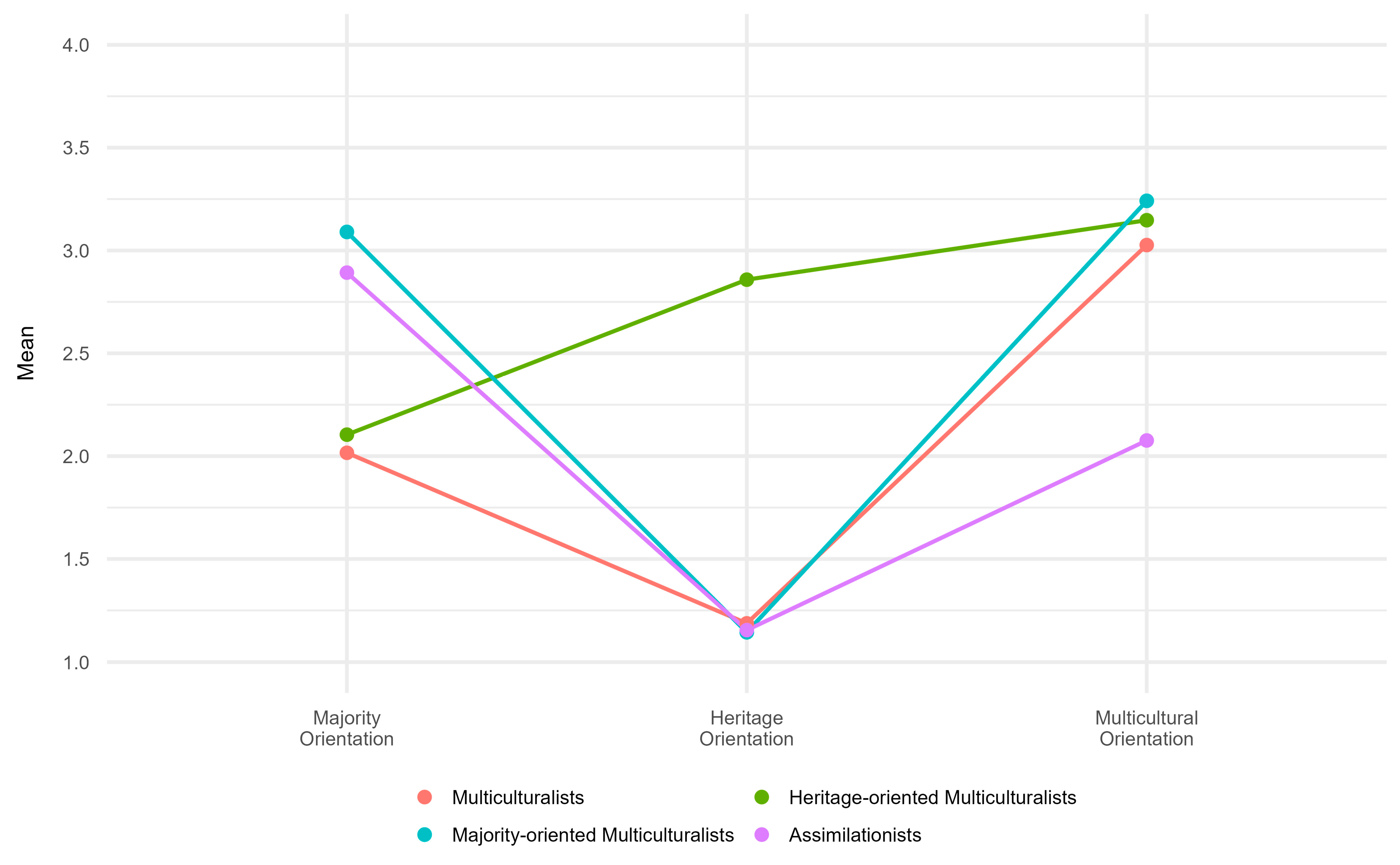
Based on the four-profile solution, we calculated posterior-probability–weighted mean scores for the three acculturation orientation variables for each profile and subsequently labeled the profiles as shown in Figure 1. Profile 1 Multiculturalists showed high multicultural orientation, a relatively lower majority orientation, and a low heritage orientation. Profile 2 Heritage-oriented Multiculturalists were characterized by a comparatively lower majority orientation combined with high heritage and multicultural orientations. Profile 3 Majority-oriented Multiculturalists displayed a high majority orientation, a low heritage orientation, and a high multicultural orientation. Profile 4 Assimilationists were characterized by a high majority orientation, low heritage orientation, and a comparatively lower multicultural orientation. Table 3 presents the distribution of students across the four identified acculturation profiles.

3.3. Multinomial Logistic Regression

We applied a weighted multinomial logistic regression to identify sociodemographic and background factors associated with students’ membership in the identified profiles (RQ2), with Heritage-oriented Multiculturalists serving as the reference profile, because it showed the highest AvePP (0.96). The model included parents born abroad, immigrant generation, language use (German spoken at home), Swiss citizenship, gender, age, educational resources at home, and religious practice as predictors. Table 4 shows the results of the weighted multinomial logistic regression. Across all comparisons with the Heritage-oriented Multiculturalists, two predictors showed consistent associations with profile membership. Students whose parents were both born abroad had lower odds of belonging to any of the other profiles, indicating a stronger likelihood of membership in the Heritage-oriented Multiculturalists profile. Likewise, higher religious practice was associated with increased odds of belonging to the Heritage-oriented Multiculturalists profile rather than to the Multiculturalists, Majority-oriented Multiculturalists, or Assimilationists. In addition, educational resources and possession of Swiss citizenship differentiated the Majority-oriented Multiculturalists from the Heritage-oriented Multiculturalists. Students with higher educational resources and Swiss citizenship had higher odds of being classified as Integrated Multiculturalists. No other predictors were significantly related to profile membership.

3.4. Bias-Corrected Mean Comparisons

We compared students’ general academic self-concept across the identified acculturation profiles using BCH-adjusted pairwise comparisons (RQ3). Table 5 shows unadjusted means and standard deviations of academic self-concept by acculturation profile.
Overall, the Wald chi-square test was significant for the distal variable (Wald χ2 = 13.73, p < 0.001). Pairwise comparisons revealed significant differences between several latent profiles and academic self-concepts, as shown in Table 6. Majority-oriented Multiculturalists reported significantly higher academic self-concept than Multiculturalists (d = 0.44) and Heritage-oriented Multiculturalists (d = 0.51), reflecting medium-sized effects, as well as compared to Assimilationists (d = 0.41), indicating a small-to-moderate effect. No other pairwise differences were statistically significant.

4. Discussion

This study aimed to identify distinct acculturation profiles among minoritized fifth- and sixth-grade students in Switzerland using a tridimensional acculturation framework and to examine how individual sociodemographic and background factors predict students’ membership in these profiles. Furthermore, the study investigated whether students’ general academic self-concept varies across the identified acculturation profiles.
The latent profile analysis identified four empirically distinct acculturation profiles, demonstrating that acculturation among minoritized students in Switzerland does not unfold along a linear continuum but manifests in multidimensional orientation patterns, with three profiles characterized by high levels of multicultural orientation. In contrast to Berry’s (1997) bidimensional model of acculturation, no integration and no marginalization profile emerged. While the absence of integration is surprising, as many studies have showed that this strategy is the most adaptive, (Musso et al., 2015; Preusche & Göbel, 2022; Rabi et al., 2023; Sheikh & Anderson, 2018), the absence of marginalization aligns with prior research from Switzerland (Makarova, 2008), indicating that this strategy is relatively uncommon among minoritized adolescents. In the present study, students who did not exhibit a pronounced orientation toward either the majority or heritage cultural context instead aligned more with a multicultural orientation. Rather than signaling cultural withdrawal, this profile of Multiculturalists represents a pluralistic orientation. This interpretation reinforces contemporary conceptualizations of acculturation as a dynamic process that extends beyond bicultural orientations toward broader, diversity-oriented strategies. Consequently, the identification of a distinct Multiculturalists profile, together with the high endorsement of multicultural orientations observed in two additional profiles, illustrates a shift from traditional bidimensional models toward more nuanced frameworks that acknowledge students’ orientations to multiple cultural contexts, as proposed in prior acculturation research (Doucerain et al., 2013; Ferguson et al., 2012; Haenni Hoti et al., 2017; Morris et al., 2015; Ozer & Schwartz, 2016; Schwartz et al., 2010).
The multinomial logistic regression analysis showed that four sociodemographic and background factors predicted students’ membership in the identified acculturation profiles. Students whose parents were both born abroad had lower odds of belonging to any of the other profiles than those of the Heritage-oriented Multiculturalists. Within immigrant families, ethnic socialization may foster acculturation in which strong heritage orientation coexists with multicultural openness. This emphasizes the broader role of school contextual factors in acculturation processes, as noted by Schachner et al. (2017b), with the family functioning as a particularly influential acculturation environment (Makarova, 2019). Our findings align with prior work by Doucerain (2018), who showed that students embedded in social environments with substantial heritage influences, including ethnically dense neighborhoods, heritage-based social networks, co-residence with parents, and strong heritage language proficiency, tend to report a heightened heritage orientation. However, contrary to these findings, our study did not find an association with language use but instead pointed to the relevance of religious practice. Given the parental transmission of religious importance (C. Smith & Adamczyk, 2021), the finding that higher religious practice may further distinguish Heritage-oriented Multiculturalists from all other profiles is theoretically coherent and in line with previous research conducted on the development of Muslim’s religious identity. For instance, de Hoon and van Tubergen (2014) found that adolescent students display heightened religious identification and engagement when surrounded by classmates who were religiously committed or shared their ethnic background. Religious and parental factors, however, were only part of the contextual picture; socioeconomic status, measured by the number of educational resources at home, and the possession of a Swiss Citizenship were positively associated with membership in the Majority-oriented Multiculturalists profile. This suggests that minoritized students from socioeconomically privileged families and who are Swiss by law may be better equipped to navigate majority cultural expectations, while endorsing broader multicultural openness. Yet the mechanisms underlying these patterns remain, to our knowledge, empirically unexplained, even though Suárez-Orozco et al. (2018) theoretically conceptualize socioeconomic status and legal status as important contextual factors in the acculturation of minoritized children. An Austrian study (Haindorfer & Haller, 2021), however, demonstrated that Austrian citizenship correlates with more frequent social interactions with fellow Austrians, improved German language proficiency, and a stronger sense of national identity. Nevertheless, the rationale behind the advantage of a multicultural orientation remains unelucidated.
Comparisons of academic self-concept across the four acculturation profiles highlighted one particularly distinct pattern. Only minoritized students classified as Majority-oriented Multiculturalists reported markedly higher academic self-concepts than their peers in all other profiles, with effect sizes in the small-to-moderate range. This pattern aligns partly with previous research documenting the advantages of assimilation-oriented strategies for various aspects of school adjustment (Baumert et al., 2024; Makarova & Birman, 2015; Schachner et al., 2017a), including academic self-concept (Lilla et al., 2021). It lends additional validity to the interpretation that assimilative strategies may align more strongly with prevailing norms and expectations in school contexts. Nonetheless, our findings indicate that these benefits are not attributable to majority orientation alone but may emerge only in conjunction with openness toward multiple cultural contexts and engagement with multiple cultural groups, resonating with previous results of Haenni Hoti et al. (2017). At the same time, the advantage of a high multicultural orientation does not seem to translate into higher academic self-concept when paired with orientations other than the majority orientation. This is most evident in the profile marked by high heritage and low majority orientation, where the largest divergence in academic self-concept emerged in comparison to Majority-oriented Multiculturalists. Although the effect sizes are moderate, this finding can nonetheless be contextualized within prior research. While some research has shown that a heritage orientation may foster emotional well-being in school (Baumert et al., 2024) and a sense of belonging (Hillekens et al., 2023), other research has already indicated that they do predict lower academic achievement (Guerra et al., 2019; Melkonian et al., 2019; Thürer et al., 2023). Given the strong empirical link between academic achievement and academic self-concept (Wu et al., 2021), this might help explain why heritage-oriented students in our study report comparatively lower academic self-concepts, despite combining it with a multicultural orientation.

5. Conclusions, Limitations, and Future Research

Schools reflect the social dynamics of the societies in which they are embedded and are continually shaped by processes of ongoing globalization and global crises. Examining the school adjustment of minoritized students within educational settings is essential for gaining insights into the factors that promote or hinder equitable educational opportunities. In this context, acculturation research offers a valuable analytical perspective, as it enables a differentiated understanding of how acculturation strategies relate to various dimensions of school adjustment, such as academic self-concept. The present study showed that minoritized students’ acculturation profiles are associated with perceptions and evaluations of their own academic abilities as expressions of sociocultural adjustment. At the same time, the findings emphasize that the cultural diversity in Swiss classrooms cannot be fully represented by Berry’s (1997) bidimensional model in its original form. Although this model still provides an important conceptual foundation, the acculturation profiles identified in this study show that its adaptation is required to capture more accurately the differentiated acculturation strategies observed in contemporary school contexts. Future research should therefore draw on conceptual frameworks that go beyond the distinction between heritage and majority orientation and account for a multicultural orientation, as exemplified by the multidimensional model proposed by Haenni Hoti et al. (2017). Our findings suggest that, in current culturally diverse school contexts, a high multicultural orientation may support academic self-concept when combined with a strong majority orientation, indicating that the potential benefits of openness toward multiple cultural contexts could be constrained by persistent assimilative tendencies. However, given that effect sizes were small to moderate, these findings warrant cautious interpretation. Still, the results provide tentative indications of the relevance of a multicultural diversity climate in school. For teachers, this underscores the importance of ensuring that classroom practices do not privilege majority-oriented cultural repertoires but instead recognize diverse cultural resources as equally legitimate and valuable assets for navigating school demands.
Notwithstanding our contributions, some questions in our study remain unresolved. A salient issue concerns the conditions of acculturation and their correlation with school adjustment. Despite the fact that theoretical work and prior empirical research have demonstrated the significance of contextual factors in school (Baysu et al., 2011; Guerra et al., 2019; Makarova & Birman, 2016; Schachner et al., 2018), the present study concentrated exclusively on contextual factors at the individual level. Consequently, the role of school environment conditions, for example, the school diversity climate, culturally responsive teaching approaches, and teachers’ beliefs, class composition, or other structural arrangements in shaping or moderating specific acculturation strategies and academic self-concept, remains ambiguous. Subsequent research endeavors should undertake a more systematic investigation of the acculturation conditions in schools in which specific acculturation strategies facilitate or impede the academic self-concept of minoritized students. Further consideration pertains to the emphasis of our study on general academic self-concept. Prior research has demonstrated that academic self-concept is domain-specific and that verbal, mathematical, and general self-concepts can exhibit significant divergence (Arens et al., 2021; Lilla et al., 2021; K. H. Smith, 2019). To address this, future research should incorporate domain-specific measures to examine whether associations with acculturation strategies vary across subject areas. Another significant limitation pertains to the cross-sectional nature of this study, which prevents causal inferences regarding the relations between acculturation profiles and academic self-concept. Consequently, the results of this study should be interpreted as illustrative of concurrent associations rather than indicative of causal or developmental trajectories. Longitudinal investigations are necessary to explore how acculturation orientations and academic self-concept, as a factor of socio-cultural adjustment, evolve over time and to elucidate potential reciprocal influences. Such studies, particularly those applying a multidimensional approach, would provide a stronger basis for exploring temporal associations and for generating more precise explanatory insights on acculturation and academic self-concept of minoritized students in contemporary culturally diverse classrooms, beyond traditional conceptualizations.

Supplementary Materials

The following supporting information can be downloaded at https://www.mdpi.com/article/10.3390/educsci16030386/s1. Table S1: Countries of birth abroad of minoritized first-generation immigrant students; Table S2: Countries of birth abroad of parents of minoritized students; Table S3: Religious affiliation of minoritized students.

Author Contributions

Conceptualization, S.S., A.H.H. and E.M.; methodology, S.S.; formal analysis, S.S.; investigation, S.S. and A.H.H.; data curation, S.S. and A.H.H.; writing—original draft preparation, S.S.; writing—review and editing, S.S., A.H.H. and E.M.; visualization, S.S.; supervision, E.M. and A.H.H.; project administration, A.H.H.; funding acquisition, A.H.H. All authors have read and agreed to the published version of the manuscript.

Funding

This work was funded by the Swiss National Science Foundation (SNSF; grant number IZINZ1_209487/1).

Institutional Review Board Statement

Approval for this study was obtained from the Ethics Committee of the University of Basel on 10 July 2024 (Approval No. 10072024), prior to data collection.

Informed Consent Statement

Written informed consent to participate in this study was obtained from the participants’ legal guardians or next of kin.

Data Availability Statement

The raw data supporting the conclusions of this article will be made available by the authors on request.

Acknowledgments

The authors would like to thank all student assistants who worked on the project team, the participating teachers, and the children, as well as Tomas Kaqinari and Glena Iten for their valuable methodological advice. The tables included in this manuscript, as well as parts of the R coding, were generated with the assistance of ChatGPT (OpenAI, GPT-5.2, February 2026). ChatGPT was also used for language refinement. Additional language polishing was supported using Grammarly (Grammarly Inc., San Francisco, CA, USA, version 1.2.185.1726). The final content was reviewed and approved by the authors.

Conflicts of Interest

The authors declare no conflicts of interest.

References

  1. Akogul, S., & Erisoglu, M. (2017). An approach for determining the number of clusters in a model-based cluster analysis. Entropy, 19(9), 452. [Google Scholar] [CrossRef]
  2. Arends-Tóth, J., & van de Vijver, F. J. R. (2006). Issues in the conceptualization and assessment of acculturation. In M. H. Bornstein, & L. R. Cote (Eds.), Acculturation and parent-child relationships (pp. 33–62). Routledge. [Google Scholar] [CrossRef]
  3. Arens, A. K., Jansen, M., Preckel, F., Schmidt, I., & Brunner, M. (2021). The structure of academic self-concept: A methodological review and empirical illustration of central models. Review of Educational Research, 91(1), 34–72. [Google Scholar] [CrossRef]
  4. Bardach, L., Röhl, S., Oczlon, S., Schumacher, A., Lüftenegger, M., Lavelle-Hill, R., Schwarzenthal, M., & Zitzmann, S. (2024). Cultural diversity climate in school: A meta-analytic review of its relationships with intergroup, academic, and socio-emotional outcomes. Psychological Bulletin, 150(12), 1397–1439. [Google Scholar] [CrossRef]
  5. Basarkod, G., Marsh, H. W., Parker, P. D., Dicke, T., & Guo, J. (2022). The immigrant paradox and math self-concept: An SES-of-origin-country hypothesis. Learning and Instruction, 77, 101539. [Google Scholar] [CrossRef]
  6. Baumert, J., Becker, M., Jansen, M., & Köller, O. (2024). Cultural identity and the academic, social, and psychological adjustment of adolescents with immigration background. Journal of Youth and Adolescence, 53(2), 294–315. [Google Scholar] [CrossRef]
  7. Baysu, G., Phalet, K., & Brown, R. (2011). Dual identity as a two-edged sword. Social Psychology Quarterly, 74(2), 121–143. [Google Scholar] [CrossRef]
  8. Berry, J. (1990). Psychology of acculturation: Understanding individuals moving between cultures. In R. Brislin (Ed.), Applied cross-cultural psychology (pp. 232–253). SAGE Publications. [Google Scholar] [CrossRef]
  9. Berry, J. (1997). Immigration, acculturation, and adaptation. Applied Psychology, 46(1), 5–34. [Google Scholar] [CrossRef]
  10. Berry, J., Phinney, J. S., Sam, D. L., & Vedder, P. (2006). Immigrant youth: Acculturation, identity, and adaptation. Applied Psychology, 55(3), 303–332. [Google Scholar] [CrossRef]
  11. Berry, J., & Ward, C. (2016). Multiculturalism. In D. L. Sam, & J. W. Berry (Eds.), The Cambridge handbook of acculturation psychology (pp. 441–463). Cambridge University Press. [Google Scholar] [CrossRef]
  12. Birman, D., Simon, C. D., Chan, W. Y., & Tran, N. (2014). A life domains perspective on acculturation and psychological adjustment: A study of refugees from the former Soviet Union. American Journal of Community Psychology, 53(1–2), 60–72. [Google Scholar] [CrossRef] [PubMed]
  13. Bolck, A., Croon, M., & Hagenaars, J. (2004). Estimating latent structure models with categorical variables: One-step versus three-step estimators. Political Analysis, 12(1), 3–27. [Google Scholar] [CrossRef]
  14. Bourdieu, P. (1986). The forms of capital. In J. Richardson (Ed.), Handbook of theory and research for the sociology of education (pp. 241–258). Greenwood Press. [Google Scholar]
  15. Céspedes, C., Rubio, A., Viñas, F., Cerrato, S. M., Lara-Órdenes, E., & Ríos, J. (2020). Relationship between self-concept, self-efficacy, and subjective well-being of native and migrant adolescents. Frontiers in Psychology, 11, 620782. [Google Scholar] [CrossRef] [PubMed]
  16. Chernick, M. R., & LaBudde, R. A. (2011). An introduction to bootstrap methods with applications to R. Wiley. [Google Scholar]
  17. Cohen, J. (1988). Statistical power analysis for the behavioral sciences. Lawrence Erlbaum Associates. [Google Scholar]
  18. de Hoon, S., & van Tubergen, F. (2014). The religiosity of children of immigrants and natives in England, Germany, and the Netherlands: The role of parents and peers in class. European Sociological Review, 30(2), 194–206. [Google Scholar] [CrossRef]
  19. Dimitrova, R., Chasiotis, A., & van de Vijver, F. (2016). Adjustment outcomes of immigrant children and youth in Europe. European Psychologist, 21(2), 150–162. [Google Scholar] [CrossRef]
  20. Doucerain, M. (2018). Heritage acculturation is associated with contextual factors at four different levels of proximity. Journal of Cross-Cultural Psychology, 49(10), 1539–1555. [Google Scholar] [CrossRef]
  21. Doucerain, M., Dere, J., & Ryder, A. G. (2013). Travels in hyper-diversity: Multiculturalism and the contextual assessment of acculturation. International Journal of Intercultural Relations, 37(6), 686–699. [Google Scholar] [CrossRef]
  22. Dueggeli, A., Kassis, M., & Kassis, W. (2021). Navigation and negotiation towards school success at upper secondary school: The interplay of structural and procedural risk and protective factors for resilience pathways. Education Sciences, 11(8), 395. [Google Scholar] [CrossRef]
  23. Dunn, T. J., Baguley, T., & Brunsden, V. (2014). From alpha to omega: A practical solution to the pervasive problem of internal consistency estimation. British Journal of Psychology, 105(3), 399–412. [Google Scholar] [CrossRef]
  24. Erzinger, A., Pham, G., Prosperi, O., & Salvisberg, M. (2024). PISA 2022: Die Schweiz im Fokus. Universität Bern. [Google Scholar] [CrossRef]
  25. Ferguson, G. M., Bornstein, M. H., & Pottinger, A. M. (2012). Tridimensional acculturation and adaptation among Jamaican adolescent-mother dyads in the United States. Child Development, 83(5), 1486–1493. [Google Scholar] [CrossRef]
  26. Gadermann, A. M., Guhn, M., & Zumbo, B. D. (2012). Estimating ordinal reliability for Likert-type and ordinal item response data: A conceptual, empirical, and practical guide. Practical Assessment, Research & Evaluation, 17(3), n3. [Google Scholar] [CrossRef]
  27. Glock, C. Y. (1962). On the study of religious commitment. Religious Education, 57(Suppl. 4), 98–110. [Google Scholar] [CrossRef]
  28. Guay, F., Larose, S., & Boivin, M. (2004). Academic self-concept and educational attainment level: A ten-year longitudinal study. Self and Identity, 3(1), 53–68. [Google Scholar] [CrossRef] [PubMed]
  29. Guerra, R., Rodrigues, R. B., Aguiar, C., Carmona, M., Alexandre, J., & Lopes, R. C. (2019). School achievement and well-being of immigrant children: The role of acculturation orientations and perceived discrimination. Journal of School Psychology, 75, 104–118. [Google Scholar] [CrossRef] [PubMed]
  30. Haenni Hoti, A., Heinzmann, S., Müller, M., & Buholzer, A. (2017). Psychosocial adaptation and school success of Italian, Portuguese and Albanian students in Switzerland: Disentangling migration background, acculturation and the school context. Journal of International Migration and Integration, 18(1), 85–106. [Google Scholar] [CrossRef]
  31. Haenni Hoti, A., Wolfgramm, C., Müller, M., Heinzmann, S., & Buholzer, A. (2019). Immigrant students and their teachers: Exploring various constellations of acculturation orientations and their impact on school adjustment. Intercultural Education, 30(5), 478–494. [Google Scholar] [CrossRef]
  32. Haindorfer, R., & Haller, M. (2021). Does citizenship promote integration? An Austrian case study of immigrants from the former Yugoslavia and Turkey. In R. Bauböck, & M. Haller (Eds.), Dual citizenship and naturalisation (pp. 253–274). Verlag der Österreichischen Akademie der Wissenschaften. [Google Scholar] [CrossRef]
  33. Hernandez, D. J., Denton, N. A., Macartney, S., & Blanchard, V. L. (2012). Children in immigrant families: Demography, policy, and evidence for the immigrant paradox. In C. G. Coll, & A. K. Marks (Eds.), The immigrant paradox in children and adolescents: Is becoming American a developmental risk? (pp. 17–36). American Psychological Association. [Google Scholar] [CrossRef]
  34. Hillekens, J., Baysu, G., & Phalet, K. (2023). Multiple pathways of integration: Acculturative change and associations with school adjustment in immigrant-origin adolescents. Child Development, 94(2), 544–562. [Google Scholar] [CrossRef] [PubMed]
  35. Holgado-Tello, F. P., Chacón-Moscoso, S., Barbero-García, I., & Vila-Abad, E. (2010). Polychoric versus Pearson correlations in exploratory and confirmatory factor analysis of ordinal variables. Quality & Quantity, 44(1), 153–166. [Google Scholar] [CrossRef]
  36. Huber, S., Ackert, M., & Scheiblich, H. (2020). Religiosität in unterschiedlichen religionskulturen—Vergleiche auf der basis der centrality of religiosity scale. Cultura & Psyché, 1(1–2), 171–185. [Google Scholar] [CrossRef]
  37. Hutson, B. L., & He, Y. (2024). Mixed methods research centering on minoritized students in higher education: A literature review. Innovative Higher Education, 49(6), 1051–1076. [Google Scholar] [CrossRef]
  38. Hübner, N., Winstone, N., Merk, S., & Hattie, J. (2025). Teacher feedback and students’ self-concept, intrinsic value, and achievement in mathematics: Juxtaposing between- and within-person perspectives on long-term reciprocal relationships. Contemporary Educational Psychology, 81, 102365. [Google Scholar] [CrossRef]
  39. Karataş, S., Eckstein, K., Noack, P., Rubini, M., & Crocetti, E. (2023). Meeting in school: Cultural diversity approaches of teachers and intergroup contact among ethnic minority and majority adolescents. Child Development, 94(1), 237–253. [Google Scholar] [CrossRef]
  40. Keller, T. (2025). The effect of positive feedback on primary school students’ academic self-concept: Gender heterogeneity in a light-touch randomized intervention. Acta Sociologica. [Google Scholar] [CrossRef]
  41. Li, J., Li, Y., & Ding, Y. (2025). Self-concept promote subjective well-being through gratitude and prosocial behavior during early adolescence? A longitudinal study. BMC Psychology, 13(1), 356. [Google Scholar] [CrossRef]
  42. Lilla, N., Thürer, S., Nieuwenboom, W., & Schüpbach, M. (2021). Exploring academic self-concepts depending on acculturation profile: Investigation of a possible factor for immigrant students’ school success. Education Sciences, 11(8), 432. [Google Scholar] [CrossRef]
  43. Lohbeck, A. (2024). Competence and affect self-concepts of elementary school children—Do gender and immigration background play a role? Intercultural Education, 35(1), 21–41. [Google Scholar] [CrossRef]
  44. Lokhande, M., & Reichle, B. (2019). Acculturation and school adjustment of children and youth from culturally diverse backgrounds: Predictors and interventions for school psychology. Journal of School Psychology, 75, 1–7. [Google Scholar] [CrossRef]
  45. Lutz, P., & Lavenex, S. (2024). Switzerland comes to terms with being a country of immigration. Migration Policy Institute. Available online: https://www.migrationpolicy.org/article/switzerland-immigration-politics-policy (accessed on 15 December 2025).
  46. Makarova, E. (2008). Akkulturation und kulturelle Identität: Eine empirische Studie unter Jugendlichen mit und ohne Migrationshintergrund in der Schweiz (1. Aufl.). Haupt. [Google Scholar]
  47. Makarova, E. (2019). Acculturation and school adjustment of minority students: School and family-related factors. Intercultural Education, 30(5), 445–447. [Google Scholar] [CrossRef]
  48. Makarova, E., & Birman, D. (2015). Cultural transition and academic achievement of students from ethnic minority backgrounds: A content analysis of empirical research on acculturation. Educational Research, 57(3), 305–330. [Google Scholar] [CrossRef]
  49. Makarova, E., & Birman, D. (2016). Minority students’ psychological adjustment in the school context: An integrative review of qualitative research on acculturation. Intercultural Education, 27(1), 1–21. [Google Scholar] [CrossRef]
  50. Makarova, E., & Herzog, W. (2013). Teachers’ acculturation attitudes and their classroom management: An empirical study among fifth-grade primary school teachers in Switzerland. European Educational Research Journal, 12(2), 256–269. [Google Scholar] [CrossRef]
  51. Makarova, E., & Sidler, P. (2023). Migration and acculturation: Supporting migrant students’ school adjustment in multicultural schools. In H. Pinson, N. Bunar, & D. Devine (Eds.), Research handbook on migration and education (pp. 54–67). Edward Elgar Publishing. [Google Scholar] [CrossRef]
  52. Mang, J., Seidl, L., Schiepe-Tiska, A., Tupac-Yupanqui, A., Ziernwald, L., Doroganova, A., Weis, M., Diedrich, J., Heine, J.-H., González Rodríguez, E., & Reiss, K. (2021). PISA 2018 Skalenhandbuch: Dokumentation der Erhebungsinstrumente. Waxmann. [Google Scholar] [CrossRef]
  53. Marsh, H. W. (1989). Age and sex effects in multiple dimensions of self-concept: Preadolescence to early adulthood. Journal of Educational Psychology, 81(3), 417–430. [Google Scholar] [CrossRef]
  54. Marsh, H. W. (1990). The structure of academic self-concept: The Marsh/Shavelson model. Journal of Educational Psychology, 82(4), 623–636. [Google Scholar] [CrossRef]
  55. Marsh, H. W., Ellis, L. A., & Craven, R. G. (2002). How do preschool children feel about themselves? Unraveling measurement and multidimensional self-concept structure. Developmental Psychology, 38(3), 376–393. [Google Scholar] [CrossRef] [PubMed]
  56. McAuliffe, M., & Oucho, L. A. (Eds.). (2024). World migration report 2024. International Organization for Migration. [Google Scholar]
  57. McDonald, R. P. (2013). Test theory. Psychology Press. [Google Scholar] [CrossRef]
  58. Melkonian, M., Areepattamannil, S., Menano, L., & Fildago, P. (2019). Examining acculturation orientations and perceived cultural distance among immigrant adolescents in Portugal: Links to performance in reading, mathematics, and science. Social Psychology of Education, 22(4), 969–989. [Google Scholar] [CrossRef]
  59. Morris, M. W., Chiu, C., & Liu, Z. (2015). Polycultural psychology. Annual Review of Psychology, 66, 631–659. [Google Scholar] [CrossRef] [PubMed]
  60. Möller, J., & Pohlmann, B. (2010). Achievement differences and self-concept differences: Stronger associations for above or below average students? British Journal of Educational Psychology, 80(Pt 3), 435–450. [Google Scholar] [CrossRef]
  61. Musso, P., Inguglia, C., & Lo Coco, A. (2015). Acculturation profiles and perceived discrimination: Associations with psychosocial well-being among Tunisian adolescents in Italy. Social Inquiry into Well-Being, 1(1), 76. [Google Scholar] [CrossRef]
  62. Muthén, B., & Clark, S. L. (2009). Relating latent class analysis results to variables not included in the analysis. StatModel. Available online: https://www.statmodel.com/download/relatinglca.pdf (accessed on 15 December 2025).
  63. Nylund-Gibson, K., & Choi, A. Y. (2018). Ten frequently asked questions about latent class analysis. Translational Issues in Psychological Science, 4(4), 440–461. [Google Scholar] [CrossRef]
  64. Organisation for Economic Co-operation and Development. (2018). Equity in education: Breaking down barriers to social mobility. OECD. [Google Scholar] [CrossRef]
  65. Organisation for Economic Co-operation and Development. (2019). PISA 2018 assessment and analytical framework. OECD. [Google Scholar] [CrossRef]
  66. Organisation for Economic Co-operation and Development. (2023a). Equity and inclusion in education. OECD Publishing. [Google Scholar] [CrossRef]
  67. Organisation for Economic Co-operation and Development. (2023b). International migration outlook 2023. OECD Publishing. [Google Scholar] [CrossRef]
  68. Organisation for Economic Co-operation and Development. (2023c). PISA 2022 results (Volume I). OECD Publishing. [Google Scholar] [CrossRef]
  69. Ozer, S., & Schwartz, S. J. (2016). Measuring globalization-based acculturation in Ladakh: Investigating possible advantages of a tridimensional acculturation scale. International Journal of Intercultural Relations, 53, 1–15. [Google Scholar] [CrossRef]
  70. Özdemir, M., & Bayram Özdemir, S. (2020). Why do some immigrant children and youth do well in school whereas others fail? Current state of knowledge and directions for future research. In D. Güngör, & D. Strohmeier (Eds.), Advances in immigrant family research: Contextualizing immigrant and refugee resilience (pp. 51–72). Springer. [Google Scholar] [CrossRef]
  71. Peel, D., & McLachlan, G. J. (2000). Robust mixture modelling using the t distribution. Statistics and Computing, 10(4), 339–348. [Google Scholar] [CrossRef]
  72. Preusche, Z. M., & Göbel, K. (2022). Does a strong bicultural identity matter for emotional, cognitive, and behavioral engagement? Education Sciences, 12(1), 5. [Google Scholar] [CrossRef]
  73. Rabi, F., Fengqi, M., & Aziz, M. (2023). The positive impact of bicultural identity on emotional, cognitive, and behavioral engagement: An exploratory analysis. American Journal of Creative Education, 6(1), 28–51. [Google Scholar] [CrossRef]
  74. Rosenberg, J., Beymer, P., Anderson, D., van Lissa, C., & Schmidt, J. (2018). tidyLPA: An R package to easily carry out latent profile analysis (LPA) using open-source or commercial software. Journal of Open Source Software, 3(30), 978. [Google Scholar] [CrossRef]
  75. Rosenthal, L., & Levy, S. R. (2010). The colorblind, multicultural, and polycultural ideological approaches to improving intergroup attitudes and relations. Social Issues and Policy Review, 4(1), 215–246. [Google Scholar] [CrossRef]
  76. Sam, D. L. (2016). Acculturation: Conceptual background and core components. In D. L. Sam, & J. W. Berry (Eds.), The Cambridge handbook of acculturation psychology (pp. 11–26). Cambridge University Press. [Google Scholar] [CrossRef]
  77. Sasaki, S. J., & Vorauer, J. D. (2013). Ignoring versus exploring differences between groups: Effects of salient color-blindness and multiculturalism on intergroup attitudes and behavior. Social and Personality Psychology Compass, 7(4), 246–259. [Google Scholar] [CrossRef]
  78. Schachner, M. K., He, J., Heizmann, B., & van de Vijver, F. J. R. (2017a). Acculturation and school adjustment of immigrant youth in six European countries: Findings from the Programme for International Student Assessment (PISA). Frontiers in Psychology, 8, 649. [Google Scholar] [CrossRef] [PubMed]
  79. Schachner, M. K., Juang, L., Moffitt, U., & van de Vijver, F. J. R. (2018). Schools as acculturative and developmental contexts for youth of immigrant and refugee background. European Psychologist, 23(1), 44–56. [Google Scholar] [CrossRef]
  80. Schachner, M. K., Schwarzenthal, M., Moffitt, U., Civitillo, S., & Juang, L. (2021). Capturing a nuanced picture of classroom cultural diversity climate: Multigroup and multilevel analyses among secondary school students in Germany. Contemporary Educational Psychology, 65, 101971. [Google Scholar] [CrossRef]
  81. Schachner, M. K., Schwarzenthal, M., van de Vijver, F. J. R., & Noack, P. (2019). How all students can belong and achieve: Effects of the cultural diversity climate amongst students of immigrant and nonimmigrant background in Germany. Journal of Educational Psychology, 111(4), 703–716. [Google Scholar] [CrossRef]
  82. Schachner, M. K., van de Vijver, F. J. R., & Noack, P. (2017b). Contextual conditions for acculturation and adjustment of adolescent immigrants—Integrating theory and findings. Online Readings in Psychology and Culture, 8(1), 12. [Google Scholar] [CrossRef]
  83. Schneider, S., Lösch, T., Schneider, D., & Schütz, A. (2022). How self-concept, competence, and their fit or misfit predict educational achievement, well-being, and social relationships in the school context. Collabra: Psychology, 8(1), 37154. [Google Scholar] [CrossRef]
  84. Schwartz, S. J., Unger, J. B., Zamboanga, B. L., & Szapocznik, J. (2010). Rethinking the concept of acculturation: Implications for theory and research. American Psychologist, 65(4), 237–251. [Google Scholar] [CrossRef]
  85. Schwarzenthal, M., Schachner, M. K., Juang, L. P., & van de Vijver, F. J. R. (2020). Reaping the benefits of cultural diversity: Classroom cultural diversity climate and students’ intercultural competence. European Journal of Social Psychology, 50(2), 323–346. [Google Scholar] [CrossRef]
  86. Schweizerische Koordinationsstelle für Bildungsforschung. (2023). Bildungsbericht Schweiz 2023. SKBF-CSRE. Available online: https://www.skbf-csre.ch/bildungsbericht/bildungsbericht/ (accessed on 15 December 2025).
  87. Shavelson, R. J., Hubner, J. J., & Stanton, G. C. (1976). Self-concept: Validation of construct interpretations. Review of Educational Research, 46(3), 407–441. [Google Scholar] [CrossRef]
  88. Sheikh, M., & Anderson, J. R. (2018). Acculturation patterns and education of refugees and asylum seekers: A systematic literature review. Learning and Individual Differences, 67, 22–32. [Google Scholar] [CrossRef]
  89. Smith, C., & Adamczyk, A. (2021). Handing down the faith. Oxford University Press. [Google Scholar] [CrossRef]
  90. Smith, K. H. (2019). The multidimensionality of academic self-concept. Educational Practice and Theory, 41(1), 71–81. [Google Scholar] [CrossRef]
  91. Suárez-Orozco, C., Motti-Stefanidi, F., Marks, A., & Katsiaficas, D. (2018). An integrative risk and resilience model for understanding the adaptation of immigrant-origin children and youth. American Psychologist, 73(6), 781–796. [Google Scholar] [CrossRef] [PubMed]
  92. Swiss Conference of Cantonal Ministers of Education. (2025). The Swiss education system. Available online: https://edudoc.ch/record/215811/files/grafik_bildung_e.pdf (accessed on 15 December 2025).
  93. Swiss Economic Institute. (2015). KOF factbook: Education system Switzerland. Swiss Federal Institute of Technology Zurich. Available online: https://ethz.ch/content/dam/ethz/special-interest/dual/kof-dam/documents/KOF_Factbook/kof_factbook_education_system_switzerland.pdf (accessed on 15 December 2025).
  94. Thürer, S., Nieuwenboom, W., Schüpbach, M., & Lilla, N. (2023). Immigrant students’ acculturation profile and reading competence development in secondary school and beyond. International Journal of Educational Research, 118, 102139. [Google Scholar] [CrossRef]
  95. van Buuren, S., & Groothuis-Oudshoorn, K. (2011). mice: Multivariate imputation by chained equations in R. Journal of Statistical Software, 45(3), 1–67. [Google Scholar] [CrossRef]
  96. Veder, P. H., & Horenczyk, G. (2016). Acculturation and the school. In D. L. Sam, & J. W. Berry (Eds.), The Cambridge handbook of acculturation psychology (pp. 419–438). Cambridge University Press. [Google Scholar] [CrossRef]
  97. Venetz, M., Zurbriggen, C., & Eckhart, M. (2014). Entwicklung und erste validierung einer kurzversion des “fragebogens zur erfassung von dimensionen der integration von schülern (FDI 4–6)” von Haeberlin, Moser, Bless und Klaghofer. Empirische Sonderpädagogik, 6(2), 99–113. [Google Scholar] [CrossRef]
  98. Vermunt, J. K. (2010). Latent class modeling with covariates: Two improved three-step approaches. Political Analysis, 18(4), 450–469. [Google Scholar] [CrossRef]
  99. Vietze, J., Stuur, N., & Hofhuis, J. (2026). School diversity perspectives and classmate diversity climate: Understanding high school students’ school belonging, well-being, and intercultural contact. Journal of Community Psychology, 54(1), e70082. [Google Scholar] [CrossRef]
  100. Wang, L., & Yu, Z. (2023). Gender-moderated effects of academic self-concept on achievement, motivation, performance, and self-efficacy: A systematic review. Frontiers in Psychology, 14, 1136141. [Google Scholar] [CrossRef]
  101. Ward, C., & Kennedy, A. (1994). Acculturation strategies, psychological adjustment, and sociocultural competence during cross-cultural transitions. International Journal of Intercultural Relations, 18(3), 329–343. [Google Scholar] [CrossRef]
  102. Weller, B. E., Bowen, N. K., & Faubert, S. J. (2020). Latent class analysis: A guide to best practice. Journal of Black Psychology, 46(4), 287–311. [Google Scholar] [CrossRef]
  103. Wu, H., Guo, Y., Yang, Y., Zhao, L., & Guo, C. (2021). A meta-analysis of the longitudinal relationship between academic self-concept and academic achievement. Educational Psychology Review, 33(4), 1749–1778. [Google Scholar] [CrossRef]
  104. Yeatts, S. D., & Martin, R. H. (2015). What is missing from my missing data plan? Stroke, 46(6), e130–e132. [Google Scholar] [CrossRef]
  105. Yi, J., Neville, H. A., Todd, N. R., & Mekawi, Y. (2023). Ignoring race and denying racism: A meta-analysis of the associations between colorblind racial ideology, anti-Blackness, and other variables antithetical to racial justice. Journal of Counseling Psychology, 70(3), 258–275. [Google Scholar] [CrossRef]
  106. Zick, A. (2010). Psychologie der akkulturation. VS Verlag für Sozialwissenschaften. [Google Scholar] [CrossRef]
Figure 1. Mean levels of acculturation orientations across profiles.
Education 16 00386 g001
Table 1. Descriptive statistics of measures.
VariableMSD123456
1. Heritage orientation1.670.87
2. Majority orientation2.430.78−0.26 **
3. Multicultural orientation3.030.640.11 **0.01
4. Religious practice3.041.070.23 **−0.33 **0.16 **
5. Educational resources at home−0.150.70−0.17 **0.33 **−0.02−0.39 **
6. Academic self-concept2.940.68−0.11 **0.23 **0.06−0.14 **0.29 **
Note. M = mean; SD = standard deviation. ** p < 0.01
Table 2. Model fit indices for 1- to 5-profile solutions.
ProfilesAICAWEBICCLCKICEntropyBLRT p
15044.195127.475071.015034.565053.191.00
24642.194782.474688.014623.564655.190.920.01
34631.194828.474695.014604.564648.190.700.01
44615.194869.474698.014580.564636.190.680.01
54620.004931.004721.004577.004645.000.640.34
Note. AIC = Akaike Information Criterion; AWE = Approximate Weight of Evidence; BIC = Bayesian Information Criterion; CLC = Classification Likelihood Criterion; KIC = Kullback Information Criterion; BLRT = Bootstrapped Likelihood Ratio Test. BLRT p-values refer to comparisons with the respective model with one fewer class.
Table 3. Distribution of students across acculturation profiles.
ProfileLabeln%
1Multiculturalists24533.3
2Heritage-oriented Multiculturalists22029.9
3Majority-oriented Multiculturalists 21529.2
4Assimilationists567.6
Table 4. Predictors of students’ membership in the identified acculturation profiles (reference category: profile 2).
ProfilePredictorOR95% CI
MulticulturalistsBoth parents born abroad0.54 *[0.33, 0.90]
Immigrant generation: second (Ref. first) 1.08[0.68, 1.72]
German spoken at home1.16[0.76, 1.75]
Educational resources at home1.14[0.85, 1.54]
Age: 11 years (Ref. ≤ 10 years)1.21[0.72, 2.02]
Age: 12 years (Ref. ≤ 10 years)1.59[0.91, 2.77]
Age: ≥13 years (Ref. ≤ 10 years)2.36[0.76, 7.28]
Swiss citizenship0.91[0.60, 1.40]
Religious practice0.72 **[0.56, 0.91]
Gender: boy (Ref. girl)0.83[0.56, 1.21]
Gender: other (Ref. girl)2.49[0.52, 11.80]
Majority-oriented
Multiculturalists
Both parents born abroad0.33 ***[0.20, 0.56]
Immigrant generation: second (Ref. first) 1.18[0.69, 2.02]
German spoken at home1.37[0.85, 2.23]
Educational resources at home1.51 *[1.09, 2.09]
Age: 11 years (Ref. ≤ 10 years)0.81[0.48, 1.37]
Age: 12 years (Ref. ≤ 10 years)0.84[0.46, 1.52]
Age: ≥13 years (Ref. ≤ 10 years)2.26[0.63, 8.08]
Swiss citizenship1.66 *[1.02, 2.71]
Religious practice0.54 ***[0.42, 0.69]
Gender: boy (Ref. girl)0.86[0.56, 1.30]
Gender: other (Ref. girl)3.68[0.75, 18.00]
AssimilationistsBoth parents born abroad0.30 ***[0.15, 0.60]
Immigrant generation: second (Ref. first) 0.91[0.43, 1.90]
German spoken at home1.44[0.70, 2.97]
Educational resources at home1.38[0.87, 2.18]
Age: 11 years (Ref. ≤ 10 years)0.99[0.46, 2.12]
Age: 12 years (Ref. ≤ 10 years)1.16[0.50, 2.70]
Age: ≥13 years (Ref. ≤ 10 years)3.80[0.71, 20.30]
Swiss citizenship1.65[0.80, 3.44]
Religious practice0.45 ***[0.33, 0.62]
Gender: boy (Ref. girl)0.86[0.48, 1.54]
Gender: other (Ref. girl)5.36[0.79, 36.40]
Note. OR = odds ratio; CI = confidence interval. * p < 0.05, ** p < 0.01, *** p < 0.001.
Table 5. Descriptive statistics of academic self-concept by acculturation profile.
ProfileMSDMinMax
Multiculturalists2.860.671.004.00
Heritage-oriented Multiculturalists2.830.671.004.00
Majority-oriented Multiculturalists3.190.591.504.00
Assimilationists2.770.801.004.00
Note. M = mean; SD = standard deviation; Min = minimum; Max = maximum.
Table 6. Pairwise comparisons of academic self-concept between profiles (BCH-adjusted).
Comparison (i vs. j)Mi (SD)Mj (SD)βd
Multiculturalists vs. Heritage-oriented Multiculturalists2.88 (0.66)2.82 (0.66)−0.060.06
Multiculturalists vs. Majority-oriented Multiculturalists2.88 (0.66)3.18 (0.61)0.34 ***−0.44
Multiculturalists vs. Assimilationists2.88 (0.66)2.93 (0.72)0.00−0.03
Heritage-oriented Multiculturalists vs. Majority-oriented Multiculturalists2.82 (0.66)3.18 (0.61)0.32 ***−0.51
Heritage-oriented Multiculturalists vs. Assimilationists2.82 (0.66)2.93 (0.72)0.06−0.09
Majority-oriented Multiculturalists vs. Assimilationists3.18 (0.61)2.93 (0.72)−0.31 **0.41
Note. M = mean; SD = standard deviation; β = unstandardized mean difference; d = Cohen’s d. ** p < 0.01, *** p < 0.001.
Disclaimer/Publisher’s Note: The statements, opinions and data contained in all publications are solely those of the individual author(s) and contributor(s) and not of MDPI and/or the editor(s). MDPI and/or the editor(s) disclaim responsibility for any injury to people or property resulting from any ideas, methods, instructions or products referred to in the content.