1. Introduction
Higher education’s pedagogical practices have changed as a result of the integration of digital technologies, making learning experiences more adaptable, customised, and data-driven (
Alam & Mohanty, 2023;
Owan et al., 2023). Learning Management Systems (LMSs) are pivotal in institutional digital strategies as they enable both synchronous and asynchronous learning, assessment, and communication (
Bradley, 2021;
Wang et al., 2024). Although traditional universities around the world have extensively researched their adoption, little is known about the context of Universities of Technology (UoTs), which have a vocational and applied focus. According to
Friedrich-Nel and Lues (
2024), UoTs in South Africa are type of institutions required to provide career-orientated education that is in line with industry demands and technologically advanced labour markets. Their contribution to bridging skills gaps emphasises how crucial it is to implement LMSs successfully. Nevertheless, lecturers at UoTs still report unequal institutional support, infrastructural deficiencies, and gaps in digital literacy despite national investments in Information and Communication Technology (ICT) infrastructure (
Molokomme, 2024;
Memon & Memon, 2025). The way that LMSs are actually used and viewed in practice is called into question by these systemic barriers.
Much LMS research has focused on North America and Europe, where robust institutional support and stable infrastructure have normalised LMS integration, including frequent platform migrations. Universities in the Global North, which thrive on stable infrastructure and support, are the primary source of research on the deployment of LMS (
Bradley, 2021). On the other hand, the conditions in the Global South provide distinct difficulties that are very different from those in the North. These include limited funding, inadequate infrastructure, persistent equity disparities, socio-economic inequalities and growing pressure from policymakers to align programmes with labour market demands (
Adarkwah, 2021). Studies of LMS in South Africa and other developing regions offer unique insights into the interplay of equity, resource constraints, and institutional readiness with digital pedagogy, distinguishing them from Global North research. This creates a unique setting in which the adoption of LMS is a process that is influenced by systematic inequalities and is not just a technical choice. This study is unique because it examines LMS adoption within a South African UoT, emphasising how student access, lecturer capacity, and institutional preparedness mediate technology integration differently than their counterparts in the Global North. This paper aims to address the following Research Questions (RQ) in order to close this gap:
RQ1—What are the lived experiences and perceptions of lecturers regarding the adoption and use of LMSs in teaching and learning?
RQ2—How do systemic, institutional, and personal factors influence lecturers’ use of LMSs?
RQ3—What is the role of institutional support structures in facilitating/hindering effective LMS integration?
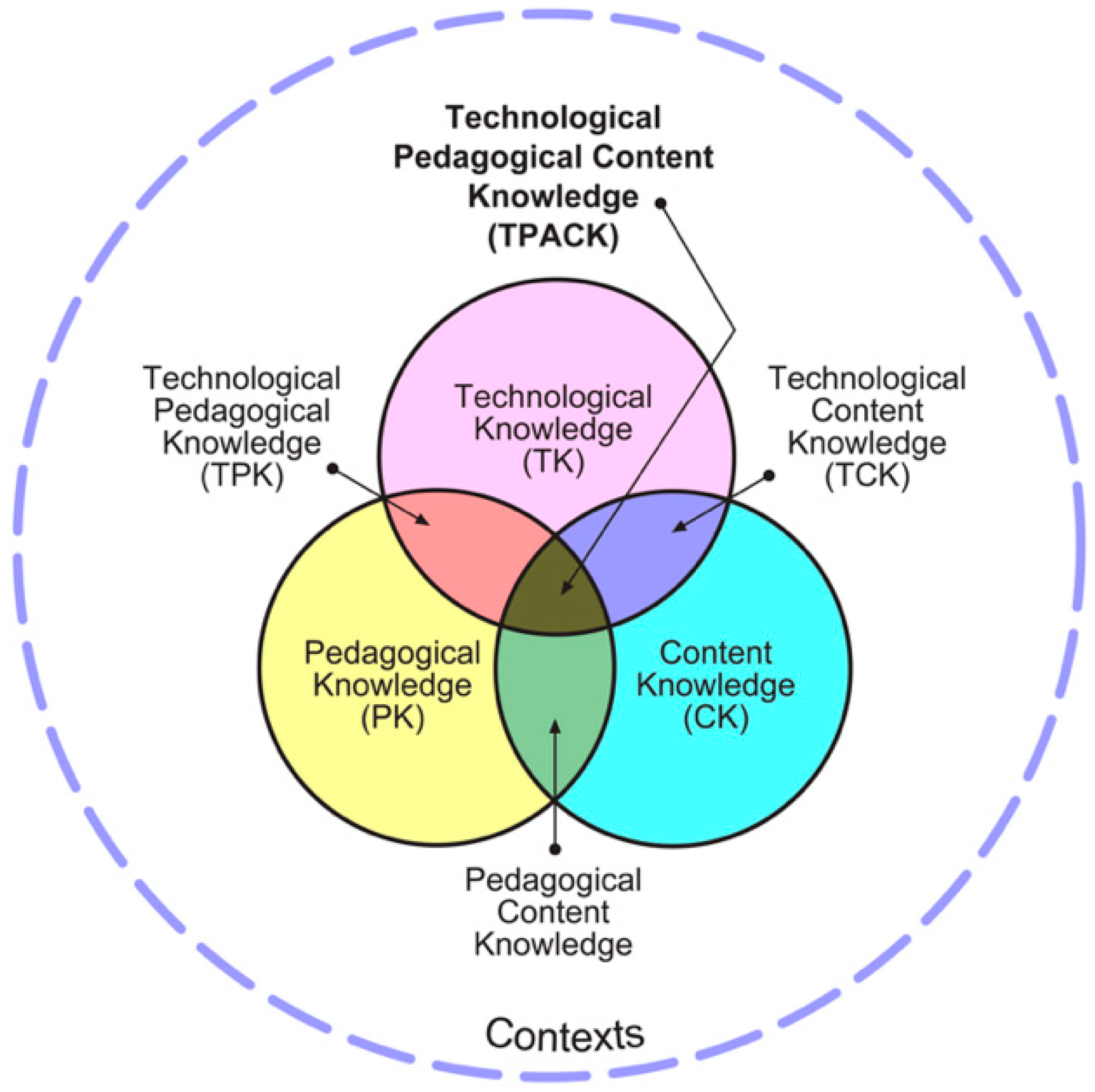
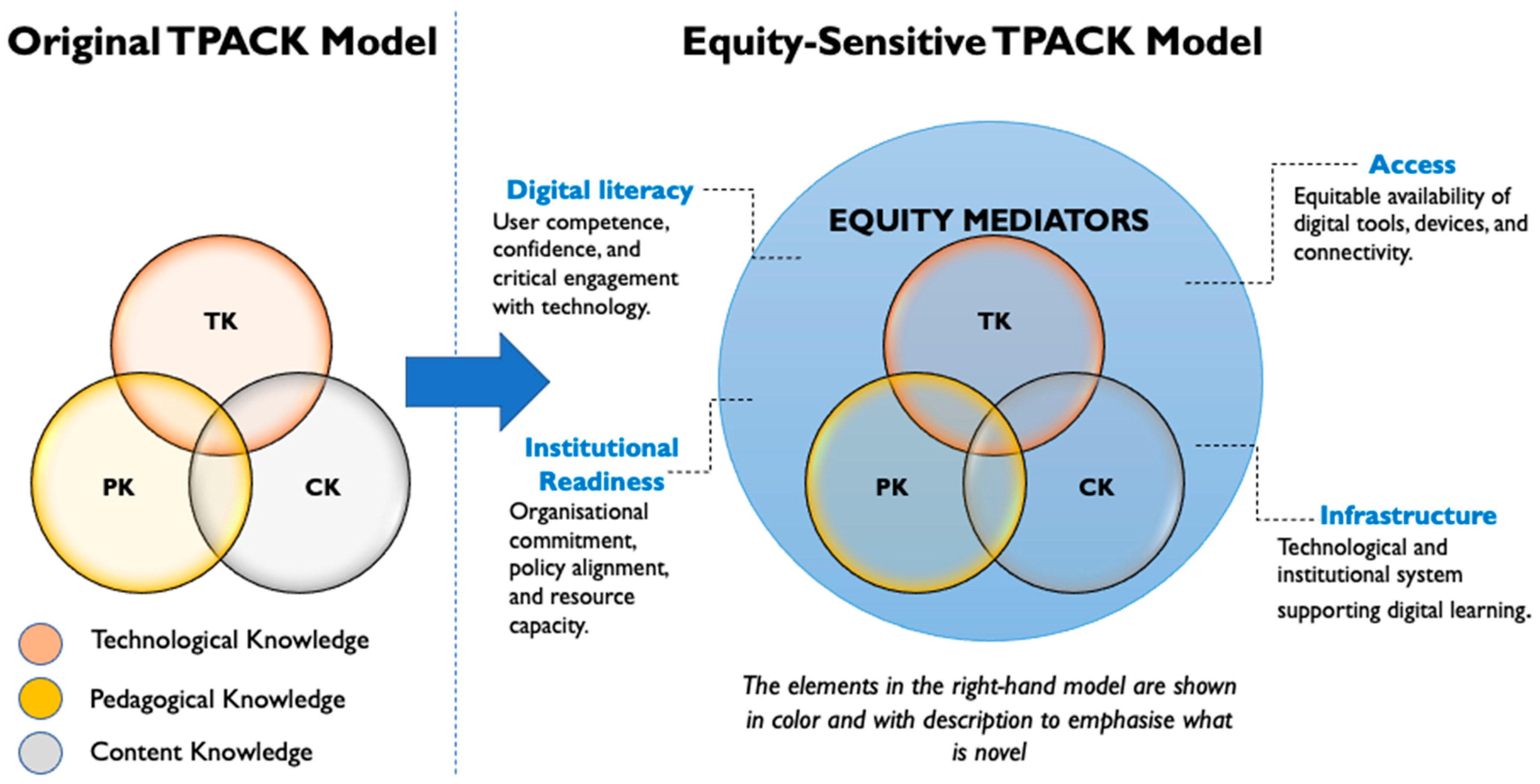
Moreover, this study extends the Technological Pedagogical Content Knowledge (TPACK) framework proposed by
Mishra and Koehler (
2006) into an “equity-sensitive TPACK” lens, emphasising inclusion and social justice as central to technology adoption. These contributions enhance comprehension of digital pedagogy in South Africa and provide applicable insights for polytechnics and vocational universities in other resource-limited environments globally. By applying the TPACK framework to UoTs, a relatively understudied institutional type, the study adds to the body of knowledge on digital teaching practices in resource-constrained higher education. Furthermore, it provides a basis for the creation of more inclusive and successful digital learning strategies. In doing so, the study further contributes to international debates on digital pedagogy by advancing an equity-sensitive TPACK lens, which repositions equity and inclusion as central rather than peripheral dimensions of technology adoption. This study will be structured as follows:
Section 2 will provide a conducted literature review.
Section 3 will present the methodology adopted for this study, while
Section 4 will provide the results and analysis of the study.
Section 5 will cover the discussions.
Section 6 provides implications for policy and practice, while in
Section 7 conclusions will be drawn, and limitations, future direction and research gaps will be considered.
4. Results and Analysis
4.1. Lecturers’ Experiences of LMS Adoption (RQ1)
In exploring the LMS experience and impact on teaching practice, the first question participants were asked was on “How would you describe your overall experience using the Learning Management System (LMS) at your institution?” In what ways has the LMS impacted your teaching practices?” The findings reveal a dual narrative whereby, on the one hand, the LMS is seen as a transformative tool for pedagogy, communication, and student engagement; on the other hand, infrastructural deficits, uneven training, and digital literacy gaps constrain its effectiveness. The overall tone, on the other hand, reflects optimism, with participants acknowledging the value of LMSs while calling for improved institutional support and equitable access.
The majority of participants viewed the LMS as a valuable tool for teaching and learning. It enabled resource sharing, communication with students, and the facilitation of online teaching. For instance, P3 highlighted the usefulness of the LMS in maintaining teaching continuity during disruptions, such as the water crisis, by allowing access to materials and discussions outside traditional classrooms. Similarly, P5 emphasised the positive impact of the LMS on student engagement, describing learners as receptive and enthusiastic about technology-mediated teaching. Even among those with limited prior exposure, the LMS was recognised as an enabler of pedagogical innovation and adaptability.
Despite these opportunities, participants consistently reported infrastructural and digital barriers. P1 stressed that limited infrastructure and inadequate digital literacy among students hindered the full utilisation of the LMS. P2 also reflected on initial challenges of insufficient training, lack of Wi-Fi access, and limited institutional support during the transition to online learning. These issues point to systemic barriers that affect both staff and students’ ability to integrate technology effectively. P2 indicated the following:
“My LMS experience I can say was both good and bad…it was good for me; it was a growth actually…. but we were not fully trained… and we didn’t have resources like data because I remember I had no Wi-Fi at home when we were told to go full online.”
(P2 Interview Excerpt).
Institutional support was described as uneven. P2 noted the lack of initial training and delayed provision of resources, which placed additional burdens on lecturers adapting to new systems. Conversely, P5 appreciated the institutional support received while also acknowledging that more improvement was necessary to fully empower lecturers. This suggests that while support structures exist, they may be inconsistent across departments and timeframes. Not all participants had direct or sustained experiences with the LMS. P4 admitted to relying primarily on traditional teaching methods and only engaging with Microsoft Teams during COVID-19, later realising it was not the official LMS. P4 explained:
“To be honest with you, I have not been using the LMS… during COVID I was introduced to online learning via MS Teams… but we were made to believe that MS Teams is not an LMS for MUT.”
(P4 Interview Excerpt).
Similarly, P6 acknowledged minimal experience, using Microsoft Teams primarily for presentations and material uploads during the pandemic. These cases highlight that LMS adoption remains uneven across the institution, with some staff still hesitant or lacking opportunities to fully engage. Despite varying levels of experience and challenges, there was an overarching optimism about technology in education. Participants such as P5 expressed enthusiasm about the potential of LMSs to align with the learning preferences of “a new generation of students”. Even P4, with limited usage, maintained a positive outlook, recognising that technology represents the future of higher education despite logistical constraints.
With regard to LMS for student learning outcomes, the question asked was, “Do you believe LMSs have enhanced student learning outcomes in your courses?” The findings illustrate that participants view the LMS as a platform that enhances access, flexibility, and student independence. Nevertheless, infrastructural limitations, inconsistent institutional practices, and student disengagement undermine its effectiveness. Despite these challenges, the responses reveal a growing optimism and gradual adaptation among participants, suggesting that LMS adoption, while uneven, is increasingly recognised as an essential component of modern higher education. Participants generally agreed that the LMS provides flexibility and convenience by allowing students to access learning materials at any time. P1 highlighted that this supports self-directed learning, enabling students to manage their studies independently. Similarly, P2 noted that the LMS fosters learner autonomy, allowing students to engage in learning activities without constant lecturer presence. P3 furthermore recognised the LMS as a vital alternative when physical classes were disrupted, particularly during the shift to online teaching. P1 and P2 said the following statements:
The LMS enables a student to access learning material at any time… which enhances flexibility and supports self-directed learning.
(P1 Interview Excerpt)
It’s improved… they are working alone more than working in front of a lecturer every day.
(P2 Interview Excerpt)
The LMS was viewed as a tool that encourages student independence and responsibility for learning. P2 emphasised that it motivates students to engage with content outside of traditional classroom settings, reducing over-reliance on lecturers. This aligns with broader goals of higher education to cultivate self-directed learning and digital competence among students. While participants acknowledged the benefits of technology integration, institutional practices and cultural factors were seen as barriers. P4 reflected on their decades of traditional teaching, noting generational resistance among some lecturers. They additionally described institutional policies that still heavily favour face-to-face teaching, which limits the scope of online learning. The account additionally revealed frustrations with institutional communication during disruptions, such as water shortages, where staff were abruptly instructed to move online without adequate preparation or consistency.
Despite the opportunities presented by the LMS, participants expressed concerns about student engagement. P6 reported that students sometimes disengaged during online classes, using the platform passively rather than interacting meaningfully with lecturers. Similarly, P1 mentioned that device accessibility, data affordability, and poor participation reduced the overall effectiveness of the LMS. These insights highlight the persistence of a digital divide and the pedagogical challenge of sustaining active engagement in online environments. Even with challenges, participants displayed a willingness to adapt. P4, who initially relied on traditional teaching methods, acknowledged the inevitability of technology and even expressed appreciation for online platforms during COVID-19. This openness suggests a gradual cultural shift among lecturers, even if adoption remains uneven across the institution.
For LMS tools and strategies for the personalised learning theme, the participants were asked a question: “What tools or strategies do you use within the LMS to personalise learning for your students?” The findings show that participants’ use of LMS features varies widely, ranging from advanced application of discussion forums and collaborative tasks to minimal reliance on content posting and announcements. While assessment and feedback functions are valued, some participants still prefer external platforms such as Microsoft Teams and email. Importantly, there is evidence of gradual progression in LMS adoption, with beginners acknowledging their learning curve and more experienced users demonstrating how the platform can support interactive, student-centred teaching.
Some participants described using a range of LMS features to cater to different learning needs. P1 reported employing discussion forums, quizzes, and assignment uploads to engage students through multiple modes of interaction. They also encouraged peer collaboration and feedback, reflecting a pedagogical orientation towards active and participatory learning. Assessment emerged as a central use of LMS platforms. P2 explained that they frequently assign tasks with deadlines and monitor student progress through the system. This indicates that the LMS is being used not only for content delivery but also as a tool for formative assessment and feedback, helping to track student engagement and accountability. Not all participants reported extensive use of the official LMS. P3 noted a preference for Microsoft Teams and email, which have become primary platforms for communication and teaching activities. This reliance on alternative technologies suggests either limited familiarity with the LMS or a perception that other platforms are more accessible or effective. For some participants, LMS adoption remains basic. P5, who described themselves as a beginner, reported mainly using the LMS for uploading course content and sending announcements. While their use is currently limited, there was recognition of the system’s potential to support two-way communication and further enhance teaching practices as familiarity increases.
The participants were additionally asked, “How effective is the LMS in facilitating communication between you and your students?” The findings suggest that while the LMS can be efficient for communication and interaction, its effectiveness is undermined by low student participation, infrastructural barriers, and reliance on external communication platforms. Participants themselves also exhibit varying levels of adoption, with some embracing collaborative tools while others limit their use to basic announcements. The overarching insight is that the LMS is perceived as more effective for lecturers than for students, reflecting a gap between institutional provision and learner engagement.
Most participants expressed concerns that LMS platforms are not fully effective in fostering student participation. P1 observed that many students prefer simpler communication tools such as WhatsApp or email, which require less digital competence, leading to low engagement in discussion forums and announcements. Similarly, P2 explained that while lecturers can efficiently upload materials and manage deadlines, students often fail to engage due to infrastructural barriers (lack of Wi-Fi, data, or devices) or a lack of digital readiness. Technical and resource constraints were repeatedly highlighted as undermining LMS effectiveness. P2 noted that student complaints about limited connectivity, absence of laptops, and data shortages were common, making online learning less reliable compared to in-class instruction. These barriers indicate that while the LMS is designed to promote inclusivity and flexibility, systemic inequities in access continue to limit its potential.
Perceptions of effectiveness varied between participants. P3 regarded the LMS as efficient for interaction during online classes, suggesting that with adequate use, it could facilitate meaningful communication. In contrast, P5 admitted minimal use of collaborative tools such as discussion forums, relying mainly on announcements and direct communication. This highlights the uneven adoption of LMS functionalities, where some staff view it as efficient while others remain at an introductory stage of use. A recurring theme is the preference among students for alternative, more familiar platforms like WhatsApp. As P1 explained, these tools demand less digital competence, making them more attractive than formal LMS features. This points to a mismatch between institutional tools and student practices, raising questions about how to align LMS adoption with existing digital habits.
4.2. Institutional, Infrastructural, and Personal Factors (RQ2)
For the question of “What kind of training or support have you received for using the LMS?”, the findings indicate that while training and institutional support are available, their quality and accessibility vary significantly across staff and students. Initial training was often superficial, with participants calling for continuous refresher sessions to keep up with evolving technologies. Institutional support centres such as TLDC were recognised as valuable, yet inconsistently experienced across departments. Moreover, delays in student training remain a critical barrier. Overall, participants underscored that sustained, equitable, and comprehensive support is essential for effective LMS integration.
Participants generally acknowledged that initial training sessions were provided, particularly during the transition to online learning in 2020. Conversely, P1 and P2 noted that these trainings were often introductory, offering only a surface-level overview rather than in-depth guidance. P1 emphasised the importance of refresher courses, as system updates and new features can quickly outpace users’ knowledge. Similarly, P2 described early training as insufficient and highlighted how only subsequent sessions provided meaningful confidence to use LMS tools effectively. This underscores the need for continuous, iterative professional development rather than one-off workshops.
Training experiences varied widely across participants. P3, for instance, had already acquired LMS skills at a previous institution, while P4 reported that their first training occurred only recently, limiting their ability to effectively engage students through the platform. The lack of consistency in exposure indicates that while training opportunities exist, access and uptake are not evenly distributed among staff. The issue of student training also emerged. P4 expressed concern that students had not been adequately introduced to LMS tools, with some cohorts potentially missing opportunities until their later years of study. This points to a systemic gap in institutional planning, where lecturer training is prioritised but student readiness is delayed, creating barriers to effective teaching and learning integration.
Participants expressed mixed views on institutional support. P5 described the Teaching and Learning Development Centre (TLDC) as highly supportive, providing workshops, one-on-one training, and interventions for both lecturers and students. In contrast, P6 reported only limited training exposure (focused on Blackboard), suggesting that while support exists, not all staff experience it equally. These perspectives highlight both the strengths of institutional support structures and the inconsistencies in their implementation. Despite uneven experiences, there was a shared recognition that training and institutional support are crucial for LMS adoption. P1 and P5 in particular stressed the importance of continuous professional development, whether through workshops or one-on-one interventions, to build confidence and keep pace with technological change. This reflects a broader awareness that institutional backing is central to successful digital integration in higher education.
Regarding LMS challenges, the participants were asked, “What are the main challenges you have experienced when using the LMS (technical, training, support, etc.)?” The findings reveal that LMS adoption is hindered by a combination of systemic and contextual challenges. Insufficient real-time technical support, unstable connectivity, limited device access, and disruptions such as load shedding undermine both teaching and learning continuity. Furthermore, unequal training provision, where lecturers receive more support than students, creates gaps in digital participation and engagement. Issues of platform usability and student disengagement further complicate the integration of LMSs. Collectively, these challenges underscore the need for institutions to provide equitable infrastructural support, strengthen immediate technical assistance, and ensure that both staff and students receive comprehensive digital training.
A recurring concern among participants was the lack of immediate and reliable technical support when encountering difficulties with LMS tools. P1 described frustration at having to navigate “long processes” to access assistance, particularly when the designated LMS manager was unavailable. This often-left staff unable to resolve urgent classroom issues, undermining confidence in digital platforms. While some, such as P5, reported positive experiences with the TLDC, these accounts highlight inconsistencies in institutional responsiveness and accessibility.
Almost all participants emphasised infrastructural barriers as a critical challenge. P1, P2, and P3 stressed poor connectivity, unreliable Wi-Fi in lecture venues and residences, and lack of stable network access as recurring obstacles. P2 in particular highlighted the dual challenges of insufficient data provision and the disruption caused by South Africa’s load shedding, which prevented both lecturers and students from maintaining consistent online engagement. P1 further noted the issue of device inequality, as some students lacked laptops or smartphones, complicating efforts to ensure inclusive participation. P3 highlighted the following:
“Yes, connectivity has been a major concern for some students. Some students will connect even if they are at home. So, it has a problem for them, and some of them do not have proper cell phones or laptops to connect so it does become a problem for some students.”
(P3 Interview Excerpt).
Beyond infrastructural factors, challenges further stemmed from student-related behaviours and readiness. P4 observed that students often logged in to platforms such as Microsoft Teams without actively participating, with some sharing devices in groups, making attendance records unreliable. Similarly, P5 stressed that while lecturers had received adequate training, students had not been given equivalent support, leading to difficulties in navigating LMS features and limiting the effectiveness of online pedagogy. Individual attitudes towards specific platforms further surfaced as a minor but relevant theme. P6 expressed a clear preference for Microsoft Teams over Blackboard, citing personal dissatisfaction with Blackboard’s usability. This highlights that LMS adoption challenges are not only infrastructural but also influenced by personal familiarity, comfort, and perceptions of user-friendliness.
With regard to resistance to adopting technology in teaching, the participants were asked, “Do you face resistance (from yourself or colleagues) to adopting technology in teaching?” Attitudes towards LMS adoption among academics reflect a spectrum ranging from outright resistance to cautious acceptance and eventual advocacy. Resistance is often rooted in generational factors, attachment to traditional pedagogy, and the fear of being displaced by technology. Structural gaps within institutions and the instability of constantly evolving platforms further hinder smooth adoption. Nonetheless, over time, some staff members have shifted from scepticism to recognition of LMS value, particularly in preparing students for digitally driven academic and professional environments. Notably, resistance also emerges in the form of caution, where participants acknowledge benefits but warn against undermining classroom engagement.
The majority of participants identified ongoing resistance among colleagues, often attributed to limited familiarity with digital tools and generational factors. P1 highlighted that some older academics, particularly those in their late 40 s and 50 s, feared that technology might replace traditional teaching practices. This resistance was framed as an attachment to conventional face-to-face methods, with participants preferring to “stand in front of the class and conduct lectures” despite the pedagogical shifts prompted by COVID-19. Similarly, P4 noted that some lecturers still relied exclusively on hard-copy materials, reinforcing the perception that “it is difficult to teach an old dog new trick.” These accounts suggest that resistance is not simply technical but deeply embedded in identity, habits, and professional comfort zones.
Beyond individual reluctance, resistance was also linked to a lack of institutional structures and clear guidance. P2 argued that the absence of formalised LMS policies and usage frameworks gave lecturers excessive flexibility to avoid engagement. Unlike physical classrooms with fixed timetables and equipped venues, online teaching lacked a “proper concrete structure that binds you” to incorporate digital tools. This lack of systemic enforcement meant that adoption was uneven and contingent on individual initiative, slowing institutional transformation. Resistance was also described as situational and linked to the rapid evolution of digital platforms. P3 admitted to moments of personal resistance when faced with upgrades or new features that were difficult to grasp. Although the participant emphasised openness to learning, the sentiment underscores how continuous technological change can produce uncertainty and reluctance, even among those generally willing to adopt new tools. Some participants described personal journeys from initial resistance to eventual acceptance. P5 recalled an early perception that LMS tools were unnecessary given the dominance of face-to-face teaching. However, he later recognised the value of these tools in supplementing instruction, preparing students for digitally integrated futures, and ensuring teaching continuity during disruptions. This shift reflects a broader narrative of adaptation, where exposure and necessity helped overcome initial doubts.
Finally, resistance was not always framed as rejection but as caution about unintended consequences. P4 expressed concern that if LMS adoption became too extensive, undergraduate students might avoid physical classes altogether, reducing face-to-face engagement. In contrast, the same participant acknowledged that postgraduate students, particularly working professionals, could benefit significantly from online flexibility. This highlights how resistance can sometimes represent a nuanced critique of balance rather than outright refusal.
4.3. Institutional Support, Training, and Inclusivity (RQ3)
With regard to LMS tools support for students, the participants were asked, “How well do LMS tools support students with disabilities or those from disadvantaged backgrounds?” The findings reveal a mixed picture of accessibility and inclusivity in LMS adoption. On the one hand, the system offers important benefits, particularly by providing exposure to digital technologies, enhancing flexibility for mobility-impaired students, and helping bridge socio-economic inequalities. On the other hand, significant challenges remain: the lack of built-in accessibility features for visually impaired or learning-difficulty students, inadequate institutional structures for sustained support, and limited lecturer awareness of inclusive tools. Inclusivity, therefore, is uneven; while LMS holds promise for disadvantaged groups, systemic and design shortcomings risk reinforcing existing inequities.
Concerns were raised about the extent to which current LMS tools accommodate students with disabilities. P1 argued that the platforms are “not compatible or user friendly” for visually impaired students or those with learning difficulties, emphasising a lack of built-in accessibility features. Similarly, P5 acknowledged limited awareness of LMS functions designed for students with disabilities, highlighting a gap in both system design and lecturer training. These accounts suggest that inclusivity remains underdeveloped in practice, particularly for students with specific impairments.
Despite these challenges, some participants viewed LMS as an important tool for exposing students from disadvantaged backgrounds to technology. P2 highlighted the benefits of students being introduced to digital tools early in their academic journey, framing this exposure as critical preparation for future employability. This participant further pointed to the support provided by student IT assistants, which helps to mitigate inequalities arising from limited device ownership or lack of digital skills. LMS adoption, therefore, was seen as a means of bridging the digital divide, even though structural disadvantages persisted.
In contrast, some participants did not perceive accessibility as a significant issue. P3, for instance, argued that LMS would not be problematic for students with disabilities provided they had the “right infrastructure”, such as laptops and internet connectivity. This perspective reflects an assumption that barriers are primarily infrastructural rather than embedded within platform design or pedagogy. LMS was additionally identified as particularly beneficial for students with physical impairments. P4 emphasised that online learning allowed wheelchair users and others with mobility difficulties to learn from home without navigating inaccessible campus infrastructure. This flexibility was described as “a huge blast” for such students, especially when compared to pre-COVID-19 circumstances where attendance at physical venues was compulsory. While some institutional mechanisms were in place to address inequities, their adequacy was questioned. P5 pointed to digital literacy training offered during orientation to support students from disadvantaged backgrounds but admitted that these efforts may not be sufficient without ongoing support. Similarly, P6 emphasised that LMS flexibility benefited students who were not funded by National Student Financial Aid Scheme (NSFAS), allowing them to study from home without incurring additional costs. These reflections indicate that while initiatives exist, more targeted interventions are needed to address both disability and socio-economic disparities.
For integration of LMS with other systems, several participants highlighted that the current LMS lacks effective integration with core university systems, particularly the Integrated Tertiary Software (ITS) used for grading and student records. The participants were asked, “How well does the LMS integrate with other systems (e.g., grading systems, communication platforms) at your institution?” P1 explained that marks must be captured manually from the LMS into ITS, a process that is not only time-consuming but also prone to human error and delays. Similarly, P3 confirmed that even when online tests are conducted, lecturers still have to manually input grades into ITS. These insights suggest that the absence of seamless system synchronisation undermines efficiency and accuracy in academic administration.
In contrast, P2 expressed a more positive view, noting that the coexistence of manual and digital processes creates a sense of balance and assurance. According to this participant, the ability to double-check records across platforms and use multiple channels for communication ensures that information reaches students reliably and provides lecturers with backup options. This reflects a transitional phase in which lecturers still find value in maintaining both systems concurrently. Some participants (P4 and P5) acknowledged limited personal engagement with the LMS for grading or integration-related functions. P4 had no experience in this regard, while P5 noted that LMS integration at the institution is still in its infancy. According to P5, institutional systems are not yet fully aligned with LMS platforms, partly due to the relatively recent adoption of these technologies. This participant emphasised the need for ongoing training and institutional commitment to enable full-scale integration in the future.
Despite current shortcomings, participants recognised growing institutional interest in advancing LMS integration. P5 expressed optimism that with increased adoption and use, universities would eventually prioritise alignment between the LMS and broader administrative systems. This indicates an awareness of the strategic importance of integration for the long-term efficiency of teaching, learning, and assessment processes.
Participants emphasised the importance of clear institutional frameworks to normalise LMS use. The question asked to participants was, “If you could improve one aspect of the LMS or how it’s used at your institution, what would it be?” They recommended that universities integrate LMS-based teaching into official timetables and workloads to avoid perceptions of online teaching as “less legitimate”. As P2 explained:
“If we can… combine it in our timetables… two hours face to face, two hours online, and it’s written down… no one will question whatever, because it’s written down.”
(P2 Interview Excerpt).
Such formalisation would provide transparency and reduce tensions between face-to-face and online modalities. The need for ongoing training for both staff and students was strongly highlighted. P3 stressed:
“I think it will be continuous training for staff, especially as we know that each technology changes every time.”
(P3 Interview Excerpt).
Similarly, P4 underscored the importance of phased training, recognising that many lecturers still “need to crawl before they run”, while students also require support to navigate LMS tools effectively. Several participants raised concerns about insufficient support services and infrastructure. P3 suggested the creation of a responsive helpdesk, while P5 argued for decentralised support:
“If they can also decentralise it to faculties so that colleagues can find the support within easy reach… that can also improve the uptake on the side of lecturers.”
(P3 Interview Excerpt).
In addition, issues such as poor internet connectivity, lack of devices, and reliance on mobile phones remain barriers to effective LMS engagement (P4). While most participants acknowledged the benefits of their current LMS, some felt restricted by the institution’s insistence on a single platform. P5 noted:
“The university seems to be tied up with only one LMS… if it can also support those who are willing to use Moodle… maybe the second one as well.”
(P5 Interview Excerpt).
This suggests a call for greater flexibility in allowing multiple LMS solutions, or at least interoperability, to accommodate staff familiar with different systems. Participants also pointed to the need for investment in resources to ensure equity of access. P4 highlighted students’ reliance on mobile phones and the importance of providing laptops, while P6 directly pointed to “resources” as a priority.
7. Conclusions, Limitations, Future Directions and Research Gaps
This study explored lecturers’ lived experiences of LMS adoption in a South African UoT using an interpretative phenomenological approach. By extending the TPACK framework through an equity lens, the study contributes to both theory and practice in inclusive educational technology. The equity-sensitive TPACK framework foregrounds access, infrastructure, and institutional readiness as critical mediating factors in technology integration, offering an actionable lens for promoting digital equity in higher education. While limited to one institution and a small sample, the study provides idiographic depth that illuminates broader systemic challenges across the Global South. Future research could test and refine the equity-sensitive TPACK model across diverse institutional contexts and explore its application in student and administrative experiences of LMS use.
This study, while providing valuable insights, is subject to several limitations. First, the research was conducted within a single UoT, which limits the generalisability of the findings to other South African higher education institutions, particularly traditional universities and comprehensive universities that may have different resources and cultures of technology adoption. Second, the small sample size (six lecturers) restricts the breadth of perspectives captured, though the phenomenological approach justifies depth over breadth. The scope of the study was limited to one faculty in a single UoT, with a small sample size and no triangulation. While these factors limit generalisability, they are consistent with the idiographic focus of IPA, which prioritises depth of understanding over breadth. Third, the study relied on self-reported data from semi-structured interviews, which may be influenced by personal bias, selective recall, or socially desirable responses. Finally, the study primarily focused on lecturers’ perspectives, excluding other stakeholders such as students, administrators, and IT support staff, whose experiences could have provided a more holistic understanding of LMS adoption.
Future research should adopt a multi-institutional design across diverse UoTs and traditional universities in South Africa to capture comparative insights and enhance external validity. Expanding participant groups to include students, administrators, and policymakers will provide a comprehensive view of LMS adoption dynamics. Future studies should compare LMS integration across multiple UoTs and between UoTs and traditional universities, both within South Africa and across the African continent. Such research would highlight contextual differences in institutional readiness and provide insights into scalable strategies for digital inclusion. Additionally, longitudinal studies are needed to track the evolving role of LMS over time, especially in light of rapid technological change and the increasing prominence of blended and hybrid learning models. As universities increasingly experiment with AI, adaptive learning systems, and mobile-first platforms, future research should explore how these innovations can complement or complicate existing LMS platforms in resource-constrained environments. For instance, AI-driven analytics may enhance personalised learning, but their success depends on reliable infrastructure and data governance policies. Methodologically, future research could combine qualitative approaches with quantitative surveys or learning analytics data to triangulate findings and provide stronger empirical evidence on the impact of LMS use.
Several gaps emerge from this study that warrant further exploration. First, while the findings reveal infrastructural and digital literacy challenges, there is limited understanding of how these barriers specifically shape student learning outcomes over the long term in UoTs. Second, the role of emerging technologies, such as AI, adaptive learning tools, and predictive analytics, in augmenting LMS effectiveness within resource-constrained contexts remains underexplored. Third, there is a paucity of research on inclusive design and accessibility of LMS platforms for students with disabilities and disadvantaged backgrounds in the South African context, despite its importance for equity. Finally, while institutional policies and support structures are recognised as critical, little empirical work has systematically examined the relationship between policy frameworks, institutional culture, and lecturers’ TPACK configurations in shaping technology adoption at UoTs.