1. Introduction
In the last three decades investigation of linguistic landscape (LL) has been among the fastest growing subfields of sociolinguistics. One reason for this is that the amount of text in urban spaces keeps growing. Secondly, globalization and mass migration lead to a superdiversity of urban populations and widespread multilingualism. Finally, there is a growing realization that LL reflects how language functions in the complex society of the 21st century, how the global and the local are intertwined, reflecting and affecting local language policies, and interactions or an absence of these among different ethnic and social groups. Numerous projects studying LL in various countries are based on rich empirical material and use different theoretical frameworks and approaches (
Han & Shang, 2024;
Laitinen & Zabrodskaja, 2015;
Milak, 2022;
Moustaoui Srhir, 2013). Most of them rely on the definition of LL formulated in
Landry and Bourhis (
1997), “The language of public signs, advertising billboards, street names, place names, commercial shop signs, and public signs on government buildings combines to form the linguistic landscape of a given territory, region, or urban agglomeration” (
Landry & Bourhis, 1997, p. 25). This definition presents LL as static, although in the contemporary city it also includes moving objects: there is advertising on vehicles, video screens with running lines, car stickers and texts on pedestrians’ clothes and accessories (
Marten et al., 2012).
The kaleidoscopic nature of LL research may be viewed as a disadvantage; on the other hand, a multitude of research frames and perspectives adopted by sociolinguists can be viewed as markers of the field’s vitality and fast development. A fascinating quality of LL is its dynamism: while some signs remain unchanged for decades, others, like advertising posters, are short lived (e.g.,
Guarín, 2024;
Maharani et al., 2025;
Mei, 2024;
Syrjälä et al., 2024;
Zhu & He, 2025). Graffiti, in particular, exemplify frequent transformations, sometimes presenting ongoing conversations between their multiple authors.
There is a consensus among sociolinguists that the study of LL may be beneficial for language learning at various levels, from primary school to tertiary courses; yet, until recently, articles dealing with LL in language pedagogies were rare. So, the publication of several monographs on the subject is very useful, all the more so that they bring together educators and sociolinguists, ethnographers and psychologists, political scientists, and geographers from numerous countries in the West and in the East (see
Dubreil et al., 2023;
Gorter & Cenoz, 2025;
Krompák et al., 2022;
Melo-Pfeifer, 2023;
Solmaz & Przymus, 2021). While these monographs and multiple journal articles explore the potential of using LL for in-class and out-of-class activities, few studies report on specific projects that have been implemented and could help teachers prepare their own teaching materials and avoid pitfalls of probing new approaches in the area that was not traditionally applied in teaching. Notably, an insightful chapter devoted to LL in the
Oxford Handbook of Language and Society and published in 2016 does not dwell on the use of LL in pedagogy at all (
Van Mensel et al., 2016). Nevertheless, in recent years the pedagogical dimension of LL studies has begun to take shape (
Hasanah et al., 2023;
Malinowski et al., 2021;
Morlan, 2024).
2. Goal and Rationale: How Aware Are Students and Teachers of the Linguistic Landscape?
Many laypeople hardly ever pay attention to the language use in their city. Signs on their usual routes—from home to work, local shopping centers and favorite places of entertainment—are so familiar that they do not draw attention unless dramatic changes occur. According to the author’s personal communication with numerous teachers and researchers, some language professionals do not pay attention to the use of language in town either. Studies reporting on projects conducted with students, future language teachers and translators clearly show that such deviations from traditional teaching were appreciated by the students but were difficult for them, particularly in the stages that required autonomous decisions and creativity (see
Chesnut et al., 2013;
Wangdia & Savski, 2023). Despite the growing interest in the use of LL as a pedagogical tool, projects conducted in the framework of teacher-training programs are relatively rare, although they could be an important resource expanding professional knowledge in three directions: pedagogical and didactic, linguistic and communicative, and ethical and political (
Andrade et al., 2023). Probably, it is the latter dimension that slows down the proliferation of these projects in teacher training, particularly in the regions where language competition and inequality is an acute political issue. Another reason why even teachers who are aware of the potential benefits of LL projects refrain from incorporating them into their courses is time constraints—such projects are time consuming and would reduce time allocated for covering material included in the curriculum (see, e.g.,
Tsoninets, 2025). Moreover, for some language teachers it may be difficult to deal with the signs that are not written in “perfect” English. Orientation to the norm, as exists in the inner circle of Englishes (
Kachru, 1989), and perception of the regional versions as faulty, are still strong in many countries (see
Shang & Xie, 2020). It requires a change of teaching ideology to make use of alternative literacies that are present in the LL of non-English speaking countries. However, documentation of clear-cut mistakes can be used in teaching as an exercise explaining what is wrong in the morphology or syntax and proposing variants of error correction.
The choice of subject for this article was prompted by the need to expand the repertoire of tasks included in EGAP courses which would promote student-centered learning, bring language acquisition closer to real-life situations, and increase learner motivation (
Robinson, 2011). The goal of the reported project was to analyze scholarly literature devoted to the use of LL in language learning, create teaching materials for students majoring in science and technology that would be used for pair- and group-work, analyze how studies of LL would help develop students’ observation skills and critical thinking, and discuss benefits and problems that can come up. The author’s dual experience of a researcher and instructor, as well as discussions with colleagues, suggested that the study of LL is relevant for the target audience because it should raise the students’ awareness of social and humanitarian role of language, which may be less developed in the students of science and technology than in those majoring in social sciences and humanities. The project also aimed at working out pedagogical strategies that would encourage students to reflect on the multilingual realities of urban life, analyze the role of written language in structuring urban life, and try their hand at creating their own signs.
Two research questions guided work on the project:
How can class activities be combined with students’ research in the field?
How can task-based activities directed at the study of LL stimulate students’ awareness of multilingualism in the life of contemporary cities?
3. Literature Review: Language Pedagogy Between the Classroom and Lived Space
Immersion in the environment of the studied language and practicing it beyond the classroom, as well as familiarization with the culture or cultures of a target language, are essential components of the language learning process. However, within the framework of traditional linguo-centric pedagogy, the opportunities for immersing students in natural communication situations in a new language are limited (
Chesnut et al., 2013;
Sayer, 2010). As already mentioned, LL can become a subject of study for schoolchildren and students, as well as for adults (migrants or those learning new languages for personal development and enjoyment).
Cenoz and Gorter (
2008) list how studying LL can be beneficial for language learning: observations of LL in one’s own or another city sharpen observational skills and mobilize language awareness. Considering technological advances of the last decades, some researchers advocate expanding the data to be studied to the Digital Linguistic Landscape (DLL). Thus, Yang and Zhang point out that social media, online learning communities, video channels and other resources form a dynamic, cross-cultural and multilingual reservoir of language input which is not restricted to physical places. It is multimodal and goes beyond geographical and cultural limits (
Yang & Zhang, 2025). Students develop pragmatic competence by analyzing texts and multimedia ensembles with different social functions. Since modern LL is multimodal, students acquire skills in integrating different modalities to extract information. There is also the development of multifaceted competences related to the necessity of manipulating languages interacting in the students’ academic and everyday realities. Studying LL is not limited to improving the students’ communicative skills in the target language but also mobilizes other languages that make up their linguistic repertoire. When analyzing LL texts, it is meaningful for teachers to draw students’ attention to the symbolic function of language and to analyze how it interacts with the instrumental function through the use of connotations and rhetorical devices. Finally,
Cenoz and Gorter (
2008) point out that studying LL also leads to “incidental” or unintentional language acquisition.
As
Huebner (
2016) notes, at the linguistic level, studying LL helps learners focus on lexical borrowings, syntactic structures, phonological adaptations, and the use of rhetorical devices such as assonance, alliteration, metaphor, and personification.
Camilleri-Grima (
2020) remarks that LL gives many examples of polysemy, which made her students discuss which meaning of the word sign owners have in mind. Polysemy gives opportunities for interpretation, and in case of ambiguity makes the reader figure out whether it is unintentional or deliberate and demonstrates how language can be manipulated for social reasons. In the experience of the present author, LL investigating tasks should include glossaries of the terms relevant to class discussion and field notes if recording observations and experiences in town is part of the assignments. Discussion of advertisements on billboards can also bring up the topic of persuasive language and fashion in forms of expression.
LL can be viewed as a text that connects the studied language and culture with local customs and history. Incorporating LL into foreign language lessons enhances the interaction of linguistic, symbolic, communicative, and ideological aspects of language study (
Bever & Richardson, 2020). It is a break away from form-focused, socially blind language education practices (
Wangdia & Savski, 2023).
When asking students to record instances of bi/multilingual signs, it is vitally important to draw their attention to the issues of power and prestige which are manifested in the prominence of the position of each language, the size of the fonts, and the amount of information provided. Encouraging students to note such details makes them engage with issues of sociolinguistic inequality in a reflective manner (
Wangdia & Savski, 2023). The type of font used also matters: the teacher may ask whether it is standard or stylized. Thus, for Slavic languages one might use Ustav, Glagolitic, Cyrillic, Gothic, Latinized, calligraphic, cursive, comic, author-designed, cyberpunk, etc. (see, e.g.,
Chernyh & Raspopova, 2020). Students can also do exercises involving changing fonts, stylizing Latin letters to resemble other scripts, e.g., Arabic, Hebrew, or Farsi characters. We can come across instances of writing one language using the script of another (e.g., Russian is frequently transliterated with the help of Latin script when users do not have a keyboard with Cyrillic characters). Today, it is popular among the young to mingle letters with figures when writing brief messages in English. Students can be asked to create such messages, and exchange them for decoding. Such exercises can serve multiple pedagogical purposes. First, they foster an awareness of script and typography as culturally and historically situated phenomena rather than purely technical means of writing (cf.
Collin, 2011). In addition, these activities develop visual literacy by training students to attend to the structural and stylistic features of written signs and to understand how visual form contributes to meaning-making in public space. Engaging with alternative scripts or stylized fonts further enhances intercultural sensitivity, as it foregrounds the symbolic and identity-related dimensions of writing systems. Furthermore, tasks involving the creation or transformation of fonts cultivate creativity and design thinking, encouraging students to experiment with form, rhythm, and composition. Finally, working across scripts helps students better grasp the relationship between sound and graphic representation and reflects how typographic choices shape the perception of a text. Collectively, these activities strengthen learners’ ability to interpret and critically analyze the LL in their environment.
Observing LL in various public places not only accompanies language acquisition but also immerses students in the linguistic ecology of the chosen object, allowing them to recognize the linguistic and cultural diversity of the modern city. It fosters the development of critical thinking and a critical view of society if students are encouraged to think about who/what is included in LL and who/what is excluded from it, who is discriminated against, and how this is manifested in LL (
Shohamy, 2018). Is the city divided in such a way that there are well-designed and attractive areas affordable only for the affluent, and others that are shabby and neglected, and therefore populated by socio-economically disadvantaged populations? Is there a division into neighborhoods inhabited by specific ethnic groups? Some behavioral rules formulated in LL by authorities may cause protest in city residents. How do unsanctioned posters, internet parodies and graffiti express them? (
Yelenevskaya, 2024). Is multilingualism more widespread in signs of state institutions or commercial enterprises? In what signs are we likely to see interlingual puns? Students majoring in science and engineering are responsive to the tasks that will make them search for indicators of technological developments. They might come across signs prohibiting the use of drones in parks, and selfie-sticks in museums, as well as signs in underground stations informing people with pace-makers which ticket-barrier it is safe for them to use.
Studying LL allows for the raising of important social questions of acceptable behavior and responsibilities, and sociolinguistic questions such as individual and collective identity (
Protassova & Yelenevskaya, 2024), social status, and the relationships between ethnic groups, as well as the language policy that is declared and practiced (see
Protassova, 2021;
Yelenevskaya & Fialkova, 2017).
Shohamy (
2018) suggests discussing with students whether they can affect the inequalities and injustices regarding different groups that they observe during their fieldwork. On the one hand, these themes are not directly related to language acquisition; on the other hand, they give students an opportunity to discuss subjects essential for young people’s identity development and social positionality in the target language. This type of activity requires the tact of the teachers and sometimes even boldness in regions where interethnic relations are a sensitive issue. Moreover, teachers should be aware of the risks of cultural, geographic, and ethnic overgeneralization and stereotyping as students do fieldwork (
Malinowski, 2016).
Students become familiar with the hierarchical division of signs into top-down, i.e., those issued by authority structures or large commercial enterprises, and bottom-up, which are authored by small business owners and private individuals. It is also useful to show the division of signs into regulatory signs—those that enforce traffic laws and behavioral rules in public places, e.g., on playgrounds, in museums, libraries, etc.)—and informative signs pointing to specific buildings, indicating on which floors different hospital departments are located, and giving working hours of government institutions and commercial enterprises, and others. This division of signs is related to semiotics of colors. The “grammar” of color in LL is not merely a matter of aesthetics. It is vitally important in everyday life. Colors in the road and city signs follow well-established conventions, with red and black signaling prohibition and warnings while green and blue being informational and directional. If these conventions were changed without prior notice, accidents could occur because people would be confused. Color combinations that do not follow the accepted conventions fail to communicate the intended message (
Caivano, 1998).
Students can be asked to trace the stylistic differences of these signs and suggest their own taxonomy of signs based on different criteria (see
Ben-Rafael et al., 2006). While pedagogical activities involving the study of LL focus on printed or handwritten language in display, it is also useful to draw students’ attention to the multimodality of LL, which is manifested not only in visual but also in audio signals (e.g., the sounds of songs coming from windows of restaurants and apartment houses, conversations of shop-owners with clients and exchanges between passers-by), and even smells emanating from various eateries owned by immigrants.
LL will enable learners to analyze how English words are incorporated into the dominant language of their city. Do they preserve the same form or are they domesticated by the addition of affixes and form derivatives? LL will prompt young researchers to reflect on the types and levels of literacy in society (
Blommaert & Maly, 2014). Texts that surround us in the city can be used to study alternative literacies and elements of regional versions of English. Teachers can also use violations of the norm established in the countries of the Inner Circle to practice correcting spelling and syntactic mistakes and discussing linguo-pragmatic missteps. Collections of inscriptions with faulty English recorded in different countries have circulated on the Internet for many years and are used by educators. It is also important for student-researchers to pay attention to the materiality of LL: the type of material used to make signs and advertisements, their dimensions and surroundings, such as their placement at the entrance of institutions, or on the façade of the buildings they occupy, on the specially installed notice-boards, or on fences, electricity polls, mailboxes, etc. (see
Aronin, 2018;
Jaworski & Thurlow, 2010).
From a practical perspective, incorporating LL into the English-language curriculum poses no significant difficulties, as even in countries where the majority of the population do not speak English and it is regarded as ideologically foreign, it is nevertheless used in LL. Students can visually confirm the high prestige of the English language. In Europe and many Asian countries, English is often used as a lingua franca in official contexts: in public transportation, in museums and in warning signs. Students can analyze when its use predominates in an instrumental function of conveying information, and when its presence is mostly symbolic, marking the city’s and business’s involvement in the global economy and its actual or desired presence on the international arena.
LL study projects include activities such as photographing objects, conducting interviews with business owners and passers-by, creating maps/plans of observed areas, studying historical documents, keeping fieldwork diaries or blogs, and writing reports. A variety of tasks that students receive in LL projects indicates the development of skills that are not always directly related to language acquisition, but since the tasks are performed either exclusively in the target language or combine the native and target languages, they foster the development of multilingual practices. In fact, one of the challenges for language instructors is the need to accept and welcome hybridization of their own curricula and teaching practice through the blending of acquisition of linguistic knowledge with the knowledge of other disciplines, such as geography and history (
Malinowski, 2016).
In sum, incorporating LL into language education expands the scope of traditional pedagogical approaches by situating language learning within authentic, multimodal, and socially meaningful environments. LL-based activities provide learners with opportunities to observe, analyze, and interpret language use as it manifests itself in public space, thereby strengthening linguistic, pragmatic, and intercultural competencies. They also allow students to engage with issues of power, identity, and social inequality, encouraging a critically informed understanding of how languages coexist, compete, and interact in contemporary societies. By fostering visual literacy, creativity, and reflective fieldwork practices, LL projects support the development of skills that transcend narrow linguistic objectives and contribute to learners’ broader intellectual and civic growth. Ultimately, the integration of LL into the curriculum highlights the interconnectedness of language, culture, and social life, offering a pedagogical framework that is adaptive, multilingual, and responsive to the complex realities of the modern world.
4. Methods
This article presents a case study. Following
Simons (
2009) and
Thomas (
2011), a case study in education is viewed here as an in-depth analysis of a project, program or pedagogical method investigated from various perspectives in order to understand its complexity in a specific context.
Merriam (
1998), cited in
Brown (
2008), posits that the process of data analysis in qualitative case studies is intuitive, and the learning is in the doing. This, however, does not free researchers from systematically recording evidence and managing it, i.e., providing reflective explanations.
Stake (
2005) states that most case studies are the empirical investigation of human activities, and the most important role of the case study researcher is to describe and interpret activities being studied. Stake is convinced that case study researchers aim to pass along to readers some of their personal meanings of events and relationships which they observe but may fail to pass along others. Moreover, the reader will not take these meanings for granted, but will add, subtract and connect ideas differently. The more the reader works on his/her interpretation to suit his/her previously received knowledge and understanding the more useful it will be (
Stake, 2005, p. 455). A case study report should provide the reader with a clearer view of the phenomenon under study through interpretation of situations and contexts. While cases themselves do not claim to be typical—in fact, outliers can be as interesting—they can encourage readers to make comparisons.
Brown (
2008) believes that case studies provide a humanistic, holistic understanding of complex situations, and as such are valuable research tools. While the scope of a case study is bounded and the findings can rarely be generalized, it can provide rich and significant insights into events and behaviors.
Case studies of pedagogical LL projects show that students become acquainted with the fieldwork—a research method in which investigators collect data directly from real-world settings rather than relying only on documents, lab experiments, or secondary sources. It is widely used in disciplines such as anthropology, sociology, geography, education, public health, and environmental studies (
Irgil et al., 2021). Fieldwork captures social, cultural, environmental, or organizational contexts that may be invisible in controlled or laboratory settings, while fieldwork immerses students in the natural environment of the people, community, or phenomenon being studied. The interdisciplinary procedures applied in fieldwork may include participant observation, interviews, field notes, mapping and spatial data collection, audio/visual documentation, material or ecological sampling. This helps students understand behaviors, practices, and meanings in their natural context, develop in-depth, qualitative insights, ground theories in lived experience, test real-world applicability of prior theories, observe processes as they unfold, not only their outcomes, and ascribe real-world relevance to their findings (see a detailed study of applications of fieldwork in education in
Delamont, 2016).
The subject chosen for a case study has to be interesting or unique, and the novelty of LL in language pedagogy makes it interesting and worthy of exploration. In the typology of case studies proposed by
George and Bennett (
2005), the one reported here represents a “configurative idiographic case study,” i.e., an illustrative study that does not aim to develop theory. At the same time, it also has features of a “plausibility probe”—a preliminary study that should help practitioners determine whether the proposed class and extra-mural activities are feasible and potentially useful in the context of their institution.
The study reported in this article is descriptive and illustrative, and is based on the ethnographic diary of the author that documented different stages of teaching material preparation, analysis of students’ classwork and research in the field, and discussions with colleagues who also incorporated tasks and projects to analyze local LL and “anglicize” it.
In some sense, every pedagogical experience is practice in phenomenology. Whether we prepare our own teaching materials, conduct discussions with students, observe their individual and group activities, evaluate their work, or make entries in diaries, we recollect, practice and interpret, relying on our own subjective experience. According to Eberle, phenomenological analysis can be applied not only in order to find the universal, invariant formal structures of the life-world, but also to research specific socio-cultural contexts and situations. Thus, it is specific about the phenomenological method that the subjective experience of the researcher in the field (in our case, classroom and beyond) is used explicitly and reflexively as an “instrument” of data generation and collection (
Eberle, 2014).
5. Materials, Participants and Procedure
The project reported in this article was conducted in summer 2025 at the Guangdong Technion–Israel Institute of Technology, which is an English-language university. Students come from different cities of China. All of them consider Mandarin as their L1, and some of them are exposed to local dialects in informal communication at home. They all studied English at school, and depending on the scores in the foreign language section of the National College Entrance Examination (Gaokao), applicants enrolled in BA programs have to take from one to three semesters of English. The project was conducted in the framework of a preparatory semester with students at B1 level. Most of them were hard-working and highly motivated. The course is project based and is aimed at preparing students for academic work in English, developing all language skills and placing emphasis on the productive ones. Speaking and aural comprehension present particular difficulties for many students due to a lack of opportunity to communicate in English in formal and informal settings.
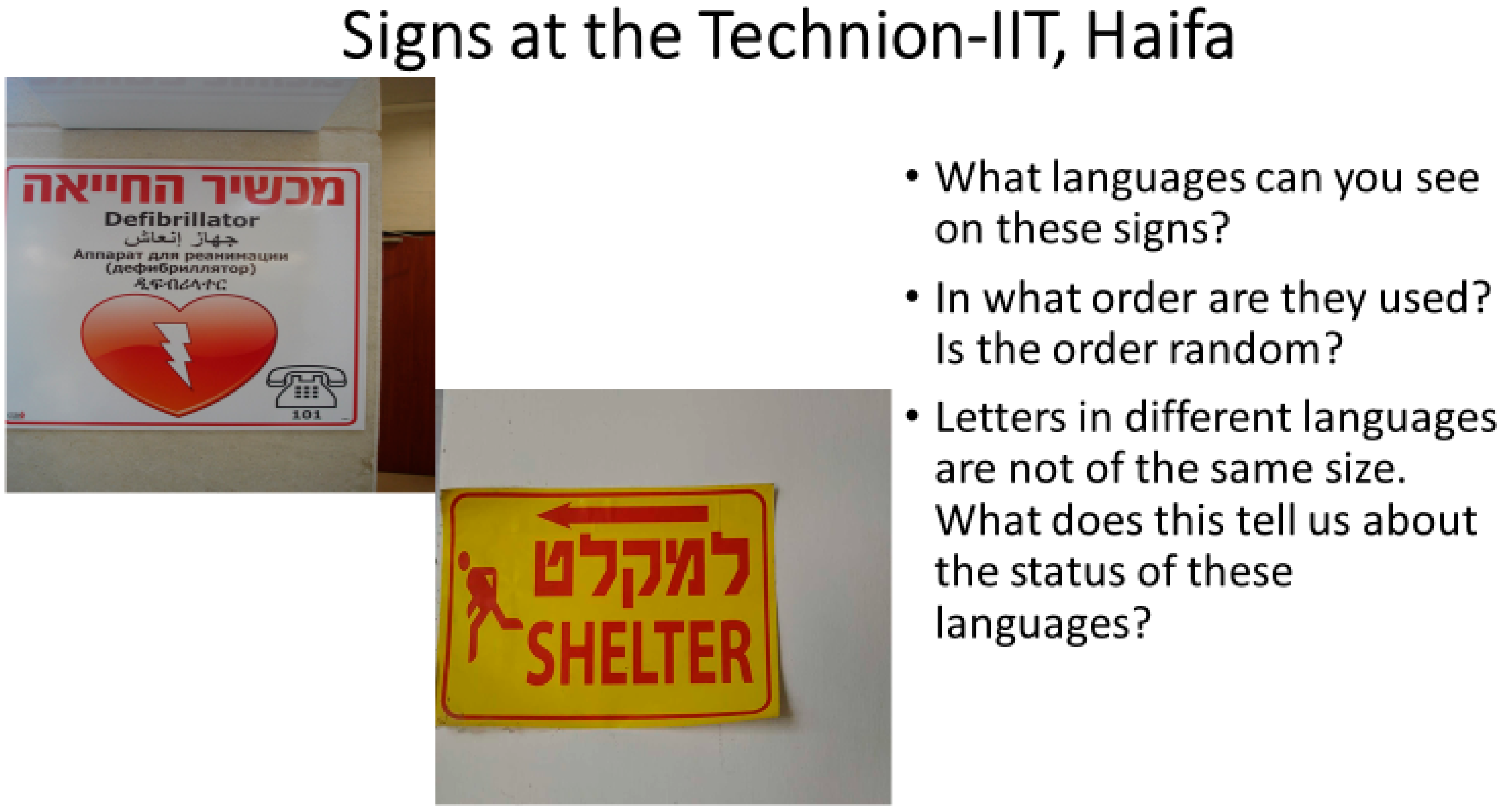
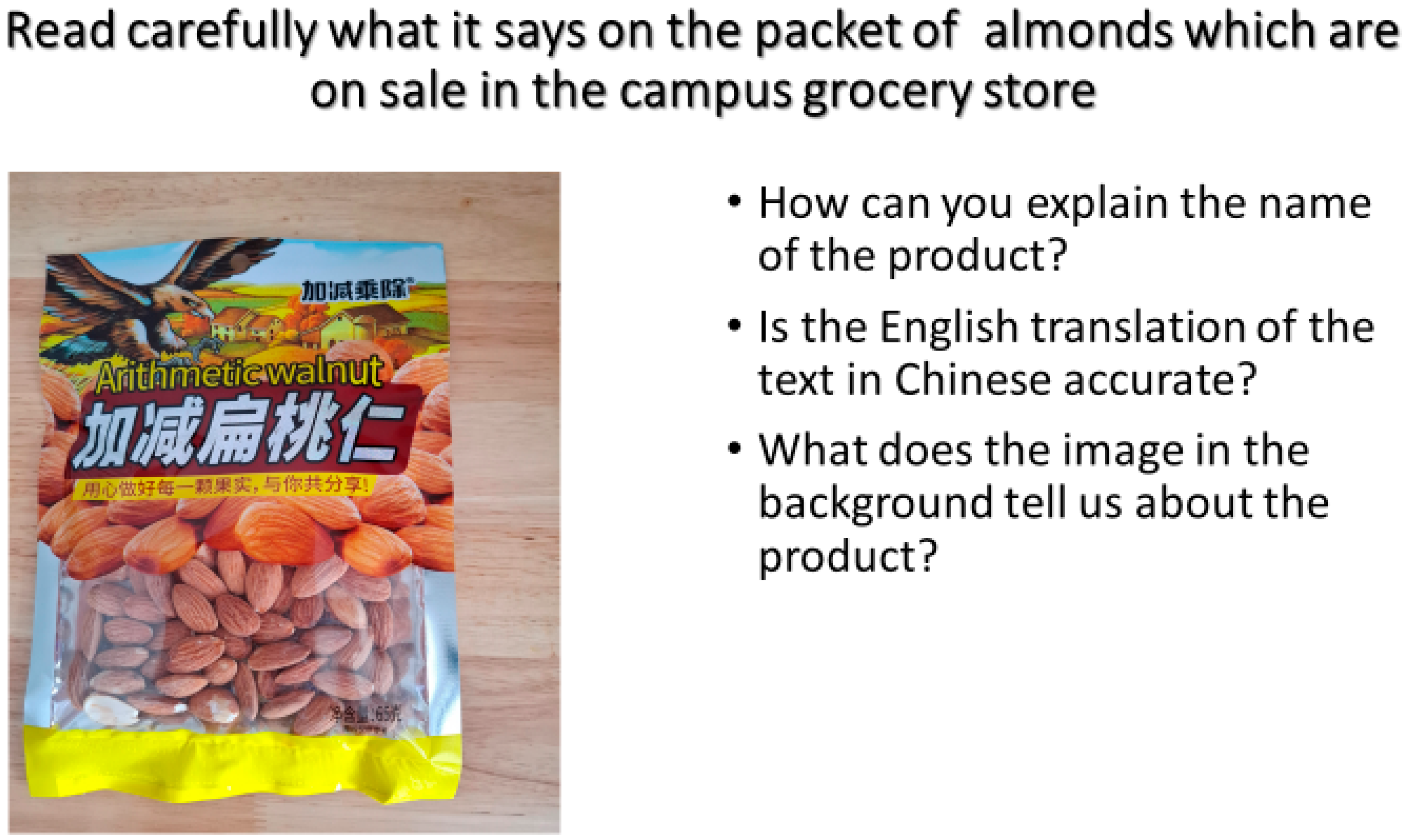
Work on LL was part of the project on the benefits of multilingualism, which included reading and analyzing texts, watching and discussing videos, essay writing, and discussions in small groups. The project lasted for 10 days, and included five hours of class time, fieldwork (approximately 2 h), and home assignments. Individual students communicated with the teachers online asking questions and consulting how to best express their ideas. An important purpose of the project was to design LL tasks enabling students to practice both receptive and productive skills. As the first step, the author prepared a short review of literature on LL for the colleagues and compiled an introductory text for the students. After discussing the concept of LL, the role of written text in contemporary cities, and how studying LL can help us understand social realities, the classes participating in the project watched and discussed a PowerPoint Presentation that included photos from the author’s archive (some of the slides from this PPT are used as illustrations here). The pictures were taken in 10 different countries and covered a wide variety of top-down and bottom-up signs. The PPT was supplied with commentaries explaining where, when and under what circumstances the pictures were taken. It also included questions for the students asking them to interpret what they see on the slides and share their own experiences in “reading the city.” (see
Figure 1).
The students were asked to look for elements of multilingualism in the dorms, in their homes, and shopping centers, and report the results in class. Afterwards, over 150 students in six classes participating in the project were divided into small groups, and each had tasks of preparing signs in English that would make it easier for foreign guests of the university to feel comfortable on the campus and in town. Among the themes they could choose were
Instructions for readers of the university library;
A menu for the university canteen;
Explanations of waste disposal rules on the campus;
An appeal to the students and staff to keep the campus clean and orderly;
Signs to be hung in the university sports center;
Signs in a bookstore;
Signs in a toy and game store;
Invitation to a new restaurant serving healthy foods;
Signs for the campus grocery store;
Instructions for ordering food online;
Signs for the local art museum.
The students could also propose to make signs covering other themes. They were encouraged to make their signs persuasive, aesthetically appealing, and creative. Work “in the field” was done by the students after classes and when the signs were ready, each group presented their PPTs with signs to the rest of the class and commented on them.
The signs that caused lively discussion dealt with the everyday life of the students and their discovery of what the campus had to offer. Contrary to the teachers’ expectations, signs for toys and games stores had a great appeal, and triggered conversations about traditional vs. robotic toys, gender distinctions of offers for boys and girls, and attraction of the toys connected to science fiction and favorite cartoons. The sport center received a variety of enthusiastic signs praising “unique equipment,” “exciting matches,” “opportunity to strengthen your muscle,” the joy of “graviteless time in the pool,” and others. Note the coinage of the italicized word which replaced the adjective “weightless”. Discussions of these signs also brought up the theme of balancing mental and physical efforts and the role of sport in building character. Signs calling on environment-friendly behavior revealed that the students who chose this theme were concerned about pollution and indifference of some of their peers to waste separation. They also show that the students want the university campus to be “green” and beautiful: “Let’s turn our campus into a stunning and cozy haven!”, “Guard our GTIIT paradise!” Notably, many of the students’ signs used a direct address to the reader, which is typical of advertising. The signs abounded in adjectives rendering emotions, and reflecting positive evaluation and appreciation of their environment.
Some of the signs were rhymed, and some used puns and lexical innovations. Clearly, some students had sought help of AI. Here is one example that was part of a sign advertising office furniture: “Desk-initely love your workspace. Our chairs seat-isfy, storage solves clutter—no more work stress, just desk-ination.” In cases like this the teacher can decide not to give a grade unless the student can explain the meaning of lexical innovations, but it seems to be more effective to involve the class in solving the puzzle of new coinages and discuss the mechanism of drawing the readers’ attention and creating comic effect by word play. All the 150 students enrolled in the six classes in which the project was conducted actively participated. Since this was a pilot project, including extramural work, it was decided not to give numerical assessment, but all participants received credit which was part of the summative grade for the project on multilingualism.
The students were informed that analysis of this pilot project might be used for a publication in a scholarly journal. Since the course is very intensive and densely packed with materials to be covered, we could not conduct a post-project survey, but in all classes the PPTs prepared by the students were colorful, and many showed students as persuasive advertisers. While working on their PPTs and during presentations, the students were highly engaged. They were willing to ask their peers questions and make suggestions for improvement of the signs, and rewarded presenters with applause. The final examination showed, among other things, that they had successfully acquired the skills needed for communicating in English in the public sphere. Due to the need to anonymize the results, the course assignments are presented in a generalized form, without specifying individual students or the particular locations analyzed.
6. Didactic Problems of Incorporating Linguistic Landscape into EGAP Courses
The articles devoted to the incorporation of LL into tertiary courses almost exclusively report on teacher-training programs and language and communication courses for students specializing in languages and humanities. Most of these projects lasted for several weeks and sometimes were a semester long. This is hardly possible in EGAP courses due to time constraints. EGAP courses focus on enhancing students’ abilities to communicate effectively in academic settings, and develop such skills as giving oral presentations at seminars and conferences, writing research proposals and reports, preparing posters, and participating in scholarly discussions. All these activities require both high language proficiency and knowledge of the academic culture. In most cases, EGAP students deal with complex subjects, sometimes directly related to their majors, but sometimes thematically remote from their knowledge and interests. The complexity of study materials may be a factor reducing student motivation, so it is important to introduce themes and projects that may be related to their everyday life, like the use of language in the city.
LL can be incorporated into EGAP courses as a task-based activity or long-term project-based activities. The former is more appropriate for EGAP courses, because the students will not be able to read and discuss multiple articles on the subject, or get more than a basic acquaintance with ethnographic research methods, such as participant observation and in-depth interviews. However, development of soft skills, such as communication with colleagues and lay people, conducting surveys and interviewing clients, is important for engineers, health workers and administrators. So, acquaintance with the main principles of fieldwork, primarily ethical issues (not to photograph people without permission, in case the task includes short interviews, explain the goals of the study, and point out that participation is voluntary and anonymous) is useful. Task-based LL projects will include in-classroom use of selected LL images in order to introduce the students to the theme, enhance communicative skills, improve language awareness, and encourage critical thinking on the role of language in society (
Krompák, 2025). After classroom discussions, students completed research work at home checking whether English is used on food labels, instructions for medication use and in manuals for electric and electronic appliances. Since the latter are usually multilingual, the students can be asked to check whether the texts in English and in their mother tongue are identical. Homescapes can also include English inscriptions on magnets which people often put on their fridges (
Yelenevskaya, 2023) and in video games. The results of these home investigations can be then reported in class. Task-based activities analyzing the LL of the university campus can include making translation of the signs used in the study buildings and laboratories into English.
Among the components of the L2 learner-based explorations of LL which require special attention of educators,
Maxim (
2020) mentions systematic attention paid to L2 development. Traditionally, lower-level L-2 instruction maps thematic content onto a grammar-based syllabus, while upper-level instruction is designed under the assumption that grammar skills and vocabulary acquired at the lower levels are sufficient for various communicative activities. However, most EGAP courses cater to B1 and B2 students who need further expansion of academic vocabulary and grammar practice, although concentrating on the discourse functions and pragmatics of different grammar phenomena.
The most appropriate pedagogical model for LL exploration for EGAP courses seems to be a literacies-centered pedagogical model “Linguistic Landscapes in Second Language Teaching and Learning (LLinL2TL)” developed by
Solmaz (
2021,
2024). Its goal is to engage students in understanding how linguistic and non-linguistic resources interact to co-create meaning, reflect and promote sociocultural values, and represent language policies and ideologies. The model allows for a synchronic and diachronic view of the city (
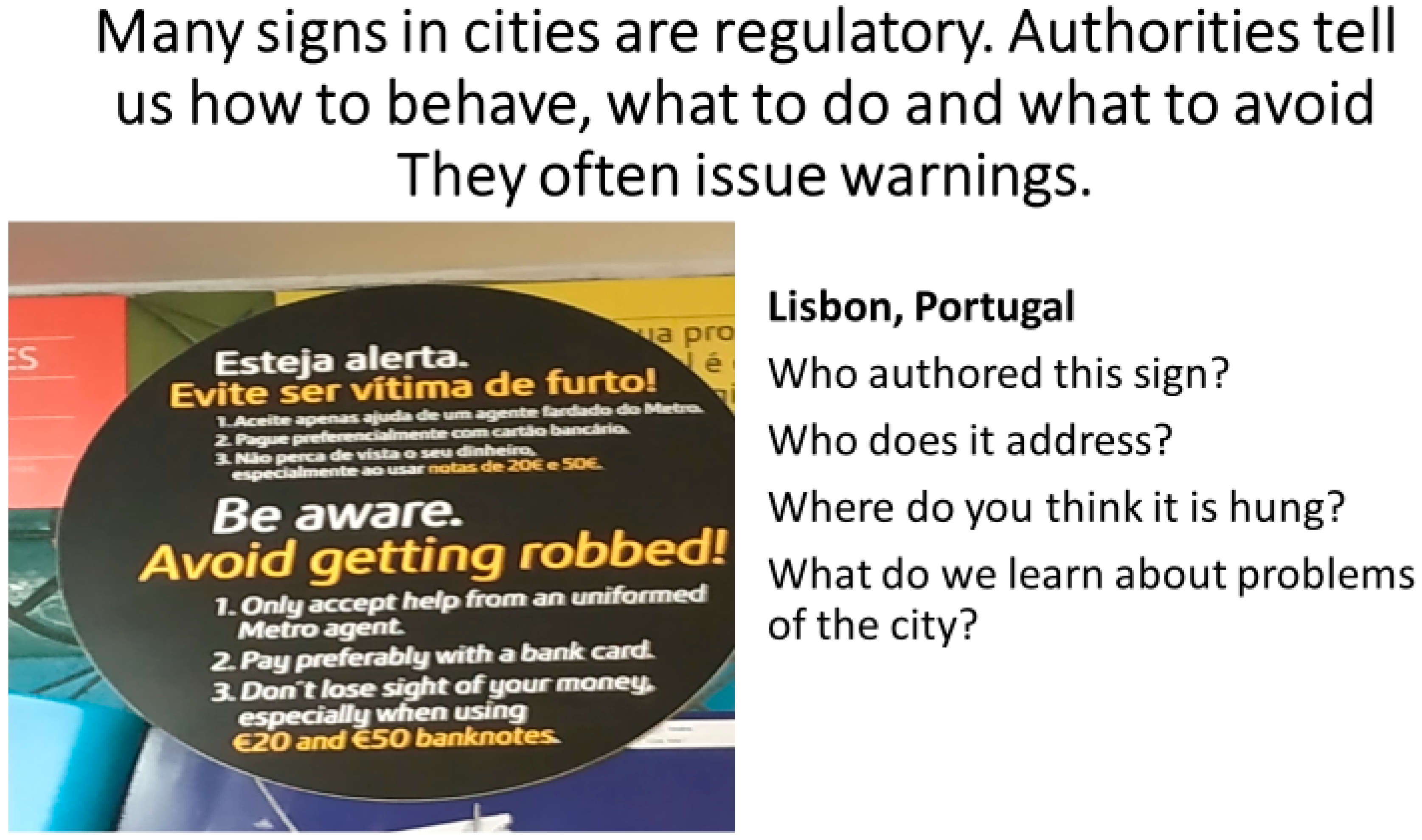
Solmaz, 2024, p. 68). Exploration of LL is carried out as a four-phase cycle of activities: situated practice, guided exploration, creation and transformed practice. In the first phase students are introduced to the concept and will develop an understanding of the classification of LLs into top-down and bottom-up signs and different genres of LLs. The teacher will encourage the students to mobilize their knowledge of and experiences in the city (see
Figure 2). The second phase, guided exploration activities, is designed to involve students in critical analysis of the linguistic and sociocultural aspects of LL resources. At this stage the teacher provides explicit guidance. Creation activities of the third phase engage students in tasks formulated by the teacher, e.g., designing signs similar to the models seen earlier, but trying to make them more appealing to the public. The last phase, transformed practice activities, will let students act independently while exploring the city. They will find signs belonging to different categories, and observe the materiality of the signs and their symbolic value. It is useful to ask students to record their observations in field notes and afterwards discuss their findings in class. The first phase can be performed individually, but the rest should be more effective if undertaken in pairs or in groups. In the first three stages it is important for the teacher not to steer the discussion in such a way as to influence the students’ opinions.
Since time allocated for LL exploration and linguistic competences of the EGAP students will not allow reading of research material on LL, the first step in incorporating LL in the course is for the teachers to compile an introductory text, and create their own archive of photos, online images and newspaper and magazine clippings that could serve as an illustration in the first phases of the work on LL. This will engage students in observing and analyzing a variety of ways language is applied, manipulated and appropriated by sign owners and creators. As
Camilleri-Grima (
2020, p. 16) aptly remarks “what language teachers need, has more to do with skills like observing and analyzing language use in an autonomous way, than with static linguistic knowledge found in books”. It is these skills that should be transferred to the students.
7. Bringing Results of Fieldwork to Class: A Lesson in Multilingual Creativity
In the project reported in
Section 5, the students were given an opportunity to look at images presented in the PPT and try to interpret them. The suggestions they made were discussed and the most plausible interpretation was chosen. The students discussed which signs have become internationally accepted and which are culture dependent. In groups, they discussed which of the signs presented to them were persuasive and how the text and visuals created synergy making them effective.
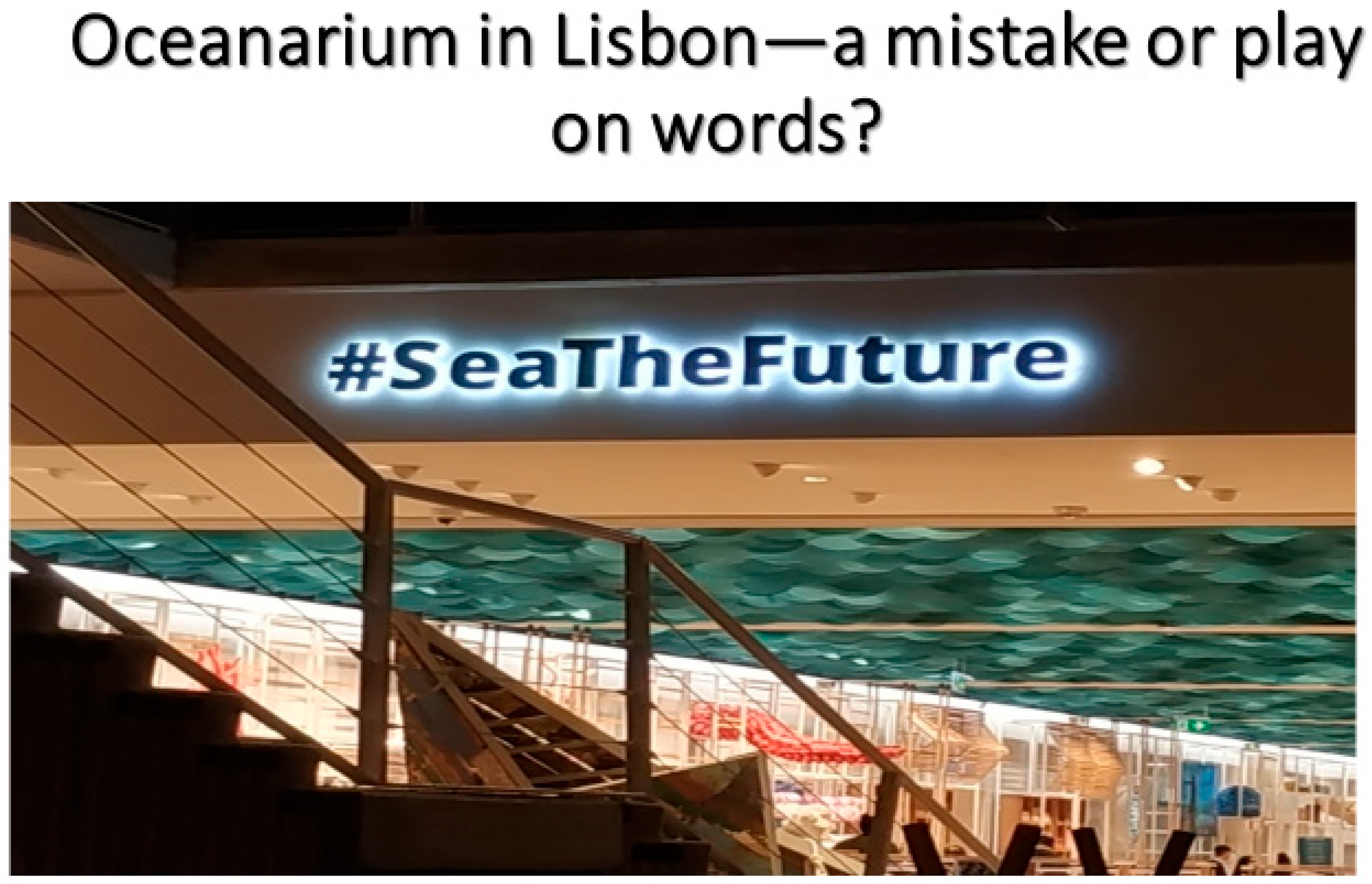
The LL of multilingual cities provides many examples of linguistic creativity. Wordplay on signs can occur within one language, often English, using homophones. Signs illustrating this were shown to the students and discussed with them. Here are some examples. At the entrance to an aquarium store in Lisbon, one reads:
Sea the future (
Figure 3). This simple pun is based on the play with the homophones
sea–
see. The students remarked that it was noteworthy that the sign was in English, without Portuguese. The authors expected that anyone familiar with these words would understand. In fact, the sign introduces visitors to the main theme of the products sold in the store: the eco-friendly use of marine resources to preserve them for future generations. Another example of the play with homophones came from a restaurant in Nicosia, Cyprus:
Eataliano Deli Caffé (the author’s highlighting). In the academic hotel of Helsinki University, guests can see a brochure inviting them to fill out a form if they want to meet colleagues who share their interests. The brochure is titled “
Everybuddy needs somebuddy”. The students noted differences in the spelling and pronunciation between familiar words and their newly coined homophones. They also pointed to the large font and bright colors highlighting the new words to attracts the visitors’ attention and cheer up those who feel lonely in a new city. The students reflected on how intentional violations of standard writing slow down comprehension and draw attention of the viewers/readers. Another example of the deliberate obstacle for understanding shown to the students was the sign at the entrance of the art museum in Lausanne, Switzerland, in which the name of the city is written upside down and has to be read from right to left.
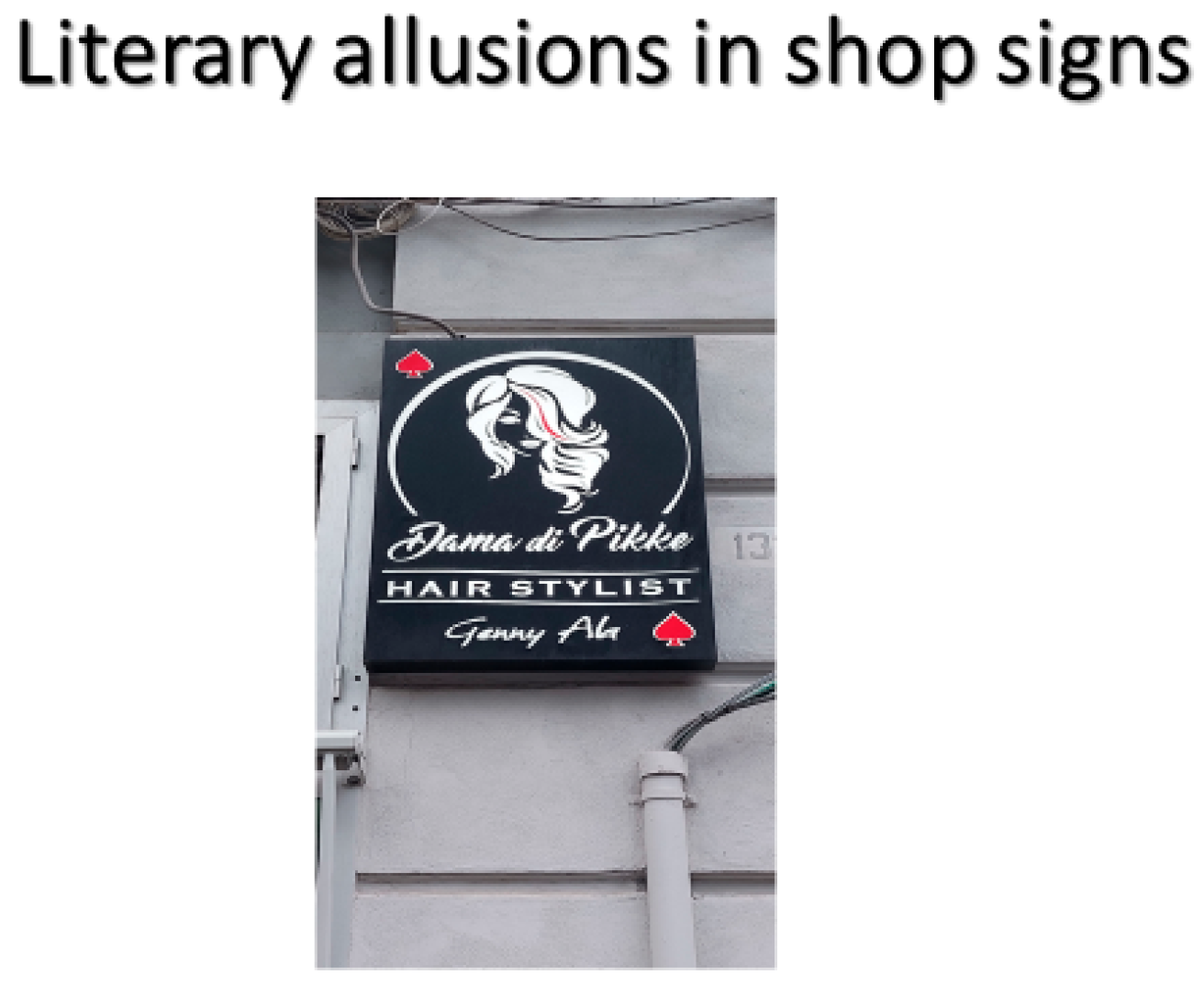
Signs can serve as guides to their authors’ interests and attachments. Participants in the project discussed a picture of a shop window in Naples combining Italian with English:
Dama di Pikke Hair Stylist Geny Ala (
Figure 4). The sign mentions the title of the Russian poet Pushkin’s novella and provided an opportunity to discuss why the owner of a hair salon in Italy would choose the name alluding to Russian literature. The protagonist is an unsympathetic character so why was she chosen by the hairdresser? The students suggested that the elaborate hairdo of the 19th century lady placed in the window could serve as evidence of the shop owner’s skills, or because the owner liked the Tchaikovsky opera, or because she was Russian and the name reminded her of her home country. Signs like this could be used to discuss the power of cultural symbols, and the prestige of languages, since the salon owner preferred English over Italian and Russian in her shop window.
As part of the meaning-making analysis, we discussed the name of a thrift shop in Haifa, Israel, which is built on contrasting connotations: B/u Tik. The abbreviation b/u (Rus. ‘byvshii v upotreblenii,’ already used) implies an item that may have lost quality but is not expensive, while “boutique,” a French word that has been borrowed by many languages, including English and Russian, refers to a small shop selling expensive and fashionable items, suggesting luxury. By combining these two contrasting concepts, the sign makes the reader choose what seems most obvious and smile at the irony of the owner.
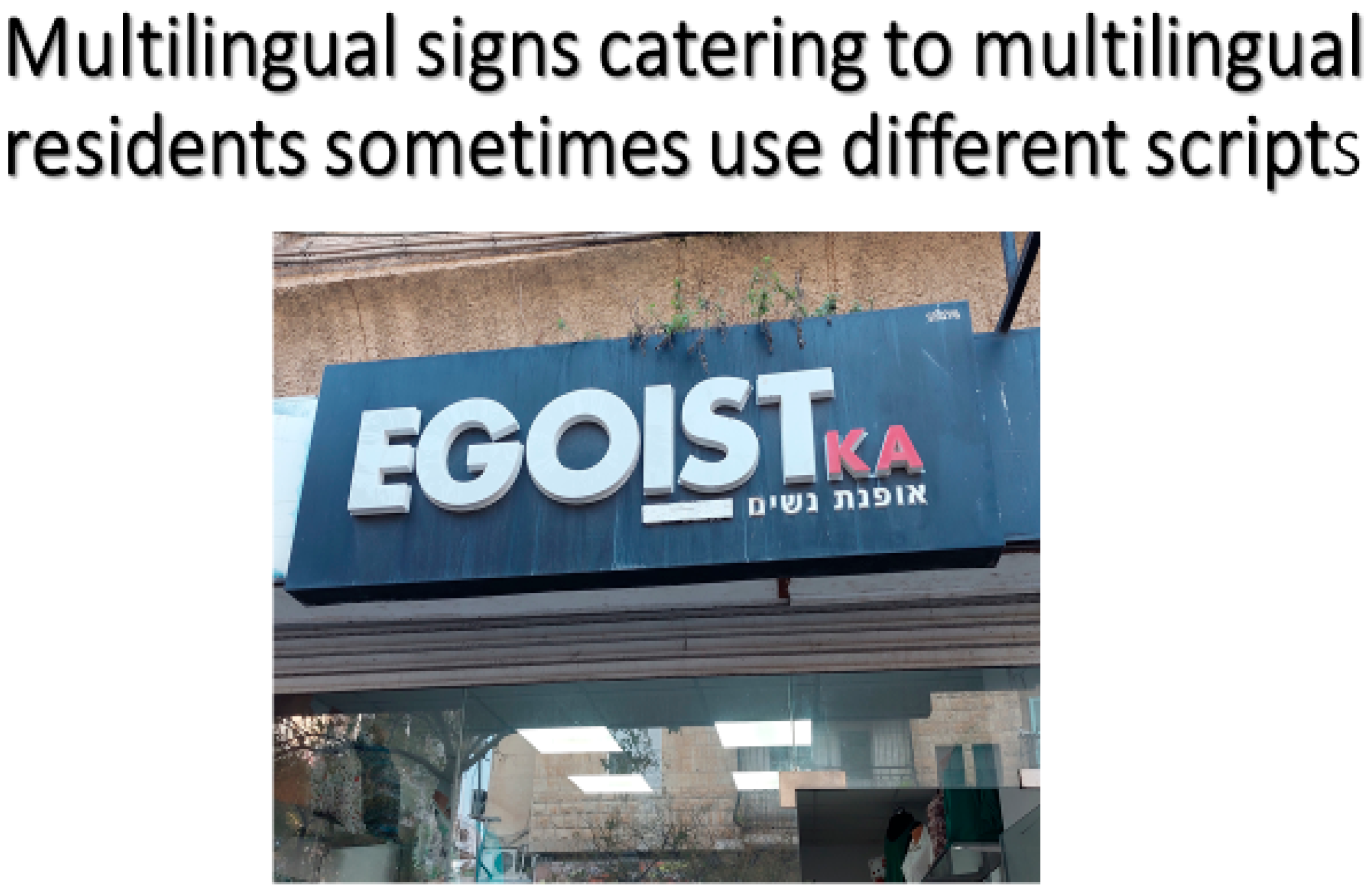
In order to illustrate the use of different scripts in the same sign we analyzed the name of a shop in Haifa (see
Figure 5). The sign prominently features the word
Egoist spelt in large, embossed Latin letters, while in smaller Cyrillic letters, it adds
ka. Thus, the word transforms into a feminine noun, aligning it more closely with what is written in the next line in Hebrew: “women’s fashion.” To enhance the effect, the letters of different languages are presented in different colors. It is evident that only those who read all three languages can appreciate the creativity of the sign’s author (see numerous examples of Russian–English hybrid words and their role in the LL of multilingual cities in
Protassova, 2021;
Yelenevskaya & Fialkova, 2017).
Ben Said (
2025) observes that in a context of global economies and in multilingual cities, “interlingual spelling” becomes a wink to the reader and brings the global closer to the local. The creativity of individual sign producers turns LL into a playful resource to reach their intended audience. Showing these signs and discussing them encourages language learners to experiment with language and mobilize their linguistic resources without intimidation and the fear of being misunderstood or derided.
In countries and regions where coexistence of contact languages is not without problems, hybrid words using two languages can provoke conflicts. For instance,
Gorter and Cenoz (
2023) cite an example from Brussels, where an interlingual hybrid combining morphemes from the French
boutique and the Dutch
bouetiek led to a new formation, “bootik” (a kiosk for selling public transport tickets). This and similar cases sparked protests and were even presented for consideration to a language control commission, which ruled that the treatment of the official languages—French and Dutch—was unequal. Such hybrids between French and English are viewed negatively but more tolerantly in Quebec. As
Lamarre (
2014) rightly notes, hybrid words reflect the complex linguistic repertoire of a significant portion of the population and also serve as examples of the aesthetics of multilingualism, based on the violation of monolingual norms and asserting multilinguals’ right to urban space.
The students were encouraged to search for witty hybrids during their walks in the city or while browsing the internet. In the city of Shantou, Guangdong, students have encountered a variety of linguistic signs, including bilingual or multilingual shop signs, advertisements featuring English and Chinese, stylized fonts, and other examples reflecting the city’s cultural, commercial, and linguistic diversity. However, they noticed that it was not easy for a foreigner to navigate the city, for example, when using public transport, visiting a clinic, or shopping. Thus, if it is unclear what a particular product contains, persons with allergies may put themselves at risk, or, conversely, may refrain from purchasing products that would be suitable for them. Given the strong emphasis on education for a global future and the desire to promote Chinese culture both domestically and abroad, the students approached their tasks with enthusiasm, imagining how internationalized and accessible their city could become for tourists and businesses in the future. Positive feedback included comments such as: “Now I see that it can be fun to read signs.”, “When I travel to another country, I’m afraid of getting lost and not finding my way, so I understand how important it is to navigate an unfamiliar city.”, and “Our campus is becoming truly international, and we want everyone coming here to feel comfortable.”
Together with the students, the teachers categorized LL according to the types of spaces in which language is visible, as well as the sources of the signage. As mentioned earlier, one useful distinction is between top-down and bottom-up signage. Produced by authorities, institutions, or large organizations, and intended to regulate, inform, or convey official messages, these signs use formal language and avoid ambiguities, metaphors and humor. In contrast, bottom-up signs created by private individuals, small businesses, or local communities often reflect personal tastes and mannerisms. These signs do not only seek to provide information, but try to be persuasive, creative, and humorous. They frequently make use of linguistic innovations, puns, code-mixing and other multilingual means of expression. Sometimes they are handwritten and contain spelling, grammatical, or translation errors. Such examples were also shown to the students and analyzed (see
Figure 6).
Certain spaces, such as religious and community centers, tourist attractions, and advertising boards in public areas, often combine elements of both top-down and bottom-up signage, reflecting a negotiation between official regulations and local practices. Increasingly, digital and virtual environments—such as online maps, apps, and social media platforms—contribute to the city’s linguistic landscape, providing a contemporary extension of physical LL. This categorization demonstrates how the LL is embedded in both formal and informal public spaces, reflecting the social, cultural, and economic dimensions of language use in society. On the one hand, it is useful to include investigation of DLL in LL projects, because it is easily accessible, saves time and appeals to the students who often prefer online communication to face-to-face encounters; yet, Yang and Zhang’s research suggests that abundant multimodal content could be overwhelming and requires literacy skills and ability to filter information efficiently that young people might not possess (
Yang & Zhang, 2025).
Both LL and DLL projects have several important implications for EGAP students. First, they provide a structured framework for observing and analyzing language use in authentic, real-world contexts, enabling students to go beyond textbook examples and engage with how English functions in diverse social, institutional, and commercial settings. Second, this categorization highlights the different communicative functions of language: top-down signage often serves regulatory, informational, or formal purposes, while bottom-up signage is frequently persuasive, creative, or identity-driven. For EGAP students, this distinction supports the development of pragmatic competence, allowing them to recognize stylistic choices, register, tone, and intended audience—skills essential for academic and professional communication. Third, understanding the distribution of English across various spaces exposes students to multilingual and multimodal practices, including code-switching, borrowings, transliteration, and visual–verbal integration, which encourages critical thinking about language hierarchies, prestige, and sociolinguistic realities, which are particularly relevant in global academic and professional contexts. Finally, applying this categorization in field-based or observational projects fosters analytical and research skills central to EGAP. Students learn to collect, classify, and interpret authentic language data, write structured reports, and discuss their findings in English, thereby simultaneously advancing both their language proficiency and their academic literacy. All in all, the LL categorization equips EGAP students with the tools to critically engage with real-world English, enhancing their linguistic, intercultural, and academic competencies in a comprehensive and applied manner.
The next section gives four examples of short-term LL projects designed after the pilot project with EGAP students reported here was conducted.
8. Sample Activities
8.1. Street Names: From the Past to the Present
Street names reflect the history of a city or country, prominent personalities, memorable events, and various features of the local geography and nature. Compared to other toponyms, street names often tell us about the outcome of a political process of commemoration that explicitly aims to emphasize local social and cultural values (
Oto-Peralías, 2018). While in the USA many street names are presidents’ surnames, in the UK kings and queens are commemorated. Specific dates in the street names are days when independence was proclaimed, victories in wars were won, or revolts took place. In Poland, Russia and Ukraine names of prominent writers and literary characters are common in city toponymy; in Greece and Cyprus street names remind one of mythology. Everywhere we will find names related to the local geography and vegetation, i.e., the geographic contour of the place is part of the of the local space-identity. Sea roads, Forest avenues and Hillside lanes are found all over the globe. The words “garden” or “park”, “school” or “station/railroad station” are also among the international favorites in toponymy. On the other hand, tree names depend on the local climate. Thus, in Berlin you can stroll along Unter den Linden (Under the Linden trees), in Vancouver along Maple street, and in Oakland along Cypress street. A project comparing toponymy of the students’ native city with that of a city where the target language is spoken can be beneficial not only for language learning, but also for culture study and comparison. Such a project can be carried out in towns where language policies do not favor multilingualism.
Suggestions for group work:
Using Google maps, compare the toponymy of the city where your university is located with a city in a country whose language you are learning (another possibility is to compare maps of the two capitals):
What do street names tell us about the geography and climate of the two cities?
Have you found any identical street names on the two maps? If you have, what are they? Do you think these are old or relatively new names? Explain your answer. Have you seen these names in other cities you have visited?
What memorable events in the life of the two countries are reflected in the street names? Pick one from each country and write a short description, explaining the national/international significance of each event.
In each city, pick up three streets bearing people’s names. Why do these individuals deserve commemoration? Using Wikipedia or other online resources, make concise biographic sketches (approximately 100 words). Shorten them to 50 words that could be used as memorial plaques in honor of these individuals. Ask the AI system you use to shorten your original sketch and compare it with your own version.
Design a future city in which all streets follow a single naming theme, such as flowers, seaweed, or animals. Select one theme and produce a map illustrating the themed street names.
Present your findings to the rest of the class. Compare your findings with those of the other teams and give your shared conclusions.
Potential benefits: Familiarization with the naming policy of the students’ city, development of critical thinking, comparing naming practices in the different countries discussed; development of oral and writing skills.
8.2. Tandem Telecommunication Practices
With a partner university conduct an online student conference to describe and analyze LL in their respective cities. The teachers prepare a PPT formulating the goal of the project and the background material about LL. On the basis of this introduction, partner teachers prepare general questions dealing with the multilingualism of a contemporary city. Here are some questions that can be a starting point for discussion:
Why are most big cities today multilingual?
What does the presence of a non-dominant language in the LL of a city reveal about that language and its use?
Which language/s is/are likely to be found in various countries? How do you account for its/their pervasiveness in LL?
Students are then divided into small groups and are asked to analyze the LL of their own city/neighborhood.
What languages are used in the signage of your town? Can you give examples?
Are there multilingual signs in your town? Are they top-down or bottom-up?
Is English used in signs for tourists or local residents?
Look for signs in which English has primarily a symbolic function.
Look for signs in which two or more languages are used to create a humorous effect, such as interlingual puns.
After the discussion the students are asked to prepare questions for the students of the partner university about the LL of their city/neighborhood, etc. The teams at both universities exchange their questions. Answers to these questions are discussed in small groups, and the students are asked to give extended answers and prepare group talks and PPTs illustrating them. During the online meeting of the partner teams, students at both universities give short talks. Each class may have one student as a moderator, taking care of the discussion and controlling the time limits. In case the difference in the time zones makes an online conference problematic, student teams can exchange posters.
Potential benefits: Development of language awareness and better understanding of language policy of the students’ city/country’s capital; development of effective teamwork and presentation skills; development of intercultural communication skills; critical thinking (analyzing sociolinguistic equality/inequality, comparing multilingual elements in the cities of both partner universities); identifying linguistic categories (words borrowed from English, deviations in grammar and spelling vs. grammar/spelling violations as rhetorical devices).
8.3. My City in the Past and Now
Make a pedestrian tour of your city center and take pictures of the memorials and prominent buildings, as well as signs on buildings occupied by city administration and commercial enterprises. Look for old images of the same sites in the postcards kept in your family or on the internet (there are many history buffs who post old postcards), or take pictures of the books on the history of your city/region that you might find in the library. If your city is not captured in old images, do the same for the capital city of your country. Compare contemporary images with the old ones along the following lines:
What languages can you see on the signs 50/100 years ago and now?
Which signs prevail in each collection: informative or regulatory?
Which of the old signs still remain unchanged?
Which of the contemporary signs point to globalization?
Have you found any instances of the symbolic use of language in either of your collections?
Interview three–five senior residents of your city about changes in the LL of your city. Analyze their responses and compare them with your own observations.
On the basis of the material collected, write a short essay about changes in the LL of your city/the capital. You can incorporate excerpts from your interviewees’ responses into the essay. Translating them into English, try to preserve the speakers’ style (matter-of-fact, emotional, humorous, etc.)
Potential benefits: Students develop awareness of the changes contemporary cities undergo. They learn to communicate with strangers and translate from the language of their interviewees into English. Since most likely they will resort to the help of AI, the teacher can ask them to critically analyze the quality of translation. Assessment of the anonymized essays can be delegated to the authors’ fellow students and double-checked by the teacher. The results of the work may be presented as posters displayed as an exhibition in the university corridors, or in community spaces, schools, and kindergartens.
8.4. Digital Signs in Smart Cities
Cities around the world are expanding the integration of Internet of Things sensors within urban spaces. These sensors collect data to perform a variety of tasks: quantifying air and noise pollution levels, monitoring temperature and atmospheric pressure, counting foot traffic, to mention just a few. Collections of Internet of Things sensors make up a smart city, which can be defined as a techno-political initiative that amasses large quantities of data about the environment, infrastructure, and people living in urban environments. Smart cities strive to use data to improve decision-making, automate public services, and enhance the overall efficiency of governance (
Corbett & Dove, 2024).
Advanced technologies in cities can simplify daily life by implementing AI-driven applications, helping people navigate different facilities, such as checking for available parking, getting live updates on public transport or the traffic situation on the roads, or receiving weather warnings. At the core of these advancements is digital signage, which enhances the urban experience by making information more accessible and better organized. It also strengthens security and improves communication of city authorities with residents. At the heart of smart city planning, integrated digital signage networks leverage real-time smart city data to create messages that protect, inform, and engage the entire city (
Forsberg, 2024;
Thrasidi, 2025). The following questions can be asked to start a discussion:
What digital signs can you find in your city?
How do digital signs help protect the environment?
How can digital signs improve residents’ information sharing?
How can city planners make use of digital signs?
How can digital signs help tourists?
Since digital signage is a relatively new development, browse the internet to find articles in English about it. Share information with your fellow students. Try to make your digital messages persuasive and appealing.
In small groups prepare texts of digital signs in your mother tongue and in English that
Notify residents about a storm approaching and list safety precautions;
Inform residents about recycling opportunities in the city;
Post information about cultural events in the city for the next weekend;
Offer personalized food recommendations based on the time of day or your past visits to the campus cafeteria;
List safety measures to prevent a flu epidemic;
Analyze the instruction manual for an electrical appliance written in different languages, and compare the descriptions in the languages you know. What did you notice? Then write your own set of instructions for using an electrical appliance you would like to buy for your home and translate it into English. Exchange the instructions you have written and translated with your peers’ work. Evaluate the clarity of the original text and the quality of translation.
Potential benefits: Development of translation skills; improvement of targeted internet search, enhancement of writing skills and language creativity; development of the ability to critically evaluate one’s peer’s work and offer useful advice for improving the advertisement’s design.
9. Discussion and Conclusions
The main benefits of LL explorations for students of EGAP is that they are exposed to the use of language in general, and English as a global language in natural settings (
Bernardo-Hinesley, 2020). The students are given an opportunity to reflect about the synergy of linguistic and non-linguistic elements of the LL (
Dagenais et al., 2009;
Napu, 2024). LL exploration is an important opportunity for EGAP students to develop as language learners, creators of content in English and as intercultural communicators (
Verzella & Tommaso, 2014;
Zhao & Yang, 2023).
The existing body of research into LL gives detailed answers to the question “why” investigation of LL is useful in language pedagogy, but it still gives few answers as to “what” practitioners do to carry out these educational tasks or projects, or “how” this should be done (
Mouboua et al., 2024). LL tasks combine in-class with extra-mural activities. The most practical order is to start with in-class activities, then conduct field research and afterwards return to class to share findings and discuss them. LL projects give an opportunity to develop both receptive and productive language skills, critical thinking, and the ability to state one’s position and defend it persuasively and politely.
LL studies are favorable for group work, and can enhance the students’ collaboration abilities (
Saito et al., 2020). Translanguaging during the preparation stage is an essential element of group work (
Ramirez-Marin et al., 2021). Today, it is also difficult to prevent students from over-relying on AI. So, it is important to alert the students to the cases of mistakes and inaccuracy of AI responses to queries and encourage them to verify the facts provided by AI. The out-of-class activities in language courses are still a rarity, so the teachers have to be ready that the students might express doubts about whether they may find any interesting signs and explore LL in a meaningful way (
Kallen, 2023).
In order for tasks and projects in LL to be widely practiced in language teaching, pre-service teachers and experienced teachers alike have to familiarize themselves with the landmark works in the field to learn about the benefits and limitations of the application of LL in language pedagogies. Since thoroughly prepared projects, including class and fieldwork, are relatively time consuming, these modules have to be included in the curriculum with goals and assessment criteria determined and elaborated.
Class activities can be combined with field research by designing task-based projects where students observe and analyze the linguistic landscape of their urban environment. This includes photographing signs, conducting interviews, and creating presentations based on their findings. The process typically involves initial classroom discussions to introduce concepts and discuss sign taxonomies and the instrumental and symbolic functions of language in signs. Classwork is followed by fieldwork, which is followed by presentations reporting on the students’ observations and analyses.
Pedagogical activities that can enhance awareness of multilingualism include collaborative projects analyzing local signage, comparing street names across different cultures, and engaging in discussions about the sociolinguistic implications of language use in public spaces. Activities that encourage critical reflection on the visibility and function of languages in the urban landscape, such as creating multilingual signs or conducting field surveys, can also stimulate students’ understanding of the complexities of language interaction in their communities. Finally, LL projects like the one reported in this article can be the first autonomous research work conducted by the students at the very beginning of EGAP courses. This requires acquisition of the academic vocabulary needed to conduct fieldwork and report on the results. Moreover, such projects serve as an introduction to research methodologies applied in different disciplines.
Limitations: Incorporating LL studies into EGAP courses can be challenging due to the limited time available and the extensive nature of LL projects, which usually require both in-class and fieldwork components, and may conflict with the need to cover essential academic content. Students may exhibit varying levels of interest and engagement with LL projects: some may find the activities enriching, while others may struggle with the autonomous decision-making and creativity required for field research and creation of their own signs. Access to resources such as digital tools for documentation, transportation for fieldwork, and relevant literature on LL may be limited, particularly in institutions with limited funding opportunities.
The interpretation of signs and language use in public spaces may vary significantly across cultural contexts; thus, students may misinterpret or overlook the significance of certain signs due to their personal biases or lack of cultural knowledge. The findings from LL projects conducted in specific locations may not be easily generalizable or applicable in other contexts or to other populations, limiting the broader applicability of the results.
Ethical Issues: Engaging with individuals in public spaces, such as conducting interviews or photographing signs that include people, raises ethical concerns regarding informed consent. Students must ensure that participants are aware of the study’s purpose and agree to their involvement, because capturing images of signs that include people or identifiable information may infringe on individuals’ privacy rights; that is why ethical guidelines should be established to avoid photographing individuals without consent, particularly in sensitive contexts. When analyzing and interpreting LL, educators and students must be mindful of cultural sensitivities; therefore, misrepresentation or oversimplification of cultural symbols and languages can perpetuate stereotypes or lead to misunderstandings. The examination of LL often involves discussions of power and prestige among languages. It is crucial for educators to manage these discussions carefully to avoid reinforcing existing inequalities or biases present in the linguistic landscape. Students conducting fieldwork may inadvertently generalize or stereotype communities based on their observations. Educators should emphasize the importance of nuanced understanding and critical reflection on language use and its social implications. By addressing these limitations and ethical issues, educators can create a more inclusive and responsible approach to integrating linguistic landscape studies into language pedagogy.
The pilot project reported in this article had a positive effect on the participants. In the spirit of competition, the students worked hard on making interesting and attractive signs. They enjoyed the opportunity of creating content that included text in English and images. Encouraged to be persuasive, they experimented with language, which helped them overcome shyness. Since everyone had to participate in the presentations of the prepared signs, they had to act as effective teams supporting each other. Presenting their group’s signs and assessing the signs of the others helped the students improve their ability to speak in public, overcoming initial shyness. The students expanded their vocabulary and increased familiarity with distinctions between formal and informal forms of expression. As novices at the university and in the city, they had a chance to appreciate the services and cultural opportunities available to them. These were among the first steps in their adult life, and since they came through their studies of English, incidental learning occurred. Finally, for many of the students, the multilingualism of their own life was some sort of revelation and a stimulus to use English in communication in different spheres of life.