1. Introduction
School leadership is widely regarded globally as a vital driver of teaching quality, student achievement, equity, and systemic transformation (
Hallinger et al., 2015;
Hallinger & Hosseingholizadeh, 2020;
Leithwood et al., 2020). In this regard, it is acknowledged that developing effective leadership practices is critical for attaining regional (e.g., Agenda 2063) and international (e.g., Sustainable Development Goals) goals on education (
Hallinger, 2018;
O’shea & Zuckerman, 2022). However, research on how school leadership is implemented in African contexts is scarce, fragmented, and weakly linked to policy and practice (
Hallinger, 2018). This fragmentation impedes the effective delivery of educational programs. Distributed instructional leadership can help resolve educational issues arising from inadequacies in school leadership (
Bush, 2023;
Spillane, 2005). It is an emerging leadership paradigm that transforms leadership from a principal-centered practice to one comprising deputy principals, heads of departments (HoDs), teacher leaders, and students (
Spillane, 2005). Hence, there is a need to explore the distributed instructional practices in African contexts.
Within the broader international discourse of school leadership, instructional leadership has emerged as a central lever for improving teaching quality and learner achievement because it directly engages with classroom instruction—such as classroom observation, feedback, curriculum coordination, and monitoring of learner progress—have significant effects on student outcomes (
Bush, 2015;
Chabalala & Naidoo, 2021;
Hallinger et al., 2015,
Nguyen et al., 2022).
Hallinger and Hosseingholizadeh (
2020) assert that effective instructional leaders create clear goals, support teacher learning, use assessment data to guide improvement, and cultivate environments that prioritise teaching and learning. The role of middle leaders in the school leadership has garnered extensive attention in recent years (
Bush, 2023;
Chabalala & Naidoo, 2021;
Shaked & Schechter, 2019). Within the framework of school leadership, HoDs are important middle leaders due to their proximity to the classroom (
Bush, 2023;
Malinga et al., 2021;
Seobi & Wood, 2016). Particularly, HoDs play an important role in shaping the quality of instruction, especially in secondary schools where subject expertise and curriculum specialisation are essential (
Bush, 2023;
Shaked & Schechter, 2019). HoDs often serve as the primary instructional leaders because principals are heavily burdened with administrative responsibilities, and usually lack subject-specific expertise to perform instructional leadership functions related to classroom enactment effectively (
Mestry, 2017).
Alrayes (
2025) adds that HoDs contribute to the academic success of institutions. Thus, the effectiveness of instructional leadership frequently depends on HoDs’ ability to support teachers, monitor curriculum implementation, and engage directly with classroom practice.
Despite the recognised importance of instructional leadership, both regional and international research indicates a persistent gap between the ideal and actual enactment of instructional leadership practices. Globally, school leaders often prioritise managerial and administrative duties over pedagogical engagement due to time constraints, policy pressures, and role expectations (
Chabalala & Naidoo, 2021;
O’shea & Zuckerman, 2022;
Spillane, 2005). For instance, regional studies (such as
Chabalala & Naidoo, 2021;
Malinga et al., 2021) indicate that HoDs tend to excel in administrative and coordination tasks, such as organising departmental meetings and ensuring curriculum coverage, but engage less frequently in high-impact practices like structured classroom observations, sustained feedback cycles, and systematic teacher development. This disconnect is under-examined in many national contexts, including Lesotho.
In Lesotho, HoDs are tasked with the responsibility of overseeing the running of subject-specific departments (e.g., Science department), wherein they perform several instructional leadership functions (
Tlali & Matete, 2021). Although this role is central to successful teaching and learning, limited empirical evidence exists regarding how science HoDs enact instructional leadership practices in the Lesotho context. The lack of such evidence hinders efforts to strengthen school leadership practices, develop targeted capacity-building initiatives, and align school leadership roles with national and regional education priorities. Given the global and regional emphasis on improving instructional leadership as a strategy for raising learning outcomes, understanding the extent and nature of science HoDs’ instructional leadership practices in the region is both timely and necessary. Therefore, this study contributes to filling the gap by examining the self-reported instructional leadership practices of Lesotho science HODs in selected secondary schools.
In response to this gap, the present study investigates the self-reported instructional leadership practices of science heads of departments in Lesotho secondary schools. Specifically, the study addresses the following research questions:
What instructional leadership practices do science heads of departments report enacting in Lesotho secondary schools?
Are there significant differences in heads of departments’ self-reported instructional leadership practices based on age, gender, years of experience, qualification, workload, and school location?
The inferential analysis for research question 2 was guided by the null hypothesis: There are no statistically significant differences in heads of departments’ self-reported instructional leadership practices based on age, gender, years of experience, qualification, workload, and school location. This hypothesis was tested using t-tests and ANOVA tests across the specific demographic and workload variables.
The findings of this study may not only inform decisions on school leadership in Lesotho context, but may also increase our global understanding of the state of school leadership. The study provides context-specific evidence that sheds light on how instructional leadership is enacted in everyday school practice in developing countries, informing meaningful educational reforms. Thus, the study addresses a critical knowledge gap by providing empirical insights into the instructional leadership practices of science HoDs in Lesotho—insights that could inform practices across the region. The rationale for focusing on science HoDs is threefold. First, science subjects are central to national and global development goals, and their effective teaching requires strong instructional guidance. Second, HoDs are uniquely positioned as subject experts capable of providing pedagogical support, yet their actual leadership practices remain understudied (
Shaked & Schechter, 2019;
Tlali & Matete, 2021). Third, understanding HoD’s strengths and limitations enables policymakers, school leaders, and teacher education institutions to design targeted interventions that enhance instructional quality. By situating the findings within regional and international scholarship on instructional leadership, the study contributes to the broader discourse on how middle leaders can drive instructional improvement, particularly in resource-constrained environments.
1.1. Perspectives on Instructional Leadership
Globally, instructional leadership frameworks emphasise the importance of leaders directly shaping the teaching and learning environments.
Hallinger et al.’s (
2015) leadership-for-learning model identifies three core domains: defining the school mission, managing the instructional program, and fostering a positive learning climate. Leaders enact these through activities such as aligning curriculum, monitoring instruction, and supporting teacher development. One of the most influential international findings comes from
Robinson et al. (
2008), who demonstrated through meta-analysis that leadership practices involving direct engagement with teacher learning—such as coaching, feedback, and structured evaluation—have the most substantial effect on student achievement. Similarly,
Hattie’s (
2015) global synthesis ranks instructional leadership among high-impact factors, as it influences teacher clarity, assessment practices, and collective teacher efficacy.
Scholars have expanded theoretical leadership constructs by examining how contextual realities shape leadership practice. For instance, studies in South Africa and Zimbabwe show that although HoDs and principals possess a conceptual understanding of instructional leadership, their practice often gravitates toward administrative and coordination tasks due to systemic constraints such as heavy teaching loads, compliance pressures, and limited training (
Chabalala & Naidoo, 2021;
Mestry, 2017). These regional insights suggest that the enactment of instructional leadership is uneven: curriculum coordination and resource management are highly implemented, whereas classroom observation, written feedback, and teacher mentoring are less common. The regional literature therefore supports an adapted conceptual understanding of instructional leadership in African contexts—one that acknowledges the importance of traditional constructs (e.g., supervision, feedback, goal-setting) but also recognizes the structural constraints that shape how middle leaders interpret and prioritize these roles. This hybridised understanding forms the basis for the conceptual framework of this study.
In many African education systems, Heads of Department (HoDs) serve as the primary instructional leaders given principals’ administrative loads (
Chabalala & Naidoo, 2021;
Malinga et al., 2021;
Tlali & Matete, 2021). For instance,
Malinga et al. (
2021) found that South African Natural Sciences HoDs understood their instructional responsibilities but reported limited time and insufficient training for observation and feedback. Similarly,
Sengai’s (
2021) Zimbabwean study demonstrated that while HoDs excelled in coordinating curriculum implementation and organizing departmental meetings, they struggled to sustain ongoing teacher supervision. Collectively, these regional studies reveal that HoDs function effectively as coordinators but less effectively as instructional coaches—a finding consistent with global research showing that middle leaders often require targeted support and training to act as effective pedagogical leaders (
Spillane, 2005).
Demographic parameters, such as age, length of service (experience), certification level, and gender, can influence how school leaders practice instructional leadership; however, the findings are frequently mixed and contextual. For example, a recent large-scale study of secondary schools in Ethiopia discovered that age and length of service significantly impacted principals’ pedagogical leadership practices. In contrast, gender had no significant effect on leadership style or teacher performance (
Berhanu, 2025). Similarly, empirical research from South-Ethiopian secondary schools shows that good instructional leadership by principals, regardless of gender, improves student achievement, particularly when instructors have high self-efficacy (
Gechere et al., 2025). However, some studies in various settings have found no strong predictive relationship between gender and leadership style or instructional outcomes, implying that professional competencies and contextual supports may outweigh demographic influence (
Berhanu, 2025;
Gechere et al., 2025). Taken together, these studies suggest that while demographic attributes, such as experience and age, can affect instructional leadership practices, their impact is mediated by training, contextual factors, and institutional conditions—highlighting the need to examine demographic effects in relation to professional development and school-context dynamics.
This examined corpus of literature reveals that, while instructional leadership is widely acknowledged as a potent mechanism for enhancing teaching and learning, its implementation remains uneven and contextually constrained, particularly among middle leaders. Across African education systems, HoDs are frequently positioned as instructional leaders, but they are frequently forced to prioritize coordination and compliance-oriented chores over sustained pedagogical involvement. This collection of data highlights the need for context-specific empirical investigations that go beyond normative assumptions to examine how instructional leadership is actually implemented in practice. The current study addresses this requirement by offering empirical insights into the instructional leadership methods of science HoDs in Lesotho, a relatively unexplored national context.
1.2. Theoretical Framework
Instructional leadership is widely regarded as one of the most influential approaches to school leadership for improving student learning outcomes (
Hallinger et al., 2015). Foundational scholarship conceptualises instructional leadership as a set of practices through which leaders shape the conditions of teaching and learning (
Hallinger et al., 2015,
2025c;
Hallinger & Murphy, 1985).
Hallinger et al.’s (
2015) Principal Instructional Management Rating Scale (PIMRS) leadership model identifies three key domains: (a) defining the school’s mission, (b) managing the instructional program, and (c) promoting a positive school learning climate. It remains the dominant model for studying instructional leadership behaviours (
Hallinger et al., 2025a,
2025b). Within these domains, school leaders perform several functions, including providing instructional materials, setting and communicating goals, supervising instruction, coordinating curriculum, monitoring learning progress, protecting teaching time, providing instructional feedback, and promoting professional growth.
While developed for principals, PIMRS has been increasingly used to analyse middle leadership, including departmental heads (HoD’s), given their direct engagement with teachers and daily instructional issues (
Seobi & Wood, 2016;
Tlali & Matete, 2021). Furthermore, the PIMRS has been demonstrated to have a positive impact on leadership research and practice (
Ng, 2019). Similarly, this study adopted the three domains to explore science HoD’s self-reported instructional leadership practices in Lesotho secondary schools. For HoDs, establishing the purpose entails converting whole-school academic goals into explicit departmental expectations, as well as ensuring that teachers understand and commit to these objectives. HoDs can promote teacher efficacy and learner achievement by articulating common standards and exhibiting high expectations (
Shaked & Schechter, 2019;
Tlali & Matete, 2021). HoDs manage the instructional program by organising curriculum delivery, monitoring instructional quality, and using feedback to improve teachers’ pedagogical competence (
Hallinger et al., 2015;
Tapala et al., 2020). Their proximity to classroom practice enables them to assist teachers with ongoing supervision, collaborative planning, and rapid intervention. Finally, by promoting a positive learning environment, HoDs help to create conditions that support professional development, protect instructional time, and retain high visibility within their departments. HoDs directly contribute to a departmental culture of continuous development by modeling professionalism, recognizing teacher efforts, and maintaining high expectations for teaching and learning (
Hallinger et al., 2015).
HoDs’ instructional leadership functions can be categorised as managerial and pedagogical. Managerial instructional leadership focuses on organizational and coordination functions that support teaching and learning indirectly, such as setting goals, coordinating curriculum, allocating resources, monitoring learner results, and protecting instructional time. On the other hand, pedagogical instructional leadership involves direct engagement with classroom practice and teacher development through observation, formative feedback, coaching, and modelling instruction. Within the PIMRS framework (
Hallinger et al., 2025b), managerial functions align with defining the school mission and coordinating the instructional programme, while pedagogical leadership is enacted through supervising and evaluating instruction, providing instructional feedback, and promoting professional growth. High-impact pedagogical leadership is operationalized through systematic observation, evidence-based feedback, and instructional coaching cycles that drive continuous instructional improvement. Applying this model (PMIRS) in this study is based on its global applicability (
Bada et al., 2020;
Bush, 2015;
Hallinger, 2018;
Hallinger et al., 2015,
2025b;
Ralebese et al., 2025), as well as its contribution to our global understanding of middle leadership practices in secondary school contexts.
The PIMRS provided both a conceptual lens and an analytical structure for examined science HoD’s instructional leadership practices. Eight instructional leadership dimensions were assessed in this study, aligning with
Hallinger and Murphy’s (
1985) three domains, allowing for systematic analysis of the extent to which HoDs report engaging in instructional leadership functions. The framework also informed the examination of the roles of demographic and workload variables in shaping the enactment of instructional leadership in science departments.
3. Results
The dataset reported in this study comprises 40 instructional leadership items, rated by 67 heads of science departments (HoDs) using a 5-point Likert scale. Firstly, the respondents’ demographic characteristics are described. Secondly, the section reports the frequency (N and %) and the most frequently chosen response category (modal response) for each instructional leadership practice (statement). Thirdly, the section reports results on the influence of demographic and workload variables on HoDs’ reported instructional practices.
- (a)
Demographic characteristics of the respondents
The demographic characteristics of the participants are shown in
Table 2. The results show that the age range of the participants varied significantly, with the highest percentage falling between 40 and 49 years old (38.47%), followed by those over 50 years old (29.23%). Only 4.62% of participants were between the ages of 20 and 29, while 27.69% of participants were between the ages of 30 and 39. Males were more prevalent (56.72%) than females (43.28%) in the gender distribution. 52.38% of respondents had ten or more years of professional experience, while 47.62% had fewer than ten years.
In terms of qualification, the majority of HoDs (83.08%) have a bachelor’s degree. A smaller percentage reported having a diploma (1.54%), a master’s degree (9.23%), or an honours degree (6.15%). The sample’s teaching responsibilities varied. While some HoDs taught one subject (16.67%) or three subjects (13.63%), the majority (69.70%) taught two subjects. There was substantial variance in their weekly teaching periods, with about similar percentages teaching 20–25 sessions (45.39%) and 26–30 periods (43.75%). A tiny proportion taught up to 31–35 times per week (6.25%) or 19 periods or fewer (4.69%). Lastly, 74.63% of the participating schools were in urban areas, while 25.37% were in rural ones.
- (b)
Self-reported instructional practices of science HODs
The next section describes teachers’ reported instructional leadership practices across the eight domains of instructional leadership.
The results in
Table 3 relate to the provision of instructional materials. The results show that HoDs reported being actively involved in ensuring that instructional materials were accessible, available, and recommended appropriately. These activities were either regularly or nearly always carried out, according to the most frequent responses. However, instruction on the use of resources was implemented very occasionally, indicating that material support is more logistical than educational.
Table 4 shows that setting and communicating goals were among the most reportedly enacted dimensions of HoD’s instructional leadership practices. HoDs routinely set high standards for departmental success and nearly always worked with teachers to establish departmental goals. Additionally, they regularly prioritized, clarified, and encouraged the execution of goals. These results suggest a leadership culture that prioritizes accountability and shared direction.
In terms of instructional supervision, HoDs showed a modest level of strength (see
Table 5). They discussed curriculum challenges, reviewed lesson plans, and assessed student performance on a regular basis. However, observations in the lab and classroom were conducted only occasionally. This suggests a preference for document-based or indirect supervision over ongoing in-class instructional supervision.
Another aspect that was heavily used was curriculum coordination.
Table 6 shows that HoDs frequently encouraged activity-based education, reviewed curriculum resources, planned strategies for improvement, and organized meetings pertaining to the curriculum. They also nearly always made sure that classroom instruction was in line with curriculum requirements. These exercises demonstrate a great dedication to curriculum coherence.
HODs’ self-reports regarding monitoring of learning progress are presented in
Table 7. Results revealed that the majority of the items in this dimension were scored as frequently, and HoDs regularly tracked learners’ progress. They often promoted open communication with parents, reviewed progress reports, examined students’ written work, held conversations with teachers about student learning, and used assessment data to inform instructional adjustments. This indicates a persistent emphasis on student results.
Strong measures were also taken to protect teaching time (
Table 8). HoDs routinely reduced interruptions, promoted teacher readiness, guaranteed student attendance, planned practical laboratory work, and made plans to continue instruction even when teachers were not present. This demonstrates efficient administration of the learning environment.
This dimension produced conflicting results as shown in
Table 9. The provision of written instructional feedback was assessed as infrequent—the lowest level of enactment in the whole dataset—while HoDs often highlighted excellent teacher performance and commended students. Teachers were likewise rarely praised in public. In general, informal and verbal feedback seems to be more common than formal, recorded feedback.
HoDs showed a moderate level of involvement in advancing the professional development of teachers (see
Table 10). They regularly held subject-matter meetings, suggested pertinent seminars, and encouraged teachers to enhance their practices, but they rarely participated in professional development or assessed teacher learning. These findings imply that HoDs typically support professional development but do not consistently track it.
The data reveal clear trends in how frequently specific objects and dimensions are used. The most often enacted practices include A1, A18, A25, B13, B36, C24, C30, E5, E12, E21, E27, F6, F14, F23, F31, F40, H39, D37, G7, and G28. A9, C10, H8, and H29 are examples of items with moderate involvement, meaning they are used occasionally. Only one item, G33, fell into the least enacted category, with replies suggesting that it was rarely or practically never used. Looking at larger dimensions, the most enacted were C2, C4, C5, and C6, while the least enacted were C7 (because of the very low enactment of written feedback (G33) and moderate enactment of praise (G15), C8—due to “sometimes” responses for PD participation (H8) and teacher learning evaluation (H29), and C3—because classroom observations (C10) are only enacted “sometimes”).
Across the eight instructional leadership dimensions, a consistent pattern is evident: practices that are organisational and coordination-oriented are reportedly enacted more frequently than those requiring direct pedagogical engagement. High-frequency reported enactment clusters around goal setting, curriculum coordination, and resource provision, monitoring learner progress, and protecting instructional time. Lower-frequency reported enactment appears in pedagogically intensive practices, particularly classroom observation, formal written instructional feedback, and systematic evaluation of teacher learning. Supervision is more often conducted through indirect methods, such as reviewing plans and learners work, than through in-class observation, while feedback is more commonly verbal than written. These patterns reflect a stronger management-supportive profile than developmental, classroom-focused instructional leadership profile.
Overall, the results show that Science HoDs in Lesotho are capable managerial instructional leaders who are adept at planning lessons, establishing precise objectives, and guaranteeing curriculum and resource congruence. They consistently show an interest in monitoring students’ progress and ensuring class time is well-protected. However, the findings also highlight areas that require more in-depth educational engagement. HoDs may benefit from concentrated assistance in developing more long-term, pedagogically focused instructional leadership practices, as evidenced by the limited number of classroom visits, infrequent written comments, and inconsistent evaluation of teacher learning. By strengthening these areas, they may be better equipped to enhance the quality of instruction and ultimately promote improved learning outcomes for students.
- (c)
Influence of demographics characteristics
Both the Kolmogorov–Smirnov (K–S = 0.071,
p = 0.200) and Shapiro–Wilk (W = 0.992,
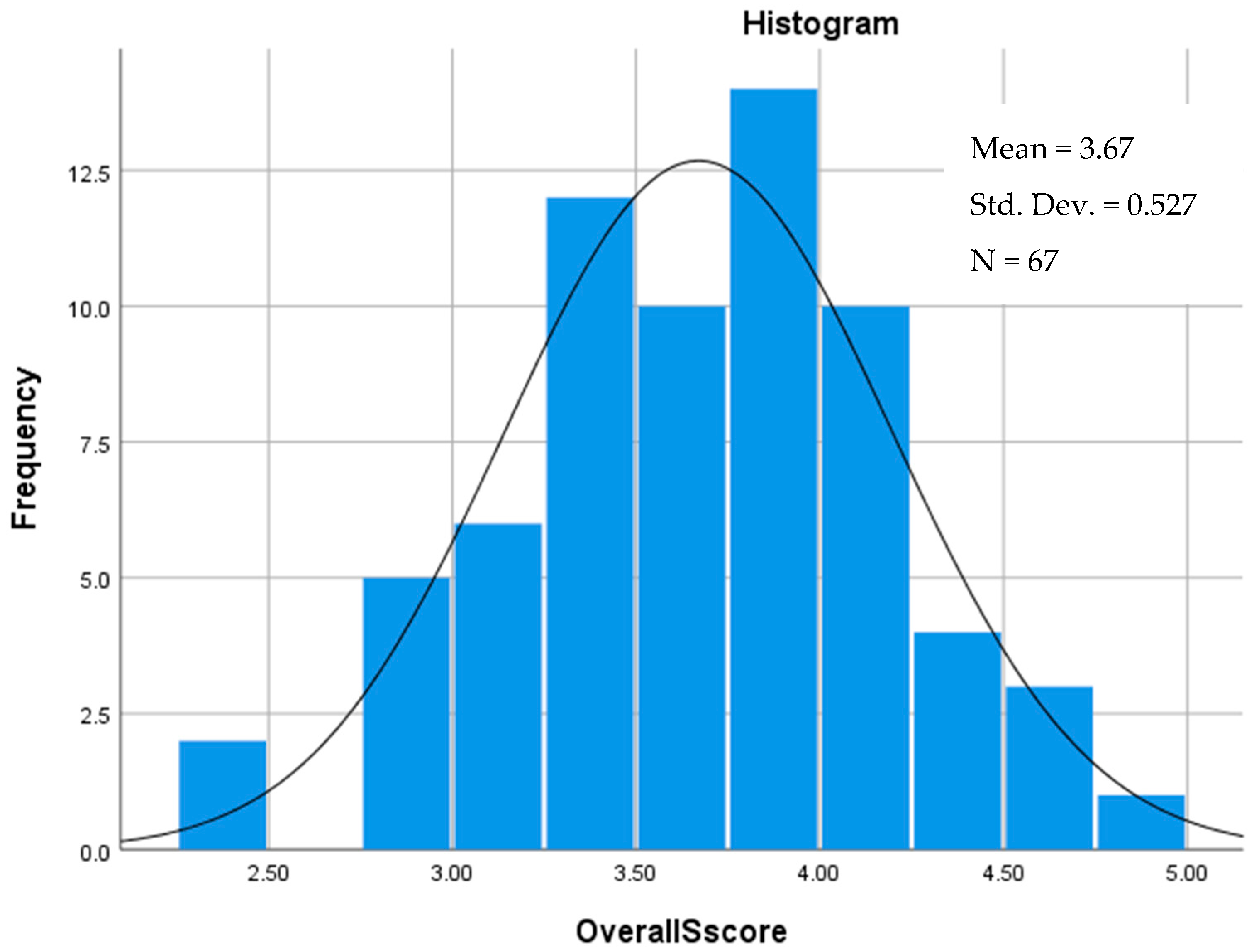
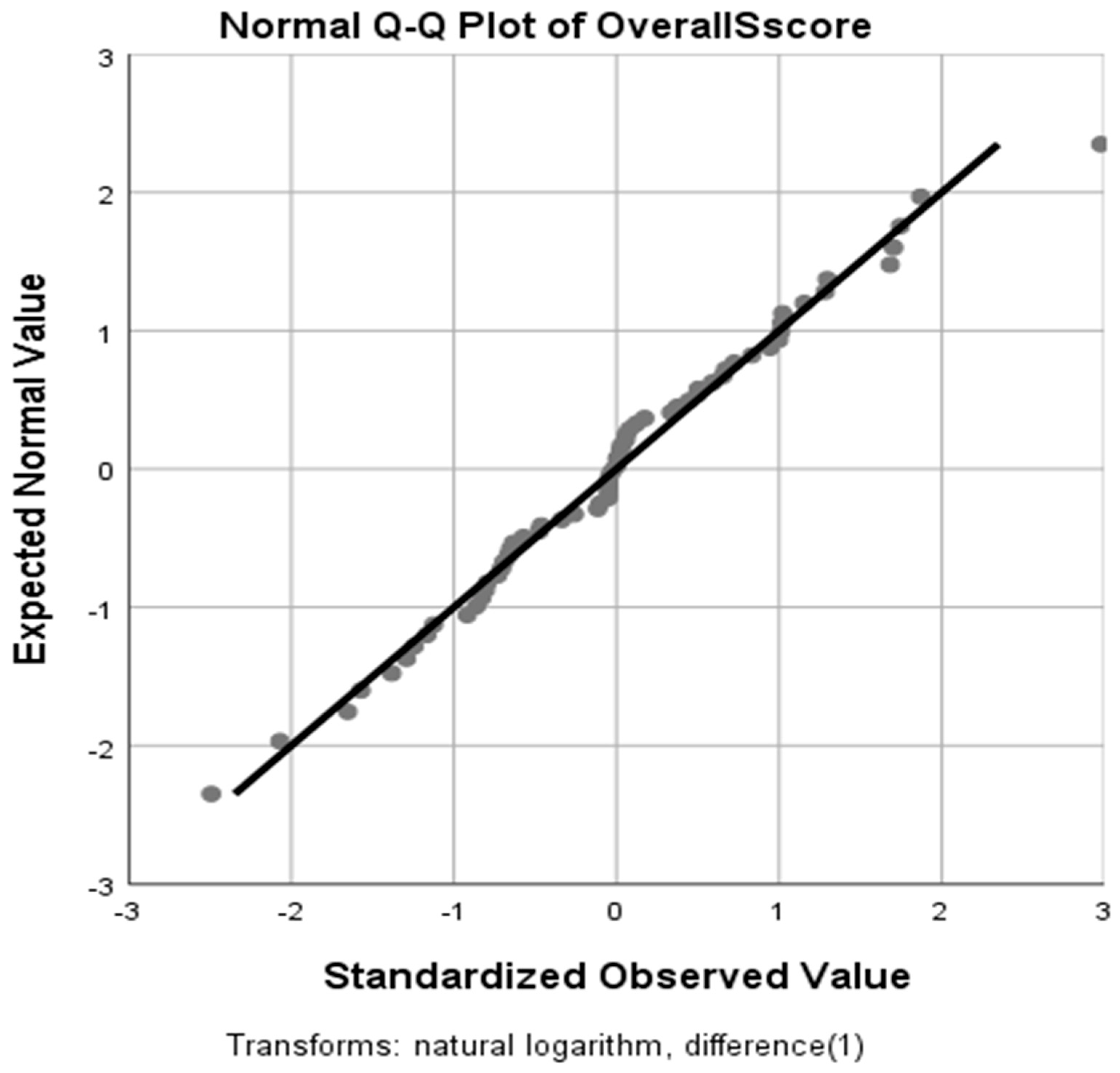
p = 0.959) tests show that the data were approximately normally distributed. Furthermore, visual inspection of
Figure 1 (Histogram) shows that overall Score is roughly bell-shaped and centred near the mean suggesting an approximately normal distrubtion. Furthermore,
Figure 2 normal Q-Q plot (B), also shows that the Q-Q plot points fall close to the reference/normal line, indicating the data are reasonably consistent with normality with only slight tail deviations. Therefore, appropriate parametric tests were computed using SPSS 25. According to
Norman (
2010), parametric statistics can be applied to Likert data, even with small sample sizes.
- (i)
Influence of gender and school location
Regarding the influence of gender,
Table 11 shows that female HoDs (N = 29, M = 3.61, SD = 0.48) and male HoDs (N = 38, M = 3.71, SD = 0.56) had comparable instructional practice scores, t(65) = −0.754,
p = 0.453. This suggests that gender was not a significant factor in establishing instructional leadership methods. School Location: Similarly, HoDs in rural schools (N = 17, M = 3.70, SD = 0.297) and urban schools (N = 50, M = 3.66, SD = 0.50) showed no significant difference, t(65) = 0.297,
p = 0.768. Thus, school location had no substantial impact on instructional leadership techniques. These results indicate that the null hypothesis of no difference in instructional leadership practices by gender and school location is not rejected.
- (ii)
Influence of age, qualification, years of experience, and workload on HOD’s self-reported instructional practices
The ANOVA test results in
Table 12 determined whether many demographic and workload-related variables were associated with differences in HoD’s self-reported instructional practices. Age-wise, results show no significant differences in instructional practices among all age groups [F(3, 61) = 0.709,
p = 0.550]. Mean scores were quite similar among the groups (3.51–3.80). Additionally, academic qualification had no significant influence [F(4, 62) = 0.963,
p = 0.149], all means ranged from M = 3.52 to M = 3.79. Years of experience also revealed no significant differences [F(2, 60) = 0.356,
p = 0.702], although the means increased marginally among the groups (3.61 to 3.83). However, the differences were not statistically significant. The number of teaching times per week (≤19, 20–25, 26–30, 31–35) had no significant effect on instructional practices, F(3, 60) = 0.246,
p = 0.864. The mean scores were constant across groups, ranging from 3.63 to 3.8.
However, there was a significant difference in the number of subjects taught by HoDs (F(2, 63) = 3.138, p = 0.050). HoDs teaching three subjects indicated higher self-reported instructional leadership practices (M = 4.06) than those teaching one or two topics (M = 3.61 and 3.59, respectively). The analysis revealed a significant difference between groups 2 and 3 (F(2, 63) = 3.14, p = 0.05). The Tukey HSD test revealed that teachers who taught three subjects reported considerably higher self-reported instructional leadership practices than those who taught two subjects (p = 0.041). However, there were no significant differences between those teaching three subjects and those teaching one (p = 0.138) or one and two (p = 0.994).
For most demographic and workload variables (age, qualification, years of experience, and teaching periods per week), the null hypothesis of no group differences is not rejected. However, for the number of subjects taught, the null hypotheses is rejected, as a statistically significant group difference was found. Overall, the hypothesis testing results show that instructional leadership practices were largely consistent across demographic groups, except for differences associated with the number of subjects taught.
The cross-dimensional patterns suggest that science HoDs’ reported instructional practices is characterised by consistent strength in managerial and coordination functions, alongside comparatively limited reported enactment of high-impact pedagogical practices. The distribution of responses indicates that leadership attention is concentrated on structures that support instruction rather than o practices that directly develop teaching quality. The following
Section 4 interprets these patterns in relation to the instructional leadership literature and considers their implications for middle leadership capacity, role expectations, and professional development needs.
4. Discussion
The present study of Science Heads of Department (HoDs) in Lesotho found that HoDs most consistently enacted activities associated with setting and communicating goals, monitoring learning progress, coordinating the curriculum, protecting teaching time, and ensuring availability of materials. In contrast, practices that involve direct, sustained pedagogical engagement—notably classroom observation and formal written feedback to teachers—were less frequently enacted. These patterns align with broader findings in the instructional leadership literature: school leaders commonly focus on organizational and managerial routines (e.g., goal setting, resource allocation, timetable protection), while the highest-impact instructional activities—direct engagement with teachers’ classroom practices—are often under-implemented (
Robinson et al., 2008).
Robinson et al.’s (
2008) synthesis emphasised that leadership practices that directly support teaching and learning (e.g., evaluation and feedback of teaching, coaching, and monitoring instruction) have a larger effect on student outcomes than more distal managerial functions. The finding that written instructional feedback is seldom provided suggests a missed opportunity for an evidence-based lever of improvement: formal feedback and systematic observation are precisely the kinds of practices that the literature identifies as high-leverage for improving classroom instruction (
Hallinger, 2011).
A closer analytical examination of the least reportedly enacted practices—particularly classroom observation, provision of formal written instructional feedback, and systematic evaluation of teacher learning—offers important insights into the nature and constraints of instructional leadership enactment among science HoDs. These practices are widely recognized as the most pedagogically demanding dimensions of instructional leadership because they require sustained engagement with classroom practice, professional judgment, and systematic follow-up (
Hallinger, 2011;
Robinson et al., 2008). Their limited reported enactment, therefore, suggests not a lack of awareness or commitment on the part of HoDs, but the influence of structural and contextual conditions that shape how instructional leadership is prioritised in everyday school practice.
Classroom observation, which is reported to occur only occasionally, is a foundational mechanism for instructional improvement, as it enables leaders to develop an informed understanding of teaching quality and learner engagement (
Hallinger et al., 2015). However, empirical research consistently shows that observation is among the most difficult leadership practices to sustain, particularly for middle leaders who carry substantial teaching and administrative workloads (
Mestry, 2017;
Malinga et al., 2021). Consequently, instructional supervision often becomes indirect—relying on document review, assessment data, or informal conversations—rather than on systematic in-class engagement. This pattern is clearly evident in the study’s findings.
The infrequent use of formal written instructional feedback and limited evaluation of teacher learning further point to a model of instructional leadership that is facilitative mainly rather than developmental. Written feedback plays a critical role in documenting instructional expectations, supporting accountability, and sustaining professional learning over time; yet, it remains underutilised in many school contexts (
Hallinger, 2011;
Robinson et al., 2008). Viewed through a distributed leadership lens, these patterns suggest that instructional leadership practice is shaped more by organizational routines, role expectations, and system-level priorities that prioritise visible managerial tasks over sustained pedagogical engagement (
Spillane, 2005).
The strong performance in goal-setting and curriculum coordination in our data corresponds to the “defining mission” and “managing the instructional program” components of
Hallinger et al.’s (
2015) leadership model. However, the relatively lower enactment of classroom observation and evaluation suggests a weaker implementation of ongoing pedagogical support and capacity-building, which
Hallinger et al. (
2015) identify as necessary to translate goals into improved teaching practices.
Regional studies in southern Africa further contextualize the under-enactment of classroom observation, written feedback, and evaluation of teacher learning observed in this study. Research on school middle-management (HODs) in South Africa and neighbouring contexts has similarly documented that HODs often concentrate on administrative, coordination and resource-related tasks while experiencing constraints in providing concentrated pedagogical leadership such as observation, coaching, and formal feedback—tasks that typically require time, training, and system supports (
Chabalala & Naidoo, 2021;
Malinga et al., 2021;
Mestry, 2017). These findings suggest that the Lesotho pattern is not idiosyncratic but rather reflects wider systemic challenges in the region concerning the distribution of leadership functions, role clarity, and the professional capacity of middle managers.
The concentration of under-enacted practices within the pedagogically intensive dimensions of instructional leadership points to systemic rather than individual limitations. These syntheses reinforce the implication of this study’s findings, that strengthening the capacity of HoDs to conduct classroom observation and to provide regular, written, formative feedback should be a key policy priority. Several plausible structural explanations are suggested by both the literature and the results of the current study. First, role overload and role ambiguity are commonly reported among HODs: they are assigned both managerial responsibilities (scheduling, meetings, resource distribution) and instructional duties without commensurate time or training, which tends to privilege managerial tasks that are quicker to enact (e.g., scheduling, material provision) over time-intensive pedagogical tasks (classroom observation; coaching). Second, capacity constraints—including limited training in observation and feedback skills and a lack of systems for documented follow-up—reduce the likelihood that feedback will be systematic or written. Third, system incentives and accountabilities in many contexts emphasise compliance and paperwork rather than instructional improvement cycles, which skews leader activity toward visible managerial outputs rather than the often less visible but higher-impact practice of iterative teacher development (
Bush & Glover, 2016). Together, these mechanisms help explain why HoDs in Lesotho frequently enact curriculum coordination and goal-setting, while providing little written instructional feedback.
Implications for policy and practice flow directly from these interpretations. At minimum, interventions should aim to (a) clarify the role of HODs so that instructional leadership is prioritised in job descriptions and performance appraisals; (b) provide structured professional development focused on observation, feedback and coaching techniques (including practice and follow-up); (c) create time and incentives for in-class engagement by protecting HODs’ time for observations and follow-up discussions; and (d) institutionalize simple, low-burden tools for written feedback and tracking teacher development (observation forms, short feedback templates, peer exchange forums). Evidence suggests that relatively modest, well-designed interventions in these areas can increase the frequency and quality of instructional leadership practices, thereby contributing to improvements in teaching and, ultimately, student learning.
Limitations of the Study
When evaluating the results, several limitations should be considered. Firstly, the study relied solely on self-reported data, which may lead to an overestimation of the frequency of instructional leadership behaviors due to social desirability bias. The quality and depth of leadership practices as they take place in classrooms cannot be adequately captured by self-reports, even though the use of an established instrument (PIMRS) improves reliability. Second, it is difficult to determine causal relationships or track changes in instructional leadership practices over time due to the cross-sectional survey design. Longitudinal research would provide a deeper understanding of how HoDs’ behaviours change in response to policy changes, professional development opportunities, or shifting school environments. Instructional leadership is a dynamic process. Third, although adequate for descriptive analysis, the comparatively small sample size and response rate may limit the applicability of the findings to institutions other than the participating ones.
Lastly, the study’s exclusive emphasis on department heads of science limits the findings’ generalisability. Due to variations in curriculum structure, assessment requirements, and pedagogical traditions, instructional leadership approaches may differ between disciplines. Future studies employing mixed-methods techniques—such as document analysis, interviews with teachers and principals, and classroom observations—would provide a more comprehensive understanding of the implementation and effects of instructional leadership practices.