Article

Learning to Argue: How Do 4th and 6th Grade Students Use Multimodal Materials to Solve a Socioscientific Issue?


by
Nuria Fernández-Huetos
*,
José Manuel Pérez-Martín
,
Tamara Esquivel-Martín
and
Irene Guevara-Herrero
Specific Didactics Department, Universidad Autónoma de Madrid, 28049 Madrid, Spain
*
Author to whom correspondence should be addressed.
Educ. Sci. 2026, 16(2), 321; https://doi.org/10.3390/educsci16020321
Submission received: 10 January 2026 / Revised: 9 February 2026 / Accepted: 14 February 2026 / Published: 16 February 2026
(This article belongs to the Section STEM Education)

Abstract

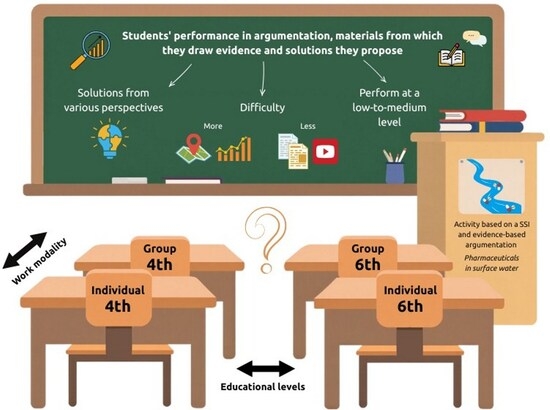
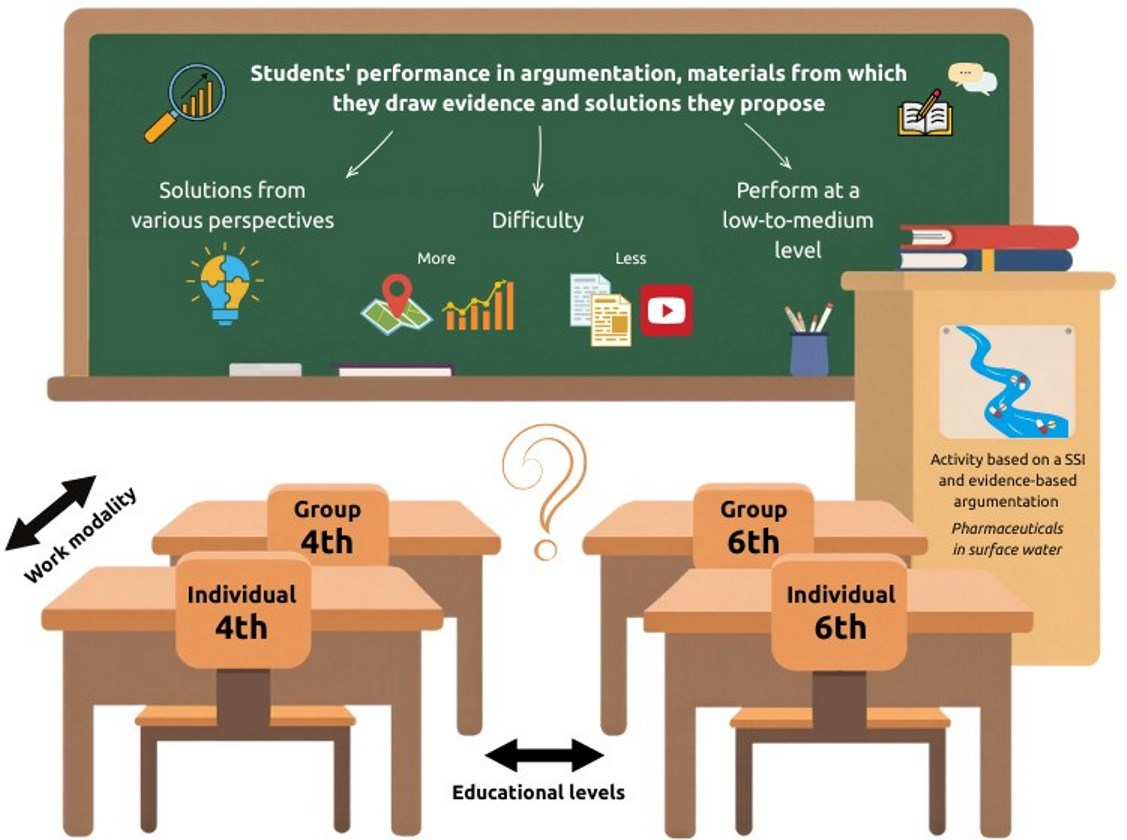
In light of the current eco-social crisis, environmental education must adopt a transformative, critical literacy-based approach grounded in scientific practices to prepare students to address socioenvironmental issues from a systemic perspective. This study, which was conducted with 4th and 6th-grade primary school students (aged 9–12), presents the results of an activity based on a socioscientific issue about the presence of pharmaceuticals in surface water. The aim is to evaluate students’ performance in argumentation, their use of and understanding of the materials from which they extract evidence, and the solutions they propose. To this end, the content (written reports) and discourse (group discussions) were analyzed, and different statistical tests were carried out to compare individual and group performance, as well as performance among educational levels. The results show students in both years tend to perform at a low-to-medium level, with higher performance in 6th grade, but there are no significant differences in most areas. They also use materials in different semiotic modalities; similarly, they experience more difficulty with maps and graphs than with texts and videos. Additionally, they propose solutions from various perspectives. Overall, this approach contributes to the development of scientific reasoning in primary school students and should therefore be incorporated into their classroom culture.

Graphical Abstract

1. Introduction

The current environmental crisis has highlighted the limitations of traditional Environmental Education practices, which mainly focus on transmitting ecological content (Guevara-Herrero et al., 2024a; Reid et al., 2021). To address the challenges of the Anthropocene, an era characterized by the interdependence of science, technology, society, and the environment (OECD, 2023; W. X. Zhang & Hsu, 2025), it is crucial to transition to Transformative Environmental Education (TEE). This approach promotes critical literacy, systemic thinking, and action grounded in environmental justice (Guevara-Herrero et al., 2024a; W. X. Zhang & Hsu, 2025).
In this context, given the interconnection of socioenvironmental issues, it is crucial that students develop the ability to make informed, reasoned, and critical decisions. Argumentation is one of the most successful scientific practices in science education (Dawson, 2025; J. Zhang et al., 2023) because, to debate complex issues, students need to be able to construct, defend, and criticize arguments based on adequate scientific literacy. There are several different views on what constitutes scientific literacy (Valladares, 2021). Firstly, view 1 focuses more on scientific content and processes. By contrast, view 2 emphasizes the application of scientific knowledge in real and controversial contexts, even encouraging citizen participation (Roberts, 2007). The latter is the one that best aligns with TEE (Dawson, 2025). While some studies have implemented scientific argumentation (view 2) in classrooms (Esquivel-Martín et al., 2023; Fernández-Huetos et al., 2025; Guevara-Herrero, 2024), this practice is not common due to time constraints and a lack of teacher training in designing, implementing, and evaluating student learning outcomes in response to such proposals (Dawson, 2025; Osborne et al., 2013). Finally, in view 3, students develop a global perspective on issues such as climate change and decide to take action and get involved in social activism (Sjöström, 2024; Siarova et al., 2019; White et al., 2022). There are a few examples of this approach in educational practice, but in the study conducted by Herman et al. (2021), students understood the impact of the reintroduction of wolves in Yellowstone and took action to address this socioscientific issue (SSI) by writing letters to public officials explaining the controversy over wolf hunting, for example.
Therefore, argumentation allows students to identify and select the most relevant data (Jiménez-Aleixandre, 2020). If this data are presented in different semiotic modalities, it encourages the interpretation of information from various communication channels (Guevara-Herrero et al., 2024b), representing a situation analogous to real-life contexts (news, social media, etc.). As a result, combining argumentation with real problems allows the complexity of socio-environmental issues to be presented from a systemic, critical perspective, contributing to TEE (Esquivel-Martín et al., 2023; Freitas et al., 2023; W. X. Zhang & Hsu, 2025).
In this sense, socioscientific issues (SSIs) are ideal for promoting argumentation (Torres & Solbes, 2018) within the framework of Transformative Environmental Education (TEE), as they address real and complex problems that require evaluating information, constructing evidence-based arguments, considering multiple perspectives, and promoting responsible actions (Zeidler & Sadler, 2023; Arifin et al., 2025; K. Y. Tang et al., 2023). These activities contextualize learning on controversial topics (GMOs, nuclear energy, climate change), revealing their systemic complexity and the existence of multiple solutions with diverse implications (Şaşmazören et al., 2023). Furthermore, SSIs enable students to connect their interests to scientific content and their everyday lives and even significantly improve their view of science (Monserrat et al., 2025), especially in local contexts (Wiyarsi & Çalik, 2019). Studies confirm that SSIs improve scientific literacy, critical thinking, argumentation, decision-making, and academic performance (Akyol & Kanadli, 2022; Martini et al., 2021), aligning with an TEE oriented towards social change (Freitas et al., 2023; Kokolaki & Stavrou, 2022).
Despite its potential, the analysis of the implementation of SSIs in educational research has been limited. There were virtually no publications on the subject between 2002 and 2006 (Narayanan et al., 2025). From 2011 onwards, growth began to be recorded, with a notable increase in publications and citations between 2019 and 2020 (Arifin et al., 2025; Kumar et al., 2024). This reflects a growing commitment to and interest in exploring SSIs as a means of promoting scientific literacy in educational institutions (Kumar et al., 2024; Zeidler & Sadler, 2023). However, SSIs are still rarely implemented in classrooms (Chen & Xiao, 2021; Högström et al., 2024). Consequently, scientific concepts such as the water cycle or energy sources are commonly taught without exploring related controversies (Dawson & Carson, 2020). Teachers also find this approach difficult to apply due to a lack of time, knowledge of how to teach SSIs, or teaching resources (Christenson et al., 2017; Dawson, 2023; Ozcan-Ermis & Hervé, 2024).
Despite these obstacles and teachers’ fear of possible criticism (Levinson, 2018), some decide to incorporate SSIs into their classrooms, primarily in secondary and higher education (Zamalloa et al., 2025). However, educational research recommends taking a transformative approach to addressing environmental issues, particularly in the early stages, as the impact on behavioral change is greater at this time (Olsson & Gericke, 2016; Van de Wetering et al., 2022). In fact, childhood is the stage at which the cognitive, emotional, and attitudinal foundations that determine a person’s relationship with the environment are formed (Nepraš et al., 2022; Zamalloa et al., 2025). Therefore, these educational practices should be incorporated throughout all years of schooling (Dawson, 2025) to promote more complex thinking (Nepraš et al., 2022) and the ability to ask questions, think critically, and make informed decisions (Öztürk & Karakaş, 2024).
In this context, several studies have demonstrated that children in early childhood education (ECE) and primary education (PE) can engage with SSIs and develop an argumentative approach, fostering positive attitudes toward science and greater environmental awareness (Byrne et al., 2014; Lu et al., 2024; Zamalloa et al., 2025). For instance, 8–9-year-old students improved their decision-making and academic performance (Öztürk & Karakaş, 2024), 9–10-year-olds debated solutions to reduce CO2 emissions from various perspectives (Byrne et al., 2014), 11–12-year-olds advanced in scientific reasoning (Dawson, 2025; McNeill, 2011), and even 3-year-olds showed good inquiry and argumentation skills (Zamalloa et al., 2025).
Consequently, it is essential to design activities within the framework of TEE, implement them in the early stages of education, and assess their efficacy. In this regard, Fernández-Huetos et al. (2025) conducted a pilot study (with 24 students in the 6th grade of PE from a public school with a medium-high socioeconomic level), analyzing the results of implementing an activity based on an SSI related to the presence of pharmaceuticals in wastewater. This activity was designed to address the pressing issue of environmental, human, and animal health (One Health) concerns, particularly the presence of drugs in wastewater. This activity is aligned with vision 2 of scientific literacy, as it is based on a real and controversial context and invites students to participate in reflecting on solutions. This context is aligned with the Sustainable Development Goals (SDGs) 3, 6, 11, 12, 14, and 15, with the objective of enhancing TEE instruction and providing students with a quality education (SDG 4). Therefore, we consider it necessary to continue with this line of research, implementing the same activity with a greater number of students from different schools and grades. In this way, we will contribute to the literature on socioscientific issues with a classroom intervention using an SSI designed by ourselves and its evaluation to analyze student performance. Specifically, it addresses evidence-based socioscientific reasoning, that is, how students seek and use evidence to reason, justify, and support their arguments (Fang et al., 2019).
The objective of this study is to analyze how the designed teaching proposal promotes argumentation and scientific reasoning in 4th- and 6th-grade students at another educational center. This study aims to assess students’ proficiency in argumentation, to identify the types of evidence they employ, and to examine the way they utilize evidence based on their level of understanding. Additionally, the study will analyze the proposed solutions. It will also compare the development of the activity between the two grades, as well as individual versus group performance. To that end, the following research questions (RQ) are hereby proposed:
  • RQ1. What levels of performance do students show when solving this SSI compared to the reference answer, and what differences are observed depending on the type of work (individual or group) and the grade (4th or 6th)?
  • RQ2. What materials do they draw when formulating arguments, how do they use them in relation to their level of understanding, and what differences can be observed depending on the type of work (individual or group) and the grade (4th or 6th)?
  • RQ3. What kind of solutions do students propose to prevent the presence of pharmaceuticals in the river, and what differences are observed depending on the type of work (individual or group) and the grade (4th or 6th)?

2. Method

2.1. Context

The study adopts a mixed-methods conversion design with data transformation (Creswell & Plano Clark, 2018; Hernández-Sampieri et al., 2014). This study is framed within the case study research method, which consists of exploring a phenomenon (the case) in its real context (Yin, 2018). Specifically, individual and group responses from students are analyzed to determine their performance in arguing to solve the tasks. These responses, in the educational context in which they occur, constitute a particular case. Therefore, each group discussion is considered as a different case study, which should be analyzed in depth to understand its complexity (multiple case studies) (Yin, 2018).
It was carried out with three class groups serving as participants: a group of 24 4th grade students (ages 9–10) and two 6th grade groups, comprising a total of 41 students (ages 11–12). They are enrolled in a public school located within the community of Madrid (Spain), which is characterized by a medium-high socioeconomic level. This classification is due to the area’s average annual household income exceeding the regional mean for the Community of Madrid (average annual household income of €61,000, according to the National Statistics Institute). In addition, the school’s documentation provides a description of the families’ context. Most families are employed, a high percentage have a university education, and there is a strong tradition of reading. It is an environment with good availability of educational and technological resources and access to cultural and leisure activities. For all these reasons, we consider that these factors influence the students’ familiarity with the information presented in the activity, since the acquisition of learning opportunities is linked to educational and family contexts (Klaver et al., 2023). In this sense, the students who take on this activity have a wide variety of opportunities for cultural experiences (museums, cinema, theater), are more accustomed to searching for and comparing data, and are more confident in participating in debates and making decisions.
During the intervention, the students initially engaged in individualized activities and subsequently collaborated in groups, thereby preserving the conventional classroom work teams. Participation was voluntary with signed consent forms, and anonymity was ensured using numerical codes.
The activity implemented, “Pharmaceuticals in the river?”, is identical to that in the study by Fernández-Huetos et al. (2025). The sequence of the activity, the design, and the teaching tools utilized remain the same (Supplementary Material S1). The activity is designed to be sequential, meaning that students gradually develop an understanding of the environmental issue as they answer each of the questions Q1–Q5, using data from the different materials to support their answers. In Q6, students are asked to reflect on decision-making. Finally, in Q7, once students have acquired an overview of the problem, they are asked about possible solutions, encouraging critical thinking and action.

2.2. Data Analysis

The present study involved a qualitative analysis of the content of the responses (Schreier, 2012) and a discourse analysis (Gee, 2014). To this end, the data were listened to and interpreted. These recordings complement the written group reports, as they provide more information for categorizing the response and for understanding the social dynamics of the group. All written responses from the students (individual and group), as well as all group oral responses, were processed (inductively, in interaction with data). During these processes, three authors of this study participated in triangulating the presented data. First, they analyzed the responses independently. Subsequently, they held a session in which the results were compared, reaching an agreement rate of over 90%.
The analysis of all questions in the activity (Q) followed the work of Fernández-Huetos et al. (2025), employing the categories included in Supplementary Material S2A. After categorization, absolute (Q1–Q6) and relative (Q7) frequencies were calculated. For RQ1, which is related to student performance, the categories used to analyze Q1–Q6 range from null (1) to high (5). For RQ2, which is related to the materials used, the categories used for the analysis of Q1 to Q6 are graphs, maps, videos, reports, and leaflets. To analyze the level of comprehension, Barrett’s (1968) taxonomy was used for texts and Curcio’s (1989) taxonomy for graphics (Supplementary Material S2B). Finally, for RQ3, the five types of solutions proposed in Q7 were identified.
Furthermore, descriptive and inferential statistical analyses were performed in all three cases using Microsoft Excel™ and IBM® SPSS® Statistics 19 (2010) to compare individual and group performance among students and between levels (4th and 6th). Specifically, a non-parametric statistical analysis of mean comparison (Mann–Whitney U test, p ≤ 0.05) was performed on the results of Q1 to Q6, since the sample did not show normality (Kolmogorov–Smirnov test) or homoscedasticity of variances (Levene test). For Q7, the data were analyzed using the nonparametric Chi-square test (χ2, p ≤ 0.05). Finally, to analyze the use of materials at different educational levels, the nonparametric Chi-square test (χ2, p ≤ 0.05) was applied.

3. Results and Discussion

3.1. Analysis of the Performance Level of Students in 4th and 6th Grade of PE (RQ1)

The results show that 4th and 6th grade PE students can solve the case, although with different levels of performance. The average individual performance (Table 1) of 4th grade students when completing the activity is 2.59, and that of 6th grade students is significantly higher (2.88 ± 1.57; Mann–Whitney U test, p ≤ 0.05). Therefore, students in both grades are between a low level (2/5) and a medium-low level (3/5). In this sense, it is reasonable that 6th grade students achieve a higher level of performance on all questions, as they have more knowledge and skills. However, when analyzing group performance, no significant differences are observed between the two grades, with a similar level of performance comparable to the individual performance of 6th grade students (Table 1).
The analysis by question enables the observation of discrepancies between grades, according to the type of work (Table 2). In Q1, Q2, Q3, Q5, and Q6, no significant differences were observed, indicating that students from both grades answered the survey questions in a similar manner. In Q4, significant differences were identified. Furthermore, this is the question with the lowest performance level in both grades. This may be because it requires students to simultaneously understand and apply information from different materials. Likewise, the perception of difficulty is similar in both grades, as reflected in the level of performance achieved in each question, which is as follows in ascending order: Q4 < Q2 < Q1 < Q5 < Q3 < Q6.
A subsequent comparison of performance levels based on work mode (individual and group) revealed no statistically significant differences (Mann–Whitney U test, p ≤ 0.05) (Table 2). This finding aligns with the conclusions of Fernández-Huetos et al. (2025), who demonstrated that group work does not enhance student performance in any of the PE grades under analysis. For instance, in Q4, G8 of 6th grade, one group member (S35) correctly argues his answer, but his classmates (S34) overlook it and give incorrect responses.
-
S33: If the pharmaceuticals most commonly found in the Bodonal stream are not the best-selling ones, how and why do they end up in such large quantities in the stream?
-
S34: Because in pharmacies, if a product, that is, a medicine, is not sold…, they throw it away.
-
S35: And because they are the most difficult to eliminate.
-
S36: And it also expires.
-
S35: They are also the most difficult to eliminate.
-
S33: Yes, but…
-
S35: The best sellers are the easiest to eliminate. And the worst sellers…
-
S34: No, but not that. It says… How and why do so many of them end up in the stream? Because pharmacies throw them away when they don’t sell them. And also when they expire.
-
S36: Because if they don’t stock them and they expire, pharmacies throw them away.

3.2. Analysis of the Use of Materials by Students in 4th and 6th Grade of PE (RQ2)

Each question analyzed the materials that 4th and 6th grade students used to support their answers. In general, 6th grade students tended to use more materials simultaneously than 4th grade students, though no significant differences were found between the two grades (χ2, p ≤ 0.05). No differences were observed in the choice of materials according to the different semiotic modalities (textual, visual, or graphic). These results suggest that 4th grade students are as capable as 6th grade students of analyzing data extracted from different sources of information. As seen in Table 2, students performed better on questions Q3 and Q5, which required extracting evidence from texts only, and on Q6, where they had to take a position without using materials. In contrast, they performed worse on questions Q4, Q2, and Q1, which required extracting evidence from maps and graphs.

3.2.1. Q1: “Based on What You Have Read and Seen, What Is Polluting the River?”

To answer this question correctly, it is necessary to use graphs, specifically the one showing the most prevalent pharmaceuticals in the river. Other materials may be useful, such as the scientist’s video mentioning the presence of drugs or the leaflet and report listing the names of the drugs present in the river. However, they do not contain enough data to provide a high-level answer. In fact, no 4th or 6th grade students achieve this level of performance.
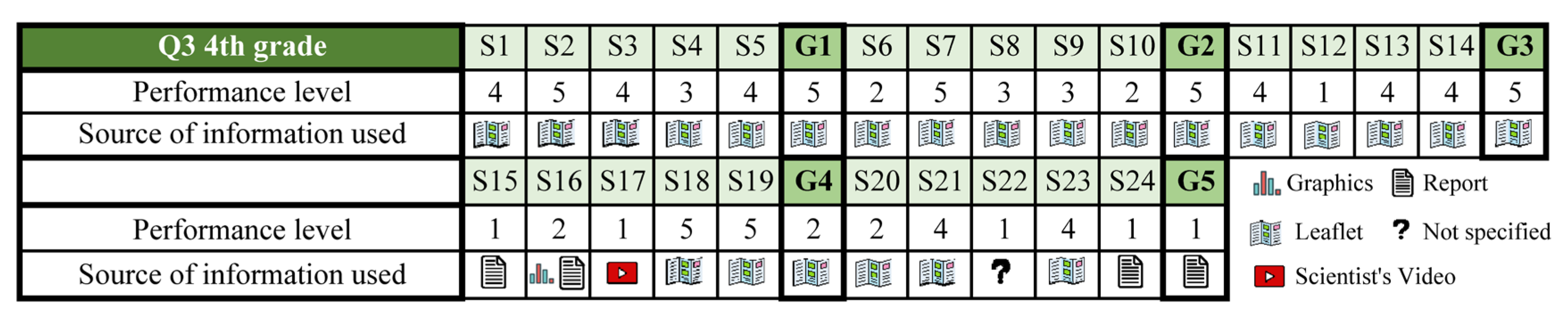
As for 4th grade students (Figure 1), during individual work, 12 students use the report, 3 use the graphs, 5 extract information from the videos, 1 combines video and text, and 3 do not specify the material used, nor can it be inferred. In contrast, when working in groups, each group uses different materials: leaflet (G1), scientist’s video (G2), graphs (G4), report (G5), and 1 group (G3) does not specify. These results suggest that 4th grade students do not tend to use them, probably because there is insufficient scaffolding of these skills, so they do not know how to interpret them correctly. Instead, most choose to look for information in the report.
In the case of 6th grade students (Figure 2), 20 use videos, 7 use texts (leaflet or report), 2 use graphs, and 3 supplement graphs with the report during individual work. Additionally, 5 students combine the scientist’s video with the report, 1 student uses 3 materials, and 3 students do not specify the material used. By contrast, when working in groups, 3 (G1, G7, and G9) use the scientist’s video; 1 (G4) relies exclusively on the report; 1 (G8) combines graphs with the report; 1 (G3) combines the scientist’s video with the report; and 3 (G2, G5, and G6) do not specify the material.
The findings reveal that, like 4th grade, 6th grade students rarely utilize graphs. Only 5 out of 41 students used them in their individual answers, which suggests possible difficulties interpreting this type of representation. Most students instead extract information from the videos. Notably, 9 6th grade students could extract information from various materials, whereas in 4th grade, this occurred in only one case. However, this combination of materials did not enable them to achieve a high level of understanding.
According to Curcio’s (1989) taxonomy of graph comprehension, high performance on Q1 is associated with level 2 (reading between the data). Students must select the bar graph and compare the values of each drug. In this study, 4th and 6th grade PE students who use graphs achieve average performance levels by identifying some or all the pharmaceuticals present in the river. In other words, they extract information by reading the data on the “Y” axis of the graph, achieving level 1 graph comprehension (reading the data). In a previous pilot study (Fernández-Huetos et al., 2025), nearly three-quarters of students used graphs, and some achieved level 2 comprehension.
Historically, multiple studies have examined PE students’ understanding of graphs using this taxonomy. In Guimarães’s (2002) study, 3rd grade students could identify the frequencies and basic elements of a bar graph (maximums and minimums). However, only a quarter could locate a specific area of the graph. According to Cruz (2013), 3rd grade students performed better with pictograms than with pie charts. Regardless of the type of graph, half of the students correctly answered level 1 and 2 comprehension questions, and only a quarter correctly answered level 3 questions (reading beyond the data). Various studies show that, in 5th and 6th grade, almost all students respond well to tasks requiring level 1 bar graphs (Canché, 2009; Pagan et al., 2008), and approximately half answer correctly when the activities are level 2 (Pagan et al., 2008) or level 3 (Canché, 2009). Furthermore, research incorporating tasks up to level 4 of graph comprehension (reading behind the data) shows that most students reach level 2 (Arteaga et al., 2021; Batanero et al., 2018). Along these lines, Evangelista (2013) concludes that students correctly answer half of the level 1 and 2 tasks. In general, PE students tend to have difficulty reaching levels 3 and 4 of graph comprehension, regardless of the type of graph they work with (Arteaga et al., 2021).
Even so, the Spanish educational curriculum (Royal Decree 157/2022, [MEFP] Ministerio de Educación y Formación Profesional, 2022) includes stochastic reasoning from the beginning of PE, in a learning progression that begins with strategies for recognizing elements of a simple graph (1st and 2nd grades), representation, selection, and comparison of two data sets (3rd and 4th grades), up to the completion of a simple statistical study (5th and 6th grades). Therefore, the cognitive demands of this question for 4th and 6th grade students (appropriate selection of the bar graph, interpretation of the data) are in line with the curriculum requirements. Despite this, our results indicate that students have difficulty understanding graphs. This is not surprising, as textbooks offer few activities requiring high levels of comprehension, so students are unfamiliar with this type of task (Arteaga et al., 2021). Instead, activities that only require literal reading of graphs and comparisons without critical evaluation or inference are usually presented (Salcedo et al., 2021). According to the 2023 Trends in International Mathematics and Science Study (TIMSS) report (Ministerio de Educación y Formación Profesional, 2024), the performance of Spanish 4th grade PE students in mathematics has declined since 2019. Their performance is significantly lower than the OECD average and the European Union (EU) total, with similar results in all three domains (numbers and measurements, geometry, and data).
Therefore, it is important to include basic knowledge and skills related to statistical literacy in the PE curriculum. However, this must be accompanied by research on children’s actual skills when faced with this type of task (Arteaga et al., 2021) and classroom practices that allow for their development. Considering the excessive amount of information in the media (Engel, 2017), it is urgent that PE students acquire critical statistical literacy to interpret and analyze information from tables and graphs at an early age. Only then will they be able to make informed decisions, for example, about election results or food ingredients (Ridgway et al., 2019; Papancheva, 2017).

3.2.2. Q2: “Based on What You Have Read and Seen, Where Do the Pharmaceuticals in the River Come from?

To achieve a high level of performance in this question, it is essential to combine information from the hydrographic and satellite maps and from the leaflet. In fact, only by correctly using the maps can a medium-high level be achieved. On the other hand, using only the leaflet can achieve at best a medium-low level. Thus, maps are key to answering this question because they allow us to identify the origin of the pharmaceuticals found in the river (Bodonal stream), a specific geographical location: Tres Cantos, Soto de Viñuelas, or the Tres Cantos Wastewater Treatment Plant (WWTP). The leaflet incorporates the idea of domestic drug consumption, which is implicit in the WWTP video as well. Therefore, students could infer that when a person takes a drug, it is excreted at home and reaches the river through wastewater. Nevertheless, the video only shows this information briefly, so students are unlikely to use it, especially since the leaflet explicitly provides the same information. Students can also use the report, but at best reach a medium-low level, as it only shows that the drugs come from a WWTP.
With regard to 4th grade students (Figure 3), during individual work, 6 students use the leaflet, 4 use maps, 3 use the report, 3 use the video on how WWTP works, 1 uses graphs, 1 combines the scientist’s video with the report, and 6 do not specify the material. In group work, each group uses a different material: report (G1), leaflet (G2), WWTP video (G4), maps (G5), and one does not specify (G3). These results show that 4th grade students have difficulty interpreting and applying information from maps. To mitigate this shortcoming, students choose to look for information in the leaflet, a text, but in a manageable and visual format.
As for the 6th grade students (Figure 4), when working individually, 9 use the report, 8 use the leaflet, 6 use the WWTP video, 4 use the maps, 1 uses the graphs, 1 combines graphs and the leaflet, 1 student uses the scientist’s video, and 11 do not specify, nor can it be inferred, the material used. When working in groups, 3 use the WWTP video (G3, G4, and G5), 1 uses the scientist’s video (G7), 1 uses the report (G1), 1 uses the maps (G2), and 1 does not specify (G6). Additionally, two groups combine two materials: WWTP video and leaflet (G9) and maps and graphs (G8). However, the latter group’s performance level was null, indicating that this strategy was ineffective. It can be observed that working in groups does not improve the choice of material.
Only 4 students use maps individually, and 1 group uses them, but both use them incorrectly. Consequently, 6th grade students are also unable to adequately extract information from these materials and instead rely mainly on texts and videos.
In short, PE students were unable to correctly interpret maps, as none of them achieved a medium-high or high level of performance. Furthermore, none of the students used the map and leaflet simultaneously. This makes this question the second most difficult for both grades because success depends on properly using maps. This issue was also identified in the previous pilot study, in which most 6th grade students were unable to extract information from the maps.
In the Spanish PE curriculum (Royal Decree 157/2022, MEFP), maps, plans, and globes appear in 3rd and 4th grades, and in 5th and 6th grades, students study the geographical diversity of Spain and Europe (rivers, mountains, provinces, etc.). Therefore, the cognitive demand required for this question (spatial location, interpretation of a river’s course on a map) is in line with the curriculum content. However, their use in classrooms tends to focus on the location and distribution of geographical features. This approach falls into a transmissive teaching model (Armas-Quintá et al., 2022) rather than encouraging spatial thinking and reasoning (Jonuzi & Selvi, 2023). Nevertheless, maps (two- and three-dimensional) should be used to promote cartographic literacy, which includes reading and interpreting maps, transferring information to maps, using scales, drawing and creating symbols, and finding addresses (Ayuldeş & Akbaş, 2023).
In fact, students need to develop their map-reading skills because maps are increasingly used in everyday life (Havelková & Hanus, 2019). Therefore, it is important for children to interact with maps, plans, globes, and world maps from an early age (Ayuldeş & Akbaş, 2023; Catling, 2018), which should be adapted to their level of understanding (Jonuzi & Selvi, 2023). Indeed, there has been an increase in publishers and cartographers designing maps specifically for children with appropriate symbols and colors. A child exposed to these resources in ECE will likely be able to understand abstract symbols and draw local maps from a plan view by the age of 11 or 12. However, many children of this age lack the knowledge to understand map or atlas information (Catling, 2018), as evidenced by our 4th and 6th PE students.

3.2.3. Q3: “What Diseases Do These Pharmaceuticals Treat?”

To achieve a high level of performance on this question, the leaflet must be used, as it is the only material that lists all the pharmaceuticals, the diseases they treat, and their characteristics.
As for the 4th grade students (Figure 5), 19 use the leaflet when working individually, 2 use the report, 1 combines the leaflet with graphs, 1 uses the scientist’s video, and 1 does not specify. When working in groups, all of them used the leaflet except one group (G5), who used the report. Thus, half of the students were able to correctly use the leaflet to identify the appropriate evidence from all the materials to answer the question. This enabled them to achieve a medium-high (4/5) or high (5/5) level of performance. Specifically, 4 students and 3 groups reached the highest level by using the leaflet’s information on diseases treated by the pharmaceuticals in the river.
As for 6th grade students (Figure 6), 35 use the leaflet when working individually, 1 combines the leaflet and report, 1 combines the leaflet and graphs, and 4 do not specify the material. Almost three-quarters of the students achieve a medium-high or high level in their responses by using the appropriate materials. When working in groups, all students use the leaflet. In this case, working in groups favors the choice of material.
At this point, it is worth noting the difference between the medium-high and high levels in relation to Barrett’s (1968) taxonomy of text comprehension. The high level on Q3 is associated with level 2 (reorganize information), as students must interpret and synthesize the information to generate a new discourse understanding that all diseases are linked to mental health. In both the 4th and 6th PE grades, there are students who have reached this level, although they are in the minority (4/24 of 4th grade students and 10/41 of 6th grade students). In contrast, the medium-high level of this question is associated with level 1 text comprehension (reading comprehension). At this level, students recognize information and identify data but make a literal copy of the leaflet. More students reach this level in 4th grade PE (8/24 students) and in 6th grade (18/41 students).
The Spanish educational curriculum (Royal Decree 157/2022, MEFP) calls for students in the second cycle of PE (3rd and 4th grades) to locate, select, and compare information from different sources. However, we observe a tendency to copy information directly rather than process it and generate new and more accurate information that is relevant to the question. This may be because textbook activities tend to require textual reproduction rather than interpretation of data (Pérez-Martín et al., 2019). On the other hand, students in 4th and 6th grade did not have difficulty selecting the appropriate material (leaflet), probably because it is a familiar type of material often found in advertising brochures that presents information concisely and visually (Esquivel-Martín et al., 2023). Nevertheless, it is crucial to implement various strategies for textual comprehension in the classroom (X. Tang et al., 2017) since students are accustomed to narrative texts from the first cycle of PE (1st and 2nd grades) but not as much to expository texts, which become more prevalent from 4th grade onwards (Míguez-Álvarez et al., 2022).

3.2.4. Q4: “If the Pharmaceuticals Most Commonly Found in the Bodonal Stream Are Not the Best-Selling Ones, How and Why Do They End Up in Such Large Quantities in the Stream?”

This is the only question in which significant differences were found between the two grades, and students performed at a lower level. To perform well, students must use graphs, report and leaflet. The expected answer should explain the ineffectiveness of WWTPs in removing certain pharmaceuticals, using evidence from the report, and relate this idea to the best- and worst-selling pharmaceuticals, using evidence from the graphs. This would lead to the conclusion that, despite not being the best-selling pharmaceuticals, they end up in the river because WWTPs cannot effectively remove them. Additionally, consider that they are used to treat mental health and chronic conditions, so their discharge is constant (evidence implicitly taken from the leaflet or an idea learned from Q3).
In the case of 4th grade PE (Figure 7), nearly half of the students could not extract the correct evidence from any of the materials. Furthermore, none of them used more than one source, as the question required. 3 students used the report; 2 used the graphs; 2 used the scientist’s video; 2 used the leaflet; 1 used the WWTP video; and 1 used the video and the report together. Of the groups working together, 2 (G1 and G3) did not specify which materials they used, 1 (G4) used the graphs, 1 (G2) used the scientist’s video, and 1 (G5) used the leaflet.
In terms of performance level, only 2 students argued that WWTPs do not effectively remove certain pharmaceuticals, placing them at the medium-low level. The rest were below this level, with most at the null level. Therefore, it seems that this question is highly difficult for 4th grade students. Perhaps students need teacher support in the form of mediating questions that help them analyze and relate the different types of data in the materials (Guevara-Herrero et al., 2024b).
As for the 6th grade students (Figure 8), 10 use the report, 5 use graphs, 5 use videos, and 5 use the leaflet when working individually. Additionally, 4 students combine the graphs with the report, 1 combines the report with the WWTP video, and 11 do not specify the material. In group work, 4 groups (G1, G3, G4, and G9) use the report; 1 (G8) uses the graphs; and 4 (G2, G5, G6, and G7) do not specify the material. Overall, most students use textual materials to find answers in a single source, suggesting a preference for text over graphics, possibly due to their frequent use in the classroom (Mohamedi-Amaruch & Rico-Martín, 2020). However, some students combined the report with the graphs, achieving performance levels ranging from low to high depending on their interpretation and understanding of the sources. Nevertheless, this question was also difficult for 6th grade students, as just over half of the group achieved a null-performance level. Only 1 student achieved the medium-high level (establishing a relationship between two sources of information), and 1 student achieved the high level (adding a third source of information).
To determine the extent to which students understood the materials needed to answer Q4, Barrett’s (1968) taxonomy for text comprehension was applied to the report and leaflet. In 4th grade, 2 students gave a level 1 response (reading comprehension) because they only identified some of the information in the report. In 6th grade, 8 students were at this level. 1 student reached level 2 (reorganize information) by combining information and establishing relationships between the most and least sold pharmaceuticals. Another student reached level 3 (inferential or interpretive) by integrating implicit data from the leaflet and inferring that the type of diseases (mental health and chronic) treated by these medicines means their discharge is constant and affects their presence and persistence in the river.
According to Curcio’s (1989) taxonomy, which is applicable to medium-high and high-performance levels, none of the 4th grade students adequately understood the graphs to answer correctly. In contrast, 2 out of 41 6th grade students reached this level: 1 reached level two (reading between the data) by comparing the most and least sold pharmaceuticals, and another reached level 3 (reading beyond the data) by connecting the information in the graphs with the rest of the materials.
Therefore, in Q4, 6th grade students performed better than 4th grade students, as reflected in their understanding of the texts and graphs. However, all students had difficulty integrating tests from different materials and establishing relationships between them. These skills are included in the Spanish educational curriculum (Royal Decree 157/2022, MEFP). For instance, in the second cycle of PE (3rd and 4th grades), students learn to “graphically compare two sets of data to establish relationships and draw conclusions” in mathematics and “search for and select information from different sources” in social and natural studies. In addition, the 3rd cycle (5th and 6th grades) includes “contrast of information”. Therefore, it is logical that performance in 4th grade was lower than in 6th grade. However, the difficulties 6th grade students encountered in this study are similar to those in the previous pilot study. In the previous study, no 6th grade student achieved a high level of performance, reaching only level 2 of text and graph comprehension. These results highlight the necessity of activities involving the search, selection, and contrast of data from various sources. Likewise, PE classrooms rarely implement activities that encourage evidence-based argumentation, such as those in this study (Dawson, 2025). These activities are more common in secondary education or preservice teachers (Ottander & Simon, 2021; Sakamoto et al., 2021). Nevertheless, such activities are possible in PE, as students understand the information in the materials when working on them separately (graphs, report and leaflet). If children had more opportunities to participate in these activities, they would probably develop better information-handling and argumentation skills. For example, Dawson (2025) found that Australian 6th grade students improved their argumentation skills after several sessions addressing SSIs related to water.

3.2.5. Q5: “Is It Harmful for Pharmaceuticals to Be in the River? Why?”

To perform at their best on this question, students must use the report. Although some students use the scientist’s video, it only provides context and lacks relevant evidence. The WWTP video could help connect the three perspectives of health: environmental, human, and animal. However, understanding the One Health approach requires a systemic view of the issue. The analysis revealed that no 4th grade students achieved this level, while two students and one group in 6th grade did. Most students fall within the medium-low level (they indicate that it is harmful without providing evidence) or the medium-high level (they argue based on evidence from the report).
In 4th grade (Figure 9), when working individually, 8 students use the report, 2 combine it with videos, 8 use videos, and 6 do not specify the material. During group work, 2 groups (G4 and G5) use the report, 2 (G1 and G2) use the scientist’s video, and 1 (G3) does not specify. Almost a quarter of the 4th grade students and 1 group use the report correctly, extracting evidence and integrating it into their answers. Most students were able to take a position on whether the presence of pharmaceuticals in the river is harmful, although they did not justify their position with evidence. This was either because they did not understand the report or because they relied on more visual materials, such as videos, that were not useful for answering this question.
In 6th grade (Figure 10), 19 students use the report when working individually. 3 students combine that material with videos, 13 use videos, 1 uses the leaflet, and 5 students do not specify. In group work, 6 groups (G2, G3, G4, G5, G8, and G9) use the report; 2 (G1 and G7) use video; and 1 (G6) does not specify. Thus, more than a third of the students and 3 groups used the report correctly. However, the rest of the students did not know how to integrate the tests into their answers, despite being able to use them, or opted for more visual materials, which is common among most 4th grade students.
This situation is reflected in the 2021 Progress in International Reading Literacy Study (PIRLS) report (Ministerio de Educación y Formación Profesional, 2023). It shows that the average reading comprehension score of 4th grade Spanish students (integration, inferences, and content evaluation) is significantly below the OECD and EU averages. This reality underscores the importance of allocating more classroom time to reading comprehension. Historically, more time has been devoted to grammar and vocabulary (Sekelj & Rigo, 2011) or to summarizing and identifying information in descriptions (Peña-García, 2019) than to understanding texts through active learning (Richmond & Hagan, 2011). However, the latter approach is more effective because it promotes greater attention and participation (Käsper et al., 2019).
In general, both PE grades identified appropriate material from which to extract the evidence. However, in relation to Barrett’s (1968) taxonomy, notable differences in the degree of comprehension emerged. On the one hand, 3 of the 24 students in the 4th grade of PE understood the text at level 1 (reading comprehension) and 5 at level 2 (reorganize information). Of the 41 6th grade students, 5 were at level 1, 14 were at level 2, and 2 students reached level 4 (critical or evaluative judgment), as they also handled the One Health concept (S31: Yes, it is harmful because it can also kill many living beings and contaminate us; S36: Yes, because they affect the environment and us. Because drinking water gets polluted and animals drink it and have problems). Interestingly, no 4th grade students addressed this idea, though a minority of 6th grade students did, as in the previous pilot study. This suggests that older PE students can grasp the concept of One Health as a whole. Therefore, this TEE activity seems to encourage a systemic perspective and helps students develop environmental competence, enabling them to critically and rationally address current environmental issues (Pérez-Martín & Esquivel-Martín, 2024; Romero-Ariza et al., 2021).

3.2.6. Q6: “Would It Be Better to Take Medication or Not? Why?”

This question does not require evidence extracted from the materials to justify the answers because it raises a socioscientific controversy (SSC) on which students must take a position. They must reflect on what they have learned in the activity and their experiences to give an answer. A high level of performance is achieved when students take a position and justify their answer based on the benefits of the medicines (or alternatives to these products). Concepts such as responsible medicine use and the need for a prescription should also be included.
In 4th grade PE (Figure 11), all groups and approximately three-quarters of the students achieved a medium-high (10 students) or high (7 students) level. These students justified the benefits of medications or proposed alternatives in their answers (S9: It depends. If you’re feeling very ill, then yes, take it to get better. But if you’re not feeling ill, then no. If you take it when you’re not feeling ill and nothing happens, it won’t have any effect when you do feel ill). 7 students are at a lower level because they did not take a position on the controversy or justify their answers. (S1: If it hurts, yes; if not, no), or respond incoherently (S22: Because otherwise, nothing heals).
In 6th grade PE (Figure 12), the situation is similar to that in 4th grade. Nearly three-quarters of students achieve the medium-high and high levels, while 12 students achieve the highest level (S1: It would be better to take medication because it helps you get better. But it’s very harmful if you don’t need it because it ends up in the river). Only 13 students are at lower levels. When working in groups, however, all of them fall within the two highest levels, except for 1 group (G7), whose level is the same as that of its individual members. This suggests that if all group members start at a low performance level, it is difficult for them to improve together.
Consistent with the findings of Fernández-Huetos et al. (2025), most students in both grades achieve medium-high and high levels, with medium-high levels predominating. In fact, this question (Q6) is the one that students answer best, perhaps because the answer depends on personal reflection rather than the evidence.
Therefore, it can be said that 4th and 6th grade students can make decisions about an SSC, take a position on whether to take medication, and justify their stance. However, although Lassoued et al. (2020) claim that social interaction improves decision-making abilities, our results reveal no significant differences in performance levels between individuals and groups.
Considering the above, it can be observed that working with SSCs involves students in debate and decision-making because they first work and reflect individually. This educational intervention prepares students to be critical citizens who contribute to society (Eidin & Shwartz, 2023; Kokolaki & Stavrou, 2022). While activities with this approach are common in secondary education—such as debates on natural versus synthetic products in food; medicine; and cosmetics (Caracuel-González et al., 2024)—they are less common in PE. One reason is that teachers are concerned about whether students will be able to participate in or lead classroom debates (Leden et al., 2017). However, an increasing number of studies demonstrate that PE students can engage in these activities effectively (Dawson & Venville, 2020; Lee & Yang, 2019).

3.3. Analysis of the Type of Solutions Proposed by Students in 4th and 6th Grade of PE (RQ3)

Q7: “What Solutions Can You Think of to Prevent So Many Medicines from Reaching the River?”
It should be noted that all 6th grade students propose at least one solution, and some propose more than one. In contrast, while some 4th grade students propose more than one solution, 4 students do not propose any (E).
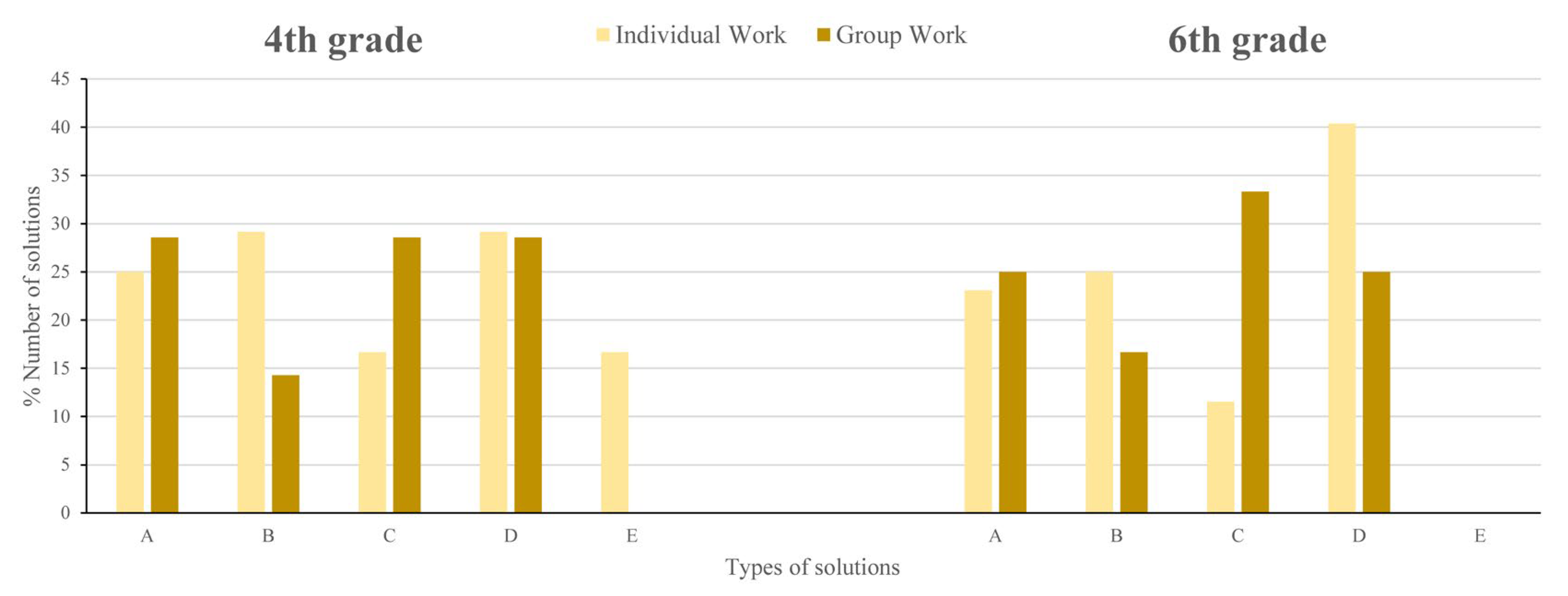
Specifically, in 4th grade (Figure 13), the same percentage of students (29.17%) proposed solutions related to responsible use (B) and solutions that were too generic or out of context (D). 25% of students propose solutions related to pharmaceutical design and WWTP (A) and, to a lesser extent (16.67%), solutions related to political-legislative measures (C). Meanwhile, 6th grade students (Figure 13) mainly propose Type D solutions (40.39%), followed by Type B solutions (25%), Type A solutions (23.08%), and finally, Type C solutions (11.54%). Thus, proportionally, 4th grade students propose more solutions than 6th grade students, although no significant differences were found (χ2, p ≤ 0.05).
Furthermore, the order of preference remains consistent across both grades, regardless of the number of solutions proposed (B = D > A > C in 4th; D > B > A > C in 6th). Thus, the least proposed solutions correspond to political-legislative measures (C). In contrast, students focus on responsible use (B) and pharmaceutical design and WWTP (A), with similar percentages.
When working in groups, both courses behave similarly, as no differences were found (χ2, p ≤ 0.05). Similarly, no differences were found when working individually and in groups in any course (χ2, p ≤ 0.05). Although we can see that Type A and Type C solutions increase while Type B and Type D solutions decrease. These changes are more pronounced in 6th grade. Working in groups increases solutions with scientific (type A) and political-legislative (type C) perspectives. This could be because, during the debate, students consider dimensions they had not previously thought of (Iordanou, 2022). Conversely, students propose fewer generic or out-of-context solutions (D) and solutions from an ethical perspective (B). Issues related to values are personal, so it makes sense that students tend to reveal their moral perspective less when working in groups and avoid standing out. The desire to belong to a group can also influence decision-making (Bader et al., 2023).
In short, and taking as a reference the perspectives put forward by Kiili et al. (2016) and List (2022), it can be seen that, when working individually, PE students make greater use of the ethical perspective (B) (S34, 6th PE: People should not take medication every time they feel a little unwell, and if they have phobias, panic attacks, or anxiety, they can go to a psychologist to resolve them) and the scientist (A) (S14, 4th PE: Create a type of trash that burns medicines) and, to a lesser extent, political and legislative (C) (S6, 4th PE: I’m thinking of setting rules). When working in groups, students consider the political-legislative and scientific perspectives more and the ethical perspective less (uncommon in classrooms). Students at different educational levels frequently consider the scientific perspective (Byrne et al., 2014; Esquivel-Martín et al., 2023; Fernández-Huetos et al., 2025; Guevara-Herrero, 2024; Öhman & Öhman, 2012). However, incorporating other perspectives is not yet widespread. Nevertheless, studies such as that by Guevara-Herrero (2024) demonstrate how preservice teachers examined the production and consumption of avocados in Spain from an ethical standpoint. Similarly, research has been conducted in PE in which students integrate the sociopolitical perspective, in addition to the ethical dimension, when dealing with different controversial issues, such as coal-fired power plants, organ donation, and assisted reproduction (Henderson et al., 2025).
However, students sometimes propose solutions without assessing their full impact (Fernández-Huetos et al., 2025; Öhman & Öhman, 2012) or put forward unrealistic ideas (Byrne et al., 2014), as they do not always consider all perspectives and the complexity of the issues (Iordanou, 2022; List, 2022; Ottander & Simon, 2021). In fact, our study revealed some ill-considered solutions, such as “Close the pipelines and never open them again” (S11, 6th PE) or “Do not manufacture medicines” (S31, 6th PE).

4. Conclusions

The results show that teaching students to argue about SSIs in PE classrooms promotes scientific reasoning. However, performance levels observed, especially in 4th grade, range from low to medium-low. These results highlight the importance of developing argumentation and data interpretation skills from an early age.
When it came to using and interpreting information to solve the case, students found maps and graphs more difficult than texts and videos. This emphasizes the importance of incorporating these types of resources into classroom activities and questions that encourage students to relate to, understand, and reflect on data. Despite this limitation, 4th and 6th PE students were able to propose solutions to the environmental problem presented from different perspectives. This reflects the development of critical and systemic thinking, as well as eco-social awareness.
Similarly, although better results were observed in 6th than in 4th grade, the differences are not statistically significant for most questions, either individually or collectively. This shows that not only is it possible to work on SSIs in the final grades of PE, but they can also be successfully addressed in the second cycle of PE. Furthermore, these findings prompt reflection on the progression of scientific reasoning throughout PE and on the fact that group work does not necessarily lead to better learning outcomes.
Despite the positive results obtained, there are some limitations that should be addressed in future studies. On the one hand, it is important to remember that this study was conducted in a single geographical region, in a single school context (socioeconomic homogeneity), and with only one specific SSI activity, so the results cannot be generalized to any other context. On the other hand, it would also be advisable to continue this line of research by increasing the study sample to try to establish more far-reaching patterns for each educational cycle.
As for the implications for educators, we consider it essential to promote a greater number of SSI-based activities in schools from an early age and to integrate them routinely into the classroom. To this end, it is key to build bridges between research and teaching practice through the continuous training of active teachers in these teaching tools, which they can apply in their science classes. For their part, researchers should delve deeper into this line of inquiry, focusing on the design, implementation (at various educational stages and socioeconomic contexts), and analysis of these SSI-based activities and scientific practices. In fact, it would be desirable for future research to replicate the design of this activity with a different SSI theme while maintaining the diversity of semiotic modalities. In this way, it would be possible to assess how students mobilize their skills in different contexts, enriching the understanding of their cross-cutting skills. This would allow us to compare the results between activities and students from different grades and social backgrounds and draw more solid conclusions.
Overall, this study reveals this proposal’s educational potential within the TEE framework, as it promotes the critical literacy necessary to understand and address the socioenvironmental issues of the Anthropocene.

Supplementary Materials

The following supporting information can be downloaded at: https://www.mdpi.com/article/10.3390/educsci16020321/s1, Two supplementary materials (S1 and S2) are attached to the manuscript submission.

Author Contributions

Conceptualization, N.F.-H., J.M.P.-M., T.E.-M., and I.G.-H.; Methodology, N.F.-H., J.M.P.-M., T.E.-M., and I.G.-H.; Validation, J.M.P.-M., T.E.-M., and I.G.-H.; Formal analysis, N.F.-H. and J.M.P.-M.; Investigation, N.F.-H. and J.M.P.-M.; Data curation, N.F.-H.; Writing—original draft, N.F.-H.; Writing—review and editing, N.F.-H., J.M.P.-M., T.E.-M., and I.G.-H.; Visualization, N.F.-H.; Supervision, J.M.P.-M.; Funding acquisition, J.M.P.-M. All authors have read and agreed to the published version of the manuscript.

Funding

This research was supported by a predoctoral research contract from the Ministerio de Ciencia, Innovación y Universidades [NFH-FPU22/02563]. The Article Processing Charges (APCs) will be covered either by the III Edition of the Programme for the Promotion of Knowledge Transfer of the Universidad Autónoma de Madrid (FUAM, 0375/2022, 465059).

Institutional Review Board Statement

The study was conducted in accordance with the Declaration of Helsinki and approved by the Ethics Committee of Universidad Autónoma de Madrid (protocol code CEI-137-2954, and date of approval 14 March 2024).

Informed Consent Statement

Informed consent was obtained from all subjects involved in the study. Prior to the activity (May 2024), a written information sheet was sent by post to the educational centers for the participant and their legal guardian, describing the aim, objectives, roles of the participants, and methods of study. Following the indications of the Ethics Committee of Universidad Autónoma de Madrid, two informed consent forms were also sent: one for the participant and one for their legal guardian. In this informed consent, both confirmed that they understood the aims of the activity and of their participation, the plans for data processing, and the communication of the results. Participants could withdraw their participation in the research at any time.

Data Availability Statement

The data presented in this study are available on request from the corresponding author.

Acknowledgments

The researchers would like to express their sincere thanks to both the students and teachers who participated in the study and to Raquel Mínguez Castellano for the technical support.

Conflicts of Interest

The authors declare no conflicts of interest.

Abbreviations

The following abbreviations are used in this manuscript:
TEETransformative Environmental Education
SSISocioscientific issue
PEPrimary Education
ECEEarly Child-hood Education
MEFPMinisterio de Educación y Formación Profesional
TIMSSTrends in International Mathematics and Science Study
PIRLSProgress in International Reading Literacy Study
SDGsSustainable Development Goals
GMOsGenetically Modified Organisms
OECDOrganisation for Economic Co-operation and Development
SSCSocioscientific Controversy

References

  1. Akyol, C., & Kanadli, S. (2022). Investigating the effect of socioscientific issues-based instruction on the academic achievement of students: A mixed-research synthesis. FIRE: Forum for International Research in Education, 7(2), 64–85. [Google Scholar] [CrossRef]
  2. Arifin, Z., Sukarmin, S., & Saputro, S. (2025). Trends and research frontiers in socioscientific issues for sustainable science education: A systematic and bibliometric analysis from 2014–2024. Journal of Pedagogical Research, 9(1), 407–434. [Google Scholar] [CrossRef]
  3. Armas-Quintá, F. X., Rodríguez-Lestegás, F., Macía-Arce, X. C., & Pérez-Guilarte, Y. (2022). Teaching and learning landscape in primary education in Spain: A necessary curricular review to educate citizens. Acta Geographica Slovenica, 62(1), 55–64. [Google Scholar] [CrossRef]
  4. Arteaga, P., Díaz-Levicoy, D., & Batanero, C. (2021). Primary school students’ reading levels of line graphs. Statistics Education Research Journal, 20(2), 6. [Google Scholar] [CrossRef]
  5. Ayuldeş, M., & Akbaş, Y. (2023). The effect of orienteering on the sixth-grade students’ academic achievement and map literacy. Education and Science, 48(213), 113–142. [Google Scholar] [CrossRef]
  6. Bader, J. D., Ahearn, K. A., Allen, B. A., Anand, D. M., Coppens, A. D., & Aikens, M. L. (2023). The decision is in the details: Justifying decisions about socioscientific issues. Journal of Research in Science Teaching, 60(10), 2147–2179. [Google Scholar] [CrossRef]
  7. Barrett, T. C. (1968). Taxonomy of cognitive and affective dimensions of reading comprehension. In H. M. Robinson (Ed.), Innovation and change in reading instruction (pp. 17–23). University of Chicago Press. [Google Scholar]
  8. Batanero, C., Díaz-Levicoy, D., & Arteaga, P. (2018). Evaluación del nivel de lectura y la traducción de pictogramas por estudiantes chilenos de educación básica. Avances de Investigación en Educación Matemática, 14, 49–64. [Google Scholar] [CrossRef]
  9. Byrne, J., Ideland, M., Malmberg, C., & Grace, M. (2014). Climate change and everyday life: Repertoires children use to negotiate a socio-scientific issue. International Journal of Science Education, 36(9), 1491–1509. [Google Scholar] [CrossRef]
  10. Canché, L. (2009). La comprensión gráfica de los alumnos del nivel primaria [Tesis de maestría, Universidad Autónoma de Yucatán]. [Google Scholar]
  11. Caracuel-González, M., Benarroch, A. B., Cobos, T. L., & López, Á. B. (2024). Preferences and reasoning of 14–15 year-old students in relation to natural or synthetic products in different contexts: Influence of an instructional module. Research in Science Education, 54, 909–932. [Google Scholar] [CrossRef]
  12. Catling, S. (2018). To know maps: Primary school children and contextualised map learning. Boletim Paulista de Geografia, 99, 268–290. Available online: https://publicacoes.agb.org.br/boletim-paulista/article/view/1480 (accessed on 20 June 2025).
  13. Chen, L., & Xiao, S. (2021). Perceptions, challenges and coping strategies of science teachers in teaching socioscientific issues: A systematic review. Educational Research Review, 32, 100377. [Google Scholar] [CrossRef]
  14. Christenson, N., Gericke, N., & Chang-Rundgren, S. N. (2017). Science and language teachers’ assessment of upper secondary students’ socioscientific argumentation. International Journal of Science and Mathematics Education, 15(8), 1403–1422. [Google Scholar] [CrossRef]
  15. Creswell, J. W., & Plano Clark, V. L. (2018). Designing and conducting mixed methods research (3rd ed.). Sage. [Google Scholar]
  16. Cruz, A. (2013). Erros e dificuldades de alunos do 1.º ciclo na representação de dados estatísticos [Tesis de maestría, Universidade de Lisboa]. [Google Scholar]
  17. Curcio, F. R. (1989). Developing graph comprehension. National Council of Teachers of Mathematics. [Google Scholar]
  18. Dawson, V. (2023). Teachers’ support in developing year 7 students’ argumentation skills about water-based socioscientific issues. International Journal of Science Education, 46(3), 222–239. [Google Scholar] [CrossRef]
  19. Dawson, V. (2025). Using socioscientific issues to teach argumentation to year 7 science students in a low socioeconomic rural Australian school. Research in Science Education, 55, 989–1004. [Google Scholar] [CrossRef]
  20. Dawson, V., & Carson, K. (2020). Introducing argumentation about climate change socioscientific issues in a disadvantaged school. Research in Science Education, 50(3), 863–883. [Google Scholar] [CrossRef]
  21. Dawson, V., & Venville, G. (2020). Testing a methodology for the development of socioscientific issues to enhance middle school students’ argumentation and reasoning. Research in Science & Technological Education, 40(4), 499–514. [Google Scholar] [CrossRef]
  22. Eidin, E., & Shwartz, Y. (2023). From ideal to practical—A design of teacher professional development on socioscientific issues. Sustainability, 15(14), 11394. [Google Scholar] [CrossRef]
  23. Engel, J. (2017). Statistical literacy for active citizenship: A call for data science education. Statistics Education Research Journal, 16(1), 44–49. [Google Scholar] [CrossRef]
  24. Esquivel-Martín, T., Pérez-Martín, J. M., & Bravo-Torija, B. (2023). Does pollution only affect human health? A scenario for argumentation in the framework of One Health education. Sustainability, 15, 6984. [Google Scholar] [CrossRef]
  25. Evangelista, B. (2013). Activities on interpreting bar and line graphs: What do 5th grade students know? In J. M. Contreras, G. R. Cañadas, M. M. Gea, & P. Arteaga (Eds.), Proceedings of the virtual conference on teaching statistics, probability and combinatorics (pp. 121–128). University of Granada. [Google Scholar]
  26. Fang, S. C., Hsu, Y. S., & Lin, S. S. (2019). Conceptualizing socioscientific decision making from a review of research in science education. International Journal of Science and Mathematics Education, 17(3), 427–448. [Google Scholar] [CrossRef]
  27. Fernández-Huetos, N., Pérez-Martín, J. M., Guevara-Herrero, I., & Esquivel-Martín, T. (2025). Primary-education students’ performance in arguing about a socioscientific issue: The case of pharmaceuticals in surface water. Sustainability 17, 1618. [Google Scholar] [CrossRef]
  28. Freitas, A. C., Do Nascimento, A. L., De Castro, R. G., Motokane, M. T., & Reis, P. (2023). Biodiversity and citizenship in an argumentative socioscientific process. Sustainability, 15(4), 2987. [Google Scholar] [CrossRef]
  29. Gee, J. P. (2014). An introduction to discourse analysis: Theory and method (4th ed.). Routledge. [Google Scholar]
  30. Guevara-Herrero, I. (2024). Is consuming avocados equally sustainable worldwide? An activity to promote eco-social education from science education. Education Sciences, 14, 560. [Google Scholar] [CrossRef]
  31. Guevara-Herrero, I., Bravo-Torija, B., & Pérez-Martín, J. M. (2024a). Educational practice in education for environmental justice: A systematic review of the literature. Sustainability, 16(7), 2805. [Google Scholar] [CrossRef]
  32. Guevara-Herrero, I., Esquivel-Martín, T., Fernández-Huetos, N., & Pérez-Martín, J. M. (2024b). Towards transformative environmental education: Effective activities for primary education. In A. M. Güneş, & E. Yünkül (Eds.), Interdisciplinary approach to fostering change in schools (pp. 70–97). IGI Global. [Google Scholar] [CrossRef]
  33. Guimarães, G. (2002). Interpretando e construindo gráficos de barras [Tesis doctoral, Universidade Federal de Pernambuco]. [Google Scholar]
  34. Havelková, L., & Hanus, M. (2019). Map skills in education: A systematic review of terminology, methodology, and influencing factors. Review of International Geographical Education Online, 9(2), 361–401. [Google Scholar] [CrossRef]
  35. Henderson, S., Tomas, L., & King, D. (2025). Does topic matter? Investigating students’ interest, emotions and learning when writing stories about socioscientific issues. Research in Science Education, 55, 1537–1555. [Google Scholar] [CrossRef]
  36. Herman, B. C., Newton, M. H., & Zeidler, D. L. (2021). Impact of place-based socioscientific issues instruction on students’ contextualization of socioscientific orientations. Science Education, 105(4), 585–627. [Google Scholar] [CrossRef]
  37. Hernández-Sampieri, R., Fernández-Collado, C., & Baptista-Lucio, P. (2014). Metodología de la investigación (6ª ed.). McGraw-Hill. [Google Scholar]
  38. Högström, P., Gericke, N., Wallin, J., & Bergman, E. (2024). Teaching socioscientific issues: A systematic review. Science Education, 34, 3079–3122. [Google Scholar] [CrossRef]
  39. Iordanou, K. (2022). Supporting strategic and meta-strategic development of argument skill: The role of reflection. Metacognition and Learning, 17, 399–425. [Google Scholar] [CrossRef]
  40. Jiménez-Aleixandre, M. (2020). ¿Cómo sabemos lo que sabemos? Mediante la argumentación y el uso de pruebas, herramientas para aprender y desarrollar el pensamiento crítico. In Enseñando ciencia con ciencia (D. Couso, M. R. Jiménez-Liso, C. Refojo, & J. A. Sacristán, Coord.; pp. 75–86). FECYT & Fundación Lilly. [Google Scholar]
  41. Jonuzi, E., & Selvi, H. Z. (2023). Enhancing map comprehension via symbols: Developing symbols for thematic maps based on children’s cognitive development. Necmettin Erbakan University Journal of Science and Engineering, 5(2), 88–110. [Google Scholar] [CrossRef]
  42. Käsper, M., Uibu, K., & Mikk, J. (2019). Primary school teachers’ teaching strategies for the development of students’ text comprehension. Education 3–13, 48(5), 512–526. [Google Scholar] [CrossRef]
  43. Kiili, C., Coiro, J., & Hämäläinen, J. (2016). An online inquiry tool to support the exploration of controversial issues on the Internet. Journal of Literacy and Technology, 17(1–2), 31–52. [Google Scholar]
  44. Klaver, L. T., Walma van der Molen, J. H., Sins, P. H., & Guérin, L. J. (2023). Students’ engagement with socioscientific issues: Use of sources of knowledge and attitudes. Journal of Research in Science Teaching, 60(5), 1125–1161. [Google Scholar] [CrossRef]
  45. Kokolaki, A., & Stavrou, D. (2022). Pre-service primary teachers develop teaching artifacts on contemporary socioscientific issues. Journal of Science Teacher Education, 34(3), 287–306. [Google Scholar] [CrossRef]
  46. Kumar, V., Choudhary, S. K., & Singh, R. (2024). Environmental socio-scientific issues as contexts in developing scientific literacy in science education: A systematic literature review. Social Sciences & Humanities Open, 9, 100765. [Google Scholar] [CrossRef]
  47. Lassoued, K., Awad, A., & Guirat, R. (2020). The impact of managerial empowerment on problem solving and decision making skills: The case of Abu Dhabi University. Management Science Letters, 10(4), 769–780. [Google Scholar] [CrossRef]
  48. Leden, L., Hansson, L., & Redfors, A. (2017). From black and white to shades of grey. Science & Education, 26, 483–511. [Google Scholar] [CrossRef]
  49. Lee, H., & Yang, J. E. (2019). Science teachers taking their first steps toward teaching socioscientific issues through collaborative action research. Research in Science Education, 49(1), 51–71. [Google Scholar] [CrossRef]
  50. Levinson, R. (2018). Realising the school science curriculum. The Curriculum Journal, 29(4), 522–537. [Google Scholar] [CrossRef]
  51. List, A. (2022). Demonstrating the effectiveness of two scaffolds for fostering students’ domain perspective reasoning. European Journal of Psychology of Education, 38(4), 1343–1376. [Google Scholar] [CrossRef]
  52. Lu, Y. H., Shih, J. L., Chen, P. C., Hong, G. D., & Chen, H. W. (2024). Exploring elementary school students’ perceptions towards socioscientific issues through the role-playing game Future City. IIAI Letters on Informatics and Interdisciplinary Research, 5, 237. [Google Scholar] [CrossRef]
  53. Martini, M., Widodo, W., Qosyim, A., Mahdiannur, M., & Jatmiko, B. (2021). Improving undergraduate science education students’ argumentation skills through debates on socioscientific issues. Jurnal Pendidikan IPA Indonesia, 10(3), 428–438. [Google Scholar] [CrossRef]
  54. McNeill, K. L. (2011). Elementary students’ views of explanation, argumentation and evidence, and their abilities to construct arguments over the school year. Journal of Research in Science Teaching, 48(7), 793–823. [Google Scholar] [CrossRef]
  55. Ministerio de Educación y Formación Profesional. (2022). Real Decreto 157/2022, de 1 de marzo. Boletín Oficial del Estado, 52, 1–109. Available online: https://www.boe.es/buscar/act.php?id=BOE-A-2022-3296 (accessed on 21 June 2025).
  56. Ministerio de Educación y Formación Profesional. (2023). PIRLS 2021: Estudio internacional de progreso en comprensión lectora. Informe español. Instituto Nacional de Evaluación Educativa. [Google Scholar]
  57. Ministerio de Educación y Formación Profesional. (2024). TIMSS 2023: Estudio internacional de tendencias en matemáticas y ciencias. Informe español. Instituto Nacional de Evaluación Educativa. [Google Scholar]
  58. Míguez-Álvarez, C., Cuevas-Alonso, M., Saavedra, A., & Cabanach, R. G. (2022). The role of text characteristics in the reading comprehension of primary school children in Spanish. Revista Iberoamericana de Psicología y Salud, 13(1), 41–55. [Google Scholar] [CrossRef]
  59. Mohamedi-Amaruch, A., & Rico-Martín, A. M. (2020). Assessment of reading comprehension in primary education: Reading processes and texts. Lenguas Modernas, 55, 37–52. [Google Scholar]
  60. Monserrat, M. R., Cantó, J., & Solbes, J. (2025). El uso de las cuestiones sociocientíficas para mejorar la imagen de la ciencia y el interés del alumnado de ESO. Revista Eureka sobre Enseñanza y Divulgación de las Ciencias, 22(1), 1101. [Google Scholar] [CrossRef]
  61. Narayanan, B., Kumar, A. G., Gunasekaran, D., Vengayil, R., Maduvegadde, K., & Alampady, N. (2025). Perspectives of socio-scientific issues in educational research: A bibliometric analysis. Journal of Teaching and Learning, 19(1), 50–84. [Google Scholar] [CrossRef]
  62. Nepraš, K., Strejčková, T., & Kroufek, R. (2022). Climate change education in primary and lower secondary education: Systematic review results. Sustainability, 14(22), 14913. [Google Scholar] [CrossRef]
  63. OECD. (2023). PISA 2025 science framework (second draft). OECD. Available online: https://pisa-framework.oecd.org/science-2025/assets/docs/PISA_2025_Science_Framework.pdf (accessed on 21 June 2025).
  64. Olsson, D., & Gericke, N. (2016). The adolescent dip in students’ sustainability consciousness. Journal of Environmental Education, 47, 35–51. [Google Scholar] [CrossRef]
  65. Osborne, J., Simon, S., Christodoulou, A., Howell-Richardson, C., & Richardson, K. (2013). Learning to argue: A study of four schools and their attempt to develop the use of argumentation as a common instructional practice and its impact on students. Journal of Research in Science Teaching, 50(3), 315–347. [Google Scholar] [CrossRef]
  66. Ottander, K., & Simon, S. (2021). Learning democratic participation? Meaning-making in discussion of socioscientific issues in science education. International Journal of Science Education, 43(12), 1895–1925. [Google Scholar] [CrossRef]
  67. Ozcan-Ermis, G., & Hervé, N. (2024). Identifying pre- and in-service teachers’ stances on teaching socioscientific issues: A systematic review of empirical studies. Canadian Journal of Science, Mathematics and Technology Education, 23(4), 741–764. [Google Scholar] [CrossRef]
  68. Öhman, J., & Öhman, M. (2012). Participatory approach in practice: An analysis of student discussions about climate change. Environmental Education Research, 19(3), 324–341. [Google Scholar] [CrossRef]
  69. Öztürk, S., & Karakaş, H. (2024). Scenario-based teaching process in the life science course based on socioscientific issues. Turkish Journal of Education, 13(5), 441–464. [Google Scholar] [CrossRef]
  70. Pagan, A., Leite, A. P., Magina, S., & Cazorla, I. (2008). A leitura e interpretação de gráficos e tabelas no ensino fundamental e médio. In V. Gitirana, F. Bellemain, & V. Andrade (Eds.), Anais do 2º Simpósio Internacional de Pesquisa em Educação Matemática (pp. 1–10). Universidade Federal de Pernambuco. [Google Scholar]
  71. Papancheva, R. Y. (2017). Working with data tables and graphs at primary school. Journal of Process Management—New Technologies, 5(4), 8–12. [Google Scholar] [CrossRef]
  72. Peña-García, S. N. (2019). The challenge of reading comprehension in primary education. Panorama, 13(24), 43–56. [Google Scholar] [CrossRef]
  73. Pérez-Martín, J. M., Calurano-Tena, M. T., Martín-Aguilar, C., Esquivel-Martín, T., & Bravo-Torija, B. (2019). Natural science questions in primary education textbooks: Processing or reproducing contents? ReiDoCrea 8, 186–201. [Google Scholar]
  74. Pérez-Martín, J. M., & Esquivel-Martín, T. (2024). New insights for teaching the One Health approach: Transformative environmental education for sustainability. Sustainability 16, 7967. [Google Scholar] [CrossRef]
  75. Reid, A., Dillon, J., Ardoin, N., & Ferreira, J. A. (2021). Scientists’ warnings and the need to reimagine, recreate, and restore environmental education. Environmental Education Research, 27, 783–795. [Google Scholar] [CrossRef]
  76. Richmond, A. S., & Hagan, L. K. (2011). Promoting higher level thinking in psychology: Is active learning the answer? Teaching of Psychology, 38(2), 102–105. [Google Scholar] [CrossRef]
  77. Ridgway, J., Nicholson, J., Sutherland, S., & Hedger, S. (2019). Critical statistical literacy and interactive data visualisations. In J. Evans, S. Ruane, & H. Southall (Eds.), Data in society: Challenging statistics in an age of globalisation (pp. 349–357). Policy Press. [Google Scholar]
  78. Roberts, D. A. (2007). Scientific literacy. In S. K. Abell, & N. G. Lederman (Eds.), Handbook of research on science education (pp. 729–780). Routledge. [Google Scholar]
  79. Romero-Ariza, M., Quesada, A., & Estepa, A. (2021). Promoting critical thinking through mathematics and science teacher education: The case of argumentation and graphs interpretation about climate change. European Journal of Teacher Education, 47, 41–59. [Google Scholar] [CrossRef]
  80. Sakamoto, M., Yamaguchi, E., Yamamoto, T., & Wakabayashi, K. (2021). An intervention study on students’ decision-making towards consensus building on socio-scientific issues. International Journal of Science Education, 43(12), 1965–1983. [Google Scholar] [CrossRef]
  81. Salcedo, A., González, J., & González, J. (2021). Lectura e interpretación de gráficos estadísticos, ¿cómo lo hace el ciudadano? Paradigma, 41(e1), 61–88. [Google Scholar] [CrossRef]
  82. Schreier, M. (2012). Qualitative content analysis in practice. SAGE. [Google Scholar]
  83. Sekelj, A., & Rigo, I. (2011). Teaching English grammar in primary school. Tabula, 9, 188–199. [Google Scholar] [CrossRef]
  84. Siarova, H., Sternadel, D., & Szőnyi, E. (2019). Science and scientific literacy as an educational challenge. European Union. [Google Scholar]
  85. Sjöström, J. (2024). Vision III of scientific literacy and science education: An alternative vision for science education emphasising the ethico-socio-political and relational-existential. Studies in Science Education, 61(2), 239–274. [Google Scholar] [CrossRef]
  86. Şaşmazören, F., Karapınar, A., Sarı, K., & Demirer, T. (2023). Teaching socioscientific issues through scientific scenarios: A case evaluation based on secondary school students’ views. Bartın University Journal of Faculty of Education, 14(1), 124–145. [Google Scholar] [CrossRef]
  87. Tang, K. Y., Lin, T. C., & Hsu, Y. S. (2023). Status and trends of socioscientific issues in educational literature: Insights and extensions from a co-word analysis. International Journal of Science Education, 46(11), 1073–1097. [Google Scholar] [CrossRef]
  88. Tang, X., Kikas, E., Pakarinen, E., Lerkkanen, M. K., Muotka, J., & Nurmi, J. E. (2017). Profiles of teaching practices and first and third graders’ reading skills in Finland and Estonia. Teaching and Teacher Education, 64, 150–161. [Google Scholar] [CrossRef]
  89. Torres, N., & Solbes, J. (2018). Pensamiento crítico desde cuestiones socio-científicas. In D. M. Conrado, & N. Nunes-Neto (Eds.), Questões sociocientíficas: Fundamentos, propostas de ensino e perspectivas para ações sociopolíticas (pp. 59–76). EDUFBA. [Google Scholar] [CrossRef]
  90. Valladares, L. (2021). Scientific literacy and social transformation. Science & Education, 30, 557–587. [Google Scholar] [CrossRef]
  91. Van de Wetering, J., Leijten, P., Spitzer, J., & Thomaes, S. (2022). Does environmental education benefit environmental outcomes in children and adolescents? A meta-analysis. Journal of Environmental Psychology, 81, 101782. [Google Scholar] [CrossRef]
  92. White, P., Ferguson, J., O’Connor Smith, N., & O’Shea Carre, H. (2022). School strikers enacting politics for climate justice: Daring to think differently about education. Australian Journal of Environmental Education, 38(1), 26–39. [Google Scholar] [CrossRef]
  93. Wiyarsi, A., & Çalik, M. (2019). Revisiting the scientific habits of mind scale for socio-scientific issues in the Indonesian context. International Journal of Science Education, 41(17), 2430–2447. [Google Scholar] [CrossRef]
  94. Yin, R. K. (2018). Case study research and applications: Design and methods (6th ed.). SAGE. [Google Scholar]
  95. Zamalloa, T., Salgado, M., & Berciano, A. (2025). How to promote scientific practices in early childhood education: The teachers’ role. International Journal of Science and Mathematics Education, 23, 2975–2995. [Google Scholar] [CrossRef]
  96. Zeidler, D. L., & Sadler, T. D. (2023). Exploring and expanding the frontiers of socioscientific issues. In N. G. Lederman, D. L. Zeidler, & J. S. Lederman (Eds.), Handbook of research on science education (pp. 899–929). Routledge. [Google Scholar]
  97. Zhang, J., Lopez Wui, M. G., Nam, R., Relyea, J. E., & Wong, S. S. (2023). Improving argumentative writing of sixth-grade adolescents through dialogic inquiry of socioscientific issues. Journal of Writing Research, 14(3), 375–419. [Google Scholar] [CrossRef]
  98. Zhang, W. X., & Hsu, Y. S. (2025). Professional development for socioscientific issue teaching: Exploring the discourse of in-service teachers in community activities through epistemic network analysis. Research in Science Education, 55, 961–987. [Google Scholar] [CrossRef]
Figure 1. Performance levels and materials used by 4th grade students for Q1 (S: individual student, G: group).
Education 16 00321 g001
Figure 2. Performance levels and materials used by 6th grade students for Q1 (S: individual student, G: group).
Education 16 00321 g002
Figure 3. Performance levels and materials used by 4th grade students for Q2 (S: individual student, G: group).
Education 16 00321 g003
Figure 4. Performance levels and materials used by 6th grade students for Q2 (S: individual student, G: group).
Education 16 00321 g004
Figure 5. Performance levels and materials used by 4th grade students for Q3 (S: individual student, G: group).
Education 16 00321 g005
Figure 6. Performance levels and materials used by 6th grade students for Q3 (S: individual student, G: group).
Education 16 00321 g006
Figure 7. Performance levels and materials used by 4th grade students for Q4 (S: individual student, G: group).
Education 16 00321 g007
Figure 8. Performance levels and materials used by 6th grade students for Q4 (S: individual student, G: group).
Education 16 00321 g008
Figure 9. Performance levels and materials used by 4th grade students for Q5 (S: individual student, G: group).
Education 16 00321 g009
Figure 10. Performance levels and materials used by 6th grade students for Q5 (S: individual student, G: group). A student used a video that had been used in a different activity a few days earlier. This demonstrates the impact that activity had on the student’s learning.
Education 16 00321 g010
Figure 11. Performance levels achieved by 4th grade students for Q6 (S: individual student, G: group).
Education 16 00321 g011
Figure 12. Performance levels achieved by 6th grade students for Q6 (S: individual student, G: group).
Education 16 00321 g012
Figure 13. Relative frequencies of types of solutions proposed by 4th and 6th grade students working individually and in groups. A: Pharmaceutical design and WWTP (e.g., Create less polluting and easier to dispose of medicines; Research more about ways to purify water and about WWTPs); B: Responsible use (e.g., We should not self-medicate if we are not 100% sure that the medication is right for us, and if not, we should go to a doctor; Take medication only with a prescription and when necessary); C: Political-legislative measures (e.g., Fine companies or individuals; Regulate social media, which causes anxiety and depression); D: Not in line with content or generic (e.g., Be more environmentally conscious; Do not pollute the environment); E: no solutions.
Education 16 00321 g013
Table 1. Analysis of the difference between the performance of 4th and 6th grade students individually and in groups in the activity. The asterisk (*) indicates statistically significant differences (Mann–Whitney U test), p ≤ 0.05).
Individual (I)Group (G)
Mean ± Variance4th2.59 ± 1.71 *2.90 ± 2.02
6th2.88 ± 1.57 *3.00 ± 1.89
Table 2. Analysis of the difference between individual and group performance and between PE courses in each question.
Q1Q2Q3Q4Q5Q6
IGIGIGIGIGIG
Mean ± Variance4th2.83 ± 0.583.20 ± 0.201.58 ± 0.781.80 ± 1.203.08 ± 2.083.60 ± 3.801.25 ± 0.371.20 ± 0.203.04 ± 0.483.20 ± 0.203.75 ± 1.504.40 ± 0.30
6th3.00 ± 0.153.00 ± 0.001.78 ± 0.931.56 ± 0.783.66 ± 1.484.00 ± 1.501.76 ± 1.041.67 ± 1.003.24 ± 0.793.44 ± 0.533.85 ± 0.984.33 ± 1.00
Disclaimer/Publisher’s Note: The statements, opinions and data contained in all publications are solely those of the individual author(s) and contributor(s) and not of MDPI and/or the editor(s). MDPI and/or the editor(s) disclaim responsibility for any injury to people or property resulting from any ideas, methods, instructions or products referred to in the content.