When AI Feedback Was Still in Its Infancy: An Exploratory Comparison of Early AI Feedback Attempts on Preservice Physics Teachers’ Reflective Writing

Abstract
1. Introduction
2. Theory
2.1. Pedagogical Reasoning and Reflection-on-Action
2.2. Required Content for Feedback on Written Reflections
2.3. Large Language Models and Generative AI
2.4. Research Questions
- RQ1:
- To what extent do descriptively observable differences in the structural composition of reflective writing coincide with participation in different internship feedback formats?
- RQ2:
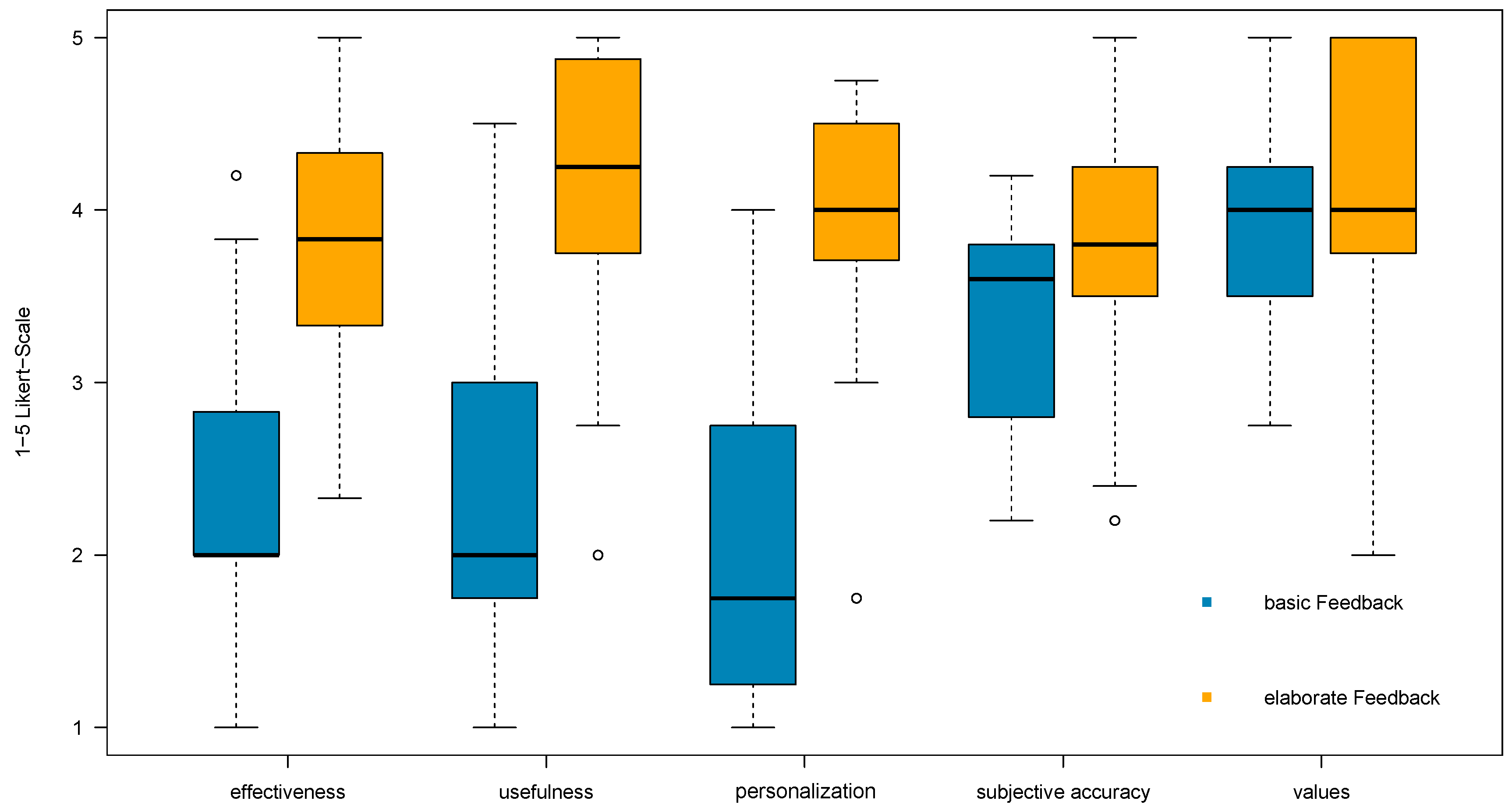
- How do preservice teachers perceive the usefulness and personalization of AI-based basic versus human-generated elaborate feedback?
3. Methods
3.1. Sample and Cohort
- Non-intervention cohort: N = 22 (three semesters from 2017–2018)
- Intervention cohort: N = 32 (five semesters from 2020–2023)
3.2. Intervention
3.3. Instruments
3.3.1. Validity and Transferability of the BERT-Based Classification Model
3.3.2. Analyzing Written Reflections (RQ1)
3.3.3. Feedback Acceptance Survey (RQ2)
4. Results
4.1. Development of Written Reflections in Comparison (RQ1)
4.1.1. Distributional Properties and Initial Group Differences
4.1.2. Longitudinal Development Across the Internship
4.1.3. Cluster-Based Analysis of Structural Quality
4.2. Feedback Acceptance (RQ2)
5. Discussion, Limitations, and Conclusions
5.1. Discussion of Results
5.2. Limitations
5.3. Conclusions and Perspectives
Author Contributions
Funding
Institutional Review Board Statement
Informed Consent Statement
Data Availability Statement
Conflicts of Interest
| 1 | ALACT: (1) Action, (2) Looking back on the action, (3) getting Awareness of essential aspects, (4) Creating alternatives methods of Action and (5) Starting a new Action with a Trial of alternatives. |
| 2 | Boxes represent the interquartile range (IQR), the central line indicates the median, and whiskers correspond to ±1.5 × IQR; outliers beyond this range are displayed as individual points. Sample sizes per time point are provided in Table 1/described in Section 3.1. |
References
- Abels, S. (2011). LehrerInnen als „Reflective Practitioner”. Reflexionskompetenz für einen demokratieförderlichen Naturwissenschaftsunterricht. VS Verlag für Sozialwissenschaften. [Google Scholar]
- Alammar, J. (2018). The illustrated transformer. Available online: https://jalammar.github.io/illustrated-transformer/ (accessed on 9 January 2026).
- Alonzo, A., Berry, A., & Nilsson, P. (2019). Unpacking the complexity of science teachers’ PCK in action. Enacted and personal PCK. In A. Hume, R. Cooper, & A. Borowski (Eds.), Repositioning pedagogical content knowledge in teachers’ professional knowledge (pp. 271–286). Springer. [Google Scholar] [CrossRef] [Scilit]
- Altrichter, H. (2000). Handlung und reflexion bei Donald Schön. In G. H. Neuweg (Ed.), Wissen—Können—Reflexion (pp. 201–221). Studien-Verlag. [Google Scholar]
- Bönke, N., Klusmann, U., Kunter, M., Richter, D., & Voss, T. (2024). Long-term changes in teacher beliefs and motivation: Progress, stagnation or regress? Teaching and Teacher Education, 141, 104489. [Google Scholar] [CrossRef] [Scilit]
- Brouwer, N., & Korthagen, F. A. J. (2005). Can teacher education make a difference? American Educational Research Journal, 42, 153–224. [Google Scholar] [CrossRef] [Scilit]
- Brown, T., Mann, B., Ryder, N., Subbiah, M., Kaplan, J. D., Dhariwal, P., Neelakantan, A., Shyam, P., Sastry, G., Askell, A., & Amodei, D. (2020). Language models are few-shot learners. Advances in Neural Information Processing Systems, 33, 1877–1901. [Google Scholar] [CrossRef] [Scilit]
- Browning, T. D., & Korthagen, F. A. J. (2021). The winding road of student teaching: Addressing Uncertainty with core reflection. European Journal of Teacher Education, 46(4), 621–638. [Google Scholar] [CrossRef] [Scilit]
- Buckingham Shum, S., Sándor, Á., Goldsmith, R., Bass, R., & McWilliams, M. (2017). Towards reflective writing analytics: Rationale, methodology, and preliminary results. Journal of Learning Analytics, 4(1), 58–84. [Google Scholar] [CrossRef] [Scilit]
- Chodorow, M., & Burstein, J. (2004). Beyond essay length. Evaluating e-rater’s performance on Toefl essays. ETS. Research Report Service, 2004, i-38. [Google Scholar] [CrossRef] [Scilit]
- Christof, E., Köhler, J., Rosenberger, K., & Wyss, C. (2018). Mündliche, schriftliche und theatrale Wege der Praxisreflexion: Beiträge zur professionalisierung pädagogischen handelns (1st ed.). Hep der Bildungsverlag. [Google Scholar]
- Collin, S., Karsenti, T., & Komis, V. (2013). Reflective practice in initial teacher training: Critiques and perspectives. Reflective Practice, 14(1), 104–117. [Google Scholar] [CrossRef] [Scilit]
- Combe, A., & Kolbe, F.-U. (2008). Lehrerprofessionalität: Wissen, Können, Handeln. In W. Helsper, & J. Böhme (Eds.), Handbuch der schulforschung (pp. 857–875). Springer. [Google Scholar]
- Darling-Hammond, L. (2012). Powerful teacher education: Lessons from exemplary programs. John Wiley & Sons. [Google Scholar]
- Devlin, J., Chang, M.-W., Lee, K., & Toutanova, K. (2018). BERT: Pre-training of deep bidirectional transformers for language understanding. arXiv, arXiv:1810.04805. [Google Scholar] [CrossRef] [Scilit]
- Fund, Z., Court, D., & Kramarski, B. (2002). Construction and application of an evaluative tool to assess reflection in teacher-training courses. Assessment & Evaluation in Higher Education, 27(6), 485–499. [Google Scholar] [CrossRef] [Scilit]
- Gröschner, A., Schmitt, C., & Seidel, T. (2013). Veränderung subjektiver Kompetenzeinschätzungen von Lehramtsstudierenden im Praxissemester. Zeitschrift für Pädagogische Psychologie, 27(1/2), 77–86. [Google Scholar] [CrossRef] [Scilit]
- Gruber, H. (2021). Reflexion. Der Königsweg zur Expertise-Entwicklung. Journal für LehrerInnenbildung, 21(1), 108–117. [Google Scholar] [CrossRef] [Scilit]
- Hattie, J., & Timperley, H. (2007). The power of feedback. Review of Educational Research, 77(1), 81–112. [Google Scholar] [CrossRef] [Scilit]
- Hatton, N., & Smith, D. (1995). Reflection in teacher education: Towards definition and implementation. Teaching and Teacher Education, 11(1), 33–49. [Google Scholar] [CrossRef] [Scilit]
- Häcker, T. H. (2019). Reflexive Professionalisierung. Anmerkungen zu dem ambitionierten Anspruch, die Reflexionskompetenz angehender Lehrkräfte umfassend zu fördern. In M. Degeling, N. Franken, S. Freund, S. Greiten, D. Neuhaus, & J. Schellenbach-Zell (Eds.), Herausforderung Kohärenz: Praxisphasen in der universitären Lehrerbildung: Bildungswissenschaftliche und fachdidaktische Perspektiven (pp. 81–96). Verlag Julius Klinkhardt. [Google Scholar]
- Jay, J. K., & Johnson, K. L. (2002). Capturing complexity: A typology of reflective practice for teacher education. Teaching and Teacher Education, 18(1), 73–85. [Google Scholar] [CrossRef] [Scilit]
- Klempin, C. (2021). Zu Entwicklung und Messung von Reflexionstiefe und -breite von Lehramtsstudierenden. Eine mixed methods interventionsstudie. Journal für LehrerInnenbildung, 21(1), 76–85. [Google Scholar] [CrossRef] [Scilit]
- KMK (Sekretariat der Ständigen Konferenz der Kultusminister der Länder in der Bundesrepublik Deutschland). (2004). Standards für die Lehrerbildung: Bildungswissenschaften. Sekretariat der Ständigen Konferenz der Kultusminister der Länder in der Bundesrepublik Deutschland. [Google Scholar]
- KMK (Sekretariat der Ständigen Konferenz der Kultusminister der Länder in der Bundesrepublik Deutschland). (2019). Standards für die Lehrerbildung: Bildungswissenschaften (Beschluss der Kultusministerkonfernez vom 16.12.2004 i. d. F. vom 16.05.2019). Available online: www.kmk.org (accessed on 9 January 2026).
- Korthagen, F. A. J. (2001). Linking practice and theory. The pedagogy of realistic teacher education. Lawrence Erlbaum Associates. [Google Scholar]
- Korthagen, F. A. J., & Kessels, J. (1999). Linking theory and practice: Changing the pedagogy of teacher education. Educational Research, 28(4), 4–17. [Google Scholar] [CrossRef]
- Labott, D., & Reintjes, C. (2022). Unvereinbarkeit von Bewertung und Reflexionsaufgaben in der Lehrer*innenbildung. In C. Reintjes, & I. Kunze (Eds.), Reflexion und reflexivität in unterricht, schule und lehrer: Innenbildung (pp. 170–184). Klinkhardt. [Google Scholar] [CrossRef] [Scilit]
- Lai, G., & Calandra, B. (2007). Using online scaffolds to enhance preservice teachers’ reflective journal writing: A qualitative analysis. International Journal of Technology in Teaching and Learning, 3(3), 66–81. [Google Scholar]
- Leonhard, T., & Rihm, T. (2011). Erhöhung der Reflexionskompetenz durch Begleitveranstaltungen zum Schulpraktikum? Konzeption und Ergebnisse eines Pilotprojekts mit Lehramtsstudierenden. Lehrerbildung auf dem Prüfstand, 4(2), 240–270. [Google Scholar]
- Meißner, C., Klempin, C., Dohrmann, R., & Nordmeier, V. (2020). Veränderung der Reflexionskompetenz im Lehr-Lern-Labor. In S. Habig (Ed.), Naturwissenschaftliche kompetenz in der gesellschaft von morgen. Gesellschaft für didaktik der chemie und physik, jahrestagung in Wien 2019 (pp. 685–688). Universität Duisburg-Essen. [Google Scholar]
- Meschede, N. (2014). Professionelle Wahrnehmung der inhaltlichen Strukturierung im naturwissenschaftlichen Grundschulunterricht. Theoretische Beschreibung und empirische Forschung. In M. Hopf, H. Niedderer, M. Ropohl, & E. Sumfleth (Eds.), Studien zum physik- und chemielernen (Vol. 163). Logos-Verlag. [Google Scholar]
- Mientus, L., Wulff, P., Nowak, A., & Borowski, A. (2021). ReFeed: Computerunterstütztes Feedback zu Reflexionstexten—Ein Lehrkonzept zur Förderung der Reflexionskompetenz angehender Physiklehrkräfte an der Universität Potsdam. In M. Kubsch, S. Sorge, J. Arnold, & N. Graulich (Eds.), Lehrkräftebildung neu gedacht—Ein praxishandbuch für die lehre in den naturwissenschaften und deren didaktiken (pp. 160–165). Waxmann. [Google Scholar] [CrossRef] [Scilit]
- Mientus, L., Wulff, P., Nowak, A., & Borowski, A. (2023a). Fast-and-frugal means to assess reflection-related reasoning processes in teacher training—Development and evaluation of a scalable machine learning-based metric. Zeitschrift für Erziehungswissenschaften. [Google Scholar] [CrossRef] [Scilit]
- Mientus, L., Wulff, P., Nowak, A., & Borowski, A. (2023b). Algorithmen als Dozierende? Akzeptanz von KI-basierten Lernangeboten in der Physik-Lehrkräftebildung. In J. Hermanns (Ed.), PSI-Potsdam—Ergebnisbericht zu den aktivitäten im rahmen der qualitätsoffensive lehrerbildung (2019–2023) (pp. 117–129). Universitätsverlag Potsdam. [Google Scholar] [CrossRef]
- Narciss, S. (2006). Informatives tutorielles Feedback: Entwicklungs- und Evaluationsprinzipien auf der Basis instruktionspsychologischer Erkenntnisse (Vol. 56). Waxmann. [Google Scholar]
- Narciss, S. (2018). Feedbackstrategien für interaktive Lernaufgaben. In H. Niegemann, & A. Weinberger (Eds.), Lernen mit bildungstechnologien. Springer Reference Psychologie. [Google Scholar] [CrossRef] [Scilit]
- NBPTS (National Board for Professional Teaching Standards). (2016). What teachers should know and be able to do. National Board for Professional Teaching Standards. [Google Scholar]
- Nordine, J., Sorge, S., Delen, I., Evans, R., Juuti, K., Lavonen, J., Nilsson, P., Ropohl, M., & Stadler, M. (2021). Promoting coherent science instruction through coherent science teacher education: A model framework for program design. Journal of Science Teacher Education, 32(8), 911–933. [Google Scholar] [CrossRef] [Scilit]
- Nowak, A. (2023). Untersuchung der Qualität von Selbstreflexionstexten zum Physikunterricht. Entwicklung des Reflexionsmodells REIZ. In M. Hopf, & M. Ropohl (Eds.), Studien zum physik- und chemielernen. Logos. [Google Scholar] [CrossRef] [Scilit]
- Nowak, A., Kempin, M., Kulgemeyer, C., & Borowski, A. (2019). Reflexion von Physikunterricht. In C. Maurer (Ed.), Naturwissenschaftliche bildung als grundlage für berufliche und gesellschaftliche teilhabe. Gesellschaft für didaktik der chemie und physik, jahrestagung in Kiel 2018 (Vol. 11, pp. 838–841). Universität Regensburg. [Google Scholar]
- OpenAI. (2019). Better language models and their implications (GPT-2). OpenAI Blog.
- OpenAI. (2022). ChatGPT: Optimizing language models for dialogue. OpenAI Blog.
- Poldner, E., van der Schaaf, M., Simons, P. R.-J., van Tartwijk, J., & Wijngaards, G. (2014). Assessing student teachers’ reflective writing through quantitative content analysis. European Journal of Teachacher Education, 37(3), 348–373. [Google Scholar] [CrossRef] [Scilit]
- Roters, B. (2012). Professionalisierung durch reflexion in der lehrerbildung. Waxmann. [Google Scholar]
- Rothland, M. (2021). Die „Lehrerpersönlichkeit”: Das Geheimnis des Lehrberufs? Die Deutsche Schule, 113(2), 188–198. [Google Scholar] [CrossRef] [Scilit]
- Schön, D. A. (1983). The reflective practitioner: How professionals think in action. Basic Books. [Google Scholar]
- Schubarth, W., Speck, K., Seidel, A., & Wendland, M. (2009). Unterrichtskompetenzen bei Referendaren und Studierenden. Empirische Befunde der Potsdamer Studien zur ersten und zweiten Phase der Lehrerausbildung. Lehrerbildung auf dem Prüfstand, 2(2), 304–323. [Google Scholar] [CrossRef]
- Sorge, S., Stender, A., & Neumann, K. (2019). The development of science teachers’ professional competence. In A. Hume, R. Cooper, & A. Borowski (Eds.), Repositioning pedagogical content knowledge in teachers’ knowledge for teaching science (pp. 149–164). Springer. [Google Scholar] [CrossRef] [Scilit]
- Sorge, S., Wulff, P., & Kubsch, M. (2025). Using a large language model to provide individualized feedback for pre-service physics teachers’ written reflections. Disciplinary and Interdsciplinary Science Education Research, 7, 25. [Google Scholar] [CrossRef] [Scilit]
- Thammasitboon, S., Rencic, J., Trowbridge, R., Olson, A., Sur, M., & Dhaliwal, G. (2018). The Assessment of Reasoning Tool (ART): Structuring the conversation between teachers and learners. Diagnosis, 5(4), 197–203. [Google Scholar] [CrossRef] [Scilit]
- Ullmann, T. D. (2019). Automated analysis of reflection in writing: Validating machine learning approaches. International Journal Artificial Intelligence in Education, 29(2), 217–257. [Google Scholar] [CrossRef] [Scilit]
- van Es, E. A., & Sherin, M. G. (2021). Expanding on prior conceptualizations of teacher noticing. ZDM Mathematics Education, 53(1), 17–27. [Google Scholar] [CrossRef] [Scilit]
- Vaswani, A., Shazeer, N., Parmar, N., Uszkoreit, J., Jones, L., Gomez, A. N., Kaiser, L., & Polosukhin, I. (2017). Attention is all you need. Advances in neural information processing systems. arXiv, arXiv:1706.03762. [Google Scholar] [CrossRef] [Scilit]
- von Aufschnaiter, C. (2023). Reflexive Professionalisierung: Zentral—Vielschichtig—Herausfordernd. In L. Mientus, A. Nowak, & C. Klempin (Eds.), Reflexion in der lehrkräftebildung—Empirisch, phasenübergreifend, interdisziplinär. Universitätsverlag Potsdam. [Google Scholar] [CrossRef]
- von Aufschnaiter, C., Fraij, A., & Kost, D. (2019). Reflexion und Reflexivität in der Lehrerbildung. Herausforderung Lehrer* innenbildung-Zeitschrift zur Konzeption, Gestaltung und Diskussion (HLZ), 2(1), 144–159. [Google Scholar] [CrossRef]
- Voss, T., & Kunter, M. (2020). “Reality shock” of beginning teachers? Changes in teacher candidates’ emotional exhaustion and constructivist-oriented beliefs. Journal of Teacher Education, 71(3), 292–306. [Google Scholar] [CrossRef] [Scilit]
- Wulff, P., Buschhüter, D., Westphal, A., Mientus, L., Nowak, A., & Borowski, A. (2022). Bridging the gap between qualitative and quantitative assessment in science education research with machine learning—A case for pretrained language models-based clustering. Journal of Science Education and Technology, 31, 490–513. [Google Scholar] [CrossRef] [Scilit]
- Wulff, P., Buschhüter, D., Westphal, A., Nowak, A., Becker, L., Robalino, H., Stede, M., & Borowski, A. (2020). Computer-based classification of preservice physics teachers’ written reflections. Journal of Science Education and Technology, 30(1), 1–15. [Google Scholar] [CrossRef] [Scilit]
- Wulff, P., Mientus, L., Nowak, A., & Borowski, A. (2021). ‘Stärkung praxisorientierter hochschullehre durch computerbasierte rückmeldung zu reflexionstexten in der physikdidaktik’, die hochschullehre (Vol. 7, pp. 93–99). Wbv Publikation. [Google Scholar] [CrossRef] [Scilit]
- Wyss, C. (2013). Unterricht und reflexion. Eine mehrperspektivische untersuchung der unterrichts- und reflexionskompetenz von lehrkräften. Waxmann. [Google Scholar]
- Wyss, C. (2018). Mündliche, kollegiale Reflexion von videografiertem Unterricht. In E. Christof, J. Köhler, K. Rosenberger, & C. Wyss (Eds.), Mündliche, schriftliche und theatrale wege der praxisreflexion: Beiträge zur professionalisierung pädagogischen handelns (1st ed., pp. 15–49). hep Verlag. [Google Scholar]



| Cohort | Non-Intervention (N = 22) | Intervention (N = 32) | MWU-Test (Participant-Level Aggregates) | ||||
|---|---|---|---|---|---|---|---|
| Variable | Median | iqr | Median | iqr | U | p | R(rb) |
| Sentences | 36 | 27 | 44 | 29 | 423.5 | 0.411 | 0.13 |
| Circumstances (in %) | 33 | 14 | 22 | 12 | 105.0 | 6.641 | −0.72 |
| Descriptions (in %) | 34 | 14 | 40 | 12 | 565.0 | 0.001 | 0.51 |
| All descriptive elements in sum | 67 | 15 | 63 | 12 | 248.0 | 0.035 | −0.34 |
| Evaluations (in %) | 21 | 10 | 24 | 12 | 485.0 | 0.064 | 0.30 |
| Alternatives (in %) | 6 | 8 | 7 | 6 | 439.5 | 0.275 | 0.18 |
| Consequences (in %) | 4 | 3 | 6 | 45 | 533.5 | 0.008 | 0.43 |
| All discursive elements in sum | 33 | 15 | 38 | 12 | 500.0 | 0.035 | 0.34 |
Disclaimer/Publisher’s Note: The statements, opinions and data contained in all publications are solely those of the individual author(s) and contributor(s) and not of MDPI and/or the editor(s). MDPI and/or the editor(s) disclaim responsibility for any injury to people or property resulting from any ideas, methods, instructions or products referred to in the content. |
© 2026 by the authors. Licensee MDPI, Basel, Switzerland. This article is an open access article distributed under the terms and conditions of the Creative Commons Attribution (CC BY) license.
Share and Cite
Mientus, L.; Wulff, P.; Nowak, A.; Borowski, A. When AI Feedback Was Still in Its Infancy: An Exploratory Comparison of Early AI Feedback Attempts on Preservice Physics Teachers’ Reflective Writing. Educ. Sci. 2026, 16, 301. https://doi.org/10.3390/educsci16020301
Mientus L, Wulff P, Nowak A, Borowski A. When AI Feedback Was Still in Its Infancy: An Exploratory Comparison of Early AI Feedback Attempts on Preservice Physics Teachers’ Reflective Writing. Education Sciences. 2026; 16(2):301. https://doi.org/10.3390/educsci16020301
Chicago/Turabian StyleMientus, Lukas, Peter Wulff, Anna Nowak, and Andreas Borowski. 2026. "When AI Feedback Was Still in Its Infancy: An Exploratory Comparison of Early AI Feedback Attempts on Preservice Physics Teachers’ Reflective Writing" Education Sciences 16, no. 2: 301. https://doi.org/10.3390/educsci16020301
APA StyleMientus, L., Wulff, P., Nowak, A., & Borowski, A. (2026). When AI Feedback Was Still in Its Infancy: An Exploratory Comparison of Early AI Feedback Attempts on Preservice Physics Teachers’ Reflective Writing. Education Sciences, 16(2), 301. https://doi.org/10.3390/educsci16020301