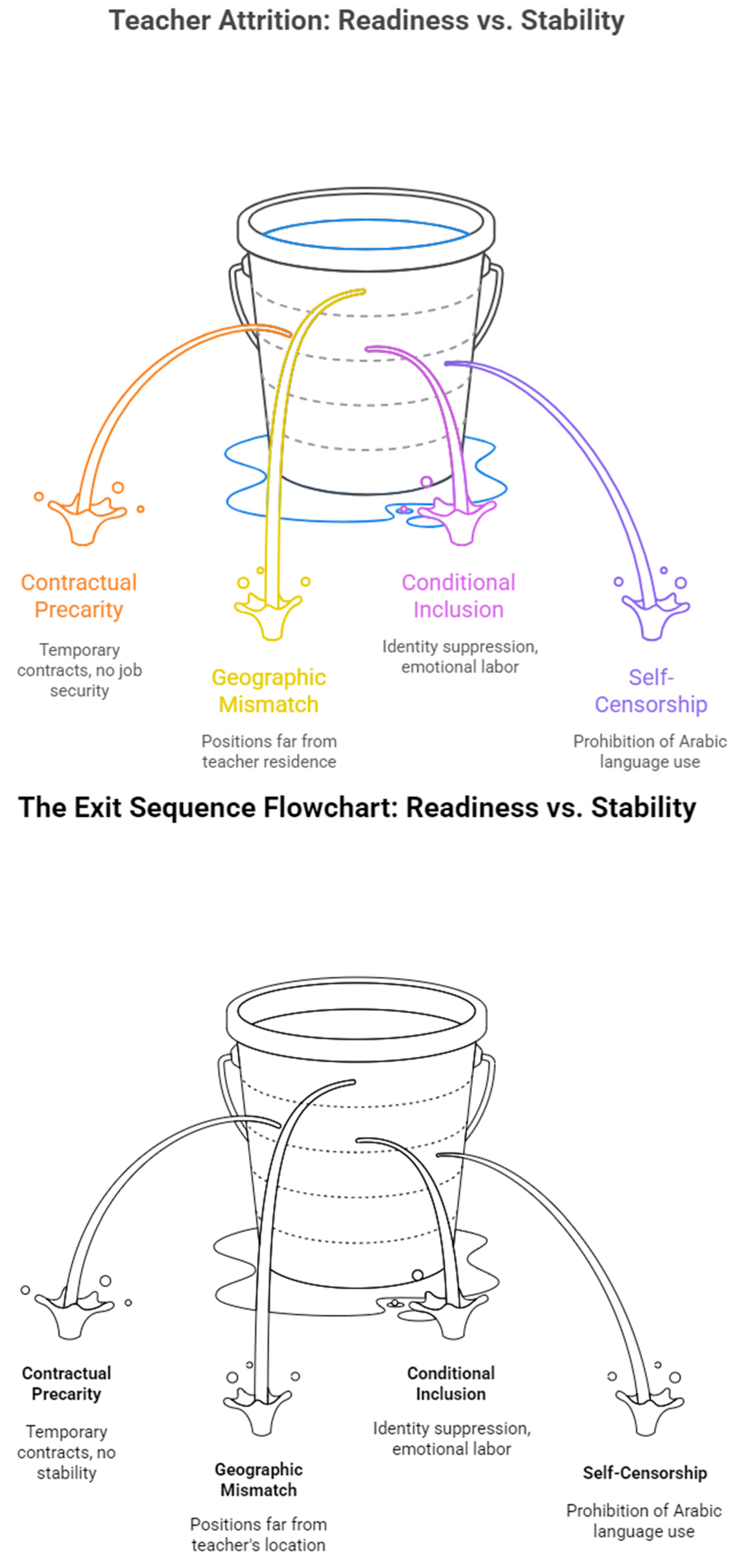
Durable Professionalism in Contested Spaces: Evaluating the Conversion of Teacher Readiness into Stable Professional Tenure in Politically Contested Multicultural Settings, 2022–2025

Abstract
1. Introduction: From Preparation to Professional Rupture in Boundary-Crossing Pedagogy
2. Literature Review: Intercultural Competence, Asymmetry, and the Ecology of Retention
2.1. The Israeli Education System and Boundary-Crossing Teachers
2.2. Intercultural Competence as Survival Mechanism
2.3. Boundary-Crossing and Power Asymmetry
2.4. The Ecology of Teacher Retention
3. Materials and Methods
3.1. The Research Context
3.2. Participants and Sampling Strategy
3.3. Procedure
3.4. Research Positionality
4. Findings: Readiness, Resilience, and the Institutional Failure of Stable Tenure
4.1. Theme I: The Cultivation of Intercultural Competence and Professional Agency
4.1.1. Professional Agency and Foundational IC
There, [in Jewish schools] it’s more ordered, more organized... I can’t have a job in the Arab sector. If you want to work at an Arab school, you need to wait in line, unless you have connections, and I am one of those who don’t have connections... I’d have to wait until my children have grandchildren, then I’ll be able to enter.
In the Jewish sector there is more order than in the Arab sector. Also, I never approached my principal and told her: ‘I want something’ and she told me ‘no’, or ‘no budget’… The management… is different. I always found inclusion and support in the Jewish sector… If I bring an idea and the principal loves the idea… [for example, once] she told me: ‘Nadin, I have the hours, what can we do with them?’, I told her: ‘Let’s do this for fourth grade… we have the national assessments soon. We will work on the assessment, give them learning strategies,’ she accepted it happily. In the Arab sector, that happens less.
4.1.2. Cultural Knowledge and Facilitation Skills
I lived in [a Jewish city], I know the culture… [but still] the [Orientation] program… deepened my knowledge… even things that were new… and that’s how you can connect things… understanding the reasons… what are the customs, it also adds to you more… It’s true that you experience it in your life, but you don’t sit and study it… learning adds a different aspect in my opinion.
4.2. Theme II: Systemic Absorption Failure: Structural Barriers to Tenure Stability
4.2.1. The Geographic Barrier
Most of the jobs that they offered me were in the center [of Israel]… Now I am a mother, and I have small children… a work in the [center] is something like, that is disconnected from reality…. It’s true that I… want to work and I love to work, and also like that to fulfill my ambitions… but still, I am a mother… So no, they (the program) are not the ones who found me the job… That’s why I didn’t immediately start teaching after I finished the program.
4.2.2. Contractual Precarity
Something came up in the [orientation] program I remember very well, which is a guarantee of employment... They promised us... and that was a very big dispute. And the matter of the in-service training was not clear either… if there is in-service training, there is no professional development bonus… You promised a bonus, then stand by your word because in the end… there wasn’t any.
4.3. Theme III: Conditional Inclusion and the Cost of Identity Negotiation
4.3.1. The Principal as a Protective Barrier
If there is someone… who is not comfortable with an Arab teacher teaching him, there is a way to deal with the matter... The principal does not agree… If the principal is strong… if the principal accepts you, the whole school will accept you… If the principal is good, then you won… She listens to us, listens to all our problems.
The principal called me after the last class and told me: ‘Wurud, everything is fine… you can go home calm.’… I told her: ‘If you want to come to school on Sunday and find all the parents standing outside the school gate, either they will beat me up, or they will break my car… I am not going home before this matter is dealt with.’ She said to me: ‘You are not entering the classroom, because now if you enter, they will say you entered to improve their opinion. I will send the school grade coordinator.’ The coordinator is strong. The coordinator went in and said to them: ‘I want to understand what happened… The children told her: ‘Not true, Wurud did not say that. Wurud said such and such.’ The coordinator reprimanded them and told them not to invent things, not to lie.
4.3.2. Enforced Self-Censorship and Linguistic Policing
4.3.3. The Demand for Emotional and Political Alignment
I told the principal: “If you can understand me, I am a mother. My heart aches for all mothers in the world, the side does not matter.” The principal responded by saying: “Between us… there is no one who is not empathetic to their people, and I understand. I cannot tell you, ‘you are an Arab, don’t be empathetic to Arabs.’ I am Jewish, I will be empathetic to Jews… I understand that a person is empathetic to their people, but there is no need for the students and the school to feel it”… And that’s exactly what happened, and that’s what is happening… I (Wurud) try as hard as I can not to show any empathy [for Palestinians]… I know that she always wants to hear from me that I am empathetic to Jews, with the situation of the Jews, and that… And she is very… happy with my answers.
5. Discussion: The Durability of IC Versus the Resistance to Systemic Change
Research Limitations and Future Directions
6. Conclusions and Recommendations
Funding
Institutional Review Board Statement
Informed Consent Statement
Data Availability Statement
Acknowledgments
Conflicts of Interest
References
- Abo-Zaed Arar, E. (2025). The research on minoritized Indigenous Palestinian teachers in majoritarian segregated education system in Israel: A systemic review. Diaspora, Indigenous, and Minority Education, 1–16. [Google Scholar] [CrossRef]
- Abu-Saad, I. (2016). Access to higher education and its impact on the development of the Palestinian Arab minority in Israel. Higher Education, 69(1), 1–16. [Google Scholar]
- Achinstein, B., Ogawa, R., Sexton, D., & Freitas, E. (2010). Retaining teachers of color: A pressing problem and a potential strategy for hard-to-staff schools. Review of Educational Research, 80(1), 71–107. [Google Scholar] [CrossRef]
- Al-Haj, M. (2002). Multiculturalism in the Israeli education system: The state of the art. Social Identities, 8(2), 177–189. [Google Scholar]
- Allport, G. W. (1954). The nature of prejudice. Addison-Wesley. [Google Scholar]
- Arasaratnam-Smith, L. A. (2025). Developing intercultural competence in higher educational contexts. In S. Liu, A. Komisarof, Z. Hua, & L. Obijiofor (Eds.), The Sage handbook of intercultural communication (pp. 212–224). Sage. [Google Scholar]
- Bar-Tal, D. (2011). Introduction: Conflicts and social psychology. In D. Bar-Tal (Ed.), Intergroup conflicts and their resolution (pp. 1–38). Psychology Press. [Google Scholar]
- Bourke, B. (2014). Positionality: Reflecting on the research process. Qualitative Report, 19(33), 1–9. [Google Scholar] [CrossRef]
- Braun, V., & Clarke, V. (2006). Using thematic analysis in psychology. Qualitative Research in Psychology, 3(2), 77–101. [Google Scholar] [CrossRef]
- Braun, V., & Clarke, V. (2019). Reflecting on reflexive thematic analysis. Qualitative Research in Sport, Exercise and Health, 11(4), 589–597. [Google Scholar] [CrossRef]
- Cushner, K. (2025). Intercultural teacher training and diversity in schools. In S. Liu, A. Komisarof, Z. Hua, & L. Obijiofor (Eds.), The Sage handbook of intercultural communication (pp. 179–193). SAGE. [Google Scholar]
- Cushner, K., & Mahon, J. (2009). Developing the intercultural competence of educators and their students: Creating the blueprints. In D. K. Deardorff (Ed.), The Sage handbook of intercultural competence (pp. 304–332). SAGE. [Google Scholar]
- Deardorff, D. K. (2006). Identification and assessment of intercultural competence as a student outcome of internationalization. Journal of Studies in International Education, 10(3), 241–266. [Google Scholar] [CrossRef]
- Dervin, F., & Hahl, K. (2015). Developing a portfolio of intercultural competences in teacher education: The case of a Finnish international programme. Scandinavian Journal of Educational Research, 59(1), 95–109. [Google Scholar] [CrossRef]
- Dhillon, J. K., & Thomas, N. (2019). Ethics of engagement and insider-outsider perspectives: Issues and dilemmas in cross-cultural interpretation. International Journal of Research and Method in Education, 42(4), 442–453. [Google Scholar] [CrossRef]
- Dimitrov, N., & Haque, A. (2016). Intercultural teaching competence: A multi-disciplinary framework for instructor reflection. Intercultural Education: Special Issue on Learning at Intercultural Intersections, 27(5), 437–456. [Google Scholar] [CrossRef]
- Erlich Ron, R. (2025). ‘Every place requires showing a different part of my identity’: Bicultural identity performance and frame-switching among Arab pre-service teachers. International Studies in Sociology of Education, 1–24. [Google Scholar] [CrossRef]
- Foote, M. Q., & Gau Bartell, T. (2011). Pathways to equity in mathematics education: How life experiences impact researcher positionality. Educational Studies in Mathematics, 78(1), 45–68. [Google Scholar] [CrossRef]
- Ghattas, F. K. (2025). The Palestinian people in Israel: Between national belonging and citizenship [Doctoral dissertation, Sofia University]. [Google Scholar]
- Gindi, S., & Erlich Ron, R. (2019). Bargaining with the system: A mixed-methods study of Arab teachers in Israel. International Journal of Intercultural Relations, 69, 44–53. [Google Scholar] [CrossRef]
- Gindi, S., & Erlich Ron, R. (2025). Examining contact and identity: Arab teachers in Jewish schools and future applicants. Citizenship, Teaching & Learning, 20(3), 313–331. [Google Scholar]
- Gindi, S., Gilat, Y., & Sagee, R. (2020). Parent, teacher and student attitudes toward boundary-crossing teachers. Journal for Multicultural Education, 14(3/4), 281–294. [Google Scholar]
- Gindi, S., Hisherik, M., Awida, N., & Yehuda, T. B. (2024). Jewish and Arab lecturers teaching Jewish and Arab teachers how to teach in the ‘other’ society: Insights into the development of intercultural competence in a high-conflict society. International Journal of Intercultural Relations, 102, 102039. [Google Scholar] [CrossRef]
- Golan-Agnon, R. (2006). Inequality in education. Babel. [Google Scholar]
- Haraway, D. (1988). Situated knowledges: The science question in feminism and the privilege of partial perspective. Fem Stud, 14(3), 575–599. [Google Scholar] [CrossRef]
- Hisherik, M., Gindi, S., Awida, N., & Saada, N. (2025). Developing intercultural competence in a training program for boundary-crossing Jewish and Palestinian pre-service teachers. Teaching & Teacher Education, 159, 104996. [Google Scholar] [CrossRef]
- Holmes, A. G. D. (2020). Researcher positionality–A consideration of its influence and place in qualitative research–A new researcher guide. Shanlax International Journal of Education, 8(4), 1–10. [Google Scholar] [CrossRef]
- Ichilov, O. (2004). Political education in a divided society: The case of Israel. Routledge. [Google Scholar]
- Jamal, A. (2007). Strategies of minority resistance: The Palestinian minority in Israel and the struggle for mobilizing the political. Journal of Palestine Studies, 36(4), 27–45. [Google Scholar]
- Jayusi, W. (2025). Teachers under fire: Experiences and resilience of Palestinian-Israeli teachers in Jewish schools post-October 7th. Teaching and Teacher Education, 165, 105147. [Google Scholar] [CrossRef]
- Jayusi, W., & Bekerman, Z. (2019). Does teaching on the “Other” side create a change. Teaching and Teacher Education, 77(1), 160–169. [Google Scholar] [CrossRef]
- Karakus, M., Toprak, M., Caliskan, O., & Crawford, M. (2024). Teachers’ affective and physical well-being: Emotional intelligence, emotional labour and implications for leadership. International Journal of Educational Management, 38(2), 469–485. [Google Scholar] [CrossRef]
- Kerstetter, K. (2012). Insider, outsider, or somewhere between: The impact of researchers’ identities on the community-based research process. Journal of Rural Social Sciences, 27(2), 7. [Google Scholar]
- Kezar, A. (2002). Reconstructing static images of leadership: An application of positionality theory. Journal of Leadership Studies, 8(3), 94–109. [Google Scholar] [CrossRef]
- Krakowski, M. (2008). Arab teachers in Jewish schools in Israel: Teachers of what? For whom? In C. Allemann-Ghionda, & E. J. J. M. van Eekeren (Eds.), Diversity in schools: Theoretical and applied challenges (pp. 115–130). Waxmann. [Google Scholar]
- Muszkat-Barkan, M. (2022). ‘Side by side’: Nurturing local intercultural competence in a professional development program for Palestinian and Jewish teachers. Teachers College Record, 124(2), 170–196. [Google Scholar] [CrossRef]
- Okken, G., Jansen, E., Hofman, W., & Coelen, R. (2022). Interculturally competence teachers: Behavioural dimensions and the role of study abroad. Cogent Education, 9(1), 2138048. [Google Scholar] [CrossRef]
- Povey, R., Trudgett, M., Page, S., & Coates, S. K. (2024). Workers united: A non-assimilatory approach to Indigenous leadership in higher education. International Journal of Qualitative Studies in Education, 37(10), 2909–2925. [Google Scholar] [CrossRef]
- Rutherford, M., Cahn, A., Chi, E., & Gurrieri, L. (2024). Children as global subjects: A comparison of translated picture books in the United States and China. In Translation and neoliberalism (pp. 245–269). Springer Nature. [Google Scholar]
- Saada, N., & Gross, Z. (2019). The experiences of Arab teachers in Jewish schools in Israel. Teaching and Teacher Education, 79, 198–207. [Google Scholar] [CrossRef]
- Shechory Bitton, M., Zvi, L., & Laufer, A. (2026). Psychological outcomes and resilience among evacuees and non-evacuees following the October 7 Hamas attack in Israel. Scientific Reports, 16, 5254. [Google Scholar] [CrossRef] [PubMed]
- Silverman, G., Ben Yehuda, T., Yaniv, I., Hisherik, M., & Awida Haj Yehya, N. (2024). Interethnic workplace relations in times of heightened social tension: Israeli-Arab teachers in Jewish schools post-10/7. Intercultural Journal of Intercultural Relation, 103, 102093. [Google Scholar] [CrossRef]
- Ting-Toomey, S. (2009). Intercultural conflict competence as a facet of intercultural competence development: Multiple conceptual approaches. In D. K. Deardorff (Ed.), The Sage handbook of intercultural competence (pp. 100–120). SAGE. [Google Scholar]
- Ungar, M. (2011). The social ecology of resilience: Addressing contextual and cultural ambiguity of a nascent construct. American Journal of Orthopsychiatry, 81(1), 1–17. [Google Scholar] [CrossRef]
- Yip, S. Y., & Ji, J. S. (2024). Diversifying the teaching workforce: Challenges and opportunities in initial teacher education (ITE). Globalisation, Societies and Education, 1–13. [Google Scholar] [CrossRef]


| Name | Age | Teaching Subject Area | Education | Instruction History |
|---|---|---|---|---|
| Rania | 37 | Mathematics and Computer Science | M.A. | Three different Jewish schools in three years, all middle schools. |
| Wurud | 29 | Art | M.A. | Taught in a Jewish elementary school for two years after the program, and now teaches in an Arab elementary school. |
| Nadin | 36 | Kindergarten teacher | M.A. | Two years in a Jewish school, followed by a year in an Arab elementary school, and back to a Jewish school. |
| Dania | 38 | Early childhood | B.Ed. | A third of her position is in a Jewish school and the other two-thirds in the Arab education stream. |
| Khawla | 30 | Mathematics | B.A. | Worked part-time (50%) in the first year and full time in the second year. |
| Amal | 32 | Hebrew Literature and Education | B.Ed. | Her second year of teaching in a Jewish high school. |
| Najakh | 27 | English | B.Ed. | First year teaching in a Jewish high school as a substitute teacher. |
| Hiba | 38 | Hebrew | M.A. | Taught one year in a Jewish school, followed by teaching Hebrew privately for two years, and going back to teach at a Jewish school part-time. |
| Lubna | 24 | Math and Science | B.Ed. | Teaching in a Jewish special education school for the past two years. |
| Latifa | 44 | Art | B.Ed. | Since graduating from the program, has been working in three different Jewish schools simultaneously. |
| Jihan | 31 | Sciences | B.Ed. | Did not work in the first year after graduating from the program, and has worked in a Jewish middle school for the past year. |
| Fadia | 47 | Physics | B.Ed. | Has been working in a Jewish middle school for three years straight since graduating from the program. |
| Themes | 1. The Cultivation of Intercultural Competence and Professional Agency | 2. Systemic Absorption Failure and the Mechanisms of Attrition | 3. Conditional Inclusion and the Cost of Identity Negotiation |
|---|---|---|---|
| Subthemes | 1A. Professional Agency and Foundational IC. | 2A. The Geographic Barrier. | 3A. The Principal as a Protective Barrier. |
| 1B. Cultural Knowledge and Facilitation Skills. | 2B. Contractual Precarity. | 3B. Enforced Self-Censorship and Linguistic Policing. | |
| 3C. The Demand for Emotional and Political Alignment. |
Disclaimer/Publisher’s Note: The statements, opinions and data contained in all publications are solely those of the individual author(s) and contributor(s) and not of MDPI and/or the editor(s). MDPI and/or the editor(s) disclaim responsibility for any injury to people or property resulting from any ideas, methods, instructions or products referred to in the content. |
© 2026 by the author. Licensee MDPI, Basel, Switzerland. This article is an open access article distributed under the terms and conditions of the Creative Commons Attribution (CC BY) license.
Share and Cite
Gindi, S. Durable Professionalism in Contested Spaces: Evaluating the Conversion of Teacher Readiness into Stable Professional Tenure in Politically Contested Multicultural Settings, 2022–2025. Educ. Sci. 2026, 16, 285. https://doi.org/10.3390/educsci16020285
Gindi S. Durable Professionalism in Contested Spaces: Evaluating the Conversion of Teacher Readiness into Stable Professional Tenure in Politically Contested Multicultural Settings, 2022–2025. Education Sciences. 2026; 16(2):285. https://doi.org/10.3390/educsci16020285
Chicago/Turabian StyleGindi, Shahar. 2026. "Durable Professionalism in Contested Spaces: Evaluating the Conversion of Teacher Readiness into Stable Professional Tenure in Politically Contested Multicultural Settings, 2022–2025" Education Sciences 16, no. 2: 285. https://doi.org/10.3390/educsci16020285
APA StyleGindi, S. (2026). Durable Professionalism in Contested Spaces: Evaluating the Conversion of Teacher Readiness into Stable Professional Tenure in Politically Contested Multicultural Settings, 2022–2025. Education Sciences, 16(2), 285. https://doi.org/10.3390/educsci16020285