Article

From Formal to Operational: A Triangulated Analysis of Policy, Practice, and Perception Regarding Digital Competence Development in Mathematics and IT Teacher Education

by
Nikolina Nikolova
1,
Borislava Kirilova
1,*,
Pencho Mihnev
2,
Temenuzhka Zafirova-Malcheva
2 and
Maria Petkova
3
1
Department of Education in Mathematics and Informatics, Faculty of Mathematics and Informatics, Sofia University St. Kliment Ohridski, 5 James Bourchier Blvd., 1164 Sofia, Bulgaria
2
Department of Information Technologies, Faculty of Mathematics and Informatics, Sofia University St. Kliment Ohridski, 5 James Bourchier Blvd., 1164 Sofia, Bulgaria
3
Department of Didactics, Faculty of Education, Sofia University St. Kliment Ohridski, 15 Tsar Osvoboditel Blvd., 1504 Sofia, Bulgaria
*
Author to whom correspondence should be addressed.
Educ. Sci. 2026, 16(2), 272; https://doi.org/10.3390/educsci16020272
Submission received: 22 December 2025 / Revised: 20 January 2026 / Accepted: 2 February 2026 / Published: 9 February 2026
(This article belongs to the Section Higher Education)

Abstract

The digital transformation of education necessitates the integration of digital competences into teacher training programs, particularly in subjects such as mathematics, informatics and information technologies. This study explores how digitalisation influences the development of digital competences among pre-service teachers at the Faculty of Mathematics and Informatics of Sofia University St. Kliment Ohridski. This article uses a triangulated research approach, combining curriculum documentation, faculty self-assessments and classroom observations, to examine the alignment between the ideal, formal, perceived, operational and experiential levels of digital competence development, based on John Goodlad’s five-level curriculum typology and Jo Tondeur’s SQD 2.0 model. The findings reveal significant discrepancies between the intended, the implemented and the experienced curriculum. Although ICT-focused disciplines strongly embed digital competences, non-ICT subjects show fragmented and inconsistent integration. Faculty staff self-assessments indicate high confidence in creating digital resources and assessment strategies, gaps persist in reflective practice, computational thinking, inclusion and self-regulated learning. Classroom observations confirm limited use of emerging technologies and insufficient development of collaborative digital learning environments. The study underscores the gap between policy requirements, faculty practices and classroom realities. The discussion emphasizes the need for systemic reforms in teacher education, offering insights for policymakers, curriculum designers and training programs.

1. Introduction

In recent years, digital transformation has changed the way institutions deliver knowledge, engage students in learning, and manage academic activities. From virtual classrooms and online learning platforms to AI-based daily routines and informed decision-making, the use of digital tools is redefining the educational experience. This includes not only technical skills, but also the ability to navigate the digital environment, critically evaluate online information, communicate, collaborate, and ensure cybersecurity. In this context, instructors assume additional responsibilities and confront multiple challenges, such as sustaining learner engagement and ensuring reliable and equitable assessment of knowledge (Hadzhikoleva et al., 2025). As working with digital tools and platforms becomes an integral part of the modern teaching process, regardless of the subject area, teacher training programs face the urgent challenge of providing future teachers with both specific experience in the field of the particular discipline and the digital competences necessary for its effective teaching with the help of technology. This article examines how digitalization in higher education impacts the development of digital competences in teacher training. It focuses on mathematics, computer science, and IT education programs. The analysis explores the skills outlined in evolving curriculum frameworks. Special attention is given to the role of digital competences in fostering adaptive, confident, and digitally savvy teachers. Although most models and frameworks focus on the pre-university level, there is a growing interest in knowing the state of digital competences of university teachers, that is, the set of knowledge, skills and attitudes necessary for a teacher to make effective use of technologies (Basilotta-Gómez-Pablos et al., 2022). The challenge lies in the lack of clarity regarding which digital competences higher education instructors need in order to effectively integrate Information and Communication Technologies (ICT) into their teaching, along with insufficient guidance on how to develop these skills (Tondeur et al., 2017). A variety of digital competence frameworks—developed by governmental bodies and international organizations such as DigCompEdu (Redecker, 2017), Standards International Society for Technology in Education Standards (ISTE, 2017), UNESCO’s ICT Competency Framework for Teachers (UNESCO, 2018), and the JISC Digital Capabilities Framework (JISC, 2019)—have been established to guide the development of educators’ digital skills. However, the majority of these frameworks have been primarily designed with school teachers in mind, leaving a relative gap in tailored guidance for higher education professionals, whose roles and digital needs often differ significantly from those in primary and secondary education (Tondeur et al., 2023). Currently, after the COVID-19 crisis, research topics in the field of teachers’ pedagogical digital competences within their basic and advanced training continue to be challenging and go beyond the obvious findings (Mizova et al., 2025).
The increasing use of technology in teaching and learning requires increasingly systematic and integrated approaches to developing pedagogical digital competences in three main areas: curriculum content, university teacher qualifications and student training. In this context, teacher professional development programs, national and European frameworks for digital competence, and interdisciplinary collaboration play an essential role in supporting transformational processes in higher education. The COVID-19 pandemic has further accelerated the digital transformation, acting as a catalyst for the introduction of new technologies and the rethinking of pedagogical approaches in remote and hybrid environments. Despite this progress, significant challenges remain related to the uneven development of digital competences. Issues such as limited access to resources, insufficient training of teachers, and a mismatch between curricula and practice continue to adversely affect the quality of education. These circumstances highlight the need for in-depth research into the current state and processes of change in the development of digital competences at the Faculty of Mathematics and Informatics (FMI) of Sofia University St. Kliment Ohridski (SU). FMI is the faculty that prepares future teachers at the bachelor’s and master’s levels for secondary school teaching in the subjects of mathematics, informatics, information technologies (IT), as well as computer modeling and information technologies (CMIT).

1.1. The Higher Education (HE) in General, and the Digitalisation

The digital transformation of higher education, accelerated by the global COVID-19 pandemic, has reshaped how universities deliver teaching, conduct assessments, and engage with students. According to Castañeda and Selwyn (2018), digitalization has not just added tools to the educator’s toolkit; it has redefined the pedagogical relationship, introducing new dynamics of observation, autonomy, and student engagement. In the face of rapidly evolving digital technologies and the wide-ranging societal changes triggered by the COVID-19 pandemic, education systems in Europe are undergoing an unprecedented transformation. The European University Association reported that about 95% of universities in Europe switched to distance learning at some point during the COVID-19 pandemic (Ndondo, 2022). Recognizing both the challenges and opportunities presented by these changes, the European Commission (EC) launched the Digital Education Action Plan (2021–2027). This initiative builds on lessons learned during the pandemic and sets out a vision for high-quality, inclusive and accessible digital education across the European Union (EU). The plan underpins the EU’s broader digital strategy and reflects a strong commitment to preparing Europe’s learners and educators for a digitally empowered future. The first Digital Education Action Plan (2018–2020) laid the groundwork for digital innovation in education, but the onset of the COVID-19 crisis revealed major gaps in digital readiness, access, and pedagogy. Additionally, an open public consultation for the Digital Education Action Plan indicated that 95% of respondents considered the COVID-19 pandemic a turning point for how technology is used in education and training (European Commission, 2020). Looking ahead, the second Digital Education Action Plan aims not only to recover from the disruptions of COVID-19 but also to reshape European education systems to thrive in a digital and globalized world. The Plan outlines a range of actions to implement its priorities, such as
  • Digital Education Hub: The European Digital Education Hub was established to foster cooperation and dialog among stakeholders in digital education. It aims to overcome fragmentation in digital education policy, research, and implementation practices across Europe. The Hub serves as a collaborative platform to support the implementation of the Digital Education Action Plan by promoting peer learning, sharing best practices, and monitoring developments (European Commission, 2021).
  • SELFIE for Teachers: A tool to help educators reflect on their digital competence and receive guidance on development. Launched in the autumn of 2021, SELFIE for Teachers is an online self-reflection tool based on the European Framework for the Digital Competence of Educators (DigCompEdu). It assists teachers in identifying their digital competence strengths and areas for improvement, enabling them to plan further training and professional development (Economou, 2023).
  • EU Digital Competence Frameworks: The DigComp—1.0, 2.0, 2.1, 2.2 for citizens and DigCompEdu (for educators) frameworks are key tools developed by the European Commission to outline the digital competences required in the digital age. These frameworks are regularly updated to include emerging skills related to artificial intelligence and data literacy, guiding national policies and educational strategies (European Commission, 2017).

1.2. Digitalisation and Teacher Preparation at Higher Education Level

Digital competences are now essential for pre-service teachers as higher education adapts to the digital era. While digital tools are widely available, many educators still lack sufficient skills, especially in pedagogical technology use. Experts argue that effective integration requires curricular redesign, ensuring future teachers become not just users but critical designers of technology-enhanced learning (Tondeur et al., 2017). On the base of the results of PISA 2022, a policy paper by OECD (OECD, 2025) in a conjunction with the comparative data collected through the “Policy Survey on School Education in the Digital Age” (Boeskens & Meyer, 2025) consider the questions of how continuous professional development (CPL) of teachers can support the effective use of digital resources by teachers. There is a significant increase in the teachers’ technical and pedagogical skills in digital technology use in instruction on average across OECD countries—a growth from 64.5% to 87.6% from 2018 to 2022. Despite that, “a sizeable proportion of teachers are still hesitant to use digital resources in ways that could transform teaching and learning” (OECD, 2025, p. 7). In a critical overview of a number of systematic reviews on teacher digital competence development in higher education, Peters et al. (2022) consider 740 studies across 13 systematic reviews and make a synthesis of their findings in three broad strands. Some of the implications for practice from the study suggests that (i) teacher digital competence (TDC) in higher education should be considered not only as firmly as a training program, but also considered in a broader system-wide context, with the corresponding implications; (ii) a strategic culture should be developed by integrating goals and visions in formal policy documents at different levels—from the institutional level to the education system level; and (iii) optimal working conditions for both student-teachers at university and for acting teachers at schools should be provided “to develop this important competency autonomously and collaboratively with colleagues and students”, as “it is critical to recognise the link between teaching competence and pedagogical leadership, curricular development and renewal, technological and institutional infrastructure, governance and academic leadership and the links and interactions between them, all of which affect teachers and their teaching practices” (Peters et al., 2022, p. 132). In a 2023 meta-analysis of 7470 university lecturers from Europe (Spain) and Latin America, the self-perception of the lecturers’ digital competence is analyzed (Liesa-Orus et al., 2023). The study shows that the perception of the university lecturers about the digital competences is positive, but they do not perceive themselves as sufficiently competent. The main challenges arising from this study include the need for educational policies supporting the digital competences development of lecturers in a combination of access to technological resources, support of digital skills development of the lecturers, and the need for skill development of pedagogical application of ICT and classroom management in teaching. A 2024 meta-analysis by Tomczyk (Tomczyk, 2022), based on global expert interviews, identified gaps in digital content management, ICT integration, soft skills, interactivity, and AI awareness. A Nigerian study (Ayanwale et al., 2024) further emphasizes the need for AI recognition training. In South Africa, a first-year technology module introduces digital tools, but practical application remains difficult without teaching experience (Marais, 2023). Turkish studies (Koyuncuoglu, 2022) recommend structured programs to enhance digital skills, including advanced interdisciplinary modules. A European study (López-Meneses et al., 2020) found students proficient in information literacy and collaboration but lacking in digital content creation. It suggests integrating social media and academic internet use into curricula. Meanwhile, Madrid et al. (2024) highlight the ongoing challenge of technology integration in both public and private institutions. Overall, targeted training and interdisciplinary approaches are critical to preparing educators for technology-driven teaching. A survey among students from the Pedagogy of Teaching Mathematics and Informatics program at Plovdiv University, conducted before the course Modeling Pedagogical Patterns in an Electronic Environment, examined their perceptions of e-learning. Only 13% reported difficulties with platforms, which is unsurprising given their background in informatics, mathematics, and teaching methodology. Despite technical issues, limited resources, and challenges in asynchronous communication, students expressed a positive attitude toward online learning, highlighting the need for more digital resources and engaging activities to enhance understanding (Yonchev et al., 2022).

1.3. The Study Context

In Bulgaria, the implementation of the DigComp and DigCompEdu frameworks is experiencing rapid growth, especially following the European Union’s call for digitally literate teachers. The national policies include national strategic plans such as
  • Strategic Framework for the Development of Education, Training, and Learning (2021–2030)—This Ministry of Education and Science strategy explicitly prioritizes Digital Transformation, describing digital skills as essential across all education levels. It calls for interactive ICT-based teaching and highlights a policy shift toward preparing students as “digital creators” (Digital National Alliance, 2023).
  • Digital Bulgaria 2025 National Program—Coordinated by the Bulgarian Ministry of Transport, Information Technology, and Communications—This strategy includes modernizing ICT infrastructure in schools and higher education institutions, improving the assessment of students’ digital competences, modernizing curricula, and improving teachers’ competences in line with the priority areas of action of the main European strategic documents (Ministry of Transport and Communications, 2019).
  • National Digital Decade Strategic Roadmap (2024–2030)—Building on EU “Digital Decade” ambitions, Bulgaria’s roadmap reveals that only ~31% of citizens have basic digital skills—well below the EU average. It identifies “Curriculum and Pedagogy” and “Digital Skills and Competences” as key pillars and aims to enhance digital skills in education via targeted national measures (European Commission, 2024).
These strategies emphasize the need to align school and higher education curricula with these frameworks. Although the frameworks are required at the administrative level, the degree of their adoption varies—most notably in higher education, where partial initiatives and institutional autonomy lead to local practices. Within the context of the project “Sofia University Marking Momentum for Innovation and Technological Transfer” (SUMMIT)—Research Group 3.1.10 DigitalEdu-SU serves as an analytical object, allowing the authors to observe how these frameworks are adopted and interpreted in teacher training in a real educational environment.

1.4. The Research Questions of the Article

The study explores the following research questions.
RQ1. What are the situation and change processes in teaching and acquisition of (1) general digital competences, and (2) pedagogical digital competences at the Faculty of Mathematics and Informatics, Sofia University St. Kliment Ohridski, Bulgaria, with respect to
  • Study courses for the preparation of future teachers in mathematics, informatics, and IT?
  • Faculty teachers who prepare and deliver courses to future teachers?
RQ2. What are the discrepancies, problems, and possible solutions in the processes of the curriculum design, development, delivery, and acquisition of general and pedagogical digital competences in regard to the preparation of pre-service teachers in mathematics, informatics, and ICT?

2. Materials and Methods

This study follows a comprehensive research strategy developed under project SUMMIT BG-RRP-2.004-0008, funded by the European Union-NextGeneration EU, through the National Recovery and Resilience Plan of the Republic of Bulgaria.
The research framework is based on the aggregation of multiple empirical data, which, as evidence, will enable policymakers, education experts, teacher trainers, and practitioners to build a realistic picture of the state of future teachers’ preparation in terms of their digital competences (Mizova et al., 2025).
John I. Goodlad’s 5-level methodology for curriculum evaluation is a foundational framework in curriculum theory and development, offering a structured approach to understanding the complexities of educational curricula. Goodlad’s 5-level methodology is embedded within his broader curriculum theory, which critiques the oversimplification of curriculum as a linear or static entity. Instead, Goodlad emphasizes curriculum as a dynamic, multi-dimensional phenomenon that must be understood within its socio-political context. Goodlad’s approach is influenced by earlier curriculum models, notably Ralph Tyler’s objectives-based model and Joseph Schwab’s deliberative approach, but it uniquely integrates a hierarchical, multi-level analysis (Button, 2021). This integration allows the methodology to capture the nuances of curriculum development and implementation, highlighting the importance of alignment between different levels to achieve educational goals effectively. Goodlad’s framework also incorporates social values as primary data sources, emphasizing the moral and ethical dimensions of education and the role of teachers as moral agents initiating students into a democratic culture.
This study uses a research approach whereby qualitative methods dominate, theoretically underpinned by John Goodlad’s (Goodlad, 1979) typology of curriculum, breaking down into a number of levels of curriculum: ideal (planned), formal (official), perceived (interpreted), operational (enacted), and experiential (lived) (Table 1). These levels capture the discrepancies between educational intentions, institutional implementations, and learner experiences, thus offering vertical depth in the analysis of coherence and misalignment.
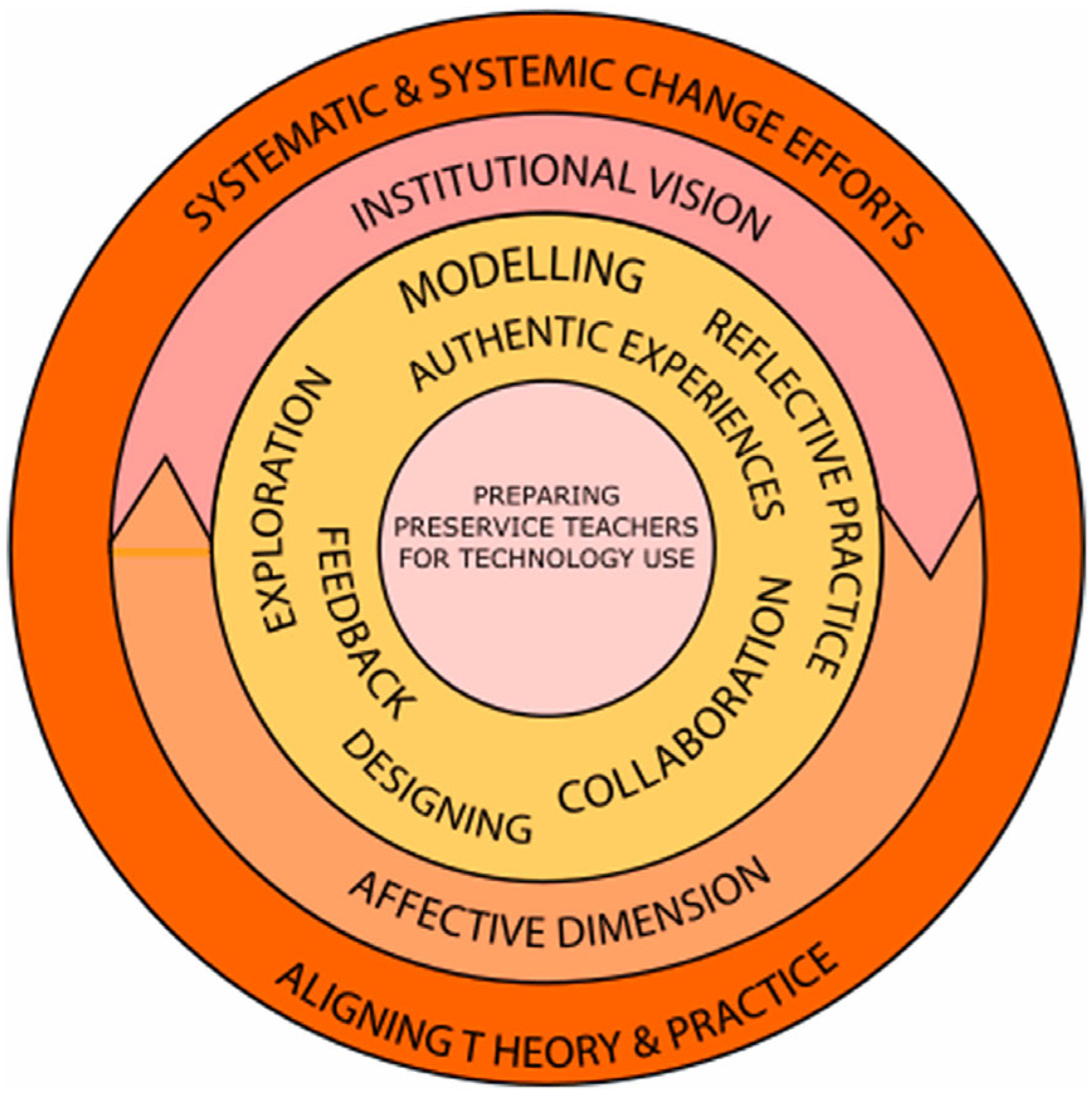
In contrast, the Tondeur Synthesis of Qualitative Data (SQD) model (Tondeur et al., 2012, 2025) framework provides a horizontal structure focusing specifically on factors influencing the integration of ICT in teacher training, such as pedagogical vision, collaborative reflection, practice-based learning, and institutional support. The SQD model outlines the conditions under which future teachers develop meaningful digital competence. The typology is adapted in this case to fit the specific research of teacher education at the FMI, using the tools DigComp 2.2, DigCompEdu, and Jo Tondeur’s SQD&SQD2 models to prepare pre-service teachers for ICT use (Tondeur et al., 2012, 2025). The updated SQD 2.0 model by Tondeur offers three structural levels of analysis (Figure 1):
  • Macro (systematic and systemic change efforts)—What are the systemic conditions and policies that influence the training of future teachers?
  • Meso (institutional vision/affective dimension)—How does the institution support digital learning?
  • Micro (key themes explicitly related to the preparation of pre-service teachers)—What is happening in the specific training situation?
Based on synergy between Goodlad and Tondeur Models, the authors proposed a three-level analytical model—Macro (formal), Meso (implementation), and Micro (operational) in order to map the structural, institutional, and experiential levels of ICT integration. This epistemological complementarity strengthens the validity of the proposed methodology and enhances its applicability to both ICT and non-ICT teacher training contexts (Table 2).
The synergy between the Goodlad and Tondeur Models is theoretically justified and methodologically valuable because
1.
Goodlad provides vertical depth—analyzing where discrepancies occur in the educational process;
2.
Tondur adds horizontal specification—explaining how ICT integration occurs at different levels.
The synthesis between Goodlad’s structural levels and Tondeur’s contextual sensitivity allows for the creation of a three-level analytical model (Macro–Meso–Micro).
As a result, a three-level structured methodology was implemented.

2.1. Formal (Officially Approved Curriculum)

At this level, the study examines the national and institutional goals for developing digital competences in the preparation of future teachers by reviewing the formal educational documentation and the curricula of 25 non-ICT and 14 ICT courses at Sofia University. The aim is to identify the stated objectives and the structural mechanisms through which the development of digital literacy is ensured. The analysis also compares ICT and non-ICT courses in terms of how they incorporate elements of digital competence, using indicators structured according to DigCompEdu and DigComp frameworks. The study takes into account the differences in the requirements for future teachers, as well as the extent to which these requirements are normatively regulated within Bulgarian educational policy. Two key regulatory documents define the mandatory nature of digital training:
  • The Ordinance on State Requirements for Acquiring Professional Qualification as a Teacher (Council of Ministers Decree No. 289 of 7 November 2016) defines the competency profile of future teachers, including mandatory digital skills such as the use of electronic resources, learning platforms, and digital communication (Council of Ministers of the Republic of Bulgaria, 2016):
    Art. 6 (1), point 6 of Council of Ministers Decree No. 289: “The required subjects are: … information and communication technologies in education and work in a digital environment.” (Council of Ministers of the Republic of Bulgaria, 2016);
    Art. 7 (1), point 2 of Council of Ministers Decree No. 289: “Elective subjects … include subjects whose teaching ensures the development of competences … including in the field of ICT.” (Council of Ministers of the Republic of Bulgaria, 2016).
  • Regulation No. 15/22.07.2019 regulates the professional development and certification requirements for teaching professionals, which also emphasizes the importance of digital competence in the context of modern teaching (Council of Ministers of the Republic of Bulgaria, 2019).
  • Appendix No. 2 to Article 42, paragraph 2, item 1 (2021) (Council of Ministers of the Republic of Bulgaria, 2016), to Regulation No. 15. The appendix defines the competence profile of a “teacher of …”.
The data from the study show the extent to which these requirements are implemented in the actual university training of teachers.

2.2. Implementation (Faculty Perspective)

The second level examines how academic faculty interpret and enact the curricular intentions. This focuses on
  • Faculty self-assessment of digital teaching competences using a tailored version of the SELFIE for TEACHERS tool, adapted to local and institutional context;
  • Semi-structured interviews with academic staff involved in preparing future teachers in mathematics, informatics, and IT. These explore their understanding of their role, perceptions of the DigCompEdu framework, and practices for integrating digital competence development into their teaching.

2.3. Operational (Observed Practice)

The final level focuses on the operational curriculum, or how the curriculum is embedded into practice:
  • Observations of selected classes at FMI by lecturers who are not directly involved in the specific courses allow for the documentation of observed practices, activities, and pedagogical approaches that reflect the development of digital competences.
  • Particular attention is given to how digital tools, methods, and strategies are used in practice, as well as the degree to which they align with the intentions expressed at the ideal and implementation levels.
By triangulating data from curriculum documentation, faculty interviews, digital competence self-assessments, and classroom observations, the study constructs a multi-layered understanding of how general and pedagogical digital competences are conceptualized, delivered, and practiced within the institutional setting of SU. This approach not only reveals areas of alignment and discrepancy across curriculum layers but also provides a grounded basis for identifying challenges and opportunities for improvement.

3. Results

The specialized pedagogical education of future teachers in mathematics and ICT is ensured by a total of 25 non-ICT and 14 ICT educational courses, provided by the Faculty of Mathematics and the Faculty of Pedagogy.
The presented study analyses the formal curricula and course documentation of a subset of 12 teacher educational courses provided by the Faculty of Mathematics and Informatics. The courses are classified into four groups (Table 3).
Further, interviews with 14 academic teachers, leading the analyzed FMI courses, provide insight into teachers’ perceptions of their pedagogical digital competences, illustrated with concrete examples from their practice.

3.1. The Ideal Curriculum

The following Table 4 presents a summary of the results from an analysis of formal curricula and course documentation of the analyzed FMI courses. The purpose of this analysis is to identify how digital competence is conceptualized and structured within the curricula, as well as the extent to which its various dimensions are integrated into course content, requirements, and assessment. The analysis is conducted through the following.
  • Integration with Tondeur’s model, which defines key indicators for the successful integration of technology into teaching.
  • Use of the DigCompEdu and DigComp 2.2 frameworks to operationalize digital competences and to structure the frequency of indicators across course syllabi, presented respectively in Table 3 (DigCompEdu) and Table 4 (DigComp). The values in both tables are presented as percentage frequencies of indicator occurrence, ensuring a valid comparison between ICT and non-ICT courses despite the difference in sample size.
  • Quantification of indicators according to five criteria: Competence is explicitly stated in course curriculum and will therefore be demonstrated by the teacher to the students; the competence is not explicitly stated in course curriculum, but there are opportunities for the teacher educator to demonstrate it; the trainee teacher is required to demonstrate competence; the trainee teacher is not required to demonstrate this competence, but has opportunities to demonstrate it; and this competence plays a role in the student’s final grade.
The values in both tables are presented as percentage frequencies of indicator occurrence, ensuring a valid comparison between ICT and non-ICT courses despite the difference in sample size. Employing John Goodlad’s curriculum typology—ideal, formal, perceived, operational, and experiential—the study examines how and to what extent regulatory requirements are reflected in the actual training of future teachers. The ideal level is represented by the goals for digital transformation specified in the regulatory framework. The formal level refers to curricula and courses that include ICT components. The perceived level represents the transition between officially prescribed and actually taught content. The operational and experiential levels are examined through teaching practices and student participation in activities related to digital competence.
Given that the same group of educators is being assessed on both the educator and general citizen frameworks, the following is an exemplary interpretation of how educators perceive their digital competences in different contexts.

3.1.1. Presence and Role of Digital Competences by the DigCompEdu Framework

Ideal Level: In ICT teacher training curricula, digital competence is systematically embedded within a coherent pedagogical framework that aligns learning objectives, teaching strategies, and assessment. This is reflected in the higher frequency with which digital competence is explicitly referenced in ICT curricula (36.1% compared to 26.5% in non-ICT curricula) and in its more consistent integration into final assessments (35.0% vs. 22.1%). Such consistency indicates a strong normative commitment to the digitalization of education, where digital competence is not optional but a foundational expectation.
Formal Level: Formally, ICT teachers much more often include digital competence as a requirement. The ratio of 1.36:1 shows a clearly structured and consistent inclusion of digital competences in the curriculum in accordance with the regulatory requirements of Article 6 of Council of Ministers Decree 289.
Perceived Level: ICT curricula also more frequently provide conditions under which digital competence can be demonstrated, even when not explicitly stated (27.8% compared to 26.5% in non-ICT curricula), indicating greater pedagogical autonomy and sensitivity to digital integration. These demonstrations typically occur through assignments, exams, and projects—often beyond what is formally required—reflecting teachers’ proactive role in embedding digital skills.
Enacted Level: The greatest contrast appears at the enacted level. Non-ICT teachers more often require students to demonstrate digital competence (10.3% compared to 0% in ICT curricula), while ICT teachers do not—suggesting expectations without structured support. At the same time, ICT courses more consistently link competence to final assessment (35.0% vs. 22.1%), reflecting stronger implementation of professional standards, such as those in Ordinance No. 15.

3.1.2. Presence and Role of Digital Competences by DigComp 2.2. Framework

An analysis of the curricula by subject shows the extent to which they are aimed at developing students’ digital competences (Table 5).
Ideal Level: ICT teacher educators show significantly higher commitment to digital competence as an educational goal. The 5:1 ratio in curriculum inclusion and assessment impact indicates a clear prioritization of digital transformation. This affirms the centrality of digital preparedness in the contemporary vision of teacher education and professional development.
Formal Level: In ICT programs, 34% of all identified indicators correspond to competences explicitly stated in the course curriculum—considerably higher than the 21.3% observed in non-ICT courses. This difference reflects not only ideological alignment but also the presence of a clear institutional framework for integrating digital objectives. The inclusion of explicit competences corresponds directly to Article 6, item 6 of Decree No. 289, reinforcing policy-driven curricular design.
Perceived Level: ICT educators more frequently interpret the curriculum as providing opportunities for informal teaching and demonstration of digital competences (32.0% compared to 25.5% in non-ICT courses). This flexibility reflects greater pedagogical autonomy and adaptability. Even in the absence of formal requirements, the emphasis on competence development suggests a proactive approach to fostering students’ digital literacy.
Enacted Level: Although ICT educators do not explicitly require students to demonstrate digital competence (0 cases), their teaching practices foster such demonstration organically—through modeling and integration into assessment. In contrast, non-ICT educators more often mandate demonstration (7 cases) but lack structured support, increasing the risk of superficial or inconsistent learning experiences. Digital competence is assessed in 50 ICT courses versus 10 in non-ICT, indicating substantive implementation of professional standards aligned with Ordinance No. 15.

3.1.3. Summarized Results Based on Both Frameworks

Clearly defined digital competences: For teachers with an ICT profile, digital competences are approximately 1.6 times more likely to be explicitly included in the curriculum than for non-ICT teachers. This fact testifies to a higher degree of focus and structure in training aimed at developing digital competences.
Opportunities for implicit demonstration: In both profiles, there are opportunities for implicit demonstration of digital competences during training. However, these opportunities occur more frequently among ICT-oriented teachers, which suggests a broader integration of digital practices into the content and methodology of teaching.
Requirement for students to demonstrate competences: Such a requirement is found only in the programs of non-ICT teachers, although in a limited number of cases. A possible explanation for this is the less distinct role model function of the teacher in relation to digital technologies, which shifts the focus to students as active providers of digital competence.
Impact on the final grade: For teachers with an ICT profile, digital competences are about five times more likely to be included as a factor influencing the final assessment of students. This is an indicator of a more systematic integration of digital skills into assessment practices and highlights their importance within the overall learning process.

3.2. The Implementation Curriculum (Faculty Perspective)

3.2.1. Academy Staff Self-Awareness Toward Their Digital Competences as Educators

In total, 14 faculty professors were provided with an adapted-for-university version of the SELFIEforTeachers (Economou, 2023) self-reflection tool in order to take a picture of their beliefs about their own pedagogical digital competences according to the DigCompEdu framework (Redecker, 2017). The tool is standardized, validated in a pan-European context, and adaptable to national educational specifics. In this case, the adaptation consists of a slight linguistic refinement of some of the questions, focusing on the context of the work of a university teacher, without changing their meaning (Mizova et al., 2025).
The survey is structured in six areas in correspondence to the DigCompEdu areas, and contains 32 items in total (Table 6).
The survey was distributed among the 14 faculty teachers from two departments (Education in Mathematics and Informatics, and Information Technologies), teaching the selected 12—7 ICT and 5 non-ICT disciplines. Most of the lecturers teach more than one discipline, even disciplines of both types—ICT and non-ICT.
The survey results present a summary of the academic staff level of digital competences for educators in the scale A1–C2, as it is described in the SELFIE for Teachers Toolkit (Economou, 2023). For operationalization of calculations, the levels are mapped to the 0–6 numeric level code as follows (Table 7).
The summary results show how many times a given level has been selected when reflecting on all competences in a given area. Weighted mean and standard deviation are calculated in order to evaluate the summative academic staff level (Table 8).
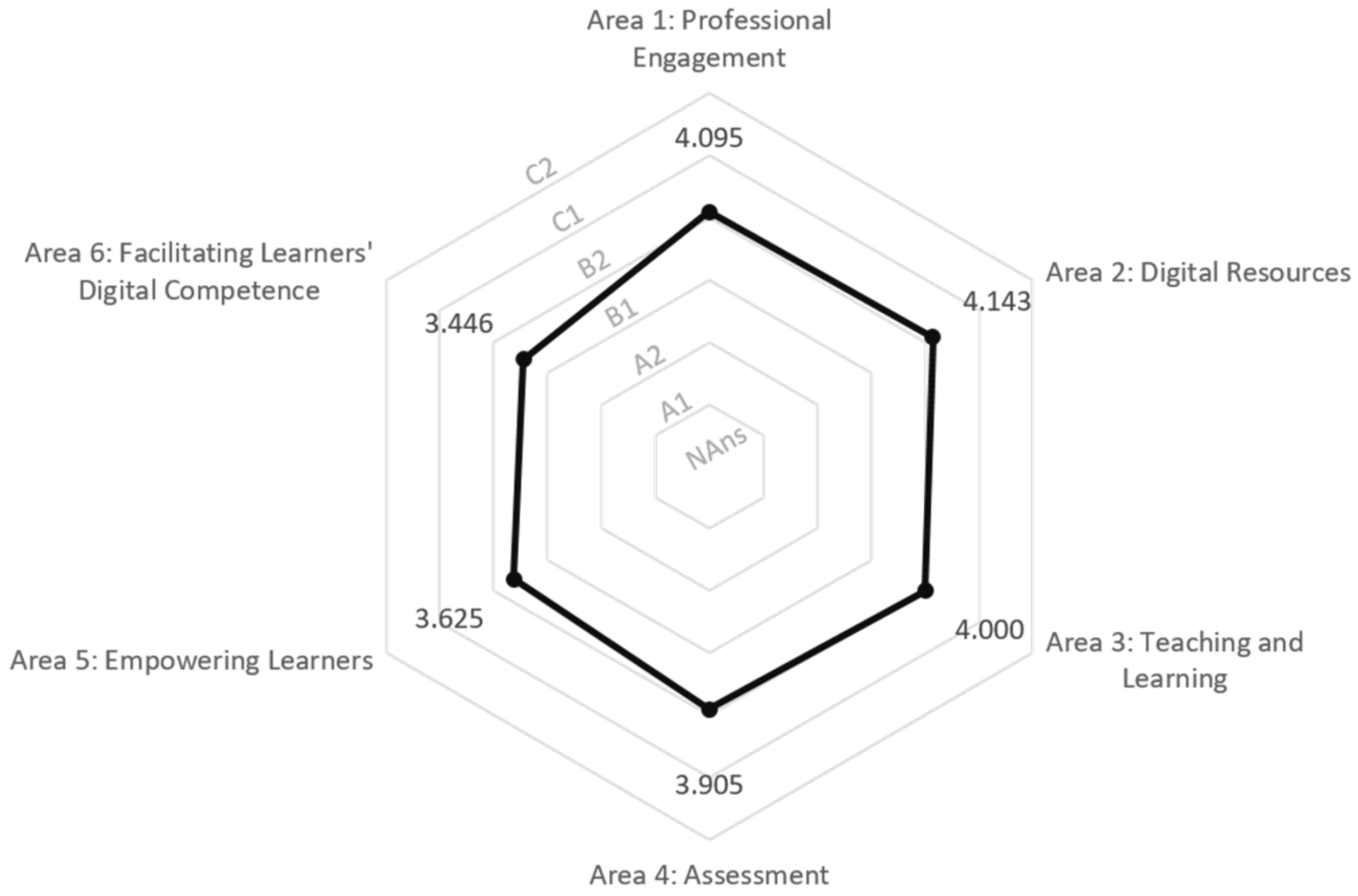
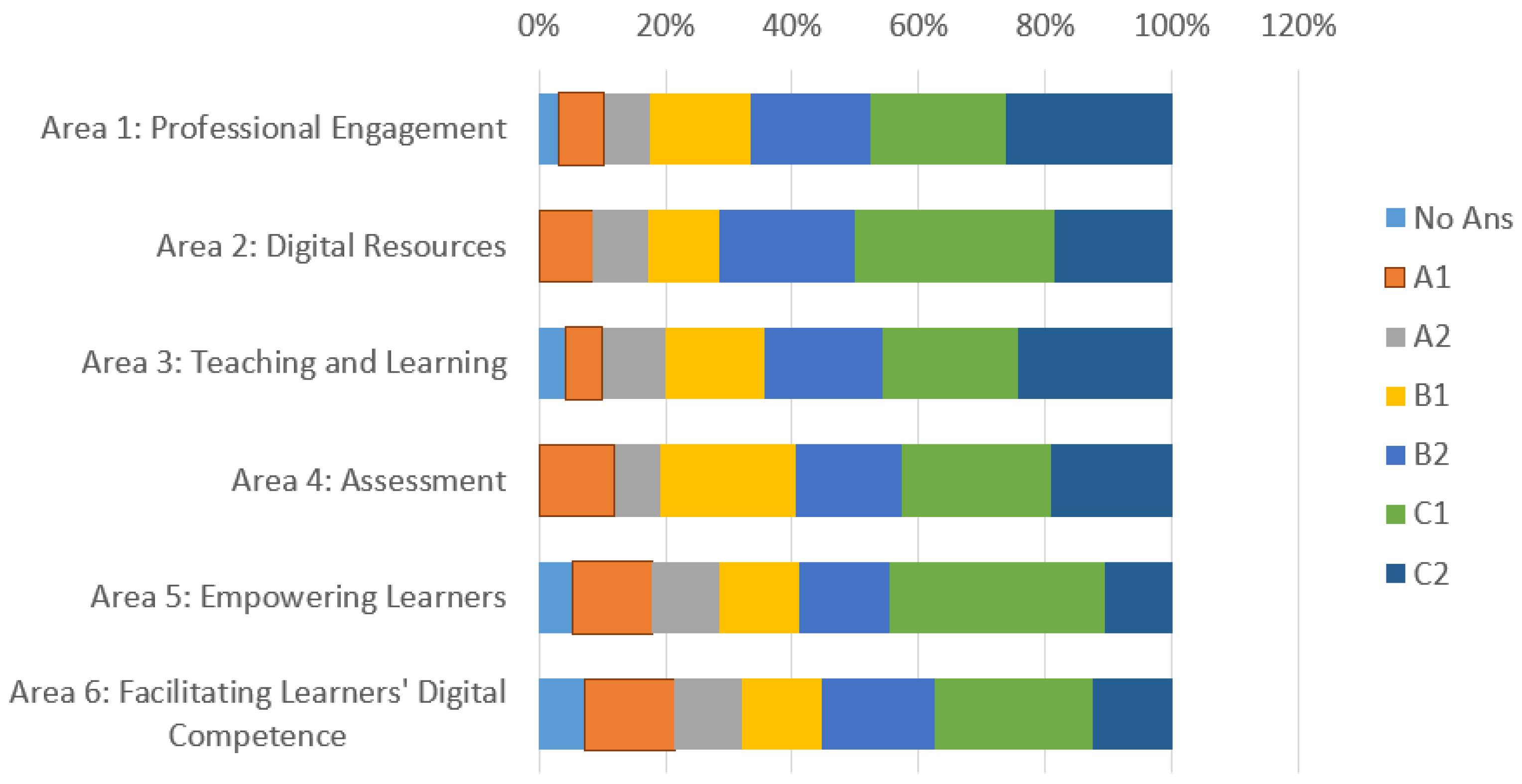
The results reveal a level of confidence around B2. Expert in almost all the competence areas. However, they are the most consistent in Areas 2. Digital Resources and 4. Assessment, while the greatest dispersion is observed in Area 6. Facilitating Learners’ Digital Competence. The weighted mean reveals that in the same area, the level of confidence in using digital technologies for educational purposes tends towards B1. Integrator. The participants’ self-assessment in Area 5. Empowering Learners ranges between levels B1 and B2 with relatively high dispersion (Figure 2 and Figure 3).
Figure 3 provides a deeper look at the distribution of the participants among levels in each area. It reveals that almost one-third of the participants feel leaders in Area 2 and Area 5, and they have the potential to support other academicians in the effective creation and modification of Digital Rresources, as well as in Empowering Learners. A similar situation is observed in Area 1 and Area 3, where approximately a quarter of participants feel like pioneers and could introduce innovative learning approaches and corresponding new digital technologies to the other staff through internal training. A look at the particular records shows that the highest professional levels are presented by the academic staff teaching in the field of ICT-related disciplines and partially in didactics (especially in didactics in informatics and ICT).

3.2.2. Deep Look at the Academy Staff Pedagogical Digital Competences

A deeper look at the particular competences in each area and the qualitative reflection on their own practices presented during the interviews provides a clearer picture of how the participants associate their own digital pedagogical practices with their awareness of their own proficiency level according to the DigCompEdu.
Area 1. Professional Engagement
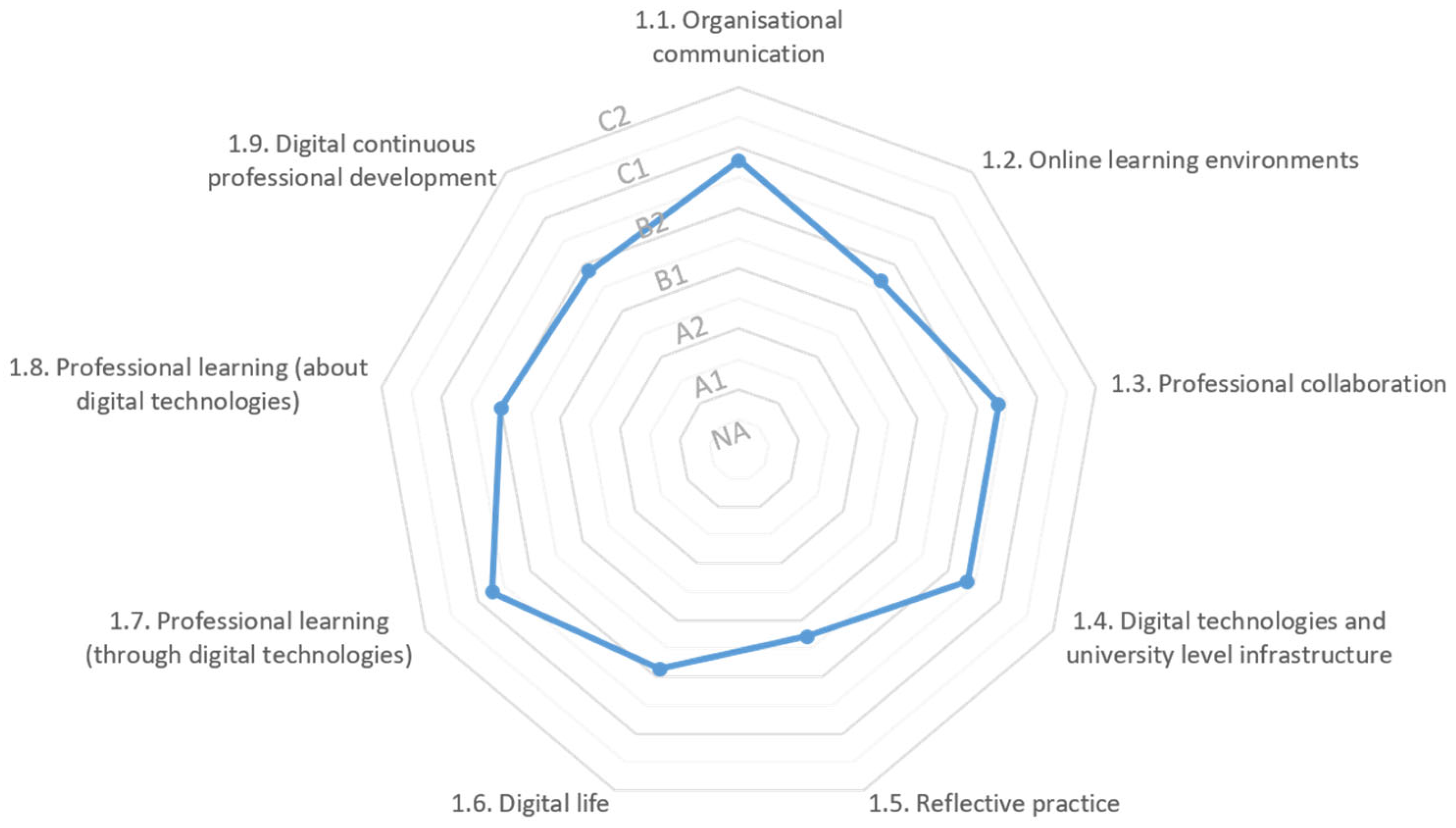
The study on educator-specific digital competences in Area 1 (Table 9) shows that the most consistent result is in competency 1.3. Professional Collaboration, while the highest level of dispersion is observed in competency 1.8. Professional learning (about digital technologies) and 1.9. Digital Continuous Professional Development (Table 9, Figure 4).
Despite the relatively high self-assessment in Area 1. Professional engagement, during the interviews, the teachers hardly commented on the individual competences from this group and how they manifest them in their practice. There were no comments on the competences 1.5. Reflective practice and 1.9. Computational thinking.
Implicitly, the level of competences 1.1. Organizational communication could be verified by the fact that the faculty has modern digital infrastructure and all the administrative communication is implemented in an electronic environment—the digital information system SUSI—with internal communication via institutional emails and the learning management system (LMS) Moodle, as well as local institutional certificates for signing documents and accessing the internal digital platforms.
With regard to 1.3. Professional cooperation, some teachers share that they participate in classes simultaneously and even collaborate in the field. In general, this is limited to participation in seminars and scientific forums, including in a digital environment, for example, in an online or hybrid format.
All the academicians teaching ICT-related courses demonstrate a high level of competences 1.7 and 1.8. Professional learning (through and about tech), consistent with their self-assessment score at levels C1–C2. For the other teachers, these competences do not seem to be necessary in the context of the subjects they teach.
Speaking about the competences to work in an online learning environment, the teachers comment on the need for flexibility to shift from one software to another in order to be able to support students: “I wanted to show an example with a tectonic processing program. It turned out that I have a much more powerful version than the students, and they cannot reproduce what I am showing them. For my part, I couldn’t quickly figure out how to solve the problem with their version of the software, and this took up a lot of teaching time and shifted the focus of the class.” (Senior assistant professor, ICT-based discipline, female).
The interviewees comment the competency 1.4. School technologies and infrastructure, mainly in terms of limitations. The computer labs are used for the specialized IT disciplines, while the others are conducted in the regular classroom, where, despite the good Wi-Fi connectivity to the Intranet and Internet, there are no electricity outlets for charging mobile devices. Similar is the experience with the interactive (smart) boards: “Although I teach a course related to the pedagogical functions of interactive whiteboards, I am unable to use one of the two classrooms equipped with such a device.” (Professor, ICT-based discipline, female).
According to 1.6. Digital life (ethics and safety), overall, the interviews reveal a positive attitude toward digitization. The main reasons are (1) the emergence of technology in everyday life and the transformation of digital skills into a requirement of the times (four people); (2) digital technologies are seen as a guarantee for high-quality and more effective learning (three people); (3) mastery of digital technologies is a criterion for competitiveness (three people): “Future teachers must be well prepared and familiar with modern technologies, able to apply them in their learning and teaching and to prepare their students so that they are ready to use these technologies in real life as an integral part of our lives.” (Associate professor, female).
On the other hand, there were also comments about technology overload (three people): “Another thing we are seeing is ‘digital fatigue’—a weariness with technology. We need to find the right balance and focus on meaning—where technology really adds value.” (Senior assist. prof., female).
Area 2. Digital Resources
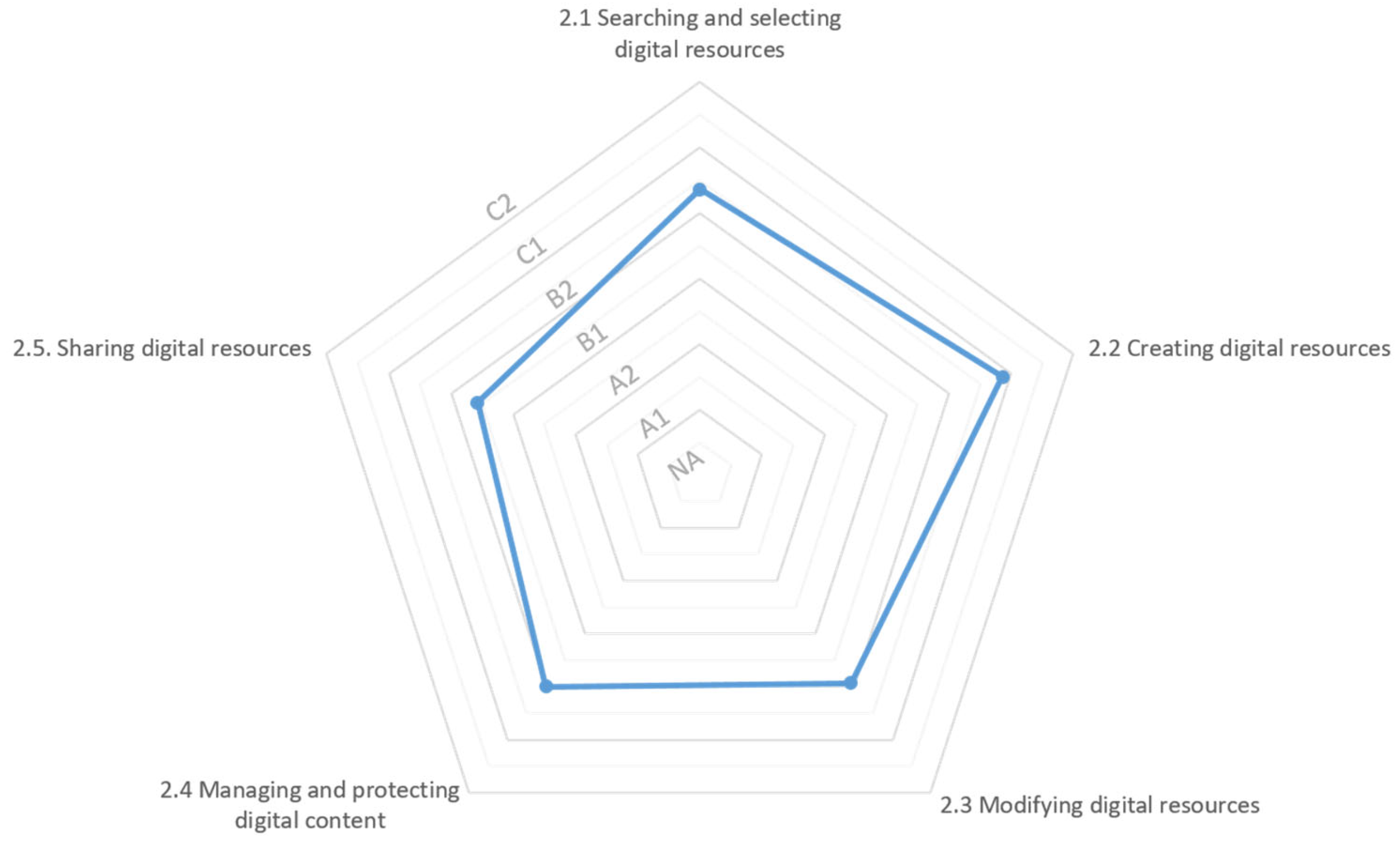
Table 10 and Figure 5 present the university teachers as leaders in creating digital resources for education in the field of mathematics, informatics and ICT. It seems they feel more confident in creating than in modifying digital resources. The weakest point is the sharing of digital resources (Table 10 and Figure 5).
The competences in the area are commented on in interviews from the aspect of forming these competences in future teachers. Lecturers provide examples of teaching methods—problem-solving, project-based learning, in which they integrate and assess competences for researching and selecting digital resources (2.1.). They express the expectation that students have already developed such competences, given that they are defined as outcomes of general education curricula at school. Ethics of use of digital resources is also focused on: “In addition to searching for and selecting digital resources, we also pay close attention to licensing rights.” (assist. prof., male).
All of the lecturers in ICT-based disciplines (multimedia, programming, digital creativity, etc.) put an emphasis on 2.2. Creating digital resources competence, as they require the creation of an authentic digital product:
  • “The course has a specific focus, and that is creativity. Therefore, naturally, the competences related to creating digital content are leading.” (Senior assist., male).
  • “In my courses, I focus 100% on practical application. You sit down in front of a computer, program software, or create a database.” (Assoc. prof., male).
Competences for Modifying digital resources (2.3.) go hand in hand with skills for the creation of digital content: “The course covers topics related to the development and design of various digital learning materials. I give students complete freedom to develop something entirely new or adapt an existing resource.” (Prof., male).
2.4. Management and protection competences are mentioned briefly and in a general way. The faculty expressed the opinion that students do not need to be developed in this direction.
From the other side, the competences for Sharing resources (2.5.) are discussed from different points of view as a part of professional and civic responsibility and they are included in different educational activities: “Sharing resources and interacting are practically mandatory components in at least one of the assignments they work on as a team, and this is actually an element that is included in their assessment.” (Prof., female).
Area 3: Teaching and Learning
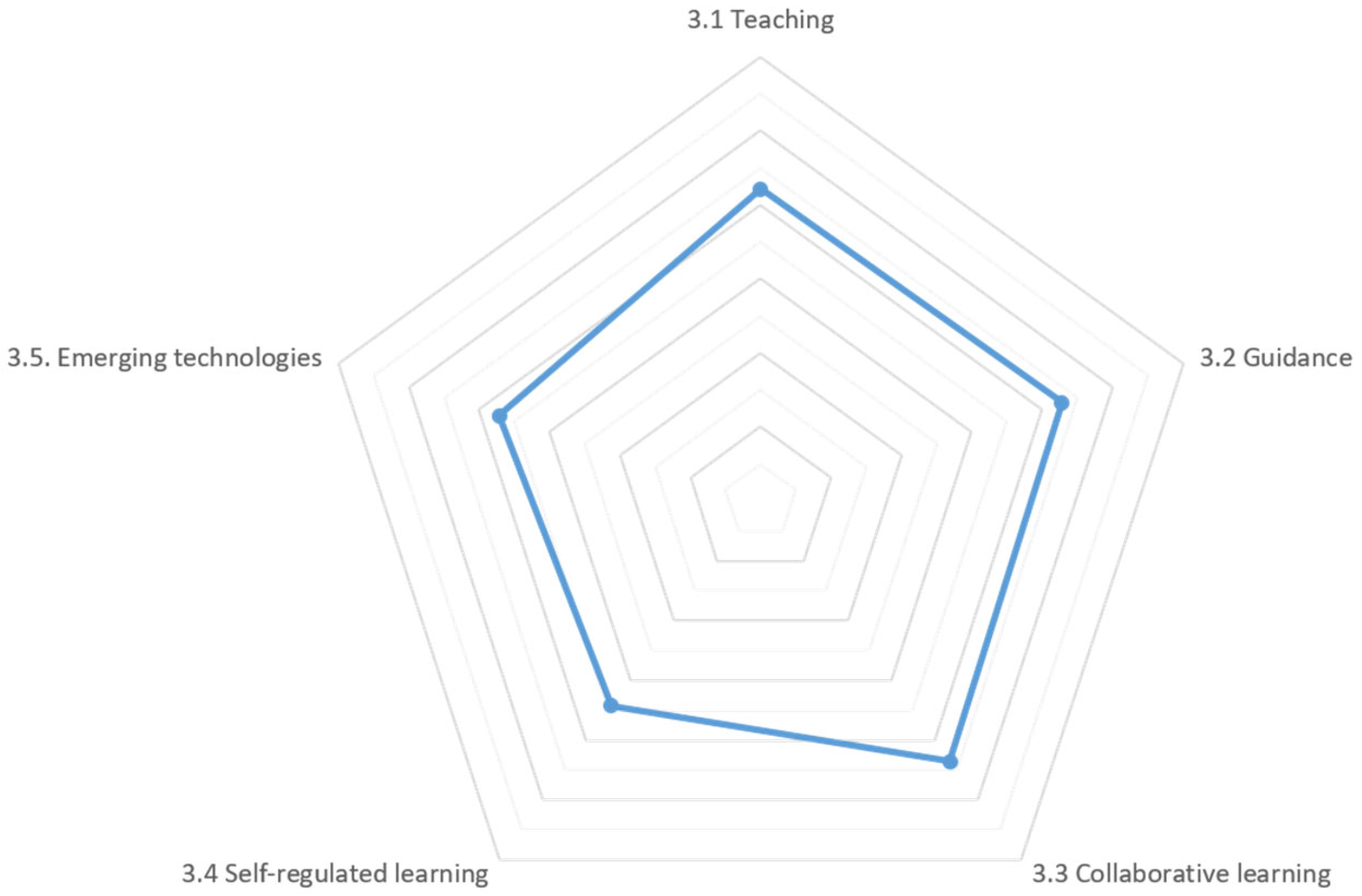
While the academic staff reflects as experts on most of the competences, it feels mostly at integrator level in relation to digitally supported self-regulated learning (Table 11 and Figure 6).
Speaking about 3.1. Teaching and lesson planning, the academic staff share experience mostly on how they develop these students’ competences, but they did not provide examples on how they develop their lesson by the help of digital technologies.
The digital guidance (3.2.) is presented mostly in demonstrations and formulating problems/assignments in a digital environment: “I demonstrate an example of programming code that is part of the lecture. A student asks,What would happen if …. Instead of answering him, I directly change the program code on the screen and we discuss together what is happening and why. Sometimes I even deliberately do ‘bugs’ to create a problem situation for them to think about.” (Prof., male).
3.3. Collaborative learning is quite prominent in the practices shared during the interview.
I constantly organize group work using Moodle tools. For example, I require students to publish their assignments in the Database object, where each group can then review the assignments of other groups and rate them.
(Assist. prof., male)
For example, at the beginning of a group project, students start with a group brainstorming session in a digital environment (e.g., Miro), and then at home they can review and further develop their ideas until they arrive at a clear formulation of the problem they will be working on.
(Assoc. prof, female)
During teaching practice, we require students to plan their lessons in pairs so that there is always feedback and continuity from one group to another.
(Assoc. prof, female)
The competence 3.4. Self-regulated learning had litter representation in the discussion The examples relate to constantly changing technologies and students’ ability to adapt to them in the future.
It is extremely important to consider when and why we use digital technologies. The task of analysing learners is very challenging because the technologies we have and use for teaching today are one set, but when our students enter the classroom as teachers, they will probably be different. Students who are future teachers must be prepared to flexibly master new teaching and learning tools and use them appropriately.
(Senior assistant, female)
Discussing competences to adopt Emerging technologies (3.5.), the topic of artificial intelligence (AI) is frequently commented on. Concerns and fears arise—on the one hand, there is an awareness that they must be involved in training, but on the other hand, they clearly realize that this will lead to radical changes in assessment and teaching practice. Some of the lecturers express their willingness to experiment with AI and other innovative technologies together with their students.
Our first encounter with good and not-so-good practices (in terms of AI) came as a result of cases that arose or were brought up by students. Whether it was to share something, or because they had used AI in preparing an assignment, or because they were interested and asked us to think, develop, and review something together. We talked about generative artificial intelligence and the hallucinations it creates, as well as about educational games that encourage students to be more critical towards the use of this type of technology.
(Assoc. prof., female)
Another problem is artificial intelligence. It is already in use, but at the same time there is no regulation at university level. Bans or restrictions cannot be enforced. Nor is there any way of knowing whether a student has used unregulated artificial intelligence or not. Therefore, in my opinion, we need to take a different approach, not a prohibitive one, but rather one that focuses on how it can be used in education.
(Prof., male)
Area 4: Assessment
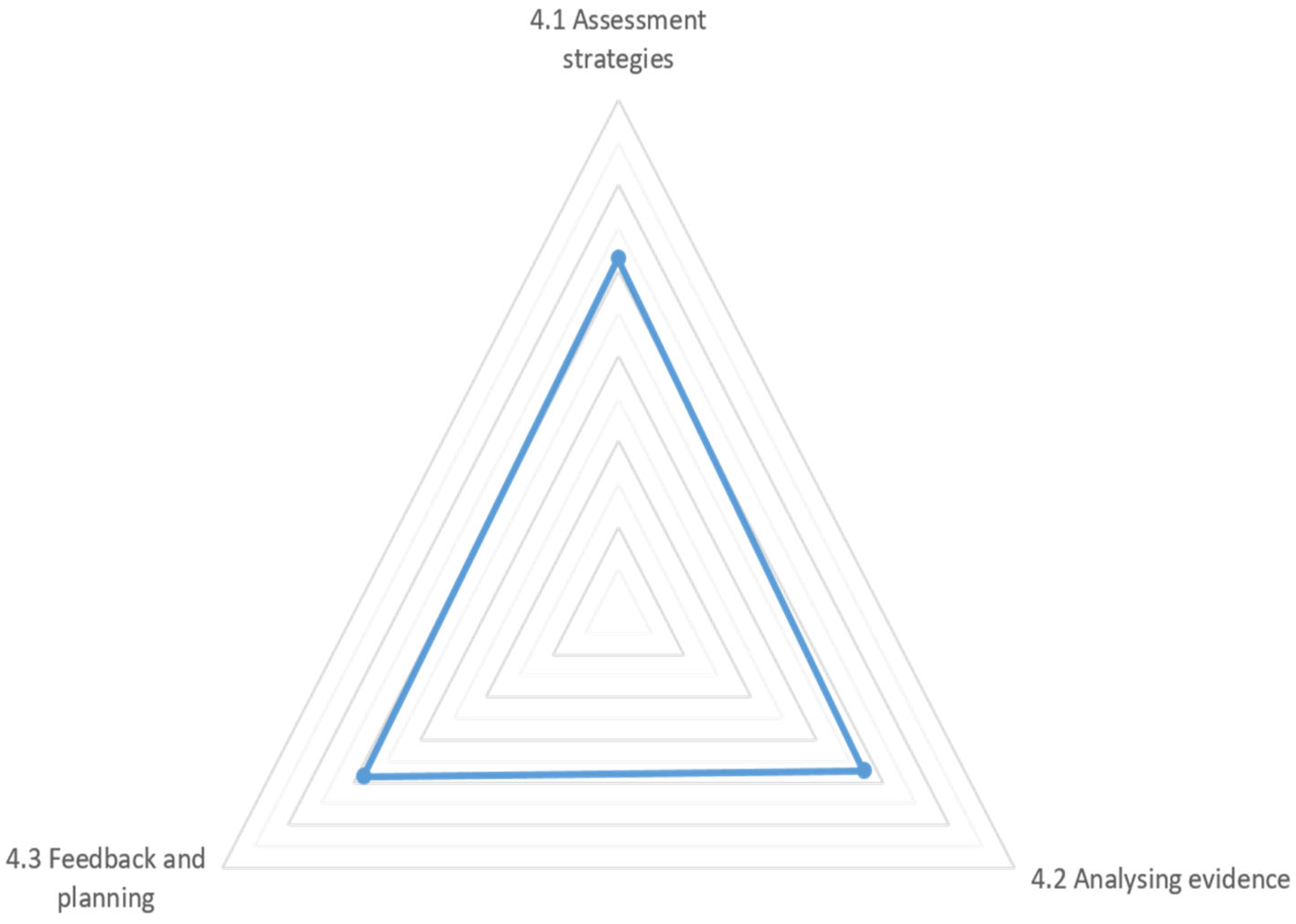
The academic staff assess themselves around (but a little bit under) level B2. Using LMS Moodle for many years, most of the lecturers are familiar with different digital assessment tools, but it seems this does not guarantee self-confidence in the area (Table 12 and Figure 7).
Competence 4.1 is demonstrated in the application of the following basic assessment strategies: (1) assessment through projects (three people) or didactical assignments (five people).
Most teachers also use digital quizzes, but only one relies mainly on them. One participant explicitly mentions that he assesses the technical skills of his students, while two others clearly state that the technical skills of students are not a subject of assessment.
I don’t assess their digital skills, but rather the results of their work. They decide for themselves how they will complete their tasks.
(Assoc. prof. female)
Three of them state that they use a criteria matrix for assessment: “We have an observation protocol, we have assessment criteria, and the assessment of pedagogical digital competence accompanies every component in practice. For example, we have a section for lesson planning, which includes components related to the design. Has the student analysed the classroom in terms of equipment, technology, and the selection of software to be used? The answers to these questions contribute to the assessment.” (Assoc. prof., female)
However, in six (6) of the interviews, unclear or hidden assessment criteria were observed, which is considered a prerequisite for educational inequalities (Peter et al., 2024):
My grading strategy is simple. I give five assignments, and each correctly completed assignment earns one point toward the grade, no further explanation necessary.
(Assoc. prof., male)
When assessing coursework, the way it is formatted also influences the grade, even though this is not part of the assessment criteria.
Most of the lecturers shared practices demonstrating their Analyzing evidence (4.2.) competence: “Tests and assignments are done in Moodle. Students receive feedback from me on them.” (Senior assistant, female).
Some teachers use imitation as a model when teaching students how to prepare digital exam materials: “For example, before a test, I tell my students that I have solved all the problems in the test in advance and have assessed how long it takes me and where the pitfalls are. This way, I set a model for them so that in the future, as teachers, they will first test the exam materials on themselves.” (Prof., male).
The competence 4.3. Feedback and planning are expressed through communication and feedback via personal messages and forums, as well as through the tools available in the e-learning environment.
We encourage students to send us drafts of their coursework and seek feedback from us before the final submission so that they can improve their work in advance.
(Senior assistant, male)
Area 5: Empowering Learners
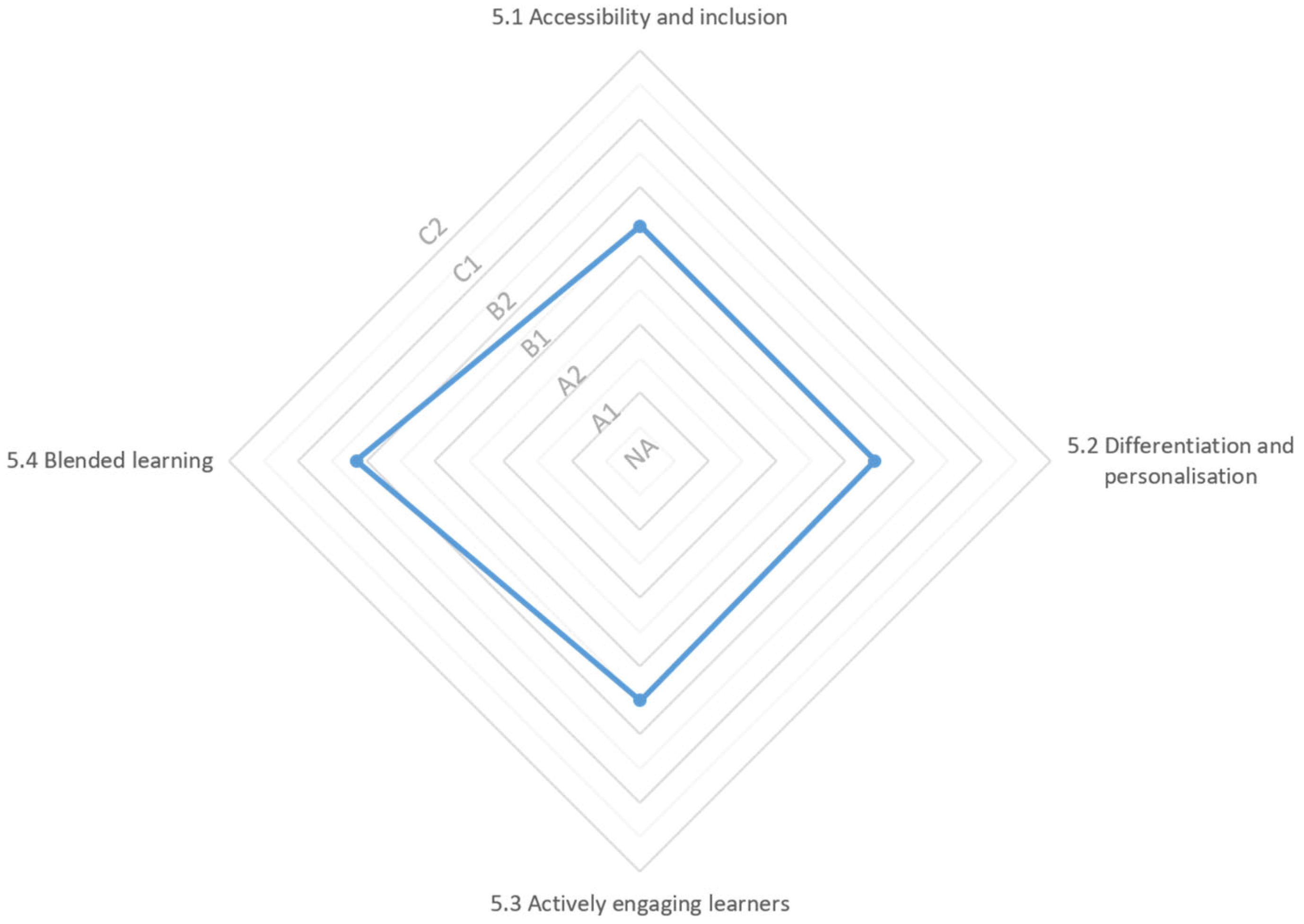
The teaching staff has expertise in blended learning as it is a traditional form in many courses at the faculty, but it still does not feel expert in other competences in the area. At the faculty, the traditional style of teaching, oriented to the mass student, still prevails, and this fact also reflects on the digital pedagogical competences of the academicians (Table 13 and Figure 8).
The competence 5.1. Accessibility and inclusion is discussed mostly as a subject of student development, but rarely in terms of the faculty practices. Only one lecturer talks about using students’ textbooks and learning resources in English: “In my classes, we compare the educational content in different educational systems, using textbooks published in other countries. Even with those in English, students find it difficult because they are not familiar with the terminology in that language, despite being fluent in it at a conversational level.
With regard to accessibility and inclusive education, we are very keen to discuss this issue with our students, and we also discuss it in relation to the technologies that should or should not be used, so as not to make the content inaccessible when working with students.
The competences 5.2. Differentiation and personalization are commented on by five participants. It is noted that adjustments are being made to the educational process and additional support is being provided through consultations, including in a digital environment, in accordance with the level of the group.
Approximately a third of the participants shared digitally supported practices that actively engage students—working in teams on projects, brainstorming sessions, collaborative content creation, digitally conducted workshops and peer reviews. At the same time, they expressed concerns that it is difficult to overcome students’ tendency to reproduce passive learning styles.
The ASSURE model we use places special emphasis on actively engaging students. We value this highly. We are advocates of a more active style of working with learners. Sometimes it is difficult to change the mindset of the students we work with because, until now, most of them have observed and participated in a less active style of work directed by their teachers and, accordingly, tend to apply this passive style to their students.
Competence 5.4. Blended learning for implementing blended learning were discussed throughout the interviews in the context of various other issues, as this form of learning is typical and traditional for the university. Teachers feel so comfortable with it that they do not even consider it to require special competences.
Area 6. Facilitating Learners’ Digital Competence
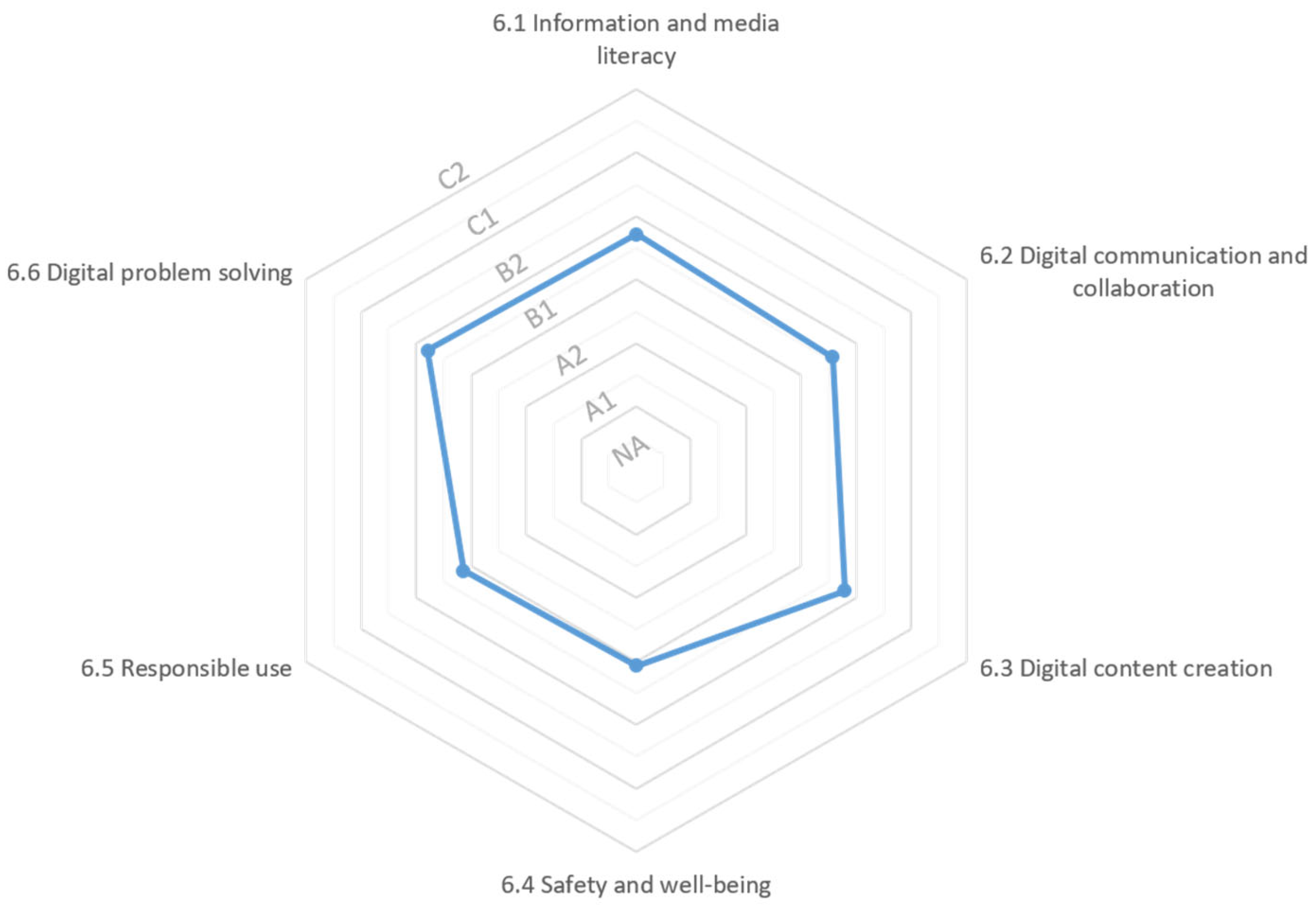
Acting as leaders in creating digital resources (Area 10), the faculty professors feel experts in facilitating students’ competences in digital content creation. They are also perceived as experts in relation to Digital problem-solving and Information and media literacy (Table 14 and Figure 9). However, they describe themselves as integrators in supporting the development of students’ competences for responsible use of digital technologies and resources, as well as digital safety and wellbeing competences.
According to facilitating students’ digital competences (6.1. and 6.2.), they share the following: “We try to focus on seeking high levels of competence of our students and to include as many cases and examples as possible, to require them to complete specific tasks that will develop such competence. We look at issues related to the reliability of sources and their accuracy, and how to extract data. We also have similar topics and components related to communication and collaboration. In some of the topics and projects we give in the course, we also assess this component.” (Prof., female).
Discussing forming competence 6.2. Communication and collaboration, a common issue in all interviews, is the lack of teamwork skills among students; sometimes this is even seen as a deliberate unwillingness on their part. Respondents, in turn, try to compensate for this usually through group activities or projects, but there are also those who directly refuse to assign such tasks in order to avoid unpleasant situations.
Even in secondary education, there is a significant gap—pupils do not work together or in groups, nor do they work on projects with interdisciplinary connections. The holistic approach is not well integrated—studying a problem in depth from the perspective of, say, mathematics, chemistry, and physics. It is as if each subject stands alone. As a step towards overcoming this problem, we require students to think across subjects and encourage them to create more complex experiences for their pupils. That is why in my course I ask them to develop ideas for Escape Room-type games, as well as various scenarios that can be used for active holistic learning.
(Senior assistant, female)
They work on their final project in pairs. This is intentional. On the one hand, it is to distribute the workload of the entire project, and on the other hand, it is to develop teamwork and cooperation skills. Cooperation within and between groups takes place in Moodle LMS.
(Assistant, male)
The strong, conscious, and professional support provided to students with regard to 6.3. Digital content creation is clearly evident in almost every interview.
We expect students to create educational content. In this sense, we try to support their thinking as teachers, i.e., not to create things just for the sake of form or specific technology, but to do so in a well-thought-out manner from an educational perspective.
(Senior assist., male)
Each of the topics in the course involves creating original content or using and integrating third-party digital content. That is why I pay attention to the types of copyright, popular and less popular free licenses, ways of citing and referencing. In general, these types of things are the focus of the course and a lot of attention is paid to them.
(Senior assist., male)
In general, the topic of compliance with license agreements and building skills to protect one’s own digital products through appropriate licenses was present in most of the interviews.
Five of the interviews seriously addressed the issue of plagiarism and the improper use of Internet resources by students in connection with the creation of resources. The professors comment on the measures they take against unethical behavior.
As a preventive measure, I show them that our electronic system (Moodle) keeps all logs, saves everything, and it is visible. The journals could be either group or individual, as well as by time and by activity.
(Assist. prof., male)
Some challenges are also discussed:
Somehow, content is generated with the expectation that it is factually accurate. In this sense, we have pointed out that this is not a good approach and that such things should be verified as information. On the other hand, we encourage the use of artificial intelligence from the perspective of digital creativity, for example, to generate ideas for approaches in different situations. Therefore, it is important to discuss when it is appropriate and when it is not appropriate to use AI.
(Senior assist. prof., male)
We also discuss digital inequality. Multimedia solutions and technologies can enable different types of access to content, such as including content in text and audio formats. Possibility to create subtitles.
(Senior assist. prof., male)
With regard to 6.4. Safety and well-being, lecturers pay particular attention to personal privacy and data protection.
I always explain how artificial intelligence works, why, and what documents exist. I try to present to them different tools and show them the pros and cons.
(Senior assist., female)
My course includes a topic focused on how technology can support and facilitate the work of teachers and students with special needs.
(Prof., female)
RegardingDigital Identity Management—what can be noticed about students is the competent use of all systems and platforms that require authentication and competent management of personal data.
Facilitating 6.5. Responsible use of digital technologies is the focus of teachers’ education at the Faculty of Mathematics and Informatics.
In all cases, critical use of information and responsible work with data is the focus. It is a mandatory requirement that they (the students) as teachers should be able to present reliable, relevant, up-to-date information, to check their sources, to refrain from making inaccurate statements, and to cultivate a similar attitude, including with regard to ethics.
(Assoc. prof, female)
With regard to 6.6. Problem-solving, the interviews reveal a rather instrumental, practically oriented view; it is associated with solving specific problems rather than analyzing the situation and identifying the problem.
In the context of digital competences, even gathering information is a form of problem solving. The first problem is how to find it or how to collect data. Another important thing is to be able to sift through the information, understand what part of it will be useful to us and what part is just filler…

3.3. Operational Curriculum (Observed Practice)

The empirical study conducted at the Faculty of Mathematics and Informatics, Sofia University, examines the integration of digital tools, methods, and strategies in the professional development of preservice teachers. The analysis, grounded in the DigCompEdu framework, evaluates the alignment of observed practices with the framework’s six areas of educator digital competence: Professional engagement, Digital Resources, Teaching and learning, Assessment, Empowering Learners, and Facilitating learners’ digital competence.

3.3.1. Professional Engagement

Teacher educators at FMI emphasize ethical use of digital resources, consistently demonstrating checking rights and licenses of online materials, and always referencing sources correctly in both teaching and student assignments. For example, during inquiry tasks in the “Information and Communication Technologies in Education and Work in Digital Environment” (ICTEWDE) course, students must track a resource to its original source, assess reliability, and provide correct referencing. Teachers also anonymize student results during digital feedback in Moodle, promoting privacy, as seen in “Creating Interactive Educational Computer Content” (CIECC) and “Ongoing Guided Pedagogical Practice in Informatics and IT” (OGPPIIT) courses. Attitudinally, faculty show both enthusiasm and healthy skepticism—such as critically discussing the benefits and risks of new technologies, and using only those that add value to the learning process—rather than indiscriminately adopting innovations.

3.3.2. Digital Resources

Educators regularly use and adapt digital resources, like math software, mind maps, shared environments (e.g., forums and voting tools), and create custom digital learning materials, sometimes from scratch. For example, in didactics-oriented courses, teachers guide their students through critical group evaluation and adaptation of found online resources to specific learning goals. In the CIECC course, a lecturer uses a self-developed graphical digital library (Suica) to create math content. Moodle is widely implemented for organizing digital resources and collecting student work in various formats, ensuring efficient resource management and access.

3.3.3. Teaching and Learning

In “School Course of Information Technologies” (SCIT), “Computer Heuristics” (CH), and “Inclusive Education for Children and Students with Special Educational Needs” (IECSSEN) courses, educators support learning through algorithmic demonstrations using ICT tools for solving similar tasks, such as using database management systems to teach data analysis and problem-solving. The ICTEWDE course features differentiated digital content for students specializing in mathematics, informatics, or both, and provides separate content and support for students with special educational needs, like adapting tools for accessibility. In OGPPIIT, students engage in field practice using blended e-learning methodologies and digital lesson planning, bridging theory and classroom practice. Mind maps, inquiry-based activities with dynamic geometry software, and project-based learning with platforms like Trello and Padlet further demonstrate digital integration.

3.3.4. Assessment

In CIECC and ICTEWDE, teachers employ digital learning analytics—such as quiz results and progress tracking—for student feedback and instruction adjustment. During OGPPIIT field practice, trainees use spreadsheet tools to process and analyze statistical information on school students’ test results, facilitating data-driven self and peer assessment. Moodle’s digital submission and peer review features are leveraged to give feedback through rubrics and anonymized assessments. While ongoing formative assessment with digital tools is not consistently observed, digital methods are central to tracking and evaluating learner performance by both teachers and pre-service teachers.

3.3.5. Empowering Learners

Empowerment is realized through tailored digital support in courses like ICTEWDE and IECSSEN, where digital content is differentiated for diverse students, with substantial focus on students with special educational needs. For example, the IECSSEN course demonstrates adapting digital tools for enhanced accessibility and includes guidelines for respectful access to resources for SEN students. In the CH course, the same mathematical problem is explored with and without ICT tools to respect different learning styles and prior knowledge, followed by classroom discussions about personalization. These adaptations foster equitable and accessible digital learning experiences.

3.3.6. Facilitating Learners’ Digital Competence

FMI educators actively foster digital competence by engaging learners in practical tasks using programming platforms, database systems, and collaborative tools. In SCIT and CH, students evaluate and select digital tools, carry out empirical investigations using geometry software (e.g., constructing and analyzing flood forecasting models), and participate in creative activities such as American Standard Code for Information Interchange (ASCII) art coding with programming environments. Group work is digitally supported in ICTEWDE and “Digital Competence and Digital Creativity” (DCDC), through platforms like Padlet and Trello, familiarizing preservice teachers with collaborative digital practices they can apply in schools. Across courses, future teachers are trained to model and teach responsible, creative, and critical use of digital technologies in real educational and societal contexts. Table 15 assesses the degree of alignment with the DigCompEdu framework.

4. Discussion and Implications

The findings illustrate a robust integration of digital resources and teaching strategies, consistent with the DigCompEdu framework’s core areas. However, the study identifies gaps in the adoption of innovative technologies and the systematic use of digital tools for ongoing assessment and collaborative learning. Addressing these gaps could enhance alignment with the framework’s comprehensive goals, ensuring that educators are not only proficient in using digital tools but also capable of fostering critical, ethical, and innovative digital practices among their students.
This analysis contributes to the ongoing discourse on digital competence in teacher education, offering actionable insights for curriculum development and professional training. By focusing on the areas where alignment with the DigCompEdu framework is less pronounced, teacher education programs can better prepare educators to meet the demands of a rapidly evolving digital landscape. Future research should explore strategies for deepening engagement with emerging technologies and ethical considerations, thereby advancing the digital competence of both educators and learners.

4.1. Conclusions and Discussion

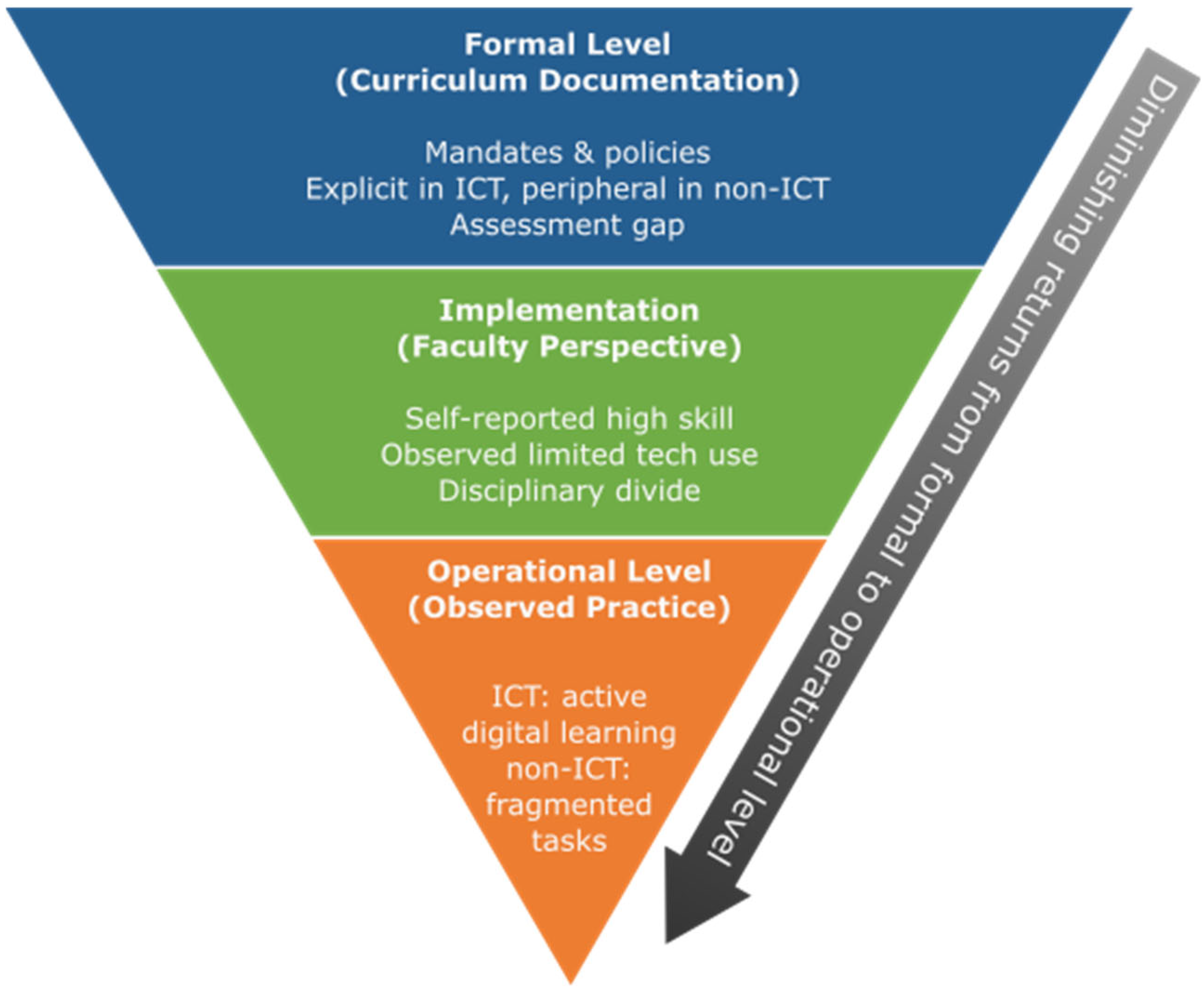
In regard to RQ1, Whatare the situation and change processes in teaching and acquisition of (1) general digital competences and (2) pedagogical digital competences at the Faculty of Mathematics and Informatics, Sofia University St. Kliment Ohridski, Bulgaria?, the empirical analysis of curriculum documentation, faculty perspectives, and observed classroom practices reveals a pyramid of diminishing returns (Figure 10)—where the formal intentions of digital competence development (as outlined in national policies and institutional curricula) are only partially realized in perceived and operational contexts. This misalignment can be examined through three key lenses:

4.1.1. Formal Level (Curriculum Documentation)

Bulgaria’s Council of Ministers Decree No. 289 (Council of Ministers of the Republic of Bulgaria, 2016) and the National Program “Digital Bulgaria 2025” (Ministry of Transport and Communications, 2019) mandate digital competence development for all pre-service teachers, yet implementation varies significantly between ICT and non-ICT educators. ICT teachers, whose training includes technology-enhanced pedagogy, integrate digital skills more effectively into instruction and assessment. In contrast, non-ICT educators often view these competences as less relevant to their disciplines and face structural barriers, including a lack of discipline-specific guidelines and resources.
Empirical data reveal stark differences:
  • In total, 65 ICT courses explicitly include digital competences, compared to 18 non-ICT courses (a 3.6:1 ratio);
  • Digital skills are five times more likely to affect final grades in ICT programs;
  • While opportunities for digital skill demonstration exist in both fields, non-ICT educators lack structured support, leading to inconsistent learning experiences.
Key findings indicate misalignments between formal policy (e.g., Ordinance No. 15 (Council of Ministers of the Republic of Bulgaria, 2019)) and practical application. ICT programs show higher integration of digital competences, though often as supplementary rather than core components. Non-ICT courses exhibit weaker formal inclusion, with digital skills treated as optional rather than essential. This variability undermines equitable teacher training, as some students gain robust digital preparation, while others receive minimal exposure.
The study highlights a systemic gap between policy mandates and classroom reality, emphasizing the need for the following:
1.
Standardized digital competence frameworks across disciplines.
2.
Targeted support for non-ICT educators.
3.
Stronger institutional accountability to ensure uniform implementation.
These insights underscore the necessity for structured, evidence-based reforms to align national policies with pedagogical practice, ensuring all future teachers develop essential digital competences.

4.1.2. Perceived Level (Faculty Perspectives)

The self-assessment of faculty digital teaching competences, conducted via an adapted version of the SELFIE for TEACHERS tool aligned with the DigCompEdu framework, reveals a generalized proficiency at the B2 (Expert) level across most competence domains. This suggests that academic staff are not only proficient in utilizing digital technologies but also capable of critically analyzing and creatively applying them to enhance pedagogical practices, particularly in digital resource development (Area 2) and assessment strategies (Area 4). However, a notable disparity emerges in Area 6 (Facilitating Learners’ Digital Competence), where the weighted mean approaches B1 (Integrator) level, signaling a need for further advancement in fostering higher-order digital skills—such as problem-solving, digital safety, and responsible tool use—among students.
The key findings indicate the following. Technical Proficiency, but Lack of Innovation—faculty demonstrate strong digital skills (B2 level) but rarely achieve innovative teaching (C1/C2) due to institutional barriers and limited professional development. Neglected Core Competencesreflective practice (1.5) and computational thinking (1.9) remain underdeveloped, despite being critical for adaptive learning and STEM education. Strengths in Collaboration and Resource Creation—high performance in collaborative digital practices and digital resource development, particularly through project-based learning and authentic assessments.
Gaps in Inclusivity and Self-Regulation—low scores in inclusivity (5.1), accessibility (5.2), and self-regulated learning (3.4) reflect insufficient training for diverse learners. Focus on Ethics and Digital Citizenship—faculty prioritize ethical technology use, copyright awareness, and responsible online behavior, aligning with international standards. These findings underscore the need for the following:
  • Targeted professional development to bridge gaps in reflective practice, computational thinking, and inclusive digital pedagogies;
  • Institutional policies that encourage innovative technology adoption beyond conventional tools;
  • Interdisciplinary collaboration to ensure equitable digital competence development across all academic fields.
This study contributes to the global discourse on digital pedagogy in higher education, highlighting the misalignment between self-perceived and observed competences and advocating for structured, evidence-based interventions to enhance teaching innovation and digital equity. Future research should explore the longitudinal impacts of professional development programs on faculty digital proficiency and student learning outcomes.

4.1.3. Operational Level (Observed Practice)

A marked contrast exists in how digital competences are cultivated across academic disciplines. Students in ICT-related programs actively participate in project-based, collaborative, and problem-solving tasks that foster critical thinking and applied skills, whereas their peers in non-ICT disciplines often encounter fragmented, tool-centric activities with minimal connection to pedagogical innovation. This disparity undermines the development of transferable digital literacy skills and limits the broader educational impact of technology integration. Despite relatively high adaptability to e-learning platforms—with only 13% of students reporting technical difficulties—qualitative feedback reveals persistent challenges, including systemic technical issues, substandard resource quality, and insufficient interactivity. These shortcomings hinder engagement and meaningful learning, particularly in non-ICT contexts where digital tools are frequently employed in isolated, procedural ways rather than as catalysts for deeper cognitive development. Furthermore, assessment practices remain overwhelmingly summative rather than formative, with digital analytics—a powerful tool for personalized, data-driven feedback—being significantly underutilized. This approach fails to leverage technology’s potential to monitor progress, identify learning gaps, and adapt instruction in real time, thereby limiting opportunities for continuous improvement and self-regulated learning.

4.1.4. Triangulation of Perspectives: Documentation, Faculty Perspective, and Experience

The triangulation of data from curriculum documents, faculty interviews, and classroom observations exposes three critical disconnections directly related to RQ2 (Table 16):
Documentation vs. Faculty Realities
Curriculum documents emphasize digital literacy and ICT integration, but faculty interpretations vary based on disciplinary culture and personal digital proficiency.
Example: While dynamic geometry software is used in math education, non-ICT disciplines often lack discipline-specific digital tools, leading to generic, decontextualized training.
Faculty Intentions vs. Student Experiences
  • Faculty may demonstrate digital tools (e.g., Moodle and Miro) but fail to scaffold student engagement in meaningful, subject-relevant ways.
Example: A programming lecturer uses live coding errors to teach problem-solving, while a math educator relies on pre-made slides with minimal interaction.
  • Assessment criteria are often unclear or hidden, creating educational inequalities (e.g., grading based on formatting rather than digital skill application).
Systemic Barriers to Alignment
Institutional Constraints:
  • Limited access to advanced technologies (e.g., AI and VR) and outdated infrastructure (e.g., lack of smartboards in non-ICT classrooms);
  • No unified strategy for digital competence assessment, leading to inconsistent student outcomes.
Cultural Resistance:
  • Some faculty view digital competences as “add-ons” rather than core pedagogical skills;
  • “Digital fatigue” (post-COVID-19) leads to reversion to traditional methods in some cases.

4.1.5. Integrating Digital Competences in Higher Education: Achievements and Challenges

The integration of digital competences in higher education has yielded notable successes, particularly in ICT disciplines, where innovative practices demonstrate the potential for broader adoption. These practices provide insights about possible solutions in the processes of the curriculum design, development, delivery, and acquisition of general and pedagogical digital competences (RQ2). Project-based learning, such as escape-room games designed to foster cross-disciplinary thinking, engages students in active problem-solving while reinforcing technical and collaborative skills. Peer collaboration is further enhanced through Moodle-based group reviews and digital brainstorming sessions, which promote critical discussion and knowledge co-creation. Additionally, authentic assessments—such as student-created digital content with real-world applications—bridge the gap between theory and practice, preparing learners for professional environments where digital literacy is essential.
Faculty-led innovations have also introduced interactive and adaptive teaching methods. For example, the use of wireless keyboards for live demonstrations enhances student participation, while integrated discussions on AI in ethics and problem-solving modules equip future educators with the skills to navigate emerging technological challenges. These approaches not only deepen technical proficiency but also cultivate higher-order thinking and ethical awareness, key competences in a rapidly evolving digital landscape.
Despite these advancements, critical gaps remain in the development of holistic digital pedagogies. Reflective practice (1.5) is often overlooked, with faculty rarely articulating how they adapt digital strategies based on student feedback, a process vital for continuous improvement. Computational thinking (1.9), foundational for logical problem-solving and STEM education, is seldom taught outside ICT courses, limiting its reach across disciplines. Inclusivity (5.1, 5.2) presents another significant challenge, as few adaptations exist for students with disabilities or diverse learning needs, risking inequitable access to digital learning opportunities. Furthermore, self-regulated learning (3.4) receives insufficient attention, leaving students without structured guidance on independent digital skill development—a competency increasingly demanded in modern workplaces. Emerging challenges further complicate the landscape. While faculty acknowledge the importance of AI in education, the absence of institutional guidelines on ethical use and assessment creates uncertainty in its pedagogical application. Similarly, cybersecurity and data literacy, though critical in an era of digital vulnerability, are minimally addressed in non-ICT disciplines, leaving gaps in students’ ability to navigate online risks responsibly. To build on existing successes and address these deficiencies, institutions must prioritize scalable models of best practice while investing in targeted professional development. This includes expanding project-based and collaborative learning beyond ICT disciplines, integrating computational thinking into non-technical curricula, and developing clear policies for AI ethics and data security. By systematically addressing these areas, higher education can ensure that all students—regardless of discipline—develop the comprehensive digital competences needed to thrive in a technology-driven world. Table 17 presents structural recommendations across Macro, Meso, and Micro levels, outlining identified issues and corresponding solutions for enhancing digital competence integration.

4.1.6. Transforming Digital Learning: Pathways for Development

This study reveals that digital competence development in teacher education remains a work in progress—advancing in some areas while stagnating in others. While innovative practices in ICT disciplines demonstrate the potential for broader adoption, the triangulated findings emphasize the urgent need for a paradigm shift that moves beyond technical training to critical, ethical, and innovative applications of technology in teaching. To achieve this, three key priorities emerge: (1) Policy–Practice Alignment, ensuring that regulatory requirements translate into equitable, discipline-relevant training; (2) Faculty Empowerment, through targeted professional development to address gaps in reflective practice, inclusivity, and emerging technologies like AI and cybersecurity; and (3) Student-Centered Design, shifting from tool-based instruction to pedagogically rich digital learning that fosters deeper engagement and competence progression. The current pyramid of implementation—where ideal intentions often narrow into fragmented realities—can only be reversed through systemic collaboration among policymakers, institutions, and educators. Effective strategies include interdisciplinary co-design of courses (e.g., math educators using Python for data visualization or IT lecturers discussing algorithmic bias), continuous professional development (e.g., workshops on AI ethics and peer mentoring), and student-centered approaches (e.g., flipped classrooms and digital portfolios). By scaling successful ICT practices, dismantling structural barriers, and cultivating a culture of innovation, higher education can prepare teachers who are not merely digitally literate but digitally transformative, equipped to navigate, critique, and redefine the future of education in a technology-driven world.

4.1.7. Limitations and Future Research

While this study provides valuable insights into digital competence development in teacher education, several data constraints and methodological challenges must be acknowledged. The small sample size (14 faculty members across 25+ courses) restricts the generalizability of findings, particularly in diverse institutional contexts. Additionally, the absence of direct student assessments—relying instead on faculty observations and self-reports—introduces potential bias, as perceptions of competence may not fully align with actual student outcomes.
From a methodological perspective, Goodlad’s curriculum model, while useful for framing curriculum alignment, may oversimplify the non-linear, dynamic nature of digital learning, where competences develop iteratively through practice rather than linear progression. Similarly, Tondeur’s SQD 2.0 framework, though robust for measuring ICT integration, offers limited sensitivity to disciplinary nuances, potentially overlooking how digital competences manifest differently across subjects like mathematics, humanities, or natural sciences.
To advance this research, future studies should prioritize:
1.
Longitudinal designs to track student digital competence development post-graduation, assessing how pre-service training translates into professional practice.
2.
Comparative research across European universities to identify transferable best practices and contextual factors influencing digital pedagogy.
3.
Experimental interventions, such as AI training modules or VR-based simulations, to empirically test the effectiveness of innovative pedagogies in fostering higher-order digital skills.
By addressing these gaps, future research can refine theoretical models, validate practical strategies, and ultimately contribute to evidence-based policies that prepare educators for the demands of a rapidly evolving digital landscape.

Author Contributions

Conceptualization, N.N., B.K., P.M., T.Z.-M. and M.P.; methodology, N.N., B.K., P.M., T.Z.-M. and M.P.; validation, N.N., B.K., P.M., T.Z.-M. and M.P.; formal analysis, N.N., B.K., P.M., T.Z.-M. and M.P.; investigation, N.N., B.K., P.M., T.Z.-M. and M.P.; resources, N.N., B.K., P.M., T.Z.-M. and M.P.; data curation, N.N., B.K., P.M., T.Z.-M. and M.P.; writing—original draft preparation, N.N., B.K., P.M. and T.Z.-M.; writing—review and editing, N.N., B.K. and T.Z.-M.; visualisation, N.N. and T.Z.-M.; supervision, N.N., B.K., P.M., T.Z.-M. and M.P.; project administration, N.N., B.K., P.M., T.Z.-M. and M.P.; funding acquisition, N.N., B.K., P.M., T.Z.-M. and M.P. All authors have read and agreed to the published version of the manuscript.

Funding

This research was funded by the European Union-NextGenerationEU, through the National Recovery and Resilience Plan of the Republic of Bulgaria grant number BG-RRP-2.004-0008. The APC was funded by the European Union-NextGenerationEU, through the National Recovery and Resili-ence Plan of the Republic of Bulgaria, project No. BG-RRP-2.004-0008.

Institutional Review Board Statement

The study was conducted in accordance with the Declaration of Helsinki, and approved by the Ethics Committee of Sofia University St. Kliment Ohridski (protocol code No. 93-P-289/19 December 2023).

Informed Consent Statement

Written informed consent was obtained from all subjects involved in the study.

Data Availability Statement

The data presented in this study are available on request from the corresponding author.

Acknowledgments

The authors gratefully acknowledge the overall support (financial, methodological, and expert) provided by the team of the Recovery and Resilience Plan of the Republic of Bulgaria under project No. BG-RRP-2.004-0008, which aims to foster innovation and digital transformation in education. The authors thanks personally to prof. Roumiana Peytcheva-Forsyth for leading and supervising all the sub-projects under the direction “DigitalEdu-SU”.

Conflicts of Interest

The authors declare no conflict of interest.

Abbreviations

The following abbreviations are used in this manuscript:
AIArtificial Intelligence
ASCIIAmerican Standard Code for Information Interchange
CHComputer Heuristics
CIECCCreating Interactive Educational Computer Content
CMITComputer Modeling and Information Technologies
DCDCDigital Competence and Digital Creativity
DigCompDigital Competence Framework for Citizens
DigCompEduEuropean Framework for the Digital Competence of Educators
ECEuropean Commission
EUEuropean Union
FMIFaculty of Mathematics and Informatics
HEHigher Education
ICTInformation and Communication Technologies
ICTEWDEInformation and Communication Technologies in Education and Work in Digital Environments
IECSSENInclusive Education for Children and Students with Special Educational Needs
ITInformation Technologies
LMSLearning Management System
OGPPIITOngoing Guided Pedagogical Practice in Informatics and IT
SCITSchool Course of Information Technologies
SQD modelSynthesis of Qualitative Data Model
STEMScience, Technology, Engineering and Mathematics
SUSofia University St. Kliment Ohridski
SUSISofia University Information System
VRVirtual Reality

References

  1. Ayanwale, M. A., Adelana, O. P., Molefi, R. R., Adeeko, O., & Ishola, A. M. (2024). Examining artificial intelligence literacy among pre-service teachers for future classrooms. Computers and Education Open, 6, 100179. [Google Scholar] [CrossRef]
  2. Basilotta-Gómez-Pablos, V., Matarranz, M., Casado-Aranda, L.-A., & Otto, A. (2022). Teachers’ digital competencies in higher education: A systematic literature review. International Journal of Educational Technology in Higher Education, 19(1), 8. [Google Scholar] [CrossRef]
  3. Bentsen, P., & Jensen, F. S. (2012). The nature of udeskole: Outdoor learning theory and practice in Danish schools. Journal of Adventure Education & Outdoor Learning, 12(3), 199–219. [Google Scholar] [CrossRef]
  4. Boeskens, L., & Meyer, K. (2025). Policies for the digital transformation of school education: Evidence from the policy survey on school education in the digital age (OECD Education Working Papers, No. 328). OECD Publishing. [Google Scholar] [CrossRef]
  5. Button, L. (2021). Curriculum essentials: A journey. Available online: https://oer.pressbooks.pub/curriculumessentials/ (accessed on 1 February 2026).
  6. Castañeda, L., & Selwyn, N. (2018). More than tools? Making sense of the ongoing digitizations of higher education. International Journal of Educational Technology in Higher Education, 15(1), 22. [Google Scholar] [CrossRef]
  7. Council of Ministers of the Republic of Bulgaria. (2016). Ordinance no. 289 on the state requirements for acquiring professional qualification as a teacher, promulgated in state gazette no. 95 of November 8, 2016. Available online: https://lex.bg/bg/laws/ldoc/2137195301 (accessed on 1 February 2026).
  8. Council of Ministers of the Republic of Bulgaria. (2019). Ordinance no. 15 on the professional development and certification of teaching professionals. Available online: https://lex.bg/bg/laws/ldoc/2136927893 (accessed on 1 February 2026).
  9. Digital National Alliance. (2023, March 28). Strategic framework for the development of education, training, and learning in the republic of Bulgaria (2021–2030)—Digital national alliance. Available online: https://digitalalliance.bg/en/strategic-framework-for-the-development-of-education-training-and-learning-in-the-republic-of-bulgaria-2021-2030/ (accessed on 1 February 2026).
  10. Economou, A. (2023). SELFIE for teachers: Toolkit using SELFIEforTEACHERS: Supporting teachers in building their digital competence. Publications Office of the European Union. Available online: https://data.europa.eu/doi/10.2760/626409 (accessed on 1 February 2026).
  11. European Commission. (2017). DigCompEd—European commission. Available online: https://joint-research-centre.ec.europa.eu/digcompedu_en (accessed on 1 February 2026).
  12. European Commission. (2020). Digital education action plan 2021–2027. European Union. Available online: https://education.ec.europa.eu/sites/default/files/document-library-docs/deap-communication-sept2020_en.pdf (accessed on 1 February 2026).
  13. European Commission. (2021). European digital education hub—European education area. Available online: https://education.ec.europa.eu/focus-topics/digital-education/action-plan/european-digital-education-hub (accessed on 1 February 2026).
  14. European Commission. (2024). Bulgaria—National digital decade strategic roadmap. Digital Skills and Jobs Platform. Available online: https://digital-skills-jobs.europa.eu/en/actions/national-initiatives/national-strategies/bulgaria-national-digital-decade-strategic-roadmap (accessed on 1 February 2026).
  15. Goodlad, J. I. (Ed.). (1979). Curriculum inquiry: The study of curriculum practice. McGraw-Hill. [Google Scholar]
  16. Hadzhikoleva, S., Hadzhikolev, E., Gaftandzhieva, S., & Pashev, G. (2025). A conceptual framework for multi-component summative assessment in an e-learning management system. Frontiers in Education, 10, 1656092. [Google Scholar] [CrossRef]
  17. ISTE. (2017). ISTE standards: For educators. Available online: https://iste.org/standards/educators (accessed on 1 February 2026).
  18. JISC. (2019). Teacher profile (higher education). Available online: https://repository.jisc.ac.uk/7283/1/BDCP-HET-Profile-110319.pdf (accessed on 1 February 2026).
  19. Koyuncuoglu, D. (2022). Analysis of digital and technological competencies of university students. International Journal of Education in Mathematics, Science and Technology, 10(4), 971–988. [Google Scholar] [CrossRef]
  20. Liesa-Orus, M., Lozano Blasco, R., & Arce-Romeral, L. (2023). Digital competence in university lecturers: A meta-analysis of teaching challenges. Education Sciences, 13(5), 508. [Google Scholar] [CrossRef]
  21. López-Meneses, E., Sirignano, F. M., Vázquez-Cano, E., & Ramírez-Hurtado, J. M. (2020). University students’ digital competence in three areas of the DigCom 2.1 model: A comparative study at three European universities. Australasian Journal of Educational Technology, 36, 69–88. [Google Scholar] [CrossRef]
  22. Madrid, C., Chimborazo, J. L., Morales-García, W. C., Quispe-Sanca, D., Huancahuire-Vega, S., Sánchez-Garcés, J., & Saintila, J. (2024). Digital competencies and transformational leadership as predictors of job performance in university teachers. Journal of Educators Online, 21(3), 1–15. [Google Scholar] [CrossRef]
  23. Marais, E. (2023). The development of digital competencies in pre-service teachers. Research in Social Sciences and Technology, 8(3), 134–154. [Google Scholar] [CrossRef]
  24. Ministry of Transport and Communications. (2019). National program “Digital Bulgaria 2025” and roadmap for its implementation. Ministry of Transport and Communications. Available online: https://www.mtc.government.bg/en/category/85/national-program-digital-bulgaria-2025-and-road-map-its-implementation-are-adopted-cm-decision-no73005-12-2019 (accessed on 1 February 2026).
  25. Mithra, R. (2016, July 29). Types of curriculum. Scribd. Available online: https://www.scribd.com/document/319588799/Types-of-curriculum-docx (accessed on 1 February 2026).
  26. Mizova, B., Peytcheva-Forsyth, R., & Mellar, H. (2025). A multi-faceted approach to researching the level of digitalization in initial teacher preparation. Strategies for Policy in Science and Education-Strategii Na Obrazovatelnata i Nauchnata Politika, 33(1), 28–53. [Google Scholar] [CrossRef]
  27. Ndondo, J. (2022, March 22). COVID-19, lockdowns and online learning in Europe. Institute for a Greater Europe. Available online: https://institutegreatereurope.com/publications/covid-19-lockdowns-and-online-learning-in-europe/ (accessed on 1 February 2026).
  28. OECD. (2025). Preparing teachers for digital education: Continuing professional learning on digital skills and pedagogies (OECD Education Policy Perspectives, No. 122). OECD Publishing. [Google Scholar]
  29. Peter, S., Karst, K., & Bonefeld, M. (2024). Objective assessment criteria reduce the influence of judgmental bias on grading. Frontiers in Education, 9, 1386016. [Google Scholar] [CrossRef]
  30. Peters, M., Elasri-Ejjaberi, A., Martínez-Argüelles, M.-J., & Fàbregues, S. (2022). Teacher digital competence development in higher education: Overview of systematic reviews. Australasian Journal of Educational Technology, 38(3), 122–139. [Google Scholar] [CrossRef]
  31. Redecker, C. (2017). European framework for the digital competence of educators: DigCompEdu. Publications Office of the European Union. Available online: https://data.europa.eu/doi/10.2760/159770 (accessed on 1 February 2026).
  32. Tomczyk, Ł. (2022). Digital literacy among students of pedagogical faculties in Poland—A systematic literature analysis. In Digital literacy for teachers (pp. 411–440). Springer. [Google Scholar] [CrossRef]
  33. Tondeur, J., Howard, S., Van Zanten, M., Gorissen, P., Van Der Neut, I., Uerz, D., & Kral, M. (2023). The HeDiCom framework: Higher Education teachers’ digital competencies for the future. Educational Technology Research and Development, 71(1), 33–53. [Google Scholar] [CrossRef] [PubMed]
  34. Tondeur, J., Trevisan, O., Howard, S. K., & Van Braak, J. (2025). Preparing preservice teachers to teach with digital technologies: An update of effective SQD-strategies. Computers & Education, 232, 105262. [Google Scholar] [CrossRef]
  35. Tondeur, J., Van Braak, J., Ertmer, P. A., & Ottenbreit-Leftwich, A. (2017). Understanding the relationship between teachers’ pedagogical beliefs and technology use in education: A systematic review of qualitative evidence. Educational Technology Research and Development, 65(3), 555–575. [Google Scholar] [CrossRef]
  36. Tondeur, J., Van Braak, J., Sang, G., Voogt, J., Fisser, P., & Ottenbreit-Leftwich, A. (2012). Preparing pre-service teachers to integrate technology in education: A synthesis of qualitative evidence. Computers & Education, 59(1), 134–144. [Google Scholar] [CrossRef]
  37. UNESCO. (2018). UNESCO ICT competency framework for teachers: Version 3. UNESCO. [Google Scholar]
  38. Yonchev, E., Tsvetkov, V., & Hadzhikoleva, S. (2022). Formation of competences for building eLearning courses with pedagogical pattern. In Scientific research of the union of scientists in Bulgaria—Plovdiv, series B. natural sciences and humanities, XXIII (pp. 99–104). Union of Scientists in Bulgaria—Plovdiv. Available online: https://usb-plovdiv.org/wp-content/uploads/2022/12/2022_natural_sciences_and_humanities_vol_XXIII.pdf (accessed on 1 February 2026).
Figure 1. Tondeur’s SQD2 Model (Tondeur et al., 2025).
Education 16 00272 g001
Figure 2. Pedagogical digital competences of the academy staff responsible for the development of pre- and in-service teachers in mathematics, informatics, and ICT.
Education 16 00272 g002
Figure 3. The distribution of the levels of proficiency in each area.
Education 16 00272 g003
Figure 4. Level of educator-specific digital competences in Area 1. Professional engagement.
Education 16 00272 g004
Figure 5. Level of educator-specific digital competences in Area 2. Digital Resources.
Education 16 00272 g005
Figure 6. Level of educator-specific digital competences in Area 3: Teaching and learning.
Education 16 00272 g006
Figure 7. Level of educator-specific digital competences in Area 4: Assessment.
Education 16 00272 g007
Figure 8. Level of educator-specific digital competences in Area 5: Empowering Learners.
Education 16 00272 g008
Figure 9. Level of educator-specific digital competences in Area 6. Facilitating Learners’ Digital Competence.
Education 16 00272 g009
Figure 10. Diminishing returns from formal to operational level.
Education 16 00272 g010
Table 1. John Goodlad’s curriculum typology, as cited by Reanu Mithra (2016) and Bentsen and Jensen (2012).
LevelDefinitionKey StakeholdersExamplesPotential Misalignments
Ideal
Level 1
Represents the philosophical ideals and aspirations of scholars and teachers about education.Scholars, educatorsDemocratic education, moral developmentGaps between ideals and formal mandates
Formal
Level 2
The officially approved curriculum, mandated by educational authorities.Policymakers, administratorsNational standards, official syllabiDiscrepancies between formal and operational
Perceived
Level 3
What teachers, parents, and stakeholders believe the curriculum to be.Teachers, parentsInterpretations of curriculum goalsDifferences between perceived and operational
Operational
Level 4
What actually occurs in classrooms—teaching methods, instructional strategies, and activities.Teachers, studentsLesson plans, teaching stylesGaps between operational and experiential
Experiential
Level 5
What learners actually experience and understand from the curriculum.StudentsStudent perceptions, learning outcomesMismatch between intended and experienced
Table 2. Three-level analytical model of ICT integration.
Model LevelDescriptionMethods and DataGoals and FocusLink to SQD 2.0 Tondeur’s ModelLink to the Goodlad Structure
1. Formal (officially approved curriculum)EU, national, and institutional goals and formal curriculum content for digital competence developmentAnalysis of official regulatory documents, curricula, and standardsIdentification of objectives and structural elements related to digital literacy training; compliance with EU and Bulgarian regulationsMacro: Political and cultural context, including access to technology and pedagogical guidelinesLevel 1 and 2—The ideal framework shaping policy and strategic orientation, and officially approved curriculum.
2. Implementation (faculty perspective)How faculty teachers interpret and enact curricular intentionsSelf-assessment of digital competences (SELFIE for TEACHERS) and semi-structured interviewsUnderstanding faculty roles, perceptions of DigCompEdu, and integration of digital competence development into teachingMeso: Institutional pedagogical vision that supports ICT integrationLevel 3—Teachers’ perspective.
3. Operational (observed practice)How the curriculum is applied in practiceClassroom observations and documentation of pedagogical practicesUse of digital tools and methods, as well as alignment between theory and practiceMicro: New elements: Observation (exploration) and reflection through research and digital identity.Levels 4 and 5—Illustrate how technologies are used and perceived by students.
Table 3. Types of courses with analyzed documentation.
Type (ICT/Non-ICT)GroupNumber of Courses
(Total)
Number of Analyzed Courses
(FMI)
Examples
Non-ICT
1.
Pedagogy
61Pedagogy;
Inclusive Education for Children and Students with Special Educational Needs
2.
Psychology
20Common Psychology;
Management of Diversity
3.
Special Didactics
113Course of Information Technologies
Didactics of Mathematics
ICT
4.
ICT-based course
147Information and Communication Technologies in Education and Work in Digital Environments
Creating Interactive Educational Computer Content
ICT and non-ICT
5.
Teaching practices
61Ongoing Guided Pedagogical Practice in Mathematics
Table 4. Percentage frequency of DigCompEdu indicators across ICT and Non-ICT teacher education course syllabi *.
IndicatorICTNon-ICTRatio (ICT:Non-ICT)
Competence is explicitly stated in the course curriculum36.1%26.5%1.36
The competence is not explicitly stated, but the educator can demonstrate it27.8%26.5%1.05
A trainee teacher is required to demonstrate competence0%10.3%0.00
The trainee teacher is not required to demonstrate this competence, but has opportunities to demonstrate it1.1%14.7%0.07
Competence plays a role in a student’s final grade35%22.1%1.58
* Total indicator frequency: ICT courses = 180; non-ICT courses = 68.
Table 5. Percentage frequency of DigComp indicators—Comparison between ICT and Non-ICT teacher education courses *.
IndicatorICT SubjectsNon-ICT SubjectsRatio (ICT:Non-ICT)
Competence is explicitly stated in course curriculum and will therefore be demonstrated34%21.3%1.60
Competence is not explicitly stated, but there are opportunities to demonstrate it32%25.5%1.25
Trainee teacher is required to demonstrate competence0%12.8%0.00
Trainee teacher is not required, but has opportunities to demonstrate competence0%19.1%0.00
Competence plays a role in student’s final grade34%21.3%1.60
* Total indicator frequency: ICT courses = 147; non-ICT courses = 47.
Table 6. SELFIEforTEACHERS competences (Economou, 2023).
AreaCompetency
Professional engagement1.1. Organizational communication
1.2. Online learning environments
1.3. Professional collaboration
1.4. School technologies and infrastructure
1.5. Reflective practice
1.6. Digital life (ethics and safety)
1.7. Professional learning (through tech)
1.8. Professional learning (about tech)
1.9. Computational thinking
Digital Resources2.1. Research and selection
2.2. Creation
2.3. Editing
2.4. Management and protection
2.5. Sharing
Teaching and learning3.1. Lesson planning
3.2. Guidance and feedback
3.3. Collaborative learning
3.4. Self-regulated learning
3.5. Emerging technologies
Assessment4.1. Assessment strategies
4.2. Test analysis
4.3. Feedback and planning
Empowering student potential5.1. Accessibility and inclusion
5.2. Differentiation and personalization
5.3. Active participation
5.4. Blended learning
Student digital competences6.1. Digital literacy
6.2. Communication and collaboration
6.3. Content creation
6.4. Safety and well-being
6.5. Responsible use
6.6. Problem-solving
Table 7. SELFIE for teacher levels and codes.
LevelNumerical Level CodeProficiency LevelDescription
NA0NANot Answered
A11NewcomerI appreciate and understand, but I require assistance with implementation.
A22ExplorerI have tried, experimented, and I want to enrich my teaching practice.
B13IntegratorI use and apply digital technologies in my teaching practice.
B24ExpertI analyze, select and modify a range of digital technologies confidently, creatively and critically to enhance my professional activities.
C15LeaderI reflect on my experience and motivate peers to update their practices. I (re)design to enhance teaching practices and innovative learning approaches.
C26Pioneer I initiate and promote innovative digital and pedagogical practices. I contribute to their development and spread.
Table 8. Summary of the results.
LevelLevel CodeArea 1: Professional EngagementArea 2: Digital ResourcesArea 3: Teaching and LearningArea 4: AssessmentArea 5: Empowering LearnersArea 6: Facilitating Learners’ Digital Competence
No Ans0403034
A11964578
A22967366
B1320811977
B242415137810
C15272215101914
C26331317867
Mean4.0954.1434.0003.9053.6253.446
SD1.8521.6491.8941.7541.9752.075
Table 9. Educator-specific digital competences in Area 1. Professional engagement.
Educator-Specific Digital CompetencesMeanSD
1.1. Organizational communication4.791.39
1.2. Online learning environments3.641.88
1.3. Professional collaboration4.361.31
1.4. Digital technologies and university-level infrastructure4.361.35
1.5. Reflective practice3.292.10
1.6. Digital life3.861.60
1.7. Professional learning (through digital technologies)4.711.27
1.8. Professional learning (about digital technologies)4.002.38
1.9. Digital continuous professional development3.862.34
Table 10. Educator-specific digital competences in Area 2. Digital Resources.
Educator-Specific Digital CompetencesMeanSD
2.1. Searching and selecting digital resources4.361.44
2.2. Creating digital resources4.861.14
2.3. Modifying digital resources3.932.05
2.4. Managing and protecting digital content4.001.60
2.5. Sharing digital resources3.571.62
Table 11. Educator-specific digital competences in Area 3. Teaching and learning.
Educator-Specific Digital CompetencesMeanSD
3.1. Teaching4.211.81
3.2. Guidance4.291.96
3.3. Collaborative learning4.361.77
3.4. Self-regulated learning3.431.77
3.5. Emerging technologies3.711.96
Table 12. Educator-specific digital competences in Area 4: Assessment.
Educator-Specific Digital CompetencesMeanSD
4.1. Assessment strategies3.711.63
4.2. Analyzing evidence3.861.93
4.3. Feedback and planning3.901.75
Table 13. Educator-specific digital competences in Area 5: Empowering Learners.
Educator-Specific Digital CompetencesMeanSD
5.1. Accessibility and inclusion3.431.99
5.2. Differentiation and personalisation3.431.99
5.3. Actively engaging learners3.501.95
5.4. Blended learning4.141.65
Table 14. Educator-specific digital competences in Area 6. Facilitating Learners’ Digital Competence.
Educator-Specific Digital CompetencesMeanSD
6.1. Information and media literacy3.711.92
6.2. Digital communication and collaboration3.571.38
6.3. Digital content creation3.791.72
6.4. Safety and well-being3.072.29
6.5. Responsible use3.141.95
6.6. Digital problem-solving3.791.91
Table 15. The degree of alignment with the DigCompEdu framework.
DigCompEdu AreaDegree of Alignment
Digital ResourcesStrong alignment is observed in the creation, adaptation, and critical evaluation of digital resources. Educators effectively integrate these resources into their teaching, though there is room for improvement in leveraging open educational resources and ensuring equitable access for all learners.
Teaching and LearningThe use of digital tools to support diverse pedagogical strategies aligns well with the framework’s emphasis on enhancing teaching and learning. However, the potential of emerging technologies (e.g., AI, machine learning) to transform instructional practices is not fully realized, indicating a need for further professional development in this area.
AssessmentWhile digital tools are used for summative assessment and feedback, the framework’s emphasis on formative and ongoing assessment through digital means is less evident. This suggests an opportunity to expand the use of digital analytics and adaptive learning technologies to monitor and support student progress continuously.
Empowering LearnersPractices that empower learners through digital means, such as personalized learning and accessibility support, are well-developed. However, the framework’s call for fostering collaborative digital learning environments is only partially met, with limited observed use of digital tools for group work and peer interaction.
Facilitating Digital CompetenceEducators effectively model ethical digital behavior and resource usage, aligning with the framework’s goals for facilitating learners’ digital competence. Nonetheless, broader ethical issues, including cybersecurity and responsible data use, require greater emphasis to fully meet the framework’s standards.
Professional EngagementProfessional engagement with digital technologies is characterized by a pragmatic and reflective approach. While educators demonstrate creativity and adaptability, the slow adoption of innovative tools highlights a need for targeted professional development to explore the pedagogical potential of cutting-edge technologies.
Table 16. Identified Gaps in ICT Integration.
Triangulation DimensionKey FindingsImplications
Documentation (Ideal/Formal)Digital competences are formally required but unevenly distributed across disciplines.Curriculum redesign needed to ensure equitable access to digital training.
Faculty Perspective (Perceived)High confidence in digital resources and assessment, but gaps in reflective practice and inclusivity.Targeted professional development to address underdeveloped competences.
Observation (Operational/Experiential)Positive attitudes toward digital learning, but limited exposure to innovative tools.Need for student-centered, interactive digital pedagogies.
Table 17. Structural Recommendations Across Levels.
LevelIssue IdentifiedProposed Solution
Macro (Policy)Fragmented national standardsUpdate DigCompEdu to include higher education-specific competences.
Meso (Institutional)Lack of unified digital strategyDevelop a faculty-wide digital competence framework aligned with DigCompEdu and SQD 2.0.
Micro (Classroom)Passive digital learningTrain faculty in active, collaborative digital pedagogies (e.g., flipped classrooms, gamification).
Disclaimer/Publisher’s Note: The statements, opinions and data contained in all publications are solely those of the individual author(s) and contributor(s) and not of MDPI and/or the editor(s). MDPI and/or the editor(s) disclaim responsibility for any injury to people or property resulting from any ideas, methods, instructions or products referred to in the content.