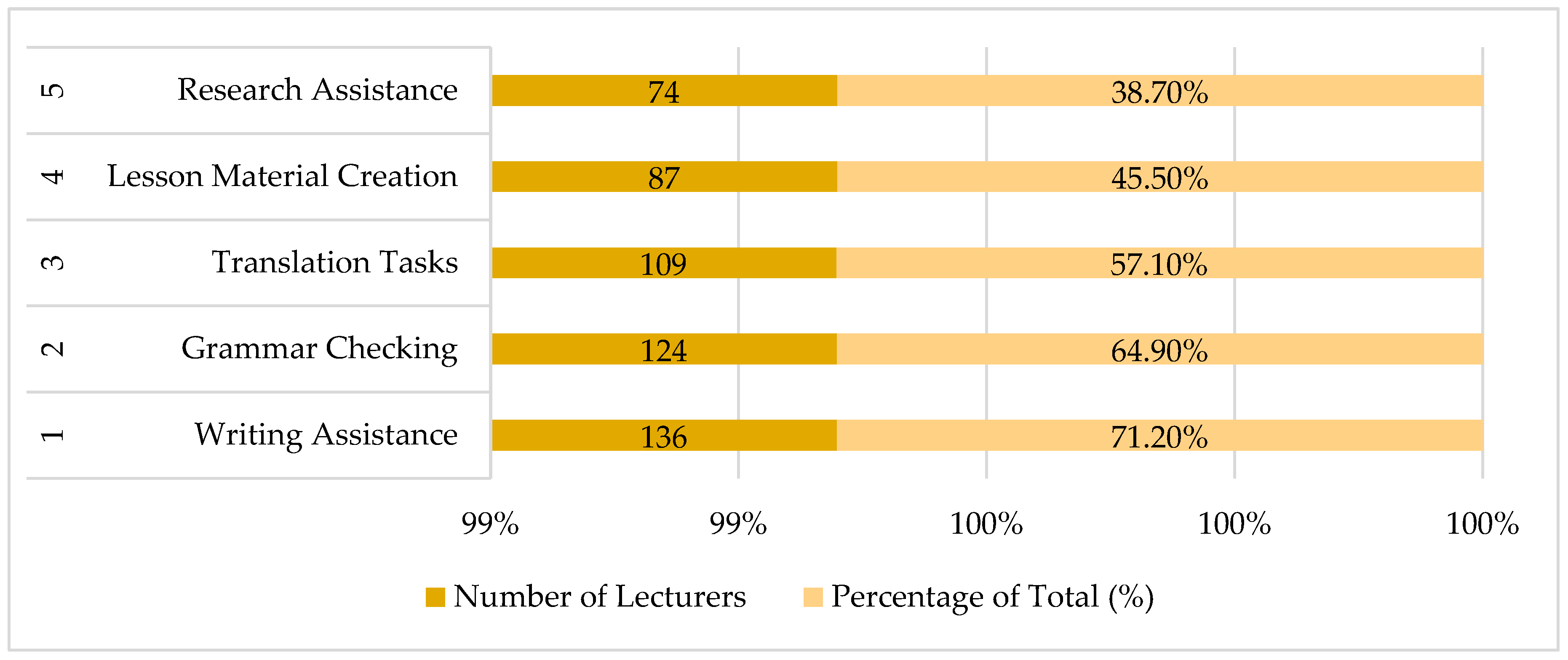
4.3.1. Patterns in AI Utilization for Teaching Preparation and Academic Work
Thematic analysis revealed that lecturers use generative AI in a variety of ways to enhance efficiency, generate teaching materials, develop assessments, refine academic writing, and support multilingual education.
Table 7 presents the four primary AI usage themes alongside their frequency of mention.
Theme 1: Lesson Material Development
A substantial proportion of lecturers reported leveraging AI to generate lesson materials, instructional content, and supplementary teaching resources, citing the technology’s ability to rapidly create diverse and customizable content as the most compelling reason for adoption. Many participants emphasized that AI not only reduces preparation time but also provides a valuable starting point for further refinement and adaptation of materials. As one lecturer remarked, “AI allows me to produce teaching materials almost instantly. If I need discussion prompts or reading exercises, I can generate them in seconds, then adapt them to my students’ proficiency levels.” Others highlighted AI’s potential to enhance content diversity and introduce fresh ideas into their lessons, with one explaining, “Sometimes, I struggle to find fresh examples for my lessons. AI provides a variety of perspectives and ideas that I wouldn’t have considered otherwise.” Despite these advantages, lecturers expressed caution about over-reliance on AI-generated content, particularly due to concerns over accuracy and pedagogical appropriateness. As one participant reflected, “I appreciate how AI can generate teaching materials quickly, but I never use the content as-is. AI does not understand my students’ needs, so I always have to revise and customize everything.” Furthermore, several lecturers emphasized that even though AI is useful for initial content creation, it lacks the deeper pedagogical reasoning and contextual sensitivity required for meaningful instruction, necessitating ongoing human intervention. As another lecturer asserted, “AI does not consider the cultural and contextual factors that influence how students interpret information. A good lesson is more than just well-structured content; it needs to be meaningful to the learners.”
Theme 2: Assessment and Quiz Generation
A significant number of lecturers reported utilizing AI to generate quizzes, comprehension exercises, and other assessment items, emphasizing the technology’s ability to efficiently produce a wide array of test formats. AI tools were particularly valued for automating the process of test item generation, thereby allowing lecturers to dedicate more time to refining question quality, alignment, and validity. As one lecturer explained, “Creating assessment questions used to take a lot of time, but now AI generates multiple-choice, true-or-false, and essay questions in just a few minutes.” Another participant highlighted the usefulness of AI in differentiating assessments to accommodate diverse learning needs: “I use AI to generate quizzes that match different difficulty levels, ensuring that students with varying abilities are challenged appropriately.” Despite these practical benefits, several lecturers expressed reservations about the accuracy and contextual appropriateness of AI-generated questions. One remarked, “AI can generate test questions, but it does not always understand what makes a question valid or pedagogically effective. Many of the questions need to be rewritten to be truly useful.” Additional concerns were raised about AI’s limitations in fostering critical thinking, with a lecturer noting, “AI-generated questions tend to focus on factual recall rather than deep analytical thinking. It is helpful for quick assessments, but it cannot replace thoughtfully designed exams.”
Theme 3: Writing Assistance and Grammar Checking
Many lecturers reported using AI tools to refine academic writing, especially for editing, paraphrasing, and grammar correction, recognizing the technology’s capacity to enhance clarity, coherence, and overall readability in both professional and scholarly documents. AI-assisted editing was frequently described as a valuable step in manuscript preparation, as one lecturer noted, “Before submitting my research papers, I run them through AI to check for grammatical errors and sentence structure improvements.” For non-native English speakers, AI’s support was particularly appreciated for its role in making writing sound more fluent and natural; as another participant explained, “English is not my first language, so I often use AI to refine my phrasing and make my writing sound more natural.” Despite these clear benefits, some lecturers voiced concerns about becoming overly reliant on AI-generated suggestions, fearing that habitual use could erode their own editing and language skills. As one put it, “I sometimes wonder if I am becoming too dependent on AI for grammar and vocabulary checks. It’s useful, but I don’t want to lose my own editing skills.” Additionally, ethical considerations emerged, with several participants highlighting the potential for misuse when AI is used to generate entire texts, thereby raising questions about academic integrity and students’ genuine skill development. As one lecturer reflected, “AI is helpful for writing assistance, but I worry that students are using it to generate entire essays instead of developing their own writing skills.”
Theme 4: Idea Generation and Lesson Planning
Some lecturers reported using AI as a brainstorming tool to develop lesson structures, generate discussion topics, and refine their overall teaching strategies. AI was frequently valued for its capacity to stimulate creative thinking and provide alternative perspectives, especially when educators faced creative blocks or sought fresh approaches to classroom engagement. As one lecturer shared, “When I struggle to come up with engaging activities, I use AI to generate ideas. Sometimes, it suggests approaches I wouldn’t have considered.” Others appreciated the way AI could offer structured frameworks for lesson planning, streamlining the initial stages of instructional design and allowing for efficient customization. One participant remarked, “AI helps me outline my lesson plans. It gives me an initial structure that I can then adjust based on my teaching goals.” Despite these advantages, some lecturers cautioned that AI-generated suggestions often lack the contextual awareness essential for effective lesson planning. As one noted, “AI-generated lesson ideas can be generic and disconnected from real classroom dynamics. It cannot replace an educator’s understanding of their students.”
Theme 5: AI-assisted Translation
A subset of lecturers reported using AI-powered translation tools to facilitate bilingual instruction, particularly in classrooms with non-native English-speaking students. These tools were valued for their ability to expedite the translation of teaching materials, academic texts, and classroom instructions, thereby enhancing accessibility and comprehension for diverse student populations. As one lecturer explained, “I teach students with varying levels of English proficiency. AI helps me translate explanations into Indonesian so they can better understand complex concepts.” Despite these benefits, several lecturers highlighted persistent concerns about the reliability and precision of AI translations, particularly when dealing with specialized academic terminology or culturally sophisticated content. As one participant cautioned, “AI translations are not always accurate, especially for advanced academic terms. I still have to manually edit most of the translations.” These experiences illustrate that even though AI translation tools can significantly support inclusive teaching practices and reduce language barriers, careful human oversight remains essential to ensure clarity, accuracy, and contextual appropriateness in bilingual educational settings.
4.3.2. Key Challenges in AI Integration for Teaching and Academic Work
Despite the advantages of AI adoption in education, lecturers reported several barriers that hinder its seamless integration into pedagogical practices. Thematic analysis identified three major challenges. The most frequently mentioned AI challenges are summarized in
Table 8, which outlines the number of mentions for each challenge and a brief description.
Theme 1: Over-Reliance on AI in Content Creation
A significant number of lecturers raised concerns about excessive dependence on AI-generated materials, emphasizing that such reliance could erode educators’ creativity, pedagogical intuition, and professional expertise. The core worry is twofold: first, educators themselves risk becoming passive consumers of AI content rather than active designers of instruction, and second, students may be discouraged from engaging critically with learning materials. As one lecturer reflected, “Before AI, I spent a lot of time designing lesson plans, thinking carefully about what to include and how to structure the materials. Now, I sometimes feel like I’m just editing AI-generated content rather than truly crafting my lessons.” Another echoed this sentiment, questioning the long-term impact on teaching practice: “If I continue relying on AI for materials, will I lose my ability to develop lessons from scratch? I fear that the convenience of AI might eventually replace the need for in-depth planning and creativity.” Several lecturers also noted that AI-generated resources often lack personalization and classroom relevance, since AI cannot account for students’ personalities, interests, or cultural backgrounds. As one participant observed, “AI can generate materials instantly, but it does not understand my students’ personalities, learning styles, or classroom dynamics. That human element in teaching is irreplaceable.” The same concerns apply to students, with some educators reporting that learners increasingly use AI to produce essays that, while polished, lack depth and originality. As one lecturer warned, “I have seen students use AI to generate entire essays, and while the writing looks polished, it lacks depth and originality. AI should not become a shortcut for avoiding intellectual effort.” In response to these issues, a number of lecturers emphasized the need for clear institutional policies on AI use, ensuring that both educators and students balance the advantages of AI assistance with the imperative for independent thinking, creativity, and authentic cognitive engagement.
Theme 2: Ethical and Pedagogical Considerations
The rise in generative AI has introduced a complex array of ethical dilemmas within higher education, particularly regarding plagiarism, academic dishonesty, and the implications of AI-generated content for authentic student learning. Many lecturers voiced concerns that students are increasingly submitting AI-generated assignments, often without demonstrating genuine comprehension or original analysis. As one lecturer observed, “Students submit AI-generated essays that look impressive but contain no critical thinking. I worry that they are learning how to use AI rather than how to write or analyze ideas.” Another educator emphasized the escalating challenge of detecting such assignments, noting, “Unlike traditional plagiarism, where students copy from sources, AI-generated text is original in form but lacks authenticity. It is becoming harder to distinguish genuine student work from AI-assisted submissions.” Beyond concerns about academic misconduct, lecturers highlighted pedagogical risks, such as diminishing student engagement with course content. Some reported that students rely on AI to generate summaries or explanations rather than engaging with reading and developing their own arguments. As one participant described, “Students are using AI to summarize texts instead of reading them. Instead of analyzing complex ideas, they generate instant explanations and move on without deeper comprehension.” There is also growing apprehension that, without explicit guidance, students may use AI as a shortcut, undermining the development of essential intellectual skills and eroding academic integrity. As one lecturer put it, “AI is not the problem, but how students use it is. If we don’t teach responsible AI usage, we risk creating a generation of passive learners who expect instant answers rather than thinking through problems.” In response to these concerns, several lecturers advocated for integrating AI literacy education into the curriculum, equipping students to engage with AI tools critically and ethically while upholding the core values of academic honesty and independent learning.
Theme 3: Concerns About Accuracy and Reliability
Another commonly cited challenge among lecturers was the accuracy and reliability of AI-generated content. Many reported that, although AI can produce responses that appear convincing, it often generates misleading, biased, or factually incorrect information, making it an unreliable source without rigorous verification. One lecturer expressed their frustration, stating, “AI can be incredibly convincing, but that does not mean it’s always right. I have found instances where AI-generated answers contain factual inaccuracies, and if educators don’t double-check, misinformation can spread.” Beyond factual accuracy, some educators pointed out that AI-generated content frequently lacks the academic depth and nuance necessary for higher education, as it rarely provides critical evaluation of sources, real-world context, or substantive argumentation. As one educator explained, “AI can provide surface-level explanations, but it lacks depth. It does not critically evaluate sources, provide real-world context, or engage in meaningful argumentation.” Concerns about bias also emerged, with several lecturers observing that AI models, being trained on pre-existing datasets, may unintentionally perpetuate certain perspectives as neglecting others. As one participant noted, “I noticed that AI tends to favor Western perspectives when generating academic content. If we use AI uncritically, we risk reinforcing certain viewpoints while ignoring others.” In response to these challenges, some lecturers advocated for the development and implementation of institutional guidelines that require educators to verify and fact-check AI-generated materials prior to their use in academic settings, thereby safeguarding the quality and integrity of educational content.




 ,
,