Article

Aligning Generative AI with Higher Education Workflows: Indonesian Lecturers’ Anxiety–Satisfaction Profiles and Adoption Patterns

1
Faculty of Languages and Arts, Universitas Negeri Padang, Padang 25132, Indonesia
2
Doctoral Program of Applied Linguistics of Teacher Training and Education Faculty, Bengkulu University, Bengkulu 38371, Indonesia
3
Research Center for Language Teaching and Learning, School of Languages and General Education, Walailak University, Nakhon Si Thammarat 80160, Thailand
*
Author to whom correspondence should be addressed.
Educ. Sci. 2026, 16(2), 271; https://doi.org/10.3390/educsci16020271
Submission received: 23 December 2025 / Revised: 16 January 2026 / Accepted: 5 February 2026 / Published: 9 February 2026

Abstract

Generative AI (GenAI) is increasingly embedded in higher education workflows for teaching preparation and academic work, yet lecturers’ affective readiness and perceived alignment between AI use and professional values remain underexplored. This mixed-methods study investigated 191 Indonesian university English lecturers’ GenAI-related anxiety and satisfaction, mapped adoption patterns through profile analysis, and identified key integration challenges. Quantitative data were collected using a reliable 10-item AI Anxiety Scale (α = 0.89) and a global satisfaction item and analyzed using descriptive statistics, Spearman’s correlations, and K-means clustering. The strongest anxieties concerned over-reliance (M = 4.20, SD = 0.80, d = −1.12) and content accuracy (M = 3.70, SD = 1.10, d = −0.76). Anxiety was negatively associated with satisfaction, most notably for perceived complexity (r = −0.197, p = 0.006) and dependency concerns (r = −0.184, p = 0.012). Three profiles emerged: high-anxiety lecturers reported distrust and pedagogical discomfort; moderate-anxiety lecturers adopted GenAI conditionally with verification; and low-anxiety lecturers used GenAI confidently and proactively. Qualitative reflections and interviews revealed five dominant use cases, involving writing support, material development, assessment design, translation, and lesson planning, while stressing persistent barriers related to ethical uncertainty, mistrust in AI-generated outputs, and concerns about diminished educator agency. The findings suggest that aligning GenAI with higher education workflows requires human-centered support, including context-sensitive AI literacy, clear ethical guidance, and institutional governance that strengthens responsible adoption.

1. Introduction

1.1. Background

The professional landscape of English as a foreign language (EFL) lecturers is undergoing substantial transformation as generative AI (GenAI) becomes increasingly embedded in higher education, particularly in academic research and teaching preparation (Zaim et al., 2024). AI-powered tools are gaining prominence for their capacity to streamline core academic activities such as lesson planning, assessment design, and scholarly writing, offering efficiencies that enhance productivity and responsiveness across teaching and research contexts through automated language processing, translation, and feedback generation (Saúde et al., 2024). Meanwhile, growing reliance on such technologies has intensified concerns regarding the validity of AI-generated content, alignment with academic integrity standards, and the broader implications of automation for lecturers’ critical engagement and scholarly agency (Peláez-Sánchez et al., 2024). Such tensions are particularly pronounced for English lecturers working in English-medium instruction (EMI) environments, where increasing pressure to publish internationally coincides with expectations to uphold rigorous standards of credibility and professional accountability (Zaim et al., 2024). Within teaching English as a foreign language (TEFL) context, the implications are especially significant, as English lecturers are tasked with evaluating linguistic accuracy, delivering precise language feedback, and maintaining assessment authenticity, which are the responsibilities that intersect directly with both the affordances and risks associated with generative AI use.
Beyond mere access to technology, a variety of contextual factors influence lecturers’ adoption of generative AI, including TEFL lecturers. Furthermore, adoption patterns are influenced by lecturers’ technological literacy, opinions about the usefulness of AI, and the existence or lack of institutional support systems (Al-Abdullatif, 2024). Artificial intelligence (AI) applications are widely used in multilingual academic settings to improve writing quality, speed up content development, and facilitate instruction through targeted language assistance, for example translation and text refinement (Rafida et al., 2024). Nonetheless, these alleged advantages are frequently offset by ingrained concerns about the reliability of AI results, possible over-reliance on automated solutions, and the deterioration of original ideas. Such issues are especially noticeable in universities in the Global South, where institutional policies may be inadequate or nonexistent (Makeleni et al., 2023). Because there are no clear policy frameworks in these situations, instructors must deal with difficult moral dilemmas concerning authorship, plagiarism, and the educational ramifications of automated feedback with little institutional support (Achruh et al., 2024).
Furthermore, psychological elements also have a major impact in determining how instructors react to generative AI. Technological Anxiety Theory states that when users encounter technologies that interfere with established cognitive and professional routines, they become more anxious (Meuter et al., 2003). Such anxiety may exacerbate resistance to technological innovation in educational settings, particularly in the absence of organizational support and clear implementation pathways (Henderson & Corry, 2021). Concerns about generative AI frequently revolve around doubts about the technology’s potential and the moral ramifications of using it to produce knowledge (Johnson & Verdicchio, 2017). The issues relate to the sense of professional identity and pedagogical autonomy of English lecturers because doubts about the processes and veracity of content produced by AI can heighten concerns about ethical transgressions and a loss of control over crucial academic practices (Schiavo et al., 2024; Wang & Wang, 2022). It is evident that technological anxiety has real effects on lecturers’ willingness to incorporate generative AI, the level of caution they exercise, and their overall assessment of its legitimacy in academic contexts, even though some researchers argue that worries about AI are sometimes exaggerated or based on false beliefs (Johnson & Verdicchio, 2017; Oravec, 2019).

1.2. Research Objectives and Gaps

The need for more in-depth research into the affective and psychological aspects that influence educators’ experiences is made apparent by the fact that, despite the growing body of research on generative AI, actual adoption rates among university faculty show substantial variations (Yusuf et al., 2024). Although empirical research has established that generative AI can improve research and teaching efficiency by supporting tasks like translation, grammar correction, and feedback generation (Alshumaimeri & Alshememry, 2023; Zaim et al., 2024; Zawacki-Richter et al., 2019; Fryer et al., 2020), there are still unanswered questions regarding the technology’s accuracy, its capacity to sustain complexity, and its impact on critical thinking. In high-stakes academic settings, where even small errors can have disproportionate consequences, these issues are especially urgent (Xia et al., 2022). Furthermore, studies consistently show that people who embrace GenAI differ from those who oppose it in terms of exposure to AI, self-efficacy, and attitudes toward digital transformation; technological anxiety is frequently mentioned as a major barrier (Lan et al., 2024; Holmes et al., 2019; Zhang et al., 2023). Nonetheless, there is still a significant lack of evidence from classroom and workflow settings that explains how lecturers’ anxiety specifically affects their satisfaction and usage patterns, as well as whether different “anxiety profiles” can be found that significantly predict adoption behaviors in higher education settings.
The institutional and ethical context in which GenAI is incorporated into lecturers’ daily work routines represents another research gap. According to existing research, anxiety is frequently brought on by feelings of complexity, uncertainty, and diminished personal autonomy, factors that can sustain resistance even in organizations that prioritize innovation (Meuter et al., 2003; Beaudry & Pinsonneault, 2010; Howard & Mozejko, 2015; Perez, 2024; Soomro et al., 2024). Teachers frequently voice concerns about AI’s dependability, the potential for increased automation to upend traditional pedagogical roles, and the possibility of being held responsible for mistakes made by AI. Such concerns have the potential to undermine confidence and increase resistance, particularly when instructors believe that the use of AI may redefine what constitutes responsible scholarship and effective teaching (Aad & Hardey, 2025; Jose & Jose, 2024). The situation is further complicated by ethical discussions about AI-assisted authorship, the possibility of plagiarism, and the unclear limits of originality, especially when GenAI is used to produce, paraphrase, or improve academic writing (Amirjalili et al., 2024; Octaberlina et al., 2024; Kim, 2024). Although it is common to recommend interventions, e.g., training programs and AI literacy initiatives, these solutions are frequently too general and not sufficiently tailored to professional contexts. Therefore, there is an urgent need for research that identifies the most prominent sources of anxiety for lecturers, how these anxieties specifically impact daily usage in academic writing and teaching, and what types of institutional support are most successful in promoting responsible, long-term AI integration (Bond et al., 2018).
The current study addresses identified gaps by examining anxiety and satisfaction levels among English instructors at Indonesian universities in relation to the use of generative AI. Alongside documenting lecturers’ actual usage practices and the challenges encountered during AI-supported teaching preparation and academic work, the study seeks to identify and characterize distinct anxiety profiles that may underline different patterns of adoption. Through linking psychological factors with everyday professional routines, the research aims to generate practical insights into forms of institutional support and ethical guidance that can help universities promote credible, ethical, and pedagogically sound integration of generative AI in higher education. Within this framework, GenAI is used as an umbrella term to denote AI-enabled tools that assist lecturers in teaching preparation and academic tasks, while acknowledging substantial variation in underlying mechanisms and associated risks (Law, 2024; Chanpradit, 2025). Large language model (LLM)-based systems, such as ChatGPT-3 and 4, generate extended original text and are therefore associated with concerns related to hallucination, authorship ambiguity, and epistemic trust (Barrett & Pack, 2023; Chanpradit, 2025). Such systems are also linked to anxieties surrounding plagiarism, reduced originality, difficulties in interpreting advanced academic content, and broader threats to academic integrity arising from misuse in educational contexts (Barrett & Pack, 2023; Yusuf et al., 2024). In contrast, language-support tools such as Grammarly and Google Translate operate primarily as assistive technologies for editing, translation, and linguistic refinement, giving rise to a different set of concerns, including overreliance, gradual erosion of language skills, data privacy, and unequal access (Chanpradit, 2025). Attention to such functional and risk-based distinctions remains essential for interpreting lecturers’ affective responses to GenAI, as anxiety and uncertainty are likely to originate from qualitatively different sources depending on how particular AI tools are incorporated into academic workflows (Chan & Lee, 2023).
The following research questions guide the study:
  • How do Indonesian university lecturers experience anxiety and satisfaction when using generative AI in teaching preparation and academic work?
  • What are the distinct AI anxiety profiles among lecturers, and how do they influence AI adoption patterns?
  • What are lecturers’ AI usage patterns, and the key challenges faced in integrating generative AI into teaching preparation and academic work?
Aligned with the research questions, this study adopts an exploratory mixed-methods design that emphasizes pattern identification and interpretive understanding rather than formal hypothesis testing. Quantitative analyses are used to descriptively map variation in lecturers’ anxiety and satisfaction and to identify meaningful profiles of generative AI adoption, serving to organize complex affective data and reveal heterogeneity within the sample rather than to test predetermined causal relationships. Insights emerging from statistical patterns are subsequently examined through qualitative inquiry to deepen contextual interpretation. An RQ-driven and context-sensitive analytical logic guides methodological decisions, ensuring coherence with the aim of understanding how lecturers experience and negotiate generative AI within everyday teaching and academic workflows. Although this study remains exploratory in nature, theoretically informed directional expectations shape the analysis, anticipating an inverse relationship between AI-related anxiety and satisfaction and the emergence of distinct anxiety profiles associated with differing patterns of GenAI adoption.

2. Literature Review

2.1. Theoretical Framework

A useful perspective for comprehending how lecturers’ use of generative AI in higher education is influenced by emotional and cognitive discomfort is provided by Technological Anxiety Theory (Meuter et al., 2003). According to Agogo and Hess (2018) and Bhattacharyya (2024), this theory encompasses a range of related constructs, including technostress, computer anxiety, and technophobia, which frequently occur when users believe digital technologies are complicated, unreliable, or disruptive to established professional routines. Such forms of anxiety typically worsen in educational settings during times of rapid technological change, particularly when the pace of implementation exceeds instructors’ readiness or when institutional support is uneven or insufficient (Henderson & Corry, 2021). Anxiety about AI appears as a context-specific expression of more general technological unease as generative AI tools become increasingly integrated into academic work and teaching preparation. This anxiety has a direct impact on how educators evaluate risks, understand the intricacy of new systems, and deal with professional accountability concerns (Meuter et al., 2003).
Furthermore, the anxiety related to AI goes beyond simple discomfort with new tools; it is a reflection of deeper worries about doubts about AI’s potential and its moral validity in the creation of knowledge. According to Johnson and Verdicchio (2017), “AI anxiety” is a socio-technical reaction that stems from the ambiguities in human–machine agency and the opacity of AI systems. In higher education, where authorship, credibility, and adherence to disciplinary standards are crucial, these issues are especially important. AI-related anxiety in lecturers is not just a reaction to novelty; rather, it frequently results from perceived threats to pedagogical autonomy, originality, and professional identity, particularly when AI-generated outputs seem authoritative but may be erroneous or out of step with academic standards (Wang & Wang, 2022; Schiavo et al., 2024). There is no question that anxiety can have real consequences, even though some academics contend that such concerns are occasionally overblown or founded on misconceptions about AI’s limitations. It can influence how generative AI is incorporated into academic practice by discouraging adoption of AI tools, encouraging excessive caution, or raising scrutiny of AI outputs (Johnson & Verdicchio, 2017; Oravec, 2019).
Technological Anxiety Theory helps rational, utility-based models of technology adoption by shedding light on the relationship between negative emotions and perceived efficiency or usefulness. According to research, users’ emotional responses to digital systems, which can range from fear to cautious optimism, have an impact on whether they avoid, try out, or regularly use new technologies (Beaudry & Pinsonneault, 2010). According to Meuter et al. (2003) and Henderson and Corry (2021), these dynamics are exacerbated in academic settings when instructors believe they have little control over AI-generated content, lack self-confidence, or receive unclear institutional guidance on responsible use. essential new research indicates that technological anxiety should not be viewed as a single, homogenous concept, but rather as a variety of profiles that correspond to various adoption and resistance patterns of technology. In addition to recognizing psychological obstacles that institutions must overcome to promote responsible and long-lasting AI integration in higher education, identifying and characterizing these distinct anxiety profiles offers a more complex, theoretically grounded account of lecturers’ varied reactions to generative AI (Meuter et al., 2003; Beaudry & Pinsonneault, 2010).

2.2. Results of Related Research

Recent foundational studies emphasize that generative artificial intelligence in higher education should be understood as a sociocognitive and ethical phenomenon rather than a uniform technical tool. Low et al. (2022) demonstrate how AI-mediated language practices intersect with identity, authorship, and knowledge authority, highlighting that “GenAI” carries different meanings and risks depending on context and use. Within Asian higher education, Day (2023) further shows that tools such as ChatGPT raise ethical concerns related to responsibility and well-being, while Day (2025) illustrates how students’ engagement with AI is shaped by sociocultural logics such as guanxi. Although these studies provide important conceptual grounding, they focus primarily on student experiences and broader cultural implications, leaving lecturers’ affective responses and everyday workflow practices underexplored. The present study addresses this gap by examining lecturers’ anxiety, satisfaction, and adoption patterns in relation to GenAI use in teaching preparation and academic work.
Recent scholarship also cautions against treating GenAI as a uniform category, as AI tools used in higher education differ substantially in their functional affordances and associated risks (Nikolic et al., 2024). In particular, large language model (LLM)-based systems capable of generating extended original text are commonly linked to concerns surrounding hallucination, authorship ambiguity, epistemic trust, and diminished educator agency (Chanpradit, 2025; Hughes et al., 2025), whereas language-support tools such as grammar checkers and translation systems are more frequently associated with risks of overreliance, deskilling, and surface-level engagement rather than content fabrication (Chanpradit, 2025). These functional distinctions are analytically important, as lecturers’ anxiety is often shaped by the perceived stakes of specific academic tasks rather than by AI use in general (Mashayekhy et al., 2025). Nevertheless, much of the existing literature continues to collapse heterogeneous AI tools into a single analytical category, limiting conceptual precision and obscuring how differing risk profiles shape affective responses and adoption behaviors (Ivanov et al., 2024; Nikolic et al., 2024). Building on the conceptual work above, the present study adopts a context-sensitive view of GenAI that foregrounds tool heterogeneity and examines how lecturers negotiate AI-related risks across integrated teaching and academic workflows.
Within this broader landscape, research on generative AI in higher education has highlighted both its transformative pedagogical potential and the complex challenges it poses for academic practice. Empirical studies consistently show that AI-powered applications can enhance instructional efficiency and streamline research-related tasks, particularly for language educators whose work involves extensive text production, material design, and feedback provision (Alshumaimeri & Alshememry, 2023; Zaim et al., 2024). Menahwile, syntheses of the literature indicate that GenAI adoption is uneven, shaped by institutional preparedness, perceived pedagogical value, and educators’ confidence in using these tools responsibly (Yusuf et al., 2024). Despite their fluency and adaptability, large language models have been shown to pose substantive epistemic risks: AI-generated content may appear authoritative whereas concealing inaccuracies or encouraging superficial engagement if not critically mediated (Peláez-Sánchez et al., 2024). The body of research underlines the need for analytically complex studies that examine not only whether educators adopt GenAI, but how different forms of AI use intersect with affective responses, professional judgment, and pedagogical accountability.
Empirical studies indicate that AI tools are widely used for translation, grammar correction, and textual enhancement in multilingual university settings and English language instruction. According to Zawacki-Richter et al. (2019), these technologies are now useful tools for instructors who want to improve their teaching materials and academic writing. Furthermore, through the development of customized exercises, summarizing readings, and offering feedback on student writing, AI-driven platforms are increasingly being used to personalize learning, expanding educators’ instructional repertoire (Fryer et al., 2020). Nonetheless, research reveals persistent worries about the linguistic and epistemic constraints of outputs produced by AI. These tools frequently fail to capture subtle nuances, contextual depth, or disciplinary conventions, which increases the possibility that if AI is used as a replacement rather than a scaffold, it will undermine critical thinking and deeper cognitive engagement (Xia et al., 2022). For lecturers, who must continuously maintain a balance between effectiveness, pedagogical integrity, and disciplinary rigor, these conflicts are especially evident.
The stratification of educators’ engagement with AI based on their prior exposure, self-efficacy, and openness to digital innovation is a recurrent theme in adoption-focused research. AI-enhanced pedagogical strategies are more likely to be incorporated by faculty members who possess strong digital competence and confidence, whereas those who struggle with technology anxiety are more likely to oppose or steer clear of these innovations (Holmes et al., 2019; Zhang et al., 2023). Reviews of the digital competency of university instructors also show that differences in professional development opportunities and readiness lead to uneven adoption paths, particularly in settings where systematic AI literacy is deficient (Lan et al., 2024). Further research reveals how attitudes toward generative AI are shaped by trust, perceived dependability, and supportive institutional conditions, confirming that organizational culture and individual readiness play equal roles in the decision to adopt (Al-Abdullatif, 2024; Nikolic et al., 2024).
Even in settings that actively encourage technological innovation, persistent negative affective responses complicate the psychological and organizational aspects of AI adoption. Teachers’ engagement and the long-term integration of AI into teaching practices can be hampered by technological anxiety, which is frequently associated with feelings of complexity, uncertainty, and diminished personal agency (Meuter et al., 2003; Beaudry & Pinsonneault, 2010). According to Howard and Mozejko (2015), resistance can be a reasonable reaction to forced change, ambiguous institutional expectations, or perceived threats to one’s professional identity and established pedagogical values. Also, empirical research indicates that organizational support is a critical moderating factor, with sufficient policy scaffolding and training serving to mitigate the disruptive effects of innovation and improve well-being (Soomro et al., 2024). Faculty acceptance of AI tools in higher education is often dependent on how reliable technology is seen to be and how well it aligns with institutional values and pedagogical responsibilities (Perez, 2024).
Lastly, a fundamental component of the new literature is ethical considerations, especially when it comes to authorship, plagiarism, and academic integrity in relation to AI-assisted writing and evaluation. According to studies (Amirjalili et al., 2024; Octaberlina et al., 2024), AI-generated content may erode originality and promote passive text replication by blurring the lines between appropriate assistance and excessive substitution. Unresolved issues regarding responsible AI use among authors and reviewers are highlighted by ongoing discussions about research ethics, pointing out the need for clear guidelines and transparent practices to protect intellectual property and academic accountability (Kim, 2024). Concurrently, researchers contend that the incorporation of generative AI is changing the roles of faculty members, making it necessary to create educational experiences that integrate AI tools in ways that respect academic integrity and critical thinking (Aad & Hardey, 2025; Jose & Jose, 2024). Many have responded by advocating for the creation of thorough AI ethics and literacy initiatives. Nonetheless, research indicates that if these programs are to encourage sustainable, equitable, and responsible adoption across various educational contexts, they must address not only technical proficiency but also ethical reasoning and professional agency (Bond et al., 2018).
In TEFL contexts, GenAI use intersects directly with skills teaching and materials development because lecturers routinely design prompts, texts, model answers, and feedback language, creating strong incentives for efficiency-oriented adoption. However, the TEFL assessment domain is particularly sensitive: anxieties are intensified when GenAI is used for assessment preparation because perceived risks map onto core assessment quality criteria, e.g., reliability (consistency of decisions), validity (whether tasks measure intended language ability), and practicality (time and workload constraints). As a result, lecturers may accept GenAI for low-stakes language-support functions (editing/translation) while resisting or tightly controlling LLM-style text generation in high-stakes tasks where hallucination and authorship ambiguity pose greater integrity risks.

3. Methodology

3.1. Research Design and Logic of Inquiry

This study employed an explanatory sequential mixed-methods design to examine Indonesian university English lecturers’ GenAI-related anxiety and satisfaction and how these affective states shape distinct adoption patterns in teaching preparation and academic work. The mixed-methods choice reflects a pragmatic, interdisciplinary logic that GenAI adoption is simultaneously measurable (e.g., levels, associations, profiles) and situated (e.g., task stakes, ethical judgment, institutional ambiguity), so neither quantitative nor qualitative methods alone can adequately capture both the structural patterning and the lived complexity of use (Creswell & Clark, 2017). The quantitative strand was prioritized to map affective readiness with item-level specificity and to identify heterogeneity through profile classification, consistent with work showing that negative affect toward technology is not monolithic but varies across forms of perceived uncertainty, disruption, and threat to professional routines (Beaudry & Pinsonneault, 2010; Henderson & Corry, 2021; Meuter et al., 2003). This study recognizes that purely protocol-driven adoption research may decontextualize anxiety by framing it as a fixed individual trait rather than a response shaped by task demands and accountability. Such concerns are especially pertinent to GenAI, where issues extend beyond technical complexity to encompass epistemic trust, authorship, and professional agency (Johnson & Verdicchio, 2017).
The qualitative strand was, therefore, designed to explain and contextualize the quantitative patterns rather than merely supplement them. Integration was planned through connecting and explanatory building, namely narrative reflections and follow-up interviews were used to interpret why certain anxiety items clustered together, how lecturers translate anxiety into practice (e.g., verification routines, conditional reliance, avoidance of critical tasks), and how institutional uncertainty and ethical ambiguity shape boundary-setting in daily workflows (Creswell & Clark, 2017; Clarke & Braun, 2017). Interpretive integration aligns with the theoretical premise that technological anxiety produces behavioral consequences, e.g., cautious experimentation, resistance, or proactive use, which become meaningful only when scores are interpreted alongside the professional perspectives lecturers attach to GenAI (Beaudry & Pinsonneault, 2010; Meuter et al., 2003). Methodological constraints are made explicit as interpretive boundaries rather than hidden limitations, in which the cross-sectional time window cannot capture change over time, self-report may under- or overestimate ethically sensitive practices, and a small interview subsample supports explanatory depth but not qualitative saturation. Hence, findings aim for analytical transferability to comparable multilingual and policy-developing higher education contexts, rather than statistical generalization (Creswell & Clark, 2017).
This study was conducted in accordance with ethical standards for research involving human participants and received approval from [Anonymized] (Approval Code: 1388/UN35.15/LT/2024; Approval Date: 6 May 2024). All participants were provided with an information sheet and gave informed consent electronically prior to participation; participation was voluntary, and participants could withdraw at any time without penalty. No personal identification information was collected, and all survey, reflection, and interview data were anonymized. Where AI-assisted transcription tools were used, transcripts were manually reviewed and corrected by the researcher to ensure accuracy and protect confidentiality. All data were stored securely on password-protected devices and used solely for research purposes.

3.2. Participants and Research Context

The study focused on Indonesian university English lecturers, whose professional roles align closely with the research aims because both teaching and scholarly responsibilities are highly language- and text-intensive. Teaching preparation routinely involves designing instructional materials, developing assessments, and providing written feedback in English, which are the activities for which generative AI tools offer potential efficiency gains and linguistic support. Academic work further encompasses drafting research articles, abstracts, and other scholarly texts that demand originality, credibility, and strict adherence to academic integrity. Such conditions make English lecturers a particularly relevant group for examining generative AI-related anxiety and satisfaction, as professional practice requires balancing the practical benefits of AI-supported workflows with concerns about accuracy, overreliance, and possible erosion of educator agency across pedagogical and scholarly domains. Participants were recruited through purposive convenience sampling via academic mailing lists and lecturer-oriented professional networks within Indonesian higher education. Eligibility criteria required current employment as a university-level English lecturer in Indonesia and active engagement in teaching preparation and/or academic writing, but lecturers who did not teach English or reported no experience with generative AI in professional workflows were excluded. Because the survey link was distributed openly across networks, a precise response rate could not be calculated; representativeness was therefore addressed analytically, prioritizing diversity across institution types, academic ranks, and teaching experience rather than statistical generalization or fixed quota matching.
The final analytic sample comprised 191 lecturers (see Table 1), representing a diverse range of career stages, academic ranks, and professional experiences, factors likely to shape their engagement with AI. The sample was predominantly female (69.6%), with nearly half of participants aged between 30 and 39 years (49.2%). Most held a master’s degree (68.1%), but 17.8% had obtained doctorates. The cohort included lecturers with a spectrum of teaching experience, with many reporting 5–15 years in the profession. Academic ranks ranged from assistant lecturer to associate professor, reflecting variability in workload demands, performance expectations, and scholarly output requirements. These demographic and professional distinctions were treated as important context markers, as they can influence perceptions of GenAI’s value (such as time-saving potential for those with heavy teaching loads) as well as concerns about its risks (including reputational considerations and discomfort with using AI for high-stakes academic writing and assessment).
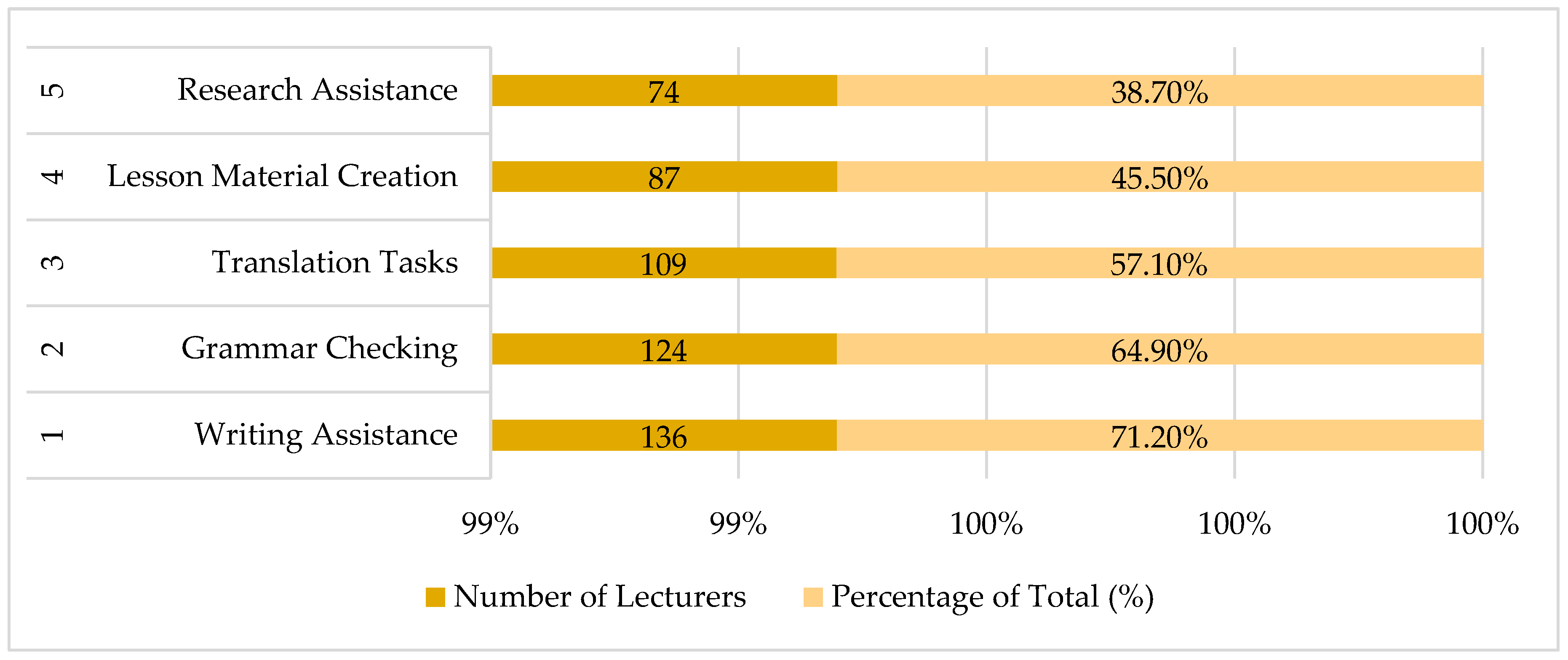
Lecturers were drawn from a wide range of Indonesian higher education institutions, including state universities, Islamic universities (UINs and IAINs), teacher training colleges (STKIPs), and other institutional types, with the largest representations coming from Universitas Negeri Padang, Universitas Bengkulu, UIN Bukittinggi, and Universitas PGRI Sumatera Barat. Such institutional diversity reflects meaningful variation in digital infrastructure, access to professional development, and local norms surrounding AI adoption, all of which shape how lecturers experience and evaluate generative AI in professional practice. In line with the study’s emphasis on everyday workflows, participants reported active use of multiple AI tools, most commonly Google Translate (82.2%), Grammarly (74.3%), and ChatGPT (61.8), for purposes including writing assistance, grammar checking, translation, lesson material development, and research support. Functionally, the most frequently used tools clustered into two broad categories: language-support systems focused on editing and translation (e.g., Google Translate, Grammarly, DeepL, QuillBot) and LLM-based generative systems (e.g., ChatGPT), a distinction that carries analytical importance given differing risk perceptions and anxiety profiles associated with each category (see Table 2 and Figure 1). The diversity of tasks and perceived stakes stresses the complex ways lecturers may experience anxiety or satisfaction and helps explain why AI adoption often remains cautious, selective, or context dependent across teaching and academic activities. Within teaching English as a foreign language, engagement with generative AI directly influences judgments of linguistic accuracy, feedback transparency, and assessment validity, rendering the professional context analytically distinctive rather than generically academic.

3.3. Instruments and Measures

3.3.1. Quantitative Instrument: AI Anxiety and Satisfaction Survey

The survey was structured into four sequential blocks designed to progress from concrete professional practices to affective evaluation. The first block collected demographic information (Table 1). The second block examined AI tool use and usage purposes (Table 2; Figure 1), anchoring affective responses in lecturers’ actual workflow behaviors; items recorded the names of AI applications used (e.g., Google Translate, Grammarly, ChatGPT) and their primary purposes, without distinguishing between free and paid subscription tiers or specific model versions. As a result, subsequent interpretations emphasize functional categories, such as LLM-based text generation versus language-support, editing, and translation tools, rather than capability differences attributable to subscription level. The third block measured AI-related anxiety using a 10-item scale, while the fourth block assessed overall AI satisfaction through a global item, followed by open-ended prompts intended to enhance explanatory depth and support integration of quantitative and qualitative findings (Creswell & Clark, 2017).
  • AI Anxiety Scale
AI-related anxiety was assessed using a 10-item instrument rated on a five-point Likert scale (1 = strongly disagree, 5 = strongly agree). The items captured practice-relevant concerns, including uncertainty about effective use, discomfort in high-stakes academic tasks, concerns about output accuracy, and apprehension regarding overdependence on AI tools. The scale demonstrated strong internal consistency (Cronbach’s α = 0.89), supporting its suitability for both item-level interpretation and the identification of anxiety profiles. Item development was informed by established research on technology- and AI-related anxiety (e.g., Agogo & Hess, 2018; Henderson & Corry, 2021; Meuter et al., 2003) and was carefully contextualized to generative AI use in teaching preparation and academic work. The instrument was translated into Indonesian and back-translated to ensure semantic equivalence, and it was piloted prior to full administration to confirm clarity and relevance. Given the exploratory focus and emphasis on profile identification rather than construct validation, factor analysis was not conducted, with internal consistency serving as the primary indicator of scale adequacy.
2.
AI Satisfaction
Satisfaction was measured using a single global item on a 5-point Likert scale (1 = Very dissatisfied, 5 = Very satisfied). This global measure was selected because lecturers’ use of AI varied substantially across tasks and tools, allowing participants to provide an overall evaluative judgment based on their integrated experiences in teaching preparation and academic work. Although a multi-item measure could offer greater granularity, a single-item approach was adopted to reduce respondent burden and is considered appropriate for the exploratory scope of the study, a choice that necessarily limits fine-grained interpretation.
3.
AI tools and purposes
Participants reported which AI tools they used and their main purposes for use. Tool use patterns indicated that Google Translate (82.2%), Grammarly (74.3%), and ChatGPT (61.8%) were most frequently used, with QuillBot and DeepL also commonly reported (Table 2). Purpose patterns indicated writing assistance, grammar checking, translation, lesson material creation, and research assistance as dominant uses (Table 3). These items served two analytic roles: they documented practice patterns and supported interpretation of anxiety and satisfaction by linking affective responses to concrete tasks.

3.3.2. Qualitative Instruments: Narrative Reflections and Interviews

  • Written narrative reflections
The survey included two open-ended prompts to elicit concrete descriptions of practice and perceived barriers: (1) how lecturers use AI in teaching preparation and academic work, (2) what challenges they face when integrating AI into these professional tasks. Participants could respond in Indonesian to reduce language burden and enable fuller expression, especially when describing ethical uncertainty, institutional norms, or professional identity concerns. These reflections were treated as a qualitative dataset that could be compared across quantitative profiles during integration (Creswell & Clark, 2017).
2.
Online interviews
Six lecturers volunteered for follow-up interviews to deepen explanatory power. Interviews followed a structured protocol shared in advance so participants could recall concrete examples of AI use, verification practices, and boundary-setting. Interviews were conducted online and lasted approximately 40 to 45 min. Audio recordings were transcribed using AI-assisted transcription to support efficiency, followed by manual cross-checking against recordings to correct tool names, technical terms, and contextual references. Interview data were used to clarify and extend themes identified in the written reflections through systematic comparison (Creswell & Clark, 2017).

3.4. Steps for Collecting and Analyzing Data

Data were gathered over four weeks using Google Forms, which allowed many lecturers from various institutions to take part whilst keeping their identities secret. The first page of the survey gave full information about the study’s purpose, the fact that it was voluntary, the protection of privacy, and the participants’ right to leave at any time. The following was done to maintain ethical standards. Only people who said they understood and agreed could go on. The survey sequence was deliberately designed to enhance validity: demographic and AI usage questions were placed first, followed by anxiety and satisfaction measures, with open-ended reflection prompts at the conclusion to reduce the likelihood of reflective writing artificially inflating anxiety responses. To further protect privacy, a separate link was provided for people to volunteer for follow-up interviews. This made sure that identifying information was kept separate from survey data and encouraged more honesty in qualitative reporting.
Quantitative data analysis followed a multi-stage procedure designed to ensure transparency and interpretive rigor. Initial data screening focused on response completeness and quality, with cases lacking sufficient data on core measures excluded from subsequent analyses. Descriptive statistics were then calculated for each anxiety and satisfaction item, and item-level results were retained to illuminate specific patterns of concern, such as apprehension about accuracy or fears of overdependence, rather than collapsing responses into a single composite score. Because anxiety and satisfaction scores deviated from normal distributions (p < 0.05), Spearman’s rank correlation was used to examine associations between individual anxiety indicators and satisfaction, allowing interpretation at the level of substantively meaningful concerns. To estimate the magnitude of prevalent anxieties, Cohen’s d was computed for each item by comparing item means against the neutral midpoint of the scale (value = 3), yielding standardized effect size estimates that indicate deviation from a neutral stance; negative values reflect stronger endorsement of anxiety-related concerns relative to the midpoint. Finally, K-means clustering was applied to standardized scores across the ten anxiety items, with the Elbow Method guiding selection of the most interpretable solution. A three-cluster model representing high, moderate, and low anxiety profiles was retained for its conceptual clarity, with salient item-level peaks, such as distrust in output accuracy or fear of dependence, informing cluster interpretation.
Qualitative analysis utilized a stringent thematic methodology, informed by the principles of interpretive depth and analytical rigor (Clarke & Braun, 2017). The process commenced with the iterative reading of narrative reflections and interview transcripts to cultivate a comprehensive understanding of lecturers’ workflows, concerns, and lived experiences. Data were categorized by source type and cross-referenced with quantitative anxiety profiles to enable comprehensive analysis across clusters (Creswell & Clark, 2017). There were two layers of coding. The first layer addressed things that could be seen, like writing support, translation, assessment generation, and lesson planning. The second layer looked at decision rules and risk management strategies, like verification routines, selective reliance, avoidance of critical tasks, and clear boundary-setting based on ethical concerns. These two layers made sure that the themes that came out of them showed both the actions that people took and the reasons behind those actions. We refined the themes repeatedly by looking at how well they fit together, how unique they were, and how well they were supported by evidence from multiple participants. We paid special attention to cases that went against the trend, for instance frequent AI users who still reported strong ethical anxiety, to avoid making a generalization too broad. In-depth interviews were particularly beneficial for elaborating and elucidating reflection-based themes, providing comprehensive insights into participants’ verification methodologies, acceptance standards for AI outputs, and perceived limits of integrity in both pedagogical preparation and scholarly endeavors.

4. Results

4.1. RQ 1: English Lecturers’ Anxiety and Satisfaction When Using Generative AI in Teaching Preparation and Academic Work

4.1.1. Descriptive Analysis of Anxiety Levels

Table 3 provides descriptive statistics, including means, standard deviations, and Cohen’s d effect sizes. Concerns about over-reliance on AI (M = 4.20, SD = 0.80) and the accuracy of AI-generated content (M = 3.70, SD = 1.10) were the most significant sources of anxiety, reflecting fears of misleading outputs and diminished independent content creation. Conversely, anxiety was lower regarding AI complexity (M = 2.35, SD = 0.92) and errors in usage (M = 2.53, SD = 0.94), suggesting technical challenges were less inhibiting. Effect sizes revealed large negative impacts, with Cohen’s d values between −0.61 and −1.87, emphasizing anxiety’s influence on AI adoption experiences.

4.1.2. Correlation Analysis Between Anxiety and Satisfaction

The Shapiro–Wilk test was conducted to assess data normality, with results shown in Table 4. p-values for anxiety (p < 0.001) and satisfaction (p = 0.003) were below 0.05, indicating non-normal distributions. Consequently, Spearman’s rank correlation was used to evaluate the relationship between anxiety and satisfaction. The analysis examined associations between the 10 anxiety items and overall satisfaction with generative AI, with correlation coefficients and p-values reported in Table 5.
Spearman’s correlation analysis revealed moderate negative correlations between anxiety factors and satisfaction levels, with several significant associations (p < 0.05). The strongest negative correlation was between perceived AI complexity and satisfaction (r = −0.197, p = 0.006), indicating that those who found AI overwhelming reported lower satisfaction. Significant negative relationships were also observed for concerns about over-reliance on AI (r = −0.184, p = 0.012) and uncertainty in usage (r = −0.152, p = 0.035). The positive correlation observed for the item “Using generative AI for teaching preparation is challenging for me” (r = 0.156, p = 0.031) does not indicate increased anxiety leading to higher satisfaction, but rather suggests that lecturers who perceive AI as challenging may also experience greater engagement or problem-solving interest, consistent with interpretations of challenge as a manageable or stimulating demand rather than a deterrent. Item wording and coding were verified, and the result is interpreted cautiously as reflecting differentiated meanings of “challenge” rather than a reversal of the overall anxiety–satisfaction relationship.

4.2. RQ2: English Lecturers’ Anxiety Profiles Regarding the Use of Generative AI in Teaching and Academic Work

The Elbow Method was used to determine the optimal number of clusters for categorizing lecturers based on AI anxiety scores. This involved standardizing scores, calculating the within-cluster sum of squares (WCSS) for varying k values, and identifying the “elbow point” where WCSS decreases slowed significantly. The analysis revealed three as the optimal number of clusters, as additional clusters provided only marginal improvements, enabling clear differentiation of lecturers with high, moderate, and low anxiety levels toward AI adoption. Following the Elbow Method, K-means clustering identified three distinct anxiety groups. Their characteristics and mean anxiety scores for ten AI-related concerns are presented in Table 6.
Cluster 1: High-Anxiety Lecturers (Strong Resistance to AI Adoption)
The first cluster, identified as the High-Anxiety Group, comprises lecturers who display pronounced apprehension toward the adoption of generative AI, consistently registering the highest scores across all anxiety-related measures. Their most significant concerns center on the dangers of over-reliance on AI (M = 4.41), doubts about the accuracy and trustworthiness of AI-generated outputs (M = 4.07), and deep discomfort with incorporating AI into critical teaching activities (M = 4.19). For these lecturers, AI is perceived less as a supportive innovation and more as a disruptive force threatening established educational practices and professional norms. Expressions of strong distrust in AI’s capacity to produce reliable or credible content are common, with many fearing that increased AI integration could undermine traditional pedagogical roles and expose students to misinformation. One lecturer articulated, “I am deeply concerned about the increasing reliance on AI. If we let AI do everything, what happens to the role of the teacher?” whereas another noted, “I don’t trust AI to produce reliable content. I worry that my students might be learning incorrect information without realizing it.” Beyond content-based anxieties, members of this cluster frequently report low confidence and a sense of being overwhelmed by the complexity of AI tools, often citing insufficient training and uncertainty about appropriate integration as barriers. As another lecturer reflected, “AI is too complex for me to navigate. I feel like I would need extensive training before I could even consider using it.”
Cluster 2: Moderate-Anxiety Lecturers (Cautious but Open to AI)
The second cluster, designated as the Moderate-Anxiety Group, consists of lecturers who exhibit a balanced perspective on generative AI, expressing moderate apprehension but simultaneously recognizing its potential advantages for academic work. Although their concerns remain focused on issues such as the accuracy of AI-generated outputs (M = 3.16) and the risks associated with over-reliance on these tools (M = 3.20), the overall level of anxiety reported is notably lower than that observed in the High-Anxiety Group. Lecturers in this cluster demonstrate a pragmatic approach to AI adoption, characterized by cautious experimentation and a clear commitment to maintaining human oversight. As one lecturer noted, “AI is a useful tool, but I don’t trust it blindly. I always verify the content it produces before using it in my teaching.” This group tends to integrate AI into specific, lower-stakes tasks, such as generating quiz questions or providing initial drafts, while remaining vigilant about the technology’s limitations and the ongoing need for educator involvement. Another participant explained, “I use AI for small tasks, like generating quiz questions, but I would never rely on it for everything. Human oversight is still necessary.”
Cluster 3: Low-Anxiety Lecturers (Confident and Proactive AI Users)
The third cluster, referred to as the Low-Anxiety Group, comprises lecturers who report minimal concerns regarding the adoption of generative AI and who demonstrate strong confidence in their ability to use such tools effectively. Members of this group consistently view AI as an enhancement to their teaching practice rather than as a threat to their professional identity or educational values. They emphasize the tangible benefits that AI affords in terms of streamlining lesson planning, increasing efficiency, and freeing up time for more meaningful engagement with students. As one lecturer explained, “AI is a game-changer for education. It helps me streamline lesson planning and frees up time for deeper engagement with students.” These lecturers tend to integrate AI routinely and across a variety of instructional and academic tasks, expressing few reservations about its reliability or its potential impact on pedagogical quality. Another participant summarized this confident stance by stating, “I use AI regularly and have not encountered major issues. It’s about knowing how to use it correctly.” Overall, the Low-Anxiety Group exemplifies a pattern of proactive adoption, marked by an openness to technological innovation and a belief in their own capacity to harness AI as a productive and reliable asset in higher education.

4.3. RQ 3: English Lecturers’ AI Usage Patterns and the Key Challenges

4.3.1. Patterns in AI Utilization for Teaching Preparation and Academic Work

Thematic analysis revealed that lecturers use generative AI in a variety of ways to enhance efficiency, generate teaching materials, develop assessments, refine academic writing, and support multilingual education. Table 7 presents the four primary AI usage themes alongside their frequency of mention.
Theme 1: Lesson Material Development
A substantial proportion of lecturers reported leveraging AI to generate lesson materials, instructional content, and supplementary teaching resources, citing the technology’s ability to rapidly create diverse and customizable content as the most compelling reason for adoption. Many participants emphasized that AI not only reduces preparation time but also provides a valuable starting point for further refinement and adaptation of materials. As one lecturer remarked, “AI allows me to produce teaching materials almost instantly. If I need discussion prompts or reading exercises, I can generate them in seconds, then adapt them to my students’ proficiency levels.” Others highlighted AI’s potential to enhance content diversity and introduce fresh ideas into their lessons, with one explaining, “Sometimes, I struggle to find fresh examples for my lessons. AI provides a variety of perspectives and ideas that I wouldn’t have considered otherwise.” Despite these advantages, lecturers expressed caution about over-reliance on AI-generated content, particularly due to concerns over accuracy and pedagogical appropriateness. As one participant reflected, “I appreciate how AI can generate teaching materials quickly, but I never use the content as-is. AI does not understand my students’ needs, so I always have to revise and customize everything.” Furthermore, several lecturers emphasized that even though AI is useful for initial content creation, it lacks the deeper pedagogical reasoning and contextual sensitivity required for meaningful instruction, necessitating ongoing human intervention. As another lecturer asserted, “AI does not consider the cultural and contextual factors that influence how students interpret information. A good lesson is more than just well-structured content; it needs to be meaningful to the learners.”
Theme 2: Assessment and Quiz Generation
A significant number of lecturers reported utilizing AI to generate quizzes, comprehension exercises, and other assessment items, emphasizing the technology’s ability to efficiently produce a wide array of test formats. AI tools were particularly valued for automating the process of test item generation, thereby allowing lecturers to dedicate more time to refining question quality, alignment, and validity. As one lecturer explained, “Creating assessment questions used to take a lot of time, but now AI generates multiple-choice, true-or-false, and essay questions in just a few minutes.” Another participant highlighted the usefulness of AI in differentiating assessments to accommodate diverse learning needs: “I use AI to generate quizzes that match different difficulty levels, ensuring that students with varying abilities are challenged appropriately.” Despite these practical benefits, several lecturers expressed reservations about the accuracy and contextual appropriateness of AI-generated questions. One remarked, “AI can generate test questions, but it does not always understand what makes a question valid or pedagogically effective. Many of the questions need to be rewritten to be truly useful.” Additional concerns were raised about AI’s limitations in fostering critical thinking, with a lecturer noting, “AI-generated questions tend to focus on factual recall rather than deep analytical thinking. It is helpful for quick assessments, but it cannot replace thoughtfully designed exams.”
Theme 3: Writing Assistance and Grammar Checking
Many lecturers reported using AI tools to refine academic writing, especially for editing, paraphrasing, and grammar correction, recognizing the technology’s capacity to enhance clarity, coherence, and overall readability in both professional and scholarly documents. AI-assisted editing was frequently described as a valuable step in manuscript preparation, as one lecturer noted, “Before submitting my research papers, I run them through AI to check for grammatical errors and sentence structure improvements.” For non-native English speakers, AI’s support was particularly appreciated for its role in making writing sound more fluent and natural; as another participant explained, “English is not my first language, so I often use AI to refine my phrasing and make my writing sound more natural.” Despite these clear benefits, some lecturers voiced concerns about becoming overly reliant on AI-generated suggestions, fearing that habitual use could erode their own editing and language skills. As one put it, “I sometimes wonder if I am becoming too dependent on AI for grammar and vocabulary checks. It’s useful, but I don’t want to lose my own editing skills.” Additionally, ethical considerations emerged, with several participants highlighting the potential for misuse when AI is used to generate entire texts, thereby raising questions about academic integrity and students’ genuine skill development. As one lecturer reflected, “AI is helpful for writing assistance, but I worry that students are using it to generate entire essays instead of developing their own writing skills.”
Theme 4: Idea Generation and Lesson Planning
Some lecturers reported using AI as a brainstorming tool to develop lesson structures, generate discussion topics, and refine their overall teaching strategies. AI was frequently valued for its capacity to stimulate creative thinking and provide alternative perspectives, especially when educators faced creative blocks or sought fresh approaches to classroom engagement. As one lecturer shared, “When I struggle to come up with engaging activities, I use AI to generate ideas. Sometimes, it suggests approaches I wouldn’t have considered.” Others appreciated the way AI could offer structured frameworks for lesson planning, streamlining the initial stages of instructional design and allowing for efficient customization. One participant remarked, “AI helps me outline my lesson plans. It gives me an initial structure that I can then adjust based on my teaching goals.” Despite these advantages, some lecturers cautioned that AI-generated suggestions often lack the contextual awareness essential for effective lesson planning. As one noted, “AI-generated lesson ideas can be generic and disconnected from real classroom dynamics. It cannot replace an educator’s understanding of their students.”
Theme 5: AI-assisted Translation
A subset of lecturers reported using AI-powered translation tools to facilitate bilingual instruction, particularly in classrooms with non-native English-speaking students. These tools were valued for their ability to expedite the translation of teaching materials, academic texts, and classroom instructions, thereby enhancing accessibility and comprehension for diverse student populations. As one lecturer explained, “I teach students with varying levels of English proficiency. AI helps me translate explanations into Indonesian so they can better understand complex concepts.” Despite these benefits, several lecturers highlighted persistent concerns about the reliability and precision of AI translations, particularly when dealing with specialized academic terminology or culturally sophisticated content. As one participant cautioned, “AI translations are not always accurate, especially for advanced academic terms. I still have to manually edit most of the translations.” These experiences illustrate that even though AI translation tools can significantly support inclusive teaching practices and reduce language barriers, careful human oversight remains essential to ensure clarity, accuracy, and contextual appropriateness in bilingual educational settings.

4.3.2. Key Challenges in AI Integration for Teaching and Academic Work

Despite the advantages of AI adoption in education, lecturers reported several barriers that hinder its seamless integration into pedagogical practices. Thematic analysis identified three major challenges. The most frequently mentioned AI challenges are summarized in Table 8, which outlines the number of mentions for each challenge and a brief description.
Theme 1: Over-Reliance on AI in Content Creation
A significant number of lecturers raised concerns about excessive dependence on AI-generated materials, emphasizing that such reliance could erode educators’ creativity, pedagogical intuition, and professional expertise. The core worry is twofold: first, educators themselves risk becoming passive consumers of AI content rather than active designers of instruction, and second, students may be discouraged from engaging critically with learning materials. As one lecturer reflected, “Before AI, I spent a lot of time designing lesson plans, thinking carefully about what to include and how to structure the materials. Now, I sometimes feel like I’m just editing AI-generated content rather than truly crafting my lessons.” Another echoed this sentiment, questioning the long-term impact on teaching practice: “If I continue relying on AI for materials, will I lose my ability to develop lessons from scratch? I fear that the convenience of AI might eventually replace the need for in-depth planning and creativity.” Several lecturers also noted that AI-generated resources often lack personalization and classroom relevance, since AI cannot account for students’ personalities, interests, or cultural backgrounds. As one participant observed, “AI can generate materials instantly, but it does not understand my students’ personalities, learning styles, or classroom dynamics. That human element in teaching is irreplaceable.” The same concerns apply to students, with some educators reporting that learners increasingly use AI to produce essays that, while polished, lack depth and originality. As one lecturer warned, “I have seen students use AI to generate entire essays, and while the writing looks polished, it lacks depth and originality. AI should not become a shortcut for avoiding intellectual effort.” In response to these issues, a number of lecturers emphasized the need for clear institutional policies on AI use, ensuring that both educators and students balance the advantages of AI assistance with the imperative for independent thinking, creativity, and authentic cognitive engagement.
Theme 2: Ethical and Pedagogical Considerations
The rise in generative AI has introduced a complex array of ethical dilemmas within higher education, particularly regarding plagiarism, academic dishonesty, and the implications of AI-generated content for authentic student learning. Many lecturers voiced concerns that students are increasingly submitting AI-generated assignments, often without demonstrating genuine comprehension or original analysis. As one lecturer observed, “Students submit AI-generated essays that look impressive but contain no critical thinking. I worry that they are learning how to use AI rather than how to write or analyze ideas.” Another educator emphasized the escalating challenge of detecting such assignments, noting, “Unlike traditional plagiarism, where students copy from sources, AI-generated text is original in form but lacks authenticity. It is becoming harder to distinguish genuine student work from AI-assisted submissions.” Beyond concerns about academic misconduct, lecturers highlighted pedagogical risks, such as diminishing student engagement with course content. Some reported that students rely on AI to generate summaries or explanations rather than engaging with reading and developing their own arguments. As one participant described, “Students are using AI to summarize texts instead of reading them. Instead of analyzing complex ideas, they generate instant explanations and move on without deeper comprehension.” There is also growing apprehension that, without explicit guidance, students may use AI as a shortcut, undermining the development of essential intellectual skills and eroding academic integrity. As one lecturer put it, “AI is not the problem, but how students use it is. If we don’t teach responsible AI usage, we risk creating a generation of passive learners who expect instant answers rather than thinking through problems.” In response to these concerns, several lecturers advocated for integrating AI literacy education into the curriculum, equipping students to engage with AI tools critically and ethically while upholding the core values of academic honesty and independent learning.
Theme 3: Concerns About Accuracy and Reliability
Another commonly cited challenge among lecturers was the accuracy and reliability of AI-generated content. Many reported that, although AI can produce responses that appear convincing, it often generates misleading, biased, or factually incorrect information, making it an unreliable source without rigorous verification. One lecturer expressed their frustration, stating, “AI can be incredibly convincing, but that does not mean it’s always right. I have found instances where AI-generated answers contain factual inaccuracies, and if educators don’t double-check, misinformation can spread.” Beyond factual accuracy, some educators pointed out that AI-generated content frequently lacks the academic depth and nuance necessary for higher education, as it rarely provides critical evaluation of sources, real-world context, or substantive argumentation. As one educator explained, “AI can provide surface-level explanations, but it lacks depth. It does not critically evaluate sources, provide real-world context, or engage in meaningful argumentation.” Concerns about bias also emerged, with several lecturers observing that AI models, being trained on pre-existing datasets, may unintentionally perpetuate certain perspectives as neglecting others. As one participant noted, “I noticed that AI tends to favor Western perspectives when generating academic content. If we use AI uncritically, we risk reinforcing certain viewpoints while ignoring others.” In response to these challenges, some lecturers advocated for the development and implementation of institutional guidelines that require educators to verify and fact-check AI-generated materials prior to their use in academic settings, thereby safeguarding the quality and integrity of educational content.


5. Discussion and Implication

The findings indicate a patterned relationship between GenAI-related anxiety, satisfaction, and reported use among Indonesian university English lecturers, consistent with prior work on the psychological and pedagogical consequences of AI in higher education. Elevated anxiety, especially concerns about over-reliance and the accuracy of AI outputs, was associated with lower satisfaction, echoing concerns that AI may weaken critical pedagogical engagement and professional accountability (Peláez-Sánchez et al., 2024; Makeleni et al., 2023). Although many lecturers valued GenAI for efficiency and language support (Zaim et al., 2024; Rafida et al., 2024), others worried about diminished autonomy and scholarly integrity, reflecting the broader view that anxiety often arises from uncertainty and ethical risk (Wang & Wang, 2022). These patterns align with Technological Anxiety Theory (Meuter et al., 2003): when a technology is perceived as complex, unpredictable, or ethically fraught, affective discomfort can shape users’ evaluations and constrain adoption. Importantly, the anxiety–satisfaction association observed here should be interpreted as a context-bound relationship rather than a universal effect, as it likely reflects the specific institutional and professional conditions in which lecturers are currently engaging with GenAI.
The identification of three anxiety profiles (high, moderate, low) further clarifies how affective orientations may translate into differentiated adoption behaviors. High-anxiety lecturers described low trust, perceived complexity, and concerns about loss of pedagogical control, a pattern consistent with research linking heightened anxiety to resistance or avoidance of AI tools (Schiavo et al., 2024; Soomro et al., 2024; Walter, 2024). By contrast, low-anxiety lecturers reported greater confidence and more proactive integration of GenAI into instructional design and academic writing, consistent with studies emphasizing self-efficacy and perceived capability as drivers of adoption (Lan et al., 2024; Holmes et al., 2019). The moderate-anxiety group appeared to operationalize “cautious use,” acknowledging benefits whereas insisting on human oversight, an orientation aligned with arguments that confidence is shaped by prior exposure and access to training (Al-Abdullatif, 2024; Nikolic et al., 2024). At the same time, alternative explanations should be considered: profile differences may also reflect uneven institutional guidance, workload pressures, and prior GenAI experience, all of which can influence whether “anxiety” is experienced as a barrier, a manageable challenge, or a trigger for stricter verification routines. Thus, the profiles are best read as context-sensitive patterns rather than fixed lecturer “types.”
Despite the practical advantages of GenAI for lesson material development, assessment preparation, and writing support, lecturers reported constraints that complicate responsible integration, including ethical ambiguity, reliability concerns, and perceived risks of cognitive atrophy through over-reliance. The concerns reinforce warnings that uncritical adoption may threaten academic integrity and diminish original thought (Octaberlina et al., 2024; Kim, 2024), and they align with evidence that AI output can appear fluent as remaining contextually weak or factually unreliable (Xia et al., 2022; Amirjalili et al., 2024). Anxiety about plagiarism and student misuse also resonates with broader accounts of integrity risk in AI-enabled learning environments (Aad & Hardey, 2025; Jose & Jose, 2024). Alongside these risks, lecturers emphasised the need for institutional policy, ethical guidance, and AI literacy support, particularly in multilingual contexts where efficiency gains are salient (Zawacki-Richter et al., 2019; Fryer et al., 2020). In line with calls for targeted interventions that build both competence and ethical confidence (Bond et al., 2018; Rahiman & Kodikal, 2024), the implications of this study are therefore pragmatic rather than universal. For similar higher-education settings where policy is still emerging, strengthening guidance, workload-sensitive training, and verification norms may help lecturers translate cautious interest into responsible GenAI use without undermining pedagogical accountability.
Furthermore, to translate these findings into practice, we propose a simple TEFL-oriented “Risk–Task–Verification” framework for responsible GenAI use. Lecturers can (1) classify the task by stakes (low-stakes materials/feedback phrasing vs. high-stakes assessment design), (2) match tool type to task (language-support tools vs. LLM-style generators), (3) apply verification routines proportionate to stakes (cross-check sources, test items, and keep human decision authority). The framework operationalizes the observed profile differences (avoidance vs. cautious verification vs. proactive use) into actionable guidance for training and institutional policy development.

6. Conclusions, Limitations, and Recommendations

The findings illuminate the multifaceted nature of English lecturers’ engagement with generative AI, revealing differentiated patterns of technological anxiety, satisfaction, and usage behavior shaped as much by affective and ethical considerations as by perceived utility. Although many lecturers recognized the practical value of AI for lesson planning, assessment preparation, and academic writing, engagement remained closely conditioned by concerns surrounding overreliance, content accuracy, and pedagogical relevance. Lecturers exhibiting higher levels of anxiety tended to restrict or avoid AI use, whereas those with lower anxiety integrated AI tools more confidently and selectively; nevertheless, ethical unease and doubts about content validity were evident across all profiles, pointing to persistent tensions related to pedagogical autonomy and academic integrity.
Interpretation of these findings should consider several methodological constraints. The cross-sectional design captures perceptions at a single point within a rapidly evolving technological landscape and cannot account for how anxiety or satisfaction may shift with increased experience, institutional guidance, or policy development. Reliance on self-reported data also introduces the possibility of socially desirable responses or uneven recall of AI use, although the sample size and focus on English lecturers within a single national context limit broader generalization across disciplines or higher education systems. Furthermore, the absence of measures distinguishing subscription tiers or model versions prevents attribution of affective differences to variations in tool capability, an issue that may be especially salient in high-stakes TEFL tasks. Rather than advancing universal claims, this study offers context-sensitive insights into how lecturers currently negotiate generative AI within specific professional and institutional conditions, stressing the need for future longitudinal, multi-site, and cross-disciplinary research that examines how time, institutional policy, and tool capability interact to shape AI-related affect, adoption, and pedagogical judgment.

Author Contributions

Conceptualization, M.Z., S.A. and B.W.; M.Z., S.A. and B.W.; validation, M.Z., S.A. and B.W.; formal analysis, M.Z., S.A. and B.W.; investigation, M.Z., S.A., B.W., A.F.R.S., R. and R.A.Z.; resources, M.Z., S.A., B.W., A.F.R.S., R. and R.A.Z.; writing—original draft preparation, M.Z., S.A., B.W., A.F.R.S., R. and R.A.Z.; writing—review and editing, M.Z., S.A., B.W., A.F.R.S., R. and R.A.Z.; supervision, M.Z., S.A. and B.W.; project administration, M.Z., S.A., B.W., A.F.R.S., R. and R.A.Z. All authors have read and agreed to the published version of the manuscript.

Funding

This research was funded by Lembaga Penelitian dan Pengabdian Masyarakat Universitas Negeri Padang (Contract Number: 1388/UN35.15/LT/2024).

Institutional Review Board Statement

The study was conducted in accordance with the Declaration of Helsinki, and approved by the Research and Community Service Institute of Universitas Negeri Padang (protocol code 1388/UN35.15/LT/2024; date of approval: 6 May 2024).

Informed Consent Statement

Informed consent was obtained from all parties involved.

Data Availability Statement

The dataset generated and/or analyzed during the current study is not publicly available due to privacy policies. However, it can be made available upon request.

Conflicts of Interest

The authors declare no conflict of interest.

References

  1. Aad, S., & Hardey, M. (2025). Generative AI: Hopes, controversies and the future of faculty roles in education. Quality Assurance in Education, 33(2), 267–282. [Google Scholar] [CrossRef] [Scilit]
  2. Achruh, A., Rapi, M., Rusdi, M., & Idris, R. (2024). Challenges and opportunities of artificial intelligence adoption in Islamic education in Indonesian higher education institutions. International Journal of Learning, Teaching and Educational Research, 23(11), 423–443. [Google Scholar] [CrossRef] [Scilit]
  3. Agogo, D., & Hess, T. J. (2018). “How does tech make you feel?” a review and examination of negative affective responses to technology use. European Journal of Information Systems, 27(5), 570–599. [Google Scholar] [CrossRef] [Scilit]
  4. Al-Abdullatif, A. M. (2024). Modeling teachers’ acceptance of generative artificial intelligence use in higher education: The role of AI literacy, intelligent TPACK, and perceived trust. Education Sciences, 14(11), 1209. [Google Scholar] [CrossRef] [Scilit]
  5. Alshumaimeri, Y. A., & Alshememry, A. K. (2023). The extent of AI applications in EFL learning and teaching. IEEE Transactions on Learning Technologies, 17, 653–663. [Google Scholar] [CrossRef] [Scilit]
  6. Amirjalili, F., Neysani, M., & Nikbakht, A. (2024). Exploring the boundaries of authorship: A comparative analysis of AI-generated text and human academic writing in English literature. Frontiers in Education, 9, 1347421. [Google Scholar] [CrossRef] [Scilit]
  7. Barrett, A., & Pack, A. (2023). Not quite eye to AI: Student and teacher perspectives on the use of generative artificial intelligence in the writing process. International Journal of Educational Technology in Higher Education, 20(1), 59. [Google Scholar] [CrossRef] [Scilit]
  8. Beaudry, A., & Pinsonneault, A. (2010). The other side of acceptance: Studying the direct and indirect effects of emotions on information technology use. MIS Quarterly, 34, 689–710. [Google Scholar] [CrossRef] [Scilit]
  9. Bhattacharyya, S. S. (2024). Co-working with robotic and automation technologies: Technology anxiety of frontline workers in organisations. Journal of Science and Technology Policy Management, 15(5), 926–947. [Google Scholar] [CrossRef] [Scilit]
  10. Bond, M., Marín, V. I., Dolch, C., Bedenlier, S., & Zawacki-Richter, O. (2018). Digital transformation in German higher education: Student and teacher perceptions and usage of digital media. International Journal of Educational Technology in Higher Education, 15(1), 48. [Google Scholar] [CrossRef] [Scilit]
  11. Chan, C. K. Y., & Lee, K. K. (2023). The AI generation gap: Are Gen Z students more interested in adopting generative AI such as ChatGPT in teaching and learning than their Gen X and millennial generation teachers? Smart Learning Environments, 10(1), 60. [Google Scholar] [CrossRef] [Scilit]
  12. Chanpradit, T. (2025). Generative artificial intelligence in academic writing in higher education: A systematic review. Edelweiss Applied Science and Technology, 9(4), 889–906. [Google Scholar] [CrossRef] [Scilit]
  13. Clarke, V., & Braun, V. (2017). Thematic analysis. The Journal of Positive Psychology, 12(3), 297–298. [Google Scholar] [CrossRef] [Scilit]
  14. Creswell, J. W., & Clark, V. L. P. (2017). Designing and conducting mixed methods research. Sage Publications. [Google Scholar]
  15. Day, M. J. (2023). Towards ethical artificial intelligence in universities: ChatGPT, culture, and mental health stigmas in Asian higher education post COVID-19. Journal of Technology in Counselor Education and Supervision, 4(1), 7. [Google Scholar] [CrossRef] [Scilit]
  16. Day, M. J. (2025). Becoming artificially intelligent: Student perspectives on AI-enabled success and guanxi in higher education. Journal of Education, Learning, and Management (JELM), 2(2), 13–25. [Google Scholar] [CrossRef] [Scilit]
  17. Fryer, L. K., Coniam, D., Carpenter, R., & Lăpușneanu, D. (2020). Bots for language learning now: Current and future directions. Language Learning & Technology, 24(2), 8–22. [Google Scholar] [CrossRef] [Scilit]
  18. Henderson, J., & Corry, M. (2021). Teacher anxiety and technology change: A review of the literature. Technology, Pedagogy and Education, 30(4), 573–587. [Google Scholar] [CrossRef] [Scilit]
  19. Holmes, W., Bialik, M., & Fadel, C. (2019). Artificial intelligence in education promises and implications for teaching and learning. Center for Curriculum Redesign. [Google Scholar]
  20. Howard, S. K., & Mozejko, A. (2015). Teachers: Technology, change, and resistance. In M. Henderson, & G. Romeo (Eds.), Teaching and digital technologies: Big issues and critical questions (pp. 307–317). Cambridge University Press. [Google Scholar]
  21. Hughes, L., Malik, T., Dettmer, S., Al-Busaidi, A. S., & Dwivedi, Y. K. (2025). Reimagining higher education: Navigating the challenges of generative AI adoption. Information Systems Frontiers, 20(59), 1–23. [Google Scholar] [CrossRef] [Scilit]
  22. Ivanov, S., Soliman, M., Tuomi, A., Alkathiri, N. A., & Al-Alawi, A. N. (2024). Drivers of generative AI adoption in higher education through the lens of the Theory of Planned Behaviour. Technology in Society, 77, 102521. [Google Scholar] [CrossRef] [Scilit]
  23. Johnson, D. G., & Verdicchio, M. (2017). AI anxiety. Journal of the Association for Information Science and Technology, 68(9), 2267–2270. [Google Scholar] [CrossRef] [Scilit]
  24. Jose, J., & Jose, B. J. (2024). Educators’ academic insights on artificial intelligence: Challenges and opportunities. Electronic Journal of e-Learning, 22(2), 59–77. [Google Scholar] [CrossRef] [Scilit]
  25. Kim, S. J. (2024). Research ethics and issues regarding the use of ChatGPT-like artificial intelligence platforms by authors and reviewers: A narrative review. Science Editing, 11(2), 96–106. [Google Scholar] [CrossRef] [Scilit]
  26. Lan, H., Bailey, R. P., & Hoe, T. W. (2024). Assessing the digital competence of in-service university educators in China: A systematic literature review. Heliyon, 10, e35675. [Google Scholar] [CrossRef] [Scilit]
  27. Law, L. (2024). Application of generative artificial intelligence (GenAI) in language teaching and learning: A scoping literature review. Computers and Education Open, 6, 100174. [Google Scholar] [CrossRef] [Scilit]
  28. Low, D. S., Mcneill, I., & Day, M. (2022). Endangered languages: A sociocognitive approach to language death, identity loss, and preservation in the age of artificial intelligence. Sustainable Multilingualism, 21(1), 1–25. [Google Scholar] [CrossRef] [Scilit]
  29. Makeleni, S., Mutongoza, B. H., & Linake, M. A. (2023). Language education and artificial intelligence: An exploration of challenges confronting academics in global south universities. Journal of Culture and Values in Education, 6(2), 158–171. [Google Scholar] [CrossRef] [Scilit]
  30. Mashayekhy, M., Nosrati, F., & Ghasemaghaei, M. (2025). Unlocking the future of education: Empirical insights into the adoption of generative AI in higher education. Communications of the Association for Information Systems, 57(1), 1270–1295. [Google Scholar] [CrossRef] [Scilit]
  31. Meuter, M. L., Ostrom, A. L., Bitner, M. J., & Roundtree, R. (2003). The influence of technology anxiety on consumer use and experiences with self-service technologies. Journal of Business Research, 56(11), 899–906. [Google Scholar] [CrossRef] [Scilit]
  32. Nikolic, S., Wentworth, I., Sheridan, L., Moss, S., Duursma, E., Jones, R. A., Ros, M., & Middleton, R. (2024). A systematic literature review of attitudes, intentions and behaviours of teaching academics pertaining to AI and generative AI (GenAI) in higher education: An analysis of GenAI adoption using the UTAUT framework. Australasian Journal of Educational Technology, 40(6), 56–75. [Google Scholar] [CrossRef] [Scilit]
  33. Octaberlina, L. R., Muslimin, A. I., Chamidah, D., Surur, M., & Mustikawan, A. (2024). Exploring the impact of AI threats on originality and critical thinking in academic writing. Edelweiss Applied Science and Technology, 8(6), 8805–8814. [Google Scholar] [CrossRef] [Scilit]
  34. Oravec, J. A. (2019). Artificial intelligence, automation, and social welfare: Some ethical and historical perspectives on technological overstatement and hyperbole. Ethics and Social Welfare, 13(1), 18–32. [Google Scholar] [CrossRef] [Scilit]
  35. Peláez-Sánchez, I. C., Velarde-Camaqui, D., & Glasserman-Morales, L. D. (2024). The impact of large language models on higher education: Exploring the connection between AI and Education 4.0. Frontiers in Education, 9, 1392091. [Google Scholar] [CrossRef] [Scilit]
  36. Perez, R. C. L. (2024). AI in higher education: Faculty perspective towards artificial intelligence through UTAUT approach. Ho Chi Minh City Open University Journal of Science-Social Sciences, 14(4), 32–50. [Google Scholar] [CrossRef] [Scilit]
  37. Rafida, T., Suwandi, S., & Ananda, R. (2024). EFL students’ perception in Indonesia and Taiwan on using artificial intelligence to enhance writing skills. Jurnal Ilmiah Peuradeun, 12(3), 987–1016. [Google Scholar] [CrossRef] [Scilit]
  38. Rahiman, H. U., & Kodikal, R. (2024). Revolutionizing education: Artificial intelligence empowered learning in higher education. Cogent Education, 11(1), 2293431. [Google Scholar] [CrossRef] [Scilit]
  39. Saúde, S., Barros, J. P., & Almeida, I. (2024). Impacts of generative artificial intelligence in higher education: Research trends and students’ perceptions. Social Sciences, 13(8), 410. [Google Scholar] [CrossRef] [Scilit]
  40. Schiavo, G., Businaro, S., & Zancanaro, M. (2024). Comprehension, apprehension, and acceptance: Understanding the influence of literacy and anxiety on acceptance of artificial Intelligence. Technology in Society, 77, 102537. [Google Scholar] [CrossRef] [Scilit]
  41. Soomro, S., Fan, M., Sohu, J. M., Soomro, S., & Shaikh, S. N. (2024). AI adoption: A bridge or a barrier? The moderating role of organizational support in the path toward employee well-being. Kybernetes. ahead-of-print. [Google Scholar] [CrossRef] [Scilit]
  42. Walter, Y. (2024). Embracing the future of Artificial Intelligence in the classroom: The relevance of AI literacy, prompt engineering, and critical thinking in modern education. International Journal of Educational Technology in Higher Education, 21(1), 15. [Google Scholar] [CrossRef] [Scilit]
  43. Wang, Y. Y., & Wang, Y. S. (2022). Development and validation of an artificial intelligence anxiety scale: An initial application in predicting motivated learning behavior. Interactive Learning Environments, 30(4), 619–634. [Google Scholar] [CrossRef] [Scilit]
  44. Xia, Q., Chiu, T. K., Lee, M., Sanusi, I. T., Dai, Y., & Chai, C. S. (2022). A self-determination theory (SDT) design approach for inclusive and diverse artificial intelligence (AI) education. Computers & Education, 189, 104582. [Google Scholar] [CrossRef] [Scilit]
  45. Yusuf, A., Pervin, N., Román-González, M., & Noor, N. M. (2024). Generative AI in education and research: A systematic mapping review. Review of Education, 12(2), e3489. [Google Scholar] [CrossRef] [Scilit]
  46. Zaim, M., Arsyad, S., Waluyo, B., Ardi, H., Al Hafizh, M., Zakiyah, M., Syafitri, W., Nusi, A., & Hardiah, M. (2024). AI-powered EFL pedagogy: Integrating generative AI into university teaching preparation through UTAUT and activity theory. Computers and Education: Artificial Intelligence, 7, 100335. [Google Scholar] [CrossRef] [Scilit]
  47. Zawacki-Richter, O., Marín, V. I., Bond, M., & Gouverneur, F. (2019). Systematic review of research on artificial intelligence applications in higher education–where are the educators? International Journal of Educational Technology in Higher Education, 16(1), 39. [Google Scholar] [CrossRef] [Scilit]
  48. Zhang, C., Schießl, J., Plößl, L., Hofmann, F., & Gläser-Zikuda, M. (2023). Acceptance of artificial intelligence among pre-service teachers: A multigroup analysis. International Journal of Educational Technology in Higher Education, 20(1), 49. [Google Scholar] [CrossRef] [Scilit]
Figure 1. Most Common AI Usage Purposes.
Education 16 00271 g001
Table 1. Demographic Profile of Participants.
VariableCategoryFrequency (N)Percentage (%)
Total Participants-191100.00%
GenderMale5830.40%
Female13369.60%
Age20–29 years4222.00%
30–39 years9449.20%
40–49 years5126.70%
50+ years42.10%
Highest Educational QualificationBachelor’s (S1)2714.10%
Master’s (S2)13068.10%
Doctorate (S3)3417.80%
Teaching ExperienceLess than 5 years2111.00%
5–10 years6131.90%
11–15 years5729.80%
16–20 years3417.80%
More than 20 years189.40%
Academic RankAssistant Lecturer4523.60%
Lecturer8343.50%
Senior Lecturer4121.50%
Associate Professor2211.50%
Table 2. Most Frequently Used AI Applications.
RankAI ApplicationNumber of UsersPercentage of Total (%)
1Google Translate15782.20%
2Grammarly14274.30%
3ChatGPT11861.80%
4QuillBot9650.30%
5DeepL Translator7237.70%
Table 3. Descriptive Statistics of AI-Related Anxiety.
Anxiety FactorMeanSDCohen’s d
I feel anxious when thinking about using generative AI for English teaching preparation.2.320.93−1.87
I worry about making mistakes when using generative AI in my teaching.2.530.94−1.61
The thought of relying on generative AI for teaching makes me uncomfortable.2.71.12−1.26
I feel overwhelmed by the complexity of generative AI applications in teaching preparation.2.350.92−1.85
Using generative AI for teaching preparation is challenging for me.3.370.95−0.61
I worry about my ability to effectively use generative AI in English teaching preparation.3.551.02−0.72
I worry about the accuracy of the information provided by generative AI.3.71.1−0.76
I feel uncomfortable using generative AI for critical teaching tasks.3.91−0.89
I am concerned about becoming overly dependent on generative AI.4.20.8−1.12
I feel uncertain about how to use generative AI effectively for teaching preparation.3.31.1−0.98
Table 4. Normality Test Results.
MeasureShapiro–Wilk’s Statisticp-ValueNormality Assumption
Anxiety Scores0.945<0.001Not Normally Distributed
Satisfaction Scores0.9620.003Not Normally Distributed
Table 5. Spearman’s Correlation Analysis Between Anxiety and Satisfaction.
Anxiety FactorSpearman’s Correlationp-Value
I feel anxious when thinking about using generative AI for English teaching preparation.−0.1390.054
I worry about making mistakes when using generative AI in my teaching.−0.160.027
The thought of relying on generative AI for teaching makes me uncomfortable.−0.1630.024
I feel overwhelmed by the complexity of generative AI applications in teaching preparation.−0.1970.006
Using generative AI for teaching preparation is challenging for me.0.1560.031
I worry about my ability to effectively use generative AI in English teaching preparation.−0.1480.038
I worry about the accuracy of the information provided by generative AI.−0.1720.019
I feel uncomfortable using generative AI for critical teaching tasks.−0.1580.029
I am concerned about becoming overly dependent on generative AI.−0.1840.012
I feel uncertain about how to use generative AI effectively for teaching preparation.−0.1520.035
Table 6. Cluster Analysis of Lecturers’ AI Anxiety Profiles.
Anxiety FactorCluster 1 (High Anxiety)Cluster 2 (Moderate Anxiety)Cluster 3 (Low Anxiety)
Feeling anxious about AI use3.742.521.65
Fear of making mistakes with AI3.812.781.85
Discomfort in relying on AI4.153.111.8
Feeling overwhelmed by AI complexity3.672.551.72
Perceived difficulty using AI3.223.323.46
Worry about AI effectiveness3.482.621.85
Concern about AI accuracy4.073.162.44
Discomfort in using AI for critical tasks4.192.942.12
Fear of becoming too dependent on AI4.413.22.15
Uncertainty about how to use AI3.72.681.79
Table 7. AI Usage Themes and Frequency of Mentions.
AI Usage ThemeFrequency of MentionsDescription
Lesson Material Development23AI-generated resources aid in content creation, including reading materials, presentation slides, and discussion prompts.
Assessment and Quiz Generation18AI is used to create quizzes, multiple-choice questions, and other assessment tasks, reducing the manual workload of test design.
Writing Assistance and Grammar Checking15AI tools assist in academic writing by improving sentence structure, checking grammar, and enhancing clarity.
Idea Generation and Lesson Planning12AI is employed to brainstorm lesson topics, structure course outlines, and generate ideas for classroom discussions.
AI-assisted Translation9AI supports the translation of instructional materials for bilingual education and non-native English-speaking students.
Table 8. AI Challenges and Frequency of Mentions.
AI Challenge ThemeFrequency of MentionsDescription
Over-Reliance on AI in Content Creation20Concerns that excessive use of AI may diminish educators’ creativity and engagement in lesson planning.
Ethical and Pedagogical Considerations16Issues related to academic integrity, AI-assisted plagiarism, and students’ dependence on AI for assignments.
Concerns About Accuracy and Reliability12AI-generated content sometimes includes misinformation, biases, or lacks contextual awareness.
Disclaimer/Publisher’s Note: The statements, opinions and data contained in all publications are solely those of the individual author(s) and contributor(s) and not of MDPI and/or the editor(s). MDPI and/or the editor(s) disclaim responsibility for any injury to people or property resulting from any ideas, methods, instructions or products referred to in the content.