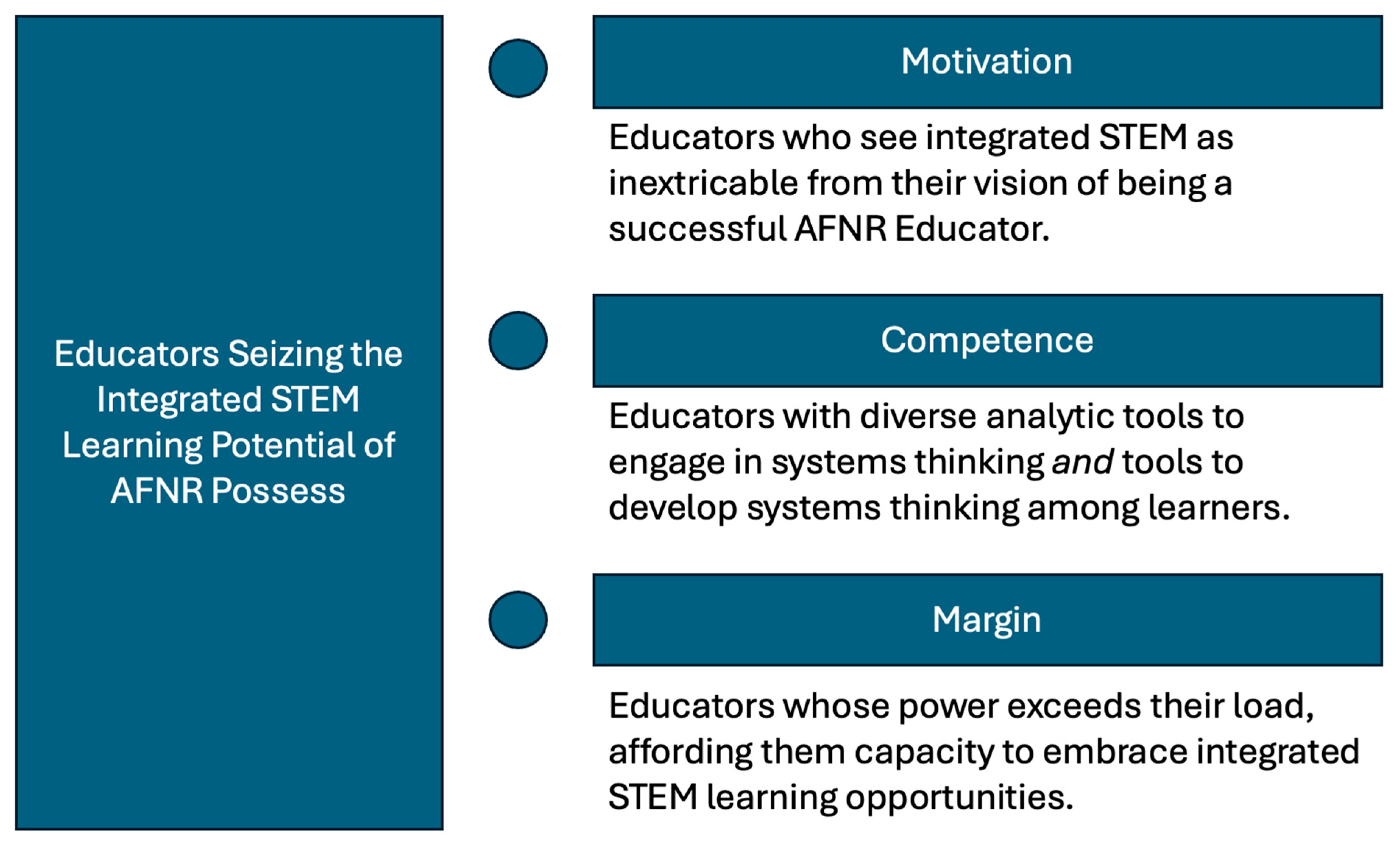
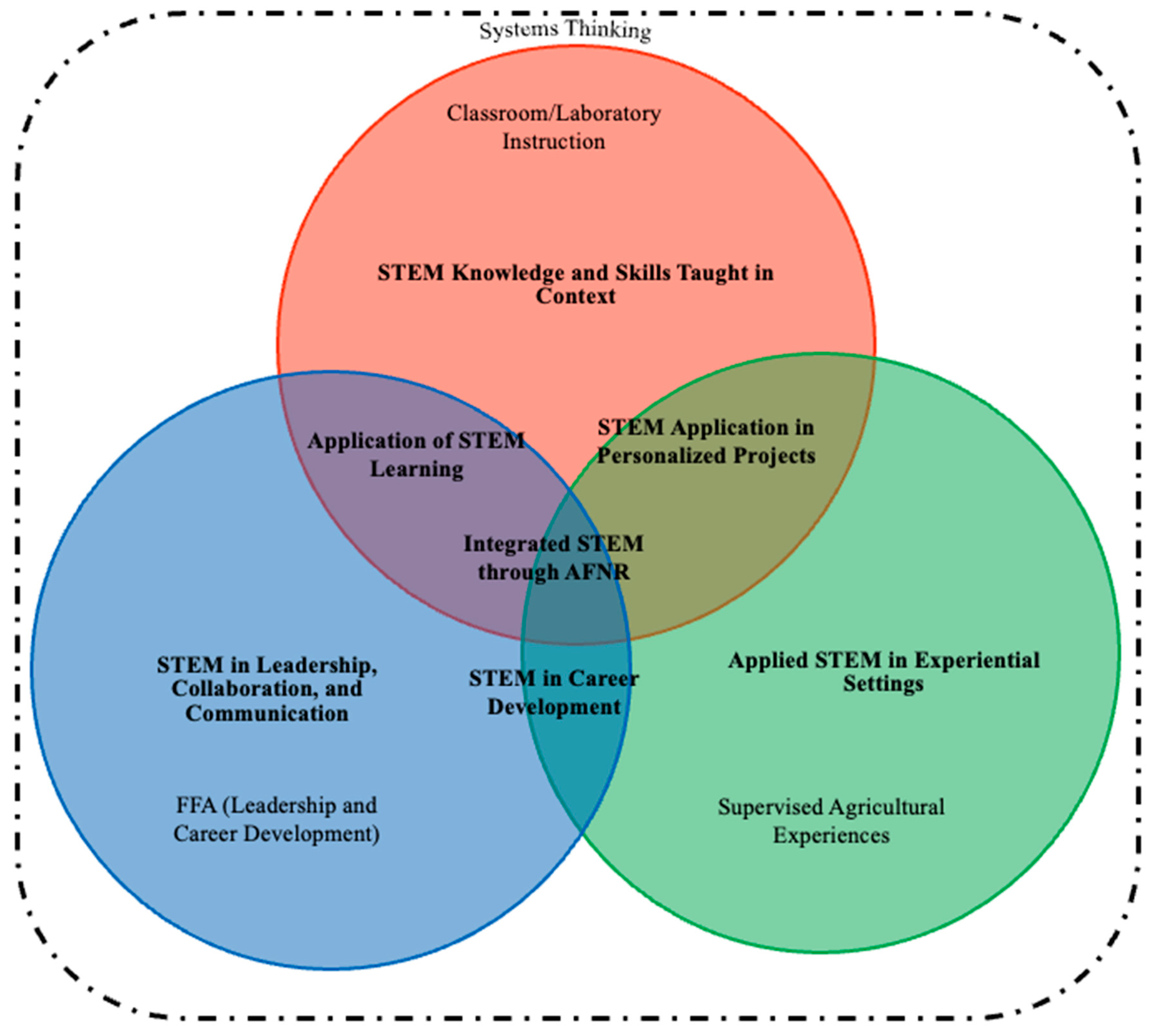
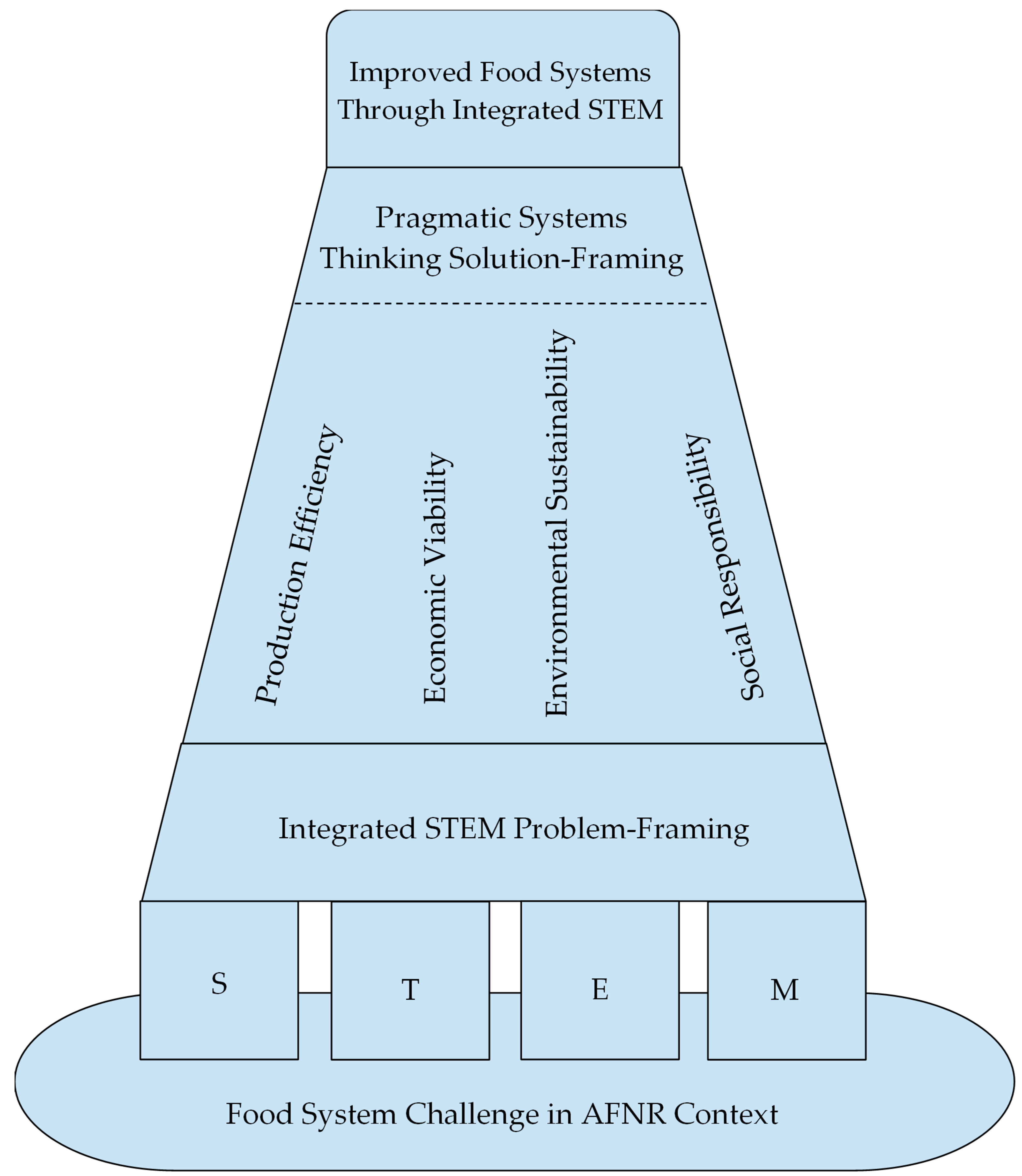
A Systems Thinking Approach to Integrated STEM in School-Based Agricultural Education





Abstract
1. Introduction
2. Theoretical Framework and Literature Review
2.1. Systems Thinking
2.2. Integrated STEM
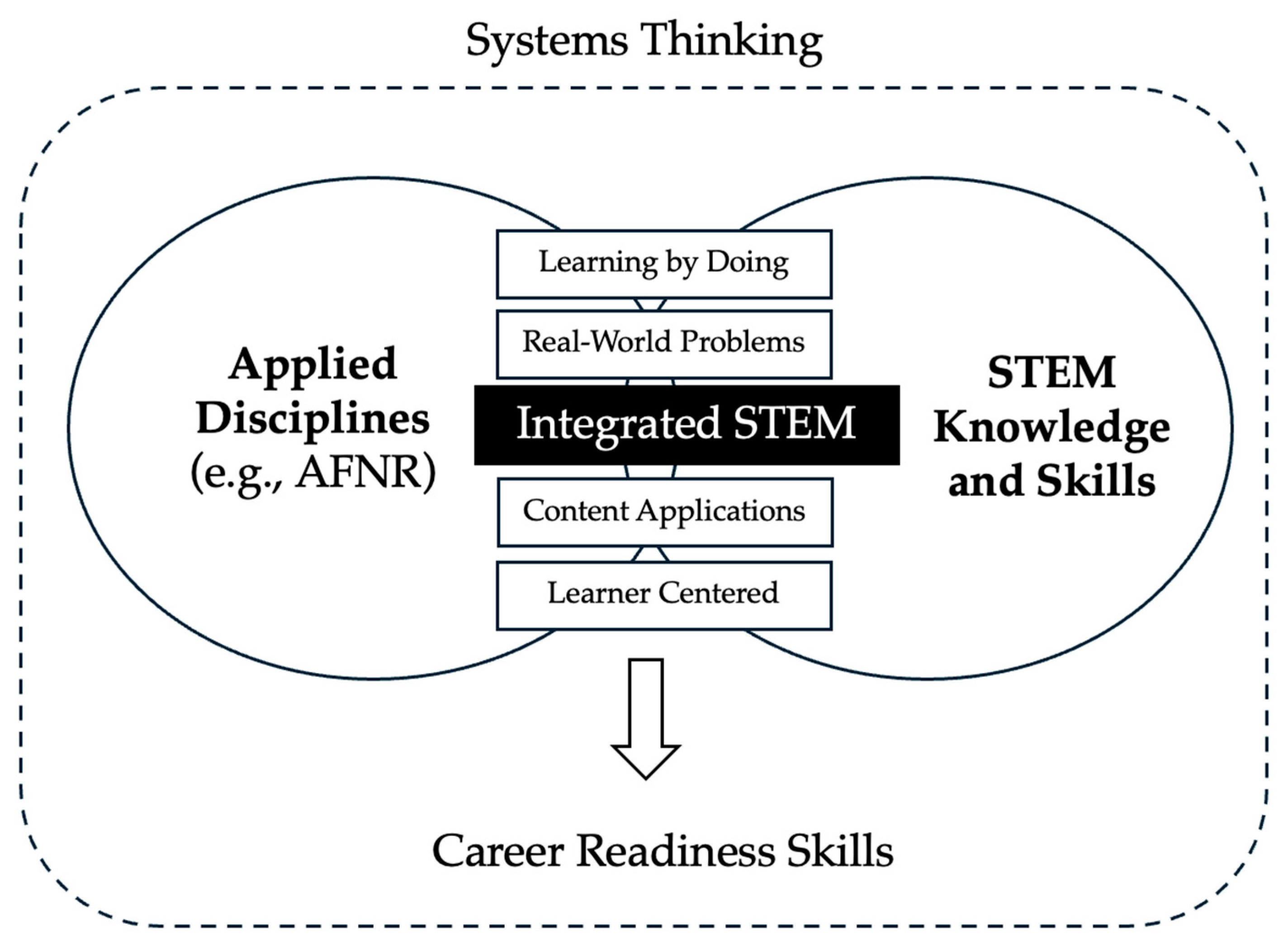
Integrated STEM education is intentionally and purposively blending multiple disciplines (i.e., academic and vocational) to help students meaningfully learn and apply academic content through real-world problems framed in designed complex systems and grounded in career and technical contexts that facilitate multidisciplinary, interdisciplinary, or transdisciplinary learning for the development of life-long and workforce development connections and skills.(Wang & Knobloch, 2023, p. 253)
2.2.1. Learning by Doing
2.2.2. Solving Real-World Problems
2.2.3. Application of Content Knowledge in Out-of-School and Community-Based Settings
2.2.4. Learner-Centered Pedagogies
2.2.5. Development of Career Readiness Skills for the Workforce
2.3. Linking Theoretical and Conceptual Models
2.4. AFNR as the Integration Catalyst for STEM
3. Methods and Analysis
4. Findings, Discussion, and Limitations
4.1. Teacher Model for Integrated STEM in SBAE
4.2. Program Model for Integrated STEM in SBAE
4.3. Learning Process Model for Integrated STEM Through AFNR
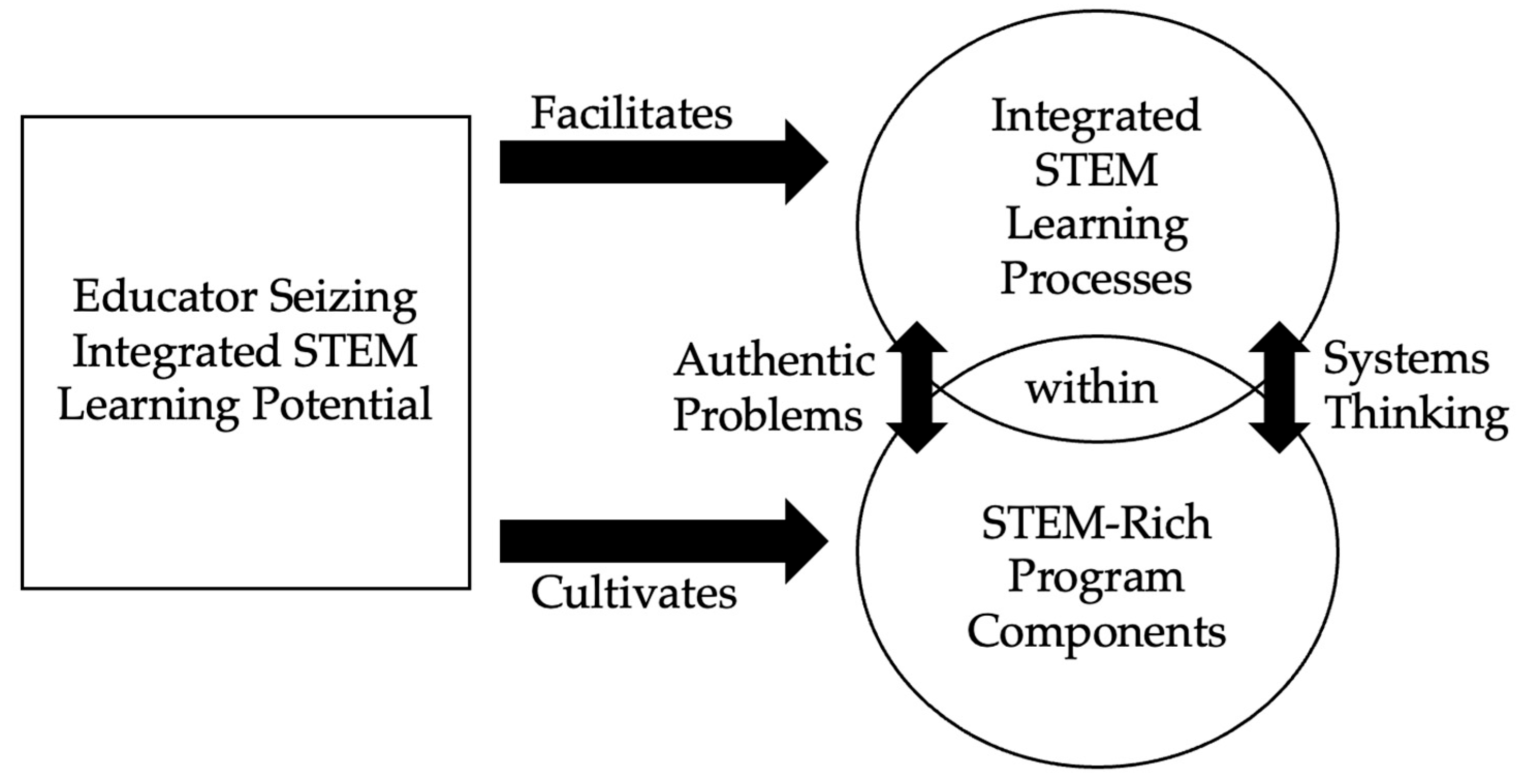
4.4. Conceptual Diagram Linking the Models
5. Implications for Career and Technical Education
5.1. Teacher Model Applied to Broader CTE
5.2. Program Model Applied to Broader CTE
5.3. Learning Process Model Applied to Broader CTE
6. Conclusions and Future Directions for Research
Author Contributions
Funding
Institutional Review Board Statement
Informed Consent Statement
Data Availability Statement
Conflicts of Interest
Abbreviations
| AFNR | Agriculture, Food and Natural Resources |
| CTE | Career and Technical Education |
| CTSO | Career and Technical Student Organization |
| SBAE | School-based Agricultural Education |
| STEM | Science, Technology, Engineering, and Mathematics |
| TPCP | Teacher, Program, and Learning Process |
References
- Advance CTE. (2013). CTE is your STEM strategy. Available online: https://careertech.org/ (accessed on 25 September 2025).
- Advance CTE. (2023). The national career Clusters® framework. Available online: https://careertech.org/career-clusters/ (accessed on 25 September 2025).
- Advance CTE. (2024). Career clusters pathways to college and career readiness guidebook: The modernized national career Clusters® framework. Available online: https://careertech.org/resource/guidebook-modernized-national-career-clusters-framework/ (accessed on 25 September 2025).
- Agunga, R., Connors, J. J., & Chen, H. Y. (2005). A study of the Ohio State University College of food, agricultural, and environmental sciences’ ecological-paradigm model. NACTA Journal, 49, 2–10. [Google Scholar]
- Albritton, M. C., & Roberts, T. G. (2020). Agricultural technical skills needed by entry level agriculture teachers: A modified Delphi study. Journal of Agricultural Education, 61(1), 140–151. [Google Scholar] [CrossRef]
- Alston, J. M., & Pardey, P. G. (2014). Agriculture in the global economy. Journal of Economic Perspectives, 28(1), 121–146. [Google Scholar] [CrossRef]
- Arnold, R. D., & Wade, J. P. (2015). A definition of systems thinking: A systems approach. Procedia Computer Science, 44, 669–678. [Google Scholar] [CrossRef]
- Association of Public and Land-Grant Universities [APLU]. (2017). The challenge of change harnessing university discovery, engagement, and learning to achieve food and nutrition security. Available online: https://www.aplu.org/our-work/2-fostering-research-innovation/challenge-of-change/#:~:text=APLU%20established%20the%20Challenge%20of,global%20food%20needs%20by%202050 (accessed on 25 September 2025).
- Asunda, P. A. (2014). A conceptual framework for STEM integration into curriculum through career and technical education. Journal of STEM Teacher Education, 49(1), 4. [Google Scholar] [CrossRef]
- Ball, A. L., & Knobloch, N. A. (2005). A document analysis of the pedagogical knowledge espoused in agriculture teaching methods courses. Journal of Agricultural Education, 46(2), 47–57. [Google Scholar] [CrossRef]
- Barak, M., & Assal, M. (2018). Robotics and STEM learning: Students’ achievements in assignments according to the P3 task taxonomy—Practice, problem solving, and projects. International Journal of Technology and Design Education, 28(1), 121–144. [Google Scholar] [CrossRef]
- Barrick, R. K. (1989). Agricultural education: Building upon our roots. Journal of Agricultural Education, 30(4), 24–29. [Google Scholar] [CrossRef]
- Batie, S. S. (2008). Wicked problems and applied economics. American Journal of Agricultural Economics, 90(5), 1176–1191. [Google Scholar] [CrossRef]
- Charoenmuang, M., Knobloch, N. A., & Scherer, H. H. (2024). High-school students’ demonstration of systems thinking in the context of sustainable food systems. Food, Culture & Society, 28(5), 1151–1169. [Google Scholar] [CrossRef]
- Cho, Y. H., Caleon, I. S., & Kapur, M. (2015). Authentic problem solving and learning for twenty-first century learners. In Authentic problem solving and learning in the 21st century (pp. 3–16). Education Innovation Series. Springer. [Google Scholar] [CrossRef]
- Coleman, B., Bunch, J., & Roberts, T. G. (2024). Experiential learning in agricultural education: A philosophical discussion. Journal of Agricultural Education, 65(1), 283–302. [Google Scholar] [CrossRef]
- Curriculum for Agricultural Science Education [CASE]. (2025). Curriculum for agricultural science education. Available online: https://www.case4learning.org/curriculum/benefits-of-case-courses/ (accessed on 25 September 2025).
- Danielson, R. W., Grace, E., White, A. J., Kelton, M. L., Owen, J. P., Saba Fisher, K., Martinez, A. D., & Mozo, M. (2022). Facilitating systems thinking through arts-based STEM integration. Frontiers in Education, 7, 915333. [Google Scholar] [CrossRef]
- Dentoni, D., Bitzer, V., & Schouten, G. (2018). Harnessing wicked problems in multi-stakeholder partnerships. Journal of Business Ethics, 150(2), 333–356. [Google Scholar] [CrossRef]
- Dyer, J. E., & Osborne, E. W. (1995). Participation in supervised agricultural experience programs: A synthesis of research. Journal of Agricultural Education, 36(1), 6–14. [Google Scholar] [CrossRef]
- Eck, C. J., Rankin, K. R. L., III, & Robinson, J. S. (2023). Purposeful STEM integration in school-based agricultural education programs. Journal of Research in Technical Careers, 7(2), 57. [Google Scholar] [CrossRef]
- Eck, C. J., Robinson, J. S., Cole, K. L., Terry, R., Jr., & Ramsey, J. W. (2020). Validation of the effective teaching instrument for school-based agricultural education teachers. Journal of Agricultural Education, 61(4), 229–248. [Google Scholar] [CrossRef]
- Edgerton, A. K. (2022). Strengthening career and technical education for the 21st century act (Perkins V): A primer. CRS report R47071, version 3. Congressional Research Service.
- Eoyang, G. H., & Holladay, R. J. (2013). Adaptive action: Leveraging uncertainty in your organization. Stanford Business Books. [Google Scholar]
- Ferraro, F., Etzion, D., & Gehman, J. (2015). Tackling grand challenges pragmatically: Robust action revisited. Organization Studies, 36(3), 363–390. [Google Scholar] [CrossRef]
- Forrester, J. W. (1994). System dynamics, systems thinking, and soft OR. System Dynamics Review, 10(2–3), 245–256. [Google Scholar] [CrossRef]
- Gaffney, J., Bing, J., Byrne, P. F., Cassman, K. G., Ciampitti, I., Delmer, D., Habben, J., Lafitte, H. R., Lidstrom, U. E., Porter, D. O., Sawyer, J. E., Schussler, J., Setter, T., Sharp, R. E., Vyn, T. J., & Warner, D. (2019). Science-based intensive agriculture: Sustainability, food security, and the role of technology. Global Food Security, 23, 236–244. [Google Scholar] [CrossRef]
- Gao, X., Li, P., Shen, J., & Sun, H. (2020). Reviewing assessment of student learning in interdisciplinary STEM education. International Journal of STEM Education, 7(1), 24. [Google Scholar] [CrossRef]
- Han, J. H., Kelley, T. R., & Knowles, J. G. (2022). Building a sustainable model of integrated stem education: Investigating secondary school stem classes after an integrated stem project. International Journal of Technology and Design Education, 33(4), 1499–1523. [Google Scholar] [CrossRef]
- Hedges, L. E. (1996). Teaching for connection: Critical thinking skills, problem solving, and academic and occupational competencies. Lesson plans. Ohio Agricultural Education Curriculum Materials. The Ohio State University. [Google Scholar]
- Herschbach, D. R. (2011). The STEM initiative: Constraints and challenges. Journal of STEM Teacher Education, 48(1), 96–122. [Google Scholar] [CrossRef]
- Hoffman, J., Pelzer, P., Albert, L., Béneker, T., Hajer, M., & Mangnus, A. (2021). A futuring approach to teaching wicked problems. Journal of Geography in Higher Education, 45(4), 576–593. [Google Scholar] [CrossRef]
- Jagger, C. (2023). Learning as problem solving. In M. Susie Whittington, R. Rudd, & J. Elliot (Eds.), The art and science of teaching agriculture: Four keys to dynamic learning (Chapter 4). Virginia Tech University Libraries Pressbooks. [Google Scholar]
- Johnson, C. C., & Czerniak, C. M. (2023). Interdisciplinary Approaches and Integrated STEM in Science Teaching. In Handbook of research on science education (pp. 559–585). Routledge. [Google Scholar] [CrossRef]
- Jordan, M. E., Kleinsasser, R. C., & Roe, M. F. (2014). Wicked problems: Inescapable wickedity. Journal of Education for Teaching, 40(4), 415–430. [Google Scholar] [CrossRef]
- Junkins, H. D. (2000). The influence of participation in secondary agriculture activities on post-secondary pursuits of agriculture students in West Virginia [Master’s thesis, West Virginia University]. Available online: https://researchrepository.wvu.edu/etd/10464 (accessed on 25 September 2025).
- Jurdak, M. (2016). STEM education as a context for real-world problem solving. In Learning and teaching real world problem solving in school mathematics (pp. 151–163). Springer. [Google Scholar] [CrossRef]
- Kelley, T. R., & Knowles, J. G. (2016). A conceptual framework for integrated stem education. International Journal of STEM Education, 3(1), 11. [Google Scholar] [CrossRef]
- Kelley, T. R., Knowles, J. G., Holland, J. D., & Han, J. (2020). Increasing high school teachers self-efficacy for integrated STEM instruction through a collaborative community of practice. International Journal of STEM Education, 7, 14. [Google Scholar] [CrossRef]
- Kennedy, T. J., & Odell, M. R. L. (2014). Engaging students in STEM education. Science Education International, 25(3), 246–258. [Google Scholar]
- Kennedy, T. J., & Odell, M. R. L. (2023). STEM Education as a Meta-discipline. In B. Akpan, B. Cavas, & T. Kennedy (Eds.), Contemporary issues in science and technology education (Vol. 56, pp. 37–51). Contemporary Trends and Issues in Science Education. Springer. [Google Scholar] [CrossRef]
- Knobloch, N. A. (2003). Is experiential learning authentic? Journal of Agricultural Education, 44(4), 22–34. [Google Scholar] [CrossRef]
- Knobloch, N. A. (2008). Factors of teacher beliefs related to integrating agriculture into elementary school classrooms. Agriculture & Human Values, 25, 529–539. [Google Scholar] [CrossRef]
- Knobloch, N. A. (2021). Learner-centered teaching modules. National Learner-Centered Teaching Partnership. Available online: https://sites.google.com/view/learnercenteredteaching/lct-modules (accessed on 25 September 2025).
- Knobloch, N. A., & Ball, A. L. (2006, April 7–11). Analyzing the contextual, motivational, and conceptual characteristics of teaching faculty in regard to the use of learner centered approaches to teaching. The Annual Meeting of the American Education Research Association, San Francisco, CA, USA. [Google Scholar]
- Knobloch, N. A., & Smith, M. (2024). Experiential learning in school-based agricultural education. In R. K. Barrick, & A. C. Thoron (Eds.), Emerging research in agricultural teacher education (pp. 98–121). IGI Global. [Google Scholar] [CrossRef]
- Knobloch, N. A., & Wang, H. H. (2024). Integrated STEM in school-based agricultural education. In R. K. Barrick, & A. C. Thoron (Eds.), Emerging research in agricultural teacher education (pp. 227–248). IGI Global. [Google Scholar] [CrossRef]
- Krathwohl, D. R. (2002). A revision of bloom’s taxonomy: An overview. Theory Into Practice, 41(4), 212–218. [Google Scholar] [CrossRef]
- Lake, D. (2015). Local food innovation in a world of wicked problems: The pitfalls and the potential. Journal of Agriculture, Food Systems, and Community Development, 5, 13–26. [Google Scholar] [CrossRef][Green Version]
- Land, M. H. (2013). Full STEAM ahead: The benefits of integrating the arts into STEM. Procedia Computer Science, 20, 547–552. [Google Scholar] [CrossRef]
- Leischow, S. J., & Milstein, B. (2006). Systems thinking and modeling for public health practice. American Journal of Public Health, 96(3), 403–405. [Google Scholar] [CrossRef]
- Lin, C., Lee, H., Wang, W., Huang, Y., & Wu, T. (2024). Enhancing reflective thinking in stem education through experiential learning: The role of generative ai as a learning aid. Education and Information Technologies, 30(5), 6315–6337. [Google Scholar] [CrossRef]
- Lönngren, J., & Poeck, K. V. (2020). Wicked problems: A mapping review of the literature. International Journal of Sustainable Development & World Ecology, 28(6), 481–502. [Google Scholar] [CrossRef]
- Maass, K., Geiger, V., Ariza, M. R., & Goos, M. (2019). The role of mathematics in interdisciplinary STEM education. Zdm, 51(6), 869–884. [Google Scholar] [CrossRef]
- McCune, V., Tauritz, R., Boyd, S., Cross, A., Higgins, P., & Scoles, J. (2021). Teaching wicked problems in higher education: Ways of thinking and practising. Teaching in Higher Education, 28(7), 1518–1533. [Google Scholar] [CrossRef]
- McDonald, K. S., & Waite, A. M. (2019). Future directions: Challenges and solutions facing career readiness and development in STEM fields. Advances in Developing Human Resources, 21(1), 133–138. [Google Scholar] [CrossRef]
- McKibben, J. D., & Murphy, T. H. (2021). The effect of authenticity on project-based learning: A quasi-experimental study of STEM integration in agriculture. Journal of Agricultural Education, 62(1), 144–155. [Google Scholar] [CrossRef]
- McKim, A. J., Goodwin, C., Haddad, B., Sorensen, T., Traini, H., & Marzolino, T. (2024). The donut model for agriculture teacher success: A model for theory and practice. Journal of Agricultural Education, 65(3), 225–240. [Google Scholar] [CrossRef]
- McKim, A. J., & McKim, L. K. (2023). Enhancing professional development by increasing agriculture teacher margin. Journal of Agricultural Education, 64(3), 16–25. [Google Scholar] [CrossRef]
- McKim, A. J., Sorensen, T., Goodwin, C., & Ware Wilkinson, S. (2025). Exploring exemplary STEM lessons in agricultural education. Journal of Agricultural Education, 66(2), 4. [Google Scholar] [CrossRef]
- McKim, A. J., Velez, J. J., Lambert, M. D., & Balschweid, M. A. (2017). A philosophical review of science and society within agricultural education. Journal of Agricultural Education, 58(2), 98–110. [Google Scholar] [CrossRef]
- McLure, F., Tang, K., & Williams, P. J. (2022). What do integrated stem projects look like in middle school and high school classrooms? A systematic literature review of empirical studies of iSTEM projects. International Journal of STEM Education, 9(1), 73. [Google Scholar] [CrossRef]
- Meadows, D. (2008). Thinking in systems: International bestseller. Chelsea Green Publishing. [Google Scholar]
- Miller, J. D. (2010). The conceptualization and measurement of civic scientific literacy for the twenty-first century. In J. Meinwald, & J. G. Hildebrand (Eds.), Science and the educated American: A core component of liberal education. American Academy of Arts and Sciences. [Google Scholar]
- Moore, K., & Yulianti, K. (2014). Preparedness to deliver integrated STEM curricula: Establishing a baseline in four Indonesian high schools. Journal of Education and Technology, 1(1), 49–67. [Google Scholar]
- Moore, T. J., Johnston, A. C., & Glancy, A. W. (2020). STEM integration: A synthesis of conceptual frameworks and definitions. In Handbook of research on STEM education (pp. 3–16). Routledge. [Google Scholar]
- Mulder, M. (2012). Interdisciplinarity and education: Towards principles of pedagogical practice. The Journal of Agricultural Education and Extension, 18(5), 437–442. [Google Scholar] [CrossRef]
- Murakami, C. D., Hendrickson, M., & Siegel, M. A. (2016). Sociocultural tensions and wicked problems in sustainable agriculture education. Agriculture and Human Values, 34(3), 591–606. [Google Scholar] [CrossRef]
- Mustafa, N., Ismail, Z., Tasir, Z., & Mohamad Said, M. N. H. (2016). A meta-analysis on effective strategies for integrated STEM education. Advanced Science Letters, 22(12), 4225–4288. [Google Scholar] [CrossRef]
- National Academies of Sciences, Engineering, and Medicine [NASEM]. (2016). Developing a national STEM workforce strategy: A workshop summary. The National Academies Press. [Google Scholar] [CrossRef]
- National Council for Agricultural Education. (2025). Career clusters. Available online: https://www.thencae.org/career-clusters (accessed on 25 September 2025).
- National Research Council [NRC]. (2009). Transforming agricultural education for a changing world. National Academies Press. [Google Scholar]
- NGSS Leader States. (2013). Next generation science standards: For states, by states. National Academics Press. [Google Scholar]
- Norris, W., & Roberts-Hill, L. (2024). Meaningful skills for the agricultural workforce: Assessing the confidence levels of agricultural educators to integrate STEM into their curriculum. Journal of Southern Agricultural Education Research, 74(1), 47–72. [Google Scholar]
- Norris, W., Swortzel, K. A., McCubbins, O., VanLeeuwen, D., & Edgar, D. W. (2024). Keeping agricultural education relevant for the 21st century: Assessing the perceptions of local CTE administration on STEM skills integration. Journal of Agricultural Education, 65(1), 40–57. [Google Scholar] [CrossRef]
- Ntaganzwa, O. (2024). Predicting high school students’ situated expectancy-value motivation regarding food system STEM projects [Master’s thesis, Purdue University Graduate School]. [Google Scholar] [CrossRef]
- Odum, H. T., & Odum, E. C. (2001). A prosperous way down. University Press of Colorado. [Google Scholar]
- Orr, D. W. (2011). Hope is an imperative: The essential David Orr. Island Press. [Google Scholar]
- Öztürk, N., & Roehrig, G. (2024). Effects of an integrated stem unit designed around socioscientific issues on middle school students’ socioscientific reasoning. International Journal of Science and Mathematics Education, 23(5), 1493–1518. [Google Scholar] [CrossRef]
- Park, T. D. (2024). Integral nature of instruction, FFA, and SAE in agricultural education. Memorandum from The Council. Available online: https://ffa.app.box.com/s/tn9enh19lciw74oibwr6eqh77nij5ild (accessed on 25 September 2025).
- Pohl, C., & Hadorn, G. H. (2008). Core terms in transdisciplinary research. In G. Hirsch Hadorn, H. Hoffmann-Riem, S. Biber-Klemm, W. Grossenbacher-Mansuy, D. Joye, C. Pohl, U. Wiesmann, & E. Zemp (Eds.), Handbook of transdisciplinary research (pp. 427–432). Springer. [Google Scholar]
- Ponto, C. F., & Linder, N. P. (2011). Sustainable tomorrow: A teachers’ guidebook for applying systems thinking to environmental education curricula. Association of Fish & Wildlife Agencies. [Google Scholar]
- Rasty, J., & Anderson, R. (2025). The importance of agricultural mechanics skills training: Implications for agricultural educators. Journal of Agricultural Systems, Technology, and Management, 36(1). Available online: https://jastm.org/index.php/jastm/article/view/11453 (accessed on 25 September 2025).
- Roberts, T. G. (2006). A philosophical examination of experiential learning theory for agricultural educators. Journal of Agricultural Education, 47(1), 17–29. [Google Scholar] [CrossRef]
- Roberts, T. G., & Ball, A. L. (2009). Secondary agricultural science as content and context for teaching. Journal of Agricultural Education, 50(1), 81–91. [Google Scholar] [CrossRef]
- Robinson, K., Westfall-Rudd, D., Drape, T., & Scherer, H. (2018). Conceptualizing integrative agricultural education: Introductory framework for integrating mathematics in agricultural curriculum. Journal of Agricultural Education, 59(4), 253–269. [Google Scholar] [CrossRef]
- Rodrigues Barbosa, M., Rafael de Almeida Moreira, B., Santos Carreira, V. D., Lopes de Brito Filho, A., Trentin, C., Pereira de Souza, F. L., Tedesco, D., Setiyono, T., Flores, J. P., Ampatzidis, Y., Pereira da Silva, R., & Shiratsuchi, L. S. (2024). Precision agriculture in the United States: A comprehensive meta-review inspiring further research, innovation, and adoption. Computers and Electronics in Agriculture, 221, 108993. [Google Scholar] [CrossRef]
- Roehrig, G., Dare, E. A., Ellis, J. A., & Ring-Whalen, E. (2021). Beyond the basics: A detailed conceptual framework of integrated STEM. Disciplinary and Interdisciplinary Science Education Research, 3(1), 11. [Google Scholar] [CrossRef]
- Ryu, M., Mentzer, N., & Knobloch, N. (2018). An examination of preservice teachers’ learning of STEM integration: Implications for integrated STEM teacher preparation. International Journal of Science Education, 29(3), 493–512. [Google Scholar] [CrossRef]
- Scherer, H. H., & Azano, A. P. (2025). Storying the FEW nexus: A framework for cultivating place-based integrated STEM education in rural schools. Education Sciences, 15(6), 744. [Google Scholar] [CrossRef]
- Scherer, H. H., McKim, A. J., Wang, H. H., DiBenedetto, C. A., & Robinson, K. (2019). Making sense of the buzz: A systematic review of STEM in agriculture, food and natural resources literature. Journal of Agricultural Education, 60(2), 28–53. [Google Scholar] [CrossRef]
- Schweingruber, H., Pearson, G., & Honey, M. (Eds.). (2014). STEM integration in K-12 education: Status, prospects, and an agenda for research. The National Academies Press. [Google Scholar] [CrossRef]
- Skaburskis, A. (2008). The origin of “wicked problems”. Planning Theory & Practice, 9(2), 277–280. [Google Scholar] [CrossRef]
- Smit, J., Chisari, L. B., Kouns, M., Oyehaug, A. B., Savelsbergh, E., & Hajer, M. (2023). Inclusive STEM teaching from a language perspective: Teacher learning in a professional development program. European Journal of STEM Education, 8(1), 7. [Google Scholar] [CrossRef] [PubMed]
- Smith, K. L., Rayfield, J., & McKim, B. R. (2015). Effective practices in STEM integration: Describing teacher perceptions and instructional method use. Journal of Agricultural Education, 56(4), 182–201. [Google Scholar] [CrossRef]
- Stohlmann, M. (2019). Three modes of STEM integration for middle school mathematics teachers. School Science and Mathematics, 119(5), 287–296. [Google Scholar] [CrossRef]
- Stohlmann, M., Moore, T. J., & Roehrig, G. H. (2012). Considerations for teaching integrated STEM education. Journal of Pre-College Engineering Education Research (J-PEER), 2(1), 4. [Google Scholar] [CrossRef]
- Stroh, D. P. (2015). Systems thinking for social change: A practical guide to solving complex problems, avoiding unintended consequences, and achieving lasting results. Chelsea Green Publishing. [Google Scholar]
- Stubbs, E. A., & Myers, B. E. (2015). Multiple case study of STEM in school-based agricultural education. Journal of Agricultural Education, 56(2), 188–203. [Google Scholar] [CrossRef]
- Stubbs, E. A., & Myers, B. E. (2016). Part of what we do: Teacher perceptions of STEM integration. Journal of Agricultural Education, 57(3), 87–100. [Google Scholar] [CrossRef]
- Subramaniam, S., Akay, M., Anastasio, M. A., Bailey, V., Boas, D., Bonato, P., Chilkoti, A., Cochran, J. R., Colvin, V., Desai, T. A., Duncan, J. S., Epstein, F. H., Fraley, S., Giachelli, C., Grande-Allen, K. J., Green, J., Guo, X. E., Hilton, I. B., Humphrey, J. D., … Miller, M. I. (2024). Grand challenges at the interface of engineering and medicine. IEEE Open Journal of Engineering in Medicine and Biology, 5, 1–13. [Google Scholar] [CrossRef] [PubMed]
- Swafford, M. (2017). STEM education at the nexus of the 3-circle model. Journal of Agricultural Education, 59(1), 297–315. [Google Scholar] [CrossRef]
- Swafford, M. (2018). The state of the profession: STEM in agricultural education. Journal of Agricultural Education, 59(4), 315–333. [Google Scholar] [CrossRef]
- Talbert, B. A., Croom, B., LaRose, S. E., Vaughn, R., & Lee, J. S. (2022). Foundations of agricultural education. Purdue University Press. [Google Scholar]
- Thibaut, L., Ceuppens, S., De Loof, H., De Meester, J., Goovaerts, L., Struyf, A., Boeve-de Pauw, J., Dehaene, W., Deprez, J., & De Cock, M. (2018). Integrated STEM education: A systematic review of instructional practices in secondary education. European Journal of STEM Education, 3(1), 2. [Google Scholar] [CrossRef] [PubMed]
- Thies, S. L., Knobloch, N. A., Wang, H. H., & Nelson, B. J. (2024). High school students’ motivation regarding an integrated STEM food system project. NACTA Journal, 68, 107–118. [Google Scholar] [CrossRef]
- Traini, H. Q., Goodwin, C., Priest, K., & Haddad, B. (2025). Leaning into the AAAE values: Theoretical frameworks for systems-oriented paradigms. Journal of Agricultural Education, 66(3), 12. [Google Scholar] [CrossRef]
- Wang, H. H., & Knobloch, N. A. (2020). Preservice educators’ beliefs and practices of teaching STEM through agriculture, food, and natural resources. Journal of Agricultural Education, 61(2), 57–76. [Google Scholar] [CrossRef]
- Wang, H. H., & Knobloch, N. A. (2022). An action research study of levels of STEM integration through agriculture, food and natural resources. Journal of Pedagogical Research, 6(2), 4–25. [Google Scholar]
- Wang, H. H., & Knobloch, N. A. (2023). K-12 teachers’ beliefs and practices in STEM integration. In R. J. Tierney, F. Rizvi, & K. Erkican (Eds.), International encyclopedia of education (Vol. 11). Elsevier. [Google Scholar] [CrossRef]
- Warnick, B. K., Thompson, G. W., & Gummer, E. S. (2004). Perceptions of science teachers regarding the integration of science into the agricultural education curriculum. Journal of Agricultural Education, 45(1), 62–73. [Google Scholar] [CrossRef]
- Weick, K. E. (2020). Sensemaking, organizing, and surpassing: A handoff. Journal of Management Studies, 57(7), 1420–1431. [Google Scholar] [CrossRef]
- Weick, K. E., Sutcliffe, K. M., & Obstfeld, D. (2009). Organizing and the process of sensemaking. In K. E. Weick (Ed.), Making sense of the organization, volume 2: The impermanent organization. John Wiley & Sons, Incorporated. ProQuest Ebook Central. Available online: https://ebookcentral.proquest.com/lib/purdue/detail.action?docID=698410 (accessed on 25 September 2025).
- Weingart, P. (2010). A short history of knowledge formations. In R. Frodeman, J. T. Klein, & C. Mitcham (Eds.), The Oxford handbook of interdisciplinarity (pp. 3–14). Oxford University Press. [Google Scholar]
- Wells, J. G. (2019). STEM education: The potential of technology education. In M. K. Daugherty, & V. Carter (Eds.), The 62nd yearbook of the Mississippi Valley conference in the 21st century: Fifteen years of influence on thought and practice (pp. 195–229). Council on Technology and Engineering Teacher Education. [Google Scholar]
- Whyte, K. P., & Thompson, P. Β. (2011). Ideas for how to take wicked problems seriously. Journal of Agricultural and Environmental Ethics, 25(4), 441–445. [Google Scholar] [CrossRef]
- Wilson, C. A., Akridge, J. T., Brewer, B. E., Martin, S. S., & Strine, J. L. (2025). Employment opportunities for college graduates in food, agriculture, renewable natural resources and the environment—United States, 2025–2030. United States Department of Agriculture National Institute for Food and Agriculture. Available online: https://www.purdue.edu/usda/employment/ (accessed on 25 September 2025).
- Worosz, M. R. (2022). Transdisciplinary research for wicked problems. Agriculture and Human Values, 39(4), 1185–1189. [Google Scholar] [CrossRef]
- Zellner, M., & Campbell, S. D. (2015). Planning for deep-rooted problems: What can we learn from aligning complex systems and wicked problems? Planning Theory & Practice, 16(4), 457–478. [Google Scholar] [CrossRef]


Disclaimer/Publisher’s Note: The statements, opinions and data contained in all publications are solely those of the individual author(s) and contributor(s) and not of MDPI and/or the editor(s). MDPI and/or the editor(s) disclaim responsibility for any injury to people or property resulting from any ideas, methods, instructions or products referred to in the content. |
© 2026 by the authors. Licensee MDPI, Basel, Switzerland. This article is an open access article distributed under the terms and conditions of the Creative Commons Attribution (CC BY) license.
Share and Cite
Knobloch, N.A.; Eck, C.J.; McKim, A.J.; Wang, H.-H. A Systems Thinking Approach to Integrated STEM in School-Based Agricultural Education. Educ. Sci. 2026, 16, 253. https://doi.org/10.3390/educsci16020253
Knobloch NA, Eck CJ, McKim AJ, Wang H-H. A Systems Thinking Approach to Integrated STEM in School-Based Agricultural Education. Education Sciences. 2026; 16(2):253. https://doi.org/10.3390/educsci16020253
Chicago/Turabian StyleKnobloch, Neil A., Christopher J. Eck, Aaron J. McKim, and Hui-Hui Wang. 2026. "A Systems Thinking Approach to Integrated STEM in School-Based Agricultural Education" Education Sciences 16, no. 2: 253. https://doi.org/10.3390/educsci16020253
APA StyleKnobloch, N. A., Eck, C. J., McKim, A. J., & Wang, H.-H. (2026). A Systems Thinking Approach to Integrated STEM in School-Based Agricultural Education. Education Sciences, 16(2), 253. https://doi.org/10.3390/educsci16020253