1. Introduction
The global issue of teacher shortages has prompted higher education research to examine the reasons for teacher attrition and strategies to enhance retention (e.g.,
Brandenburg et al., 2024;
Cuervo & Vera-Toscano, 2025). In Australia, the context of this study, the teacher workforce crisis mirrors that in the United Kingdom, Canada, and the United States (
Dawborn-Gundlach, 2025). Across these English-speaking education systems, teacher shortages are concentrated in hard-to-staff schools and regional and remote locations and have prompted policy emphasis on recruitment and retention alongside alternative/accelerated tertiary pathways. EBPs have emerged as a shared policy response, raising questions about how such pathways shape PSTs’ belonging, wellbeing, and persistence. At the policy level, teacher attraction and retention have become priorities (
OECD, 2024), particularly for attracting and retaining teachers, especially those from diverse cultural and demographic backgrounds, in high-needs schools (
Dawborn-Gundlach, 2025;
Mills et al., 2024). A key policy response to these workforce challenges has been employment-based pathways (EBPs), which serve as alternatives to traditional initial teacher education (ITE) pathways (
White et al., 2025). EBPs are often underpinned by the belief that schools are the preferred sites for learning to teach as they address issues related to the theory–practice nexus (
White et al., 2025).
The success of EBPs in Australia is difficult to gauge because many initiatives remain relatively new. While there is some international research on well-established programs such as the “Teach for All” network, the success of these EBPs in retaining teachers and deploying them to hard-to-staff schools, particularly in Australia, remains questionable (
Varadharajan & Buchanan, 2021). This paper responds to
Dawborn-Gundlach’s (
2025) call for further investigation of the impact of EBPs on teacher effectiveness and retention. It explores how pre-service teachers’ (PSTs) participation in an EBP influences their sense of belonging to the university, course, profession, and community in geographically isolated areas. The key questions that shape this research are:
RQ1: How do PSTs teaching and studying in regional and remote schools experience a sense of academic belonging to university, course, profession, and community?
RQ2: What are the factors that facilitate connection or disconnection to university, course, profession, and community belonging?
This paper addresses these two questions, drawing upon
Kahu et al.’s (
2022) conceptualisation of academic sense of belonging. The literature on EBPs is reviewed, followed by an overview of Employing Queensland: Innovative Pathways to Teaching (EQuIPT), which provides the context for this research. The methodology section describes this qualitative study of this one university EBP, the participants, data collection, and focus group data analysis, before presenting the results in response to each research question. These findings are then discussed in relation to the current state of the field. Finally, the paper concludes with recommendations and directions for future research.
2. Conceptual Framework: Academic Sense of Belonging
A sense of belonging is broadly defined as university students’ sense of being supported, connected, respected, and valued in higher education (
Goodenow, 1993;
Strayhorn, 2018). Research identifies a sense of belonging as key to university students’ overall educational experience (
Crawford et al., 2024) and to supporting retention, motivation, and wellbeing (
Ahn & Davis, 2020;
Pedler et al., 2022). While there is consensus on a broad definition of belonging, it has been investigated as a multi-dimensional concept.
Ahn and Davis (
2020) conceptualise belonging across four domains: social engagement, academic engagement, surroundings, and personal space. Similarly,
Kahu et al. (
2022) conceptualise belonging as incorporating familiarity, interpersonal belonging, and academic belonging. The social and interpersonal aspects of belonging are often foregrounded in research (
Ahn & Davis, 2020;
Pedler et al., 2022), whereas less attention is paid to understanding belonging through an academic lens, namely, a university student’s academic sense of belonging. This academic perspective is interconnected with social experiences of belonging but remains distinct; students may have positive relationships with educators and peers but remain unsure whether they belong at university or in their course.
An academic sense of belonging has been defined by
Kahu et al. (
2022) as university students’ sense of belonging in relation to their studies, chosen degree, and future career. Belonging in relation to university studies may be shaped by assessment grades, feedback, and peer learning interactions, through which they develop a sense that they can meet academic expectations in higher education. University students’ academic sense of belonging also relates to their chosen degree, potentially impacted by experiences of co-curricular activities and mentoring interactions with peers who are further along in the course. How PSTs conceive of belonging in relation to their future careers (i.e., becoming teachers) also needs to be considered. This is based on the PSTs’ view that they are on the “right” career path, influenced by professional placements or employer engagement events.
Research on academic belonging often focuses on urban university campuses (
Mulrooney & Kelly, 2021;
Thompson et al., 2025) and regular in-person/face-to-face interactions between university students and their peers and educators (
Tinto, 2022). For instance,
Tinto (
2022) states that, “Of the various experiences that shape a student’s sense of academic belonging, and there are many, none are more important than those that occur within the classrooms and laboratories of the university” (p. 58). Given this focus in the research to date, there is a need to better understand an academic sense of belonging beyond these contexts, particularly for PSTs undertaking EBPs in regional, rural, and remote (RRR) contexts, which is outside the traditional university campus and within online and asynchronous modes of learning. Recent research in Australia has found that university students’ sense of belonging in a regional campus can be enhanced through building a culture of community and support (
Duchesne et al., 2025). In RRR settings, academic belonging may also be closely tied to belonging in the local community where they live and study.
Ussher (
2016) investigated the experiences of PSTs in a distance ITE program with placements in familiar local community schools. The study reported that PSTs who already felt a sense of belonging in their local community and were familiar with their placement schools had a high course retention rate, followed by a high employment rate as teachers. Recent research in Australia has found that country university centres in RRR locations may reduce university students’ sense of isolation by providing spaces and facilities for study (
Bunn & Lumb, 2024).
Bringing these fields together, this study examines how PSTs develop a sense of belonging to their university, degree program, future profession, and local community while participating in an EBP.
3. Context: Employment-Based Pathways
In this study, an EBP is understood as a structured ITE model in which PSTs are employed in schools while completing their degrees. Unlike incidental part-time work in schools, these pathways deliberately integrate employment into program design, positioning professional practice as central to both learning and qualification (
Wyatt-Smith et al., 2022). Responsibility for learning to teach is shared across universities, schools, and communities. EBPs have historically been introduced and then reintroduced during periods of teacher shortages as a perceived “quick-fix” workforce strategy (
Lampert & Dadvand, 2024). EBPs have been critiqued as producing graduate teachers shaped to fit particular schools rather than developing a broader theoretical orientation (
Benade, 2023;
Mutton & Burn, 2024;
Tillin, 2023).
Internationally, programs such as the School-Centred Initial Teacher Training (SCITT) in the United Kingdom and Teach For America in the United States were introduced in the late 1980s to address shortages in hard-to-staff schools. Teach For America has since become part of the global Teach For All network, which includes Teach For Australia (
Teach For Australia, 2025). Despite substantial investment, they have been criticised for failing to provide long-term solutions to teacher shortages (
Varadharajan & Buchanan, 2021).
EBPs have a long history in Australian teacher education (
Aspland, 2006). In the late 19th and early 20th centuries, they were used to train pupil teachers, who worked in classrooms while earning a modest wage (
Aspland, 2006). From the late 1960s, a “professional model” of teacher education emerged, with Colleges of Advanced Education and universities offering programs that placed greater emphasis on theory and less on classroom employment (
Barcan, 1989). As a result, EBPs declined and university-led ITE became the dominant model. In Australia, ITE refers to accredited undergraduate or postgraduate university programs that combine coursework and supervised professional experience and lead to teacher registration eligibility. Nearly thirty years ago, the Senate Employment, Education and Training References Committee recommended ITE programs that embedded “practical skills … in a sound theoretical and research base” and proposed models where PSTs nearing the end of their degrees worked almost full-time in schools, with gradually declining supervision and a combined pattern of days at university and in schools (
Senate Employment, Education and Training References Committee, 1998, p. 190). This has influenced contemporary EBPs and initiatives. In 2022, the National Teacher Workforce Action Plan (
Australian Department of Education, 2022) identified teacher supply as a key priority. Proposed actions included extending the High Achieving Teachers (HAT) program, which funds EBPs in ITE. Established in 2020, the HAT program aims to support these pathways, particularly in schools experiencing persistent staffing challenges (
Australian Department of Education, 2025). It initially funded two higher education providers and has since expanded to ten.
While there have been criticisms of EBP (
Becher, 2024;
Benade, 2023;
Dawborn-Gundlach, 2025), more recent work suggests that, when the balance between theory and practice is carefully considered, EBPs can provide a valid pathway into teaching (
Kwok et al., 2023). Supported through HAT funding, EQuIPT aims to address critical shortages in RRR Queensland by enabling local and metropolitan candidates to study while working in some of the hardest-to-staff schools. EQuIPT is organised around five regional hubs across Queensland, each linked to a Regional University Study Hub (RUSH) and to clusters of selected partner schools in outer regional, remote, and very remote communities. This EBP model uses a hub structure to coordinate wrap-around academic and wellbeing support and to tailor employment pathways to local contexts. Two streams operate in each hub to create a single cohort: Stream 1 “Grow Your Own” recruits aspiring teachers who already live in hub communities, while Stream 2 “Send Our Best” supports PSTs to relocate mid-degree and move into employment roles such as teacher aides, youth support officers, or early practice roles such as Permission to Teach (PTT) positions
1. This study is part of a larger research project and only focuses on the “Send Our Best” cohort, who were all in PTT roles. Given the complexity of EBPs, a range of supports and strategies are built into the program, as outlined in
Table 1.
5. Results
In response to
RQ1—How do PSTs teaching and studying in regional and remote schools experience a sense of academic belonging to university, course, profession, and community?—
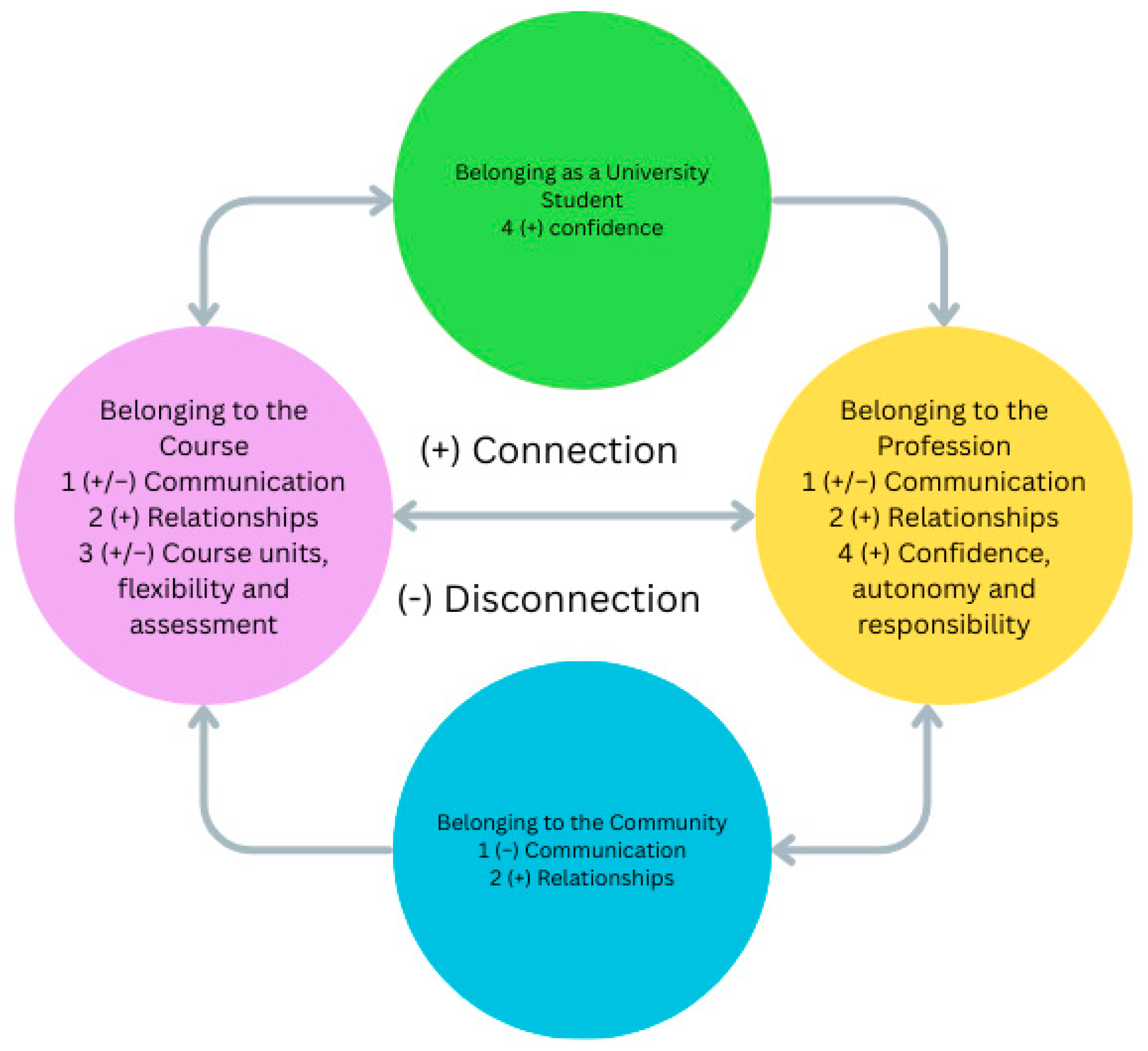
Figure 1 provides a conceptual summary of how PSTs described connections and tensions across four domains of belonging (university, course, profession, and community) and the key influences shaping those connections. The grey arrows illustrate how belonging in one domain influenced belonging in others, reflecting the reciprocal nature of belonging during early practice. The numbered labels (1–4) indicate the themes identified in the data. A plus sign indicates a perceived positive influence (connection) and a minus sign indicates a perceived negative influence (disconnection).
PSTs in this cohort who had all relocated to RRR communities reported a sense of belonging across all four domains, but not to the same extent. They described the strongest belonging to the profession, identifying themselves as teachers rather than university students and all shared pivotal moments when they felt they had “become a teacher”. In this study, we distinguish belonging to the profession (feeling accepted, supported, and recognized as a teacher within professional contexts) as a domain of an academic sense of belonging and distinctive from professional identity formation (the ongoing development of a sense of oneself as a teacher over time). Belonging to the profession may contribute to identity formation by providing affirmation and legitimacy, particularly during early practice when university/course belonging is unsettled. While PSTs maintained a connection to the ITE course, there was some disconnection between course expectations and their professional roles, which influenced their sense of belonging (discussed in later sections). Notably, in their responses, their identity as university students was often linked to their readiness to teach and to feelings of confidence. Connections to RRR communities were still emerging, with most reporting a greater sense of belonging in their schools than in the wider community, which is not unexpected given their recent relocation.
In response to RQ2—What are the factors that facilitate connection or disconnection to university, course, profession, and community belonging?—four main influences on belonging emerged across the university, course, profession, and community: (1) communication; (2) relationships; (3) university study, flexibility, and assessments; and (4) confidence, autonomy, and responsibility. Findings indicate that communication and university study enable or undermine belonging, whereas relationships and growing confidence generally strengthen connections across the four domains and support PSTs’ wellbeing and belonging.
5.1. Communication
The EQuIPT program deliberately incorporated comprehensive support, including assistance from hybrid roles of [EQuIPT] leadership (based at the metropolitan university) and hub liaisons (based in RRR communities). Across the focus groups, PSTs described communication with these hybrid staff as key to feeling connected to the university, course, profession, and community. As these PSTs had previously been face-to-face learners, electronic communication (email, text, phone calls) was critical for those who were unable to attend the university in person. As shared by Kaitlyn, “because I’m far away, it’s important to communicate”. Thomas also noted that strong communication and connection “made [him] feel still like a QUT student instead of someone just studying remotely”.
All 12 PSTs reported that communication was the greatest enabler of their success as they navigated belonging to the course and to the profession. Informal communication, such as “texts on the day of exams” (Thomas) or the first day of professional experience (Scarlett), created a sense of belonging. Other PSTs noted:
Just knowing that I had a multitude of people to go and talk to was … relieving.
(Ben)
A casual text message … and she’ll go sort it … whatever you need … it kind of just happens … it’s kind of like informal, where you can just go to them with anything, and they’ll give you a hand with it.
(Cameron)
You can reach out informally, just have a quick text … and it’s big for confidence too, because you can have a regular conversation with someone who’s willing to have that banter and chat … I can’t rate it enough.
(Harry)
I probably get an email once a week, being like “How are you? How are you going?” Like they give me a call … “can I check in with a call this morning?”
(Grace)
Responsiveness and flexibility were also important when communicating electronically, particularly as these PSTs navigated the time constraints of full-time classroom teaching and study.
If you send her a text message it’s [a] pretty quick reply.
(Cameron)
I can only talk between first period, so having someone that can have those conversations without taking away from our time, in terms of communication, it’s been really good … you can message them at like six or something and they’ll be there.
(Thomas)
We’d be so confused … and by the time we could actually contact our unit coordinators it was the end of the business day … but [EQuIPTleadership] would be there and help us straight away.
(Demi)
Being able to text any of those wonderful women on the weekend or throughout the week and getting a very quick response back really helped.
(Kaitlyn)
While PSTs appreciated the clear, regular, and responsive communication with EQuIPT leadership, there were times when the communication between the university and the school employing the PSTs needed to be strengthened. As this was a new program, PSTs reported a lack of clarity around EBPs, which created tensions, with Liam sharing, “my school had no idea what the program really required … that would be something to improve in the future”, and Andrew shared, “I have to explain that aspect of it [EBP] … with uni and everything”.
The greatest barrier to belonging was related to limited or negative communication with their unit coordinators, lecturers, or tutors at university. Demi reported difficulty contacting tutors when confused because they were unavailable outside business hours. Grace recounted that “with some lecturers and unit coordinators, there was very little communication, and I had one tutor be like, if you’re on a PTT, that doesn’t matter” with Thomas echoing this sentiment that the tutors “just don’t get it”. This negative communication led Demi to become “a sobbing mess” and even though the situation was resolved by EQuIPT leadership, “it was awful, but it was sorted out but it was so stressful”, with Thomas adding that “it throws you off when you get those things, when people just don’t care, you’re still meant to teach us”. Kaitlyn summed it up by sharing that the unit tutors “weren’t super flexible or understanding”, but that she was getting “more support from the people who work at EQuIPT”, which balanced some of the issues around belonging to her course.
Communication issues also affect PSTs’ sense of belonging to their new community. Four of them experienced delays and confusion around housing and relocation from the employing authority, making their first days and weeks in the new community stressful. Danica noted that “figuring out housing and having that information in a timely manner … Threw me off a little bit at the start, just getting up here was a bit convoluted”. This lack of timely communication was also experienced by Cameron and Harry, who both expressed frustration with departmental communication: “I hadn’t heard anything” (Cameron) and “oh, we don’t know when it’s going to be” (Harry) when asking for specifics about his relocation. Because of this delay, both PSTs had to use their EBP scholarship funds to pay for new furniture and moving costs rather than university expenses. Cameron reflected that such a “bumpy start could turn [PSTs] away” from EBPs. Overall, communication functioned as the primary connective mechanism linking course and university belonging to professional and community belonging during early practice.
5.2. Relationships
Relationships were also positioned as a central condition for belonging. PSTs described feeling “known” by EQuIPT leadership and liaisons, which made support feel personal rather than procedural. This relational work built confidence and helped sustain wellbeing during periods of heavy workload and transitions, even when geographically separated:
You can just leave it with them, trust them.
(Cameron)
It’s like a confessor too, like I did this thing how do I fix it? And she was like, “don’t panic, it’s this”. She would do that and she’d be happy to, and she’s explained it, very reachable, very approachable, you would not get that normally through the course of your studies … that sort of very approachable, very human, very candid interaction which just makes all the difference.
(Harry)
That one-on-one support where they really focus in on you and your circumstances has aided me.
(Andrew)
So [EQuIPT leadership] were like, “we’ll get you over the line, we’ll get you there” … the immense support they gave me over the whole two terms … you know, insane, but I think that they really supported us in helping us mentally and also workload wise.
(Grace)
Hub liaisons were often described as trusted “go-to” people who could respond to immediate questions, provide classroom-focused feedback and normalise the challenges of early practice:
My [liaison]… any question that you might feel like an idiot asking someone else, she kind of just, gets it out of you.
(Cameron)
He did a whole [professional development] with us off the cuff … it genuinely was the best two hours, I’ve learned so much from those two hours and the feedback I’ve had from him since.
(Harry)
Peer relationships also mattered to belonging. Some PSTs remained closely connected to existing relationships with their metropolitan peers through group chats and end-of-semester catch-ups, while others formed new peer groups within hub communities. Ben notes he was “lucky enough to complete prac [professional experience in the remote community] with a couple of my mates”, which helped him to build a connection to the profession and community before beginning early practice. For Scarlett, Grace, and Thomas (who had not previously known each other), they valued the cohort approach and meeting other EQuIPT PSTs before relocation and then living and working alongside them in very remote settings and identified that this helped them counter feelings of disconnection from their original friendship groups. Demi discussed the importance of being able to talk to other PSTs in EQuIPT, even if they are geographically diverse: “it’s nice to talk to people who understand” and Thomas reinforced this point: “it’s having people that are in the same boat as you”.
When discussing the enablers of success, all 12 PSTs were particularly forthcoming about the importance of their relationships with colleagues, which supported their sense of belonging to the profession. It was clear that these PSTs felt they belonged in their staffrooms as teachers, and the hub school facilitated a smooth transition from university student to teacher. Both Ben and Harry shared experiences with fellow teachers who mentored them, including observations of other teachers and classes, curriculum and assessment planning, and classroom profiling. Demi shared that the teachers in her school “don’t treat me like a uni student, they just treat me like a teacher”. Scarlet shared that she also felt she was supported and seen by other teachers: “I didn’t say anything to anyone in my staff room, I just put my head on the desk and I looked up and there was a can of Coke … everyone’s supportive and they don’t treat us like [PSTs]; we’re just teachers”. Grace had a similar experience within her staffroom where “my mental health definitely took a big hit … but the support I got from [teaching colleagues] was real … they got me this really big gift and it was really nice and it makes the bad days a little bit better when everyone’s there to support you like that”. Katilyn also spoke about the empathy and understanding of other teachers as they told her, “we get it’s hard, just talk to us if you need”.
Formal and informal meetings with other beginning teachers, RUSH staff, and feeling being “adopted” into local RRR families were also identified as important. Ben, Katilyn, and Liam (all situated in different hub sites) each commented on the importance of their relationships with other beginning teachers as it allowed for open discussions about common concerns such as “how to write reports, contact parents, having check-ins” (Ben). Other relationships were also important for the connection between university and community belonging, such as those formed with the RUSH manager “he is great … one of those people who just sort of will throw anything he can to help people” (Thomas) and community members: “I feel like I’ve been adopted, you know, they invite you out to family dinners and meeting with their kids, all their family, all their extended family and obviously, you know, they go that extra to make you feel like you’re actually part of the community” (Harry). These relational supports strengthened belonging to the profession and buffered tensions in course and university belonging, particularly during periods of workload and transition.
5.3. University Study, Flexibility, and Assessments
Tensions in an academic sense of belonging were most evident in relation to the course, particularly for these PSTs who were both geographically distant from campus and working full-time as teachers. PSTs felt that professional experience, which crossed the theory–practice nexus, strengthened belonging. For Ben, Cameron, and Thomas, professional experience units were “the best part of uni” (Ben). All three completed placements in regional or remote schools before relocating for early practice, which strengthened their connection to the profession and community. As Thomas explained, “I found out I really loved teaching rurally and kids out there in the community”.
Others felt that some units were too disconnected from the school realities they were experiencing, which undermined their sense of connection to the course and university.
Experiences in other units were mixed. Danica described tutors and unit coordinators who were “super understanding”, allowed online presentations, and ensured materials were accessible. For her, belonging to the course and profession was “pretty straightforward, and the transition has been perfectly fine”. Most others, however, reported that work commitments and distance made it hard to participate. A lack of flexibility in the timing and mode of delivery of units was the first thing PSTs shared. Ben noted that unit coordinators needed to recognise “there are people that don’t have the option to come in or be there for a live lecture or tutorial”. Scarlett “had a complete clash and [couldn’t] attend any … classes. They’re all during the day … I am actively teaching over all of them”. Grace found units “not really accessible for me at all”, and Kaitlyn faced clashes with “one afternoon session on a Tuesday at five and most people’s staff meetings … then, and then the other one was in the middle of the day”. Limited flexibility in timing and mode made it difficult for these PSTs to feel that they belonged in their course.
The assessment of the unit content was also perceived as a barrier to PSTs’ sense of belonging to the course, as they found it out of touch with their reality and the profession. Grace, Kaitlyn, Kimberley, and Demi, although geographically distant from one another, collaborated on and submitted a group assignment. Grace shared this experience:
I had one of these assessments that we failed. Because of certain things that we had said or written in, and we were marked down for it, and I, like the things that we did related to our context, our rural context, you obviously couldn’t do those things in a metro school, but you can out here, we were still marked down for it. It was so annoying that the person marking us has never taught in a rural setting and telling us all these things that were like, actually, that’s what we’re doing every day! Why are you telling us we’re wrong?
Scarlett, in a different course, “lost marks for using a rural context … and that was for [unit name] all about inclusive teaching, and it’s like, how am I losing marks for inclusive practices at a rural school?” Group assessments also created practical barriers. As Katilyn explained, “as a group, we probably only worked like one or two hours that we were able to all come together” because of competing responsibilities. Advocacy and support, such as assessment extensions and assistance in modifying assessments to suit the context and keeping PSTs on track by EQuIPT leaders, “really helped” Danica, Liam, and Kaitlyn to stay focused. However, the ongoing misalignment between unit expectations and the realities of employment contributed to a sense of disconnection between the course and the profession among many in this cohort.
5.4. “Being a Teacher”: Confidence, Autonomy, and Responsibility
Although belonging to the university was discussed least, it was still important. Most PSTs reported that their confidence as PSTs was what made them feel ready to enter classrooms in RRR areas. By their final year, they felt academically capable and “confident enough to jump into the classroom and be teaching” (Cameron), with several describing university study as “pretty straightforward” (Danica) or not requiring “any kind of additional support” (Kimberley) to be successful.
Despite tensions around course and assessment, all participants described feeling confident in their sense of belonging to the profession as teachers, which is counter to the media and policy discourse about ITE’s effectiveness in preparing beginning teachers for the classroom (
Alexander, 2018). Harry reflected that once he began teaching,
“it was better than I expected, far better … when you actually step into the classroom … and suddenly all the doubts [and] anxiety … is just, it’s gone”. Others echoed this, describing themselves as
“ready to get out into the classroom … ready to do that next step” (Grace) and Cameron felt
“confident to jump into the classroom”. For some, the shift was tied to increased responsibility:
“I just fell in love with the space, the classroom, and the fact that I was a real teacher instead of just sort of existing in a school” (Scarlett). While they acknowledged that the university’s professional experience courses supported their development, their new roles afforded them the autonomy and responsibility that affirmed their teacher identity. Cameron described the difference between placement and teaching:
In your own class where you’re by yourself, you command a lot more respect from the kids or the kids kind of respect you a lot more without your supervising teacher in the room … you’re the only one in the room, the kids know that, they know that you’re confident enough to look after them and actually teach them … that’s when I’ve known that I’m a teacher.
(Cameron)
Others pointed to everyday markers of recognition, such as students greeting them around the school (Thomas), students following routines they had set up (Kaitlyn), or families attending parent–teacher interviews: “they’ve now trusted me with their child … that was probably my biggest realisation moment of I’m actually now a teacher. I’m not just a [university] student” (Kimberley).
These experiences highlight how the EBP accelerated belonging to the profession. Participants also described how this strengthened confidence and sense of purpose shaped their intentions to remain in teaching, particularly in RRR contexts. The confidence and responsibility gained through the EBP directly influenced participants’ commitment to teaching such as Scarlett who captures the effectiveness and goals of the EBP: “EQuIPT has set me up … helped to build my confidence around working rurally … without this program I would not have enjoyed this last year of uni as much. It allowed me to make connections (now great friendships) with people in a similar situation and be supported while trying to achieve the requirements of uni and getting the real classroom experience at the same time”. Kaitlyn simply stated, “without EQuIPT I don’t think I’d be here”. All PSTs echoed Kaitlyn’s sentiment, “I love teaching, and I’d like to keep doing it” which is apparent as 11 of the 12 had already signed contracts and committed to three to five years in RRR communities. Several spoke about aspirations to move into inclusion roles, Head of Department, or Deputy Principal positions, or to teach internationally, suggesting a strong and future-oriented professional identity made possible through EQuIPT.
6. Discussion
The findings extend understanding of academic sense of belonging (
Kahu et al., 2022) by showing that, for this cohort, a sense of belonging to the profession had the strongest influence on wellbeing, motivation, and perseverance. Feeling that they
“were teachers” helped PSTs keep going when their belonging to the course or the university was unsettled or fragile. This offers a different emphasis to much of the existing literature, which tends to foreground course-based learning interactions and classroom engagement as key drivers of belonging and persistence at university (
Tinto, 2022).
Much of the belonging literature also focuses on social and interpersonal connections on metropolitan campuses (
Ahn & Davis, 2020;
Pedler et al., 2022;
Strayhorn, 2018). Recent Australian research has highlighted the importance of cultivating community and support on regional campuses (
Duchesne et al., 2025) and the role of country university centres in reducing isolation among those in higher education (
Bunn & Lumb, 2024).
Ussher (
2016) similarly found that distance/online PSTs who already felt a sense of belonging in their local communities and undertook placements in familiar schools were more likely to complete their courses and gain employment. This study builds on that research by emphasising that academic belonging was also supported by being connected to a hub or cohort as part of their EBP. The pillars of belonging identified in our analysis were not linked to regular campus attendance but to collaborative structures that connected the hub, university, school, and local community. Within schools, participants emphasised being treated
“like a teacher” rather than
“like a uni student” and being included in beginning-teacher networks and staffroom conversations. These relationships supported belonging to course, profession, and community at the same time.
Communication sat at the centre of these relationships. PSTs identified it as the primary factor that either enabled or constrained their sense of belonging across the four domains. Regular, responsive, and informal contact from EQuIPT leadership and hub liaisons helped PSTs feel connected to their course and the university. Text messages, phone calls, and brief email responses, timed to school timetables and university assessment periods, made support feel immediate and tangible. At the same time, communication gaps highlighted risks for both belonging and wellbeing. When communication between the university and employing schools was unclear, PSTs found themselves explaining early practice policy and processes, as well as EQuIPT requirements, to school leaders and staff.
Participants valued interpersonal support that recognised the realities of their context, including peak periods of school workload, university assessment due dates, and the emotional strain of managing both. Many described those in hybrid roles as people they could trust to
“get it sorted” when they were overwhelmed or when university processes were confusing or inflexible. The combination of academic advice, mentoring, emotional support, and advocacy reflects what
Mansfield et al. (
2016) describe as relational resources of resilience. Several PSTs stated that they might have withdrawn from units or from the degree without this support due to the geographical distance:
“just because we’ve moved up here … disconnected from uni now, on our own … they still really care” (Grace). This aligns with broader teacher wellbeing research, which cautions against treating resilience as an individual trait and instead positions it as relational and systemic (
Day & Gu, 2014;
Mansfield et al., 2016).
PSTs’ accounts make clear that this level of relational and communicative work is resource intensive, and this was only possible because of additional HAT funding and the relatively small size of the cohort. It is important to stress that many of the features PSTs valued most, such as dedicated liaisons, frequent check-ins, and tailored help with assessment and progression, are not standard components of university ITE programs and are difficult to maintain within usual workload models. Beginning-teacher networks and informal collegial groups within communities also strengthened belonging to the profession and to place, aligning with research that highlights the importance of positive relationships and supportive professional cultures in challenging settings (
Day & Gu, 2014;
Mansfield et al., 2016;
Mullen et al., 2021).
The study also shows that a significant portion of this wrap-around effort was directed towards managing misalignments between the EBPs and existing ITE structures. Some PSTs described that the university systems and lecturers/tutors did not recognise the realities of employment. Limited flexibility in class scheduling, classes held during school hours, a lack of viable asynchronous learning options, and assessment tasks that, in some cases, discredited their lived experiences made it difficult for them to feel that they belonged in the course. While EQuIPT leadership and liaisons frequently negotiated extensions, clarified requirements, and advocated for PSTs, many of the systems at the Queensland University of Technology are still based on assumptions of campus-based, full-time university students.
The theme of confidence and autonomy shows how, when conditions are right, EBPs can strengthen belonging to the profession and support resilience. PSTs in this study described feeling ready to step into classrooms, valued the trust schools placed in them, and recalled specific moments when they saw themselves as “teachers”. The pathway appeared to accelerate these experiences, providing PSTs with earlier and more sustained opportunities to assume the role of teacher while remaining supported as learners. The confidence gained in this context shaped future plans. Almost all PSTs intended to remain in teaching in RRR settings. These experiences contributed to a strong professional identity and sense of purpose, even where belonging to the university felt less secure.
Current debates have raised concerns that EBPs can be used as quick responses to teacher shortages or may narrow practice to suit particular school contexts (
Benade, 2023;
Lampert & Dadvand, 2024;
Mutton & Burn, 2024;
Tillin, 2023;
White et al., 2025). This study suggests a more optimistic perspective of EBPs when they are carefully designed and adequately resourced. For these final-year PSTs, the pathway accelerated belonging to the profession and supported longer-term commitments to teach in hard-to-staff schools in areas of need.
Limitations
The study focuses on a single EBP in one Australian university, focused on a small cohort of final-year PSTs (N = 12). Participants were selected into the pathway based on readiness to manage the combined demands of work and study, and most reported existing academic confidence prior to commencing early practice. These features shape how the findings should be interpreted and may not reflect experiences of EBPs undertaken earlier in a degree or by cohorts with different levels of academic confidence. Additionally, we acknowledge that the program model examined here was well resourced and the enabling conditions may be difficult to sustain within other workload models or at scale without system-level investment. However, frequent check-ins and advocacy were already established by the program facilitators without external support, and the majority of the enablers are good teaching practice. Communication that fits school-based work patterns, structured relationship-building and “being known,” accessible local study spaces or hub supports, coherent university–employer coordination, and assessment and learning design that recognizes workplace context emerged as mechanisms that strengthened belonging across domains.
While four of the authors were involved in the program’s design and delivery, one author with expertise in the theory of academic sense of belonging was not involved in the program and had no relationship with participants. We acknowledge that researcher proximity may introduce risks of confirmation bias or overly positive interpretation and therefore introduced several ways to mitigate this. First, the focus groups were facilitated by an author who was familiar with the program but had no prior relationship with participants, and all transcripts were de-identified prior to analysis. Second, initial coding and theme development were conducted by authors familiar with the program through team-based, iterative discussion, with attention to discrepant cases and the inclusion of both enabling and constraining experiences in the analytic account. Third, trustworthiness was strengthened through independent coding of a transcript by the author not involved in the program or participants, with comparison and discussion used to check alignment in coding decisions and theme interpretation.
Future research could follow cohorts over time to trace how belonging and wellbeing shift through transitions into EBPs and then into the early years of teaching. Comparative studies of different EBP designs and different levels of collaboration and wrap around support would also help to identify which program features most strongly support belonging and retention.
7. Conclusions and Recommendations
This study sought to examine how universities, schools, and communities can collaborate to foster PSTs’ sense of belonging within EBPs in RRR communities. Guided by academic sense of belonging (
Kahu et al., 2022) and broader work that conceptualises belonging as feeling supported, connected, respected, and valued (
Goodenow, 1993;
Strayhorn, 2018), the analysis focused on four domains: belonging as a university student, belonging to the course, belonging to the profession, and belonging to the wider community. Using these as deductive codes, the findings of this cohort indicated that belonging to the course and to the profession were the strongest, whereas belonging as a university student and belonging to a wider community had more tension. This in part reflects the realities of an EBP, in which participants spend more time in schools and often prioritise their responsibilities and accountabilities for their classroom and the students in their care, while also navigating relocation to a new community.
Across the data, six pillars of belonging emerged that linked the four domains: being known, having a place to go, communication that fits work and life, recognition of context, supportive peer networks, and feeling like a “real” teacher. These pillars were not created by chance. They were underpinned by the deliberate design and funding of the EQuIPT program through the HAT program: Phase 2 Expansion Pilots. The hub model, the use of RUSHs, the creation of dedicated EQuIPT leadership roles, and the appointment of local EQuIPT liaisons all redistributed responsibility for learning to teach across universities, schools, and communities (
Wyatt-Smith et al., 2022).
It is important to note that the PSTs in this study were in the final year of their ITE degrees, and most had already built a basic sense of belonging to the university before beginning their EBP. They described feeling academically capable and “ready to get into the classroom”. Indeed, participants were selected into the program because of their existing connection to the university and their perceived readiness to manage the combined demands of work and study. As such, the pathway is built on an established foundation of university belonging and academic confidence, rather than creating this from the beginning of the degree. The timing of starting their EBP, therefore, has implications for how these findings are interpreted and for the transferability of recommendations to employment-based cohorts in earlier stages of study.
These findings raise questions about how wider systems are adapting their structures and expectations to support EBPs. While EQuIPT provided targeted support that bridged many of the gaps, the experiences of the PSTs showed that underlying arrangements across universities, employing authorities, schools, accrediting bodies, and regulators continued to assume a traditional university student profile and a linear path to registration. In this context, the work of maintaining belonging and wellbeing fell heavily on EQuIPT leadership, school leaders, liaisons, and, at times, the PSTs themselves. If EBPs are to function as a sustainable response to teacher shortages, systems will need to be reviewed and modified so that they do not undermine PSTs’ experiences or sense of belonging.
While this study examined a single, well-resourced pathway, the mechanisms that supported belonging, such as communication aligned to teachers’ work patterns, structured relational support, hub/cohort connection, and university learning design that recognises workplace contexts, are likely transferable principles for EBP design across settings. However, scaling these benefits will require system-level adjustments to staffing, timetabling, and assessment so that belonging and wellbeing do not rely on exceptional funding or small cohorts.
Practical strategies could include a combination of more flexible timetabling and access to learning; university assessment that values workplace contexts and lived experience, or alternative assessment that draws on their early practice; streamlined recognised prior learning for PSTs with substantial paraprofessional or early practice experience to support progression; extensions aligned with school year workload; clear and consistently understood study leave processes; and greater understandings of their experiences of balancing work and study.
At a system level, several practical strategies are evident. These include establishing EBP liaison roles within employing bodies (e.g., Department level) to coordinate onboarding and relocation, particularly for those beginning early practice outside the usual start of the school year; clarifying expectations for early practice to host schools and PSTs; and ensuring study leave is negotiated at the system level rather than by individual PSTs. These will help reduce the extent to which this work falls on already understaffed schools or the PSTs themselves. More broadly, public, policy, and media narratives surrounding PTT and beginning teacher readiness need to be reshaped to recognise early practice teachers as capable professionals whose work is essential to the functioning of the system, particularly in Queensland, where workforce pressures are acute. Affirming their contribution can strengthen their confidence and sense of belonging and elevate how they are perceived by university staff and school colleagues and position them as valued assets in critical roles rather than burdens or short-term solutions.
This research shows that EBP models when deliberately designed and well supported can foster a strong sense of academic belonging, wellbeing, and long-term commitment to teaching in RRR communities, filling critical vacancies in the hardest-to-staff schools. EQuIPT demonstrates what is possible when universities, employing authorities, schools, and community partners share responsibility for learning to teach and invest in communication and relationships that align the realities of early practice. Building on this foundation, system-level shifts in policy, program structures, and public narratives about beginning teacher readiness could extend these benefits to larger cohorts so that belonging and wellbeing are not features of funded programs, but core strengths of EBPs into teaching.