‘Fun Music with My Friends’: ‘Musicking-as-Play’ in the West End Theatre

Abstract
1. Introduction
2. Literature Review
2.1. Musicking-as-Play
2.2. Play, Education and Music
2.3. Music in the West End Theatre
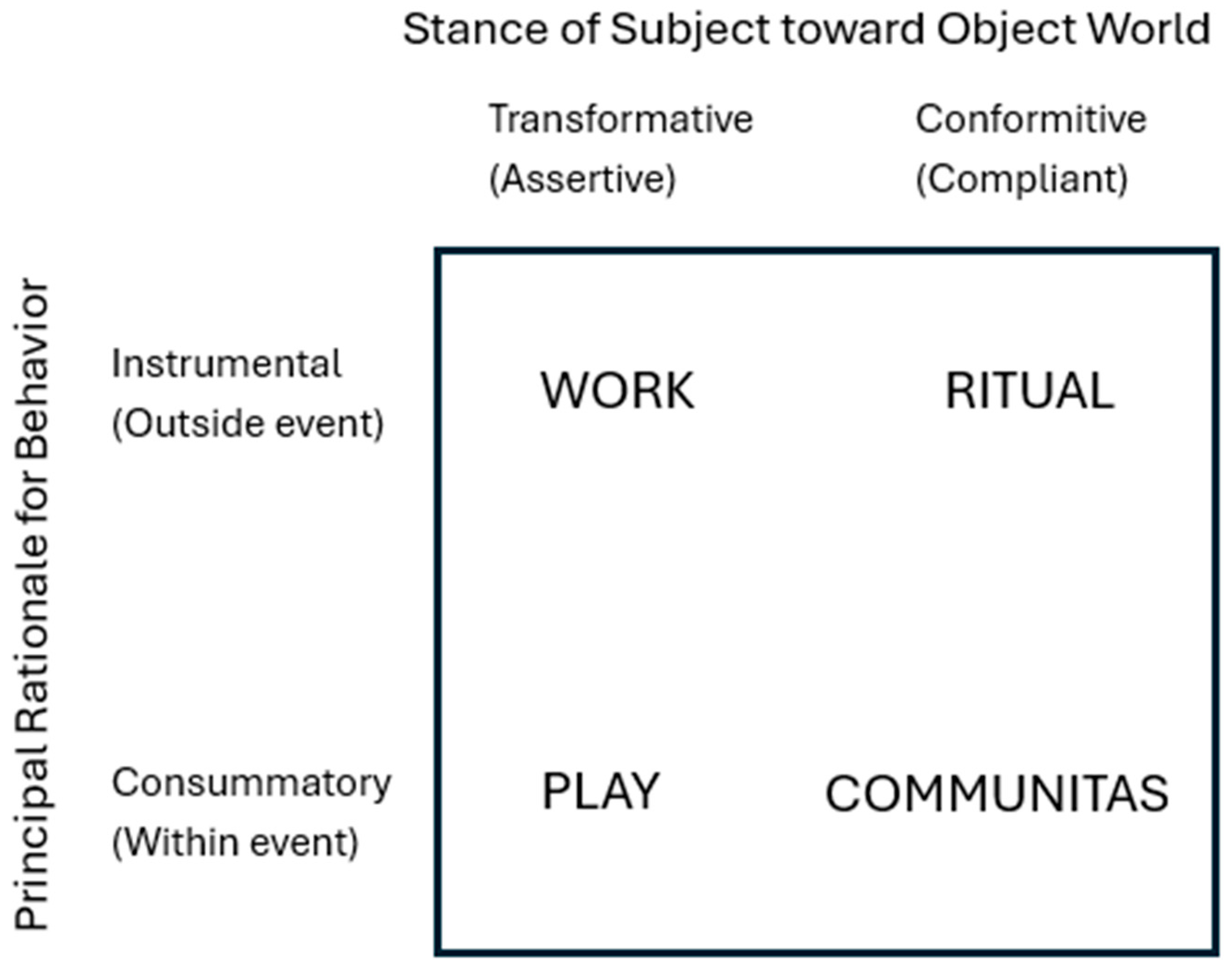
2.4. Henrick’s ‘Pathways of Experience’
- In what ways can repetitive theatre music performance practices be considered as ‘musicking-as-play’?
- What might the characteristics of ‘musicking-as-play’ be in the West End theatre?
- What might the implications of ‘musicking-as-play’ in the West End theatre be for music education?
3. Materials and Methods
4. Results
4.1. Theatre Musicking Experienced as Play
Gtr: Comparing it to serious work? Yeah. Yeah, it’s not a real job.
TP: Okay. It gets paid real money.
Gtr: Yeah, and that’s part of the joke, isn’t it?… It’s like being back in school, it’s a lot of fun, it’s good. It’s got to the point now where it’s like being… with people who have never grown up.
Is it play? Yeah, I would count it as that only because… it’s going to sound horribly idealistic, but I still love playing the instrument. I still love trying to make it work.(Tbn)
Because it’s a bit of nonsense. We’re not saving lives. We’re just entertaining people.(Dms)
It’s sort of like working in an office in some ways… I think I’d say that it’s work pretty much 100%… Saying, ‘it’s not the game we want to be playing’ doesn’t mean that we’re all sat there hating it every night, you know, it’s still good fun, but there… are still going to be nights where you don’t feel like doing that. And that’s kind of how it is on the show.
It’s all play in the sense that you’re playing an instrument, even if you’re playing the same notes, night after night, you’re still bringing your own interpretations… When you talk about work and play, I think it’s kind of a false dichotomy in music in some ways, insofar as we’re not working in a factory, we’re not working in finance, we’re not sitting in front of terminals, everything we do is play… It’s play, it’s enjoyable and fun, and not stressful… play is something where the cognitive obstacles that are coming out you can deal with, you can reach into your toolkit, and you can say, ‘yes, because of my experience, because of my personality and how I apply that to my instrument, I can get out of the thing, I can jump over that obstacle’.(Bass)
I guess in my own little world with my blinkers on, there is that play with ‘I wonder if I’ll get it right tonight?’(Keys 2/AMD)
It’s a very different sort of play… where I feel like I’m actively in a dialogue with the other musicians and the cast… I can feel how the audience behind me is reacting to things so that I can feed off their energy… That feels much more in the moment, much more spontaneous.(Keys 2/AMD)
The worst thing I could say for it is sometimes I go in just thinking, ‘I really don’t feel like doing this right now’. But then there’ll still be moments that I enjoy.(Bass)
I suppose I’m lucky. Very rarely do I have [moments the job feels arduous]. But they, of course they exist, they happen. There are moments where I’d rather be elsewhere… but most of the time I’m looking forward to going in to play.(Gtr)
Some shows at the start of the show, or when you’re coming in, and something’s happened in your day and you’re not quite in the right frame of mind, but you’ve got to do it, then… its harder to kind of pick yourself up to get ready… and it’d be a lot easier to not be here. But the feeling of just being very lucky to have this job, this chair on a long running show that, touch wood, is fairly safe… the audiences are loving it. And yeah, being very lucky to be here.(Dms)
4.2. Introducing the Five Themes
- (1)
- Play is dominated by social relations;
- (2)
- Play manifests in an undiminished enjoyment of musicking;
- (3)
- Play motivates a hyper-attention to the subtle microvariations within the ensemble;
- (4)
- Play drives a consistent focus on the materiality of sounds, instruments, bodies and click;
- (5)
- Play exists within the movement between automation and presence, consistency and variability.
4.3. Theme 1: Play Is Dominated by Social Relations
Playing music with my friends every day… I couldn’t practice or go and play fun music with my friends… it’s more about the people than the music… the social thing is really important.(Gtr)
It was actually the social aspect of it that I missed the most. Because almost all of my friends are also musicians or work peripherally in music… it’s equally, if not more, about ‘that’s where all my friends are’.(Bass)
Playing aside, sort of just the community that you build up with your colleagues.(Dms)
You missed the people, you missed the community, you missed the experience of doing the thing that’s a very core part of your being…. It’s only proper playing when you’re playing with other people.(Tbn)
You could be playing good music. If it’s with a bunch of knobheads1, and you don’t enjoy people’s company, then it’s going to be a miserable experience.(Gtr)
It’s a nice social dynamism. And part of the ‘doing the right’ thing is the way that you play with other people… your playing is fundamentally an extension of who you are. So I think there’s the argument that when you are socially not rubbing up that well with somebody, you still do your job but there’s less of a sense of connectivity.(Tbn)
We’ve all got little bits in the show where we sort of do the same things or acknowledge each other… And that’s kind of equally as important as well to the routine thing for me.(Dms)
There are like rehearsed moments of interaction with other members of the band that are the same every night… we gesture to each other congratulations, well done, we got we got through that bit. And that’s the same every time whether it was good or bad, it’s just ‘great job’.(Keys 2/AMD)
I can feel how the audience behind me is reacting to things so that I can feed off their energy.(Keys 2/AMD)
If you know the audience are up for it, then that helps you be up for it as well. If the audience are a bit muted, and you’re not feeling… they go hand in hand… There’s seven out of eight shows a week it’ll be standing ovation and they’ll be loving it, which makes you feel good… I always like it when I can eyeball a few people or see them like laughing and joking.(Dms)
If they’re having the best time of their lives, that’s very infectious, it’s difficult to be miserable while that’s going on.(Bass)
No. No. I don’t think any musician does. You’ve got to be very superficial to be playing for the audience…. I’m not trying to impress the audience.(Bass)
You never allow your standards to drop, because you can’t… you’re playing for the people around you, you are playing for the people next to you. You know, when I clip a note, I’m awfully aware of the trumpet player and how good he is. And the fact that he’s heard it, even if no one else in the building hears it, I know he has. And that matters.(Tbn)
I think there’s an evolutionary process, I think people who are less agreeable just get filtered out of the market, especially in theatre, touring, in long running gigs. I think there’s a natural selection.(Gtr)
4.4. Theme 2: Play Manifests in an Undiminished Enjoyment of Musicking
I think initially, it’s the playing, it’s getting the adrenaline hit of playing… I guess just feeling very lucky to kind of turn a sort of hobby into a career, you know… I’m certainly having fun when I’m when I’m doing it.(Dms)
When it’s executed, by everyone, to a standard where it is really enjoyable you do get that “yeah, this is working. This is grooving, like, everyone is just in the same place here and it feels good”. That’s a fantastic feeling. I never ever get bored of that.(Bass)
It is fun and it’s challenging. It’s good. It’s good for my playing… it’s got loads of different stuff in it that works different muscles…. and I get to play a lot of rock guitar for money… so, I get to do the shred guitar thing a little bit.(Gtr)
I still love playing the instrument. I still love trying to make it work… It’s fun, I think, because I’ve done it so often.(Tbn)
But I’d be very specific about what, where the enjoyment lies for me. And it’s with a very good rhythm section. I think the principal satisfaction for me I suppose, is reaching…. a flow state where I just feel very, very focused.(Gtr)
In the rhythm section you really have to have a sort of a mutual trust established for it to be enjoyable… to get that real sense of ‘Yeah, this is why I do this’ it really needs to be a sort of a good day for everyone.(Bass)
It’s fun… but that’s more down to the show and the people than the regularity of doing it…. the people are lovely, it’s a fun show… being in a room full of laughing people does keep you buoyed.(Tbn)
‘It’s… to do with the sense of being involved in something, we’re all doing our thing ‘together’. It’s the sense of performing something together and making something happen and that if stuff goes wrong on stage or… in the band, that becomes a moment that we all share, that we get some joy from.’(Bass)
Being part of something and to know that you’re contributing a piece into a big puzzle.(Dms)
4.5. Theme 3: Play Motivates a Hyper-Attention to the Subtle Microvariations Within the Ensemble
With the repetition of just like night after night after night. If you’re not going to go insane you need to find things in the music that you can listen to, to… try and hone what you’re doing. Even just microscopic levels of detail.(Bass)
When deps come in, even if they’ve done it 100,000 times before, they still play it in a completely different way to the regular guy. And that’s play, I think… when you can bring something to it… We have some fantastic deps in the band so you’re never really performing with the same group of people every night.(Keys2/AMD)
Because I did a tour for two years, and we were the same 10 guys for the whole time. So musically, we were tight, because we knew exactly, we could guess exactly whatever everyone else is going to do. Whereas, whereas in here, you’re kind of in real time working it out as you go along, even though we all know the show.(Dms)
So, I can tell with my eyes closed who is in, pretty much, because there are certain little idiosyncrasies of sound, of phrasing, of placement, of all those little bits.(Tbn)
I’ve got to the stage where I know which deps hold which notes for how long so that I can always make sure that I’m matching them, trying to follow, trying to blend, and that’s the game that I play with myself.(Keys 2/AMD)
I might have a bit of policing to do, it might be starting to fluctuate, and it becomes an effort. And then the resolution is so narrow that it feels like time is passing really slow. Like, when you’re actually playing, this bar and this bar and this bar, you’re focusing on everything, those moments feel like they last forever.(Bass)
I would make the show different for myself every night like ‘this evening, I’ll turn up the viola.’ And I’ll just, I’ll see how I play with the viola. Oh, and this evening, I’ll let’s see what reed 4 is doing. And I’ve got all these bassoon bits, she’s got all of those bass clarinet bits, let’s see how we interweave.(Keys2/AMD)
4.6. Theme 4: Play Drives a Consistent Focus on the Materiality of Sounds, Instruments, Bodies and Click
It’s more like I’m playing a game with the click. I’m seeing how I grid to that, how… when I’m playing a really strict grooving electric guitar with one hand, and then in another voice I’m triggering flute samples, and then trying to be as expressive as I can with a string line at the top of my right… there’s a lot going on.(Keys2/AMD)
The principal satisfaction for me, I suppose, is reaching… a flow state where I just feel very, very focused on one little element, and it’s usually about the relationship with bass, drums and guitar to click.(Gtr)
People go ‘well, clicks are entirely restrictive and are a terrible thing’. I know many musicians who love clicks and find they’re more creative with a click than they are without it… when the click is running [there] is one less thing for me to think about and then I can focus on other things… And you can absolutely phrase around the click… Different drummers feel different playing with a click track… they’ve got forwards energy or backwards energy… even with a click you can play behind or ahead.(MD)
This show more than any other show I’ve done…. muscle memory is the winner… If you were to sight read it, it’s not a natural thing, because you would then… be like, ‘Oh, but my arm needs to be over there to start the click’, which is more important… [you have to] simplify the fill, or make sure you can do the end of the fill with one hand, because then you’ve got to be over there [indicates left to the trigger pad].(Dms)
The playing of the majority of the show now is just completely subconscious, completely muscle memory, I’ve got my ears open and I’m listening.(Bass)
So for keys two it’s a combination of muscle memory and looking. And you cannot trust your ears. Because the keys that you are playing bear no relation to what’s coming [out]. You could be doing an F major arpeggio and the sound is coming out with a triangle groove… When I’m conducting, I’m not reading the score at all. And that’s muscle memory…I need to be making eye contact either with the camera or with the people on the stage.(Keys2/AMD)
I know I move my body. And I think that’s, I think that’s a good thing. I used to think it isn’t. But I’ve changed my mind to think it’s all, it’s all a dance, isn’t it?(Gtr)
I’ll quite often get halfway through the show, and I’ll even be thinking, “Oh, this is going well, I wonder why it’s going well”, at which point my kind of my phenomenological experience of what it’s like to play fundamentally changes. And then I start asking questions about how…“how’s your face working like this?” “How’s your embouchure doing this”?… It’s a little bit like running down an escalator and you’re fine until you look at your feet, and go, “Well, that’s clever, I wonder what they’re doing?” That’s the point when you fall over.(Tbn)
I aim for as close as I can every show. But human error and sweat and the stick will fly out your hand or something or deps have come in and slightly moved things and it feels a bit strange.(Dms)
4.7. Theme 5: Play Exists Within the Movement Between Automation and Presence, Consistency and Variability
I think the principal satisfaction for me, I suppose, is reaching…. a flow state where I just feel very, very focused on one little element… and what I find is I lose sense of the passage of time. And that’s special… that’s the thing I look for…. that’s deeply satisfying… I zone out a fair amount, a couple of pages will go by and I will question whether I’ve actually played something. You know, ‘have we done that bit?’ ‘I don’t remember playing that’(Gtr)
When I’ve got my head in the right place, and the show’s going well, I think what’s coming out is, what the muscles are doing to just be a completely automated process, the music comes into my ear and then the right notes come out. And there’s just no conscious effort involved at all… I’ll turn up, plug in the instrument and warm up, and the show will just happen.(Bass)
When I first experienced it, it was quite disconcerting, that I sort of “came to” in the middle of a page and was like, “have I been playing for the last minute and a half?” I assume so—no one is staring at me… it’s not that I’ve been daydreaming or thinking about other things, it’s that I’ve been so focused on doing.(Keys 2/AMD)
Our job is to produce the same thing at a high standard night after night after night, without it getting tired.(Tbn)
This style of show is very just ‘deliver the product’… the degree of variability is quite small.(Keys2/AMD)
I aim for as close as I can every show…. I’m the sort of player who, you tell me what to play. And I’ll replicate that eight times a week as long as I need to do it…. I’m booked for, I would like to think consistency… they have not employed me for my ideas and my interpretation of what they’ve created. They want what they’ve created executed night after night.(Dms)
I feel like on the keyboard side of things, it’s just consistency(Keys2/AMD)
I pride myself on being able to just replicate things… I like repetition… I’m quite happy to hammer out iterations of something… that’s a challenge that I’ll happily accept and enjoy.(Gtr)
I like the predictability of it. I guess that’s, for me as a person, structure and knowing what I’m doing when I’m doing it… I like that routine that makes me kind of feel calm and I don’t get bored easily, I’m very content with what I’ve got.(Dms)
You’ve got to do your part in turning up and not just physically but musically and being a presence and an energy. And especially with the drums because if you start playing a bit softer, or you start sort of phoning it in, then people know straightaway.(Dms)
You’re playing for the people around you. And part of the job of that is to make a performance out of it.(Tbn)
I think it’s Liza Minnelli that said, acting is doing it for the first time, every time. And there’s something really lovely that I feel when I’m conducting… If I’m really engaged in the drama of the music, it can be this wonderful collaborative self-discovery, dramatic experience with the actors… you would hope to hit that a couple of times a week.(Keys2/AMD)
Sometimes when deps come in, or when there’s understudies on and something doesn’t [seem] quite right, you get that warm hit of adrenaline, which brings you out of ‘where are we, what’s happened?’… but I always try and be ‘in the moment’ and be present.(Dms)
One of the things that I’ve used on a lot of shows to help get me through is to have a particular point in a show where the challenge is to do something different every time, just a tiny little variation, could just be one thing in one bar.(Gtr)
We like a little bit of variation but we don’t like much. As humans… people returning to the same restaurants time after time, they watch the same film every Christmas… And they love it… And they know the bits and they get enjoyment out of the whole expectation and you get… enjoyment when you get what you expect. So a little bit of novelty is good, but too much is really annoying.(MD)
I think people, everybody outside of the pit needs consistency. Yeah, the dancers need the tempos and… but I think [variation] within the pit and deps, it keeps it fresh, and keeps you on your toes.(Dms)
5. Summary and Implications
6. Conclusions
Funding
Institutional Review Board Statement
Informed Consent Statement
Data Availability Statement
Conflicts of Interest
Abbreviations
| WAM | Western Art Music |
| 1 | A British English abusive term. |
References
- Addison, R. (1991). Music and play. British Journal of Music Education, 8(3), 207–217. [Google Scholar] [CrossRef]
- Bates, V. C. (2021). Music education, neoliberal social reproduction, and play. Action, Criticism, and Theory for Music Education, 20(3), 82–107. [Google Scholar] [CrossRef]
- Bergen, D. (2015). Psychological approaches to the study of play. American Journal of Play, 7(3), 101–128. [Google Scholar]
- Blignaut, H., Erasmus, E., & Du Toit-Brits, C. (2023). Joyful learning: Advocating for self-directed learning through authentic, playful problem-based learning. In M. Havenga, J. Oliver, & B. Bunt (Eds.), Problem-based learning and pedagogies of play: Active approaches towards self-directed learning, NWU self-directed learning series (Vol. 11, pp. 71–95). AOSIS Books. [Google Scholar]
- British Educational Research Association (BERA). (2024). Ethical guidelines for educational research. British Educational Research Association (BERA). [Google Scholar]
- Brown, S. L. (2009). Play: How it shapes the brain, opens the imagination, and invigorates the soul. Avery. [Google Scholar]
- Bull, A., & Scharff, C. (2021). Classical music as genre: Hierarchies of value within freelance classical musicians’ discourses. European Journal of Cultural Studies, 24(3), 673–689. [Google Scholar] [CrossRef]
- Bunt, B. (2023). Pedagogy of play: A framework for self-directed learning. In M. Havenga, J. Olivier, & B. Bunt (Eds.), Problem-based learning and pedagogies of play: Active approaches towards self-directed learning, NWU self-directed learning series (Vol. 11, pp. 17–42). AOSIS Books. [Google Scholar]
- Burnard, P. (2012). Musical creativities in practice (1st ed.). Oxford University Press, USA. [Google Scholar]
- Burnard, P., Colucci-Gray, L., Gray, D., & Palmer, T. (2026). Re-mattering ‘thing-power’: Expanding methodological research possibilities for change. In D. Mattson, & N. Verger (Eds.), Enacting social change: Possibilities for change and preservation. Palgrave. [Google Scholar]
- Burnard, P., & Köbli, N. A. (2024). Posthumanist new materialist pathways for reimagining music education research: What matters? What can this offer music educators? Music Education Research, 26(3), 251–263. [Google Scholar] [CrossRef]
- Burston, J. (1998). Theatre space as virtual place: Audio technology, the reconfigured singing body, and the megamusical. Popular Music, 17(2), 205–218. [Google Scholar] [CrossRef]
- Burwell, K., Carey, G., & Bennett, D. (2017). Isolation in studio music teaching: The secret garden. Arts and Humanities in Higher Education, 18(4), 372–394. [Google Scholar] [CrossRef]
- Caizley, S. (2024). Bravo Maestros: The experiences of state-school students’ journeys to a UK music conservatoire. Kings College London. [Google Scholar]
- Camlin, D., Clements, H., & Perkins, R. (2025). Towards the civic conservatoire. In C. Lawson, D. Salazar, & R. Perkins (Eds.), Inside the contemporary conservatoire: Critical perspectives from the Royal College of Music, London (pp. 205–214). Routledge. [Google Scholar]
- Campbell, K. (1987). Life in the pit. Musical America, 111(4), 22–25. [Google Scholar]
- Carey, G., Bridgstock, R., Taylor, P., McWilliam, E., & Grant, C. (2013). Characterising one-to-one conservatoire teaching: Some implications of a quantitative analysis. Music Education Research, 15(3), 357–368. [Google Scholar] [CrossRef]
- Casari, I. S., Duarte, M., & Nogueira, M. (2018). From play to gesture: Exploring the intrinsic relations between body and mind in the pedagogy of musical performance (pp. 103–106). Proceedings of ICMPC15/ESCOM10. Centre for Systematic Musicology, University of Graz. [Google Scholar]
- Christensen, J. (2018). Sound and the aesthetics of play: A musical ontology of constructed emotions. Palgrave. [Google Scholar]
- Clarke, D., & Clarke, E. F. (2011). Music and consciousness: Philosophical, psychological, and cultural perspectives. Oxford University Press. [Google Scholar]
- Cook, N. (2018). Music as creative practice. Oxford University Press. [Google Scholar]
- Corkhill, D. (2005). A young person’s guide to the orchestral profession. British Journal of Music Education, 22(03), 269. [Google Scholar] [CrossRef]
- Cottrell, S. (2002). Music as capital: Deputizing among London’s freelance musicians. British Journal of Ethnomusicology, 11(2), 61–80. [Google Scholar] [CrossRef]
- Cottrell, S. (2004). Professional music-making in London: Ethnography and experience. Ashgate. [Google Scholar]
- Cronqvist, M. (2024). Enhanced student joy in learning environment; understanding and influencing the process. European Journal of Education, 59(3), e12671. [Google Scholar] [CrossRef]
- Csepregi, G. (2013). On musical performance as play. Nordic Journal of Aesthetics, 23(46), 96–114. [Google Scholar] [CrossRef][Green Version]
- Csikszentmihalyi, M. (1996). Creativity: Flow and the psychology of discovery and invention. Harper. [Google Scholar]
- Daubney, A. (2024). What does it mean to be musical? Musical ability and learning in instrumental education. In N. Beach, & G. Spruce (Eds.), Instrumental music teaching: Perspectives and challenges (pp. 71–88). Trinity College London. [Google Scholar]
- de Bruin, L. R. (2018). Musical play, creativity and metacognitive processes in developing improvisational expertise: Expert improvising voices. International Journal of Play, 7(3), 248–265. [Google Scholar] [CrossRef]
- De Koven, B. (2014). A playful path. Carnegie Mellon University. [Google Scholar] [CrossRef]
- Delamont, S. (2016). Fieldwork in educational settings: Methods, pitfalls and perspectives. Routledge. [Google Scholar]
- Dissanayake, E. (2017). Ethology, interpersonal neurobiology, and play: Insights into the evolutionary origin of the arts. American Journal of Play, 9(2), 143–168. [Google Scholar]
- Eberle, S. G. (2014). The elements of play: Toward a philosophy and a definition of play. American Journal of Play, 6(2), 214–233. [Google Scholar]
- Eichberg, H. (2016). Questioning play: What play can tell us about social life. Routledge. [Google Scholar]
- Fisher, R., & Gaydon, P. (2019). The dark would: Higher education, play and playfulness (i). In A. James, & C. Nerantzi (Eds.), The power of play in higher education (pp. 77–92). Palgrave Macmillan. [Google Scholar]
- Flick, U. (2014). The SAGE handbook of qualitative data analysis. Sage Publications. [Google Scholar]
- Forbes, L. K. (2021). The process of play in learning in higher education: A phenomenological study. Journal of Teaching and Learning, 15(1), 57–73. [Google Scholar] [CrossRef]
- Forbes, L. K., & Thomas, D. (2022). Professors at play playbook: Real world techniques from a more playful higher education classroom. Carnegie Mellon University ETC Press. [Google Scholar]
- Gadamer, H.-G. (1975). Truth and method. Continuum. [Google Scholar]
- Glaser, B. G., & Strauss, A. L. (1967). The discovery of grounded theory. Aldine. [Google Scholar]
- Green, C. C. (2011). Permission to play: Obstacles and open spaces in music-making. Visions of Research in Music Education, 18, 4. [Google Scholar]
- Guillaumier, C., Lester, G., & Salazar, D. (2025). Re-imagining the one-to-one studio. In C. Lawson, D. Salazar, & R. Perkins (Eds.), Inside the contemporary conservatoire: Critical perspectives from the Royal College of Music, London (pp. 87–100). Routledge. [Google Scholar]
- Harmer, A. (2024). OOO, Guerrilla metaphysics, and the allure of children’s musical play. Music Education Research, 26(3), 361–372. [Google Scholar] [CrossRef]
- Harnum, J. (2014). The practice of practice. Sol Ut Press. [Google Scholar]
- Henricks, T. S. (2006). Play reconsidered: Sociological perspectives on human expression. University of Illinois Press. [Google Scholar]
- Henricks, T. S. (2015). Play and the human condition. University of Illinois Press. [Google Scholar]
- Henricks, T. S. (2018). Theme and variation: Arranging play’s forms, functions, and “colors”. American Journal of Play, 10(2), 133–167. [Google Scholar]
- Holst, J. (2017). The dynamics of play—Back to the basics of playing. International Journal of Play, 6(1), 85–95. [Google Scholar] [CrossRef]
- Høffding, S. (2018). A phenomenology of musical absorption. Springer International Publishing. [Google Scholar] [CrossRef]
- Høffding, S. (2019). Performative passivity: Lessons on phenomenology and the extended musical mind with the Danish String Quartet. In R. Herbert, D. Clarke, & E. Clarke (Eds.), Music and consciousness 2: Worlds, practices, modalities. Oxford University Press. [Google Scholar]
- Høffding, S., & Satne, G. (2021). Interactive expertise in solo and joint musical performance. Synthese, 198(1), 427–445. [Google Scholar] [CrossRef]
- Huizinga, J. (2016). Homo Ludens: A study of the play-element in culture. Angelico Press. [Google Scholar]
- James, A. (2019). Making a case for the playful university. In A. James, & C. Nerantzi (Eds.), The power of play in higher education (pp. 1–19). Palgrave Macmillan. [Google Scholar]
- Johns, S., & Kelly, J. (2025). Personal realities II: How does the conservatoire link with the profession? In C. Lawson, D. Salazar, & R. Perkins (Eds.), Inside the contemporary conservatoire: Critical perspectives from the Royal College of Music, London (pp. 30–39). Routledge. [Google Scholar]
- Kanellopoulos, P. A. (2021). Studious play as an Archê of creative music- making: Repositing “the scandal of democracy” in music education. Action, Criticism & Theory for Music Education, 20(2), 79–109. [Google Scholar] [CrossRef]
- Keil, C. (1987). Participatory discrepancies and the power of music. Cultural Anthropology, 2(3), 275–283. [Google Scholar] [CrossRef]
- Keil, C. (1995). The theory of participatory discrepancies: A progress report. Ethnomusicology, 39(1), 1–19. [Google Scholar] [CrossRef]
- Kenny, D. T., Driscoll, T., & Ackermann, B. (2016). Is playing in the pit really the pits? Pain, strength, music performance anxiety and workplace satisfaction in professional musicians in stage, pit and combined stage/pit orchestras. Medical Problems of Performing Artists, 31(1), 1–7. [Google Scholar] [CrossRef]
- King, P., & Howard, J. (2016). Free Choice or adaptable choice self-determination theory and play. American Journal of Play, 9(1), 56–70. [Google Scholar]
- Kivy, P. (1993). The fine art of repetition: Essays in the philosophy of music. Cambridge University Press. [Google Scholar]
- Leman, M., & Maes, P.-J. (2015). Music Perception and embodied music cognition. In The Routledge handbook of embodied cognition. Routledge. [Google Scholar] [CrossRef]
- Maggart, A. (2021). Rethinking babbitt’s ‘serious’ music as play. Contemporary Music Review, 40(2–3), 141–161. [Google Scholar] [CrossRef]
- Margulis, E. H. (2014). On repeat: How music plays the mind. Oxford University Press. [Google Scholar]
- McCaleb, J. M. (2014). Embodied knowledge in ensemble performance. Routledge. [Google Scholar] [CrossRef]
- Merleau-Ponty, M. (2005). The phenomenology of perception. Routledge. [Google Scholar]
- Morey, T. (2019). The particulars of pit playing. Canadian Musician, 41(5), 25–26. [Google Scholar]
- Morin, F. L. (2001). Cultivating music play: The need for changed teaching practice. General Music Today, 14(2), 24–29. [Google Scholar] [CrossRef]
- Moseley, R. (2016). Keys to play: Music as a ludic medium from Apollo to Nintendo. University of California Press. [Google Scholar]
- Nguyen, C. T. (2020). Games: Agency as art. Oxford University Press. [Google Scholar]
- Palmer, T. (2026). The play-filled conservatoire: (Re)Conceptualising western art music performance practices and pedagogies as ‘musicking-as-play’ [Manuscript in preparation]. University of Cambridge. [Google Scholar]
- Palmer, T., Burnard, P., & Burke, D. (2025). Inviting a (Re)Orientation to ‘musicking-as-play’ in higher music education performance studies: Insights from three genre performance practices. Action, Criticism, and Theory for Music Education, 23(2), 7–47. [Google Scholar]
- Payne, E. (2016). Creativity beyond innovation: Musical performance and craft. Musicae Scientiae, 20(3), 325–344. [Google Scholar] [CrossRef]
- Perkins, R. (2013). Learning cultures and the conservatoire: An ethnographically-informed case study. Music Education Research, 15(2), 196–213. [Google Scholar] [CrossRef]
- Peters, G. (2017). What is a live event? In M. Reason, & A. Lindelof (Eds.), Experiencing liveness in contemporary performance: Interdisciplinary perspectives (pp. 163–177). Routledge. [Google Scholar]
- Reason, M., & Lindelof, A. M. (2017). Experiencing liveness in contemporary performance: Interdisciplinary perspectives. Routledge. [Google Scholar]
- Reichling, M. J. (1997). Music, imagination, and play. The Journal of Aesthetic Education, 31(1), 41–55. [Google Scholar] [CrossRef]
- Richter, G. (2024). Serious play: Towards a philosophical understanding of interpretative musical performance. In S. McAuliffe (Ed.), Gadamer, music and philosophical hermeneutics (pp. 17–30). Springer. [Google Scholar]
- Ringering, R. (2014). The pit: Teaching instrumental students to play musical theater. The American Music Teacher, 63(6), 20–22. [Google Scholar]
- Sahlberg, P., & Doyle, W. (2020). Let the children play: For the learning, well-being, and life success of every child. Oxford University Press. [Google Scholar]
- Schiavio, A. (2017). The primacy of experience: Phenomenology, embodiment, and assessments in music education. In D. J. Elliott, M. Silverman, & G. E. McPherson (Eds.), The Oxford handbook of philosophical and qualitative assessment in music education (pp. 1–25). Oxford Handbooks. [Google Scholar]
- Schore, A. N. (2008). Playing on the right side of the brain: An interview with Allan Schore. American Journal of Play, 9(2), 105–142. [Google Scholar]
- Sennett, R. (2008). The craftsman. Yale University Press. [Google Scholar]
- Serravalie, P. (2016). Tales from the pit. Canadian Musician, 38(5), 25–26. [Google Scholar]
- Sicart, M. (2014). Play matters. MIT Press. [Google Scholar]
- Simons, H. (2014). Case study research: In-depth understanding in context. In Oxford handbook of qualitative research (pp. 455–470). Oxford University Press. [Google Scholar] [CrossRef]
- Small, C. (1998). Musicking: The meanings of performing and listening. Wesleyan University Press. [Google Scholar]
- Stubley, E. V. (1993). Musical performance, play and constructive knowledge: Experiences of self and culture. Philosophy of Music Education Review, 1(2), 94–102. [Google Scholar]
- Sutton-Smith, B. (1997). The ambiguity of play. Harvard University Press. [Google Scholar]
- Swanwick, K. (1988). Music, mind and education. Routledge. [Google Scholar]
- Teague, A., & Dylan Smith, G. (2015). Portfolio careers and work-life balance among musicians: An initial study into implications for higher music education. British Journal of Music Education, 32(2), 177–193. [Google Scholar] [CrossRef]
- Thompson, M. (2011). Ontological shift or ontological drift? Reality claims, epistemological frameworks, and theory generation in organizational studies. The Academy of Management Review, 36(4), 754–773. [Google Scholar]
- Todd, R. W., & King, E. C. (2022). “Let’s Play!”: Professional performers’ perspectives on play in chamber ensemble rehearsal. In The chamber musician in the twenty-first century (pp. 205–229). MDPI. [Google Scholar]
- Trujillo, B. (2024). The virtue of playfulness: Why happy people are playful. Routledge. [Google Scholar]
- van der Schyff, D. (2016). Fostering a phenomenological attitude in music education. Phenomenology & Practice, 10(1), 4–24. [Google Scholar] [CrossRef]
- van der Schyff, D., Schiavio, A., & Elliott, D. J. (2022). Musical bodies, musical minds: Enactive cognitive science and the meaning of human musicality. In Musical bodies, musical minds. The MIT Press. [Google Scholar] [CrossRef]
- Vandervert, L. (2017). Vygotsky meets neuroscience: The cerebellum and the rise of culture through play. American Journal of Play, 9(2), 202–227. [Google Scholar]
- Whitebread, D. (2018). Play: The new renaissance. International Journal of Play, 7(3), 237–243. [Google Scholar] [CrossRef]
- Williamon, A., Ginsborg, J., Perkins, R., & Waddell, G. (2021). Performing music research: Methods in music education, psychology, and performance science. Oxford University Press. [Google Scholar]
- Wilson, S., & Samuel, J. (2021). New music and the crises of materiality: Sounding bodies and objects in late modernity. Routledge. [Google Scholar]
- Wistreich, R., & Perkins, R. (2025). Cultivating research cultures. In C. Lawson, D. Salazar, & R. Perkins (Eds.), Inside the contemporary conservatoire: Critical perspectives from the Royal College of Music, London (pp. 140–166). Routledge. [Google Scholar]
- Wood, E. (2014). The play-pedagogy interface in contemporary debates. In L. Brooker, M. Blaise, & S. Edwards (Eds.), The sage handbook of play and learning in early childhood (pp. 145–156). Sage. [Google Scholar]
- Yin, R. K. (1994). Case study research: Design and methods. Sage. [Google Scholar]
- Zosh, J. M., Hopkins, E. J., Jensen, H., Liu, C., Neale, D., Hirsh-Pasek, K., Solis, S. L., & Whitebread, D. (2017). Learning through play: A review of the evidence. White paper. Danish University Colleges. [Google Scholar]


| Context | Instrumentalist | Abbreviation Used |
|---|---|---|
| Observed Show | Guitarist | Gtr |
| Drummer | Dms | |
| Bass player | Bass | |
| Trombonist | Tbn | |
| Keyboard 2, Assistant Music Director | Keys2/AMD | |
| Additional Show | Music Director | MD |
Disclaimer/Publisher’s Note: The statements, opinions and data contained in all publications are solely those of the individual author(s) and contributor(s) and not of MDPI and/or the editor(s). MDPI and/or the editor(s) disclaim responsibility for any injury to people or property resulting from any ideas, methods, instructions or products referred to in the content. |
© 2026 by the author. Licensee MDPI, Basel, Switzerland. This article is an open access article distributed under the terms and conditions of the Creative Commons Attribution (CC BY) license.
Share and Cite
Palmer, T. ‘Fun Music with My Friends’: ‘Musicking-as-Play’ in the West End Theatre. Educ. Sci. 2026, 16, 189. https://doi.org/10.3390/educsci16020189
Palmer T. ‘Fun Music with My Friends’: ‘Musicking-as-Play’ in the West End Theatre. Education Sciences. 2026; 16(2):189. https://doi.org/10.3390/educsci16020189
Chicago/Turabian StylePalmer, Tim. 2026. "‘Fun Music with My Friends’: ‘Musicking-as-Play’ in the West End Theatre" Education Sciences 16, no. 2: 189. https://doi.org/10.3390/educsci16020189
APA StylePalmer, T. (2026). ‘Fun Music with My Friends’: ‘Musicking-as-Play’ in the West End Theatre. Education Sciences, 16(2), 189. https://doi.org/10.3390/educsci16020189