Use of Simulated Discussion Prompts to Assess Sentiment Toward Agriculture in Higher Education Instructors

 , , and
Abstract
1. Introduction
- If given a prompt, will instructors introduce agriculture in simulated discussion posts?
- If agriculture is introduced, is it framed in a positive, negative, or neutral perspective?
Conceptual Framework
2. Materials and Methods
2.1. Discipline Selection and Discussion Prompt Generation
2.2. Statistical Analysis
2.3. Participants
3. Results
Sentiment Analysis for Prompts Mentioning Agriculture
4. Discussion
5. Conclusions
Author Contributions
Funding
Institutional Review Board Statement
Informed Consent Statement
Data Availability Statement
Conflicts of Interest
References
- Ali, M. A., Kamal, M. M., Rahman, M. H., Siddiqui, M. N., Haque, M. A., Saha, K. K., & Rahman, M. A. (2021). Functional dairy products as a source of bioactive peptides and probiotics: Current trends and future prospectives. Journal of Food Science and Technology, 59(4), 1263–1279. [Google Scholar] [CrossRef] [PubMed]
- American College Testing. (2023). ACT list of college majors. Available online: https://www.act.org/content/act/en/students-and-parents/college-planning-resources/college-and-career-planning/how-to-choose-a-major.html (accessed on 17 March 2023).
- Barnes, C., Angle, J., & Montgomery, D. (2015). Teachers describe epistemologies of science instruction through Q methodology. School Science and Mathematics, 115(3), 141–150. [Google Scholar] [CrossRef]
- Barnhill, A., & Doggett, T. (2018). Food ethics I: Food production and food justice. Philosophy Compass, 13(3). [Google Scholar] [CrossRef]
- Barry, A., Born, G., & Weszkalnys, G. (2008). Logics of interdisciplinarity. Economy and Society, 37(1), 20–49. [Google Scholar] [CrossRef]
- Basch, C. A. (2012). Student-teacher trust relationships and student performance [Doctoral thesis, St. John Fisher University]. [Google Scholar]
- Baumeister, R. F., Bratslavsky, E., Finkenauer, C., & Vohs, K. D. (2001). Bad is stronger than good. Review of General Psychology, 5(4), 323–370. [Google Scholar] [CrossRef]
- Burgess, L. G., Riddell, P. M., Fancourt, A., & Murayama, K. (2018). The influence of social contagion within education: A motivational perspective. Mind, Brain, and Education, 12, 164–174. [Google Scholar] [CrossRef]
- Butler, M. (2022). Interdisciplinary experiential learning during COVID-19: Lessons learned and reflections for the future. Journal of Environmental Studies and Sciences, 12(2), 369–377. [Google Scholar] [CrossRef]
- Christakis, N. A., & Fowler, J. H. (2012). Social contagion theory: Examining dynamic social networks and human behavior. Statistics in Medicine, 32(4), 556–577. [Google Scholar] [CrossRef]
- Christophersen, O. A., & Haug, A. (2011). Animal Products, diseases, and drugs: A plea for better integration between Agricultural Sciences, human nutrition and human pharmacology. Lipids in Health and Disease, 10(1), 16. [Google Scholar] [CrossRef]
- Clark, B., Stewart, G. B., Panzone, L. A., Kyriazakis, I., & Frewer, L. J. (2016). A systematic review of public attitudes, perceptions and behaviours towards production diseases associated with farm animal welfare. Journal of Agricultural and Environmental Ethics, 29, 455–478. [Google Scholar] [CrossRef]
- Cook, J., & Lewandowsky, S. (2016). Rational irrationality: Modeling climate change belief polarization using Bayesian networks. Topics in Cognitive Science, 8(1), 160–179. [Google Scholar] [CrossRef] [PubMed]
- Corbitt, K., Hiltbrand, K., Coursen-Sullivan, M., Johnson, G., Rodning, S., Smith, W. B., & Mulvaney, D. (2025). Common knowledge or common sense? Identifying systematic misconceptions of animal agriculture and food familiarity in higher education individuals. Sustainability, 17(19), 8923. [Google Scholar] [CrossRef]
- Cypress, B. S. (2017). Rigor or reliability and validity in qualitative research: Perspectives, strategies, reconceptualization, and recommendations. Dimensions of Critical Care Nursing, 36(4), 253–263. [Google Scholar] [CrossRef] [PubMed]
- Dillman, D. A., Smyth, J. D., & Christian, L. M. (2014). Internet, phone, mail, and mixed-mode surveys: The tailored design method (4th ed.). Wiley. [Google Scholar]
- Driver, J. (2014). The history of utilitarianism. Stanford Encyclopedia of Philosophy. Available online: https://plato.stanford.edu/entries/utilitarianism-history/ (accessed on 17 March 2023).
- Elliot, T. (2021). Social contagion in Veganville. Research Square. preprint. [Google Scholar] [CrossRef]
- Farrell, J. R., Campbell, C., & Sands, S. (2022). What drives consumers to engage with influencers? Journal of Advertising Research, 62(1), 35–48. [Google Scholar] [CrossRef]
- Felt, U., Igelsböck, J., Schikowitz, A., & Völker, T. (2012). Growing into what? the (un-)disciplined socialization of early stage researchers in Transdisciplinary Research. Higher Education, 65(4), 511–524. [Google Scholar] [CrossRef]
- Flensner, K. K., & Von der Lippe, M. (2019). Being safe from what and safe for whom? A critical discussion of the conceptual metaphor of “safe space”. Intercultural Education, 30(3), 275–288. [Google Scholar] [CrossRef]
- Fonseca, R. P., & Vizachri, T. R. (2023). Teachers’ views on ‘food’ animals for sustainability education: An exploratory study. Environmental Education Research, 29(9), 1310–1327. [Google Scholar] [CrossRef]
- Gil-Perez, D., Vilches, A., Edwards, M., Praia, J., Marques, L., & Oliveira, T. (2003). A proposal to enrich teachers’ perception of the state of the world: First results. Environmental Education Research, 9(1), 67–90. [Google Scholar] [CrossRef]
- Goldstone, R. L., & Janssen, M. A. (2005). Computational models of collective behavior. Trends in Cognitive Sciences, 9(9), 424–430. [Google Scholar] [CrossRef]
- González-González, F., Delgado, S., Ruiz, L., Margolles, A., & Ruas-Madiedo, P. (2022). Functional bacterial cultures for dairy applications: Towards improving safety, quality, nutritional and health benefit aspects. Journal of Applied Microbiology, 133(1), 212–229. [Google Scholar] [CrossRef] [PubMed]
- Happer, C., & Wellesley, L. (2019). Meat consumption, behaviour, and the media environment: A focus group analysis across four countries. Food Security, 11(1), 123–139. [Google Scholar] [CrossRef]
- Harrington, C. (2022, January 25). Successful instructors understand their own biases and beliefs (opinion). Inside Higher Ed | Higher Education News, Events and Jobs. Available online: https://www.insidehighered.com/advice/2022/01/26/successful-instructors-understand-their-own-biases-and-beliefs-opinion (accessed on 16 January 2026).
- Hawthorne, K. M., Castle, J., & Donovan, S. M. (2022). Meat helps make every bite count: An ideal first food for infants. Nutrition Today, 57(1), 8–13. [Google Scholar] [CrossRef]
- Hobbs-Grimmer, D. A., Givens, D. I., & Lovegrove, J. A. (2021). Associations between red meat, processed red meat and total red and processed red meat consumption, nutritional adequacy and markers of health and cardio-metabolic diseases in British adults: A cross-sectional analysis using data from UK national diet and nutrition survey. European Journal of Nutrition, 60(6), 2979–2997. [Google Scholar] [CrossRef]
- Jackson-Smith, D. B., & Jensen, E. (2009). Finding farms: Comparing indicators of farming dependence and agricultural importance in the United States. Rural Sociology, 74(1), 37–55. [Google Scholar] [CrossRef]
- Jampolis, M. B., Rothkopf, M. M., Li, Z., Diamond, S. J., Allen, K., Abdelhadi, R. A., Kahana, D. D., & McClave, S. A. (2016). Principles of healthful eating. Current Nutrition Reports, 5(3), 180–190. [Google Scholar] [CrossRef]
- John, T., & Flores, C. (2018). Philosophers against factory farming. Philosophers Against Factory Farming. Available online: https://philosophersagainstfactoryfarming.wordpress.com/ (accessed on 17 March 2023).
- Konstantinou, P., Georgiou, K., Kumar, N., Kyprianidou, M., Nicolaides, C., Karekla, M., & Kassianos, A. P. (2021). Transmission of vaccination attitudes and uptake based on social contagion theory: A scoping review. Vaccines, 9(6), 607. [Google Scholar] [CrossRef]
- Korthals, M. (2008). The birth of philosophy and the contempt for food. Gastronomica, 8, 62–69. [Google Scholar] [CrossRef]
- Krebs, N. F., Mazariegos, M., Tshefu, A., Bose, C., Sami, N., Chomba, E., Carlo, W., Goco, N., Kindem, M., Wright, L. L., & Hambidge, K. M. (2011). Meat consumption is associated with less stunting among toddlers in four diverse low-income settings. Food and Nutrition Bulletin, 32(3), 185–191. [Google Scholar] [CrossRef]
- Kunkle, K. A., & Monroe, M. C. (2018). Cultural cognition and climate change education in the U.S.: Why consensus is not enough. Environmental Education Research, 25(5), 633–655. [Google Scholar] [CrossRef]
- Leroy, F., Smith, N. W., Adesogan, A. T., Beal, T., Iannotti, L., Moughan, P. J., & Mann, N. (2023). The role of meat in the human diet: Evolutionary aspects and nutritional value. Animal Frontiers, 13(2), 11–18. [Google Scholar] [CrossRef]
- Linvill, D. L. (2011). The relationship between student identity development and the perception of political bias in the college classroom. College Teaching, 59(2), 49–55. [Google Scholar] [CrossRef]
- Linvill, D. L., & Havice, P. A. (2011). Political bias on campus: Understanding the student experience. Journal of College Student Development, 52(4), 487–496. [Google Scholar] [CrossRef]
- Liu, J., Chriki, S., Kombolo, M., Santinello, M., Pflanzer, S. B., Hocquette, É., Ellies-Oury, M.-P., & Hocquette, J.-F. (2023). Consumer perception of the challenges facing livestock production and meat consumption. Meat Science, 200, 109144. [Google Scholar] [CrossRef] [PubMed]
- Looney, J. (2009). Assessment and innovation in education. OECD Education Working Papers. OECD. [Google Scholar] [CrossRef]
- Mabie, R., & Baker, M. (1996). A comparison of experiential instructional strategies upon the science process skills of urban elementary students. Journal of Agricultural Education, 37(2), 1–7. [Google Scholar] [CrossRef]
- MacDonald, D. W., Raebel, E. M., & Feber, R. E. (2015). Farming and wildlife. In Wildlife conservation on farmland (Vol. 1, pp. 1–19). Oxford University Press. [Google Scholar] [CrossRef]
- Malecki, C. L., Israel, G. D., & Toro, E. (2004). Using “AG in the classroom” Curricula: Teachers’ awareness, attitudes, and perceptions of agricultural literacy. EDIS, 2004(2). [Google Scholar] [CrossRef]
- Misra, R., Balagopal, P., Raj, S., & Patel, T. G. (2018). Red meat consumption (heme iron intake) and risk for diabetes and comorbidities? Current Diabetes Reports, 18(11), 100. [Google Scholar] [CrossRef]
- Modlinska, K., Adamczyk, D., Maison, D., & Pisula, W. (2020). Gender differences in attitudes to vegans/vegetarians and their food preferences, and their implications for promoting sustainable dietary patterns—A systematic review. Sustainability, 12, 6292. [Google Scholar] [CrossRef]
- Mohapatra, A. K., Priyadarshini, D., & Biswas, A. (2010). Genetically modified food: Knowledge and attitude of teachers and students. Journal of Science Education and Technology, 19(5), 489–497. [Google Scholar] [CrossRef]
- NRCS Conservation Programs. (n.d.). Conservation programs. Available online: https://www.fsa.usda.gov/resources/programs (accessed on 16 January 2026).
- O’Sullivan, T. A., & Jefferson, C. G. (2019). A review of strategies for enhancing clarity and reader accessibility of qualitative research results. American Journal of Pharmaceutical Education, 84(1), 7124. [Google Scholar] [CrossRef]
- Pennycook, G., Cannon, T. D., & Rand, D. G. (2018). Prior exposure increases perceived accuracy of fake news. Journal of Experimental Psychology: General, 147(12), 1865–1880. [Google Scholar] [CrossRef] [PubMed]
- Pereira, P. M., & Vicente, A. F. (2013). Meat nutritional composition and nutritive role in the human diet. Meat Science, 93(3), 586–592. [Google Scholar] [CrossRef] [PubMed]
- Platz, M. (2021). Trust between teacher and student in academic education at school. Journal of Philosophy of Education, 55(4–5), 688–697. [Google Scholar] [CrossRef]
- Prusaczyk, E., Earle, M., & Hodson, G. (2021). A brief nudge or education intervention delivered online can increase willingness to order a beef-mushroom burger. Food Quality and Preference, 87, 104045. [Google Scholar] [CrossRef]
- Riesberg, L. A., Weed, S. A., McDonald, T. L., Eckerson, J. M., & Drescher, K. M. (2016). Beyond muscles: The untapped potential of creatine. International Immunopharmacology, 37, 31–42. [Google Scholar] [CrossRef]
- Rodriguez, F., Ng, A., & Shah, P. (2016a). Do college students notice errors in evidence when evaluating research findings? Journal on Excellence in College Teaching, 27(3), 63–78. [Google Scholar]
- Rodriguez, F., Ng, A., & Shah, P. (2016b). Examining the influence of anecdotal stories and the interplay of individual differences on reasoning. Thinking & Reasoning, 22(3), 274–296. [Google Scholar]
- Saldaña, J. (2016). The coding manual for qualitative researchers (3rd ed.). Sage. [Google Scholar]
- Schwitzgebel, E., Cokelet, B., & Singer, P. (2020). Do ethics classes influence student behavior? Case study: Teaching the ethics of eating meat. Cognition, 203, 104397. [Google Scholar] [CrossRef]
- Seale, C. (1999). Quality in qualitative research. Qual Inquiry, 5(4), 465–478. [Google Scholar] [CrossRef]
- Sommier, M., Wang, Y., & Vasques, A. (2022). Transformative, interdisciplinary, and intercultural learning for developing HEI students’ sustainability-oriented competences: A case study. Environment, Development and Sustainability, 27(9), 20453–20470. [Google Scholar] [CrossRef]
- Spielmaker, D. M., & Leising, J. G. (2013). National agricultural literacy outcomes. Utah State University, School of Applied Sciences & Technology. Available online: https://cdn.agclassroom.org/nat/data/get/NALObooklet.pdf (accessed on 16 January 2026).
- Svensson, T., Wilk, J., & Gustafsson Åman, K. (2022). Information literacy skills and learning gaps—Students’ experiences and teachers’ perceptions in interdisciplinary environmental science. The Journal of Academic Librarianship, 48(1), 102465. [Google Scholar] [CrossRef]
- Szcześniak, D., Budzeń, S., Kopeć, W., & Rymaszewska, J. (2014). Anserine and carnosine supplementation in the elderly: Effects on cognitive functioning and physical capacity. Archives of Gerontology and Geriatrics, 59(2), 485–490. [Google Scholar] [CrossRef]
- Theisen, A. J. (2020). Religious implications for agriculture, diet, and social issues. The Macksey Journal, 1, 30. [Google Scholar]
- Thompson, P. B. (2016). The emergence of food ethics. Food Ethics, 1(1), 61–74. [Google Scholar] [CrossRef]
- University of Southern California. (2023). Research guides—Demographics: Age groups. Age groups—Demographics—Research guides. Available online: https://libguides.usc.edu/busdem/age#:~:text=GENERATIONS%20Defined&text=Baby%20Boomers%3A%201946%20%2D%201964,%2F%20iGen%20%2F%20Centennials%201995%20%2D%202010 (accessed on 28 February 2023).
- van der Linden, S., Leiserowitz, A., & Maibach, E. W. (2016). Communicating the scientific consensus on human-caused climate change is an effective and depolarizing public engagement strategy: Experimental evidence from a large national replication study. SSRN Electronic Journal. [Google Scholar] [CrossRef]
- van der Linden, S., Leiserowitz, A., Rosenthal, S., & Maibach, E. (2017). Inoculating the Public against Misinformation about Climate Change. Global Challenges, 1(2), 1600008. [Google Scholar] [CrossRef]
- Wyness, L. (2016). The role of red meat in the diet: Nutrition and health benefits. Proceedings of the Nutrition Society, 75(3), 227–232. [Google Scholar] [CrossRef] [PubMed]
- Zwart, H. (2000). A short history of food ethics. Journal of Agricultural and Environmental Ethics, 12, 113–126. [Google Scholar] [CrossRef]


| ACT Area of Interest | Discussion Topic |
|---|---|
| Agriculture and Natural Resources Conservation | Climate change |
| Sciences: Biological and Physical | |
| Architecture | Urban sprawl and/or imminent domain |
| Repair, Production, and Construction | |
| Area, Ethnic, and Multidisciplinary Studies | Challenges facing rural communities |
| Education | |
| Business | International trade |
| Communication | Product marketing of food |
| Community, Family, and Personal Services | |
| Health Administration and Assisting | Dietary choice |
| Health Sciences and Technologies | |
| Computer Science and Mathematics | Agricultural census |
| English and Foreign Languages | Migrant workers |
| Philosophy and Religion | Ethical or theological reasoning toward dietary choice |
| Social Sciences and Law | Politically policy ramifications of the Animal Welfare Act |
| Engineering | Genetically engineered products |
| Engineering Technology and Drafting | |
| Arts: Visual and Performing | Incorporation of natural landscapes and environmental elements into the arts |
| Personal Demographics | n | % | Academic Demographics | n | % |
|---|---|---|---|---|---|
| Gender | University Role or Rank | ||||
| Female | 28 | 47.5 | Instructor or Lecturer | 8 | 13.6 |
| Male | 30 | 50.8 | Assistant Professor | 20 | 33.9 |
| Third gender/non-binary | 1 | 1.7 | Associate Professor | 9 | 15.3 |
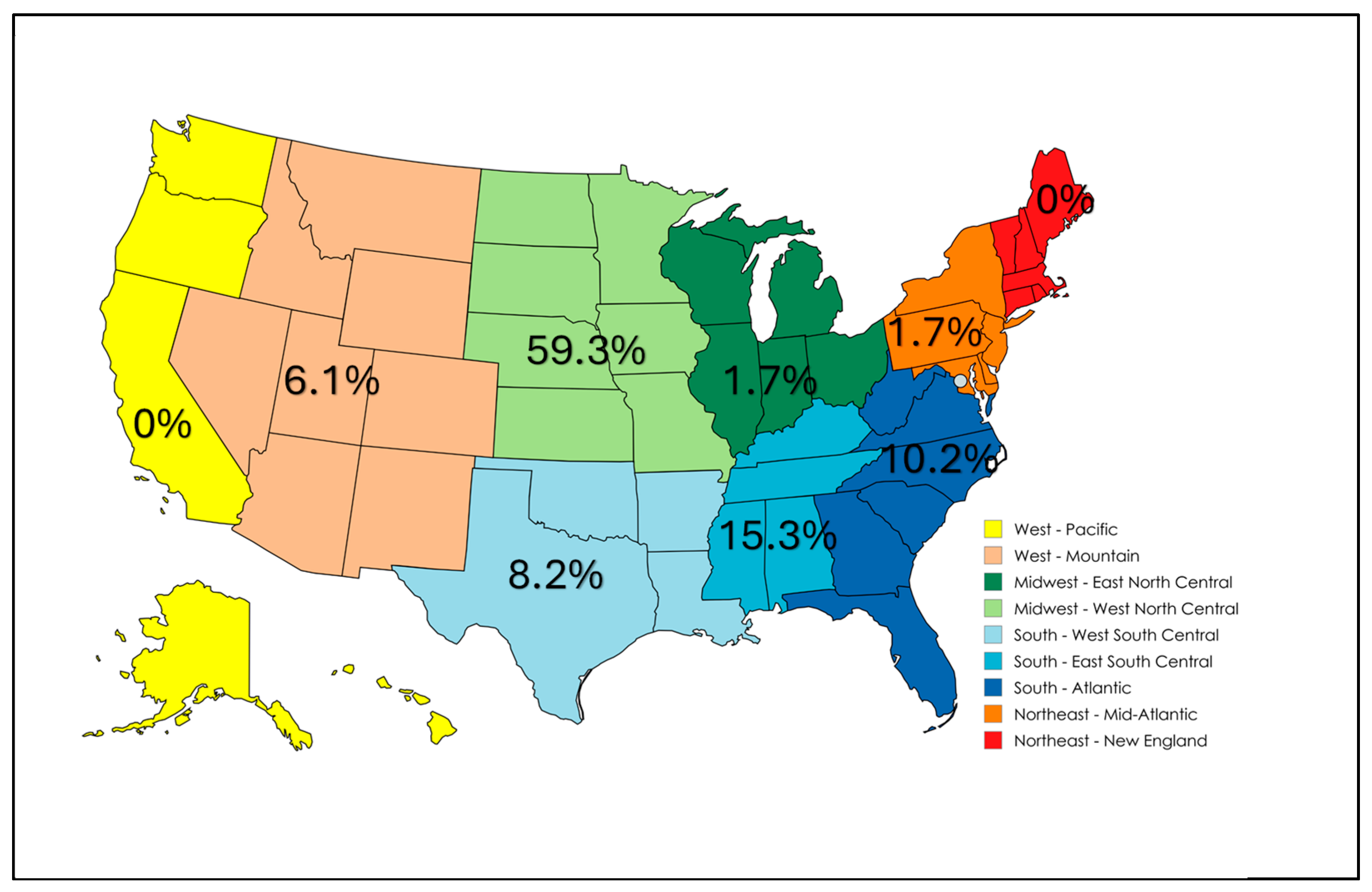
| Age y | Professor | 16 | 27.1 | ||
| Millennial (27–42) | 29 | 49.2 | Professor of Practice | 3 | 5.1 |
| Generation X (43–59) | 22 | 37.3 | Other | 3 | 5.1 |
| Baby Boomers (60–77) | 8 | 13.6 | Position Appointment | ||
| Ethnicity | Majority teaching or extension | 37 | 62.7 | ||
| Caucasian/White | 53 | 89.8 | |||
| Hispanic/Latino | 2 | 3.4 | Majority research with some teaching or extension | 9 | 15.3 |
| African American/Black | 1 | 1.7 | |||
| Asian/Pacific Islander | 1 | 1.7 | |||
| Mixed/Other | 2 | 3.4 | Majority administration with some teaching or extension | 6 | 10.2 |
| Upbringing | |||||
| Urban | 4 | 6.8 | |||
| Suburban | 27 | 45.8 | Evenly split teaching or extension or research | 7 | 11.9 |
| Rural | 28 | 47.5 |
| ACT Area of Interest | n | Code Words for Agriculture |
|---|---|---|
| Agriculture and Natural Resource Conservation | 14 | BEEF, FOOD PRODUCTION, FARM PRODUCTION ENTERPRISES, HORSE INDUSTRY, CROPPING SYSTEMS, LIVESTOCK PRODUCTION, GROW FOOD, RUMINANT |
| Sciences: Biological and Physical | 1 | ANIMAL AGRICULTURE |
| Business | 1 | FOOD SUPPLY, SUPPLY CHAIN |
| Communication | 1 | DAIRY MILK |
| Health Sciences and Technologies | 1 | GLOBAL AG PRODUCTION, FRUITS, VEGETABLES, MEAT |
| Computer Science and Mathematics | 2 | AG CENSUS DATA, FARM MODEL |
| English and Foreign Languages | 1 | FARM LABORERS |
| Philosophy and Religion | 1 | INDUSTRIAL FARMING, MEAT CONSUMPTION |
| Social Sciences and Law | 2 | ANIMAL RIGHTS, COCK FIGHTING RING |
| Engineering Technology and Drafting | 1 | GMO FOOD y |
| Total | 25 |
| Sentiment | n | % |
|---|---|---|
| Positive | 2 | 8.0 |
| Negative | 5 | 20.0 |
| Neutral | 18 | 72.0 |
| Total | 25 | 100.0 |
| Code Words | n | % |
|---|---|---|
| NATURAL CYCLE | 1 | 8.3 |
| SUSTAINABILITY | 3 | 25.0 |
| AG SOLUTIONS | 3 | 25.0 |
| PRO-AG | 4 | 33.3 |
| HEALTH BENEFITS | 1 | 8.3 |
| Area of Interest x | Example Quotes |
|---|---|
| Agriculture and Natural Resources Conservation | “When considering the percentage of greenhouse gas emissions the agriculture sector is responsible for compared to other industries, it seems the blame is not justified. Those in the livestock industry argue that, livestock can actually be part of the climate change solution with their ability to sequester and recycle carbon from the earth’s atmosphere and help lower earth’s temperature… Based on your own research in conjunction with what you have learned in this course about livestock production and stewardship of land, discuss what you think options are for sustainable solutions to climate change are in the agriculture industry.” |
| Communication | “You are working with an integrated marketing and communications team to increase the reach of your social media campaign focused on the health benefits of dairy milk to consumers… What would be one strategy you would recommend for the company to pursue? How would you measure the success of the strategy?” |
| Code Words | n | % |
|---|---|---|
| CLIMATE CHANGE CONTRIBUTORS | 6 | 40.0 |
| MASSIVE EFFECTS | 4 | 26.7 |
| JUSTIFYING EXTREMIST ANIMAL RIGHTS ASSOC. | 1 | 6.7 |
| UNDERPRODUCING | 3 | 20.0 |
| REDUCED MEAT INTAKE | 1 | 6.7 |
| Area of Interest x | Example Quotes |
|---|---|
| Sciences: Biological and Physical | “Assuming you believe in climate change, how large a role do you think animal agriculture plays in the general warming of the planet?” |
| Philosophy and Religion | “PETA argues that we should be vegan because industrial farming is harming the environment. Suppose they are right (and they might be—Milford reservoir has been closed to fishing and swimming due to green algae blooms for at least a month of the summer in most of the past 10 years in consequence to nitrogen pollution). Does PETA’s argument justify government policies designed to decrease stockyard pollution by decreasing the demand for meat?” |
| Sentiment | n | (%) |
|---|---|---|
| FACTFUL INSIGHT | 27 | (42.9) |
| ECONOMICS | 3 | (4.8) |
| POLICY ACTIONS | 5 | (7.9) |
| AG ADAPTATIONS | 4 | (6.3) |
| ANIMAL AGRICULTURE | 6 | (9.5) |
| PLANT OR CROP AGRICULTURE | 9 | (14.3) |
| AG CENSUS DATA | 2 | (3.2) |
| FARM MODEL | 1 | (1.6) |
| FARM LABOR | 1 | (1.6) |
| FOOD SUPPLY | 5 | (7.9) |
| Area of Interest x | Example Quotes |
|---|---|
| Agriculture and Natural Resources Conservation | “For this assignment, please provide a 5-min video discussion of the issue of methane production by ruminants and its effects on the environment. Frame this discussion as if you were talking to an audience of dieticians at a human nutrition conference. You should discuss some data (with sources), as well as how those data should be interpreted in the context of the current debate in the public square.” “How might a changing climate in Florida impact an invasive species like citrus greening and therefore impact Florida’s citrus industry?” |
| English and Foreign Languages | “How does Pam Munoz Ryan’s young adult novel Esperanza Rising depict migrant workers compared with your own perceptions of them? In your response, you can discuss your perspective in terms of experience (direct or observational), research or studies, assumptions or stereotypes, and opinions based on media depictions (including social media, news sources, films/shows, etc.).” |
| Business | “When considering supply chain issues in the food service industry; What attributes can influence a food products ability to enter the United States? How does this effect your production, menu design, and pricing structure?” |
Disclaimer/Publisher’s Note: The statements, opinions and data contained in all publications are solely those of the individual author(s) and contributor(s) and not of MDPI and/or the editor(s). MDPI and/or the editor(s) disclaim responsibility for any injury to people or property resulting from any ideas, methods, instructions or products referred to in the content. |
© 2026 by the authors. Licensee MDPI, Basel, Switzerland. This article is an open access article distributed under the terms and conditions of the Creative Commons Attribution (CC BY) license.
Share and Cite
Corbitt, K.; Hiltbrand, K.; Johnson, G.; Rodning, S.; Smith, W.B.; Mulvaney, D. Use of Simulated Discussion Prompts to Assess Sentiment Toward Agriculture in Higher Education Instructors. Educ. Sci. 2026, 16, 188. https://doi.org/10.3390/educsci16020188
Corbitt K, Hiltbrand K, Johnson G, Rodning S, Smith WB, Mulvaney D. Use of Simulated Discussion Prompts to Assess Sentiment Toward Agriculture in Higher Education Instructors. Education Sciences. 2026; 16(2):188. https://doi.org/10.3390/educsci16020188
Chicago/Turabian StyleCorbitt, Katie, Karen Hiltbrand, Gabriella Johnson, Soren Rodning, William Brandon Smith, and Don Mulvaney. 2026. "Use of Simulated Discussion Prompts to Assess Sentiment Toward Agriculture in Higher Education Instructors" Education Sciences 16, no. 2: 188. https://doi.org/10.3390/educsci16020188
APA StyleCorbitt, K., Hiltbrand, K., Johnson, G., Rodning, S., Smith, W. B., & Mulvaney, D. (2026). Use of Simulated Discussion Prompts to Assess Sentiment Toward Agriculture in Higher Education Instructors. Education Sciences, 16(2), 188. https://doi.org/10.3390/educsci16020188