Literacies of Transnational Students of Color: A Critical Interpretive Synthesis Through an Intersectionally Informed Critical Race Theory Lens

 , ,
, ,
Abstract
1. Introduction
2. Conceptualizing the Review
2.1. Historicizing Literacy Research with Transnational Students of Color (TSCs)
2.2. Conceptualizing the Literacies of Transnational Students of Color
“[The autonomous] model assumes literacy is a single thing, with a big L and a single Y—Literacy…readers are treated as though they are autonomous, as though they can be separated from the society that gives meaning to their uses of literacy”(p. 82).
2.3. Intersectionally Informed Critical Race Theory (CRT)
3. Method for Literature Review
3.1. Design and Search Process
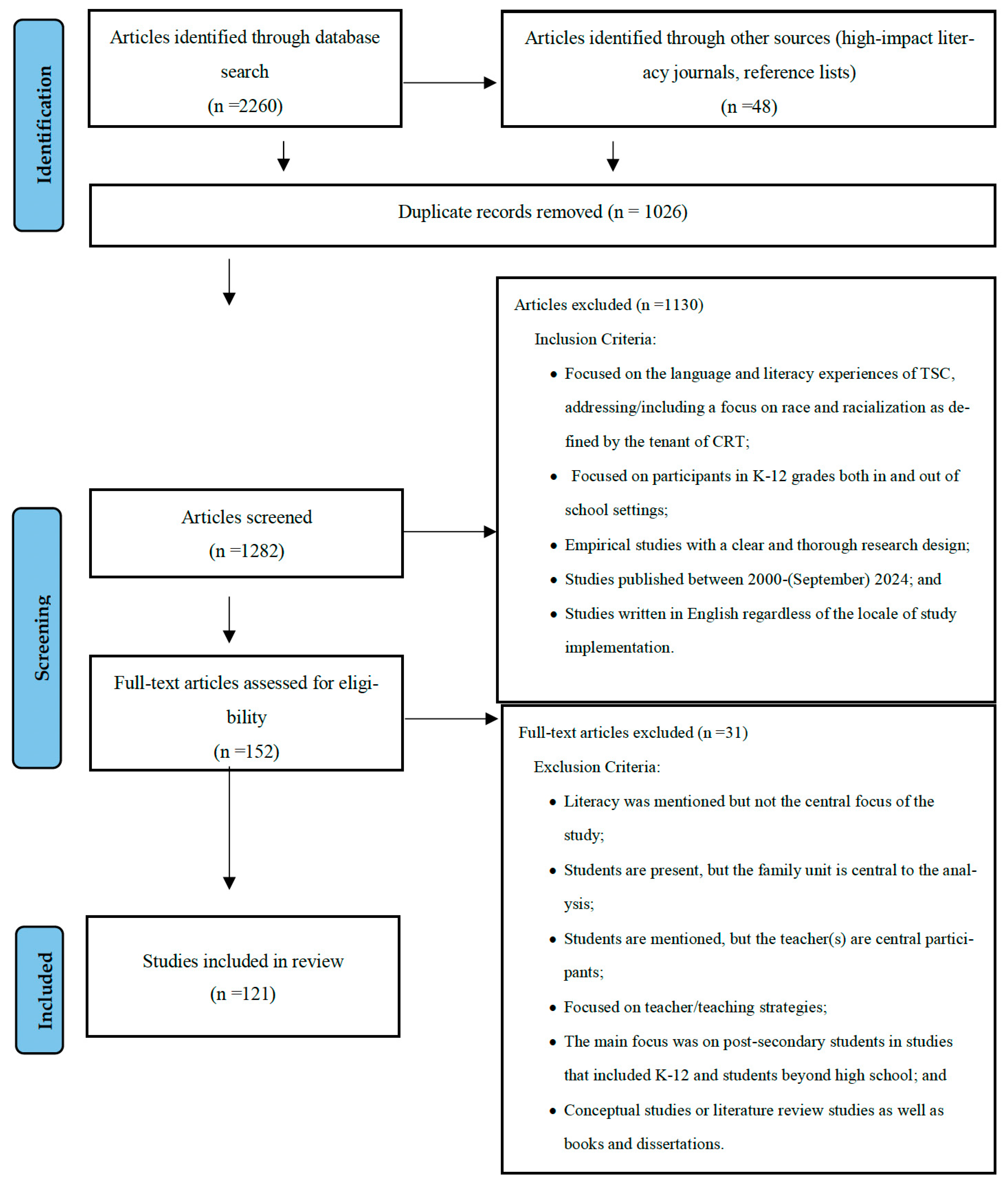
3.1.1. Identification
3.1.2. Screening and Eligibility
3.1.3. Refining for Creation of a Final Corpus
3.2. Analysis
3.3. Limitations
4. Findings
4.1. Descriptive Characteristics of Studies
4.2. Conceptions of Literacies and Corresponding Characterizations of Race and Racialization
4.3. Representations of Race and Racialization
4.3.1. Transformed Traditional Pathways
4.3.2. Complexified Intersectional Avenues
4.3.3. Questioned Educational Systems
4.3.4. Geographically Oriented Avenues
5. Discussion
6. Conclusions
Supplementary Materials
Author Contributions
Funding
Institutional Review Board Statement
Informed Consent Statement
Data Availability Statement
Acknowledgments
Conflicts of Interest
| 1 | These estimates describe distinct demographic populations and provide a broader context for this review; neither serves as the operational definition of TSCs. |
| 2 | These terms were used to maximize retrieval across partially overlapping bodies of scholarship; they were not treated as synonyms or as independently sufficient indicators of transnationality. |
References
- Afolalu, L. (2024). More than my race: Deconstructing racial identity categories through digital literacies. Research in the Teaching of English, 59(2), 155–186. [Google Scholar] [CrossRef] [Scilit]
- African American Policy Forum. (2021). A primer on intersectionality. African American Policy Forum. Available online: https://www.aapf.org/publications (accessed on 5 July 2026).
- Alim, H. S. (2004). You know my steez: An ethnographic and sociolinguistic study of styleshifting in a Black American Speech community. Duke University Press. [Google Scholar]
- Alim, H. S., Rickford, J. R., & Ball, A. F. (2016). Introducing raciolinguistics: Racing language and language race in hyperracial times. In H. S. Alim, J. R. Rickford, & A. F. Ball (Eds.), Raciolinguistics: How language shapes our ideas about race (pp. 1–30). Oxford University Press. [Google Scholar]
- Anzaldua, G. (1987). How to tame a wild tongue. In G. Anzaldua, & S. Saldívar-Hull (Eds.), Bor-derlands/La frontera: The new mestiza (pp. 33–45). Aunt Lute Books. [Google Scholar]
- Applebaum, B. (2010). Being white, being good: White complicity, white moral responsibility, and social justice pedagogy. Lexington Books. [Google Scholar]
- * Bajaj, M., Argenal, A., & Canlas, M. (2017a). Socio-politically relevant pedagogy for immigrant and refugee youth. Equity & Excellence in Education, 50(3), 258–274. [Google Scholar] [CrossRef] [Scilit]
- * Bajaj, M., Canlas, M., & Argenal, A. (2017b). Between rights and realities: Human rights education for immigrant and refugee youth in an urban public high school. Anthropology & Education Quarterly, 48(2), 124–140. [Google Scholar] [CrossRef] [Scilit]
- Baker-Bell, A. (2020). Dismantling anti-Black linguistic racism in English language arts classrooms: Toward an anti-racist Black language pedagogy. Theory Into Practice, 59(1), 8–21. [Google Scholar] [CrossRef] [Scilit]
- * Bartlett, L. (2007). Bilingual literacies, social identification, and educational trajectories. Linguistics and Education, 18(3–4), 215–231. [Google Scholar] [CrossRef] [Scilit]
- Batalova, J. (2026, March 12). Frequently requested statistics on immigrants and immigration in the United States. Migration Policy Institute. Available online: https://www.migrationpolicy.org/journal/spotlight/frequently-requested-statistics-immigrants-and-immigration-united-states (accessed on 5 July 2026).
- * Bauer, E. B., & Sánchez, L. (2020). Living nan lonbraj la: Haitian immigrant young people writing their selves into the world. Teachers College Record: The Voice of Scholarship in Education, 122(13), 1–36. [Google Scholar] [CrossRef] [Scilit]
- * Becker, M. L. (2023). Unboxing care: Constructions of happiness and gratitude in a Brazilian transnational family’s video production in the United States. Journal of Early Childhood Literacy, 23(4), 725–750. [Google Scholar] [CrossRef] [Scilit]
- Bell, D. A. (1995). Who’s afraid of critical race theory? University of Illinois Law Review, 1995(4), 893–910. [Google Scholar]
- * Boateng, S., Watson, V. W. M., Berends, J., & Hateka, D. (2024). “I would love for teachers to teach in a way that relates to my culture”: African immigrant youth composing digital collages. Journal of Adolescent & Adult Literacy, 68(2), 129–141. [Google Scholar] [CrossRef] [Scilit]
- * Braden, E. G. (2020). Navigating Black racial identities: Literacy insights from an immigrant family. Teachers College Record: The Voice of Scholarship in Education, 122(13), 1–26. [Google Scholar] [CrossRef] [Scilit]
- Bronfenbrenner, U., & Morris, P. A. (2006). The bioecological model of human development. In R. M. Lerner, & W. Damon (Eds.), Handbook of child psychology: Vol. 1. Theoretical models of human development (6th ed., pp. 793–828). Wiley. [Google Scholar] [CrossRef] [Scilit]
- * Bruinenberg, H., Sprenger, S., Omerović, E., & Leurs, K. (2021). Practicing critical media literacy education with/for young migrants: Lessons learned from a participatory action research project. International Communication Gazette, 83(1), 26–47. [Google Scholar] [CrossRef] [Scilit]
- * Bruna, K. R. (2007). Traveling tags: The informal literacies of Mexican newcomers in and out of the classroom. Linguistics and Education, 18(3–4), 232–257. [Google Scholar] [CrossRef] [Scilit]
- * Bryan, K. (2020). “I had to get tougher”: An African immigrant’s (counter)narrative of language, race, and resistance. Teachers College Record: The Voice of Scholarship in Education, 122(13), 1–28. [Google Scholar] [CrossRef] [Scilit]
- Bryce-Laporte, R. S. (1972). Black immigrants: The experience of invisibility and inequality. Journal of Black Studies, 3(1), 29–56. [Google Scholar] [CrossRef] [Scilit]
- Cabrera, N. L. (2018). Where is the racial theory in critical race theory? A constructive criticism of the crits. The Review of Higher Education, 42(1), 209–233. [Google Scholar] [CrossRef] [Scilit]
- Calvet, L.-J. (1974). Linguistique et colonialisme: Petit traité de glottophagie. Payot. [Google Scholar]
- * Cammarota, J., & Aguilera, M. (2012). ‘By the time I get to Arizona’: Race, language, and education in America’s racist state. Race Ethnicity and Education, 15(4), 485–500. [Google Scholar] [CrossRef] [Scilit]
- Campano, G. (2007). Immigrant students and literacy: Reading, writing, and remembering. Teachers College Press. [Google Scholar] [CrossRef] [Scilit]
- Campano, G., & Ghiso, M. P. (2011). Immigrant students as cosmopolitan intellectuals. In S. A. Wolf, K. Coats, P. Enciso, & C. A. Jenkins (Eds.), Handbook of research on children’s and young adult literature (pp. 164–176). Routledge. [Google Scholar] [CrossRef] [Scilit]
- Campano, G., Ghiso, M. P., & Welch, B. J. (2016). Partnering with immigrant communities: Action through literacy. Teachers College Press. [Google Scholar] [CrossRef] [Scilit]
- * Caraballo, L. (2017). Students’ critical meta-awareness in a figured world of achievement: Toward a culturally sustaining stance in curriculum, pedagogy, and research. Urban Education, 52(5), 585–609. [Google Scholar] [CrossRef] [Scilit]
- Carr, P. R., & Klassen, T. R. (1997). Different perceptions of race in education: Racial minority and white teachers. Canadian Journal of Education/Revue canadienne de l’éducation, 22(1), 67–81. [Google Scholar] [CrossRef] [Scilit]
- * Chao, X., & Ma, X. (2019). Transnational habitus: Educational, bilingual and biliteracy practices of Chinese sojourner families in the U.S. Journal of Early Childhood Literacy, 19(3), 399–423. [Google Scholar] [CrossRef] [Scilit]
- * Choi, J., Godina, H., & Ro, Y. S. (2014). Korean-American student perceptions on literacy and identity: Perspectives from an ethnographic case study. Asia Pacific Journal of Education, 34(3), 259–272. [Google Scholar] [CrossRef] [Scilit]
- Chu, Y., Guo, W., Sun, Y., & Yu, M. (2026a). Racing across borders: Transnational racial literacies of Chinese heritage language school teachers. Language, Culture and Curriculum, 1–17. [Google Scholar] [CrossRef] [Scilit]
- Chu, Y., Tian, Z., & Guo, W. (2026b). Bringing language to AsianCrit: Introducing a challenging linguistic racism tenet. Educational Researcher. Advanced online publication. [Google Scholar] [CrossRef] [Scilit]
- Combahee River Collective. (1995). Combahee river collective statement. In B. Guy-Sheftall (Ed.), Words of fire: An anthology of African American feminist thought (pp. 232–240). The New Press. (Original work published 1977). [Google Scholar]
- * Compton-Lilly, C., Kim, J., Quast, E., Tran, S., & Shedrow, S. (2019a). The emergence of transnational awareness among children in immigrant families. Journal of Early Childhood Literacy, 19(1), 3–33. [Google Scholar] [CrossRef] [Scilit]
- * Compton-Lilly, C., Kim, J., Quast, E., Tran, S., & Shedrow, S. (2019b). What we must learn from children in immigrant families. The Reading Teacher, 73(2), 135–140. [Google Scholar] [CrossRef] [Scilit]
- * Compton-Lilly, C., Papoi, K., Venegas, P., Hamman, L., & Schwabenbauer, B. (2017). Intersectional identity negotiation: The case of young immigrant children. Journal of Literacy Research, 49(1), 115–140. [Google Scholar] [CrossRef] [Scilit]
- Compton-Lilly, C., Spence, L. K., Thomas, P. L., & Decker, S. L. (2023). Stories grounded in decades of research: What we truly know about the teaching of reading. The Reading Teacher, 77(3), 392–400. [Google Scholar] [CrossRef] [Scilit]
- Crenshaw, K. (1991). Mapping the margins: Intersectionality, identity politics, and violence against women of Color. Stanford Law Review, 43(6), 1241–1299. [Google Scholar] [CrossRef] [Scilit]
- Crenshaw, K., Gotanda, N., Peller, G., & Thomas, K. (Eds.). (1995). Critical race theory: The key writings that formed the movement. The New Press. [Google Scholar]
- Critical Appraisal Skills Programme. (2018). CASP qualitative studies checklist. Available online: https://casp-uk.net/casp-tools-checklists/ (accessed on 5 July 2026).
- * Cuero, K. K. (2010). Artisan with words: Transnational funds of knowledge in a bilingual Latina’s narratives. Language Arts, 87(6), 427–436. [Google Scholar] [CrossRef] [Scilit]
- * Cun, A. (2021). Transnational literacy practices of two Burmese families: An ethnographic study. Pedagogies: An International Journal, 16(3), 286–306. [Google Scholar] [CrossRef] [Scilit]
- * Curdt-Christiansen, X. L., & La Morgia, F. L. (2018). Managing heritage language development: Opportunities and challenges for Chinese, Italian and Pakistani Urdu-speaking families in the UK. Multilingua, 37(2), 177–200. [Google Scholar] [CrossRef] [Scilit]
- * Daniel, S. M. (2019). Writing our identities for successful endeavors: Resettled refugee youth look to the future. Journal of Research in Childhood Education, 33(1), 71–83. [Google Scholar] [CrossRef] [Scilit]
- * Daniel, S. M., & Pacheco, M. B. (2016). Translanguaging practices and perspectives of four multilingual teens. Journal of Adolescent & Adult Literacy, 59(6), 653–663. [Google Scholar] [CrossRef] [Scilit]
- * Dao, N. (2021). Promoting biculturalism and biliteracy for Vietnamese American children through cultural performing arts. Bilingual Research Journal, 44(4), 466–484. [Google Scholar] [CrossRef] [Scilit]
- da Silva Iddings, A. C., & Warraich, A. K. (2024). Facilitating educational equity and safety of undocumented immigrant students. Urban Education, 59(2), 520–547. [Google Scholar] [CrossRef]
- * Dávila, D., Noguerón, S., & Vasquez-Dominguez, M. (2017). The Latinx family: Learning y la literatura at the library. Bilingual Review/Revista Bilingüe, 33(5), 33–49. Available online: https://bilingualreviewjournal.org/index.php/br/article/view/290 (accessed on 5 July 2026).
- De Genova, N. (Ed.). (2017). The borders of “Europe”: Autonomy of migration, tactics of bordering. Duke University Press. [Google Scholar] [CrossRef] [Scilit]
- * de la Piedra, M. T. (2010). Adolescent worlds and literacy practices on the United States-Mexico border. Journal of Adolescent & Adult Literacy, 53(7), 575–584. [Google Scholar] [CrossRef] [Scilit]
- * de la Piedra, M. T., & Araujo, B. E. (2012). Literacies crossing borders: Transfronterizo literacy practices of students in a dual language program on the USA-Mexico border. Language and Intercultural Communication, 12(3), 214–229. [Google Scholar] [CrossRef] [Scilit]
- Delgado, R. (1989). Storytelling for oppositionists and others: A plea for narrative. Michigan Law Review, 87(8), 2411–2441. [Google Scholar] [CrossRef] [Scilit]
- Delgado, R., & Stefancic, J. (2023). Critical race theory: An introduction (4th ed.). New York University Press. [Google Scholar] [CrossRef] [Scilit]
- * de los Ríos, C. V. (2018). Toward a Corridista consciousness: Learning from one transnational youth’s critical reading, writing, and performance of Mexican corridos. Reading Research Quarterly, 53(4), 455–471. [Google Scholar] [CrossRef] [Scilit]
- * de los Ríos, C. V. (2020). Writing oneself into the curriculum: Photovoice journaling in a secondary ethnic studies course. Written Communication, 37(4), 487–511. [Google Scholar] [CrossRef] [Scilit]
- * de los Ríos, C. V. (2022a). Guitarras on the rise: Framing youth sierreño bands as translingual ingenuity. Reading Research Quarterly, 57(2), 691–706. [Google Scholar] [CrossRef] [Scilit]
- * de los Ríos, C. V. (2022b). Translingual youth podcasts as acoustic allies: Writing and negotiating identities at the intersection of literacies, language and racialization. Journal of Language, Identity & Education, 21(6), 378–392. [Google Scholar] [CrossRef] [Scilit]
- * Deroo, M. R., & Mohamud, I. (2022). “I would rather be informed than misinformed”: Critical conversations supporting transnational religious identity across time and space. English Teaching: Practice & Critique, 21(3), 254–266. [Google Scholar] [CrossRef] [Scilit]
- * Dewilde, J. (2019). Translation and translingual remixing: A young person developing as a writer. International Journal of Bilingualism, 23(5), 942–953. [Google Scholar] [CrossRef] [Scilit]
- Dixon-Woods, M., Cavers, D., Agarwal, S., Annandale, E., Arthur, A., Harvey, J., Hsu, R., Katbamna, S., Olsen, R., Smith, L., Riley, R., & Sutton, A. J. (2006). Conducting a critical interpretive synthesis of the literature on access to healthcare by vulnerable groups. BMC Medical Research Methodology, 6, 35. [Google Scholar] [CrossRef] [Scilit]
- Dixson, A. D., & Rousseau Anderson, C. (2018). Where are we? Critical race theory in education 20 years later. Peabody Journal of Education, 93(1), 121–131. [Google Scholar] [CrossRef] [Scilit]
- * Dorner, L. M., Orellana, M. F., & Jiménez, R. (2008). “It’s one of those things that you do to help the family”: Language brokering and the development of immigrant adolescents. Journal of Adolescent Research, 23(5), 515–543. [Google Scholar] [CrossRef] [Scilit]
- * Dorner, L. M., Orellana, M. F., & Li-Grining, C. P. (2007). “I helped my mom,” and it helped me: Translating the skills of language brokers into improved standardized test scores. American Journal of Education, 113(3), 451–478. [Google Scholar] [CrossRef] [Scilit]
- Du Bois, W. E. B., & Marable, M. (2015). Souls of Black folk. Routledge. [Google Scholar] [CrossRef] [Scilit]
- Duncan, G. J., & Murnane, R. J. (2014). Restoring opportunity: The crisis of inequality and the challenge for American education. Harvard Education Press. [Google Scholar]
- * Durán, L., & Aguilera, M. (2022). Walls, bridges, borders, papers: Civic literacy in the borderlands. Research in the Teaching of English, 57(2), 156–176. [Google Scholar] [CrossRef] [Scilit]
- * Dutro, E., & Haberl, E. (2018). Blurring material and rhetorical walls: Children writing the border/lands in a second-grade classroom. Journal of Literacy Research, 50(2), 167–189. [Google Scholar] [CrossRef] [Scilit]
- * Endo, R. (2016). Counternarrating racialized expectations at school: The diverse enactments of “non-dominant” identities among 1.5-generation Japanese immigrant youth. Journal of Language, Identity & Education, 15(4), 201–215. [Google Scholar] [CrossRef] [Scilit]
- Fanon, F. (1963). The wretched of the earth (C. Farrington, Trans.). Grove Press. (Original work published 1961). [Google Scholar]
- * Flores, T. T. (2018). Breaking silence and amplifying voices: Youths writing and performing their worlds. Journal of Adolescent & Adult Literacy, 61(6), 653–661. [Google Scholar] [CrossRef] [Scilit]
- * Flores, T. T. (2019). The family writing workshop: Latinx families cultivando comunidad through stories. Language Arts, 97(2), 59–71. [Google Scholar] [CrossRef] [Scilit]
- * Flores, T. T. (2022). Somos escritoras/we are writers: Latina mothers and daughters writing and sharing “en convivencia”. Urban Education, 57(10), 1730–1756. [Google Scholar] [CrossRef] [Scilit]
- * Flores, T. T. (2023). “We are more than that!”: Latina girls writing themselves from margins to center. Research in the Teaching of English, 57(4), 332–354. [Google Scholar] [CrossRef] [Scilit]
- * Fránquiz, M. E., & Salinas, C. S. (2011). Newcomers to the U.S.: Developing historical thinking among Latino immigrant students in a central Texas high school. Bilingual Research Journal, 34(1), 58–75. [Google Scholar] [CrossRef] [Scilit]
- Freire, P. (1970). Pedagogy of the oppressed. Seabury Press. [Google Scholar]
- Freire, P. (2004). Pedagogy of indignation. Paradigm Publishers. [Google Scholar]
- * Gallo, S., & Hornberger, N. H. (2019). Immigration policy as family language policy: Mexican immigrant children and families in search of biliteracy. International Journal of Bilingualism, 23(3), 757–770. [Google Scholar] [CrossRef] [Scilit]
- * Garcia, A., & Mirra, N. (2021). Writing toward justice: Youth speculative civic literacies in online policy discourse. Urban Education, 56(4), 640–669. [Google Scholar] [CrossRef] [Scilit]
- * García, A., & Gaddes, A. (2012). Weaving language and culture: Latina adolescent writers in an after-school writing project. Reading & Writing Quarterly, 28(2), 143–163. [Google Scholar] [CrossRef] [Scilit]
- * García, O. (2023). Decolonizing US Latinx students’ language: El Sur in the schools of El Norte. Applied Linguistics, 44(5), 848–864. [Google Scholar] [CrossRef] [Scilit]
- García, O., & Li, W. (2014). Translanguaging: Language, bilingualism and education. Palgrave Macmillan. [Google Scholar] [CrossRef] [Scilit]
- * García, O., Woodley, H. H., Flores, N., & Chu, H. (2013). Latino emergent bilingual youth in high schools: Transcaring strategies for academic success. Urban Education, 48(6), 798–827. [Google Scholar] [CrossRef] [Scilit]
- * Ghiso, M. P. (2016). The laundromat as the transnational local: Young children’s literacies of interdependence. Teachers College Record: The Voice of Scholarship in Education, 118(1), 1–46. [Google Scholar] [CrossRef] [Scilit]
- * Gilhooly, D., Amos, M., & Kitson, C. (2019). Reading the ink around us: How Karen refugee youth use tattoos as an alternative literacy practice. Journal of Research in Childhood Education, 33(1), 145–163. [Google Scholar] [CrossRef] [Scilit]
- * Gonzales, L., González Ybarra, M., & The Fugitive Literacies Collective. (2020). Multimodal cuentos as fugitive literacies on the Mexico-US borderlands. English Education, 52(3), 223–255. [Google Scholar] [CrossRef] [Scilit]
- * González Ybarra, M. (2020). “We have a strong way of thinking… and it shows through our words”: Exploring mujerista literacies with Chicana/Latina youth in a community ethnic studies course. Research in the Teaching of English, 54(3), 231–253. [Google Scholar] [CrossRef] [Scilit]
- * Guo, W. (2024). Fostering student activism: Addressing anti-Asian racism through children’s literature in a community-based book club. Journal of Children’s Literature, 50(2), 25–37. [Google Scholar]
- Guo, W. (2025). Transnational funds of knowledge as counternarratives: Chinese students respond to multicultural children’s literature. Teachers College Record: The Voice of Scholarship in Education, 127(9–10), 37–66. [Google Scholar] [CrossRef] [Scilit]
- Guo, W., & Sun, Y. (2025). “U.S. and China can be friends for once”: Immigrant children engage in transnational literature in a community-based book club. In P. Edwards, C. Compton-Lilly, & G. Li (Eds.), The international handbook of literacies in families and communities (pp. 186–205). Edward Elgar Publishing. [Google Scholar]
- Guo, W., Tian, Z., & Stemme, M. (2026). Cultivating critical racial consciousness in dual language bilingual education: A participatory design of Asian American biliteracy lessons. English Teaching: Practice & Critique. Advanced online publication. [CrossRef] [Scilit]
- Gutiérrez, K. D. (2008). Developing a sociocritical literacy in the third space. Reading Research Quarterly, 43(2), 148–164. [Google Scholar] [CrossRef] [Scilit]
- Gutiérrez, K. D., Baquedano-López, P., & Turner, M. G. (1997). Putting language back into language arts: When the radical middle meets the third space. Language Arts, 74(5), 368–378. [Google Scholar] [CrossRef] [Scilit]
- * Gutiérrez, K. D., Bien, A. C., Selland, M. K., & Pierce, D. M. (2011). Polylingual and polycultural learning ecologies: Mediating emergent academic literacies for dual language learners. Journal of Early Childhood Literacy, 11(2), 232–261. [Google Scholar] [CrossRef] [Scilit]
- Harris, V. J. (1989). Race consciousness, refinement, and radicalism: Socialization in the Brownies’ book. Children’s Literature Association Quarterly, 14(4), 192–196. [Google Scholar] [CrossRef] [Scilit]
- Hesson, T. (2024, October 31). Sheriffs push Trump’s ‘migrant crime’ message with scant evidence. U.S. News & World Report. Available online: https://www.usnews.com/news/world/articles/2024-10-31/sheriffs-push-trumps-migrant-crime-message-with-scant-evidence (accessed on 5 July 2026).
- * Honeyford, M. A. (2013b). The simultaneity of experience: Cultural identity, magical realism and the artefactual in digital storytelling. Literacy, 47(1), 17–25. [Google Scholar] [CrossRef] [Scilit]
- * Hsin, C. (2017). Young children’s learning of literacies in transnational and sociocultural contexts in families with immigrant mothers in Taiwan. Australasian Journal of Early Childhood, 42(1), 33–40. [Google Scholar] [CrossRef] [Scilit]
- * Huang, Y., Guerrettaz, A. M., & Newcomer, S. N. (2024). Third space of the home: Transnational Chinese families’ English home literacy and language learning. International Journal of Bilingual Education and Bilingualism, 27(2), 213–229. [Google Scholar] [CrossRef] [Scilit]
- * Irizarry, J. G., & Kleyn, T. (2011). Immigration and education in the “supposed land of opportunity”: Youth perspectives on living and learning in the United States. The New Educator, 7(1), 5–26. [Google Scholar] [CrossRef] [Scilit]
- Jiménez, R. T., Smith, P. H., & Teague, B. L. (2009). Transnational and community literacies for teachers. Journal of Adolescent & Adult Literacy, 53(1), 16–26. [Google Scholar] [CrossRef] [Scilit]
- Kalantzis, M., Cope, B., Chan, E., & Dalley-Trim, L. (2016). Literacies (2nd ed.). Cambridge University Press. [Google Scholar] [CrossRef] [Scilit]
- * Kennedy, L. M., Oviatt, R. L., & De Costa, P. I. (2019). Refugee youth’s identity expressions and multimodal literacy practices in a third space. Journal of Research in Childhood Education, 33(1), 56–70. [Google Scholar] [CrossRef] [Scilit]
- Keyes, C. L. M. (2002). The mental health continuum: From languishing to flourishing in life. Journal of Health and Social Behavior, 43(2), 207–222. [Google Scholar] [CrossRef] [Scilit]
- * Kim, G. M. (2016). Transcultural digital literacies: Cross-border connections and self-representations in an online forum. Reading Research Quarterly, 51(2), 199–219. [Google Scholar] [CrossRef] [Scilit]
- * Kim, G. M., & Omerbašic, D. (2017). Multimodal literacies: Imagining lives through Korean dramas. Journal of Adolescent & Adult Literacy, 60(5), 557–566. [Google Scholar] [CrossRef] [Scilit]
- * Kim, S. (2018). “It was kind of a given that we were all multilingual”: Transnational youth identity work in digital translanguaging. Linguistics and Education, 43, 39–52. [Google Scholar] [CrossRef] [Scilit]
- * Knight, M. G., Norton, N. E., Bentley, C. C., & Dixon, I. R. (2004). The power of Black and Latina/o counterstories: Urban families and college-going processes. Anthropology & Education Quarterly, 35(1), 99–120. [Google Scholar] [CrossRef] [Scilit]
- * Kwon, J. (2020). The circulation of care in multilingual and transnational children. Literacy Research: Theory, Method, and Practice, 69(1), 99–119. [Google Scholar] [CrossRef] [Scilit]
- * Kwon, J. (2021). Mobilizing historical knowledge through transcultural play: A multi-sited ethnographic case study of an immigrant child. Early Child Development and Care, 191(4), 624–639. [Google Scholar] [CrossRef] [Scilit]
- * Kwon, J. (2022). Parent–child translanguaging among transnational immigrant families in museums. International Journal of Bilingual Education and Bilingualism, 25(2), 436–451. [Google Scholar] [CrossRef] [Scilit]
- * Kwon, J., Ghiso, M. P., & Martínez-Álvarez, P. (2019). Showcasing transnational and bilingual expertise: A case study of a Cantonese-English emergent bilingual within an after-school program centering Latinx experiences. Bilingual Research Journal, 42(2), 164–177. [Google Scholar] [CrossRef] [Scilit]
- * Kwon, J., Sun, W., & Rheem, C. S. (2022). Teaching while becoming: The transnational expertise of a Korean immigrant youth-educator. Journal of Adolescent & Adult Literacy, 66(1), 31–39. [Google Scholar] [CrossRef] [Scilit]
- Ladson-Billings, G., & Tate, W. F. (1995). Toward a critical race theory of education. Teachers College Record: The Voice of Scholarship in Education, 97(1), 47–68. [Google Scholar] [CrossRef] [Scilit]
- * Lam, W. S. E. (2009a). Literacy and learning across transnational online spaces. E-Learning and Digital Media, 6(4), 303–324. [Google Scholar] [CrossRef] [Scilit]
- * Lam, W. S. E. (2009b). Multiliteracies on instant messaging in negotiating local, translocal, and transnational affiliations: A case of an adolescent immigrant. Reading Research Quarterly, 44(4), 377–397. [Google Scholar] [CrossRef] [Scilit]
- * Lam, W. S. E. (2014). Literacy and capital in immigrant youths’ online networks across countries. Learning, Media and Technology, 39(4), 488–506. [Google Scholar] [CrossRef] [Scilit]
- * Lam, W. S. E., & Christiansen, M. S. (2022). Transnational Mexican youth negotiating languages, identities, and cultures online: A chronotopic lens. TESOL Quarterly, 56(3), 907–933. [Google Scholar] [CrossRef] [Scilit]
- * Lam, W. S. E., & Rosario-Ramos, E. (2009). Multilingual literacies in transnational digitally mediated contexts: An exploratory study of immigrant teens in the United States. Language and Education, 23(2), 171–190. [Google Scholar] [CrossRef] [Scilit]
- Lam, W. S. E., & Warriner, D. S. (2012). Transnationalism and literacy: Investigating the mobility of people, languages, texts, and practices in contexts of migration. Reading Research Quarterly, 47(2), 191–215. [Google Scholar] [CrossRef] [Scilit]
- * Lam, W. S. E., & Wu, J. (2025). Chronotopes of transnational literacies: How youth live and imagine social worlds in their digital media practices. Reading Research Quarterly, 60(1), e577. [Google Scholar] [CrossRef] [Scilit]
- * LeBlanc, R. J. (2017). Literacy rituals in the community and the classroom. Language Arts, 95(2), 77–86. [Google Scholar] [CrossRef] [Scilit]
- * Lee, C. (2025). (Co)constructing hybrid, transformative, and democratic third spaces in a heritage language classroom for Asian American transnational students. Language and Education, 39(3), 699–716. [Google Scholar] [CrossRef] [Scilit]
- * Lee, C. C., Dufresne, K. V., & Relyea, J. E. (2021). “They are doers”: Writing to advocate with immigrant youth in community-based organizations. Journal of Adolescent & Adult Literacy, 64(5), 497–509. [Google Scholar] [CrossRef] [Scilit]
- Lee, C. D. (2001). Is October Brown Chinese? A cultural modeling activity system for underachieving students. American Educational Research Journal, 38(1), 97–141. [Google Scholar] [CrossRef] [Scilit]
- Lewin, S., Glenton, C., Munthe-Kaas, H., Carlsen, B., Colvin, C. J., Gülmezoglu, M., Noyes, J., Booth, A., Garside, R., & Rashidian, A. (2015). Using qualitative evidence in decision making for health and social interventions: An approach to assess confidence in findings from qualitative evidence syntheses (GRADE-CERQual). PLoS Medicine, 12(10), e1001895. [Google Scholar] [CrossRef] [Scilit]
- * Li, R., & Hawkins, M. R. (2021). Figured worlds in transnational transmodal communications. TESOL Quarterly, 55(1), 5–28. [Google Scholar] [CrossRef] [Scilit]
- * Linares, R. E. (2021). Creating and navigating a transborder writing space: One multilingual adolescent’s take-up of dialogue journaling in an English-medium classroom. Reading Research Quarterly, 56(4), 673–692. [Google Scholar] [CrossRef] [Scilit]
- * Linares, R. E. (2022). Maintaining connections, cultivating community: The role of transnational translingual literacy sponsorships in one adolescent’s literacy practices. Teachers College Record: The Voice of Scholarship in Education, 124(12), 162–191. [Google Scholar] [CrossRef] [Scilit]
- Luke, A. (2018). Regrounding critical literacy: Representation, facts and reality. In D. E. Alvermann, N. J. Unrau, M. Sailors, & R. B. Ruddell (Eds.), Theoretical models and processes of literacy (7th ed., pp. 349–361). Routledge. [Google Scholar] [CrossRef] [Scilit]
- * Lundqvist, U., & Erduyan, I. (2025). Syncretic literacy practices among Arab heritage students in Denmark. Language and Education, 39(1), 111–131. [Google Scholar] [CrossRef] [Scilit]
- Lynch, J., Gesing, P., & Cruz, N. (2024). International student trauma during COVID-19: Relationships among mental health, visa status, and institutional support. Journal of American College Health, 72(9), 3456–3463. [Google Scholar] [CrossRef] [Scilit]
- * Lytra, V. (2011). Negotiating language, culture and pupil agency in complementary school classrooms. Linguistics and Education, 22(1), 23–36. [Google Scholar] [CrossRef] [Scilit]
- * Machado, E., & Hartman, P. (2021). “It took us a long time to go here”: Creating space for young children’s transnationalism in an early writers’ workshop. Reading Research Quarterly, 56(4), 693–714. [Google Scholar] [CrossRef] [Scilit]
- * Mangual Figueroa, A., Baquedano-López, P., & Leyva-Cutler, B. (2014). La Cosecha/The Harvest: Sustainable models of school-community engagement at a bilingual program. Bilingual Research Journal, 37(1), 43–63. [Google Scholar] [CrossRef] [Scilit]
- * Martínez, R. A., Durán, L., & Hikida, M. (2017). Becoming “Spanish learners”: Identity and interaction among multilingual children in a Spanish-English dual language classroom. International Multilingual Research Journal, 11(3), 167–183. [Google Scholar] [CrossRef] [Scilit]
- Martínez, R. A., Orellana, M. F., Pacheco, M., & Carbone, P. (2008). Found in translation: Connecting translating experiences to academic writing. Language Arts, 85(6), 421–431. [Google Scholar] [CrossRef] [Scilit]
- * Martínez-Álvarez, P., & Ghiso, M. P. (2017). On languaging and communities: Latino/a emergent bilinguals’ expansive learning and critical inquiries into global childhoods. International Journal of Bilingual Education and Bilingualism, 20(6), 667–687. [Google Scholar] [CrossRef] [Scilit]
- Matsuda, M. J. (1987). Looking to the bottom: Critical legal studies and reparations. Harvard Civil Rights-Civil Liberties Law Review, 22(2), 323–399. Available online: https://scholarspace.manoa.hawaii.edu/items/69a4e33e-612e-4925-954e-454f48a7d952 (accessed on 5 July 2026).
- * McGinnis, T., Goodstein-Stolzenberg, A., & Saliani, E. C. (2007). “indnpride”: Online spaces of transnational youth as sites of creative and sophisticated literacy and identity work. Linguistics and Education, 18(3–4), 283–304. [Google Scholar] [CrossRef] [Scilit]
- * McLean, C. A. (2012). The author’s I: Adolescents mediating selfhood through writing. Pedagogies: An International Journal, 7(3), 229–245. [Google Scholar] [CrossRef] [Scilit]
- * Medina, C. L. (2005). Discourse and ideology in writing in role: Critical discourse analysis as a tool for interpretation. Youth Theatre Journal, 19(1), 102–116. [Google Scholar] [CrossRef] [Scilit]
- * Medina, C. L. (2010). “Reading across communities” in biliteracy practices: Examining translocal discourses and cultural flows in literature discussions. Reading Research Quarterly, 45(1), 40–60. [Google Scholar] [CrossRef] [Scilit]
- Mezzadra, S. (2011). The gaze of autonomy: Capitalism, migration, and social struggles. In V. Squire (Ed.), The contested politics of mobility: Borderzones and irregularity (pp. 121–142). Routledge. [Google Scholar]
- Mezzadra, S., & Neilson, B. (2013). Border as method, or, the multiplication of labor. Duke University Press. [Google Scholar] [CrossRef] [Scilit]
- Moll, L. C. (2019). Elaborating funds of knowledge: Community-oriented practices in international contexts. Literacy Research: Theory, Method, and Practice, 68(1), 130–138. [Google Scholar] [CrossRef] [Scilit]
- Moll, L. C., Amanti, C., Neff, D., & González, N. (2006). Funds of knowledge for teaching: Using a qualitative approach to connect homes and classrooms. In N. González, L. C. Moll, & C. Amanti (Eds.), Funds of knowledge: Theorizing practices in households, communities, and classrooms (pp. 83–100). Routledge. [Google Scholar] [CrossRef] [Scilit]
- New London Group. (1996). A pedagogy of multiliteracies: Designing social futures. Harvard Educational Review, 66(1), 60–92. [Google Scholar] [CrossRef] [Scilit]
- * Noguerón-Liu, S., & Driscoll, K. (2021). Bilingual families’ perspectives on literacy resources and supports at home. The Reading Teacher, 75(1), 17–25. [Google Scholar] [CrossRef] [Scilit]
- * Nuñez, I. (2021a). “Because we have to speak English at school”: Transfronterizx children translanguaging identity to cross the academic border. Research in the Teaching of English, 56(1), 10–32. [Google Scholar] [CrossRef] [Scilit]
- * Nuñez, I. (2021b). Collective (re) constructions of linguistic surveillance at home: Transfronterizx families as cultural and linguistic guardians. Equity & Excellence in Education, 54(3), 238–251. [Google Scholar] [CrossRef] [Scilit]
- * Nuñez, I. (2022). ‘Siento que el inglés esta tumbando mi español’: A transfronteriza child’s embodied critical language awareness. International Journal of Bilingual Education and Bilingualism, 25(7), 2608–2620. [Google Scholar] [CrossRef] [Scilit]
- * Nuñez, I., & Urrieta, L., Jr. (2021). Transfronterizo children’s literacies of surveillance and the cultural production of border crossing identities on the U.S.–Mexico border. Anthropology & Education Quarterly, 52(1), 21–41. [Google Scholar] [CrossRef] [Scilit]
- * Nuñez, I., Ybarra, M. G., Tissenbaum, C. D., & Acosta, B. (2024). Yo! Chisme is good! Latina/x girls’ cultivando confianza in an after-school program. Teachers College Record: The Voice of Scholarship in Education, 126(8), 3–31. [Google Scholar] [CrossRef] [Scilit]
- Olmos, D. (2019). Racialized im/migration and autonomy of migration perspectives: New directions and opportunities. Sociology Compass, 13(9), e12729. [Google Scholar] [CrossRef] [Scilit]
- Olsen, L. (1997). Made in America: Immigrant students in our public schools. The New Press. [Google Scholar]
- Omi, M., & Winant, H. (1993). On the theoretical concept of race. In C. McCarthy, & W. Crichlow (Eds.), Race, identity, and representation in education (pp. 3–10). Routledge. [Google Scholar]
- Orellana, M. F. (2009). Translating childhoods: Immigrant youth, language, and culture. Rutgers University Press. [Google Scholar] [CrossRef] [Scilit]
- Page, M. J., McKenzie, J. E., Bossuyt, P. M., Boutron, I., Hoffmann, T. C., Mulrow, C. D., Shamseer, L., Tetzlaff, J. M., Akl, E. A., Brennan, S. E., Chou, R., Glanville, J., Grimshaw, J. M., Hróbjartsson, A., Lalu, M. M., Li, T., Loder, E. W., Mayo-Wilson, E., McDonald, S., … Moher, D. (2021). The PRISMA 2020 statement: An updated guideline for reporting systematic reviews. BMJ, 372, n71. [Google Scholar] [CrossRef] [Scilit]
- Pahl, K., & Rowsell, J. (2005). Literacy and education: Understanding the new literacy studies in the classroom. SAGE. [Google Scholar] [CrossRef] [Scilit]
- * Pandya, J. Z., Pagdilao, K. C., Kim, A. E., & Marquez, E. (2015). Transnational children orchestrating competing voices in multimodal, digital autobiographies. Teachers College Record: The Voice of Scholarship in Education, 117(7), 1–32. [Google Scholar] [CrossRef] [Scilit]
- Panelli, R., Punch, S., & Robson, E. (Eds.). (2007). Global perspectives on rural childhood and youth: Young rural lives (Vol. 13). Routledge. [Google Scholar] [CrossRef] [Scilit]
- * Park, J. Y. (2013). Becoming academically literate: A case study of an African immigrant youth. Journal of Adolescent & Adult Literacy, 57(4), 298–306. [Google Scholar] [CrossRef] [Scilit]
- Passel, J. S., Krogstad, J. M., & Moslimani, M. (2024, July 22). How the origins of America’s immigrants have changed since 1850. Pew Research Center. Available online: https://www.pewresearch.org/short-reads/2024/07/22/how-the-origins-of-americas-immigrants-have-changed-since-1850/ (accessed on 5 July 2026).
- * Peñalva, S. L. (2017). An ethnographic portrait of translingual/transcultural navigation among immigrant children and youth: Voices during Sunday school at a Latino church. Journal of Multilingual and Multicultural Development, 38(5), 438–452. [Google Scholar] [CrossRef] [Scilit]
- * Player, G. D. (2021). “My color of my name”: Composing critical self-celebration with girls of color through a feminist of color writing pedagogy. Research in the Teaching of English, 55(3), 216–240. [Google Scholar] [CrossRef] [Scilit]
- * Player, G. D. (2022). Girls of color embodied and experiential dreams for education. Journal of Literacy Research, 54(4), 379–401. [Google Scholar] [CrossRef] [Scilit]
- Portes, A., & Rumbaut, R. G. (2005). Introduction: The second generation and the children of immigrants longitudinal study. Ethnic and Racial Studies, 28(6), 983–999. [Google Scholar] [CrossRef] [Scilit]
- * Pyo, J. (2016). Bridging in-school and out-of-school literacies: An adolescent EL’s composition of a multimodal project. Journal of Adolescent & Adult Literacy, 59(4), 421–430. [Google Scholar] [CrossRef] [Scilit]
- Qiu, T. (2025). Here, There, and In-Between: The Poetic Narratives of a Transnational Family’s Translingual, Multiliterate, and Trans-Geographic Reality. Reading Research Quarterly, 60(2), e70002. [Google Scholar] [CrossRef] [Scilit]
- * Quast, E., & Taira, B. W. (2021). Attending to the intersections: Exploring the literacies of a transnational child with autism. Language Arts, 98(3), 123–133. [Google Scholar] [CrossRef] [Scilit]
- * Ramos-Salazar, L., Diego-Medrano, E., García, N., & Castillo, Y. (2023). An examination of family cohesion and self-esteem as mediators of bilingualism and reading achievement among second-generation immigrant students. Journal of Latinos and Education, 22(4), 1660–1675. [Google Scholar] [CrossRef] [Scilit]
- Risko, V. J., Roller, C. M., Cummins, C., Bean, R. M., Block, C. C., Anders, P. L., & Flood, J. (2008). A critical analysis of research on reading teacher education. Reading Research Quarterly, 43(3), 252–288. [Google Scholar] [CrossRef] [Scilit]
- Rosa, J., & Flores, N. (2017). Unsettling race and language: Toward a raciolinguistic perspective. Language in Society, 46(5), 621–647. [Google Scholar] [CrossRef] [Scilit]
- * Rubinstein-Ávila, E. (2007). From the Dominican Republic to Drew High: What counts as literacy for Yanira Lara? Reading Research Quarterly, 42(4), 568–589. [Google Scholar] [CrossRef] [Scilit]
- * Sanchez, P. (2007). Cultural authenticity and transnational Latina youth: Constructing a meta-narrative across borders. Linguistics and Education, 18(3–4), 258–282. [Google Scholar] [CrossRef] [Scilit]
- * Sanchez, P. (2009). Chicana feminist strategies in a participatory action research project with transnational Latina youth. New Directions for Youth Development, 2009(123), 83–97. [Google Scholar] [CrossRef] [Scilit]
- Sayad, A. (2004). The suffering of the immigrant. Polity. [Google Scholar]
- Sánchez, P. (2009). Even beyond the local community: A close look at Latina youths’ return trips to Mexico. The High School Journal, 92(4), 49–66. [Google Scholar] [CrossRef] [Scilit]
- Sánchez, P., & Kasun, G. S. (2012). Connecting transnationalism to the classroom and to theories of immigrant student adaptation. Berkeley Review of Education, 3(1), 71–93. [Google Scholar] [CrossRef] [Scilit]
- * Seraphin, W. (2023). Dyasporic dreaming: The extraordinary literacies and superpowers of Haitian and Haitian American girls. International Journal of Qualitative Studies in Education, 36(7), 1212–1227. [Google Scholar] [CrossRef] [Scilit]
- * Skerrett, A. (2012). Languages and literacies in translocation: Experiences and perspectives of a transnational youth. Journal of Literacy Research, 44(4), 364–395. [Google Scholar] [CrossRef] [Scilit]
- Skerrett, A. (2015). Teaching transnational youth: Literacy and education in a changing world. Teachers College Press. [Google Scholar] [CrossRef] [Scilit]
- * Skerrett, A., & Bomer, R. (2013). Recruiting languages and lifeworlds for border-crossing compositions. Research in the Teaching of English, 47(3), 313–337. [Google Scholar] [CrossRef] [Scilit]
- Skutnabb-Kangas, T. (1988). Multilingualism and the education of minority children. In T. Skutnabb-Kangas, & J. Cummins (Eds.), Minority education: From shame to struggle (pp. 9–44). Multilingual Matters. [Google Scholar] [CrossRef] [Scilit]
- Skutnabb-Kangas, T., & Cummins, J. (Eds.). (1988). Minority education: From shame to struggle. Multilingual Matters. [Google Scholar] [CrossRef] [Scilit]
- Smith, P. (2019). (Re)Positioning in the Englishes and (English) literacies of a Black immigrant youth: Towards a ‘transraciolinguistic’ approach. Theory into Practice, 58(3), 292–303. [Google Scholar] [CrossRef] [Scilit]
- Smith, P. (2020). The case for translanguaging in Black immigrant literacies. Literacy Research: Theory, Method, and Practice, 69(1), 192–210. [Google Scholar] [CrossRef] [Scilit]
- Smith, P. (2022). A Transraciolinguistic Approach for Literacy Classrooms. The Reading Teacher, 75(5), 545–554. [Google Scholar] [CrossRef] [Scilit]
- Smith, P. (2023). Black immigrant literacies: Intersections of race, language and culture in the classroom. Teachers College Press. [Google Scholar]
- Smith, P. (2024). Literacies of migration: Translanguaging imaginaries of innocence. Cambridge University Press. [Google Scholar]
- * Smith, P., Kumi-Yeboah, A., Chang, R., Lee, J., & Frazier, P. (2019). Rethinking “(under) performance” for Black English speakers: Beyond achievement to opportunity. Journal of Black Studies, 50(6), 528–554. [Google Scholar] [CrossRef] [Scilit]
- * Smith, P., Lee, J., & Chang, R. (2022). Characterizing competing tensions in Black immigrant literacies: Beyond partial representations of success. Reading Research Quarterly, 57(1), 59–90. [Google Scholar] [CrossRef] [Scilit]
- Smith, P., Patterson, D., & Willis, A. (2025). Complicating Postcolonial Logics: Toward Transraciolinguistic Justice in Literacy Instruction. In Theories, models, and practices of literacy (pp. 4–25). Routledge. [Google Scholar]
- Smith, P., Wellington, D., Alabede, Y. S., Hunte, A., & Ogundapo, T. (2026). 11 Entanglements, Englishes, and transraciolinguistic becoming. In Countering colonialingualism in language education: Research practices and pedagogies from the global south (pp. 202–228). Routledge. [Google Scholar] [CrossRef] [Scilit]
- Smith, R. C. (2006). Mexican New York: Transnational lives of new immigrants. University of California Press. [Google Scholar]
- Soja, E. W. (1996). Thirdspace: Journeys to Los Angeles and other real-and-imagined places. Blackwell. [Google Scholar]
- * Somé-Guiébré, E. (2016). Mainstreaming English language learners: Does it promote or hinder literacy development? English Language Teaching, 9(1), 33–40. [Google Scholar] [CrossRef] [Scilit]
- * Son, Y. (2022). Critical literacy practices with bilingual immigrant children: Multicultural book club in an out-of-school context. International Journal of Early Years Education, 30(2), 307–321. [Google Scholar] [CrossRef] [Scilit]
- * Souto-Manning, M., Dernikos, B., & Yu, H. M. (2016). Rethinking normative literacy practices, behaviors, and interactions: Learning from young immigrant boys. Journal of Early Childhood Research, 14(2), 163–180. [Google Scholar] [CrossRef] [Scilit]
- Souto-Manning, M., Martinez, D. C., & Musser, A. D. (2022). ELA as English language abolition: Toward a pedagogy of communicative belonging. Reading Research Quarterly, 57(4), 1089–1106. [Google Scholar] [CrossRef] [Scilit]
- Street, B. V. (Ed.). (1993). Cross-cultural approaches to literacy. Cambridge University Press. [Google Scholar]
- Street, B. V. (1995). Social literacies. Routledge. [Google Scholar]
- Street, B. V. (1997). The implications of the ‘New Literacy Studies’ for literacy education. English in Education, 31(3), 45–59. [Google Scholar] [CrossRef] [Scilit]
- Suárez-Orozco, C. (2017). The diverse immigrant student experience: What does it mean for teaching? Educational Studies, 53(5), 522–534. [Google Scholar] [CrossRef] [Scilit]
- Suárez-Orozco, C., Abo-Zena, M. M., & Marks, A. K. (Eds.). (2015). Transitions: The development of children of immigrants. New York University Press. [Google Scholar] [CrossRef] [Scilit]
- Suárez-Orozco, C., & Suárez-Orozco, M. M. (2001). Children of immigration. Harvard University Press. [Google Scholar]
- * Taira, B. W. (2019). (In)visible literacies of transnational newcomer youth in a secondary English classroom. Global Education Review, 6(2), 74–93. Available online: https://ger.mercy.edu/index.php/ger/article/view/497 (accessed on 5 July 2026).
- * Thakurta, A. G. (2021). “The door was always there”: Transnational youth leveraging their multiliteracies for civic justice. Journal of Adolescent & Adult Literacy, 64(6), 645–656. [Google Scholar] [CrossRef] [Scilit]
- Tian, Z. (2022). Challenging the ‘dual’: Designing translanguaging spaces in a Mandarin-English dual language bilingual education program. Journal of Multilingual and Multicultural Development, 43(6), 534–553. [Google Scholar] [CrossRef] [Scilit]
- Tierney, R. J., & Pearson, P. D. (2024). Fact-checking the science of reading: Opening up the conversation. Literacy Research Commons. Available online: https://literacyresearchcommons.org/wp-content/uploads/2024/04/Fact-checking-the-SoR-3.pdf (accessed on 5 July 2026).
- Tong, A., Flemming, K., McInnes, E., Oliver, S., & Craig, J. (2012). Enhancing transparency in reporting the synthesis of qualitative research: ENTREQ. BMC Medical Research Methodology, 12, 181. [Google Scholar] [CrossRef] [Scilit]
- Treisman, R. (2024, October 19). Trump is promising deportation under the Alien Enemies Act of 1798. What is it? NPR. Available online: https://www.npr.org/2024/10/19/nx-s1-5156027/alien-enemies-act-1798-trump-immigration (accessed on 5 July 2026).
- * Vargas, L. (2006). Transnational media literacy: Analytic reflections on a program with Latina teens. Hispanic Journal of Behavioral Sciences, 28(2), 267–285. [Google Scholar] [CrossRef] [Scilit]
- * Vehabovic, N. (2021). Picturebooks as critical literacy: Experiences and perspectives of translingual children from refugee backgrounds. Journal of Literacy Research, 53(3), 382–405. [Google Scholar] [CrossRef] [Scilit]
- Vigouroux, C. B. (2023). Why this text? Why now? A response to Flores and Rosa. Journal of Sociolinguistics, 27(5), 445–448. [Google Scholar] [CrossRef] [Scilit]
- Wang, C., Cheah, C. S. L., Liu, J. L., Zhu, Q., Havewala, M., Ma, R., Cheong, Y., & Housden, M. (2023). Parents’ perspectives regarding anti-Asian racism during COVID-19: Supporting elementary students at school. School Psychology Review, 52(4), 435–452. [Google Scholar] [CrossRef] [Scilit]
- Warrican, S. J. (2020). Toward caring language and literacy classrooms for Black immigrant youth: Combating raciolinguistic ideologies and moral licensing. Teachers College Record: The Voice of Scholarship in Education, 122(13), 1–22. [Google Scholar] [CrossRef] [Scilit]
- Warriner, D. S. (2007). Language learning and the politics of belonging: Sudanese women refugees becoming and being “American”. Anthropology & Education Quarterly, 38(4), 343–359. [Google Scholar] [CrossRef] [Scilit]
- Wetzel, M. M., Vlach, S. K., Svrcek, N. S., Steinitz, E., Omogun, L., Salmeron, C., Batista-Morales, N., Taylor, L. A., & Villarreal, D. (2019). Preparing teachers with sociocultural knowledge in literacy: A literature review. Journal of Literacy Research, 51(2), 138–157. [Google Scholar] [CrossRef] [Scilit]
- * Willis, A. I. (2015). Literacy and race: Access, equity, and freedom. Literacy Research: Theory, Method, and Practice, 64(1), 23–55. [Google Scholar] [CrossRef] [Scilit]
- Willis, A. I. (2017). Re-positioning race in English language arts research. In D. Fisher, & D. Lapp (Eds.), Handbook of research on teaching the English language arts (4th ed., pp. 30–56). Routledge. [Google Scholar] [CrossRef] [Scilit]
- Willis, A. I. (2023). Revolutionizing literacy: The life of Omar ibn Said, written by himself. Literacy Research: Theory, Method, and Practice, 72(1), 118–138. [Google Scholar] [CrossRef] [Scilit]
- * Worthy, J., Nuñez, I., & Espinoza, K. (2016). “Wow, I get to choose now!” Bilingualism and biliteracy development from childhood to young adulthood. Bilingual Research Journal, 39(1), 20–34. [Google Scholar] [CrossRef] [Scilit]
- Yancy, G. (2005). Whiteness and the return of the Black body. The Journal of Speculative Philosophy, 19(4), 215–241. [Google Scholar] [CrossRef] [Scilit]
- Yosso, T. J., Smith, W. A., Ceja, M., & Solórzano, D. G. (2009). Critical race theory, racial microaggressions, and campus racial climate for Latina/o undergraduates. Harvard Educational Review, 79(4), 659–691. [Google Scholar] [CrossRef] [Scilit]
- Yu, J. (2021). Lost in lockdown? The impact of COVID-19 on Chinese international student mobility. Journal of International Students, 11(S2), 1–18. [Google Scholar] [CrossRef] [Scilit]
- * Zhang, Z., & Heydon, R. (2014). Lived literacy curriculum in a globalized schooling context: A case study of a Sino-Canadian transnational programme. Journal of Curriculum Studies, 46(3), 389–418. [Google Scholar] [CrossRef] [Scilit]
- * Zhao, S., & Flewitt, R. (2020). Young Chinese immigrant children’s language and literacy practices on social media: A translanguaging perspective. Language and Education, 34(3), 267–285. [Google Scholar] [CrossRef] [Scilit]


| Analytic Dimension | Deficit-/Assimilation-Oriented Tendency Criticized in the Literature | Asset-Based, Critical, and Transnational Reorientation | Indicators Reflected in This Review | Representative Scholarship |
|---|---|---|---|---|
| Conception of literacy | Literacy treated as an autonomous, decontextualized, and individually measurable skill | Literacies understood as ideological, socially situated practices shaped by culture, history, and power | Social-practice literacies; critical literacy; family and community literacies | Campano (2007); Gutiérrez (2008); Gutiérrez et al. (1997); P. Smith (2024); Street (1997) |
| Language and multilingualism | Named-language proficiency and English acquisition treated as primary indicators of competence; multilingual practices framed as interference or deficiency | Students’ full linguistic repertoires treated as resources for learning, meaning-making, and participation | Translanguaging; translingual literacy; biliteracy; language brokering | Baker-Bell (2020); Gallo and Hornberger (2019); O. García and Li (2014); Orellana (2009); P. Smith (2019, 2020); Tian (2022) |
| Students, families, and communities | Educational difficulty attributed primarily to individual, familial, or cultural limitations | Family and community practices recognized as sources of knowledge, expertise, and curricular possibility | Funds of knowledge; community literacies; family language practices; epistemic resources | Campano et al. (2016); Moll et al. (2006); Orellana (2009); P. Smith (2023) |
| Migration and adaptation | Movement represented through home/host binaries, linear adaptation, and normative expectations of assimilation | Migration understood as multidirectional and transnational, with relationships and practices sustained across borders | Transnational and translocal literacies; cross-border practices; multiple affiliations | Jiménez et al. (2009); Lam and Warriner (2012); Sánchez and Kasun (2012); Skerrett (2015); P. Smith (2022) |
| Identity and belonging | Identity treated as fixed, nationally bounded, or measured by proximity to dominant norms | Identity understood as plural, relational, diasporic, and continually negotiated across contexts | Hybrid identities; diasporic affiliations; third spaces; transnational identity work | Compton-Lilly et al. (2017); Guo (2025); Gutiérrez (2008); Kwon (2021); Lam and Rosario-Ramos (2009); P. Smith (2024) |
| Race and institutional power | Educational inequalities individualized or discussed without sustained attention to racialization and colonial power | Literacy practices situated within racialized, raciolinguistic, colonial, and institutional structures | Explicit analysis of racism; hegemonic whiteness; linguistic racism; raciolinguistics | Alim et al. (2016); Chu et al. (2026b); Rosa and Flores (2017); P. Smith (2019); Yosso et al. (2009); P. Smith et al. (2022) |
| Educational purpose | Emphasis on remediation, proficiency, adaptation, and standardized academic outcomes | Emphasis on agency, belonging, critical participation, knowledge production, and flourishing | Counterstorytelling; critical media literacy; social-justice literacies; multimodal composition | Garcia and Mirra (2021); Campano (2007); de los Ríos (2018); Player (2021, 2022); P. Smith et al. (2026) |
| Concepts | Transnationality- and Migration-Related Identifiers | Literacy | Race/Racialization | Students of Color |
|---|---|---|---|---|
| Keywords and synonyms | Transnational Across-borders English learners Bilingual Multilingual Immigrant First-generation Second-generation Refugee Undocumented Diaspora Foreign-born Newcomer Asylum-seeking Global | Literacy Reading Writing Literacies English language arts Fluency | Race Racialization Racism Colonialism Ethnicization Marginalization Discrimination Othering Stereotype | Student High school Middle school Elementary school Community Center Latino Latina Hispanic Latinx African African American Black Students Haitian students Asian students |
Disclaimer/Publisher’s Note: The statements, opinions and data contained in all publications are solely those of the individual author(s) and contributor(s) and not of MDPI and/or the editor(s). MDPI and/or the editor(s) disclaim responsibility for any injury to people or property resulting from any ideas, methods, instructions or products referred to in the content. |
© 2026 by the authors. Licensee MDPI, Basel, Switzerland. This article is an open access article distributed under the terms and conditions of the Creative Commons Attribution (CC BY) license.
Share and Cite
Guo, W.; Smith, P.; Stemme, M.R.; Patterson, D.; Han, S. Literacies of Transnational Students of Color: A Critical Interpretive Synthesis Through an Intersectionally Informed Critical Race Theory Lens. Educ. Sci. 2026, 16, 1598. https://doi.org/10.3390/educsci16101598
Guo W, Smith P, Stemme MR, Patterson D, Han S. Literacies of Transnational Students of Color: A Critical Interpretive Synthesis Through an Intersectionally Informed Critical Race Theory Lens. Education Sciences. 2026; 16(10):1598. https://doi.org/10.3390/educsci16101598
Chicago/Turabian StyleGuo, Wenyu, Patriann Smith, Margaret Robertson Stemme, Darlshawn Patterson, and Sophia Han. 2026. "Literacies of Transnational Students of Color: A Critical Interpretive Synthesis Through an Intersectionally Informed Critical Race Theory Lens" Education Sciences 16, no. 10: 1598. https://doi.org/10.3390/educsci16101598
APA StyleGuo, W., Smith, P., Stemme, M. R., Patterson, D., & Han, S. (2026). Literacies of Transnational Students of Color: A Critical Interpretive Synthesis Through an Intersectionally Informed Critical Race Theory Lens. Education Sciences, 16(10), 1598. https://doi.org/10.3390/educsci16101598