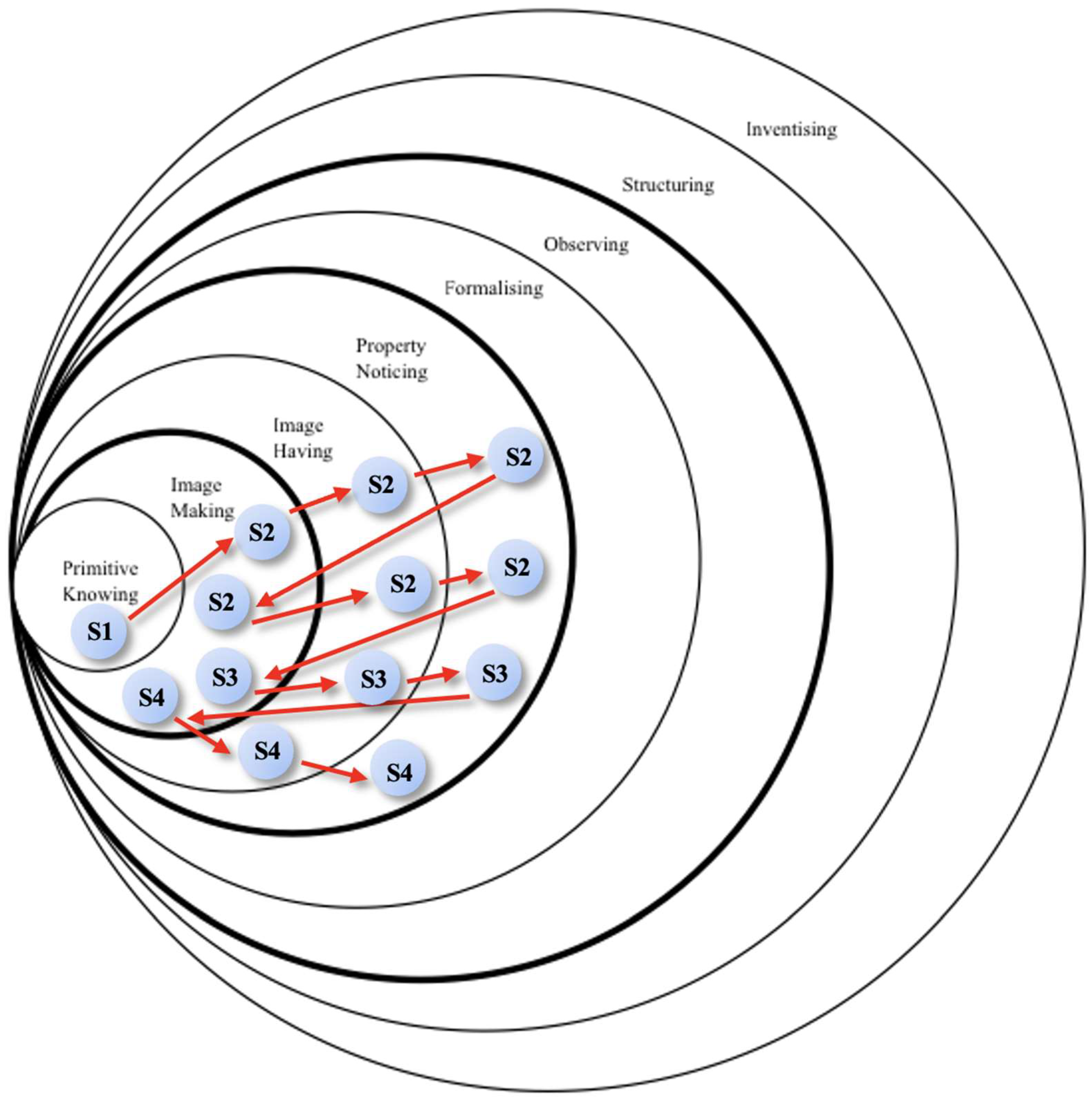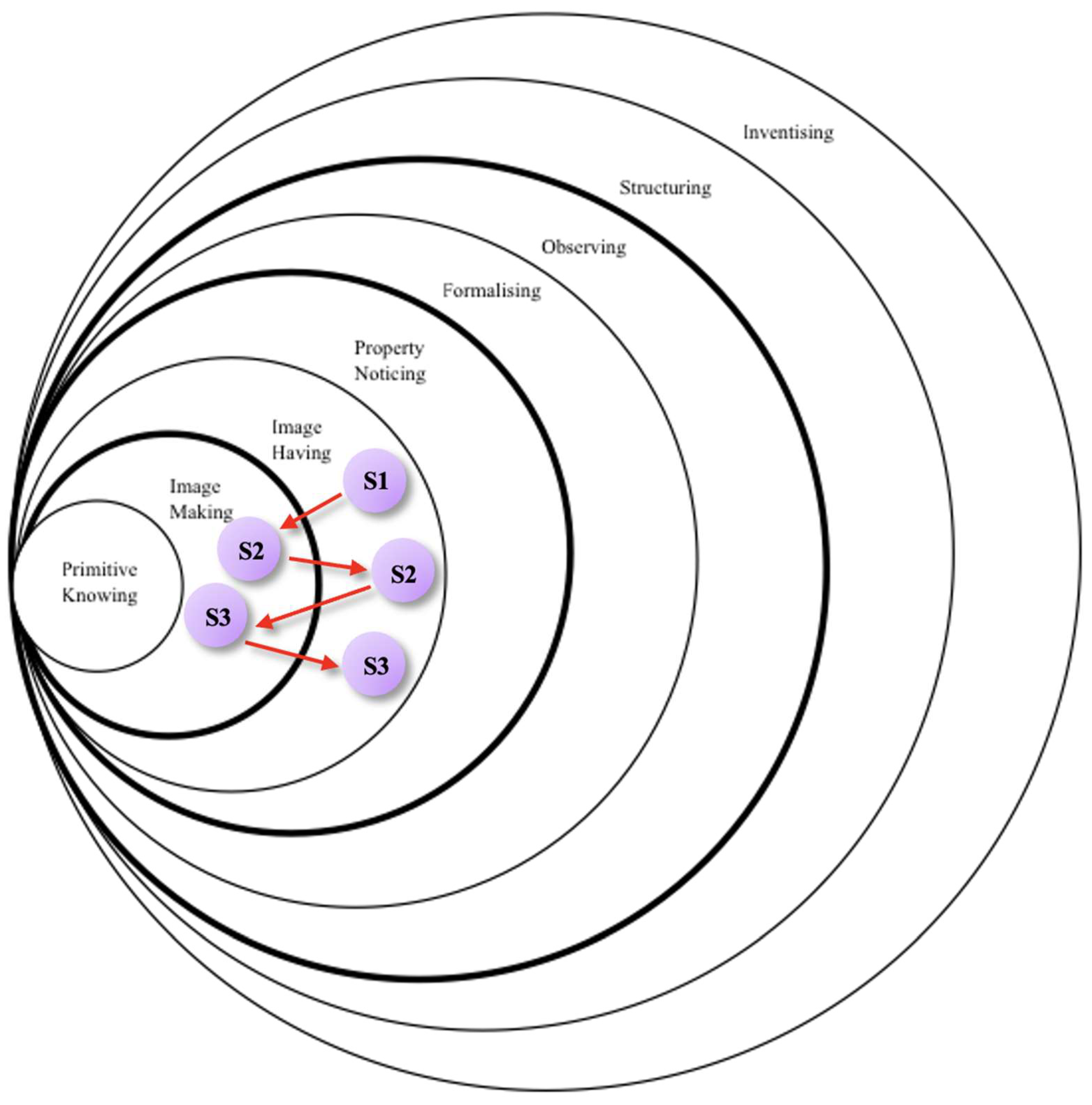



Exploring Deaf Aesthetics as Spatial-Geometric Thinking, Acting, and Feeling: A Case Study
Abstract
1. Introduction
2. Literature Review
2.1. Study Rationale
2.2. Aesthetics and Mathematics for Spatial Cognition Within STEAM Education
2.3. Spatial Cognition as Geometric, Embodied, and Aesthetic
2.4. STEAM Education: Aesthetics, Deaf Aesthetics, and Deaf Education
3. Theoretical–Methodological Framework
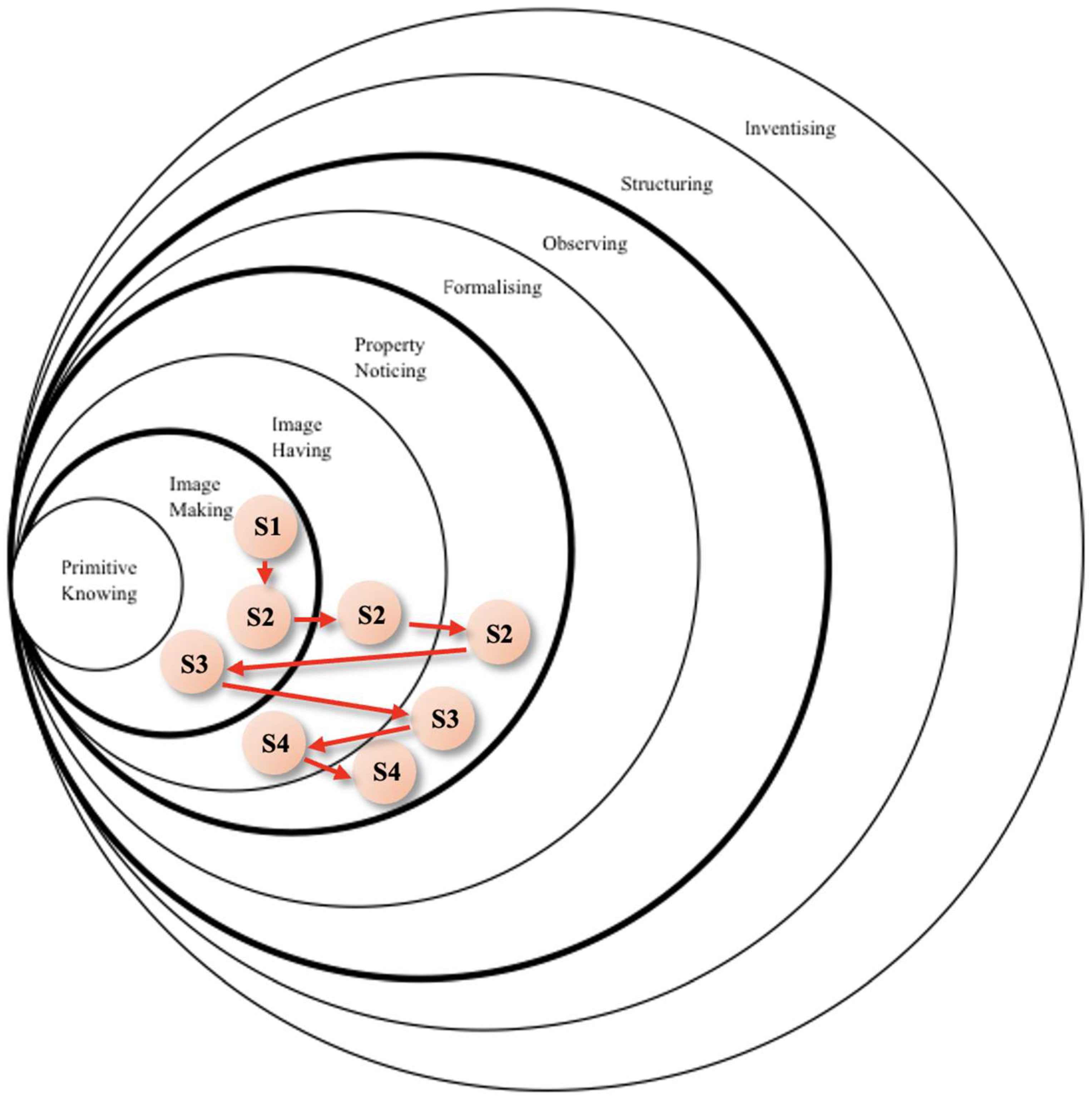
The Pirie–Kieren Dynamical Theory and Model for the Growth of Mathematical Understanding
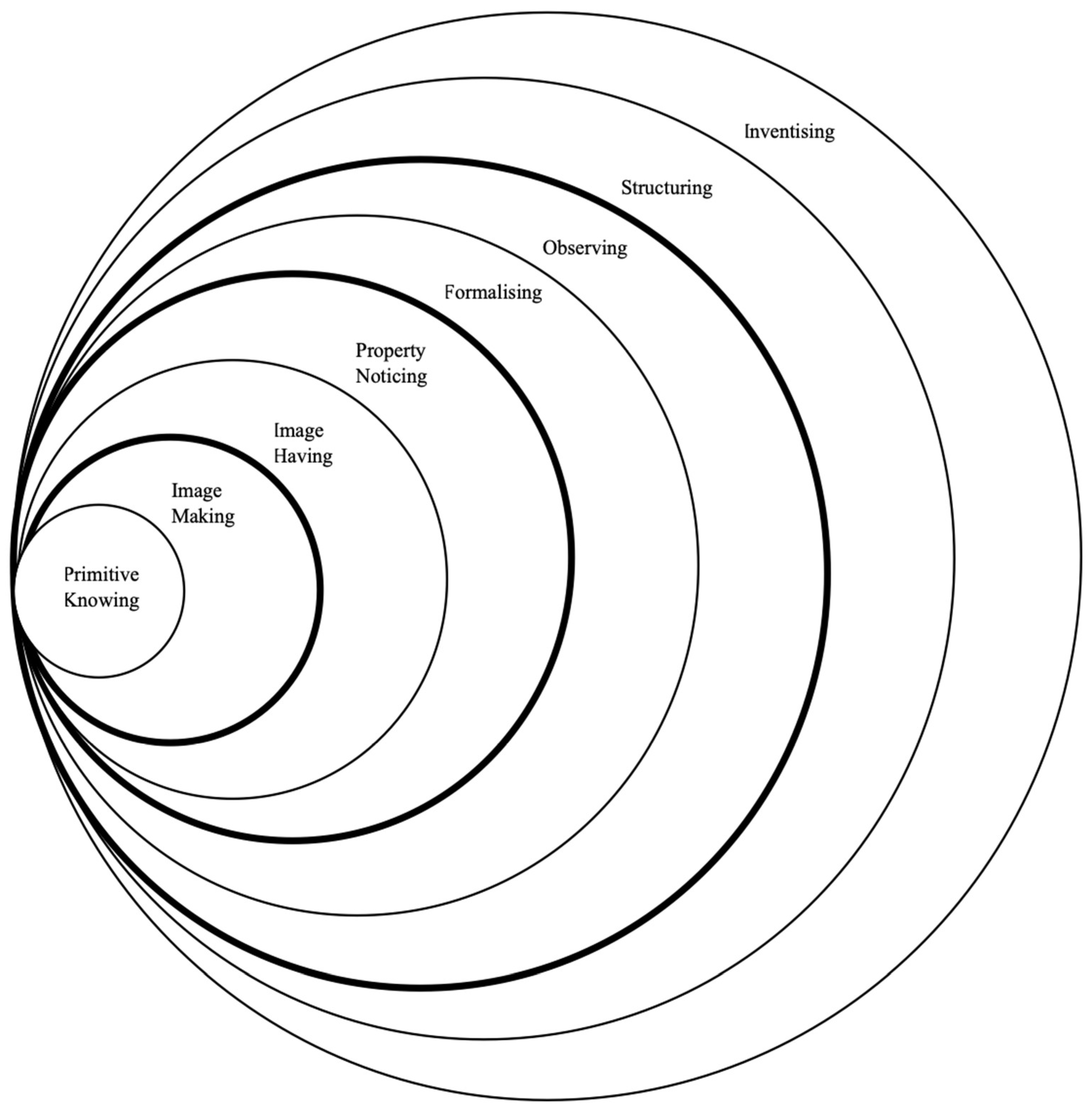
4. Watching Evan’s Spatial-Geometric Understandings Grow
4.1. Methods
4.2. Data Sources
4.2.1. Study Context
4.2.2. Participants
4.2.3. Data and Data Collection
Tasks 1, 2, and 3
5. Results and Analysis: Towards Understanding Evan’s Understandings
5.1. Task 1: Where Does It Belong?

| Sequence 1 |
 |
| Spatial Actions |
|
| Corresponding Pirie–Kieren Level |
|
| Sequence 2 |
 |
| Spatial Actions |
|
| Corresponding Pirie–Kieren Level |
|
| Sequence 3 |
 |
| Spatial Actions |
|
| Corresponding Pirie–Kieren Level |
|
| Sequence 4 |
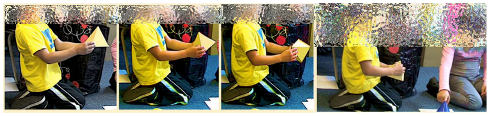
Evan turns the pyramid over, takes the cone from Noreen, inverts it, and presses the bases together. He explains, “because…this one is ova[l] and this one isn’t”. Evan then points to the corners of the bottom of the pyramid as he says, “These. Ouch! I feel pointy, sharp”, tracing around the edges of the objects’ bases with his finger.  |
| Spatial Actions |
|
| Corresponding Pirie–Kieren Level |
|
5.2. Task 2: Down by the Station
| Sequence 1 |
When asked what is different about the second train car (i.e., cube) from the first car (i.e., sphere), Evan says “I don’t know.”  |
| Spatial Actions |
|
| Corresponding Pirie–Kieren Level |
|
| Sequence 2 |
TOD places the sphere and cube in each of Evan’s hands. Evan looks at them and turns them about. Putting the sphere down, he gazes at the cube. Evan announces “edges [sic] [corners]” as he places his fingertip on the four corners. |
| Spatial Actions |
|
| Corresponding Pirie–Kieren Level |
|
| Sequence 3 |
Evan points to the side of the block, then grasps the front and says, “faces”; flattening his two fingers, he sweeps them across the surface. |
| Spatial Actions |
|
| Corresponding Pirie–Kieren Level |
|
| Sequence 4 |
Gazing downward, Evan places his fingertips along one of the edges of the cube. As he says “edges”, he looks at his fingers gliding along the edge. He then stares straight ahead. Looking at the edge of the cube again, he repeats the straight downward motion, this time with his index finger.  |
| Spatial Actions |
|
| Corresponding Pirie–Kieren Level |
|

5.3. Task 3: Pack Them up
| Sequence 1 |
Right away, Evan assembles one rod of six cubes. To this he adds a second rod of six cubes to create a 2 × 6 array. |
| Spatial Actions |
|
| Corresponding Pirie–Kieren Level |
|
| Sequence 2 |
Evan builds a rod of four cubes and measures it against the length of another cube model that contains two 2 × 3 arrays. Evan adds two more cubes to the rod at a right angle to make a width of three cubes.  He then fills in the rest of the cubes and produces a 3 × 4 array. |
| Spatial Actions |
|
| Corresponding Pirie–Kieren Level |
|
| Sequence 3 |
Evan looks back and forth at the other models and the 12 cubes in front of him. He disassembles one of the cube models, rebuilding it as three 2 × 2 arrays, and connects them as a 2 × 2 × 3 array.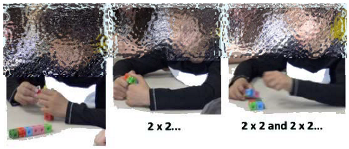  |
| Spatial Actions |
|
| Corresponding Pirie–Kieren Level |
|

6. Discussion
Com[es] to understand… when [he] performs actions — mental or physical — in order to create some “idea” of the new topic. Here, understanding grows from making distinctions through mathematical actions … the intent of working at this level is to give rise to the creation of new mathematical “images,” which may exist in mental, verbal, written, [signed], or physical forms.
Not as just the recollection of a mathematical experience or piece of information, but as providing a means by which [he] reconstruct[s], reintegrate[s], or re-evaluate[s] known mathematics so that [he] may function in the outer layers with a ‘thicker’ understanding.
7. Conclusions: Implications and Considerations for Future STEAM-Related Research in Deaf Education
7.1. STEAM Education Within Deaf Education
7.2. Research Methodologies
7.3. Spatial Cognition and Language Development
Author Contributions
Funding
Institutional Review Board Statement
Informed Consent Statement
Data Availability Statement
Acknowledgments
Conflicts of Interest
| 1 | The terms used to describe subsets of deaf populations including those who are hard of hearing vary significantly. In this paper, we eschew the following terms: Deaf, DHH, deaf and/or hard of hearing, DeafDisabled, D/deaf with disabilities in favor of the lower case “deaf” as adopted by deaf academics throughout the world. Friedner and Kusters (2015) out of the concern of dividing a low incidence population into additional identities, and in the spirit of inclusion, propose the term “deaf” to describe any one with a hearing loss regardless of the degree or type of hearing loss, cultural and social affiliations, language usage, and the presence of additional disabilities. |
| 2 | Mathematical objects include physical entities, such as a cylinder, as well as abstract ideas such as numbers, functions, and theorems. |
References
- Abram, D. (1996). The spell of the sensuous: Perception and language in a more-than-human world. Pantheon Books. [Google Scholar]
- Abram, D. (2010). Becoming animal: An earthly cosmology. Pantheon Books. [Google Scholar]
- Al-Jokhadar, A., & Jabi, W. (2020). Spatial reasoning as a syntactic method for programming socio-spatial parametric grammar for vertical residential buildings. Architectural Science Review, 63(2), 135–153. [Google Scholar] [CrossRef]
- Anderson, M. L., & Wolf Craig, K. S. (2018). Developing therapy approaches for deaf clients impacted by language deprivation. In N. S. Glickman, & W. C. Hall (Eds.), Language deprivation and deaf mental health (pp. 83–100). Routledge. [Google Scholar]
- Beardsley, J. (2021). James castle: Memory palace. Yale University Press. [Google Scholar]
- Brielmann, A. A., Nuzzo, A., & Pelli, D. G. (2021). Beauty, the feeling. Acta Psychologica, 219, 103365. [Google Scholar] [CrossRef]
- Brielmann, A. A., & Pelli, D. G. (2018). Aesthetics. Current Biology, 28(16), R859–R863. [Google Scholar] [CrossRef]
- Brielmann, A. A., Vale, L., & Pelli, D. G. (2017). Beauty at a glance: The feeling of beauty and the amplitude of pleasure are independent of stimulus duration. Journal of Vision, 17(14), 9. [Google Scholar] [CrossRef]
- Bussi, M. G. B., & Baccaglini-Frank, A. (2015). Geometry in early years: Sowing the seeds towards a mathematical definition of squares and rectangles. ZDM Mathematics Education, 47(3), 391–405. [Google Scholar] [CrossRef][Green Version]
- Caselli, N. K., Hall, W. C., & Henner, J. (2020). American sign language interpreters in public schools: An illusion of inclusion that perpetuates language deprivation. Maternal and Child Health Journal, 24(11), 1323–1329. [Google Scholar] [CrossRef] [PubMed]
- Cawthon, S., & Leppo, R. (2013). Assessment accommodations on tests of academic achievement for students who are deaf or hard of hearing: A qualitative meta-analysis of the research literature. American Annals of the Deaf, 158(3), 363–376. [Google Scholar] [CrossRef] [PubMed]
- Cheng, Q., Roth, A., Halgren, E., & Mayberry, R. I. (2019). Effects of early language deprivation on brain connectivity: Language pathways in deaf native and late first-language learners of American Sign Language. Frontiers in Human Neuroscience, 13, 320. [Google Scholar] [CrossRef] [PubMed]
- Cherryholmes, C. H. (1999). Reading pragmatism. Teachers College Press. [Google Scholar]
- Clements, D. H., & Sarama, J. (2011). Early childhood teacher education: The case of geometry. Journal of Mathematics Teacher Education, 14(2), 133–148. [Google Scholar] [CrossRef]
- Clements, D. H., & Sarama, J. (2014). Learning and teaching early math: The learning trajectories approach (2nd ed.). Routledge. [Google Scholar]
- Curry, P. (2023). Art and enchantment: How wonder works. Routledge. [Google Scholar] [CrossRef]
- Davis, B., Glanfield, F., Thom, J. S., & Towers, J. (2025a). Inventising the Pirie-Kieren theory. For the Learning of Mathematics: An International Journal of Mathematics Education, 45, 2–5. [Google Scholar]
- Davis, B., Glanfield, F., Thom, J. S., & Towers, J. (Eds.). (2025b). Unfolding with the Pirie-Kieren dynamical theory for the growth of mathematical learning. For the Learning of Mathematics. Monograph 3. Available online: https://flm-journal.org/index.php?do=show&lang=en&vol=45&num=0 (accessed on 10 September 2025).
- Davis, B., & The Spatial Reasoning Study Group (Eds.). (2015). Spatial reasoning in the early years: Principles, assertions, and speculations. Routledge. [Google Scholar] [CrossRef]
- Decoursey, M. (2018). Embodied aesthetics. In Drama education: Theatre, literature and philosophy. Bloomsbury Academic. [Google Scholar]
- Delahunty, T., Seery, N., Dunbar, R., & Ryan, M. (2020). An exploration of the variables contributing to graphical education students’ CAD modelling capability. International Journal of Technology and Design Education, 30(2), 389–411. [Google Scholar] [CrossRef]
- Dewey, J. (1934). Art as experience. Perigee Books. [Google Scholar]
- Edwards, A., Edwards, L., & Langdon, D. (2013). The mathematical abilities of children with cochlear implants. Child Neuropsychology, 19(2), 127–142. [Google Scholar] [CrossRef]
- Egan, K. (2005). An imaginative approach to teaching. Jossey-Bass. [Google Scholar]
- English, L. D. (2013). Mathematical reasoning: Analogies, metaphors, and images. Routledge. [Google Scholar]
- Enns, C. (2017). Making the case for case studies in deaf education. In S. Cawthon, & C. L. Garberoglio (Eds.), Research in deaf education: Contexts, challenges, and considerations (pp. 181–203). Oxford University Press. [Google Scholar]
- Feinberg, L. J. (2023). The private universe of James Castle: Drawings from the William Louis-Dreyfus Foundation and the James Castle Collection and Archive. Santa Barbara Museum of Art. [Google Scholar]
- Fowler, S., Cutting, C., Kennedy, J., Leonard, S. N., Gabriel, F., & Jaeschke, W. (2022). Technology enhanced learning environments and the potential for enhancing spatial reasoning: A mixed methods study. Mathematics Education Research Journal, 34(4), 887–910. [Google Scholar] [CrossRef]
- Freudenthal, H. (1973). Mathematics as an educational task. Springer. [Google Scholar]
- Friedner, M. (2016). Understanding and not-understanding: What do epistemologies and ontologies do in deaf worlds? Sign Language Studies, 16(2), 184–203. [Google Scholar] [CrossRef]
- Friedner, M., & Kusters, A. (2015). It’s a small world: International deaf spaces and encounters. Gallaudet University Press. [Google Scholar]
- Gao, R., Chen, C., Al-Halah, Z., Schissler, C., & Grauman, K. (2020). VisualEchoes: Spatial image representation learning through echolocation. In A. Vedaldi, H. Bischof, T. Brox, & J. M. Frahm (Eds.), Computer vision—ECCV 2020: 16th European conference, Glasgow, UK, August 23–28, 2020, Proceedings, Part IX (pp. 658–676). Springer International Publishing. [Google Scholar] [CrossRef]
- Gettings, M. (2016). Putting it all together: STEAM, PBL, scientific method, and the studio habits of mind. Art Education, 69(4), 10–11. [Google Scholar] [CrossRef]
- Gilligan, K. A., Flouri, E., & Farran, E. K. (2017). The contribution of spatial ability to mathematics achievement in middle childhood. Journal of Experimental Child Psychology, 163, 107–125. [Google Scholar] [CrossRef]
- Glickman, N. S., & Hall, W. (2019). Language deprivation and mental health. Routledge. [Google Scholar]
- Golos, D., Kuntze, M., Wolbers, K., & Kurz, C. (Eds.). (2024). 58-in-mind: Multilingual teaching strategies for diverse deaf students. Gallaudet University Press. [Google Scholar]
- Gottardis, L., Nunes, T., & Lunt, I. (2011). A synthesis of research on deaf and hearing children’s mathematical achievement. Deafness & Education International, 13(3), 131–150. [Google Scholar] [CrossRef]
- Graham, M. A. (2021). The disciplinary borderlands of education: Art and STEAM education (Los límites disciplinares de la educación: Arte y educación STEAM). Journal for the Study of Education and Development, 44(4), 769–800. [Google Scholar] [CrossRef]
- Green, E. M. (2015). One language, or maybe two: Direct communication, understanding, and informal interpreting in international deaf encounters. In M. Friedner, & A. Kusters (Eds.), It’s a small world: International deaf spaces and encounters (pp. 70–82). Gallaudet University Press. [Google Scholar]
- Grote, K., Stenzel, M., Wegner, S., & Karar, E. (2024). The devastating effects of language deprivation and misguided diagnosis in deaf children with cognitive and language disorders in medical centers, special needs, and educational settings. Journal of Deaf Mind & Deaf Didactics, 1(1), 1–22. [Google Scholar]
- Gulliksen, M. S. (2017). Making matters? Unpacking the role of practical aesthetic making activities in the general education through the theoretical lens of embodied learning. Cogent Education, 4(1). [Google Scholar] [CrossRef]
- Hall, M. L., Hall, W. C., & Caselli, N. K. (2019). Deaf children need language, not (just) speech. First Language, 39(4), 367–395. [Google Scholar] [CrossRef]
- Hauser, P., O’Hearn, A., McKee, M., Steider, A., & Thew, D. (2010). Deaf epistemology: Deafhood and deafness. American Annals of the Deaf, 154(5), 486–492. [Google Scholar] [CrossRef]
- Hawes, Z., Moss, J., Caswell, B., Naqvi, S., & MacKinnon, S. (2017). Enhancing children’s spatial and numerical skills through a dynamic spatial approach to early geometry instruction: Effects of a 32-week intervention. Cognition and Instruction, 35(3), 236–264. [Google Scholar] [CrossRef]
- Healy, L. (2015). Hands that see, hands that speak: Investigating relationships between sensory activity, forms of communicating, and mathematical cognition. In S. J. Cho (Ed.), Selected regular lectures from the 12th International congress on mathematical education (pp. 230–289). Springer. [Google Scholar] [CrossRef]
- Hecht, J. L. (2019). Responsibility in the current epidemic of language deprivation (1990–present). Maternal and Child Health Journal, 23(11), 1319–1322. [Google Scholar] [CrossRef] [PubMed]
- Henner, J., Pagliaro, C., Sullivan, S. B., & Hoffmeister, R. (2021). Counting differently: Assessing mathematics achievement of signing deaf and hard of hearing children through a unique lens. American Annals of the Deaf, 166(3), 318–341. [Google Scholar] [CrossRef] [PubMed]
- Henry, M. (1999). Material phenomenology and language (or, pathos and language). Continental Philosophy Review, 32(3), 343–365. [Google Scholar] [CrossRef]
- Henry, M. (2009). Seeing the invisible: On Kandinsky (S. Davidson, Trans.). Continuum. [Google Scholar]
- Ho, H.-N., Iwai, D., Yoshikawa, Y., Watanabe, J., & Nishida, S. (2014). Combining colour and temperature: A blue object is more likely to be judged as warm than a red object. Scientific Reports, 4, 5527. [Google Scholar] [CrossRef]
- Howerton-Fox, A., & Falk, J. L. (2019). Deaf children as ‘English learners’: The psycholinguistic turn in deaf education. Education Sciences, 9(2), 133. [Google Scholar] [CrossRef]
- Irvine, J. (2023). The Pirie Kieren dynamic model of the growth of mathematical understanding: The critical concept of folding back. Journal of Instructional Pedagogies, 29, 1–18. [Google Scholar]
- Jacobs, K. W., & Hustmyer, F. E., Jr. (1974). Effects of four psychological primary colors on GSR, heart rate and respiration rate. Perceptual and Motor Skills, 38(3), 763–766. [Google Scholar] [CrossRef]
- Jagodzinski, J., & Wallin, J. (2013). Arts-based research: A critique and a proposal. Springer Science & Business Media. [Google Scholar]
- Kandinsky, W. (1979). Point and line to plane: Contribution to the analysis of the pictorial elements (H. Dearstyne, & H. Rebay, Trans.). Dover. (Original work published 1926). [Google Scholar]
- Karadöller, D. Z., Sümer, B., & Özyürek, A. (2021). Effects and non-effects of late language exposure on spatial language development: Evidence from deaf adults and children. Language Learning and Development, 17(1), 1–18. [Google Scholar] [CrossRef]
- Karadöller, D. Z., Sümer, B., Ünal, E., & Özyürek, A. (2022a). Late sign language exposure does not modulate the relation between spatial language and spatial memory in deaf children and adults. Memory & Cognition, 50(3), 582–600. [Google Scholar] [CrossRef]
- Karadöller, D. Z., Sümer, B., Ünal, E., & Özyürek, A. (2022b). Sign advantage: Both children’s and adults’ spatial expressions in sign are more informative than those in speech and gestures combined. Journal of Child Language. Advance online publication. [Google Scholar] [CrossRef]
- Kasavan, S. R. (2012). Aesthetic mathematics: Using a SMART board in a kindergarten deaf classroom to explore and express geometry through the arts [Master’s thesis, University of California, San Diego]. [Google Scholar]
- Kelly, R. R., Lang, H. G., & Pagliaro, C. M. (2003). Mathematics word problem solving for deaf students: A survey of practices in grades 6–12. Journal of Deaf Studies and Deaf Education, 8(2), 104–119. [Google Scholar] [CrossRef]
- Kieren, T. E. (1990). Understanding for teaching for understanding. The Alberta Journal of Educational Research, 36(3), 191–201. [Google Scholar]
- Kong, L., Liu, Z., Pan, X., Wang, Y., Guo, X., & Wu, J. (2022). How do different types and landscape attributes of urban parks affect visitors’ positive emotions? Landscape and Urban Planning, 226, 104482. [Google Scholar] [CrossRef]
- Krause, C. M. (2018). Embodied geometry: Signs and gestures used in the deaf mathematics classroom—The case of symmetry. In Mathematical discourse that breaks barriers and creates space for marginalized learners (pp. 171–194). Brill. [Google Scholar]
- Krause, C. M. (2019). Brief report: What you see is what you get? Sign language in the mathematics classroom. Journal for Research in Mathematics Education, 50(1), 84–97. [Google Scholar] [CrossRef]
- Kritzer, K. L., & Green, L. (2021). Playing with code: An Innovative way to teach numeracy and early math concepts to young DHH children in the 21st Century. American Annals of the Deaf, 166(3), 409–423. [Google Scholar] [CrossRef]
- Kurz, C., Golos, D., Kuntze, M., Henner, J., & Scott, J. (2021). Guidelines for multilingual deaf education teacher preparation programs. Gallaudet University Press. [Google Scholar]
- Lakoff, G., & Johnson, M. (1999). Philosophy in the flesh: The embodied mind and its challenge to Western thought. Basic Books. [Google Scholar]
- Lakoff, G., & Núñez, R. (2000). Where mathematics comes from: How the embodied mind brings mathematics into being. Basic Books. [Google Scholar]
- Lang, H., & Pagliaro, C. (2007). Factors predicting recall of mathematics terms by deaf students: Implications for teaching. Journal of Deaf Studies and Deaf Education, 12(4), 449–460. [Google Scholar] [CrossRef]
- Larkin, K., Grootenboer, P., & Lack, P. (2016). Staff development: The missing ingredient in teaching geometry to year 3 students. In B. White, M. Chinnappan, & S. Trenholm (Eds.), Proceedings of the 39th annual conference of the mathematics education research group of Australasia (pp. 381–388). MERGA Inc. [Google Scholar]
- Lesh, R. (1976). Transformational geometry in elementary school: Some research issues. In J. L. Martin, & A. David (Eds.), Space and geometry: Papers from a research workshop (pp. 185–243). Ohio State University. [Google Scholar]
- Light, E. (2024). Bridging the affective gap in online classes: Teaching public memory through embodied learning. Communication Teacher, 38(1), 28–33. [Google Scholar] [CrossRef]
- Lockhart, P. (2002). A mathematician’s lament [Unpublished manuscript].
- Lockhart, P. (2009). A mathematician’s lament: How school cheats us out of our most fascinating and imaginative art form. Bellevue Literary Press. [Google Scholar]
- Lowrie, T., Logan, T., & Ramful, A. (2017). Visuospatial training improves elementary students’ mathematics performance. British Journal of Educational Psychology, 87(2), 170–186. [Google Scholar] [CrossRef]
- Luft, P. (2017). What is different about deaf education? The effects of child and family factors on educational services. Journal of Special Education, 51(1), 27–37. [Google Scholar] [CrossRef]
- Maivorsdotter, N., & Lundvall, S. (2009). Aesthetic experience as an aspect of embodied learning: Stories from physical education student teachers. Sport, Education and Society, 14(3), 265–279. [Google Scholar] [CrossRef]
- Mandelbrot, B. B. (1982). The fractal nature of geometry. W. H. Freeman and Co. [Google Scholar]
- Martin, L. C., & Pirie, S. E. B. (1998). “She says we’ve got to think back”: Effective folding back for growth of mathematical understanding. In A. Olivier, & K. Newstead (Eds.), Proceedings of the twenty-second annual conference of the international group for the psychology of mathematics education (Vol. 3, pp. 255–262). IGPME. [Google Scholar]
- Mayberry, R. I., & Kluender, R. (2018). Rethinking the critical period for language: New insights into an old question from American Sign Language. Bilingualism: Language and Cognition, 21(5), 938–944. [Google Scholar] [CrossRef] [PubMed]
- McGarvey, L. M., Thom, J. S., & Markle, J. (2024). Creating space for a topic in the null curriculum. In D. R. Thompson, M. A. Huntley, & C. Suurtamm (Eds.), Lessons learned from research on mathematics curriculum (pp. 57–78). IAP. [Google Scholar]
- Merleau-Ponty, M. (1945). Phénoménologie de la perception [Phenomenology of perception]. Gallimard. [Google Scholar]
- Merleau-Ponty, M., & Lefort, C. (1968). The visible and the invisible (A. Lingis, Trans.). Northwestern University Press. [Google Scholar]
- Mix, K. S., Levine, S. C., Cheng, Y. L., Young, C., Hambrick, D. Z., Ping, R., & Konstantopoulos, S. (2016). Separate but correlated: The latent structure of space and mathematics across development. Journal of Experimental Psychology: General, 145(9), 1206–1227. [Google Scholar] [CrossRef] [PubMed]
- Munn, K., Dragićević, S., & Feick, R. (2022). Spatial decision-making for dense built environments: The logic scoring of preference method for 3D suitability analysis. Land, 11(3), 443. [Google Scholar] [CrossRef]
- Mystakidis, S., Theologi-Gouti, P., & Iliopoulos, I. (2023). STEAM project exhibition in the metaverse for deaf-high school students’ affective empowerment: The power of student museum exhibitions in social virtual reality. In Communications in computer and information science, 9th International Conference, ILRN, 2023, San Luis Obispo, USA, June 26–29 (pp. 239–249). Immersive Learning Research Network (iLRN). [Google Scholar] [CrossRef]
- Nancy, J.-L. (2006). Corpus. Éditions Métailié. [Google Scholar]
- National Council of Teachers of Mathematics. (2006). Curriculum focal points for prekindergarten through grade 8 mathematics: A quest for coherence. National Council of Teachers of Mathematics. [Google Scholar]
- National Research Council. (2006). Learning to think spatially: GIS as a support system in the K–12 curriculum. National Academies Press. [Google Scholar] [CrossRef]
- National Research Council. (2009). Mathematics learning in early childhood: Paths toward excellence and equity. National Academies Press. [Google Scholar] [CrossRef]
- Newcombe, N. S., Uttal, D. H., & Sauter, M. (2013). Spatial development. In P. D. Zelazo (Ed.), The Oxford handbook of developmental psychology (Vol. 1: Body and mind, pp. 564–590). Oxford University Press. [Google Scholar] [CrossRef]
- Núñez, R. (2008). A fresh look at the foundations of mathematics: Gesture and the psychological reality of conceptual metaphor. In A. Cienki, & C. Müller (Eds.), Metaphor and gesture (pp. 93–114). John Benjamins Publishing. [Google Scholar] [CrossRef]
- Odendahl, J. (2021). Embodied Cognition, affects and language comprehension. Phenomenology and the Cognitive Sciences, 20, 483–499. [Google Scholar] [CrossRef]
- Pagliaro, C. M., & Ansell, E. (2002). Story problems in the deaf education classroom: Frequency and mode of presentation. Journal of Deaf Studies and Deaf Education, 7(2), 107–119. [Google Scholar] [CrossRef]
- Pagliaro, C. M., & Ansell, E. (2012). Deaf and hard of hearing students’ problem-solving strategies with signed arithmetic story problems. American Annals of the Deaf, 156(5), 438–458. [Google Scholar] [CrossRef]
- Pagliaro, C. M., & Kritzer, K. L. (2013). The math gap: A description of the mathematics performance of preschool-aged deaf/hard-of-hearing children. The Journal of Deaf Studies and Deaf Education, 18(2), 139–160. [Google Scholar] [CrossRef]
- Pagliaro, C. M., & Thom, J. S. (2021). A new stepping-stone on the path to mathematics success for DHH learners. American Annals of the Deaf, 166(3), 309–317. [Google Scholar] [CrossRef]
- Parasnis, I., Samar, V. J., Bettger, J. G., & Sathe, K. (1996). Does deafness lead to enhancement of visual spatial cog-nition in children? Negative evidence from deaf non-signers. Journal of Deaf Studies and Deaf Education, 1(2), 145–152. [Google Scholar] [CrossRef][Green Version]
- Pennycook, A. (2018). Posthumanist applied linguistics. Routledge. [Google Scholar]
- Pimm, D. (1987). Speaking mathematically: Communication in mathematics classrooms (1st ed.). Routledge. [Google Scholar] [CrossRef]
- Pirie, S. E. B. (1996). Classroom video-recording: When, why and how does it offer a valuable data source for qualitative research? In E. Jakubowski, D. Watkins, & H. Biske (Eds.), Proceedings of the eighteenth annual meeting of the North American chapter of the international group for the psychology of mathematics education (pp. 553–559). PME-NA. [Google Scholar]
- Pirie, S. E. B., & Kieren, T. (1989). A recursive theory of mathematical understanding. For the Learning of Mathematics, 9(3), 7–11. [Google Scholar]
- Pirie, S. E. B., & Kieren, T. (1994). Growth in mathematical understanding: How can we characterise it and how can we represent it? Educational Studies in Mathematics, 26(2–3), 165–190. [Google Scholar] [CrossRef]
- Pirie, S. E. B., & Kieren, T. E. (1991). Folding back: Dynamics in the growth of mathematical understanding. In F. Furinghetti (Ed.), Proceedings of the 15th conference of the international group for the psychology of mathematics education, PME proceedings/Psychology of Mathematics Education, Assisi, Italy from June 29, 1991 to July 4, 1991 (pp. 169–176). IGPME. [Google Scholar]
- Pirie, S. E. B., & Kieren, T. E. (1992). Watching Sandy’s understanding grow. The Journal of Mathematical Behavior, 11(3), 243–257. [Google Scholar]
- Pixner, S., Leyrer, M., & Moeller, K. (2014). Number processing and arithmetic skills in children with cochlear implants. Frontiers in Psychology, 5, 1479. [Google Scholar] [CrossRef][Green Version]
- Pulvermüller, F. (2012). Meaning and the brain: The neurosemantics of referential, interactive, and combinatorial knowledge. Journal of Neurolinguistics, 25(5), 423–459. [Google Scholar] [CrossRef]
- Punch, R., & Hyde, M. (2010). Children with cochlear implants in Australia: Educational settings, supports, and outcomes. Journal of Deaf Studies and Deaf Education, 15(4), 405–421. [Google Scholar] [CrossRef]
- Qi, S., & Mitchell, R. E. (2012). Large-scale academic achievement testing of deaf and hard-of-hearing students: Past, present, and future. Journal of Deaf Studies and Deaf Education, 17(1), 1–18. [Google Scholar] [CrossRef]
- Radford, L. (2014). The progressive development of early embodied algebraic thinking. Mathematics Education Research Journal, 26(2), 257–277. [Google Scholar] [CrossRef]
- Ramey, K. E., Stevens, R., & Uttal, D. H. (2020). In-FUSE-ing STEAM learning with spatial reasoning: Distributed spatial sense-making in school-based making activities. Journal of Educational Psychology, 112(3), 466–493. [Google Scholar] [CrossRef]
- Rusolowati, A., Ulya, E., & Sumpono, I. (2020). STEAM-deaf learning model assisted by rube Goldberg machine for deaf student in junior special needs school. Journal of Physics Conference Series, 1567(4), 042087. [Google Scholar] [CrossRef]
- Sanz-Camarero, R., Ortiz-Revilla, J., & Greca, I. M. (2023). The impact of integrated STEAM education on arts education: A systematic review. Education Sciences, 13(11), 1139. [Google Scholar] [CrossRef]
- Sfard, A. (1994). Reification as the birth of metaphor. For the Learning of Mathematics, 14(1), 44–55. [Google Scholar]
- Shaver, D. M., Marschark, M., Newman, L., & Marder, C. (2014). Who is where? Characteristics of deaf and hard-of-hearing students in regular and special schools. Journal of Deaf Studies and Deaf Education, 19(2), 203–219. [Google Scholar] [CrossRef]
- Sinclair, N., Bussi, M. G. B., de Villiers, M., Jones, K., Kortenkamp, U., Leung, A., & Owens, K. (2016). Recent research on geometry education: An ICME-13 survey team report. ZDM Mathematics Education, 48(5), 691–719. [Google Scholar] [CrossRef]
- Sinclair, N., & Tabaghi, S. G. (2010). Drawing space: Mathematicians’ kinetic conceptions of eigenvectors. Educational Studies in Mathematics, 74(3), 223–240. [Google Scholar] [CrossRef]
- Skyer, M. E. (2021). Pupil ⇄ pedagogue: Grounded theories about biosocial interactions and axiology for deaf educators [Doctoral dissertation, University of Rochester]. ProQuest Dissertations & Theses Global. Available online: https://www.proquest.com/openview/61637c22f25bb23a90d5501c1ddebe00/1?pqorigsite=gscholar&cbl=18750&diss=y (accessed on 10 September 2025).
- Skyer, M. E. (2023). Multimodal transduction and translanguaging in deaf pedagogy. Languages, 8(2), 127. [Google Scholar] [CrossRef]
- Smith, I. (1964). Spatial ability: Its educational and social significance. Knapp. [Google Scholar]
- Sümer, B., & Özyürek, A. (2020). No effects of modality in the development of locative expressions of space in signing and speaking children. Journal of Child Language, 47(6), 1101–1131. [Google Scholar] [CrossRef]
- Tahta, D. (1980). About geometry. For the Learning of Mathematics, 1(1), 2–9. [Google Scholar]
- Tahta, D. (1989). Is there a geometric imperative? Mathematics Teaching, 129, 20–29. [Google Scholar]
- Taub, S. F. (2001). Language from the body: Iconicity and metaphor in American Sign Language. Cambridge University Press. [Google Scholar]
- Technology University Dublin. (2024). Spatial cognition 2024. Available online: https://eleceng.tudublin.ie/sc2024/ (accessed on 10 September 2025).
- Thom, J. S. (2018). (Re)(con)figuring space: Three children’s geometric reasonings. In I. Elia, J. Mulligan, A. Anderson, A. Baccaglini-Frank, & C. Benz (Eds.), Contemporary research and perspectives on early childhood mathematics education (pp. 131–158). Springer. [Google Scholar]
- Thom, J. S., & Hallenbeck, T. (2021). Beyond words/signs. American Annals of the Deaf, 166(3), 378–408. [Google Scholar] [CrossRef]
- Thom, J. S., & Hallenbeck, T. (2022). Spatial reasoning in mathematics: A cross-field perspective on deaf and general education research. Deafness & Education International, 24(2), 127–159. [Google Scholar] [CrossRef]
- Thom, J. S., & Pirie, S. E. B. (2006). Looking at the complexity of two young children’s understanding of number. Journal of Mathematical Behavior, 25(3), 185–195. [Google Scholar] [CrossRef]
- Thoutenhoofd, E. D. (2000). Philosophy’s real-world consequences for deaf people: Thoughts on iconicity, sign language, and being deaf. Human Studies, 23(3), 261–279. [Google Scholar] [CrossRef]
- Todd, S., Hoveid, M. H., & Langmann, E. (2021). Educating the senses: Explorations in aesthetics, embodiment and sensory pedagogy. Studies in Philosophy and Education, 40(2), 243–248. [Google Scholar] [CrossRef]
- Traxler, C. B. (2000). Measuring up to performance standards in reading and mathematics: Achievement of selected deaf and hard-of-hearing students in the national norming of the ninth edition Stanford Achievement Test. Journal of Deaf Studies and Deaf Education, 5, 337–348. [Google Scholar] [CrossRef]
- Uttal, D. H., & Cohen, C. A. (2012). Spatial thinking and STEM education: When, why, and how? Psychology of Learning and Motivation, 57, 147–181. [Google Scholar] [CrossRef]
- Uttal, D. H., Miller, D. I., & Newcombe, N. S. (2013). Exploring and enhancing spatial thinking: Links to achievement in science, technology, engineering, and mathematics? Current Directions in Psychological Science, 22(5), 367–373. [Google Scholar] [CrossRef]
- Varela, F. J., Thompson, E., & Rosch, E. (2016). The embodied mind: Cognitive science and human experience (Revised ed.). MIT Press. [Google Scholar]
- Verdine, B. N., Golinkoff, R. M., Hirsh-Pasek, K., & Newcombe, N. (2017). Links between spatial and mathematical skills across the preschool years. Wiley. [Google Scholar]
- Vygotsky, L. S. (1997). The collected works of L. S. Vygotsky (vol. 4): The history of the development of higher mental functions (M. J. Hall, Trans.; R. Rieber, Ed.). Plenum. [Google Scholar]
- Watts, W. J. (1979). The influence of language on the development of quantitative, spatial and social thinking in deaf children. American Annals of the Deaf, 124(1), 46–56. [Google Scholar]
- Weber, J. (2018). Becoming deaf in the posthuman era: Posthumanism, arts-based research and deaf education [Doctoral dissertation, University of Regina]. [Google Scholar]
- Weber, J. (2024). Making multiple deaf worlds intelligible: A posthumanist arts-based cartography of Apple Time. Studies in Social Justice, 18(1), 16–34. [Google Scholar] [CrossRef]
- Weber, J., & Thom, J. (2026). Frank conversations about the wickedness of problems in deaf education. In C. Chovaz (Ed.), Deaf people and mental health—Research to lived experience (pp. 36–59). Gallaudet University Press. [Google Scholar]
- Wood, M. (2019, February 8). How the brain responds to texture. ScienceDaily. Available online: https://www.sciencedaily.com/releases/2019/02/190208124705.htm (accessed on 10 September 2025).
- Xu, Y., Qi, X., & He, Z. (2025). Embodied learning in physical education: Making space for aesthetic cultivation in yoga pedagogy. Physical Education and Sport Pedagogy, 1–16. [Google Scholar] [CrossRef]
- Zarfaty, Y., Nunes, T., & Bryant, P. (2004). The performance of young deaf children in spatial and temporal number tasks. Journal of Deaf Studies and Deaf Education, 9(3), 315–326. [Google Scholar] [CrossRef] [PubMed]
Disclaimer/Publisher’s Note: The statements, opinions and data contained in all publications are solely those of the individual author(s) and contributor(s) and not of MDPI and/or the editor(s). MDPI and/or the editor(s) disclaim responsibility for any injury to people or property resulting from any ideas, methods, instructions or products referred to in the content. |
© 2026 by the authors. Licensee MDPI, Basel, Switzerland. This article is an open access article distributed under the terms and conditions of the Creative Commons Attribution (CC BY) license.
Share and Cite
Thom, J.S.; Weber, J.C. Exploring Deaf Aesthetics as Spatial-Geometric Thinking, Acting, and Feeling: A Case Study. Educ. Sci. 2026, 16, 88. https://doi.org/10.3390/educsci16010088
Thom JS, Weber JC. Exploring Deaf Aesthetics as Spatial-Geometric Thinking, Acting, and Feeling: A Case Study. Education Sciences. 2026; 16(1):88. https://doi.org/10.3390/educsci16010088
Chicago/Turabian StyleThom, Jennifer S., and Joanne C. Weber. 2026. "Exploring Deaf Aesthetics as Spatial-Geometric Thinking, Acting, and Feeling: A Case Study" Education Sciences 16, no. 1: 88. https://doi.org/10.3390/educsci16010088
APA StyleThom, J. S., & Weber, J. C. (2026). Exploring Deaf Aesthetics as Spatial-Geometric Thinking, Acting, and Feeling: A Case Study. Education Sciences, 16(1), 88. https://doi.org/10.3390/educsci16010088