Abstract
A growing body of research shows that students’ self-regulatory behaviors are positively associated with reading achievement, whereas attention difficulties are negatively related. However, these factors have typically been examined separately. This study addresses this gap by simultaneously analyzing self-regulation and attention difficulties, as well as their interactions with sociodemographic characteristics, thereby offering a more comprehensive understanding of early reading development. Using nationally representative data from approximately 18,000 first-grade students in the Early Childhood Longitudinal Study (ECLS-K:2011), we employed structural equation modeling to examine how self-regulatory behaviors and attention difficulties mediate the relationship between reading achievement and attention difficulties. Findings indicated that the direct and mediating effects of self-regulation and attention difficulties differed across sociodemographic groups. Attention difficulties emerged as the stronger mediator of reading achievement compared to self-regulation. These results underscore the importance of supporting self-regulatory skills in the early elementary grades to manage attention difficulties and improve reading performance. This study is among the first to integrate sociodemographic factors with self-regulation and attention in predicting reading outcomes, providing a foundation for more targeted early interventions.
1. Introduction
Researchers emphasize the critical role of self-regulatory behaviors in early childhood, as they are fundamental precursors to future academic achievement and overall school success (Moffett & Morrison, 2020). Self-regulated students can harness their cognitive skills, motivations, and emotional intelligence to effectively tackle tasks and challenges (Blair & Razza, 2007), even in the face of environmental distractions (Ratcliff et al., 2021; Yogman et al., 2018). Several scholars have delineated the reciprocal relationship between self-regulatory behaviors and reading achievement (Connor et al., 2016), a relationship that can be skillfully imparted to elementary school students, English language learners (Liew et al., 2020), and students with disabilities (Lichtinger & Kaplan, 2015).
Attention difficulties, including attention-shifting and off-task behaviors, generally have a negative influence on students’ reading abilities (Kieffer et al., 2013) and listening comprehension (Y.-S. Kim & Phillips, 2014). The study by Roberts et al. (2019) supported the idea that children with heightened attention levels demonstrated greater reading achievement in subsequent years, emphasizing the positive impact of students’ active participation and emotional behaviors on reading development.
However, previous studies have typically examined self-regulatory and attention behaviors in isolation, leaving a gap in our understanding of how these behaviors dynamically impact students’ reading development. In response to this gap, the current study conducted an integrated analysis to examine the distinct direct and indirect effects of self-regulatory behaviors and attention difficulties on pathways to reading achievement, accounting for students’ diverse characteristics. These characteristics included parental income, use of a non-English language at home, dual-language status, gender, age, and disability.
This research makes a significant contribution to the field of reading by illuminating the differential effects of students’ sociodemographic characteristics on their reading achievement. In particular, it examines the challenges faced by students from low-income households, who often encounter limited opportunities for reading comprehension learning experiences and access to academic resources, which can hinder their school readiness and the development of self-regulatory behaviors necessary for academic success.
Self-regulation in early childhood is essential for student engagement in academic tasks that demand sustained attention and goal-directed behavior. In the context of young learners, self-regulation is the executive control children use to manage their thoughts, emotions, and behaviors to meet academic expectations (Culotta et al., 2025), including among children with disabilities (Veerasamy, 2024) and those with limited English language proficiency (Caughy et al., 2022; F. Zhang et al., 2022) noted by Green et al. (2023), “self-regulation often refers to the executive influence of cognitive resources to alter prepotent responses,” highlighting children’s ability to inhibit impulsive actions and select more adaptive, task-appropriate behaviors. In first grade, these skills are vital when following multi-step directions, persisting through challenging tasks, shifting attention appropriately, and using strategies to stay focused to meet academic expectations (Culotta et al., 2025; Green et al., 2023; Veerasamy, 2024). Similarly, attention difficulties in the early elementary grades are often evident in difficulties sustaining focus, resisting distractions, and maintaining engagement with academic tasks (Laursen et al., 2022). Both self-regulatory behaviors and attention processes play critical roles in reading achievement during the early school years.
2. Literature Review
The literature identifies Executive Function (EF), Effortful Control (EC), Attention Difficulties (AD), and Task-Avoidant Behavior (TAB) as key cognitive–behavioral constructs, but their hierarchical relationships warrant clearer understanding. Self-regulation (SR) is widely recognized as essential to children’s academic, social, and behavioral success (Stucke & Doebel, 2024; Weiss, 2024) and operates through a structured hierarchy. At its foundation, EF encompasses mental processes that support goal-directed planning, organizing, and behavioral control (Stucke & Doebel, 2024). Core EF components—such as inhibition, working memory, and cognitive flexibility—are critical for reading development (Kubota et al., 2023). EC represents the next level, reflecting children’s disposition to apply EF skills in everyday contexts and is often assessed through teacher reports (Weiss, 2024). These integrated EF–EC processes become visible in students’ behaviors. Attention control, a central element of EC, shapes the degree of Attention Difficulties, while challenges with sustaining EF-supported goal-directed behavior can manifest as Task-Avoidant Behavior (Weiss, 2024). Understanding this SR hierarchy—from foundational cognitive skills to context-dependent behaviors—is essential for effectively supporting elementary students’ developmental and academic trajectories.
2.1. Self-Regulatory Behaviors and Reading Comprehension Development
Self-regulation (SR)—students’ ability to manage their attention, emotions, and actions—is essential for academic success, particularly in reading development (McClelland & Cameron, 2012). These behaviors include organizing materials, monitoring progress, rehearsing, minimizing distractions, and using self-reward or self-correction strategies (D. H. Schunk & Greene, 2018; Birgisdóttir et al., 2015; Mills et al., 2019). Students demonstrate self-regulation when they manage their thoughts and behaviors during academic tasks, solve challenges, plan their learning, and complete assignments effectively (McClelland & Cameron, 2019). Such skills require conscious motivation and deliberate engagement.
Reading competence develops through sustained effort and emotional regulation, making self-regulation especially important for English language learners and students with disabilities (Lonigan et al., 2017; Woolley, 2016; Liew et al., 2020). Early self-regulatory skills formed in preschool strongly predict later reading achievement (Lonigan et al., 2017). Liew et al. (2020) highlight the need for instructional approaches that integrate emotional self-regulation with literacy comprehension, as motivation and engagement can further support reading development.
As students enter formal schooling, academic demands—such as following instructions, sustaining attention, organizing materials, and working independently or collaboratively—intensify. These expectations reflect core components of self-regulatory behavior (D. H. Schunk & Greene, 2018) and underscore the importance of learning environments that support students’ behavioral and emotional regulation in early reading contexts.
2.2. Attention Difficulties and Effortful Control for Reading Comprehension Development
Longitudinal evidence shows that motivated students who sustain attention from preschool through first grade achieve higher academic success than their peers (P. A. McDermott et al., 2014). However, as academic demands increase, students’ motivation and attentional persistence may decline, underscoring the need for teachers to recognize early signs of reduced motivation and focus, and to implement strategies that strengthen these skills before academic difficulties arise.
Academic attention is a critical predictor of reading achievement. Early-grade students who demonstrate strong attentional control tend to excel in areas such as kindergarten writing and first-grade oral language (Kent et al., 2014). Zevenbergen and Ryan (2010) found that preschool boys with attention difficulties exhibited limited expressive language skills, whereas girls with attention difficulties displayed lower overall academic performance. Similarly, Moffett and Morrison (2020) reported that kindergarten boys often exhibited off-task behaviors by switching activities, whereas girls were more likely to engage in peer interactions. These findings suggest that attentional regulation is essential for reading achievement and is shaped by gender-specific behavioral tendencies.
Teachers’ awareness of students’ effortful control also plays an important role in reading development. Effortful control—the ability to plan, activate subdominant responses, and inhibit dominant ones (Blair & Razza, 2007)—is strongly associated with gains in literacy. Students who enter first grade with higher effortful control tend to achieve greater reading success by the end of the school year (L. Zhang & Rao, 2017). Students’ perceptions of their own effortful control and frustration levels also relate to literacy outcomes. For example, Huang and Yeh (2019) found that fifth graders with higher perceived effortful control demonstrated stronger reading comprehension, while high frustration levels hindered attentional control in reading. L. Zhang and Rao (2017) further emphasize the importance of fostering effortful control in early elementary grades.
2.3. Emotions and Attention Behaviors in Students
Young children’s ability to sustain attention is strongly tied to emotional regulation. O’Connor et al. (2014) found that reduced disruptive behavior improves attention and reading achievement, especially among low-income students. Kulkarni and Sullivan (2019) similarly reported that interventions targeting disruptive behavior boost reading outcomes for kindergarteners, particularly those with disabilities, and noted that persistent disruptive behavior in first grade predicts special education placement by third grade. Inattention in kindergarten is also shaped by response inhibition and working memory (Ahmed et al., 2019).
Task-avoidant behaviors consistently predict lower reading achievement in early elementary grades. Students who struggle with reading often disengage due to negative emotions such as hopelessness or shame (Greulich et al., 2014), a pattern confirmed by Mägi et al. (2013) and Torppa et al. (2017). Because task avoidance reflects underlying motivational and emotional challenges, early interventions must address both academic skills and the emotional factors contributing to disengagement.
Classroom environments further influence students’ attention and self-regulatory development. Supportive settings enhance behavioral regulation (Blair & Raver, 2012, 2015), while opportunities for peer interaction foster self-regulation from early childhood through adolescence (Holmes et al., 2016; Huston et al., 2015) and strengthen children’s ability to stay focused (Yogman et al., 2018).
Task-avoidant behaviors are strong negative predictors of reading performance, sometimes exceeding the influence of cognitive skills (Niemi et al., 2011; Georgiou et al., 2017). Because avoidance often stems from prior academic failures, students may disengage to protect their self-concept, reducing opportunities for reading growth. Moffett and Morrison (2020) found that off-task behavior generally undermines reading achievement, though specific peer-based off-task interactions may offer incidental learning benefits.
2.4. Self-Regulatory Behaviors and Attention Difficulties in English Language Learners and Students with Disabilities
Numerous researchers have highlighted the significant impact of self-regulatory behaviors on literacy achievement, particularly for English language learners (ELLs) in kindergarten (Palacios & Bohlmann, 2020). ELLs typically come from homes where a language other than English is spoken, and both self-regulation and language proficiency are essential for academic success (Best & Miller, 2010). When ELLs enter preschool with a below-average English vocabulary, they are more likely to experience academic difficulties in kindergarten. Lonigan et al. (2017) found that preschoolers with strong inhibitory control—regardless of whether their home language was English or Spanish—demonstrated higher academic outcomes than peers with weaker control. However, ELLs still require phonological awareness to excel in language-specific skills such as print knowledge and vocabulary. These findings suggest that interventions for ELLs should integrate cognitive regulation strategies alongside language instruction.
Students’ self-regulatory behaviors are also shaped by their motivational orientations, which influence how they approach academic tasks (Lichtinger & Kaplan, 2015). In their case study, Lichtinger and Kaplan found that seven- to twelve-year-old students with learning disabilities in inclusive classrooms approached tasks differently based on their goals, prior knowledge, and awareness of effective strategies. Students who possessed a clear purpose, relevant knowledge, and awareness of strategy demonstrated stronger reading outcomes than peers lacking these attributes. This underscores the empowering role of explicit strategy instruction in fostering self-efficacy and academic success. Consistent with this, Conderman and Hedin (2010) and Özbek et al. (2019) argued that teaching learning strategies to students with disabilities significantly enhances academic achievement.
Existing literature emphasizes the importance of self-regulatory behaviors in early childhood and their differential effects across sociodemographic groups, underscoring the need for educators to cultivate these skills to improve learning outcomes. However, a critical gap remains in explaining how these differential effects operate empirically.
The present study addresses this gap by proposing a comprehensive path model that integrates multiple predictors simultaneously, examining first-grade students’ sociodemographic characteristics alongside two mediating factors: self-regulatory behaviors and attention difficulties. Using nationally representative ECLS-K:2011 data, this study will analyze how these mediators influence sociodemographic disparities in reading achievement among first-grade students.
3. Methods
The primary objective of this study was to investigate the relationships between first-grade students’ sociodemographic factors and their reading achievement, mediated by students’ academic self-regulatory behaviors and attention difficulties. Reading achievement is explained as the level of proficiency young students demonstrate in comprehending and interpreting written texts. The student’s reading proficiency is measured by their ability to achieve in word decoding, reading fluency, vocabulary knowledge, and reading comprehension, which are vital to reading achievement and academic success (National Center for Education Statistics [NCES], 2022).
Although the structural equation modeling (SEM) framework allows for the testing of mediation pathways, the analyses are based on cross-sectional data. As such, the modeled relationship should be interpreted as a statistical association rather than as evidence of causal effects.
This study’s authors sought to address the following overarching research questions:
- To what extent do self-regulatory behaviors and attention difficulties mediate the relationship between students’ sociodemographic characteristics and their reading achievement?
- What are the effects of first-grade students’ self-regulatory behaviors, attention difficulties, parent income, non-English language spoken at home, dual language status, gender, age, and disability status on their reading achievement?
3.1. Data Source and Variables
To conduct this research, the authors utilized a national dataset from the United States, the Early Childhood Longitudinal Study (K-5) (ECLS-K:2010–2011). This dataset was initially collected from kindergarteners during the 2010–2011 academic year and subsequently tracked their progress through fifth grade (National Center for Education Statistics [NCES], 2011). This study focused on the data collected during the first-grade year. Missing cases were appropriately addressed for each construct analyzed.
The ECLS-K:2010–2011 was used for its distinctive scope, providing measures of self-regulatory behaviors, attention difficulties, and reading outcomes that are central to the present analysis. More recent ECLS-K:2024 data are not yet available, making ECLS-K:2010–2011 particularly valuable for examining the hypothesized mediation pathways. Therefore, ECLS-K:2010–2011 remains the most complete and accessible dataset for investigating the relationships among self-regulation, attention, and reading outcomes.
3.2. Dependent Variables
The dependent variable was the reading performance score, which was collected using Item Response Theory (IRT) during the students’ first-grade spring semester. The score was assessed in two parts, each focusing on different aspects of reading. The overall IRT scale scores were determined through criterion-referenced assessment at each data collection point.
3.3. Reading Assessment
The assessment was categorized into three difficulty levels, and each student received a test version corresponding to their performance level. The reading assessment encompassed various elements of basic reading skills, including print familiarity, letter recognition, initial and final sounds, rhyming words, word recognition, vocabulary knowledge, and reading comprehension. For instance, the reading comprehension segment of the assessment required students to identify text-specific information, such as definitions, facts, and supporting details. It also tasked students with drawing complex inferences from the text, evaluating it objectively, and assessing its appropriateness and quality. This adaptive design was implemented to enhance measurement accuracy while minimizing the time required for test administration.
3.4. Self-Regulatory Behaviors and Attention Difficulties Assessment
The mediating variables, students’ self-regulatory behaviors and attention difficulties, were latent constructs established from seven and four observed (indicator) variables, respectively. Data was collected via teacher report through a questionnaire incorporating items from the Short Form of the Children’s Behavior Questionnaire (Putnam & Rothbart, 2006). In addition to these items, teachers were asked to report the frequency with which students displayed these behaviors. Data for the first mediating latent variable specified in the study, students’ self-regulatory learning, were collected during the fall of the first grade (see Table 1 for details). Data for the second mediating latent variable, students’ attention difficulties, were gathered during the first-grade spring semester (see Table 1 for details).
Table 1.
Correlations Among Items for Self-Regulatory Behaviors and Attention Difficulties.
3.5. Independent Variables
The independent variables in the study included students’ parents’ income, non-English-speaking households (non-English), dual-language status, gender, age, and disability status. Those variables were initially collected through parental interviews during the kindergarten fall semester, and subsequently, missing data were collected in the following spring. Data on students’ parents’ income were gathered through parent interviews in the spring of 2011 and subsequently revised in the spring of 2012. Parent income ranges were categorized into 18 groups, each with a $5000 increment, starting from $5000 or less to $200,001 or more. The student’s home language was coded as 1 for a non-English language, 2 for English, and 3 when it was impossible to determine whether two languages were equally represented. These codes were reconfigured into two dummy variables for structural equation modeling analysis: non-English and dual language. The student’s sex was coded as 0 for male and 1 for female. Students’ ages were measured in months at the time of the assessments. For data on identifying students with disabilities, parents reported whether their child had been diagnosed with a disability or had received specialized services. Students were coded as 1 if they had been diagnosed with a disability and had received therapy services, and 0 if they had not been diagnosed with a disability and had not received therapy services.
3.6. Data Analyses
The two mediator variables, self-regulatory learning and attention difficulties, were established as latent constructs using indicator variables. These variables were constructed for two distinct purposes: one for preliminary analysis and the other for primary analysis. In the preliminary analysis, Cronbach’s Alpha was employed as a reliability measure to assess the internal consistency of each construct. After confirming internal consistency for each construct, we generated two composite variables using Bartlett’s scores from the exploratory factor analysis (EFA). These composite variables were subsequently used to assess correlations with other variables. The findings from the preliminary analyses are presented in Table 1, Table 2 and Table 3.
Table 2.
Descriptive Statistics, Reliabilities, and Factor Loadings of EFA and CFA for Two Constructs.
Table 3.
Correlations among Variables.
The primary analyses of the study included a two-stage Structural Equation Modeling (SEM) approach. In the first stage, the study employed Confirmatory Factor Analysis (CFA) utilizing the Analysis of Moment Structures (AMOS, version 23; IBM Corp., Armonk, NY, USA) software (Arbuckle, 2023). The CFA was conducted to evaluate the extent to which the proposed model accurately represented the two latent variables, using indicator variables and fit statistics. Upon confirming the validity of the two constructs in the first stage, the study proceeded to the second stage, in which the complete structural model was analyzed, including all variables. This structural model aimed to explore the direct and indirect effects of students’ sociodemographic characteristics on their first-grade reading scores. Furthermore, it examined the impact of the two mediating variables—self-regulatory learning and attention difficulties—on these relationships.
3.7. Hypothesis
To guide the subsequent structural equation modeling (SEM) analysis, the following hypothesis was formulated to clarify the expected relationship among self-regulatory behaviors, attention difficulties, and reading achievement:
Higher self-regulatory behaviors will positively predict higher reading achievement scores, whereas greater attention difficulties will negatively predict lower reading achievement scores.
4. Results
The reported pathways indicate significant associations among self-regulatory behaviors, attention difficulties, and reading achievement. However, these findings do not establish causality; they reflect correlational patterns within the sample.
4.1. Preliminary Analysis for Two Constructs
In the preliminary analysis, the study conducted correlation analyses among the indicator variables for each construct, as presented in Table 1. All indicators for both constructs exhibited significant correlations with their respective constructs. The correlations among the items for self-regulatory behavior ranged from 0.449 to 0.714, and those for attention difficulty ranged from 0.588 to 0.756.
The authors of the current study also conducted an exploratory analysis to assess the unidimensionality of each construct, confirming sufficient loadings for the indicators. The results showed that the two constructs yielded satisfactory fit statistics, indicating that the indicators effectively represented each construct, as presented in Table 2. Two composite variables were derived using Bartlett scores for correlation analyses with other variables. All indicators exhibited significant loadings on the factors of self-regulatory learning, with loadings ranging from 0.708 to 0.882 (p < 0.001) and attention difficulty, with loadings ranging from 0.847 to 0.904 (p < 0.001). These EFA results mirrored the patterns observed in the correlation analysis, with attention difficulties displaying higher loadings when compared to self-regulatory learning behaviors.
4.2. Correlation Among All Variables
The study’s author included two composite variables derived from the indicator items and conducted a correlation analysis of all variables, as summarized in Table 3. The correlation matrix highlights significant associations among all variables. During the preliminary analyses, it was observed that the variables were normally distributed and exhibited linear relationships. Furthermore, there were no indications of multivariate normality violations.
4.3. Structural Equation Model (SEM) as Main Analyses
As an initial SEM model, the researchers conducted a confirmatory factor analysis (CFA) to confirm the loadings of two constructs, as depicted in Table 2. All indicator variables exhibited significant loadings on self-regulatory behavior and attention difficulty factors. The loadings of the indicators for self-regulatory behavior ranged from 0.631 to 0.883 (p < 0.001), while those for attention difficulty ranged from 0.776 to 0.888 (p < 0.001). These CFA results are aligned with the patterns observed in the correlation and exploratory factor analyses.
The structural model included all variables as provided in Table 4. The overall model demonstrated an acceptable fit, as evidenced by a Root Mean Square Error of Approximation (RMSEA) value of 0.058, which falls below the threshold of 0.08 (Schumacker & Lomax, 2016). Furthermore, the Normed Fit Index (NFI) was 0.886. The Goodness of Fit Index (GFI) was also 0.886, slightly below the desired threshold of 0.90. It is important to note that the chi-square statistic was extremely large (χ2 = 7500.984, p < 0.01). However, because chi-square is highly sensitive to sample size, this significant result is likely attributable to the large number of participants rather than true model misfit (Peugh & Feldon, 2020; Zheng & Bentler, 2023).
Table 4.
Goodness-of-Fit Statistics.
In the subsequent section, the study provided three sets of individual paths: the first set involved students’ sociodemographic characteristics leading directly to mediator variables, the second set comprised the paths from these mediators to the outcome variable, and the final set consisted of paths from students’ sociodemographic characteristics, mediated through the mediator variables, to the outcome variable (see Table 5).
Table 5.
Structural Equation Model Examining Relationships of All Variables.
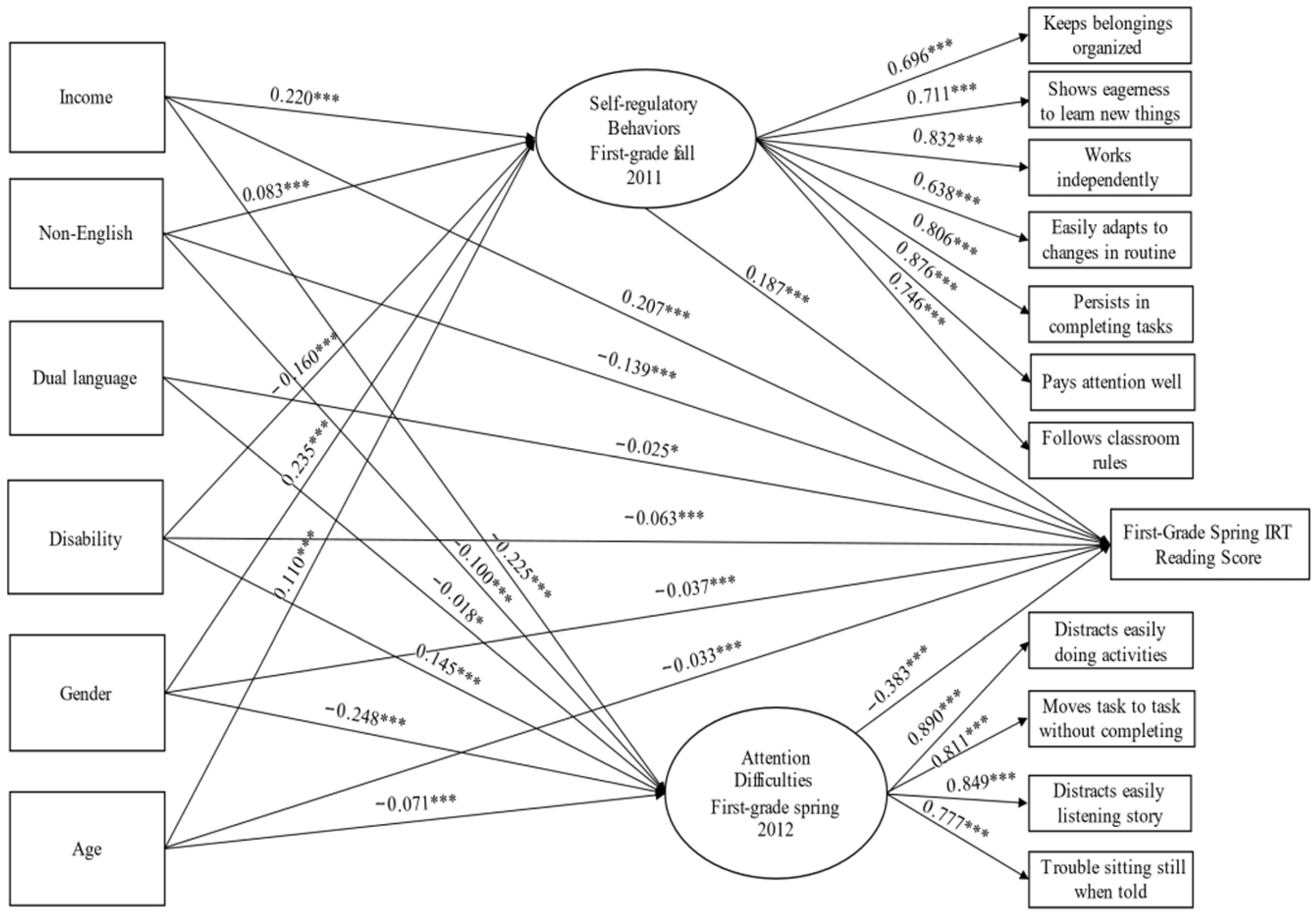
The first set of results showed that students’ demographic characteristics were significantly associated with their self-regulatory behavior. Notably, students from higher-income families exhibited higher levels of self-regulatory behavior. With each one-unit increase in income, a student’s self-regulatory score increased by 0.220 points, which was statistically significant (β = 0.220, p < 0.001). Furthermore, students from homes where a language other than English was the primary language had self-regulatory scores 0.083 points higher than those of students from primarily English-speaking households (β = 0.083, p < 0.001). However, students from homes with a dual-language (English and another language) environment did not exhibit a significant difference in self-regulatory behaviors compared with students from homes where English was the primary language (β = 0.003, p > 0.001). In addition, students with disabilities showed significantly lower reading performance, with scores 0.160 points lower than students without disabilities (β = −0.160, p < 0.001). Female students outperformed their male counterparts significantly, with scores 0.235 points higher (β = 0.235, p < 0.001). Moreover, students’ age was significantly related to reading performance, with each monthly increase in age resulting in a 0.110-point improvement in self-regulatory behaviors (β = 0.110, p < 0.001).
The researchers in the present study also observed notable differences in attention difficulties across students’ demographic characteristics. Specifically, students from homes with a one-point increase in income showed a 0.225-point reduction in attention difficulties, indicating the inverse relationship between home income and attention difficulties (β = −0.225, p < 0.001). Intriguingly, students from homes where a language other than English was the primary language had significantly lower attention difficulties scores by 0.100 points than students from primarily English-speaking households (β = −0.100, p < 0.001). Conversely, students from homes with a dual-language (English and another language) environment did not exhibit a statistically significant difference in attention difficulties compared with students from primarily English-speaking homes (β = −0.018, p > 0.001). Students with disabilities had significantly higher attention difficulties, scoring 0.145 points higher than students without disabilities (β = 0.145, p < 0.001). Furthermore, females demonstrated significantly lower attention difficulties compared to males, with a difference of 0.248 points (β = −0.248, p < 0.001). The students’ age was also significantly associated with their reading performance, particularly with attention difficulties. For each additional month beyond the average age, students scored 0.071 points lower on attention difficulties (β = 0.071, p < 0.001).
In the second set of interpretations, we identified significant paths from the mediator variables to reading achievement. Specifically, when self-regulatory behavior increased by one point, reading achievement improved by 0.187 points (β = 0.187, p < 0.001). Conversely, when attention difficulties increased by one point, reading achievement decreased by 0.383 points (β = −0.383, p < 0.001).
The final set revealed that students’ sociodemographic characteristics directly and indirectly influenced their reading achievement; the study provided a total effect (TE), a direct effect (DE), and an indirect effect (IE) for each path. Students from higher-income households outperformed their counterparts (TE: β = 0.334, p < 0.001; DE: β = 0.207, p < 0.001; IE: β = 0.127, p < 0.001). Students from homes where a language other than English was the primary language achieved lower reading performance compared to students from primarily English-speaking households (TE: β = −0.085, p < 0.001; DE: β = −0.139, p < 0.001; IE: β = 0.054, p < 0.001). Similarly, students from homes that spoke a dual language (English and another language) also exhibited lower reading performance than students whose primary language was English (TE: β = −0.018, p < 0.001; DE: β = −0.025, p < 0.001; IE: β = 0.007, p < 0.001). Students with disabilities displayed significantly lower reading performance than those without disabilities (TE: β = −0.148, p < 0.001; DE: β = −0.063, p < 0.001; IE: β = −0.085, p < 0.001). A significant gender difference in first-grade reading achievement was observed, with females outperforming males (TE: β = 0.102, p < 0.001; DE: β = −0.037, p < 0.001; IE: β = 0.139, p < 0.001). Additionally, students’ age was significantly related to reading performance, with students scoring higher in reading achievement for each additional month of age beyond the average (TE: β = 0.081, p < 0.001; DE: β = 0.033, p < 0.001; IE: β = 0.048, p < 0.001).
Figure 1 illustrates the comprehensive model, incorporating students’ sociodemographic characteristics and the two mediators: self-regulatory behaviors, attention difficulties, and reading achievement, including all their respective loadings.
Figure 1.
The Full Structural Model with Loadings. * p < 0.05; *** p < 0.001.
Results indicated that students’ sociodemographic characteristics (income, language background, disability status, gender, and age) significantly influenced self-regulatory behaviors and attention difficulties, which in turn affected reading achievement. Older females with higher income and stronger self-regulation were associated with better reading outcomes. On the contrary, students with disabilities, attention difficulties, and those with non-English as their first language were associated with lower reading performance.
5. Discussion
The selection of self-regulatory behaviors as mediators was guided by prior research demonstrating their strong influence on academic performance. Although these factors have often been examined independently, this study investigates their combined effects within a single model. It also contributes to the literature by analyzing how students’ sociodemographic backgrounds relate to their reading performance. Using a nationally representative U.S. dataset of more than 21,000 participants, the study controlled for multiple confounding variables and employed rigorous analytical methods, including structural equation modeling (SEM), reliability and internal consistency tests, exploratory factor analysis (EFA), and confirmatory factor analysis (CFA).
Findings on sociodemographic disparities highlight the need for educators to recognize and respond to students’ diverse backgrounds. Adopting explicit, differentiated instructional practices can better address students’ varied needs and promote more inclusive and equitable learning environments.
5.1. Mediation Effects of Self-Regulatory and Attention Difficulties on Reading Achievement
This study examined the direct and indirect effects of first-grade students’ sociodemographic characteristics on their reading achievement, incorporating two mediators: self-regulatory behavior and attention difficulties. Regarding the first research question, the results showed that self-regulatory behaviors positively mediated the relationships between reading achievement, reading strategy use, and reading efficacy. This finding underscores that students who can regulate their behavior during academic tasks consistently demonstrate stronger reading performance (Hubert et al., 2015) and show promising long-term academic trajectories (Moffett & Morrison, 2020). Recent studies further confirm that self-regulation interventions strengthen reading comprehension, strategy use, and self-efficacy in young children (Dermitzaki, 2025; D. Schunk et al., 2022).
Attention difficulties also had significant mediating effects. Consistent with O’Connor et al. (2014), students with fewer attention-related challenges and behaviors conducive to learning exhibited higher reading achievement. This study found particularly strong negative effects when attention difficulties mediated the influence of sociodemographic factors—especially among students from low-income households and those who speak a non-English or dual-language at home. Recent longitudinal research similarly demonstrates bidirectional links between attentional control and reading comprehension in elementary grades (Meixner et al., 2019), suggesting that attention skills support early reading development and continue to shape reading outcomes across school years.
These mediating patterns support findings by Mills et al. (2019), who report that students from low-income backgrounds underperform when they exhibit greater attention difficulties and fewer inhibitory behaviors during complex reading tasks. Their work also indicates that students who speak a non-English language at home often perform less proficiently than English-dominant peers, partly due to more limited inhibitory control. However, little empirical research has examined students who use dual languages interchangeably at home. By highlighting this understudied group, the present study points to an important direction for future research on linguistic environments and early reading development.
5.2. Sociodemographic Effects on Self-Regulatory Behaviors
This study, next, examined how sociodemographic characteristics influence first-grade students’ self-regulatory behaviors. Five of the six factors—income, home language, disability status, gender, and age—showed significant associations. Students from higher-income households, those who spoke a non-English language at home, and older students demonstrated stronger self-regulatory behaviors. In contrast, male students exhibited significantly fewer self-regulatory behaviors than females. These findings support prior research indicating that economic advantage is associated with stronger self-regulation (Cadima et al., 2015) and that children from low-income households often show lower reading achievement, underscoring the importance of promoting effortful and inhibitory control (Blair & Razza, 2007).
The strong effects of socioeconomic status align with findings from Stormont et al. (2013), Rojas and Abenavoli (2021), Ansari et al. (2021), and H. Zhang et al. (2025) who noted that family stressors, limited parental involvement, and a lack of early education opportunities can impede children’s self-regulatory development. Consistent with this study’s results, students who spoke a non-English language at home demonstrated enhanced self-regulation, consistent with evidence that bilingualism may strengthen executive function through set-shifting skills (Bialystok, 2007; Bialystok & Craik, 2010). However, this perspective remains debated, as some scholars report insufficient evidence to support the claim that bilingualism confers advantages in self-regulation (Dick et al., 2019). Notably, this study also found that dual-language use influenced reading achievement through the mediating roles of self-regulation and attention difficulties, highlighting an underexplored linguistic context that warrants further research.
Students with disabilities demonstrated reduced self-regulatory behaviors, confirming prior findings (Conderman & Hedin, 2010; Kulkarni & Sullivan, 2019; Lichtinger & Kaplan, 2015; Özbek et al., 2019). Researchers consistently emphasize the need for explicit instruction in behavioral and learning strategies for these students. Strategy awareness has been shown to improve reading achievement among students with disabilities, and early interventions targeting attention and social-emotional competencies further strengthen self-regulatory skills.
Age also emerged as a significant positive predictor of self-regulation, consistent with research suggesting that older students benefit from greater maturity and cumulative learning experiences (Murray & Harrison, 2011; Bodovski & Youn, 2011).
Finally, the study confirmed well-documented gender differences: male students exhibited fewer self-regulatory behaviors than female students. Prior research (Veijalainen et al., 2021; Montroy et al., 2016) similarly reports that boys, from early childhood onward, tend to exhibit lower self-regulation and greater emotional reactivity, making them more sensitive to environmental demands.
5.3. Sociodemographic Effects on Attention Difficulties
The current study aligns with prior research (Blair et al., 2015; Brandes-Aitken et al., 2019; Reinelt et al., 2019) showing that students from higher-income households report fewer attention difficulties. Previous studies have similarly found that poverty is negatively associated with attention and self-regulation, underscoring the role of broader socioeconomic factors, including family education, occupation, income, and neighborhood context. These researchers have also highlighted the value of early childhood intervention programs to support families.
This study found that first-grade students who spoke a language other than English at home showed lower attention difficulties than those whose primary home language was English. However, the dataset did not include students’ English proficiency levels, making the result difficult to interpret. Limited evidence exists on how English proficiency affects attention difficulties, and the few relevant studies (Skinner & Madden, 2010; Wang & Pongpairoj, 2021) examined older students, noting that attention problems emerged when English skills were limited but improved in low-stress learning environments. Thus, student age, proficiency, and classroom conditions may have shaped the findings. No significant effects were identified among students whose families reported using dual-language instruction at home, without specifying the primary language. This may reflect limited research on indistinct dual-language use; existing literature mainly discusses bilingual students who use one home language while learning in English or who are enrolled in dual-language programs. Some studies indicate that students using two languages concurrently may perform less effectively than English monolinguals because their learning time is divided between languages (Mancilla-Martinez et al., 2020).
Consistent with prior work, students with disabilities showed higher attention difficulties. Young children with disabilities or developmental delays often require more time to regulate behavior and maintain attention during academic activities (Coelho et al., 2019). Tasks involving collaboration, peer interaction, perspective-taking, and procedural expectations can be especially challenging due to social-emotional factors (McCollow & Hoffman, 2019), developmental delays (J. M. McDermott et al., 2018), and pragmatic language difficulties (Lin et al., 2019). Teachers are encouraged to collaborate on targeted instructional interventions to support reading development (Denton et al., 2021) and self-regulation (Denton et al., 2021; Vasquez & Marino, 2021).
The study also found that male students exhibited greater attention difficulties than female students, consistent with prior research documenting gender differences in attention-related behaviors during academic tasks (Kırkıç & Demir, 2020; Yamamoto & Imai-Matsumura, 2019; Zakszeski et al., 2020). Boys are more often distracted, engage in off-task behaviors, and differ in emotion regulation (Veijalainen et al., 2021), which contributes to lower task attention.
Finally, older students demonstrated fewer attention difficulties. As children mature and gain experience with schooling, they better understand academic expectations and classroom routines (Murray & Harrison, 2011), which strengthens their ability to sustain attention and manage academic responsibilities, ultimately supporting reading achievement.
5.4. Direct Effects of Self-Regulatory and Attention Difficulties on Reading Achievement
To address the study’s second research question, we first examined the impact of self-regulatory behaviors on reading achievement and found direct associations between the two. These results align with prior research showing that students who sustain engagement and regulate their behavior tend to achieve higher levels of literacy/reading (Bohlmann & Downer, 2016; Duncan et al., 2018). This underscores the importance of inhibitory control and persistence for literacy success (Lonigan et al., 2017). Teachers should therefore pursue professional development that strengthens their ability to foster self-regulation in students (Pianta et al., 2017; Pratt & Martin, 2017). Instructional practices that require planning, idea elaboration, and organized thinking—such as storytelling, think-aloud, and reader’s theater—can meaningfully support literacy development (Allee-Herndon & Roberts, 2018). Allee and Roberts also recommend integrating dramatic play, games, and puzzles to improve working memory, inhibitory control, and cognitive flexibility.
The study also identified a direct relationship between attention difficulties and literacy/reading achievement: students who exhibited attention problems or task-avoidant behaviors underperformed relative to peers. This finding is consistent with research showing that attention difficulties and task avoidance hinder literacy progress (Georgiou et al., 2017). Students may engage in task avoidance for several reasons, including limited pre-literacy skills (Greulich et al., 2014; Mägi et al., 2013; Torppa et al., 2017). The classroom environment plays a key role in shaping on-task behavior, particularly when it is supportive, adaptable, and offers meaningful peer interaction (Blair & Raver, 2012, 2015; Holmes et al., 2016; Huston et al., 2015). Ensuring that students possess the foundational skills needed for assigned tasks can reduce frustration (Huang & Yeh, 2019) and decrease task avoidance. A well-designed learning environment helps students focus on their goals while limiting distractions (Yogman et al., 2018).
5.5. Direct Effects of Sociodemographic Characteristics on Reading Achievement
The study found that students from higher-income households demonstrated more substantial reading achievement than their lower-income peers. This aligns with J. S. Kim and Quinn (2013), who argued that students from low-income households often underperform, especially when home literacy environments are limited. These findings underscore the importance of home- and school-based literacy interventions, particularly summer programs, to narrow achievement gaps. Similarly, O’Connor et al. (2014) and Collins et al. (2017) noted that socioeconomically disadvantaged students often show fewer learning-supportive behaviors and lower literacy achievement.
The study also found that students who spoke a language other than English at home demonstrated lower literacy/reading achievement, consistent with T. M. Dussling (2020), Mancilla-Martinez et al. (2020), and Swanson et al. (2016). Persistently low-performing English learners (ELs) are also at heightened risk of misidentification as having reading disabilities (Swanson et al., 2016). Therefore, early, explicit, and systematic literacy interventions are essential (T. Dussling, 2020). Effective first-grade support for ELs includes small-group instruction focused on phonemic awareness, phonics, decoding, oral reading, dictation, and vocabulary development, all of which contribute to improved reading comprehension and broader literacy outcomes (F. Zhang et al., 2022). Opportunities to interact with native English speakers also enhance foundational reading skills.
Students who used dual languages equally at home also demonstrated lower literacy/reading performance. This is consistent with Mancilla-Martinez et al. (2020), who attributed weaker literacy outcomes among dual-language users to reduced vocabulary depth in both languages, a pattern supported by Guan and Cheatham (2018) and Arteagoitia and Yen (2020). Dual-language learners may acquire literacy skills more slowly because they are developing two linguistic systems simultaneously (Guan & Cheatham, 2018). At the same time, bilingualism can benefit executive functioning and self-regulation (Bialystok, 2007; Bialystok & Craik, 2010). To support continued growth in bilingual literacy, teachers should provide explicit instruction in receptive vocabulary, phonological awareness, and word reading—skills that strongly predict first-grade reading achievement (Edyburn et al., 2017). Techniques such as interactive storybook reading and multimodal vocabulary instruction can strengthen bilingual learners’ language development (Guan & Cheatham, 2018).
Students with disabilities in this study underperformed their peers in literacy/reading achievement, consistent with prior research (Conderman & Hedin, 2017; Kaye et al., 2022; Lichtinger & Kaplan, 2015; Özbek et al., 2019; Pufpaff, 2021). Teachers should identify students’ specific literacy skill gaps (Pufpaff, 2021), address associated learning disabilities (Kaye et al., 2022), and explicitly teach effective learning strategies, particularly because many students with disabilities lack strategic learning awareness (Lichtinger & Kaplan, 2015). Research demonstrates that early strategy instruction can significantly improve literacy outcomes for young learners (Conderman & Hedin, 2017; Özbek et al., 2019).
Gender differences also emerged: male students underperformed compared to female students, consistent with findings from Collins et al. (2017). Boys with limited language and literacy skills often display more externalizing behaviors (Sparapani et al., 2019), which can hinder academic engagement. Sparapani et al. emphasize the importance of educators addressing behavioral profiles through social-emotional supports that can enhance literacy outcomes. Although girls often outperform boys in early literacy, McTigue et al. (2021) note that these gender differences typically diminish over time and may relate to differences in students’ ability to self-select learning activities.
Finally, older first-grade students outperformed younger peers, supporting prior research indicating that age contributes to literacy/reading achievement. As children mature, they develop greater school readiness (Murray & Harrison, 2011) and stronger self-regulatory behaviors (Bodovski & Youn, 2011). Research on relative age effects (RAEs) suggests that these age-related advantages are particularly pronounced in early primary grades and gradually decline as children grow older (Mavilidi et al., 2022; Whitely et al., 2021).
5.6. Limitations and Future Research
As with any study using secondary data, this research has several limitations tied to the lack of detailed information on key variables. First, although we examined the effects of disability status on reading scores, self-regulatory behaviors, and attention difficulties, the dataset did not specify the type or severity of disability. Students were identified as receiving academic support solely based on disability, preventing analyses of how different disability categories or levels (e.g., mild, moderate, severe) relate to outcomes or mediating variables. Future research should collect more comprehensive disability data to understand better the distinct barriers faced by students with varying exceptionalities and to generate more targeted policy recommendations (Alquraini & Rao, 2020). Additionally, further research is needed to examine the long-term effects of specific self-regulatory behaviors on literacy/reading achievement among students with different types and levels of learning disabilities, thereby helping educators tailor instructional practices more effectively.
Second, the study lacks information on students’ primary language proficiency, limiting the interpretation of the non-English language variable. Prior research shows that proficiency in a first language predicts success in acquiring a second language (Shum et al., 2016; Winsler et al., 2014). Future studies should investigate how varying levels of primary language proficiency influence long-term literacy/reading outcomes within similar models.
Third, although household income was included, the dataset did not capture household size. The number of individuals supported by the same income can influence a family’s economic resources, and prior research has shown that larger household size can negatively affect literacy/reading achievement (Mustapha et al., 2019). Future research should incorporate household size or dependency ratios to more accurately assess socioeconomic influences.
Fourth, the structural equation modeling (SEM) used in this study is associational. Although mediation pathways were tested, the data does not support causal claims. Longitudinal or experimental designs are needed to determine whether the observed relationships reflect true causal mechanisms.
Finally, although the study yielded statistically significant results, we caution that the large sample size may have contributed to this significance. Accordingly, the findings should be interpreted in light of their practical relevance, not solely their statistical significance.
5.7. Implications for Educators
Based on the study’s findings, first-grade students who demonstrate strong self-regulatory behaviors and minimal attention difficulties tend to achieve higher literacy/reading outcomes. This is especially critical for English language learners and students with learning disabilities. Accordingly, educators should prioritize developing self-regulatory and attention-related skills to support literacy/reading achievement in these populations.
Several practical strategies can help teachers cultivate these skills during literacy/reading activities such as vocabulary instruction, comprehension, and writing. One effective approach is the use of personalized anchor charts. These charts allow teachers and students to outline key content, procedures, and reminders that can be referenced throughout instruction (Bacchioni & Kurstedt, 2019). Consistent use of anchor charts helps students understand their purpose, supports task independence, and encourages students to regulate their behavior by referring to the information as needed. They also provide essential scaffolding for students with disabilities who may require additional structure during literacy tasks.
Another strategy involves integrating learning experiences that emphasize organization and time management. Teachers can model and teach students how to organize their materials (e.g., writing tools, manipulatives, texts) and manage their time by following clear steps and procedures. Such preparation supports students in setting goals, planning tasks, and feeling competent in their work. These structured learning experiences are particularly beneficial for English learners, students with learning disabilities, and students with behavioral challenges (Bulotsky-Shearer et al., 2011).
6. Conclusions
Unlike prior studies that examined self-regulatory behaviors or attention difficulties in isolation, this investigation considered both constructs simultaneously and on a larger scale. By doing so, it explored their mediating effects alongside the differential influence of students’ sociodemographic characteristics. The findings highlight several critical areas that warrant further research:
- Family stressors: How specific stressors within the home environment may impede the development of self-regulatory behaviors before children enter formal schooling.
- Classroom instructional quality: The extent to which high-quality instruction supports self-regulation and dual language development.
- Teacher professional development: The need for training focused on fostering self-regulation and dual language development to enhance students’ academic outcomes.
Exploring these areas can deepen understanding of how to strengthen students’ self-regulatory behaviors and attention—particularly for English language learners and students with disabilities—and ultimately improve academic achievement.
Author Contributions
Conceptualization, O.B.L.; Methodology, O.B.L. and M.C.; Validation, O.B.L. and M.C.; Formal analysis, O.B.L. and M.C.; Investigation, O.B.L. and A.B.L.; Data curation, M.C.; Writing—original draft, O.B.L.; Writing—review & editing, A.B.L.; Visualization, A.B.L. All authors have read and agreed to the published version of the manuscript.
Funding
This research received no external funding.
Institutional Review Board Statement
Not applicable.
Informed Consent Statement
Not applicable.
Data Availability Statement
The data presented in this study are publicly available at [ECLS-K] [https://nces.ed.gov/ecls/kindergarten2011.asp] (Accessed 1 January 2023).
Conflicts of Interest
The authors declare no conflict of interest.
References
- Ahmed, S. F., Tang, S., Waters, N. E., & Davis-Kean, P. (2019). Executive function and academic achievement: Longitudinal relations from early childhood to adolescence. Journal of Educational Psychology, 111(3), 446–458. [Google Scholar] [CrossRef]
- Allee-Herndon, K., & Roberts, S. K. (2018). Neuroeducation and early elementary teaching: Retrospective innovation for promoting growth with students living in poverty. International Journal of the Whole Child, 3(2), 4–8. [Google Scholar]
- Alquraini, T. A., & Rao, S. M. (2020). Developing and sustaining readers with intellectual and multiple disabilities: A systematic review of literature. International Journal of Developmental Disabilities, 66(2), 91–103. [Google Scholar] [CrossRef]
- Ansari, A., Pianta, R. C., Whittaker, J. E., Vitiello, V., & Ruzek, E. (2021). Enrollment in public-prekindergarten and school readiness skills at kindergarten entry: Differential associations by home language, income, and program characteristics. Early Childhood Research Quarterly, 54, 60–71. [Google Scholar] [CrossRef]
- Arbuckle, J. L. (2023). IBM SPSS Amos 23 user’s guide (p. 635). Amos Development Corporation. [Google Scholar]
- Arteagoitia, I., & Yen, S. J. (2020). Equity in representing literacy growth in dual language bilingual education for emerging bilingual students. TESOL Quarterly: A Journal for Teachers of English to Speakers of Other Languages and of Standard English as a Second Dialect, 54(3), 719–742. [Google Scholar] [CrossRef]
- Bacchioni, S., & Kurstedt, R. L. (2019). Personalized anchor charts: Bridging small-group work to independence. The Reading Teacher, 72(5), 652–658. [Google Scholar] [CrossRef]
- Best, J. R., & Miller, P. H. (2010). A developmental perspective on executive function. Child Development, 81(6), 1641–1660. [Google Scholar] [CrossRef]
- Bialystok, E. (2007). Cognitive effects of bilingualism: How linguistic experience leads to cognitive change. International Journal of Bilingual Education and Bilingualism, 10(3), 210–223. [Google Scholar] [CrossRef]
- Bialystok, E., & Craik, F. I. M. (2010). Cognitive and linguistic processing in the bilingual mind. Current Directions in Psychological Science, 19(1), 19–23. [Google Scholar] [CrossRef]
- Birgisdóttir, F., Gestsdóttir, S., & Thorsdóttir, F. (2015). The role of behavioral self-regulation in learning to read: A 2-year longitudinal study of Icelandic preschool children. Early Education and Development, 26(5–6), 807–828. [Google Scholar] [CrossRef]
- Blair, C., & Raver, C. C. (2012). Child development in the context of adversity: Experiential canalization of brain and behavior. American Psychologist, 67(4), 309–318. [Google Scholar] [CrossRef] [PubMed]
- Blair, C., & Raver, C. C. (2015). School readiness and self-regulation: A developmental psychobiological approach. Annual Review of Psychology, 66, 711–731. [Google Scholar] [CrossRef] [PubMed]
- Blair, C., & Razza, R. P. (2007). Relating effortful control, executive function, and false belief understanding to emerging math and literacy ability in kindergarten. Child Development, 78(2), 647–663. [Google Scholar] [CrossRef]
- Blair, C., Ursache, A., & Vernon-Feagans, L. (2015). Multiple aspects of self-regulation uniquely predict mathematics but not letter-word knowledge in the early elementary grades. Developmental Psychology, 51(4), 459–472. [Google Scholar] [CrossRef]
- Bodovski, K., & Youn, M. (2011). The long-term effects of early acquired skills and behaviors on young children’s achievement in literacy and mathematics. Journal of Early Childhood Research, 9(1), 4–19. [Google Scholar] [CrossRef]
- Bohlmann, N. L., & Downer, J. T. (2016). Self-regulation and task engagement as predictors of emergent language and literacy skills. Early Education and Development, 27(1), 18–37. [Google Scholar] [CrossRef]
- Brandes-Aitken, A., Braren, S., Swingler, M., Voegtline, K., & Blair, C. (2019). Sustained attention in infancy: A foundation for the development of multiple aspects of self-regulation for children in poverty. Journal of Experimental Child Psychology, 184, 192–209. [Google Scholar] [CrossRef]
- Bulotsky-Shearer, R. J., Fernandez, V., Dominguez, X., & Rouse, H. L. (2011). Behavior problems in learning activities and social interactions in head start classrooms and early reading, mathematics, and approaches to learning. School Psychology Review, 40(1), 39–56. [Google Scholar] [CrossRef]
- Cadima, J., Gamelas, A. M., McClelland, M., & Peixoto, C. (2015). Associations between early family risk, children’s behavioral regulation, and academic achievement in Portugal. Early Education and Development, 26(5–6), 708–728. [Google Scholar] [CrossRef]
- Caughy, M. O., Brinkley, D. Y., Pacheco, D., Rojas, R., Miao, A., Contreras, M. M., Owen, M. T., Easterbrooks, M. A., & McClelland, M. (2022). Self-regulation development among young Spanish-English dual language learners. Early Childhood Research Quarterly, 60, 226–236. [Google Scholar] [CrossRef]
- Coelho, Cadima, J., Pinto, A. I., & Guimarães, C. (2019). Self-regulation, engagement, and developmental functioning in preschool-aged children. Journal of Early Intervention, 41(2), 105–124. [Google Scholar] [CrossRef]
- Collins, A., O’Connor, E., & McClowry, S. (2017). The role of a temperament intervention in kindergarten children’s standardized academic achievement. Journal of Education and Training Studies, 5(2), 120. [Google Scholar] [CrossRef][Green Version]
- Conderman, G., & Hedin, L. (2010). Cue cards: A self-regulatory strategy for students with learning disabilities. Intervention in School and Clinic, 46(3), 165–173. [Google Scholar] [CrossRef]
- Conderman, G., & Hedin, L. (2017). Differentiating study guides. Intervention in School and Clinic, 53(1), 19–27. [Google Scholar] [CrossRef]
- Connor, C. M., Day, S. L., Phillips, B., Sparapani, N., Ingebrand, S. W., McLean, L., Barrus, A., & Kaschak, M. P. (2016). Reciprocal effects of self-regulation, semantic knowledge, and reading comprehension in early elementary school. Child Development, 87(6), 1813–1824. [Google Scholar] [CrossRef]
- Culotta, E., DiCarlo, C., & Rueter, D. (2025). Using mindfulness practices to increase self-regulation in pre-kindergarten and kindergarten-aged children. Child & Youth Care Forum, 54(4), 859–884. [Google Scholar] [CrossRef]
- Denton, Montroy, J. J., Zucker, T. A., & Cannon, G. (2021). Designing an intervention in reading and self-regulation for students with significant reading difficulties, including dyslexia. Learning Disability Quarterly, 44(3), 170–182. [Google Scholar] [CrossRef]
- Dermitzaki, I. (2025). Fostering elementary school students’ self-regulation skills in reading comprehension: Effects on text comprehension, strategy use, and self-efficacy. Behavioral Sciences, 15(2), 101. [Google Scholar] [CrossRef]
- Dick, A. S., Garcia, N. L., Pruden, S. M., Thompson, W. K., Hawes, S. W., Sutherland, M. T., Riedel, M. C., Laird, A. R., & Gonzalez, R. (2019). No evidence for a bilingual executive function advantage in the ABCD study. Nature Human Behaviour, 3(7), 692–701. [Google Scholar] [CrossRef] [PubMed]
- Duncan, R. J., Schmitt, S. A., Burke, M., & McClelland, M. M. (2018). Combining a kindergarten readiness summer program with a self-regulation intervention improves school readiness. Early Childhood Research Quarterly, 42, 291–300. [Google Scholar] [CrossRef]
- Dussling, T. (2020). English language learners’ and native English-speakers’ spelling growth after supplemental early reading instruction. International Journal of Education and Literacy Studies, 8(1), 1. [Google Scholar] [CrossRef]
- Dussling, T. M. (2020). The impact of an early reading intervention with English language learners and native-English-speaking children. Reading Psychology, 41(4), 241–263. [Google Scholar] [CrossRef]
- Edyburn, K. L., Quirk, M., Felix, E., Swami, S., Goldstein, A., Terzieva, A., & Scheller, J. (2017). Literacy screening among latino/a and dual language learner kindergarteners: Predicting first grade reading achievement. Literacy Research and Instruction, 56(3), 250–267. [Google Scholar] [CrossRef]
- Georgiou, G. K., Hirvonen, R., Manolitsis, G., & Nurmi, J. (2017). Cross-lagged relations between teacher and parent ratings of children’s task avoidance and different literacy skills. British Journal of Educational Psychology, 87(3), 438–455. [Google Scholar] [CrossRef] [PubMed]
- Green, L. M., Genaro, B. G., Ratcliff, K. A., Cole, P. M., & Ram, N. (2023). Investigating the developmental timing of self-regulation in early childhood. International Journal of Behavioral Development, 47(2), 101–110. [Google Scholar] [CrossRef]
- Greulich, L., Otaiba, S. A., Schatschneider, C., Wanzek, J., Ortiz, M., & Wagner, R. K. (2014). Understanding inadequate response to first-grade multi-tier intervention: Nomothetic and ideographic perspectives. Learning Disability Quarterly, 37(4), 204–217. [Google Scholar] [CrossRef] [PubMed]
- Guan, C. D., & Cheatham, G. A. (2018). Bilingual vocabulary development for dual language learners with disabilities: Two research-based approaches. Young Exceptional Children, 21(3), 142–156. [Google Scholar] [CrossRef]
- Holmes, C. J., Kim-Spoon, J., & Deater-Deckard, K. (2016). Linking executive function and peer problems from early childhood through middle adolescence. Journal of Abnormal Child Psychology, 44(1), 31–42. [Google Scholar] [CrossRef]
- Huang, S., & Yeh, L. (2019). The association among literacy proficiency, effortful control, and frustration. Journal of Educational Research, 112(2), 168–178. [Google Scholar] [CrossRef]
- Hubert, B., Guimard, P., Florin, A., & Tracy, A. (2015). Indirect and direct relationships between self-regulation and academic achievement during the nursery/elementary school transition of French students. Early Education and Development, 26(5–6), 685–707. [Google Scholar] [CrossRef]
- Huston, A. C., Bobbitt, K. C., & Bentley, A. (2015). Time spent in child care: How and why does it affect social development? Developmental Psychology, 51(5), 621–634. [Google Scholar] [CrossRef]
- Kaye, E. L., Lozada, V., & Briggs, C. (2022). Early identification of and intervention for children with and without dyslexia characteristics: A comparison study. Literacy Research and Instruction, 61(3), 298–313. [Google Scholar] [CrossRef]
- Kent, S., Wanzek, J., Petscher, Y., Al Otaiba, S., & Kim, Y. (2014). Writing fluency and quality in kindergarten and first grade: The role of attention, reading, transcription, and oral language. Reading and Writing: An Interdisciplinary Journal, 27(7), 1163–1188. [Google Scholar] [CrossRef]
- Kieffer, M. J., Vukovic, R. K., & Berry, D. (2013). Roles of attention shifting and inhibitory control in fourth-grade reading comprehension. Reading Research Quarterly, 48(4), 333–348. [Google Scholar] [CrossRef]
- Kim, J. S., & Quinn, D. M. (2013). The effects of summer reading on low income children’s literacy achievement from kindergarten to grade 8: A meta analysis of classroom and home interventions. Review of Educational Research, 83(3), 386–431. [Google Scholar] [CrossRef]
- Kim, Y.-S., & Phillips, B. (2014). Cognitive correlates of listening comprehension. Reading Research Quarterly, 49(3), 269–281. [Google Scholar] [CrossRef]
- Kırkıç, K. A., & Demir, B. (2020). Examination of pre-school students’ self-regulation skills. Problems of Education in the 21st Century, 78(6), 967–982. [Google Scholar] [CrossRef]
- Kubota, M., Hadley, L. V., Schaeffner, S., Könen, T., Meaney, J., Morey, C. C., Auyeung, B., Moriguchi, Y., Karbach, J., & Chevalier, N. (2023). The effect of metacognitive executive function training on children’s executive function, proactive control, and academic skills. Developmental Psychology, 59(11). [Google Scholar] [CrossRef] [PubMed]
- Kulkarni, T., & Sullivan, A. L. (2019). The relationship between behavior at school entry and services received in third grade. Psychology in the Schools, 56(5), 809–823. [Google Scholar] [CrossRef]
- Laursen, B., Richmond, A., Kiuru, N., Lerkkanen, M., & Poikkeus, A. (2022). Off on the wrong foot: Task avoidance at the outset of primary school anticipates academic difficulties and declining peer acceptance. European Journal of Developmental Psychology, 19(4), 601–615. [Google Scholar] [CrossRef]
- Lichtinger, E., & Kaplan, A. (2015). Employing a case study approach to capture motivation and self-regulation of young students with learning disabilities in authentic educational contexts. Metacognition and Learning, 10(1), 119–149. [Google Scholar] [CrossRef]
- Liew, J., Erbeli, F., Nyanamba, J. M., & Li, D. (2020). Pathways to reading competence: Emotional self-regulation, literacy contexts, and embodied learning processes. Reading Psychology, 41(7), 633–659. [Google Scholar] [CrossRef]
- Lin, T.-J., Chen, J., Justice, L. M., & Sawyer, B. (2019). Peer interactions in preschool inclusive classrooms: The roles of pragmatic language and self-regulation. Exceptional Children, 85(4), 432–452. [Google Scholar] [CrossRef]
- Lonigan, C. J., Allan, D. M., Goodrich, J. M., Farrington, A. L., & Phillips, B. M. (2017). Inhibitory control of Spanish-speaking language-minority preschool children: Measurement and association with language, literacy, and math skills. Journal of Learning Disabilities, 50(4), 373–385. [Google Scholar] [CrossRef] [PubMed]
- Mancilla-Martinez, J., Hwang, J. K., Oh, M. H., & McClain, J. B. (2020). Early elementary grade dual language learners from Spanish-speaking homes struggling with English reading comprehension: The Dormant Role of Language Skills. Journal of Educational Psychology, 112(5), 880–894. [Google Scholar] [CrossRef]
- Mavilidi, M. F., Marsh, H. W., Xu, K. M., Parker, P. D., Jansen, P. W., & Paas, F. (2022). Relative age effects on academic achievement in the first ten years of formal schooling: A nationally representative longitudinal prospective study. Journal of Educational Psychology, 114(2), 308–325. [Google Scholar] [CrossRef]
- Mägi, K., Torppa, M., Lerkkanen, M., Poikkeus, A., Rasku-Puttonen, H., & Nurmi, J. (2013). Developmental profiles of task-avoidant behaviour and reading skills in grades 1 and 2. Learning and Individual Differences, 23, 22–31. [Google Scholar] [CrossRef]
- McClelland, M. M., & Cameron, C. E. (2012). Self-regulation in early childhood: Improving conceptual clarity and developing ecologically valid measures. Child Development Perspectives, 6(2), 136–142. [Google Scholar] [CrossRef]
- McClelland, M. M., & Cameron, C. E. (2019). Developing together: The role of executive function and motor skills in children’s early academic lives. Early Childhood Research Quarterly, 46, 142–151. [Google Scholar] [CrossRef]
- McCollow, M. M., & Hoffman, H. H. (2019). Supporting social development in young children with disabilities: Building a practitioner’s toolkit. Early Childhood Education Journal, 47(3), 309–320. [Google Scholar] [CrossRef]
- McDermott, J. M., Pears, K. C., Bruce, J., Kim, H. K., Roos, L., Yoerger, K. L., & Fisher, P. A. (2018). Improving kindergarten readiness in children with developmental disabilities: Changes in neural correlates of response monitoring. Applied Neuropsychology: Child, 7(3), 187–199. [Google Scholar] [CrossRef] [PubMed]
- McDermott, P. A., Rikoon, S. H., & Fantuzzo, J. W. (2014). Tracing children’s approaches to learning through head start, kindergarten, and first grade: Different pathways to different outcomes. Journal of Educational Psychology, 106(1), 200–213. [Google Scholar] [CrossRef]
- McTigue, E. M., Schwippert, K., Uppstad, P. H., Lundetrae, K., & Solheim, O. J. (2021). Gender differences in early literacy: Boys’ response to formal instruction. Journal of Educational Psychology, 113(4), 690–705. [Google Scholar] [CrossRef]
- Meixner, J. M., Warner, G. J., Lensing, N., Schiefele, U., & Elsner, B. (2019). The relation between executive functions and reading comprehension in primary-school students: A cross-lagged-panel analysis. Early Childhood Research Quarterly, 46, 62–74. [Google Scholar] [CrossRef]
- Mills, B., Dyer, N., Pacheco, D., Brinkley, D., Owen, M. T., & Caughy, M. O. (2019). Developmental transactions between self-regulation and academic achievement among low-income African American and Latino children. Child Development, 90(5), 1614–1631. [Google Scholar] [CrossRef]
- Moffett, L., & Morrison, F. J. (2020). Off-task behavior in kindergarten: Relations to executive function and academic achievement. Journal of Educational Psychology, 112(5), 938–955. [Google Scholar] [CrossRef]
- Montroy, J. J., Bowles, R. P., Skibbe, L. E., McClelland, M. M., & Morrison, F. J. (2016). The development of self-regulation across early childhood. Developmental Psychology, 52(11), 1744–1762. [Google Scholar] [CrossRef] [PubMed]
- Murray, E., & Harrison, L. J. (2011). The influence of being ready to learn on children’s early school literacy and numeracy achievement. Educational Psychology, 31(5), 529–545. [Google Scholar] [CrossRef]
- Mustapha, M. A., Wali, Y. S., & Abulfathi, F. A. (2019). Impact family size on children’s literacy development in maiduguri metropolitan council, Borno State, Nigeria. i-Manager’s Journal on Educational Psychology, 13(1), 24–28. [Google Scholar] [CrossRef]
- National Center for Education Statistics [NCES]. (2011). Early childhood longitudinal study, kindergarten—Fifth grade (ECLS-K:2011). [Data set]. U.S. Department of Education, Institute of Education Sciences. Available online: https://nces.ed.gov/ecls/ (accessed on 1 January 2023).
- National Center for Education Statistics [NCES]. (2022). NAEP reading: National achievement-level results (NCES 2022-068). U.S. Department of Education, Institute of Education Sciences. Available online: https://nces.ed.gov/ (accessed on 1 January 2023).
- Niemi, P., Nurmi, J., Lyyra, A., Lerkkanen, M., Lepola, J., Poskiparta, E., & Poikkeus, A. (2011). Task avoidance, number skills and parental learning difficulties as predictors of poor response to instruction. Journal of Learning Disabilities, 44(5), 459–471. [Google Scholar] [CrossRef]
- O’Connor, E. E., Cappella, E., McCormick, M. P., & McClowry, S. G. (2014). An examination of the efficacy of insights in enhancing the academic and behavioral development of children in early grades. Journal of Educational Psychology, 106(4), 1156–1169. [Google Scholar] [CrossRef]
- Özbek, A. B., Tulu, B. K., & Ergul, C. (2019). An intervention to improve the writing skills of students with learning disabilities: Stop list strategy. Insights on Learning Disabilities, 16(2), 155. [Google Scholar]
- Palacios, N., & Bohlmann, N. L. (2020). Self-regulation mediates the associations between demographic characteristics and Latino children’s early achievement. Journal of Applied Developmental Psychology, 70, 16. [Google Scholar] [CrossRef]
- Peugh, J., & Feldon, D. F. (2020). “How well does your structural equation model fit your data?”: Is Marcoulides and Yuan’s equivalence test the answer? CBE—Life Sciences Education, 19(3), es5. [Google Scholar] [CrossRef] [PubMed]
- Pianta, R., Hamre, B., Downer, J., Burchinal, M., Williford, A., LoCasale-Crouch, J., Howes, C., La Paro, K., & Scott-Little, C. (2017). Early childhood professional development: Coaching and coursework effects on indicators of children’s school readiness. Early Education and Development, 28(8), 956–975. [Google Scholar] [CrossRef]
- Pratt, S. M., & Martin, A. M. (2017). Exploring effective professional development strategies for in-service teachers on guiding beginning readers to become more metacognitive in their oral reading. Reading Horizons, 56(3), 31. [Google Scholar]
- Pufpaff, L. A. (2021). The efficacy of rhyme instruction in early childhood special education. Journal of the American Academy of Special Education Professionals, 16(2), 68–80. [Google Scholar] [CrossRef]
- Putnam, S. P., & Rothbart, M. K. (2006). Development of short and very short forms of the children’s behavior questionnaire. Journal of Personality Assessment, 87(1), 102–112. [Google Scholar] [CrossRef]
- Ratcliff, K. A., Vazquez, L. C., Lunkenheimer, E. S., & Cole, P. M. (2021). Longitudinal changes in young children’s strategy use for emotion regulation. Developmental Psychology, 57(9), 1471–1486. [Google Scholar] [CrossRef] [PubMed]
- Reinelt, T., Samdan, G., Kiel, N., & Petermann, F. (2019). Frühkindliche prädiktoren externalisierender verhaltensauffälligkeiten: Evidenzen aus längsschnittstudien [Predicting externalizing behavior problems in early childhood: Evidence from longitudinal studies]. Kindheit und Entwicklung: Zeitschrift für Klinische Kinderpsychologie, 28(1), 19–32. [Google Scholar] [CrossRef]
- Roberts, G. J., Solis, M., & Chance, B. (2019). Embedding self-regulation into reading interventions to support reading and behavior outcomes. Teaching Exceptional Children, 52(2), 78–86. [Google Scholar] [CrossRef]
- Rojas, N. M., & Abenavoli, R. M. (2021). Preschool teacher-child relationships and children’s expressive vocabulary skills: The potential mediating role of profiles of children’s engagement in the classroom. Early Childhood Research Quarterly, 56, 225–235. [Google Scholar] [CrossRef]
- Schumacker, R. E., & Lomax, R. G. (2016). A beginner’s guide to structural equation modeling (4th ed.). Routledge. [Google Scholar]
- Schunk, D., Berger, E. M., Hermes, H., Winkel, K., & Fehr, E. (2022). Teaching self-regulation. Nature Human Behaviour, 6(12), 1680–1690. [Google Scholar] [CrossRef] [PubMed]
- Schunk, D. H., & Greene, J. A. (2018). Handbook of self-regulation of learning and performance (2nd ed.). Routledge. [Google Scholar]
- Shum, K. K., Ho, C. S.-H., Siegel, L. S., & Au, T. K. (2016). First-language longitudinal predictors of second-language literacy in young L2 learners. Reading Research Quarterly, 51(3), 323–344. [Google Scholar] [CrossRef]
- Skinner, B., & Madden, M. C. (2010). Help seeking in English language learning. ELT Journal, 64(1), 21–31. [Google Scholar] [CrossRef]
- Sparapani, N., Connor, C. M., Day, S., Wood, T., Ingebrand, S., McLean, L., & Phillips, B. (2019). Profiles of foundational learning skills among first graders. Learning and Individual Differences, 70, 216–227. [Google Scholar] [CrossRef]
- Stormont, M., Herman, K. C., Reinke, W. M., David, K. B., & Goel, N. (2013). Latent profile analysis of teacher perceptions of parent contact and comfort. School Psychology Quarterly, 28(3), 195. [Google Scholar] [CrossRef] [PubMed]
- Stucke, N. J., & Doebel, S. (2024). Early childhood executive function predicts concurrent and later social behavioral outcomes: A Review and meta-analysis. Psychological Bulletin, 150(10), 1178–1206. [Google Scholar] [CrossRef] [PubMed]
- Swanson, H. L., Kudo, M., & Guzman-Orth, D. (2016). Cognition and literacy in English language learners at risk for reading disabilities: A latent transition analysis. Journal of Educational Psychology, 108(6), 830–856. [Google Scholar] [CrossRef]
- Torppa, M., Georgiou, G. K., Niemi, P., Lerkkanen, M., & Poikkeus, A. (2017). The precursors of double dissociation between reading and spelling in a transparent orthography. Annals of Dyslexia, 67(1), 42–62. [Google Scholar] [CrossRef]
- Vasquez, E., & Marino, M. T. (2021). Enhancing executive function while addressing learner variability in inclusive classrooms. Intervention in School and Clinic, 56(3), 179–185. [Google Scholar] [CrossRef]
- Veerasamy, S. (2024). Managing self-regulatory behaviour in young autistic children in the Western Cape, South Africa. South African Journal of Childhood Education, 14(1), a1352. [Google Scholar] [CrossRef]
- Veijalainen, J., Reunamo, J., & Heikkilä, M. (2021). Early gender differences in emotional expressions and self-regulation in settings of early childhood education and care. Early Child Development and Care, 191(2), 173–186. [Google Scholar] [CrossRef]
- Wang, Y., & Pongpairoj, N. (2021). Avoidance of the English passive construction by L1 Chinese learners. Learn Journal: Language Education and Acquisition Research Network, 14(1), 294–316. [Google Scholar]
- Weiss, E. M. (2024). Self-regulation in elementary school: Do teacher-reported effortful control and directly assessed executive function codevelop? Developmental Psychology, 60(11), 2101. [Google Scholar] [CrossRef]
- Whitely, M., Phillimore, J., & Moorin, R. (2021). The effect of a child’s relative age on numeracy and literacy test results: An analysis of NAPLAN in western Australian government schools in 2017. Australian Educational Researcher, 48(2), 249–265. [Google Scholar] [CrossRef]
- Winsler, A., Kim, Y. K., & Richard, E. R. (2014). Socio-emotional skills, behavior problems, and Spanish competence predict the acquisition of English among English language learners in poverty. Developmental Psychology, 50(9), 2242–2254. [Google Scholar] [CrossRef]
- Woolley, G. (2016). Reading comprehension intervention for high-functioning children with autism spectrum disorders. Australian Journal of Learning Difficulties, 21(1), 41–58. [Google Scholar] [CrossRef]
- Yamamoto, N., & Imai-Matsumura, K. (2019). Gender differences in executive function and behavioural self-regulation in 5 years old kindergarteners from east Japan. Early Child Development and Care, 189(1), 56–67. [Google Scholar] [CrossRef]
- Yogman, M., Garner, A., Hutchinson, J., Hirsh-Pasek, K., & Golinkoff, R. M. (2018). The power of play: A pediatric role in enhancing development in young children. Pediatrics, 142(3), 1. [Google Scholar] [CrossRef] [PubMed]
- Zakszeski, B., Hojnoski, R. L., Dever, B. V., DuPaul, G. J., & McClelland, M. M. (2020). Early elementary trajectories of classroom behavior self-regulation: Prediction by student characteristics and malleable contextual factors. School Psychology Review, 49(2), 161–177. [Google Scholar] [CrossRef]
- Zevenbergen, A. A., & Ryan, M. M. (2010). Gender differences in the relationship between attention problems and expressive language and emerging academic skills in preschool-aged children. Early Child Development and Care, 180(10), 1337–1348. [Google Scholar] [CrossRef]
- Zhang, F., Shen, Y., Pasquarella, A., & Coker, D. L. (2022). Early writing skills of English language learners (ELLs) and native English speakers (NESs): Examining predictors of contextualized spelling, writing fluency, and writing quality. Reading & Writing, 35(5), 1177–1200. [Google Scholar] [CrossRef]
- Zhang, H., Li, X., & Wang, Y. (2025). Influence of socioeconomic status on children’s reading abilities: The mediating role of the home learning environment and the moderating role of grade level. BMC Psychology, 13(1), 24. [Google Scholar] [CrossRef] [PubMed]
- Zhang, L., & Rao, N. (2017). Effortful control and academic achievement in rural China. Early Education and Development, 28(5), 541–558. [Google Scholar] [CrossRef]
- Zheng, B. Q., & Bentler, P. M. (2023). Enhancing model fit evaluation in SEM: Practical tips for optimizing chi-square tests. arXiv, arXiv:2308.13939. [Google Scholar] [CrossRef]
Disclaimer/Publisher’s Note: The statements, opinions and data contained in all publications are solely those of the individual author(s) and contributor(s) and not of MDPI and/or the editor(s). MDPI and/or the editor(s) disclaim responsibility for any injury to people or property resulting from any ideas, methods, instructions or products referred to in the content. |
© 2025 by the authors. Licensee MDPI, Basel, Switzerland. This article is an open access article distributed under the terms and conditions of the Creative Commons Attribution (CC BY) license.