Article

Enhancing First-Year Mathematics Achievement Through a Complex Gamified Learning System

1
Faculty of Science and Technology, University of Debrecen, Egyetem tér 1, 4032 Debrecen, Hungary
2
MTA-ELTE Theory of Learning Mathematics Research Group, Eötvös Loránd University, Pázmány Péter sétány 1/A, 1117 Budapest, Hungary
3
Department of Economics and Methodology, Edutus University, Fehérvári út 84/A, 1119 Budapest, Hungary
4
HUN-REN Rényi Institute of Mathematics, Reáltanoda Street 13-15, 1053 Budapest, Hungary
5
Faculty of Primary and Pre-School Education, Eötvös Loránd University, Kiss János altábornagy utca 40, 1126 Budapest, Hungary
*
Author to whom correspondence should be addressed.
These authors contributed equally to this work.
Educ. Sci. 2026, 16(1), 159; https://doi.org/10.3390/educsci16010159
Submission received: 26 November 2025 / Revised: 1 January 2026 / Accepted: 16 January 2026 / Published: 20 January 2026

Abstract

The transition from high school to university-level mathematics is often accompanied by significant challenges. During the COVID-19 pandemic, these difficulties were further exacerbated by the abrupt shift to online learning. In response, educators increasingly turned to gamification—“a process of enhancing a service with affordances for gameful experiences in order to support users’ overall value creation”—as a strategy to address the limitations of remote instruction. In this study, we designed a gamified environment for a first-year Number Theory course. The system was constructed using targeted game elements such as leaderboards, optional challenge exams, and recognition for elegant solutions. These features were then integrated into a comprehensive point-based assessment system, which accounted for weekly quizzes and active participation. Following a quasi-experimental design, this study compared two groups of pre-service mathematics teachers: the class of 2017 (N = 62), which received traditional in-person instruction (control group), and the class of 2020 (N = 61), which participated in an online, gamified version of the course (experimental group). Both groups were taught by the same lecturer, using identical content, concepts, and similar tasks throughout the course. Academic performance was measured using midterm exam results. While no significant difference emerged on the first midterm in week 6 (their average percentages were 50% and 51%), the experimental group significantly outperformed the control group on the second midterm at the end of the term (their average percentages were 65% and 49%). These results suggest that a thoughtfully designed, gamified approach can enhance learning outcomes in an online mathematics course.

1. Introduction

The challenges associated with first-year university mathematics and transitioning from high school to higher education are often marked by low performance in mathematics programs, particularly during the first year of university (Di Martino et al., 2023). In Rach and Heinze’s (2017) research, despite strong school performance, 38% of mathematics first-year math majors failed their exams or dropped out in their first semester, highlighting the school-university transition gap. Experience shows that first-year students’ performance needs to be reinforced in several ways, as the percentage of students who fail or perform poorly is high—for example, experiments in Germany often show failure rates exceed 50% (Kolbe & Liebendörfer, 2024). These difficulties were intensified by a shift to online teaching during the COVID-19 pandemic. In response to these circumstances, many educators turned to gamification as a strategy to mitigate the limitations of remote learning environments (Burlacu et al., 2023). Gamification has demonstrated positive effects in both traditional and online educational settings, including enhanced student participation (Tsay et al., 2020; Xiao & Hew, 2024), increased engagement (Garcia-Cabot et al., 2020; Lo & Hew, 2018; Tsay et al., 2020), improved learning performance (Bai et al., 2020; Buckley & Doyle, 2016; Garcia-Cabot et al., 2020), and greater motivation (Adukaite et al., 2017; Jayalath & Esichaikul, 2022; Jurgelaitis et al., 2018; Leitão et al., 2022). It is important to note, however, that findings on gamification are not uniformly positive; some studies report mixed or even negative outcomes, suggesting that its effectiveness is highly dependent on factors such as design quality, contextual fit, and implementation strategy (Almeida et al., 2023; Dichev & Dicheva, 2017; Zainuddin, 2020). These results point to a well-designed gamified system being a possible solution for increasing performance amongst first-year students in both the traditional educational setting and the online one introduced during the pandemic.
This study presents the design and implementation of a gamified learning environment utilizing a point-based assessment system intended to support students’ learning in an online environment. The gamified design incorporated formative assessment approach—a well-established and effective pedagogical approach, particularly beneficial for lower- to medium-performing students (Maskos et al., 2025). It was introduced in the first semester of the pandemic, in the fall of 2020, to aid first-year university students enrolled in a Number Theory course. The intervention aimed to explore the impact of this gamification strategy assessment approach on students’ academic performance. This paper is structured as follows: Section 2 provides a comprehensive literature review on the challenges of first-year university mathematics education and the role of gamification in addressing them. Section 3 details the materials and methods, including the quasi-experimental design, participant selection, and the specifics of the gamified assessment system implemented in Number Theory course. Section 4 presents the results from statistical analyses of the midterm exam performances between the control and experimental groups. Finally, Section 5 and Section 6 discuss the implications of these findings, limitations of this study, and directions for future research on gamified learning interventions.

2. Literature Review

2.1. The First Year at the University—A Challenging Period

The transition from high school to higher education presents a major discontinuity involving a transformation in the nature of mathematics as a discipline. In “Country Name”—the context in which this study was conducted—as well as in several other educational systems, there is a notable divergence between the mathematical content and pedagogical approaches employed at the secondary level and those encountered in higher education. At the university level, mathematical instruction typically emphasizes formalism and abstraction, which stands in contrast to the more intuitive, informal, and image-based methods that are often used in secondary education (Di Martino & Gregorio, 2019; Engelbrecht, 2010; Gueudet, 2008). The second key discontinuity pertains to a shift in the learning environment—from a guided learning environment to one that requires greater self-regulation (Rach & Heinze, 2017). University-level studies typically require students to engage in independent learning practices that are not commonly emphasized at the high school level (Biza et al., 2014; O’Shea & Breen, 2021). Many incoming university students are not adequately equipped with the metacognitive and self-regulatory skills necessary to succeed in this new academic context (Rach & Heinze, 2017), further compounding the challenges of the transition.
In addition to academic challenges and a shift in the learning environment, affective and motivational factors also play an important role: students’ attitudes towards the mathematical content they learn significantly impact their decision to persist in or drop out of their studies; a decline in these attitudes during the first year is associated with higher dropout rates (Geisler, 2021). Students’ self-concept—how they perceive their academic abilities, competence and value as learners- and their initial interest are key factors in persistence. Both factors, along with students’ positive development during the first trimester, are linked to higher performance and lower dropout rates. Didactical interventions should therefore aim to support–or at least maintain–students’ interest and self-concept during this critical period (Geisler et al., 2023)
The onset of the COVID-19 pandemic and the subsequent shift to online teaching exacerbated existing challenges, placing the class of 2020 and their instructors in an even more difficult position than in previous years (Chan et al., 2021; Fellus et al., 2025; Radmehr & Goodchild, 2022). The sudden shift to online learning disrupted the critical social and academic transitions that first-year students typically rely on to integrate into university life (Berger et al., 2025; Mickwitz et al., 2024). Lacking face-to-face interaction, many freshmen struggled to build peer networks and connect with instructors, leading to feelings of isolation and reduced motivation (Akpen et al., 2024). Furthermore, technical issues, unfamiliarity with digital platforms, and difficulty adapting to self-regulated learning further hampered their academic performance (Liebendörfer et al., 2023; Radmehr & Goodchild, 2022). These factors, combined with limited institutional support and increased emotional stress, contributed to higher dropout risks among first-year students during the pandemic (Dagorn & Moulin, 2025).
A potential way to support incoming students in online education while also addressing challenges related to the transition is to implement gamification strategies into university mathematics courses.

2.2. Implementing Gamification into University Mathematics Education

Many definitions of gamification have been formulated in the past 15 years, most of which concentrate on the technical part of gamification, implementing game elements. A definition relying on game elements was formulated, for example, by Deterding et al. (2011): “the use of game design elements in non-game contexts”. We believe, however, that the definition of gamification should refrain from using game elements, but instead contain the goal of gamification. The reason for this is that game elements are neither clearly defined nor is there a complete list of them, and that game elements in themselves do not necessarily lead to a gamified experience. Therefore, we use the definition by Huotari and Hamari even though it does not come from the field of education research: “a process of enhancing a service with affordances for gameful experiences in order to support users’ overall value creation” (Huotari & Hamari, 2017, p. 19). In our case, the activity is education, with the user being the learner, and value creation can be understood as, among others, the acquisition of knowledge and regular practice.
A growing body of research supports the integration of thoughtfully designed gamified systems into both traditional and online education, demonstrating the potential of gamification. Most often, the effect of gamification is measured in student performance (Diaz & Estoque-Loñez, 2024). There have been multiple studies showing the positive impact of gamification on student performance in different age groups and disciplines and lowering dropout rates (Bai et al., 2020; Buckley & Doyle, 2016; Garcia-Cabot et al., 2020). Even though gamification has gained popularity over the last decade as a strategy to enhance learning (Hanus & Fox, 2015), research presents a mixed picture regarding its effectiveness (Seaborn & Fels, 2015) in boosting cognitive, motivational, and behavioral learning outcomes; Almeida et al. (2023), Dichev and Dicheva (2017), and Zainuddin (2020) emphasize that gamification’s success largely depends on its design, context, and implementation.
Zeng et al. (2024) conducted a meta-analysis that revealed a moderately positive effect of gamification on academic performance, based on objective measures such as test scores. However, there are certain studies where gamification failed to enhance performance. For instance, Ortiz-Rojas et al. (2019) found that although participation increased during a 6-week gamified intervention with engineering students, there was no significant improvement in learning performance, intrinsic motivation, or self-efficacy. Similarly, Hanus and Fox (2015) reported that students exposed to a gamified curriculum performed worse on final exams compared to those in a non-gamified setting. In the context of computer science education, both Gafni et al. (2018), Pilkington (2018), and Alsadoon et al. (2022) concluded that gamification had no measurable effect on academic achievement, though Alsadoon et al. (2022) did note improvements in student motivation and satisfaction.
Contrasting these findings, the meta-analysis by Sailer and Homner (2020) identified positive effects on academic achievement, with statistically significant gains for gamified groups, although no reliable improvements in motivation or behavioral outcomes were found. Also, while some authors have claimed that gamification positively influences both extrinsic and intrinsic motivation (Adukaite et al., 2017; Jurgelaitis et al., 2018; L. Li et al., 2024), others found that the use of gamification only creates extrinsic motivation by the implementing elements such as points or badges and does not necessarily make students more engaged, or lead to the increase in intrinsic motivation (Mekler et al., 2017; Hanus & Fox, 2015). A longitudinal study found that students in a gamified course, despite starting at similar motivational levels as those in the non-gamified course, showed a decline in motivation, satisfaction, and empowerment over time. The combination of leaderboards, badges, and competition used in this study did not improve learning outcomes but harmed intrinsic motivation (Hanus & Fox, 2015).
The above-mentioned results suggest that gamification may not be a universal solution to improve both cognitive, motivational, and behavioral learning outcomes, or its effectiveness is highly influenced by factors such as the quality of its design, the time, and the way it is implemented (Zainuddin, 2020).
Many learning environments operate under the assumption that all learners share similar characteristics (Kamunya et al., 2020). However, Schöbel and Söllner (2016) and Arufe Giráldez et al. (2022) argue that the ineffectiveness of many gamification projects stems from their one-size-fits-all design, which overlooks individual user needs. This highlights the value of personalized learning, as learners differ in preferences, styles, and abilities (Naik & Kamat, 2015).
The use of appropriate game elements can significantly enhance user motivation, while poorly chosen elements may have the opposite effect and lead to demotivation (Hallifax et al., 2019). For example, while leaderboards can motivate some learners, they may also increase anxiety, exacerbate achievement gaps, and demotivate students who are lower-performing or less competitive (Leitão et al., 2022). Also, research shows that extrinsic rewards can reduce intrinsic motivation when the task is already perceived as interesting, but may enhance motivation for tasks considered boring (Cameron et al., 2001; Deci et al., 2001). This helps explain why gamification can lead to mixed motivational outcomes. If a student already finds a task engaging, adding game elements might reduce their intrinsic motivation. In contrast, students who initially view the task as boring may become more motivated through gamification. Therefore, deciding whether to gamify a given task or process, and if we choose to gamify, selecting a well-suited combination of game elements is crucial to support the intended behavior change effectively.
In addition to choosing appropriate game elements, proper teacher instruction is just as important. A meta-synthesis in mathematics education revealed that gamified instruction is often undermined by poor teacher motivation or inadequate training (Cabanilla et al., 2023). When teachers lack confidence or a clear understanding of applying game elements effectively, student learning suffers (Cabanilla et al., 2023).
Finally, the mixed results may also be due to the different time frame they used in the experiments. Although gamification may show promising short-term results, such as an increase in motivation, improved behavior or initial spikes in engagement, the positive effects are often likely to decrease after about 4 weeks (Rodrigues et al., 2022), but may return in the long-term (M. Li et al., 2023; Rodrigues et al., 2022). It is also unclear whether the positive effects persist once gamification is no longer used or after a longer period of time (Jaramillo-Mediavilla et al., 2024; Rodrigues et al., 2022). Some studies suggest that the short-term gains can be sustained over a longer period of time if the game design evolves (Rodrigues et al., 2022).
These results underscore the importance of a thoughtful and context-sensitive approach to applying gamification in educational settings. Overall, researchers stress the need for more theory-driven, long term, and context-specific studies to deepen understanding and provide a clearer picture of gamification’s effectiveness and application (Dikmen, 2021; Sailer & Homner, 2020).
As noted above, designing effective gamified systems requires careful consideration of individual differences in motivation and behavior, often referred to as player types in the context of gamification. Over the years, several taxonomies of player types have been proposed, each reflecting different theoretical frameworks and application contexts (Xiao & Hew, 2024). While these models share certain commonalities, they also diverge based on the domains in which they were developed. One of the earliest and most influential frameworks is Bartle’s taxonomy, originally developed through observations of player behavior in multiplayer online role-playing games (Bartle, 1996). Although Bartle’s model is not the most comprehensive by today’s standards, it remains one of the most accessible and well-articulated classifications, offering insights not only into players’ motivational profiles but also their typical patterns of interaction. Given its clarity, foundational nature, and practical applicability, we chose to base our gamified system on Bartle’s taxonomy rather than more recent, but often more complex, models.
The course was designed so that each of Bartle’s player types—achievers, killers, explorers, and socializers—would find motivating elements especially for them. Achievers want to master the game as fast as possible, and they want to be high in the game’s hierarchy. Killers, on the other hand, want to show their superiority by dominating or imposing their will on other players. Explorers want to understand the game, and they are motivated by a sense of wonder, while socializers want to interact with other players in the game (Bartle, 1996).
Based on Bartle’s taxonomy of players, one can determine what game elements to use, but the specific implementation is strongly influenced by the educational context and the available resources and tools. The backbone of our gamified system was a point system. A gamified point system can not only be motivating for two out of the four player types, but is also a useful tool for formative assessment. In this study, the term formative assessment is used in the sense of Suurtamm et al. (2016, p. 14), referring to all activities through which teachers gather information about students’ current understanding, give them feedback on their learning, and plan future instruction (Szeibert et al., 2022). Since gamification and formative assessment methods have several common goals, such as actively engaging students through ongoing feedback and interactive challenges, promoting differentiation by tailoring tasks to individual needs, and boosting intrinsic motivation via progress tracking and achievement rewards. Consequently, the specific teaching tools overlap in several dimensions. Despite these common factors, the two concepts view the learning-teaching process from different perspectives. Formative assessment adopts a teacher-centered diagnostic lens, emphasizing evidence-based feedback to identify knowledge gaps and adjust instruction dynamically. In contrast, gamification takes a student-centered motivational approach, leveraging game mechanics like points and badges to drive voluntary engagement and intrinsic enjoyment. While formative assessment prioritizes instructional adaptation and skill mastery through ongoing monitoring, gamification focuses on psychological immersion and competition to sustain effort, often treating learning as a playful quest (Zainuddin et al., 2020). While the positive impact of gamification—including within mathematics education—has become an increasingly prominent area of research, its application specifically as a formative assessment tool remains less studied (Zainuddin, 2020). Most of these studies focus on gamified applications such as Quizizz or Kahoot!, showing that some of these tools have a positive effect on academic achievement (Bolat & Taş, 2023; Benben & Bug-os, 2022) or motivation (Zainuddin, 2020; Göksün & Gürsoy, 2019). However, in gamified applications, the most creatively designed features and the possibility to engage a higher number of participants are often restricted to premium versions, making them inaccessible to most educators. In our case, access to such commercial tools was similarly limited. We had only three online learning system tools available, none of which were gamified; so, we explored whether we could design and implement gamified elements ourselves within one of the learning management systems. Ultimately, we chose to use Canvas due to its user-friendly interface and effective point tracking system, and we proceeded to gamify the uploaded materials and lessons.

2.3. The Present Study

In this study, we aim to investigate whether first-year students’ academic performance could be improved in online education by using gamification. The first year of university is already challenging for most students, as we observed in 2017 when we designed the beginning of our experiment. However, for the class of 2020, these challenges were worsened by the pandemic and the sudden shift to online education. As a response to the pressing need to support students in the remote online learning environment, we developed and implemented a point-based, gamified system on a first-year Number Theory course for pre-service mathematics teachers.
We propose that incorporating a certain form of gamification into first-year mathematics instruction may not only enhance overall academic performance but also have a positive influence on students’ attitudes towards the gamified Number Theory course. The gamified design uses formative assessment approach described in Section 2.2 to provide continuous feedback.
In Country Name, university mathematics courses generally comprise two main components: lectures and problem-solving sessions, both in-person. Lectures, typically delivered by professors or mathematicians, focus on presenting the fundamental concepts, theories, and proofs central to the course. In contrast, problem-solving sessions are intended to reinforce and apply the theoretical material covered in the previous week’s lecture. These sessions often involve students working either independently or in groups on a series of exercises, under the guidance of an instructor. In first-year mathematics courses, most often, summative assessment is used, in the form of two midterms and a final exam at the end of the semester. Based on these exams, students are awarded a final grade on a scale from 1 to 5, with 5 representing the highest level of achievement. Accordingly, the control group had these parameters, as the students were still studying in the traditional system in 2017.
The participants in the experiment studied from the same textbook, took the same final exam at the end of high school, and were taught this subject by the same instructor at university. In the gamified course we designed for 2020, students had synchronous online lectures and practices. Without making significant changes, it was likely that students would perform worse than usual. Contrary to traditional courses, students had multiple activities with which to earn points; so, their final grade placed minimal emphasis on midterm exam performance, reflecting a more continuous and diversified assessment approach. One important consequence of the continuous learning system was that the first midterm exam was not announced in advance in the gamified group, thus avoiding “cramming” for the midterm exam (Smolen et al., 2016). The point-earning activities consisted of weekly quizzes and active participation in lectures and practices, as well as weekly task submissions on top of the midterms. Weekly task sheets were designed based on Bartle’s taxonomy of players to include challenges appealing to different player types, ensuring that all students could find motivating tasks. Students received detailed feedback on their tests and submissions each week. Students could also monitor their accumulated points and what grade they achieved so far, as the grading thresholds and point values for each activity were clearly defined at the beginning of the course.
In this paper, we investigated whether the gamified system influenced students’ academic performance. Namely, our research questions were the following:
RQ1
Is there a significant difference between students’ results in the experimental group and in the control group on the first midterm?
RQ2
Does the experimental group outperform the control group on a test after we announce the test following a 12-week gaming phase?

3. Materials and Methods

3.1. Methods

The present study was conducted in “Country Name” at the “University”, within a first-year mathematics course titled “Number Theory” for pre-service mathematics teachers. This course is a compulsory component of the teacher training program, it is always held in the fall semester and is recognized as one of the initial significant academic challenges for students. The course structure includes a 60 min lecture and a 90 min practice session each week. Attendance at the practice sessions is mandatory, with a maximum allowance of three absences per student, whereas attendance at the lectures is optional. The primary objective of this study was to evaluate the potential benefits of the implemented gamified learning system in supporting student success in the Number Theory course. Academic performance was assessed through midterm examination results.

3.1.1. Participants

Participants were pre-service mathematics teacher students taking the Number Theory course in the academic years 2017/18 and 2020/21. In both academic years, participants were selected based on active participation; a student was considered active if they completed at least one of the two midterm exams. Additionally, only students who were taking the course for the first time were included in the analysis. Those who had previously taken the course but were retaking it were excluded. This study compares two groups of pre-service mathematics teacher students: the class of 2017 (N = 62), which received traditional, in-person instruction (control group), and the class of 2020 (N = 61), which participated in an online, gamified version of the course (experimental group).

3.1.2. Study Design

In this study, a quasi-experimental design with a control group was employed. The control group consisted of first-year pre-service mathematics teachers enrolled in 2017, while the experimental group comprised students from the class of 2020. Both groups followed an identical curriculum (see Appendix A), were taught by the same lecturer (who is also one of the authors), solved the same exercises during the practice sessions, and completed the same midterm examinations. The control group followed a traditional assessment approach in an in-person instructional setting, whereas the experimental group participated in a fully online version of the course that incorporated a gamified assessment system. Regarding the students’ prior knowledge, we found that the average level was similar in both years. The entry requirements were the same in the years, the minimum score for admission to the university was almost the same, they took the same high school final exams, and only first-time applicants were included in the analysis.
To evaluate the effectiveness of the applied gamified system, both groups’ topic-specific problem-solving abilities were assessed at two points during the semester. Students completed a midterm exam on the 6th week (first midterm exam) of the semester, focused on problem sets derived from the first half of the course content, assessing students’ understanding of the material from the initial 4–5 weeks of the course. Also, there was an end-of-semester assessment (second midterm exam), administered on the 13th week (the last week of the semester), that evaluated students’ proficiency in topics covered during the latter half of the term, but also relied heavily on foundational topics from earlier in the term, thereby assessing both retention and integration. For more than 20 years, these midterms have featured essentially the same problems every second year, with minimal variation in task types and difficulty levels, enhancing their reliability as diagnostic instruments. The full set of midterm problems is provided in Appendix B. We were unable to compare end-of-semester exam results because, on the one hand, those who receive a recommended grade were exempt from the exam, and on the other hand, the exam is always oral, with randomly drawn topics, lacking the standardization necessary for valid comparison.
In the control group, students completed two midterm examinations during the semester, which were worth 30 and 36 points. Additionally, they participated in brief weekly quizzes administered at the beginning of each practice session, which assessed their understanding of material covered in the most recent lecture. Final course grades were determined primarily by the cumulative scores from the two midterm exams. The weekly quizzes had minimal or no direct impact on the final grade; however, in cases where a student performed well on the quizzes and was marginally below a higher grade threshold, one or two additional points were awarded to improve the final mark.
In the experimental group, a more complex, gamified assessment system was implemented, based on the accumulation of points across various activities throughout the semester. From the outset of the course, the grading criteria were made transparent: both the point thresholds for each final grade and the point values of individual activities were clearly defined and communicated to students. The main ways of earning points were weekly quizzes based on lecture and practice content, active participation during the lessons, and submission of weekly assignments. These items are shown in Table 1, and the grading system is shown in Table 2. In “Country Name”, the grading system is on a scale from 1 to 5, with 5 being the best and 1 the worst. Apart from these, there were additional gamified elements that allowed students to earn more points. At the end of the year, students received grades based on their total points. They were informed in advance on how many points they needed to achieve for the end-of-year results. These grades are shown in Table 3.
The weekly quizzes were made up of two exercises and were completed at the end of every practice and lecture. At practices, students had to complete a short test of two questions, one from that lesson’s material, and the second from two weeks prior, while in lectures, one question was about the material of that lesson, and the other was the proof of a previously learnt theorem. Active participation points were given by the teachers, with a maximum limit set for each week.
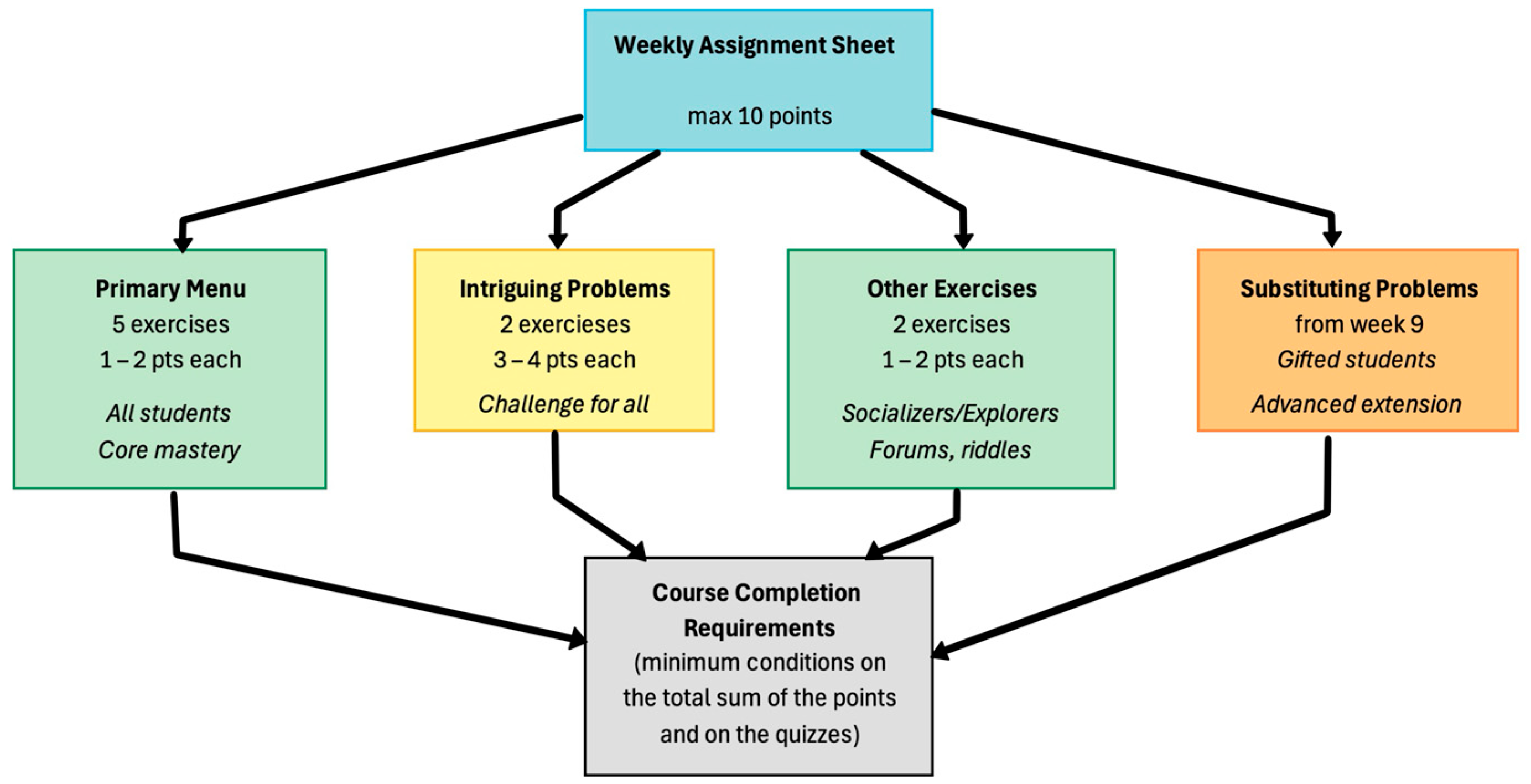
The most points could be gathered by submitting weekly assignments (see Figure 1). There was a maximum limit to how many points students could earn on these; so, it was not required of them to solve all the exercises. There were four types of problems on these sheets:
  • Primary menu: five exercises of 1–2 points each based on the material of the given week and previous weeks, designed to pose appropriate challenges to the students’ general level of understanding.
  • Intriguing problems: two exercises of 3–4 points each meant to pose a challenge for all students.
  • Other exercises: two exercises of 1–2 points each, designed to motivate socializer and explorer students.
  • Substituting problems: introduced later in the semester, from week 9, for gifted students, who found the problems in the primary menu, and intriguing problems too easy
There were two minimum requirements for students to complete the course. The first one was to gather the minimum points for a passing grade (grade 2), and the second one was to complete at least four of the end-of-practice quizzes on previous materials at 80%.
The weekly assignment structure follows a differentiated task framework grounded in Bartle’s player taxonomy (Bartle, 1996), integrating formative assessment principles with adaptive challenge levels to address diverse learner motivations while limiting the total points to prevent overload. This framework operationalizes four core principles:
-
Accessibility: Primary menu ensures baseline mastery for all (achievers).
-
Differentiation based on the player types: Tiered challenges match cognitive levels and player types (explorers/socializers via “other exercises”).
-
Extension: Adaptive escalation for advanced learners (substituting problems from week 9).
-
Curriculum coverage: ensures all core topics are addressed.
To ensure engagement, the design acknowledges that a “one-size-fits-all” approach often renders the gamification approach ineffective, since students are driven by different intrinsic motivations. Bartle (1996) categorizes these preferences into four main types: Achievers (focused on points and status), Explorers (driven by discovery and understanding mechanics), Socializers (motivated by interaction) and Killers (focused on competition and defeating others). By incorporating distinct paths for these profiles, the framework avoids the pitfalls of generic gamification strategies that fail to account for user (student) diversity. The design aligns with Huotari and Hamari’s (2017) gamification definition by creating gameful affordances that support knowledge acquisition through personalized value creation across these player profiles.
We supplemented the point system with additional game elements. In Xiao and Hew (2024)’s review provides a framework linking game design elements to specific gamer types. In our study, we selected a subset of these game elements, which are visualized in Table 4, which maps each element to the Bartle player type it aims to motivate. We focus on three elements in detail: the Trial of Courage, Defeat Your Instructor, and the Elegant Solutions list. The Trial of Courage was introduced for the experimental group as an alternative to the mid-semester examination of the control group, while the Defeat Your Instructor substituted the end-of-semester examination. Both activities consisted of the same problems as the midterms in the control group, but participation was not mandatory. By completing these challenges, students could gain rewards other than points. The Elegant Solutions list was introduced from the 3rd week onwards. By that point, it was clear that the workload of correcting and giving detailed feedback to all students on all their solutions would not be sustainable throughout the semester. To lessen the workload, the lecturer decided which submitted solutions were the most clever and elegant ones and uploaded them for all students to see. This list served as a gamified element to guide and motivate students, as those struggling with problems could review the listed solutions for insights, while those submitting the chosen solutions took great pride in making it onto the list. The Elegant Solutions list allowed teachers to focus their feedback on conceptual and procedural errors, rather than on computational or careless mistakes. After creating the lists, students still received personalized feedback, but they were less detailed, consisting of only a few sentences and their points.
The course was designed so that each of Bartle’s player types (achievers, killers, explorers, and socializers) would find motivating elements for them. For achievers, the point system and the thresholds for grades (levels) were motivating elements. To accommodate killers, we introduced leaderboards, and Defeat Your Instructor was also designed with their needs in mind. Three of the instructors completed the course in 2017, and therefore, the midterms as well. In Defeat Your Instructor, only those students who outperformed the average of the three instructors from the previous semester received rewards. For the explorer and socializer player types, we added motivating exercises to each assignment, called other exercises. For example, we wanted to motivate explorers by adding easter egg-type elements to the assignment pages, such as QR codes or riddles and tasks where students had to look for high school number theory exercises using a given method of solution or find the connection between the learnt material and other fields of mathematics. As for socializers, we created forums where students had to discuss questions, look for people whose digits of their birthday added up to different residue classes of modulo 13, or make a video of them explaining a task to each other. These videos also proved to be very useful for the lecturer to structure the later lessons.

4. Results

Although the distribution of midterm 1 scores showed some deviation from normality, the sample size per group was sufficiently large for the t-test to remain robust to moderate non-normality, particularly given that the residuals were approximately normally distributed and variances were homogeneous (Levene’s test: midterm1: F(1,118) = 0.78, p = 0.38; midterm 2: F(1,91) = 0.08, p = 0.78). Therefore, independent-samples t-tests with equal variances assumed were used.
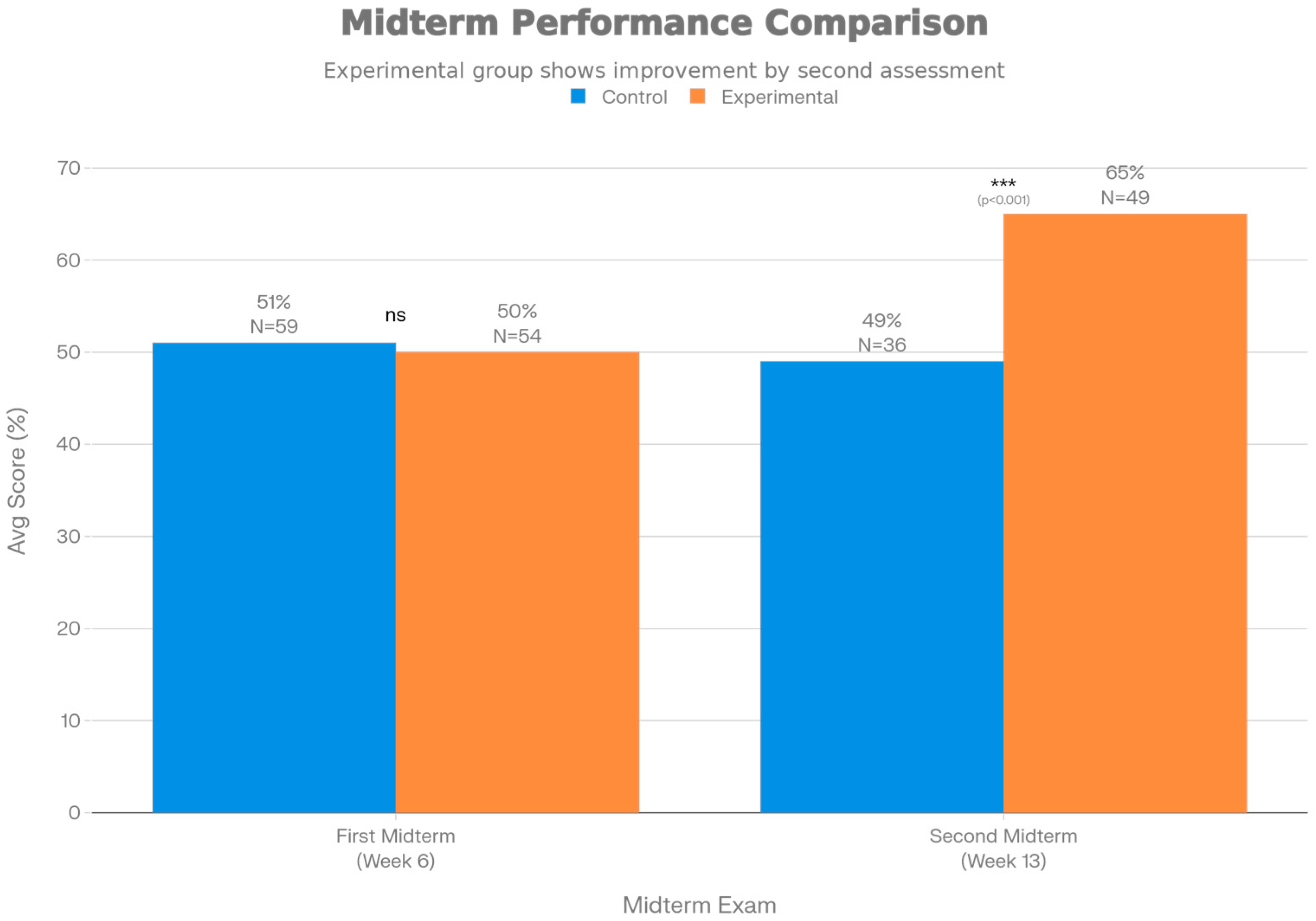
There was no significant difference in midterm 1 scores between the control group (M = 51.22, SD = 21.92, n = 58) and the experimental group (M = 49.52, SD = 19.13, n = 54), t(110) = 0.44, p = 0.66. The effect size was negligible (Cohen’s d = 0.08).
In contrast, midterm 2 scores differed significantly between groups, with the experimental group scoring higher (M = 65.14, SD = 19.56, N = 49) than the control group (M = 48.98, SD = 19.55, N = 36), t(75.59) = −3.80, p < 0.001, Cohen’s d = 0.83, indicating a large effect size in favor of the experimental group.
On the first midterm both groups achieved the same score, 50% and 51%, respectively. On the second midterm the averages were 49% and 65%, the experimental group outperformed the control group by 33%. This is a remarkable improvement, which is represented in Figure 2.

5. Discussion

This study aimed to evaluate the impact of a gamified formative assessment system on the academic performance of first-year mathematics students. Our analysis compared the examination results of a traditional control group with those of an experimental group learning in a fully online, gamified environment.
Both groups were assessed twice during the semester via midterm exams. Both midterms were the same for the two classes. In response to RQ1, on the first midterm exam, taken at week 6, there was no significant difference between the two groups in the exam scores. Regarding RQ2, the pattern changed on the second midterm exam at the last week of the term (week 13), where the experimental group significantly outperformed the control group. However, a limitation to consider is that the second midterm coincided with the seasonal flu period. This necessitated make-up exams, which could not be included in the comparative analysis. Additionally, comprehensive data on student attrition were unavailable; consequently, it is unclear whether students who failed retook the course or withdrew from the university. This also shows that the complexity of this educational experiment limits direct causal conclusions, the data are consistent with prior studies demonstrating that well-implemented gamification can enhance academic performance, engagement, and persistence (Bai et al., 2020; Buckley & Doyle, 2016; Meylani, 2025; Zeng et al., 2024) and that the use of gamified systems enhance academic achievement, motivation and engagement (Göksün & Gürsoy, 2019; Benben & Bug-os, 2022).
Gamification often shows promising short-term benefits–such as increased motivation, higher academic performance, and initial spikes in engagement–though these effects tend to fade after a few weeks (Hanus & Fox, 2015; Rodrigues et al., 2022). Some studies suggest, however, that these positive effects can later return and stabilize over the long term (Rodrigues et al., 2022). Our 13-week study can be considered as a longer-term gamification. Although we measured the effectiveness of our system only twice during the semester, our results support Rodrigues et al. (2022), indicating that gamification generally has a positive impact and does not harm learners at any stage.
The delayed performance gains observed–with significant differences emerging only in the second midterm–may be attributed to multiple factors. One of these factors can be that extended interventions can substantially enhance learners’ engagement and motivation, ultimately leading to improved academic performance (Kim & Castelli, 2021). Another factor may be that gamification enhances knowledge retention and facilitates the understanding of complex concepts by fostering active learning possibly through distributed practice and self-regulation (Dunlosky et al., 2013; Roediger & Butler, 2011) these typically unfold gradually. Hypothetically, a mandatory first midterm might have induced ‘cramming,’ potentially inflating initial scores. However, such high-stakes testing conflicts with gamification principles. While intensive, last-minute study can temporarily enhance recall through working memory overload, it often fails to support the long-term retention fostered by distributed practice (Smolen et al., 2016). Consequently, the gamified approach, by prioritizing continuous engagement, may result in lower initial performance but ultimately fosters more durable knowledge, as evidenced by the significant improvement in the second midterm. By engaging directly in tasks and challenges tied to course content, students reinforce their understanding and consolidate learning more effectively (Jaramillo-Mediavilla et al., 2024; Sailer et al., 2017). Finally, the feedback-rich design of the gamified system may have played a critical role in facilitating timely error correction and adaptive learning strategies. By enabling students to promptly adjust their approaches based on ongoing feedback, the system supports deeper cognitive processing and longer-term retention, ultimately contributing to a more effective and meaningful educational experience (Jaramillo-Mediavilla et al., 2024).
Our results also support the view that gamification’s effectiveness depends heavily on design quality and contextual fit (Almeida et al., 2023; Dichev & Dicheva, 2017). The system deliberately incorporated elements addressing different player types based on Bartle’s taxonomy (Bartle, 1996), as well as transparent grading thresholds and continuous feedback.
At the same time, we acknowledge the potential limitations of our study. While our quasi-experimental design provides compelling evidence of gamification’s efficacy, important methodological differences between groups warrant caution in interpretation. The control group benefited from face-to-face instruction under pre-pandemic conditions with traditional summative assessment, whereas the experimental group experienced fully online delivery amid COVID-19 stressors, with a diversified point-based system minimizing midterm weight. Differences in delivery mode, the nature and frequency of interaction and communication with instructors and peers, as well as exam conditions and levels of supervision, the quality of the home learning environment, digital technology access and competencies, as well as other pandemic-related stress factors–might all influence student performance independently of the gamified intervention.
Another confounding factor lies in the different sources of test anxiety. While the experimental group faced pandemic-related stress, the control group likely experienced higher anxiety linked to the high-stakes, mandatory nature of their midterms. It is possible that the pressure of mandatory assessments negatively impacted the control group’s performance or, conversely, spurred short-term effort. Future research should explicitly examine the relationship between performance and test anxiety in gamified versus traditional assessment systems to disentangle these effects. These contextual factors should be considered when interpreting the results and drawing conclusions about the efficacy of gamification in mathematics education. Additionally, this study examines the impact of gamified instruction on academic achievement over a single 13-week semester. While the results indicate promising effects on retention, it remains unclear whether these benefits persist beyond the duration of the course or once the gamified elements are removed.
Our findings suggest that a thoughtfully designed gamified system with formative assessment can serve as a powerful tool to support students in the transition to university mathematics. However, the system was resource-intensive, requiring significant effort in weekly task design and individualized feedback. Future research should explore how to streamline such interventions to reduce instructors’ workload while maintaining their educational impact. Identifying the “core” game elements that drive performance gains would allow for more sustainable implementation. Further studies should also investigate long-term impacts, including whether improvements persist beyond the intervention. Also, it would be valuable for future research to explore the influence of gamified instruction not only on students’ cognitive, but also on non-cognitive learning outcomes as well. Expanding the evaluation to include qualitative data and post-tests in subsequent semesters could provide a richer understanding of how the type of gamification used in this study impacts different learning outcomes. Finally, replicating this study across different mathematical topics and institutional contexts would help determine the generalizability of these findings.

6. Conclusions

The transition from high school to university mathematics is a critical period often marked by high failure rates, a challenge significantly intensified by the COVID-19 pandemic. To address these difficulties and mitigate the limitations of remote instruction, we designed and implemented a comprehensive gamified learning system. We compared the academic performance of a control group receiving traditional in-person instruction with an experimental group participating in this online environment. Unlike the traditional approach, the experimental course utilized a gamified design grounded in Bartle’s player taxonomy, supporting diverse student needs through continuous point-earning activities, weekly quizzes, and tiered assignments. Both groups were assessed twice during the semester via the same midterm exams. Analysis of the results revealed that while there was no significant difference in performance on the first midterm exam, the experimental group significantly outperformed the control group by the end of the semester. This delayed but substantial improvement suggests that the gamified system helped students retain and apply knowledge more effectively as the course progressed. It is likely that the continuous and complex point-earning system, with weekly quizzes, active participation, and tiered assignments contributed to sustaining deep engagement and more active learning procedure. This finding aligns with the idea that gamification can enhance motivation and perseverance in challenging academic contexts, particularly in an online setting.
Our results indicate that a gamified system can be a powerful tool to support learning in university mathematics education. The positive effect emerging primarily in the latter exam suggests that the benefits of gamification may develop gradually, as students adapt to and internalize the new learning environment. The system’s design, incorporating continuous feedback and addressing different motivational profiles, appears to have mitigated the motivational decline observed in some gamification studies. While this study confirms the potential of gamification, it also highlights the importance of thoughtful and context-sensitive implementation. The significant difference in the second midterm exam suggests enhanced long-term knowledge retention and conceptual understanding, which was likely fostered by the active engagement and distributed practice encouraged by the gamified approach. These insights provide valuable guidance for educators seeking to integrate gamification into mathematics curricula to enhance student outcomes.
Although the course was highly successful and met its goals, there remains potential for further research to explore how a similar gamified system would function in offline or face-to-face educational settings. Investigating its impact in traditional classroom environments, where direct interaction between teachers and students occurs, could provide valuable insights. Given that educators often face substantial administrative and instructional demands, an important direction for future work is to find ways to reduce their workload. It would be particularly beneficial to identify which tasks can be reliably and effectively delegated to a digital learning platform or AI-based system, thus freeing up teacher time. Such automation could enhance both the efficiency and quality of instruction by providing timely support to learners and educators alike.

Author Contributions

Conceptualization, A.M. and S.S.; Methodology, A.M., S.S., A.K.S. and J.S.; Formal analysis, A.M., S.S. and C.S.; Investigation, A.M., S.S., C.S. and J.S.; Resources, A.M., S.S., C.S. and J.S.; Data curation, C.S.; Writing—original draft, A.M., S.S. and J.S.; Writing—review & editing, A.K.S., C.S. and J.S.; Visualization, A.K.S.; Supervision, C.S. and J.S.; Project administration, A.M., S.S. and J.S.; Funding acquisition, C.S. All authors have read and agreed to the published version of the manuscript.

Funding

This research was funded by Digital Education Development Competence Center at Eötvös Loránd University, Budapest, grant number 2022-1.1.1-KK-2022-00003.

Institutional Review Board Statement

The study was conducted in accordance with the Declaration of Helsinki, and approved by the Research Ethics Committee (REC), of Eötvös Loránd University (protocol code 2024/423 and date of approval 2 December 2024).

Informed Consent Statement

Participants’ consent was not required for this study, as it was conducted under ethical approval granted by the university research ethics committee. According to the approved protocol, the intervention involved modifying the regular assessment system within an existing university course. No additional procedures, personal data collection, or interventions beyond normal educational activities were introduced.

Data Availability Statement

The original contributions presented in this study are included in the article. Further inquiries can be directed to the corresponding author(s).

Conflicts of Interest

The authors declare no conflict of interest.

Appendix A

The Topics Covered by the Course Number Theory

Divisibility, greatest common divisor, the Euclidean algorithm, prime numbers, and the fundamental theorem of arithmetic. Special arithmetic functions, additive and multiplicative arithmetic functions. Congruences. The Euler-Fermat theorem, Wilson’s theorem. Linear congruences and Diophantine equations. Linear congruence systems. Divisibility rules (2, 4, 8, 5, 25, 3, 9, 11). Algebraic formulas: Geometric progression. The concept of rational exponentiation, identities of exponentiation. Mersenne primes, Fermat primes, perfect numbers. An infinite number of primes in the form, Dirichlet’s theorem (without proof). Prime gap. Pythagorean triples, Fermat’s Last Theorem. Order and structure. Divisors of Mersenne and Fermat numbers. Famous number theory problems. Row and column vectors, matrices–basic operations.

Appendix B

Appendix B.1. Problems of the First Midterm Exam (Trial of Courage)

1.
Determine the possible values of the greatest common divisor of (5n + 1, 4n + 2).
2.
The little princess found a prime number, but the witch changed the last digit and got 102,480. Let us help the princess. What was the last digit?
3.
Decide whether there is a solution to the following equations among the integers. If there is, give one.
a.
30x − 12y = 69
b.
92u81v = 2114
4.
Determine whether there are solutions to the following equations among the integers.
4x2 − 555y4 = 423
5.
For which primes p is p + 1 a perfect cube?
6.
Is there a power of 2 in which every digit (from 0 to 9) appears exactly 2020 times? And is there one in which it appears at most 2020 times?

Appendix B.2. Problems of the Second Midterm Exam (Defeat Your Instructor)

1.
Determine all positive solutions of the following system of congruences.
10x ≡ 5 mod 7 ∧ x ≡ 4 mod 9
2.
Prove that the following equation has no solutions among the integers.
10!x10 + 12y20 + 110z1211 = 44z2017 + 6
3.
Find the remainder of 7373731199993330002 modulo 73.
OR
Find the remainder of 2017 1111 1212 modulo 43.
4.
For which positive integers n is
σ (3n) = σ (n) + 24
5.
We know that 11 is a primitive root modulo 29. Is it true that 115 and 117 are primitive roots?

References

  1. Adukaite, A., van Zyl, I., Er, Ş., & Cantoni, L. (2017). Teacher perceptions on the use of digital gamified learning in tourism education: The case of south African secondary schools. Computers & Education, 111, 172–190. [Google Scholar] [CrossRef]
  2. Akpen, C. N., Asaolu, S., Atobatele, S., Okagbue, H., & Sampson, S. (2024). Impact of online learning on student’s performance and engagement: A systematic review. Discover Education, 3, 205. [Google Scholar] [CrossRef]
  3. Almeida, C., Kalinowski, M., Uchôa, A., & Feijó, B. (2023). Negative effects of gamification in education software: Systematic mapping and practitioner perceptions. Information and Software Technology, 156, 107142. [Google Scholar] [CrossRef]
  4. Alsadoon, E., Alkhawajah, A., & Suhaim, A. (2022). Effects of a gamified learning environment on students’ achievement, motivations, and satisfaction. Heliyon, 8, e10249. [Google Scholar] [CrossRef] [PubMed]
  5. Arufe Giráldez, V., Sanmiguel-Rodríguez, A., Ramos Álvarez, O., & Navarro-Patón, R. (2022). Can gamification influence the academic performance of students? Sustainability, 14(9), 5115. [Google Scholar] [CrossRef]
  6. Bai, S., Hew, K. F., & Huang, B. (2020). Does gamification improve student learning outcome? Evidence from a meta-analysis and synthesis of qualitative data in educational contexts. Educational Research Review, 30, 100322. [Google Scholar] [CrossRef]
  7. Bartle, R. (1996). Hearts, clubs, diamonds, spades: Players who suit MUDs. Journal of MUD Research, 1(1), 19. [Google Scholar]
  8. Benben, V. Y., & Bug-os, M. A. A. C. (2022). Physics students’ academic achievement and motivation in a Gamified formative assessment. American Journal of Educational Research, 10(6), 385–390. [Google Scholar] [CrossRef]
  9. Berger, S., Stadler, M., Sailer, M., Eberele, J., Cooper, H. D., & Stegmann, K. (2025). Crossing the distance: University student newcomer socialization in online semesters—A case study. Unterrichtswissenschaft, 53, 53–71. [Google Scholar] [CrossRef]
  10. Biza, I., Jaworski, B., & Hemmi, K. (2014). Communities in university mathematics. Research in Mathematics Education, 16(2), 161–176. [Google Scholar] [CrossRef]
  11. Bolat, Y. I., & Taş, N. (2023). A meta-analysis on the effect of gamified-assessment tools’ on academic achievement in formal educational settings. Education and Information Technologies, 28(5), 5011–5039. [Google Scholar] [CrossRef]
  12. Buckley, P., & Doyle, E. (2016). Gamification and student motivation. Interactive Learning Environments, 24(6), 1162–1175. [Google Scholar] [CrossRef]
  13. Burlacu, M., Coman, C., & Bularca, M. C. (2023). Blogged into the system: A systematic review of the gamification in e-learning before and during the COVID-19 pandemic. Sustainability, 15(8), 6476. [Google Scholar] [CrossRef]
  14. Cabanilla, A. J., Batolbatol, G., Jacaban, F., & Bonotan, A. (2023). Gamified instruction in mathematics: A meta-synthesis. Human Behavior, Development and Society, 24(1), 36–46. [Google Scholar]
  15. Cameron, J., Banko, K. M., & Pierce, W. D. (2001). Pervasive negative effects of rewards on intrinsic motivation: The myth continues. The Behavior Analyst, 24(1), 1–44. [Google Scholar] [CrossRef]
  16. Chan, M. C. E., Sabena, C., & Wagner, D. (2021). Mathematics education in a time of crisis—A viral pandemic. Educational Studies in Mathematics, 108(1), 1–13. [Google Scholar] [CrossRef] [PubMed]
  17. Dagorn, E., & Moulin, L. (2025). Dropping out of university in response to the COVID-19 pandemic. Economics of Education Review, 104, 102604. [Google Scholar] [CrossRef]
  18. Deci, E. L., Ryan, R. M., Gagné, M., Leone, D. R., Usunov, J., & Kornazheva, B. P. (2001). Need satisfaction, motivation, and well-being in the work organizations of a former Eastern bloc country: A cross-cultural study of self-determination. Personality and Social Psychology Bulletin, 27(8), 930–942. [Google Scholar] [CrossRef]
  19. Deterding, S., Khaled, R., Nacke, L. E., & Dixon, D. (2011, May 7–12). Gamification: Toward a definition [Paper presentation]. 15th International Academic MindTrek Conference: Envisioning Future Media Environments, CHI 2011 Gamification Workshop Proceedings. ACM (pp. 9–15), Vancouver, BC, Canada. [Google Scholar] [CrossRef]
  20. Diaz, A. F., & Estoque-Loñez, H. (2024). A meta-analysis on the effectiveness of gamification on student learning achievement. International Journal of Education in Mathematics, Science, and Technology (IJEMST), 12(5), 1236–1253. [Google Scholar] [CrossRef]
  21. Dichev, C., & Dicheva, D. (2017). Gamifying education: What is known, what is believed and what remains uncertain: A critical review. International Journal of Educational Technology in Higher Education, 14(1). [Google Scholar] [CrossRef]
  22. Dikmen, M. (2021). Does gamification affect academic achievement? A meta-analysis of studies conducted in turkey. International Journal of Curriculum and Instruction, 13(3), 3001–3020. [Google Scholar]
  23. Di Martino, P., & Gregorio, F. (2019). The mathematical crisis in secondary–tertiary transition. International Journal of Science and Mathematics Education, 17(4), 825–843. [Google Scholar] [CrossRef]
  24. Di Martino, P., Gregorio, F., & Iannone, P. (2023). The transition from school to university in mathematics education research: New trends and ideas from a systematic literature review. Educational Studies in Mathematics, 113, 7–34. [Google Scholar] [CrossRef]
  25. Dunlosky, J., Rawson, K. A., Marsh, E. J., Nathan, M. J., & Willingham, D. T. (2013). Improving students’ learning with effective learning techniques: Promising directions from cognitive and educational psychology. Psychological Science in the Public Interest, 14(1), 4–58. [Google Scholar] [CrossRef]
  26. Engelbrecht, J. (2010). Adding structure to the transition process to advanced mathematical activity. International Journal of Mathematical Education in Science and Technology, 41(2), 143–154. [Google Scholar] [CrossRef]
  27. Fellus, O., Segal, R., Silverman, B., Shriki, A., & Movshoviz-Hadar, N. (2025). Change in mathematics education during a time of crisis: Reflections through the lens of complexity constructs. European Educational Research Journal. [Google Scholar] [CrossRef]
  28. Gafni, R., Achituv, D., Eidelman, S., & Chatsky, T. (2018). The effects of gamification elements in e-learning platforms. Online Journal of Applied Knowledge Management, 6, 37–53. [Google Scholar] [CrossRef] [PubMed]
  29. Garcia-Cabot, A., Garcia-Lopez, E., Caro-Alvaro, S., Gutierrez-Martinez, J.-M., & de-Marcos, L. (2020). Measuring the effects on learning performance and engagement with a gamified social platform in an MSc program. Computer Applications in Engineering Education, 28(1), 207–223. [Google Scholar] [CrossRef]
  30. Geisler, S. (2021). Early dropout from university mathematics: The role of students’ attitudes towards mathematics. In M. Inprasitha, N. Changsri, & N. Boonsena (Eds.), Proceedings of the 44th conference of the international group for the psychology of mathematics education (Vol. 2, pp. 320–329). PME. [Google Scholar]
  31. Geisler, S., Rolka, K., & Rach, S. (2023). Development of affect at the transition to university mathematics and its relation to dropout—Identifying related learning situations and deriving possible support measures. Educational Studies in Mathematics, 113, 35–56. [Google Scholar] [CrossRef]
  32. Göksün, D. O., & Gürsoy, G. (2019). Comparing success and engagement in gamified learning experiences via Kahoot and Quizizz. Computers & Education, 135, 15–29. [Google Scholar] [CrossRef]
  33. Gueudet, G. (2008). Investigating the secondary–tertiary transition. Educational Studies in Mathematics, 67(3), 237–254. [Google Scholar] [CrossRef]
  34. Hallifax, S., Serna, A., Marty, J., Lavoué, G., & Lavoué, E. (2019). Factors to consider for tailored gamification. In Proceedings of the annual symposium on computer-human interaction in play (pp. 559–572). Association for Computing Machinery. [Google Scholar] [CrossRef]
  35. Hanus, M. D., & Fox, J. (2015). Assessing the effects of gamification in the classroom: A longitudinal study on intrinsic motivation, social comparison, satisfaction, effort, and academic performance. Computers & Education, 80, 152–161. [Google Scholar] [CrossRef]
  36. Huotari, K., & Hamari, J. (2017). A definition for gamification: Anchoring gamification in the service marketing literature. Electron Markets, 27, 21–31. [Google Scholar] [CrossRef]
  37. Jaramillo-Mediavilla, L., Basantes-Andrade, A., Cabezas-González, M., & Casillas-Martín, S. (2024). Impact of gamification on motivation and academic performance: A systematic review. Education Sciences, 14(6), 639. [Google Scholar] [CrossRef]
  38. Jayalath, J., & Esichaikul, V. (2022). Gamification to enhance motivation and engagement in blended elearning for technical and vocational education and training. Technology, Knowledge and Learning, 27(1), 91–118. [Google Scholar] [CrossRef]
  39. Jurgelaitis, M., Čeponienė, L., Čeponis, J., & Drungilas, V. (2018). Implementing gamification in a university-level UML modeling course: A case study. Computer Applications in Engineering Education, 27(2), 332–343. [Google Scholar] [CrossRef]
  40. Kamunya, S., Mirirti, E., Oboko, R., & Maina, E. (2020, May 18–22). An adaptive gamification model for e-learning. 2020 IST-Africa Conference (IST-Africa), Kampala, Uganda. [Google Scholar]
  41. Kim, J., & Castelli, D. M. (2021). Effects of gamification on behavioral change in education: A meta-analysis. International Journal of Environmental Research and Public Health, 18(7), 3550. [Google Scholar] [CrossRef]
  42. Kolbe, T., & Liebendörfer, M. (2024). Which knowledge is required in exams on analysis 1 courses at German universities? Teaching Mathematics and Its Applications: An International Journal of the IMA, 44(2), 154–173. [Google Scholar] [CrossRef]
  43. Leitão, R., Maguire, M., Turner, S., & Guimarães, L. (2022). A systematic evaluation of game elements effects on students’ motivation. Education and Information Technologies, 27(1), 1081–1103. [Google Scholar] [CrossRef]
  44. Li, L., Hew, K. F., & Du, J. (2024). Gamification enhances student intrinsic motivation, perceptions of autonomy and relatedness, but minimal impact on competency: A meta-analysis and systematic review. Educational Technology Research and Development, 72(2), 765–796. [Google Scholar] [CrossRef]
  45. Li, M., Ma, S., & Shi, Y. (2023). Examining the effectiveness of gamification as a tool promoting teaching and learning in educational settings: A meta-analysis. Frontiers in Psychology, 14, 1253549. [Google Scholar] [CrossRef]
  46. Liebendörfer, M., Kempen, L., & Schukajlow, S. (2023). First-year university students’ self-regulated learning during the COVID-19 pandemic: A qualitative longitudinal study. ZDM–Mathematics Education, 55(1), 119–131. [Google Scholar] [CrossRef]
  47. Lo, C. K., & Hew, K. F. (2018). A comparison of flipped learning with gamification, traditional learning, and online independent study: The effects on students’ mathematics achievement and cognitive engagement. Interactive Learning Environments, 28(4), 464–481. [Google Scholar] [CrossRef]
  48. Maskos, K., Schulz, A., Oeksuez, S. S., & Rakoczy, K. (2025). Formative assessment in mathematics education: A systematic review. ZDM Mathematics Education, 57, 679–693. [Google Scholar] [CrossRef]
  49. Mekler, E. D., Brühlmann, F., Tuch, A. N., & Opwis, K. (2017). Towards understanding the effects of individual gamification elements on intrinsic motivation and performance. Computers in Human Behavior, 71, 525–534. [Google Scholar] [CrossRef]
  50. Meylani, R. (2025). Gamification and game-based learning in mathematics education for advancing SDG 4: A systematic review and qualitative synthesis of contemporary research literature. Journal of Lifestyle and SDGs Review, 5(2), e04567. [Google Scholar] [CrossRef]
  51. Mickwitz, Å., Londen, M., Perander, K., & Tiihonen, S. (2024). Understanding the varieties in first-year university students’ experience of self-regulated learning during emergency remote teaching. European Journal of Higher Education, 15, 467–484. [Google Scholar] [CrossRef]
  52. Naik, V., & Kamat, V. V. (2015, December 10–12). Adaptive and gamified learning environment (AGLE). 2015 IEEE Seventh International Conference on Technology for Education (T4E), Warangal, India. [Google Scholar]
  53. Ortiz-Rojas, M., Chiluiza, K., & Valcke, M. (2019). Gamification through leaderboards: An empirical study in engineering education. Computer Applications in Engineering Education, 27(4), 777–788. [Google Scholar] [CrossRef]
  54. O’Shea, A., & Breen, S. (2021). Students’ views on transition to university: The role of mathematical tasks. Canadian Journal of Science, Mathematics and Technology Education, 21(1), 29–43. [Google Scholar] [CrossRef]
  55. Pilkington, C. (2018). A playful approach to fostering motivation in a distance education computer programming course: Behaviour change and student perceptions. The International Review of Research in Open and Distributed Learning, 19(3), 282–298. [Google Scholar] [CrossRef]
  56. Rach, S., & Heinze, A. (2017). The transition from school to university in mathematics: Which influence do school-related variables have? International Journal of Science and Mathematics Education, 15(7), 1343–1363. [Google Scholar] [CrossRef]
  57. Radmehr, F., & Goodchild, S. (2022). Switching to fully online teaching and learning of mathematics: The case of Norwegian mathematics lecturers and university students during the COVID-19 pandemic. International Journal of Research in Undergraduate Mathematics Education, 8, 581–611. [Google Scholar] [CrossRef]
  58. Rodrigues, L., Pereira, F. D., Toda, A. M., Palomino, P. T., Pessoa, M., Carvalho, L. S. G., Fernandes, D., Oliveira, E. H. T., Cristea, A., & Isotani, S. (2022). Gamification suffers from the novelty effect but benefits from the familiarization effect: Findings from a longitudinal study. International Journal of Educational Technology in Higher Education, 19, 13. [Google Scholar] [CrossRef]
  59. Roediger, H. L., & Butler, A. C. (2011). The critical role of retrieval practice in long-term retention. Trends in Cognitive Sciences, 15(1), 20–27. [Google Scholar] [CrossRef] [PubMed]
  60. Sailer, M., Hense, J. U., Mayr, S. K., & Mandl, H. (2017). How gamification motivates: An experimental study of the effects of specific game design elements on psychological need satisfaction. Computers in Human Behavior, 69, 371–380. [Google Scholar] [CrossRef]
  61. Sailer, M., & Homner, L. (2020). The gamification of learning: A meta-ANALYSIS. Educational Psychology Review, 32(1), 77–112. [Google Scholar] [CrossRef]
  62. Schöbel, S., & Söllner, M. (2016, June 12–15). How to gamify information systems—Adapting gamification to individual user preferences. European Conference on Information Systems (ECIS) 2016, Istanbul, Turkey. [Google Scholar]
  63. Seaborn, K., & Fels, D. I. (2015). Gamification in theory and action: A survey. International Journal of Human-Computer Studies, 74, 14–31. [Google Scholar] [CrossRef]
  64. Smolen, P., Zhang, Y., & Byrne, J. H. (2016). The right time to learn: Mechanisms and optimization of spaced learning. Nature Reviews Neuroscience, 17(2), 77–88. [Google Scholar] [CrossRef]
  65. Suurtamm, C., Thompson, D. R., Kim, R. Y., Moreno, L. D., Sayac, N., Schukajlow, S., Silver, E., Ufer, S., & Vos, P. (2016). Assessment in mathematics education. In G. Kaiser (Ed.), Assessment in mathematics education. ICME-13 topical surveys. Springer. [Google Scholar] [CrossRef]
  66. Szeibert, J., Muzsnay, A., Szabó, C., & Bereczky-Zámbó, C. G. (2022). A case study of using test-enhanced learning as a formative assessment in high school mathematics. International Journal of Science and Mathematics Education, 21(2), 623–643. [Google Scholar] [CrossRef]
  67. Tsay, C. H.-H., Kofinas, A. K., Trivedi, S. K., & Yang, Y. (2020). Overcoming the novelty effect in online gamified learning systems: An empirical evaluation of student engagement and performance. Journal of Computer Assisted Learning, 36(2), 128–146. [Google Scholar] [CrossRef]
  68. Xiao, Y., & Hew, K. F. (2024). Personalised gamification enhances student participation but produces mixed effects on emotional and cognitive engagements: A systematic review. Interactive Learning Environments, 32(10), 7014–7040. [Google Scholar] [CrossRef]
  69. Zainuddin, Z. (2020). The impact of gamification on learning and instruction: A systematic review of empirical evidence. Educational Research Review, 30, 100326. [Google Scholar] [CrossRef]
  70. Zainuddin, Z., Shujahat, M., Haruna, H., & Chu, S. K. (2020). The role of gamified E-quizzEs on student learning and engagement: An interactive gamification solution for a formative assessment system. Computers & Education, 145, 103729. [Google Scholar] [CrossRef]
  71. Zeng, J., Sun, D., Looi, C.-K., & Fan, A. C. W. (2024). Exploring the impact of gamification on students‘ academic performance: A comprehensive meta-analysis of studies from the year 2008 to 2023. British Journal of Educational Technology, 55, 2478–2502. [Google Scholar] [CrossRef]
Figure 1. The most points could be gathered by submitting weekly assignments.
Education 16 00159 g001
Figure 2. Summary of results in a histogram.
Education 16 00159 g002
Table 1. Comparison of the Experimental and the Control Group.
AspectControl Group (2017, N = 62)Experimental Group (2020, N = 61)
Participant TypePre-service mathematics teachers from the same university
CurriculumIdentical curriculum used: same course content, practice problem sets, and midterm problem sets
LecturerSame lecturer
Mode of DeliveryTraditional in-person instructionFully online delivery
Assessment SystemTraditional grading based on two midterms (30 and 36 points) + weekly quizzesGamified system with various point-earning activities (see Table 2)
Midterm AssessmentsTwo required midtermsOptional gamified equivalents: Trial of Courage and Defeat Your Instructor
Weekly QuizzesShort weekly quizzes (minimal grade impact)Weekly quizzes at every practice and lecture (major point source)
Grading SystemBased primarily on midterm scores; quiz points used to round gradesBased on total accumulated points from quizzes, assignments, participation, etc.
AssignmentsNot emphasizedWeekly assignments categorized into different difficulty/problem types
Table 2. Primary Point Gathering Opportunities.
ComponentDescriptionMaximal Point Value Per Week
Quizzes on lectures2 questions: —1 about the current lecture—1 proof-based question from earlier material8 points
(6 points for proof and 2 points for quiz)
Quizzes on practices2 short exercises: —1 from the current week’s material—1 from two weeks earlier6 points
Weekly assignmentsCollection of exercises categorized by difficulty and role10 points
Active participation in lecturesPoints awarded by teachers for active involvement during lessons2 points
Active participation in practicesPoints awarded by teachers for active involvement during lessons2 points
Table 3. Point Thresholds.
GradesPoints
5 (best grade)180–
4130–179
390–129
2 (passing grade)60–89
1 (failing grade)0–59
Table 4. Motivating Elements in the Gamified Course System for Each of Bartle’s Player Types.
AchieverKillerExplorerSocializer
Point systemEducation 16 00159 i001Education 16 00159 i001
Thresholds (levels)Education 16 00159 i001
Defeat your instructor Education 16 00159 i001
Leaderboards Education 16 00159 i001
Weekly assignments-Other exercises Education 16 00159 i001Education 16 00159 i001
Disclaimer/Publisher’s Note: The statements, opinions and data contained in all publications are solely those of the individual author(s) and contributor(s) and not of MDPI and/or the editor(s). MDPI and/or the editor(s) disclaim responsibility for any injury to people or property resulting from any ideas, methods, instructions or products referred to in the content.