Article

Validating the Music Wellness Model: Evidence from Expert and Public Perspectives
1
Honours Health Sciences Program, Faculty of Health Sciences, McMaster University, Hamilton, ON L8S 4L8, Canada
2
Dalla Lana School of Public Health, University of Toronto, Toronto, ON M5T 3M7, Canada
3
Michael G. DeGroote School of Medicine, McMaster University, Hamilton, ON L8P 1H6, Canada
4
Room 217 Foundation, Port Perry, ON L9L 1A2, Canada
5
Faculty of Music, University of Toronto, Toronto, ON M5S 2C5, Canada
*
Author to whom correspondence should be addressed.
Educ. Sci. 2026, 16(1), 152; https://doi.org/10.3390/educsci16010152
Submission received: 13 November 2025 / Revised: 11 January 2026 / Accepted: 14 January 2026 / Published: 19 January 2026
(This article belongs to the Special Issue Music Education: Current Changes, Future Trajectories)

Abstract

Rising rates of mental health concerns worldwide highlight the need for accessible and effective support. Music wellness, defined as “interacting with music in a way that contributes to holistic health and flourishing,” may help address this gap when integrated into education. In 2024, this research team conducted a Delphi study to establish this definition and propose a four-dimensional music wellness model (catalyst, act, outcome, and skill). The present study builds on that work by evaluating the model’s clarity, relevance, and real-world applicability through a mixed-methods validation study. Semi-structured interviews with five experts assessed conceptual coherence and clarity, and a survey of 160 adults examined whether the model reflected everyday uses of music for well-being. Experts confirmed the model’s logic and utility while suggesting refinements to improve clarity. Survey responses showed high overall agreement (mean = 85.6%) across items representing all four dimensions, and all participants reported daily engagement with music and positive emotional effects. These findings support the model’s validity and applicability, providing an evidence-based foundation for integrating music wellness into curricula that promote lifelong health and flourishing.

1. Introduction

Across the globe, wellness has become an increasingly urgent priority, with rates of stress, anxiety, and mental health concerns rising across all age groups (Bie et al., 2024; Moitra et al., 2023; Piao et al., 2024). These challenges disproportionately affect youth (ages 16–24), who are navigating critical periods of social, emotional, and cognitive development while facing heightened academic and societal pressures (Public Health Agency of Canada, 2025; World Health Organization, 2025). As a result, schools and universities are being called upon to address not only academic development but also the holistic well-being of students.
Music has been empirically, anecdotally, and historically connected with health since ancient civilizations, and many researchers have documented these effects through conceptual models and frameworks. Much of this work is grounded in wellness-oriented and salutogenic perspectives, as well as theories of musicking that emphasize music as an active, meaning-making practice rather than a passive intervention (Batt-Rawden, 2010; Bonde, 2011; Bonde et al., 2023; Viola et al., 2023). Several models link music to health, but most are designed for specific settings or targeted outcomes rather than general use. For example, the CHIME framework has been applied to music interventions by connecting musical engagement to personal recovery principles (Damsgaard & Jensen, 2021; Leamy et al., 2011). The Music, Mood, and Movement (MMM) theory focuses on how music’s psychological effects make physical activity more enjoyable (Murrock & Higgins, 2009). The 10 Domains of Music Care Delivery conceptualizes how music can be embedded within caregiving practices (Foster et al., 2016), while Health Musicking provides a descriptive map of how different musical activities can support individual, social, mind, and body goals (Bonde et al., 2023). Together, these models demonstrate robust links between music and health, but they are typically bounded by professional roles, intervention contexts, or specific outcome domains. While this work has contributed important insights into how music supports health and well-being, less attention has been given to whether broad, integrative models are clear, meaningful, and applicable across everyday educational, community, and personal contexts.
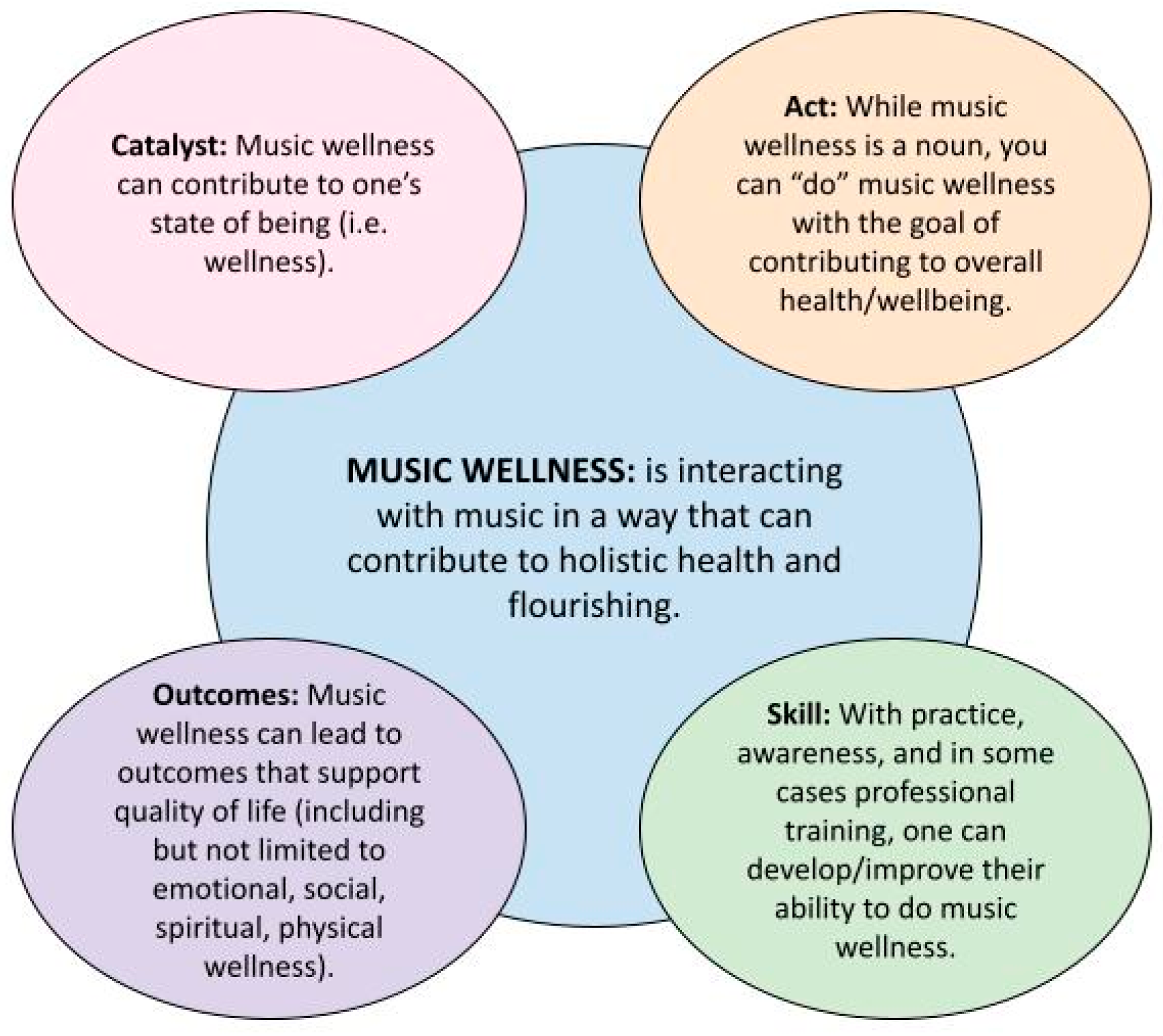
In recent years, the concept of “music wellness” has gained traction in both academic and applied contexts, reflecting a growing interest in music as a resource for holistic health beyond clinical or therapeutic settings. For example, Berklee College offers a Music for Wellness course, and hospitals, community organizations, and conservatories have adopted music wellness programming (Philip & Hanser, n.d.; MedStar Health, 2025; Victoria Conservatory of Music, 2025). This emerging and interdisciplinary use of the term reflects broader theoretical perspectives that conceptualize music as a multidimensional contributor to health and wellbeing across psychological, social, and participatory domains, as articulated in existing frameworks by MacDonald et al. (2012) and Bonde et al. (2023). In 2024, this research team conducted a Delphi study that convened 19 experts to establish a working definition of music wellness as “interacting with music in a way that contributes to holistic health and flourishing” (George et al., 2024). Both the definition and the accompanying model (Figure 1) were generated inductively through expert consensus rather than derived from existing theoretical frameworks. However, the proposed model has not yet been systematically validated to assess its clarity, relevance, or alignment with how people actually use music in their lives.
Validating this model is an essential next step. Beyond addressing common challenges of the Delphi process, such as limited diversity of perspectives and uneven idea representation, validation ensures that the model reflects both expert knowledge and the lived experiences of the general public (Fink-Hafner et al., 2019). As Inglis (2008) notes, approaches to validating quality models as “fit for purpose” can include (1) reviewing relevant research literature, (2) seeking input from an expert panel, (3) undertaking empirical research, (4) undertaking survey research, (5) conducting pilot projects, and (6) drawing on case studies. These strategies have been applied across diverse fields, including housing (Luciano et al., 2020), eHealth (Broomhead et al., 2023; Mauco et al., 2020; Ndlovu et al., 2023), lean manufacturing (Nordin et al., 2012), and e-learning (Alsobhi et al., 2015). Together, these examples highlight that validation is a flexible and context-specific process.
Guided by this framework, the present study advances the validation of the music wellness model by addressing points two through four of Inglis’s (2008) approach. This study asked two research questions: does the model make sense to experts, and does it reflect how people actually use music in their lives? To answer these questions, we employed a two-part mixed methods validation design: (1) expert interviews to assess the model’s content validity and clarity, and (2) a general population survey to evaluate whether the model reflects how people use music for wellness in their daily lives. We expected that experts would support the basic structure, and that most people would describe using music in ways that match the four parts of the model. By combining professional and lay perspectives, this study refines the conceptualization of music wellness and evaluates the applicability of the model as a foundation for music education and lifelong learning.

2. Materials and Methods

This study utilized a two-part mixed methods design. Part 1 used a series of semi-structured interviews with content experts to provide feedback on the proposed music wellness model. Part 2 used a multiple-choice survey with room for optional comments to assess how well the model reflects the daily experiences of music users from the general population.

2.1. Part 1: Expert Interview Methods

Part 1 of the study used a semi-structured interview method. Participants were provided with and asked to review the music wellness model before the interview. To ensure continuity across interviews, an interview guide was developed by the research team (available in Appendix A). The guide consisted of ten open-ended questions that were designed to elicit participants’ experiences with music wellness and their reflections on the proposed model. Questions addressed (1) participants’ current relationship with music wellness in both professional and personal contexts, (2) their initial impressions of the model, (3) perceptions of the model’s clarity, logic, and structure, and (4) its perceived applicability and transferability to different settings. A final open-ended question invited any additional thoughts or comments not previously discussed. Throughout the interview, interviewers were encouraged to ask prompting follow up questions as needed to improve clarity and gain deeper insights into participants’ responses.
Expert opinion was sought for validation given that it is built on tacit knowledge and can therefore be expected to provide an adequate answer for relevant topics (Inglis, 2008). The number of expert panel members for model validation depends on the desired level of expertise and diversity of knowledge, with a minimum of three experts generally considered sufficient to establish content validity (Grant & Davis, 1997; Lynn, 1986). For this study, content experts were used to assess model completeness, utility, structure, and content. As it pertains to the music wellness model, a content expert was defined as a professional who has worked or published in the field of music wellness (Rubio et al., 2003). Recruitment occurred through online searches of individuals who had experience in “music” and “wellbeing” or explicitly used the phrase “music wellness” in their academic or professional work. Snowball sampling was also used to further recruit experts.
Zoom interview recordings were transcribed verbatim and de-identified prior to analysis. Three researchers trained in qualitative methods independently conducted the analysis. One researcher had conducted the interviews, one had attended a single session, and one worked only with de-identified data to provide an external perspective. Thematic analysis followed Braun and Clarke’s (2006) six-step approach. Each researcher independently coded the transcripts, identified initial patterns, and grouped related codes into themes. The team then met to cross-check, review and refine themes collaboratively, comparing interpretations to ensure consistency and deepen understanding of participants’ perspectives.

2.2. Part 2: General Survey Methods

The second part of this validation study used a multiple-choice survey with optional comment fields to assess how well the music wellness model reflects the everyday experiences of music users. Survey research is a well-established method for evaluating whether conceptual models resonate with lived experience (Grand-Guillaume-Perrenoud et al., 2023; Inglis, 2008). Self-identified individuals who use music in daily life were the target population to better understand how music wellness exists among those who interact with music regularly.
Survey questions were derived from the model’s components, translating each music wellness dimension into questions about participants’ music use. For example, the catalyst dimension of “contributing to one’s state of being” (i.e., feelings) was operationalized as the questions, “Does music evoke positive feelings in your life?” and “Does music evoke negative feelings in your life?” Items were developed according to current best practices in survey design (Czaja et al., 2014; Fowler & Consenza, 2009) and piloted with a small internal group to ensure clarity and reliability (Ruel et al., 2016; Van Teijlingen & Hundley, 2002). The survey targeted a broad adult population to capture how music is used for wellness across diverse demographic groups. Recruitment aimed to reach as many adult, English-speaking participants who interact with music as possible through online promotion, physical posters, and word-of-mouth. Posters were placed in community spaces and university buildings, and members of the research team shared the survey link through personal networks and social media to encourage broad, voluntary participation among adults aged 18 and older.
Following the initial review, the analysis of survey responses involved two components. Firstly, a thematic analysis of all participant comments was conducted, with inductive coding of recurrent themes by two members of the research team (Braun & Clarke, 2006). The researchers then cross-checked their codes for reliability, discussed discrepancies, and reached agreement to ensure that key ideas were represented in the final results. Secondly, descriptive statistics (e.g., mean, %yes, %no) were computed to summarize the dataset. Through this process, patterns, trends, and relationships across the dataset were identified to draw meaningful conclusions and comparisons as outlined in the discussion.

3. Results

3.1. Part 1: Expert Interview Results

From January to March 2024, five individual semi-structured expert interviews were conducted, lasting on average 30 min. The five experts represented diverse academic and professional backgrounds, including three based in Canada, one in the United States, and one in the United Kingdom. Inductive thematic analysis of the interview transcripts identified four major themes: model clarity and utility, clarifying terminology and conceptual language, refining conceptual boundaries between dimensions, and visual representation and structural flow.

3.1.1. Model Clarity and Utility

Expert feedback indicated that the music wellness model was generally viewed as clear, coherent, and logically structured. One expert stated that it “makes absolute logical sense” (Participant 4 (P4)) and could “be applied in a number of perspectives” (P4). Similarly, one participant remarked, “First of all, I love that… I love it. I love what you’re putting together” (P3). Several affirmed the appropriateness of the dimension names and their ease of understanding. One participant noted, “I like the words, the catalyst, the act, the outcome, and the skill” (P5), while another remarked that “the catalyst, act, outcome, [and] skill… all make sense to me” (P2).
Feedback was mixed when experts described the model’s usefulness for conceptualizing music wellness within their professional practice. One expert described it as “a very helpful model that I would be able to use beautifully within my work” and connected it to their community-based research on choir participation, noting that the catalyst dimension “can really support what would happen within that kind of research context” by capturing the transformational impact of collective music-making (P4). Another participant emphasized the catalyst dimension, explaining that “the catalyst could also be someone’s awareness that music wellness can contribute to their state of being… It’s probably what I do in 80% of my job, is creating the a-ha moment” (P3).
Several participants also reflected on how the model related to everyday use of music. One expert explained that “people know how to use music effectively… I think intuitively all of us know how to do that, whether we know the contraindications” (P2). Another reflected on how the model could support discussions about “how do we have music wellness as musicians,” while also being able to be adapted for use among music therapists, educators, and researchers (P1).
In contrast, one expert expressed uncertainty about how the model could be applied in practice, commenting that they “can’t see how it could be actually used, if you see what I mean in a practical way… because at the moment this is telling us kind of what we know already. But how do we do it?” (P5). Another participant similarly suggested that “you may need to do a bit of work to link the theoretical concepts to how it can look in everyday life… I think that these components do happen in everyday lives, but people might not be that aware of it… how we do music wellness?” (P1).

3.1.2. Clarifying Terminology and Conceptual Language

Participants discussed several key terms used in the model and reflected on how language shaped their understanding of its meaning and accessibility. Feedback focused on three main terms: flourishing, wellness, and catalyst, each of which prompted discussion about clarity and audience interpretation.
The use of the word flourishing in the central definition of music wellness was flagged by multiple participants as potentially confusing. One participant described it as “a very pretty word, a colorful word,” but suggested that it “might not connect with all people or with people with different background or even English language connection” (P1). Another participant reflected on its grammatical use, explaining, “I had to stop and think about flourishing because I hadn’t thought about flourishing as a noun either… It makes sense… It’s just a slightly different approach” (P2).
Participants also commented on the use of wellness compared to well-being in the model and its central definition. One expert shared that they were “not kind of familiar with or would use” the term music wellness but understood the intent as “music for well-being” (P5). They elaborated that among colleagues, they “talk about well-being as opposed to wellness… Wellness to me is about physical wellness, whereas well-being is more about the holistic kind of sense of you know how we are” (P5). Similarly, another expert reflected, “I like the word well-being myself” (P1) and questioned the choice of terminology, asking, “Was there a choice to not use the term well-being? Because I see that it is not in the framework, that’s one that we see in the literature and clinically a lot” (P1). A third participant reflected on the use of wellness and well-being within the model itself, observing that both terms appeared in the “act” dimension, as they explained, “One thing that might be a bit of a question mark is… the idea of wellness versus well-being, and the use of that terminology… I see the use of well-being… in the act bubble… I don’t know if that would conjure up any kind of confusion at all” (P4).
Finally, two participants reflected on the term catalyst, with one noting that “catalyst tends to be a pretty strong word, like there’s a lot of expectation if something is a catalyst for change,” but added that the concept itself remained meaningful because “music’s impact can be big or small” (P1). Another participant sought clarification by asking “can I ask you how you’re using the word catalyst there for me?”, adding that they could see it being feasibly interpreted as a goal, an awareness, or an intention related to music wellness (P3). This suggested that while the idea behind “catalyst” resonated, the term itself required clearer definition to ensure shared understanding.

3.1.3. Refining Conceptual Boundaries Between Dimensions

Multiple participants highlighted that the conceptual boundaries between the model’s four dimensions were not always distinct. Most discussion focused on the overlap and ambiguity of the catalyst and skill dimensions.
Several participants questioned whether the catalyst dimension was conceptually distinct or if it restated similar ideas within the model. One expert remarked, “It’s just saying the words a little bit differently… the definition of catalyst and the definition of act” and added that “the catalyst and the outcomes are sometimes I can’t differentiate them” (P2). Another observed that the catalyst was redundant given the model’s central definition of music wellness, explaining, “The catalyst, if you look at the catalyst up on the upper left, it’s kind of also restating what the central music and wellness block is” (P4).
Experts also raised questions about the skill dimension, particularly regarding its intended audience and practical meaning. The model defines skill as “with practice, awareness, and in some cases professional training, one can develop or improve their ability to do music wellness.” However, participants were uncertain whether professional training referred to practitioners, participants, or both. One expert asked, “Is the professional training for the person, like they have become professionally trained in order to do the music wellness, or is it that they receive assistance from a trained professional to help them use music in their lives?” (P5). Another participant voiced similar uncertainty, asking, “Who’s developing the awareness and doing the professional training… is it for the practitioner or for the participant?” (P1). A further comment connected the skill and act dimensions, suggesting they were not entirely distinct: “I was maybe kind of alluding to that in just my previous comment about the act and the skill… there’s a lot of similarity… it can be the doing and the practice, right” (P4).

3.1.4. Visual Representation and Structural Flow

Several participants discussed the model’s visual presentation, emphasizing the importance of showing clearer relationships between its components. Three participants expressed a desire for it to better convey directionality and interaction among dimensions. One participant observed that “it may be missing some arrows or some steps or level of relationship” (P1). Another added that they “would love to see them interacting a little bit more,” explaining they would “love to see things connected, which also is musical because of flow. So having that level of flow in the diagram itself” would be more representative (P3). A third participant described how their interpretation of directionality was influenced by the model’s layout, explaining, “I’m looking first at the top left, and then I immediately go to the right… I follow it clockwise in this graphic” (P4). They added that in this orientation it was “good that [skill] is lined up with the act,” since both relate to the experiential side of music wellness (P4).
Finally, one expert suggested that simplifying the structure might make the model easier to understand, proposing what “[they] would try to do is get it down to three [dimensions] and connect them and it’s in the intersect that music wellness truly happens [by omitting the skill dimension], or have “the catalyst leading into [the music wellness definition] and then you just have the outcomes, act and skill.” (P3).

3.2. Part 2: General Survey Results

A total of 160 individuals completed the survey (Table 1). Respondents ranged in age from 18 to 91 years (mean = 52). The largest age groups were 60–69 (21.9%) and 70–79 (18.8%). Most participants resided in Canada (90.6%) and held at least a bachelor’s degree (74.4%). Table 1 presents the full demographic breakdown.

3.2.1. Quantitative Results from the General Survey

Table 2 summarizes participants’ responses to categorical survey questions that corresponded to the model’s four dimensions and whether they left a comment to expand on their response. Nearly all participants (98.8%) indicated that they interact with music daily, and 95.6% described music as an important part of their lives. This broad engagement provided a strong basis for evaluating how the model reflects everyday experiences.
Music was widely recognized for its emotional and health-related benefits. All respondents (100%) agreed that music evokes positive feelings, while 88.1% used music for health-related purposes, and 89.4% found it helped them achieve health-related goals. In addition, 94.4% reported using music for emotional expression and social connection, and 71.9% for spiritual purposes. These findings demonstrate that participants regularly use music to support their emotional, physical, social, and spiritual well-being.

3.2.2. Qualitative Descriptions of Model Dimensions

Table 3 provides commonly suggested applications from the survey’s comment sections, and further examples of how participants described using music within each dimension.
For the catalyst dimension, participants frequently described music as influencing mood, prompting reflection, and evoking emotion. Many said it helped them process feelings, with one noting, “Music can be the difference between a good day and a tough day.” Others described more nuanced emotional uses: “Sometimes I listen to music to help validate ‘negative’ emotional experiences,” and “Music can help me tap into feelings that I sometimes repress, such as grief and sadness.” A few associated music with memory and meaning, as one wrote, “Even music that helped me through negative times is remembered positively.” These reflections support the model’s description of catalyst as the initial activation of music’s impact on one’s state of being.
Engagement through listening, movement, or facilitation were common in the act dimension. Many described using music to support relaxation or focus, for instance, “I often use music tuned to different frequencies to aid in meditation/manifestation,” or “I also use music to help me stay focused when I am working on stuff like homework or working at home.” Physical activity was another common theme: “As an avid cyclist I find music helps me ride faster and longer,” and it’s “easier to exercise listening to favourite music. It just elevates my mood and puts a smile on my face.” Participants also described using music in professional and volunteer contexts. For example, one participant explained, “I volunteer in a music program at extended care facilities. I see that music has a positive effect on both the physical and mental health of residents.”
Participants described outcomes that reflected emotional regulation, social connection, and spiritual fulfillment. For many, music served as an anchor for mood regulation: “Yes I definitely use it when I’m sad and happy. Especially when I’m not in a good place, it can definitely help” and “I have a drum that I play to let go.” Others emphasized music’s role in spiritual practice and mindfulness: “all singing is spiritual for me” and providing “meditation/yoga” as illustrative examples. Finally, social aspects of music were evident in responses such as “I enjoy putting music on when I have friends over” and “I like to share my favourite music with friends.”
Responses associated with skill captured musical learning, teaching, and personal development. Many cited formal or informal learning experiences, such as, “I took formal piano lessons for about ten years as a kid… and belonged to several ensembles in highschool,” and “I’ve performed on the piano and with singing and have gotten better with more experience.” Others described skill development in caregiving and facilitation contexts: “I used to work in a long-term-care setting… I took webinars to learn how music can help with dementia,” and “We use music to evoke reminiscence and hear a client’s voice each day.”

4. Discussion

This study used expert interviews and a general population survey to test the clarity and practical value of the music wellness model. The results provide support for the model overall as encapsulating the idea of music wellness, but they also point to areas that need further refinement to be more effectively presented.

4.1. Theoretical Coherance and Model Refinement

Experts viewed the model as clear and logically structured, but they also raised several conceptual and practical questions. While they agreed that the four dimensions captured important aspects of music and well-being, they pointed out that the relationships between the dimensions were not always distinct and that the language could be simplified. Terms such as flourishing and catalyst were identified as potentially confusing for some audiences, particularly outside of academic or therapeutic contexts.
These observations suggest that although the model is theoretically sound, its accessibility depends on clearer definitions and visuals. Experts also emphasized that the model’s usefulness will depend on how it is communicated and implemented. Some described it as a “helpful model” they could apply in their work, while others were unsure how it could translate into everyday practice. This range of responses reflects the model’s flexibility across professional domains, but also shows that additional guidance or examples are needed to help users apply it effectively. To support this and honour the experts’ comments, we believe simple examples (e.g., those from the survey component of the study) should be included alongside the model so readers can see what applying it might look like in practice.
Expert review represents the first stage of the model’s validation process. As Inglis (2008) explains, validation involves evaluating both theoretical coherence and practical clarity. The expert interviews address the former, identifying how language, structure, and visual presentation might be refined by those who are professionally experienced in the music wellness space. Overall, the model appears theoretically sound but could benefit from refinements to terminology, simplified language, and clearer examples to illustrate directionality.

4.2. Everyday Use

Survey results provided strong evidence that the model reflects real-world experiences with music wellness. Nearly all participants reported using music to influence mood, manage stress, and connect with others. These results demonstrate that people already use music in ways that align with the four dimensions: as a catalyst for emotional change, an act of engagement, a skill developed through practice, and an outcome tied to well-being. However, the results also reveal complexity that the current version of the model may not fully capture. For instance, while nearly all respondents associated music with positive emotion, fewer recognized its role in evoking or processing difficult feelings. This may indicate that the model could add more detail or nuance to highlight the range of emotional experiences associated with music.
Participants’ written responses added nuance to these findings by illustrating how they interpreted and applied the model in their own words. These examples varied widely, reflecting how people relate to the idea of music wellness in highly individual and context-dependent ways. This diversity suggests that the model is flexible enough to accommodate different perspectives and experiences with music.
This stage of testing among the general population also reflects a key component of framework validation. Inglis (2008) emphasizes that validation depends not only on internal consistency but also on how clearly a framework is understood and how relevant it appears to its intended users, which in this case is as broad a population as possible. From this perspective, the survey findings provide evidence of the accessibility of the music wellness model, while identifying areas where additional examples could strengthen its usefulness.

4.3. Implications for Teaching and Curriculum

From a pedagogical perspective, the practical value of the music wellness model lies in the way its four components organize complex and often implicit experiences with music into distinct but related elements that can be discussed, reflected upon, and taught. Rather than treating music’s contribution to well-being as an assumed or incidental outcome of participation, the model encourages learners and educators to attend to different aspects of the process, including the initial conditions or intentions that shape engagement (catalyst), the forms of musical participation themselves (act), the effects or meanings that emerge (outcome), and the ways these capacities can be developed over time through experience, awareness, and learning (skill). This structure supports music learning and teaching by providing a shared language that makes the relationship between musical activity and wellness explicit, without reducing it to a single mechanism or outcome. By making these dimensions visible, the model can help learners articulate their own experiences with music and support educators in designing activities that intentionally connect musical engagement with broader goals related to wellness, including emotional awareness, motivation, and holistic development.
The variety in responses across the survey also has direct relevance to education. The act and skill dimensions were typically associated with concrete and experiential examples, such as music lessons, teaching, or using music to exercise or motivate oneself. In contrast, the catalyst and outcome dimensions reflected more emotional and social goals, including influencing or expressing emotions, connecting with others through community, and engaging in spiritual or therapeutic practice. These patterns suggest that the model’s structure aligns with educational aims that integrate both cognitive and affective learning. Integrating music wellness into educational curricula in ways that align with didactic learning while also supporting students’ and teachers’ emotional well-being highlights music’s potential to function as both a creative and health-promoting practice. As such, the model supports the use of both active music-related activities, such as lyric analysis, songwriting, and investigations of artists’ musical journeys, and passive music listening in educational settings beyond traditional music classes, including English, physical education, history, and more.
Findings from both the expert interviews and the survey further suggest that the model is adaptable for educational use. Experts described it as flexible and easy to tailor, making it suitable for a range of teaching goals. Educators could draw on the model to help students reflect on their own music wellness, to guide discussions about emotional awareness, or to design classroom activities that connect music with health and well-being. Practical applications might include short music listening moments before tests, songwriting to support emotional expression, or opportunities for students to share music that helps them feel calm or motivated. These activities illustrate how the model can bridge traditional learning outcomes with social–emotional learning.
Based on these findings, the model can also serve as a tool to support awareness and intentional integration of music into daily life in both educational and health-related settings. Because the four dimensions map onto how survey participants described using music in their own lives, the model offers a way to translate an abstract concept like music wellness into usable and relatable components. In teaching contexts, this could involve inviting students to reflect on their own music use through each dimension, rather than attempting to define music wellness without a guiding structure. Drawing on simple examples from the survey data may also help learners make personal connections and bring clarity to a high-level concept. In both educational and health-related settings, taking time to consider where music fits into daily life or how it can be used more intentionally may support emotional regulation, motivation, and social connection.
Taken together, these findings support a shift in how music education can be framed. Rather than focusing solely on technical mastery or performance excellence, a music wellness approach encourages students to view music as a lifelong resource for well-being. Much like physical education promotes care for the body, music wellness education can support care for mental and emotional well-being through intentional engagement with music. This approach aligns with broader educational priorities related to mental health, social–emotional learning, and holistic development, positioning music as both an artistic and health-promoting practice.

4.4. Limitations and Future Directions

The survey sample was primarily composed of older adults and individuals who already engage with music frequently. Because participation was voluntary and recruitment targeted music users, the sample is likely biased toward individuals predisposed to music, while those with little or no interest in music are underrepresented, limiting the generalizability of the findings; the age distribution of respondents may further contribute to this limitation. The vast majority of respondents were based in Canada, which limits cultural transferability, since music and wellness practices may differ across cultural and community contexts. In addition, demographic data did not include social identities such as race, ethnicity, or gender, which limits the ability to understand how experiences of music wellness may differ across these populations. All participants were primarily based in Western countries, which may have influenced their interpretations of music wellness and among experts, their preferences for particular terms such as wellness and flourishing.
Future studies should test the model in schools, community programs, and non-Western settings to explore how cultural and age differences shape its use. Future work should also focus on refining the model’s visuals and language so that it is easier for educators, students, and community users to understand.

5. Conclusions

This study provides strong support for the music wellness model as a valid and practical tool. Experts confirmed its logic and adaptability, while survey participants demonstrated that its dimensions reflect how people already use music to support their well-being. Consistent with Inglis’s (2008) approach to framework validation, these findings indicate both theoretical coherence and clarity among intended users. The model offers a foundation for music education that emphasizes wellness, emotional growth, and lifelong engagement, positioning music as an integral part of holistic learning and the promotion of well-being across educational contexts.

Author Contributions

Conceptualization, B.F., L.B. and C.M.; methodology, J.W., L.B. and C.M.; validation, J.W. and C.M.; formal analysis, J.W., S.G. and C.M.; investigation, J.W., D.S. and C.M.; data curation, D.S.; writing—original draft preparation, J.W. and S.G.; writing—review and editing, J.W., S.G., D.S., B.F., L.B. and C.M.; visualization, S.G.; supervision, B.F. and C.M.; project administration, J.W.; funding acquisition, B.F. All authors have read and agreed to the published version of the manuscript.

Funding

This research was funded by The Azrieli Foundation, grant number G-2301-18017.

Institutional Review Board Statement

The study was conducted in accordance with the Declaration of Helsinki and approved by the Hamilton Integrated Research Ethics Board (protocol code 17128; approved 7 February 2024) for studies involving humans.

Informed Consent Statement

Informed consent was obtained from all subjects involved in the study.

Data Availability Statement

The original contributions presented in this study are included in the article. The full transcripts presented in this article are not readily available to maintain participant confidentiality. Further inquiries can be directed to the corresponding author.

Acknowledgments

The authors are grateful to all interview and survey participants for sharing their experiences and perspectives, which informed the development of a model of music wellness that is grounded in meaning and relevance for its users.

Conflicts of Interest

The authors declare no conflicts of interest. The funders had no role in the design of the study; in the collection, analyses, or interpretation of data; in the writing of the manuscript; or in the decision to publish the results.

Appendix A

Appendix A.1. Expert Interview Guide

Note that as needed, the facilitator may ask prompting questions following any of the questions below to gather further details. For example, “What I’m hearing is…?”, “Please tell me more?”, “Why do you think that is…?”.
  • What is your current relationship with music wellness?
  • How do you currently interact with music in your professional life?
  • How do you currently interact with music in your personal life?
  • What are your initial thoughts when looking at this model?
  • Do you feel that you can transfer this framework to different settings and situations?
  • In your opinion, how applicable are the components of the model to everyday life?
  • In your opinion, how can you see the components of this model being applied?
  • Do you believe that this model makes logical sense?
  • Do you think this model has proper structure? (i.e., grammar, sentence structure, punctuation, visual representation etc.)
  • Do you have any thoughts/comments/questions regarding the music wellness model that you do not feel were captured in today’s interview?

References

  1. Alsobhi, A., Khan, N., & Rahanu, H. (2015, July 22–24). An empirical approach to validate the Dyslexia Adaptive E-Learning (DAEL) framework. 2015 10th International Conference on Computer Science & Education (ICCSE) (pp. 253–258), Cambridge, UK. [Google Scholar] [CrossRef]
  2. Batt-Rawden, K. (2010). The role of music in a salutogenic approach to health. International Journal of Mental Health Promotion, 12(2), 11–18. [Google Scholar] [CrossRef]
  3. Bie, F., Yan, X., Xing, J., Wang, L., Xu, Y., Wang, G., Wang, Q., Guo, J., Qiao, J., & Rao, Z. (2024). Rising global burden of anxiety disorders among adolescents and young adults: Trends, risk factors, and the impact of socioeconomic disparities and COVID-19 from 1990 to 2021. Frontiers in Psychiatry, 15, 1489427. [Google Scholar] [CrossRef]
  4. Bonde, L. (2011). Health musicing—Music therapy or music and health? A model, empirical examples and personal reflections. Music and Arts in Action, 3, 120–140. [Google Scholar]
  5. Bonde, L., Stensæth, K., & Ruud, E. (2023). Health musicking: A descriptive map of the field. Aalborg Universitet—Nordjysk Center for Kultur & Sundhed. [Google Scholar]
  6. Braun, V., & Clarke, V. (2006). Using thematic analysis in psychology. Qualitative Research in Psychology, 3(2), 77–101. [Google Scholar] [CrossRef]
  7. Broomhead, S. C., Mars, M., & Scott, R. E. (2023). A new eHealth investment appraisal framework for Africa: Validation. International Journal of Environmental Research and Public Health, 20(14), 6426. [Google Scholar] [CrossRef]
  8. Czaja, R., Blair, J., & Blair, E. (2014). Designing surveys: A guide to decisions and procedures (3rd ed.). SAGE. [Google Scholar]
  9. Damsgaard, J. B., & Jensen, A. (2021). Music activities and mental health recovery: Service users’ perspectives presented in the CHIME framework. International Journal of Environmental Research and Public Health, 18(12), 6638. [Google Scholar] [CrossRef]
  10. Fink-Hafner, D., Dagen, T., Doušak, M., & Novak, M. (2019). Delphi method: Strengths and weaknesses. Metodoloski Zvezki, 16(2), 1–19. [Google Scholar] [CrossRef]
  11. Foster, B., Pearson, S., & Berends, A. (2016). 10 domains of music care: A framework for delivering music in Canadian healthcare settings (part 3 of 3). Music and Medicine, 8(4), 199–206. [Google Scholar] [CrossRef]
  12. Fowler, F., Jr., & Consenza, C. (2009). Design and evaluation of survey questions. In The SAGE handbook of applied social research methods (pp. 375–412). SAGE Publications, Inc. [Google Scholar]
  13. George, S., Walia, J., Berends, A., Ellis-Mobbs, D., Foster, B., Bartel, L., & Mackinnon, C. (2024). What is “music wellness”? Using the Delphi technique to create a working definition. International Journal of Music, Health, and Wellbeing. Available online: https://tinyurl.com/bdf9f2vr (accessed on 15 October 2025).
  14. Grand-Guillaume-Perrenoud, J. A., Geese, F., Uhlmann, K., Blasimann, A., Wagner, F. L., Neubauer, F. B., Huwendiek, S., Hahn, S., & Schmitt, K.-U. (2023). Mixed methods instrument validation: Evaluation procedures for practitioners developed from the validation of the Swiss Instrument for Evaluating Interprofessional Collaboration. BMC Health Services Research, 23(1), 83. [Google Scholar] [CrossRef]
  15. Grant, J. S., & Davis, L. L. (1997). Selection and use of content experts for instrument development. Research in Nursing & Health, 20(3), 269–274. [Google Scholar] [CrossRef]
  16. Inglis, A. (2008). Approaches to the validation of quality frameworks for e-learning. Quality Assurance in Education, 16(4), 347–362. [Google Scholar] [CrossRef]
  17. Leamy, M., Bird, V., Le Boutillier, C., Williams, J., & Slade, M. (2011). Conceptual framework for personal recovery in mental health: Systematic review and narrative synthesis. The British Journal of Psychiatry: The Journal of Mental Science, 199(6), 445–452. [Google Scholar] [CrossRef] [PubMed]
  18. Luciano, A., Pascale, F., Polverino, F., & Pooley, A. (2020). Measuring age-friendly housing: A framework. Sustainability, 12(3), 848. [Google Scholar] [CrossRef]
  19. Lynn, M. R. (1986). Determination and quantification of content validity. Nursing Research, 35(6), 382–385. [Google Scholar] [CrossRef]
  20. MacDonald, R., Kreutz, G., & Mitchell, L. (Eds.). (2012). Music, health, and wellbeing. Oxford University Press. [Google Scholar] [CrossRef]
  21. Mauco, K. L., Scott, R. E., & Mars, M. (2020). Validation of an e-health readiness assessment framework for developing countries. BMC Health Services Research, 20(1), 575. [Google Scholar] [CrossRef]
  22. MedStar Health. (2025). Music wellness program. Music wellness program at MedStar national rehabilitation hospital. Available online: https://www.medstarhealth.org/philanthropy/get-involved/music-wellness-program (accessed on 10 April 2025).
  23. Moitra, M., Owens, S., Hailemariam, M., Wilson, K. S., Mensa-Kwao, A., Gonese, G., Kamamia, C. K., White, B., Young, D. M., & Collins, P. Y. (2023). Global mental health: Where we are and where we are going. Current Psychiatry Reports, 25(7), 301–311. [Google Scholar] [CrossRef]
  24. Murrock, C. J., & Higgins, P. A. (2009). The theory of music, mood, and movement to improve health outcomes. Journal of Advanced Nursing, 65(10), 2249–2257. [Google Scholar] [CrossRef] [PubMed]
  25. Ndlovu, K., Mars, M., & Scott, R. E. (2023). Validation of an interoperability framework for linking mHealth apps to electronic record systems in Botswana: Expert survey study. JMIR Formative Research, 7, e41225. [Google Scholar] [CrossRef]
  26. Nordin, N., Md Deros, B. M. D., Abdul Wahab, D., & Ab Rahman, M. N. (2012). Validation of lean manufacturing implementation framework using Delphi technique. Jurnal Teknologi, 59(2), 1–6. [Google Scholar] [CrossRef]
  27. Philip, A., & Hanser, S. (n.d.). Music for wellness. Coursera. Available online: https://www.coursera.org/learn/music-for-wellness (accessed on 9 September 2025).
  28. Piao, X., Xie, J., & Managi, S. (2024). Continuous worsening of population emotional stress globally: Universality and variations. BMC Public Health, 24(1), 3576. [Google Scholar] [CrossRef]
  29. Public Health Agency of Canada. (2025, June 19). Overview: Mental health of youth and young adults—Canada.ca [Datasets; statistics; education and awareness]. Available online: https://health-infobase.canada.ca/mental-health/youth-young-adults/ (accessed on 15 October 2025).
  30. Rubio, D. M., Berg-Weger, M., Tebb, S. S., Lee, E. S., & Rauch, S. (2003). Objectifying content validity: Conducting a content validity study in social work research. Social Work Research, 27(2), 94–104. [Google Scholar] [CrossRef]
  31. Ruel, E., Wagner, W. E., & Gillespie, B. J. (2016). The practice of survey research: Theory and applications. SAGE Publications, Inc. [Google Scholar] [CrossRef]
  32. Van Teijlingen, E., & Hundley, V. (2002). The importance of pilot studies. Nursing Standard, 16(40), 33. [Google Scholar] [CrossRef] [PubMed]
  33. Victoria Conservatory of Music. (2025). Music wellness. Available online: https://vcm.bc.ca/centre-for-music-therapy/music-wellness/ (accessed on 15 October 2025).
  34. Viola, E., Martorana, M., Airoldi, C., Meini, C., Ceriotti, D., De Vito, M., De Ambrosi, D., & Faggiano, F. (2023). The role of music in promoting health and wellbeing: A systematic review and meta-analysis. European Journal of Public Health, 33(4), 738–745. [Google Scholar] [CrossRef] [PubMed]
  35. World Health Organization. (2025, September 1). Mental health of adolescents. World Health Organization. Available online: https://www.who.int/news-room/fact-sheets/detail/adolescent-mental-health (accessed on 15 October 2025).
Figure 1. Suggested model for music wellness developed by George et al. (2024).
Education 16 00152 g001
Table 1. Demographic Characteristics of Survey Respondents.
CharacteristicCategoryn (%)
Total respondents-160
Age18–2922 (13.8%)
30–3929 (18.1%)
40–4913 (8.1%)
50–5923 (14.4%)
60–6935 (21.9%)
70–7930 (18.8%)
80+5 (3.1%)
No response3 (1.9%)
Country of ResidenceCanada145 (90.6%)
Australia8 (5.0%)
United States3 (1.9%)
Other 14 (2.4%)
Municipality Population<50,00042 (26.3%)
50,000–199,00025 (15.6%)
200,000–499,99914 (8.8%)
500,000–999,99927 (16.9%)
≥1,000,00050 (31.3%)
No response2 (1.3%)
Highest Level of Education CompletedHigh school or less15 (9.4%)
Bachelor’s degree67 (41.9%)
Master’s or Doctorate52 (32.5%)
Other26 (16.3%)
1 One participant each reported China, Mexico, South Korea, and the United Kingdom as their country of residence.
Table 2. Categorical Survey Results.
Related
Dimension
QuestionYes n (%)No n (%)Comments n (%)
General
Definition
Do you interact with music in your daily life?158 (98.75%)2 (1.25%)N/A *
Is music an important part of your life?153 (95.63%)4 (2.5%)N/A *
CatalystDoes music evoke positive feelings in your life?160 (100%)0 (0%)38 (23.75%)
Does music evoke negative feelings in your life?72 (45%)87 (54.83%)55 (34.38%)
ActDo you ever use music for purposes related to health?141 (88.13%)19 (11.88%)78 (48.75%)
Do you find music helps with health-related goals?143 (89.38%)16 (10%)54 (33.75%)
OutcomesHave you ever used music for spiritual purposes?115 (71.88%)44 (27.50%)53 (33.13%)
Have you ever used music for emotional purposes?151 (94.38%)8 (5.00%)47 (29.38%)
Have you ever used music for purposes related to social connectedness?151 (94.38%)8 (5.00%)56 (35%)
SkillHave you been in a setting with the purpose of improving any skills related to music?138 (86.25%)22 (13.75%)56 (35%)
Have you become better at using music with
experience (e.g., getting older, any professional music training, etc.)?
125 (78.13%)34 (21.25%)50 (31.25%)
* Participants were not provided with a space to comment on these questions.
Table 3. Potential Applications of the Music Wellness Model.
Related
Dimension
Suggested
Application
Number of MentionsParticipant Examples
CatalystEmotional expression8“Music evokes emotions that could otherwise not be found through verbal conversation, a language of its own, diverse and as broad as the universe and beyond.”
“Music is a form of transportation for emotions of all kinds, sad, glad, joy, pain, anger, bliss, mystery, wonder… etc.”
Mood influencing8“I use music to shift my mood, help identify a mood, help understand an emotion and process it…”
“Music can put me in almost any mood I choose to be in at the moment.”
Social/community connection3“Sharing music with others when I volunteer at the hospital makes me feel very happy.”
“When I sing with others it’s transcendent.”
Mental health2“It is a major part of my ministry and mental health.”
“I use music for mental health. I am a widow and live alone. Music is a happy outlet.”
Act Intrinsic motivation11“I think it’s definitely really motivating in the gym as it really helps you get your energy up.”
“As an avid cyclist I find music helps me ride faster and longer vs. without.”
Exercise/physical wellness9“I have run lists to assist my exercise”
“Yoga/chanting music for calming or sleep, upbeat music for exercise”
Relaxation/stress
reduction
9“I use it to help me sleep and destress.”
“To relax.”
Mental health7“Especially managing my mental health”
“Especially for mental health”
Extracurricular or professional usage5“I am a music therapist and use music to help myself and others with goals related to health.”
“I volunteer at our local hospital. My personal choice of visiting strangers in the ward is to offer a song. I have experienced amazing responses from patients whose reactions surprised their family.”
Emotional regulation5“Music helps me to work through my emotions. I also attend sound therapy once a month.”
“Music helps me keep a positive attitude which is especially important in these challenging times.”
OutcomesSocial gatherings11“Love a social setting complimented by a soundtrack that fits the vibe.”
“At parties or gatherings of friends/family, we always have music as part of the event”
Emotional regulation9“I play piano and sing to deal with stresses in my life.”
“I use music to work through my emotions.”
Meditation5“I use music to build a soundtrack when practicing mindfulness or meditation.”
“I regularly meditate to various types of music.”
Spiritual practice5“Music is a vital part of my walk with God.”
“I often perceive playing my piano as a spiritual practice.”
Therapeutic contexts4“Yes, listening to music with partners and friends, as well as in my work using music to make connections with others who are in distress or in need of social support.”
“I use music at work to help calm clients exhibiting responsive behaviours.”
Mood enhancement3“To help me elevate my mood.”
“I play music to enhance my mood.”
SkillMusic lessons7“I took piano lessons as a child. I was in the high school jazz band.”
“I continue to take lessons even in my senior years.”
Growth in musical skills5“Yes, I have increased my skills every day by listening to music, practicing music and playing music with others.”
“Joining a regular ukulele jam where we learn new songs and chords has made me a better player.”
Teaching/facilitating music4“I have worked as a music teacher and have been a student in music many times.”
“I used to work in a long-term care setting (as a recreation therapist), and I really wanted to bring more joy into our memory-care unit. I took some webinars to further understand how music can help with dementia and started to learn how to play the ukulele in hopes of bringing more music into the lives of the people that I served.”
Learning music-related skills for
therapeutic purposes
3“I study regularly… usually online these days at conferences, etc.”
“Not of late, but as a choral music teacher I attended many conferences to learn and improve instruction.”
Disclaimer/Publisher’s Note: The statements, opinions and data contained in all publications are solely those of the individual author(s) and contributor(s) and not of MDPI and/or the editor(s). MDPI and/or the editor(s) disclaim responsibility for any injury to people or property resulting from any ideas, methods, instructions or products referred to in the content.