1. Introduction
Higher education faces the challenge of integrating inclusion, accessibility, and digital transformation within a landscape shaped by the 2030 Agenda (
UNESCO, 2020), the Convention on the Rights of Persons with Disabilities (
CRPD, 2016), and European standards for educational quality (
ENQA et al., 2015). A dizzying challenge in the postmodern societies of the 21st century given the frenetic rise of the fourth industrial revolution with the artificial intelligence, particularly generative AI, which offers new possibilities for personalization and accessibility but also raises risks related to algorithmic bias, equity, and the absence of robust ethical frameworks to guarantee its implementation in the educational field (
UNESCO, 2023).
It is true that, although there has been significant progress in inclusive approaches and in the adoption of frameworks such as Universal Design for Learning (
CAST, 2018,
2024), the literature warns that the professional development of university teaching staff remains uneven. Training offerings often focus on technology from primarily instrumental perspectives (
CRUE-TIC, 2022) and show limited integration of digital ethics, accessibility, and social justice to ensure its implementation in the teaching–learning process and achieve comprehensive training of future citizens (
Ainscow, 2020;
Lucena-Rodríguez et al., 2025;
Slee, 2018). An emerging reality revealed through international studies implemented by the OECD has prompted the creation of specific measures at the European level through the design of DigCompEdu framework, which establishes principles as central axes on which university faculty must develop their digital competence, integrating, among others: algorithmic ethics, accessibility, data protection, and a critical pedagogical use of emerging technologies, including AI (
Comisión Europea, 2014,
2021;
Redecker, 2017). However, several studies indicate that the actual teacher training offered in universities does not always align with these guidelines, reproducing significant gaps between the normative framework and institutional practice (
CRUE-TIC, 2022;
Kamsker et al., 2020).
From a critical perspective grounded in the sociology of education and critical studies of digitalization, university teacher training can be understood as a key site where power relations, institutional priorities, and implicit educational values are reproduced or contested. Rather than being neutral, training programs reflect dominant conceptions of efficiency, innovation, and quality, which may align unevenly with principles of inclusion, social justice, and educational equity. In this sense, the analysis of faculty development policies constitutes a relevant entry point for examining how universities position themselves in relation to the ethical, social, and political implications of artificial intelligence in education.
At the European level, recent policy frameworks also emphasize the need to align the development and use of artificial intelligence in education with principles of equity, inclusion, transparency, and human rights (
European Commission, 2022;
European Union, 2024).
Beyond their normative relevance, the convergence of inclusion, accessibility, and artificial intelligence in higher education raises a conceptual challenge for faculty development. These dimensions are frequently addressed as parallel or additive requirements, rather than as interdependent components of a coherent pedagogical and ethical framework. This fragmentation reflects not only institutional priorities, but also underlying conceptions of teaching quality, professional responsibility, and educational justice in digitally mediated environments. Analysing how universities articulate, or fail to articulate, these dimensions therefore requires moving beyond policy alignment toward an examination of the training logics and institutional models that shape faculty professional development.
In this context, the aim of this study is to analyze how Spanish universities integrate inclusion, accessibility, and both educational and generative artificial intelligence into the professional development of university teaching staff, identifying patterns, gaps, and emerging orientations that may inform more coherent and equitable faculty development policies and practices. Previous research has already highlighted the heterogeneous and fragmented nature of faculty development provision in the Spanish university system. For instance,
Higueras-Rodríguez et al. (
2020) analyzed institutional training offers on active learning methodologies and identified significant differences across universities in terms of scope, target audiences, and strategic orientation, pointing to the absence of a coordinated national model of faculty training.
The central research question guiding this study is whether and how Spanish universities are providing faculty development training that integrates inclusion, accessibility, and the responsible use of educational and generative artificial intelligence in a coherent and comprehensive manner.
To address this aim, the study is guided by the following research questions:
RQ1. How are inclusion, accessibility, digital competence, and educational and generative artificial intelligence represented and articulated in the professional development training offered to university teaching staff in Spain?
RQ2. What thematic imbalances, gaps, or disconnections can be identified in the training content related to inclusion, accessibility, and artificial intelligence across Spanish universities?
RQ3. What institutional training profiles emerge from the analysis of faculty development programs when considering the integration of inclusion, accessibility, digital competence, and AI?
RQ4. How are these training contents distributed across initial and continuing professional development, and what implications does this distribution have for equity and coherence in faculty training?
Although research on inclusion, digital competence, and artificial intelligence in higher education has increased, significant gaps remain. Literature tends to address these areas in a fragmented manner, without integrating inclusion, accessibility, digital ethics, and generative AI into the analysis of university teacher training (
Ainscow, 2020;
Filippou et al., 2025). Moreover, case studies and partial approaches predominate, with few comparative studies across universities and limited evidence drawn from institutional training documents, beyond perceptions or self-reports (
Kamsker et al., 2020;
Moriña & Cotán Fernández, 2017). There is also limited attention to algorithmic accessibility and UDL in contexts mediated by generative AI, as well as an absence of typologies that explain differentiated training models around inclusion, accessibility, and digitalization (
UNESCO, 2023;
Zawacki-Richter et al., 2019). Finally, little research examines how these contents are distributed between initial and continuing teacher training, a key issue for understanding training inequalities among academic staff (
CRUE-TIC, 2022).
From a theoretical standpoint, this study is informed by a critical digital pedagogy and an institutional perspective on faculty development. Critical approaches to digital education emphasize that digital technologies, including artificial intelligence, are not neutral tools, but socio-technical constructs embedded in power relations, value systems, and institutional priorities that shape their pedagogical and ethical implications (
Selwyn, 2016;
Selwyn et al., 2023). From this view, faculty development is understood not merely as a technical process of skills acquisition, but as a strategic institutional space where dominant conceptions of quality, innovation, efficiency, inclusion, and educational justice are reproduced, negotiated, or contested.
Complementarily, drawing on sociological and institutional perspectives on higher education, faculty training programmes are analyzed as organizational arrangements that reflect differentiated institutional logics, governance models, and strategic orientations (
Scott, 2014). This perspective is particularly relevant for examining how inclusion and accessibility are translated into concrete training priorities and professional practices, or remain marginal within institutional agendas (
Slee, 2018). Together, these theoretical lenses provide the analytical foundation for examining how inclusion, accessibility, digital competence, and educational and generative artificial intelligence are configured within university faculty development programmes.
This study offers an original contribution by proposing an exploratory and empirically grounded institutional typology that articulates inclusion, accessibility, digital competence, and the use of artificial intelligence in university teacher training. Rather than advancing a causal or predictive model, the study adopts an exploratory–typological approach aimed at identifying patterns, configurations, and degrees of integration among these dimensions across Spanish universities.
3. Methodology: Research Design
This section presents an integrated account of the results obtained from the analysis of the 83 training courses offered to academic staff (PDI) across 24 Spanish universities. Quantitative evidence (coding matrices) and qualitative evidence (thematic analysis conducted with NVivo) are combined to provide a rich understanding of how teacher training is being structured around inclusion, accessibility, digital competence, and both educational and generative artificial intelligence (AI). (
Appendix A. Matrix 1. Distribution of nodes by university;
Appendix B. Matrix 2. Global frequency of nodes and references; and
Appendix C. Matrix 3. Type of training (initial/continuing/mixed) × nodes). All matrices can be found in the
Appendix A,
Appendix B and
Appendix C.
The study adopts a mixed methods design with a qualitative predominance, appropriate for analyzing complex and multidimensional phenomena in Higher Education, particularly those related to institutional policies, digital innovation, and faculty development. The design was implemented following a sequential-explanatory structure: the initial qualitative phase generated the category system and thematic densities that subsequently informed the quantitative analyses (matrices and clusters), with both sources being integrated in the final interpretation (
Creswell & Plano Clark, 2017).
Accordingly, the study is explicitly framed as exploratory and typological in nature. The hierarchical cluster analysis is employed not to explain causal relationships or predict institutional behavior, but to identify empirically grounded institutional profiles that reflect different configurations of inclusion, accessibility, digital competence, and artificial intelligence in faculty development.
The methodological combination made the following possible:
- (a)
Identify and quantify thematic patterns within the training offered to academic staff, generating comparative matrices across universities;
- (b)
Analyze structural relationships through hierarchical cluster analysis, complemented by an interpretive qualitative phase that provided institutional meaning.
This approach is particularly suitable for analyzing teacher training policies, as it combines broad coverage (24 universities and 83 courses), qualitative depth, structural comparison through cluster analysis, and a systemic perspective on university teacher development. The selection of the 24 universities was based on two strategic criteria aimed at ensuring the representativeness of the corpus.
First, priority was given to institutions with continuous presence in the Academic Ranking of World Universities (ARWU) between 2020 and 2023, which allowed the inclusion of universities with consolidated teacher training systems and stable trajectories in educational innovation. Second, to ensure institutional diversity, universities from different autonomous communities were included, and public institutions were combined with nationally recognized private universities.
Although the sample does not aim to be territorially exhaustive, it provides a wide and heterogeneous representation of the Spanish university system (see
Appendix D for the list of selected universities).
From a critical-analytical standpoint, institutional training documents are treated not merely as administrative artifacts, but as policy texts that encode normative assumptions, priorities, and silences. Analyzing these materials allows for the identification of structural orientations and institutional discourses that shape professional development opportunities, even when direct evidence of teaching practices or outcomes is not available.
3.1. Corpus of Analysis: Inclusion and Exclusion Criteria
Table 1 summarizes the corpus of documents included in the study, as well as the sources and procedures used for their identification and selection.
Table 2 below summarises the selection criteria applied to the corpus.
This procedure made it possible to build a structured, traceable, and representative corpus of the current training landscape for university teaching staff in Spain.
3.2. Development of the Analytical Framework and Codebook
The codebook was constructed from two sources:
The procedure followed
Schreier’s (
2012) guidelines for qualitative content analysis, ensuring clear definitions, semantic differentiation, and iterative refinement of the category system.
The final system was organized into three major analytical dimensions, whose detailed description is presented in
Appendix B:
Themes: educational inclusion, disability, accessibility/UDL, educational AI, teachers’ digital competence, and digital ethics/rights.
Pedagogical approaches: UDL, active methodologies, collaborative learning, and blended/microlearning models.
Technological–ethical design: privacy, algorithmic bias, digital assessment, and generative AI (material creation, automated assessment, GPT assistants, and training in prompt engineering).
This category system provided a solid framework for accurately analyzing the training orientation of each course and the emerging institutional priorities in university faculty professional development (see
Appendix E).
3.3. Coding Procedure and Reliability
The documents were imported into NVivo 12 Plus and coded in three phases. First, a pilot coding was conducted with 10 courses (5 from public and 5 from private universities), coded independently by two researchers; discrepancies were discussed and used to refine the codebook. In the final phase, the codebook was applied to the full corpus using Coding Stripes and frequency queries to ensure consistency. Intercoder reliability was calculated using Cohen’s Kappa in the Coding Comparison tool, yielding values ≥ 0.80 for most nodes and between 0.61–0.79 for emerging categories; nodes with κ < 0.60 were reviewed and redefined. The procedure follows
Braun and Clarke’s (
2006) thematic analysis guidelines and the qualitative rigor criteria proposed by
Nowell et al. (
2017).
3.4. Matrix Construction and Analysis
Three matrices were developed based on coded node density to organize and synthesize the corpus information. Matrix 1 (University × node density) enabled comparison of the relative presence of each node across institutions. Matrix 2 (global frequency by node) captured the total volume of coding associated with each thematic category. Finally, Matrix 3 (type of training × nodes) allowed for examining the distribution of content depending on whether the courses corresponded to initial, continuing, mixed, or unspecified training.
These matrices were generated and managed in NVivo, following systematic procedures for coding and data retrieval (
Nowell et al., 2017;
Miles et al., 2020). Their function was exclusively analytical and preparatory for the subsequent phases of institutional comparison and for the multivariate analysis through hierarchical clustering.
3.5. Cluster Analysis (Hierarchical Clustering)
A hierarchical cluster analysis was applied, a technique widely used in comparative studies and exploratory analyses of educational structures (
Everitt et al., 2011;
Kaufman & Rousseeuw, 2005). This procedure makes it possible to group cases based on their multivariate similarity and to construct empirically grounded typologies. To this end, Ward’s method was employed, recognized for generating compact clusters by minimizing within-group variance (
Hair et al., 2019;
Ward, 1963), together with Euclidean distance as the proximity measure.
The analysis was conducted on a matrix composed of 24 universities and 18 thematic nodes derived from the coding densities identified in the teacher training content.
The resulting dendrogram made it possible to identify four institutional profiles that synthesize how universities integrate inclusion, accessibility, digital competence, and artificial intelligence into their training initiatives:
Typology 1. Technocentric Universities Without Inclusive Integration: High presence of generative AI and ICT, but very low levels of inclusion, accessibility, or digital ethics. A form of technological innovation is observed that is disconnected from equity principles.
Typology 2. Analogically Inclusive Universities: Institutions with a strong inclusive orientation and a UDL-based pedagogical approach, yet with limited adoption of emerging technologies. They maintain consolidated equity models but exhibit low levels of digitalization.
Typology 3. Advanced Hybrid Universities: They combine high levels of inclusion, accessibility, generative AI, and digital competence. These universities approximate international reference standards for teacher training (
UNESCO, 2023;
Redecker, 2017).
Typology 4. Low-Density Training Universities: They show minimal levels across most nodes, reflecting weak or poorly articulated training strategies.
3.6. Ensuring Validity, Rigor, and Ethical Compliance
Methodological quality was ensured by following
Lincoln and Guba’s (
1985) criteria of credibility, dependability, confirmability, and transferability, together with the thematic analysis recommendations of
Braun and Clarke (
2006) and guidelines for the systematic use of NVivo (
Miles et al., 2020;
Nowell et al., 2017). Two researchers independently coded a subset of the corpus, and Cohen’s Kappa was calculated, yielding values ≥ 0.80 for most nodes. Discrepancies were resolved through consensus and iterative refinement of the codebook.
Dependability and confirmability were strengthened through a documented decision trail, triangulation across thematic analysis, node-density matrices, and hierarchical clusters, as well as the generation of automated NVivo reports. This procedure ensured traceability and prevented conclusions from depending on a single technique.
From an ethical standpoint, the study relied exclusively on publicly available institutional documentation and did not involve personal data; informed consent was therefore not required. The study followed
AERA (
2011) guidelines and the transparency and responsible AI-use recommendations of
COPE (
2021) and
UNESCO (
2023), ensuring integrity, traceability, and responsibility in data handling
4. Results
Quantitative evidence (coding matrices) and qualitative evidence (thematic analysis using NVivo) are combined to provide a rich understanding of how teacher training is being shaped around inclusion, accessibility, digital competence, and both educational and generative artificial intelligence (AI). All matrices can be found in the
Appendix A,
Appendix B and
Appendix C (
Appendix A. Matrix 1: Distribution of nodes by university;
Appendix B. Matrix 2: Global frequency of nodes and references; and
Appendix C. Matrix 3: Type of training (initial/continuing/mixed) × nodes).
4.1. General Description of the Training Corpus
The corpus consisted of 83 teacher training courses offered by 24 Spanish universities between 2020 and 2025. Overall, it reflects a varied offer in terms of volume, pedagogical orientation, and the degree of integration of inclusion, accessibility, digital competence, and artificial intelligence. Although certain shared trends are evident, such as the recurrent presence of content related to ICT, inclusion, and digital competences, the structure and focus of the training initiatives differ considerably across institutions, revealing distinct rhythms and priorities in the updating of faculty development.
The courses are distributed across initial training, continuing professional development, and mixed modalities, with a predominance of proposals focused on digital tools and active methodologies. Content related to accessibility, digital ethics, or artificial intelligence appears less consistently and is more frequent in universities with consolidated teaching innovation units or specific institutional strategies for digitalization. This diversity points to an ongoing transition toward more integrated training models, although with differentiated levels of development depending on institutional context and trajectory.
4.2. Results from Matrix 1: Node Distribution Across Universities
Matrix 1 reveals substantial differences across universities in the relative weight assigned to inclusion, accessibility, digital competence, and AI-related training. This comparative reading reveals the existence of highly diverse training models that respond to institutional decisions rather than to state or regional patterns (see
Appendix A).
4.2.1. Thematic Density Differences
Matrix 1 reveals marked institutional differences in how inclusion, accessibility, digital competence, and AI-related training are prioritized. These universities appear to embrace a systemic vision in which accessibility, universal design, and digitalization are conceived as interdependent components of teaching quality.
Other institutions, however, concentrate their efforts on one or two highly specific areas. For example, some universities display a strong presence of educational AI and ICT, yet show minimal references to accessibility, UDL, or digital ethics. This imbalance indicates a technocentric approach that prioritizes technological innovation over inclusive or ethical reflection.
Finally, a third group of universities shows low densities across nearly all nodes, pointing to an emerging, fragmented, and weakly cohesive training offer. In these cases, training is delivered through isolated actions without a global strategy or shared framework.
Overall, the comparison across institutions confirms that there is no shared standard regarding what should constitute university teacher training in inclusion, accessibility, and emerging technologies. Each university constructs its own “training ecosystem,” generating inequalities in professional development opportunities for academic staff.
4.2.2. Institutional Ownership and Training Orientation
The reading of Matrix 1 suggests certain tendencies related to institutional ownership. Some private universities tend to emphasize training in educational and generative AI, while content related to disability, accessibility, or digital ethics appears less frequently. In contrast, several public universities show a stronger presence of inclusion, disability, and UDL-related content, although not always combined with advanced AI training. However, when institutions are analyzed individually, internal variability proves more significant than ownership type, indicating that training orientations are primarily shaped by specific institutional policies rather than by public or private status.
4.2.3. Territorial Patterns and the Absence of a National Model
The analysis does not reveal consistent territorial patterns across autonomous communities. Within the same regions, universities with strong training offers in inclusion and accessibility coexist with institutions showing minimal training density. This finding points to the absence of a shared national or regional model of faculty development.
Rather than an “autonomous community model,” the data point to a mosaic of institutional decisions influenced by factors such as the following: previous projects in educational innovation and change, the existence of specialized units in inclusion or digitalization, internal leadership in these areas, or participation in national and international networks. Ultimately, no homogeneous territorial model exists: training depends fundamentally on local strategies and institutional organizational dynamics.
4.3. Results of Matrix 2: Global Frequency by Nodes
4.3.1. Consolidated Nodes: Inclusion, Accessibility, and Digital Competence
The global frequency analysis reveals that inclusion, accessibility/UDL, and teachers digital competence constitute the most consolidated areas of faculty training. These dimensions appear recurrently across institutions and are often articulated through regulatory references, introductory pedagogical frameworks, and general digital literacy initiatives.
This shows that universities have integrated—at least at a declarative level—the terminology of inclusive education and digital literacy. They have also established stable courses that combine regulatory awareness (SDG 4, CRPD, national legislation) with introductory proposals on ICT and related methodologies.
Accessibility and UDL appear as recurring frameworks, although with uneven levels of depth. Taken together, these nodes constitute the consolidated foundation of faculty development for academic staff.
4.3.2. Emerging Nodes: Generative AI and Its Subdimensions
The analysis reveals substantial growth in the “4.4 Generative AI” node and its subnodes, creation of teaching materials, automated feedback, design of educational assistants, and prompt engineering, especially since 2023.
This expansion responds to the public impact of generative models and the institutional need to offer rapid, applied training. In general, these courses focus on the following:
Using tools such as ChatGPT 5.1 and other models;
Generating resources more efficiently;
Automating assessment and feedback tasks;
Exploring creative uses in teaching.
However, the emergent nature of this field means that development is uneven and dependent on isolated initiatives rather than consolidated institutional policies.
4.3.3. “Shadow Areas”: Ethics, Bias, and Privacy
Matrix 2 shows that nodes related to digital ethics (1.6), privacy and data protection (4.1), algorithmic bias (4.2), and digital assessment (4.3) have very limited presence.
This finding is crucial: while technological offerings grow rapidly, the content that would enable understanding of associated risks and challenges remains practically absent. Nodes related to digital ethics, privacy, algorithmic bias, and digital assessment show a consistently marginal presence. Despite the rapid expansion of AI-related training, issues such as algorithmic discrimination, data protection, transparency, and accessibility in AI-mediated environments remain largely unaddressed.
This disconnect between technological proliferation and ethical reflection constitutes a structural feature of current faculty training.
4.4. Results of Matrix 3: Type of Training × Nodes
The data show that initial university teacher training focuses on general pedagogical aspects: course design, active methodologies, assessment, teaching communication, and only occasionally basic modules on inclusion.
Educational AI, and especially generative AI, appears almost exclusively in continuing professional development, as upskilling courses responding to recent changes in the digital ecosystem. This means that AI is not part of initial teacher socialization but is instead added later in an optional and fragmented way.
The consequence is clear: many faculty members enter the system without an integrated framework connecting teaching, inclusion, and emerging technologies, relying on voluntary continuing training to acquire these competences.
4.4.1. Inclusion and Accessibility as Transversal but Weakly Structured Areas
Inclusion and accessibility tend to appear as transversal elements within broader training programs, but rarely as structured or continuous learning pathways. Their presence is often limited to isolated sessions or introductory modules, which constrains their depth and transformative potential.
4.4.2. Misalignments Between Mandatory Training, Voluntary Participation, and Strategic Relevance
Most training initiatives related to AI, digital ethics, or accessibility are offered on a voluntary basis and are not linked to accreditation or promotion requirements. This structure generates a participation bias, whereby faculty members already sensitized to these issues are more likely to engage, while those who may most need this training often remain excluded. As a result, a clear misalignment emerges between institutional discourse—where inclusion and digital transformation are presented as strategic priorities—and the actual incentive structures governing faculty professional development.
4.5. Qualitative Findings: Discursive Patterns and Tensions in Faculty Training
Beyond the quantitative distribution of nodes and matrices, the qualitative analysis conducted in NVivo enabled a deeper examination of how inclusion, accessibility, ICT, and artificial intelligence are discursively constructed in faculty development programs across Spanish universities. This analysis allowed for the identification of recurring patterns, silences, and internal tensions that help explain not only what content is present in training offerings, but how these dimensions are framed and prioritized at the institutional level.
Triangulation across coded nodes, analytic memos, and thematic segmentation revealed a complex and uneven training landscape in which technological discourses advance rapidly, while inclusive, pedagogical, and ethical dimensions develop in a more fragmented and partial manner. Five interrelated qualitative patterns emerged from the analysis.
4.5.1. Inclusion as a Normative but Weakly Transformative Discourse
Inclusion is frequently constructed in faculty training as a normative or declarative principle, strongly linked to regulatory frameworks, institutional policies, and references to equal opportunities or diversity commitments. Course descriptions often emphasize familiarization with legislation or general principles of inclusive education, positioning inclusion as knowledge that teaching staff should be aware of rather than as a professional competence requiring pedagogical transformation.
In many cases, this discourse remains at a descriptive level. For example, some courses state objectives such as the following: “The main objective is to become familiar with current legislation on inclusion and the different types of specific educational support needs.” Such formulations, recurrent across institutions, reflect an understanding of inclusion as theoretical or informational content, detached from instructional redesign.
Qualitative coding revealed only limited references to advanced inclusive practices, such as flexibility in learning pathways, multilevel assessment, co-design with students, anticipatory planning through Universal Design for Learning (UDL), or the systematic identification and removal of barriers. As a result, inclusion appears institutionally visible but pedagogically underdeveloped, with limited presence in transformative teaching discourses aligned with broader commitments to educational justice and SDG 4.
4.5.2. Accessibility Framed Through a Technicist Lens
Accessibility is predominantly framed through a technical–operational perspective. Training initiatives frequently focus on concrete actions such as creating accessible documents, adding subtitles, adjusting visual contrast, following WCAG 2.1 guidelines, or using easy-to-read tools. While these actions are necessary, the analysis shows that cognitive, pedagogical, and experiential dimensions of accessibility are largely absent.
References to UDL tend to remain generic and disconnected from anticipatory design strategies or from a deeper consideration of cognitive load, meaningful visual supports, multilevel structuring, or emotional accessibility. Algorithmic accessibility in AI-mediated environments is scarcely addressed.
In some cases, explicit discursive contradictions emerge. For instance, certain courses promote the use of generative AI to “automatically generate accessible materials” without providing criteria or procedures to verify the actual accessibility of the outputs. One course notes: “We will learn to use Microsoft Stream to automatically caption videos and improve the accessibility of our teaching materials.” However, extended descriptions do not mention the need for manual review of captions, despite well-documented issues related to transcription accuracy, reading speed, synchronization, or the real experiences of deaf or hard-of-hearing students.
This framing reduces accessibility to the execution of automated technical tasks, rather than integrating it as a pedagogical principle grounded in UDL and in the lived experiences of students with disabilities.
4.5.3. ICT and Educational AI as Instruments of Efficiency
The discourse surrounding ICT and educational AI is strongly instrumental. Technology is primarily presented as a means to optimize time, automate processes, and increase teaching efficiency. Recurrent expressions include “speeding up feedback,” “generating materials in seconds,” “simplifying assessment,” or “optimizing virtual classroom management.”
Training content focuses predominantly on how to use specific tools—automatic editors, quiz generators, AI assistants, or authoring platforms—rather than on their pedagogical purpose or their effects on learning processes. In courses on educational AI, the emphasis is placed on solving everyday teaching challenges through automation: generating rubrics, producing feedback, summarizing texts, or creating self-assessment activities.
However, qualitative analysis reveals a systematic absence of critical reflection on central pedagogical dimensions, such as the relevance of these practices for student learning, the risk of technological dependency, the potential dehumanization of feedback, or the mediating role of the teacher in increasingly automated environments. Ethical issues related to bias, transparency, or accessibility are rarely addressed.
An illustrative example appears in a course proposing to “use ChatGPT to generate personalized comments in seconds.” While appealing from an efficiency standpoint, the course offers no guidance on ensuring pedagogical alignment, fairness, respect for student diversity, or the ethical implications of delegating sensitive teaching processes to generative systems.
4.5.4. Generative AI: Accelerated Expansion Without Ethical Anchoring
Generative AI constitutes the most expansive and rapidly growing discourse within the training offer. Courses frequently adopt an enthusiastic tone, inviting faculty to “discover what AI can do,” “explore creative possibilities,” or “leverage intelligent assistants” to innovate in teaching. This narrative constructs generative AI as a versatile and almost limitless resource for transforming university education.
Training initiatives emphasize activities such as the creation of teaching materials, automated assessment and feedback, the design of educational assistants or GPTs, and prompt engineering as an emerging form of digital literacy. These practices are presented as immediate solutions to workload pressures and instructional demands.
However, this expansion contrasts sharply with a significant ethical–discursive void. Most courses do not address algorithmic bias, data traceability, privacy, or the implications of automated decision-making. Nor are generative AI applications systematically connected to principles of accessibility, UDL, or digital justice. Even when “responsible use” is mentioned, it is usually limited to concerns about plagiarism or academic integrity, without a broader consideration of equity or digital rights.
This imbalance reveals a paradox in faculty training: technological experimentation advances at a much faster pace than the development of ethical, inclusive, and critically grounded frameworks to guide its educational use.
4.5.5. Digital Ethics, Privacy, and Algorithmic Bias: A Structural Absence
Finally, the analysis highlights the marginal and fragmented presence of content related to digital ethics, privacy, and algorithmic bias. When such topics appear, they are typically framed in terms of formal compliance, such as GDPR adherence or the prevention of AI-generated plagiarism. Ethics is thus reduced to procedural norms, rather than addressed as a core dimension of professional responsibility in digital and AI-mediated education.
As a result, key issues remain unexamined, including algorithmic discrimination, automated decision-making, digital surveillance, or the impact of intensive AI use on students’ autonomy and self-regulation. The differential risks faced by vulnerable groups, particularly students with disabilities, are also largely overlooked.
Given that many of the tools promoted in faculty training carry well-documented ethical risks, this absence constitutes a structural limitation of current training models. The qualitative findings confirm that institutional emphasis is placed on rapid innovation and technical functionality, while critical reflection on rights, bias, accessibility, and digital justice remains peripheral.
4.6. Cluster Analysis and Institutional Typologies
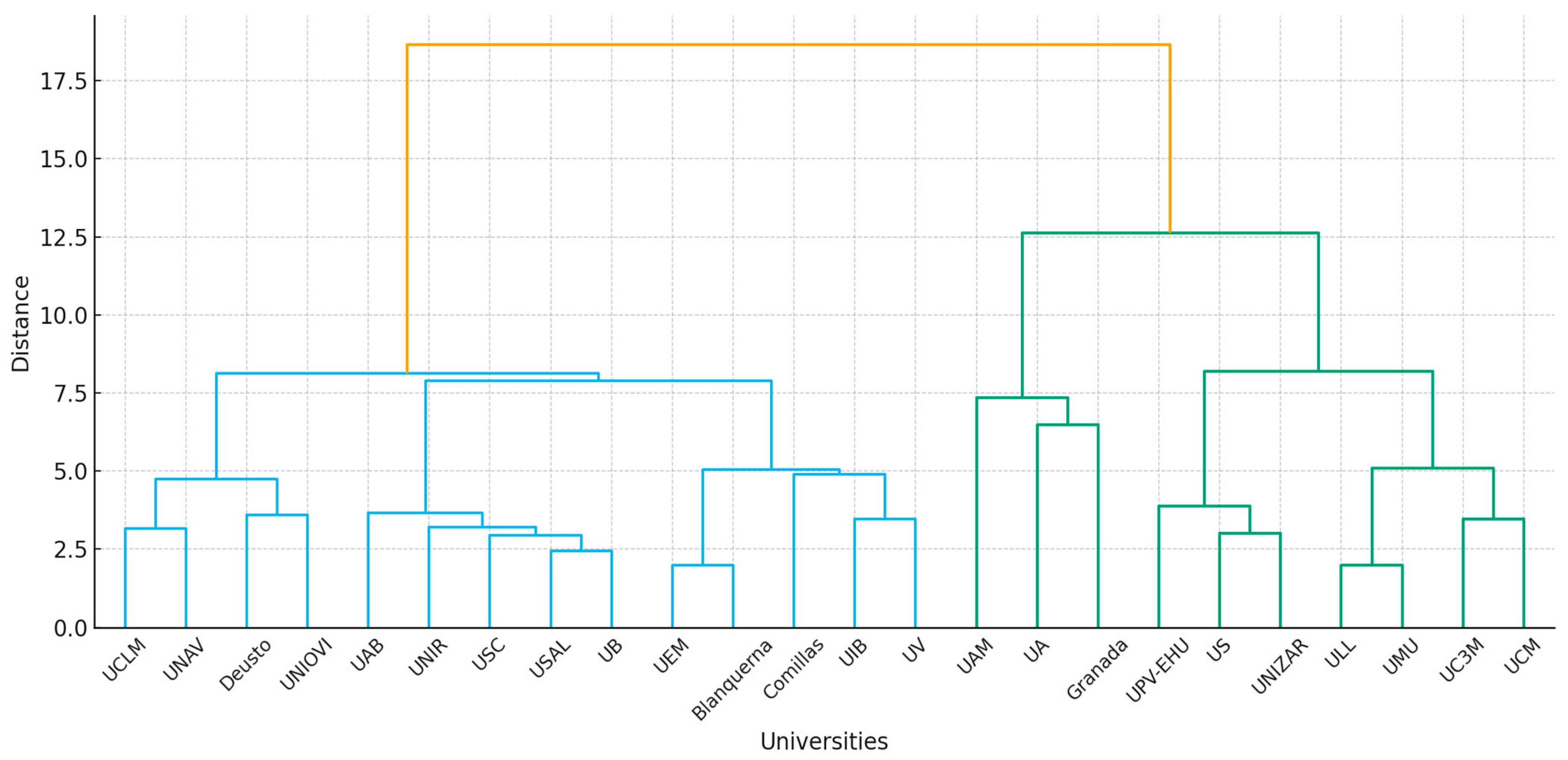
The hierarchical cluster analysis conducted using the node matrix made it possible to identify four distinct institutional profiles in faculty training. These profiles do not correspond solely to institutional type (public/private), but rather to the way each university articulates—more or less coherently—generative AI, inclusion, accessibility, and the ethical and strategic dimensions of teacher training. In
Figure 1, the analysis conducted is presented.
- (a)
Technocentric Universities with Low Inclusive Integration
This first cluster groups universities with high values in the nodes related to generative AI and its subdimensions (material creation, automated assessment, design of assistants/GPTs, and prompt engineering), as well as in general digital competence. However, they show a much weaker presence of content related to educational inclusion, disability, or accessibility/UDL. In these contexts, faculty training is primarily oriented toward the instrumental use of technology, with strong investment in tools and technical upskilling, but without systematic alignment with frameworks of equity, social justice, or human rights. Inclusion is mentioned tangentially or taken for granted, but not operationalized in terms of universal design, barrier removal, or critical analysis of algorithmic bias. These institutions project an image of digital leadership, yet AI is deployed mainly as an efficiency resource (automation, faster production) rather than as a driver of inclusive transformation.
- (b)
Analogically Inclusive Universities
The second profile consists of universities with a strong density of codes in inclusion, accessibility, and UDL, as well as in active methodologies and collaborative learning, but with a very limited or residual presence of generative AI and its advanced applications. These institutions have a well-established culture of educational justice and have developed solid training proposals around diversity, barrier removal, reflective teaching, and cooperative work. However, the digital dimension is mostly associated with general ICT and, in some cases, descriptive forms of educational AI, without decisively incorporating emerging scenarios related to generative AI, automation, or algorithmic assessment. This combination produces universities that are “highly inclusive but minimally digitalized,” where the risk is that innovation in AI becomes externalized (or delegated to individual projects) instead of being integrated into a coherent institutional strategy for faculty development.
- (c)
Advanced Hybrid Universities
The third cluster brings together universities that display simultaneously high and balanced values in inclusion, accessibility/UDL, digital competence, and generative AI, including several of the most sophisticated subdimensions (design of educational assistants or GPTs, automated feedback, creation of accessible materials with AI, etc.). In these institutions, faculty training integrates technology and pedagogy within an explicitly inclusive framework, incorporating content on digital ethics, privacy, and algorithmic bias. The focus is not merely on “using AI,” but on doing so within robust normative and conceptual frameworks: disability rights, Universal Design for Learning, SDG 4, UNESCO recommendations, and digital competence frameworks such as DigCompEdu. This model can be considered the most “mature” in terms of alignment with international agendas for digital transformation and inclusion, and it is often supported by stable structures for teaching innovation, microcredentials, and institutional professional development programs.
- (d)
Low-Intensity Training Universities
Finally, the fourth profile includes universities with low and dispersed values across nearly all nodes analyzed. In these cases, faculty training in inclusion, accessibility, AI (educational or generative), digital assessment, or technological ethics is scarce, occasional, and weakly structured. No clear lines are identified in either the inclusive or digital dimensions, and training tends to be fragmented into one-off actions without continuity or strategic articulation. Rather than representing a defined model, this cluster reflects an absence of a coherent faculty development policy in the emerging areas that shape today’s university agenda, leading to a significant gap compared to institutions in the other groups.
Overall, these typologies show that faculty training in the Spanish university system is highly heterogeneous and at uneven stages of maturity. Generative AI is being adopted rapidly in certain contexts, often disconnected from accessibility and inclusion (technocentric profile), while others sustain a robust inclusive tradition that does not yet engage with the challenges of advanced digitalization (analogically inclusive profile). Only a small subset of universities achieves an advanced hybrid model, where AI, inclusion, and accessibility are understood as interdependent dimensions of the same educational project and supported by stable institutional structures. At the opposite extreme, low-intensity universities demonstrate that there are still institutions where faculty upskilling in these areas is not a strategic priority.
From a higher education policy perspective, these findings highlight the need to move toward common reference frameworks that guide faculty training around a shared core of digital and inclusive competencies, preventing access to advanced training in AI and accessibility from depending on the “institutional postcode.” The cluster analysis therefore not only describes differences but also identifies gaps and opportunities for designing more coherent, equitable, and internationally aligned faculty development plans in relation to human rights, digital transformation, and higher education quality.
5. Discussion
The results reveal a heterogeneous and fragmented training landscape within Spanish universities, where inclusion, accessibility, digital competence, and artificial intelligence (AI) exhibit markedly uneven levels of development. This diversity aligns with the literature, which highlights that university teacher training continues to be uneven and dependent on institutional policies rather than on shared national frameworks (
Ainscow, 2020;
Slee, 2018). As shown by matrices and thematic analysis, inclusion appears predominantly as a normative discourse with limited practical depth. This finding is consistent with studies that point to a persistent gap between inclusive rhetoric and its effective implementation in higher education (
Filippou et al., 2025). These results reinforce the idea that educational equity cannot depend solely on the individual commitment of teaching staff but rather requires robust institutional frameworks that ensure it (
Bolívar, 2012).
Beyond describing differences in training provision, the identified institutional profiles reflect distinct conceptualizations of university teaching in digitally mediated contexts. Technocentric models implicitly frame teaching as a technical and efficiency-driven task, while analogically inclusive models emphasize equity and pedagogical values but risk marginalizing digital transformation. Advanced hybrid models, by contrast, represent an emerging conceptual synthesis in which inclusion, accessibility, and artificial intelligence are understood as mutually constitutive dimensions of professional teaching competence. In this sense, the proposed typology offers an analytical framework for interpreting how institutional training models shape the ethical and pedagogical horizons of faculty development.
Regarding accessibility, courses tend to focus on technical aspects (captioning, format adjustments, WCAG compliance) without integrating the pedagogical or cognitive dimensions of universal design—an issue also emphasized in the literature, which notes that UDL adoption in higher education is often superficial or purely formal (
Nelson, 2021). The results also show that algorithmic accessibility and accessibility in AI-generated environments remain absent, despite their growing relevance for contemporary educational justice (
UNESCO, 2023). This disconnect confirms that universities have not yet incorporated robust frameworks for digital accessibility, consistent with findings in previous work on institutional weaknesses in this area (
ENQA et al., 2015;
ISO, 2018).
With respect to educational and generative AI, the study confirms its rapid expansion and predominantly instrumental orientation. Courses emphasize efficiency and automation—generating materials, streamlining feedback, creating conversational assistants—without incorporating ethical or inclusive reflections. Recent literature similarly warns that the accelerated adoption of AI is often guided by an uncritical enthusiasm that prioritizes functionality over professional responsibility (
Sozon et al., 2025;
UNESCO, 2023). Likewise, the absence of content on bias, privacy, or algorithmic decision-making confirms the ethical and regulatory gap widely documented by international bodies (
COPE, 2021;
UNESCO, 2021). From a critical perspective, it is important to clarify the epistemological scope of these findings. Given the documentary nature of the data, the study does not provide direct evidence of effects on teaching practices or student outcomes. Instead, the analysis identifies structural conditions and institutional configurations under which ethical risks and the potential reinforcement of inequalities may emerge. The limited presence of training related to accessibility, algorithmic bias, and digital ethics is therefore interpreted as an analytically grounded risk factor, rather than as an empirically demonstrated consequence. This interpretation is consistent with critical approaches in the sociology of education and studies of digitalization, which emphasize how institutional discourses and training structures shape possibilities for action without determining outcomes in a linear or deterministic way.
Beyond these descriptive findings, it is necessary to situate the conceptual contribution of the study within international debates on faculty development and digital inclusion. This study offers an original theoretical contribution by proposing an institutional typology that provides an exploratory typological framework to identify structural patterns, configurations, and gaps in how universities integrate—or keep disconnected—the dimensions of inclusion, accessibility, digital competence, and artificial intelligence in university teacher training. Based on hierarchical cluster analysis, this typology enables a structural understanding of the coexistence of technocentric, analogically inclusive, advanced hybrid, and low-density training models, thus expanding existing analytical frameworks for faculty development in university contexts (
Carbonell, 2019;
Kamsker et al., 2020). Unlike previous research focused on teachers’ perceptions or partial case studies (
Filippou et al., 2025;
Moriña & Cotán Fernández, 2017), our conceptual model offers an integrated perspective that directly links institutional orientations with the quality and coherence of faculty development in the digital era. In doing so, the study contributes to the international literature on inclusion and digital transformation in higher education, providing an analytical framework transferable to other university systems and aligned with global standards such as the Standards and Guidelines for Quality Assurance (
ENQA et al., 2015), Universal Design for Learning (
CAST, 2018,
2024), and the European DigCompEdu framework (
Redecker, 2017).
A relevant contribution of the study is the identification of four institutional profiles through cluster analysis: technocentric without inclusion, analogically inclusive, advanced hybrid, and low-density training universities. This typology aligns with literature indicating that universities evolve unevenly toward digital and inclusive ecosystems depending on their organizational cultures, leadership, and innovation capacities (
Carbonell, 2019;
Redecker & Punie, 2017). The advanced hybrid universities—with coherent integration of inclusion, UDL, accessibility, and AI—reflect international trends that simultaneously incorporate these dimensions from ethical standpoints (
UNESCO, 2023), whereas technocentric models reveal innovation detached from educational justice, a phenomenon already noted in critical studies on educational digitalization (
Slee, 2018).
At the same time, it is important to avoid a homogeneous or deficit-based interpretation of the findings. The analysis reveals not only gaps and tensions, but also substantial institutional heterogeneity and emerging efforts to integrate inclusion, accessibility, and artificial intelligence in more coherent and reflective ways. In many cases, the identified limitations are better understood as the result of structural constraints, rapid technological change, and uneven institutional capacity, rather than as deliberate neglect or ethical weakness. From an analytical standpoint, the purpose of this discussion is to illuminate patterns, contrasts, and tensions within faculty development systems, rather than to issue normative or political judgments about universities.
Finally, the fact that AI appears only in continuing professional development and is practically absent from initial teacher training confirms a structural gap and a lack of essential content in foundational training processes. In this regard, the literature emphasizes that critical AI literacy must be part of professional socialization from the outset (
Garzón et al., 2025), as late incorporation generates inequalities among faculty and limits the transformative pedagogical use of these technologies.
6. Conclusions
This study shows that the Spanish university system is at an uneven stage of maturity in relation to the integration of inclusion, accessibility, and AI into the training of academic staff. Although consolidated progress has been made in raising awareness about diversity and in basic digital literacy, these advances do not translate into a coherent articulation between technological innovation and educational equity. Accessibility is addressed in a fragmented and technicist manner, while UDL is incorporated with limited depth and without becoming a structuring framework for curricular design. From an epistemological standpoint, the study is explicitly exploratory and typological in scope. It does not seek to establish causal explanations, but to map the current institutional landscape of faculty development and to identify structural patterns and gaps that may inform future confirmatory and impact-oriented research.
Generative AI is emerging as a rapidly expanding area, yet its incorporation is reactive, overtly instrumental, and disconnected from digital ethics and educational justice. This ethical–discursive gap constitutes one of the main risks identified, as the absence of training in bias, privacy, digital rights, or algorithmic accessibility may reinforce pre-existing inequalities.
Likewise, the major differences between universities highlight the absence of a common national or regional model; the quality and coherence of training depend on local factors such as institutional leadership, inclusive traditions, or investment in innovation. This inequality creates what could be described as a “training postcode,” where teachers’ professional development depends excessively on the institution where they work and on their voluntary participation in non-mandatory training.
The most promising institutional profile identified is that of advanced hybrid universities, capable of integrating inclusion, accessibility, digital competence, and AI under robust ethical frameworks. This model represents a strategic pathway toward faculty development aligned with international commitments to social justice, human rights, and digital transformation.
This study has several limitations. As it relies exclusively on publicly available institutional documents, it does not include direct observation or evidence of the real impact of training on teaching practice, limiting the assessment of its effectiveness. The variable quality of course descriptions provided by universities may have led to the under-representation of certain initiatives. Furthermore, although cluster analysis allowed consistent typologies to be identified, this approach does not establish causal relationships between institutional policies and training models. The absence of teachers’ perspectives also limits understanding of how these initiatives are experienced and applied in everyday teaching.
Building on these limitations, future research should evaluate the longitudinal impact of training on teaching practice and student learning; examine the actual accessibility of digital materials and AI-generated resources; and explore teachers’ ethical, digital, and inclusive preparedness in the context of expanding generative AI. It would also be valuable to compare international training models and conduct in-depth qualitative studies to better understand how teaching teams experience the tensions between technological innovation and equity.