An Integrated Individual, Social, and Technology Model for the Sustainable Adoption of Generative AI in Blended Learning


Abstract
1. Introduction
- RQ1: What are the different perspectives in explaining generative AI adoption?
- RQ2: What are the key determinants influencing generative AI adoption?
- RQ3: What are the relationships among these key determinants?
- RQ4: Are there any differences to the relationships among these key determinants and generative AI adoption at different usage time points?
1.1. Literature Review
1.1.1. Technology Adoption
1.1.2. Risk Propensity
1.1.3. Social Influence
1.1.4. Performance Expectance
1.1.5. Indirect and Mediating Effects
1.1.6. Short Run and the Long Run
1.2. Model Framework and Hypotheses Development
1.2.1. Risk Propensity
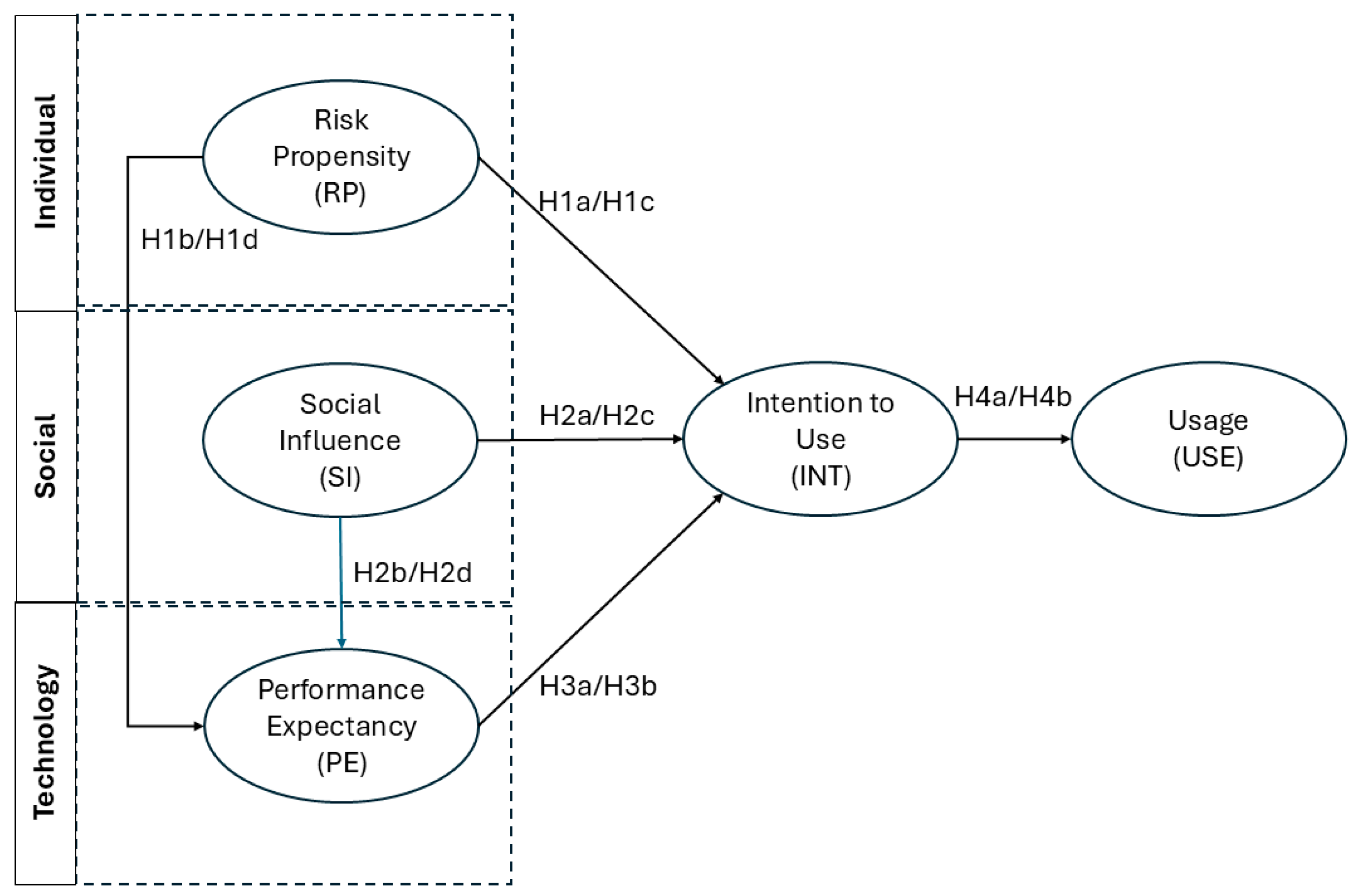
- H1a: Greater risk aversion is associated with lower behavioral intention to use generative AI.
- H1b: Greater risk aversion is associated with lower performance expectancy regarding generative AI.
- H1c: At a longer usage time point, as experience accumulates, greater risk aversion is associated with higher behavioral intention to use generative AI.
- H1d: At a longer usage time point, as experience accumulates, greater risk aversion is associated with higher performance expectancy regarding generative AI.
1.2.2. Social Influence
- H2a: Greater social influence is associated with higher behavioral intention to use generative AI.
- H2b: Greater social influence is associated with higher performance expectancy regarding generative AI.
- H2c: At a longer usage time point, as experience accumulates, greater social influence is associated with higher behavioral intention to use generative AI.
- H2d: At a longer usage time point, as experience accumulates, greater social influence is associated with higher performance expectancy regarding generative AI.
1.2.3. Performance Expectancy
- H3a: Higher performance expectancy regarding generative AI is associated with higher behavioral intention to use generative AI.
- H3b: At a longer usage time point, the positive association between performance expectancy and behavioral intention to use generative AI will be stronger than in the short run.
1.2.4. Intention to Use
- H4a: Higher behavioral intention to use generative AI is associated with higher actual usage of generative AI among individual students.
- H4b: At a longer usage time point, higher behavioral intention to use generative AI remains associated with higher actual usage of generative AI among individual students.
2. Materials and Methods
2.1. Background
2.2. Subjects
2.3. Measurements
2.4. Data Collection
2.5. Data Analysis
3. Results
3.1. Descriptive Analysis of Respondents
3.2. Instrument Validation
3.3. Model Testing Results
3.3.1. Overall Model
3.3.2. Risk Propensity
3.3.3. Social Influence
3.3.4. Performance Expectancy
3.3.5. Intention to Use
3.3.6. Independent Analysis on Risk Propensity
4. Discussion
4.1. Key Findings
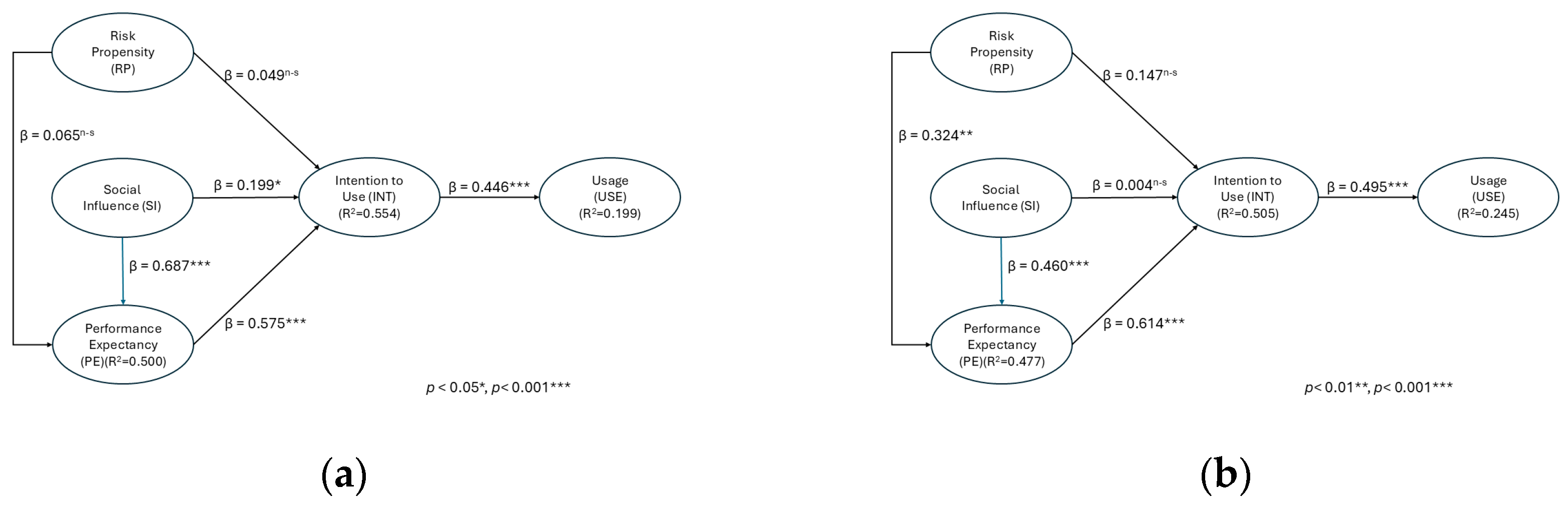
- Model performance: The model showed moderate explanatory power for intention to use (Stage 1: R2 = 0.554, adjusted R2 = 0.552; Stage 2: R2 = 0.505, adjusted R2 = 0.492), consistent with PLS-SEM benchmarks (Hair et al., 2022; Cohen, 1988), and weak-to-lower-moderate but improving explanatory power for usage (R2 = 0.199 → 0.245; +0.046, ~23% gain), aligning with field norms that regard ~0.40–0.60 for intention and ~0.20–0.30 for behavior as acceptable.
- Individual factor—risk propensity: Overall, risk propensity shows no influence on intention or usage at Stage 1—either directly or via performance expectancy—indicating no short-run mediation; by contrast, at Stage 2, with the direct effect on intention remaining non-significant and the indirect pathways becoming significant, risk propensity’s impact on both intention and usage is fully mediated by performance expectancy.
- Social factor—social influence: The influence of social factors shifts from a combination of direct and indirect pathways at Stage 1 to a purely indirect pathway via performance expectancy at Stage 2.
- Technology factor—performance expectancy: Performance expectancy was a consistent and central determinant, exerting both direct and indirect effects on intention to use at both the initial stage and a longer usage time point.
- Behavioral linkage: Intention to use significantly predicted actual usage
4.2. Individual Factor—Risk Propensity
4.3. Social Factor—Social Influence
4.4. Technology Factor—Performance Expectancy
4.5. Theoretical Contribution
4.6. Practical Contribution
4.7. Limitations and Future Research
5. Conclusions
Funding
Institutional Review Board Statement
Informed Consent Statement
Data Availability Statement
Acknowledgments
Conflicts of Interest
Abbreviations
| AI | Artificial Intelligence |
| PLS-SEM | Partial Least Squares Structural Equation Modeling |
Appendix A. Measurement Items

| Constructs (Sources)/Items | |
|---|---|
| Risk Propensity (Xu et al., 2005) | |
| RP1 | I avoid risky things. |
| RP2 | I would rather be safe than sorry. |
| Social Influence (Venkatesh et al., 2003) | |
| SI1 | People who influence my behavior think that I should use ChatGPT. |
| SI2 | People who are important to me think that I should use ChatGPT. |
| SI3 | The senior management of this business has been helpful in the use of ChatGPT. |
| SI4 | In general, the organization has supported the use of ChatGPT. |
| Performance Expectancy (Venkatesh et al., 2003) | |
| PE1 | I would find ChatGPT useful in my study. |
| PE2 | Using ChatGPT enables me to accomplish tasks more quickly. |
| PE3 | Using ChatGPT increases my productivity. |
| PE4 | If I use ChatGPT, I will increase my chances of getting better academic performance. |
| Intention to Use (Venkatesh et al., 2003) | |
| INT1 | I intend to use ChatGPT in the next 4 weeks. |
| INT2 | I predict I would use ChatGPT in the next 4 weeks. |
| INT3 | I plan to use ChatGPT in the next 4 weeks. |
References
- Acquah, B. Y. S., Arthur, F., Salifu, I., Quayson, E., & Nortey, S. A. (2024). Preservice teachers’ behavioural intention to use artificial intelligence in lesson planning: A dual-staged PLS-SEM-ANN approach. Computers and Education: Artificial Intelligence, 7, 100307. [Google Scholar] [CrossRef] [Scilit]
- Alajmi, M. A., & Said Ali, M. (2022). Video-conference platforms: Understanding the antecedents and consequences of participating in or attending virtual conferences in developing countries. International Journal of Human–Computer Interaction, 38(13), 1195–1211. [Google Scholar] [CrossRef] [Scilit]
- Annamalai, N., Bervell, B., Mireku, D. O., & Andoh, R. P. K. (2025). Artificial intelligence in higher education: Modelling students’ motivation for continuous use of ChatGPT based on a modified self-determination theory. Computers and Education: Artificial Intelligence, 8, 100346. [Google Scholar] [CrossRef] [Scilit]
- Ayanwale, M. A., Ntshangase, S. D., Adelana, O. P., Afolabi, K. W., Adam, U. A., & Olatunbosun, S. O. (2024). Navigating the future: Exploring in-service teachers’ preparedness for artificial intelligence integration into South African schools. Computers and Education: Artificial Intelligence, 7, 100330. [Google Scholar] [CrossRef] [Scilit]
- Bagozzi, R. P., & Yi, Y. (1988). On the evaluation of structural equation models. Journal of the Academy of Marketing Science, 16(1), 74–94. [Google Scholar] [CrossRef]
- Batac, C. A., Baroja, M. J., Caballero, D. J. D., Coloma, L. G., Tan, L. M., & Ebardo, R. (2024, April 26–29). Do human beliefs and traits influence the adoption of ChatGPT among programming students? 2024 10th International Conference on Computing and Artificial Intelligence (pp. 339–344), Bali, Indonesia. [Google Scholar]
- Berényi, L., & Deutsch, N. (2023). Technology adoption among higher education students. Vezetéstudomány/Budapest Management Review, 54(11), 28–39. [Google Scholar] [CrossRef] [Scilit]
- Bracci, E., Tallaki, M., & Ebua Otia, J. (2025). Propensity factors of artificial intelligence technology adoption by public sector auditors. Journal of Public Budgeting, Accounting & Financial Management, ahead-of-print. [Google Scholar] [CrossRef] [Scilit]
- Brick, K., & Visser, M. (2015). Risk preferences, technology adoption and insurance uptake: A framed experiment. Journal of Economic Behavior & Organization, 118, 383–396. [Google Scholar] [CrossRef] [Scilit]
- Burriss, S. K., Hutchins, N., Conley, Z., Deweese, M. M., Doe, Y. J., Eeds, A., Villanueva, A., Ziegler, H., & Oliver, K. (2024). Redesigning an AI bill of rights with/for young people: Principles for exploring AI ethics with middle and high school students. Computers and Education: Artificial Intelligence, 7, 100317. [Google Scholar] [CrossRef] [Scilit]
- Chi, O. H., Gursoy, D., & Chi, C. G. (2022). Tourists’ attitudes toward the use of artificially intelligent (AI) devices in tourism service delivery: Moderating role of service value seeking. Journal of Travel Research, 61(1), 170–185. [Google Scholar] [CrossRef] [Scilit]
- Chin, W. W. (1998). The partial least squares approach to structural equation modeling. In G. A. Marcoulides (Ed.), Modern methods for business research (pp. 295–336). Lawrence Erlbaum. [Google Scholar]
- Cohen, J. (1988). Statistical power analysis for the behavioral sciences (2nd ed.). Lawrence Erlbaum Associates. [Google Scholar] [CrossRef] [Scilit]
- Doe, J. K., Van de Wetering, R., Honyenuga, B., & Versendaal, J. (2022). Extended contextual validation of stakeholder approach to firm technology adoption: Moderating and mediating relationships in an innovation eco-system. Society and Business Review, 17(4), 506–540. [Google Scholar] [CrossRef] [Scilit]
- Donthu, N., & Gilliland, D. (1996). Observations: The infomercial shopper. Journal of Advertising Research, 36(2), 69–76. [Google Scholar] [CrossRef] [Scilit]
- Farhi, F., Jeljeli, R., Aburezeq, I., Dweikat, F. F., Al-shami, S. A., & Slamene, R. (2023). Analyzing the students’ views, concerns, and perceived ethics about chat GPT usage. Computers and Education: Artificial Intelligence, 5, 100180. [Google Scholar] [CrossRef] [Scilit]
- Fornell, C., & Larcker, D. F. (1981). Evaluating structural equation models with unobservable variables and measurement error. Journal of Marketing Research, 18(1), 39–50. [Google Scholar] [CrossRef] [Scilit]
- Freeman, J. (2025). Student generative AI survey 2025. HEPI Policy Note 61, Higher Education Policy Institute (HEPI). Available online: https://www.hepi.ac.uk/reports/student-generative-ai-survey-2025/ (accessed on 23 November 2025).
- Geng, L., Hui, H., Liang, X., Yan, S., & Xue, Y. (2023). Factors affecting intention toward ICT adoption in rural entrepreneurship: Understanding the differences between business types of organizations and previous experience of entrepreneurs. Sage Open, 13(3), 21582440231197112. [Google Scholar] [CrossRef] [Scilit]
- Gong, Y., Xu, C., Luo, S., & Lin, J. (2025). Modeling teacher education students’ adoption of large language models through an extended technology acceptance framework. Scientific Reports, 15(1), 32208. [Google Scholar] [CrossRef] [Scilit]
- Hair, J. F., Black, W. C., Babin, B. J., & Anderson, R. E. (2010). Multivariate data analysis (7th ed.). Pearson Prentice Hall. Available online: https://openlibrary.org/works/OL16979906W/Multivariate_data_analysis?edition=key:/books/OL22691711M (accessed on 1 November 2025).
- Hair, J. F., Hult, G. T. M., Ringle, C. M., & Sarstedt, M. (2022). A primer on partial least squares structural equation modeling (PLS-SEM) (3rd ed.). Sage. Available online: https://uk.sagepub.com/en-gb/eur/a-primer-on-partial-least-squares-structural-equation-modeling-pls-sem/book270548#:~:text=Other%20Titles%20in:,popular%20software%20package%20SmartPLS%203 (accessed on 1 November 2025).
- Hemdanou, A. L., Sefian, M. L., Achtoun, Y., & Tahiri, I. (2024). Comparative analysis of feature selection and extraction methods for student performance prediction across different machine learning models. Computers and Education: Artificial Intelligence, 7, 100301. [Google Scholar] [CrossRef] [Scilit]
- Henseler, J., Ringle, C. M., & Sarstedt, M. (2015). A new criterion for assessing discriminant validity in variance-based structural equation modeling. Journal of the Academy of Marketing Science, 43(1), 115–135. [Google Scholar] [CrossRef] [Scilit]
- Huang, D., Hash, N., Cummings, J. J., & Prena, K. (2025). Academic cheating with generative AI: Exploring a moral extension of the theory of planned behavior. Computers and Education: Artificial Intelligence, 8, 100424. [Google Scholar] [CrossRef] [Scilit]
- Johnson, A. (2023, January 18). ChatGPT in schools: Here’s where it’s banned—And how it could potentially help students. Forbes. Available online: https://www.forbes.com/sites/ariannajohnson/2023/01/18/chatgpt-in-schools-heres-where-its-banned-and-how-it-could-potentially-help-students/ (accessed on 23 November 2025).
- Kaiser, R., De Benedetto, S., Planing, P., & Müller, P. (2024). What will the delivery robots bring us tomorrow? International Journal of Consumer Studies, 48(5), e13093. [Google Scholar] [CrossRef] [Scilit]
- Kim, E. D., Kuan, K. K., Vaghasiya, M. R., Penm, J., Gunja, N., El Amrani, R., & Poon, S. K. (2023). Passive resistance to health information technology implementation: The case of electronic medication management system. Behaviour & Information Technology, 42(13), 2308–2329. [Google Scholar] [CrossRef] [Scilit]
- Kim, S., Connerton, T. P., & Park, C. (2022). Transforming the automotive retail: Drivers for customers’ omnichannel BOPS (Buy Online & Pick up in Store) behavior. Journal of Business Research, 139, 411–425. [Google Scholar] [CrossRef] [Scilit]
- Kolil, V. K., & Achuthan, K. (2023). Longitudinal study of teacher acceptance of mobile virtual labs. Education and Information Technologies, 28(7), 7763–7796. [Google Scholar] [CrossRef] [Scilit]
- Kwak, Y., Seo, Y. H., & Ahn, J. W. (2022). Nursing students’ intent to use AI-based healthcare technology: Path analysis using the unified theory of acceptance and use of technology. Nurse Education Today, 119, 105541. [Google Scholar] [CrossRef] [Scilit] [PubMed]
- Li, M. (2025). Integrating artificial intelligence in primary mathematics education: Investigating internal and external influences on teacher adoption. International Journal of Science and Mathematics Education, 23(5), 1283–1308. [Google Scholar] [CrossRef] [Scilit]
- Liébana-Cabanillas, F., Kalinic, Z., Muñoz-Leiva, F., & Higueras-Castillo, E. (2024). Biometric m-payment systems: A multi-analytical approach to determining use intention. Information & Management, 61(2), 103907. [Google Scholar] [CrossRef] [Scilit]
- Liu, C. T., Guo, Y. M., & Huang, S. R. (2023). The factors affecting customers’ satisfaction and continuance intention in platform-to-consumer environments: A case of mobile food ordering platforms. e-Service Journal, 15(1), 1–28. [Google Scholar] [CrossRef] [Scilit]
- Marikyan, D., Papagiannidis, S., Rana, O. F., Ranjan, R., & Morgan, G. (2022). “Alexa, let’s talk about my productivity”: The impact of digital assistants on work productivity. Journal of Business Research, 142, 572–584. [Google Scholar] [CrossRef] [Scilit]
- Marks, L. (2025, September). What 2025 generative AI trends reveal about student behavior? Turnitin Blog. Available online: https://www.turnitin.com/blog/what-2025-generative-ai-trends-reveal-about-student-behavior (accessed on 23 November 2025).
- Metallo, C., Agrifoglio, R., Lepore, L., & Landriani, L. (2022). Explaing users’ technology acceptance through national cultural values in the hospital context. BMC Health Services Research, 22(1), 84. [Google Scholar] [CrossRef] [Scilit]
- Mohammad-Salehi, B., Vaez-Dalili, M., & Heidari Tabrizi, H. (2021). Investigating factors that influence EFL teachers’ adoption of web 2.0 technologies: Evidence from applying the UTAUT and TPACK. Tesl-Ej, 25(1), n1. Available online: https://tesl-ej.org/wordpress/issues/volume25/ej97a/ej97a21/ (accessed on 1 November 2025).
- Mothibi, N. H., & Malebana, M. J. (2025). Entrepreneurship education, role models, and risk-taking propensity as predictors of entrepreneurial intention and behaviour: Evidence from TVET and university students in Gauteng, South Africa. Administrative Sciences, 15(10), 374. [Google Scholar] [CrossRef] [Scilit]
- Müller, W., Leyer, M., & Gaugel, M. (2025). Trust towards using autonomous taxis: Evidence from Germany. Transportation Research Part F: Traffic Psychology and Behaviour, 113, 357–373. [Google Scholar] [CrossRef] [Scilit]
- Nazaretsky, T., Mejia-Domenzain, P., Swamy, V., Frej, J., & Käser, T. (2025). The critical role of trust in adopting AI-powered educational technology for learning: An instrument for measuring student perceptions. Computers and Education: Artificial Intelligence, 8, 100368. [Google Scholar] [CrossRef] [Scilit]
- Nordhoff, S., Madigan, R., Van Arem, B., Merat, N., & Happee, R. (2021). Interrelationships among predictors of automated vehicle acceptance: A structural equation modelling approach. Theoretical Issues in Ergonomics Science, 22(4), 383–408. [Google Scholar] [CrossRef] [Scilit]
- Nunnally, J. C., & Bernstein, I. H. (1994). Psychometric theory (3rd ed.). McGraw-Hill. Available online: https://books.google.com.hk/books/about/Psychometric_Theory.html?id=r0fuAAAAMAAJ&redir_esc=y (accessed on 1 November 2025).
- Qin, R., & Yu, Z. (2024). Extending the UTAUT model of tencent meeting for online courses by including community of inquiry and collaborative learning constructs. International Journal of Human–Computer Interaction, 40(18), 5279–5297. [Google Scholar] [CrossRef] [Scilit]
- Queiroz, M. M., Fosso Wamba, S., De Bourmont, M., & Telles, R. (2021). Blockchain adoption in operations and supply chain management: Empirical evidence from an emerging economy. International Journal of Production Research, 59(20), 6087–6103. [Google Scholar] [CrossRef] [Scilit]
- Ribeiro, M. A., Gursoy, D., & Chi, O. H. (2022). Customer acceptance of autonomous vehicles in travel and tourism. Journal of Travel Research, 61(3), 620–636. [Google Scholar] [CrossRef] [Scilit]
- Roy, P. (2024). What drives the adoption of data analytics at Australian university libraries in the perspective of UTAUT2? The Journal of Academic Librarianship, 50(5), 102927. [Google Scholar] [CrossRef] [Scilit]
- Sestino, A., Amatulli, C., Peluso, A. M., & Guido, G. (2024). Integrating internet-of-things technologies in luxury industries: The roles of consumers’ openness to technological innovations and status consumption. Technology Analysis & Strategic Management, 36(11), 3577–3591. [Google Scholar] [CrossRef] [Scilit]
- Sitkin, S. B., & Weingart, L. R. (1995). Determinants of risky decision-making behavior: A test of the mediating role of risk perceptions and propensity. Academy of Management Journal, 38(6), 1573–1592. [Google Scholar] [CrossRef] [Scilit]
- Sorwar, G., Aggar, C., Penman, O., Seton, C., & Ward, A. (2023). Factors that predict the acceptance and adoption of smart home technology by seniors in Australia: A structural equation model with longitudinal data. Informatics for Health and Social Care, 48(1), 80–94. [Google Scholar] [CrossRef] [Scilit]
- Terho, H., Giovannetti, M., & Cardinali, S. (2022). Measuring B2B social selling: Key activities, antecedents and performance outcomes. Industrial Marketing Management, 101, 208–222. [Google Scholar] [CrossRef] [Scilit]
- Uymaz, P., Uymaz, A. O., & Akgül, Y. (2024). Assessing the behavioral intention of individuals to use an AI doctor at the primary, secondary, and tertiary care levels. International Journal of Human–Computer Interaction, 40(18), 5229–5246. [Google Scholar] [CrossRef] [Scilit]
- Venkatesh, V., Morris, M. G., Davis, G. B., & Davis, F. D. (2003). User acceptance of information technology: Toward a unified view. MIS Quarterly, 27(3), 425–478. [Google Scholar] [CrossRef] [Scilit]
- Xu, H., Wang, H., & Teo, H. H. (2005, January 3–6). Predicting the usage of P2P sharing software: The role of trust and perceived risk. 38th IEEE Annual Hawaii International Conference on System Sciences (p. 201a), Big Island, HI, USA. [Google Scholar]
- Yang, C. C., Liu, C., & Wang, Y. S. (2023). The acceptance and use of smartphones among older adults: Differences in UTAUT determinants before and after training. Library Hi Tech, 41(5), 1357–1375. [Google Scholar] [CrossRef] [Scilit]
- Yuswandi, A., & Hamdani, H. (2025). Influence of materialism, financial literacy, and risk perception on propensity to indebtedness among peer-to-peer lending users: A case study of generation Z in Tangerang City. Eduvest-Journal of Universal Studies, 5(9), 11848–11861. [Google Scholar] [CrossRef] [Scilit]
- Zhang, H., Wang, Z., Jiang, R., & Wu, H. (2025). Exploring the influence of technology-enhanced active learning environments on pre-service teachers’ TPACK and technology beliefs. Sage Open, 15(3), 21582440251359823. [Google Scholar] [CrossRef] [Scilit]
- Zhao, Y., Li, Y., Xiao, Y., Chang, H., & Liu, B. (2024). Factors influencing the acceptance of ChatGPT in high education: An integrated model with PLS-SEM and fsQCA approach. Sage Open, 14(4), 21582440241289835. [Google Scholar] [CrossRef] [Scilit]
- Zhong, R., Ma, M., Zhou, Y., Lin, Q., Li, L., & Zhang, N. (2024). User acceptance of smart home voice assistant: A comparison among younger, middle-aged, and older adults. Universal Access in the Information Society, 23(1), 275–292. [Google Scholar] [CrossRef] [Scilit] [PubMed]


| Stage 1 (October 2024) n = 145 | Stage 2 (July 2025) n = 111 | |
|---|---|---|
| Gender | Male: 44 (30.3%); | Male: 23 (20.9%); |
| Female: 101 (60.7%) | Female = 87 (79.1%) (1 not indicated) | |
| Year of Study | Year 1: 69 | Year 1: 12 |
| Year 2: 28 | Year 2: 48 | |
| Year 3: 24 | Year 3: 38 | |
| Year 4: 19 | Year 4: 13 | |
| Year 5: 5 | Year 5: 0 |
| Stage 1 (October 2024) | Stage 2 (July 2025) | |||||||
|---|---|---|---|---|---|---|---|---|
| M(SD) | α | CR | AVE | M(SD) | α | CR | AVE | |
| RP | 5.08 (1.217) | 0.818 | 0.915 | 0.843 | 4.52 (1.298) | 0.780 | 0.900 | 0.819 |
| SI | 4.77 (1.183) | 0.864 | 0.907 | 0.710 | 4.02 (1.234) | 0.891 | 0.924 | 0.753 |
| PE | 5.45 (1.194) | 0.944 | 0.959 | 0.856 | 4.90 (1.551) | 0.964 | 0.974 | 0.904 |
| INT | 5.33 (1.435) | 0.965 | 0.977 | 0.934 | 4.75 (1.658) | 0.970 | 0.981 | 0.944 |
| Usage 1 | 3.80 (1.869) | 3.47 (1.925) | ||||||
| Stage 1 (October 2024) | Stage 2 (July 2025) | |||||||||
|---|---|---|---|---|---|---|---|---|---|---|
| RP | SI | PE | INT | Usage | RP | SI | PE | INT | Usage | |
| RP | 0.918 | 0.905 | ||||||||
| SI | 0.278 | 0.842 | 0.541 | 0.868 | ||||||
| PE | 0.256 | 0.705 | 0.925 | 0.572 | 0.635 | 0.951 | ||||
| INT | 0.251 | 0.618 | 0.728 | 0.966 | 0.5 | 0.473 | 0.7 | 0.972 | ||
| Usage | −0.058 | 0.234 | 0.318 | 0.446 | 1 | 0.244 | 0.348 | 0.508 | 0.495 | 1 |
| Stage 1 (October 2024) | Stage 2 (July 2025) | |||||||
|---|---|---|---|---|---|---|---|---|
| INT | PE | RP | SI | INT | PE | RP | SI | |
| RP1 | 0.237 | 0.285 | 0.942 | 0.287 | 0.391 | 0.485 | 0.887 | 0.476 |
| RP2 | 0.223 | 0.17 | 0.894 | 0.215 | 0.506 | 0.547 | 0.923 | 0.501 |
| SI1 | 0.507 | 0.592 | 0.208 | 0.857 | 0.342 | 0.517 | 0.499 | 0.85 |
| SI2 | 0.479 | 0.564 | 0.209 | 0.832 | 0.356 | 0.497 | 0.448 | 0.888 |
| SI3 | 0.565 | 0.652 | 0.243 | 0.867 | 0.493 | 0.593 | 0.47 | 0.908 |
| SI4 | 0.528 | 0.56 | 0.275 | 0.813 | 0.429 | 0.581 | 0.459 | 0.822 |
| PE1 | 0.697 | 0.924 | 0.18 | 0.638 | 0.655 | 0.936 | 0.554 | 0.586 |
| PE2 | 0.663 | 0.934 | 0.258 | 0.639 | 0.678 | 0.972 | 0.541 | 0.622 |
| PE3 | 0.635 | 0.932 | 0.245 | 0.632 | 0.71 | 0.962 | 0.529 | 0.583 |
| PE4 | 0.695 | 0.91 | 0.263 | 0.694 | 0.619 | 0.933 | 0.555 | 0.624 |
| INT1 | 0.973 | 0.712 | 0.273 | 0.614 | 0.967 | 0.684 | 0.478 | 0.474 |
| INT2 | 0.964 | 0.705 | 0.233 | 0.604 | 0.979 | 0.653 | 0.46 | 0.418 |
| INT3 | 0.962 | 0.695 | 0.221 | 0.573 | 0.968 | 0.703 | 0.519 | 0.486 |
| Stage 1 (October 2024) | Stage 2 (July 2025) | |||
|---|---|---|---|---|
| Hypotheses | Coefficients | Support | Coefficients | Support |
| H1a: RP → INT | β = 0.049, n-s | No | β = 0.147, n-s | No |
| H1b: RP → PE | β = 0.065, n-s | No | β = 0.324 ** | Yes |
| H2a: SI → INT | β = 0.199 * | Yes | β = 0.004, n-s | No |
| H2b: SI → PE | β = 0.687 *** | Yes | β = 0.460 *** | Yes |
| H3: PE → INT | β = 0.575 *** | Yes | β = 0.614 *** | Yes |
| H4: INT → Usage | β = 0.446 *** | Yes | β = 0.495 *** | Yes |
| Indirect effect | ||||
| RP → PE → INT | β = 0.037, n-s | β = 0.199 ** | ||
| RP→ PE → INT → Usage | β = 0.038, n-s | β = 0.171 ** | ||
| SI → PE → INT | β = 0.395 *** | β = 0.282 ** | ||
| SI→ PE → INT → Usage | β = 0.176 *** | β = 0.140 ** | ||
Disclaimer/Publisher’s Note: The statements, opinions and data contained in all publications are solely those of the individual author(s) and contributor(s) and not of MDPI and/or the editor(s). MDPI and/or the editor(s) disclaim responsibility for any injury to people or property resulting from any ideas, methods, instructions or products referred to in the content. |
© 2026 by the author. Licensee MDPI, Basel, Switzerland. This article is an open access article distributed under the terms and conditions of the Creative Commons Attribution (CC BY) license.
Share and Cite
Ma, W.W.K. An Integrated Individual, Social, and Technology Model for the Sustainable Adoption of Generative AI in Blended Learning. Educ. Sci. 2026, 16, 128. https://doi.org/10.3390/educsci16010128
Ma WWK. An Integrated Individual, Social, and Technology Model for the Sustainable Adoption of Generative AI in Blended Learning. Education Sciences. 2026; 16(1):128. https://doi.org/10.3390/educsci16010128
Chicago/Turabian StyleMa, Will W. K. 2026. "An Integrated Individual, Social, and Technology Model for the Sustainable Adoption of Generative AI in Blended Learning" Education Sciences 16, no. 1: 128. https://doi.org/10.3390/educsci16010128
APA StyleMa, W. W. K. (2026). An Integrated Individual, Social, and Technology Model for the Sustainable Adoption of Generative AI in Blended Learning. Education Sciences, 16(1), 128. https://doi.org/10.3390/educsci16010128