Systematised Review of Know-How in Teacher Training: Science–Technology–Society Teaching in the Primary School Classroom

 ,
,  , and
, and
Abstract

1. Introduction
1.1. The Nature of Science and Technology to Address the Simplistic and Negative Vision
1.2. The Union of Reason and Emotion to Promote the Didactic Change
1.3. Purpose of the Study
- (1)
- How is the scientific literature on the attitudes of primary school teachers towards teaching the nature of science and technology structured and organised?
- (2)
- What aspects related to attitudes are predominantly addressed in the literature, and what problems are detected?
- (3)
- What research gaps and future directions emerge from the existing body of knowledge in this field?
2. Method
2.1. Sample
Evidence Collection and Evaluation Procedure
2.2. Data Analysis Procedure
3. Results
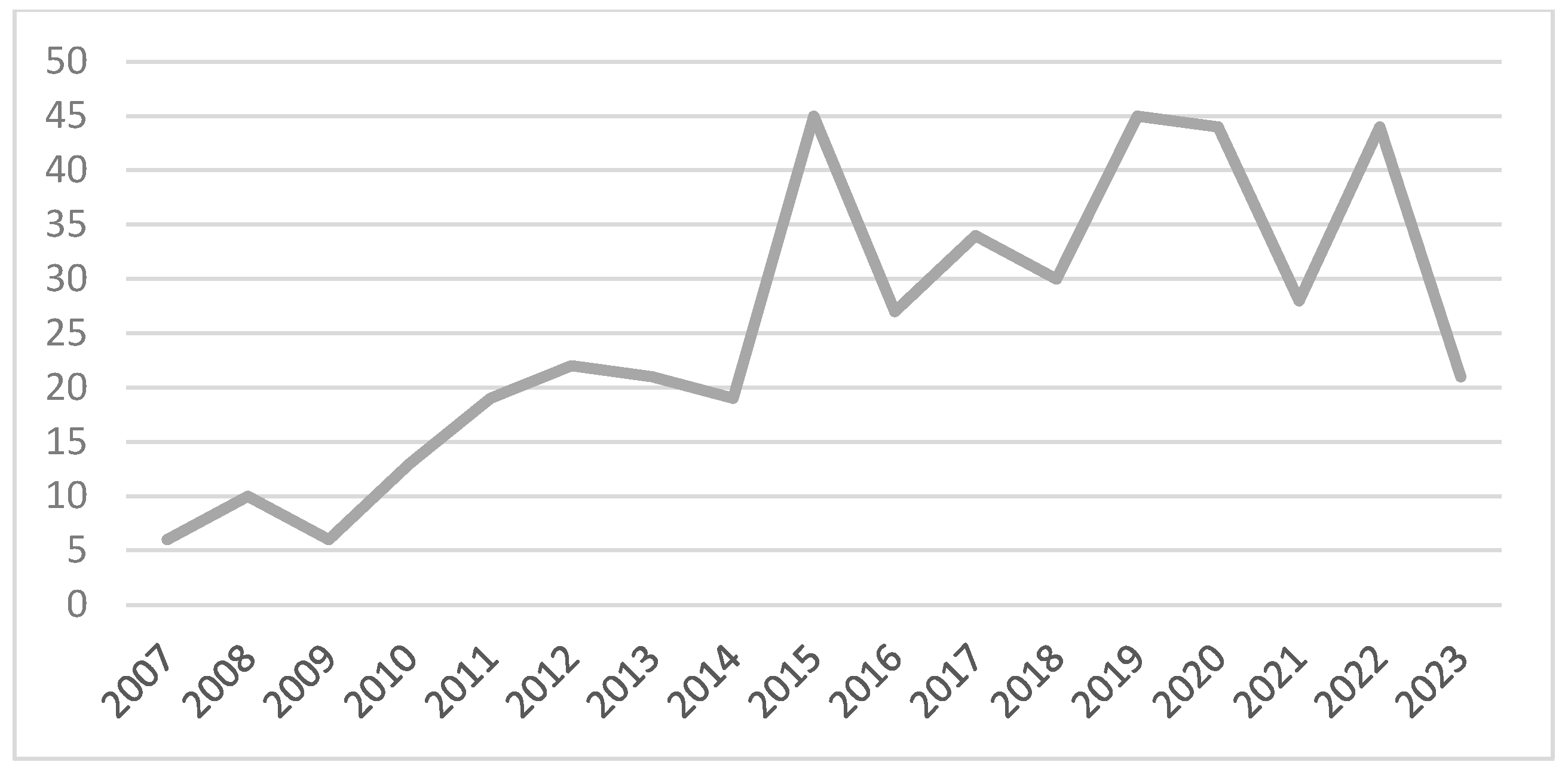
3.1. Results of the Bibliometric Analysis
3.2. Results of the Documentary Analysis
3.2.1. Approaches and Key Concepts
3.2.2. Discussions and Problems
3.2.3. Research Gaps and Opportunities
4. Discussion and Conclusions
Author Contributions
Funding
Data Availability Statement
Acknowledgments
Conflicts of Interest
Abbreviations
| STS | Science–Technology–Society |
| CT | Critical Thinking |
| NOS | Nature of Science |
| GCE | Global Citizenship Education |
| ESD | Education for Sustainable Development |
| WOS | Web of Science |
References
- Abd-El-Khalick, F. (2013). Teaching with and about nature of science, and science teacher knowledge domains. Science & Education, 22, 2087–2107. [Google Scholar] [CrossRef]
- Acevedo, J. A., García-Carmona, A., & Aragón-Méndez, M. M. (2016). Un caso de historia de la Ciencia para aprender naturaleza de la ciencia: Semmelweis y la fiebre puerperal. Revista Eureka sobre Enseñanza y Divulgación de las Ciencias, 13(2), 408–422. [Google Scholar] [CrossRef]
- Acevedo-Díaz, J. A., & García-Carmona, A. (2016). “Algo antiguo, algo nuevo, algo prestado”. Tendencias sobre la naturaleza de la ciencia en la educación científica. Revista Eureka sobre Enseñanza y Divulgación de las Ciencias, 13(1), 3–19. [Google Scholar] [CrossRef]
- Aguirregabiria, F., & Garcia-Olalla, A. (2022). Primary school teacher in training and the natural sciences: Previous experience, self-perception and training needs. Góndola, 17(2), 268–285. [Google Scholar] [CrossRef]
- Ajzen, I., & Fishbein, M. (1980). Understanding attitudes and predicting social behaviour. Prentice Hall. [Google Scholar]
- Almerich, G., Suárez-Rodríguez, J., Díaz-García, I., & Orellana, N. (2020). Estructura de las competencias del siglo XXI en alumnado del ámbito educativo. Factores Personales Influyentes. Educación XX1, 23(1), 45–74. [Google Scholar] [CrossRef]
- Aragón-Núñez, L., Jiménez Tenorio, N., Vicente Martorell, J. J., & Eugenio, M. (2021). ¿Progresan las concepciones sobre la ciencia de futuros maestros/as tras la implementación de propuestas constructivistas para la alfabetización científica? Góndola, Enseñanza y Aprendizaje de las Ciencias, 16(1), 78–95. [Google Scholar] [CrossRef]
- Avraamidou, L. (2014). Studying science teacher identity: Current insights and future research directions. Studies in Science Education, 50(2), 145–179. [Google Scholar] [CrossRef]
- Barnes, C., Angle, J., & Montgomery, D. (2015). Teachers describe epistemologies of science instruction through Q methodology. School Science and Mathematics, 115(3), 141–150. [Google Scholar] [CrossRef]
- Bindé, J. (2005). Hacia las sociedades del conocimiento: Informe mundial de la UNESCO. UNESCO. Available online: https://unesdoc.unesco.org/ark:/48223/pf0000141908 (accessed on 1 January 2021).
- Cadena-Nogales, P., Solaz-Portoles, J., Echegoyen-Sanz, Y., & Sanjose-Lopez, V. (2022). Level of acceptance of epistemically unwarranted beliefs in pre-service primary school teachers: Influence of cognitive style, academic level and gender. Journal of Baltic Science Education, 21(3), 398–407. [Google Scholar] [CrossRef]
- Callejas-Restrepo, M. M., & Vázquez Alonso, Á. (2009). Actitudes respecto a los temas CTS de profesores colombianos en formación y en ejercicio. Enseñanza de las Ciencias: Revista de Investigación y Experiencias Didácticas, 2428–2433. Available online: https://raco.cat/index.php/Ensenanza/article/view/294322 (accessed on 5 January 2026).
- Castellví, J., & González-Monfort, N. (2020). Educação para uma cidadania crítica na Espanha: Mudanças e continuidades. Revista Espaço do Curriculo, 13(2), 166–175. [Google Scholar] [CrossRef]
- Clerici, R. (2008). Knowledge and attitudes of future schoolteachers in the scientific-mathematical sphere: Some evidences for Italy. Educational Studies, 34(4), 277–287. [Google Scholar] [CrossRef]
- Codina, L. (2018). Revisiones bibliográficas sistematizadas: Procedimientos generales y Framework para ciencias humanas y sociales. Universitat Pompeu Fabra. [Google Scholar]
- Day, C. (1999). Teachers as inquirer. In Developing teachers, the challenges of lifelong learning (pp. 22–47). Falmer Press. [Google Scholar]
- Delgado Iglesias, J. (2015). Evaluación inicial del aprendizaje de contenidos científicos en los maestros en formación. In VII encuentro internacional de aprendizaje significativo; V encuentro iberoamericano sobre investigación en enseñanza de las ciencias [Recurso electrónico] (pp. 1023–1030). M. C. Caballero Sahelices, J. Á. Meneses Villagrá, & M. A. Moreira (coords.). Universidad de Burgos, Servicio de Publicaciones e Imagen Institucional. Available online: https://dialnet.unirioja.es/servlet/extart?codigo=6873299 (accessed on 10 February 2021).
- De Pro, A., de Pro, C., & Cantó, J. (2022). Cinco problemas en la formación de maestros y maestras para enseñar ciencias en Educación Primaria. Revista Interuniversitaria de Formación del Profesorado, 97(36.1), 185–202. [Google Scholar] [CrossRef]
- De Pro, A., & Rodríguez, J. (2011). La investigación en la didáctica de las ciencias experimentales. Educatio Siglo XXI, 29(1), 129–148. [Google Scholar]
- Erduran, S., & Dagher, R. F. (2014). Reconceptualizing the nature of science for science education. Springer. [Google Scholar]
- Esteban, R., Marcos-Merino, J., De Jesus, J., & Pixel. (2019, March 21–22). Training pre-service teachers to connect biology teaching to daily life: Role of positive emotions. 8th New Perspectives in Science Education, Florence, Italy. [Google Scholar]
- Fernández-Carro, R., Vilchez, J., Vilchez-Gonzalez, J., & Ezquerra, A. (2023). Multivariate analysis of beliefs in pseudoscience and superstitions among pre-service teachers in Spain. Science & Education, 32, 909–925. [Google Scholar] [CrossRef]
- Fuertes-Prieto, M., Andrés-Sánchez, S., Corrochano-Fernández, D., Urones-Jambrina, C., Delgado-Martin, M., Herrero-Teijon, P., & Ruiz, C. (2020). Pre-service teachers’ false beliefs in superstitions and pseudosciences in relation to science and technology. Science & Education, 29(5), 1235–1254. [Google Scholar] [CrossRef]
- Fueyo, A., Hevia, I., & García, S. (2015). Haciendo educación para el desarrollo: Guía didáctica. Universidad de Oviedo. [Google Scholar]
- García-Marigómez, C. (2025). Nuevos desafíos de la educación científica en la era digital: El papel de las actitudes de los docentes de Educación Primaria en el cambio didáctico hacia una alfabetización mediática en ciencias con una perspectiva crítica [Ph.D. thesis, Universidad de Valladolid]. [Google Scholar]
- Gardner, P. L. (1975). Attitudes to science: A review. Studies in Science Education, 2, 1–41. [Google Scholar] [CrossRef]
- Grant, M. J., & Booth, A. (2008). A typology of reviews: An analysis of 14 review types and associated methodologies. Health Information and Libraries Journal, 26(2), 91–108. [Google Scholar] [CrossRef] [PubMed]
- Hart, C. (2008). Doing a literature review: Releasing the social science research imagination. Sage. [Google Scholar]
- Hernández-Sampieri, R., & Mendoza, C. P. (2018). Metodología de la investigación. Las rutas cuantitativa, cualitativa y mixta. McGraw Hill Education. [Google Scholar]
- Hodson, D. (1988). Toward a philosophically more valid science curriculum. Science Education, 72, 19–40. [Google Scholar] [CrossRef]
- Hogg, M. A., & Vaughan, G. M. (1995). Psicología social. Editorial Médica Panamericana. [Google Scholar]
- Hoyos, C. (2010). Un modelo para investigación documental. Señal Editoria. [Google Scholar]
- Irzik, G., & Nola, R. (2011). A family resemblance approach to the nature of science. Science & Education, 20(7–8), 591–607. [Google Scholar] [CrossRef]
- Irzik, G., & Nola, R. (2014). New directions for nature of science research. In M. Matthews (Ed.), International handbook of research in history, philosophy and science teaching (pp. 999–1021). Springer. [Google Scholar]
- Kartal, E., Dogan, N., Irez, S., Cakmakci, G., & Yalaki, Y. (2019). Teachers’ beliefs about learning and teaching nature of science: Professional development program. EGitim Ve Bilim-Education and Science, 44(198), 291–307. [Google Scholar] [CrossRef]
- Kaya, O., Yager, R., & Dogan, A. (2009). Changes in attitudes towards science-technology-society of pre-service science teachers. Research in Science Education, 39(2), 257–279. [Google Scholar] [CrossRef]
- Kim, M., & Tan, A. (2011). Rethinking difficulties of teaching inquiry-based practical work: Stories from elementary pre-service teachers. International Journal of Science Education, 33(4), 465–486. [Google Scholar] [CrossRef]
- Lederman, N. G., Abd-El-Khalick, F., Bell, R. L., & Schwartz, R. S. (2002). Views of nature of science questionnaire: Towards valid and meaningful assessment of learners’ conceptions of nature of science. Journal of Research in Science Teaching, 39(6), 497–521. [Google Scholar] [CrossRef]
- Malandrakis, G. (2018). Influencing Greek pre-service teachers’ efficacy beliefs and self-confidence to implement the new “Studies for the Environment’ curricula. Enviromental Educational Education Research, 24(4), 537–563. [Google Scholar] [CrossRef]
- Manassero, M. A., & Vázquez, A. (2019). Conceptualización y taxonomía para estructurar los conocimientos acerca de la ciencia [Conceptualization and taxonomy to structure the knowledge about science]. Revista Eureka Sobre Enseñanza Y Divulgación De Las Ciencias, 16(3), 3104–3117. [Google Scholar] [CrossRef]
- Mansour, N. (2013). Consistencies and inconsistencies between science teachers’ beliefs and practices. International Journal of Science Education, 35(7), 1230–1275. [Google Scholar] [CrossRef]
- Martín-Baro, I. (1983). Acción e ideología. Psicología social desde Centroamérica [Action and ideology. Social psychology from Central America]. UCA Editores. [Google Scholar]
- Martínez-Borreguero, G., Naranjo-Correa, F., & Mateos-Nunez, M. (2022). Cognitive and emotional development of stem skills in primary school teacher training through practical work. Education Sciences, 12(7), 470. [Google Scholar] [CrossRef]
- Mateos Núñez, M., & Martínez Borreguero, M. G. (Dir. tes.). (2021). Diseño y validación de metodologías didácticas aplicadas en el aula de educación primaria para mejorar el dominio cognitivo y emocional en la enseñanza/aprendizaje de competencias stem. Available online: https://dialnet.unirioja.es/servlet/exttes?codigo=302259 (accessed on 12 March 2021).
- Matthews, M. (2012). Changing the focus: From nature of science (NOS) to features of science (FOS). In M. S. Khine (Ed.), Advances in nature of science research (pp. 3–26). Springer. [Google Scholar]
- McComas, W. F. (2002). The nature of science in science education, rationales and strategies. Kluwer Academic Publishers. [Google Scholar]
- Mellado, V. (2003). Cambio didáctico del profesorado de ciencias experimentales y filosofía de la ciencia. Enseñanza de las Ciencias, 21(3), 343–358. [Google Scholar]
- Montero, I., & León, O. (2007). A guide for naming research studies in Psychology. Internacional Journal of Clinical and Health Psychology, 7(3), 857–862. [Google Scholar]
- Morales, P. (2000). Medición de actitudes en psicología y educación. Universidad Pontificia de Comillas. [Google Scholar]
- Muñoz-García, G. A. (2014). Comprensión sobre la naturaleza de la ciencia en la enseñanza de las ciencias desde el enfoque ciencia, tecnología y sociedad (CTS). Revista Trilogía, 6(11), 61–76. [Google Scholar] [CrossRef]
- Murphy, C., & Smith, G. (2012). The impact of a curriculum course on pre-service primary teachers’ science content knowledge and attitudes towards teaching science. Irish Educational Studies, 31(1), 77–95. [Google Scholar] [CrossRef]
- Núñez-López, S., Ávila-Palet, J.-E., & Olivares-Olivares, S.-L. (2017). El desarrollo del pensamiento crítico en estudiantes universitarios por medio del Aprendizaje Basado en Problemas. Revista Iberoamericana de Educación Superior, 8(23), 85–103. [Google Scholar] [CrossRef]
- Osborne, J., Collins, S., Ratcliffe, M., Millar, R., & Duschl, R. (2003). What ‘ideas-aboutscience’ should be taught in school science? A Delphi study of the expert community. Journal of Research in Science Teaching, 40(7), 692–720. [Google Scholar] [CrossRef]
- Ozturk-Akar, E., & Dogan, D. (2013). Turkish pre-service teachers’ views of science-technology-society: Influence of a history of science course. Journal of Baltic Science Education, 12(6), 793–802. [Google Scholar] [CrossRef]
- Page, M. J., McKenzie, J. E., Bossuyt, P. M., Boutron, I., Hoffmann, T. C., Mulrow, C. D., Shamseer, L., Tetzlaff, J. M., Akl, E. A., Brennan, S. E., Chou, R., Glanville, J., Grimshaw, J. M., Hróbjartsson, A., Lalu, M. M., Li, T., Loder, E. W., Mayo-Wilson, E., McDoland, S., … Thomas, J. (2021). Declaración PRISMA 2020: Una guía actualizada para la publicación de revisiones sistemáticas. Revista Española de Cardiología, 74(9), 790–799. [Google Scholar] [CrossRef]
- Pastor-García, I., López-Toro, A., & Moral-Toranzo, F. (2019). Assessment approach of development education and global citizenship education. Revista Iberoamericana de Estudios de Desarrollo, 8(1), 244–269. [Google Scholar] [CrossRef]
- Pérez, Á. I. (2010). Nuevas exigencias y escenarios para la profesión docente en la era de la información y de la incertidumbre. Revista Interuniversitaria de Formación del Profesorado, 24(2), 17–36. [Google Scholar]
- Pérez-Foguet, A., & Lazzarini, B. (2019). Continuing professional education in engineering faculties: Transversal integration of sustainable human development in basic engineering sciences courses. Journal of Cleaner Production, 218, 772–781. [Google Scholar] [CrossRef]
- Rivas, S. F., & Saiz, C. (2020). Programa de desarrollo de pensamiento crítico en la Universidad de Salamanca. In Pensamento Crítico em Universidades Iberoamericanas (pp. 31–78). S. F. Rivas, C. Saiz, & R. M. Vieira (Orgs.). Brazil Publishing. [Google Scholar]
- Rivera-Maulucci, M. S. (2013). Emotions and positional identity in becoming a social justice science teacher: Nicole’s story. Journal of Research in Science Teaching, 50, 453–478. [Google Scholar] [CrossRef]
- Sanmartí, N. (2001). Enseñar a enseñar ciencias en secundaria: Un reto muy completo. Revista Interuniversitaria de Formación del Profesorado, 40, 31–48. [Google Scholar]
- Sarabia, B. (1992). El aprendizaje y la enseñanza de las actitudes. In C. Coll, J. I. Pozo, B. Sarabia, & E. Valls (Eds.), Los contenidos de la reforma. Enseñanza y aprendizaje de conceptos, procedimientos y actitudes (pp. 133–198). Aula XXI y Satillana. [Google Scholar]
- Sheridan, V., Landy, D., & Stout, V. (2017). The return of the “Black Babies”: How development education affects schoolchildren’s attitudes to the majority world—The Trócaire 2012 Lenten campaign. Race Ethnicity and Education, 22, 858–874. [Google Scholar] [CrossRef]
- Solbes, J. (2019). Cuestiones socio-científicas y pensamiento crítico: Una propuesta para cuestionar las pseudociencias. Tecné, Episteme y Didaxis: TED, 46, 81–99. [Google Scholar] [CrossRef]
- Solbes, J., & Vilches, A. (1997). STS interactions and the teaching of physics and chemistry. Science Education, 81(4), 377–386. [Google Scholar] [CrossRef]
- Spinak, E. (1998). Indicadores cienciométricos. Ciência da informação, 27(2), 144–148. [Google Scholar] [CrossRef]
- Tenreiro-Vieira, C., & Vieira, R. M. (2000). Promover o pensamento crítico dos alunos. Propostas concretas para a Sala de Aula. Porto Editora. [Google Scholar]
- Tenreiro-Vieira, C., & Vieira, R. M. (2021). Promover o pensamento crítico e criativo no ensino das ciências: Propostas didáticas e seus contributos em alunos portugueses. IENCI, 26(1), 70–84. [Google Scholar] [CrossRef]
- Thompson, K. (2016). Developing education v. education for development. ANNALS, AAPSS, 424, 16–28. [Google Scholar] [CrossRef]
- Torres, N. Y., & Solbes, J. (2016). Contribuciones de una intervención didáctica usando cuestiones sociocientíficas para desarrollar el pensamiento crítico. Enseñanza de las Ciencias, 34(2), 43–65. [Google Scholar] [CrossRef]
- Tosun, C., & Ozturk, S. (2020). Science teachers and pre-service science teachers’ science teaching competence belief scores in the resource room in terms of certain variables. Teachers and Teaching, 26(5–6), 365–394. [Google Scholar] [CrossRef]
- Van Eck, N. J., & Waltman, L. (2010). Software survey: VOSviewer, a computer program for bibliometric mapping. Scientometrics, 84(2), 523–538. [Google Scholar] [CrossRef] [PubMed]
- Vazquez-Alonso, A., Garcia-Carmona, A., Manassero-Mas, M. A., & Bennassar-Roig, A. (2013). Science teachers’ thinking about the nature of science: A new methodological approach to its assessment. Research in Science Education, 43(2), 781–808. [Google Scholar] [CrossRef]
- Vázquez-Alonso, A., & Manassero-Mas, M. A. (2007). En defensa de las actitudes y emociones en la educación científica (I): Evidencias y argumentos generales. Revista Eureka, 4(2), 247–271. [Google Scholar] [CrossRef]
- Vázquez-Alonso, A., & Manassero-Mas, M. A. (2017). Una conceptualización de la Naturaleza de la Ciencia y la Tecnología para reducir la brecha entre investigación y enseñanza de las ciencias. Enseñanza de las Ciencias, 3851–3858. Available online: https://raco.cat/index.php/Ensenanza/article/view/337518 (accessed on 5 January 2026).
- Vázquez-Alonso, A., & Manassero-Mas, M. A. (2018). Más allá de la comprensión científica: Educación científica para desarrollar el pensamiento. Revista Electrónica de Enseñanza de las Ciencias, 17(2), 309–336. [Google Scholar]
- Vieira, R., Tenreiro-Vieira, C., & Martins, I. (2010). Pensamiento crítico y literacia científica. Alambique: Didáctica de las Ciencias Experimentales, 65, 96–103. [Google Scholar]
- Walag, A., Fajardo, M., Bacarrisas, P., & Guimary, F. (2022). A canonical correlation analysis of filipino science teachers’ scientific literacy and science teaching efficacy. International Journal of Instruction, 15(3), 249–266. [Google Scholar] [CrossRef]
- Ward, G., Dixon, H., & Withy, H. (2020). Primary science teachers’ self-efficacy and outcome expectancy: A case study. Australian Journal of Teacher Education, 45(9), 79–91. [Google Scholar] [CrossRef]
- Wenger, E. (1998). Communities of practice: Learning, meaning, and identity. Cambridge University Press. [Google Scholar]
- Yalvac, B., Tekkaya, C., Cakiroglu, J., & Kahyaoglu, E. (2007). Turkish pre-service science teachers’ ciews on science-technology-society issues. International Journal of Science Education, 29(3), 331–348. [Google Scholar] [CrossRef]
- Yemini, M., Tibbitts, F., & Goren, H. (2019). Trends and caveats: Review of literature on global citizenship education in teacher training. Teaching and Teacher Education, 77(1), 77–89. [Google Scholar] [CrossRef]



| Author and Year | Country | Paradigm | Design | Collection Technique | Attitude Component and Object |
|---|---|---|---|---|---|
| (Aragón-Núñez et al., 2021) | Spain | Quantitative. | Descriptive, correlational and predictive | Questionnaire (Likert scale) | Cognitive component (pedagogical and scientific beliefs towards the image of science, its learning and its teaching) |
| (Callejas-Restrepo & Vázquez Alonso, 2009) | Colombia | Quantitative. | Descriptive, comparative and predictive | Multiple choice questionnaire (COCTS). | Cognitive component (Views towards STS issues) |
| (Delgado Iglesias, 2015) | Spain | Quantitative. | Descriptive | Questionnaire (Likert scale) | Cognitive component (opinion on science and scientific knowledge) |
| (Mateos Núñez & Martínez Borreguero, 2021) | Spain | Quantitative | Descriptive and inferencial | Questionnaire | Cognitive component (beliefs about one’s own competence and beliefs about the usefulness of science for students) Affective component (emotions towards the areas of knowledge and science education) |
| (Clerici, 2008) | Italy | Quantitative. | Descriptive, correlational and comparative | Knowledge level tests and a self-report questionnaire. | Cognitive component (self-efficacy to teach) Affective component (affections towards disciplines) |
| (Murphy & Smith, 2012) | Irleland | Quantitative. | Descriptive | Questionnaire (Likert scale and open questions) | Cognitive component (beliefs towards the discipline and its teaching capabilities). Affective component (liking) |
| (Barnes et al., 2015) | Oklahoma (USA) | Quantitative. | Correlational and factorial | Form Q | Cognitive and conative component (beliefs about the nature of science and intention to teach it) |
| (Aguirregabiria & Garcia-Olalla, 2022) | Spain | Quantitative. | Descriptive | Questionnaire (Likert scale, dichotomous questions and open questions). | Cognitive component (beliefs about the usefulness of science, perception of the importance of science in the curriculum, perception of their ability). Affective component (liking for science topics) |
| (Cadena-Nogales et al., 2022) | Spain | Quantitative. | Descriptive, correlational and comparative | Questionnaire | Cognitive component (opinions/beliefs about unjustified epistemic knowledge). |
| (Fernández-Carro et al., 2023) | Spain | Quantitative. | Descriptive and explorative | Survey. | Cognitive component (beliefs in pseudoscience and superstition) |
| (Fuertes-Prieto et al., 2020) | Spain | Quantitative. | Descriptive and comparative | Survey and questionnaire | Cognitive component (beliefs in pseudoscience and superstition) |
| (Esteban et al., 2019) | Spain | Quantitative. | Descriptive and correlational | Questionnaire | Affective component (negative and positive emotions experienced in an STS learning experience) |
| (Kartal et al., 2019) | Turkey | Quantitative. | Descriptive and comparative | Questionnaire (Likert scale) | Cognitive component (self-efficacy beliefs in NDC teaching). Cognitive component (beliefs about the NDC curriculum, about teachers and the learning environment, about lessons and about how science is learned). |
| (Kaya et al., 2009) | Turkey | Mixt | Descriptive and comparative | Questionnaire (Likert scale) and interview | Cognitive component (perceived importance of STS issues). Affective component (interest in STS issues and the science teacher’s interest in STS topics). |
| (Kim & Tan, 2011) | Korea | Qualitative | Interpretative | Reflective writing and group discussions. | Cognitive component (views and beliefs about science education) |
| (Malandrakis, 2018) | Greece | Mixt | Comparative | Interview and questionnaire (Likert scale and factor ranking) | Cognitive component (efficacy beliefs and confidence) |
| (Mansour, 2013) | Egypt | Qualitative | Comparative case study. | Semi-structured interview, classroom observations, and lesson plans. | Cognitive component (beliefs about science education) |
| (Martínez-Borreguero et al., 2022) | Spain | Quantitative. | Comparative | Likert scale (emotional variables and self-efficacy). Multiple-choice questionnaire and open-ended questions (knowledge). | Cognitive component (self-efficacy beliefs). Affective component (emotions towards STEM areas) |
| (Ozturk-Akar & Dogan, 2013) | Turkey | Quantitative. | Descriptive and inferential | Multiple choice questionnaire (VOSTS). | Cognitive component (Views towards STS issues) |
| (Tosun & Ozturk, 2020) | Turkey | Quantitative. | Correlational and comparative | Survey. | Cognitive component (beliefs about competence in science teaching—self-efficacy) |
| (Vazquez-Alonso et al., 2013) | Spain | Quantitative. | Descriptive, comparative and predictive | Multiple choice questionnaire (COCTS) | Cognitive component (Views towards STS issues) |
| (Walag et al., 2022) | Philippines | Quantitative. | Explorative and correlational | Questionnaire | Cognitive component (self-efficacy beliefs) |
| (Ward et al., 2020) | New Zeland | Qualitative | Case studies | Interview | Cognitive component (self-efficacy beliefs) |
| (Yalvac et al., 2007) | Turkey | Quantitative. | Descriptive | Multiple choice questionnaire (VOSTS) | Cognitive component (Views towards STS issues) |
Disclaimer/Publisher’s Note: The statements, opinions and data contained in all publications are solely those of the individual author(s) and contributor(s) and not of MDPI and/or the editor(s). MDPI and/or the editor(s) disclaim responsibility for any injury to people or property resulting from any ideas, methods, instructions or products referred to in the content. |
© 2026 by the authors. Licensee MDPI, Basel, Switzerland. This article is an open access article distributed under the terms and conditions of the Creative Commons Attribution (CC BY) license.
Share and Cite
García-Marigómez, C.; Ortega-Quevedo, V.; Santamaría-Cárdaba, N.; Gil-Puente, C. Systematised Review of Know-How in Teacher Training: Science–Technology–Society Teaching in the Primary School Classroom. Educ. Sci. 2026, 16, 112. https://doi.org/10.3390/educsci16010112
García-Marigómez C, Ortega-Quevedo V, Santamaría-Cárdaba N, Gil-Puente C. Systematised Review of Know-How in Teacher Training: Science–Technology–Society Teaching in the Primary School Classroom. Education Sciences. 2026; 16(1):112. https://doi.org/10.3390/educsci16010112
Chicago/Turabian StyleGarcía-Marigómez, Carmela, Vanessa Ortega-Quevedo, Noelia Santamaría-Cárdaba, and Cristina Gil-Puente. 2026. "Systematised Review of Know-How in Teacher Training: Science–Technology–Society Teaching in the Primary School Classroom" Education Sciences 16, no. 1: 112. https://doi.org/10.3390/educsci16010112
APA StyleGarcía-Marigómez, C., Ortega-Quevedo, V., Santamaría-Cárdaba, N., & Gil-Puente, C. (2026). Systematised Review of Know-How in Teacher Training: Science–Technology–Society Teaching in the Primary School Classroom. Education Sciences, 16(1), 112. https://doi.org/10.3390/educsci16010112