Article

An SSI-Based Instructional Unit to Enhance Primary Students’ Risk-Related Decision-Making

1
Graduate School of Human Development and Environment, Kobe University, Kobe 657-8501, Japan
2
Graduate School of Education, Hyogo University of Teacher Education, Kato 673-1415, Japan
3
Elementary School Attached to Kobe University, Akashi 673-0878, Japan
*
Author to whom correspondence should be addressed.
Educ. Sci. 2026, 16(1), 143; https://doi.org/10.3390/educsci16010143 (registering DOI)
Submission received: 18 November 2025 / Revised: 7 January 2026 / Accepted: 13 January 2026 / Published: 17 January 2026

Abstract

Socioscientific issues (SSIs) provide meaningful contexts for developing students’ competencies in scientific evaluation and decision-making. This study developed an SSI-based instructional unit to support primary school students in making decisions about genome-edited fish by considering risks and benefits and proposing risk mitigation. The study aimed to examine the unit’s effectiveness in improving students’ risk-related decision-making and their attitudes toward critical thinking and risk. Sixty-three fifth-grade students participated in an 18-lesson unit comprising two phases: information gathering and risk management practice. Students completed three decision-making tasks and a post-unit questionnaire on related attitudes. Written arguments were analysed using a rubric based on claims, risk knowledge, benefit knowledge, and risk mitigation. The results indicated that the unit improved the quality of students’ socioscientific arguments. By the final task, about 60% of arguments reached the highest level, demonstrating integration of risk knowledge and corresponding mitigation. However, students’ risk–benefit emphasis ratings showed that their decisions remained predominantly risk-focused, and questionnaire data revealed a persistent zero-risk mindset. These findings provide empirical evidence that an SSI-based unit incorporating risk management practice can foster primary students’ risk-related socioscientific decision-making. Further refinement is needed to shift students’ risk attitudes and support more balanced risk–benefit reasoning.

1. Introduction

1.1. Science Competency and Socioscientific Issues

The PISA 2025 framework for the science assessment places a new emphasis on educating students to “research, evaluate, and use scientific information for decision-making and action” as a third competency (OECD, 2025). Socioscientific issues (SSIs) offer authentic contexts for developing such scientific competencies. SSIs are controversial topics in contemporary science and technology that encompass social, scientific, political, economic, and ethical dimensions (Sadler, 2004). Scholars argue that SSI education should cultivate students’ interest in science- and technology-related problems, promote rational decision-making and/or argumentation, and nurture active citizenship to address these complex issues (Zeidler, 2014; Romine et al., 2017). In discussing the use of SSI approaches to develop scientific competencies, Birdsall (2022) emphasised the importance of critical thinking that explores the ethics, values, and risks involved in an issue, both at the personal and societal levels.
As the number of studies on SSI education continues to grow, several comprehensive reviews have synthesised the research trends in this field. For example, Högström et al. (2025) reviewed 157 articles on SSI teaching and learning in primary and secondary school contexts, and found that most research focused on developing students’ higher-order thinking skills and science content knowledge. In most studies, the primary objectives of SSI instruction were informed decision-making and argumentation. As an example of empirical research, Sparks et al. (2022) examined and compared students’ socioscientific arguments before and after participating in a science literacy course centred on structured decision-making, in which students integrated multidisciplinary perspectives and considered trade-offs among various solutions. The structured decision-making (SDM) process consists of seven steps designed to support students’ decision-making process in solving SSIs: (1) define the problem, (2) objectives, (3) alternatives, (4) information, (5) analysis, (6) choice, and (7) review (Dauer et al., 2022, 2025; Jimenez et al., 2024). Many intervention studies have adopted structured decision-making processes to improve students’ decision-making practices in SSI contexts.
In recent years, several researchers have viewed SSI education as a means of promoting social action and proposed science programmes that encourage students to engage in actions aimed at resolving SSIs. One example is a community-based SSI programme (SSI-COMM) for lower secondary students (G. Kim et al., 2020). The SSI-COMM consists of four stages: recognition, exploration, sharing, and action taking. In the first stage, students investigate the community’s situation regarding the issue to understand its local impact. In the second stage, students gather relevant information about the issue. During the sharing stage, students communicate what they have learned with their peers and community members. In the final stage, action taking, students identify and implement the most appropriate solutions, considering local situations.
Other educational programmes developed over the years include STEPWISE and SSIBL/ENACT. The ENACT programme adopts a project-based approach that integrates SSI education with problem-solving processes to enhance students’ competencies and social responsibility. The programme is structured into two cycles and five stages: (1) Engage in SSIs, (2) Navigate SSIs, (3) Anticipate consequences, (4) Conduct scientific and engineering practices, and (5) Take action (Lee & Ko, 2025). The aim of Cycle I (Stages 1–3) is to help students understand the nature of science and technology by exploring diverse stakeholders and anticipating future implications. In Cycle II (Stages 4–5), students address SSIs using scientific and engineering methods and take action based on these solutions for a better future. The STEPWISE (Science & Technology Education Promoting Wellbeing for Individuals, Societies & Environments) approach is distinctive in that it includes evaluation of the effectiveness and appropriateness of the action(s) taken (Bencze, 2017).
While a number of SSI-based instructional units have been developed for older learners, relatively few have targeted primary school students. Kahn (2020) developed and implemented SSI units in first-, second-, and fourth-grade science classrooms over one year. Ke et al. (2020) introduced socio-scientific issues and model-based learning (SIMBL) as a framework for SSI instruction and demonstrated in detail how third-grade students engaged in scientific modelling and socio-scientific reasoning. Nicolaou et al. (2015) interviewed sixth-grade students individually at the end of their instruction to explore their emotions regarding the learning environment. Karpudewan and Roth (2018) implemented eight SSI-based tasks for sixth-grade students in a science curriculum and progressively measured their levels of informal reasoning using an open-ended questionnaire. However, intervention studies on socioscientific decision-making in primary school students are rare.

1.2. Socioscientific Decision-Making

Some researchers define that decision quality should be determined by the quality of the decision-making process (Dauer et al., 2025). Fang et al. (2019) proposed a socioscientific decision-making framework comprising three phases: formulating the decision-making space, positing a decision-making strategy, and reflecting on the decision-making process. In the second phase, students employ an appropriate decision-making strategy to select a solution across multiple solution options. This phase corresponds to Step 5 and 6 of SDM, in which students evaluate alternatives against predefined objectives and choose an alternative on the analysis (Dauer et al., 2022; Jimenez et al., 2024). Several science education studies have characterised higher-quality trade-off reasoning as the use of compensatory strategies (Fang et al., 2019). A compensatory strategy involves weighing trade-offs by considering multiple criteria simultaneously and analysing the strengths and weaknesses of each alternative. In contrast, a non-compensatory strategy considers one criterion at a time using a cut-off rule; when an option fails to meet a knockout criterion, it is eliminated from further consideration.
A number of SSI studies have evaluated the quality of learners’ decision-making arguments. Dauer et al. (2017) categorised students’ statements into three hierarchical levels of argumentation quality: non-justificatory arguments, non-functional arguments, and functional arguments. Functional arguments represent the highest level, as they include justifications that consider the function or purpose of the focal issue and relate it to alternative solutions. Similarly, Wu and Tsai (2007)’s integrated analytical framework for informal reasoning on SSIs also contained the indicator of reasoning level or quality. Reasoning quality describes the learner’s ability to generate arguments using three components: supportive arguments, counterarguments, and rebuttals. Sparks et al. (2022) defined high-quality arguments as those that make a claim, provide evidence for the claim, identify counterarguments, and refute those counterarguments through basic refutations, design claims, and/or weighing refutations.
This study focused on risk-related decision-making concerning to novel technologies. Risk refers to the possibility that negative or undesirable outcomes will occur in the future (Hansen & Hammann, 2017; J. U. Kim et al., 2025). Given that the participants are primary school students, the SSI programme in this study narrows the decision-making alternatives to “for” and “against” positions while requiring students to generate ideas for taking action. Although critical thinking about risk is essential socioscientific decision-making and action, people often perceive risk intuitively, basing decisions more on emotion and “gut feeling” than on rational decision-making (Birdsall, 2022). Accordingly, the SSI programme in this study incorporates a risk management practice to support students in generating ideas to balance the risks and benefits of the targeted technology.

1.3. Dealing with Risks in SSI Education

There is a broad consensus on the importance of addressing and managing various risks to thrive in modern society (Hansen & Hammann, 2017; J. U. Kim et al., 2025). However, laypeople’s perceptions of risk are influenced by their feelings, in contrast to professional judgments of risk (Aven, 2024). Christensen (2009) elucidated the role of risk understanding in school science education and in the development of students’ decision-making. Schenk et al. (2021), in their review of the concept of risk in SSI research, found that relatively few studies explicitly engaged in risk and risk analysis, even though the SSIs examined in empirical studies were closely linked to risk-related decision-making. With the exception of studies that address risk-focused socio-scientific argumentation (Kolstø, 2006; Rundgren et al., 2016), research on risk has remained peripheral within SSI education. Consequently, the quality of students’ arguments concerning risk-related SSIs remains relatively underexplored area of research.
J. U. Kim et al. (2025) examined the quality of the socioscientific arguments produced by sixth-grade students on a risk-related issue. Participants read two articles presenting opposing views on the nuclear phase-out policy and constructed written arguments to justify their positions. The quality of these arguments was analysed using a risk–benefit oriented model comprising knowledge and comparison components. The findings indicated that participants generally justified their claims without incorporating comparison components. These results suggest that educational strategies are needed to enhance the quality of students’ risk-related socioscientific arguments. In particular, there remains a lack of empirical research employing quantitative data on primary school students’ decision-making in SSI contexts.
This study focused on informed decisions that considers the risks and benefits of scientific technologies. Students often perceive the risks of novel technologies intuitively; as a result, some may avoid altogether, whereas others may overlook their potential risks. However, giving excessive priority to either risks or benefits is problematic. Those in favour of introducing novel technologies must address the potential risks, while those opposed should consider how lost benefits might be compensated. Accordingly, the goal of the present programme was to support students in constructing decision-making arguments that addressed both the advantages and potential risks of the targeted technology and proposed risk mitigation measures or alternative solutions. An additional goal was to help students become aware of their personal priorities in decision-making, and to moderate tendencies to overemphasise either risks or benefits.

1.4. The Purpose of This Study

This study developed an SSI-based instructional unit for primary school students to enable them to make informed decisions that consider both the risks and benefits of genome-edited (GE) fish. The unit included learning activities designed to help students balance risks and benefits. The goal was to support students in constructing arguments that not only addressed both the advantages and potential risks of GE fish but also proposed risk mitigation measures or alternative solutions to manage these risks. This design builds on previous research on SSI education, particularly science programmes such as SSI-COMM, SSIBL/ENACT, and STEPWISE, which emphasise social action as an ultimate goal.
The purpose of this study was to examine the effectiveness of the SSI-based instructional unit in enhancing primary school students’ risk-related socioscientific decision-making and their attitudes toward risk. The data for this study were derived from two primary sources: (1) students’ responses to the decision-making task in which they constructed written arguments regarding GE fish and rated the extent to which they prioritised benefits or risks, and (2) the post-unit questionnaire, which assessed their attitudes toward risks and related constructs. The post-unit questionnaire aimed to provide an exploratory overview of students’ attitudes toward critical thinking and their attitudes toward risks associated with science and technology in general after completion of the curriculum unit.
To address these aims, the following research questions were formulated. While RQ1 and RQ2 were designed to examine change in students’ decision-making over the course of the curriculum unit, RQ3 is exploratory in nature.
RQ1. 
Did the quality of students’ decision-making argument improve over the course of the curriculum unit, and did the student’s positions influence their progression?
RQ2. 
How did the students’ personal priorities in their decision-making change over the course of the curriculum unit?
RQ3. 
What were students’ attitudes toward critical thinking and risk after completing the curriculum unit?

2. Materials and Methods

2.1. Participants

Sixty-three students (33 girls and 30 boys) in the fifth grade (10–11 years of age) from two classes at a national university-affiliated primary school in the Kansai region participated. All the students were Japanese and had a middle-class socioeconomic background. The students’ regular science teacher taught the SSI-based curriculum and science for nearly 17 years and had some experience in teaching SSI.

2.2. Instructional Unit

The goal of the instructional unit was to support primary school students make informed decisions through risk management practices, in which they compared and weighed the benefits and risks of the novel technology. The development and marketing of GE fish were selected as the focal issue, and collaborative sessions were conducted to address it.
The instructional unit was conducted in Japanese, which was the language of instruction for the students. The instruction unital consisted of 18 lessons (each 45 min) and included two phases. The contents of the instructional sequences are shown in Table 1.
Phase 1 included an information search for content knowledge on the focal issue. The students learned about global and local food problems as background knowledge, as well as scientific content knowledge about genome editing. Teaching materials presenting this background and scientific information through text, photographs, and diagrams were provided. Students first read the materials individually, after which the teacher explained the content to the whole class. Public decision-making concerning the development and marketing of GE fish was set as the objective of the unit.
Students then explored the benefits and risks of GE fish, which were presented as favouring or opposing opinions drawn from stakeholders such as scientists, consumers, and aquaculture operators. Four categories of benefits and risks were presented: economy, ecology, safety, and bioethics. Table 2 summarises the principal benefits and risks which were discussed in Phase 2. Students were provided with teaching materials presenting stakeholder opinions through text and photographs. To support students’ understanding of these perspectives, dialogue videos were also created. Students read the materials individually and watched the videos in pairs, after which the teacher facilitated a whole-class discussion to share and consolidate what students had learned from the materials. Students then made their first and preliminary decisions (the first decision-making task, hereafter, DM Task 1).
In Phase 2, the students engaged in risk management practices. Students worked in groups of approximately four. Each group received a set of cards summarising key points from stakeholder opinions, corresponding to specific risks or benefits. As a group activity, students categorised the cards by matching risks and benefits and labelled each category. The teacher then shared each group’s categorisation and labels with the whole class. Through class-wide discussion and deliberation, a final categorisation of risks and benefits was agreed upon (economy, ecology, and safety). Next, students reviewed their initial decision-making arguments, focusing on the benefits or risks they had cited to justify their positions. They identified which benefits or risks they had prioritised in DM Task 1 and the categories to which these belonged. Through guided group and whole-class discussions, students compared which benefits or risks were prioritised by peers and examined the corresponding categories. The students then made a second decision (the second decision-making task, hereafter, DM Task 2).
Students then engaged in group activities to devise risk mitigation measures to manage the identified risks. The proposed risk mitigation measures were shared with the entire class and collectively examined. Students were provided the worksheets listing the risk mitigation measures and were asked to estimate the benefits and risks both before and after the implementation of these measures. The results of students’ estimation were also shared with the whole class. These procedures repeated for three risk categories.
During the group activities, the teacher monitored students’ discussions to ensure that the proposed risk mitigation measures did not focus solely on individual-level choices, such as “simply not buying genome-edited fish.” In risk estimation process, students discussed the likelihood of risks occurring (e.g., ‘the GE fish might escape’), engaging with the uncertainty inherent in scientific predictions. Finally, the students made their third and final decisions (third decision-making task, DM Task 3).

2.3. Data Collection and Analysis

Data for this study were derived from two primary sources: decision-making tasks and a post-unit questionnaire. Participants completed the decision-making tasks three times during the instructional unit. In each task, students were first asked to state their position on the focal issue by choosing one of three options: (1) agreement with both the development and marketing of GE fish; (2) agreement with the development but opposition to the marketing of GE fish; or (3) opposition to both the development and marketing of GE fish. They were then asked to construct written arguments regarding GE fish and to indicate the extent to which they prioritised the benefits or risks when making decisions using an 11-point scale to capture their decision-making priorities (hereafter referred to as risk–benefit emphasis ratings).
Following the instructional unit, the students completed a post-programme questionnaire measuring their broader attitudes toward risks and related constructs. The questionnaire consisted of eight items: two measuring zero-risk mindset and risk tolerance (as indicators of risk attitudes), four assessing critical thinking attitudes, and two assessing interests in SSIs. The risk attitude items were adapted from the Risk Literacy Scale (Kanazawa et al., 2020), and the critical thinking attitude items were adapted from the Critical Thinking Disposition Scale (Kusumi et al., 2016).
To assess students’ socioscientific arguments, Sparks et al. (2022) employed Critical Integrative Argumentation (CIA) as an analytical framework, which included six argument components: claim, reasons, counterargument, basic refutation, integrated refutation-design claim and integrated refutation-weighing. J. U. Kim et al. (2025) proposed a Risk–Benefit Oriented Model for analysing risk-related informal arguments comprising three key components: claim, knowledge and comparison. Knowledge refers to the information or evidence supporting a claim and is subdivided into risk and benefit knowledge. Comparison was further divided into the estimation of risks and benefits, and value judgments. They distinguished the level of individual argumentative writing based on pattern formed by combinations of argumentative components, that is, whether students’ arguments include only knowledge components or also incorporate comparison components.
Building on these frameworks, the quality of students’ written arguments from decision-making tasks was analysed in terms of four components: claims, risk knowledge, benefit knowledge and risk mitigation measures or alternatives. The final component, risk mitigation measures or alternatives, corresponds to the design claims of Sparks et al. (2022). The evaluative rubric used in this study is listed in Table 3. Arguments consisting solely of unsupported claims were assigned the lowest scores. Higher scores were assigned to arguments that incorporated additional components, including a claim, relevant risk knowledge and corresponding risk mitigation rated at a higher level. Examples of student responses corresponding to each score level (0–3) are presented in Table 3. The resulting scores are hereafter referred to as decision-making scores. Two independent raters scored students’ written arguments. Interrater reliability was calculated to ensure the reliability of the qualitative analysis. The inter-rater reliability coefficients for DM Tasks 1–3 ranged from κ = 0.898 to 0.943, indicating a high level of agreement between raters. All discrepancies were resolved through discussions.

3. Results

3.1. Students’ Positions

Figure 1 shows the distribution of the students’ positions on the focal issue across the three decision-making tasks. In the first and second tasks, more than half the students opposed both development and marketing, whereas approximately one-third opposed marketing. However, in the third task, the number of students who agreed with both development and marketing increased, whereas the number of students who opposed both decreased. For simplicity, the three decision options are (1) Pro-Development and Marketing (PDM), (2) Pro-Development/Anti-Marketing (PDAM), and (3) Anti-Development and Marketing (ADMS). These abbreviations have been used throughout the Section 3 and corresponding figures and tables.

3.2. Analysis of the Quality of Students’ Decision-Making Arguments (RQ1)

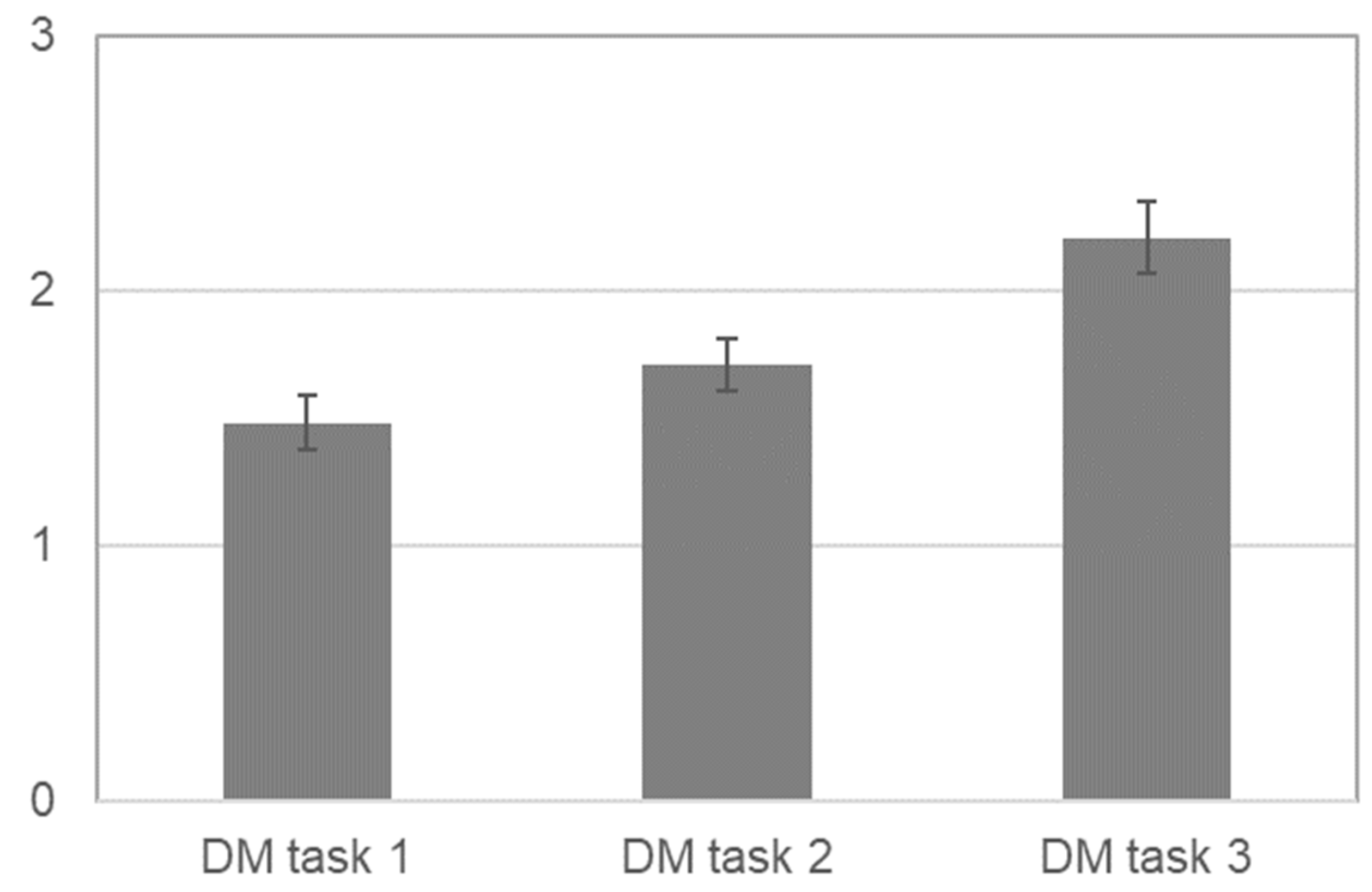
Figure 2 shows the means of decision-making scores for all students across the three tasks (DM Tasks 1–3, N = 62). A one-way ANOVA revealed a significant main effect of measurement (F(2,122) = 13.12, p < 0.001). Multiple comparisons using the Bonferroni method indicated that the mean score for DM Task 3 was significantly higher than that for DM Tasks 1 and 2 (p < 0.001 for both). The proportion of arguments that included risk mitigation measures and were assigned the highest score increased from less than 20% in DM Tasks 1 and 2 to approximately 60% in DM Task 3 following the risk management practice in which students generated risk mitigation measures to manage the risks.
To consider whether or not the student’s positions influence their progression, the proportion of arguments that received the highest score in DM Task 3 was compared across student positions. A chi-square test revealed a marginally significant difference between positions (χ2(2) = 5.39, p < 0.10). Residual analysis showed that the proportion of Level 3 arguments was lower among students in the ADM position (41.7%) than among those in the PDM (73.7%) or PDAM (68.4%) positions.
Even fifth-grade students demonstrated evidence-based decision-making by citing both the risks and benefits related to genome editing in their written arguments. In the final decision-making task, approximately 60% of the arguments were assigned the highest score, whereas the remaining students failed to incorporate risk mitigation measures into their arguments. Among students holding the ADM position, the proportion of arguments that achieved educational goals was lower.

3.3. Change in Risk–Benefit Emphasis Ratings (RQ2)

In the decision-making tasks, students indicated the extent to which they prioritised benefits or risks when making their decisions. This variable is referred to as the risk-emphasis score.
Table 4 shows the mean risk emphasis scores of all students. After excluding cases with missing values, the sample size for analysis was N = 58. A one-way ANOVA revealed a significant main effect of measurement (F(2,114) = 18.88, p < 0.001). Multiple comparisons using the Bonferroni method indicated that the mean score for DM Task 3 was significantly lower than those for DM Tasks 1 and 2 (p < 0.001 for both). However, even in the third and final measurements, the mean risk emphasis score remained relatively high (4.78 out of 10 points), suggesting that the students did not make benefit-oriented decisions.
Table 5 shows the means of risk emphasis scores in the DM Task 3 by students’ positions. A one-way ANOVA revealed a significant main effect of Position (F(2,62) = 38.09, p < 0.001), and multiple comparisons using the Bonferroni method indicated that the mean scores increased in the following order: PDM, PDAM, and ADM (p < 0.001, p < 0.05).
To summarise the results of the decision-making tasks, the findings suggests that the instructional unit promoted the development of more structured and evidence-based socioscientific decision-making among students. Through repeated engagement in risk management practice, students learned to construct arguments that incorporated both risks and benefits and proposed solutions, including risk mitigation. However, the results also indicated that student’s positions influence their progression. Analyses of students’ personal priorities, as reflected in their risk–benefit emphasis ratings, similarly suggested an influence of students’ positions. Although students’ emphasis on risk decreased over the course of the unit, most students—except those holding the PDM position—continued to make predominantly risk-focused decisions rather than shifting fully toward benefit-oriented reasoning. Taken together, these findings indicate that the unit facilitated partial progress toward a balanced risk–benefit evaluation; however, students’ caution regarding potential risks remained a dominant feature of their decision-making.

3.4. Students’ Attitudes Toward Critical Thinking and Risk (RQ3)

Table 6 presents the mean scores for students’ attitudes toward critical thinking, their interest in socioscientific issues, and their broader attitudes toward risks associated with science and technology, as measured by the post-unit questionnaire.
A one-way ANOVA and subsequent multiple comparisons revealed significant differences among the four variables (F(3,60) = 13.84, p < 0.001). The mean scores were in the following order: critical thinking attitude, risk tolerance and zero-risk mindset. Critical thinking attitude and interest in SSIs achieved near-maximum scores post-programme, indicating substantial attainment. In contrast, risk tolerance scores did not reach comparable levels. Furthermore, the mean score for the zero-risk mindset was lower than that for interest in SSIs. This zero-risk mindset was measured using a single item assessing students’ broader attitudes toward risks, stated as: “We should not use any technology that poses even the slightest risk.” Although the zero-risk mindset score was statistically lower than those of the other measures, it still stood at 3.5 out of 5 points, suggesting that students retained a degree of zero-risk mindset toward science and technology even after engaging in risk management practice to devise risk mitigation measures.

4. Discussion

4.1. Overview of the Findings

This study investigated how a socioscientific issue (SSI)-based instructional unit influenced primary school students’ decision-making and related attitudes. The instructional unit had two key features: it integrated risk perspectives and encouraged students to engage in risk management practice. The results revealed several noteworthy trends.
First, the students’ decision-making arguments became more evidence-based and reflective over the course of the unit. Engagement in information gathering and risk management practice appeared to help students integrate both risk and benefit considerations and propose concrete risk mitigation measures to balance potential trade-offs. In the final decision-making task, many students—particularly those who supported GE fish—incorporated risk mitigation measures corresponding to specific risk knowledge in their arguments. J. U. Kim et al. (2025) found that primary students generated more than twice as many knowledge-driven arguments as comparison-driven arguments, and approximately 40% focused solely on either risks or benefits regarding the knowledge used in their arguments. In this study, a relatively long curriculum unit comprising 18 lessons enabled a larger proportion of students to achieve their educational goals regarding decision-making arguments.
Second, although students’ tendencies to prioritise risks in their decision-making diminished slightly after repeated decision-making experiences, their reasoning remained predominantly risk-focused, except students who agreed with both the development and marketing of GE fish. This suggests that, while the instructional unit encouraged students to balance risk and benefit perspectives, a cautious approach to potential risks continued to dominate their decision-making. This result may be partly due to food-related risk perceptions. Japanese children appear to experience stronger feelings of risk or anxiety, particularly regarding genome editing in animals. Such affective responses are known to influence individuals’ perceptions of risk (Aven, 2024). These findings should therefore be interpreted in relation to students’ broader attitudes toward risks.
Third, the post-unit questionnaire indicated that students achieved high levels of critical thinking and interest in SSIs, suggesting strong engagement with the learning process. However, even after learning activities designed to devise risk mitigation measures, students’ broader attitudes toward risks—particularly their zero-risk mindset—remained relatively high.
In sum, these results suggest that the SSI-based unit effectively fostered students’ decision-making competence, while also revealing the challenges of cultivating more flexible and realistic attitudes toward risk among primary school students.

4.2. Educational Significance and Future Directions

This study developed and evaluated an SSI-based instructional unit designed to enhance risk-related socioscientific decision-making among primary school students. The unit consisted of two main phases: information search (Phase 1) and risk management practice (Phase 2). Phase 2 centred on learning activities in which students collaboratively generated risk mitigation measures or alternatives for three categories of risks surrounding GE fish through consensus-oriented instruction. The results confirm the effectiveness of this design in improving the quality of students’ decision-making arguments. However, it should be noted that among students holding the ADM position, a greater proportion failed to incorporate risk mitigation measures into their arguments. For students who oppose both the development and marketing of GE fish, additional learning activities may be necessary―specifically, activities that encourage them to consider the conditions under which they might revise their position toward agreement.
This study provided empirical evidence that an SSI-based instructional unit can improve the quality of primary students’ risk-related socioscientific decision-making. Nevertheless, further refinement of instructional strategies is required to influence students’ risk attitudes and to support movement beyond predominantly risk-focused decision-making. To guide such refinement, recent frameworks such as the SSI-CURE model (Lee et al., 2024) offer valuable insights. While Phase 2 in the present unit successfully engaged students in developing countermeasures (i.e., risk mitigation), future iterations could incorporate more explicit instructional activities focused on risk assessment and evaluation—such as structured opportunities to discuss the likelihood of outcomes and to articulate acceptable levels of risk in light of uncertainty.

4.3. Limitations and Suggestions for Further Research

The findings of this study indicate that students’ risk-benefit emphasis ratings and risk attitudes are unlikely to change substantially over the short term. This may be partly due to the limited duration of the instructional unit or the limited scope of educational content related to risk. In addition, students’ attitudes toward risk―specifically their zero-risk mindset and risk tolerance―were each assessed using a single-item measure, which may have constrained the measurement sensitivity.
The former suggests that a shift toward longer-term and iterative learning approaches is required. Karpudewan and Roth (2018) implemented eight SSI-based tasks over a five-week science curriculum and found that the progressive implementation of SSI activities improved students’ competence in informal decision-making. In addition, Sparks et al. (2022) demonstrated that students’ socioscientific arguments differ across SSI contexts. Regarding risk attitudes and risk-benefit-oriented decision-making, it may be necessary to design SSI instruction consisting of multiple units implemented over an extended period, in line with previous research. The progressive implementation of SSI activities, along with students’ retrospective reflections on their own decision-making arguments and risk–benefit emphasis ratings, could gradually modify students’ risk attitudes and improve their risk-focused decision-making.
The latter suggests the importance of extending the content of risk education. As discussed in Section 4.2, integrating instructional components that target risk assessment skills—such as those emphasised in the SSI-CURE model (Lee et al., 2024)—may contribute to fostering changes in students’ risk attitudes by helping them distinguish between hazard and risk, and between uncertainty and danger.
Finally, the limited duration, small sample size, and restricted scope of instruction related to risk literacy in this study highlight the need for future research involving diverse educational contexts and longitudinal designs.

Author Contributions

Conceptualization, M.S., E.Y. and T.Y.; methodology, M.S. and E.Y.; formal analysis, M.S. and E.Y.; investigation, M.S., E.Y. and M.M.; resources, T.Y., N.O. and R.M.; writing—original draft, M.S. and E.Y.; writing—review & editing, M.S., E.Y., T.Y., M.M., N.O. and R.M. visualization, M.S.; project administration, M.S., E.Y. and M.M.; funding acquisition, M.S. All authors have read and agreed to the published version of the manuscript.

Funding

This study was funded by JSPS KAKENHI Grant Number JP24K00467 and JP22K18625.

Institutional Review Board Statement

The study was conducted in accordance with the Declaration of Helsinki, and approved by the Ethics Committee of Kobe University attached school department (Approval code: 144; approval date: 16 December 2022).

Informed Consent Statement

Informed consent was obtained from the parents of all subjects involved in the study.

Data Availability Statement

The data have been anonymised but are not publicly available due to privacy concerns associated with participants’ open-ended responses.

Acknowledgments

We sincerely thank the teachers and students who participated in this study.

Conflicts of Interest

The authors declare no conflicts of interest.

References

  1. Aven, T. (2024). Risk literacy: Foundational issues and its connection to risk science. Risk Analysis, 44(5), 1011–1020. [Google Scholar] [CrossRef]
  2. Bencze, L. (2017). Science and technology education promoting wellbeing for individuals, societies & environments (STEPWISE). Springer. [Google Scholar]
  3. Birdsall, S. (2022). Socioscientific issues, scientific literacy, and citizenship: Assembling the puzzle pieces. In Y.-S. Hsu, R. Tytler, & P. J. White (Eds.), Innovative approaches to socioscientific issues and sustainability education: Linking research to practice (pp. 235–250). Springer. [Google Scholar]
  4. Christensen, C. (2009). Risk and school science education. Studies in Science Education, 45(2), 205–223. [Google Scholar] [CrossRef]
  5. Dauer, J. M., Kirby, C. K., & Sorensen, A. E. (2025). Defining students’ socioscientific issues classroom decision-making components and practice proficiencies. Disciplinary and Interdisciplinary Science Education Research, 7(1), 12. [Google Scholar] [CrossRef]
  6. Dauer, J. M., Lute, M. L., & Straka, O. (2017). Indicators of informal and formal decision-making about a socioscientific issue. International Journal of Education in Mathematics, Science and Technology, 5(2), 124–138. [Google Scholar] [CrossRef]
  7. Dauer, J. M., Sorensen, A. E., & Jimenez, P. C. (2022). Using structured decision making in the classroom to promote information literacy in the context of decision making. Journal of College Science Teaching, 51(6), 75–82. [Google Scholar] [CrossRef]
  8. Fang, S. C., Hsu, Y. S., & Lin, S. S. (2019). Conceptualizing socioscientific decision making from a review of research in science education. International Journal of Science and Mathematics Education, 17(3), 427–448. [Google Scholar] [CrossRef]
  9. Hansen, J., & Hammann, M. (2017). Risk in science instruction: The realist and constructivist paradigms of risk. Science & Education, 26(7–9), 749–775. [Google Scholar] [CrossRef]
  10. Högström, P., Gericke, N., Wallin, J., & Bergman, E. (2025). Teaching socioscientific issues: A systematic review. Science & Education, 34(5), 3079–3122. [Google Scholar] [CrossRef]
  11. Jimenez, P. C., Zwickle, A., & Dauer, J. M. (2024). Defining and describing students’ socioscientific issues tradeoff practices. International Journal of Science Education, Part B, 14(3), 277–293. [Google Scholar] [CrossRef]
  12. Kahn, S. (2020). No child too young: A teacher research study of socioscientific issues implementation at the elementary level. In W. Powell (Ed.), Socioscientific issues-based instruction for scientific literacy development (pp. 1–30). IGI Global. [Google Scholar]
  13. Kanazawa, N., Tanaka, Y., Koyama, K., Naitou, H., Ikawa, M., & Nakayama, Y. (2020). Measurement scales of risk literacy for risk education. Japanese Journal of Risk Analysis, 29(4), 243–249. (In Japanese) [Google Scholar] [CrossRef]
  14. Karpudewan, M., & Roth, W. M. (2018). Changes in primary students’ informal reasoning during an environment-related curriculum on socio-scientific issues. International Journal of Science and Mathematics Education, 16(3), 401–419. [Google Scholar] [CrossRef]
  15. Ke, L., Zangori, L., Sadler, T. D., & Friedrichsen, P. (2020). Integrating scientific modeling and socio-scientific reasoning to promote scientific literacy. In W. Powell (Ed.), Socioscientific issues-based instruction for scientific literacy development (pp. 31–54). IGI Global. [Google Scholar]
  16. Kim, G., Ko, Y., & Lee, H. (2020). The effects of community-based socioscientific issues program (SSI-COMM) on promoting students’ sense of place and character as citizens. International Journal of Science and Mathematics Education, 18(3), 399–418. [Google Scholar] [CrossRef]
  17. Kim, J. U., Kang, D., & Kim, C. J. (2025). Analysing the quality of risk-focused socio-scientific arguments on nuclear power using a risk-benefit oriented model. Research in Science Education, 55(5), 1205–1228. [Google Scholar] [CrossRef]
  18. Kolstø, S. D. (2006). Patterns in students’ argumentation confronted with a risk-focused socio-scientific issue. International Journal of Science Education, 28(14), 1689–1716. [Google Scholar] [CrossRef]
  19. Kusumi, T., Murase, M., & Takeda, A. (2016). Measurement of critical thinking attitude in fifth- through ninth-graders: Relationship to reflective predisposition, perceived academic competence and the educational program. Japan Journal of Educational Technology, 40(1), 33–44. [Google Scholar]
  20. Lee, H., & Ko, Y. (2025). ENACT project as a pedagogical approach for cultivating awareness and willingness to act on socioscientific issues. In J. L. Bencze (Ed.), Building networks for critical and altruistic science education (pp. 443–465). Springer. [Google Scholar] [CrossRef]
  21. Lee, H., Park, Y., Lee, H., Mun, K., & Hwang, Y. (2024). Exploring educational models for integrating socioscientific issues (SSI) with risk education. Journal of the Korean Association for Science Education, 44(4), 313–323. [Google Scholar] [CrossRef]
  22. Nicolaou, C. T., Evagorou, M., & Lymbouridou, C. (2015). Elementary school students’ emotions when exploring an authentic socio-scientific issue through the use of models. Science Education International, 26(2), 240–259. [Google Scholar]
  23. OECD. (2025). PISA 2025 science framework. Available online: https://pisa-framework.oecd.org/science-2025/ (accessed on 12 January 2026).
  24. Romine, W. L., Sadler, T. D., & Kinslow, A. T. (2017). Assessment of scientific literacy: Development and validation of the Quantitative Assessment of Socio-Scientific Reasoning (QuASSR). Journal of Research in Science Teaching, 54(2), 274–295. [Google Scholar] [CrossRef]
  25. Rundgren, C. J., Eriksson, M., & Rundgren, S.-N. C. (2016). Investigating the intertwinement of knowledge, value, and experience of upper secondary students’ argumentation concerning socioscientific issues. Science & Education, 25(9–10), 1049–1071. [Google Scholar] [CrossRef]
  26. Sadler, T. D. (2004). Informal reasoning regarding socioscientific issues: A critical review of research. Journal of Research in Science Teaching, 41(5), 513–536. [Google Scholar] [CrossRef]
  27. Schenk, L., Hamza, K., Arvanitis, L., Lundegård, I., Wojcik, A., & Haglund, K. (2021). Socioscientific issues in science education: An opportunity to incorporate education about risk and risk analysis? Risk Analysis, 41(12), 2209–2219. [Google Scholar] [CrossRef] [PubMed]
  28. Sparks, R. A., Johnson, P. C., Kim, C. K., & Dauer, J. M. (2022). Structured decision-making as a context for socioscientific argumentation. Educational Sciences, 12(10), 644. [Google Scholar] [CrossRef]
  29. Wu, Y., & Tsai, C. (2007). High school students’ informal reasoning on a socio-scientific issue: Qualitative and quantitative analyses. International Journal of Science Education, 29(9), 1163–1187. [Google Scholar] [CrossRef]
  30. Zeidler, D. L. (2014). Socioscientific issues as a curriculum emphasis: Theory, research, and practice. In N. G. Lederman, & S. K. Abell (Eds.), Handbook of research on science education (Vol. II, pp. 697–726). Routledge. [Google Scholar]
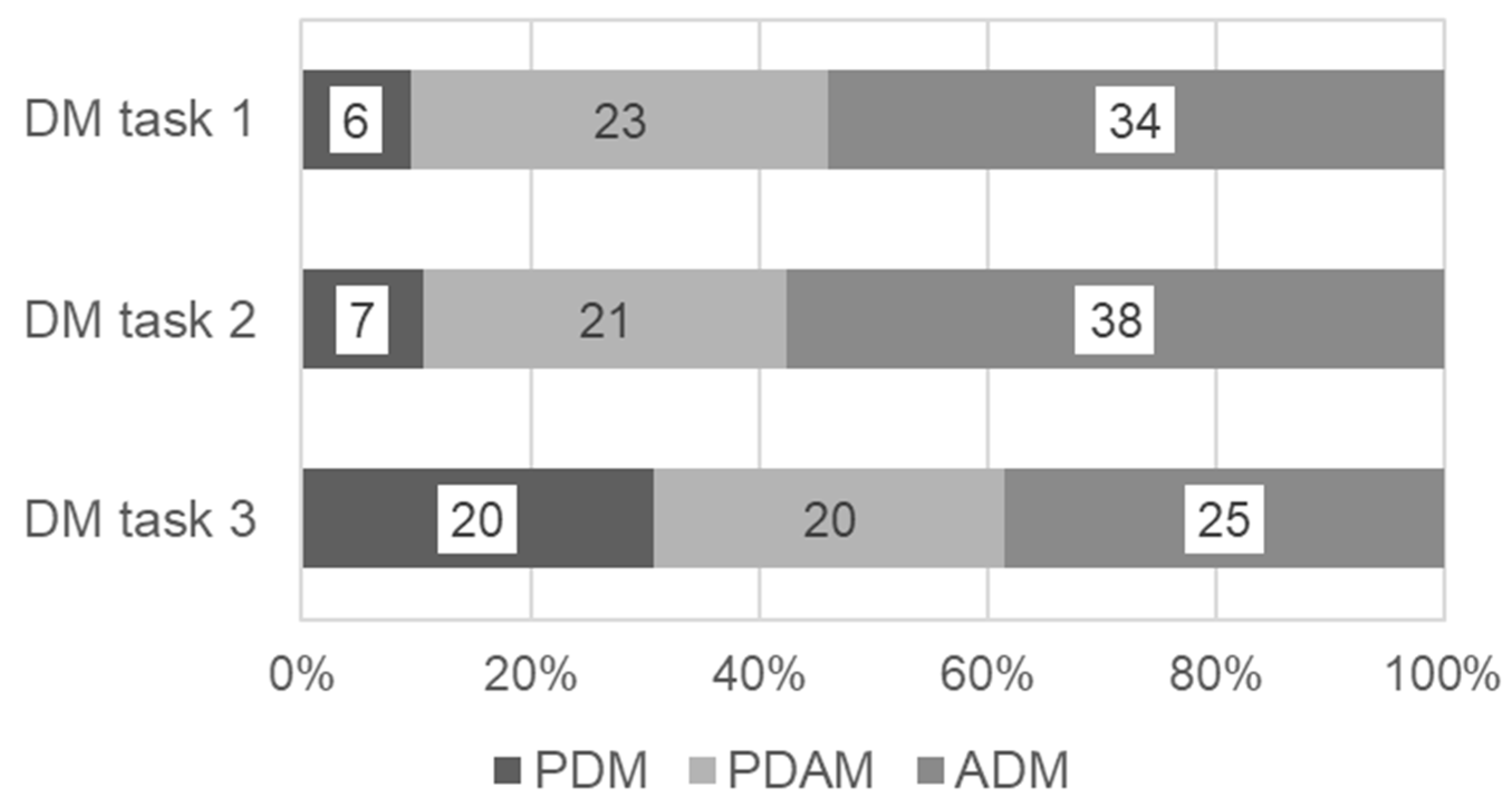
Figure 1. The distribution of students’ positions on genome-edited fish across the decision-making tasks 1 (1 PDM = Pro-Development and Marketing, PDAM = Pro-Development/Anti-Marketing, ADM = Anti-Development and Marketing.)
Education 16 00143 g001
Figure 2. The means of decision-making scores across the decision-making tasks.
Education 16 00143 g002
Table 1. Overview of the instructional sequence and corresponding learning activities in each phase of the unit.
PhaseContents and Learning Activities
1. Information searchStudents learned content knowledge and background knowledge regarding the focal issue.
Learn about global and local food problems as background knowledge and the scientific content knowledge about genome editing.
Explore stakeholders’ opinions around the issue and examine the benefits and risks of genome-edited fish.
The first decision-making task
2. Risk management practices
The teacher guided students to categorise the benefits and risks
Students reviewed their decision-making arguments focusing on the benefits or risks they had cited to justify their claims.
The second decision-making task
Students generated risk mitigation measures to manage the risks and examined them with the whole class.
The third decision-making task
Table 2. Overview of the benefits and risks of genome-edited fish discussed in the instructional unit.
CategoriesBenefitsRisks
Economy
Can boost sales of seafood products.
Requires less time and cost compared to conventional genetic modification.
Sales of non-genome-edited fish may decline.
Companies holding patents for genome-editing technologies may monopolise the aquaculture market.
EcologyHelps prevent overfishing and contributes to the conservation of fishery resources and marine ecosystems.May disrupt the existing ecological balance.
SafetyThe technology can be applied to the medical and pharmaceutical fields.
Unintended genetic changes or editing errors may render the food unsafe for consumption.
There are concerns that this technology could eventually be applied to humans.
Table 3. Rubric for assessing the quality of students’ decision-making arguments and examples of responses.
ScoreDescriptionExamples of Students’ Descriptions
0Contained only a simple claim, without any justification.Providing detailed information about genome-edited fish ensures a certain level of safety, and if it tastes good, that is all that matters.
1Included a claim supported by risk knowledge.I oppose the development and marketing of genome-edited fish [Claim]. My reasons are that it is unclear whether they are safe for continued consumption [Risk] 1, they could potentially disrupt the ecological balance [Risk], and genome editing may cause distress to the animals [Risk]. Furthermore, verifying the safety of genome-edited fish will take time, and during that period, retailers’ sales may decline [Risk].
2Included a claim and justification with both risk and benefit knowledge.I oppose the development and marketing of genome-edited fish [Claim]. The reason is that it may disrupt the balance of ecosystems [Risk]. For example, while “meaty sea bream” may offer benefits such as increased edible portions [Benefit] 2, abnormalities could occur in the fish’s body [Risk]. Moreover, even if the risk of editing failure is significantly reduced [Benefit], there remains a slight possibility of failure [Risk].
3Included a claim, risk knowledge, and corresponding risk mitigation.I was concerned that fish might escape from aquaculture cages and disrupt the ecosystem [Risk], but if the cages are built on land, the fish will not escape [Mitigation] 3. I was also worried that patents might lead to market monopolisation [Risk], but if the state regulates the quantity that a single company may sell, monopolisation will not occur [Mitigation]. Even if research costs are high [Risk], state subsidies for researchers could promote further studies [Mitigation]. Therefore, I support genome editing research that can help address the global food crisis [Benefit].
1 Risk knowledge; 2 Benefit knowledge; 3 Risk mitigation measures or alternatives.
Table 4. The means of risk emphasis scores across the decision-making tasks.
Means 1SD
DM task 16.312.59
DM task 26.472.56
DM task 34.782.75
1 N = 58. Range = 0–10.
Table 5. The means of risk emphasis scores in the DM task 3 by students’ positions.
MeansSD
Pro-Development and Marketing (PDM)2.152.03
Pro-Development/Anti-Marketing (PDAM)5.301.53
Anti-Development and Marketing (ADM)6.921.89
Table 6. Mean scores for students’ critical thinking attitudes, interests in SSI, and broader risk attitudes.
αRangeMeansSD
Critical thinking attitude (Scale)0.6333–54.480.512
Interests in SSI (Scale)0.7331–54.400.708
Risk attitudes
 Risk tolerance-1–54.061.08
 Zero-risk mind-set-1–53.491.37
Disclaimer/Publisher’s Note: The statements, opinions and data contained in all publications are solely those of the individual author(s) and contributor(s) and not of MDPI and/or the editor(s). MDPI and/or the editor(s) disclaim responsibility for any injury to people or property resulting from any ideas, methods, instructions or products referred to in the content.