Illustrating Situated Manifestations of Assessment Literacy in Higher Professional Education
 , , and
Abstract
1. Introduction
1.1. Theoretical Framework
- What aspects of AL emerge in assessment-related situations in HPE?
- What are HPE teachers’ interpretations of these aspects within each assessment-related situation?
- How does the interplay between these aspects manifest in teachers’ activities within each assessment-related situation?
1.2. Context of This Study
2. Materials and Methods
2.1. Study Design
2.2. Selection of Situations and Participants
2.3. Data Collection
2.4. Analysis
2.5. Use of Writing Support Tools
3. Results
3.1. Aspects of AL Emerging in Acting in Assessment-Related Situations in HPE
3.2. HPE Teachers’ Interpretations of the Aspects of AL Within the Situations
3.3. The Interplay Between Aspects of AL in Teachers’ Activities Within Assessment-Related Situations
4. Discussion
5. Conclusions
Supplementary Materials
Author Contributions
Funding
Institutional Review Board Statement
Informed Consent Statement
Data Availability Statement
Conflicts of Interest
Abbreviations
| AL | Assessment Literacy |
| HPE | Higher professional education |
References
- Akerlind, G. S. (2024). Phenomenography in the 21st century: A methodology for investigating human experience of the world. Open Book Publishers. [Google Scholar] [CrossRef]
- Antera, S. (2021). Professional competence of vocational teachers: A conceptual review. Vocations and Learning, 14(3), 459–479. [Google Scholar] [CrossRef]
- Åkerlind, G. S. (2008). A phenomenographic approach to developing academics’ understanding of the nature of teaching and learning. Teaching in Higher Education, 13(6), 633–644. [Google Scholar] [CrossRef]
- Åkerlind, G. S. (2025). Why should I be interested in phenomenographic research? Variation in views of phenomenography amongst higher education scholars. Higher Education, 89(5), 1235–1251. [Google Scholar] [CrossRef]
- Baartman, L. K. J., & Quinlan, K. M. (2024). Assessment and feedback in higher education reimagined: Using programmatic assessment to transform higher education. Perspectives: Policy and Practice in Higher Education, 28(2), 57–67. [Google Scholar] [CrossRef]
- Bearman, M., Dawson, P., Dawson, P., Bennett, S., Hall, M., & Molloy, E. (2016). Support for assessment practice: Developing the assessment design decisions framework. Teaching in Higher Education, 21(5), 545–556. [Google Scholar] [CrossRef]
- Biggs, J. (1996). Enhancing teaching through constructive alignment. Higher Education, 32(3), 347–364. [Google Scholar] [CrossRef]
- Bråten, I., Muis, K. R., & Reznitskaya, A. (2017). Teachers’ epistemic cognition in the context of dialogic practice: A question of calibration? Educational Psychologist, 52(4), 253–269. [Google Scholar] [CrossRef]
- Brookhart, S. M. (2011). Educational assessment knowledge and skills for teachers. Educational Measurement: Issues and Practice, 30(1), 3–12. [Google Scholar] [CrossRef]
- Carless, D., & Chan, K. (2016). A good idea is not enough: Academics need assessment change literacy. In Assessment literacies in higher education: From micro to macro. Springer. [Google Scholar]
- Charteris, J., & Dargusch, J. (2018). The tensions of preparing pre-service teachers to be assessment capable and profession-ready. Asia-Pacific Journal of Teacher Education, 46(4), 354–368. [Google Scholar] [CrossRef]
- Charteris, J., & Smardon, D. (2022). Leadership for assessment capability: Dimensions of situated leadership practice for enhanced sociocultural assessment in schools. Leadership and Policy in Schools, 21(4), 1005–1017. [Google Scholar] [CrossRef]
- Clarke, D., & Hollingsworth, H. (2002). Elaborating a model of teacher professional growth. Teaching and Teacher Education, 18, 947–967. [Google Scholar] [CrossRef]
- Coombs, A., & DeLuca, C. (2022). Mapping the constellation of assessment discourses: A scoping review study on assessment competence, literacy, capability, and identity. Educational Assessment, Evaluation and Accountability, 34(3), 279–301. [Google Scholar] [CrossRef]
- de Bruijn, E., Billett, S., & Onstenk, J. (2017). Enhancing teaching and learning in the Dutch vocational education system (18th ed., Vol. 18). Springer. [Google Scholar]
- De Groot, A. D., & Spiekerman, J. A. A. (2020). Methodology: Foundations of inference and research in the behavioral sciences (4th, e-book ed., Vol. 6). Walter de Gruyter GmbH & Co KG. [Google Scholar]
- DeLuca, C., & Johnson, S. (2017). Developing assessment capable teachers in this age of accountability. Assessment in Education: Principles, Policy and Practice, 24(2), 121–126. [Google Scholar] [CrossRef]
- Deneen, C. C., & Brown, G. T. L. (2016). The impact of conceptions of assessment on assessment literacy in a teacher education program. Cogent Education, 3, 1225380. [Google Scholar] [CrossRef]
- Desimone, L. M. (2009). Improving impact studies of teachers’ professional development: Toward better conceptualizations and measures. Educational Researcher, 38(3), 181–199. [Google Scholar] [CrossRef]
- Evers, A. T., Kreijns, K., & Van der Heijden, B. I. J. M. (2016). The design and validation of an instrument to measure teachers’ professional development at work. Studies in Continuing Education, 38(2), 162–178. [Google Scholar] [CrossRef]
- Flynn, C., Gilchrist, D., & Olson, L. (2004). Using the assessment cycle as a tool for collaboration. Resource Sharing & Information Networks, 17(1–2), 187–203. [Google Scholar] [CrossRef]
- Forsyth, R., Cullen, R., Ringan, N., & Stubbs, M. (2015). Supporting the development of assessment literacy of staff through institutional process change. London Review of Education, 13(3), 34–41. [Google Scholar] [CrossRef]
- Fulmer, G. W., Lee, I. C. H., & Tan, K. H. K. (2015). Multi-level model of contextual factors and teachers’ assessment practices: An integrative review of research. Assessment in Education: Principles, Policy and Practice, 22(4), 475–494. [Google Scholar] [CrossRef]
- Grollmann, P. (2008). The quality of vocational teachers: Teacher education, institutional roles and professional reality. European Educational Research Journal, 7(4), 535–547. [Google Scholar] [CrossRef]
- Gulikers, J., Veugen, M., & Baartman, L. (2021). What are we really aiming for? Identifying concrete student behavior in co-regulatory formative assessment processes in the classroom. Frontiers in Education, 6, 415. [Google Scholar] [CrossRef]
- Hays, D. G., & Singh, A. A. (2023). Qualitative research in education and social sciences (2nd ed.). Cognella Academic Publishing. [Google Scholar]
- Herppich, S., Praetorius, A. K., Förster, N., Glogger-Frey, I., Karst, K., Leutner, D., Behrmann, L., Böhmer, M., Ufer, S., Klug, J., Hetmanek, A., Ohle, A., Böhmer, I., Karing, C., Kaiser, J., & Südkamp, A. (2018). Teachers’ assessment competence: Integrating knowledge-, process-, and product-oriented approaches into a competence-oriented conceptual model. In Teaching and teacher education (Vol. 76, pp. 181–193). Elsevier Ltd. [Google Scholar] [CrossRef]
- Kriszan, A., & Nienaber, B. (2024). Researching playfully? Assessing the applicability of LEGO® serious Play® for researching vulnerable groups. Societies, 14(2), 15. [Google Scholar] [CrossRef]
- La Marca, P. M. (2001). Alignment of standards and assessments as an accountability criterion. Practical Assessment, Research and Evaluation, 7(21), 1–7. [Google Scholar]
- Leont’ev, A. N. (1978). Activity, consciousness, and personality. Prentice-Hall. [Google Scholar]
- Lock, J., Kim, B., Koh, K., & Wilcox, G. (2018). Navigating the tensions of innovative assessment and pedagogy in higher education lock. The Canadian Journal for the Scholarship of Teaching and Learning, 9(1), n1. [Google Scholar] [CrossRef]
- Looney, A., Cumming, J., van Der Kleij, F., & Harris, K. (2018). Reconceptualising the role of teachers as assessors: Teacher assessment identity. Assessment in Education: Principles, Policy & Practice, 25(5), 442–467. [Google Scholar] [CrossRef]
- Malau-Aduli, B. S., Hays, R. B., D’Souza, K., Smith, A. M., Jones, K., Turner, R., Shires, L., Smith, J., Saad, S., Richmond, C., Celenza, A., & Sen Gupta, T. (2021). Examiners’ decision-making processes in observation-based clinical examinations. Medical Education, 55(3), 344–353. [Google Scholar] [CrossRef] [PubMed]
- Malterud, K., Siersma, V. D., & Guassora, A. D. (2016). Sample size in qualitative interview studies: Guided by information power. Qualitative Health Research, 26(13), 1753–1760. [Google Scholar] [CrossRef]
- Marton, F. (1981). Phenomenography—Describing conceptions of the world around us. Instructional Science, 10, 177–200. [Google Scholar] [CrossRef]
- McTighe, J., & Emberger, M. (2006). Teamwork on assessments creates powerful professional development. Journal of Staff Development, 27(1), 38–44. [Google Scholar]
- Meijer, K., Baartman, L., Vermeulen, M., & de Bruijn, E. (2023). Teachers’ conceptions of assessment literacy. Teachers and Teaching, 29, 695–709. [Google Scholar] [CrossRef]
- Meijer, K., Baartman, L., Vermeulen, M., & de Bruijn, E. (2025). Mapping teachers’ perceived importance of assessment competence: A quantitative exploration in the context of Dutch Higher Vocational Education. Empirical Research in Vocational Education and Training, 17(1), 10. [Google Scholar] [CrossRef]
- Näsström, G., & Henriksson, W. (2008). Alignment of standards and assessment: A theoretical and empirical study of methods for alignment. Electronic Journal of Research in Educational Psychology, 6(3), 667–690. [Google Scholar] [CrossRef]
- Obsuth, I., Brown, R. H., & Armstrong, R. (2022). Validation of a new scale evaluating the personal, interpersonal and contextual dimensions of growth through learning—The EPIC scale. Studies in Educational Evaluation, 74, 101154. [Google Scholar] [CrossRef]
- Pastore, S., & Andrade, H. L. (2019). Teacher assessment literacy: A three-dimensional model. Teaching and Teacher Education, 84, 128–138. [Google Scholar] [CrossRef]
- Reinholz, D. (2016). The assessment cycle: A model for learning through peer assessment. Assessment and Evaluation in Higher Education, 41(2), 301–315. [Google Scholar] [CrossRef]
- Rose, S., & Furness, P. (2024). Lego serious play in psychology: Exploring its use in qualitative interviews. Qualitative Research in Psychology, 21(4), 578–609. Available online: http://shura.shu.ac.uk/information.html (accessed on 1 December 2025). [CrossRef]
- Schaap, H., Louws, M., Meirink, J., Oolbekkink-Marchand, H., Van Der Want, A., Zuiker, I., Zwart, R., & Meijer, P. (2019). Tensions experienced by teachers when participating in a professional learning community. Professional Development in Education, 45(5), 814–831. [Google Scholar] [CrossRef]
- Sluijsmans, D. M. A., & Struyven, K. (2014). Quality assurance in assessment: An introduction to this special issue. Studies in Educational Evaluation, 43, 1–4. [Google Scholar] [CrossRef]
- Stiggins, R. J. (1991). Assessment literacy. Phi Delta Kappan, 72(7), 534–539. [Google Scholar]
- Svensson, L., & Doumas, K. (2013). Contextual and analytic qualities of research methods exemplified in research on teaching. Qualitative Inquiry, 19(6), 441–450. [Google Scholar] [CrossRef]
- van Houten, M. M. (2018). Vocational education and the binary higher education system in the Netherlands: Higher education symbiosis or vocational education dichotomy? Journal of Vocational Education and Training, 70(1), 130–147. [Google Scholar] [CrossRef]
- van Renselaar, E., Brouwer, P., Koeslag-Kreunen, M., & de Bruijn, E. (2025). How do second career teachers in vocational education experience their induction period? An interview study. Vocations and Learning, 18(1), 17. [Google Scholar] [CrossRef]
- Webb, N. L. (2002, April 1–5). Assessment literacy in a standards-based education setting [Conference session]. American Education Research Association Annual Meeting, New Orleans, LA, USA. [Google Scholar]
- Webster-Wright, A. (2009). Reframing professional development through understanding authentic professional learning. Review of Educational Research, 79(2), 702–739. [Google Scholar] [CrossRef]
- Willis, J., Adie, L., & Klenowski, V. (2013). Conceptualising teachers’ assessment literacies in an era of curriculum and assessment reform. Australian Educational Researcher, 40(2), 241–256. [Google Scholar] [CrossRef]
- Xu, Y., & Brown, G. T. L. (2016). Teacher assessment literacy in practice: A reconceptualization. Teaching and Teacher Education, 58, 149–162. [Google Scholar] [CrossRef]
- Xu, Y., & He, L. (2019). How pre-service teachers’ conceptions of assessment change over practicum: Implications for teacher assessment literacy. Frontiers in Education, 4, 1–16. [Google Scholar] [CrossRef]



| Short Description of the Assessment-Related Situation | Participants’ Characteristics |
|---|---|
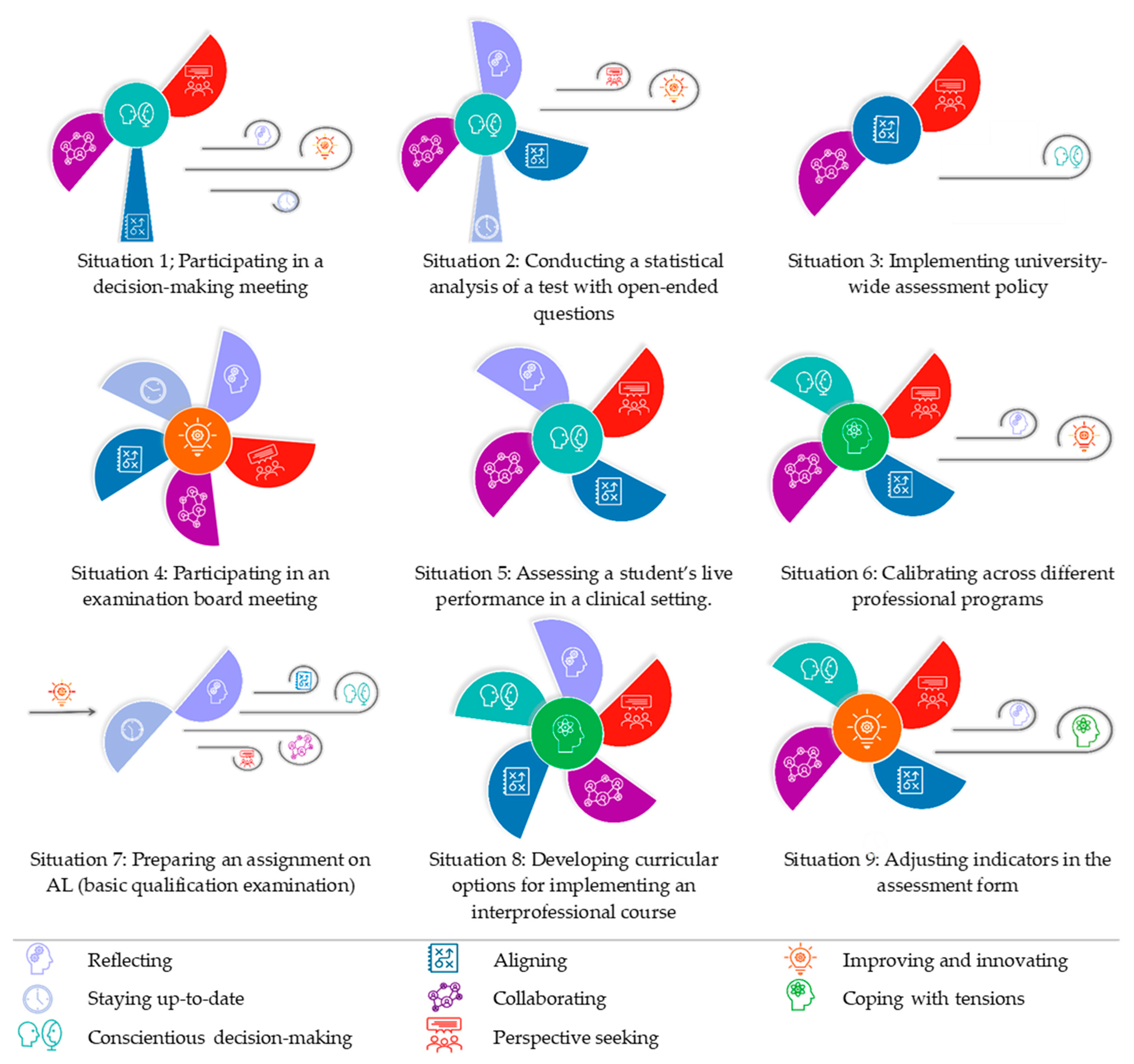
| Situation 1: Participating in a decision-making meeting: | |
| A teacher participating in a decision meeting on awarding/remediation for first-year students in an educational programme based on programmatic assessment. Portfolios with scores and feedback are discussed with six examiners. The roles during the meeting included a chairperson and a dashboard presenter, who displayed the portfolio dashboard and summarised the student’s development. There was a relaxed but critical atmosphere in the room chosen explicitly to avoid interruptions and to minimise external stimuli. |
|
| Situation 2: Conducting a statistical analysis of a test with open-ended questions: | |
| A teacher is conducting a test analysis for a resit of a small group of students. Validity and reliability indices were calculated, outlier scores were analysed, and scores were adjusted accordingly. Paper exams were physically reviewed as an additional source. During the analysis, consultation with a colleague took place via Microsoft Teams. The atmosphere was quiet and focused in a separate workspace. |
|
| Situation 3: Implementing university-wide assessment policy: | |
| A teacher in the role of educational advisor discusses the implications of the new university-wide assessment policy with two programme coordinators. These coordinators represent an educational programme that is offered at two locations. The new policy includes some changes and two new assessment themes: gen AI and Inclusivity. They discuss the potential impact and share practical examples of implementation. The atmosphere is relaxed; the meeting takes place in the office area of the relevant departments. |
|
| Situation 4: Participating in an examination board meeting: | |
| A teacher participating in a weekly meeting of the Examination Board begins with a group reflection on their examination board practices and experiences, looking back at the past period to jointly consider how to improve working methods in line with the PDCA cycle (this situation). Six board members were seated around a large conference table, each with laptops and documents in front of them. The atmosphere is slightly chaotic, with people talking over each other, and jokes being made. |
|
| Situation 5: Assessing a student’s live performance in a clinical setting: | |
| A teacher assessing a third-year student performing a clinical procedure on a patient in a teaching clinic at the university of applied sciences. The focus is on both learning and demonstrating competence. The student is coached by a fourth-year student, who is also supervised by the teacher. The student records the performance and the feedback in a digital portfolio. Other students are also treating patients in the clinic at the same time, and a specialist and another teacher are present. The atmosphere is professional and calm, with attentive non-verbal communication that signalled active listening and engagement. |
|
| Situation 6: Calibrating across different professional programmes | |
| A teacher participating in a calibration session on the required level of student learning outcomes before entering the final phase of the programme. The session involved five teachers from four different paramedical programmes, using a standardised procedure and a template for recording possible adjustments. One participant prepared the session and shared a student’s portfolio showcase for discussion. One on-site participant arrived late and left early. Four participants were online. The meeting room was situated in a quiet location, but the session itself was somewhat restless and disjointed. |
|
| Situation 7: Preparing an assignment on AL (basic qualification examination) | |
| A teacher in the role of researcher at an external site works on the final assignment of a course on AL. The final assignment, to present an innovative assessment plan, is a mandatory course requirement that teachers must complete to fulfil their role as examiners. The assessment cycle is used as the framework for the assignment. The participant prepares the presentation on assessing third-year students working on practice-oriented projects with researchers and the business sector related to the energy transition. The workspace is open, with the sound of students and staff around. The atmosphere is informal and constructive. |
|
| Situation 8: Developing curricular options for an interprofessional course | |
| A teacher, as a member of the curriculum committee, meets with another member to prepare implementation advice for an interprofessional course (15 ECTS) that will be offered externally. They discuss seven possible scenarios to prepare the advice they need to present in a management meeting. The meeting takes place in a spacious classroom with large sheets of scenarios spread out on the table. The atmosphere was collaborative, with a mild sense of ‘closing ranks’. |
|
| Situation 9: Adjusting indicators in the assessment form | |
| A teacher is adjusting an assessment form because an assignment has been changed. The learning outcomes have already been established, but the indicators (detailed descriptions of each learning outcome) still require revision. Three teachers who deliver this course meet for a working session behind two shared screens, reviewing the texts together. They work in an open workspace along a hallway. The atmosphere is highly collaborative and respectful. |
|
| Situation 1 | Situation 2 | Situation 3 | Situation 4 | Situation 5 | Situation 6 | Situation 7 | Situation 8 | Situation 9 | |
|---|---|---|---|---|---|---|---|---|---|
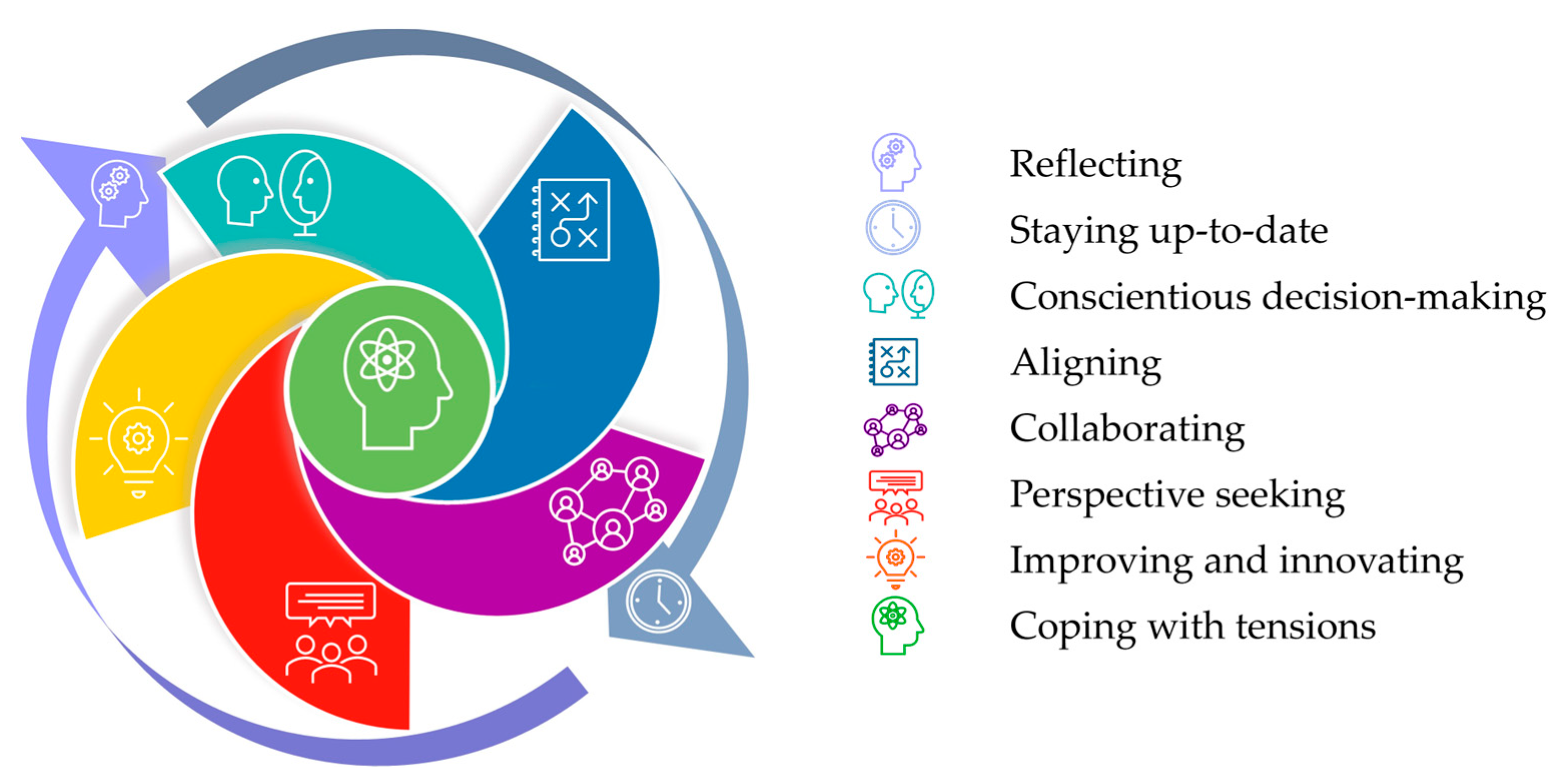
| Reflecting | x | x | x | x | x | x | x | ||
| Staying up-to-date | x | x | x | ||||||
| Conscientious decision-making | x | x | x | x | x | x | x | ||
| Aligning | x | x | x | x | x | x | x | x | |
| Collaborating | x | x | x | x | x | x | x | x | |
| Perspective seeking | x | x | x | x | x | x | x | ||
| Improving and Innovating | x | x | x | x | |||||
| Coping with tensions | x | x | x |
| Aspect | Example Manifestations | Situation |
|---|---|---|
| Reflecting | Reflecting together as a group on examination board practices to improve coherence (PDCA cycle) | Situation 4 |
| Considering how their feedback and choice of words might affect the student’s response during the live performance assessment | Situation 5 | |
| Staying up-to-date | Being well-informed about lessons, didactics, statistical procedures, and relevant results | Situation 2 |
| Gathering information needed for the assignments, including policies, student tasks, and previous evaluations | Situation 7 | |
| Conscientious decision- making | Taking the time to engage in conversation, giving the student space to speak first, and refraining from forming a judgement immediately | Situation 5 |
| Determining the advice that the curriculum committee will give to the management team and other relevant stakeholders on how to appropriately incorporate a specific part in the educational programme, including students’ assessment, that will be delivered externally | Situation 8 | |
| Aligning | Aligning the university-wide assessment policy with the assessment practices of this educational programme at both locations, checking whether there is a shared understanding, and ensuring consistency between the two locations | Situation 3 |
| Ensuring that the assessment assignment and the assessment form align with professional standards and practices | Situation 8 | |
| Collaborating | Consciously taking a modest role by recognising that others have a strong involvement in policy and are well-informed, which in turn manifests in expediting the process | Situation 3 |
| Contradictions and arguments are being defended rather than collaborative efforts aimed at common objectives | Situation 6 | |
| Perspective seeking | Deliberately adopting multiple perspectives to make holistic decisions about student performance | Situation 1 |
| Exploring where the members of the examination board stand and mapping out the different interests involved, including those of management, students, and teachers | Situation 4 | |
| Improving and Innovating | Adjusting item scores and documenting which questions require revision for future improvement | Situation 2 |
| Continuously working through an ongoing improvement cycle that is never truly finished to adjust the indicators | Situation 9 | |
| Coping with tensions | Managing time pressure and limited capacity for remediation by postponing feedback rather than rushing | Situation 1 |
| Struggling with the desire to be fully transparent and to write out every step for students, even though this conflicts with the belief that real behavioural change requires students to think for themselves and engage more holistically | Situation 9 |
Disclaimer/Publisher’s Note: The statements, opinions and data contained in all publications are solely those of the individual author(s) and contributor(s) and not of MDPI and/or the editor(s). MDPI and/or the editor(s) disclaim responsibility for any injury to people or property resulting from any ideas, methods, instructions or products referred to in the content. |
© 2025 by the authors. Licensee MDPI, Basel, Switzerland. This article is an open access article distributed under the terms and conditions of the Creative Commons Attribution (CC BY) license (https://creativecommons.org/licenses/by/4.0/).
Share and Cite
Meijer, K.; Grootenboer, C.; Baartman, L.; Vermeulen, M.; de Bruijn, E. Illustrating Situated Manifestations of Assessment Literacy in Higher Professional Education. Educ. Sci. 2025, 15, 1644. https://doi.org/10.3390/educsci15121644
Meijer K, Grootenboer C, Baartman L, Vermeulen M, de Bruijn E. Illustrating Situated Manifestations of Assessment Literacy in Higher Professional Education. Education Sciences. 2025; 15(12):1644. https://doi.org/10.3390/educsci15121644
Chicago/Turabian StyleMeijer, Kitty, Carine Grootenboer, Liesbeth Baartman, Marjan Vermeulen, and Elly de Bruijn. 2025. "Illustrating Situated Manifestations of Assessment Literacy in Higher Professional Education" Education Sciences 15, no. 12: 1644. https://doi.org/10.3390/educsci15121644
APA StyleMeijer, K., Grootenboer, C., Baartman, L., Vermeulen, M., & de Bruijn, E. (2025). Illustrating Situated Manifestations of Assessment Literacy in Higher Professional Education. Education Sciences, 15(12), 1644. https://doi.org/10.3390/educsci15121644