Balancing Identities: An Autoethnographic Inquiry of the Educator–Researcher–Artist Self


Abstract
1. Introduction
- How do ERAs experience the integration and negotiation of multiple professional identities within institutional contexts that may privilege teaching over artistry or scholarship?
- In what ways does sustaining a balanced portfolio career contribute to educators’ professional currency and psychological well-being?
- What are the tensions and synergies between artistic, pedagogical, and scholarly identities in contemporary educational environments?
2. Theoretical Frameworks
3. Materials and Methods
4. Results and Analysis
4.1. Results: Structuring the Dataset from the Vignettes
4.2. Analysis
5. Discussion
Growing up, my father introduced me to a wide variety of artists, and so from a young age, I listened to Widor, Saint-Saëns, and Messiaen, but also ABBA, Kate Bush, and The Beatles.
My bandmates and I listened to King Crimson, Mr. Bungle, John Zorn, and Deftones. At the same time, at university, I played and listened to the usual classical repertoire of a clarinet student; I particularly loved Weber and was beginning to explore the works of Stockhausen.
When I was with friends or acquaintances from the rock community, I felt like I didn’t quite fit in, that I was “too classical”; this was also true when I was in the company of my fellow music major undergraduates, that I was “too rock”. Although there was plenty of excitement around performing, writing, recording, and learning a wide range of repertoire, I was not able to grasp my musical identity as a fixed form yet. I felt inauthentic when my “classical self” was presented in the rock environment, and vice versa.
Research Questions as a Basis for Understanding
At one point, [when I was 16], I was asked to conduct the junior community concert band… I took on the role with enthusiasm and seriousness. I considered it to be of extreme importance to make music together… As a very young teacher/conductor, I celebrated the successes with my students and community band members and, admittedly, took it personally when things did not go according to plan. I found teaching and conducting to be fulfilling and was exceptionally proud of my work.
I enjoyed playing the clarinet immensely but was convinced that I had started learning too late to be a serious contender in the world of professional music performance. As I saw it, teaching was a meaningful and purposeful way to continue my musical journey.
I had become far more serious about performing clarinet and was practicing or playing many hours most days, resulting in competing interests between performance and teaching.
I was seeking a sense of belonging as a researcher–educator–musician in a new, transformative environment by presenting at an international music educators’ conference for the first time. After identifying as a musician–teacher for 27 years, finding my place in the research community, a new community, really mattered to me.
Upon accepting the position, I informed the school that I would require two days off for a previously booked performance. I was producing a concert at a high-profile venue in Melbourne with international guest artists and would also be performing. I was summoned to the assistant principal’s office, who asked for an explanation. I stated my case as clearly as seemed necessary, oblivious to the concept that this previously booked event would be an issue. The assistant principal expressed exasperation as he declared he would “allow” me to perform this one time, but it couldn’t happen again. He also pointed out that in my contract there was a clause that disallowed any outside work to be entered into. This meant that I was forbidden from performances; my recollection is that this extended to work outside of school hours.
When I received an opportunity to present at a major international music educators’ conference, I was excited; however, my place of employment was not, and rejected my application for leave. I felt that this opportunity was far too important not to take up, so I appealed the decision… It was also imputed that the music education conference was not sufficiently relevant for my professional development. As a music educator, I found this statement to be a source of cognitive dissonance.
I carry with me a deep affection for each of the three worlds of performance, teaching, and research, and as time goes by, the more intertwined these worlds become. For me, there is a profound clarity in how teaching music informs my communication skills, which in turn transfers to communication in performance. My experience on stage has supplied me with knowledge and authority on music craft, from practice and performance strategies right through to managing performance anxiety. Additionally, my doctoral research on memory and cognition for instrumental music learning has opened a whole new world of understanding my students; I put into practice the new knowledge I have acquired in every lesson I teach. The doctoral coursework has shown me new theories of learning, illuminated compassionate teaching practices, and refocused my lens of instruction toward that of service as opposed to facilitator of virtuosic music making.
6. Conclusions
Funding
Institutional Review Board Statement
Informed Consent Statement
Data Availability Statement
Conflicts of Interest
Correction Statement
Abbreviations
| CMR | Complete Member Researcher |
| ERA | Educator–Researcher–Artist |
| SIT | Social Identity Theory |
| SSI | Structural Symbolic Interactionism |
References
- Adler, P. A., & Adler, P. (1987). Membership roles in field research. Sage. [Google Scholar]
- Akkerman, S. F., & Meijer, P. C. (2009). A dialogical approach to conceptualizing teacher identity. Teaching and Teacher Education, 27, 308–319. [Google Scholar] [CrossRef] [Scilit]
- Anderson, L. (2006). Analytic autoethnography. Journal of Contemporary Ethnography, 35(4), 373–395. [Google Scholar] [CrossRef] [Scilit]
- Anderson, L., & Glass-Coffin, B. (2013). I learn by going: Autoethnographic modes of inquiry. In S. Holman Jones, T. E. Adams, & C. Ellis (Eds.), Handbook of autoethnography (pp. 57–83). Left Coast Press. [Google Scholar]
- Ballet, K., & Kelchtermans, G. (2009). Struggling with workload: Primary teachers’ experience of intensification. Teaching and Teacher Education, 25(8), 1150–1157. [Google Scholar] [CrossRef] [Scilit]
- Beech, N., Gilmore, C., Hibbert., P., & Ybema, S. (2016). Identity-in-the-work and musicians’ struggles: The production of self-questioning identity work. Work, Employment, and Society, 30(3), 506–522. [Google Scholar] [CrossRef] [Scilit]
- Bennett, D. (2009). Academy and the real world: Developing realistic notions of career in the performing arts. Arts and Humanities in Higher Education, 8(3), 309–327. [Google Scholar] [CrossRef] [Scilit]
- Blazhevska Stoilkovska, B., & Frichand, A. (2023). Identification of work-family boundary management styles: Two-step cluster analysis among teachers in primary, secondary and university education. Annual of the Faculty of Philosophy in Skopje, 76(1), 361–372. [Google Scholar] [CrossRef] [Scilit]
- Bochner, A. P., & Ellis, C. (2001). Ethnographically speaking: Autoethnography, literature, and aesthetics. AltaMira Press. [Google Scholar]
- Boyle, K. (2021). The instrumental music teacher: Autonomy, identity, and the portfolio career in music. Routledge. [Google Scholar]
- Bracher, M. (2006). Radical pedagogy: Identity, generativity, and social transformation. Palgrave Macmillan. [Google Scholar]
- Burke, P. J., & Stets, J. E. (2023). Identity theory: Revised and expanded (2nd ed.). Oxford Academic. [Google Scholar] [CrossRef] [Scilit]
- Callagher, L. J., Elsahn, Z., Hibbert, P., Korber, S., & Siedlok, F. (2021). Early career researchers’ identity threats in the field: The shelter and shadow of collective support. Management Learning, 52(4), 442–465. [Google Scholar] [CrossRef] [Scilit]
- Castelló, M., McAlpine, L., Sala-Bubaré, A., Inouye, K., & Skakni, I. (2021). What perspectives underlie ‘researcher identity’? A review of two decades of empirical studies. Higher Education, 81, 567–590. [Google Scholar] [CrossRef] [Scilit]
- Cho, H., Pyun, D. Y., & Wang, C. K. J. (2023). Teachers’ work-life balance: The effect of work-leisure conflict on work-related outcomes. Asia Pacific Journal of Education, 45, 1097–1112. [Google Scholar] [CrossRef] [Scilit]
- Clark, A. B., & Lonsdale, A. J. (2023). Music preference, social identity, and collective self-esteem. Psychology of Music, 51(4), 1119–1131. [Google Scholar] [CrossRef] [Scilit]
- Cohen, D. K., & Hill, H. C. (2001). Learning policy. Yale University Press. [Google Scholar]
- Cooley, C. H. (1902). Human nature and the social order. Charles Scribner’s Sons. [Google Scholar]
- Cooley, C. H. (1911). Social organization: A study of the larger mind. Charles Scribner’s Sons. [Google Scholar]
- Coulson, S. (2012). Collaborating in a competitive world: Musicians’ working lives and understandings of entrepreneurship. Work, Employment and Society, 26(2), 246–261. [Google Scholar] [CrossRef] [Scilit]
- Creagh, S., Thompson, G., Mockler, N., Stacey, M., & Hogan, A. (2023). Workload, work intensification and time poverty for teachers and school leaders: A systematic research synthesis. Educational Review, 77, 661–680. [Google Scholar] [CrossRef] [Scilit]
- Creemers, B., Kyriakides, L., & Antoniou, P. (2013). Teacher professional development for improving quality of teaching. Springer. [Google Scholar] [CrossRef] [Scilit]
- Darling-Hammond, L., & McLaughlin, M. W. (1995). Policies that support professional development in an era of reform. Phi Delta Kappan, 76(8), 597–604. [Google Scholar] [CrossRef] [Scilit]
- De Carlo, A., Girardi, D., Falco, A., Dal Corso, L., & Di Sipio, A. (2019). When does work interfere with teachers’ private life? An application of the Job Demands-Resources Model. Frontiers in Psychology, 10, 1121. [Google Scholar] [CrossRef] [Scilit]
- Department of Education. (2022). National teacher workforce action plan: Keeping the teachers we have. Australian Government. Available online: https://www.education.gov.au/national-teacher-workforce-action-plan/priority-area-3-keeping-teachers-we-have (accessed on 11 August 2025).
- Dreer, B. (2023). On the outcomes of teacher wellbeing: A systematic review of research. Frontiers in Psychology, 14, 1205179. [Google Scholar] [CrossRef] [Scilit]
- Dworkin, G. A. (1986). Teacher burnout in public schools: Structural causes and consequences for children. State University of New York Press. [Google Scholar]
- Education Support UK. (2023). Teacher wellbeing index 2023. Available online: https://www.educationsupport.org.uk/media/0h4jd5pt/twix_2023.pdf (accessed on 2 July 2025).
- Edwards, J. (2021). Ethical autoethnography: Is it possible? International Journal of Qualitative Methods, 20, 160940692199530. [Google Scholar] [CrossRef] [Scilit]
- Ellis, C. (1991). Sociological introspection and emotional experience. Symbolic Interaction, 14, 23–50. [Google Scholar] [CrossRef] [Scilit]
- Ellis, C. (1995). Final negotiations: A story of love, loss, and chronic illness. Temple University Press. [Google Scholar]
- Ellis, C. (1997). Evocative autoethnography: Writing emotionally about our lives. In W. G. Tierney, & Y. S. Lincoln (Eds.), Representation and the text: Re-framing the narrative voice (pp. 115–142). State University of New York Press. [Google Scholar]
- Ellis, C. (2004). The ethnographic I: A methodological novel about autoethnography. AltaMira Press. [Google Scholar]
- Ellis, C., & Bochner, A. P. (2000). Autoethnography, personal narrative, reflexivity: Researcher as subject. In N. K. Denzin, & Y. S. Lincoln (Eds.), Handbook of qualitative research (2nd ed., pp. 733–768). Sage. [Google Scholar]
- Erikson, E. H. (1950). Childhood and society. W. W. Norton & Co. [Google Scholar]
- Frith, S. (1983). Sound effects: Youth, leisure and the politics of rock‘n’roll. Constable. [Google Scholar]
- Gonzalez, M. J. F. (2012). How students learn to teach? A case study of instrumental lessons given by latvian undergraduate performer students without prior teacher training. Music Education Research, 14(2), 227–242. [Google Scholar] [CrossRef] [Scilit]
- Griffin, G. (2022). The ‘Work-Work Balance’ in higher education: Between over-work, falling short and the pleasures of multiplicity. Studies in Higher Education, 47(11), 2190–2203. [Google Scholar] [CrossRef] [Scilit]
- Hallam, S. (1998). Instrumental teaching. Heinemann Educational Publishers. [Google Scholar]
- Hargreaves, A. (1992). Time and teachers’ work: An analysis of the intensification thesis. Teachers College Record, 94(1), 87–108. [Google Scholar] [CrossRef] [Scilit]
- Henebery, B. (2023, February 20). How teacher burnout is exacerbating Australia’s school workforce crisis. The Educator Australia. Available online: https://www.theeducatoronline.com/k12/news/how-teacher-burnout-is-exacerbating-australias-school-workforce-crisis/281966 (accessed on 2 July 2025).
- Iriarte Redín, C., & Erro-Garcés, A. (2020). Stress in teaching professionals across Europe. International Journal of Educational Research, 103, 101623. [Google Scholar] [CrossRef] [Scilit]
- Kossek, E., & Lautsch, B. (2012). Work-family boundary management styles in organizations: A cross-level model. Organizational Psychology Review, 2, 152–171. [Google Scholar] [CrossRef] [Scilit]
- Krolak-Schwerdt, S., Glock, S., & Böhmer, M. (2014). Teachers’ professional development: Assessment, training, and learning (Vol. 3). Sense Publishers. [Google Scholar]
- Lemon, N., & Turner, K. (2024). Unravelling the wellbeing needs of Australian teachers: A qualitative inquiry. The Australian Educational Researcher, 51, 2161–2181. [Google Scholar] [CrossRef] [Scilit]
- Lonsdale, A. J., & North, A. C. (2017). Self-to-stereotype matching and musical taste: Is there a link between self-to-stereotype similarity and self-rated music-genre preferences? Psychology of Music, 45(3), 307–320. [Google Scholar] [CrossRef] [Scilit]
- Ma, D. (2022). The role of motivation and commitment in teachers’ professional identity. Frontiers in Psychology, 13, 910747. [Google Scholar] [CrossRef] [Scilit] [PubMed]
- Mead, G. H. (1934). Mind, self & society. The University of Chicago Press. [Google Scholar]
- Morris, D. (2019). Student voice and teacher professional development: Knowledge exchange and transformational learning. Palgrave Macmillan. [Google Scholar]
- North, A. C., & Hargreaves, D. J. (1999). Music and adolescent identity. Music Education Research, 1(1), 75–92. [Google Scholar] [CrossRef] [Scilit]
- Offner, D. (2022). Educators as first responders: A teacher’s guide to adolescent development and mental health, grades 6–12. Routledge. [Google Scholar]
- Porter, G. (2010). Work ethic and ethical work: Distortions in the American dream. Journal of Business Ethics, 96, 535–550. [Google Scholar] [CrossRef] [Scilit]
- Seibt, R., & Kreuzfeld, S. (2021). Influence of work-related and personal characteristics on the burnout risk among full and part time teachers. International Journal of Environmental Research and Public Health, 18, 1535. [Google Scholar] [CrossRef] [Scilit]
- Smith, M. S., & O’Day, J. (1991). Systemic school reform. In S. Fuhrman, & B. Malen (Eds.), The politics of curriculum and testing (pp. 233–268). Falmer Press. [Google Scholar]
- Song, P., Zha, M., Yang, Q., Zhang, Y., Li, X., & Rudan, I. (2021). The prevalence of adult attention-deficit hyperactivity disorder: A global systematic review and meta-analysis. Journal of Global Health, 11, 04009. [Google Scholar] [CrossRef] [Scilit]
- Stets, J. E., & Serpe, R. T. (2013). Handbook of social psychology, handbooks of sociology and social research (J. DeLamater, & A. Ward, Eds.; Vol. 31). Springer Science and Business Media. [Google Scholar] [CrossRef] [Scilit]
- Stryker, S. (1980). Symbolic interactionism: A social structural version. Benjamin/Cummings Publishing Company. [Google Scholar]
- Stryker, S. (1987). The vitalization of symbolic interactionism. Social Psychology Quarterly, 50(1), 83–94. [Google Scholar] [CrossRef] [Scilit]
- Tajfel, H., & Turner, J. C. (1986). The social identity theory of intergroup behavior. In S. Worchel, & W. Austin (Eds.), Psychology of intergroup relations (pp. 7–24). Nelson-Hall. [Google Scholar]
- Tsaur, S. H., Liang, Y. W., & Hsu, H. J. (2012). A multidimensional measurement of work-leisure conflict. Leisure Sciences, 34, 395–416. [Google Scholar] [CrossRef] [Scilit]
- Turner, K., & Garvis, S. (2023). Teacher educator wellbeing, stress and burnout: A scoping review. Education Sciences, 13, 351. [Google Scholar] [CrossRef] [Scilit]
- Van Droogenbroeck, F., Spruyt, B., Quittre, V., & Lafontaine, D. (2021). Does the school context really matter for teacher burnout? Review of existing multilevel teacher burnout research and results from the Teaching and Learning International Survey 2018 in the Flemish- and French-speaking communities of Belgium. Educational Researcher, 50(5), 290–305. [Google Scholar] [CrossRef] [Scilit]
- Van Droogenbroeck, F., Spruyt, B., & Vanroelen, C. (2014). Burnout among senior teachers: Investigating the role of workload and interpersonal relationships at work. Teaching and Teacher Education, 43(2014), 99–109. [Google Scholar] [CrossRef] [Scilit]



| Words per Line | |||||
|---|---|---|---|---|---|
| Vignettes | Word Count | Line Count | Average | Median | Mode |
| 6 | 2036 | 117 | 17.55 | 18 | 19 |
| Codes | Descriptions | Total | Deviation from Mean | Squared Deviation |
|---|---|---|---|---|
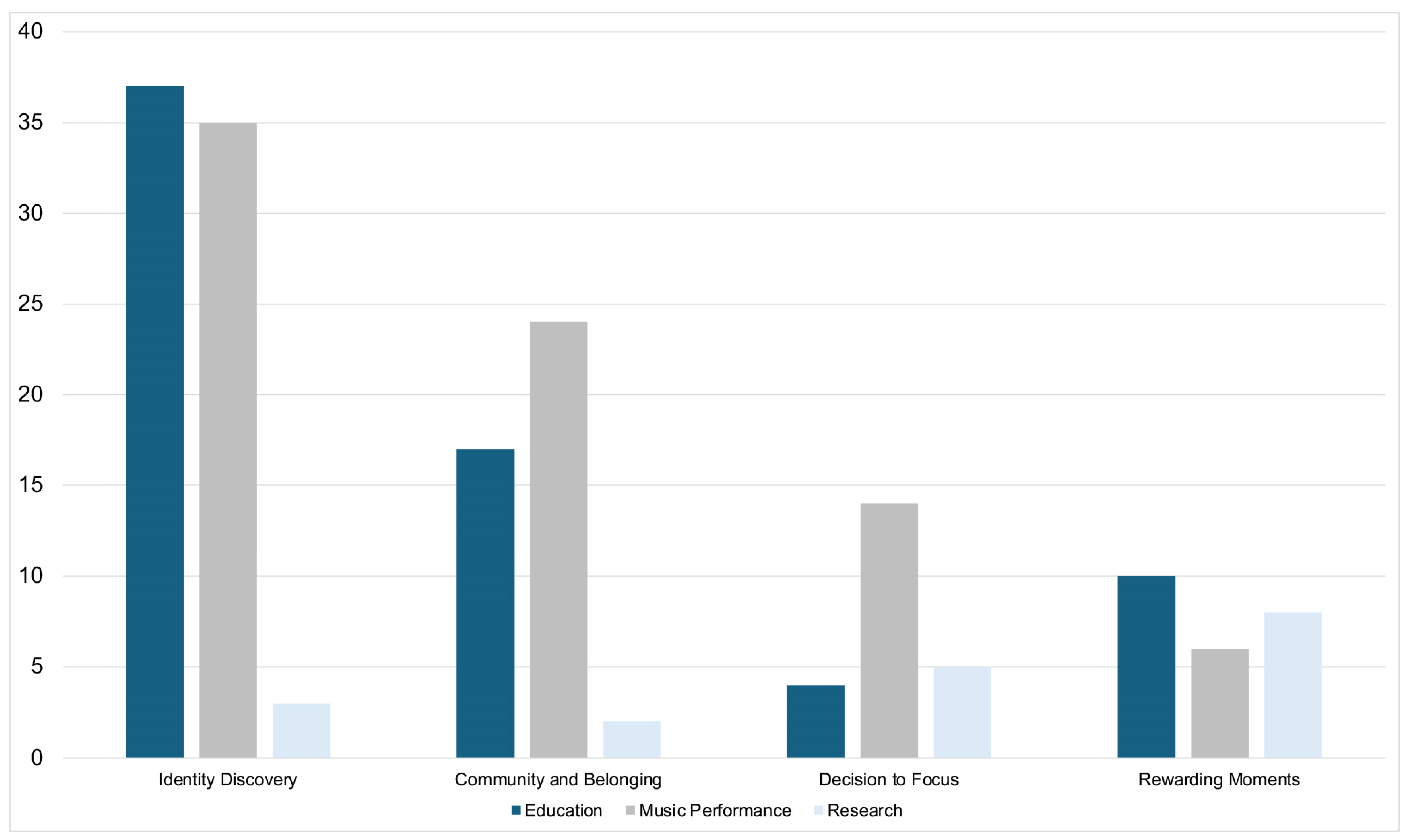
| ID_Edu | Identity discovery: Education | 37 | 23.86 | 569.47 |
| ID_MusPerf | Identity discovery: Music performance | 35 | 21.86 | 478.02 |
| ID_Res | Identity discovery: Research | 3 | −10.14 | 102.75 |
| CaB_Edu | Community and belonging: Education | 17 | 3.86 | 14.93 |
| CaB_Mus | Community and belonging: Music | 24 | 10.86 | 118.02 |
| CaB_Res | Community and belonging: Research | 2 | −11.14 | 124.02 |
| Des_Foc_Ed | Decision to focus on education | 4 | −9.14 | 83.47 |
| Des_Foc_MusPerf | Decision to focus on music performance | 14 | 0.86 | 0.75 |
| Des_Foc_Res | Decision to focus on research | 5 | −8.14 | 66.20 |
| CompInt | Competing interests | 11 | −2.14 | 4.56 |
| RewMom_Edu | Rewarding moments: Education | 10 | −3.14 | 9.84 |
| RewMom_Mus | Rewarding moments: Music | 6 | −7.14 | 50.93 |
| RewMom_Res | Rewarding moments: Research | 8 | −5.14 | 26.38 |
| JugIDs | Juggling identities | 8 | −5.14 | 26.38 |
| F_NotFit | Feelings of not fitting in | 8 | −5.14 | 26.38 |
| F_Belong | Feelings of belonging | 6 | −7.14 | 50.93 |
| Rej_PD_Opp | Rejection from school: Professional development opportunity | 12 | −1.14 | 1.29 |
| Compr_PD_Opp | Compromise and affordance of professional development opportunity | 14 | 0.86 | 0.75 |
| Conn_ERA | Finding connections between each component of ERA | 15 | 1.86 | 3.47 |
| Benefits_ERA | Benefits of inhabiting the ERA identity | 24 | 10.86 | 118.02 |
| Aff_ID | Affirming identity | 11 | −2.14 | 4.56 |
| SchooNoConn_ERA | School unable to see connection between music or research and duties at work | 15 | 1.86 | 3.47 |
| 22 Codes | Total | 289 |
Disclaimer/Publisher’s Note: The statements, opinions and data contained in all publications are solely those of the individual author(s) and contributor(s) and not of MDPI and/or the editor(s). MDPI and/or the editor(s) disclaim responsibility for any injury to people or property resulting from any ideas, methods, instructions or products referred to in the content. |
© 2025 by the author. Licensee MDPI, Basel, Switzerland. This article is an open access article distributed under the terms and conditions of the Creative Commons Attribution (CC BY) license (https://creativecommons.org/licenses/by/4.0/).
Share and Cite
Heath, K.L. Balancing Identities: An Autoethnographic Inquiry of the Educator–Researcher–Artist Self. Educ. Sci. 2025, 15, 1630. https://doi.org/10.3390/educsci15121630
Heath KL. Balancing Identities: An Autoethnographic Inquiry of the Educator–Researcher–Artist Self. Education Sciences. 2025; 15(12):1630. https://doi.org/10.3390/educsci15121630
Chicago/Turabian StyleHeath, Karen L. 2025. "Balancing Identities: An Autoethnographic Inquiry of the Educator–Researcher–Artist Self" Education Sciences 15, no. 12: 1630. https://doi.org/10.3390/educsci15121630
APA StyleHeath, K. L. (2025). Balancing Identities: An Autoethnographic Inquiry of the Educator–Researcher–Artist Self. Education Sciences, 15(12), 1630. https://doi.org/10.3390/educsci15121630