


Self-Concept and Feeling of Belonging as a Predictor Variable of the Attitude towards the Study from the PISA 2018 Report



Abstract
1. Introduction
2. Materials and Methods
2.1. Participants
2.2. Instrument
2.3. Procedure
2.4. Data Analysis
3. Results
3.1. Descriptive Statistics, Reliability and Bivariate Correlations
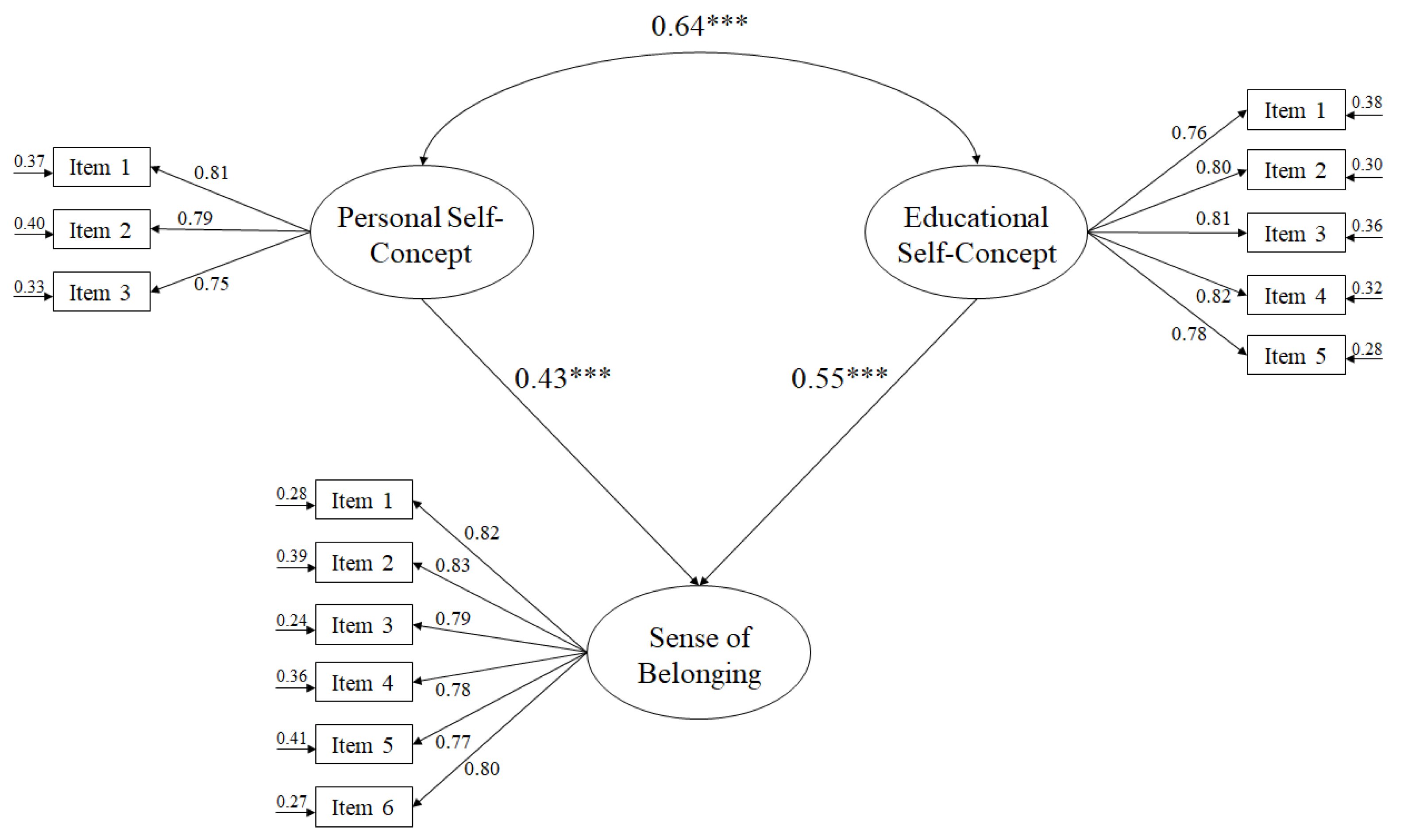
3.2. Structural Equation Model
- (a)
- Personal Self-Concept and Educational Self-Concept correlated positively (β = 0.64, p < 0.001).
- (b)
- Personal Self-Concept is positively related to sense of belonging (β = 0.43, p < 0.001).
- (c)
- Educational Self-Concept is positively related to sense of belonging (β = 0.55, p < 0.001).
4. Discussion
Author Contributions
Funding
Institutional Review Board Statement
Informed Consent Statement
Data Availability Statement
Conflicts of Interest
Appendix A
References
- Esnaola, I.; Goñi, A.; Madariaga, J.M. El autoconcepto: Perspectivas de investigación. Rev. Psicodidáctica 2008, 13, 179–194. [Google Scholar]
- Cornellà-Font, M.G.; Viñas-Poch, F.; Juárez-López, J.R.; Malo-Cerrato, S. Risk of addiction: Its prevalence in adolescence and its relationship with security of attachment and self-concept. Clin. Health 2020, 31, 21–25. [Google Scholar] [CrossRef] [Scilit]
- Fuentes, M.C.; García, J.F.; Gracia, E.; Lila, M. Autoconcepto y ajuste psicosocial en la dolescencia. Psicothema 2011, 23, 7–12. [Google Scholar] [PubMed]
- Enrique, M.; Muñoz, R. El problema de la autoestima basado en la eficacia. PSOCIAL 2015, 1, 52–58. [Google Scholar]
- Arslan, E. Investigation of Pre-School Childrens’ Self-Concept in terms of Emotion Regulation Skill, Behavior and Emotional Status. An. Psicol. 2021, 37, 508–515. [Google Scholar] [CrossRef] [Scilit]
- Guay, F.; Pantano, H.; Boivin, M. Autoconcepto y logro académico: Perspectivas del desarrollo sobre su ordenamiento causal. D. Psicol. Educ. 2003, 95, 124–136. [Google Scholar]
- Martínez-Antón, M.; Buelga, S.; Cava, M.J. La satisfacción con la vida en la adolescencia y su relación con la autoestima y el ajuste escolar. Anu. Psicol. 2007, 38, 293–303. [Google Scholar]
- Goñi, A.; Esnaola, I.; de Ruiz Azúa, S.; Rodríguez, A.; Zulaika, L.M. Autoconcepto físico y desarrollo personal: Perspectivas de investigación. Rev. Psicodidáctica 2003, 15–16, 7–62. [Google Scholar]
- Garaigordobil, M.; Durá, A.; Pérez, J.I. Síntomas psicopatológicos, problemas de conductayautoconcepto—autoestima: Un estudio con adolescentes de 14 a 17 años. Anu. Psicol. Clínica Salud 2005, 1, 53–63. [Google Scholar]
- De la Torre, C.; Ávila, A. Diferencias individuales en las atribuciones causales de los alumnos y su influencia en el componente afectivo. Rev. Mex. Psicol. 2003, 20, 237–246. [Google Scholar]
- Taylor, L.D.; Davis-Kean, P.; Malanchuk, O. Self-Esteem, academic self-concept, and aggression at school. Aggress. Behav. 2007, 33, 130–136. [Google Scholar] [CrossRef] [Scilit] [PubMed]
- Celorrio, R.; Finistrosa, E. Estudio sobre las relaciones entre nivel de autoconcepto y rendimiento académico. Rev. Cienc. Educ. 2009, 218, 221–243. [Google Scholar]
- Sevilla-Santo, D.E.; Martín-Pavón, M.J.; Sunza-Chan, S.P.; Druet-Domínguez, N.V. Self-Concept, Expectations, and Meaning of Life: Sinergy That Determines Learning. Rev. Electrónica Educ. 2021, 25, 223–245. [Google Scholar]
- Zsolnai, A. Relationship between children’s social competence, learning motivation and school achievement. Educ. Psychol. 2002, 22, 317–329. [Google Scholar] [CrossRef] [Scilit]
- Barquín, A. ¿De dónde son los hijos de los inmigrantes? La construcción de la identidad y la escuela. Educar 2009, 44, 81–96. [Google Scholar] [CrossRef] [Scilit]
- García, D.L.; Padilla, E.H.; Hernández, B.P. Analysis of the psychometric properties of the Piers-Harris Self-Concept Scale 2 in Mexican school children. Rev. Psicol. Cienc. Comport. UACJS RPCC-UACJS 2020, 11, 39–53. [Google Scholar]
- Merenstein, B. La construcción de identidad en las minorías: Acerca de su importancia y sus consecuencias teóricas. Araucaria Rev. Iberoam. Filos. Política Humanid. 2001, 6, 96–112. [Google Scholar]
- Hagborg, W. An investigation of a brief measure of school membership. Adolescence 1998, 33, 461–468. [Google Scholar]
- Brea, L. Factores determinantes del sentido de pertenencia de los estudiantes de arquitectura de la Pontificia Universidad Católica Madre y Maestra, Campus Santo Tomás de Aquino. Ph.D. Thesis, Universidad de Murcia, Murcia, Spain, 2014. [Google Scholar]
- Pratiwi, F.D.; Mangunsong, F.M. Social Support Impact on Academic Self-Concept of Students with Special Needs. Electron. J. Res. Educ. Psychol. 2020, 18, 143–158. [Google Scholar] [CrossRef] [Scilit]
- Rogers, C. A Theory of Therapy, Personality, and Interpersonal Relationships as Developed in the Client-Centered Framework. Reprinted. In The Carl Rogers Reader; Kirschenbaum, H., Henderson, V., Eds.; Houghton Mifflin: Boston, MA, USA, 1959. [Google Scholar]
- Rogers, C.R. El proceso de Convertirse en Persona; Ediciones Paidos Iberica: Barcelona, Spain, 2003. [Google Scholar]
- Vereau, E. Relación entre el autoconcepto, la ansiedad ante los exámenes y el rendimiento Académico en estudiantes de secundaria de Lima. Bachelor’s Thesis, Universidad Inca Garcilaso de la Vega, Lima, Peru, 1998. [Google Scholar]
- Shavelson, R.J.; Hubner, J.J.; Stanton, J.C. Self-concept: Validation of construct interpretation. Rev. Educ. Res. 1976, 46, 407–441. [Google Scholar] [CrossRef]
- Harter, S. The Construction of Self: Developmental and Sociocultural Foundations; The Guilford Press: New York, NY, USA, 2012. [Google Scholar]
- Cardenal, V.; Fierro, A. Componentes y correlatos del autoconcepto en la escala de Piers-Harris. Estud. Psicol. 2003, 24, 101–111. [Google Scholar] [CrossRef] [Scilit]
- Ballester, L.; March, M.; Orte, C. Autoconcepto, estilos de afrontamiento y conducta del alumnado universitario. Rev. Cienc. Soc. 2006, 27, 249–278. [Google Scholar]
- Fernández, M.; Mena, L.; Riviere, J. Fracaso Y Abandono Escolar en España; Obra Social Fundación: Barcelona, Spain, 2010. [Google Scholar]
- Etxeberría, F.; Elosegui, K. Integración del alumnado inmigrante: Obstáculos y propuestas. Rev. Española Educ. Comp. 2010, 16, 235–264. [Google Scholar]
- Finn, J. Withdrawing from school. Rev. Educ. Res. 1989, 59, 117–142. [Google Scholar] [CrossRef]
- Goodenow, C. The psychological sense of school membership among adolescents: Scale development and educational correlates. J. Psychol. Sch. 1993, 30, 79–90. [Google Scholar] [CrossRef] [Scilit]
- Appleton, J.; Christenson, S.; Furlong, M. Student engagement: Critical conceptual and methodological issues of the construct. Psychol. Sch. 2008, 45, 369–386. [Google Scholar] [CrossRef] [Scilit]
- You, S.; Ritchey, K.; Furlong, M.; Shochet, I.; Boman, P. Examination of the latent structure of the psychological sense of school membership. J. Psychoeduc. Assess. 2011, 29, 225–237. [Google Scholar] [CrossRef] [Scilit]

| Factors | M | SD | α | 1 | 2 | 3 |
|---|---|---|---|---|---|---|
| Personal self-concept | 3.18 | 0.72 | 0.79 | - | 0.51 *** | 0.34 *** |
| Educational self-concept | 3.35 | 1.15 | 0.84 | - | 0.67 *** | |
| Sense of belonging | 2.78 | 0.79 | 0.73 | - |
Publisher’s Note: MDPI stays neutral with regard to jurisdictional claims in published maps and institutional affiliations. |
© 2022 by the authors. Licensee MDPI, Basel, Switzerland. This article is an open access article distributed under the terms and conditions of the Creative Commons Attribution (CC BY) license (https://creativecommons.org/licenses/by/4.0/).
Share and Cite
Gutiérrez, N.; Mercader, I.; Carrión, J.J.; Trigueros, R. Self-Concept and Feeling of Belonging as a Predictor Variable of the Attitude towards the Study from the PISA 2018 Report. Educ. Sci. 2022, 12, 91. https://doi.org/10.3390/educsci12020091
Gutiérrez N, Mercader I, Carrión JJ, Trigueros R. Self-Concept and Feeling of Belonging as a Predictor Variable of the Attitude towards the Study from the PISA 2018 Report. Education Sciences. 2022; 12(2):91. https://doi.org/10.3390/educsci12020091
Chicago/Turabian StyleGutiérrez, Nieves, Isabel Mercader, José Juan Carrión, and Rubén Trigueros. 2022. "Self-Concept and Feeling of Belonging as a Predictor Variable of the Attitude towards the Study from the PISA 2018 Report" Education Sciences 12, no. 2: 91. https://doi.org/10.3390/educsci12020091
APA StyleGutiérrez, N., Mercader, I., Carrión, J. J., & Trigueros, R. (2022). Self-Concept and Feeling of Belonging as a Predictor Variable of the Attitude towards the Study from the PISA 2018 Report. Education Sciences, 12(2), 91. https://doi.org/10.3390/educsci12020091

