The Battle between the Correct and Mirror Writings of a Digit in Children’s Recognition Memory


Abstract
1. Introduction
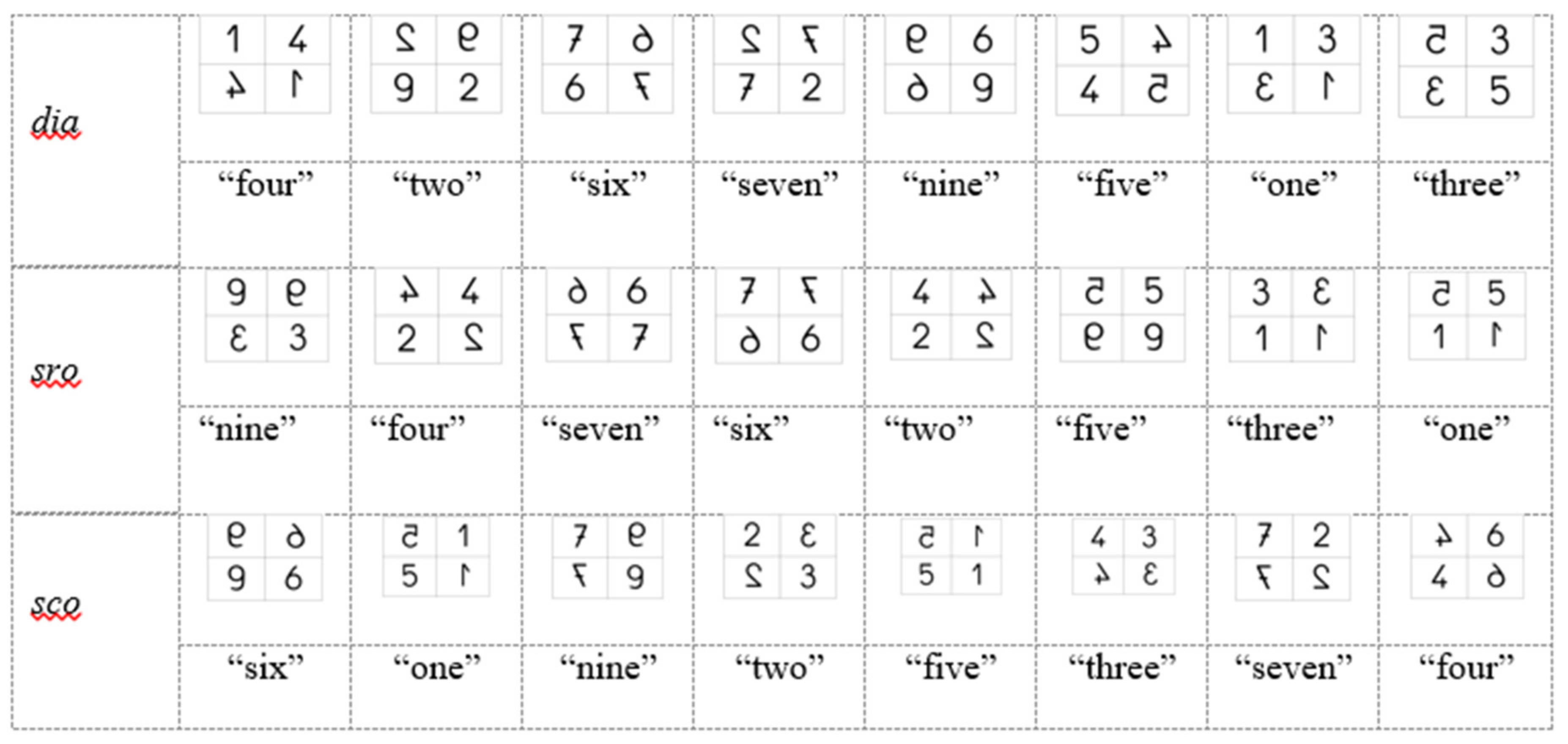
 in the first column and row (i.e., diagonally opposite from target); the matrix was completed with the digit 3 (i.e., any other asymmetrical digit) and its reversal e. All the other seven matrices followed an analogous construction.
2. Experiment
2.1. Material and Method
2.1.1. Participants
2.1.2. Material
2.1.3. Apparatus
2.1.4. Procedure
2.1.5. Hypotheses
 respectively. Note that the debatable right-oriented categorization of digit 4 was well argued in other studies [28,33].
2.2. Results
2.2.1. Behavioral Results
2.2.2. Eye-Tracking Results
3. Discussion
3.1. The “Battle” between Correct and Reversed Writings of Digits in Children’s Recognition Memory
3.2. The Right Spatial Position Versus Digit’s Orientation Bias in the Children’s Recognition Response-Choices
3.3. Educational Implications
3.4. Limitations of the Study
4. Conclusions
Author Contributions
Funding
Acknowledgments
Conflicts of Interest
References
- Buchwald, A. Spiegelschrift bei Hirnkranken [Mirror writing in patients with cerebral disease]. Berliner klinische Wochenschrift 1878, 5, 6–8. [Google Scholar]
- Orton, S.T. “Word-blindness” in school children. Arch. Neurol. Psychiatry 1925, 14, 581–615. [Google Scholar] [CrossRef] [Scilit]
- Corballis, M.C. The left-right problem in psychology. Can. Psychol. 1974, 15, 16–33. [Google Scholar] [CrossRef] [Scilit]
- Corballis, M.C.; Beale, I.L. The Psychology of Left and Right; Erlbaum: New York, NY, USA, 1976. [Google Scholar]
- Corballis, M.C. Mirror-image equivalence and interhemispheric mirror-image reversal. Front. Hum. Neurosci. 2018, 12, 140. [Google Scholar] [CrossRef] [Scilit] [PubMed]
- Mather, D.S. Does dyslexia develop from learning the alphabet in the wrong hemisphere? A cognitive neuroscience analysis. Brain Lang. 2001, 76, 282–316. [Google Scholar] [CrossRef] [Scilit]
- Lachmann, T.; Geyer, T. Letter reversals in dyslexia: Is the case really closed? A critical review and conclusions. Psychol. Beitr. 2003, 45 (Suppl. 1), 50–70. [Google Scholar]
- Lachmann, T.; Van Leeuwen, C. Differentiation of holistic processing in the time course of letter recognition. Acta Psychol. 2008, 129, 121–129. [Google Scholar] [CrossRef] [Scilit]
- Lachmann, T. Reading and dyslexia: The functional coordination framework. In Reading and Dyslexia: From Basic Functions to Higher Order cognition; Lachmann, T., Weis, T., Eds.; Springer: Cham, Switzerland; Birkhäuser: Cham, Switzerland, 2018; pp. 271–296. [Google Scholar] [CrossRef] [Scilit]
- Banich, M.T. Hemispheric specialization and cognition. In Encyclopedia of Neuroscience; Squire, L.R., Ed.; Elsevier: Amsterdam, The Netherlands, 2010; pp. 1081–1086. [Google Scholar] [CrossRef] [Scilit]
- Kemler, D.G. Holistic and analytic modes in perceptual and cognitive development. In Perception, Cognition, and Development: Interactional Analyses; Tighe, T.J., Shepp, B.E., Eds.; Erlbaum: Hillsdale, NJ, USA, 1983; pp. 77–102. [Google Scholar]
- Stiles, J.; Delis, D.C.; Tada, W.L. Global-local processing in preschool children. Child Dev. 1991, 62, 1258–1275. [Google Scholar] [CrossRef]
- Carlos, B.J.; Hirshorn, E.A.; Durisko, C.; Fiez, J.A.; Coutanche, M.N. Word inversion sensitivity as a marker of visual word form area lateralization: An application of a novel multivariate measure of laterality. NeuroImage. 2019, 191, 493–502. [Google Scholar] [CrossRef] [Scilit]
- Gordon, H. Left-handedness and mirror writing, especially among defective children. Brain 1921, 43, 313–368. [Google Scholar] [CrossRef] [Scilit]
- Lebrun, Y. Mirror-reading and mirror-writing in schoolchildren. ANAE 1990, 2, 177–182. [Google Scholar]
- Della Sala, S.; Cubelli, R. Directional apraxia: A unitary account of mirror writing following brain injury or as found in normal young children. J. Neuropsychol. 2007, 1, 3–26. [Google Scholar] [CrossRef] [Scilit]
- Kushnir, T.; Arzouan, Y.; Karni, A.; Manor, D. Brain activation associated with practiced left hand mirror writing. Brain Lang. 2013, 125, 38–46. [Google Scholar] [CrossRef] [Scilit]
- Mather, D.S. Ipsilateral printing in children’s mirror-writing: A cause of specific learning disabilities? Can. J. Exp. Psychol. 2012, 66, 172–180. [Google Scholar] [CrossRef] [Scilit]
- Kolers, P.A. Clues to a letter’s recognition: Implications for the design of characters. J. Typogr. Res. 1969, 3, 145–168. [Google Scholar]
- Simner, M.L. The grammar of action and reversal errors in children’s printing. Dev. Psychol. 1984, 20, 136–142. [Google Scholar] [CrossRef]
- Fischer, J.P. Vers une levée du mystère des écritures en miroir (des lettres majuscules) chez l’enfant: Une hypothèse nouvelle. Enfance 2010, 62, 371–386. [Google Scholar] [CrossRef] [Scilit]
- Treiman, R.; Kessler, B. Similarities among the shapes of writing and their effects on learning. Writ. Lang. Lit. 2011, 14, 39–57. [Google Scholar] [CrossRef] [Scilit] [PubMed]
- Dehaene, S. Reading in the Brain: The New Science of How We Read; Penguin Books: London, UK, 2010. [Google Scholar]
- Freiwald, W.A.; Tsao, D.Y. Functional compartmentalization and viewpoint generalization within the macaque face-processing system. Science 2010, 330, 845–851. [Google Scholar] [CrossRef] [Scilit]
- Kietzmann, T.C.; Swisher, J.D.; König, P.; Tong, F. Prevalence of selectivity for mirror-symmetric views of faces in the ventral and dorsal visual pathways. J. Neurosci. 2012, 32, 11763–11772. [Google Scholar] [CrossRef] [Scilit]
- Kietzmann, T.C.; Poltoratski, S.; König, P.; Blake, R.; Tong, F.; Ling, S. The occipital face area is causally involved in facial viewpoint perception. J. Neurosci. 2015, 35, 16398–16403. [Google Scholar] [CrossRef] [Scilit] [PubMed]
- McIntosh, R.D.; Anderson, E.L.; Henderson, R.M. Experimental confirmation of a character-facing bias in literacy development. J. Exp. Child Psychol. 2018, 170, 207–214. [Google Scholar] [CrossRef] [Scilit] [PubMed]
- Fischer, J.P.; Luxembourger, C. A synoptic and theoretical account of character (digits and capital letters) reversal in writings by typically developing children. Educ. Sci. 2018, 8, 137. [Google Scholar] [CrossRef] [Scilit]
- Fischer, J.P. Character reversal in children: The prominent role of writing direction. Read. Writ. 2017, 30, 523–542. [Google Scholar] [CrossRef] [Scilit]
- Portex, M.; Hélin, C.; Ponce, C.; Foulin, J.N. Dynamics of mirror writing compared to conventional writing in typical preliterate children. Read. Writ. 2018, 31, 1435–1448. [Google Scholar] [CrossRef] [Scilit]
- Treiman, R.; Gordon, J.; Boada, R.; Peterson, R.L.; Pennington, B.F. Statistical learning, letter reversals, and reading. Sci. Stud. Read. 2014, 18, 383–394. [Google Scholar] [CrossRef] [Scilit] [PubMed]
- Fischer, J.P. Studies on the written characters orientation and its influence on digit reversal by children. Educ. Psychol.-UK 2018, 38, 556–571. [Google Scholar] [CrossRef] [Scilit]
- Fischer, J.P. Digit reversal in children’s writing: A simple theory and its empirical validation. J. Exp. Child Psychol. 2013, 115, 356–370. [Google Scholar] [CrossRef] [Scilit]
- Tazouti, Y.; Jarlegan, A. Les Apprentissages Premiers en école Maternelle à l’ère du Numérique: Contribution du Projet LINUMEN. The Conversation. Available online: https://theconversation.com/les-apprentissages-premiers-en-ecole-maternelle-a-lere-du-numerique-contribution-du-projet-linumen-94074 (accessed on 31 October 2018).
- Tobii, A.B. Tobii Pro Glasses Analyzer: User’s Manual (Version 1.41). Available online: https://bmslab.utwente.nl/wp-content/uploads/2018/03/Tobii-Pro-Glasses-2-Analyzer-manual.pdf (accessed on 31 October 2018).
- Lawrence, M.A. Easy Analysis and Visualization of Factorial Experiments (Package ‘ez’, Version 4.4-0). Available online: https://cran.r-project.org/web/packages/ez/ez.pdf (accessed on 22 September 2018).
- Bates, D.; Maechler, M.; Bolker, B.; Walker, S. Fitting linear mixed-effects models using lme4. J. Stat. Softw. 2015, 67, 1–48. [Google Scholar] [CrossRef] [Scilit]
- Patro, K.; Nuerk, H.C.; Brugger, P. Visuospatial biases in preschool children: Evidence from line bisection in three-dimensional space. J. Exp. Child Psychol. 2018, 173, 16–27. [Google Scholar] [CrossRef] [Scilit]
- Boiteau, T.W.; Smith, C.; Almor, A. Rightward directional bias in art produced by cultures without a written language. Laterality 2020, 25, 165–176. [Google Scholar] [CrossRef] [Scilit] [PubMed]
- Maass, A.; Suitner, C.; Deconchy, J.P. Living in an Asymmetrical World: How Writing Direction Affects Thought and Action; Psychology Press: London, UK, 2014. [Google Scholar]
- Patro, K.; Nuerk, H.C.; Cress, U. Does your body count? Embodied influences on the preferred counting direction of preschoolers. J. Cogn. Psychol. 2015, 27, 413–425. [Google Scholar] [CrossRef] [Scilit]
- Göbel, S.M.; McCrink, K.; Fischer, M.H.; Shaki, S. Observation of directional storybook reading influences young children’s counting direction. J. Exp. Child Psychol. 2018, 166, 49–66. [Google Scholar] [CrossRef] [Scilit] [PubMed]
- Lange-Küttner, C. Disappearance of biased visual attention in infants: Remediated tonic neck reflex or maturating visual asymmetry? Percept. Motor Skill. 2018, 125, 839–865. [Google Scholar] [CrossRef] [Scilit]
- Failla, C.V.; Sheppard, D.M.; Bradshaw, J.L. Age and responding-hand related changes in performance of neurologically normal subjects on the line-bisection and chimeric-faces tasks. Brain Cogn. 2003, 52, 353–363. [Google Scholar] [CrossRef] [Scilit]
- Dehaene, S.; Bossini, S.; Giraux, P. The mental representation of parity and number magnitude. J. Exp. Psychol. Gen. 1993, 122, 371–396. [Google Scholar] [CrossRef]
- Sella, F.; Lucangeli, D.; Zorzi, M. Spatial order relates to the exact numerical magnitude of digits in young children. J. Exp. Child Psychol. 2019, 178, 385–404. [Google Scholar] [CrossRef] [Scilit]
- Hoffmann, D.; Hornung, C.; Martin, R.; Schiltz, C. Developing number–space associations: SNARC effects using a color discrimination task in 5–year–olds. J. Exp. Child Psychol. 2013, 116, 775–791. [Google Scholar] [CrossRef] [Scilit]
- Weis, T.; Estner, B.; van Leeuwen, C.; Lachmann, T. SNARC (spatial–numerical association of response codes) meets SPARC (spatial–pitch association of response codes): Automaticity and interdependency in compatibility effects. Q. J. Exp. Psychol. 2016, 69, 1366–1383. [Google Scholar] [CrossRef] [Scilit]
- Richmond, J.; Taylor, M. Visual recognition difficulties: Identifying primary school students’ directional confusion in writing letters and numbers. S. Afr. J. Occup. Ther. 2014, 44, 2–6. [Google Scholar]
- McIntosh, R.D.; Hillary, K.; Brennan, A.; Lechowicz, M. Developmental mirror-writing is paralleled by orientation recognition errors. Laterality 2018, 23, 664–683. [Google Scholar] [CrossRef] [Scilit] [PubMed]
- Ahr, E.; Houdé, O.; Borst, G. Inhibition of the mirror generalization process in reading in school-aged children. J. Exp. Child Psychol. 2016, 145, 157–165. [Google Scholar] [CrossRef] [Scilit] [PubMed]
- Fischer, J.P.; Tazouti, Y. Unraveling the mystery of mirror writing in typically developing children. J. Educ. Psychol. 2012, 104, 193–205. [Google Scholar] [CrossRef] [Scilit]
- Goodnow, J.J.; Levine, R.A. The grammar of action: Sequence and syntax in children’s copying. Cogn. Psychol. 1973, 4, 82–98. [Google Scholar] [CrossRef] [Scilit]
- Doi, H.; Shinohara, K. Attention allocation towards own face is pronounced during middle adolescence: An eye-tracking study. Dev. Sci. 2018, 21, e12490. [Google Scholar] [CrossRef] [Scilit]
- Urgolites, Z.J.; Smith, C.N.; Squire, L.R. Eye movements support the link between conscious memory and medial temporal lobe function. Proc. Natl. Acad. Sci. USA 2018, 115, 7599–7604. [Google Scholar] [CrossRef] [Scilit]
- Ryan, J.D.; Hannula, D.E.; Cohen, N.J. The obligatory effects of memory on eye movements. Memory 2007, 15, 508–525. [Google Scholar] [CrossRef] [Scilit]
- Brault-Foisy, L.M.; Ahr, E.; Masson, S.; Houdé, O.; Borst, G. Is inhibitory control involved in discriminating pseudowords that contain the reversible letters b and d? J. Exp. Child Psychol. 2017, 162, 259–267. [Google Scholar] [CrossRef] [Scilit]
- Davidson, H.P. A study of the confusing letters b, d, p, and q. Pedagog. Semin. J. Gen. 1935, 47, 458–468. [Google Scholar] [CrossRef] [Scilit]
- Fernandes, T.; Leite, I. Mirrors are hard to break: A critical review and behavioral evidence on mirror-image processing in developmental dyslexia. J. Exp. Child Psychol. 2017, 159, 66–82. [Google Scholar] [CrossRef] [Scilit]
- Fernandes, T.; Leite, I.; Kolinsky, R. Into the looking glass: Literacy acquisition and mirror invariance in preschool and first-grade children. Child Dev. 2016, 87, 2008–2025. [Google Scholar] [CrossRef] [Scilit] [PubMed]
- Liberman, I.Y.; Shankweiler, D.; Orlando, C.; Harris, K.S.; Berti, F.B. Letter confusions and reversals of sequence in the beginning reader: Implications for Orton’s theory of developmental dyslexia. Cortex 1971, 7, 127–142. [Google Scholar] [CrossRef] [Scilit]
- Orton, S.T. A physiological theory of reading disability and stuttering in children. N. Engl. J. Med. 1928, 199, 1046–1052. [Google Scholar] [CrossRef] [Scilit]
- Wechsler, D.; Pignatelli, M.L. Reversal errors in reading: Phenomena of axial rotation. J. Educ. Psychol. 1937, 28, 215–221. [Google Scholar] [CrossRef] [Scilit]
- Soares, A.P.; Lages, A.; Oliveira, H.; Hernández, J. The mirror reflects more for d than for b: Right asymmetry bias on the visual recognition of words containing reversal letters. J. Exp. Child Psychol. 2019, 182, 18–37. [Google Scholar] [CrossRef] [Scilit]
- Longcamp, M.; Anton, J.L.; Roth, M.; Velay, J.L. Visual presentation of single letters activates a premotor area involved in writing. NeuroImage 2003, 19, 1492–1500. [Google Scholar] [CrossRef] [Scilit]
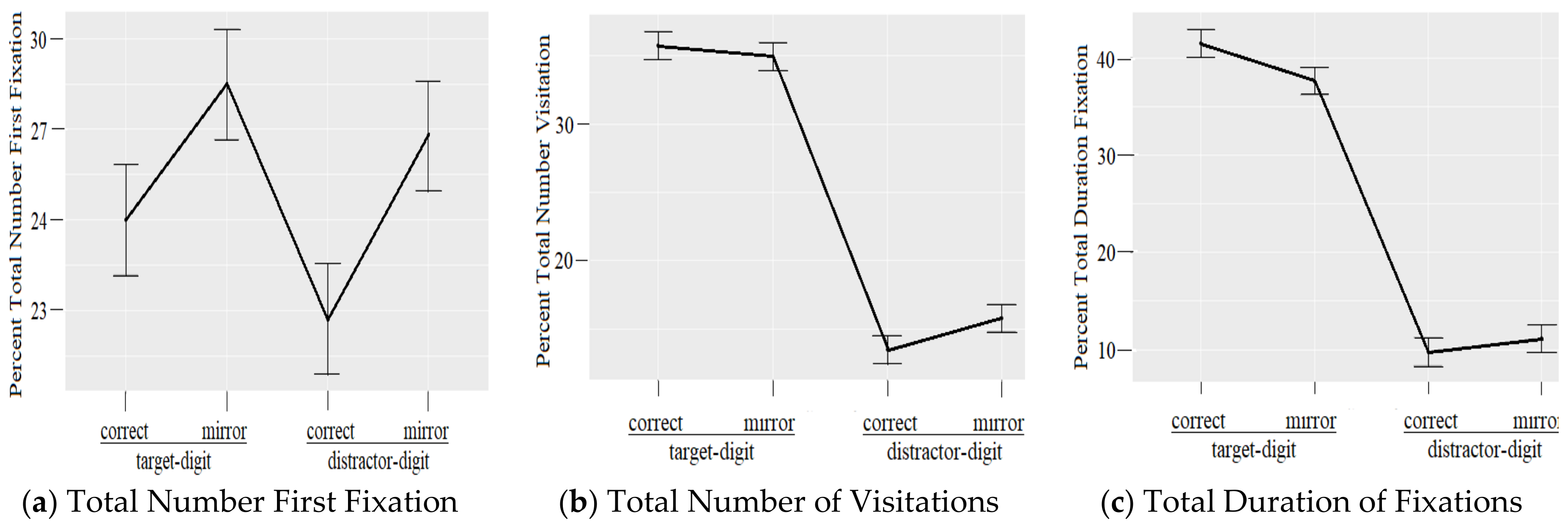
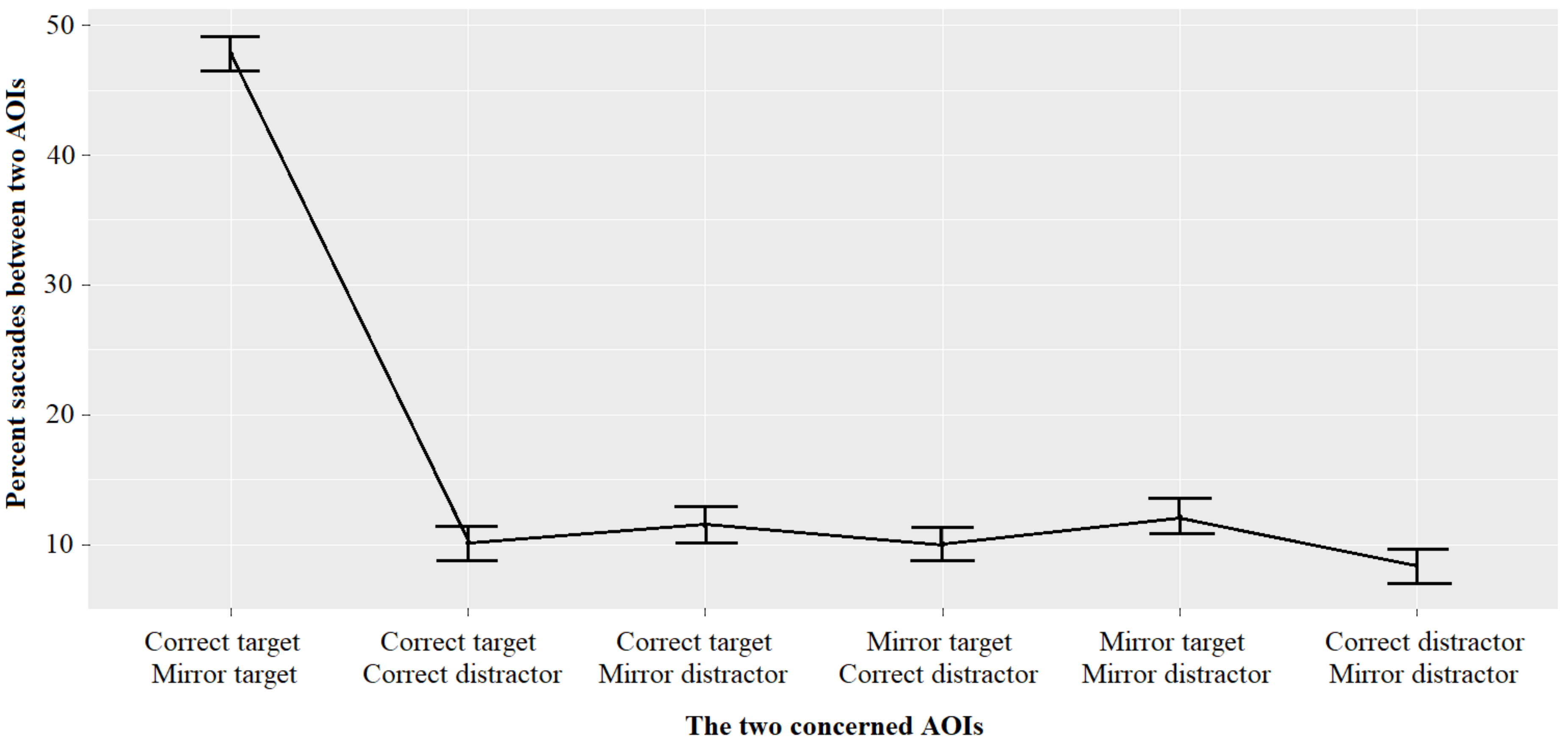
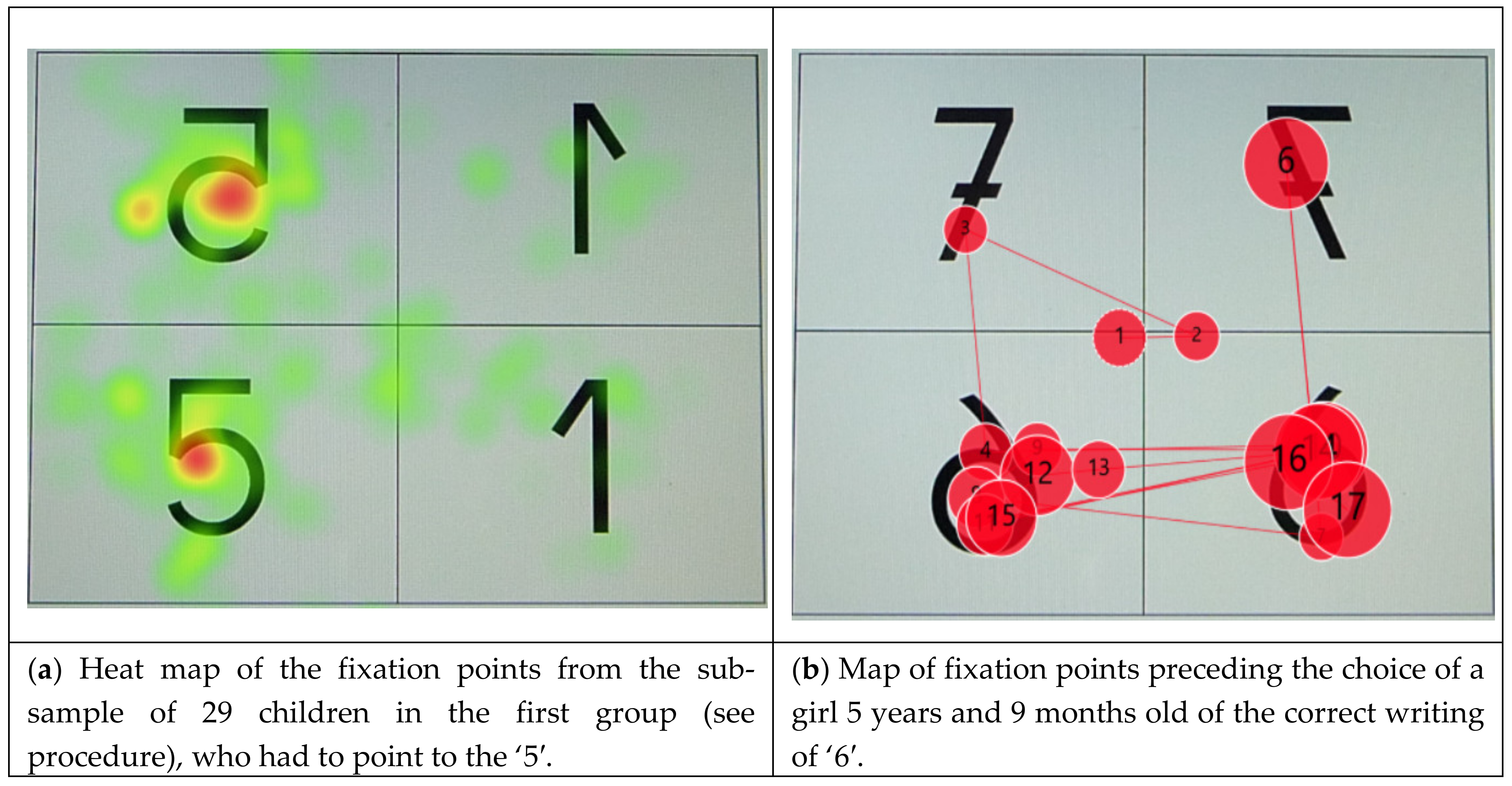
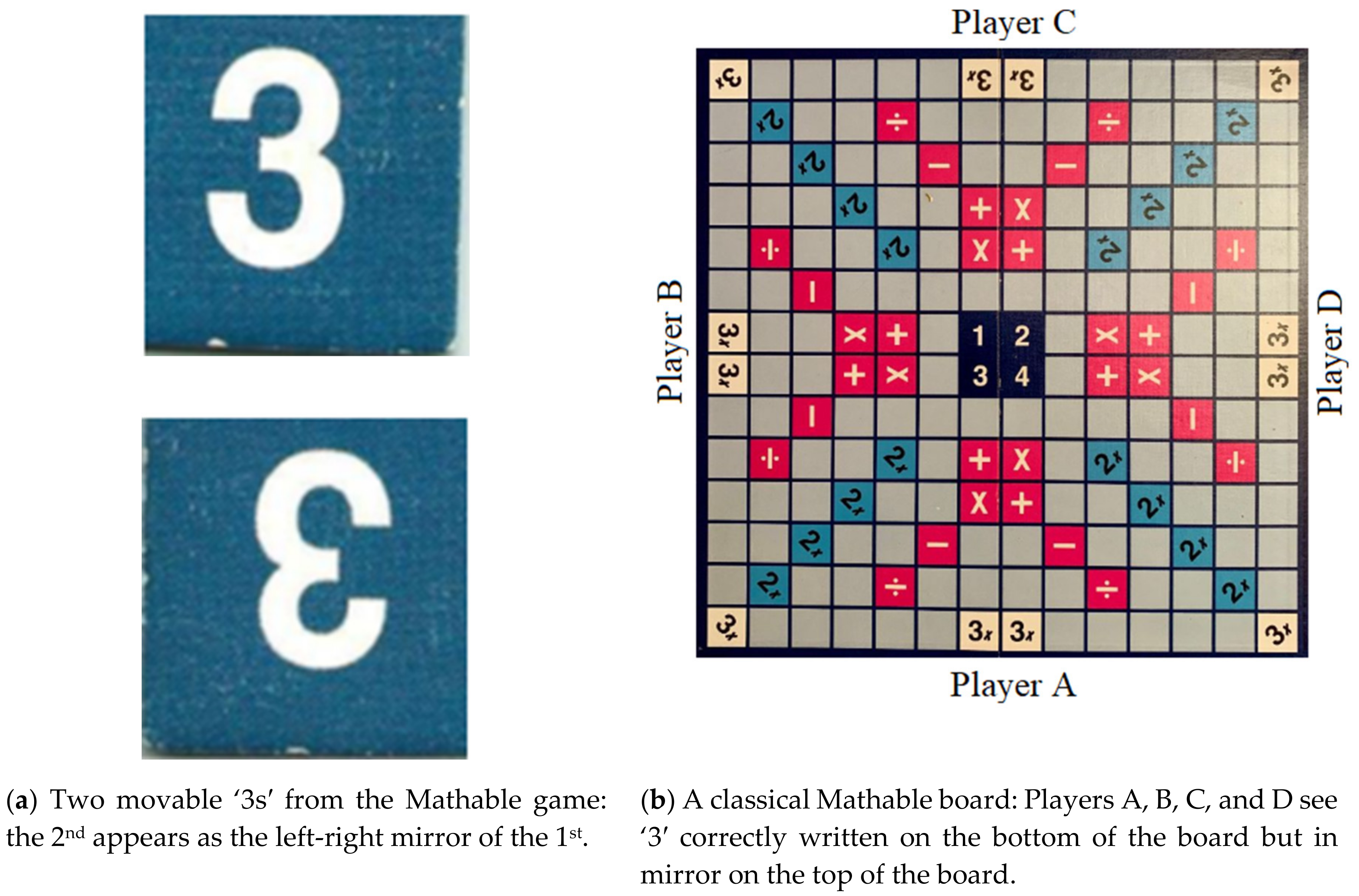

| Choice | 1 | 2 | 3 | 4 | 5 | 6 | 7 | 9 |
|---|---|---|---|---|---|---|---|---|
| Correct Target | 54.67 | 68.67 | 69.33 | 60.00 | 61.33 | 60.00 | 56.67 | 50.00 |
| Mirror Target | 45.33 | 31.33 | 30.67 | 40.00 | 37.33 | 36.00 | 42.00 | 44.00 |
| Correct Distractor | 0.00 | 0.00 | 0.00 | 0.00 | 0.00 | 0.67 | 0.67 | 5.33 |
| Mirror Distractor | 0.00 | 0.00 | 0.00 | 0.00 | 1.33 | 3.33 | 0.67 | 0.67 |
© 2020 by the authors. Licensee MDPI, Basel, Switzerland. This article is an open access article distributed under the terms and conditions of the Creative Commons Attribution (CC BY) license (http://creativecommons.org/licenses/by/4.0/).
Share and Cite
Fischer, J.-P.; Luxembourger, C. The Battle between the Correct and Mirror Writings of a Digit in Children’s Recognition Memory. Educ. Sci. 2020, 10, 183. https://doi.org/10.3390/educsci10070183
Fischer J-P, Luxembourger C. The Battle between the Correct and Mirror Writings of a Digit in Children’s Recognition Memory. Education Sciences. 2020; 10(7):183. https://doi.org/10.3390/educsci10070183
Chicago/Turabian StyleFischer, Jean-Paul, and Christophe Luxembourger. 2020. "The Battle between the Correct and Mirror Writings of a Digit in Children’s Recognition Memory" Education Sciences 10, no. 7: 183. https://doi.org/10.3390/educsci10070183
APA StyleFischer, J.-P., & Luxembourger, C. (2020). The Battle between the Correct and Mirror Writings of a Digit in Children’s Recognition Memory. Education Sciences, 10(7), 183. https://doi.org/10.3390/educsci10070183