1. Introduction
Poverty and income inequality remain central challenges in both developing and transition economies. Despite sustained economic growth in many countries, its benefits are often unevenly distributed, resulting in persistent socio-economic disparities (
Krugman, 1991;
Datt & Ravallion, 1992). In this context, identifying mechanisms that promote not only growth but also its inclusiveness has become a key research and policy priority.
Small and medium-sized enterprises (SMEs) are widely regarded as a key driver of inclusive economic development. They contribute to job creation, economic diversification, and the expansion of income-generating opportunities (
Beck et al., 2005;
van Stel et al., 2005). From a theoretical perspective, SME development is expected to reduce poverty by increasing employment and facilitating economic participation among vulnerable groups. However, empirical evidence suggests that these effects are far from uniform, particularly in transition economies characterized by institutional constraints and structural imbalances (
G. D. Bruton et al., 2013;
Sutter et al., 2019;
Maksimov et al., 2017).
Kazakhstan provides a relevant empirical setting for examining these relationships. The country has experienced significant economic growth alongside substantial regional disparities in income, poverty, and inequality. At the same time, SME development has been actively promoted as a policy priority. This raises a critical question: to what extent does SME development contribute to reducing poverty and inequality in a transition economy?
To address this question, the study conducts a regional analysis of Kazakhstan, incorporating multiple dimensions of poverty and employing econometric techniques that are robust to cross-sectional dependence.
The study makes three contributions to the entrepreneurship literature and directly engages with the ongoing debate on whether entrepreneurship promotes or hinders inclusive development.
First, it extends the SME–inequality debate by incorporating multidimensional poverty measures, moving beyond income-based indicators.
Second, it demonstrates that SME development is not a homogeneous driver of inclusive growth, but depends critically on its structural characteristics.
Third, it provides evidence from a transition economy where institutional constraints influence the relationship between entrepreneurship and socioeconomic outcomes.
Section 2 summarizes the literature on entrepreneurship, SMEs, poverty, and income inequality and formulates research hypotheses.
Section 3 outlines the data, variables, and estimation technique.
Section 4 reports the empirical results and discusses the heterogeneous impacts of SME development on poverty and inequality.
Section 5 concludes by discussing policy implications, limitations, and avenues for future research.
2. Literature Review
Research on the impact of entrepreneurship on poverty and income inequality has gained increasing attention in development economics, entrepreneurship, and policy debates on inclusive growth. While SMEs have traditionally been viewed as drivers of employment, innovation, and structural transformation, recent research suggests that their developmental effects are more heterogeneous than previously assumed. In particular, growing evidence suggests that entrepreneurship can alleviate poverty when supported by productive transformation and effective institutions. Otherwise, it may reinforce low-productivity employment, exacerbate inequality, or have only limited effects on welfare.
2.1. Economic Growth, Poverty, and Income Distribution
A large body of classical literature on poverty emphasizes that economic growth has little impact on welfare unless coupled with distributional changes and reductions in inequality.
Datt and Ravallion (
1992) argue that growth can reduce poverty only through income improvements and distributional shifts. Although proposed several decades ago, this conclusion continues to inform current debates on inclusive growth.
Subsequent research has shown that economic growth may coexist with persistent poverty when productive sectors fail to absorb labor, productivity remains unevenly distributed, or redistribution mechanisms are ineffective (
Obayelu & Edewor, 2022). Therefore, poverty should be analyzed not only through aggregate income growth but also through structural and distributional mechanisms.
Empirically, this insight applies strongly to transition contexts where inequality often rises alongside growth due to regional heterogeneity, institutional instability, and disparate access to productive resources.
2.2. SMEs and Inclusive Growth
Entrepreneurship research has traditionally viewed SMEs as important drivers of economic growth. According to early studies, SMEs create jobs, diversify markets, spur competition, and enhance entrepreneurial zeal (
Beck et al., 2005;
van Stel et al., 2005). An important distinction in entrepreneurship research is that between firm creation, entrepreneurship, innovation, and productivity growth. Empirical studies of SME development often equate firm creation with entrepreneurship and implicitly assume that entrepreneurial activity leads to innovation, productivity growth, and structural transformation. However, firm creation does not necessarily imply innovation, productivity growth, or structural transformation. SMEs operating in local markets, with limited market power and weak innovation capacity, may provide only subsistence employment and modest income opportunities, leaving firms trapped in low-productivity activities.
By contrast, innovative and growth-oriented SMEs can generate substantially higher economic returns by increasing productivity, promoting technological upgrading and knowledge spillovers, and integrating firms into larger value chains. Thus, the impact of SME development depends not only on the number of enterprises created but also on their ability to improve productivity and competitiveness. This may explain the mixed findings in the literature on the relationship between SME development, poverty, and inequality.
Recent studies build on these findings by introducing inclusive growth into the entrepreneurship-development paradigm. For example,
Acs et al. (
2018) show that entrepreneurship and entrepreneurial ecosystems matter, but their impact is conditioned by institutional context. According to
Aparicio et al. (
2021), entrepreneurship contributes to inclusive growth when it facilitates access to productive work and economic engagement.
Audretsch and Belitski (
2021) reach similar conclusions by showing that entrepreneurship quality, productivity, and knowledge complexity are more important than entrepreneurial activity alone. These studies reflect recent trends in the entrepreneurship literature toward quality-adjusted assessments of SME development rather than quantity-driven evaluations.
Despite agreement on SMEs’ positive role in economic development, empirical evidence remains mixed.
Urbano et al. (
2019) find that entrepreneurial activity is associated with poverty reduction and welfare outcomes. In contrast, other studies report that enterprise creation has little or no effect on welfare (
Sutter et al., 2019).
G. Bruton et al. (
2021) expand on this argument by showing that entrepreneurship may either diminish or reinforce socio-economic inequalities, depending on how it relates to institutional development.
Another important distinction in the entrepreneurship literature is that firm creation, entrepreneurship, and innovation are related but distinct concepts. Although existing research often treats entrepreneurship and firm formation as synonymous, creating new firms does not necessarily constitute entrepreneurship, nor does it automatically lead to innovation, productivity growth, or structural change. For example, a large fraction of SMEs in developing and transition countries serve local niche markets where competitive pressures are weak, innovation capacity is limited, and growth prospects are correspondingly poor. Under such conditions, these firms primarily absorb unemployed and underemployed workers, providing little beyond subsistence employment and basic income opportunities.
This stands in stark contrast to innovative or growth-oriented SMEs that have the potential to lead to disproportionate increases in aggregate welfare through productivity gains, knowledge spillovers, technological upgrading, and integration into national and global value chains. From this perspective, not all SMEs contribute equally to development; rather, their impacts depend on both quantity (how many SMEs there are) and quality, or the degree to which SMEs contribute to innovation and productivity growth. This line of reasoning may help explain why so many empirical studies of SME development find heterogeneous effects on poverty and inequality.
Emphasizing institutional drivers of heterogeneous development outcomes implies that SMEs should not be considered pro-poor a priori.
Recent entrepreneurship research extends this argument by showing that the developmental impact of SMEs depends not only on entrepreneurial activity but also on the quality of entrepreneurship.
Bosma et al. (
2018) argue that entrepreneurship only spurs inclusive growth when conducive entrepreneurial ecosystems channel entrepreneurial activity into productive uses by fostering innovation, knowledge diffusion, and opportunity discovery among entrepreneurs. Similarly,
Nambisan et al. (
2019) show that digital entrepreneurship is increasingly critical for economic development, implying that technology-enabled SMEs may have large and disproportionate welfare effects through innovation and market creation. Elsewhere,
Aparicio et al. (
2016) show that entrepreneurship is only inclusive if institutions are geared towards facilitating access to productive opportunities by wider segments of society. Along similar lines,
Stoica et al. (
2020) find that entrepreneurship positively impacts sustainable development if it leads to higher levels of productivity, competitiveness, and innovation. Taken together, this research suggests that the poverty-reducing effects of entrepreneurship depend on the extent to which it fosters innovation and productivity growth.
2.3. Poverty Beyond Incidence: Depth and Severity
Earlier poverty research primarily focused on incidence—the share of the population living below a given poverty line—while paying limited attention to other dimensions of deprivation. More recent studies have expanded poverty measurement to include poverty depth, severity, vulnerability, and social exclusion (
Putri et al., 2024;
Alkire & Fang, 2019).
This shift has two important implications for entrepreneurship research. First, although SMEs may reduce the number of people living in poverty, they may have little impact on those experiencing the deepest forms of deprivation.
Morris et al. (
2022) support this argument by showing that entrepreneurship may provide livelihoods with limited productivity gains and few long-term welfare improvements.
Second, as
Hashim and Gaddefors (
2023) show, in developing countries, entrepreneurs often face multiple dimensions of poverty, including exclusion from the educational system, a lack of productive assets, or institutional failure. These studies suggest that entrepreneurship scholars should look beyond income thresholds and examine poverty intensity.
Therefore, analyses focusing solely on poverty incidence may overlook the heterogeneous welfare effects of SME development.
Similar conclusions have recently been reached in other strands of multidimensional poverty literature. For example,
Alkire and Jahan (
2018) contend that poverty must be defined as a phenomenon that manifests itself not only through income deprivation but also through a lack of resources in terms of health, education, living standards and economic opportunity.
Santos and Villatoro (
2018) show that income-based poverty measures often fail to capture the dynamics of poverty, highlighting the need for multidimensional analysis.
Suppa (
2018) points out that vulnerability and persistence matter more for welfare than transitory income changes. In the same line of thought,
Burchi et al. (
2022) argue that poverty measurement needs to take into account phenomena related to social exclusion, access to productive assets, as well as human development. Consequently, the effects of SMEs should be assessed not only in terms of poverty incidence but also with respect to poverty depth, severity, and vulnerability.
2.4. Opportunity-Driven and Necessity-Driven Entrepreneurship
Opportunity entrepreneurship is typically linked to business innovation, productivity, scalability, and formality. In contrast, necessity-driven entrepreneurship is typically observed in countries with high unemployment and limited labor market opportunities (
Gindling & Newhouse, 2014;
Meyer & de Jongh, 2018).
Entrepreneurship may emerge as a response to weaknesses in labor markets and entrepreneurial ecosystems (
Williams & Vorley, 2014).
Welter et al. (
2017) consequently argue that entrepreneurship should be viewed through the lens of country-specific institutional arrangements and social norms.
Consequently, SMEs differ substantially in their developmental impact. An increase in SME quantity may have a limited bearing on productivity improvements, poverty reduction, or inclusive growth.
This distinction is closely related to differences in productivity and competitiveness. The long-term growth potential of necessity-driven businesses tends to stay trapped in localized markets of low productivity and growth, while opportunity entrepreneurship is likely to correlate with innovation, productivity increases and successful market entry and expansion more often. From this perspective, the poverty-reducing effects of SMEs may depend less on the number of firms created and more on their productivity and competitiveness.
Higher productivity would allow SMEs to become part of larger regional, national and international value chains. Moving beyond local markets would create stronger income and employment multipliers (
Dvouletý, 2018). This argument echoes larger themes found in economic geography and trade literature, which posit that competitiveness, market access and specialization are non-trivial factors in determining regional welfare.
In addition to distinguishing between opportunity- and necessity-driven entrepreneurship, a growing literature focuses on underlying productivity and growth factors.
Block et al. (
2015) posit that necessity entrepreneurship often arises out of labor market rigidities and that such entrepreneurship is commonly found in low productivity sectors.
Van der Zwan et al. (
2018) echo this finding and show that entrepreneurial motivation impacts subsequent business outcomes and growth. Last,
Kautonen et al. (
2017) find that institutional quality plays a role in determining if entrepreneurship takes an opportunity vs. survival form. Taken together, these studies suggest that entrepreneurship is a heterogeneous phenomenon whose welfare effects depend on institutional and economic conditions.
2.5. Entrepreneurship and Income Inequality
The relationship between entrepreneurship and income inequality remains inconclusive. From a Schumpeterian perspective, entrepreneurship may reduce inequality by stimulating innovation, productivity growth, job creation, and market competition (
Acs et al., 2018). By expanding labor demand, SMEs may broaden economic participation by expanding employment opportunities.
Conversely, entrepreneurship may increase inequality when access to productive resources, education, and entrepreneurial support is unevenly distributed (
Tamvada, 2010). Cross-country analysis further confirms that entrepreneurship might raise rather than lower inequality under certain conditions (
Boudreaux et al., 2019). For example,
Al-Azzam (
2026) shows that entrepreneurship might only reduce inequality after surpassing certain thresholds.
G. Bruton et al. (
2021) arrive at similar conclusions by demonstrating that entrepreneurship may lift workers into employment while driving socio-economic inequality higher.
Taken together, these studies suggest that the distributional effects of SMEs depend more on their productivity and qualitative characteristics than on numerical expansion alone.
The nuanced relationship between entrepreneurship and inequality has attracted growing scholarly attention in recent years.
Halvarsson et al. (
2018) show that entrepreneurship expansion can lead to greater income dispersion, at least in the short term, because returns from entrepreneurial activity are not evenly distributed across firms and entrepreneurs.
Shir et al. (
2019) also find that entrepreneurship may have dual effects on the economy by increasing economic vibrancy while entrenching existing inequalities if access to entrepreneurial opportunities is not equally distributed. Recent studies by
Bonaparte and Kumar (
2024) and
Al-Azzam (
2026) echo the same sentiment that entrepreneurship’s distributional impact hinges on the institutional context, productivity heterogeneity, and entrepreneurial ecosystem.
2.6. SMEs in Transition Economies and Regional Heterogeneity
Transition economies provide a particularly relevant context for examining heterogeneous SME effects. Institutional volatility, financial constraints, labor-market segmentation, productivity disparities, and weak entrepreneurial ecosystems often limit the developmental impact of entrepreneurial activity (
Mair & Martí, 2009;
Webb et al., 2013;
Maksimov et al., 2017;
Azamat et al., 2023).
Evidence from emerging and transition economies suggests that SME performance and productivity vary substantially across regions. This regional disparity results from differences in infrastructure, market reach, governance, and specialization among sectors and territories (
Korosteleva & Stępień-Baig, 2020;
Si et al., 2015).
Kazakhstan provides a particularly relevant example of these dynamics because of historically entrenched regional inequality, uneven development of entrepreneurial ecosystems across space, and heavy policy emphasis on SME development. Therefore, analyzing regional-level variation becomes particularly important.
Related work on regional development and innovation systems also highlights the importance of anchor firms for local entrepreneurial structures. Large firms may act as regional growth poles by generating demand, facilitating knowledge spillovers, promoting technology diffusion, and integrating SMEs into production and innovation networks (
Buchmann & Pyka, 2015). Anchor firms can directly shape the entrepreneurial structures relevant for our study through their supplier networks and quality requirements that incentivize SME productivity upgrading and innovation. Regions with a higher concentration of anchor firms may exhibit stronger complementarities between SMEs and productivity upgrading. In contrast, regions with less developed industries may feature less-developed innovation systems and entrepreneurship that is more necessity-driven. This argument is particularly relevant in the context of transition economies. Owing to their industrial specialization from Soviet times and uneven post-socialist transformation, transition countries have high levels of regional industry concentration, which may contribute to heterogeneous entrepreneurial effects.
Contributions from the study of regional development can help further elaborate these heterogeneous effects.
Rodríguez-Pose and Wilkie (
2019) and
Iammarino et al. (
2019) show that regional inequalities can be conceptualized as unequal access to productive assets, innovation networks, and market access.
McCann (
2020) argues that persistent differences in regional productivity are a key driver of long-term regional inequality. In Kazakhstan, historical industry specialization may have led to uneven development in various regions, affecting opportunities.
2.7. Institutions, Productivity, and Heterogeneous SME Effects
Recent research suggests that entrepreneurship promotes inclusive growth only when supported by productive capacity and effective institutions.
Mair and Martí (
2009) and
Webb et al. (
2013) show that entrepreneurship often remains informal and concentrated in low-productivity sectors where institutional support is weak. Heterogeneous SME outcomes also reflect differences in innovative capacity and productivity. Research by
Audretsch and Belitski (
2021) and recently
Ratten (
2025) builds on these insights by showing that productive entrepreneurship is more strongly associated with welfare improvements than entrepreneurship rates alone. SMEs may also enhance productivity through linkages with regional anchor firms. Such linkages may facilitate productivity growth by providing SMEs with access to suppliers, markets, and knowledge networks. Research on innovation systems and entrepreneurial ecosystems provides further support for this view. Work by
Autio et al. (
2018) shows that entrepreneurial ecosystems affect firm outcomes by enabling knowledge spillovers that lead to new business formation and innovation. Other scholars such as
Spigel and Harrison (
2018) encourage seeing regional entrepreneurial ecosystems less as structures and more as processes that connect firms to institutions and each other.
Stam and Van de Ven (
2021) reach a similar conclusion in their assessment of how entrepreneurial ecosystems impact development outcomes. Instead of affecting regional prosperity through entrepreneurship per se, they facilitate productive entrepreneurship. Research by
Audretsch et al. (
2025) and
Fritsch and Wyrwich (
2018) finds similar results for productivity growth, innovation, and knowledge creation.
2.8. Synthesis and Research Gap
The existing literature on entrepreneurship, poverty, and inequality highlights several important insights. First, SMEs may contribute to poverty reduction, but their effects depend on productive conditions rather than enterprise expansion alone. Second, entrepreneurship may lift households out of poverty while leaving inequality untouched or even raising it. Third, poverty remains insufficiently examined beyond incidence, particularly with respect to poverty depth and severity. Fourth, empirical evidence from transition economies at the regional level remains limited. Fifth, entrepreneurship is frequently treated as a homogeneous phenomenon despite growing evidence of heterogeneous effects.
Against this background, the present study contributes to the literature in two ways. First, it extends the literature by examining the effects of SME development on poverty incidence, depth, and severity. Second, it employs regional panel data from Kazakhstan to assess the heterogeneous effects of SME development on multidimensional poverty and income inequality using Driscoll–Kraay estimation.
2.9. Hypotheses Development
Drawing on the literature reviewed above, this study argues that the effects of entrepreneurship on poverty, inequality, and welfare are likely to depend on productivity growth, institutional quality, and the structure of entrepreneurial activity. Although SMEs are commonly associated with job creation and income diversification, existing evidence suggests that enterprise expansion alone does not necessarily generate inclusive growth (
Urbano et al., 2019;
G. Bruton et al., 2021). In many transition economies, entrepreneurial activity is often necessity-driven and concentrated in low-productivity sectors. Research also consistently shows that income growth is a key driver of poverty reduction. However, income increases have a more consistent impact on the depth of poverty than on its incidence (
Datt & Ravallion, 1992;
Putri et al., 2024).
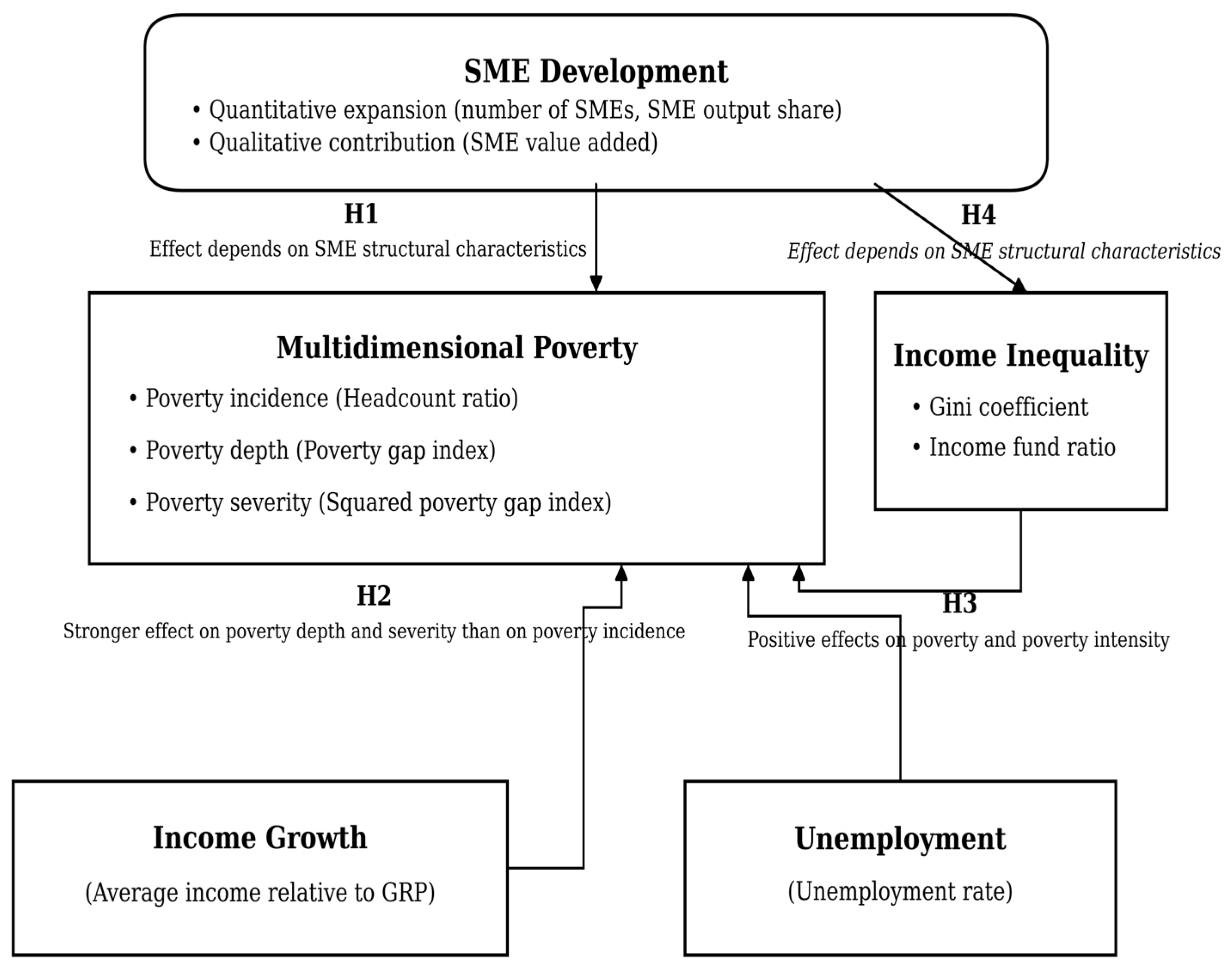
H1. SME development has a heterogeneous effect on poverty, which depends on its structural characteristics.
Studies of multidimensional poverty concur that rising household incomes have positive effects on welfare by improving resilience, allowing asset accumulation, and securing long-run welfare prospects (
Morris et al., 2022;
Obayelu & Edewor, 2022). As a result, we expect income growth to exert a stronger influence on poverty depth and severity than on poverty incidence.
H2. Income growth has a significant positive effect on poverty reduction. This effect is stronger for poverty depth and severity than for poverty incidence.
Empirical studies consistently identify unemployment and income inequality as major determinants of poverty (
Gindling & Newhouse, 2014;
Maksimov et al., 2017). Moreover, since unequal incomes may concentrate poverty within vulnerable demographics, high inequality can worsen multidimensional forms of poverty (
G. Bruton et al., 2021;
Al-Azzam, 2026). Therefore, we expect unemployment and income inequality to have positive effects on poverty and its intensity.
H3. Unemployment and income inequality have significant positive effects on poverty and poverty intensity.
The relationship between entrepreneurship and income inequality remains inconclusive in the existing literature. On the one hand, SME development may increase labor demand, give people more opportunities to engage in economic life, and stimulate local economies (
Acs et al., 2018). On the other hand, entrepreneurship may become concentrated in higher-productivity firms or socially advantaged groups with better access to finance, education, or institutional support. Under these conditions, SME proliferation may disproportionately favor well-connected individuals (
Boudreaux et al., 2019;
Ratten, 2025). Taken together, we can expect entrepreneurship to have different effects on income inequality depending on its relationship with productivity.
H4. The effect of SME development on income inequality depends on the structural characteristics of the SME sector.
Figure 1 illustrates the conceptual framework and the hypothesized relationships examined in this study.
3. Data and Methodology
The analysis is based on panel data for 15 regions of Kazakhstan and employs Driscoll–Kraay standard errors to account for cross-sectional dependence, heteroskedasticity, and autocorrelation (
Driscoll & Kraay, 1998). Multiple model specifications are estimated to assess the robustness of the results.
3.1. Data and Variables
This study employs a balanced panel dataset covering 15 regions of Kazakhstan during 2005–2024. The dataset includes key socioeconomic indicators related to poverty, income inequality, SME development, and macroeconomic conditions.
Definition of SMEs. This study applies the official national definition of small and medium-sized enterprises (SMEs) provided by the Bureau of National Statistics of the Republic of Kazakhstan. In accordance with the Entrepreneurial Code of the Republic of Kazakhstan, the SME sector includes micro, small, and medium-sized enterprises classified according to employment and income criteria established by national legislation.
Different international organizations, including the European Union, the World Bank, and the OECD, use alternative SME definitions based on employment, turnover, and asset thresholds. To ensure consistency and comparability across regions and over time, this study applies the official definition used in Kazakhstan.
All SME indicators used in this study, including the number of active enterprises, SME employment, SME output, and SME value added, therefore, encompass micro, small, and medium-sized enterprises. Available regional statistics do not distinguish between microenterprises, subsistence entrepreneurs, innovative SMEs, high-growth firms, or SMEs integrated into production and value chains. Consequently, the analysis focuses on aggregate SME indicators.
To capture different dimensions of poverty, three dependent variables are employed: poverty incidence (BelowSL), measured as the share of the population with incomes below the subsistence minimum; poverty depth (PovDeep), reflecting the average income shortfall of the poor; and poverty severity (PovAcuity), capturing the distribution of income shortfalls among the poor.
Income inequality is measured using the Gini coefficient (Gini) and the income fund ratio (CoefFund).
SME development is captured through five indicators: SME share in gross regional product (SMEgrp), number of active SMEs (SMEnumber), SME output share in gross regional product (SMEoutputG), SME gross value added relative to gross regional product (SMEgvaG), and SME employment (SMEemployed).
Control variables include the unemployment rate (Unempl), investment index (InvIndex), average income relative to gross regional product (IncomeG), the number of recipients of targeted social assistance (TSArecips), and the average monthly amount of targeted social assistance relative to gross regional product (TSAmonthG). All explanatory variables were constructed using the official regional statistics published by the Bureau of National Statistics of the Republic of Kazakhstan.
All non-ratio variables are transformed into natural logarithms to mitigate heteroskedasticity and facilitate elasticity-based interpretation of coefficients. The prefix “ln” denotes the natural logarithm of the corresponding variable.
3.2. Model Specification
To examine the relationship between SME development, poverty, and income inequality, the following baseline panel model is estimated:
where
Yit represents the dependent variables (poverty indicators or inequality measures) for region i at time t; SMEit denotes indicators of SME development; Xit is a vector of control variables; μi captures unobserved region-specific effects; λt represents time effects; εit is the error term.
Separate specifications are estimated for:
Poverty incidence (lnBelowSL),
Poverty depth (lnPovDeep),
Poverty severity (lnPovAcuity),
Income inequality (Gini, CoefFund).
3.3. Estimation Technique
This study employs fixed-effects panel regressions with Driscoll–Kraay standard errors to examine the relationship between SME development, poverty, and income inequality across 15 regions of Kazakhstan over the period 2005–2024. The fixed-effects specification was selected to control for unobserved time-invariant regional characteristics that may influence both SME development and socioeconomic outcomes. Prior to estimation, a series of diagnostic tests was conducted to identify common econometric issues in the regional panel data. The Wooldridge test detected first-order serial correlation (F(1,14) = 37.102,
p < 0.001), the Breusch–Pagan LM test revealed significant cross-sectional dependence (χ
2(105) = 427.586,
p < 0.001), and the Modified Wald test confirmed the presence of groupwise heteroskedasticity (χ
2(15) = 275.40,
p < 0.001). In addition, Pesaran’s cross-sectional dependence test also indicated significant cross-sectional dependence across regional units (CD = 15.323,
p < 0.001). Detailed diagnostic results are reported in
Appendix A. Taken together, these diagnostic tests indicate that conventional panel standard errors may yield unreliable inference, thereby justifying the use of Driscoll–Kraay standard errors.
Given the presence of autocorrelation, heteroskedasticity, and cross-sectional dependence, conventional panel estimators with standard covariance assumptions may produce biased standard errors and unreliable statistical inference. Therefore, Driscoll–Kraay standard errors (
Driscoll & Kraay, 1998) were employed because they provide robust inference in the presence of heteroskedasticity, serial correlation, and very general forms of cross-sectional dependence. The Driscoll–Kraay estimator is particularly suitable for macro-panel datasets where economic shocks, policy changes, and national trends may simultaneously affect multiple regions. Given that Kazakhstan’s regions operate within a common economic system, cross-regional interdependencies are expected. Consequently, Driscoll–Kraay standard errors provide more reliable statistical inference. To further assess the stability of the findings, additional robustness checks were performed using alternative fixed-effects specifications and lagged SME indicators. The results remained substantively consistent across alternative model specifications, supporting the robustness of the main conclusions.
3.4. Model Strategy
To ensure robustness, multiple model specifications are estimated for each dependent variable. This approach allows the stability of estimated coefficients to be assessed across alternative specifications and facilitates the identification of the most consistent determinants of poverty and inequality.
Specifically, Models 1–4 examine poverty incidence, Models 5–8 analyze poverty depth and severity, and Models 9–12 assess income inequality.
Including different SME indicators across specifications makes it possible to distinguish between quantitative expansion and the qualitative contribution of the SME sector.
3.5. Interpretation of Coefficients
Due to the logarithmic transformation of most variables, the estimated coefficients can generally be interpreted as elasticities. Specifically, a 1% increase in an explanatory variable is associated with a β% change in the dependent variable, holding other factors constant. For example, a 1% increase in unemployment is associated with a β% change in poverty, while a 1% increase in SME output share is associated with a β% change in poverty or income inequality, depending on the model specification.
For variables expressed in levels, such as the Gini coefficient, the estimated coefficients should be interpreted as marginal effects. The reported relationships should be interpreted as conditional associations rather than causal effects, as potential reverse causality may exist between SME development, poverty, and income inequality.
3.6. Robustness Considerations
Several procedures are implemented to assess the robustness of the empirical findings. These include the estimation of alternative model specifications, the inclusion of multiple control variables, the application of Driscoll–Kraay standard errors, and the use of multiple dependent variables capturing different dimensions of poverty. Together, these procedures strengthen confidence in the reliability of the reported results.
In addition, multicollinearity diagnostics were conducted, and no serious multicollinearity issues were detected, supporting the stability of the estimated coefficients.
As an additional robustness check, supplementary estimations were performed using lagged SME indicators to account for potential delayed effects of SME development on poverty and income inequality. The results remained qualitatively consistent with the baseline estimations, as the signs and substantive interpretation of the key coefficients were unchanged. Furthermore, income inequality was assessed using two alternative indicators—the Gini coefficient and the income fund ratio (CoefFund)—which produced similar conclusions. These additional analyses provide further support for the robustness and stability of the empirical findings.
4. Results
The results indicate that the effects vary substantially across SME indicators. While enterprise quantity shows only a limited association with social outcomes, indicators reflecting SME value added are associated with more favorable poverty and inequality outcomes.
Taken together, these findings highlight the importance of distinguishing between quantitative expansion and qualitative development of the SME sector. Growth in the number of enterprises may partly reflect necessity-driven entrepreneurship and the entry of low-productivity firms in response to limited employment opportunities. While this may provide subsistence income, it is unlikely to generate productivity growth, innovation, or broader economic spillovers. Consequently, the poverty-reducing effects of enterprise expansion may be more limited than commonly assumed.
By contrast, SME value added is more closely associated with productivity growth, competitiveness, and enterprise upgrading. SMEs generating higher value added are more likely to create stable employment and support wage growth. As a result, the impact of SMEs on poverty appears to depend more on productivity-enhancing entrepreneurship than on enterprise expansion alone.
These findings are consistent with recent contributions to the entrepreneurship literature. In other words, productive entrepreneurship contributes more to development than entrepreneurship measured solely by new firm creation (
Sutter et al., 2019;
Morris et al., 2022).
Table 1 presents the estimation results for poverty incidence (lnBelowSL). The findings indicate that unemployment is the most robust determinant of poverty across all model specifications.
The unemployment coefficient is positive and statistically significant at the 1% level, indicating that a 1% increase in unemployment is associated with a 0.59–0.64% increase in poverty incidence. This result strongly supports Hypothesis H3 and confirms the central role of labor market conditions in shaping poverty outcomes.
Income inequality, measured by the Gini coefficient, also has a positive and statistically significant effect. The estimated coefficients (ranging from 3.6 to 6.5) indicate that higher inequality substantially increases the share of the population living below the subsistence minimum. This finding highlights the reinforcing relationship between inequality and poverty.
The effects of SME development are heterogeneous. The SME output share (lnSMEoutputG) is positively and significantly associated with poverty. The estimates suggest that a 1% increase in SME output share is associated with an approximately 0.34% increase in poverty.
This finding is broadly consistent with the distinction between necessity-driven and opportunity-driven entrepreneurship proposed by
Sutter et al. (
2019) and
Williams and Vorley (
2014). They argue that new firm creation does not necessarily reflect productive entrepreneurship but may instead arise from labor-market constraints and subsistence-oriented business activity.
In contrast, SME gross value added (lnSMEgvaG) has a negative and statistically significant coefficient (−0.606). Higher SME value added is associated with lower poverty levels. These findings support Hypothesis H1, indicating that the effects of SME development depend on its qualitative rather than purely quantitative characteristics. A negative correlation between SME value added and poverty is also reported by
Audretsch and Belitski (
2021),
Aparicio et al. (
2021), and
Morris et al. (
2022), concluding that entrepreneurship improves welfare through productiveness, innovation, and value creation rather than through firm counts.
Social assistance variables (lnTSArecips, lnTSAmonthG) display positive coefficients, indicating that higher levels of assistance are associated with higher poverty rates. This likely reflects reverse causality, where increased poverty leads to expanded social support rather than the opposite.
Table 2 presents the estimation results for poverty depth (lnPovDeep) and poverty severity (lnPovAcuity). The results show that income plays a crucial role in reducing poverty intensity. The coefficient on lnIncomeG is negative and highly significant. The estimates indicate that a 1% increase in income reduces poverty depth by approximately 1.46% and poverty severity by about 0.99%. These findings provide strong support for Hypothesis H2, suggesting that income growth is particularly effective in reducing more severe forms of poverty.
Unemployment remains positively and significantly associated with both poverty measures across all model specifications. The estimated coefficients (0.56–0.73) indicate that unemployment increases both poverty depth and poverty severity. This reinforces the importance of employment policies in poverty reduction.
Inequality indicators (Gini and CoefFund) are also positively associated with both poverty depth and severity. These results suggest that higher inequality worsens the economic conditions of the poorest households, increasing the depth and severity of poverty rather than merely its prevalence.
The SME indicators again display mixed effects. Both SME output and value-added variables are positively associated with poverty depth and severity. This contrasts with the findings for poverty incidence, suggesting that while SMEs may reduce the number of people living in poverty, they do not necessarily improve the living conditions of those experiencing deeper poverty. This finding points to structural limitations within the SME sector, such as low productivity or low-wage employment. One possible explanation is that SME expansion reduces poverty incidence through job creation while having a weaker effect on poverty depth and severity. Low-productivity SMEs may provide subsistence employment without generating sufficient wage growth or long-term welfare improvements. Thus, SME expansion alone may be insufficient to alleviate deeper forms of poverty.
Table 3 presents the estimation results for income inequality (Gini and CoefFund). The results indicate that income growth (lnIncomeG) is positively associated with income inequality. The coefficients are statistically significant, indicating that a 1% increase in income is associated with higher income inequality. This result is consistent with the early stage of the Kuznets hypothesis and supports the view that economic growth does not automatically lead to a more equitable income distribution.
The relationship between SME development and income inequality is also heterogeneous. The number of SMEs (lnSMEnumber) has a positive and significant effect on inequality, indicating that a quantitative expansion of the sector may increase income disparities. In contrast, the share of SMEs in the economy (lnSMEgrp) and SME output (lnSMEoutputG) have negative coefficients, suggesting that a stronger contribution of SMEs to the economy helps reduce income inequality. These findings support Hypothesis H4.
Our findings also provide insights into how SME development affects income inequality, highlighting its heterogeneous distributional effects. Productive SMEs can foster inclusive growth by creating better employment opportunities. However, if firm growth is concentrated among more productive enterprises, its benefits may be distributed unevenly across regions and population groups. This finding is consistent with recent studies showing that entrepreneurship can either reduce or increase income inequality depending on the institutional and structural context (
Audretsch et al., 2025).
One possible explanation is that SME expansion in transition economies is often concentrated in low-productivity sectors characterized by informal employment and limited wage growth.
As a result, while SMEs increase employment, they do not necessarily improve income distribution or reduce poverty intensity.
Unemployment is positively associated with income inequality across all specifications, confirming its role as a key driver of income dispersion. Additionally, poverty incidence (lnBelowSL) is positively associated with inequality, indicating a feedback mechanism in which poverty and inequality reinforce each other.
Social assistance variables also show positive coefficients, which likely reflect the targeting of assistance toward poorer regions rather than the redistributive effect of the assistance itself.
Importantly, these findings challenge the conventional assumption that SME expansion inherently promotes inclusive growth. Instead, they suggest that without structural transformation and productivity improvements, SME growth may reproduce existing inequalities rather than reduce them. These findings reinforce the argument that the developmental impact of entrepreneurship depends more on its quality than on its scale.
Summary of Findings
Overall, the findings highlight the multidimensional nature of poverty and inequality and underscore the importance of structural determinants. The findings support all proposed hypotheses, with varying degrees of strength:
Hypothesis H1 is partially supported: the effects of SME development vary according to its structural characteristics.
Hypothesis H2 is strongly supported: income growth significantly reduces poverty depth and severity.
Hypothesis H3 is strongly supported: unemployment and income inequality consistently increase poverty.
Hypothesis H4 is supported: the effect of SME development on income inequality depends on the structural characteristics of the SME sector.
These results suggest that policies aimed at reducing poverty and inequality should focus not only on expanding the SME sector but also on improving its productivity and inclusiveness while strengthening labor market conditions.
One limitation of the analysis is the potential presence of endogeneity. For example, higher poverty levels may stimulate necessity-driven entrepreneurship, thereby influencing SME development. Although Driscoll–Kraay standard errors address statistical dependence, future research could employ instrumental-variable approaches to strengthen causal inference.
The findings are consistent with
G. Bruton et al. (
2021), who argue that entrepreneurship can both reduce and exacerbate inequality depending on institutional conditions. At the same time, our results extend
Sutter et al. (
2019) by showing that even when SMEs expand, they may fail to reduce poverty intensity. This suggests that the poverty-reducing potential of entrepreneurship is conditional on productivity and structural transformation rather than firm proliferation.
The results presented above suggest that SME development should not be treated as a uniform phenomenon. The empirical evidence suggests that the socioeconomic effects of SMEs depend on productivity, value added, and structural characteristics. These findings suggest that policy should focus not only on increasing the number of SMEs but also on promoting productivity improvements to achieve meaningful poverty reduction. Achieving these objectives may require complementary policies that promote productivity growth, innovation, competitiveness, and stronger integration into regional and global value chains.
5. Conclusions and Policy Implications
This study provides an empirical assessment of the relationship between SME development, multidimensional poverty, and income inequality across the regions of Kazakhstan using panel data with Driscoll–Kraay standard errors. By incorporating multiple dimensions of poverty—incidence, depth, and severity—alongside income inequality, the analysis provides a more comprehensive understanding of socioeconomic disparities in a transition economy. The findings indicate that poverty and inequality are shaped primarily by structural factors, particularly labor market conditions and income distribution. Unemployment emerges as the most consistent and significant determinant across all models, increasing not only the incidence of poverty but also its depth and severity. These findings underscore the central role of labor market conditions in promoting inclusive economic development. Income growth significantly reduces the intensity of poverty, confirming that improvements in household earnings are essential for alleviating extreme deprivation. However, the results also indicate that economic growth alone does not guarantee equitable outcomes, as higher income levels are associated with increased income inequality. Together, these findings suggest that economic growth by itself may be insufficient to ensure inclusive and equitable development. The role of SMEs is both complex and heterogeneous. While the qualitative development of SMEs—measured through their contribution to value added—contributes to reducing poverty and inequality, their quantitative expansion does not necessarily produce similar outcomes. In several model specifications, an increase in the number of SMEs or their output share is associated with higher poverty and inequality. This pattern likely reflects structural limitations within parts of the SME sector, including relatively low productivity and the prevalence of informal or low-wage employment.
The findings further suggest that productivity growth is an important channel through which SME development contributes to poverty reduction and inclusive growth. While increases in the number of enterprises alone do not necessarily translate into better socioeconomic outcomes, value-added measures of SME development exhibit stronger poverty- and inequality-reducing associations. This suggests that enterprise quantity and enterprise quality capture different dimensions of entrepreneurship. Firm counts may partly reflect the expansion of low-productivity microenterprises engaged in necessity-driven entrepreneurship and serving predominantly local markets. Such enterprises may provide income and employment but generate limited productivity gains, innovation, or broader economic spillovers. In contrast, SMEs generating higher value added are more likely to improve competitiveness, integrate into regional and national value chains, create more sustainable employment opportunities, and support wage growth. Consequently, the poverty-reducing effects of SMEs operate primarily through productivity growth and value creation rather than through increases in the number of firms alone. These findings are consistent with the distinction between opportunity-driven and necessity-driven entrepreneurship, where the former is more commonly associated with productivity growth and inclusive development. The heterogeneous effects identified in this study may also reflect differences in SME integration into regional production networks. Mining, oil and gas, metallurgical, and large manufacturing enterprises are concentrated in a limited number of regions in Kazakhstan, reflecting both historical industrial specialization and the legacy of economic transition. Regions characterized by a stronger presence of large industrial enterprises may provide SMEs with greater opportunities for supply-chain participation, knowledge spillovers, and productivity upgrading. In contrast, regions dominated by small local-market firms may experience weaker productivity gains despite growth in the number of enterprises. Social assistance variables appear to play a reactive rather than a preventive role, as higher levels of support are associated with higher poverty rates. This finding likely reflects the fact that social assistance is directed toward regions experiencing greater socioeconomic challenges rather than acting as an independent driver of poverty reduction. More broadly, the findings suggest that entrepreneurship should not be viewed as a universal solution to poverty and inequality. Rather, its developmental impact depends on structural, institutional, and labor market conditions. The results indicate that the contribution of SMEs depends less on enterprise quantity than on productivity, value creation, and successful integration into broader economic networks.
Taken together, these findings contribute to the growing literature by demonstrating that SME development should not be treated as a homogeneous policy instrument for inclusive growth. Instead, the socioeconomic effects of SMEs depend fundamentally on their structural characteristics, highlighting the importance of moving beyond quantity-based assessments of entrepreneurship in both future research and policy evaluation.
5.1. Policy Implications
The empirical findings of this study have several important implications for understanding the relationship between SME development, poverty, and income inequality.
First, the findings highlight the importance of labor market conditions for poverty and inequality outcomes. Given the strong and consistent association between unemployment and all dimensions of poverty and inequality, employment-related measures may play an important role in promoting socioeconomic development. This includes labor market programs, vocational training and skills development, and support for formal employment opportunities.
Second, the findings suggest that policy support for SMEs may benefit from greater emphasis on qualitative development rather than quantitative expansion alone. The results indicate that SME value added and structural contribution are more closely associated with favorable poverty and inequality outcomes than simple increases in the number of enterprises. Therefore, consideration may be given to measures that enhance the productivity and economic contribution of SMEs.
Third, the findings suggest that broad-based income growth may contribute to reducing poverty depth and severity. Since higher incomes are associated with lower levels of poverty intensity, improvements in labor productivity and access to higher-value employment opportunities may be relevant factors in poverty reduction.
Fourth, the positive association between income growth and inequality suggests that economic growth does not necessarily translate into a more equal income distribution. This finding indicates that distributional aspects of economic development may warrant additional consideration when evaluating poverty and inequality outcomes.
Fifth, the results suggest that social assistance policies may benefit from closer integration with broader socioeconomic and labor market measures. The findings indicate that poverty reduction outcomes are influenced by multiple interconnected economic factors rather than by a single policy instrument.
Finally, the observed regional heterogeneity suggests that the socioeconomic effects of SME development may vary across regions depending on local economic structures, labor market conditions, and levels of development. Therefore, regional context should be considered when interpreting the relationship between SME development, poverty, and inequality.
5.2. Limitations and Future Research
Although this study contributes novel insights into the relationship between SME development and poverty, several limitations should be noted. First, while regional variation is analyzed with the use of panel data, the findings may only apply to Kazakhstan. Other transition or emerging economies may experience different SME effects due to institutional, structural, or labor-market heterogeneity. Consequently, the external validity of the findings beyond Central Asia may be limited.
Second, although Driscoll–Kraay standard errors provide robust inference in the presence of heteroskedasticity, serial correlation, and cross-sectional dependence, they do not eliminate potential endogeneity. Reverse causality may arise because higher poverty levels can stimulate necessity-driven entrepreneurship, while SME development may simultaneously affect poverty and inequality outcomes. In addition, omitted institutional and regional factors may influence both entrepreneurial activity and socioeconomic performance. Consequently, the estimated coefficients should be interpreted as conditional associations rather than definitive causal effects.
Third, while the study uses aggregate indicators of SME development to capture possible structural differences in Kazakhstan’s entrepreneurial sector, data on the informal sector, sector-specific productivity, or opportunity- versus necessity-driven entrepreneurship is unavailable.
Fourth, this study is limited to examining regional-level macro relationships between entrepreneurship and poverty. Household-level relationships are not analyzed, which precludes informal labor-market dynamics and entrepreneurial decision-making from this study.
Future research could use dynamic panel GMM estimators or instrumental variable approaches to attempt to more convincingly identify causal relationships between entrepreneurship and poverty. Future research may also explore the impacts of anchor firms and regional production networks. Alternatively, future research could use firm-level or survey data to examine how different forms of entrepreneurship affect poverty and inequality.