1. Introduction
Half a century after
Kaldor (
1966) formulated his three growth laws, the proposition that manufacturing is a privileged engine of aggregate economic dynamics remains a central reference point in development economics. This theory primarily has informed the empirical work across developed and developing economies for more than five decades. However, still, two contemporary developments have placed renewed pressure on this framework.
The first is the premature-deindustrialisation thesis advanced by
Rodrik (
2016) and elaborated by recent literature (
Lábaj & Majzlíková, 2024;
Taguchi et al., 2023), which documents that developing economies are losing manufacturing employment and value-added shares at lower per-capita income levels than today’s advanced economies experienced during their own industrialisation. Thus, if manufacturing is contracting prematurely, the Kaldorian claim becomes empirically harder to sustain. The second is the commodity super-cycle of 2002–2014 and its aftermath, which exposed Latin American economies—and the Andean Community of Nations (ACN), in particular—to extended terms-of-trade shocks, real-exchange-rate appreciation, and the Dutch-disease pressures that the contemporary literature on resource-dependent economies has documented in detail (
Cimoli et al., 2019;
Alssadek & Benhin, 2023;
Warnecke-Berger et al., 2023;
Rodríguez Abraham et al., 2025).
Whether the Kaldorian mechanism still operates in these economies, and through what channel, is therefore not a question that the prior evidence settles. The most recent comparative test of Kaldor’s laws covering the four AC countries is
Carton (
2009), who examined the thirteen Latin American Integration Association (ALADI) economies—including all four AC members—over 1980–2007, and who confirmed the Verdoorn mechanism for Argentina, Brazil, Chile, Uruguay, and Venezuela, but found that the cumulative-causation mechanism was not operative for Bolivia, Colombia, Ecuador, Mexico, Paraguay, or Peru, apparently blocking the virtuous Kaldorian cycle in the Andean bloc. Carton’s evidence is now more than fifteen years old and was obtained over a sample period that pre-dates the commodity super-cycle and the post-cycle adjustment phase, and excludes the structural transformations associated with the deeper trade integration and financial openness over the past two decades.
On the other hand, there is recent evidence on single-country studies for AC members (
Agurto, 2018;
Zapata Chin et al., 2022 for Ecuador;
Martín Rivas, 2008 for Colombia) but they all rely on time-series methods that cannot exploit the cross-sectional variation across countries with similar productive structures. Given the lack of a contemporary empirical analysis of this bloc which possesses particular characteristics under global and regional schemes, assessing its trajectories according to fundamental factors such as the industrial sector is a must.
A second gap in the existing literature is methodological. The contemporary work on Kaldor’s laws has converged on three identification concerns: the accounting-identity problem flagged by
McCombie (
1981), the reverse-causality concern raised by
Rowthorn and Ramaswamy (
1999) and recently re-articulated in the theoretical critique of
Basu et al. (
2021), and the Okun-versus-Verdoorn confounding problem documented by
Paternesi Meloni (
2024) for OECD samples. None of the existing ACN work has deployed the combined static-dynamic identification strategy—feasible generalised least squares (FGLS) paired with the Arellano–Bond difference-GMM (
Arellano & Bond, 1991) and explicit long-run multipliers—that the contemporary literature now treats as standard (
Wells & Thirlwall, 2015;
Deleidi et al., 2023;
Doré et al., 2025).
Notably, we have identified a third gap which is the most important: this is the transmission channel through which manufacturing growth translates into aggregate effects. The recent firm-level evidence from developing economies (
Diao et al., 2021), productivity-decomposition evidence (
Alkathiri, 2021), and structural-change evidence for Latin America (
Paus, 2020;
Iasco-Pereira et al., 2024;
Palma, 2024) jointly suggest that manufacturing in commodity-dependent middle-income economies may operate primarily through capital deepening rather than through the labour-absorbing learning-by-doing channel that Kaldor and Verdoorn originally emphasised.
Thus, whether this pattern characterises the ACN bloc and what its implications are for the operation of the three laws have not been tested—in other words, to what extent the three Kaldor laws are empirically supported in the Andean Community, and through what transmission mechanism manufacturing growth translates into aggregate effects. We address this question with a balanced panel and twenty-seven years of annual observations on the real value added and employment at the sectoral level, using a two-stage empirical strategy. Additionally, we perform a novel diagnostic on our own results: the Verdoorn relationship implies an accounting identity according to which the productivity-output elasticity and the employment-output elasticity must sum 1. We test this identity directly on our sample, treating its failure or success as informative about the channel through which manufacturing growth is transmitted to aggregate output.
In summary, we made three contribution to the current literature. Empirically, it provides the first bloc-level panel test of all three Kaldor laws for the Andean Community since
Carton (
2009), covering the full commodity super-cycle and its aftermath, and updating the now-stale finding that cumulative-causation mechanisms are absent in the ACN economies. Methodologically, our dynamic specification is shown to be substantially larger than static estimates clarifying that the cumulative-causation dynamics are not visible in conventional static estimates; last but no least, we perform a Verdoorn-decomposition consistency check that has not been applied to the existing ACN evidence.
Our results also call for a more nuanced reading of the Kaldorian evidence in commodity-dependent economies: the first-order predictions of the three laws are supported in our sample but the Verdoorn decomposition fails. The Kaldorian mechanism in ACN has therefore neither collapsed (as a strict premature-deindustrialisation reading would imply) nor remained intact (as an unqualified Kaldorian reading would suggest), but has mutated into a capital-intensive, labour-saving form. This contribution responds directly to the contemporary debate on how Kaldor’s framework continues to operate in middle-income commodity-exporting economies, building on the structuralist tradition that emerged at the United Nations Economic Commission for Latin America and the Caribbean (ECLAC) under Raúl Prebisch in the 1950s (
Prebisch, 1950/1962) and extending into the contemporary structuralist-developmentalist literature (
Bresser-Pereira, 2020;
Ocampo, 2020;
Botta et al., 2023;
H.-J. Chang & Andreoni, 2020), and it provides specific policy implications that depart from conventional Kaldorian prescriptions.
The paper proceeds as follows.
Section 1 states the literature review and situates the empirical literature on Latin America and other developing regions.
Section 2 describes the data, presents the structural and decomposition findings that bound the empirical results, and details the static and dynamic econometric strategies.
Section 3 reports the estimation results, and develops the Verdoorn-decomposition.
Section 4 discusses the findings in dialogue with the prior empirical literature and acknowledges the limitations of the present design. Finally,
Section 5 synthesises the findings and offers policy recommendations.
2. Literature Review
Changes in a country’s economic structure are linked to shifts in the relative importance of sectors over time, measured by their contribution to real aggregate output or employment.
Kaldor (
1966,
1967), contrary to the neoclassical postulate of cross-country convergence (
Solow, 1956) and to the pessimism of
Harrod’s (
1939) dynamic theory, argued that growth is governed by the rate of change of the sector with the most favourable technical characteristics—manufacturing—which, alone, is subject to increasing returns to scale, while primary activities and most services exhibit diminishing returns.
The pace of economic and productivity growth is therefore associated with the rapid expansion of the secondary sector, and these generalisations are codified in the three laws set out below. Kaldor’s argument is rooted in centre-periphery reasoning, drawing on
Young (
1928) on the circular process of the division of labour and on the development tradition of
Myrdal (
1957) and
Prebisch (
1950/1962): increasing returns are not confined to any single industry but flow through inter-industry linkages, while trade theory’s assumption of non-increasing returns obscures the divergence between rich and poor countries (
Ángeles-Castro et al., 2023;
Rodrik, 2016).
The framework combines a demand-side account of growth—with a long-run balance-of-payments constraint via the current account (
Dixon & Thirlwall, 2015;
Pacheco-López & Thirlwall, 2014)—with an endogenous supply-side mechanism in which manufacturing operates under “learning by doing”, absorbs labour from low-productivity sectors, and generates foreign exchange (
Trusina & Jermolajeva, 2024). Kaldor’s first law states that aggregate growth is positively related to manufacturing growth, formalised most simply as Equation (1), as shown below:
where
is the growth rate of the total real value added and
is the growth rate of the manufacturing real value added. To address the obvious accounting identity concern raised by
McCombie (
1981,
1983),
Kaldor (
1967) proposed an alternative formulation in which the dependent variable is non-manufacturing output (see Equation (2)), and
Wells and Thirlwall (
2015) developed a third specification (see Equation (3)) using the growth-rate surplus of manufacturing over non-manufacturing:
Kaldor’s second law—Verdoorn’s law (
Verdoorn, 1949)—posits that the growth of manufacturing labour productivity is positively related to the growth of manufacturing output through static and dynamic increasing returns, while the growth of manufacturing employment absorbs the residual (Equations (4) and (5)):
By construction, the productivity-output elasticity
λ and the employment-output elasticity (1 −
λ) must sum to unity: this property we exploit as a diagnostic in the
Section 4. Kaldor’s third law combines the first two: total productivity growth is positively related to manufacturing output growth and negatively to non-manufacturing employment growth, capturing the labour-reallocation channel through which manufacturing expansion draws workers from low-productivity activities and raises aggregate productivity (
Kaldor, 1975;
McCombie & Thirlwall, 1994;
Thirlwall, 2015,
2017), which is expressed in Equation (6):
Although Kaldor’s laws remain influential, a growing section of critical literature urges caution before treating a positive Verdoorn coefficient or a correlation between manufacturing and aggregate growth as definitive proof of virtuous industrial dynamics. Five debates are particularly relevant for any contemporary test. First,
Basu et al. (
2021) show that a Verdoorn coefficient bounded in (0, 1) is jointly determined by the elasticity of factor substitution, the labour-supply elasticity, the profit share, and the increasing-returns parameter, so empirical estimates cannot unambiguously identify aggregate increasing returns. Because these forces are bundled into a single estimated value, the coefficient cannot, by itself, reveal whether genuine aggregate increasing returns exist. The practical implication is as follow: even an ACN economy operating under constant returns to scale—with no true aggregate increasing returns at all—could still produce a Verdoorn coefficient that falls squarely within the canonical range (0,1) routinely read as proof of increasing returns. Our estimated coefficients are therefore consistent with the presence of increasing returns, but they do not constitute unambiguous evidence of it.
Second,
Chandra and Sandilands (
2020), revisiting the Smith–Young tradition on increasing returns, argue that Kaldor was guided more by empirical observation than by theory when formulating policy implications, and that favouring industry over agriculture and services may distort the intersectoral terms of trade and ultimately generate a demand constraint for industry itself. Third,
Di Meglio et al. (
2021), testing Kaldor’s first and second laws for thirty-two developing countries between 1970 and 2010, find that market services—particularly business services—also display Kaldorian patterns, especially in Latin America and Asia; the assumption that manufacturing is uniquely capable of generating cumulative-causation dynamics has therefore been challenged. Fourth,
Paternesi Meloni (
2024) demonstrates that Okun’s law and Verdoorn’s law can be empirically confounded—the short-run cyclical co-movement between output and productivity mimics the long-run structural relationship—and reports OECD short-run coefficients of about 0.3 and long-run elasticities of about 0.5. In this sense, reverse causality (
Rowthorn & Ramaswamy, 1999;
Nabar-Bhaduri & Vernengo, 2025) compounds the identification problem and motivates dynamic panel estimators with lagged instruments.
Fifth, and most important for the present paper, the channel through which manufacturing growth translates into productivity gains is not uniform across contexts:
Diao et al. (
2021), using firm-level panels for Tanzania (2008–2016) and Ethiopia (1996–2017), document a dichotomy in which large productive firms use highly capital-intensive techniques and do not expand employment while smaller firms absorb labour without productivity gains. Similarly,
Alkathiri (
2021), decomposing manufacturing labour productivity in a broad cross-country sample, finds that capital accumulation is the dominant driver, ahead of both technological progress and technical efficiency;
Crossa and Cypher (
2020) and
Iasco-Pereira et al. (
2024) report parallel findings for Mexico and Brazil; and
Palma (
2024) generalises the pattern to resource-rich middle-income economies, where extractivist strategies fail to generate high-productivity linkages. Taken together, these debates imply that the Verdoorn decomposition—productivity growth plus employment growth equals output growth—may fail to close in developing-country manufacturing, with capital-intensity increases absorbing a substantial residual, a hypothesis we examine directly for the ACN bloc in
Section 3.
Panel methods address this limitation:
Wells and Thirlwall (
2015) test the laws for African countries, finding the core relationships and the expected negative association between total productivity and non-manufacturing employment growth;
Dasgupta and Singh (
2007) test the framework in the context of premature deindustrialisation;
Hansen and Zhang (
2010) and
Guo et al. (
2012) document the strong manufacturing-led growth in Chinese regions;
Pieper (
2003) isolates the sectoral productivity regularities holding technology diffusion constant; and
Marconi et al. (
2016) and
Szirmai and Verspagen (
2015) study the evolving relevance of Kaldor’s laws across developed and developing samples.
More recent panel work has updated the picture:
Ángeles-Castro et al. (
2023) test the Kaldor–Verdoorn laws for twelve of the largest Latin American economies over 1992–2021 using static and dynamic panel methods, reporting a small but dynamically persistent coefficient between manufacturing growth and its productivity;
Lábaj and Majzlíková (
2024) document the heterogeneous trajectories of premature deindustrialisation across Argentina, Brazil, and Mexico, with sharply different sectoral profiles; and
Forero and Tena-Junguito (
2024) and
Arnaut (
2020) develop disaggregated structural-change accounts for the largest Latin American economies. None of these studies, however, isolates the Andean Community as a bloc. Other works, similar to ours, include the one by
Wan et al. (
2022), applying Arellano–Bond GMM to 130 developing countries over 1996–2019, finding that manufacturing contributes positively to growth but that export-oriented strategies can induce deindustrialisation.
Methodologically, recent work has advanced in three directions: panel structural VAR approaches (
Deleidi et al., 2023) allow for simultaneity between output, productivity, and demand;
Doré et al. (
2025) use Markov-regime-switching models to show that Kaldor’s first and second laws hold for Brazil from 1909 to 2020 only in higher-growth regimes, introducing a non-linear dimension; and spatial panel methods (
Sofi et al., 2022) reveal strong spatial interactions, particularly relevant for geographically contiguous blocs like ACN.
Magacho and McCombie (
2020) provide a multisectoral cumulative-causation extension that incorporates structural-change effects, while
Pieper (
2003),
Dasgupta and Singh (
2007), and
Atesoglu (
1993) provide foundational comparative tests against which the contemporary work measures itself.
Cross-cutting findings indicate that Kaldorian mechanisms operate but with substantial heterogeneity. Resource-dependent economies present a particularly open question:
Sadik-Zada (
2020) extends the Kaldor–Lewis framework to commodity-exporting countries, showing that the productive re-investment of resource rents—rather than redistribution—determines whether modernisation proceeds;
Savona and Bontadini (
2023) revisit the resource-curse debate and find empirical support for backward linkages from natural-resource industries to knowledge-intensive services and high-tech manufacturing;
Ocampo (
2020) argues that industrial policy for natural-resource-dependent economies must be co-ordinated with macroeconomic policy; and
Rodríguez Abraham et al. (
2025),
Alssadek and Benhin (
2023),
Cimoli et al. (
2019),
Isabella (
2024), and
Warnecke-Berger et al. (
2023) collectively document Dutch-disease pressures on Latin American manufacturing during commodity-price episodes.
Hofman et al. (
2020) and
Aravena and Hofman (
2015) provide the long-run productivity benchmarks against which our ACN findings are read.
In conclusion, we mainly identify three gaps in this literature. The regional gap is that
Carton (
2009) is the most recent comparative test for the ACN bloc and is now stale; subsequent Latin American panels (
Ángeles-Castro et al., 2023) aggregate Andean economies into broader samples dominated by Argentina, Brazil, and Mexico; and country-level updates (
Agurto, 2018;
Zapata Chin et al., 2022) cannot test cross-country coordination dynamics. The methodological gap is that no existing ACN-relevant work has deployed the combined static–dynamic identification strategy—feasible generalised least squares paired with
Arellano and Bond (
1991) difference-GMM, with computed long-run multipliers and a Verdoorn-decomposition consistency check—that the contemporary literature now treats as standard. The contextual gap is that the channel through which manufacturing growth translates into aggregate effects in commodity-dependent economies has not been tested for this bloc, despite the firm-level (
Diao et al., 2021), productivity-decomposition, and structural-change (
Paus, 2020;
Iasco-Pereira et al., 2024;
Palma, 2024) evidence that points to a capital-intensive, labour-saving transmission mechanism.
5. Discussion
The empirical results support the three Kaldor laws in their first-order prediction for the Andean Community during 1993–2019: manufacturing growth is positively associated with aggregate growth, Verdoorn’s coefficient is positive and significant, and the labour-reallocation channel of the third law operates with a lag. However, the magnitude, structure, and decomposition of these relationships reveal a transmission mechanism that differs substantively from the Canonical Kaldorian account. Three features of the ACN evidence—the decomposition failure of the Verdoorn identity, the attenuation of coefficients relative to developed economy benchmarks, and the slow, cumulative character of the productivity effects—converge on a single interpretation we describe below.
The paper’s central conceptual contribution resides in the Verdoorn decomposition result reported before. The accounting identity that links productivity growth, employment growth, and output growth in manufacturing requires the Verdoorn coefficient and the employment–output elasticity to sum to unity. In the ACN sample, their sum is 0.345, leaving a residual of 0.655 that cannot be attributed to either channel. Since the identity must hold exactly one in logarithmic growth rates, this residual reflects an economic phenomenon: approximately two-thirds of manufacturing output growth between 1993 and 2019 was absorbed by capital-intensity increases rather than by labour absorption or by scale-economy learning effects. We term this configuration jobless manufacturing growth—a Kaldorian regime in which the laws operate in their first-order prediction but the transmission mechanism has mutated from the labour-absorbing, learning-intensive form that Kaldor and Verdoorn originally described into a capital-intensive, labour-saving form typical of commodity-dependent middle-income economies.
This finding is not anomalous within the contemporary developing-country literature. It is, in fact, precisely what the most recent microeconomic evidence predicts.
Diao et al. (
2021), using firm-level panels for Tanzania (2008–2016) and Ethiopia (1996–2017), document a dichotomy within manufacturing: large, productive firms use highly capital-intensive techniques and do not expand employment, while smaller firms absorb labour without achieving productivity gains.
For Latin America specifically,
Paus (
2020) demonstrates that within-sector productivity gains in nine Latin American economies between 1950 and 2011 have been insufficient to generate cross-sector structural transformation, with the productivity gains that did occur concentrated in capital-intensive pockets that failed to lift aggregate performance.
Iasco-Pereira et al. (
2024), examining Brazilian manufacturing from 1947 to 2021, show that productivity dynamics have deteriorated under policies that privileged financial openness over productive investment.
Palma (
2024) generalises the pattern to resource-rich middle-income economies: “extractivist” strategies exhaust themselves precisely because their capital-intensive industrial footprint fails to generate high-productivity linkages, leaving these economies suspended in the middle-income trap.
Why is ACN manufacturing capital-absorbing rather than labour-absorbing? The Dutch-disease literature on commodity-dependent economies offers a cogent mechanism.
Rodríguez Abraham et al. (
2025), analysing Peruvian quarterly data for 2012–2024, find a negative and statistically significant relationship between terms-of-trade improvements and manufacturing performance—direct evidence of Dutch disease in one of the four ACN economies.
Alssadek and Benhin (
2023), examining 36 oil-rich economies over 1970–2016, confirm that commodity booms systematically appreciate the real exchange rate and depress manufacturing output. For South America specifically,
Isabella (
2024) shows that commodity price surges damage productive capabilities specifically when they coincide with the dismantling of state industrial intervention—a configuration that is applied across ACN during the liberalisation episodes of the 1990s and early 2000s.
Cimoli et al. (
2019) generalise the diagnosis: in Latin America, long periods of real-exchange-rate appreciation combined with the absence of industrial policy have contributed to the loss of productive capabilities.
Warnecke-Berger et al. (
2023) document that the commodity super-cycle of the 2000s failed to translate into diversification and structural transformation in Latin America, concluding that neo-extractivism did not enable a shift toward non-extractivist sectors.
The implication for the ACN regime is a coherent narrative. During the commodity super-cycle (2002–2014), real-exchange-rate appreciation eroded the external competitiveness of manufacturing tradables. Firms that survived the squeeze did so primarily by adopting labour-saving capital-intensive technologies that raised the output per worker without expanding employment. After 2014, when commodity prices fell, the manufacturing deceleration became visible in the growth-rate data: Peru’s manufacturing growth collapsed from 6.0% in 2002–2010 to 1.9% in 2011–2019, Colombia fell by 1.9 pp, Ecuador by 1.6 pp, and only Bolivia accelerated by 0.3 pp. The Verdoorn decomposition failure reported above is the cross-sectional fingerprint of this adjustment: the capital-deepening that allowed manufacturing to survive exchange-rate appreciation during the boom also means that manufacturing output growth now maps onto capital accumulation rather than onto labour productivity gains or employment expansion.
This diagnosis reconciles two apparently competing readings of the ACN evidence. A strict reading of the premature-deindustrialisation literature (
Rodrik, 2016;
Lábaj & Majzlíková, 2024;
Taguchi et al., 2023) would predict that Kaldorian mechanisms have been extinguished in commodity-dependent economies, with manufacturing losing its “engine” status. A strict reading of the classical Kaldorian literature would predict that the mechanism operates unchanged once its empirical footprint is recovered. Neither reading describes the ACN evidence. Manufacturing is still associated with aggregate growth (Law 1), still exhibits positive but attenuated increasing returns (Law 2), and still generates labour-reallocation benefits over time (Law 3). But the decomposition fails as we have already noticed.
The policy consequences are substantial and depart from conventional Kaldorian prescriptions. An industrial-policy response that relied on capital subsidies alone—investment tax credits, accelerated depreciation, and subsidised credit for machinery—would deepen rather than correct the jobless-growth pattern. Instead, the ACN evidence supports the structuralist–developmentalist prescription articulated by
Botta et al. (
2023),
Bresser-Pereira (
2020), and
Ocampo (
2020): a combination of (i) real-exchange-rate management to neutralise Dutch-disease pressures, (ii) targeted industrial policy for labour-absorbing sub-sectors, and (iii) deliberate skill-upgrading strategies aligned with the productive matrix.
H.-J. Chang and Andreoni (
2020) articulate the broader doctrine: the contemporary industrial policy must manage uncertainty, learning, demand, and political–economic conflicts simultaneously, rather than relying on individual market-failure arguments.
Sadik-Zada (
2020) and
Savona and Bontadini (
2023) offer complementary prescriptions for commodity-exporting economies: the productive re-investment of resource rents into backward and forward linkages with manufacturing and knowledge-intensive services, rather than redistribution or capital-intensity subsidy alone.
Last, but not least, we discuss the reverse-causality and identity debate.
McCombie (
1981) pointed out that regressing total output on its manufacturing component risks recovering an accounting relationship rather than a behavioural one. Our response, following
Wells and Thirlwall (
2015), is to estimate Equation (3) in the surplus specification, regressing the total GVA on the growth-rate gap between manufacturing and non-manufacturing. This specification cannot be reduced to an identity because the surplus variable is not a mechanical component of the dependent variable. The resulting coefficient (0.493 static; 0.265 long-run) is comparable to the level’s specification in sign and significance, which supports the view that the Equation (1) coefficient reflects a behavioural relationship rather than a decomposition artefact.
Regarding the reverse-causality concern,
Rowthorn and Ramaswamy (
1999) raised the concern that aggregate growth might drive manufacturing growth rather than the reverse. Our response is the Arellano–Bond difference-GMM specification with lagged instruments, which identifies Granger-type precedence rather than structural causality. The finding that lagged manufacturing growth carries significant coefficients even after controlling for lagged aggregate growth supports the directional interpretation that manufacturing precedes aggregate output in the ACN data.
Nabar-Bhaduri and Vernengo (
2025) adopt a similar strategy for China and India and arrive at compatible conclusions. We stress, however, that Granger precedence is not structural causality in the
Rubin (
1974) sense.
On the other hand, regarding the Verdoorn-interpretation concern,
Basu et al. (
2021) have shown that a Verdoorn coefficient bounded in the (0, 1) interval does not by itself identify aggregate increasing returns to scale, because that coefficient is jointly determined by factor-substitution elasticities, the labour-supply elasticity, the profit share, and the increasing-returns parameter. Our response is that the Verdoorn coefficient is here interpreted not as proof of increasing returns but as one component of a decomposition whose identity failure is itself informative. The 0.655 residual is, in fact, exactly the kind of evidence that
Basu et al. (
2021) would read as inconsistent with a pure increasing-returns interpretation of the estimated coefficient.
Similarly, the Okun–Verdoorn confounding critic is discussed following
Paternesi Meloni (
2024), who shows that the short-run cyclical co-movement between output and productivity (Okun-like) can contaminate estimates of the Verdoorn relationship. The panel cointegration shows a short-run coefficient of about 0.3 and a long-run one of about 0.5 for OECD data. Our ACN short-run static estimate of 0.42 sits between these benchmarks, and the long-run multiplier from the dynamic specification (0.36) indicates that the structural effect is of similar magnitude to the short-run coefficient. This contrast is itself informative about the ACN regime: the absence of a long-run amplification in Verdoorn (unlike the first law, where the long-run multiplier is 3× the static) is consistent with the capital-deepening interpretation since capital-intensity adjustments transmit faster and do not compound in the same way as learning-by-doing effects would.
Finally, we discuss the services behaving like manufacturing.
Di Meglio et al. (
2021) demonstrate that business services in developing economies display Kaldorian patterns comparable to manufacturing. Our design aggregates services into a single non-manufacturing category, which cannot separate business from personal services. This limits the conclusions in two directions. On one hand, it likely attenuates our non-manufacturing coefficient on growth spillovers, since the business-services subset that might exhibit its own Kaldorian dynamics is bundled with less dynamic activities.
6. Caveats and Future Research
Three limitations of the present study warrant acknowledgment, each opening a distinct avenue for future research. First, the study treats manufacturing as a monolithic entity because the WDI data used for the value added are not disaggregated below the one-digit ISIC Rev. 4 level. This design cannot distinguish the productivity spillovers generated by low-technology manufacturing branches (food, textiles, and basic materials) from those generated by medium- and high-technology branches (chemicals, machinery, and electronics). The jobless-growth finding is therefore a sector-average phenomenon; it is consistent with a regime in which capital-intensive, high-technology sub-sectors drive the decomposition failure while labour-intensive sub-sectors absorb what employment growth exists, but the available data cannot verify or refute this. Future work using GGDC 10-Sector Database extensions, or national industrial censuses at the 2- or 3-digit ISIC level, would permit this disaggregation.
Second, the panel includes four countries, which is small relative to the typical recommendations for dynamic GMM. The cross-country heterogeneity is substantial: the coefficient of variation (CV) of manufacturing productivity growth across ACN countries within any single sub-period exceeds 80% in all three sub-periods examined (117% in 1993–2001, 103% in 2002–2010, and 82% in 2011–2019). The declining CV over time suggests regional convergence in manufacturing productivity dynamics, but the heterogeneity within each period is large enough that a pooled coefficient necessarily averages over meaningfully different national trajectories.
Škrabić Perić (
2019) documents the performance limitations of the difference-GMM in small panels; a longer time dimension (
T = 27 here) partially compensates for but does not eliminate the concern. Future work should exploit longer time series as they become available (WDI and ILOSTAT are progressively backfilling data for earlier decades) and consider panel structural-VAR approaches along the lines of
Deleidi et al. (
2023).
Third, we interpret the Verdoorn decomposition residual as capital deepening, but the sample as currently assembled does not contain direct measurements of the manufacturing capital stock or of the capital–labour ratio. The identification of capital deepening is therefore indirect—it relies on the logic of the accounting identity combined with comparative evidence from
Diao et al. (
2021) and
Alkathiri (
2021), which document the same pattern directly using firm-level and production-frontier methods. Future work extending would permit a direct test of the capital-deepening hypothesis and its decomposition (
J.-J. Chang et al., 2025) against alternative explanations such as the measurement error in employment statistics (
Gollin et al., 2014;
McCullough, 2017) or cross-sector labour misallocation (
Marconi et al., 2016;
Gangopadhyay et al., 2024).
To advance in this field, we also suggest some research lines to answer more questions regarding the Kaldorian framework. For example, for the sub-sectoral disaggregation of manufacturing (
Sofi et al., 2022), the direct integration of capital-stock measurements, available for some Latin American economies from the Penn World Tables and LA-KLEMS database, would convert the indirect capital-deepening interpretation into a direct test against alternative explanations. Similarly, service disaggregation would permit testing whether business-services sub-sectors behave like manufacturing in Kaldorian terms. Last, integrating the Kaldorian framework with the Thirlwall balance-of-payments-constrained growth model—as surveyed by
Blecker (
2021) and modelled by
Botta et al. (
2023)—would also provide a holistic account of the external macroeconomic limits to ACN industrialisation, since the Dutch-disease channel identified here operates partly through the external constraint.
Taken together, these limitations define a research programme rather than a defensive posture. The paper’s central claim that Kaldorian dynamics operate through capital-deepening and that this regime requires a policy response combining industrial policy with macroeconomic management is robust. What the limitations affect is the precise magnitude and sub-sectoral granularity of the effect, not its existence.
7. Conclusions
This paper asked to what extent Kaldor’s three growth laws are empirically supported in the Andean Community of Nations over 1993–2019, and through what transmission mechanism manufacturing growth translates into aggregate effects. Using a balanced panel of 4 countries and 27 years of annual observations on the real value added and employment, and combining static panel models with FGLS corrections with the dynamic Arellano–Bond difference that allows the computation of long-run multipliers, the evidence supports the first-order prediction of the three laws but reveals a transmission mechanism that differs substantively from the Canonical Kaldorian account.
The first law is supported: the contemporaneous elasticity of the total value added on the manufacturing value added is 0.29 in the static specification, rising to a long-run multiplier of 0.91 in the dynamic specification. The surplus-specification coefficient of 0.49 indicates that the relative dynamism—manufacturing growing faster than non-manufacturing—is a stronger correlate of aggregate growth than absolute manufacturing expansion. Similarly, the second law is supported in its core prediction—the Verdoorn coefficient of 0.42 is positive, statistically significant, and consistent with the presence of increasing returns—but the accounting decomposition that underpins Verdoorn’s law does not close. In fact, the productivity-output elasticity (0.42) and the employment-output elasticity (−0.07) sum to 0.35 rather than to the unity required by the underlying identity. The residual of approximately 0.65 implies that roughly two-thirds of manufacturing output growth in the ACN was absorbed by capital-intensity increases rather than by labour absorption or by sector-wide learning effects.
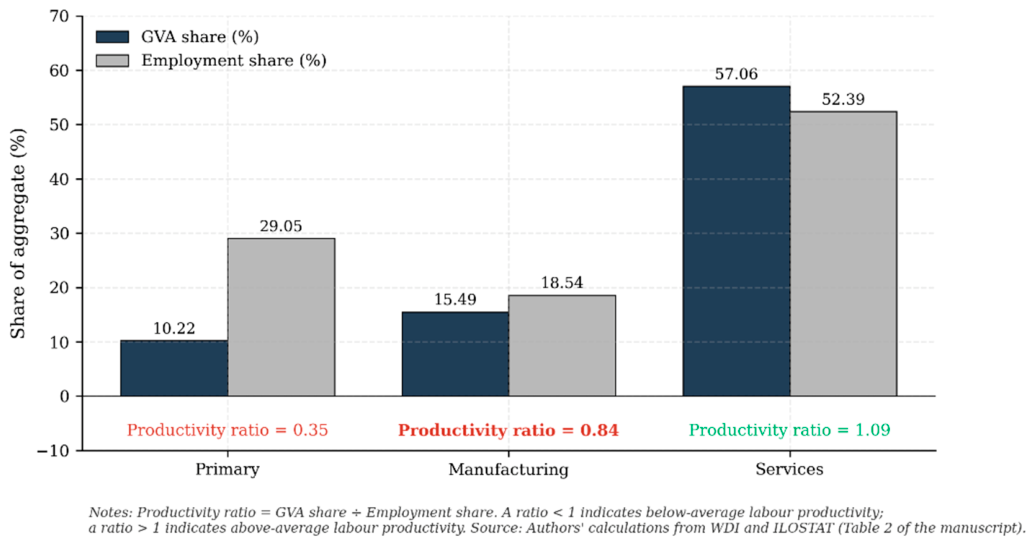
We term this configuration jobless manufacturing growth, and it is the paper’s main contribution: the Kaldorian regime has neither collapsed nor remained intact, but has mutated into a capital-intensive, labour-saving form consistent with the Dutch-disease adjustment expected in commodity-dependent economies under sustained terms-of-trade improvements and real-exchange-rate appreciation. Last, the third law is also supported with important caveats: the contemporaneous coefficient on non-manufacturing employment is fragile across specifications, but the long-run multiplier of −0.23 is roughly four times the static estimate, indicating that the labour-reallocation channel operates slowly and cumulatively rather than instantaneously—a profile consistent with the capital-deepening regime identified under the second law. Despite the statistical significance of the Kaldorian relationships, manufacturing contributes only 0.5 percentage points of the region’s 3.9 per cent annual aggregate growth—roughly 13 per cent of the observed growth, against 61 per cent contributed by services—so its importance lies in cumulative multipliers and qualitative spillovers rather than in the direct arithmetic share. The cross-country heterogeneity within the bloc is also substantial, with the coefficient of variation of manufacturing productivity growth exceeding 80 per cent across countries within any single sub-period and with manufacturing growth declining sharply after 2011 in Peru, Colombia, and Ecuador and accelerating mildly in Bolivia. Thus, the region-wide coefficients summarise four distinct national trajectories.
From these findings, three policies depart from conventional Kaldorian prescriptions that treat manufacturing expansion as an unalloyed good. Industrial policy in ACN cannot rely on capital-subsidy instruments alone: investment tax credits, accelerated depreciation, and subsidised credit for machinery would reinforce rather than correct the jobless-growth pattern, since two-thirds of manufacturing output growth is already absorbed by capital-intensity increases. In other words, capital-support instruments remain necessary but must be paired with skill-upgrading programmes and with selective support for labour-intensive sub-sectors capable of absorbing workers reallocating from primary activities.
Thus, ACN requires macroeconomic instruments that neutralise Dutch-disease pressures, since prolonged real-exchange-rate appreciation during commodity booms erodes the external competitiveness of manufacturing tradable and is the principal cause of the capital-intensive adjustment margin documented here; real-exchange-rate management—through variable export taxation on commodity exports during boom periods, countercyclical capital controls, and the productive re-investment of resource rents—is therefore not separable from industrial policy but a necessary complement to it. The region’s resource endowments should also be leveraged through backward and forward linkages rather than substituted for, with industrial policy building on the existing extractive-sector capability base through resource-based transformation industries (agro-processing, chemicals, metallurgy, and cement) and through high-value services whose linkages to manufacturing have blurred in recent decades.
That being said, our paper’s central contribution was to identify this regime and to reconcile its existence with both the classical Kaldorian framework and the contemporary premature-deindustrialisation debate; the question of what policies can most effectively transform it remains open and invites the empirical work to refine the diagnosis developed here.




 and
and