1. Introduction
1.1. The Governance Challenge
The rapid expansion of platform-mediated work has intensified regulatory tensions between labour market flexibility and social protection, particularly in emerging economies where institutional capacity and developmental trajectories diverge markedly from those of advanced economies. Global estimates of the platform workforce range between 154 and 435 million workers (
ILO, 2023b;
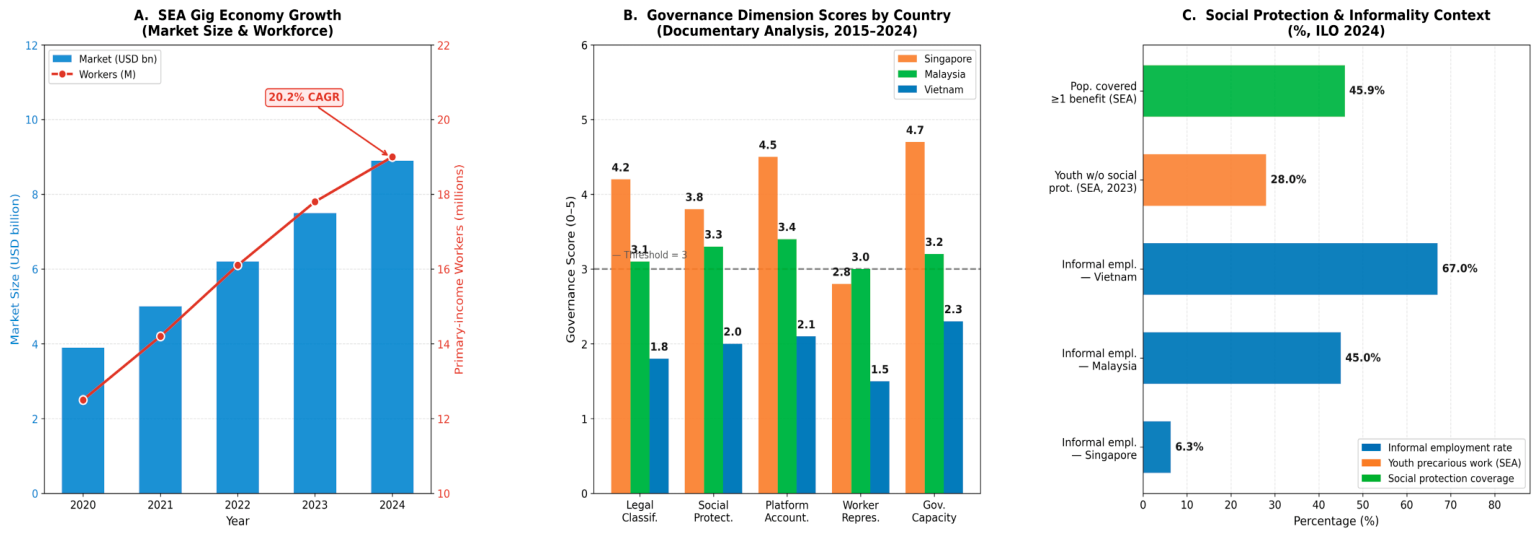
World Bank, 2023) a wide range that itself reflects measurement uncertainty and definitional variation, not a resolved empirical question. What is established is the growth trajectory: in Southeast Asia alone, the platform economy has expanded at a compound annual rate of approximately 20 per cent since 2020, reaching an estimated market size of USD 8.9 billion in 2024, with 19 million workers depending on platform income as their primary source of earnings (
ILO, 2023a;
ASEAN Secretariat, 2024a). The governance challenge is therefore not merely technical but deeply institutional: how should states with different administrative capacities, developmental trajectories, and labour market structures respond to a common technological disruption? This question is the animating concern of the present article.
The distributional stakes are substantial. According to the
ILO (
2024b)
(World Social Protection Report 2024–26), effective social protection coverage in Southeastern Asia reached 45.9 per cent of the population in 2023, representing a 13.4-percentage-point increase since 2015, but still leaving the majority of the workforce without access to comprehensive protections (
ILO, 2024b). Platform workers, legally classified as independent contractors by default in all three cases studied here, are systematically excluded from employer-funded social security contributions. Over 28 per cent of youth in Southeast Asia and the Pacific were engaged in precarious temporary employment without social protections in 2023 (
ILO, 2024a); informal employment stands at approximately 67 per cent in Vietnam, 45 per cent in Malaysia, and 6.3 per cent in Singapore (
ILO, 2024b). These structural differences across the three cases are not incidental: they represent the institutional context within which platform governance choices are made, and the primary source of cross-national variation in the governance designs documented in this article.
1.2. Three Interconnected Gaps in the Existing Literature
Although scholarship on the platform economy has expanded rapidly since 2015, the present study is motivated by three interconnected lacunae that together define a significant intellectual space for comparative analysis. These gaps are not independent; each builds on the preceding one to identify why existing scholarship cannot answer the research question posed here.
First, the platform-work literature retains a systematic geographical bias. Comparative studies are predominantly situated in advanced economies, particularly the United States and Western Europe, leaving the institutional configurations of emerging economies largely untheorised (
Wood et al., 2019;
Heeks, 2017;
Fairwork, 2023;
Katta et al., 2020). This is not merely a coverage gap: as
Rani and Furrer (
2020) demonstrate, the institutional preconditions that shape platform regulation in developing contexts of incomplete social protection floors, high informality, and constrained administrative capacity are structurally different from those in OECD settings. Advanced-economy regulatory frameworks are accordingly analytically inappropriate as direct templates for emerging economies, not merely politically inconvenient.
Second, and consequentially, even the emerging comparative literature treats regulatory instruments in isolation, examining legal classification or social security extensions separately rather than analysing governance as an interdependent configuration of multiple policy dimensions (
Todolí-Signes, 2017;
De Stefano & Aloisi, 2019;
Schoukens et al., 2018). This instrument-by-instrument approach, a direct consequence of the first gap’s implicit assumption that advanced-economy models transfer in parts, obscures the systemic logic through which states combine legal, social–protective, accountability, and representational tools under particular institutional conditions. The result is a scholarship that can describe individual regulatory choices but cannot explain why those choices cluster in the configurations observed across cases.
Third, the emerging literature on Southeast Asian platform governance remains fragmented and under-theorised. Country-level case studies in the region (
ADBI, 2024;
ILO, 2023a) lack systematic cross-case comparison grounded in explicit theoretical propositions. The relationship between institutional capacity and regulatory design central to the political economy of development (
Evans, 1995;
Doner et al., 2005;
Rodrik, 2014) has not been systematically operationalised in this context. Without that theoretical grounding, the growing body of regional case studies cannot cumulate in an explanatory theory.
The present study is designed to address all three gaps simultaneously: it situates the analysis in emerging economies; it analyses governance as configuration rather than instrument; and it grounds cross-case comparison in explicit, falsifiable theory-linked propositions.
1.3. Research Question and Scholarly Contributions
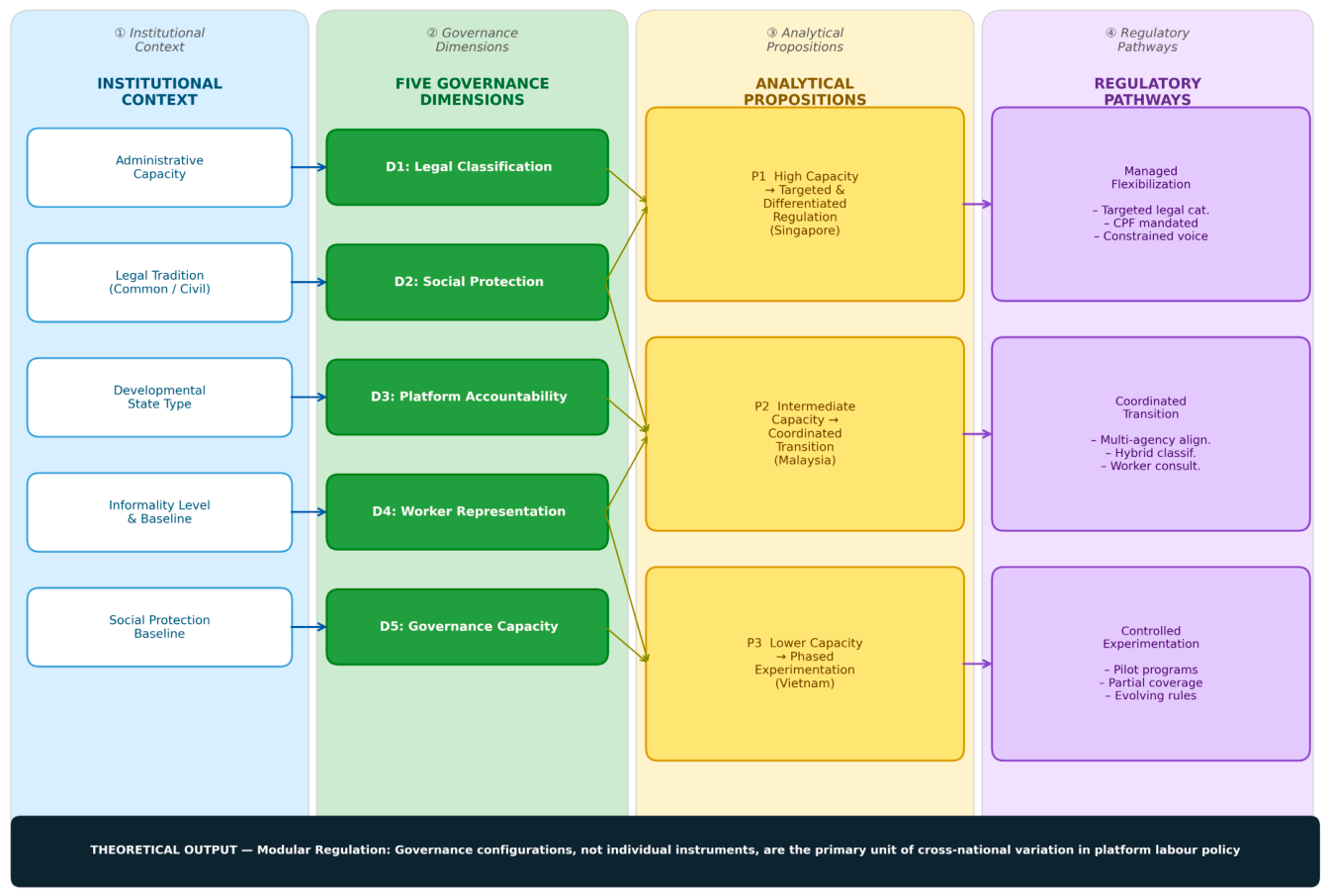
The central research question is as follows: What governance configurations do Southeast Asian states adopt in response to platform work, and how are those configurations shaped by institutional capacity? The question is formulated to be open rather than presumptive; it does not assume that institutional capacity is the explanation but treats it as the primary theoretical candidate to be evaluated against the evidence. Three analytical propositions operationalise this question (
Section 2.2).
This article makes three contributions. First, theoretically, it advances the concept of modular regulation as a development-oriented framework, proposing that governance configurations, rather than individual instruments, represent the primary unit of cross-national variation in platform labour policy, and that the assembly of those configurations is systematically conditioned by institutional capacity. Second, methodologically, it provides a transparent, theory-testing qualitative comparative design using 127 policy documents across three cases, with a structured coding rubric, full corpus disclosure, and explicit falsification criteria offering a replicable template for the growing literature on platform governance in the Global South. Third, normatively, it derives a four-pillar policy architecture for inclusive platform governance that is calibrated to institutional context rather than imported from advanced-economy models, providing empirically grounded guidance for the region’s policymakers.
4. Results: Three Governance Configurations and Their Evidential Basis
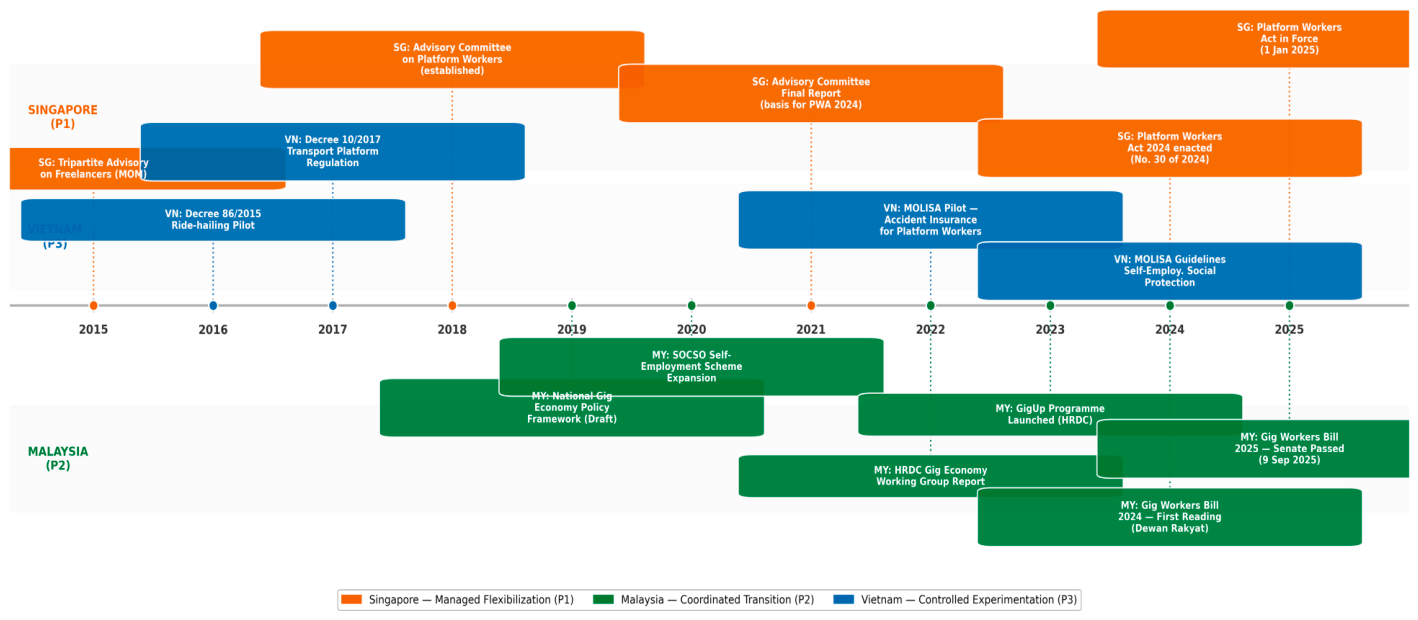
Figure 3 provides the regulatory timeline that contextualises the three case analyses. The timeline shows a shared starting point: all three cases initiated platform-governance activity between 2015 and 2017 and then showed divergent trajectories in pace, ambition, and instrument choice. Singapore reached comprehensive legislation (Platform Workers Act 2024) after nine years of institutional development; Malaysia has followed a coordinated but slower trajectory, with the Gig Workers Bill 2025 representing the culmination of a six-year multi-agency process; Vietnam has maintained a pilot-based approach through the full decade, with no equivalent legislative endpoint (
The Diplomat, 2025).
Before the case-level analyses, it is useful to concretely state what each pathway label means in governance design terms, so that the reader can evaluate the evidence against a clear prior expectation. Managed flexibilisation (Singapore/P1) denotes a governance design that targets specific, high-risk worker groups rather than all platform workers; extends social protections selectively and in tiered form rather than universally; and achieves regulatory precision through a centralised agency architecture backed by strong enforcement capacity. The defining characteristic is calibration: instruments are tailored to the protection deficit and the institutional infrastructure available, not maximised in ambition or minimised in cost. Coordinated transition (Malaysia/P2) denotes a governance design in which no single agency has full regulatory authority; protections are built incrementally across multiple institutional actors (MOHR, SOCSO, HRDC, Parliament); and the policy trajectory is driven by a combination of administrative sequencing and political responsiveness to worker mobilisation. The defining characteristic is coordination across distributed institutional capacity in lieu of centralised direction. Controlled experimentation (Vietnam/P3) denotes a governance design that initiates governance activity through time-limited pilots and partial protections rather than comprehensive legislation; prioritises platform accountability and registration (D3) before more demanding legal classification and social protection instruments (D1, D2); and generates policy learning incrementally, with each pilot informing subsequent instrument design. The defining characteristic is sequencing under capacity constraint: instruments are introduced in an order determined by what the current administrative infrastructure can support.
Table 3 presents a cross-case summary of governance dimension scores and proposition outcomes, providing a structured overview of the evidence before the case-level analyses in
Section 4.1,
Section 4.2 and
Section 4.3.
4.1. Singapore: Managed Flexibilisation—P1 Evaluation
The Singapore case provides the most systematically documented governance configuration in the regional corpus (48 documents). The trajectory from the 2015 Tripartite Advisory on Freelancers, through the 2018 establishment of the Advisory Committee on Platform Workers to its 2021 Final Report, and ultimately to the Platform Workers Act (No. 30 of 2024), which entered into force on 1 January 2025, constitutes a coherent nine-year sequence of institutionally deliberate regulatory development (
Singapore Statutes Online, 2024). Each step built explicitly on the preceding one; the 2021 Advisory Committee Report is the direct legislative precursor to the 2024 Act, enabling a traceable evidence chain from policy problem identification to legislative solution.
The Platform Workers Act establishes three governance mechanisms designed, according to the documented intent of the 2021 Advisory Committee Report (SG-03), to be precisely calibrated to the protection deficits identified in the policy record. The calibration is a documented design property; whether it translates into effective coverage in practice is a question that documentary analysis cannot address and that future fieldwork research should investigate. First, a distinct statutory category is created for platform workers in ride-hailing and delivery services, with neither employees nor independent contractors triggering mandatory Central Provident Fund (CPF) contributions by both platform operators and workers, phased in at increasing rates between 2025 and 2028. Contribution rates are tiered: 3.5 per cent for workers earning below SGD 500 per month, rising incrementally to full employee-equivalent rates above SGD 1500, a calibration designed to protect low-earning workers while preserving flexibility for those with higher incomes. Second, Work Injury Compensation Insurance (WICA) coverage is extended to platform workers at employee-equivalent rates, addressing what the Advisory Committee identified as the most acute and measurable protection deficit. Third, Platform Work Associations (PWAs) are legally recognised, with powers analogous to trade unions, for the purpose of dispute representation and operator consultation, but explicitly excluded from collective bargaining rights.
This governance configuration is consistent with P1. What characterises Singapore is not the universality of the protection but the state’s capacity to intervene selectively, precisely, and in a targeted manner without disrupting the operational flexibility that makes platform work attractive to operators and workers alike. The CPF tiering, the WICA rate calibration, and the PWA consultative (rather than bargaining) model all reflect the administrative precision and institutional sophistication that high governance capacity enables.
However, P1 requires a scope condition. The worker representation dimension (D4: 2.8) scores below the analytical threshold, despite Singapore’s overall governance capacity score of 4.7 the widest intra-case gap in the dataset (
Table 3). This is not a measurement anomaly: this reflects the deliberate exclusion of collective bargaining from the PWA framework, a political-economy constraint that high administrative capacity does not dissolve. The implication is that P1 must be specified: high institutional capacity enables targeted regulatory precision in technically complex governance domains (D1, D3, D5) but does not automatically generate inclusive participatory governance (D4), where the political economy of collective action creates structural constraints. This is a scope condition for P1, not a disconfirmation of it. The key distinction from the Malaysian pathway (P2) is that Singapore’s governance architecture is centralised—a single agency (MOM) orchestrates D1 through D5—whereas Malaysia assembles similar protections through multi-agency coordination. The key distinction from the Vietnamese pathway (P3) is that Singapore’s instruments are comprehensive in their target domain, not partial or piloted: mandatory CPF contributions and WICA coverage are system-wide within their defined scope from the Act’s commencement.
4.2. Malaysia: Coordinated Transition—P2 Evaluation
The Malaysian case illustrates how an intermediate-capacity state develops platform governance through cross-institutional coordination as both a mechanism (
HRDC Malaysia, 2023) and a substitute for the centralised authority (
MOHR Malaysia, 2019) available to higher-capacity systems. The trajectory is traceable across four institutional actors, whose coordination defines the case: the Ministry of Human Resources (MOHR), which provides the legislative mandate; the Social Security Organisation (SOCSO), which administers accident insurance expansion; the Human Resources Development Corporation (HRDC), which manages the GigUp skilling programme; and the Parliament of Malaysia, which provides the legislative endpoint. This multi-actor architecture is not a design choice; it reflects the distributed institutional landscape of an intermediate-capacity state in which no single agency has the mandate, resources, or authority to govern platform work unilaterally.
The legislative trajectory from the 2019 National Gig Economy Policy Framework, through SOCSO’s 2020 self-employment scheme expansion, the 2022 HRDC Gig Economy Working Group, the 2023 GigUp Programme, and the passage of the Gig Workers Bill 2025 through the Senate on 9 September 2025 (
Malaysian Parliament, 2025) documents a six-year coordinated policy development process. The Gig Workers Bill 2025 creates what has been described as a “hybrid model” that assigns platform workers a distinct statutory category with mandatory SOCSO accident insurance coverage, consultation rights, and a registered platform contract without employee reclassification. This positioning between Singapore’s social-security extension model and the EU’s employment presumption approach reflects the institutional feasibility constraints of an intermediate-capacity system: employee reclassification would require an enforcement infrastructure that Malaysia’s labour inspection system does not yet uniformly possess.
The Malaysian case is consistent with P2. Coordination operates as a governance mechanism sequencing instruments across agencies to build aggregate regulatory coverage that no single agency could deliver alone. The passage of the Gig Workers Bill following sustained worker mobilisation (the 2022 Klang Valley delivery strikes and the 2024 “Grab Blackout” protests) further illustrates that the coordination pathway is not purely technocratic but also politically responsive: a characteristic consistent with the intermediate-capacity state’s reliance on coalitional governance rather than technocratic direction.
A key evidentiary limitation must be registered. The documentary corpus captures formal policy architecture but cannot resolve a crucial interpretive ambiguity: whether multi-agency coordination in Malaysia reflects a
deliberate developmental strategy (a choice among alternatives) or an
institutional default (the only feasible arrangement given fragmented mandates). This distinction matters theoretically: if the latter, P2 may reflect path dependency rather than a developmentally purposive state. The documentary record cannot adjudicate this question; qualitative fieldwork with policymakers would be required. This limitation is flagged as a scope condition on P2: the proposition is consistent with the evidence but does not establish the mechanism through which coordination occurs. The key distinction from the Singapore pathway (P1) is architectural: Malaysia’s governance is distributed across multiple agencies with overlapping mandates, whereas Singapore’s is centralised under MOM. The key distinction from the Vietnamese pathway (P3) is in the degree of institutionalisation: Malaysia has produced binding legislation ((
Malaysian Parliament, 2025) (the Gig Workers Bill 2025)) as the endpoint of its coordinated process, whereas Vietnam has not yet reached a legislative consolidation of its pilot-based instruments.
4.3. Vietnam: Controlled Experimentation—P3 Evaluation
The Vietnamese case illustrates how a lower-capacity state manages platform governance under the conditions of rapid market expansion, high informality, and constrained administrative infrastructure. The governance challenge is severe: gig platform registrations increased approximately 21 per cent year-on-year through 2024 (
ASEAN Secretariat, 2024a), informal employment stands at approximately 67 per cent, and effective social protection coverage remains among the lowest in the region (
ILO, 2024b). The state’s regulatory response has been calibrated to these constraints through a phased, experimental approach that prioritises accountability and classification over comprehensive protection.
The governance trajectory documents a consistent pattern of limited intervention followed by expansion (
Heilmann, 2008): Decree 86/2015 established a pilot framework for ride-hailing platforms under the Ministry of Transport, imposing registration and reporting obligations; Decree 10/2017 extended this framework; the Labour Code 2019 clarified but did not resolve platform worker classification; a
MOLISA (
2022) circular introduced a limited pilot accident insurance scheme for platform-adjacent workers on a voluntary basis; and 2024 MOLISA guidelines extended partial voluntary social protection to self-employed workers including some platform workers. Comprehensive reform a dedicated platform workers act or equivalent legislation remains aspirational, with no enacted legislation as of December 2024.
This trajectory is consistent with P3. Experimentation functions both as a pragmatic response to capacity constraints and as a policy learning instrument: the 2022 accident insurance pilot generated operational knowledge about enrolment mechanisms, contribution rates, and platform compliance that informs the 2024 MOLISA guidelines. The Vietnamese case thus illustrates the positive institutional learning dimension of phased experimentation that P3 predicts.
P3 requires a boundary condition, however. For experimentation to constitute a genuine governance strategy rather than regulatory inertia, it must be coupled with an institutionalisation pathway, a formal mechanism for scaling pilots into systemic protections. Across the 37 Vietnamese documents in the corpus, no such mechanism is identifiable: no sunset clause, scaling timeline, or institutionalisation trigger is documented for the 2022 accident insurance pilot or the 2024 social protection extension. This absence does not disconfirm P3—the proposition specifies phased experimentation, not institutionalisation—but it qualifies the normative status of the Vietnamese pathway: controlled experimentation without an institutionalisation pathway risks becoming permanent partiality rather than a transitional strategy. The key distinction from the Singapore pathway (P1) is scope: Vietnam’s instruments cover specific platforms or sectors on a pilot basis, whereas Singapore’s apply comprehensively within their defined target group. The key distinction from the Malaysian pathway (P2) is institutional architecture: Vietnam’s pilots operate primarily through MOLISA directives, without the multi-agency coordination mechanism that characterises Malaysia, and without the cross-institutional accountability that coordination provides.
5. Discussion
5.1. Proposition Evaluation: Confirmations, Scope Conditions, and Disconfirming Evidence
The cross-case analysis provides conditional support for all three propositions. The term “conditional” is deliberate: each proposition is confirmed in its core prediction but requires specification of the scope conditions to achieve the theoretical precision expected of Q2+ scholarship.
Table 3 summarises the proposition outcomes; this section develops the analytical reasoning behind each.
For P1, the Singapore evidence confirms the core prediction: high institutional capacity is associated with targeted, calibrated governance rather than broad intervention. The scope condition is that this precision operates differentially across governance dimensions: it is most evident in technically complex domains (D1, D3) and least evident in the participatory domain (D4), where the political economy of collective action creates constraints that administrative capacity alone cannot dissolve. P1 should therefore be reformulated: high-capacity states adopt targeted and differentiated governance in administratively tractable dimensions but may systematically underprovide participatory governance where political-economy constraints override capacity.
For P2, the Malaysian evidence confirms the coordination prediction but cannot determine the mechanism. The key theoretical distinction between coordination as deliberate strategy and coordination as institutional default is unresolvable from documentary evidence alone. This matters for the scope of P2: if coordination reflects the default rather than strategy, the proposition may overstate the developmental intentionality of intermediate-capacity states. P2 is better formulated as a structural prediction (intermediate-capacity states will exhibit multi-agency governance) with agnosticism about the deliberateness of that structure.
For P3, the Vietnamese evidence confirms phased experimentation but reveals an unintended implication: in the absence of an institutionalisation pathway, P3’s predicted governance pattern is structurally indistinguishable from regulatory delay. The proposition requires a boundary condition: controlled experimentation is a governance strategy only where pilots are designed with institutionalisation criteria. Where they are not, P3 describes a state of permanent partiality rather than a developmental trajectory.
5.2. Modular Regulation: Theoretical Contribution and Conceptual Differentiation
The comparative findings support a theoretical synthesis, proposed here under the concept of modular regulation. The concept is motivated by three observations from the cross-case analysis: (i) all three states operate from a common five-dimensional menu of governance instruments (D1–D5); (ii) the configurations assembled from that menu are systematically differentiated by institutional capacity rather than by policy preference, lobbying outcome, or legal tradition; and (iii) the configurations are internally coherent–each pathway combines its instruments in a way that reflects the institutional constraints and feasibility conditions of the case rather than in an arbitrary or accidental manner.
Modular regulation is formally defined as the structured, capacity-conditioned process by which states select, sequence, and calibrate governance instruments from a common dimensional menu to produce internally coherent governance configurations that are adapted to their institutional context and developmental stage. Four properties distinguish this concept from adjacent ideas in the literature. First, unlike the flexibility-versus-protection binary of the platform-work literature (
Berg et al., 2018;
De Stefano, 2016;
Prassl, 2018), modular regulation does not assume a trade-off: both high-protection and low-protection outcomes can be modular, depending on the institutional context. Second, unlike
Streeck and Thelen’s (
2005) “layering,” modular regulation describes the structure of a governance configuration at a point in time, not the process of incremental addition to existing institutions. Third, unlike bricolage, modular regulation is not an opportunistic assemblage: it is capacity-constrained selection from a theoretically specified dimensional menu. Fourth, unlike the variety of capitalism (
Hall & Soskice, 2001), which identifies stable complementarities in advanced economies, modular regulation applies specifically to developmental contexts where configurations are still forming and institutional capacity is the binding constraint.
The normative implication of modular regulation is significant: policy transfer between countries at different institutional capacity levels is likely to be ineffective and potentially counterproductive (
ILO, 2025) if it involves transplanting individual instruments without the complementary governance infrastructure. Singapore’s Platform Workers Act 2024 is functional because it is embedded in a high-capacity configuration: CPF infrastructure, mature labour inspection, and a dispute resolution system that pre-existed the Act. Transplanting D1 (the third-category classification) to Vietnam without the D5 infrastructure would likely produce nominal legal recognition without substantive protection. The practical implication for policymakers in lower-capacity settings is to build D5 governance capacity first, enabling more ambitious D1–D4 configurations at a later stage.
5.3. Rival Explanations: Adjudication Against the Evidence
The institutional-capacity explanation is assessed against two principal rivals. The first—rival platform industry lobbying as the primary driver of governance outcomes (
Rahman & Thelen, 2019;
Thelen, 2018)—predicts that regulatory governance will be most permissive where platform industry influence is strongest. The evidence is inconsistent with this prediction across all three cases. Singapore, where major platforms (Grab, Foodpanda) have the most organised lobbying presence in the region, has produced the most comprehensive and burdensome governance framework. Vietnam, where platforms face minimal organised regulatory challenge and state capacity is lower, has produced the least comprehensive framework. If lobbying power were the primary driver, this pattern would be reversed. Malaysia is the most complex case: the passage of the Gig Workers Bill followed worker mobilisation, not platform lobbying, consistent with the capacity explanation (which predicts that intermediate-capacity states respond to coalitional pressure) rather than the lobbying explanation.
The second—rival legal tradition (common law versus civil law) as the primary driver—is addressed by the within-design comparison of Singapore and Malaysia. Both are common law systems and both have Grab and other major platforms operating under identical legal frameworks at the operator level; however, they have adopted divergent governance configurations (P1 versus P2). This divergence is consistent with the institutional capacity explanation and inconsistent with the legal tradition explanation: legal tradition alone cannot account for why two common law systems have produced systematically different governance configurations for the same technological disruption. Vietnam’s civil law system produces a distinct configuration (P3), which is consistent with both institutional capacity differences (the primary explanation) and legal tradition differences (the secondary variable). The comparative design cannot fully separate these two variables for the Vietnam case; future research should include Thailand (civil law, intermediate capacity) or the Philippines (common law, intermediate–lower capacity) to provide the additional variation needed to adjudicate.
5.4. Policy Implications: A Four-Pillar Architecture for Context-Sensitive Governance
The modular regulation framework generates a four-pillar architecture for platform governance that is calibrated to the institutional context rather than derived from advanced-economy templates. Each pillar corresponds to one or more governance dimensions (D1–D4) and is specified for three institutional capacity levels, as summarized in
Table 4.
Recommendations are derived from the cross-case evidence and are context-specific, not universal prescriptions. States should calibrate implementation to their assessed D5 capacity.
Two implications of the architecture deserve emphasis. First, the pillar sequencing matters: Pillar 3 (platform accountability) is achievable at all capacity levels and should be prioritised early, because operator registration and reporting requirements generate the information base on which more ambitious D1 and D2 protections subsequently depend. Second, the architecture is modular in the intended sense: states can adopt elements of any pillar independently, sequencing them according to their specific institutional constraints, rather than being required to implement all four pillars simultaneously. The Vietnam case shows that partial adoption of Pillar 3 first, generating accountability obligations before social protection obligations, is both feasible and informative as a first step.
6. Conclusions
This article has examined how institutional capacity shapes the design of platform work governance configurations in Southeast Asia, drawing on a theory-informed qualitative comparative documentary analysis of 127 policy documents across Singapore, Malaysia, and Vietnam (2015–2024). The analysis confirms three institutionally distinct regulatory pathways managed flexibilisation, coordinated transition, and controlled experimentation and suggests that these pathways are not arbitrary national choices but structurally conditioned outcomes of the institutional contexts within which governance decisions are made.
The article’s theoretical contribution is the concept of modular regulation, which proposes that governance configurations assembled from a common five-dimensional menu under different institutional capacity constraints are the primary unit of cross-national variation in platform labour policy. This concept resolves a key explanatory deficit in the existing literature: the platform-work scholarship can describe regulatory differences across cases but has lacked a framework that systematically accounts for why those differences cluster in the configurations observed. Modular regulation provides that framework by specifying both the dimensional menu (D1–D5) and the capacity-based selection logic that produces different configurations from that common menu.
The propositions are conditionally confirmed. P1 is confirmed for technical governance dimensions but requires a scope condition for participatory governance (D4), where political-economy constraints limit even high-capacity states. P2 is confirmed structurally but cannot be adjudicated mechanistically without fieldwork evidence on coordination intentionality. P3 is confirmed for phased experimentation but requires a boundary condition: experimentation is a governance strategy only when accompanied by institutionalisation pathways, not when it constitutes de facto permanent partiality.
Three limitations of the study are noted. First, the documentary design documents governance intent rather than governance impact: the study cannot assess whether the Platform Workers Act 2024 has improved workers’ material conditions, whether SOCSO coverage in Malaysia has reached the workers it is designed to protect, or whether Vietnam’s pilots have generated the learning that P3 predicts. These impact questions require implementation data—worker surveys, enforcement records, administrative enrolment statistics, or semi-structured interviews with workers and officials—that lie beyond the scope of documentary analysis. All claims in this article are accordingly calibrated to governance design, not governance effectiveness. Second, single-coder analysis introduces reliability risks that the audit trail and coding rubric mitigate but do not eliminate. Third, three cases cannot establish generalised claims about all emerging economies; the findings are analytically generalisable to institutionally similar cases but require extension to be empirically generalisable to the region as a whole.
Four research directions are identified as priorities. First, larger-N comparative designs extending the analysis to Indonesia, Thailand, and the Philippines would provide the additional variation needed to adjudicate the legal tradition rival explanation and test the modular regulation framework more robustly. Second, semi-structured interview fieldwork with policymakers, platform operators, and workers represents the highest-priority methodological extension of this research. Such fieldwork would allow the mechanism question for P2 (Malaysia)—whether multi-agency coordination reflects deliberate developmental strategy or institutional default—to be adjudicated. It would also provide implementation evidence that documentary analysis cannot generate: whether governance designs translate into substantive worker protection. Worker survey data on CPF access in Singapore, SOCSO enrolment rates in Malaysia, and pilot scheme participation in Vietnam would directly assess whether the documented governance designs produce the outcomes they are designed to achieve. Third, worker survey data would enable assessment of whether governance design differences translate into measurable differences in protection outcomes—the document-to-outcome gap that constitutes the most significant limitation of the present study. Fourth, longitudinal tracking of the three pathways as platform economies mature would test the path-dependency claim and assess whether capacity-building efforts in Malaysia and Vietnam produce the configuration convergence or divergence that the modular regulation framework predicts.
In emerging economies, effective platform governance depends less on replicating any single advanced-economy template than on building the institutional capacity to assemble context-appropriate governance configurations from the five-dimensional menu. The modular regulation framework advanced here offers a theoretically grounded and empirically tractable starting point for that process—one that takes institutional capacity not as a background condition to be assumed away but as the central variable in the comparative politics of digital labour governance.