Article

Asymmetric Moderating Role of Geopolitical Risk in the Relationship Between Oil Rents and CO2 Emissions in Saudi Arabia: An NARDL Approach


by
Mohammed Sultan Alsubaie
Department of Finance, College of Business Administration, Prince Sattam Bin Abdulaziz University, 173, Alkharj 11942, Saudi Arabia
Economies 2026, 14(6), 213; https://doi.org/10.3390/economies14060213
Submission received: 11 April 2026 / Revised: 18 May 2026 / Accepted: 2 June 2026 / Published: 5 June 2026

Abstract

Oil is a major source of income and emissions in the Saudi economy. Thus, this study examines the symmetrical and asymmetrical impacts of oil rents (ORs) on CO2 emissions using data from 1970 to 2024. For this purpose, the Nonlinear Autoregressive Distributed Lag (NARDL) model is applied, while the conventional ARDL model is used as a baseline model. In addition, the moderating effect of geopolitical risk (GPR) is also tested in the association between OR and emissions. The Environmental Kuznets Curve is validated in both the long run and the short run. Moreover, OR is found to be a major driver of emissions, and positive shocks amplify emissions more than negative shocks reduce them. GPR has a negative relationship with emissions, and the impact of positive shocks in GPR is found to be greater than the impact of negative shocks in GPR. However, the interaction between OR and GPR shows that simultaneous increases in both factors exacerbate emissions, whereas the effect of negative shocks in this interaction is insignificant. Thus, asymmetry is corroborated in all investigated relationships. Moreover, the Wald tests also confirm significant asymmetric relationships. The findings suggest reducing oil dependence and adopting GPR-sensitive planning to mitigate the environmental impacts of the oil sector in line with Vision 2030 and the Sustainable Development Goals (SDGs).

1. Introduction

The oil sector is a major source of income for the Saudi economy, but it also poses serious environmental threats because of extensive Greenhouse Gas (GHG) emissions generated throughout the stages of oil extraction, production, and consumption. Moreover, oil remains a primary energy source for electricity generation, transportation, and other commercial and residential energy needs in Saudi Arabia. Therefore, the combustion of oil for energy production significantly contributes to GHG emissions and environmental pollution. In recent years, Saudi Arabia has ranked among the world’s top 10 polluting economies (Worldometer, 2025). In addition, oil rents (ORs) constitute a major source of export earnings and government revenues, which are used to finance urban development, infrastructure projects, and social programs that may generate additional environmental pressure through demand-side effects. OR is the net value of crude oil production after deduction of the cost of production, which is expressed as a percentage of Gross Domestic Product (GDP) (World Bank, 2026). Alongside these environmental concerns, Saudi Arabia is located in the Middle East, a region characterized by high geopolitical risk (GPR) arising from conflicts, wars, political tensions, and policy uncertainty. From an environmental perspective, higher GPR may reduce economic activities and pollution levels because uncertainty can weaken investment and production activities. However, GPR may also discourage investment in renewable energy infrastructure and green transition projects, which are key objectives under Saudi Vision 2030 and are also aligned with the SDGs.
This study follows the Prospect Theory of Kahneman and Tversky (1979), which advocates that decision-makers respond differently to gains and losses under conditions of risk and uncertainty. Accordingly, policymakers in Saudi Arabia may react differently to increases and decreases in oil rents, leading to asymmetric effects of oil rents on CO2 emissions. For instance, during periods of high GPR, the government may prioritize oil rent generation and economic stability over environmental sustainability concerns, which can strengthen the positive association between OR and emissions. Conversely, during periods of low geopolitical risk, policymakers may adopt a more flexible and sustainability-oriented approach, which may weaken the relationship between oil rents and environmental degradation. Moreover, the government may allocate a larger share of oil revenues toward renewable energy development and green transition projects under stable geopolitical conditions. From a global perspective, GPR can also influence international oil prices, as observed during recent Iran–US geopolitical tensions. Conflicts and wars may threaten global oil supply chains, leading to higher oil prices in international markets. Under relatively stable production and export conditions, rising oil prices can increase Saudi Arabia’s oil revenues and oil rents. However, heightened geopolitical risk may simultaneously slow global economic activities and reduce energy demand because of rising uncertainty, which may eventually place downward pressure on oil prices. In another extreme scenario, attacks on oil facilities in Saudi Arabia may disrupt oil production and exports, thereby reducing oil production capacity and oil rents even during periods of high oil prices. Furthermore, geopolitical risk can increase volatility in global oil markets, creating uncertainty for both the government and private sector in undertaking long-term investments in renewables.
In the OR, GPR, and the environment nexus, the literature has worked separately on the connection between OR and pollution (Lin et al., 2024; W. Wang et al., 2023) and GPR and pollution (Anser et al., 2021; Ding et al., 2023). However, the literature is scant in exploring how GPR may change the impact of OR on emissions (W. Zhao et al., 2021). Moreover, it is not necessary that the effects of OR and GPR on emissions are symmetrical. For instance, increasing oil prices and rents lead to higher oil production, which increases emissions. However, it can be invested in renewable energy infrastructure, which can reduce emissions. So, the net effect of increasing OR can be uncertain, which depends on government decisions and economic conditions. Alternatively, a fall in oil prices may motivate oil producers to produce more to sustain OR, which may generate more emissions. However, a fall in oil prices may also reduce oil production and emissions. But lower oil revenues can limit investment in environmental projects. Thus, the effects of positive and negative shocks to oil prices and rents could have asymmetrical effects.
Similarly, asymmetry can be expected in the GPR–emissions nexus. For instance, a rising GPR would reduce economic activities, oil production, and emissions in the short run. However, a persistently high GPR may shift the government’s focus toward energy security and OR, which can increase emissions in the long run. Conversely, a decreasing GPR may have a milder impact on emissions. For instance, reduced GPR can improve stability in government behavior toward long-term planning, green investment, and stronger environmental policies, which may reduce emissions gradually. Thus, the response of the environment to GPR is not symmetrical or instantaneous under both rising and falling GPR conditions. Likewise, the moderating effect of GPR can also be asymmetrical. Increasing GPR may strengthen the positive relationship between OR and emissions, as governments often prioritize securing revenues and maintaining economic stability. Consequently, oil production and emissions may increase, and environmental policies may be weakened. However, declining GPR may result in a weaker or even inverse relationship between OR and emissions. For instance, OR may be invested in renewable energy production under low GPR conditions.
The above discussion highlights the importance of GPR and OR in determining environmental quality in Saudi Arabia. Several Saudi-based studies have examined the role of GPR in explaining economic diversification (Sweidan & Elbargathi, 2023), economic complexity (Aloui et al., 2024), trade performance (Islam & Islam, 2026), international competitiveness (Su et al., 2019; Razek & McQuinn, 2021), insurance demand (Hemrit, 2021), and climate-related variables (Dhifaoui et al., 2023). Some studies have also explored the moderating effect of GPR in the nexus between FDI, trade, and CO2 emissions (Alsubaie et al., 2025), as well as between OR and economic development (Sweidan & Elbargathi, 2022). However, no study has examined the moderating effect of GPR on the connection between OR and emissions. In addition, the simultaneous examination of OR, economic growth, GPR, and emissions has also not been investigated in resource-dependent economies. This study is therefore motivated to estimate the direct impact of OR and GPR on emissions in the Saudi economy. Moreover, it also examines whether GPR moderates the effect of OR on emissions. Finally, the possibility of asymmetry is tested across all hypothesized relationships. Accordingly, a nonlinear ARDL (NARDL) model is applied to data from 1970 to 2024 in the oil-dependent Saudi economy, which is still missing in the existing Saudi literature. Overall, the following research questions are examined:
  • Does OR have a symmetrical or asymmetrical impact on CO2 emissions in Saudi Arabia?
  • Does GPR directly affect CO2 emissions symmetrically or asymmetrically?
  • Does GPR moderate the relationship between oil rents and CO2 emissions?
  • Is the Environmental Kuznets Curve (EKC) valid in Saudi Arabia over the period 1970–2024 in the presence of GPR, OR, and their interaction in the model?

2. Literature Review

2.1. Negative Environmental Effects of GPR

GPR could have a different impact on the environment. The literature suggests that GPR can disrupt environmental regulatory frameworks. Many studies have investigated the GPR and emissions relationship in BRICS economies. Anser et al. (2021) examined the impact of GPR on CO2 emissions in BRICS countries from 1985 to 2017 and found that a 1% increase in GPR raised CO2 emissions by 13%, indicating disruption in long-term environmental planning and delayed green investments. Khan et al. (2023) re-examined BRICS countries over the period 2000–2021 using a fully modified bias-corrected technique and found that both GPR and militarization increased emissions and energy usage. In addition, bidirectional relationships between GPR and environmental degradation were also reported. Using similar econometric techniques, Guo et al. (2023) included nuclear energy efficiency in the analysis of BRICS economies and found that it reduced carbon emissions; however, the effects of GPR and Economic Policy Uncertainty (EPU) were found to be ineffective in reducing carbon emissions.
Using Cross-Sectional Dependence (CSD) techniques, Uddin et al. (2023) re-investigated BRICS countries by including Institutional Quality (IQ) indicators in the analysis. The authors found that IQ and Foreign Direct Investment (FDI) condensed emissions; however, GPR positively affected CO2 emissions. In a CSD framework, Cui et al. (2024) re-examined BRICS countries from 1992 to 2021 by incorporating both aggregated IQ and EPU in the analysis and revealed that IQ and energy productivity mitigated CO2 emissions, whereas GPR and EPU increased pollution. In a sectoral analysis, Kartal et al. (2025) analyzed and confirmed the heterogeneous influence of GPR on sectoral emissions in BRICS countries over the period 2000 to 2022. In a quantile-based approach, Syed et al. (2022) investigated BRICS countries and Turkey and reported a heterogeneous environmental effect of GPR; for instance, GPR increased emissions at earlier quantiles but reduced emissions at higher quantiles. Thus, the impact of GPR depends on a country’s existing emission levels.
Qamruzzaman et al. (2025) re-examined BRICS economies over the period 2004 to 2022 and found that green innovation and renewable energy consumption (REC) improved environmental quality. Nevertheless, GPR and unplanned urbanization increased emissions. Moreover, feedback effects were observed between GPR, urbanization, and environmental degradation. Luo and Sun (2024) indicated that GPR accelerated emissions; however, environmental policy stringency weakened the impact of GPR. In a panel of 38 countries with different development levels, L. Chen et al. (2024) used data from 1990 to 2019 and reported that GPR amplified CO2 emissions inequality. Kolati and Raghutla (2025) examined leading economies from 1990 to 2022 and substantiated that REC, fintech development, and industrialization mitigated CO2 emissions, while GPR intensified them. Sanusi et al. (2025) studied China, India, and the USA from 1990 to 2019 and confirmed that GPR increased CO2 emissions. In a causality analysis for China, K.-H. Wang et al. (2022) reported feedback between GPR and CO2 emissions. Similarly, for South Africa, Lawal et al. (2023) also confirmed feedback causality between GPR and CO2 emissions.
Using CSD techniques, Zhang et al. (2024) explored G7 nations from 1990 to 2021 and substantiated that energy consumption and GPR negatively affected environmental quality. Shanyazov et al. (2026) re-explored the G7 from 1990 to 2022 and found that GPR increased emissions. Moreover, policy uncertainties also contributed to CO2 emissions. Kisswani et al. (2024) explored Southeast Asia from 1990 to 2020 and found that climate policy uncertainty reduced CO2 emissions. However, GPR and Gross Domestic Product (GDP) increased emissions. Liza et al. (2024) probed the G20 and reported that green finance reduced pollution. Nevertheless, GPR positively impacted emissions. Shen et al. (2024) scrutinized 156 economies from 2000 to 2022 and reported that increasing GPR and migration positively contributed to emissions. Flouros et al. (2022) evaluated 171 economies and reported that GPR reduced green investments.

2.2. Positive Environmental Effects of GPR

The literature has also corroborated the positive environmental effects of GPR through reducing pollution, as GPR can reduce economic activities and emissions. For instance, Hashmi et al. (2022) utilized a global dataset and substantiated that GPR condensed emissions globally due to an immediate economic slowdown. Nevertheless, GPR raised emissions in the long run. Ma et al. (2022) found that GPR reduced emissions in the short run and increased them in the long-term. Moreover, the EKC was validated. Husnain et al. (2022) investigated E7 and corroborated that GPR reduced CO2 emissions. Kızılkaya et al. (2024) evaluated Turkey from 1985 to 2019 and reported that increases in GPR reduced CO2 emissions. Villanthenkodath and Pal (2024) investigated India from 1990 to 2019 and found that GPR improved environmental quality. Pata et al. (2023) analyzed sectoral CO2 emissions from 1997 to 2022 and validated that GPR and EPU reduced CO2 emissions in most sectors because of production disruptions. Still, GPR increased emissions in the transportation sector.
Ulussever et al. (2025) investigated GCC from 2000 to 2021 and corroborated that GPR showed mixed impacts on CO2 emissions in different quantiles. Nawaz et al. (2023) examined Italy from 1997 to 2019 and found that religious tourist arrivals and GPR reduced CO2 emissions. However, FDI and transportation contributed to CO2 emissions. Rashid and Gopinathan (2023) investigated India and found that GPR reduced CH4 and N2O emissions, substantiating the EKC. Saadaoui et al. (2024) explored Turkey from 1985 to 2021. GPR, hydroelectricity, and FDI reduced emissions. Zeng et al. (2025) investigated Mexico, Indonesia, Nigeria, and Turkey from 1990 to 2020 and found that REC and EPS increased emissions. However, GPR and innovation reduced CO2 emissions. Yuen and Yuen (2024) scrutinized the role of GPR on R&D and found that financially capable governments increased investments in renewable R&D to safeguard energy supply during high GPR. Alsagr and van Hemmen (2021) assessed emerging markets from 1996 to 2015 and reported that GPR raised REC. Rasoulinezhad et al. (2020) analyzed Russia from 1993 to 2018 and found that GDP, population, and inflation reduced energy transition. However, CO2 emissions, GPR, exchange rate, and financial openness promoted energy transition.

2.3. The Resource–Emissions–GPR Nexus

The reliance on resource rents, particularly from fossil fuels, may exacerbate emissions in any resource-abundant nation. In an extension of the resource curse theory, studies have investigated the ecological effects of Natural Resource Rents (NRRs). Iqbal et al. (2025) probed 36 economies from 2000 to 2021 and reported that artificial intelligence, GPR, and NRR amplified emissions. However, REC and IQ reduced emissions. In the mixed sample of 36 economies from 2000 to 2020, Lin et al. (2024) evaluated and confirmed that NRR, productive capacity index, and GPR positively affected CO2 emissions. Nevertheless, globalization and REC reduced CO2 emissions. Bello and Hassan (2024) probed the influence of GPR on REC and found that a 1% increase in GPR reduced REC by 0.22% in OECD economies from 1970 to 2022. Moreover, CO2 emissions and NRR adversely affected REC. However, economic growth and globalization promoted REC.
Ding et al. (2023) analyzed 25 OECD and substantiated that GPR increased CO2 emissions, which were primarily driven by risks related to mineral resource extraction. Moreover, GPR promoted fuel imports, which also contributed to emissions. In quantile analysis, Du and Wang (2023) considered China from 1995 to 2020. GPR, agricultural development, and NRR raised CO2 emissions in the upper quantiles. However, green financing reduced them in all quantiles. W. Wang et al. (2023) examined China from 1988 to 2021 and reported that NRR increased CO2 emissions. However, GPR in China significantly contributed to lowering emissions. Z. Zhao et al. (2023) scrutinized 20 OECD nations from 1970 to 2019 and found that both GPR and NRR reduced REC. Z. Chen et al. (2025) examined 38 nations from 1990 to 2021 and validated that NRR, GPR, and REC improved the energy security index.

2.4. Asymmetrical Analysis and GPR as a Moderator

In the methodological contribution, the literature has investigated the moderating effect of GPR. L. Chen et al. (2023) investigated 38 industrialized countries from 1970 to 2021 and substantiated that GPR and NRR amplified CO2. Moreover, the moderation of GPR further increased the effect of NRR on CO2 emissions. Thus, GPR had direct adverse environmental effects and also had indirect adverse environmental effects through NRR’s interaction. Kartal et al. (2024) analyzed daily data from 2019 to 2024 and established that REC condensed CO2 emissions. Nevertheless, GPR decreased this effect.
By using System GMM, Y. Zhao et al. (2024) examined BRICS by using data from the period 1990–2018. The authors reported that GPR directly raised CO2 emissions. Nevertheless, the influence of the interaction of green technology and GPR reduced CO2 emissions. Thus, green technology helped GPR to reduce emissions. Fatima et al. (2026b) augmented the relationship between GPR and emissions by adding EPS in BRICS economies from 1990 to 2020 and substantiated that EPS and green technology innovation directly condensed emissions. Moreover, their interaction effect also helped reduce emissions. However, GPR increased emissions directly. Fatima et al. (2026a) assessed the moderating role of EPS in 13 EU countries from 1990 to 2022 and found that the interaction of EPS with GPR, innovation, and energy transition promoted environmental sustainability. In the asymmetric analysis of BRICS countries from 1985 to 2019, W. Zhao et al. (2021) reported that GPR had negative effects on emissions in Russia, and falling GPR reduced emissions in India and China. Moreover, the positive coefficient of GPR was found in Russia. Thus, GPR asymmetrically and differently affected the energy and environmental variables in different BRICS economies.

2.5. The Saudi GPR Literature and a Research Gap

The recent literature on Saudi Arabia has examined the role of GPR in macroeconomic performance. However, limited attention has been paid to its implications for environmental degradation. For instance, Islam and Islam (2026) investigated the effects of GPR on Saudi metal exports and found that GPR negatively affected trade performance. Aloui et al. (2024) explored the impact of GPR, uncertainty, and oil price volatility on economic complexity and found that GPR and oil price volatility positively influenced economic complexity. Moreover, Sweidan and Elbargathi (2023) showed that oil prices and GPR hindered economic diversification. Guizani (2024) and Guizani et al. (2023) demonstrated that GPR and EPU significantly influenced firms’ financing and cash-holding decisions. Hemrit (2021) further revealed that GPR and EPU negatively affected insurance demand. Some studies emphasized the importance of geopolitical conditions in shaping oil prices, liquidity, and international competitiveness (Su et al., 2019; Razek & McQuinn, 2021). Moreover, Dhifaoui et al. (2023) identified dynamic causal links between GPR, total precipitation, relative humidity, temperature, and wind speed and direction. Some studies also tested the moderating effect of GPR in the association between FDI, trade, and CO2 emissions (Alsubaie et al., 2025) and OR and economic development (Sweidan & Elbargathi, 2022). However, no study has specifically examined whether geopolitical risk moderates the relationship between OR and environmental degradation. Moreover, most studies relied on symmetric modeling approaches. However, the symmetric assumption may be unrealistic in an oil-dependent economy, where increases and decreases in OR or GPR may generate different environmental responses. In addition, no study has integrated the moderating effect of Saudi GPR in the OR–emissions nexus. Therefore, this research contributes to the literature by examining the asymmetric moderating effect of Saudi GPR in the association between OR and CO2 emissions by using the NARDL approach. Particularly, GPR can shape oil prices and rents as per the recent US–Iran conflicts, which can consequently affect carbon emissions. Considering a gap in the Saudi literature, this paper augments the literature by probing these relationships. To add novelty to the study, all direct and moderating effects are tested by using NARDL.

3. Methodology

GDP growth is a basic component of the CO2 emissions model, and this relationship is nonlinear as per the EKC theory (Grossman & Krueger, 1991). Thus, early GDP growth may increase emissions, which can be reduced with further GDP growth after a threshold point. OR can play a significant role in the EKC framework as OR is a major part of the GDP in Saudi Arabia, which is the value of crude oil production net of production costs (World Bank, 2026). The resource curse literature argues that resource wealth may distort economic incentives, which can affect institutional capacity and disturb environmental quality in oil-dependent economies. Saudi Arabia is a rentier state, and oil rents have been invested in its modernization without sufficient investment in renewable markets. The literature has signified a positive connection between OR and emissions in oil-dependent economies (Lin et al., 2024; W. Wang et al., 2023). On the positive long-term aspects, OR can be invested in renewable markets and infrastructure. However, GPR shapes investment decisions in a different time horizon. For instance, an increase in GPR may reduce long-term environmental investments, and short-term OR maximization can be preferred over long-run sustainability concerns (Anser et al., 2021). Therefore, GPR moderates the impact of OR on emissions (L. Chen et al., 2023). However, combining economic growth (GDP per capita) with OR (OR percentage of GDP) may raise multicollinearity and endogeneity concerns in the model because a significant amount of GDP depends on OR in Saudi Arabia. To accommodate this issue, the Autoregressive Distributed Lag (ARDL) framework of Pesaran et al. (2001) is applied, which is specifically designed to accommodate these issues by allowing lagged differenced variables and provides consistent estimates regardless of potential endogeneity among regressors. Thus, the model is hypothesized as:
C O 2 t = f ( Y t , Y t 2 , O R t , G P R t , G P R t × O R t )
CO2t is the natural log of carbon dioxide (CO2) emissions excluding Land Use, Land-Use Change, and Forestry (LULUCF), which are based on the agriculture, energy, waste, and industrial sectors. This measure excludes GHG fluxes caused by LULUCF (World Bank, 2026). Yt is the natural log of GDP per capita (constant LCU). Moreover, the square term Yt2 is added, which can be used to test the EKC in nonlinear form. ORt shows the natural logarithm of the OR percentage of GDP. These data series are sourced from the World Bank (2026). GPRt is converted from a monthly series to an annual series of the Saudi GPR index, and this data has been taken from the Economic Policy Uncertainty Database (2026) as per the methodology of Caldara and Iacoviello (2022). t represents the time period from 1970 to 2024.
In Equation (1), potential endogeneity and reverse causality between CO2 emissions and per capita GDP are also expected. Therefore, the study applies the ARDL methodology of Pesaran et al. (2001), which partially addresses this issue through its dynamic specification. For instance, the ARDL model incorporates lagged values of both the dependent and explanatory variables, which allows the current level of CO2 emissions to depend on past realizations of economic growth and other regressors, thereby mitigating the potential problem of reverse causality and simultaneity bias between economic growth and CO2 emissions. Moreover, ARDL reduces omitted variable bias through appropriate lag selection, and the error correction representation further captures the speed of adjustment toward long-run equilibrium, which helps limit contemporaneous feedback effects between GDP and CO2 emissions. However, the series in Equation (1) should be tested for the unit root problem to proceed with the ARDL methodology. The unit root is tested by the four test statistics proposed by Ng and Perron (2001) in the following way:
M Z a d = Y T d T 2 / 2 K f 0 / 2 K
M S B d = k f 0 1 / 2
M Z t d = M Z a d · M S B d
M P T T d = [ c 2 · K + 1 c T ] · Y T d f 0
YTd is the detrended series, T is the sample size, K is the lag truncation parameter, f0 is the spectral density estimator at zero frequency, and c is the local alternative parameter. The ARDL framework requires that all independent series should be stationary at the level or difference. However, the CO2t must be stationary at its first difference. In the presence of these conditions, Equation (1) can be written in the following ARDL framework:
C O 2 t = a 10 + a 11 C O 2 t 1 + a 12 Y t 1 + a 13 Y t 1 2 + a 14 O R t 1 + a 15 G P R t 1         + a 16 ( G P R × O R ) t 1 + i = 1 j a 17 i C O 2 t i + i = 0 j a 18 i Y t i         + i = 0 j a 19 i Y t 1 2 + i = 0 j a 20 i O R t i + i = 0 j a 21 i G P R t i         + i = 0 j a 22 i ( G P R × O R ) t i + e 1 t
Δ is the first difference operator, and a10 is the intercept term. e1t is the white noise error term. At first, Equation 6 will be tested for a Bound test with a null hypothesis of (H0: a11 = a12 = a13 = a14 = a15 = a16 = 0). If the F-value of the Wald test exceeds the upper bound critical value, then H0 can be rejected, which will corroborate the cointegration. Later, a12, a13, a14, a15, a16, and a17 will be normalized by a11, which will assess the long run effects. j represents the optimal lag length selected through AIC, with the maximum lag order restricted to 2, with the help of the following formula:
AIC = −2ln(L) + 2k
L is the maximum value of the likelihood function, and k is the number of estimated parameters (including intercept and variance terms). The AIC approach is chosen as it balances model goodness-of-fit with model parsimony by penalizing excessive lag structures in Equation (6). Moreover, a maximum lag length of 2 is imposed to avoid over-parameterization and loss of degrees of freedom with the sample size of 55 observations. In the ARDL framework with 4 regressors (Yt, Yt2, ORt, and GPRt) and interaction term (GPR×OR)t, increasing lag length excessively can significantly reduce the available degrees of freedom, which may lead to inefficient and unstable parameter estimates with additional lagged variables. Thus, restricting the maximum lag to 2 ensures a balance between capturing sufficient dynamic behavior in the relationships among CO2 emissions, economic growth, oil rents, and geopolitical risk, along with maintaining model parsimony. This choice also helps to minimize the risk of multicollinearity among lagged regressors and avoids overfitting. Thus, the imposed lag restriction enhances the robustness, efficiency, and interpretability of the estimated ARDL model. Later, short-run effects can be captured by the following Error Correction Model (ECM). The ECM is derived from Equation (6) by replacing the lagged-level variable with the Error Correction Term (ECTt−1):
C O 2 t = g 10 E C T 1 t 1 + i = 1 j g 11 i C O 2 t i + i = 0 j g 12 i Y t i + i = 0 j g 13 i Y t 1 2         + i = 0 j g 14 i O R t i + i = 0 j g 15 i G P R t i         + i = 0 j g 16 i ( G P R × O R ) t i + e 2 t
In Equation (8), g10 is the coefficient of the error correction term (ECT1t−1). g11i–g15i are short-run effects and e2t is the white noise error term. The short-run relationship can be substantiated with a negative and significant value of g 10 . All other coefficients will capture the short-run effects. Equations (1), (6) and (7) are assumed to capture the symmetrical effects of all independent variables. However, the nexus between OR and emissions can be treated as asymmetrical as per Prospect Theory (Kahneman & Tversky, 1979). For instance, investment decisions in the case of rising OR can be taken more cautiously as per Prospect Theory, and a part of the gain from OR can be invested in diversification or cleaner technologies, instead of investing all OR gains into fossil-fuel expansion. Thus, emissions should not increase in the same proportion as the increase in OR. In the case of negative shocks in OR, policymakers may react more strongly to losses compared to gains, in fear of fiscal and income loss. Thus, this situation can increase the extraction of oil to maintain the country’s income and fiscal capacity, which can delay green investment (W. Zhao et al., 2021). Thus, positive and negative shocks in OR could have asymmetrical effects on emissions in Saudi Arabia. In a similar way, these shocks in GPR could have different direct effects on carbon emissions and can also indirectly and differently affect the impact of OR on emissions. To test this asymmetrical nexus, all series are converted into positive and negative cumulative series by following Shin et al. (2014), except for GDP per capita (taken in quadratic form to test the EKC). The variables are transformed in the following way:
G P R P t = j = 1 t G P R j + = j = 1 t m a x ( G P R j , 0 )
G P R N t = j = 1 t G P R j = j = 1 t m i n ( G P R j , 0 )
O R P t = j = 1 t O R j + = j = 1 t m a x ( O R j , 0 )
O R N t = j = 1 t O R j = j = 1 t m i n ( O R j , 0 )
( G P R O R ) P t = j = 1 t ( G P R O R ) j + = j = 1 t m a x ( G P R × O R ) j , 0 )
( G P R O R ) N t = j = 1 t ( G P R O R ) j = j = 1 t m i n ( G P R × O R ) j , 0 )
Equations (9), (11) and (13) estimate positive shocks of GPRt, ORt, and (GPRt×ORt). Equations (10), (12) and (14) estimate negative shocks of GPRt, ORt, and (GPRt×ORt). Considering the positive and negative shock variables, the symmetrical model in Equation (1) is written in the following asymmetrical form:
C O 2 t = f [ Y t , Y t 2 , G P R P t , G P R N t , O R P t , O R N t , G P R × O R P t , G P R × O R N t ]
The linear ARDL in Equation (6) and ECM in Equation (8) are also taken into asymmetrical forms as follows:
C O 2 t = b 10 + b 11 C O 2 t 1 + b 12 Y t 1 + b 13 Y t 1 2 + b 14 O R P t 1 + b 15 O R N t 1         + b 16 G P R P t 1 + b 17 G P R N t 1 + b 18 G P R × O R P t 1         + b 19 G P R × O R N t 1 + i = 1 j b 20 i C O 2 t i + i = 0 j b 21 i Y t i         + i = 0 j b 22 i Y t 1 2 + i = 0 j b 23 i O R P t i + i = 0 j b 24 i O R N t i         + i = 0 j b 25 i G P R P t i + i = 0 j b 26 i G P R N t i         + i = 0 j b 27 i G P R × O R P t i + i = 0 j b 28 i G P R × O R N t i         + e 3 t
C O 2 t = g 20 E C T 2 t 1 + i = 1 j g 23 i C O 2 t i + i = 0 j g 24 i Y t i + i = 0 j g 25 i Y t 1 2         + i = 0 j g 26 i O R P t i + i = 0 j g 27 i O R N t i         + i = 0 j g 28 i G P R P t i + i = 0 j g 29 i G P R N t i         + i = 0 j g 30 i ( G P R × O R ) P t i + i = 0 j g 31 i ( G P R × O R ) N t i         + e 4 t
In Equations (16) and (17), Δ is the first difference operator, and e3t and e4t are the white noise error terms. In Equation (16), b10 is the intercept term. j is the optimal lag length (selected by AIC). b11i–b19i will be used to test for cointegration (the Bound test) with a null hypothesis of (H0: b11 = b12 = b13 = b14 = b15 = b16 = b17 = b18 = b19 = 0). Then, b12, b13, b14, b15, b16, b17, b18, and b19 will be normalized by b11 to estimate long run effects. In Equation (17), g20 is the coefficient of the error correction term (ECT2t−1), and g23i–g31i are short-run effects.

4. Data Analysis

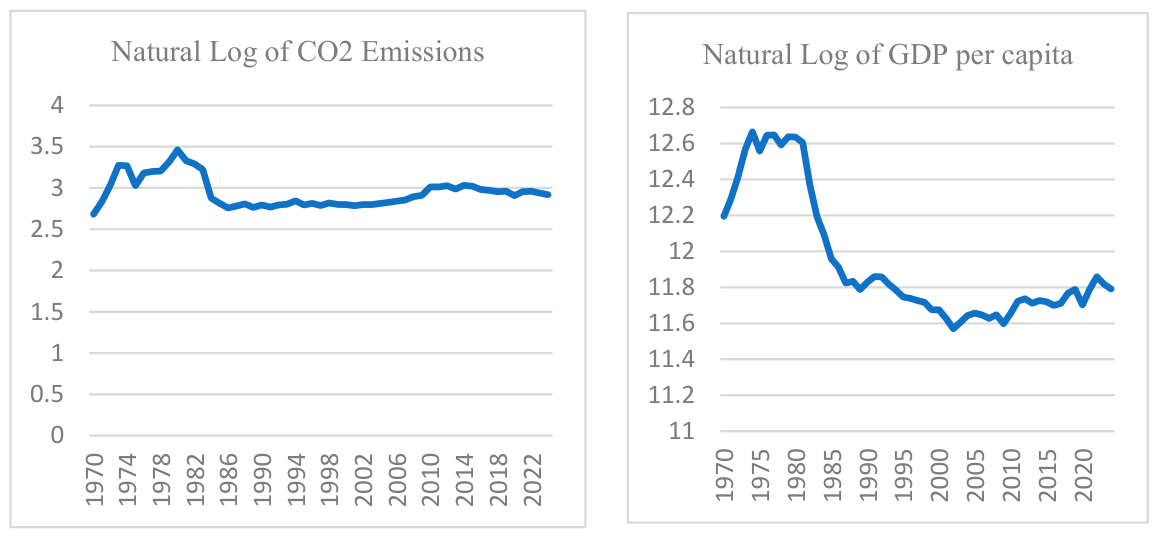
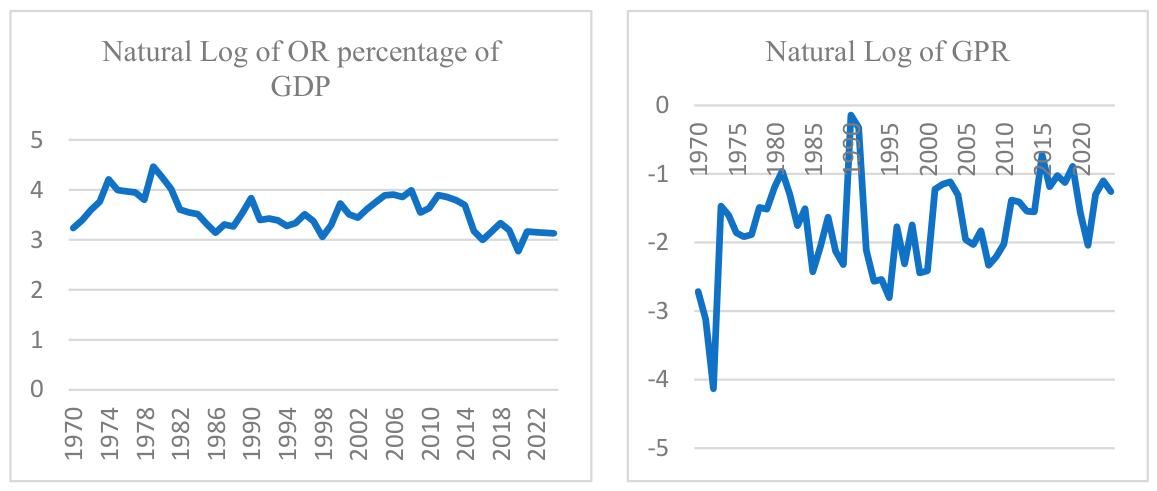
Figure 1 presents the annual time-series data in natural logarithms for CO2 emissions and GDP per capita, GPR, and OR in Saudi Arabia from 1970 to 2024. Over the sample period, CO2 emissions exhibit an initial trend from approximately 2.68 in 1970 to a peak of 3.46 in 1980, followed by a gradual decline until 1986 and stabilization between 2.68 and 3.32 from 1986 onward. Examining co-movement, GDP per capita shows a steady increase from 12.19 in 1970 to 12.67 in 1974 and then declines until 1989, after which it remains constant. The declining trend of GDP per capita suggests that post-1980 economic growth coincided with a declining CO2 emissions trend, which indicates a potential decoupling of emissions from GDP growth consistent with the EKC hypothesis. GPR exhibits a minimum value of −4.13 in 1972 and the highest value of −0.14 in 1990. Moreover, most years show higher geopolitical tensions. The co-movement between GPR and CO2 emissions is generally negative. For instance, during the 1970s, GPR was more negative, and CO2 emissions were relatively higher. OR shows a highest peak in 1979 with a value of 4.47 and a drop in 2020 with a value of 2.77. Mostly, OR shows a comparatively stable trend around an average of 3.5 after 1980. During the 1970s, OR shows a relatively higher share in GDP, which is consistent with higher CO2 emissions per capita during 1970, reflecting a general positive co-movement between OR and CO2 emissions per capita.
Table 1 reports the Variance Inflation Factor (VIF) results to examine the presence of possible multicollinearity among the explanatory variables, and all VIFs are found to be less than 10, which indicates that multicollinearity is not a severe issue in the hypothesized model. However, a slightly high VIF (4.65) is found between economic growth and oil rents, which is due to the reason that GDP per capita significantly depends on oil rents in Saudi Arabia, but the VIF is still less than 10, and the estimated coefficients can be interpreted reliably.
Table 2 shows the unit root analysis, based on Equations (2)–(5). All variables are found to be non-stationary at their levels. However, ΔCO2t, ΔGPRt, ΔORt, ΔGPRPt, ΔORNt, Δ(GPR*OR)Pt, and ΔGPRt*ORt are stationary at 1% level of significance, and the rest of the differenced variables are stationary at 5%.
Table 3 shows the results of the bounds test and diagnostic checks, based on Equations (6) and (16). F-values are more than their upper critical bounds at the 1% level of significance in both models. Thus, cointegration is corroborated in both models. The p-values of all diagnostic tests are found to be more than 0.1 in both models, which indicates that both models are free from any of the tested econometric problems. Thus, the residuals have constant variance. Serial correlation is not detected in the residuals. The residuals are normally distributed. The functional forms show appropriate model specifications. Thus, the results demonstrate that both models are well specified.
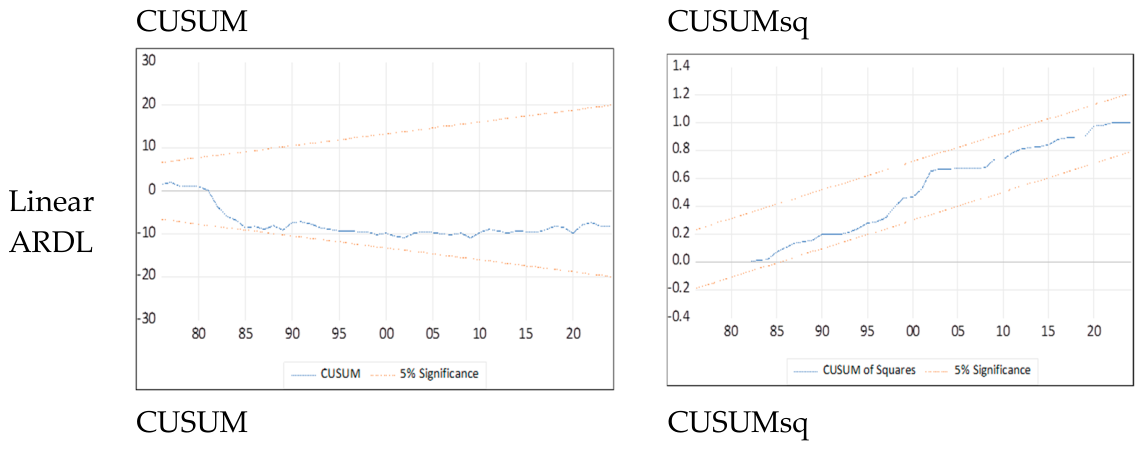
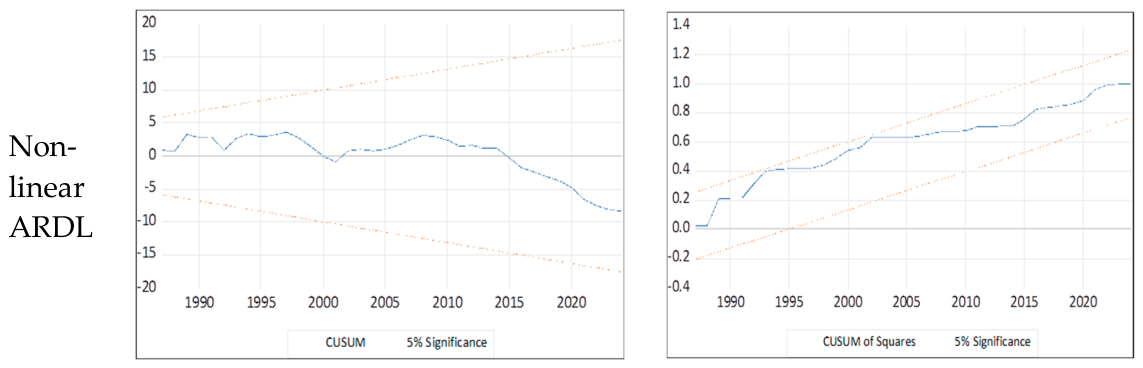
Figure 2 shows CUSUM and CUSUMsq stability tests for both models, which test the structural stability of a model’s estimated coefficients over the sample period. The estimated lines of both tests remain inside the 5% significance bounds in all sample periods, which corroborate stable estimated parameters over time.
Table 4 presents the long-run estimates obtained from the ARDL and NARDL, based on Equations (6) and (16). The EKC is corroborated in both models with the positive parameters of Yt and the negative parameters of Yt2. Thus, both models explain that carbon emissions initially rise with increasing income and later decline after reaching the income threshold. In the ARDL results, ORt raises CO2t, and a 1% increase in OR increases emissions by 0.1972%. In NARDL results, a 1% rise in ORPt increases emissions by 0.2175%, and a 1% decrease in ORNt decreases emissions by 0.0574%. The positive shocks of OR carry about a four-times greater effect compared to the effect of negative shocks of OR, which indicates the presence of an asymmetric impact of OR. In addition, the Wald test is applied with the null hypothesis of equal effects of both positive and negative shocks of OR (symmetrical effects). The estimated Chi-square is 184.56 with a p-value less than 0.01. Thus, the null hypothesis is rejected, and asymmetric effects are confirmed. In the ARDL results, a 1% rise in GPR reduces emissions by 0.1676%. In NARDL results, a 1% rise in GPRPt decreases emissions by 0.2542%. On the other hand, a 1% decrease in GPRNt increases emissions by 0.1004%. Thus, the negative effect of GPRPt is found to be more than 2.5 times greater than the effect of GPRNt. Thus, increases in GPR have a stronger environmental impact than decreases in GPR. The asymmetric effects of GPR are also verified with the Wald test and validate asymmetry with the estimated Chi-square = 121.36 and a p-value < 0.01. In the ARDL results, a 1% simultaneous rise in GPRt*ORt may amplify emissions by 0.1397%. In NARDL results, a 1% simultaneous rise in (GPR*OR)Pt may increase carbon emissions by 0.1921%. However, the effect of (GPR*OR)Nt is found to be insignificant. The asymmetric effects of GPRt*ORt are also tested with the Wald test, which validates asymmetry with the estimated Chi-square = 84.54 and a p-value < 0.01. Thus, a simultaneous increase in oil rents and GPR cannot help reduce carbon emissions.
Table 5 presents the short-run estimates obtained from the ARDL and NARDL, based on Equations (8) and (17). The negative coefficients of ECTt−1 show the existence of short-run relationships in both ARDL and NARDL models, with the speed of adjustment for the NARDL model (−0.7831) and the ARDL model (−0.6974). Thus, the ECM works better in the NARDL model. The coefficients show that both models’ short-run deviations toward equilibrium can be settled with a speed of about 70–78% per year. Moreover, the coefficients of lagged CO2 emissions are positive. Thus, past carbon emissions are partially responsible for current period emissions in both models. Moreover, the EKC is again corroborated by the estimated parameters of ΔYt and ΔYt2 in both ARDL and NARDL models. ΔORt amplifies emissions with a coefficient of 0.4719, which is greater than the long-run coefficient. Thus, increases in OR produce larger instantaneous spikes in emissions before adjusting to the long-run equilibrium. In NARDL results, a 1% increase in ΔORPt may increase emissions by 0.4491%, and a 1% decrease in ΔORNt may decrease emissions by 0.1704%. Thus, the spikes of positive shocks of OR are stronger than the spikes of negative shocks of OR, which validates asymmetry. The asymmetric effects of ΔORPt and ΔORNt are also tested with the Wald test, and the estimated Chi-square = 112.33 and a p-value < 0.01 validate the asymmetry.
In ARDL results, ΔGPRt has a negative effect on ΔCO2t, and a 1% rise in ΔGPRt might reduce 0.4021% of carbon emissions. In NARDL results, the effect of ΔGPRPt is found to be negative, but the effect of ΔGPRNt is insignificant. The asymmetrical effects of ΔGPRPt and ΔGPRNt are tested with the Wald test, and the estimated Chi-square = 156.35 and a p-value less than 0.01 validate the asymmetry. Thus, increasing GPR would reduce carbon emissions, but decreasing GPR could not amplify emissions, which validates the short-run asymmetric effect. So, the environmental influence of decreases in GPR may take a longer time to materialize. A 1% rise in GPRPt may decrease emissions by 0.5123%. In ARDL results, GPRt*ORt has a positive coefficient, and a 1% simultaneous rise in GPRt*ORt may amplify emissions by 0.1295%. In NARDL results, a 1% simultaneous change in (GPR*OR)Pt may increase carbon emissions by 0.1504%. However, the effect of (GPR*OR)Nt is found to be insignificant, which corroborates short-run asymmetry in this relationship. In addition, the asymmetric effects of Δ(GPR*OR)Pt and Δ(GPR*OR)Nt are also tested with the Wald test, which validates asymmetry with the estimated Chi-square = 96.57 and a p-value < 0.01.

5. Discussions

The results of both ARDL and NARDL corroborate the EKC, and this result is consistent with Alsubaie et al. (2025), who have similarly confirmed the EKC for Saudi Arabia. Moreover, Ma et al. (2022) have also validated the EKC for developing economies. The findings of EKC validity corroborate the efforts of Saudi Vision 2030, which targets renewable energy and sector transformation in the economy. Thus, rising GDP per capita in the Kingdom has no environmental problems. The results of ARDL and NARDL corroborate that the coefficient of OR is less than 1, and the impact of increasing OR is higher than the effect of decreasing OR. This result aligns with Prospect Theory, which explains different responses to gains and losses.
OR is a major proportion of GDP, government revenue, and exports in the Kingdom. Rising oil rents are viewed as gains, which can be invested in oil production, industrial expansion, public spending, and energy-intensive development. Thus, increasing OR can contribute to carbon emissions as all these activities are energy-intensive in Saudi Arabia. However, the effect is found to be less than one, which explains that the response of increasing carbon emissions is less than the rise in OR. Thus, some part of increasing OR is also invested in renewable energy, technologies, and sectors. For instance, the Saudi economy is nowadays significantly spending its income on the tourism sector and renewable energy projects, which can slow down the growth of emissions compared to the growth of OR. Moreover, the impact of decreasing OR is smaller than the impact of rising OR. Falling oil rents are viewed as losses in the Saudi economy. Thus, policymakers may try to protect output, revenues, and economic stability instead of investing in renewable markets. Therefore, carbon emissions will not decline proportionately to OR declines. This finding reflects the dependence of the structure of the Saudi economy on the oil sector, where OR positive shocks quickly translate into greater environmental damage compared to environmental improvement with OR negative shocks. This result also highlights the importance of diversification. The result of the positive relationship between NRR and emissions is aligned with the past literature (Iqbal et al., 2025; Lin et al., 2024; Du & Wang, 2023). Moreover, the asymmetric results are also consistent with the findings of W. Zhao et al. (2021).
The negative association between GPR and emissions is also found to be non-proportional (less than 1), and the impact of increasing GPR is higher than the impact of decreasing GPR. The negative relationship explains that increasing GPR may immediately disrupt trade, transport, consumption, investments, and industrial activities, which can reduce energy consumption and emissions in Saudi Arabia. However, the environmental benefits are smaller than the economic losses because of fossil-fuel dependence. The smaller effect of decreasing GPR compared to the effect of increasing GPR is in line with Prospect Theory, as the effect of gain (decreasing GPR) is smaller than the loss (increasing GPR). The negative effect of GPR on emissions aligns with the literature (Hashmi et al., 2022; Husnain et al., 2022; Ma et al., 2022; Kızılkaya et al., 2024; Villanthenkodath & Pal, 2024; Nawaz et al., 2023; Saadaoui et al., 2024).
The interaction between GPR and oil rents positively affects carbon emissions. Thus, under conditions of both higher OR and rising GPR, policymakers may give stronger priority to oil revenue generation, energy security, and short-term economic stability instead of caring for environmental problems. Moreover, higher OR provides the financial incentive to expand extraction and carbon-intensive activities in the oil sector, which is carbon-intensive. On the other hand, higher GPR will shift the intention of policymakers toward fiscal sustainability, as OR is a major contributor to public spending. Thus, increasing both GPR and OR can contribute to carbon emissions as both can give rise to carbon-intensive activities in the oil sector and may discourage investment in the renewable sector (L. Chen et al., 2023). Nevertheless, the insignificant impact of both ORNt and GPRNt on carbon emissions explains that falling both factors simultaneously cannot help reduce carbon emissions, which corroborates the ratchet effects in the case of decreasing both factors. For instance, simultaneously increasing OR and GPR increases carbon emissions, but simultaneously decreasing both factors cannot reverse the environmental condition of the country by reducing carbon emissions.
In a limitation of this study, it is acknowledged that the generalizability of the findings is specific to Saudi Arabia, which is a rentier economy with extreme oil dependence, centralized governance, and high exposure to regional geopolitical conflicts. However, these structural characteristics may not be replicated in other resource-rich or resource-poor economies, which restricts the applicability of the findings to other resource-rich or developing economies. For instance, the asymmetric effects of oil rent shocks and geopolitical risk on emissions could differ in countries with diversified energy portfolios, stronger environmental institutions, and different geopolitical risk profiles. Consequently, the results can be interpreted as country-specific instead of universally applicable. However, future comparative studies across multiple oil-dependent economies would help establish the external validity of the asymmetric relationships.

6. Conclusions

In the Saudi oil-dependent economy, the interaction of economic growth, OR, and GPR may shape environmental outcomes. Thus, the present research investigates the effect of GPR and OR in the EKC framework by using a dataset from 1970 to 2024 in Saudi Arabia. In addition, Prospect Theory suggests investigating the asymmetric nexus between OR and emissions. Thus, NARDL is utilized. The results substantiate the long- and short-run EKC, which corroborates that environmental benefits can be realized after a threshold GDP per capita. OR is identified as a major driver of emissions. In the asymmetric analysis, positive shocks in OR increase CO2 emissions more strongly compared to the effect of negative shocks. This result corroborates Prospect Theory with asymmetric effects of OR. Thus, increasing OR may contribute to more CO2 emissions compared to the decline in emissions with decreasing OR, which corroborates a slight ratchet effect of energy consumption behavior with rising income due to rising OR. Moreover, rising GPR reduces carbon emissions, and falling GPR increases emissions in the long run. Nevertheless, falling GPR shows a short-run insignificant effect, but positive shocks in GPR also reduce emissions in the short run. The simultaneous positive shocks in both OR and GPR (the interaction effect) raise emissions, and the simultaneous negative shocks in both OR and GPR do not affect carbon emissions. Thus, GPR significantly and adversely moderates environmental degradation with rising OR. However, GPR could not moderate the positive environmental outcomes with declining OR. Overall, the effects of OR, GPR, and their interaction are asymmetric. The oil dependence of the Saudi economy has resulted in environmental problems. Moreover, the combined effect of a simultaneous increase in OR and GPR also shows environmental concerns. However, GPR shows a negative direct effect on emissions. Thus, GPR is directly responsible for the slowdown of economic activities, which helps improve environmental quality at the cost of economic growth.

6.1. Policy Implications

The results show that positive shocks in OR increase emissions more than the decline in emissions associated with negative shocks in OR, which emphasizes the existence of emission-intensive activities even during periods of declining OR. Thus, policymakers should focus on proactive emission control measures. For instance, the Ministry of Energy and the Saudi oil company (Aramco) should enforce stricter emission intensity standards for upstream oil extraction and use clean technologies across all oil production facilities. Additionally, the government should invest in green projects, including solar and wind technologies, green hydrogen production, and non-oil sectors. Rising GPR helps reduce carbon emissions due to slower economic activity, but declining GPR again increases emissions (a rebound effect). During high-GPR periods, to further enhance environmental benefits, the government should invest in renewable infrastructure to develop renewable capacity, which could also help reduce emissions during low-GPR periods. During low-GPR periods, the government should use countercyclical green transition policies. For instance, the government should increase carbon efficiency standards by introducing dynamic carbon pricing mechanisms and pollution taxes and strengthen environmental monitoring. This action may provide more fiscal space to invest in renewable energy projects and expand green infrastructure. Moreover, the government can also provide fiscal incentives to the private sector for adopting renewable technologies to offset the pollution-intensive effects of economic growth. Moreover, a simultaneous rise in OR and GPR increases emissions, which shows that high OR during high GPR has been largely directed toward fossil-fuel-based activities instead of renewable energy projects. Thus, the government should adopt integrated energy, environmental, and risk-management policies to reduce the pollution-enhancing effects of oil rents during high-GPR periods. For instance, during high GPR, private investments in renewable projects may decline. However, the government has a buffer fiscal space due to high OR, which can be invested in renewable energy development, green public industrialization projects, and sustainable infrastructure projects.

6.2. Limitations and Future Directions

The study faces limitations due to the limited availability of GPR data for other GCC countries, which restricts the applicability of the findings to other GCC economies. Future research may construct self-generated or country-specific GPR indices for other oil-rich economies to conduct comparative studies, which could improve the external validity and generalization power of the findings. Moreover, the study relies on aggregate national-level data, which reduces the ability to capture sector-specific environmental responses to fluctuations in GPR and oil rents. For instance, the oil sector, transportation, manufacturing, non-oil industries, electricity generation, and service sector may respond differently to changes in GPR and oil-related revenues. Future studies could conduct sector-specific analyses to provide a more detailed understanding of the heterogeneous environmental responses to fluctuations in GPR and oil rents across different sectors, which would offer more targeted policy implications for designing sector-specific environmental and energy strategies.

Funding

The authors extend their appreciation to Prince Sattam bin Abdulaziz University for funding this research work through the project number (PSAU/2025/02/36408).

Institutional Review Board Statement

Not applicable.

Informed Consent Statement

Not applicable.

Data Availability Statement

The data is publicly available at: https://www.policyuncertainty.com/gpr.html?utm_source; https://databank.worldbank.org/source/world-development-indicators (accessed on 15 January 2026). The data is also available with a reasonable request from the corresponding author.

Conflicts of Interest

The author declares no conflicts of interest.

References

  1. Aloui, C., Hela, B. H., & Hathroubi, S. (2024). Nexus among economic uncertainty, geopolitical risk, oil price volatility and economic complexity in Saudi Arabia: Fresh insights from wavelet local multiple correlations. International Journal of Energy Economics and Policy, 14(6), 1–14. [Google Scholar] [CrossRef]
  2. Alsagr, N., & van Hemmen, S. (2021). The impact of financial development and geopolitical risk on renewable energy consumption: Evidence from emerging markets. Environmental Science and Pollution Research, 28(20), 25906–25919. [Google Scholar] [CrossRef]
  3. Alsubaie, M. S., Tanveer, M., & Mahmood, H. (2025). The moderating effect of geopolitical risk in the nexus between trade openness, FDI, and carbon emissions in Saudi Arabia. Environmental and Sustainability Indicators, 28, 100967. [Google Scholar] [CrossRef]
  4. Anser, M. K., Syed, Q. R., & Apergis, N. (2021). Does geopolitical risk escalate CO2 emissions? Evidence from the BRICS countries. Environmental Science and Pollution Research, 28(35), 48011–48021. [Google Scholar] [CrossRef] [PubMed]
  5. Bello, S., & Hassan, Y. A. (2024). Examining the effect of geopolitical risks on renewable energy consumption in OECD countries. Environmental Economics, 15(2), 108–117. [Google Scholar] [CrossRef]
  6. Caldara, D., & Iacoviello, M. (2022). Measuring geopolitical risk. American Economic Review, 112(4), 1194–1225. [Google Scholar] [CrossRef]
  7. Chen, L., Gozgor, G., Lau, C. K. M., Mahalik, M. K., Rather, K. N., & Soliman, A. M. (2024). The impact of geopolitical risk on CO2 emissions inequality: Evidence from 38 developed and developing economies. Journal of Environmental Management, 349, 119345. [Google Scholar] [CrossRef] [PubMed]
  8. Chen, L., Gozgor, G., Mahalik, M. K., Pal, S., & Rather, K. N. (2023). How does geopolitical risk affect CO2 emissions? The role of natural resource rents. Resources Policy, 87, 104321. [Google Scholar] [CrossRef]
  9. Chen, Z., He, M., & Ali, M. (2025). Natural resources and geopolitical risk impact on energy security risk: The role of renewable energy consumption and foreign direct investment. Natural Resources Forum, 50(2), 967–979. [Google Scholar] [CrossRef]
  10. Cui, X., Wang, W., Işık, C., Uddin, I., Yan, J., Gu, X., & Ahmad, M. (2024). Do geopolitical risk and economic policy uncertainty cause CO2 emissions in BRICS? The role of institutional quality and energy productivity. Stochastic Environmental Research and Risk Assessment, 38(5), 1685–1699. [Google Scholar] [CrossRef]
  11. Dhifaoui, Z., Ncibi, K., Gasmi, F., & Alqarni, A. A. (2023). The nexus between climate change and geopolitical risk index in Saudi Arabia based on the Fourier-domain transfer entropy spectrum method. Sustainability, 15(18), 13579. [Google Scholar] [CrossRef]
  12. Ding, T., Li, H., Tan, R., & Zhao, X. (2023). How does geopolitical risk affect carbon emissions? An empirical study from the perspective of mineral resources extraction in OECD countries. Resources Policy, 85, 103983. [Google Scholar] [CrossRef]
  13. Du, Y., & Wang, W. (2023). The role of green financing, agriculture development, geopolitical risk, and natural resources on environmental pollution in China. Resources Policy, 82, 103440. [Google Scholar] [CrossRef]
  14. Economic Policy Uncertainty Database. (2026). Saudi geopolitical risk index. Available online: https://www.policyuncertainty.com/gpr.html?utm_source (accessed on 11 January 2026).
  15. Fatima, N., Štreimikienė, D., Kumar, P., Radulescu, M., & Xuhua, H. (2026a). Striving for carbon neutrality in the EU region: Examining the role of environmental policy stringency in geopolitical risk and energy transition. Technological and Economic Development of Economy, 32(1), 283–314. [Google Scholar] [CrossRef]
  16. Fatima, N., Yanting, Z., Guohua, N., & Khan, M. K. (2026b). The dynamics of green technological innovation and environmental policy stringency for sustainable environment in BRICS economies. Natural Resources Forum, 50(1), 275–304. [Google Scholar] [CrossRef]
  17. Flouros, F., Pistikou, V., & Plakandaras, V. (2022). Geopolitical risk as a determinant of renewable energy investments. Energies, 15(4), 1498. [Google Scholar] [CrossRef]
  18. Grossman, G. M., & Krueger, A. B. (1991). Environmental impacts of the North American free trade agreement (Cambridge Working Paper 3914). NBER. [Google Scholar] [CrossRef]
  19. Guizani, M. (2024). Does internal cash flow-external financing sensitivity react to economic policy uncertainty and geopolitical risk? Evidence from Saudi Arabia. Journal of Financial Economic Policy, 16(3), 296–314. [Google Scholar] [CrossRef]
  20. Guizani, M., Talbi, D., & Abdalkrim, G. (2023). Economic policy uncertainty, geopolitical risk and cash holdings: Evidence from Saudi Arabia. Arab Gulf Journal of Scientific Research, 41(2), 183–201. [Google Scholar] [CrossRef]
  21. Guo, Q., Guo, B., Adnan, S. M., & Sheer, A. (2023). Can BRICS economies shift some burden on nuclear energy efficiency for sustainable environment? An empirical investigation. Progress in Nuclear Energy, 164, 104882. [Google Scholar] [CrossRef]
  22. Hashmi, S. M., Bhowmik, R., Inglesi-Lotz, R., & Syed, Q. R. (2022). Investigating the environmental Kuznets curve hypothesis amidst geopolitical risk: Global evidence using bootstrap ARDL approach. Environmental Science and Pollution Research, 29(16), 24049–24062. [Google Scholar] [CrossRef]
  23. Hemrit, W. (2021). Does insurance demand react to economic policy uncertainty and geopolitical risk? Evidence from Saudi Arabia. The Geneva Papers on Risk and Insurance. Issues and Practice, 47(2), 460. [Google Scholar] [CrossRef]
  24. Husnain, M. I., Syed, Q. R., Bashir, A., & Khan, M. A. (2022). Do geopolitical risk and energy consumption contribute to environmental degradation? Evidence from E7 countries. Environmental Science and Pollution Research, 29(27), 41640–41652. [Google Scholar] [CrossRef] [PubMed]
  25. Iqbal, A., Zhang, W., & Jahangir, S. (2025). Building a sustainable future: The nexus between artificial intelligence, renewable energy, green human capital, geopolitical risk, and carbon emissions through the moderating role of institutional quality. Sustainability, 17(3), 990. [Google Scholar] [CrossRef]
  26. Islam, M. S., & Islam, M. M. (2026). Global supply chain pressures and metal trade of Saudi Arabia: Do time-varying geopolitical risks matter? Economic Change and Restructuring, 59(1), 27. [Google Scholar] [CrossRef]
  27. Kahneman, D., & Tversky, A. (1979). Prospect theory: An analysis of decision under risk. Econometrica, 47(2), 263–291. [Google Scholar] [CrossRef]
  28. Kartal, M. T., Pata, U. K., Taşkın, D., & Mukhtarov, S. (2024). Impact of disaggregated level clean electricity on CO2 emissions: Evidence from EU-5 countries by bivariate and multivariate QQ approaches. Energy & Environment, 37(3), 1568–1589. [Google Scholar] [CrossRef]
  29. Kartal, M. T., Taşkın, D., Kılıç Depren, S., Borowski, P. F., & Sarıoğlu, M. (2025). Analysis of disaggregated level energy use, income, geopolitical risk, energy transition, and energy price impact on decarbonization of main sectors in BRICS countries by marginal analysis. Energy & Environment. [Google Scholar] [CrossRef]
  30. Khan, A., Sun, C., Xu, Z., & Liu, Y. (2023). Geopolitical risk, economic uncertainty, and militarization: Significant agents of energy consumption and environmental quality. Environmental Impact Assessment Review, 102, 107166. [Google Scholar] [CrossRef]
  31. Kisswani, K. M., Elian, M. I., Lahiani, A., & Mefteh-Wali, S. (2024). The role of climate policy uncertainty, renewable energy use, and geopolitical risk towards low-carbon emission: Evidence from selected ASEAN countries. Environmental Economics and Policy Studies, 28(1), 219–247. [Google Scholar] [CrossRef]
  32. Kızılkaya, F., Kızılkaya, O., & Mike, F. (2024). Does geopolitical risk escalate environmental degradation in Turkey? Evidence from a Fourier approach. Environment, Development and Sustainability, 28(3), 7085–7106. [Google Scholar] [CrossRef]
  33. Kolati, Y., & Raghutla, C. (2025). The influence of renewable energy sources on CO2 emissions: A multi-factor analysis across leading countries. Environmental Science and Pollution Research, 32(34), 20461–20477. [Google Scholar] [CrossRef]
  34. Lawal, G. O., Aladenika, B., Akadiri, S. S., Fatigun, A. S., & Olanrewaju, V. O. (2023). Geopolitical risk, globalization and environmental degradation in South Africa: Evidence from advanced quantiles approach. Problemy Ekorozwoju, 18(1), 207–215. [Google Scholar] [CrossRef]
  35. Lin, T.-X., Gozgor, G., Rather, K. N., Mahalik, M. K., & Lau, C. K. M. (2024). How do natural resource rents and productive capacity affect carbon emissions? Evidence from developed and developing countries. Resources Policy, 93, 105095. [Google Scholar] [CrossRef]
  36. Liza, F. F., Wei, L., Hassan, S. T., Khan, I., & Ahmad, F. (2024). Driving low-carbon mechanisms through smart investments in renewable resources and green finance initiatives among G20 nations. Journal of Environmental Management, 370, 122439. [Google Scholar] [CrossRef]
  37. Luo, H., & Sun, Y. (2024). Effects of geopolitical risk on environmental sustainability and the moderating role of environmental policy stringency. Scientific Reports, 14(1), 10747. [Google Scholar] [CrossRef]
  38. Ma, W., Nasriddinov, F., Haseeb, M., Ray, S., Kamal, M., Khalid, N., & Ur Rehman, M. (2022). Revisiting the impact of energy consumption, foreign direct investment, and geopolitical risk on CO2 emissions: Comparing developed and developing countries. Frontiers in Environmental Science, 10, 985384. [Google Scholar] [CrossRef]
  39. Nawaz, M. Z., Guo, J., Nawaz, S., & Hussain, S. (2023). Sustainable development goals perspective: Nexus between Christians’ religious tourism, geopolitical risk, and CO2 pollution in Italy. Environmental Science and Pollution Research, 30(22), 62341–62354. [Google Scholar] [CrossRef]
  40. Ng, S., & Perron, P. (2001). Lag length selection and the construction of unit root tests with good size and power. Econometrica, 66, 1519–1554. [Google Scholar] [CrossRef]
  41. Pata, U. K., Kartal, M. T., & Zafar, M. W. (2023). Environmental reverberations of geopolitical risk and economic policy uncertainty resulting from the Russia–Ukraine conflict: A wavelet-based approach for sectoral CO2 emissions. Environmental Research, 231, 116034. [Google Scholar] [CrossRef]
  42. Pesaran, M. H., Shin, Y., & Smith, R. J. (2001). Structural analysis of vector error correction models with exogenous I(1) variables. Journal of Econometrics, 97, 293–343. [Google Scholar] [CrossRef]
  43. Qamruzzaman, M., Hossain, M. A., Hasan, M. T., & Hossain, R. R. (2025). Effects of green innovations, geopolitical risk, renewable energy, and urbanization on environmental quality in BRICS + T. International Journal of Energy Economics and Policy, 15(5), 502–517. [Google Scholar] [CrossRef]
  44. Rashid, A., & Gopinathan, R. (2023). Revisiting the nexus between economic growth and disaggregated greenhouse gases in India: Evidence from necessary and sufficient conditions. Journal of Cleaner Production, 430, 139514. [Google Scholar] [CrossRef]
  45. Rasoulinezhad, E., Taghizadeh-Hesary, F., Sung, J., & Panthamit, N. (2020). Geopolitical risk and energy transition in Russia: Evidence from ARDL bounds testing method. Sustainability, 12(7), 2689. [Google Scholar] [CrossRef]
  46. Razek, N. H., & McQuinn, B. (2021). Saudi Arabia’s currency misalignment and international competitiveness, accounting for geopolitical risks and the super-contango oil market. Resources Policy, 72, 102057. [Google Scholar] [CrossRef]
  47. Saadaoui, H., Dogan, M., & Omri, E. (2024). The impacts of hydroelectricity generation, financial development, geopolitical risk, income, and foreign direct investment on carbon emissions in Turkey. Environmental Economics and Policy Studies, 26(2), 239–261. [Google Scholar] [CrossRef]
  48. Sanusi, O. I., Aliyu, S., & Safi, S. (2025). Geopolitical risk and country-level CO2 emissions: A deep learning approach comparing LSTM, CNN, and ConvLSTM. International Journal of Energy Economics and Policy, 15(4), 109–117. [Google Scholar] [CrossRef]
  49. Shanyazov, N., Salayev, S. K., Makhmudov, S., Sharipov, I., Matkuliyeva, S., Babajanov, J., & Saidov, D. (2026). The impact of geopolitical risk and policy uncertainty on CO2 emissions: A CS-ARDL analysis of G7 economies. Environmental Economics, 17(1), 25–37. [Google Scholar] [CrossRef]
  50. Shen, J., Azam, M., Jin, H., & Hunjra, A. I. (2024). Environmental implications of migration: Worldwide insights. Journal of Environmental Management, 369, 122270. [Google Scholar] [CrossRef]
  51. Shin, Y., Yu, B., & Greenwood-Nimmo, M. (2014). Modelling asymmetric cointegration and dynamic multiplier in an ARDL framework. In W. C. Horrace, & R. C. Sickles (Eds.), Festschrift in honor of Peter Schmidt: Econometric methods and applications (pp. 281–314). Springer Science and Business Media. ISBN 1489980075. [Google Scholar]
  52. Su, C. W., Khan, K., Tao, R., & Nicoleta-Claudia, M. (2019). Does geopolitical risk strengthen or depress oil prices and financial liquidity? Evidence from Saudi Arabia. Energy, 187, 116003. [Google Scholar] [CrossRef]
  53. Sweidan, O. D., & Elbargathi, K. (2022). The effect of oil rent on economic development in Saudi Arabia: Comparing the role of globalization and the international geopolitical risk. Resources Policy, 75, 102469. [Google Scholar] [CrossRef]
  54. Sweidan, O. D., & Elbargathi, K. (2023). Economic diversification in Saudi Arabia: Comparing the impact of oil prices, geopolitical risk, and government expenditures. International Economics, 175, 13–24. [Google Scholar] [CrossRef]
  55. Syed, Q. R., Bhowmik, R., Adedoyin, F. F., Alola, A. A., & Khalid, N. (2022). Do economic policy uncertainty and geopolitical risk surge CO2 emissions? New insights from panel quantile regression approach. Environmental Science and Pollution Research, 29(19), 27845–27861. [Google Scholar] [CrossRef]
  56. Uddin, I., Usman, M., Saqib, N., & Makhdum, M. S. A. (2023). The impact of geopolitical risk, governance, technological innovations, energy use, and foreign direct investment on CO2 emissions in the BRICS region. Environmental Science and Pollution Research, 30(29), 73714–73729. [Google Scholar] [CrossRef]
  57. Ulussever, T., Kartal, M. T., & Kılıç Depren, S. (2025). Effect of income, energy consumption, energy prices, political stability, and geopolitical risk on the environment: Evidence from GCC countries by novel quantile-based methods. Energy & Environment, 36(2), 979–1004. [Google Scholar] [CrossRef]
  58. Villanthenkodath, M. A., & Pal, S. (2024). Environmental degradation in geopolitical risk and uncertainty contexts for India: A comparison of ecological footprint, CO2 emissions, and load capacity factor. Energy and Climate Change, 5, 100122. [Google Scholar] [CrossRef]
  59. Wang, K.-H., Kan, J.-M., Jiang, C.-F., & Su, C.-W. (2022). Is geopolitical risk powerful enough to affect carbon dioxide emissions? Evidence from China. Sustainability, 14(13), 7867. [Google Scholar] [CrossRef]
  60. Wang, W., Niu, Y., Gapich, A., & Strielkowski, W. (2023). Natural resources extractions and carbon neutrality: The role of geopolitical risk. Resources Policy, 83, 103577. [Google Scholar] [CrossRef]
  61. World Bank. (2026). World development indicators. The World Bank Group. Available online: https://databank.worldbank.org/source/world-development-indicators (accessed on 11 January 2026).
  62. Worldometer. (2025). CO2 emissions by country. Available online: https://www.worldometers.info/co2-emissions/co2-emissions-by-country/ (accessed on 18 February 2026).
  63. Yuen, T. H. A., & Yuen, W. K. T. (2024). Public investment on renewable energy R&D projects: The role of geopolitical risk and economic and political uncertainties. Energy Economics, 138, 107837. [Google Scholar] [CrossRef]
  64. Zeng, Q., He, C., Eweade, B. S., Awosusi, A. A., Sevinç, D. E., & Yan, Y. (2025). Examining how environmental policy stringency, geopolitical risks, technological innovation, and renewable energy contribute to achieving Sustainable Development Goals 7 and 13 policies in MINT countries. Environmental Progress & Sustainable Energy, 44(3), e14595. [Google Scholar] [CrossRef]
  65. Zhang, X., Lau, C. K. M., Li, R., Wang, Y., Wanjiru, R., & Seetaram, N. (2024). Determinants of carbon emissions cycles in the G7 countries. Technological Forecasting and Social Change, 201, 123261. [Google Scholar] [CrossRef]
  66. Zhao, W., Zhong, R., Sohail, S., Majeed, M. T., & Ullah, S. (2021). Geopolitical risks, energy consumption, and CO2 emissions in BRICS: An asymmetric analysis. Environmental Science and Pollution Research, 28(29), 39668–39679. [Google Scholar] [CrossRef]
  67. Zhao, Y., Wang, W., Liang, Z., & Luo, P. (2024). Racing towards zero carbon: Unraveling the interplay between natural resource rents, green innovation, geopolitical risk and environmental pollution in BRICS countries. Resources Policy, 88, 104379. [Google Scholar] [CrossRef]
  68. Zhao, Z., Gozgor, G., Lau, M. C. K., Mahalik, M. K., Patel, G., & Khalfaoui, R. (2023). The impact of geopolitical risks on renewable energy demand in OECD countries. Energy Economics, 122, 106700. [Google Scholar] [CrossRef]
Figure 1. Time series evolution of variables (1970–2024).
Economies 14 00213 g001aEconomies 14 00213 g001b
Figure 2. CUSUM and CUSUMsq tests.
Economies 14 00213 g002aEconomies 14 00213 g002b
Table 1. VIF analysis.
VariablesYtGPRt
Yt
GPRt1.36
ORt4.652.11
Table 2. Unit root test.
VariablesMZaMZtMSBMPT
CO2t−1.7621−0.77440.423911.1716
Yt−10.5381−2.20550.20747.7918
Yt2−10.1467−2.15690.20107.8860
GPRt−12.9365−2.49350.18767.6252
ORt−13.3973−2.71380.18476.5757
GPRPt−7.5339−1.67630.228810.1256
GPRNt−8.9360−1.88500.22799.2553
ORPt−6.695−1.74360.267510.3198
ORNt−11.3847−2.15790.18685.9056
GPRt*ORt−7.5599−1.81990.239611.4396
(GPR*OR)Pt−12.319−2.46910.18955.6595
(GPR*OR)Nt−7.5027−1.87340.20418.8085
ΔCO2t−24.1416 ***−3.4333 ***0.1358 ***3.0274 ***
ΔYt−18.7656 **−2.8623 **0.1547 **4.9311 **
ΔYt2−18.1766 **−2.8823 **0.1598 **4.2360 **
ΔGPRt−25.4644 ***−3.7190 ***0.0985 ***3.0236 ***
ΔORt−24.1119 ***−3.5383 ***0.1151 ***2.9595 ***
ΔGPRPt−24.7747 ***−3.6015 ***0.1211 ***2.9899 ***
ΔGPRNt−21.6399 **−2.9617 **0.1451 **4.1245 **
ΔORPt−22.2215 **−3.0708 **0.1529 **4.1410 **
ΔORNt−23.8892 ***−3.3180 ***0.1194 ***2.9735 ***
ΔGPRt*ORt−24.5786 ***−3.3739 ***0.1243 ***2.8909 ***
Δ(GPR*OR)Pt−23.2561 ***−3.3576 ***0.1550 **2.9999 ***
Δ(GPR*OR)Nt−18.0995 **−2.8365 **0.1516 **4.2188 **
Note: ** and *** depict stationarity at 5% and 1%.
Table 3. Bound test.
ModelF-Values from the Bound TestHeteroscedasticitySerial CorrelationNormalityFunctional Form
Linear ARDL6.7538 ***1.1500
(0.3186)
0.1836 (0.7804)0.1802 (0.8591)2.1141 (0.1201)
Nonlinear ARDL5.1645 ***1.5946
(0.2056)
1.1075 (0.5525)0.8308 (0.7101)1.8669 (0.2553)
Note: *** shows cointegration at 1% level of significance.
Table 4. Long run results.
RegressorsLinear ARDLNonlinear ARDL
Yt34.5214 ***
(0.0264 *)
39.5416 ***
(0.0052 *)
Yt2−1.6219 **
(0.0567 *)
−1.8658 **
(0.0669 *)
ORt0.1972 ***
(0.0125 *)
ORPt 0.2175 **
(0.0654 *)
ORNt 0.0574 **
(0.0947 *)
GPRt−0.1676 **
(0.0847 *)
GPRPt −0.2542 ***
(0.0165 *)
GPRNt −0.1004 ***
(0.0067 *)
GPRt*ORt0.1397 **
(0.0954 *)
(GPR*OR)Pt 0.1921 ***
(0.0245 *)
(GPR*OR)Nt 0.0676 *
(0.2465 *)
Intercept−138.4380 **
(0.0541 *)
−56.5241 *
(0.1547 *)
Note: (p-values). *, **, and *** represent level of significance at 10%, 5%, and 1%.
Table 5. Short run results.
RegressorsLinear ARDLNonlinear ARDL
ΔCO2t−10.2386 **
(0.0947 *)
0.5947 ***
(0.0498 *)
ΔYt22.9578 ***
(0.0254 *)
26.5469 ***
(0.0056 *)
ΔYt2−1.0833 ***
(0.0297 *)
−1.2526 ***
(0.0349 *)
ΔORt0.4719 ***
(0.0249 *)
ΔORPt 0.4491 **
(0.0647 *)
ΔORNt 0.1704 ***
(0.0244 *)
ΔGPRt−0.4021 ***
(0.0439 *)
ΔGPRPt −0.5123 ***
(0.0000 *)
ΔGPRNt −0.0787 *
(0.1269 *)
Δ(GPRt*ORt)0.1295 ***
(0.0009 *)
Δ(GPR*OR)Pt 0.1504 ***
(0.0067 *)
Δ(GPR*OR)Nt 0.1138 *
(0.8168 *)
ECTt−1−0.6974 ***
(0.0005 *)
−0.7831 ***
(0.0000 *)
Note: (p-values). *, **, and *** represent level of significance at 10%, 5%, and 1%.
Disclaimer/Publisher’s Note: The statements, opinions and data contained in all publications are solely those of the individual author(s) and contributor(s) and not of MDPI and/or the editor(s). MDPI and/or the editor(s) disclaim responsibility for any injury to people or property resulting from any ideas, methods, instructions or products referred to in the content.