1. Introduction
Digital transformation has fundamentally altered global economic systems, as broadband internet, mobile telecommunications, and blockchain-based financial structures have modified production functions, reduced transaction costs, and established new value chains (
Goldfarb & Tucker, 2019). This transformation offers emerging economies the chance to bypass conventional industrialization while also posing the problem of achieving equitable benefits (
World Bank, 2016;
Aker & Mbiti, 2010). Despite the ICT sector expanding nearly threefold compared to the overall economy in OECD countries from 2013 to 2023 (
OECD, 2024), considerable disparities remain in developing regions, highlighting the necessity to comprehend how digital connectivity impacts economic performance in diverse institutional settings.
Simultaneously, financial development has become a focal point of the global development agenda. Approximately 1.4 billion adults remain unbanked, predominantly in developing economies (
Demirguc-Kunt et al., 2022). Financial development is increasingly acknowledged as a vital catalyst for economic growth, poverty alleviation, and macroeconomic stability (
D. W. Kim et al., 2018). Inclusive financial systems facilitate savings mobilization, optimize capital allocation, and enhance entrepreneurial endeavours at the base of the economic pyramid (
Levine, 2005;
T. Beck et al., 2007), with recent evidence substantiating its role as a catalyst for growth in lower-income contexts (
Hussain et al., 2024;
Cosma & Rimo, 2024).
The intersection of these two megatrends has precipitated the digital finance revolution (
Philippon, 2016;
Gomber et al., 2017). Mobile money platforms, digital payment ecosystems, and algorithmic credit scoring have significantly expanded financial services to marginalized people at much lower prices (
Jack & Suri, 2014). The M-Pesa story in Kenya, which reportedly elevated 194,000 households from extreme poverty, illustrates the potential of digital connectivity to promote financial development and overall development (
Suri & Jack, 2016).
Azmeh and Al-Raeei (
2024) similarly discovered that the implementation of digital payments substantially enhanced financial access and growth in 108 developing nations. A thorough analysis of the tripartite relationship between digital connectivity, financial development, and economic performance in a cohesive set of large emerging economies is still lacking.
The BRICS economies, which are Brazil, Russia, India, China, and South Africa, serve as a significant analytical framework for examining these dynamics. The BRICS bloc represents over 40 percent of the global population and around 31.5 percent of world GDP in purchasing power parity, illustrating the potential and intricacies of the digital–financial development–growth relationship (
Stuenkel, 2015). China’s fintech ecosystem facilitates more than
$16 trillion in annual mobile payments, and India’s UPI managed over 10 billion monthly transactions by 2023, whereas South Africa’s ongoing digital divide and Russia’s geopolitical challenges illustrate divergent paths (
Frost et al., 2019). Recent data substantiates that internet penetration substantially influences financial development in these economies (
Pandey et al., 2023) and that digital financial development mitigates income inequality when strengthened by infrastructure development (
Suhrab et al., 2024). This variability facilitates the discovery of varying effects and the examination of how country-specific factors influence the relationship between digital connectivity, financial development, and economic development.
Despite the increasing academic attention devoted to the determinants of economic growth, several important gaps persist in the literature, particularly in the context of the BRICS economies. First, a substantial body of research treats the relationships between digital connectivity and economic growth, and financial development and economic growth, as separate analytical strands, thereby neglecting the potential complementarities and synergistic interactions between digital infrastructure and financial deepening (
Asongu & Odhiambo, 2019). Such fragmentation may lead to incomplete conclusions, especially given the increasing integration of digital platforms with financial systems. Second, many empirical studies rely on conventional panel estimators that assume slope homogeneity and cross-sectional independence, assumptions that are unlikely to hold in an interconnected bloc such as BRICS, where policy spillovers, financial integration, and technological diffusion generate significant cross-sectional dependence (
Pesaran, 2006;
N. Beck & Katz, 1995;
Awad & Albaity, 2024). Ignoring these econometric realities may compromise the consistency and reliability of estimated parameters. Third, the distributional dimension of economic performance remains largely underexplored, as most studies employ conditional mean estimators that mask heterogeneous effects across different segments of the growth distribution (
Canay, 2011;
Machado & Silva, 2019). Fourth, relatively limited attention has been paid to long-run structural dynamics due to shorter sample periods, which restrict the ability to capture technological transitions, digital expansion waves, and financial reforms that have evolved over multiple decades. Fifth, the interaction between digital and financial development and broader macroeconomic fundamentals—such as capital formation, urbanization, and fiscal expenditure—has often been insufficiently modeled, potentially leading to omitted variable bias and incomplete structural interpretations. Finally, heteroskedasticity, serial correlation, and cross-sectional dependence concerns, including reverse causality between economic growth and financial or digital development, are not always adequately addressed, thereby limiting causal inference. Collectively, these gaps underscore the need for a more integrated, distribution-sensitive, and methodologically robust framework to better understand growth dynamics in major emerging economies.
This study makes several substantive contributions to the empirical literature on economic growth in emerging economies, with a specific focus on the BRICS countries over the period 1994–2024. First, it advances a comprehensive growth framework that explicitly integrates digital infrastructure and financial development into a conventional macroeconomic setting, alongside gross fixed capital formation, urbanization, and government expenditure. By embedding technological connectivity and financial deepening within a broader production structure, this study extends traditional growth models and captures key structural drivers of contemporary economic performance. Second, the extended time horizon of three decades allows the analysis to account for major phases of digital transformation, financial sector reforms, and macroeconomic restructuring, thereby enhancing the long-run relevance and robustness of the findings. Third, this study employs a triangulated panel econometric strategy—including Driscoll–Kraay standard errors to address heteroskedasticity, serial correlation, and cross-sectional dependence; Feasible Generalized Least Squares to accommodate panel-specific error structures; and Panel-Corrected Standard Errors to mitigate potential bias in conventional FGLS estimation—thereby ensuring methodological rigor and consistency across alternative specifications. Fourth, by applying the panel quantile regression approach developed by
Machado and Silva (
2019), this study uncovers heterogeneous effects of digital infrastructure and financial development across different points of the conditional growth distribution, revealing nonlinear and distribution-specific dynamics that cannot be captured by mean-based estimators. Finally, the integrated empirical design enables the derivation of nuanced policy implications concerning the coordination of digital development, financial development, capital formation, urban expansion, and fiscal policy, thereby contributing to a deeper understanding of sustainable growth strategies in large emerging economies.
The remainder of this paper is structured as follows.
Section 2 provides a comprehensive review of the relevant literature, focusing on environmental efficiency, urbanization, renewable energy, and institutional quality.
Section 3 outlines the data sources, variable construction, and econometric methodology employed in the analysis.
Section 4 presents and interprets the empirical findings.
Section 5 discusses the theoretical and policy implications of the results. Finally,
Section 6 concludes by summarizing the main findings and offering directions for future research.
2. Literature Review
This section presents a systematic synthesis of the empirical evidence regarding three interconnected dimensions: (i) the nexus between digital connectivity and economic performance, (ii) the nexus between financial development and economic performance, and (iii) the mediating and moderating role of financial development in the relationship between digital connectivity and growth. The section finishes by addressing the particular methodological deficiencies in the current literature that necessitate the present analytical methodology and the development of the research hypotheses.
2.1. Digital Connectivity and Economic Performance
The empirical literature regarding the growth effects of digital connectivity is extensive, characterized by methodological problems and conflicting results. Initial cross-country research conducted by
Roller and Waverman (
2001) demonstrated a positive and significant correlation between telecommunications infrastructure and GDP growth, revealing threshold effects that indicate a requisite level of penetration for economic effects to emerge.
Czernich et al. (
2011) expanded this research to broadband adoption in OECD nations via instrumental variable estimates, discovering that a 10 percentage-point rise in broadband penetration correlated with a 0.9 to 1.5 percentage-point increase in annual GDP per capita growth. The findings offer substantial evidence that digital infrastructure significantly influences overall productivity, aligning with the notion of ICT as a general-purpose technology whose transformative capabilities are actualized through complementary investments in human capital, institutional quality, and organizational innovation (
Bresnahan & Trajtenberg, 1995;
Jovanovic & Rousseau, 2005).
In developing economies, the research indicates significantly greater marginal effects of digital connectivity, aligning with the leapfrogging hypothesis.
Aker and Mbiti (
2010) presented persuasive micro-econometric evidence from sub-Saharan Africa indicating that mobile phone use diminished information asymmetries in agricultural markets, decreased price dispersion by 6.4 percent, and enhanced farmer welfare.
Hjort and Poulsen (
2019) utilized a difference-in-differences methodology associated with the staggered deployment of submarine internet cables in African nations, revealing that high-speed internet connectivity elevated employment rates by 4.6 percentage points, particularly in higher-skilled professions.
Myovella et al. (
2020) investigated 41 sub-Saharan African and OECD nations, discovering that digital adoption positively influenced GDP, with a notably greater effect in underdeveloped countries. In a recent analysis,
Saba et al. (
2024) examined ICT infrastructure and economic growth across 42 African economies using second-generation panel tools. They found a significant positive correlation between the ICT index and per capita GDP growth.
In the context of BRICS, the evidence is more fragmented yet informative.
Appiah-Otoo and Song (
2021) examined the relationship between ICT and economic growth in 45 economies, including BRICS nations, revealing positive yet diverse effects dependent on institutional quality and absorptive capacity.
Saba et al. (
2024), utilizing the PVAR-GMM methodology across 73 developing nations in sub-Saharan Africa, MENA, and Latin America, revealed significant regional variability in the ICT-growth link, underscoring the necessity for context-specific study.
2.2. Financial Development and Economic Performance
The empirical literature investigating the relationship between financial development and economic growth has proliferated swiftly; however, it still faces considerable measurement difficulties and endogeneity issues. Expanding upon the extensive finance–growth literature established by
Goldsmith (
1969),
McKinnon (
1973), and
Levine (
2005), financial development research asserts that the growth-promoting roles of financial systems—such as information generation, savings mobilization, corporate governance, risk management, and exchange facilitation—are optimized when the financial system encompasses all demographic segments (
Levine, 1997).
Sarma and Pais (
2011) developed a multidimensional Index of Financial development (IFI) that includes characteristics of penetration, availability, and usage, revealing a significant positive correlation with per capita GDP and the Human Development Index across 49 nations.
D. W. Kim et al. (
2018) examined the impact of financial development on economic growth in 55 countries utilizing dynamic panel GMM estimation, revealing that financial development, assessed via account ownership, savings practices, and credit accessibility, had a positive and significant influence on GDP per capita growth, particularly in developing nations.
Hussain et al. (
2024) expanded this research through a comparative panel data analysis of established and developing Asian nations, affirming the strong positive correlation while emphasizing that the growth effect is contingent upon institutional quality and the depth of the financial system.
Regional studies have yielded generally uniform results.
Sethi and Acharya (
2018) investigated the finance–growth relationship in 31 developing countries utilizing panel cointegration methods and discovered substantial evidence of a long-term equilibrium association between financial development and GDP growth.
Omar and Inaba (
2020) investigated the relationship between financial development and economic growth in 116 developing countries, revealing that while the access aspect of financial development consistently promotes growth, the usage and quality aspects demonstrated non-linear effects, indicating the presence of optimal thresholds beyond which further financial deepening may not produce equivalent growth benefits.
Ofoeda et al. (
2024) examined the influence of institutional quality and financial regulation on the financial development–growth nexus in a sample of developing nations, revealing that governance quality significantly enhances the growth impacts of financial development.
In the context of BRICS,
Cosma and Rimo (
2024) presented additional evidence specific to BRICS, utilizing the Augmented Mean Group (AMG) methodology alongside the Method of Moments Quantile Regression (MMQR). Their findings indicate that financial development enhances green growth in BRICS nations, with MMQR results demonstrating that the effects are especially significant in the lower and medium quantiles.
Pandey et al. (
2023) validated the importance of internet users and demographic factors as predictors of financial development in BRICS nations.
Onatunji (
2025) proved that financial development mitigates income disparity in BRICS nations over both the long and short term, with institutional quality amplifying this impact.
2.3. The Digital Connectivity–Financial Development Nexus: Mediation and Complementarity
The convergence of digital connection and financial development constitutes a highly promising area of analysis in the current study. The processes by which digital infrastructure promotes financial development function through both supply-side and demand-side channels. Digital technologies diminish the marginal cost of delivering financial services by facilitating branchless banking models, automating transaction processing, and utilizing alternative data sources for credit evaluation (
T. Beck et al., 2018). Agent banking networks surmount geographic obstacles that have traditionally marginalized rural and remote populations from formal financial services (
Mas & Radcliffe, 2011), whereas cloud computing and application programming interfaces diminish entry barriers for fintech start-ups, promoting competition and innovation (
FSB, 2019). Digital connectivity improves financial literacy and awareness, facilitates comparison shopping for financial goods, and diminishes the opportunity costs associated with participating in the formal financial system (
Munyegera & Matsumoto, 2016).
Empirical studies examining the tripartite relationship among digital connectivity, financial development, and economic growth are rather limited, and existing research often concentrates on certain channels or subsets of this broader relationship. The seminal studies by
Jack and Suri (
2014) and
Suri and Jack (
2016) regarding M-Pesa in Kenya provided micro-level empirical evidence, indicating that mobile money adoption augmented per capita consumption by roughly 5 percent and diminished the prevalence of extreme poverty by 8.6 percent, chiefly through improved risk-sharing and occupational mobility enabled by enhanced access to financial services.
Asongu and Odhiambo (
2020) examined the moderating influence of mobile phone penetration on the relationship between financial development and economic growth in 48 sub-Saharan African countries. Their findings revealed significant interaction effects that corroborated the complementarity hypothesis, suggesting that digital connectivity and financial development do not simply add to each other’s growth impacts but rather demonstrate a positive interaction. This indicates that the marginal growth effect of digital connectivity increases with the level of financial development, and conversely (
Asongu & Nwachukwu, 2018;
Tchamyou et al., 2019). The rationale behind this hypothesis is clear: digital infrastructure lacking financial development fosters connectivity without economic activation, whereas financial development devoid of digital infrastructure is hindered by the expenses and geographic constraints of conventional delivery methods. The integration of digital financial ecosystems facilitates significant economic benefits by broadening market participation, lowering transaction costs, and fostering innovative, productive economic activities.
Recent contributions have significantly progressed this area of research.
Azmeh and Al-Raeei (
2024) meticulously studied the relationship among fintech, financial development, and economic growth in 108 developing countries employing Panel-Corrected Standard Errors and Feasible Generalized Least Squares methodologies, discovering that the adoption of digital payments and mobile e-commerce substantially enhanced both financial access and economic growth.
Demir et al. (
2022) examined the influence of fintech on financial development in 140 countries through instrumental variable estimation, revealing that fintech adoption markedly enhanced account ownership and digital payment utilization, with effects moderated by institutional quality and regulatory frameworks.
Tidjani and Madouri (
2024) investigated the relationship among fintech, financial development, and sustainable development across 25 African nations, revealing a significant positive influence of both financial development and fintech on sustainable development.
An incisive assessment of the empirical literature examined above uncovers a pervasive methodological issue that spans nearly all three categories. The primary dependence on first-generation panel estimators, such as pooled OLS, standard fixed effects, random effects, and traditional panel GMM, implicitly presupposes that the cross-sectional units are independently distributed, given the observed covariates and fixed effects. This assumption is clearly contravened within the context of BRICS economies, which are interlinked via trade, capital movements, technology exchange, and policy alignment, and which collectively face shared global shocks such as commodity price volatility, monetary policy spillovers from developed economies, and the COVID-19 pandemic (
Pesaran, 2015;
Chudik & Pesaran, 2015).
Awad and Albaity (
2024) recently illustrated that neglecting cross-sectional dependence in ICT-growth research might yield significantly distorted outcomes, underscoring the necessity for estimation methods that account for non-spherical error configurations.
Neglecting cross-sectional dependence and panel heteroskedasticity results in skewed coefficient estimates and erroneous inferences, as standard errors are underestimated and test statistics are exaggerated (
Sarafidis & Wansbeek, 2012). The econometric research has established various estimating procedures that are resilient to these complexities. The Driscoll–Kraay Standard Errors (DKSE) estimator generates nonparametric covariance matrix estimates that remain consistent amid heteroskedasticity, arbitrary autocorrelation, and cross-sectional dependence, rendering it especially appropriate for panels with a smaller cross-sectional dimension compared to the time dimension (
Driscoll & Kraay, 1998;
Hoechle, 2007). The Feasible Generalized Least Squares (FGLS) method, based on the work of
Parks (
1967) and
Kmenta (
1986), captures the complete variance–covariance structure of the error term, addressing panel-specific heteroskedasticity and contemporaneous cross-sectional correlation. The Panel-Corrected Standard Errors (PCSE) estimator developed by
N. Beck and Katz (
1995) maintains the pooled OLS coefficient estimates while calculating standard errors that adjust for contemporaneous correlation and heteroskedasticity, mitigating the established propensity of FGLS to yield overly optimistic standard errors when the number of time periods does not significantly surpass the number of panels. Utilizing all three estimators in a triangulated manner establishes a strong inferential framework, as the consistency of results across different error structure treatments significantly enhances the confidence of the conclusions presented. Recent implementations of these complementary methodologies in the digital economy and financial development literature validate their effectiveness for macro-panel contexts (
Suhrab et al., 2024;
Azmeh & Al-Raeei, 2024).
The current literature’s exclusive emphasis on conditional mean effects neglects the potential for digital connection and financial development to have varying impacts across different segments of the economic performance distribution. The panel quantile regression methodology established by
Koenker (
2004), enhanced by
Canay (
2011), and expanded by
Machado and Silva (
2019) with non-additive fixed effects, offers an appropriate framework for examining these distributional patterns. This method, by assessing the relationship across various quantiles of the conditional distribution, can demonstrate whether digital connectivity exerts a more substantial growth impact on countries with lower GDP per capita, a result that would have considerable implications for the influence of digital infrastructure in fostering convergence and diminishing inter-country inequality within the BRICS bloc. The increasing utilization of MMQR in recent empirical studies on fintech and financial development (
Sanga & Aziakpono, 2025;
Cosma & Rimo, 2024) highlights the significance and relevance of integrating distributional analysis into the current research.
2.4. Research Hypotheses
Based on the empirical foundations and methodological considerations discussed, a comprehensive analytical framework is proposed that positions digital connectivity and financial development as interdependent factors influencing economic performance, with their interaction mediated and moderated by institutional context. This paradigm produces four testable hypotheses:
Hypothesis 1 (H1). Digital connectedness positively and significantly influences economic performance in BRICS economies by enhancing productivity, lowering transaction costs, and increasing market participation.
Hypothesis 2 (H2). Financial development has a positive and statistically significant impact on economic performance in BRICS nations, facilitated by enhanced capital allocation, consumer stabilization, and entrepreneurial stimulation.
Hypothesis 3 (H3). The interplay between digital connection and financial development generates a synergistic effect on economic performance, whereby their combined impact surpasses the aggregate of their individual contributions, in alignment with the complementarity hypothesis.
Hypothesis 4 (H4). The impacts of digital connection and financial development on economic performance exhibit heterogeneity over the conditional distribution, demonstrating more substantial positive effects at lower quantiles, in alignment with pro-poor growth dynamics and the convergence hypothesis.
3. Conceptual and Theoretical Framework
The interaction between digital connectivity and financial development can be understood through an augmented endogenous growth framework. Digital infrastructure lowers transaction costs, enhances information flows, and improves allocative efficiency, thereby raising total factor productivity (TFP). This mechanism aligns with the innovation-driven growth tradition, where technological diffusion contributes directly to productivity improvements (e.g., contributions by Joseph Schumpeter). At the same time, financial development expands access to credit, savings, and payment instruments, easing liquidity constraints and supporting capital accumulation. This channel is consistent with financial development theory, which emphasizes that deeper and more accessible financial systems facilitate investment, entrepreneurship, and long-run economic performance (e.g., Ross Levine).
3.1. Digital Connectivity, Financial Development, and Growth
Let
denote the economic growth rate for country
at time
. Digital connectivity (
) and financial development (
) influence growth both directly and through synergistic effects. The reduced-form growth equation can therefore be expressed as:
where
is a vector of standard growth determinants,
captures unobserved country-specific heterogeneity, and
is the idiosyncratic error term. The interaction term captures the complementarity between digital and financial systems.
3.2. Mechanism: Digital Connectivity as a Source of Productivity Gains
Digital infrastructure enhances TFP through more efficient communication, faster information diffusion, and increased market integration. Formally, let:
where
is the productivity level and
. This formulation is consistent with ICT-driven growth models, in which digital adoption accelerates technological upgrading and reduces inefficiencies in production processes.
3.3. Mechanism: Financial Development and Capital Accumulation
Financial development enhances growth by improving credit availability, lowering borrowing constraints, and enabling households and firms to invest in productive assets. Capital accumulation can be represented as:
where
denotes capital stock,
is output, and
is an increasing function of financial development such that
. This reflects the notion that greater financial access facilitates higher savings and investment, consistent with established financial development–growth frameworks.
3.4. Complementarity Between Digital Connectivity and Financial Development
Digital infrastructure strengthens financial development by enabling digital payments, mobile banking, and broader access to formal financial services. Conversely, greater financial development promotes the adoption and productive use of digital technologies. This mutual reinforcement can be captured as:
indicating that the marginal contribution of digital connectivity to growth increases with higher levels of financial development (and vice versa). This interaction aligns with emerging digital–financial development literature, including frameworks such as those synthesized in The Economics of Digital Transformation.
3.5. Integrated Growth Function
Bringing these mechanisms together, the production process can be modeled as an augmented Cobb–Douglas function:
where
is labor input and
. Log-differentiation yields a growth equation in which digital connectivity, financial development, and their interaction enter as key determinants:
This formulation provides a coherent theoretical basis for examining the joint effect of digital connectivity and financial development on economic growth. It also offers an internally consistent rationale for the empirical specification adopted in the study.
4. Data and Methodology
4.1. Data Description
Table 1 presents the definitions, measurement approaches, and data sources of the variables employed in the empirical analysis of economic growth in the BRICS economies—Brazil, Russia, India, China, and South Africa—over the period 1994–2024. Economic growth is proxied by real GDP per capita (constant 2015 US dollars), which captures improvements in average living standards while controlling for inflation. This measure is widely used in growth literature as it reflects sustained increases in productive capacity and income per capita rather than short-term output fluctuations. Digital infrastructure is measured by the percentage of individuals using the Internet, reflecting the extent of technological diffusion and digital connectivity within each economy (
Kouladoum, 2023;
Oloyede et al., 2023;
J. Kim et al., 2022). This proxy captures the penetration of information and communication technologies (ICT), which are essential for enhancing productivity, facilitating innovation, improving information flows, and integrating economies into global digital markets (
Cardona et al., 2013;
Luo & Bu, 2016;
Gaglio et al., 2022;
Amador & Silva, 2025). Financial development is proxied by domestic credit to the private sector as a percentage of GDP, which reflects the depth and accessibility of financial services available to households and firms (
Taddese Bekele & Abebaw Degu, 2021;
Shapoval & Shpanel-Yukhta, 2021;
Ji & Abbas, 2025). A more developed financial sector promotes investment, entrepreneurship, capital allocation efficiency, and risk diversification, thereby supporting sustained economic growth (
Iheonu et al., 2020;
Dutta & Meierrieks, 2021;
Mao et al., 2023). In this study, financial development is proxied by domestic credit to the private sector (% of GDP). This indicator represents the extent to which financial resources are channelled toward households and private businesses, capturing the actual depth and accessibility of financial services in the economy (
Ozsahin & Uysal, 2017;
Khera et al., 2022). Among the commonly used metrics, this measure is widely regarded as one of the most appropriate for cross-country empirical work because it reflects the effective use of formal financial institutions in supporting economic activity (
Durusu-Ciftci et al., 2017;
Küçüksakarya, 2021). Additionally, alternative measures of financial development—such as account ownership or digital payment indicators—are either unavailable for long time spans or inconsistent across countries (
Jammeh, 2022). Given these data constraints and the need for a comparable, continuous, and long-term indicator, domestic credit to the private sector (% of GDP) provides the most suitable and empirically robust proxy for financial development in this context. Urbanization, measured as the share of urban population in total population, reflects structural transformation, labor mobility, and agglomeration effects that can enhance productivity through economies of scale and knowledge spillovers (
Michaels et al., 2012;
Brunt & García-Peñalosa, 2021;
Celik et al., 2024). Government expenditure, proxied by general government final consumption expenditure as a percentage of GDP, captures fiscal activity and the role of the public sector in providing public goods, infrastructure, and institutional support (
Sidek & Asutay, 2020;
Akanyonge, 2022;
Mohamud & Abdulle, 2025). The analysis includes capital formation, government spending, and urbanization as control variables, selected based on their well-established role in the economic growth literature. Capital formation captures investment in productive assets, government spending reflects fiscal policy and public resource allocation, and urbanization proxies for structural economic changes and agglomeration effects (
Bal et al., 2016;
Chindengwike, 2025;
Ntamwiza & Masengesho, 2022;
Mohamud & Abdulle, 2025;
Liu et al., 2024). To ensure that these variables do not introduce multicollinearity, we report the correlation matrix and conduct Variance Inflation Factor tests, which indicate that multicollinearity is not a concern in the empirical specification.
All variables are sourced from the World Development Indicators database of the World Bank, ensuring consistency and comparability across countries and over time. The transformation of all variables into natural logarithms serves three main purposes: it reduces potential heteroskedasticity, standardizes the scale of measurement across heterogeneous economies, and allows for elasticity-based interpretation within the log-log regression framework. Overall, the selected variables collectively capture the technological, financial, structural, and fiscal dimensions of economic growth in the BRICS context.
4.2. Model Specification
To empirically assess the relationship between structural determinants and economic growth, the following baseline panel model is specified:
where
= 1, …, 5 indexes countries and
= 1994, …, 2024 indexes years indexes time. The term
captures unobserved country-specific heterogeneity, controlling for time-invariant structural characteristics such as geography, institutional background, and long-term development patterns. The disturbance term
represents the idiosyncratic error.
The specification is grounded in augmented neoclassical and endogenous growth frameworks, where technological advancement (ICT), financial intermediation (DCP), capital accumulation (GFC), structural transformation (URBAN), and fiscal intervention (GOVEX) are treated as key growth-enhancing mechanisms. Country fixed effects are incorporated to eliminate omitted variable bias arising from unobservable time-invariant factors. The log-log specification allows for direct interpretation of coefficients as elasticities, measuring the percent change in economic growth in response to a 1% change in each explanatory variable.
The empirical procedure proceeds in four stages. First, cross-sectional dependence is tested using the Pesaran CD statistic. Second, second-generation panel unit root tests (CADF/CIPS) are implemented to determine stationarity properties. Third, the baseline fixed-effects model is estimated using DKSE, FGLS, and PCSE to ensure robust inference under alternative assumptions about the error structure. Finally, MMQR is employed to assess distributional heterogeneity and confirm the robustness of the main findings. This multi-method approach strengthens the reliability of the empirical results by addressing potential econometric challenges common in macro-panel data, including cross-sectional interdependence, heteroskedasticity, serial correlation, and structural heterogeneity across countries.
4.3. Pre-Estimation Diagnostics
Given the macro-panel structure (small N, moderate T) and the potential presence of cross-country interdependence, several pre-estimation tests were conducted to ensure the validity of the econometric strategy.
4.3.1. Cross-Sectional Dependence (CSD)
To test whether residuals are correlated across countries, the
Pesaran (
2004) CD test was employed:
where
denotes the pairwise correlation coefficient of residuals from preliminary regressions. The presence of significant cross-sectional dependence indicates that BRICS economies are exposed to common shocks, such as global financial crises, commodity price fluctuations, and synchronized policy responses. This finding justifies the use of second-generation panel techniques that are robust to cross-sectional correlation.
4.3.2. Panel Unit Root Test (CADF/CIPS)
To avoid spurious regression results, stationarity properties were examined using the Cross-Sectionally Augmented Dickey–Fuller (CADF) approach, which accounts for cross-sectional dependence:
where
represents the cross-sectional average. The corresponding CIPS statistic is computed as:
The results confirm that the variables are integrated of order zero or one, thereby supporting the appropriateness of fixed-effects estimation in levels and mitigating concerns about spurious relationships.
4.4. Estimation Techniques
Considering the detected cross-sectional dependence, heteroskedasticity, and serial correlation, three complementary estimators were employed as the main empirical approaches: DKSE, FGLS, and PCSE. Additionally, the Method of Moments Quantile Regression (MMQR) was applied as a robustness check.
4.4.1. Driscoll–Kraay Standard Errors (DKSE)
Driscoll–Kraay Standard Errors (DKSE) provide heteroskedasticity- and autocorrelation-consistent standard errors that are also robust to very general forms of cross-sectional dependence. This estimator is particularly appropriate in macro-panel settings such as the BRICS economies, where countries may be simultaneously affected by global financial cycles, commodity price shocks, technological diffusion, or geopolitical events (
Sobirov et al., 2025). Traditional fixed-effects standard errors assume cross-sectional independence and may therefore underestimate variability when such interdependencies are present. DKSE corrects this limitation without altering the coefficient estimates themselves.
The baseline fixed-effects (within) estimator is defined as:
where M is the within-transformation matrix removing country-specific effects. Driscoll–Kraay standard errors adjust the covariance matrix to account for heteroskedasticity, serial correlation, and general forms of cross-sectional dependence:
where
is a nonparametric heteroskedasticity and autocorrelation consistent (HAC) estimator. DKSE is particularly suitable for panels where T exceeds N, as in this study. It produces consistent inference even when residuals are spatially and temporally correlated, making it a preferred estimator in macroeconomic panel settings.
4.4.2. Feasible Generalized Least Squares (FGLS)
Feasible Generalized Least Squares (FGLS) addresses inefficiencies arising from heteroskedastic and autocorrelated disturbances by explicitly modeling the structure of the error variance–covariance matrix. In macro-panel datasets such as BRICS countries over 1994–2024, the classical OLS assumption is often violated due to country-specific heteroskedasticity, serial correlation within panels, and contemporaneous correlation across countries driven by common global shocks. While OLS and fixed effects estimators remain unbiased under strict exogeneity, they are no longer efficient, and their conventional standard errors become unreliable. FGLS improves efficiency by transforming the model according to the estimated covariance structure of the disturbances.
However, since Ω is typically unknown, it must be estimated from the data. FGLS replaces Ω with a consistent estimate
, yielding:
where
represents the estimated variance–covariance matrix of the disturbances. By explicitly modeling the error structure, FGLS improves efficiency relative to conventional OLS or fixed-effects estimators. In macro-panels such as BRICS, where country-specific heteroskedasticity and serial correlation are common, FGLS provides an important robustness benchmark.
4.4.3. Panel-Corrected Standard Errors (PCSE)
Panel-Corrected Standard Errors (PCSE), developed by
N. Beck and Katz (
1995), are designed to provide reliable inference in time-series cross-sectional (TSCS) data where classical assumptions of homoskedasticity and cross-sectional independence are violated. In macro-panel settings such as BRICS countries observed over 1994–2024, disturbances are often characterized by panel-specific heteroskedasticity, contemporaneous correlation across countries due to common global shocks, and potential serial correlation within panels. Conventional pooled OLS or fixed effects estimators produce unbiased coefficient estimates under strict exogeneity, but their standard errors become inconsistent in the presence of such error structures, leading to misleading statistical inference. PCSE addresses this limitation by correcting the estimated variance–covariance matrix of the coefficients while retaining the original coefficient estimates.
Formally, consider the linear panel model:
The main advantage of PCSE relative to FGLS lies in its superior small-sample performance.
N. Beck and Katz (
1995) demonstrate that FGLS tends to underestimate standard errors in finite samples when T is not substantially larger than N, leading to overconfident inference. In contrast, PCSE provides more conservative and reliable standard errors, particularly in panels with moderate time dimensions, such as the BRICS sample with N = 5 and T = 31. For this reason, PCSE serves as a benchmark estimator in the presence of heteroskedasticity, serial correlation, and cross-sectional dependence, complementing DKSE and FGLS in the empirical strategy.
4.4.4. Method of Moments Quantile Regression (MMQR)
To examine potential heterogeneity across the conditional distribution of economic growth, the Method of Moments Quantile Regression (MMQR) framework is applied. Unlike conventional mean-based estimators such as DKSE, FGLS, and PCSE, which estimate the average effect of explanatory variables on economic growth, MMQR enables the impact of regressors to vary across different quantiles of the growth distribution. This is particularly relevant for BRICS economies, where structural differences, institutional capacities, and stages of development may lead to asymmetric responses of growth to ICT development, financial deepening, government expenditure, urbanization, and capital formation. Mean estimators may mask these distributional dynamics, whereas quantile-based approaches reveal whether the determinants of growth differ between low-growth and high-growth regimes.
The MMQR approach, developed by
Machado and Silva (
2019), extends traditional panel quantile regression by incorporating fixed effects while addressing the incidental parameter problem. The model can be expressed as:
where
denotes the conditional quantile
of economic growth for country i at time t,
captures unobserved country-specific heterogeneity, and
represents quantile-specific slope coefficients. Unlike standard quantile regression, MMQR estimates parameters through moment conditions, improving efficiency and robustness in finite samples.
Methodologically, MMQR offers several advantages in this study. First, it is robust to heteroskedasticity and non-normal error distributions, which are common in macro-panel datasets covering long periods such as 1994–2024. Second, it accommodates cross-sectional heterogeneity across BRICS economies, whose economic structures differ substantially. Third, it enables identification of whether the growth-enhancing effects of ICT, domestic credit, gross fixed capital formation, and government expenditure are stronger in lower-growth economies attempting convergence or in higher-growth economies operating near their productive frontier. By employing MMQR as a robustness check, the analysis verifies whether the positive associations identified in the mean regressions persist across the entire distribution of economic growth. Consistency of results across quantiles would indicate structural stability in the growth process, whereas variation across quantiles would suggest distribution-dependent effects, thereby enriching the policy implications for heterogeneous emerging economies such as the BRICS bloc.
The descriptive statistics, described in
Table 2, reveal substantial heterogeneity across the BRICS economies. There are a total of 155 observations in the dataset. GDP per capita shows a wide variation, with a mean of about 5731 USD and a large standard deviation, indicating significant income disparities among member countries. Internet connectivity also varies markedly, ranging from near-zero access to widespread digital penetration, reflecting uneven progress in digital infrastructure. Domestic credit to the private sector exhibits considerable dispersion, suggesting differing levels of financial system development and credit availability. Gross capital formation shows moderate variation, indicating diverse investment capacities and capital accumulation patterns. Urbanization levels differ widely across the sample, consistent with varying stages of urban development. Government expenditure is comparatively more stable, although meaningful differences remain across countries and periods. Overall, the substantial variability across all variables underscores the structural diversity within the BRICS group and highlights the importance of employing econometric methods capable of addressing cross-sectional differences and dependence.
All variables in the model are expressed in natural logarithmic form for several methodological and interpretational advantages. First, the logarithmic transformation helps to reduce potential heteroskedasticity and stabilize the variance of the series, thereby improving the robustness and reliability of the estimated results. Second, it enables the estimated coefficients to be interpreted as elasticities, allowing for a more intuitive and policy-relevant understanding of the proportional relationships among variables. Third, the transformation mitigates the influence of extreme values and contributes to a more normalized distribution of the data, which is particularly important for ensuring the validity of econometric inferences.
The correlation analysis shows clear patterns in the relationships among the variables in
Table 3. Digital infrastructure appears to move closely in line with economic growth, suggesting that greater ICT development is associated with stronger economic performance. Government expenditure also shows a positive association with economic growth, indicating that public spending may play a supportive role in fostering economic activity. Domestic credit shows a moderate positive link with growth, consistent with the idea that access to finance can stimulate investment and consumption. In contrast, urbanization and gross fixed capital formation display negative associations with economic growth, which may point to structural challenges, inefficiencies, or transitional dynamics within the economies under study. The multicollinearity diagnostics further support the reliability of the model. All variables demonstrate acceptable levels of independence from one another, and none show signs of excessive overlap that would distort the regression results. The average level of multicollinearity is low, indicating that the variables can be included together in the model without compromising the precision or stability of the estimated coefficients. Taken together, both the correlation patterns and the multicollinearity assessment confirm that the model specification is robust and suitable for further econometric analysis.
In addition, the Ramsey RESET test was employed to assess whether the model suffers from omitted variable bias. The test evaluates whether nonlinear combinations of the fitted values help explain the dependent variable, which would indicate that the model is missing important explanatory information. The test results can be seen in
Table 4. The test returns a statistic of 8.67 with a corresponding
p-value of 0.255. Since the
p-value is well above conventional significance levels, we fail to reject the null hypothesis that the model is correctly specified. This outcome indicates that there is no statistical evidence of omitted variable bias in the current specification. The model appears to adequately capture the relationship between economic growth and the included regressors, and there is no indication that additional nonlinear terms or omitted factors are necessary for improving its explanatory power.
The results of the diagnostic tests which is given in
Table 5 reveal violations of key OLS assumptions. Both White’s test and the Breusch–Pagan/Cook–Weisberg test reject the null hypothesis of homoskedasticity, indicating the presence of heteroskedasticity. Additionally, the Wooldridge test for autocorrelation provides evidence of serial correlation in the error terms. These findings suggest that robust standard errors or alternative estimation techniques should be employed to ensure valid statistical inference.
Table 6 shows the results of cross-sectional dependence (CD) tests. Both the Breusch–Pagan LM test and Pesaran’s CD test point to significant dependence across the panels, indicating that the units are correlated with each other. On the other hand,
Pesaran’s (
2015) test for weak cross-sectional dependence does not show evidence of weak dependence. Overall, these findings suggest that strong cross-sectional correlations exist and should be considered when estimating panel data models to ensure reliable results.
The results of the Cross-Sectionally Augmented Dickey–Fuller CADF test, which can be seen in
Table 7, provide clear evidence regarding the order of integration of the variables in the panel. At levels, most variables exhibit non-stationarity, as indicated by statistically insignificant CADF statistics. Exceptions include the variables for gross fixed capital formation and government expenditure, which show marginal evidence of stationarity at conventional significance levels. However, once the variables are transformed into first differences, all series become strongly stationary, with CADF statistics statistically significant at the 1 percent level. This pattern indicates that the majority of the variables, such as economic growth, digital connectivity, financial development, and urbanization, are integrated of order one, I1. The consistent stationarity in first differences confirms that the variables do not exhibit unit roots after differencing, validating their suitability for use in panel regressions that accommodate I1 processes. These results justify the empirical strategy adopted in the study and support the robustness of the subsequent econometric estimations.
5. Results
This paper examines how internet connectivity, financial development, and broader economic dynamics interact in the BRICS economies over the period 1994–2024. Because the dataset exhibits heteroskedasticity, serial correlation, and cross-sectional dependence, the analysis relies on robust panel estimation techniques. The Driscoll–Kraay fixed effects (DKSE) estimator is used as the main specification, while Feasible Generalized Least Squares (FGLS) and Panel-Corrected Standard Errors (PCSE) are employed to ensure the results are consistent and reliable. All variables in the analysis have been log-transformed to stabilize variance, improve normality, and facilitate interpretation of the estimated coefficients as elasticities. This transformation is particularly useful in cross-country panels, as it allows for meaningful comparison across countries of different sizes and scales, and aligns with standard practice in empirical growth studies.
The results reported in
Table 8 demonstrate a clear and statistically significant positive link between internet connectivity and economic growth across all models. Under the DKSE estimator, the elasticity of about 0.09 suggests that a 1% increase in internet connectivity raises economic growth by roughly 0.09%. The fact that the FGLS and PCSE models yield similar results strengthens the credibility of this relationship. This pattern suggests that, although digital infrastructure has contributed to economic activity in BRICS countries, it may simultaneously be associated with increased energy consumption, higher resource demand, and potential rebound effects arising from the expansion of digital services. Financial development, proxied by domestic credit to the private sector, also exhibits a positive and statistically significant effect. Specifically, the Driscoll–Kraay standard error (DKSE) elasticity estimate of 0.312 indicates that a 1% increase in private-sector credit is associated with an approximate 0.31% rise in economic growth. This finding highlights the critical role of financial deepening in promoting economic development by enhancing access to capital, supporting investment activities, and facilitating the expansion of productive sectors within BRICS economies. Gross fixed capital formation similarly shows a stable positive effect. The DKSE elasticity of 0.579 indicates that a 1% increase in capital formation raises economic growth by about 0.58%. Although the coefficient size falls slightly under FGLS and PCSE, the direction and significance remain intact. These results highlight the continuing importance of investment for growth, even though much of this investment may still rely on conventional, environmentally intensive technologies. Urbanization, however, behaves quite differently. Across all three estimators, urbanization has a negative and statistically significant effect. The DKSE elasticity of −0.141 suggests that a 1% increase in urbanization reduces economic growth by around 0.14%. The negative coefficient on urbanization may reflect the specific context of rapid and sometimes unplanned urban expansion in the BRICS economies. While urbanization generally promotes productivity through agglomeration economies, innovation spillovers, and improved labor market efficiency, it can also generate substantial costs when the pace of urban growth outstrips the development of infrastructure, public services, and formal employment opportunities. In such cases, congestion, housing shortages, rising living costs, and growing informality can reduce overall productivity and limit the positive effects of urban concentration. These dynamics are particularly relevant in emerging economies, where institutional and infrastructural capacity may not fully support rapid urban growth. Robustness checks using alternative model specifications and variable transformations indicate that the negative association is consistent, suggesting that these contextual factors help explain the unexpected result. Government expenditure exerts a positive and significant influence on economic growth, though the estimated elasticities vary across models. Under DKSE, a 1% rise in public spending increases economic output by approximately 0.93%. Higher elasticities under FGLS and PCSE likely reflect these models’ sensitivity to cross-sectional dependence. Overall, the results suggest that fiscal policy has supported economic activity in BRICS economies, but much of this spending may not yet be aligned with environmental sustainability goals.
The interaction term between internet connectivity and financial development is positive and statistically significant across all three estimation techniques. Under the DKSE estimator with the fixed effects option, the coefficient provides strong evidence of complementarity between digital infrastructure and financial deepening in fostering economic growth. The interaction term remains positive and statistically significant under FGLS and PCSE, although the magnitude decreases across alternative estimators. The stability in sign and statistical significance confirms the robustness of the complementary relationship. In elasticity terms, the findings indicate that the growth effect of internet connectivity is conditional upon the level of financial development. Under the DKSE specification, a 1% increase in internet connectivity results in an additional 0.074% increase in economic growth for every 1% rise in domestic credit to the private sector. Conversely, a 1% increase in financial development leads to an additional 0.074% increase in economic growth for every 1% expansion in internet connectivity. This demonstrates that improvements in one dimension amplify the growth impact of the other. Although the magnitude of the interaction elasticity is smaller under FGLS and PCSE, the complementary mechanism persists. A 1% simultaneous increase in internet connectivity and financial development contributes an additional 0.024% (FGLS) and 0.008% (PCSE) to economic growth, respectively. The interaction between digital connectivity and financial development is particularly relevant because these two dimensions are mutually reinforcing. Digital infrastructure facilitates access to financial services through mobile banking, online payments, and digital credit platforms, while broader financial development encourages the adoption and effective use of digital technologies by households and firms. This complementarity implies that the positive impact of digital connectivity on growth is amplified in environments where financial development is higher, and vice versa, highlighting the importance of examining their joint effects. Taken together, these results suggest that digital infrastructure and financial development operate through a mutually reinforcing and multiplicative channel. The combined expansion of internet penetration and financial deepening generates stronger growth effects than would be achieved through isolated improvements in either factor alone.
In sum, the empirical findings indicate that financial development, gross fixed capital formation, internet connectivity, and government expenditure exert positive and statistically significant effects on economic growth, whereas urbanization displays a negative and dampening impact. In addition to these direct effects, the positive and significant interaction between internet connectivity and financial development reveals a complementary and mutually reinforcing relationship. The results demonstrate that the growth-enhancing effect of digital infrastructure becomes stronger as financial systems deepen, and likewise, the contribution of financial development increases with higher levels of internet penetration. Taken together, these findings suggest that economic growth in BRICS economies is driven not only by individual structural factors but also by their joint synergies.
To further validate the baseline estimates, the study employs the Method of Moments Quantile Regression (MMQR), which is well suited to examining distributional heterogeneity across the economic growth profiles of the BRICS economies. Given the considerable structural diversity among Brazil, Russia, India, China, and South Africa, MMQR offers a robust approach for uncovering how the drivers of growth differ across low-, middle-, and high-growth regimes.
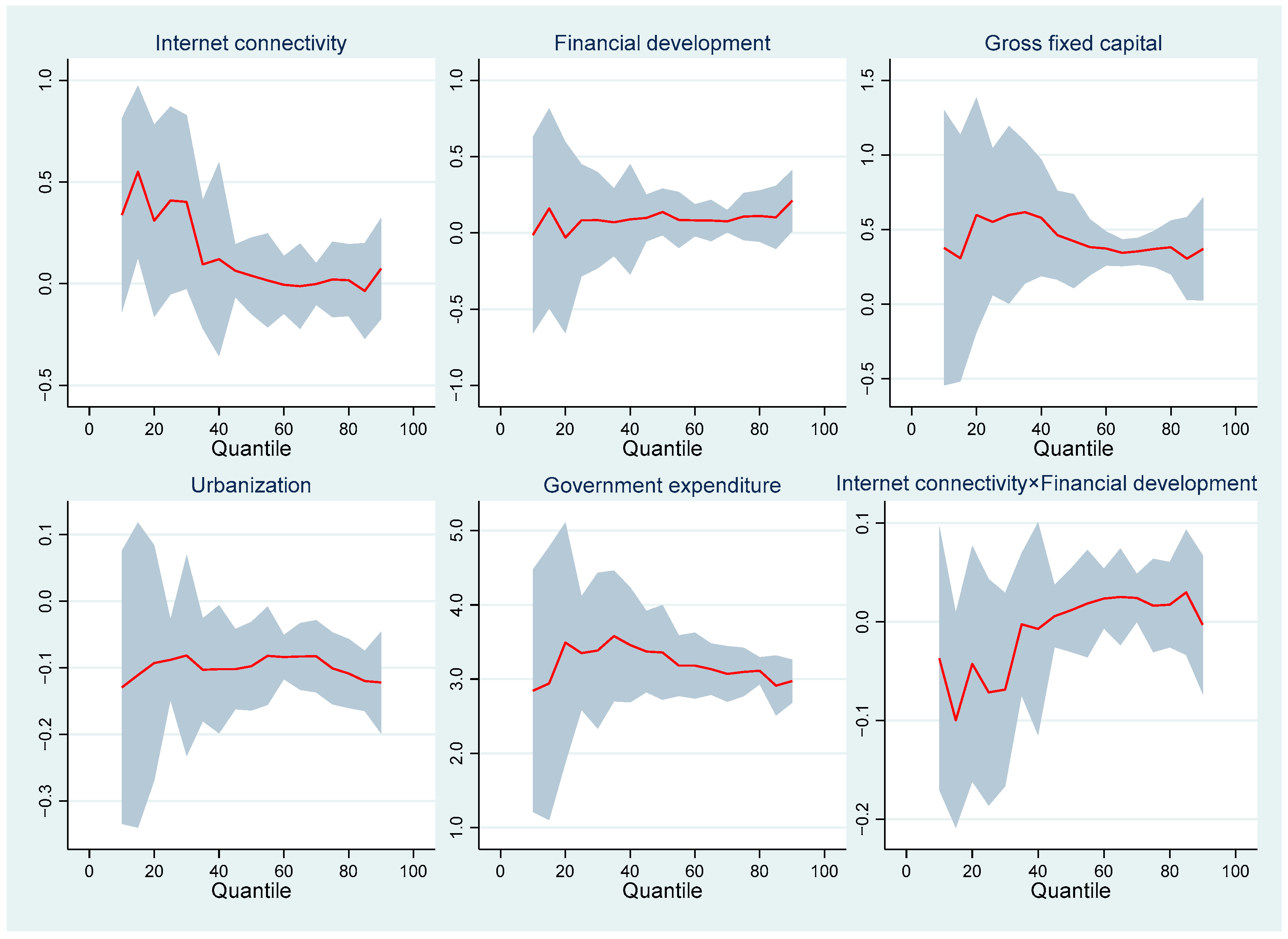
The MMQR estimates in
Figure 1 reveal notable variation across the conditional growth distribution. Internet connectivity has a consistently positive influence at all quantiles, with the effect particularly strong in the lower-growth regimes. This pattern underscores the importance of digital infrastructure as a mechanism for overcoming productivity bottlenecks in the BRICS economies, helping to ease market frictions, expand information flows, and foster technological adoption where growth remains weakest. Financial development exhibits a more complex and uneven pattern across the distribution. Its coefficient is slightly negative in the lowest quantiles, likely reflecting institutional weaknesses, inefficiencies in credit allocation, or the dominance of informal financial systems in parts of the BRICS region. As growth levels rise, however, the effect turns positive and strengthens, suggesting that financial deepening yields greater benefits in structurally stronger BRICS economies where regulatory quality and financial intermediation are more developed. Gross capital formation also displays its largest positive effect in the lower quantiles, consistent with the idea that investment has higher marginal returns in settings where capital shortages and infrastructure gaps are more pronounced. The strength of this effect gradually moderates as growth improves, mirroring diminishing returns to capital accumulation as economies advance. Urbanization is negatively associated with growth at the lower end of the distribution, reflecting challenges typical of early-stage urban expansion in the BRICS countries—including congestion, pressure on public services, pollution, and inadequately planned settlements. This negative influence becomes less pronounced toward the upper quantiles, indicating that improvements in urban planning, infrastructure development, and governance—particularly evident in China and increasingly in India and Brazil—help unlock the growth-enhancing potential of urbanization over time. Government expenditure shows its strongest positive influence in low-growth quantiles, highlighting its stabilizing and countercyclical role in environments characterized by weaker private-sector activity. As economic conditions improve, the impact of government spending diminishes, which may reflect lower fiscal multipliers or a shift in public expenditure toward activities with less direct growth payoff. The interaction between Internet connectivity and financial development provides an additional layer of insight. The interaction term becomes increasingly positive and statistically significant in the middle and upper segments of the growth distribution. This pattern suggests that the benefits of combining digital infrastructure with inclusive financial systems are most fully realized in BRICS economies that have already achieved higher levels of economic performance. In these settings, digital–financial complementarities promote efficiency, stimulate innovation, strengthen financial access, and support the scaling of digital financial services. In contrast, countries at the lower end of the growth spectrum may struggle to capture these synergies due to institutional constraints, limited digital penetration, or weaker financial infrastructure. Taken together, the MMQR results demonstrate that the determinants of economic growth in the BRICS economies operate differently across the growth distribution. The findings point to the need for differentiated policy approaches that consider each country’s growth position, emphasizing digital and financial complementarities in stronger-performing economies, while focusing on foundational infrastructure, institutional strengthening, and improved urban management in those facing more binding structural constraints.
6. Discussion and Policy Recommendations
The empirical results provide robust evidence on the determinants of economic growth in BRICS economies over the period 1994–2024, with findings remaining largely consistent across DKSE, FGLS, and PCSE, while MMQR further validates these relationships and reveals distributional heterogeneity, in line with recent evidence that quantile-based methods capture heterogeneous growth effects in BRICS and related country groups (
Xu et al., 2022). Internet connectivity exerts a positive and statistically significant impact on growth, consistent with studies showing that ICT innovation and diffusion, including internet and mobile technologies, contribute persistently to BRICS’ economic performance and, more broadly, to green and conventional growth outcomes (
Hammed & Ademosu, 2023;
Tang et al., 2022). Domestic credit to the private sector is also strongly and positively associated with economic growth, corroborating panel evidence that banking-sector depth and credit to the private sector significantly foster growth in BRICS and BRICS T economies and generate cross-country growth spillovers through private credit shocks (
Guru & Yadav, 2019;
Gövdeli et al., 2021;
Azam, 2019). In line with classical and modern growth theory, gross fixed capital formation is positively related to economic growth, echoing findings that physical capital formation is a key driver of output and sustainable development in BRICS and other emerging economies (
Azam, 2019;
Rani & Kumar, 2019;
Shaheen et al., 2024). By contrast, urbanization exhibits a negative but significant effect on growth in the present analysis, diverging from some prior work that reports growth-enhancing or green-growth-enhancing roles of urban development, and instead resonating with evidence that rapid urbanization can exacerbate environmental pressures and infrastructural strain, thereby undermining broader development objectives in fast-growing regions (
Ridwan et al., 2024;
Rani & Kumar, 2019). Government expenditure demonstrates a positive association with growth, in line with research emphasizing the importance of macro-fiscal conditions, national income growth, and governance quality for supporting economic and green growth in BRICS and BRICS T, although the relatively smaller DKSE coefficients compared with FGLS and PCSE in the current study suggest that institutional capacity and governance effectiveness condition the growth returns to public spending (
Arzova & Sahin, 2023;
Duan et al., 2022;
Benjamin et al., 2023;
Mahwish et al., 2023).
Importantly, the inclusion of the interaction term between internet connectivity and domestic credit to the private sector reveals a positive and statistically significant complementary effect across estimators. This finding indicates that digital infrastructure and financial deepening operate through a mutually reinforcing mechanism rather than independent channels. Specifically, improvements in internet connectivity amplify the growth-enhancing effect of financial development, while deeper financial systems strengthen the contribution of digital penetration to economic performance (
Khoshimov et al., 2024;
Khudoykulov et al., 2026). This nonlinear synergy aligns with emerging literature emphasizing the integration of digital finance, fintech expansion, and ICT-enabled financial intermediation as critical drivers of structural transformation and productivity gains in emerging markets. The interaction effect thus suggests that the combined expansion of ICT infrastructure and private-sector credit generates multiplicative growth benefits beyond their individual impacts. Overall, the evidence highlights Internet connectivity, financial deepening, and capital accumulation as core structural drivers of growth in BRICS, while the impacts of urbanization and public expenditure appear more context dependent, reflecting heterogeneity in institutional quality, technological readiness, and urban governance across countries and over time; the MMQR results additionally indicate that the magnitude and, in some cases, the direction of these effects vary across the conditional distribution of growth, implying that effective policy design must be tailored to country-specific structural characteristics and growth regimes (
Xu et al., 2022). Findings confirm that the growth-enhancing effect of digital connectivity rises with higher levels of financial development, highlighting the synergistic relationship. From a policy perspective, these findings suggest that BRICS economies should adopt integrated strategies that simultaneously expand digital infrastructure and improve access to financial services, taking into account country-specific institutional and regulatory conditions to maximize the developmental impact of the digital economy.
The empirical findings carry several important policy implications for the BRICS economies—Brazil, Russia, India, China, and South Africa. First, governments should prioritize sustained investment in digital infrastructure, particularly expanding affordable and high-quality internet access in underserved and rural areas. Enhancing broadband penetration, improving digital reliability, and promoting digital literacy programs can strengthen productivity, innovation, and integration into global digital markets. Second, policies aimed at deepening financial development should focus on improving access to credit for small and medium-sized enterprises (SMEs), strengthening financial regulation, and promoting digital financial services such as mobile banking and fintech solutions. The positive interaction between internet connectivity and financial development suggests that coordinated policies integrating digital and financial strategies are likely to yield stronger growth outcomes than isolated reforms. For instance, expanding digital payment systems and online banking platforms can simultaneously enhance financial access and leverage digital infrastructure. Furthermore, maintaining productive public expenditure—particularly in infrastructure, education, and institutional quality—can reinforce the enabling environment necessary for digital and financial sectors to thrive. Policymakers should also carefully manage urbanization processes by investing in sustainable urban planning and infrastructure to mitigate structural pressures associated with rapid urban growth. To sum up, a comprehensive development strategy that simultaneously advances digital transformation, financial deepening, capital formation, and effective public governance is essential for sustaining long-term economic growth in the BRICS economies.
7. Conclusions
This paper examined the determinants of economic growth in the BRICS economies—Brazil, Russia, India, China, and South Africa—over the period 1994–2024, with particular emphasis on internet connectivity and financial development. Using robust panel estimation techniques, including Driscoll–Kraay standard errors (DKSE) as the baseline estimator, along with Feasible Generalized Least Squares (FGLS) and Panel-Corrected Standard Errors (PCSE), the analysis addressed heteroskedasticity, serial correlation, and cross-sectional dependence. The empirical results consistently indicate that internet connectivity and financial development exert a positive and statistically significant influence on economic growth across all main specifications, confirming the structural importance of digital and financial development in the BRICS growth trajectory. The inclusion of the interaction term between internet connectivity and financial development further reveals a complementary relationship between these two dimensions. The positive and statistically significant interaction effect across DKSE, FGLS, and PCSE models suggests that the growth impact of digital infrastructure is strengthened in economies with more developed financial systems, while financial development becomes more effective in environments with greater digital penetration. This synergy underscores the mutually reinforcing role of technological and financial deepening in shaping long-term economic performance. Control variables behave largely in line with theoretical expectations. Gross fixed capital formation maintains a positive and significant association with growth, highlighting the continued relevance of capital accumulation. Government expenditure also shows a positive and statistically significant contribution, reflecting the supportive role of fiscal policy in infrastructure provision and institutional development. Urbanization, however, exhibits a negative and significant coefficient across specifications, suggesting that rapid urban expansion in the BRICS context may generate transitional structural pressures that offset potential productivity gains. To further ensure the robustness of the findings and to account for potential heterogeneity across the conditional distribution of economic growth, the Method of Moments Quantile Regression (MMQR) is employed as an additional robustness check. The MMQR results confirm the baseline conclusions, indicating that the positive effects of internet connectivity, financial development, and their interaction persist across different quantiles of the growth distribution. This suggests that the identified relationships are not confined to average growth effects but are broadly consistent across low-, medium-, and high-growth regimes within the BRICS economies.
Despite these robust findings, certain limitations should be acknowledged. The analysis is restricted to five countries, limiting the generalizability of the results to other emerging or developing economies. The proxies employed for digital infrastructure and financial development in this study may not fully capture qualitative aspects such as digital skills, fintech innovation, or the inclusiveness and quality of financial services. Although digital development encompasses infrastructure quality, technology usage, business adoption, human capital, and regulatory frameworks, long-term and comparable data for these dimensions are not consistently available for the BRICS. Consequently, this analysis relies on internet connectivity as the sole indicator with complete and harmonized coverage since the 1990s. While this measure adequately reflects the early diffusion of digital infrastructure, it does not capture the full complexity of the contemporary digital economy. Future research could expand the number of periods in the sample. A key limitation of this study is the small number of countries in the panel, which constrains the use of dynamic estimation techniques such as System GMM or panel ARDL. While these methods can capture short- and long-term dynamics and address endogeneity and cross-sectional dependence, their reliability requires a larger cross-sectional dimension. Future research could expand the number of countries in the sample, allowing for the application of System GMM or panel ARDL models to more fully explore temporal dependencies, long-run effects, and the dynamic interactions between digital connectivity, financial development, and economic growth.




 ,
,