Article

When Does Green Innovation Matter? Financial Globalization and Pollution Abatement Across the Ecological Footprint Distribution in the EU


1
Department of Accounting and Taxation, Nevşehir Vocational School, Nevşehir Hacı Bektaş Veli University, Nevşehir 50300, Turkey
2
Department of Finance and Banking, Faculty of Applied Sciences, Antalya, Akdeniz University, Antalya 07600, Turkey
3
KOSGEB Kayseri Directorate, Kayseri 38070, Türkiye
4
Department of Finance, Banking, and Insurance Vocational School of Social Sciences, Akdeniz University, Antalya 07600, Turkey
*
Author to whom correspondence should be addressed.
Economies 2026, 14(6), 223; https://doi.org/10.3390/economies14060223
Submission received: 25 April 2026 / Revised: 29 May 2026 / Accepted: 2 June 2026 / Published: 11 June 2026

Abstract

This study examines when green innovation contributes to pollution abatement by analyzing how financial globalization and different forms of innovation jointly shape ecological pressure across European Union (EU) countries over the period 1992–2021. The findings show that financial globalization consistently increases ecological pressure, with stronger effects at upper quantiles (0.8–0.9). Technological innovation exhibits a nonlinear pattern: general RD increases ecological pressure at lower quantiles (0.1–0.4), but this effect becomes insignificant and then negative at higher quantiles (0.7–0.9). In contrast, environmental innovation (EI) reduces CO2 emissions at middle and upper quantiles (0.5–0.8), suggesting a stronger environmental contribution under medium-to-high ecological pressure conditions. Overall, the results demonstrate that the environmental impact of innovation depends on both the type of innovation and the prevailing level of ecological pressure. Specifically, general R&D and environmental innovation exhibit different environmental effects across lower and upper quantiles, suggesting that environmentally oriented innovation policies may be more effective under higher ecological pressure conditions.

1. Introduction

Environmental degradation remains one of the most pressing global challenges, as increasing resource use, energy consumption, and production intensity continue to exert substantial pressure on ecological systems. Indicators such as ecological footprint and carbon emissions reveal that human activities are increasingly exceeding the Earth’s biocapacity, intensifying pressure on the biosphere and contributing to long-term environmental risks (Wackernagel & Rees, 1996; Peters et al., 2011). In this context, a critical policy question emerges: under what conditions can innovation effectively contribute to pollution abatement? Understanding the drivers of ecological pressure and the circumstances under which environmental improvements can be achieved has therefore become a central issue for both researchers and policymakers.
The EU provides a relevant empirical setting for examining these dynamics, as it represents a region characterized by deep financial integration and advanced environmental policy frameworks (Dreher et al., 2008). Within this context, financial globalization and technological innovation have emerged as key forces shaping environmental outcomes. The liberalization of capital flows and the integration of financial markets have stimulated economic activity; however, their environmental consequences remain theoretically ambiguous. While financial globalization may facilitate access to cleaner technologies, it may also intensify ecological pressure by expanding production and energy demand. Consistent with this theoretical ambiguity, empirical evidence remains inconclusive, with studies reporting both mitigating (Tamazian & Rao, 2010) and amplifying (Shahbaz et al., 2017b) effects. Through scale, composition, and technique effects, financial globalization may simultaneously intensify ecological pressure while also facilitating the diffusion of cleaner technologies (Grossman & Krueger, 1991; Antweiler et al., 2001; Copeland & Taylor, 2004). Theoretically, the Environmental Kuznets Curve (EKC) hypothesis also informs this study by suggesting that environmental degradation may follow an inverted-U trajectory relative to economic development (Grossman & Krueger, 1995). This duality translates into a clear policy trade-off: greater financial integration may stimulate capital accumulation and economic growth but also risks increasing environmental pressure through scale effects, whereas insufficient financial integration may limit access to cleaner technologies and efficiency gains associated with technique effects. Balancing these competing outcomes defines the finance–environment nexus (Frankel & Rose, 2005; Tamazian et al., 2009). In particular, cross-border capital flows may influence resource allocation, energy consumption patterns, and production structures, thereby reinforcing the energy–pollution nexus observed in many economies (Shahbaz et al., 2017b; Destek & Sarkodie, 2019; Zaidi et al., 2019). However, whether financial globalization amplifies or mitigates ecological pressure may depend on underlying environmental conditions and the direction of technological change. These mixed findings may partly reflect methodological limitations, as most studies rely on mean-based estimation approaches that cannot fully capture how these effects vary across different levels of environmental pressure. Technological innovation constitutes another critical mechanism influencing ecological pressure. While general research and development (R&D) activities may increase environmental pressure in the early stages by expanding production and energy use, environmentally oriented innovation can improve energy efficiency and reduce emissions (Popp, 2010; Aghion et al., 2016). However, whether technological innovation can effectively offset the environmental pressures associated with financial globalization remains an open empirical question. The answer is likely to depend not only on the scale of innovation but also on its interaction with financial systems and, crucially, on the existing level of ecological pressure (Claessens & Feijen, 2007; Costantini et al., 2017).
Despite growing interest, the empirical literature remains constrained by several limitations. First, most studies rely on production-based CO2 emissions, overlooking broader measures such as ecological footprint and consumption-based emissions that capture resource depletion and carbon leakage (Peters et al., 2011; Ulucak & Bilgili, 2018; Destek & Okumus, 2019; Nathaniel & Khan, 2020). Second, technological innovation is often treated as a homogeneous concept, obscuring the distinct roles of general R&D and environmental innovation (Popp, 2010; Aghion et al., 2016). Third, conventional mean-based estimation techniques may mask heterogeneity across different levels of ecological pressure. As a result, limited attention has been paid to how financial globalization and the direction of innovation jointly shape pollution abatement across heterogeneous environmental regimes.
Against this backdrop, this study examines when green innovation matters for pollution abatement by analyzing the relationship between financial globalization, technological innovation, and ecological pressure in a panel of EU countries over 1992–2021. Environmental pressure is measured using two complementary indicators: ecological footprint per capita and consumption-based CO2 emissions. By distinguishing between general R&D expenditures and environmental innovation, the study provides a more detailed assessment of the role of technological change. Furthermore, the analysis employs a panel quantile regression (PQR) framework, which allows the effects of explanatory variables to vary across the conditional distribution of ecological pressure, thereby capturing heterogeneous and nonlinear effects (Koenker & Bassett, 1978; Koenker, 2004).
This study contributes to the literature in four ways. First, it adopts a dual-indicator approach by incorporating both ecological footprint and consumption-based emissions, addressing an important measurement gap. Second, it explicitly distinguishes between general and environmentally oriented innovation, providing a clearer assessment of their roles in shaping ecological pressure and pollution abatement. Third, from a methodological perspective, the PQR framework reveals distributional heterogeneity that remains hidden in conventional mean-based models—an approach well suited to evaluating policy effectiveness across different environmental regimes. Fourth, by focusing on the EU, the study provides context-specific evidence on how financial and technological factors jointly influence ecological pressure, with direct implications for the design of targeted and regime-specific pollution abatement strategies. Overall, the additional value of this study lies in showing not only whether financial globalization and innovation affect environmental quality, but also how these effects vary across different environmental conditions. In addition, the study is related to broader sustainability objectives, particularly SDG 13 (Climate Action) and SDG 9 (Industry, Innovation and Infrastructure), by providing evidence on how financial globalization and different forms of innovation may contribute to environmental sustainability and climate-related policy goals. The novelty of this study extends beyond the use of PQR by combining different environmental indicators, distinguishing between general and environmental innovation, and identifying heterogeneous effects across environmental conditions.
To further clarify the scope and objectives of the study, the following research questions are addressed:
RQ1.
Do changes in the level of financial globalization significantly affect environmental quality across EU countries?
RQ2.
Do technological innovation and environmental innovation contribute differently to environmental quality in EU countries?
RQ3.
Do the effects of financial globalization and innovation on environmental quality vary across different levels of environmental quality distribution?
To address these questions empirically, this study employs a panel dataset covering EU countries over the period 1992–2021. The empirical analysis first examines the long-run relationship among variables using the Kao cointegration test. Subsequently, the heterogeneous effects of financial globalization and innovation on environmental quality are analyzed using PQR. The remainder of this paper is structured as follows. Section 2 reviews the theoretical and empirical literature. Section 3 presents the data and variable definitions. Section 4 outlines the empirical methodology. Section 5 discusses the empirical findings and robustness checks. Finally, Section 6 concludes and provides policy implications.

2. Review of Literature

2.1. Financial Globalization and Ecological Quality

The Environmental Kuznets Curve (EKC) hypothesis provides a useful framework for understanding the finance–environment nexus. The EKC suggests that environmental outcomes may evolve through scale, composition, and technique effects as economic and financial development progresses (Grossman & Krueger, 1991, 1995).
Financial globalization refers to the integration of national financial markets into the global financial system through cross-border capital flows, foreign direct investment, and financial liberalization. It is widely regarded as one of the central dynamics of the contemporary global economy. Its environmental implications are typically conceptualized through three mechanisms. The scale effect suggests that financial integration expands production and consumption, thereby increasing energy demand and intensifying ecological pressure and emissions (Grossman & Krueger, 1991; Antweiler et al., 2001). The composition effect argues that financial openness may direct capital toward pollution-intensive industries, particularly where environmental regulations are weak, thereby reinforcing environmental degradation (Copeland & Taylor, 2004; Cole & Elliott, 2005). The technique effect, conversely, highlights the potential diffusion of cleaner technologies, environmentally friendly investments, and stronger environmental standards, which may alleviate ecological pressure (Frankel & Rose, 2005; Tamazian et al., 2009). Consequently, the net impact of financial globalization on ecological pressure remains ambiguous and depends on the relative dominance of these mechanisms as well as country-specific factors such as institutional quality, income levels, and environmental policies.
A substantial body of empirical evidence documents that ecological pressure increases in response to financial globalization, particularly in developing economies. Panel studies show that financial openness stimulates industrial production and fossil fuel consumption, leading to higher CO2 emissions and intensified environmental pressure (Shahbaz et al., 2017b; Destek & Sarkodie, 2019). Foreign capital inflows are frequently directed toward pollution-intensive sectors in countries with relatively weak regulatory frameworks, further amplifying ecological degradation (Cole et al., 2017; Balsalobre-Lorente et al., 2019). Beyond production channels, financial deepening and credit expansion may increase household demand for energy-intensive goods, contributing to a growing carbon footprint and resource use (Sadorsky, 2010; Acheampong, 2019). Empirical studies employing ecological footprint indicators confirm that financial globalization intensifies pressure on natural resource use and biocapacity (Destek & Okumus, 2019; Nathaniel & Khan, 2020). Collectively, these findings indicate that ecological pressure is amplified through multiple transmission channels and that these effects are particularly pronounced in developing country contexts.
Conversely, another strand of the literature suggests that ecological pressure may decrease under certain conditions associated with financial globalization. Empirical analyses focusing on advanced economies with strong institutional frameworks indicate that financial globalization can reduce emissions through the technique effect (Tamazian & Rao, 2010; Tamazian et al., 2009). In such contexts, deeper financial systems facilitate the financing of environmentally friendly projects and investments that improve energy efficiency (Claessens & Feijen, 2007; Popp et al., 2010). Financial openness may also promote renewable energy investments, thereby mitigating environmental pressure (Sadorsky, 2011; Shahbaz et al., 2012). In addition, foreign direct investment can contribute to cleaner production processes through the transfer of advanced technologies and the enforcement of stricter environmental standards (Eskeland & Harrison, 2003; Dean et al., 2009). Evidence based on ecological footprint indicators further shows that financial globalization may enhance resource-use efficiency and reduce pressure on biocapacity (Al-Mulali et al., 2016). These findings suggest that reductions in ecological pressure are highly context-dependent and vary across institutional and economic environments.
Recent studies emphasize that the relationship between financial globalization and ecological pressure is nonlinear and heterogeneous. Income-based analyses reveal that financial globalization exacerbates environmental degradation in low- and middle-income countries but may reduce emissions in high-income economies through cleaner technologies and stricter regulations (Shahbaz et al., 2017a; Destek et al., 2018). Similarly, strong environmental policies, rule of law, and regulatory effectiveness can shift the impact of financial globalization toward improved environmental outcomes (Tamazian & Rao, 2010). Nonlinear panel approaches indicate that financial globalization increases ecological pressure below certain financial development thresholds, whereas beyond these thresholds the technique effect dominates, leading to reductions in both ecological footprint and CO2 emissions (Le & Le, 2023). These findings demonstrate that the effects of financial globalization cannot be fully captured by average-based estimation techniques and that heterogeneous environmental conditions play a critical role.
The absence of a clear consensus in the empirical literature reflects both conceptual and methodological differences across studies. Research focusing on production-based carbon emissions captures only part of environmental pressure, whereas broader indicators such as ecological footprint account for consumption patterns, natural resource use, and biocapacity constraints (Destek & Sarkodie, 2019; Nathaniel & Khan, 2020). Differences in country samples, institutional structures, and regulatory environments further contribute to inconsistent findings (Tamazian et al., 2009; Shahbaz et al., 2017a). In addition, the omission of institutional quality, governance, and environmental policy variables may lead to incomplete interpretations of the finance–environment nexus (Acheampong et al., 2021). Importantly, reliance on mean-based estimation techniques may conceal heterogeneity across different levels of ecological pressure.
These mixed findings highlight that the effects of financial globalization on ecological pressure are highly context-dependent and cannot be fully understood without considering heterogeneous environmental conditions. Although the literature has examined this relationship from multiple perspectives, several important gaps remain. First, most studies rely on production-based carbon emissions, while more comprehensive indicators such as ecological footprint—which captures consumption, natural resource use, and biocapacity pressures—remain underutilized (Destek & Sarkodie, 2019; Destek & Okumus, 2019; Nathaniel & Khan, 2020). Second, the role of technological innovation as a transmission channel linking financial globalization to environmental outcomes has not been sufficiently explored; existing studies often treat financial globalization and technological progress as separate determinants (Popp et al., 2010). Third, studies focusing on EU countries remain limited despite the region’s high financial integration and institutionalized environmental frameworks (Dreher et al., 2008; Zaidi et al., 2019). Finally, existing research largely overlooks how the effects of financial globalization vary across the distribution of environmental outcomes. This study addresses these gaps by examining heterogeneous effects across different quantiles using ecological footprint and consumption-based CO2 indicators within a PQR.
To provide a clearer overview of the existing evidence, Table 1 summarizes representative studies examining the relationship between financial globalization and environmental quality. The table highlights the main variables, methodological approaches, and key findings reported in the literature.
Previous studies generally suggest that financial globalization may intensify environmental pressure through increased production activity, fossil fuel dependence, and resource use. However, existing evidence largely relies on average-based estimators and provides limited insight into heterogeneous environmental regimes.

2.2. Technological Innovation and Ecological Quality

Technological innovation plays a central role in shaping ecological pressure through its influence on natural resource use, energy efficiency, and emission intensity. Within the environmental–economic literature, innovation is widely recognized as a key mechanism affecting environmental outcomes, as it can both mitigate and intensify ecological pressure depending on its direction and application (Popp, 2005; Aghion et al., 2016). The environmental effects of technological innovation are commonly explained through several theoretical perspectives, most notably the Porter Hypothesis, which posits that well-designed environmental regulations can stimulate innovation and thereby improve both environmental performance and competitiveness (Porter & van der Linde, 1995). These mechanisms typically operate through improvements in energy efficiency, cleaner production technologies, and enhanced resource utilization, which collectively reduce emissions per unit of output (Jaffe et al., 2003; Popp et al., 2010). However, technological progress may also generate countervailing effects. By lowering production costs and expanding output, innovation can increase aggregate energy consumption and indirectly intensify ecological pressure through rebound mechanisms (Sorrell, 2009; Brockway et al., 2021).
A large body of empirical research suggests that technological innovation, particularly in the form of research and development (R&D) activities, contributes to the mitigation of ecological pressure. These studies indicate that R&D expenditures foster the development of energy-efficient technologies and reduce emission intensity across production processes. Empirical findings further show that technological innovation supports the adoption of cleaner production technologies and helps mitigate environmental degradation, although these effects are not uniform across countries and environmental conditions (Aghion et al., 2016; Mensah et al., 2019). Evidence based on ecological footprint indicators also supports this view, demonstrating that technological innovation enhances the efficiency of natural resource use and alleviates pressure on biocapacity (Ulucak & Bilgili, 2018; Destek & Manga, 2021). In addition, R&D activities contribute to the development of renewable energy technologies and reduce dependence on fossil fuels, thereby indirectly lowering ecological pressure (Sadorsky, 2012; Balsalobre-Lorente et al., 2021). Collectively, these findings suggest that technological innovation can reduce ecological pressure through multiple channels, particularly when supported by appropriate structural conditions.
At the same time, a substantial strand of the literature highlights that technological innovation may also intensify ecological pressure under certain conditions. This perspective is grounded in the rebound and scale effects, which imply that technological progress reduces production costs, expands economic activity, and ultimately increases aggregate energy consumption and emissions (Sorrell, 2009; Brockway et al., 2021). When general R&D expenditures are not explicitly aligned with environmental objectives, innovation may stimulate production in energy-intensive sectors, leading to higher carbon emissions and greater ecological pressure (York & McGee, 2017). Empirical evidence from developing economies supports this argument, showing that technological advancement can accelerate industrialization and increase reliance on fossil fuel-based energy systems (Acheampong, 2019; Ulucak, 2020). Similarly, cross-country evidence indicates that the environmental effects of technological innovation vary across different institutional and economic contexts (Sadorsky, 2011). Studies employing ecological footprint indicators further confirm that general technological innovation may increase consumption levels and intensify pressure on natural resource use and biocapacity (Charfeddine & Kahia, 2019; Ahmed et al., 2019). Taken together, these findings suggest that technological innovation does not uniformly reduce ecological pressure and may, in some cases, exacerbate environmental degradation.
In contrast to general technological innovation, environmental (green) innovation—explicitly designed to achieve environmental objectives—emerges as a more consistent mechanism for reducing ecological pressure. Environmental innovation encompasses technological advances aimed at reducing emissions, improving energy efficiency, expanding renewable energy use, and promoting sustainable resource management. Empirical studies show that environmental innovation aligns with the Porter Hypothesis by simultaneously improving environmental performance and production efficiency (Porter & van der Linde, 1995; Dechezleprêtre & Sato, 2017). Evidence based on environmental patents and green technology indicators demonstrates that environmental innovation has a stronger and more direct impact on reducing CO2 emissions compared to general R&D activities (Popp, 2010; Johnstone et al., 2010). Panel data studies focusing on European countries further indicate that environmental innovation reduces energy intensity, promotes renewable energy investments, and leads to sustained reductions in ecological footprint (Aghion et al., 2016). These effects are also found to depend on environmental policy frameworks and the level of ecological pressure (Costantini et al., 2017). Additional evidence based on ecological footprint indicators confirms that environmental innovation enhances resource-use efficiency and alleviates pressure on biocapacity (Truffer & Coenen, 2012). Recent evidence from EU countries further suggests that the environmental effects of green technological development may vary substantially across the conditional distribution of environmental outcomes, reinforcing the importance of distribution-sensitive approaches (Ağan, 2024).
The divergence in empirical findings can largely be attributed to differences in how technological innovation is measured and conceptualized. Aggregate indicators such as total R&D expenditures or overall patent counts often include innovation activities that are not environmentally oriented, which helps explain why their effects on ecological pressure are inconsistent or even contradictory across studies (Sadorsky, 2011; Charfeddine & Kahia, 2019). In contrast, indicators that explicitly capture environmental innovation—focused on emission reduction, energy efficiency, and cleaner production—tend to produce more consistent evidence of environmental improvement (Popp, 2010; Dechezleprêtre & Sato, 2017). In addition, contextual factors such as country characteristics, energy structures, and regulatory frameworks play a decisive role in shaping the innovation–environment nexus (Aghion et al., 2016; Costantini et al., 2017). These findings indicate that technological innovation affects ecological pressure through multiple and sometimes conflicting channels, reinforcing the need to consider heterogeneous environmental conditions.
Despite the extensive literature, several important gaps remain. First, many studies treat technological innovation as a homogeneous concept, failing to distinguish between general R&D activities and environmentally oriented innovation, which contributes to inconsistent findings (Popp, 2010; Dechezleprêtre & Sato, 2017). Second, most empirical analyses focus on carbon emissions, while broader indicators such as ecological footprint—which capture consumption patterns, natural resource use, and biocapacity pressures—remain relatively underexplored (Ulucak & Bilgili, 2018). Third, the literature largely relies on mean-based estimation techniques, which may obscure heterogeneous and distributional effects across different levels of ecological pressure (Pesaran et al., 2001; Aghion et al., 2016). Furthermore, empirical studies focusing specifically on regions such as the EU remain limited, despite their relevance for understanding the interaction between technological innovation and environmental policy frameworks. Against this backdrop, the present study addresses these gaps by distinguishing between general technological innovation and environmental innovation, and by examining their heterogeneous effects on ecological pressure across different quantiles using a PQR framework. Although recent studies have increasingly adopted quantile-based approaches to investigate environmental sustainability and emissions dynamics (Ağan, 2024), empirical evidence jointly examining financial globalization, environmental innovation, and ecological pressure within the EU context remains limited. To further clarify the role of innovation in environmental outcomes, Table 2 presents selected studies focusing on technological and environmental innovation and their implications for environmental quality.
Existing studies suggest that technological and environmental innovation may improve environmental quality through efficiency gains and cleaner technologies. Nevertheless, previous evidence rarely distinguishes between general technological innovation and environmental innovation under different levels of ecological pressure. Despite these advances, important gaps remain in the innovation–environment literature. Although innovation may create opportunities for environmental improvements, its benefits are not always automatic and may be constrained by factors such as rebound effects and differences in ecological pressure conditions. In addition, previous studies often treat innovation as a homogeneous concept, providing limited evidence on the distinct roles of general and environmentally oriented innovation.

3. Data and Methodological Framework

3.1. Data and Model Specification

This study examines the effects of financial globalization and technological innovation on environmental quality in 27 EU countries over the period 1992–2021. The study covers the period 1992–2021. The starting year coincides with the Maastricht Treaty and the availability of KOF financial globalization data, while the ending year (2021) precedes the post-COVID energy crisis, which may introduce additional structural changes. This period also encompasses several EU enlargement waves, thereby enhancing panel heterogeneity and capturing important stages of financial integration and environmental policy development.
The model employed in the study is developed based on the existing empirical literature that investigates the relationship between financial globalization, technological innovation, and environmental quality. To measure environmental quality, two separate models are constructed in the study. These models are presented below.
Model   1   E F i t = β i 0 + β i 1 F G i t + β i 2 R D i t + β i 3 E I i t + β i 4 P G i t + β i 5 U R B i t + ε i t
Model   2   C O 2 i t = β i 0 + β i 1 F G i t + β i 2 R D i t + β i 3 E I i t + β i 4 P G i t + β i 5 U R B i t + ε i t
In the model, the dependent variables are EF, which represents the ecological footprint, and CO2, which denotes carbon dioxide emissions. The independent variables included in the model are FG, representing the financial globalization index; RD, research and development expenditures; EI, environmental technological innovation; PG, population growth; and URB, the urbanization rate. In addition, i denotes countries, t represents time periods, and ε is the error term. The data for the variables used in this study are obtained from internationally recognized and reliable databases. Data on the ecological footprint (EF) are sourced from the Global Footprint Network database. Data on carbon dioxide emissions (CO2), research and development expenditures (RD), population growth (PG), and urbanization (URB) are obtained from the World Development Indicators (WDI) database provided by the World Bank. The financial globalization (FG) variable is derived from the KOF Globalization Index compiled by the KOF Swiss Economic Institute. Finally, data for environmental innovation (EI) are collected from environment-related patent indicators available in the OECD database. Regarding measurement scales, financial globalization (FG) is measured using the KOF Financial Globalization Index, research and development (RD) is measured as R&D expenditure (% of GDP), population growth (PG) is measured as annual population growth (%), urbanization (URB) is measured as urban population (% of total population), ecological footprint (EF) is measured in global hectares per capita, carbon dioxide emissions (CO2) are measured in metric tons per capita, and environmental innovation (EI) is proxied using environment-related patent indicators obtained from the OECD database.
The model employed in this study is grounded in the empirical literature examining the relationship between environmental quality, financial development, and technological innovation. In this context, the theoretical framework of the model is informed by the EKC hypothesis. The EKC approach suggests that environmental degradation increases in the early stages of economic and financial development, but beyond a certain threshold level, environmental quality improves through technological progress and structural transformation (Grossman & Krueger, 1995; Stern, 2004). The inclusion of the financial globalization (FG) variable in the model is motivated by the findings of studies investigating the finance–environment nexus. This literature indicates that financial integration may improve environmental quality by facilitating access to cleaner technologies, while at the same time it may increase environmental pressure by expanding the scale of production and consumption (Shahbaz et al., 2012; Acheampong, 2019). Therefore, the direction of the effect of financial globalization remains an empirical issue. The variables representing technological progress—research and development (RD) and environmental innovation (EI)—are considered key determinants of environmental sustainability in the literature. In particular, environmental innovation is emphasized as a mechanism that can reduce environmental degradation by improving energy efficiency and transforming carbon-intensive production processes (Popp, 2002; Aghion et al., 2016). However, it is also acknowledged that technological activities may increase environmental pressure in the short term by expanding production and energy use. The population growth (PG) and urbanization (URB) variables included in the model represent the scale and demand effects on environmental quality. The literature widely suggests that increasing population and rapid urbanization intensify environmental degradation by raising energy demand and natural resource consumption (York et al., 2003; Poumanyvong & Kaneko, 2010).

3.2. Methodology

This study analyzes the effects of financial globalization and technological innovation on environmental quality using a panel dataset of 27 EU countries within a multi-stage econometric framework. In panel data analysis, especially in multi-country datasets, ignoring structural features such as cross-sectional dependence and parameter heterogeneity may lead to biased and inconsistent estimation results (Pesaran, 2004). Therefore, the empirical analysis is designed based on second-generation panel data techniques that account for these characteristics of the dataset.
In this context, the presence of cross-sectional dependence among countries in the panel is first tested using the LM test developed by Breusch and Pagan (1980) and the CD test proposed by Pesaran (2004). The Breusch–Pagan LM test examines the correlation structure across cross-sectional units based on error terms to determine whether cross-sectional dependence exists. The results indicate the presence of strong cross-sectional dependence in the panel, which necessitates the use of second-generation econometric techniques. Following the detection of cross-sectional dependence, the stationarity properties of the variables are examined using the CADF and CIPS unit root tests developed by Pesaran (2007). The CADF approach incorporates cross-sectional averages into standard unit root tests to account for common factor structures and can be expressed as follows:
Δ y i t = α i + β i y i , t 1 + γ i y ¯ t 1 + δ i Δ y ¯ t + ε i t
Within this framework, the CIPS statistic is defined as the average of the individual CADF statistics and can be expressed as follows:
C I P S = 1 N i = 1 N t i
This method provides more reliable stationarity results, as it accounts for cross-sectional dependence (Pesaran, 2007). Following the determination of the stationarity properties of the variables, the presence of a long-run relationship among the variables is examined using the panel cointegration tests developed by Pedroni (1999) and Kao (1999). These tests are employed as preliminary diagnostic tools to provide supporting evidence on the existence of a long-term association among the variables. The Pedroni approach is based on the following long-run equilibrium relationship, taking into account the heterogeneous structure of the panel:
y i t = α i + δ i t + k = 1 K β k i x k i t + ε i t
This test examines the existence of a cointegration relationship through both within-group and between-group statistics. The Kao (1999) test, on the other hand, evaluates the cointegration relationship under the assumption of a more homogeneous panel structure. The empirical findings indicate the presence of a long-run equilibrium relationship among the variables. Finally, in order to go beyond average effects and to capture the variation in relationships across the conditional distribution, the PQR method is employed. Unlike conventional mean-based estimation techniques, PQR allows the effects of explanatory variables to differ across different quantiles of the dependent variable, thereby capturing potential heterogeneity and nonlinearities in the relationships.
The panel extension of the quantile regression approach developed by Koenker and Bassett (1978) can be expressed as follows:
Q y i t ( τ X i t ) = α i ( τ ) + β 1 ( τ ) F G i t + β 2 ( τ ) R D i t + β 3 ( τ ) E I i t + β 4 ( τ ) P G i t + β 5 ( τ ) U R B i t
Here Q y i t ( τ X i t ) , represents the conditional quantile of the dependent variable at the τ -th quantile, where τ ( 0 , 1 ) . This approach allows the estimated coefficients to vary across different quantiles, thereby enabling the identification of heterogeneous effects within the model (Koenker, 2004). In particular, for variables such as environmental indicators, which often exhibit asymmetric and skewed distributions, the PQR approach provides a more flexible and comprehensive analytical framework compared to conventional mean-based estimation methods.
Accordingly, this study aims to examine the effects of financial globalization and technological innovation on environmental quality not only at the average level but also across different points of the distribution, thereby providing deeper and more policy-relevant insights.

4. Results

4.1. Descriptive Statistics

To reveal the fundamental characteristics of the variables used in the model, descriptive statistics are examined. In this context, the general structure of the dataset is evaluated by analyzing measures such as the mean, median, maximum and minimum values, as well as distributional properties including standard deviation, skewness, and kurtosis. The obtained results are presented in Table 3.
An examination of the mean values of the variables reported in Table 3 indicates that the CO2 and FG variables exhibit relatively higher average values. In contrast, the RD and EI variables display comparatively lower mean values. This suggests that environmental and technological investments remain relatively limited within the sample. Although the proximity of median values to the means implies a relatively symmetric distribution for some variables, the skewness coefficients provide a more detailed perspective. In particular, the positive skewness values observed for EF, CO2, and EI indicate that these variables are right-skewed, suggesting that higher values are less frequent but more influential. In contrast, the negative skewness of the FG variable implies a left-skewed distribution, indicating a higher concentration of relatively large values. An examination of kurtosis values reveals that most variables exhibit values greater than 3. This finding suggests that the distributions are more peaked (leptokurtic) compared to the normal distribution and indicates the presence of extreme values (outliers). Finally, the number of observations for all variables is 786, indicating that the dataset has a balanced panel structure, which provides a significant advantage in terms of the reliability of the econometric analysis.

4.2. Correlation Matrix

To assess the presence of multicollinearity in the panel data model, Spearman correlation analysis and the Variance Inflation Factor (VIF) test are employed. A high degree of correlation among explanatory variables may weaken the reliability of regression estimates and lead to misleading statistical significance of the coefficients. Therefore, it is essential to carefully examine the relationships among the variables included in the model. According to the commonly accepted approach in the literature, multicollinearity may arise when the correlation coefficient between explanatory variables exceeds 0.80 (Gujarati, 2004). Correlation levels below this threshold are generally considered acceptable in terms of the reliability of model estimates. In addition, to provide a more comprehensive assessment of multicollinearity, VIF analysis is conducted. VIF values below 10 indicate the absence of a serious multicollinearity problem among the variables (Curto & Pinto, 2010). In this context, the correlation coefficients and VIF values are reported in Table 4.
An examination of the Spearman correlation coefficients reported in Table 4 reveals notable positive correlations, particularly between ecological footprint (EF), CO2 emissions, and financial globalization (FG). This finding suggests that increases in environmental pressure tend to move in tandem with rising carbon emissions and the expansion of financial systems. Similarly, the positive relationships between FG and RD (0.6128), as well as URB (0.5338), indicate that financial globalization is closely associated with both innovation activities and urbanization. This result implies that the development of financial systems may support technological progress and urban transformation. On the other hand, the environmental innovation (EI) variable exhibits generally weak and negative correlations with the other variables. This finding suggests that environmental innovation does not display a strong relationship with environmental pressure or economic indicators in the short term, implying that its effects may materialize over a longer time horizon. Furthermore, since all correlation coefficients are below the threshold value of 0.80, there is no evidence of a serious multicollinearity problem among the variables. This supports the reliability of the regression estimates, indicating that the independent variables do not excessively explain each other. In addition, the VIF values, calculated to further assess multicollinearity, range between 1 and 1.26 for all variables. These results provide additional evidence that multicollinearity is not a concern in the model.

4.3. Cross-Sectional Dependence Test Results

In panel data analysis, diagnostic tests are conducted to ensure the appropriate selection of unit root tests and the validity of the estimation method. In particular, the presence of cross-sectional dependence and heteroskedasticity among variables must be taken into account, as ignoring these issues may compromise the accuracy and reliability of the findings (Breusch & Pagan, 1980; Pesaran, 2004).The results of these tests are reported in Table 5.
According to the diagnostic test results reported in Table 5, the Breusch–Pagan LM test statistic is high and statistically significant (1486.003; p < 0.01), clearly rejecting the null hypothesis of cross-sectional independence among panel units. This finding indicates that the countries included in the analysis are interconnected through common shocks, global economic fluctuations, and channels of financial integration. This result is strongly supported by the findings of the Pesaran (2004) CD test. The statistical significance of the CD test statistic (13.66897; p < 0.01) confirms the presence of cross-sectional dependence not only in small panels but also in datasets with large cross-sectional and time dimensions. From a methodological perspective, this outcome is expected, particularly given that environmental indicators and financial variables tend to exhibit globally interconnected dynamics. Similar evidence is also obtained from the remaining cross-sectional dependence tests. The Pesaran Scaled LM test (42.83794; p < 0.01) and the Bias-Corrected Scaled LM test (42.37242; p < 0.01) both confirm that cross-sectional dependence remains robust across alternative testing procedures. In addition, the Pesaran CD statistic (13.66897; p < 0.01) further supports the existence of cross-sectional dependence within the panel dataset. These findings suggest that the countries included in the analysis are interconnected through common economic, financial, and environmental dynamics, thereby justifying the use of estimation approaches robust to cross-sectional dependence.

4.4. Panel Unit Root Test Results

When the findings reported in Table 5 are evaluated jointly, it is evident that the panel dataset exhibits a strong structure of cross-sectional dependence. In this context, since the fundamental assumptions of first-generation panel data methods are violated, the use of second-generation panel data techniques that account for cross-sectional dependence becomes a methodological necessity. Otherwise, the estimated coefficients may be biased and inconsistent, thereby weakening the reliability of the empirical findings. Accordingly, the CADF-CIPS unit root test developed by Pesaran (2007), one of the second-generation panel data techniques, is employed in this study. The statistical values and corresponding probability levels obtained from the unit root tests are presented in Table 6.
The CADF–CIPS unit root test results reported in Table 6 indicate that the probability values of all variables included in the model are below the 5% significance level. This finding suggests that all variables are stationary at their level values, implying the absence of a unit root problem in the series.

4.5. Panel Cointegration Tests

Following the determination of the stationarity properties of the series, panel cointegration analysis is conducted to examine the existence of a long-run relationship among the variables. In this context, the Pedroni and Kao panel cointegration tests, which are widely used in the literature, are employed. These tests are utilized as preliminary diagnostic tools to provide supporting evidence on the existence of a long-term association among the variables. The results of the respective tests are reported in Table 7 and Table 8.
The Pedroni panel cointegration test results reported in Table 7 indicate that the null hypothesis of no cointegration is rejected when both within-group (panel PP-statistic and panel ADF-statistic) and between-group (group PP-statistic and group ADF-statistic) statistics are considered. This finding suggests the existence of a long-term association among the variables. In addition, the results obtained from the Kao panel cointegration test further support the presence of this long-term relationship and provide additional evidence consistent with the Pedroni test findings.

4.6. Panel Quantile Regression Results

The PQR method is employed to estimate the study models. The PQR results reveal that the effects of the independent variables on the dependent variables vary significantly across the conditional distribution, thereby offering a more comprehensive analytical framework beyond conventional mean-based estimation techniques. Furthermore, the findings demonstrate that the impacts of explanatory variables are not limited to the average level but systematically differ across various points of the distribution. This indicates that the dynamics of environmental degradation exhibit a pronounced heterogeneous structure. The estimated coefficients and corresponding probability values obtained from the PQR are reported in Table 9.
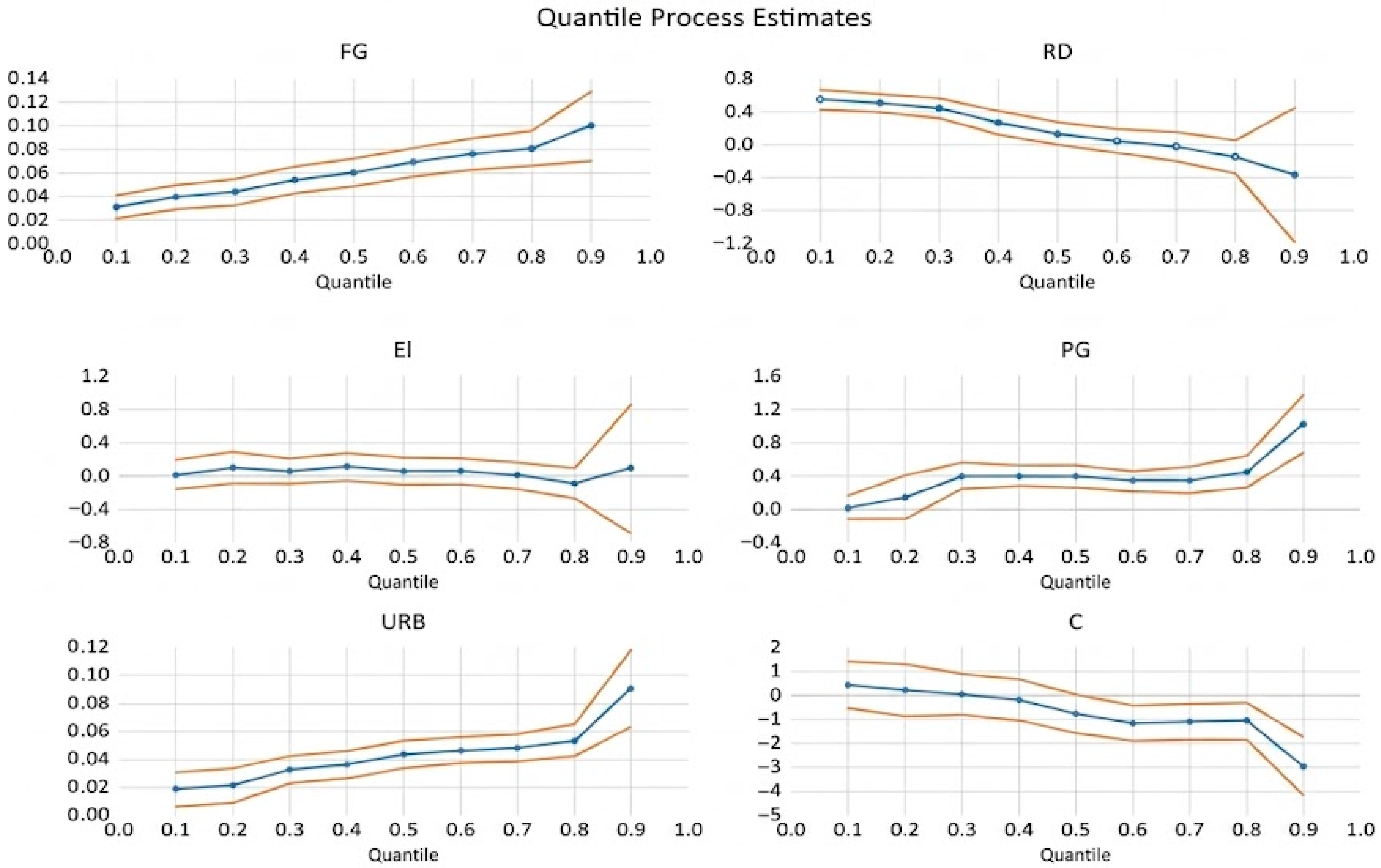
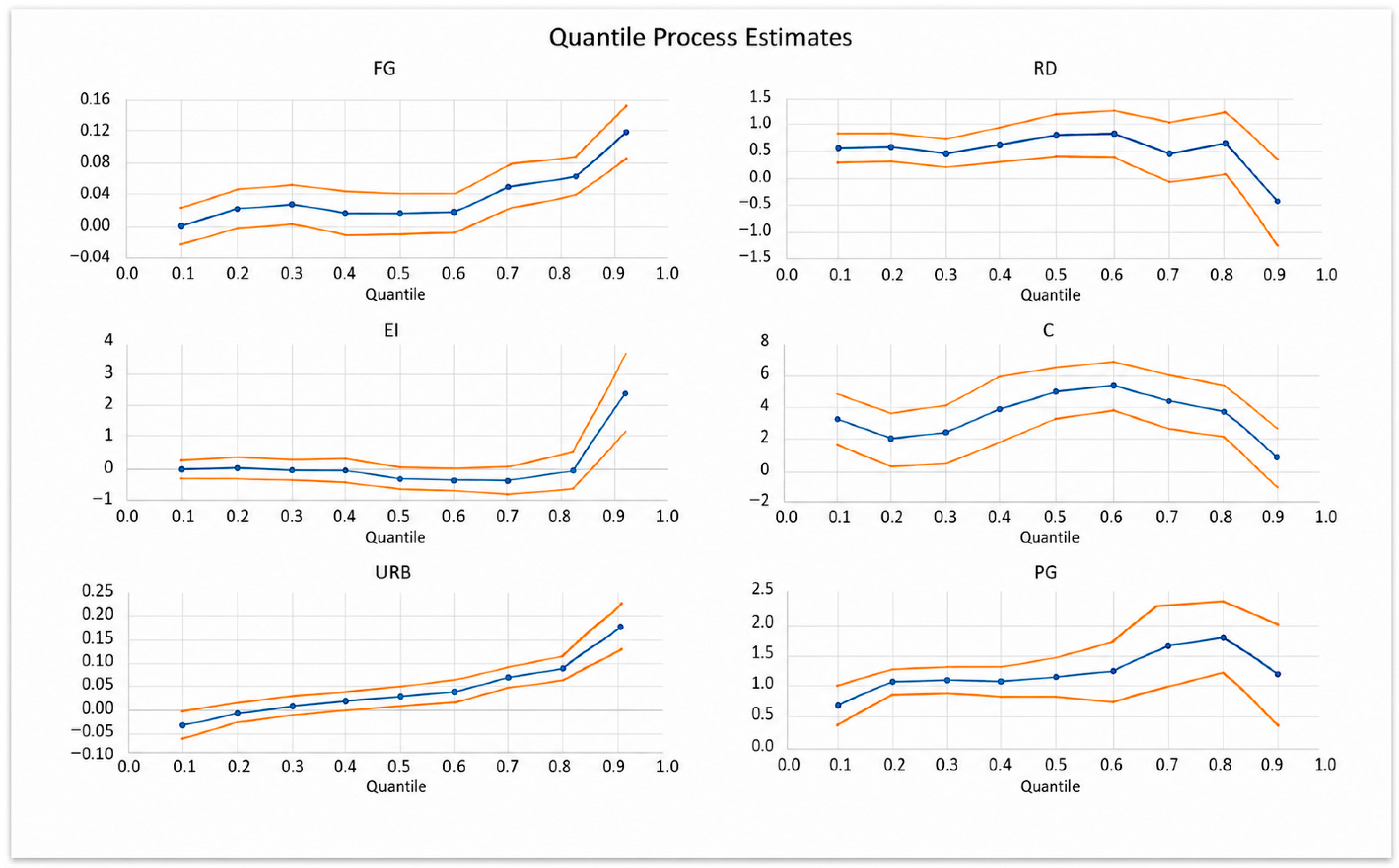
According to the Model 1 results reported in Table 9, the consistently positive and highly significant coefficients of financial globalization across all quantiles indicate that its expansionary effect on the ecological footprint is both structural and pervasive. Moreover, the steady increase in coefficient magnitudes from lower to upper quantiles suggests that the environmental costs of financial globalization become more pronounced at higher levels of ecological pressure. This finding is consistent with theoretical arguments suggesting that financial resource allocation toward environmentally inefficient sectors may accelerate environmental degradation. The research and development (RD) variable exhibits a strong and positive effect at lower quantiles; however, this effect weakens and loses statistical significance as the quantile level increases. This pattern indicates that the environmental impact of innovation activities is threshold-dependent. In particular, early-stage technological development may increase environmental pressure by expanding production and energy use, whereas beyond a certain level of development, this effect may diminish or potentially reverse. The findings related to environmental innovation (EI) point to a nonlinear and quantile-specific impact structure. While the effects are weak or statistically insignificant at lower and middle quantiles, they become positive and significant at higher quantiles. This suggests that environmental innovation operates as a complementary mechanism, particularly under conditions of high environmental pressure. In this context, the effectiveness of environmental innovation appears to be context-dependent and becomes more pronounced only after a certain level of environmental degradation is reached. The population growth (PG) variable exhibits a strong and positive effect at middle and upper quantiles, with increasing coefficient magnitudes. This finding indicates that the scale effect dominates the growth–environment nexus, particularly at higher levels of environmental degradation. Similarly, the urbanization (URB) variable is positive and statistically significant across all quantiles, with its impact strengthening as the quantile increases. This suggests that the environmental pressure associated with urbanization becomes more pronounced at higher levels of ecological footprint, likely through channels such as agglomeration effects and infrastructure-related pressures.
According to the Model 2 results reported in Table 9, the findings based on the CO2 dependent variable similarly confirm a strong heterogeneous structure. While the financial globalization variable exhibits a limited effect at lower quantiles, its positive coefficients become stronger and statistically significant toward the upper quantiles. This pattern indicates that the emission-increasing impact of financial systems becomes more pronounced in carbon-intensive economies. In other words, financial globalization may remain relatively neutral at lower emission levels, but it tends to exacerbate environmental costs as emission intensity increases.
The RD variable is positive and statistically significant across most quantiles, suggesting that technological progress may increase carbon emissions in the short to medium term through higher energy demand and expanded production scale. However, the weakening of this effect at the upper quantile indicates that the relationship is nonlinear, implying that at more advanced stages, technological transformation may evolve toward a more environmentally friendly structure. The environmental innovation (EI) variable exhibits negative and statistically significant coefficients, particularly at middle and upper quantiles, indicating that its emission-reducing effect becomes more effective under high-emission regimes. This finding supports the role of environmental innovation as a critical policy tool for carbon mitigation. Nevertheless, the observed change in direction at the highest quantile suggests that this relationship is not strictly linear and may vary depending on specific conditions. Finally, the increasing coefficients of population growth (PG) and urbanization (URB) toward the upper quantiles indicate that their impact on carbon emissions becomes stronger in high-emission economies. This finding suggests that scale and intensity effects associated with population growth and urbanization are more pronounced under higher emission regimes.
The graphical representation of the quantile regression estimates for Model 1 and Model 2 is presented in Figure 1 and Figure 2. An examination of Figure 1 and Figure 2 reveals that the effects of the explanatory variables vary systematically across quantiles and become statistically significant beyond certain threshold levels. These findings provide clear evidence of the presence of heterogeneous effects within the model.

5. Discussion

The finding that financial globalization exerts a consistently positive effect on ecological pressure, with stronger impacts at higher quantiles, aligns with recent studies documenting nonlinear and context-dependent environmental effects of financial integration (Shahbaz et al., 2017a; Destek et al., 2018; Le & Le, 2023). However, our results extend this literature by demonstrating that the scale effect dominates across the entire distribution, with no evidence of a technique effect offsetting environmental damage even at high quantiles. This suggests that financial globalization contributes directly to increasing ecological pressure, particularly in environments already characterized by high emissions and resource use intensity. More importantly, these findings indicate that the environmental consequences of financial globalization are not uniform, but become more pronounced under conditions of elevated ecological pressure.
This result contrasts with studies on advanced economies that report emission-reducing effects of financial openness (Tamazian & Rao, 2010). One possible explanation for this discrepancy lies in differences in institutional quality, regulatory stringency, and the period of analysis. While Tamazian and Rao (2010) focus on an earlier period (1992–2004), when financial globalization was still evolving, the extended sample used in this study (1992–2021) captures a more mature phase of financial integration in the EU. In this later stage, scale effects may have become more dominant than technique effects, leading to stronger environmental pressures. Overall, these findings indicate that financial globalization acts as a persistent driver of ecological pressure rather than a mitigating mechanism under current environmental and regulatory conditions.
The quantile-dependent behavior of general research and development (RD)—positive at lower quantiles but weakening at higher quantiles—provides empirical support for the coexistence of scale and technique effects (Grossman & Krueger, 1991). This pattern is consistent with the rebound effect literature, which shows that efficiency gains from technological progress may be partially or fully offset by increased consumption (Sorrell, 2009; Brockway et al., 2021). From an environmental perspective, this implies that early-stage technological development tends to intensify ecological pressure through increased production and energy demand, while its effectiveness in reducing environmental degradation remains limited.
The weakening of RD’s positive effect at higher quantiles may reflect a process of technological maturation, in which innovation gradually shifts from production-expanding activities toward efficiency-improving applications. Alternatively, it may indicate that high-emission countries have already exploited the most accessible efficiency gains, making further reductions in ecological pressure more difficult to achieve through general RD alone. These findings suggest that the environmental effects of technological innovation are inherently stage-dependent, and that general innovation alone may not be sufficient to achieve meaningful pollution abatement.
In contrast to general RD, the consistently negative impact of environmental innovation at higher quantiles provides strong support for the Porter Hypothesis (Porter & van der Linde, 1995). Unlike studies that treat innovation as a homogeneous process (e.g., Charfeddine & Kahia, 2019; Ahmed et al., 2019), the distinction between general RD and environmental innovation in this study reveals that only targeted innovation aimed at environmental objectives generates consistent reductions in ecological pressure. In this respect, the results directly address the central question of this study: green innovation matters for pollution abatement primarily under conditions of high environmental stress.
The absence of a significant effect of environmental innovation at lower quantiles suggests that, in low-emission regimes, the marginal impact of green innovation may be limited. This may be due to already relatively efficient environmental conditions or diminishing returns to additional efficiency improvements. Alternatively, this pattern may reflect measurement-related factors, such as the time lag between innovation activities (e.g., patents) and their actual impact on emissions and ecological outcomes. Despite this, the results are consistent with evidence from European patent data showing that environmentally oriented innovation has a stronger and more direct effect on emission reductions compared to general R&D (Popp, 2010; Johnstone et al., 2010; Aghion et al., 2016; Ding et al., 2024; Elhassan, 2025). These findings highlight that the environmental benefits of technological progress depend not only on the scale of innovation but also on its direction and composition.
The increasing impact of population growth and urbanization at higher quantiles further confirms that scale and intensity effects are particularly pronounced in high-emission contexts. This finding is consistent with the STIRPAT framework, which emphasizes the multiplicative effects of population, affluence, and technology on environmental impacts (York et al., 2003). The stronger effects observed at upper quantiles suggest that demographic expansion and urban concentration amplify ecological pressure in already degraded environmental regimes. In this context, population growth and urbanization contribute directly to increased ecological pressure through higher energy demand, infrastructure expansion, and intensified resource consumption.
Finally, the pronounced heterogeneity observed across quantiles confirms that mean-based estimation techniques (e.g., OLS, fixed effects, GMM) cannot fully capture the finance–environment and innovation–environment relationships. The results demonstrate that environmental impacts vary systematically across the conditional distribution of ecological pressure, reinforcing the need for distribution-sensitive empirical frameworks (Koenker & Bassett, 1978; Koenker, 2004). This study provides empirical evidence that such heterogeneity is not only present but also environmentally meaningful across different levels of ecological pressure. Consequently, approaches that account for nonlinearities and distributional dynamics offer a more comprehensive understanding of environmental processes and provide a more reliable basis for evaluating policy effectiveness.

6. Conclusions and Policy Implications

This study examines the effects of financial globalization and technological innovation on ecological pressure in EU countries over the period 1992–2021 using a PQR framework. The findings reveal strong heterogeneity across the distribution of environmental indicators, indicating that the impacts of financial and technological factors vary significantly depending on the level of ecological pressure.
The results show that financial globalization exerts a consistently positive and statistically significant effect on environmental degradation, particularly in higher quantiles, suggesting that its environmental costs become more pronounced in high-emission contexts. This finding supports the dominance of the scale effect, whereby financial integration expands economic activity, energy demand, and environmental pressure in the absence of adequate environmental regulation (Grossman & Krueger, 1991; Copeland & Taylor, 2004). Technological innovation exhibits a nonlinear and stage-dependent pattern. General research and development (RD) increases ecological pressure in lower and middle quantiles, while its effect weakens at higher quantiles, indicating a transition from scale to technique effects. In contrast, environmental innovation (EI) demonstrates a consistently beneficial impact, particularly at higher levels of ecological pressure, where it contributes to reducing emissions and ecological pressure, providing strong empirical support for the Porter Hypothesis (Porter & van der Linde, 1995).
Population growth and urbanization further reinforce scale and intensity dynamics, with stronger effects observed at higher quantiles. These findings collectively suggest that ecological pressure is shaped by multiple interacting factors and that their impacts differ substantially across environmental conditions. In this context, the results confirm that mean-based estimation approaches are insufficient to capture these dynamics, highlighting the importance of distribution-sensitive methods (Koenker & Bassett, 1978; Koenker, 2004). Green innovation matters for pollution abatement primarily under conditions of high environmental stress, whereas its impact remains limited at lower levels of ecological pressure.
From a broader perspective, the findings indicate that financial globalization may intensify ecological pressure in the absence of effective environmental and regulatory frameworks. The differing impacts of RD and environmental innovation further suggest that the environmental outcomes of technological progress depend critically on its direction and composition. In particular, environmentally oriented innovation appears to play a more consistent and policy-relevant role in mitigating ecological pressure compared to general technological advancement.
These findings carry important implications for environmental policy effectiveness. First, policies aimed at reducing environmental degradation should move beyond uniform approaches and instead account for different levels of ecological pressure. In high-pressure contexts, where environmental degradation is more severe, targeted support for environmental innovation becomes particularly critical for achieving meaningful pollution abatement. Second, financial globalization should be complemented by stronger environmental regulations and governance mechanisms to prevent the amplification of scale effects. Third, policy frameworks should prioritize the direction of innovation by incentivizing environmentally oriented technologies rather than relying solely on general R&D expansion. Finally, the increasing impact of urbanization and population dynamics highlights the need to integrate environmental considerations into long-term planning and resource management strategies. From a policy perspective, the findings are also relevant for broader sustainability objectives, particularly SDG 13 and SDG 9. The results suggest that environmental innovation should receive greater policy attention, especially under higher ecological pressure regimes. Moreover, the findings imply that the effectiveness of innovation policies depends not only on the level of R&D activity but also on whether innovation efforts are directed toward environmentally oriented technologies.
While the study provides robust evidence, several limitations should be acknowledged. First, the analysis covers the period 1992–2021 and does not include the post-2022 energy crisis, which may influence the generalizability of the findings under current energy market conditions. Second, although PQR captures distributional heterogeneity, it does not establish causality, and unobserved time-varying factors may affect the estimated relationships. Third, the use of patent-based indicators for environmental innovation may not fully capture informal or non-patented green innovation activities. Finally, institutional and governance-related variables such as government effectiveness, regulatory quality, and rule of law could not be fully incorporated due to data constraints. This constitutes an important limitation because institutional quality may influence both the effectiveness of environmental innovation and the environmental consequences of financial globalization. Countries with stronger regulatory frameworks may be better positioned to channel financial globalization toward cleaner technologies, whereas weaker institutions may amplify scale effects and environmental pressure. The absence of these variables may therefore limit the interpretation of cross-country heterogeneity within the EU sample. From a broader sustainability perspective, these findings are also closely aligned with the objectives of SDG 13 and SDG 9. The results suggest that environmentally oriented innovation and effective environmental governance may play a critical role in supporting low-carbon transition strategies and improving the environmental sustainability of economic development within the European Union.
Future research may extend the time horizon to include more recent data, incorporate institutional quality indicators, and explore comparative analyses across different regional blocks to assess the external validity of these findings. Further research may also examine the potential role of institutional quality in shaping the relationship between financial globalization and environmental outcomes.

Author Contributions

Conceptualization, A.K., F.Y. and İ.Y.; Methodology, F.Y. and U.Ü.; Formal analysis, U.Ü.; Investigation, A.K., F.Y., U.Ü., İ.Y. and Ö.Ç.; Resources, F.Y.; Data curation, A.K., F.Y., İ.Y. and Ö.Ç.; Writing—original draft, A.K., F.Y., U.Ü., İ.Y. and Ö.Ç.; Writing—review & editing, U.Ü. All authors have read and agreed to the published version of the manuscript.

Funding

This research received no external funding.

Institutional Review Board Statement

Not applicable.

Informed Consent Statement

Not applicable.

Data Availability Statement

The data used in this study are available from publicly accessible databases. Further details are available from the author upon reasonable request.

Conflicts of Interest

The author declares no conflicts of interest.

References

  1. Acheampong, A. O. (2019). Modelling for insight: Does financial development improve environmental quality? Energy Economics, 83, 156–179. [Google Scholar] [CrossRef]
  2. Acheampong, A. O., Boateng, E., Amponsah, M., & Dzator, J. (2021). Revisiting the economic growth–energy consumption nexus: Does globalization matter? Energy Economics, 102, 105472. [Google Scholar] [CrossRef]
  3. Aghion, P., Dechezleprêtre, A., Hémous, D., Martin, R., & Van Reenen, J. (2016). Carbon taxes, path dependency, and directed technical change: Evidence from the auto industry. Journal of Political Economy, 124(1), 1–51. [Google Scholar] [CrossRef]
  4. Ağan, B. (2024). Sustainable development through green transition in EU countries: New evidence from panel quantile regression. Journal of Environmental Management, 365, 121545. [Google Scholar] [CrossRef]
  5. Ahmed, Z., Wang, Z., Mahmood, F., Hafeez, M., & Ali, N. (2019). Does globalization increase the ecological footprint? Empirical evidence from Malaysia. Environmental Science and Pollution Research, 26(18), 18565–18582. [Google Scholar] [CrossRef]
  6. Al-Mulali, U., Solarin, S. A., & Ozturk, I. (2016). Investigating the presence of the environmental Kuznets curve (EKC) hypothesis in Kenya: An autoregressive distributed lag (ARDL) approach. Natural Hazards, 80(3), 1729–1747. [Google Scholar] [CrossRef]
  7. Antweiler, W., Copeland, B. R., & Taylor, M. S. (2001). Is free trade good for the environment? American Economic Review, 91(4), 877–908. [Google Scholar] [CrossRef]
  8. Balsalobre-Lorente, D., Driha, O. M., Bekun, F. V., & Adedoyin, F. F. (2021). The asymmetric impact of air transport on economic growth in Spain: Fresh evidence from the tourism-led growth hypothesis. Current Issues in Tourism, 24(4), 503–519. [Google Scholar] [CrossRef]
  9. Balsalobre-Lorente, D., Shahbaz, M., Roubaud, D., & Farhani, S. (2019). How economic growth, renewable electricity and natural resources contribute to CO2 emissions? Energy Policy, 113, 356–367. [Google Scholar] [CrossRef]
  10. Breusch, T. S., & Pagan, A. R. (1980). The Lagrange multiplier test and its applications to model specification. Review of Economic Studies, 47(1), 239–253. [Google Scholar] [CrossRef]
  11. Brockway, P. E., Sorrell, S., Semieniuk, G., Heun, M. K., & Court, V. (2021). Energy efficiency and economy-wide rebound effects: A review of the evidence and its implications. Renewable and Sustainable Energy Reviews, 141, 110781. [Google Scholar] [CrossRef]
  12. Charfeddine, L., & Kahia, M. (2019). Impact of renewable energy consumption and financial development on CO2 emissions and economic growth in the MENA region: A panel vector autoregressive (PVAR) analysis. Renewable Energy, 139, 198–213. [Google Scholar] [CrossRef]
  13. Claessens, S., & Feijen, E. (2007). Financial sector development and the millennium development goals. World bank working paper No. 89. World Bank. Available online: https://documents1.worldbank.org/curated/en/689301468175151075/pdf/386880Financia101OFFICIAL0USE0ONLY1.pdf (accessed on 29 May 2026).
  14. Cole, M. A., & Elliott, R. J. R. (2005). FDI and the capital intensity of “dirty” sectors: A missing piece of the pollution haven puzzle. Review of Development Economics, 9(4), 530–548. [Google Scholar] [CrossRef]
  15. Cole, M. A., Elliott, R. J. R., & Zhang, J. (2017). Foreign direct investment and the environment. Annual Review of Environment and Resources, 42, 465–487. [Google Scholar] [CrossRef]
  16. Copeland, B. R., & Taylor, M. S. (2004). Trade, growth, and the environment. Journal of Economic Literature, 42(1), 7–71. [Google Scholar] [CrossRef]
  17. Costantini, V., Crespi, F., & Palma, A. (2017). Characterizing the policy mix and its impact on eco-innovation: A patent analysis of energy-efficient technologies. Research Policy, 46(4), 799–819. [Google Scholar] [CrossRef]
  18. Curto, J. D., & Pinto, J. C. (2010). The corrected VIF (CVIF). Journal of Applied Statistics, 38(7), 1499. [Google Scholar] [CrossRef]
  19. Dean, J. M., Lovely, M. E., & Wang, H. (2009). Are foreign investors attracted to weak environmental regulations? Journal of Development Economics, 90(1), 1–13. [Google Scholar] [CrossRef]
  20. Dechezleprêtre, A., & Sato, M. (2017). The impacts of environmental regulations on competitiveness. Review of Environmental Economics and Policy, 11(2), 183–206. [Google Scholar] [CrossRef]
  21. Destek, M. A., & Manga, M. (2021). Technological innovation, financialization, and ecological footprint: Evidence from BEM economies. Environmental Science and Pollution Research, 28(17), 21991–22001. [Google Scholar] [CrossRef] [PubMed]
  22. Destek, M. A., & Okumus, I. (2019). Does pollution haven hypothesis hold in newly industrialized countries? Evidence from ecological footprint. Environmental Science and Pollution Research, 26(23), 23689–23695. [Google Scholar] [CrossRef]
  23. Destek, M. A., & Sarkodie, S. A. (2019). Investigation of environmental Kuznets curve for ecological footprint: The role of energy and financial development. Science of the Total Environment, 650, 2483–2489. [Google Scholar] [CrossRef] [PubMed]
  24. Destek, M. A., Ulucak, R., & Dogan, E. (2018). Analyzing the environmental Kuznets curve for the EU countries: The role of ecological footprint. Environmental Science and Pollution Research, 25(29), 29387–29396. [Google Scholar] [CrossRef]
  25. Ding, S., Li, R., Liu, Z., Li, Y., & Geng, S. (2024). Sustainable potential of the strategic emerging industries: Insights from technological innovation, economy, and ecology. Journal of Cleaner Production, 434, 140038. [Google Scholar] [CrossRef]
  26. Dreher, A., Gaston, N., & Martens, P. (2008). Measuring globalisation: Gauging its consequences. Springer. [Google Scholar] [CrossRef]
  27. Elhassan, T. (2025). Green technology innovation, green financing, and economic growth in G7 countries: Implications for environmental sustainability. Economics-Innovative and Economics Research Journal, 13(1), 69–91. [Google Scholar] [CrossRef]
  28. Eskeland, G. S., & Harrison, A. E. (2003). Moving to greener pastures? Multinationals and the pollution haven hypothesis. Journal of Development Economics, 70(1), 1–23. [Google Scholar] [CrossRef]
  29. Frankel, J. A., & Rose, A. K. (2005). Is trade good or bad for the environment? Sorting out the causality. Review of Economics and Statistics, 87(1), 85–91. [Google Scholar] [CrossRef]
  30. Grossman, G. M., & Krueger, A. B. (1991). Environmental impacts of a North American free trade agreement. NBER. [Google Scholar] [CrossRef]
  31. Grossman, G. M., & Krueger, A. B. (1995). Economic growth and the environment. The Quarterly Journal of Economics, 110(2), 353–377. [Google Scholar] [CrossRef]
  32. Gujarati, D. N. (2004). Basic econometrics (4th ed.). McGraw-Hill. [Google Scholar]
  33. Jaffe, A. B., Newell, R. G., & Stavins, R. N. (2003). Technological change and the environment. In Handbook of environmental economics (Vol. 1, pp. 461–516). Elsevier. [Google Scholar] [CrossRef]
  34. Johnstone, N., Haščič, I., & Popp, D. (2010). Renewable energy policies and technological innovation: Evidence based on patent counts. Environmental and Resource Economics, 45(1), 133–155. [Google Scholar] [CrossRef]
  35. Kao, C. (1999). Spurious regression and residual-based tests for cointegration in panel data. Journal of Econometrics, 90(1), 1–44. [Google Scholar] [CrossRef]
  36. Koenker, R. (2004). Quantile regression for longitudinal data. Journal of Multivariate Analysis, 91(1), 74–89. [Google Scholar] [CrossRef]
  37. Koenker, R., & Bassett, G., Jr. (1978). Regression quantiles. Econometrica: Journal of the Econometric Society, 46, 33–50. [Google Scholar] [CrossRef]
  38. Le, H. C., & Le, T. H. (2023). Effects of economic, social, and political globalization on environmental quality: International evidence. Environment, Development and Sustainability, 25(5), 4269–4299. [Google Scholar] [CrossRef]
  39. Mensah, I. A., Sun, M., Gao, C., Omari-Sasu, A. Y., Zhu, D., Ampimah, B. C., & Quarcoo, A. (2019). Analysis on the nexus of economic growth, fossil fuel energy consumption, CO2 emissions and oil price in Africa based on a PMG panel ARDL approach. Journal of Cleaner Production, 228, 161–174. [Google Scholar] [CrossRef]
  40. Nathaniel, S., & Khan, S. A. R. (2020). The nexus between urbanization, renewable energy, trade, and ecological footprint in ASEAN countries. Journal of Cleaner Production, 272, 122709. [Google Scholar] [CrossRef]
  41. Pedroni, P. (1999). Critical values for cointegration tests in heterogeneous panels with multiple regressors. Oxford Bulletin of Economics and Statistics, 61(S1), 653–670. [Google Scholar] [CrossRef]
  42. Pesaran, M. H. (2004). General diagnostic tests for cross-section dependence in panels. CESifo Working Paper No. 1229. SSRN. [Google Scholar] [CrossRef]
  43. Pesaran, M. H. (2007). A simple panel unit root test in the presence of cross-section dependence. Journal of Applied Econometrics, 22(2), 265–312. [Google Scholar] [CrossRef]
  44. Pesaran, M. H., Shin, Y., & Smith, R. J. (2001). Bounds testing approaches to the analysis of level relationships. Journal of Applied Econometrics, 16(3), 289–326. [Google Scholar] [CrossRef]
  45. Peters, G. P., Minx, J. C., Weber, C. L., & Edenhofer, O. (2011). Growth in emission transfers via international trade from 1990 to 2008. Proceedings of the National Academy of Sciences of the United States of America, 108(21), 8903–8908. [Google Scholar] [CrossRef] [PubMed]
  46. Popp, D. (2002). Induced innovation and energy prices. American Economic Review, 92(1), 160–180. [Google Scholar] [CrossRef]
  47. Popp, D. (2005). Lessons from patents: Using patents to measure technological change in environmental models. Ecological Economics, 54(2–3), 209–226. [Google Scholar] [CrossRef]
  48. Popp, D. (2010). Innovation and climate policy. Annual Review of Resource Economics, 2(1), 275–298. [Google Scholar] [CrossRef]
  49. Popp, D., Newell, R. G., & Jaffe, A. B. (2010). Energy, the environment, and technological change. Handbook of the Economics of Innovation, 2, 873–937. [Google Scholar] [CrossRef]
  50. Porter, M. E., & van der Linde, C. (1995). Toward a new conception of the environment–competitiveness relationship. Journal of Economic Perspectives, 9(4), 97–118. [Google Scholar] [CrossRef]
  51. Poumanyvong, P., & Kaneko, S. (2010). Does urbanization lead to less energy use and lower CO2 emissions? A cross-country analysis. Ecological Economics, 70(2), 434–444. [Google Scholar] [CrossRef]
  52. Sadorsky, P. (2010). The impact of financial development on energy consumption. Energy Policy, 38(5), 2528–2535. [Google Scholar] [CrossRef]
  53. Sadorsky, P. (2011). Financial development and energy consumption in Central and Eastern European frontier economies. Energy Policy, 39(2), 999–1006. [Google Scholar] [CrossRef]
  54. Sadorsky, P. (2012). Energy consumption, output and trade in South America. Energy Economics, 34(2), 476–488. [Google Scholar] [CrossRef]
  55. Shahbaz, M., Lean, H. H., & Shabbir, M. S. (2012). Environmental Kuznets curve hypothesis in Pakistan: Cointegration and Granger causality. Renewable and Sustainable Energy Reviews, 21, 257–264. [Google Scholar] [CrossRef]
  56. Shahbaz, M., Nasreen, S., Ahmed, K., & Hammoudeh, S. (2017a). Trade openness–carbon emissions nexus: The importance of turning points of trade openness for country panels. Energy Economics, 61, 221–232. [Google Scholar] [CrossRef]
  57. Shahbaz, M., Solarin, S. A., Hammoudeh, S., & Shahzad, S. J. H. (2017b). Bounds testing approach to analyzing the environment Kuznets curve hypothesis with structural beaks: The role of biomass energy consumption in the United States. Energy Economics, 68, 548–565. [Google Scholar] [CrossRef]
  58. Sorrell, S. (2009). Jevons’ Paradox revisited: The evidence for backfire from improved energy efficiency. Energy Policy, 37(4), 1456–1469. [Google Scholar] [CrossRef]
  59. Stern, D. I. (2004). The rise and fall of the environmental Kuznets curve. World Development, 32(8), 1419–1439. [Google Scholar] [CrossRef]
  60. Tamazian, A., Chousa, J. P., & Vadlamannati, K. C. (2009). Does higher economic and financial development lead to environmental degradation: Evidence from BRIC countries. Energy Policy, 37(1), 246–253. [Google Scholar] [CrossRef]
  61. Tamazian, A., & Rao, B. B. (2010). Do economic, financial and institutional developments matter? Energy Economics, 32(1), 137–145. [Google Scholar] [CrossRef]
  62. Truffer, B., & Coenen, L. (2012). Environmental innovation and sustainability transitions in regional studies. Regional Studies, 46(1), 1–21. [Google Scholar] [CrossRef]
  63. Ulucak, R. (2020). How do environmental technologies affect green growth? Evidence from BRICS economies. Science of the Total Environment, 712, 136504. [Google Scholar] [CrossRef]
  64. Ulucak, R., & Bilgili, F. (2018). A reinvestigation of EKC model by ecological footprint measurement for high, middle and low income countries. Journal of Cleaner Production, 188, 144–157. [Google Scholar] [CrossRef]
  65. Wackernagel, M., & Rees, W. (1996). Our ecological footprint: Reducing human impact on the earth. New Society Publishers. [Google Scholar]
  66. York, R., & McGee, J. A. (2017). Does renewable energy development decouple economic growth from CO2 emissions? Socius, 3, 2378023116689098. [Google Scholar] [CrossRef]
  67. York, R., Rosa, E. A., & Dietz, T. (2003). STIRPAT, IPAT and ImPACT: Analytic tools for unpacking the driving forces of environmental impacts. Ecological Economics, 46(3), 351–365. [Google Scholar] [CrossRef]
  68. Zaidi, S. A. H., Zafar, M. W., Shahbaz, M., & Hou, F. (2019). Dynamic linkages between globalization, financial development and carbon emissions: Evidence from Asia Pacific Economic Cooperation countries. Journal of Cleaner Production, 228, 533–543. [Google Scholar] [CrossRef]
Figure 1. Model 1: Panel quantile regression coefficients.
Economies 14 00223 g001
Figure 2. Model 2: Panel quantile regression coefficients.
Economies 14 00223 g002
Table 1. Previous studies on financial globalization and environmental quality.
StudyCountry/SampleMethodVariablesFindings
Shahbaz et al. (2017b)Developing economiesPanel analysisFinancial openness, industrial production, fossil fuel consumption, CO2 emissionsFinancial openness increases industrial production and fossil fuel use, leading to higher CO2 emissions.
Destek and Sarkodie (2019)Panel countriesEcological footprint analysisFinancial globalization, ecological footprint, natural resource use, biocapacityFinancial globalization increases ecological footprint and pressure on natural resources.
Cole et al. (2017)Countries with weak regulatory frameworksEmpirical analysisForeign capital inflows, pollution-intensive sectors, environmental regulationForeign capital may move toward pollution-intensive sectors where environmental regulation is weak.
Balsalobre-Lorente et al. (2019)Countries with weak/developing regulatory settingsEmpirical analysisForeign capital inflows, ecological degradation, regulationForeign capital inflows can amplify ecological degradation under weak regulation.
Sadorsky (2010)Emerging economiesPanel analysisFinancial deepening, credit expansion, energy demand, carbon footprintFinancial deepening increases demand for energy-intensive goods and raises carbon pressure.
Acheampong (2019)Panel countries/developing contextEmpirical analysisFinancial deepening, energy consumption, carbon footprintCredit expansion and financial deepening can increase household energy demand and carbon footprint.
Destek and Okumus (2019)Panel countriesEcological footprint analysisFinancial globalization, ecological footprintFinancial globalization intensifies pressure on natural resources and biocapacity.
Nathaniel and Khan (2020)Panel countriesEcological footprint analysisFinancial globalization, ecological footprint, natural resource useFinancial globalization increases ecological footprint through resource-use channels.
Tamazian and Rao (2010)Advanced/institutionally stronger economiesEmpirical analysisFinancial globalization, institutional quality, emissionsStrong institutions help financial globalization reduce emissions through cleaner technologies.
Tamazian et al. (2009)Panel countriesEmpirical panel analysisFinancial globalization, institutions, CO2 emissionsBetter institutional quality can shift the effect of financial globalization toward environmental improvement.
Sadorsky (2011)Panel countriesEmpirical analysisFinancial openness, renewable energy investment, energy consumptionFinancial openness may support renewable energy investment and reduce environmental pressure.
Shahbaz et al. (2012)Panel/country-level evidenceEmpirical analysisFinancial openness, renewable energy, environmental pressureFinancial openness can promote renewable energy use and mitigate environmental degradation.
Eskeland and Harrison (2003)Developing countries/foreign firmsEmpirical analysisFDI, cleaner production, technology transferFDI may support cleaner production through advanced technology transfer.
Dean et al. (2009)ChinaEmpirical FDI analysisFDI, environmental regulation, cleaner productionFDI can contribute to cleaner production when linked with stricter standards.
Al-Mulali et al. (2016)Panel countriesEcological footprint analysisFinancial globalization, resource-use efficiency, biocapacityFinancial globalization may improve resource-use efficiency and reduce biocapacity pressure.
Shahbaz et al. (2017a)Low-, middle-, and high-income countriesIncome-based panel analysisFinancial globalization, income level, environmental degradationFinancial globalization increases degradation in low- and middle-income countries but may reduce emissions in high-income countries.
Destek et al. (2018)Income-based country groupsPanel analysisFinancial globalization, income level, environmental outcomesThe environmental effect of financial globalization differs by income level and institutional context.
Le and Le (2023)Panel countriesNonlinear panel approachFinancial globalization, financial development thresholds, ecological footprint, CO2Financial globalization increases ecological pressure below development thresholds but reduces ecological footprint and CO2 after the threshold.
Table 2. Previous studies on innovation and environmental quality.
StudyCountry/SampleMethodVariablesFindings
Aghion et al. (2016)Mainly developed/European economiesEmpirical innovation analysisR&D, innovation, CO2 emissionsInnovation and R&D can reduce emissions by supporting cleaner technologies.
Mensah et al. (2019)Panel countriesPanel analysisTechnological innovation, energy efficiency, environmental qualityTechnological innovation improves environmental quality by reducing energy intensity.
Ulucak and Bilgili (2018)Income-based country groupsEcological footprint analysisTechnological innovation, ecological footprint, natural resource useTechnological innovation can reduce pressure on natural resources and biocapacity.
Destek and Manga (2021)Panel countriesEcological footprint analysisTechnological innovation, ecological footprint, biocapacityTechnological innovation may reduce ecological footprint by improving resource efficiency.
Sadorsky (2012)Emerging economiesEmpirical analysisR&D, renewable energy technology, energy consumptionR&D supports renewable energy technology and can reduce fossil-fuel dependence.
Balsalobre-Lorente et al. (2021)Panel countriesEmpirical analysisR&D, renewable energy technology, fossil fuel useR&D and renewable energy technologies help lower fossil-fuel dependence.
York and McGee (2017)Cross-country evidenceEmpirical analysisGeneral innovation, production cost, energy consumptionGeneral innovation may increase energy use through rebound and scale effects.
Acheampong (2019)Developing economiesEmpirical analysisTechnological progress, industrialization, fossil fuelsNon-green technological progress can increase emissions by accelerating fossil-fuel-based industrialization.
Ulucak (2020)Emerging economiesEmpirical analysisTechnological advancement, industrialization, fossil fuel systemsTechnological advancement may worsen pollution when it supports fossil-fuel-based production.
Charfeddine and Kahia (2019)MENA countriesEcological footprint analysisTechnological innovation, consumption, natural resourcesGeneral technological innovation may increase consumption and ecological pressure.
Ahmed et al. (2019)Panel countriesEcological footprint analysisTechnological innovation, ecological footprintThe environmental effect of technological innovation differs across countries and contexts.
Popp (2010)Cross-country/patent-based evidenceEnvironmental patent analysisEnvironmental innovation, green patents, CO2Green innovation is more effective than general R&D in reducing emissions.
Johnstone et al. (2010)OECD countriesEnvironmental patent analysisEnvironmental policy, green patents, renewable energy technologyEnvironmental policy stimulates green patents and supports renewable energy innovation.
Costantini et al. (2017)European countriesEmpirical innovation analysisEnvironmental innovation, policy framework, ecological pressureThe effect of environmental innovation depends on policy conditions and existing ecological pressure.
Truffer and Coenen (2012)Regional/sustainability innovation literatureSustainability transition analysisEnvironmental innovation, resource efficiency, biocapacityEnvironmental innovation supports resource efficiency and reduces pressure on biocapacity.
Dechezleprêtre and Sato (2017)Review/policy-oriented evidenceLiterature reviewEnvironmental regulation, green innovation, competitivenessEnvironmental regulation and green innovation can jointly support environmental and economic outcomes.
Table 3. Descriptive Statistics of the Variables.
VariablesEFCO2FGRDEIPGURB
Mean5.65338.224774.2741.38581.18200.212971.385
Median5.37077.526478.2251.17951.05160.242169.315
Std. Dev.2.18023.851014.1710.88080.60070.833312.446
Skewness2.16512.0355−0.94730.82811.94690.03710.2640
Kurtosis9.79519.59333.45322.72048.73225.06002.2477
Jar. Bera2126.3431966.507124.307992.393441572.7139.16327.664
Obs.786786786786786786786
Table 4. Spearman Correlation and VIF Values.
EFCO2FGRDEIPGURB
EF1.0000
CO20.67021.0000
FG0.61230.34371.000
RD0.46180.36790.61281.0000
EI−0.0574−0.0336−0.1580−0.08341.0000
PG0.44500.35480.46430.2455−0.06351.0000
URB0.55170.30790.53380.38880.07200.37681.0000
VIF 1.24401.15201.01331.244091.2551
Table 5. Diagnostic Tests.
TestsStat. ValueProb.
B-P LM Test1486.000.000 *
P-S LM Test (2004)42.830.000 *
B-C-S LM Test42.370.000 *
Pesaran (2004) CD Test13.660.000 *
Note: * indicates statistical significance at the 0.01 level.
Table 6. CADF-CIPS Unit Root Test Results.
VariablesLevel Values Zt-bar (Prob.)
EF−3.2232 (<0.01) *
CO2−2.2302 (<0.05) *
FG−3.2668 (<0.01) *
RD−3.0216 (<0.01) *
EI−2.9984 (<0.01) *
PG−2.8669 (<0.01) *
URB−3.6704 (<0.01) *
Note: * indicates statistical significance at the 0.01 level.
Table 7. Pedroni Cointegration Test Results.
Pedroni StatisticStatProb.
Model 1Panel v-Statistic0.38070.3517
Panel rho-Statistic−1.05000.1469
Panel PP-Statistic−9.81290.0000 *
Panel ADF-Statistic−4.73620.0000 *
Group rho-Statistic2.06120.9804
Group PP-Statistic−10.48270.0000 *
Group ADF-Statistic−3.75640.0001 *
Model 2Panel v-Statistic1.52020.0642
Panel rho-Statistic4.99261.0000
Panel PP-Statistic−3.73030.0001 *
Panel ADF-Statistic−6.80240.0000 *
Group rho-Statistic5.26911.0000
Group PP-Statistic−6.52330.0000 *
Group ADF-Statistic−0.65730.2555
Note: * indicates statistical significance at the 0.01 level.
Table 8. Kao Cointegration Test Results.
Kao Stat.t-Stat.Prob.
Model 1ADF−4.14020.0000 *
Model 2ADF−1.59200.0557 **
Note: * and ** indicate statistical significance at the 0.01, and 0.05 levels, respectively.
Table 9. Panel quantile regression results.
Model 1
EF
Lower Quantile Middle Quantile Upper Quantile
0.10.20.30.40.50.60.70.80.9
FG0.0304 *
(0.000)
0.0388 *
(0.000)
0.0431 *
(0.000)
0.0537 *
(0.000)
0.0599 *
(0.000)
0.0685 *
(0.000)
0.0755 *
(0.000)
0.0806 *
(0.000)
0.0996 *
(0.000)
RD0.5375 *
(0.000)
0.4953 *
(0.000)
0.4320 *
(0.000)
0.2522 *
(0.000)
0.1269 **
(0.073)
0.0351
(0.635)
−0.0322
(0.722)
−0.1595
(0.123)
−0.3740
(0.362)
EI0.1423 **
(0.047)
0.0750
(0.444)
0.1576
(0.112)
0.1393
(0.150)
0.0541
(0.598)
0.2397 *
(0.000)
0.3861 *
(0.000)
0.3183 *
(0.000)
0.4718
(0.373)
PG0.0245
(0.735)
0.1526
(0.247)
0.4028
(0.000)
0.3956
(0.000)
0.3954
(0.000)
0.3389 *
(0.000)
0.3532 *
(0.000)
0.4510 *
(0.000)
1.0205 *
(0.000)
URB0.0187 *
(0.002)
0.0214 *
(0.000)
0.0327 *
(0.000)
0.0366 *
(0.000)
0.0433 *
(0.000)
0.0466 *
(0.000)
0.0481 *
(0.000)
0.0535 *
(0.000)
0.0903 *
(0.000)
Model 2
CO2
Lower Quantile Middle Quantile Upper Quantile
0.10.20.30.40.50.60.70.80.9
FG0.0043
(0.722)
0.0283 *(0.009)0.0336 *
(0.007)
0.0221
(0.116)
0.0213 **
(0.083)
0.0241 **(0.049)0.0576 *
(0.000)
0.0692 *
(0.000)
0.1212 *
(0.000)
RD0.6563
(0.000)
0.6711 *
(0.000)
0.5579 *
(0.000)
0.7198 *
(0.000)
0.8726 *
(0.000)
0.8900 *
(0.000)
0.5408 **
(0.034)
0.7194 *
(0.002)
−0.3756
(0.360)
EI0.1542
(0.238)
−0.0045
(0.976)
−0.0397
(0.793)
−0.2303
(0.170)
−0.5106 *
(0.003)
−0.5154
(0.001)
−0.6546 *
(0.009)
−0.5044
(0.039)
1.1367
(0.045)
PG0.6730 *
(0.000)
1.0237 *
(0.000)
1.0513 *
(0.000)
1.0328 *
(0.000)
1.1090 *
(0.000)
1.1979 *
(0.000)
1.6155 *
(0.000)
1.7721 *
(0.000)
1.1647 *
(0.005)
URB−0.0186
(0.170)
0.0247 *
(0.004)
0.0287 *
(0.001)
0.0390 *
(0.000)
0.0473 *
(0.000)
0.0592 *
(0.000)
0.0734 *
(0.000)
0.0752
(0.000)
0.1768 *
(0.000)
* and ** indicate statistical significance at the 1% and 5% levels, respectively.
Disclaimer/Publisher’s Note: The statements, opinions and data contained in all publications are solely those of the individual author(s) and contributor(s) and not of MDPI and/or the editor(s). MDPI and/or the editor(s) disclaim responsibility for any injury to people or property resulting from any ideas, methods, instructions or products referred to in the content.