Article

Digital Infrastructure and Firm Labor Productivity: Evidence from the Implementation of China’s Labor Contract Law


1
School of Finance, Auckland University of Technology, Auckland 1010, New Zealand
2
School of Finance, Dongbei University of Finance and Economics, Dalian 116023, China
3
Shanghai Photonic View Technology Co., Ltd., Shanghai 200444, China
4
School of Finance, Zhejiang University of Finance and Economics, Hangzhou 310018, China
*
Author to whom correspondence should be addressed.
Economies 2026, 14(4), 140; https://doi.org/10.3390/economies14040140
Submission received: 14 February 2026 / Revised: 31 March 2026 / Accepted: 6 April 2026 / Published: 16 April 2026
(This article belongs to the Special Issue Macroeconomics of the Labour Market)

Abstract

This paper utilizes panel data of Chinese A-share listed manufacturing firms from 2006 to 2022 and measures regional digital infrastructure by the number of internet broadband access ports per capita. It systematically examines the moderating role of digital infrastructure in the relationship between labor protection policies and firms’ labor productivity. The findings are as follows: (1) Digital infrastructure exhibits a positive moderating effect on the relationship between the Labor Contract Law and firms’ labor productivity. This conclusion remains generally robust across multiple robustness tests and endogeneity treatments, and the direction of the results remains consistent after applying an instrumental variable approach to alleviate endogeneity concerns. (2) The digital transformation channel exhibits a negative relationship, indicating that compliance pressure associated with the institutional reform generates a short-term “crowding-out effect” on firms’ digital investment; the human capital channel shows a positive relationship, indicating that digital infrastructure strengthens the institutional effect by improving the level of urban human capital. (3) The moderating effect is particularly pronounced in cities with strong digital industry foundations, abundant fiscal resources, and firms that have not received government digital subsidies. These results provide empirical support for optimizing the supporting environment of labor protection policies, accelerating digital infrastructure development, and enhancing enterprise adaptability to institutional changes.

1. Introduction

Against the backdrop of the global pursuit of high-quality development and inclusive growth, how to reconcile labor market rigidity with improvements in firm productivity remains a central issue in labor and development economics (Autor et al., 2007; Besley & Burgess, 2004). While stricter labor protection is intended to safeguard workers’ rights, it is often viewed as a potential impediment to firm efficiency due to increased firing costs and reduced labor flexibility (Bertrand & Mullainathan, 2004; Botero et al., 2004). Meanwhile, major economies around the world have been actively investing in digital infrastructure—from Industry 4.0 initiatives to national digital strategies—regarding it as a key engine for reshaping competitive advantages and driving efficiency-enhancing transformations (Brynjolfsson & McAfee, 2014). The intersection of these two trends gives rise to an important and timely question: can exogenous technological change, particularly the expansion of digital infrastructure, alter the conventional impact of labor protection on firm performance? Addressing this issue deepens our understanding of the interplay between institutions and technological change and offers valuable insights for countries seeking to design balanced labor policies during the critical phase of digital transformation.
China provides an ideal quasi-natural experiment to examine this question. From an institutional standpoint, the enactment of the Labor Contract Law in 2008 (hereafter, the Labor Contract Law) signaled a shift toward stricter labor market regulation, significantly increasing labor rigidity faced by firms and offering a clear policy discontinuity to identify the effects of labor protection (Pan, 2016). From a technological perspective, alongside the continuous advancement of national digital strategies, digital infrastructures—such as broadband internet access and 5G base stations—has expanded rapidly across regions. However, substantial regional disparities persist, resulting in an uneven landscape of technological development. The historical overlap between a well-defined institutional shock and cross-regional heterogeneity in technological conditions provides a unique empirical setting to identify the interaction effects between technological change and institutional reforms.
Building on the dual heterogeneity in institutional settings and technological environments, we investigate the moderating role of regional digital infrastructure in shaping how labor protection policies affect firms’ labor productivity. In particular, we focus on three related issues. First, what is the effect of strengthened labor protection—captured by the implementation of the Labor Contract Law—on firm-level labor productivity? Second, does the level of regional digital infrastructure modify the relationship between labor protection and firm-level labor productivity? Third, if such a moderate effect exists, what are the underlying mechanisms and boundary conditions? By addressing these questions, this paper aims to uncover the patterns of co-evolution between technological change and institutional reform in shaping firm performance, and to offer a fresh perspective on the classic trade-off between efficiency and equity.
In this setting, this study treats the implementation of the Labor Contract Law of the People’s Republic of China in 2008 as a quasi-natural experiment. Using data on Chinese A-share listed manufacturing firms from 2006 to 2022, it constructs a triple-difference model and uses the number of internet broadband access ports per capita as a proxy for regional digital infrastructure. It systematically examines the moderating effect of regional digital infrastructure in the process through which labor protection policies affect firms’ labor productivity. The results show that regional digital infrastructure exhibits a positive moderating effect on the relationship between the Labor Contract Law and firms’ labor productivity. The core interaction term is significant at the 10% level, and this basic conclusion remains stable after multiple robustness checks and endogeneity treatments, although the statistical strength is relatively limited. Mechanism analysis indicates that this moderating effect operates primarily through two channels: promoting firms’ digital transformation and enhancing urban human capital. The effect is more evident for firms without government digital subsidies and in regions with stronger fiscal capacity and more developed digital industrial bases. These findings highlight the important boundary conditions imposed by institutional environments and regional development characteristics in the process of digital empowerment.
This study makes several key contributions. First, it reexamines the economic consequences of labor protection from a technological contextual perspective. Earlier studies have predominantly emphasized the direct influences of the Labor Contract Law on firm behavior, often overlooking the influence of external technological conditions (G. Li & Ma, 2025; X. Xu et al., 2023; J. Li et al., 2019). This study, for the first time, incorporates the two into a unified analytical framework to examine the moderating role of digital infrastructure as a contextual factor in the effects of labor protection institutions. It finds that the performance of the same institution may exhibit systematic differences under different technological environments, providing preliminary empirical evidence for understanding the technological dependence in the transformation of institutional incentives into efficiency—that is, under certain technological conditions, the dividends of institutional arrangements may be more effectively realized. Second, this paper opens the “black box” of how digital infrastructure exerts its moderating effect. We identify two key transmission channels—firms’ digital transformation and improvements in urban human capital—and provide systematic evidence on the underlying mechanisms. Our findings indicate that digital infrastructure strengthens the productivity effects associated with the Labor Contract Law by facilitating firm-level technological upgrading and optimizing the regional talent structure. This points to a dual pathway through which technology and institutions co-evolve: technology not only directly reshapes production processes but also indirectly strengthens firms’ adaptability to institutional changes by improving human capital. The comparative analysis of these two mechanisms reveals the dual pathways and complexity of the co-evolution between technology and institutions—technology not only exerts its effects by directly transforming production modes but also indirectly enhances firms’ institutional adaptability by reshaping the regional human capital structure; however, this process may be accompanied by short-term transition costs. Third, this paper identifies important sources of heterogeneity and delineates the boundary conditions of the moderating effect, offering broadly applicable policy implications. By analyzing variations in government support in the form of digital subsidies, fiscal capacity, and the strength of the digital industrial base, we show that the moderating effect tends to be stronger for firms without government subsidies, in fiscally stronger regions, and in cities with more developed digital industries. The findings highlight diminishing marginal returns to digital resources and carry important implications for emerging economies balancing labor protection and efficiency. In particular, the extent to which labor protection enhances productivity depends critically on the level of digital infrastructure development.
The remainder of the study proceeds as follows. Section 2 outlines the institutional background and literature review. Section 3 formulates theoretical analysis and research hypotheses. Section 4 describes the research methodology. Section 5 presents empirical results and analysis, and Section 6 concludes with research findings, policy implications, and limitations.

2. Institutional Background and Related Literature

2.1. Institutional Background

China’s Labor Contract Law (hereinafter referred to as the “Labor Contract Law”), formally enforced on 1 January 2008, represents a major institutional shift in labor market governance. The reform aims to strengthen worker protection, reduce imbalances between capital and labor, and foster more stable employment relationships. Compared with the earlier Labor Law, which mainly governed de facto labor relationships, the Labor Contract Law substantially raises firms’ compliance requirements and adjustment costs. Its key provisions can be summarized as follows. First, it mandates the widespread use of written labor contracts and increases penalties for non-compliance. Firms that fail to sign written contracts with employees are required to pay double wages, and if no contract is signed within one year, an open-ended contract is deemed to be established. This significantly limits firms’ ability to rely on informal employment arrangements to evade responsibilities. Second, it expands the applicability of open-ended contracts. While this provision enhances job security, it further restricts firms’ capacity to adapt their workforce to market fluctuations, thereby increasing labor rigidity. Third, it imposes stricter regulations on flexible employment arrangements, particularly labor dispatch. The law restricts labor dispatch to temporary, auxiliary, or substitute positions and enforces the principle of “equal pay for equal work,” curbing firms’ ability to use such arrangements to circumvent formal employment obligations. Fourth, it improves the system of severance compensation and dispute resolution. By clarifying compensation standards for contract termination and strengthening mechanisms such as collective bargaining and labor dispute mediation, the law enhances worker protection while increasing both the explicit costs and potential risks associated with dismissal decisions. Overall, the implementation of the Labor Contract Law constitutes an exogenous policy shock affecting firms’ employment decisions, largely driven by increased dismissal costs, restricting labor flexibility, and strengthening compliance obligations. The well-defined timing of the reform (2008), together with its heterogeneous impact across industries—particularly the stronger effects on labor-intensive firms—provides a key institutional basis for the difference-in-differences (DID) approach used to investigate the economic impacts of labor protection.

2.2. Related Literature

Following the implementation of the Labor Contract Law, a growing body of research has explored its economic implications. Research to date can be categorized into three major approaches: the economic effects of the policy, the underlying mechanisms through which it operates, and the moderating role of external environments.
First, the literature on the economic outcomes of the Labor Contract Law has paid particular attention to its impact on firm productivity. Some studies argue that, by strengthening requirements for formal labor contracts, standardizing employment procedures, and improving compensation mechanisms, the law enhances worker protection and organizational stability, thereby optimizing firms’ human capital allocation and ultimately increasing labor productivity (L. Zhao & Zhang, 2024; Huang & Gao, 2023; Guo et al., 2021). This line of research emphasizes that more stable employment relationships can improve employees’ sense of job security and organizational commitment, which translates into higher productivity. In contrast, another strand of research emphasizes the cost side of labor protection. By increasing labor costs and reducing employment flexibility, the Labor Contract Law may impose constraints on firms’ adjustment capacity, particularly for labor-intensive firms (Tian & Wu, 2021; Cui et al., 2018). This perspective highlights the presence of considerable industry heterogeneity in the economic effects of institutional reform: for firms that rely heavily on labor, increased rigidity may lead to a decline in productivity. Overall, the existing literature indicates that the impact of the Labor Contract Law on firm performance is not unidirectional but rather complex and heterogeneous, laying the groundwork for further exploration of its boundary conditions and moderating factors.
Second, the literature on the underlying mechanisms has identified multiple channels through which the Labor Contract Law influences firm behavior. One line of inquiry highlights the incentive effects of strengthened labor protection. By improving employment stability, the law encourages greater worker effort and skill investment, thereby enhancing firm performance (X. Xu et al., 2023). Within this framework, the formalization of labor contracts and the design of severance compensation mechanisms are viewed as institutional arrangements that incentivize employee effort and strengthen organizational commitment. Another strand of the literature emphasizes the cost-related consequences of labor protection. In particular, higher dismissal costs and reduced labor flexibility constrain firms’ ability to adjust their workforce in response to changing market conditions (Wiese et al., 2025). This rigidity may become especially constraining during economic downturns or periods of heightened uncertainty, when firms face greater difficulty in adjusting their labor inputs efficiently. Moreover, some studies extend the analysis by examining indirect effects on firm behavior, such as R&D investment and capital–labor substitution. These studies suggest that the Labor Contract Law may induce firms to adjust their production processes and business models, thereby affecting overall efficiency (G. Liu et al., 2024; He et al., 2020; Francis et al., 2018). The literature suggests that labor protection affects not only labor market outcomes but also firm behavior, with implications for capital allocation and technological innovation.
Finally, as the digital economy has expanded, research has increasingly focused on how external conditions shape firm outcomes, particularly how digital infrastructure moderates the effects of the Labor Contract Law (Hua & Zhang, 2025; Gong et al., 2025). Existing studies suggest that digital infrastructure development is crucial for determining how effective labor protection policies are. Digital technologies can enhance information processing efficiency, reduce coordination costs, and alleviate internal information asymmetries, thereby enabling firms to maintain a relatively high operational efficiency under institutional constraints (James et al., 2024). Well-developed digital infrastructure also provides firms with advanced human resource management (HRM) systems, allowing them to achieve more precise workforce allocation, compensation design, and performance evaluation under the rigid constraints imposed by the Labor Contract Law, thus mitigating the negative impact of institutional costs on productivity (Bansal et al., 2023). In addition, the diffusion of digital infrastructure accelerates information flows both within and across firms and improves decision-making efficiency, helping firms remain agile in adapting to institutional changes, maximizing policy benefits while minimizing efficiency losses.
In summary, the existing literature has generated substantial insights into how the Labor Contract Law affects firms’ labor productivity, particularly with respect to mechanisms such as employment stability, labor cost structures, and firm behavioral adjustments. However, although some studies have begun to consider the role of external environments, little systematic evidence exists regarding the moderating role of digital infrastructure in the effectiveness of labor protection policies. To address this gap, this paper incorporates regional digital development into the analytical framework and systematically examines its moderating effect on firms’ labor productivity in the context of the Labor Contract Law, as well as the underlying mechanisms. In doing so, the paper provides new empirical insights into the interaction between institutional change and technological development, contributing to the broader literature on labor protection and economic performance.

3. Theoretical Framework and Hypotheses

In modern economies, firm labor productivity is shaped not only by internal management practices and technological innovation but also by changes in the external institutional and technological environment. According to the theory of institutional complementarity, different institutional arrangements may exhibit synergistic effects, whereby the technological environment can reinforce the positive incentives of formal institutions and enhance their overall effectiveness (R. Wu & Wang, 2024; Donbesuur et al., 2020; Landini & Pagano, 2013). This theoretical framework provides important insights into the interaction between the Labor Contract Law and digital infrastructure. As an institutional reform aimed at strengthening worker protection, the implementation of the Labor Contract Law not only improves employment formalization but also imposes stronger constraints on firms’ labor practices—manifested in higher firing costs, reduced labor flexibility, and increased complexity of compliance management. The impact of such an institutional shock on firms’ labor productivity is not unidirectional; rather, it critically depends on the technological environment in which firms operate and their capacity to adapt. In this context, digital infrastructure development provides essential technological support for firms to improve efficiency under heightened institutional constraints.
Digital infrastructure may shape the effects of the Labor Contract Law through two contrasting channels. On the one hand, digital infrastructure may positively moderate the effects of the policy. This expectation is grounded in the following mechanisms. First, digital infrastructure can mitigate the efficiency losses associated with institutional constraints, thereby acting as a “buffer” (Hua & Zhang, 2025; Acemoglu & Restrepo, 2022; Autor et al., 2003). Well-developed digital infrastructure—particularly the widespread adoption of enterprise resource planning (ERP) and human resource management (HRM) systems—can substantially reduce the institutional transaction costs associated with workforce adjustment, contract administration, and payroll management (Bansal et al., 2023). Through automated contract management, intelligent workforce scheduling, and data-driven performance evaluation, firms can comply with labor protection regulations while minimizing the negative impact of increased labor rigidity on productivity. Second, digital infrastructure may amplify the efficiency-enhancing potential of institutional reforms, functioning as an “enabler” (Acemoglu & Restrepo, 2018, 2022; Brynjolfsson et al., 2021). While the Labor Contract Law raises labor costs, it also incentivizes firms to shift away from labor-intensive, low-cost expansion toward a more intensive growth model driven by technological upgrading and human capital accumulation. In this context, advanced digital infrastructure supports this transformation. On the one hand, it facilitates the automation of production processes and the intelligence of managerial decision-making, enabling firms to achieve higher output efficiency with fewer labor inputs. On the other hand, it helps firms attract and retain highly skilled workers, optimize their human capital structure, and better meet the higher labor quality requirements imposed by institutional changes.
Conversely, digital infrastructure may weaken the effects of the Labor Contract Law. Several theoretical mechanisms support this possibility. First, digital infrastructure may accelerate capital–labor substitution, thereby intensifying the adjustment costs associated with institutional shocks (Leduc & Liu, 2024; Autor et al., 2003). After the enactment of the Labor Contract Law, firms experienced higher firing costs. Where digital infrastructure is more developed, firms can more effectively adopt automation technologies; however, elevated dismissal costs make labor adjustments more expensive and difficult, potentially exacerbating the tension between labor rigidity and technological substitution. Second, organizational frictions and learning costs associated with digital transformation may offset efficiency gains from institutional adaptation in the short run. Firms simultaneously face pressures from both institutional compliance and technological upgrading, which may lead to a “double adjustment dilemma,” where hasty transformation results in managerial inefficiencies and declining performance (Kane et al., 2021; Venkatesh et al., 2003). Third, digital infrastructure may contribute to widening skill disparities across workers. Under the strengthened employment stability imposed by the Labor Contract Law, firms may increasingly favor high-skilled labor, potentially leading to structural mismatches in the labor market and, in turn, constraining overall productivity.
Taken together, although a negative moderating effect cannot be ruled out theoretically, digital infrastructure is expected to reinforce the relationship between labor protection and firm performance. This expectation is grounded in the rapid development of China’s digital economy and the increasingly mature application of digital infrastructure in reducing costs, improving efficiency, and optimizing management practices. With the growing awareness of digitalization among firms and the widespread adoption of digital technologies in recent years, digital infrastructure is increasingly capable of helping firms transform institutional pressures into incentives for upgrading, thereby achieving higher labor productivity.
This analysis leads to the following hypothesis:
H1. 
Higher levels of digital infrastructure in a region tend to amplify the positive effect of the Labor Contract Law on firm-level labor productivity.
Having established the overall moderating effect of digital infrastructure, we next explore the specific channels through which this effect operates.
From the perspective of technology adoption, digital infrastructure lowers the barriers to firms’ transformation. The technology adoption theory suggests that firms’ decisions to adopt new technologies depend critically on the quality of external infrastructure (Arbelo et al., 2022). Digital infrastructure, including broadband networks, data centers, and industrial internet platforms, facilitates firms’ transformation (Blaschke et al., 2016). When regional digital infrastructure is well developed, the marginal cost of accessing digital technology services declines significantly, and the technical obstacles to the implementation of tools including enterprise resource planning (ERP) and human resource management (HRM), and manufacturing execution systems (MES) are reduced. This creates the necessary conditions for firms to initiate and deepen digital transformation. From the perspective of factor substitution, the institutional pressure induced by the Labor Contract Law incentivizes firms to substitute capital for labor through digital transformation. The implementation of the law raises labor costs and strengthens labor rigidity, thereby increasing the relative cost of maintaining labor-intensive production models. Under such conditions, firms have stronger incentives to adopt technologies that substitute for labor. When external digital infrastructure is more advanced, the feasibility and cost-effectiveness of such substitution are substantially enhanced. Firms can introduce automation technologies and deploy intelligent management systems at lower cost, allowing them to comply with labor protection requirements while reducing reliance on labor inputs. From the perspective of organizational change, digital transformation improves firms’ operational efficiency under institutional constraints (Mayor Ravines et al., 2026; Mukhopadhyay et al., 2025). Digital transformation is not merely the adoption of technological tools but also entails profound changes in organizational processes. By implementing digital systems such as HRM, firms can achieve more precise and intelligent scheduling, attendance management, and performance evaluation, thereby minimizing compliance costs and improving managerial efficiency under the rigid constraints imposed by the Labor Contract Law (Bansal et al., 2023). Automation and intelligent decision-making enable firms to produce more output with the same level of labor input.
In summary, under the “technology-enhancing effect,” digital infrastructure operates through a chain of “external enablement–internal transformation–efficiency improvement.” Well-developed regional digital infrastructure lowers the barriers to firms’ transformation, while the institutional pressure induced by the Labor Contract Law provides incentives for such transformation. Ultimately, the efficiency gains brought about by digital transformation enhance firms’ labor productivity under institutional constraints.
The above discussion suggests the following hypothesis:
H2a. 
Digital infrastructure strengthens the productivity-enhancing effect of the Labor Contract Law through firms’ digital transformation.
In contrast, digital transformation itself requires sustained resource investment, and its benefits are typically realized in a staged and lagged manner. In the early phase of strengthened labor protection, firms may face a trade-off between institutional compliance and digital transformation. From the perspective of the resource-based view, firms operate under limited resource endowments and must allocate resources across competing objectives (Rahmandad, 2012). To comply with the requirements of the Labor Contract Law, firms need to invest in formalizing labor contract management, improving employee benefits, standardizing employment practices, and strengthening human resource management, all of which constitute “institutional costs” of operation (Autor et al., 2007). When institutional pressure intensifies abruptly, firms are more likely to prioritize compliance-related expenditures to avoid legal risks and potential litigation costs, rather than forward-looking technological investments. From the perspective of transformation costs, digital transformation is characterized by “front-loaded investment and delayed returns.” Firms not only incur explicit costs such as software procurement and hardware deployment, but also must devote substantial managerial attention and organizational resources to process reengineering, employee training, and organizational adaptation (Brynjolfsson et al., 2021). These transformation costs are difficult to recover in the short run, whereas the costs associated with institutional compliance are immediate and binding. Under resource constraints, compliance requirements may crowd out resources—both financial and managerial—that would otherwise be allocated to digital transformation, giving rise to a “crowding-out effect” of institutions on technology. Among small and medium-sized enterprises and labor-intensive firms with relatively limited resource endowments, this effect is more salient. In such cases, institutional pressures and the costs of digital transformation may interact, resulting in a short-term reduction in digital investment. When such a crowding-out effect dominates, even firms located in regions with more advanced digital infrastructure may not fully capture the benefits of technological opportunities and may experience a temporary slowdown in digitalization.
The above discussion suggests the following hypothesis:
H2b. 
Under institutional compliance pressure, which crowds out firms’ resources, the moderating effect of digital infrastructure operating through digital transformation is weakened and may even become negative.
In addition to promoting firms’ digital transformation, digital infrastructure may also indirectly strengthen the institutional effects of the Labor Contract Law by improving the regional supply of human capital. According to urban economics theory, high-skilled workers consider not only wage levels but also urban amenities and public services when making location decisions (Buch et al., 2017). Well-developed digital infrastructure—including high-speed broadband, smart city services, and digital healthcare and education—significantly enhances urban livability and economic opportunities, thereby becoming an important factor in attracting skilled labor. Existing studies show that digital infrastructure development facilitates labor inflows, particularly among high-skilled workers (Zou et al., 2026; S. Zhang et al., 2024). When regional digital infrastructure is more advanced, cities are better able to attract highly educated and skilled individuals, providing firms with a higher-quality labor supply. Following the implementation of the Labor Contract Law, firms tend to adopt more cautious hiring strategies and prefer workers who can quickly adapt to technological changes, thereby reducing employment risks and adjustment costs. At the same time, the diffusion of digital infrastructure not only attracts skilled labor inflows but also enhances the digital skills of the local workforce through channels such as online education and remote training. This “dual improvement” in human capital—external talent inflows and internal skill upgrading—enables the labor market to better match firms’ skill requirements under institutional constraints, reducing search, training, and matching costs, and ultimately improving overall labor productivity. Human capital theory emphasizes that skilled labor is a key determinant of firms’ marginal productivity (Herkenhoff et al., 2024; Mincer, 1958). Under the Labor Contract Law, which strengthens employment stability and raises adjustment costs, firms place greater emphasis on workers’ adaptability and learning capacity. Highly skilled workers are better able to adopt new technologies, adjust to evolving processes, and contribute to innovation under institutional change, thereby helping firms comply with regulations more efficiently. When digital infrastructure is well developed and human capital levels are high, firms can maintain organizational flexibility and operational efficiency under institutional constraints, leading to higher labor productivity.
In summary, digital infrastructure operates through a mechanism of “talent attraction–matching optimization–adaptation enhancement.” Well-developed regional digital infrastructure attracts highly skilled workers, improves the skill composition of the labor market, and enhances firms’ ability to adapt to institutional constraints. As a result, firms achieve higher labor productivity under the Labor Contract Law.
The above discussion suggests the following hypothesis:
H3. 
Digital infrastructure amplifies the productivity effects of the Labor Contract Law by facilitating the accumulation of regional human capital.

4. Research Methodology

4.1. Data and Sample Selection

This research uses panel data on Chinese A-share listed manufacturing firms covering the period 2006–2022. The implementation of the Labor Contract Law in 2008 is exploited as an exogenous policy shock, and its impact on firm-level labor productivity is identified using a triple-differences (DDD) framework.
The sample period starts in 2006, when data on urban internet access ports—used to proxy regional digital infrastructure—became publicly available from that year onward. The years 2006–2007 serve as the pre-policy period, allowing us to capture firms’ adjustment trends prior to the law’s implementation and to better control for potential confounding shocks. The sample ends in 2022, which not only reflects the long-term effects of the policy but also captures the recent acceleration in digital infrastructure development. This time span thus provides both credible institutional identification and a relevant technological context.
In constructing the sample, we apply several screening procedures. First, we exclude ST, *ST, and delisted firms, thereby eliminating distortions associated with abnormal financial situations. Second, firms with large missing values in key financial and control variables are excluded. To mitigate extreme value effects, all continuous variables are winsorized at the 1% two-tailed level. The final dataset consists of 8802 firm-level unbalanced panel observations.
Financial data at the firm level are sourced from the CSMAR database, with regional data primarily coming from the China City Statistical Yearbook.

4.2. Variable Definitions

4.2.1. Dependent Variable: Firm Labor Productivity (LProductivity)

Traditional studies typically measure labor productivity using output per worker (e.g., the ratio of operating revenue to the number of employees). While this approach is intuitive and convenient, it suffers from two main limitations. First, it fails to disentangle the contribution of capital inputs from labor output, potentially leading to an overestimation of labor productivity. Second, as a single-factor and static indicator, it cannot capture firms’ relative positions on the industry production frontier or their dynamic evolution over time. To address these limitations, this study measures labor productivity by combining the super-efficiency EBM model with the Global Malmquist index. Within this framework, firms are considered decision-making units with multiple inputs, and a production frontier is used to evaluate both the allocation and utilization efficiency of labor. It therefore provides a more comprehensive assessment of labor productivity and its intertemporal dynamics. The EBM model is chosen for the following reasons. Traditional radial models (CCR and BCC) assume proportional input contraction and thus overlook slack variables, whereas non-radial models such as the slack-based measure (SBM) may fail to preserve the original proportional relationships among inputs. The EBM model proposed by Tone and Tsutsui (2010) integrates radial and non-radial measures within a unified framework by introducing a parameter that captures both proportional and non-proportional inefficiencies. As such, it preserves the proportional structure of inputs while identifying inefficiencies in factor allocation, making it particularly suitable for evaluating the production efficiency of manufacturing firms. The estimation procedure is described as follows:
Based on the input–output indicator system, we first construct an input-oriented super-efficiency EBM model to estimate firms’ static labor efficiency in each year. We assume that there are n decision-making units, each using m inputs x R + m to produce s outputs y R + s . The input-oriented super-efficiency EBM model is defined as:
γ * = m i n θ , λ , s θ ε x i = 1 m ω i s i x i k
s . t .   j = 1 , j k n x i j λ j > θ x i k s i ,       i = 1 , , m j = 1 , j k n y r j λ j > y r k ,   r = 1 , , s λ j 0 ,   s i 0
In this model, θ denotes the radial efficiency score, with a value range of θ 1 (under the super-efficiency framework, efficient decision-making units may have θ > 1). The term s i represents the input slack variable, capturing non-radial input redundancy. The parameter ε x is a core coefficient, taking values in the range [0, 1], and serves to measure the relative significance of the non-radial component in efficiency assessment. Its value is endogenously determined from the data through principal component analysis of the affinity matrix. The weights w i denote the relative importance of each input and satisfy w i = 1 ; they are likewise calculated based on the affinity index. When ε x = 0 , the EBM model reduces to a radial model; when θ = 1 and ε x = 1 , the EBM model reduces to the slack-based measure (SBM) model. Therefore, by adjusting the parameter ε, the EBM model unifies radial and non-radial efficiency measures into one integrated framework. This study adopts an input-oriented specification, as firms are more likely to adjust the allocation of labor inputs to improve efficiency given a target level of output under labor protection policies. Under the assumption of variable returns to scale (VRS), the model is specified to separate pure technical efficiency from scale efficiency.
Static efficiency measures capture firm performance at a specific point in time but fail to reflect the dynamic evolution of labor productivity. To address this limitation, this paper further constructs a Global Malmquist Index based on global technology to dynamically examine changes in labor productivity. Unlike the traditional Malmquist index, which compares production frontiers between adjacent periods, the Global Malmquist index is constructed using the pooled input–output data across all periods to form a unified production frontier, defined as P G x = P 1 x P 2 x P T x . This method, proposed by Pastor and Lovell (2005), possesses desirable properties such as circularity and transitivity, thereby avoiding potential infeasibility issues in linear programming. Combined with the efficiency scores obtained from the super-efficiency EBM model, the Global Malmquist index is defined as follows:
G M L x t + 1 , y t + 1 , x t , y t = E G x t + 1 , y t + 1 E G x t , y t
Here, E G ( x t , y t ) denotes the efficiency score of the decision-making unit x t y t in period t , relative to the global production frontier, which is obtained from the super-efficiency EBM model. The Global Malmquist index (GML) measures the change in labor productivity from period t to t + 1 . Specifically, G M L > 1 indicates an improvement in labor productivity, G M L < 1 indicates a decline, and G M L = 1 indicates no change.
Following Färe et al. (1994), the Global Malmquist (GML) index can be further decomposed into the efficiency change (EC) component and the technical change (TC) component:
G M L = E C × T C
Here, the efficiency change index (EC) measures the extent to which firms catch up to the contemporaneous production frontier, reflecting improvements in labor management efficiency and resource allocation. The technical change (TC) component reflects changes in the production frontier itself, indicating the role of technological progress in driving labor productivity.

4.2.2. Key Independent Variable: Implementation of the Labor Contract Law (DID)

To identify the institutional shock induced by the Labor Contract Law, this paper follows He et al. (2020) and constructs the treatment indicator (Treat) and the time indicator (Post) required for the difference-in-differences (DID) framework. The variable Post equals one for the years 2008 and thereafter, and zero otherwise. The treatment indicator identifies whether a firm operates in a labor-intensive industry. The identification procedure is as follows. Step 1: Preliminary screening based on industry classification. Based on the Industrial Classification for National Economic Activities (Standardization Administration of China, 2017) released by the National Bureau of Statistics of China, we preliminarily identify labor-intensive manufacturing industries, including: agricultural and sideline food processing (C13), food manufacturing (C14), textile manufacturing (C17), textile and apparel (C18), leather, fur, feather, and related products (C19), wood processing and bamboo, rattan, palm, and straw products (C20), furniture manufacturing (C21), paper and paper products (C22), printing and reproduction of recording media (C23), cultural, educational, sports, and entertainment goods manufacturing (C24), rubber and plastic products (C29), non-metallic mineral products (C30), and fabricated metal products (C33). Step 2: Quantitative identification based on financial indicators. To mitigate potential subjectivity in industry-based classification, we further adopt an objective financial indicator. Consistent with standard practice in prior literature, we define capital intensity as the ratio of net fixed assets to the year-end number of employees. A lower value of this indicator implies a greater reliance on labor input and thus a higher degree of labor intensity. Using the median value of this ratio for all manufacturing firms in 2007 (the year prior to policy implementation) as the cutoff, firms below the median are classified as labor-intensive. Step 3: Case-by-case identification based on annual reports (manual verification). For firms whose classification results based on industry and financial indicators are inconsistent, this study conducts case-by-case identification through manual examination of firms’ annual reports to ensure the accuracy of treatment group assignment. The specific criteria are as follows: Criterion 1: Description of main business. By reviewing sections such as “Main Business Analysis” and “Discussion of Business Operations” in annual reports, firms are classified as labor-intensive if the descriptions explicitly mention keywords such as “labor-intensive production,” “extensive use of production workers,” or “primarily manual operations.” Criterion 2: Employee composition. By examining the “Employee Information” section, firms are classified as labor-intensive if the proportion of production workers in total employment is significantly higher than that of other firms in the same region and year (i.e., exceeding the sample mean by more than one standard deviation). Criterion 3: Production mode. By reviewing descriptions of production processes, firms are classified as labor-intensive if it is explicitly stated that “core production processes have not undergone large-scale automation” or that “production still mainly relies on manual operations.” For firms that belong to the preliminary industry-based screening list but have above-median fixed assets per employee, they are regarded as capital-intensive firms within the industry and assigned to the control group, without further case-by-case verification. For firms that are not included in the preliminary industry list but have below-median fixed assets per employee, manual verification is conducted based on the three criteria above: if at least two criteria are satisfied, the firm is included in the treatment group; if only one or none of the criteria is satisfied, the firm is excluded.
The interaction term D I D = T r e a t × P o s t reflects the policy shock arising from the enactment of the Labor Contract Law for labor-intensive firms.

4.2.3. Moderating Variable: Regional Digital Infrastructure (Pinform)

To capture regional digital infrastructure development, this paper follows T. Zhao et al. (2020) and uses the number of broadband internet access ports per capita as a proxy for this measure. Specifically, this variable is constructed as the number of broadband access ports (in ten thousand units) divided by the year-end resident population (in ten thousand persons), and is denoted as Pinform. This indicator reflects the per capita availability of information infrastructure and effectively captures the capacity of urban digital network services and the density of information technology coverage. The variable serves as an indicator of the regional digital external environment.

4.2.4. Control Variables

Following prior studies (R. Xu et al., 2025; Faleye et al., 2006), We control for observable characteristics to mitigate omitted variable bias. These controls cover firm financial characteristics, corporate governance features, and fixed effects specifications.
First, to account for firms’ operating and financial conditions that may directly affect labor productivity, we control for return on assets (ROA), leverage ratio (Lev), total equity (Equity), return on invested capital (ROIC), operating profit (Profit), and firm age (Age).
Second, to address the potential influence of corporate governance structure on firm efficiency, we further include variables capturing the largest shareholder’s ownership (Top1), executive compensation (Pay), board size (BoardSize), the proportion of independent directors (IndepRatio), and the number of employees (Staff).
Finally, to control unobservable macroeconomic fluctuations, industry-specific trends, and regional development differences, firm and year fixed effects are incorporated into the baseline specification. We further incorporate industry-by-year and city-by-year fixed effects to capture industry-specific dynamics, regional policy heterogeneity, and time-varying local economic conditions. These fixed effects serve to disentangle the causal effects of the Labor Contract Law and digital infrastructure from confounding shocks, with detailed variable definitions provided in Table 1.

4.3. Model Specification

To assess how the Labor Contract Law affects firms’ labor productivity and whether this effect varies with the degree of regional digital infrastructure development, this paper follows the approaches of Qian and Shi (2024) and Autor et al. (2007). Building on a difference-in-differences (DID) framework, we introduce a moderating variable and construct a triple-differences (DDD) model, specified as follows:
L P r o d u c t i v i t y i t = α 0 + α 1 D I D i t × P i n f o r m i t + α 2 T r e a t i × P i n f o r m i t + α 3 P o s t t × P i n f o r m i t + α 4 D I D i t + ω α ω C o n t r o l i t + γ i + λ t + δ j t + θ c t + ε i t
In the above specification, L P r o d u c t i v i t y i t represents the labor productivity of firm i   in year t . D I D i t is the policy treatment indicator capturing the institutional shock induced by the implementation of the Labor Contract Law. P i n f o r m i t represents the level of digital infrastructure in the city (or province-level city) where firm i is located. The interaction term D I D i t × P i n f o r m i t is the key variable of interest, measuring whether regional digital infrastructure moderates the impact of the Labor Contract Law on firm labor productivity. To account for potential confounding effects, we additionally include two lower-order interaction terms. First, T r e a t i × P i n f o r m i t controls for systematic performance differences between labor-intensive and non-labor-intensive firms across regions with varying levels of digital infrastructure. Second, P o s t t × P i n f o r m i t captures common time-varying digitalization trends following the policy implementation, thereby isolating the net moderating effect from general technological progress. C o n t r o l i t denotes a vector of firm-level control variables, including financial characteristics and corporate governance features. γ i , λ t , δ j t , and θ c t represent firm fixed effects, year fixed effects, industry-by-year fixed effects, and city-by-year fixed effects, respectively. These fixed effects control for time-invariant firm heterogeneity as well as macroeconomic, industry-specific, and regional time-varying shocks. ε i t   is the error term. The primary coefficient of interest is α 1 , associated with the triple interaction term.

5. Empirical Results

5.1. Descriptive Statistics

The descriptive statistics of the key variables are reported in Table 2. Overall, the core variables exhibit reasonable distributions with sufficient variation, supporting subsequent empirical identification. Firm labor productivity (LProductivity) exhibits a mean of 1.065 and a range of 0.352 to 2.227, indicating considerable dispersion across firms. The policy treatment variable (DID), defined as the interaction term Treat × Post, with a mean of 0.417, approximately 41.7% of the sample is classified as treated following the implementation of the Labor Contract Law. The relatively balanced distribution between treated and control groups provides a solid basis for identifying policy effects. The moderating variable, regional digital infrastructure (Pinform), has an average value of 0.404, with values ranging between 0.019 and 1.152. This wide dispersion reflects considerable regional differences in digital infrastructure development and ensures sufficient variation for testing the moderating effect. The remaining control variables fall within reasonable ranges and are broadly consistent with those reported in related studies; therefore, they are not discussed in detail here.

5.2. Main Regression Results

Table 3 reports the baseline estimation results regarding the interaction effect of the Labor Contract Law and regional digital infrastructure on firm-level labor productivity. Columns (1)–(4) gradually add control variables and fixed effects in a progressive manner, with robust standard errors clustered at the provincial and city levels. The coefficient associated with the key interaction term DID × Pinform remains positive across all specifications. The estimated coefficient associated with the key interaction term is positive and statistically significant at the 10% significance level across all model specifications. This result provides preliminary but limited statistical support for Hypothesis H1, indicating that digital infrastructure may exert a positive moderating effect on the relationship between labor protection and firm productivity. It should be noted, however, that the statistical significance is relatively modest, warranting a cautious interpretation. Several factors may account for this pattern. First, the moderating effect of digital infrastructure may exhibit a lag, as firms require time to absorb and translate improvements in the technological environment into productivity gains, implying that contemporaneous effects may only be partially captured. Second, the policy effect may be heterogeneous across industries or firm types, and estimation based on the full sample may attenuate the average effect. Third, in long-panel studies that combine macro-level and firm-level data, statistical significance at the 10% level is still generally acceptable, and marginal significance may carry meaningful economic implications. The subsequent heterogeneity analyses and dynamic effect tests provide further evidence to substantiate these findings.
Notably, the coefficient associated with the Treat × Pinform interaction term is negative and statistically significant across all specifications. One plausible explanation is that, in regions where digital infrastructure is more developed, labor-intensive firms face a compounded pressure from both institutional compliance and digital transformation. In the short run, this may generate resource competition and adjustment costs, thereby weakening the positive effect of digital infrastructure on efficiency improvement. The coefficient on the policy main effect, DID, is statistically insignificant across all specifications, suggesting that the average treatment effect of the Labor Contract Law on firms’ labor productivity is not significant. This finding aligns with expectations, given that the effectiveness of the policy may rely on enabling conditions rather than operating in isolation. Similarly, the interaction term P o s t × P i n f o r m is not statistically significant, indicating that digital infrastructure does not exert a uniform impact on all firms following the policy implementation. Instead, its role primarily manifests through interaction mechanisms in conjunction with the policy. The overall R2 values remain stable above 0.48 across specifications, indicating a satisfactory model fit. Taken as a whole, the baseline results suggest that the impact of the Labor Contract Law on firms’ labor productivity is context-dependent, and that digital infrastructure, as an external technological environment, may act as a moderating factor in translating institutional incentives into efficiency improvements.

5.3. Parallel Trends Test

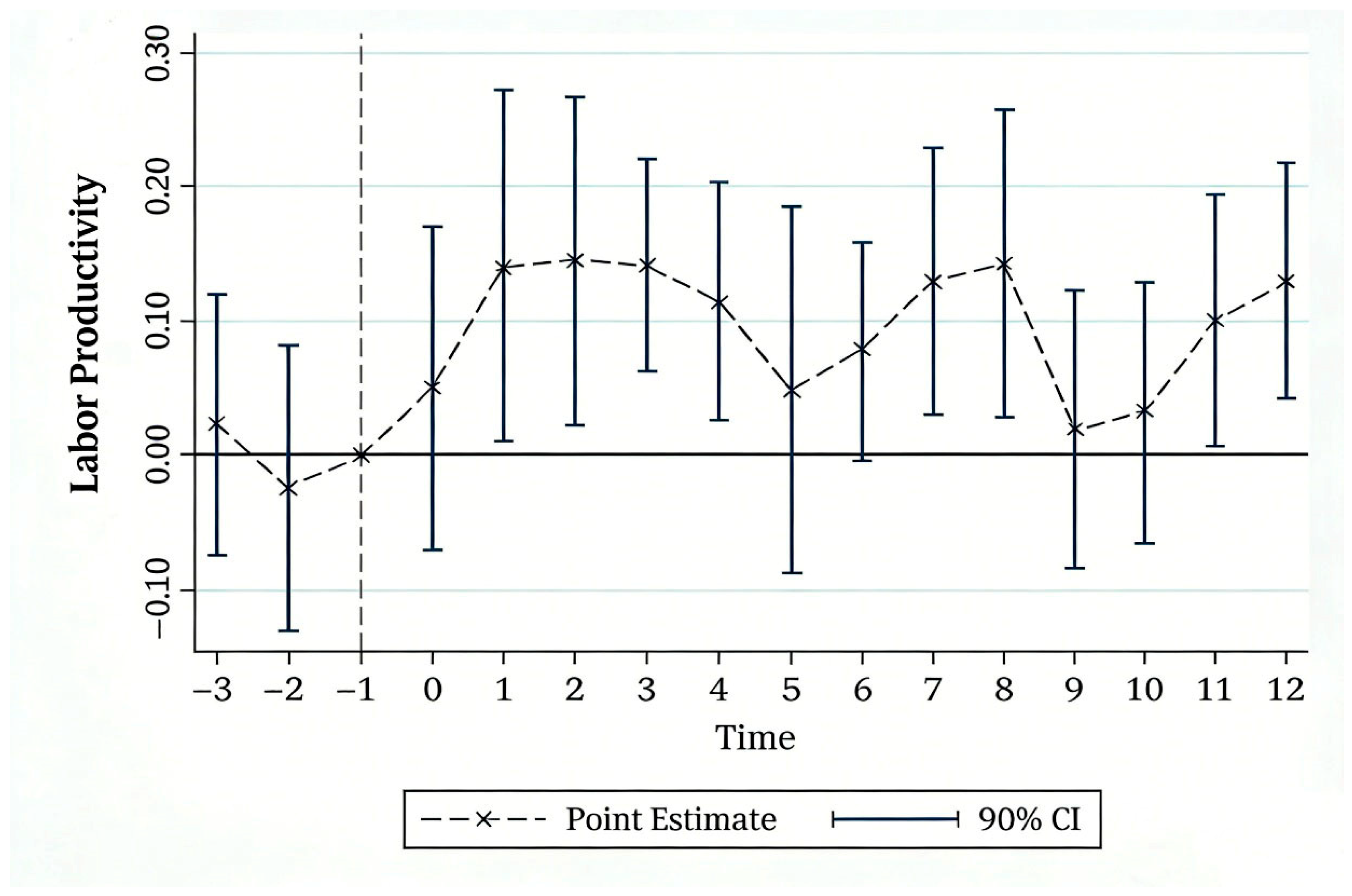
To evaluate the identification assumption, we adopt an event-study framework following Sun and Abraham (2021) to test whether labor productivity evolves similarly across treated and control firms in the periods surrounding the implementation of the Labor Contract Law. Specifically, using the pre-policy year (2007) as the reference period, the following model is estimated:
L P r o d u c t i v i t y i t = β 0 + k = 3 12 β k T r e a t i D t k + ω X i t + γ i + λ t + δ j t + θ c t + ε i t
Here, D t k is an indicator variable for the k-th period relative to the policy implementation, and β k measures the difference in labor productivity between the treatment and control groups in period k , relative to the baseline period. The remaining variables are defined as in Equation (4).
Figure 1 displays the estimated coefficients β k with 90% confidence intervals. The estimates indicate that in the three periods before the policy (t = −3, −2, −1), all confidence intervals include zero, indicating no significant differences in pre-treatment labor productivity trends between labor-intensive and non-labor-intensive firms. This finding supports the parallel trends assumption and validates the identification strategy based on the DID framework. Following the implementation of the Labor Contract Law, the treatment effect evolves over time. In the implementation year, the coefficient is −0.02 and not statistically significant, suggesting that the policy shock does not generate an immediate effect. From the first to the fourth year after implementation, the estimated coefficients are positive, and they are statistically significant at the 90% confidence level, indicating that the positive impact of the Labor Contract Law on labor productivity among labor-intensive firms emerges one year after implementation and persists through the fourth year, although the magnitude of the effect gradually declines over time. From the fifth to the sixth year after implementation, the estimated coefficients are no longer statistically significant, suggesting a temporary attenuation of the policy effect. In the seventh to the eighth year, the positive effect reappears and reaches statistical significance. From the ninth to the tenth year, the effect again becomes insignificant, while in the eleventh to the twelfth year, the positive effect reemerges.
The empirical findings reveal that the effect of the Labor Contract Law on labor productivity in labor-intensive firms follows a dynamic trajectory, rather than remaining constant over time. Specifically, the pattern can be described as “emergence–attenuation–reemergence.” This dynamic pattern may reflect firms’ adaptive adjustment process in response to institutional shocks: in the early stage, firms improve efficiency through managerial optimization and technological upgrading; as adjustment space narrows, the effect weakens; and in the longer run, firms undertake deeper strategic transformations, leading to renewed improvements in labor productivity.

5.4. Robustness Check(s)

5.4.1. Replacing the Dependent Variable (CProductivity)

To further assess robustness, we replace the baseline dependent variable—measured as relative efficiency based on the super-efficiency EBM–Global Malmquist index—with cumulative labor productivity (CProductivity) and re-estimate the model (Wei & Xia, 2024). Cumulative labor productivity captures long-term changes in firms’ production efficiency and helps mitigate potential volatility bias associated with single-period efficiency measures. The estimates indicate that the coefficient on the main interaction term, D I D × P i n f o r m , is 0.564 and statistically significant at the 1% level. This finding indicates that the positive moderating effect of digital infrastructure remains robust regardless of whether labor productivity is measured using contemporaneous efficiency or cumulative long-term indicators. The results suggest that the key findings remain robust even when alternative measures of productivity are adopted.

5.4.2. Replacing the Moderating Variable (Ptelecom)

To assess robustness, we employ an alternative proxy for digital infrastructure by following A. Z. Zhang (2023) and W. X. Xu et al. (2022), using total telecommunications services per 10,000 people (Ptelecom) as an alternative proxy for the moderating variable. From the perspective of industry output, total telecommunications services comprehensively reflect the level of regional information and communication technology (ICT) development and provide a more holistic measure of digital infrastructure capacity. We construct the interaction term D I D × P t e l e c o m based on principal component analysis and re-estimate the model. The estimated coefficient is 0.908, which remains significant at the 1% level; this finding further corroborates the baseline results.

5.4.3. Replacing the Moderating Variable (Pcable)

This paper further employs the length of long-distance optical fiber cables per capita (Pcable) as an alternative proxy for digital infrastructure (Chen et al., 2011). The length of optical fiber cables directly reflects a region’s information transmission capacity and captures the physical carrying capacity and network coverage depth of digital infrastructure. Using this measure, we construct the interaction term D I D × P c a b l e and re-estimate the model. The coefficient is 0.908 and statistically significant at the 1% level. This finding is in line with prior robustness checks, further confirming the robustness of the moderating effect of digital infrastructure to alternative measurement specifications.

5.4.4. Using Lagged Dependent Variables

To consider the potential lagged effects that digital infrastructure may have on firm productivity, we re-estimate the model using next-period labor productivity as the dependent variable. This lag specification helps capture the dynamic nature of the moderating effect of digital infrastructure and alleviates potential concerns about contemporaneous reverse causality. The interaction term coefficient implies that, D I D × P i n f o r m , is 0.550 and statistically significant at the 1% level. This finding indicates that the positive moderating effect of digital infrastructure is persistent and continues to exert an influence on firm productivity in subsequent periods.

5.4.5. Shortening the Sample Period

To reduce the influence of external macroeconomic shocks, such as the COVID-19 pandemic after 2020, we adjust the sample period. Following Giannetti et al. (2015), we restrict the sample to 2006–2018 to examine the stability of the moderating effect of digital infrastructure during the early and intermediate stages of policy implementation. Table 4 presents the regression results. As shown, the coefficient on the interaction term D I D × P i n f o r m is 0.033 and statistically significant at the 5% level, consistent with the baseline findings. This suggests that our main results are not driven by later-period shocks and remain robust after excluding such external disturbances, thereby enhancing the reliability and generalizability of our conclusions.

5.4.6. Excluding the Effects of Other Policy Interventions

To precisely identify the net interaction effect between the Labor Contract Law and digital infrastructure, this paper further controls for a set of potential confounding factors, including the 2008 global financial crisis, changes in corporate income tax policy, and reforms in the basic pension insurance system for employees. First, to account for the effects of the 2008 financial crisis, we classify firms into export-oriented and non-export-oriented groups based on the presence of overseas sales revenue, and construct a financial crisis indicator (Financialcrisis), which is included in the model as a control variable. This variable helps isolate the potential interference of the financial crisis with the estimated effects of labor protection policies. Second, to control changes in corporate income tax policy, we include firms’ effective tax rate (Tax) directly in the regression, thereby accounting for the influence of tax burden variations on firm productivity and the moderating role of digital infrastructure. Finally, to account for the potential effects of pension system reforms, we construct a proxy variable based on the share of retired employees in 2007. Specifically, firms are categorized into treatment and control groups according to whether the ratio of their retired employees is higher than the sample median. We then interact with this indicator (denoted as Elder2007) with the post-policy dummy (Post) to form the pension reform variable (EInsurance), which captures the indirect impact of pension system changes on firms’ labor productivity.
Table 5 displays the regression results, where the above policy-related confounders have been controlled to ensure the reliability of the results. The coefficient on the key interaction term, D I D × P i n f o r m , is 0.030 and statistically significant at the 10% level, consistent with the baseline results. This finding suggests that, after accounting for potential confounders such as the global financial crisis, corporate income tax changes, and pension system reforms, the effect of digital infrastructure in strengthening the impact of labor protection policies remains robust. further strengthening the credibility of our conclusions. Among the control variables, the coefficient on Financialcrisis is not statistically significant, which indicates that the impact of the financial crisis may have been fully absorbed by the fixed effects incorporated in the model. The coefficient on Tax is −0.008, which is not statistically significant, suggesting that variations in tax burden have a limited direct effect on labor productivity. In contrast, the coefficient on EInsurance is −0.132 and statistically significant at the 5% level, implying that improvements in the pension system may increase firms’ labor costs and exert a short-term negative impact on labor productivity. This result also provides indirect evidence that, while labor protection policies enhance worker welfare, they may impose cost pressures on firms’ short-term efficiency.

5.5. Further Discussion of Endogeneity: Instrumental Variable Estimation

Although the baseline regression results indicate that digital infrastructure exerts a positive moderating effect on the performance of the implementation of the Labor Contract Law, these estimates may still be subject to potential endogeneity concerns, such as reverse causality, omitted variables, or measurement error. To alleviate these concerns, this study further employs an instrumental variable approach as a supplementary test to the baseline results. It should be noted that the instrumental variable estimation in this section is primarily intended to assess the robustness of the baseline conclusions rather than to provide definitive causal inference. First, a potential concern is that measuring regional digital infrastructure measuring digital infrastructure using the number of broadband access ports per 10,000 people may be subject to measurement error. Second, changes in firms’ labor productivity may not only be influenced by digital infrastructure but could also induce local governments to increase digital investment, raising concerns about reverse causality. Although the specification controls for firm, industry, city, and year fixed effects, and controls for a range of financial and governance characteristics, it remains difficult to fully eliminate potential biases arising from omitted variables. To alleviate these concerns, we implement an instrumental variable (IV) strategy to address identification concerns and ensure more reliable estimates.
Following Yang and Liu (2025) and Feng and Cui (2023), the number of post offices per capita, measured relative to the year-end population in each province in 1984 (postoffice) is used as an instrument for regional digital infrastructure (Pinform). The choice of this instrument is motivated by the following considerations. First, as an early endowment in the information and communication sector, postoffice reflects the path dependence of digital infrastructure development and is likely to be strongly correlated with the current level of digitalization, thereby satisfying the relevance condition. Second, as a historical variable, it should not directly affect firms’ current labor productivity, thus meeting the exclusion restriction in principle. It should be acknowledged that historical post office density may be correlated with factors such as long-term regional economic development, human capital accumulation, and the process of marketization. These factors may indirectly affect current firm labor productivity through other channels, thereby posing a potential threat to the exclusion restriction of the instrumental variable. Therefore, the instrumental variable estimates in this study should be primarily regarded as a supplementary robustness check of the baseline conclusions rather than as definitive evidence of causality. To mitigate this concern as much as possible, this study implements the following approaches: First, this study controls for a series of historical characteristics at the city level. (e.g., GDP per capita, industrialization level, and education level in 1984) interacted with time trends, thereby absorbing the long-term effects of historical factors. Second, following Dong and Wang (2021), we interact postoffice with a time trend to construct the core instrumental variable ( p o s t o f f i c e × t r e n d ). This specification introduces exogenous time variation and strengthens the validity of the instrument in a panel setting. Third, in robustness checks, we further control for regional marketization indices and institutional environment variables to rule out the possibility that historical infrastructure affects current productivity through institutional channels.
This paper employs a two-stage least squares (2SLS) approach for estimation. In the first stage, the interaction term p o s t o f f i c e × t r e n d is used as an instrument to predict the policy interaction term D I D × P i n f o r m . In the second stage, the predicted values are used to replace the original interaction term in the regression of firms’ labor productivity. Table 6 presents IV estimation results. From the statistical test results: the first-stage regression shows that p o s t o f f i c e × t r e n d is strongly correlated with D I D × P i n f o r m (coefficient = −0.0002, significant at the 1% level). The first-stage F-statistic is 10.92, above the conventional threshold of 10, indicating that weak instruments are not a concern. The Kleibergen–Paap rk LM statistic from the under-identification test is 24.95, rejecting the null hypothesis of under-identification at the 1% level. In the weak instrument test, the Cragg–Donald Wald F-statistic is 83.87, well above the Stock–Yogo critical values, further confirming the strong relevance of the instrument. Moreover, the Anderson–Rubin Wald test and the Stock–Wright LM test yield statistics of 6.02 and 6.35, respectively, statistics are significant at the 5% level. Despite potential concerns regarding the exclusion restriction, the results remain robust. The second-stage results show that the coefficient on D I D × P i n f o r m is 0.1808 is 0.1808 and significant at the 10% level, with a sign aligned with the baseline findings. Overall, the instrumental variable estimates are broadly consistent with the baseline regression results, providing further robustness support for the core findings of this study. It should be emphasized that, given potential concerns regarding the exclusion restriction of the instrument, these results should be interpreted primarily as supplementary validation of the baseline conclusions rather than as definitive evidence of causal effects.

5.6. Mediation Mechanism Analysis

While the baseline results document a positive moderating role of digital infrastructure, the mechanisms underlying this effect remain to be explored. Theoretical considerations suggest that digital infrastructure may operate through two primary channels: first, by facilitating firms’ digital transformation and thereby enhancing operational efficiency; and second, by improving human capital allocation through the attraction of high-skilled labor. To test these mechanisms, this paper follows J. Liu et al. (2024) and employs a mediation analysis framework, using firms’ digitalization level (lndigital) and the share of high-skilled labor (postgraduate) as mediating variables, respectively.

5.6.1. Firm-Level Digitalization (Lndigital)

Following F. Wu et al. (2021), we measure firms’ level of digitalization using a text-based approach. Specifically, we extract keywords from firms’ annual reports—such as “artificial intelligence,” “blockchain,” “cloud computing,” “big data,” and “digital technology applications”—and count their frequencies. We take the natural logarithm of the aggregated frequency to construct the digitalization indicator (lndigital). Column (1) of Table 7 reports that the coefficient on the key interaction term D I D × P i n f o r m is −0.095 and statistically significant at the 10% level. This indicates that after the implementation of the Labor Contract Law, in regions with higher levels of digital infrastructure, firms’ digitalization levels instead exhibit a declining trend, implying the presence of a significant “crowding-out effect.” A plausible explanation is that, in response to increased labor costs and heightened labor rigidity induced by stronger labor protection, firms are required to allocate substantial resources toward compliance-related adjustments, such as formalizing labor contract management, improving employee benefits, and standardizing employment practices. These compliance expenditures may crowd out financial and managerial resources that would otherwise be devoted to digital transformation, giving rise to a “crowding-out effect” of institutional compliance on technological investment. This effect is likely to be more pronounced for firms with limited resources, where the combined pressures of institutional compliance and transformation costs constrain digital investment in the short run. These findings support Hypothesis 2b (the resource crowding-out effect), while providing no evidence in favor of Hypothesis 2a (the technology-enhancing effect). It should be emphasized that this study does not find evidence that digital infrastructure enhances institutional effects through promoting firms’ digital transformation; instead, the mechanism analysis shows that this transmission channel exhibits a negative relationship in the short term.

5.6.2. City-Level Human Capital (Postgraduate)

Following Shapiro (2006), we measure urban human capital as the share of workers with a postgraduate degree or above in the total labor force of a city (postgraduate). This indicator captures the stock of human capital and the skill composition at the city level, and serves as an important proxy for regional talent endowment and development potential. Column (2) of Table 7 presents regression results where urban human capital is the dependent variable. The interaction term DID × Pinform has a coefficient of 0.601 and is significant at the 1% level. This finding indicates that, following the implementation of the Labor Contract Law, cities with more advanced digital infrastructure experience a significant increase in human capital levels. This result can be explained from three perspectives. First, from a knowledge spillover perspective, digital infrastructure facilitates the cross-regional diffusion of knowledge and skills, thereby promoting human capital accumulation (Forman & van Zeebroeck, 2012). Second, from a labor mobility perspective, well-developed digital infrastructure enhances cities’ attractiveness to high-skilled workers. Digital services—such as remote work, online education, and smart city applications—improve urban livability and generate agglomeration effects for talent (Dong & Wang, 2021). Third, from an industrial upgrading perspective, digital infrastructure and labor protection policies may jointly drive the transition toward more skill-intensive industrial structures, increasing the demand for high-skilled labor and creating a virtuous cycle of “institutions–technology–talent.” The results support Hypothesis 3 and indicate that digital infrastructure reinforces the effect of the Labor Contract Law on firms’ labor productivity by enhancing urban human capital.
The comparative analysis of the two mechanisms reveals an important finding: the moderating effect of digital infrastructure is not realized through promoting firms’ digital transformation, but rather operates through the indirect channel of optimizing the regional human capital structure. This finding suggests that the co-evolution of technology and institutions may exhibit a stage-based pattern of “human capital first, technology later”—in the short term, institutional pressure may crowd out firms’ technological investment, but by attracting and cultivating high-skilled labor, it lays the foundation for long-term technological upgrading and efficiency improvement.

5.7. Heterogeneity Analysis

The empirical findings suggest that the Labor Contract Law exerts a stronger effect on firms’ labor productivity in regions where digital infrastructure is more developed. However, this effect may vary with firms’ access to external resources and industry characteristics. To explore such heterogeneity, this paper conducts subgroup analyses along three dimensions: government digital subsidies, local fiscal capacity, and telecommunications industry exports. Table 8 reports the results of these group-specific regressions.

5.7.1. Government Digitalization Subsidies

Government digital subsidies reflect the extent of external resource support that firms receive in the process of digital transformation. The resource-based view suggests that digital transformation requires sustained investment, and government subsidies, serving as a key source of external funding, can alleviate financial constraints and lower the barriers to transformation. Firms that receive subsidies may already possess stronger digital capabilities, whereas those without such support are likely to rely more heavily on external digital infrastructure. Comparing these two groups allows us to identify differences in the marginal effects of digital infrastructure across firms with varying resource endowments.
To this end, following Zhu and Manansala (2024), we identify government digital subsidies based on subsidy information disclosed in firms’ annual reports. Specifically, we screen for subsidy items containing keywords such as “blockchain,” “big data,” “artificial intelligence,” “software,” “digitalization,” “informatization,” and “information technology,” and use the aggregated amounts to construct a dummy variable indicating whether a firm receives government digital subsidies (Subsidy). Columns (1) and (2) of Table 8 present regression results for firms with and without subsidies. The results show that, for firms receiving digital subsidies (Subsidy = 1), the coefficient on the key interaction term D I D × P i n f o r m is 1.075 but not statistically significant. In contrast, for firms that do not receive subsidies (Subsidy = 0), the coefficient is 0.027, with significance at the 10% level. These findings suggest that the moderating effect of digital infrastructure is primarily significant among firms without government digital subsidies. A possible explanation for this phenomenon is that firms eligible for subsidies already have strong digital capabilities and possess greater access to various resources, which enables them to better adapt to market changes, and their digital transformation processes may be more mature, leaving limited scope for additional marginal gains from digital infrastructure. By contrast, firms without subsidies typically face tighter resource constraints and rely more heavily on external digital infrastructure; therefore, improvements in digital infrastructure play a more pronounced role in enhancing their ability to respond to institutional changes. This finding also provides indirect support for the resource crowding-out mechanism discussed earlier, suggesting greater responsiveness among resource-constrained firms to the external technological environment.

5.7.2. Local Government Fiscal Capacity

The construction of digital infrastructure is characterized by high upfront investment and long payback periods, making it highly dependent on local government fiscal support. Regions with stronger fiscal capacity are not only better able to ensure the quality and coverage of digital infrastructure but also more capable of implementing complementary policies—such as talent attraction and industrial support—thereby generating policy synergies. Comparing regions with different levels of fiscal capacity allows us to assess how local government capability shapes the moderating effect of digital infrastructure. To this end, following Wang et al. (2016), local fiscal capacity is proxied by the revenue-to-expenditure ratio at the provincial level. Using the 2007 sample median as the cutoff, the sample is split by fiscal capacity, and a dummy variable (Gov) is constructed for subgroup analysis. Columns (3) and (4) of Table 8 report the corresponding results. The results show that, in regions with stronger fiscal capacity (High Gov), the interaction term DID × Pinform is positive and significant at the 5% level (coefficient = 0.064). In contrast, the coefficient is −0.092 and insignificant in regions with weaker fiscal capacity (Low Gov). The impact of digital infrastructure manifests itself only in regions where fiscal capacity is relatively strong.
A plausible explanation is that fiscal capacity directly affects a local government’s ability to invest in and sustain digital infrastructure development. Regions with stronger fiscal resources can provide more substantial financial support and complementary policy measures, ensuring higher quality, broader coverage, and more effective maintenance of digital infrastructure. Moreover, such regions are better positioned to implement coordinated talent and industrial policies, which, together with digital infrastructure, enhance firms’ ability to adapt to institutional constraints. By contrast, in fiscally constrained regions, digital infrastructure development may suffer from funding shortages and delayed upgrades, thereby limiting its effectiveness as a moderating factor.

5.7.3. Telecommunications Industry Exports

According to Melitz (2003), firms engaged in export activities typically exhibit higher productivity and stronger capacity to absorb advanced technologies. Regions with a larger telecommunications export sector tend to possess more mature digital industry chains, more vibrant innovation ecosystems, and technical standards that are better aligned with global markets. These industrial advantages can complement digital infrastructure and enhance firms’ responsiveness to the external technological environment. Comparing regions with different levels of telecommunications exports therefore helps identify how industrial foundations shape the moderating role of digital infrastructure.
To this end, we measure the scale of telecommunications exports using the ratio of provincial telecommunications exports to total exports. Using the 2007 sample median as the cutoff, regions are divided into high- and low-export groups, and a dummy variable (Export) is constructed for heterogeneity analysis. The estimates reported in Table 8 (Columns (5) and (6)) show that, in regions with a higher level of telecommunications exports (High Export), the coefficient on interaction term D I D × P i n f o r m is 0.050 and significant at the 5% level. In regions with lower export levels (Low Export), the coefficient is 0.105 and insignificant. The effect of digital infrastructure appears stronger in regions with higher telecommunications exports. A plausible explanation is that telecommunications exports capture the strength of a region’s ICT-related industrial base and its degree of integration into global markets. Regions with higher export intensity typically have more developed digital industry chains, stronger innovation ecosystems, and better alignment with international technological standards. These advantages complement digital infrastructure and enhance firms’ ability to absorb and apply digital technologies, enabling them to more effectively leverage digital infrastructure to improve labor productivity following the implementation of the Labor Contract Law. By contrast, in regions with weaker telecommunication export bases, even well-developed digital infrastructure may not fully translate into productivity gains due to the lack of supporting industrial ecosystems and technical services.

6. Conclusions, Policy Implications, and Future Research

6.1. Conclusions

Regional digital infrastructure, as a key external condition in the context of institutional change, significantly influences firms’ production behavior and their capacity to respond to institutional constraints. This study examines how the effect of labor protection policies on firms’ labor productivity varies with regional digital infrastructure, using the 2008 Labor Contract Law as a quasi-natural experiment. It further explores two underlying mechanisms—firms’ digital transformation and the accumulation of urban human capital—and investigates heterogeneity across external conditions, including government digital subsidies, local fiscal capacity, and the strength of the telecommunications export sector. The results suggest that regional digital infrastructure exerts a positive moderating effect on the relationship between the implementation of the Labor Contract Law and firms’ labor productivity, with the core interaction term passing the statistical test at the 10% significance level. This basic conclusion remains stable across multiple robustness checks; after applying an instrumental variable approach to alleviate endogeneity concerns, the direction of the results remains consistent, providing further robustness support for the baseline findings. Mechanism analysis reveals that digital infrastructure does not enhance this effect through promoting firms’ digital transformation; instead, under institutional compliance pressure, it generates a significant crowding-out effect on firms’ digital investment, leading to a short-term decline in digitalization. In contrast, digital infrastructure enhances the policy effect by improving urban human capital, thereby strengthening firms’ productivity performance under institutional constraints. The effect of digital infrastructure is stronger for firms that do not receive government digital subsidies, in regions with stronger fiscal capacity, and in cities with a more developed digital industrial base. These findings highlight the important role of institutional environments and regional development conditions in shaping the marginal effectiveness of digital infrastructure.

6.2. Policy Implications

The following policy implications emerge from the findings:
Governments should expand investment in digital infrastructure, especially in regions with limited digital resources. Priority should be given to less developed and inland regions, where digital infrastructure—such as 5G networks, fiber-optic broadband, and data centers—remains underdeveloped. Targeted fiscal support is needed to bridge the regional digital divide. By improving digital infrastructure, governments can not only provide firms with more efficient digital service platforms but also promote balanced regional economic development. In addition, governments should provide targeted financial support to SMEs to encourage technology adoption and workforce training, thereby promoting digital transformation.
Second, policymakers should promote firms’ digital transformation while strengthening complementary legal and technical support. Governments should encourage firms to leverage local digital infrastructure and deepen the implementation of digital transformation strategies. Firms that have not yet benefited from policy support should be provided with greater access to funding, technical assistance, and institutional support to overcome initial transformation barriers. Meanwhile, policies should aim to strengthen awareness and implement the Labor Contract Law, ensuring that firms can effectively utilize digital tools to comply with labor regulations while improving productivity. By providing clear guidance and support, governments can help firms achieve both regulatory compliance and efficiency gains, thereby enhancing their competitiveness.
Third, governments should strengthen the cultivation and mobility of digital talent to improve overall human capital. This includes enhancing collaboration with universities and vocational training institutions to establish targeted training programs that equip workers with digital skills required for transformation. Improving workforce digital capabilities will help firms better cope with the challenges posed by labor protection policies and adapt to evolving market demands. Moreover, policies should facilitate the mobility of high-skilled workers across regions, particularly toward cities with more developed digital industries, to promote the diffusion of knowledge and support regional digital development. Incentive mechanisms—such as scholarships and talent subsidies—can further attract skilled professionals to the digital sector, facilitating digital transformation at both firm and regional levels.

6.3. Research Limitations and Future Directions

Despite providing evidence on the role of digital infrastructure in influencing the effect of the Labor Contract Law on firms’ labor productivity, this study has several limitations that merit further consideration.
First, the measurement of digital infrastructure can be further improved. Due to data availability constraints, this study uses the number of broadband access ports per capita as a proxy for digital infrastructure, which primarily captures physical network access but may not fully reflect network quality, depth of digital application, or broader societal digital readiness. In other words, the “digital infrastructure” examined in this study is in fact a subset rather than the full spectrum of digital infrastructure. Therefore, the findings should be primarily interpreted as preliminary evidence based on the specific dimension of “network access capacity.” Future research could, subject to data availability, construct a multidimensional composite evaluation framework (e.g., incorporating broadband quality, computing infrastructure, and application platforms) to more accurately assess the economic effects of digital infrastructure.
Second, there remains room for improvement in addressing endogeneity. Although this study employs historical post office density as an instrumental variable and controls for multi-dimensional fixed effects and historical characteristics as much as possible, the exclusion restriction of the instrument may still be subject to debate—historical infrastructure may indirectly affect current firm efficiency through channels such as long-term regional economic development and human capital accumulation. Therefore, the instrumental variable estimates in this study should be primarily interpreted as supplementary robustness evidence for the baseline conclusions rather than as definitive causal inference. Future research could seek more exogenous policy shocks (e.g., pilot programs under the “Broadband China” strategy) as quasi-natural experiments and adopt more advanced causal inference methods for cleaner identification.
Third, the sample scope is relatively narrow. This study focuses on A-share listed manufacturing firms, which are typically larger in scale, have more standardized governance structures, and possess stronger resource acquisition capabilities, potentially giving them advantages in institutional adaptation and technology adoption. However, small and medium-sized enterprises (SMEs) account for a significant share of China’s manufacturing sector, and their behavioral responses to institutional constraints, as well as their reliance on the external technological environment, may differ substantially from those of listed firms. Therefore, caution is warranted when generalizing the findings of this study to non-listed firms and SMEs. Future research could extend the analysis to samples such as firms listed on the National Equities Exchange and Quotations (NEEQ), above-scale industrial enterprises, or SMEs to examine the applicability and boundary conditions of the conclusions.
Finally, the research context is confined to China. The research context of this study is China, taking the implementation of the Labor Contract Law in 2008 as an institutional shock that strengthened labor protection. There are substantial differences across countries in terms of the strength of labor protection legislation, the strictness of enforcement, labor market structures, and stages of digital development. For example, labor protection systems in European countries are generally more stringent, while the enforcement of such institutions in developing countries may vary considerably. Therefore, it remains unclear whether the findings of this study can be generalized to countries with different institutional environments and stages of digital development. Future research could conduct cross-country comparative analyses to uncover the deeper logic of the interaction between institutional environments and digital technologies, and to test the external validity of the findings.

Author Contributions

Conceptualization, Y.C. and L.Z.; Methodology, Q.H.; Investigation, L.Z.; Data curation, Q.H.; Writing—original draft, Y.C.; Writing—review & editing, Q.H.; Supervision, L.Z. All authors have read and agreed to the published version of the manuscript.

Funding

This research received no external funding.

Institutional Review Board Statement

Not applicable.

Informed Consent Statement

Not applicable.

Data Availability Statement

The data that support the findings of this study are publicly available from sources such as the China Stock Market & Accounting Research (CSMAR) Database (https://data.csmar.com/, accessed on 25 March 2026) and the National Bureau of Statistics of China (https://data.stats.gov.cn/, accessed on 25 March 2026). Restrictions may apply to the availability of these data, which were used under license for this study. Interested researchers may access the same data by obtaining permission from the respective data providers.

Conflicts of Interest

Lu Zhao is an employee of Shanghai Photonic View Technology Co., Ltd. This research was conducted independently of the company, and the company had no role in the study design, data collection and analysis, decision to publish, or preparation of the manuscript. The authors declare no other competing financial or non-financial interests.

References

  1. Acemoglu, D., & Restrepo, P. (2018). The race between man and machine: Implications of technology for growth, factor shares, and employment. American Economic Review, 108, 1488–1542. [Google Scholar] [CrossRef]
  2. Acemoglu, D., & Restrepo, P. (2022). Tasks, automation, and the rise in US wage inequality. Econometrica, 90, 1973–2016. [Google Scholar] [CrossRef]
  3. Arbelo, A., Arbelo-Pérez, M., & Pérez-Gómez, P. (2022). Are SMEs less efficient? A Bayesian approach to addressing heterogeneity across firms. Small Business Economics, 58(4), 1915–1929. [Google Scholar] [CrossRef]
  4. Autor, D. H., Kerr, W. R., & Kugler, A. D. (2007). Does employment protection reduce productivity? Evidence from US states. Economic Journal, 117, F189–F217. [Google Scholar] [CrossRef]
  5. Autor, D. H., Levy, F., & Murnane, R. J. (2003). The skill content of recent technological change: An empirical exploration. Quarterly Journal of Economics, 118, 1279–1333. [Google Scholar] [CrossRef]
  6. Bansal, A., Panchal, T., Jabeen, F., Mangla, S. K., & Singh, G. (2023). A study of human resource digital transformation (HRDT): A phenomenon of innovation capability led by digital and individual factors. Journal of Business Research, 157, 113611. [Google Scholar] [CrossRef]
  7. Bertrand, M., & Mullainathan, S. (2004). Are Emily and Greg more employable than Lakisha and Jamal? A field experiment on labor market discrimination. American Economic Review, 94, 991–1013. [Google Scholar] [CrossRef]
  8. Besley, T., & Burgess, R. (2004). Can labor regulation hinder economic performance? Evidence from India. Quarterly Journal of Economics, 119, 91–134. [Google Scholar] [CrossRef]
  9. Blaschke, M., Haki, M. K., Riss, U. V., Winter, R., & Aier, S. (2016). Digital infrastructure: A service-dominant logic perspective. In Proceedings of the international conference on information systems (ICIS 2016). AIS eLibrary. [Google Scholar]
  10. Botero, J. C., Djankov, S., La Porta, R., Lopez-de-Silanes, F., & Shleifer, A. (2004). The regulation of labor. Quarterly Journal of Economics, 119, 1339–1382. [Google Scholar] [CrossRef]
  11. Brynjolfsson, E., & McAfee, A. (2014). The second machine age: Work, progress, and prosperity in a time of Brilliant technologies. W. W. Norton & Company. [Google Scholar]
  12. Brynjolfsson, E., Rock, D., & Syverson, C. (2021). The productivity J-curve: How intangibles complement general purpose technologies. American Economic Journal: Macroeconomics, 13, 333–372. [Google Scholar] [CrossRef]
  13. Buch, T., Hamann, S., Niebuhr, A., & Rossen, A. (2017). How to woo the smart ones? Evaluating the determinants that particularly attract highly qualified people to cities. Journal of Urban Affairs, 39, 764–782. [Google Scholar] [CrossRef]
  14. Chen, L., Li, J. W., & Xu, C. S. (2011). Information infrastructure and economic growth: Evidence from Chinese provincial data. Journal of Management Science, 24, 98–107. (In Chinese) [Google Scholar]
  15. Cui, C., John, K., Pang, J., & Wu, H. (2018). Employment protection and corporate cash holdings: Evidence from China’s labor contract law. Journal of Banking and Finance, 92, 182–194. [Google Scholar] [CrossRef]
  16. Donbesuur, F., Ampong, G. O. A., Owusu-Yirenkyi, D., & Chu, I. (2020). Technological innovation, organizational innovation and international performance of SMEs: The moderating role of domestic institutional environment. Technological Forecasting and Social Change, 161, 120252. [Google Scholar] [CrossRef]
  17. Dong, Z. Q., & Wang, H. (2021). Urban wealth and green technology choice. Economic Research Journal, 56(4), 143–159. (In Chinese) [Google Scholar]
  18. Faleye, O., Mehrotra, V., & Morck, R. (2006). When labor has a voice in corporate governance. Journal of Financial and Quantitative Analysis, 41, 489–510. [Google Scholar] [CrossRef]
  19. Färe, R., Grosskopf, S., Norris, M., & Zhang, Z. (1994). Productivity growth, technical progress, and efficiency change in industrialized countries. American Economic Review, 84, 66–83. [Google Scholar]
  20. Feng, F., & Cui, L. H. (2023). How does digital economy development release the demographic dividend under the new development paradigm? Evidence from urban human capital allocation efficiency. Inquiry into Economic Issues, 10, 48–58. (In Chinese) [Google Scholar]
  21. Forman, C., & van Zeebroeck, N. (2012). From wires to partners: How the internet has fostered R&D collaborations within firms. Management Science, 58(8), 1549–1568. [Google Scholar] [CrossRef]
  22. Francis, B. B., Kim, I., Wang, B., & Zhang, Z. (2018). Labor law and innovation revisited. Journal of Banking and Finance, 94, 1–15. [Google Scholar] [CrossRef]
  23. Giannetti, M., Liao, G., & Yu, X. (2015). The brain gain of corporate boards: Evidence from China. Journal of Finance, 70, 1629–1682. [Google Scholar] [CrossRef]
  24. Gong, J., Feng, Q., & Deng, F. (2025). Broadband infrastructure expansion and labour income share: Micro-evidence from Chinese industrial enterprises. Applied Economics, 57, 8291–8308. [Google Scholar] [CrossRef]
  25. Guo, J., Tang, Q., & Jin, G. (2021). Labor protection and the efficiency of human capital investment. Economic Analysis and Policy, 69, 195–207. [Google Scholar] [CrossRef]
  26. He, J., Zhang, Y., & Lei, Z. (2020). Labor cost, government intervention, and corporate innovation: Evidence from China. Journal of Corporate Finance, 64, 101668. [Google Scholar] [CrossRef]
  27. Herkenhoff, K., Lise, J., Menzio, G., & Phillips, G. M. (2024). Production and learning in teams. Econometrica, 92, 481–512. [Google Scholar] [CrossRef]
  28. Hua, Y., & Zhang, H. (2025). Labour misallocation and digital infrastructure: Evidence from a quasi-natural experiment of “Broadband China Strategy”. Applied Economics Letters, 32, 2291–2297. [Google Scholar] [CrossRef]
  29. Huang, Y., & Gao, Y. (2023). Labor protection and the digital transformation of enterprises: Empirical evidence from China’s social insurance law. Finance Research Letters, 57, 104169. [Google Scholar] [CrossRef]
  30. James, H. L., Wang, H., & Wang, Z. (2024). Covenant violation and operational efficiency. Accounting & Finance, 64, 1879–1920. [Google Scholar] [CrossRef]
  31. Kane, G. C., Phillips, A. N., Copulsky, J., & Andrus, G. (2021). The technology fallacy: How people are the real key to digital transformation. MIT Press. [Google Scholar]
  32. Landini, F., & Pagano, U. (2013). Synergy, conflict and institutional complementarities (DEPS Working Paper No. 686). University of Siena. [Google Scholar]
  33. Leduc, S., & Liu, Z. (2024). Automation, bargaining power, and labor market fluctuations. American Economic Journal: Macroeconomics, 16, 311–349. [Google Scholar] [CrossRef]
  34. Li, G., & Ma, Y. (2025). Labor contract law, labor income share, and corporate risk-taking. Finance Research Letters, 85, 108020. [Google Scholar] [CrossRef]
  35. Li, J., Ye, Y., Yu, Y., & Wang, H. (2019). The labour contract law, profit shock and corporate short-term responses: Based on the perspective of corporate earnings management. China Journal of Accounting Studies, 7, 364–384. [Google Scholar] [CrossRef]
  36. Liu, G., Liu, Y., Yang, J., & Zhang, Y. (2024). Labor contract law and inventor mobility: Evidence from China. Journal of Population Economics, 37, 7. [Google Scholar] [CrossRef]
  37. Liu, J., Tang, Q., & Ayangbah, F. (2024). Digital innovation and manufacturing employment: Based on the analysis of mediating and threshold effects. Cogent Economics & Finance, 12, 2420203. [Google Scholar] [CrossRef]
  38. Mayor Ravines, M. G., Mayor Gamero, J. G., Velasquez Vasquez, J. A., & Mayuri Barron, J. V. (2026). Digital transformation in SMEs: Systematic review of factors, barriers and results. Revista InveCom, 6, e603094. [Google Scholar] [CrossRef]
  39. Melitz, M. J. (2003). The impact of trade on intra-industry reallocations and aggregate industry productivity. Econometrica, 71, 1695–1725. [Google Scholar] [CrossRef]
  40. Mincer, J. (1958). Investment in human capital and personal income distribution. Journal of Political Economy, 66, 281–302. [Google Scholar] [CrossRef]
  41. Mukhopadhyay, S., Chauhan, S., Paul, M., Bhattacharyya, S., Upadhyay, P., & Sinha, S. K. (2025). Why do few organizations succeed while others fail? Impact of organizational capabilities and barriers on digital government transformation. Information Systems Frontiers, 27, 2213–2231. [Google Scholar] [CrossRef]
  42. Pan, Y. (2016). The failure of labor dispatch regulation and its remedy. Social Sciences in China, 37, 191–202. [Google Scholar] [CrossRef]
  43. Pastor, J. T., & Lovell, C. A. K. (2005). A global Malmquist productivity index. Economics Letters, 88, 266–271. [Google Scholar] [CrossRef]
  44. Qian, X. S., & Shi, X. (2024). Does strengthening labor protection increase labor income share? Evidence from the implementation of China’s Labor Contract Law. China Economic Quarterly, 24(1), 286–302. (In Chinese) [Google Scholar] [CrossRef]
  45. Rahmandad, H. (2012). Impact of growth opportunities and competition on firm-level capability development trade-offs. Organization Science, 23, 138–154. [Google Scholar] [CrossRef]
  46. Shapiro, J. M. (2006). Smart cities: Quality of life, productivity, and the growth effects of human capital. Review of Economics and Statistics, 88, 324–335. [Google Scholar] [CrossRef]
  47. Standardization Administration of China. (2017). Industrial classification for national economic activities (GB/T 4754-2017). Standardization Administration of China. Available online: https://openstd.samr.gov.cn/bzgk/gb/newGbInfo?hcno=A703F0E23DD165A5A1318679F312D158 (accessed on 8 March 2026).
  48. Sun, L., & Abraham, S. (2021). Estimating dynamic treatment effects in event studies with heterogeneous treatment effects. Journal of Econometrics, 225, 175–199. [Google Scholar] [CrossRef]
  49. Tian, G., & Wu, W. (2021). Employment protection, production flexibility and corporate capital spending. Australian Economic Papers, 60, 672–708. [Google Scholar] [CrossRef]
  50. Tone, K., & Tsutsui, M. (2010). An epsilon-based measure of efficiency in DEA: A third pole of technical efficiency. European Journal of Operational Research, 207, 1554–1563. [Google Scholar] [CrossRef]
  51. Venkatesh, V., Morris, M. G., Davis, G. B., & Davis, F. D. (2003). User acceptance of information technology: Toward a unified view. MIS Quarterly, 27, 425–478. [Google Scholar] [CrossRef]
  52. Wang, Y. Q., Chen, Y. H., & Du, J. L. (2016). Soft budget constraints and local government debt default risk in China: Evidence from financial markets. Economic Research Journal, 51, 96–109. (In Chinese) [Google Scholar]
  53. Wei, R., & Xia, Y. (2024). Digital transformation and corporate green total factor productivity: Based on double/debiased machine learning robustness estimation. Economic Analysis and Policy, 84, 808–827. [Google Scholar] [CrossRef]
  54. Wiese, R., Jalles, J. T., & de Haan, J. (2025). The impact of increasing labour market rigidity on employment growth in OECD countries. Economic Analysis and Policy, 85, 2265–2275. [Google Scholar] [CrossRef]
  55. Wu, F., Hu, H. Z., Lin, H. Y., & Ren, X. Y. (2021). Enterprise digital transformation and capital market performance: Evidence from stock liquidity. Management World, 37, 130–144. (In Chinese) [Google Scholar]
  56. Wu, R., & Wang, N. (2024). The mixed effects of innovation strategies and bribery on firm performance: A re-investigation via institutional quality. Journal of Economic Behavior & Organization, 224, 438–462. [Google Scholar] [CrossRef]
  57. Xu, R., Yu, M., & Zhao, Z. (2025). How do industrial cluster policies enhance firm labor productivity? International Business Research. forthcoming (In Chinese) [Google Scholar]
  58. Xu, W. X., Zhou, J. P., & Liu, C. J. (2022). The spatial effect of digital economy development on urban carbon emissions. Geographical Research, 41, 111–124. (In Chinese) [Google Scholar]
  59. Xu, X., Zhang, Y., Liao, Y., & Fu, X. (2023). Labor protection, enterprise innovation, and sustainable development. Sustainability, 15, 8529. [Google Scholar] [CrossRef]
  60. Yang, W. J., & Liu, M. Z. (2025). Digital transformation, specialization division and corporate total factor productivity: Evidence from A-share manufacturing firms in China. Journal of Industrial Technological Economics, 44, 14–23. (In Chinese) [Google Scholar]
  61. Zhang, A. Z. (2023). Measurement and evaluation of the coupling coordination between digital economy and high-quality development of the civil aviation industry. Journal of Zhengzhou University of Aeronautics, 41(4), 52–59. (In Chinese) [Google Scholar] [CrossRef]
  62. Zhang, S., Xia, Y., Wang, H., Pan, J., & Lv, G. (2024). Repel or attract? Effects of urban digital infrastructure on labor migration: Evidence from urban China. Cities, 154, 105386. [Google Scholar] [CrossRef]
  63. Zhao, L., & Zhang, K. (2024). Labor protection and corporate labor investment efficiency: Evidence based on the implementation of the “Labor Contract Law”. Finance Research Letters, 67, 105823. [Google Scholar] [CrossRef]
  64. Zhao, T., Zhang, Z., & Liang, S. K. (2020). Digital economy, entrepreneurial activity and high-quality development: Evidence from Chinese cities. Management World, 36, 65–75. (In Chinese) [Google Scholar]
  65. Zhu, Y., & Manansala, L. D. (2024). The impact of digital transformation on the innovation capacity of Chinese-listed firms: The role of government subsidies. International Journal of Applied Business and International Management, 9, 149–164. [Google Scholar] [CrossRef]
  66. Zou, X., Meng, S., & Liu, C. (2026). Digital infrastructure construction and urban inflow of high-skilled talents: Evidence from China. Humanities and Social Sciences Communications, 13, 272. [Google Scholar] [CrossRef]
Figure 1. Parallel Trends Test Results.
Economies 14 00140 g001
Table 1. Variable Definitions.
CategoryVariableSymbolDefinition
Dependent VariableFirm Labor ProductivityLProductivityFirm relative efficiency is estimated based on the super-efficiency EBM model in conjunction with the Global Malmquist index.
Key Independent VariableImplementation of the Labor Contract LawDID = Treat × PostThe variable treat is defined as one if the firm belongs to a labor-intensive industry, and 0 otherwise. Post equals 1 for years from 2008 onward, and 0 for years prior to 2008.
Moderating VariableRegional Digital InfrastructurePinformRatio of broadband internet access ports to year-end resident population.
Control VariableReturn on AssetsROAThe ratio of net profit to total assets
Leverage RatioLevThe ratio of total liabilities to total assets.
Total EquityEquityBook value of shareholders’ equity
Return on Invested CapitalROICThe ratio of earnings before interest and after taxes to invested capital
Operating ProfitProfitSum of profit from main business operations and other business activities
Firm ageAgeNumber of years since firm establishment
Largest Shareholder OwnershipTop1The ownership share of the largest shareholder
Executive CompensationPayNatural logarithm of total compensation of the top three executives
Board SizeBoardSizeThe natural logarithm of the number of board directors
Independent Director RatioIndepRatioProportion of independent directors on the board
Firm SizeStaffThe natural logarithm of the number of employees
Table 2. Descriptive Statistics.
VariableObservationsMeanMinimumMaximum
LProductivity88021.0650.3522.227
DID = Treat × Post88020.4170.0001.000
Pinform88020.4040.0191.152
ROA88020.035−3.9113.116
Lev88020.4960.00712.238
Equity880221.74918.68624.428
ROIC88020.066−0.1150.254
Profit880219.34615.53922.817
Age88022.7001.0993.434
Top1880234.0723.39089.990
Pay880214.22810.09418.049
BoardSize88022.1791.3862.833
IndepRatio88020.3670.0910.800
Staff88028.1095.45510.628
Table 3. Baseline Regression Results.
(1)
LProductivity
(2)
LProductivity
(3)
LProductivity
(4)
LProductivity
DID × Pinform0.058 *0.058 *0.054 *0.054 *
(0.033)(0.032)(0.031)(0.033)
DID0.0320.0320.0230.023
(0.047)(0.057)(0.050)(0.060)
Treat × Pinform−0.061 *−0.061 *−0.056 *−0.056 *
(0.034)(0.031)(0.031)(0.031)
Post × Pinform0.0140.0140.0050.005
(0.022)(0.021)(0.021)(0.021)
Financial ControlsYesYesYesYes
Corporate GovernanceNoNoYesYes
Constant1.409 ***1.409 ***1.320 ***1.320 ***
(0.246)(0.221)(0.376)(0.324)
Firm Fixed EffectsYesYesYesYes
Year Fixed EffectsYesYesYesYes
Industry × Year Fixed EffectsYesYesYesYes
City × Year Fixed EffectsYesYesYesYes
Clustered Robust Standard ErrorsProvincialMunicipalProvincialMunicipal
N8802880288028802
R20.4840.4840.4910.491
Note: ***, and * denote significance at the 1% and 10% levels, respectively. In parentheses are reported the robust standard errors, which are clustered at the province (or city) level.
Table 4. Robustness Checks (1).
(1)(2)(3)(4)(5)
DID × Pinform0.564 *** 0.550 ***0.033 **
(0.179) (0.173)(0.016)
DID × Ptelecom 0.908 ***
(0.283)
DID × Pcable 0.908 ***
(0.233)
Other Interaction TermsYesYesYesYesYes
Control VariablesYesYesYesYesYes
Constant−2.606−4.992 **−4.992 ***2.280 *1.167 ***
(1.658)(1.894)(1.701)(1.125)(0.248)
Firm Fixed EffectsYesYesYesYesYes
Year Fixed EffectsYesYesYesYesYes
Industry × Year Fixed EffectsYesYesYesYesYes
City × Year Fixed EffectsYesYesYesYesYes
Clustered Robust Standard ErrorsProvincialProvincialProvincialProvincialProvincial
N88027971797181666961
R20.6980.6820.6820.7150.506
Notes: ***, **, and * denote statistical significance at the 1%, 5%, and 10% levels, respectively. Robust standard errors clustered at the provincial/municipal level are reported in parentheses.
Table 5. Robustness Checks (2).
(1)(2)
DID × Pinform0.030 *0.030 *
(0.017)(0.018)
Financialcrisis−0.042−0.042
(0.029)(0.027)
Tax−0.008−0.008
(0.005)(0.005)
EInsurance−0.132 **−0.132 **
(0.048)(0.052)
Other Interaction TermsYesYes
Control VariablesYesYes
Constant1.274 ***1.274 ***
(0.274)(0.243)
Firm Fixed EffectsYesYes
Year Fixed EffectsYesYes
Industry × Year Fixed EffectsYesYes
City × Year Fixed EffectsYesYes
Clustered Robust Standard ErrorsProvincialMunicipal
N77687768
R20.4990.499
Notes: ***, **, and * indicate statistical significance at the 1%, 5%, and 10% levels, respectively. Robust standard errors, which are clustered by province/municipality, are reported in parentheses.
Table 6. Results of Endogeneity Tests.
(1)
First Stage
DID × Pinform
(2)
Second Stage
LProductivity
DID × postoffice × trend−0.0002 ***
(0.00004)
DID × Pinform 0.1808 *
(0.0888)
Control VariablesYESYES
Firm Fixed EffectsYESYES
Year Fixed EffectsYESYES
Industry × Year Fixed EffectsYESYES
City × Year Fixed EffectsYESYES
N64146664
R2 0.0435
First-Stage F-Statistic10.92
Kleibergen–Paap rk LM24.95 ***
Cragg–Donald Wald F83.87 ***
Anderson–Rubin Wald6.02 *
Stock–Wright LM S6.35 **
Notes: ***, **, and * signify that the results are statistically significant at the 1%, 5%, and 10% levels, respectively. Robust standard errors, which are clustered at the provincial/municipal level, are reported in parentheses.
Table 7. Results of Mediation Effect Tests.
(1)
Lndigital
(2)
Postgraduate
DID × Pinform−0.095 *0.601 ***
(0.052)(0.150)
Other Interaction TermsYesYes
Control VariablesYesYes
Constant−2.907 ***1.262
(0.883)(1.380)
Firm Fixed EffectsYesYes
Year Fixed EffectsYesYes
Industry × Year Fixed EffectsYesYes
City × Year Fixed EffectsYesYes
N74467971
R20.7570.902
Notes: ***, and * signify that the results are statistically significant at the 1% and 10% levels, respectively. Robust standard errors, which are clustered at the provincial/municipal level, are reported in parentheses.
Table 8. Results of Heterogeneity Analysis.
(1)
Subsidy = 1
(2)
Subsidy = 0
(3)
High Gov
(4)
Low Gov
(5)
High Export
(6)
Low Export
DID × Pinform1.0750.027 *0.064 **−0.0920.050 **0.105
(2.066)(0.018)(0.024)(0.145)(0.024)(0.095)
Other Interaction TermsYesYesYesYesYesYes
Control VariablesYesYesYesYesYesYes
Constant6.8621.100 ***1.006 **1.563 ***0.721 *2.421 ***
(3.712)(0.258)(0.389)(0.359)(0.323)(0.441)
Firm Fixed EffectsYesYesYesYesYesYes
Year Fixed EffectsYesYesYesYesYesYes
Industry × Year Fixed EffectsYesYesYesYesYesYes
City × Year Fixed EffectsYesYesYesYesYesYes
N14659943312302936422759
R20.7440.4030.4330.4470.3970.488
Notes: ***, **, and * denote significance at the 1%, 5%, and 10% levels, respectively. Robust standard errors clustered at the provincial/municipal level are reported in parentheses.
Disclaimer/Publisher’s Note: The statements, opinions and data contained in all publications are solely those of the individual author(s) and contributor(s) and not of MDPI and/or the editor(s). MDPI and/or the editor(s) disclaim responsibility for any injury to people or property resulting from any ideas, methods, instructions or products referred to in the content.