1. Introduction
Poverty alleviation is a strategic tool for achieving the Sustainable Development Goals (
Cai & Xia, 2018). Agriculture, as a labor-intensive industry, and rural areas, which are home to most of the poor population in developing countries, matter significantly for poverty alleviation. Thus, rural transformation and agricultural upgrading are essential to unlocking inclusive development pathways and ensuring that economic growth reaches the bottom.
In agriculture and rural development, the primary challenge is to integrate smallholders into improved agricultural value chains that link production areas in remote and mountainous regions to major markets and sustain demand growth. Sustained urbanization and the outmigration of farmers have reduced the number of active laborers in remote villages. However, income-generating activities in agriculture require reorganization through a high-efficiency approach. Farmers’ organizations, such as producer cooperatives, can be sustained only after scale production is no longer a barrier. Limited access to credit, poor business management and entrepreneurial skills, and finance-implementation-related challenges, ranging from high attrition among participating rural banks to high microfinance costs, have also been reported to have negatively affected the scale of smallholders’ production (
Boukaka et al., 2022).
To address this complex issue, a significant challenge facing the global community is identifying appropriate strategies and mechanisms to strengthen multiple stakeholders and enable them to work together efficiently and sustainably. The dilemma persists due to diverse stakeholder interests (
Wojewnik-Filipkowska & Węgrzyn, 2019), particularly within the comprehensive agri-food value chain. Value chain development is generally regarded as an effective strategy to enhance growth in rural areas, increase demand for surplus food, and improve the livelihoods of the rural population. The Public–Private–Producer Partnership (4P) concept was developed through projects financed by the International Fund for Agricultural Development (IFAD) in many countries. The strategic partnership addresses this challenge by fostering trust-based collaboration among governments, businesses, and producer groups. Through shared investment and joint responsibility, the 4P approach creates incentives for co-investment, risk-sharing, and long-term partnership-building, enabling members to share risk and pool resources, including capital and expertise.
A growing body of literature highlights the potential of value chain approaches and multi-stakeholder partnerships—particularly the 4P model—to foster inclusive growth by improving infrastructure, market access, and farmer capacities (
Haggblade et al., 2012) (
Food and Agriculture Organization of the United Nations, 2018). We have evidence from single-case studies in Indonesia (
Natawidjaja, 2015), Rwanda (
Byakweli & Nzeyimana, 2015), and Ghana. Although this evidence shows that crop yields and incomes increase significantly under 4P arrangements, it is still weak in explaining “why it works, how it works, and under what conditions it can be replicated.” First, Haggblade focuses primarily on a conceptual framework for value chain diagnosis and intervention design and uses a small number of illustrative cases to explain key ideas. However, it lacks a testable, comparable breakdown of how, within 4P cooperation, the public sector, the private sector, and producer organizations form a shared governance mechanism through mutual incentives, risk sharing, and information exchange. Second, although the IFAD project case studies provide fairly rich descriptions—such as how partnerships are formed, who the key actors are, and what factors facilitate cooperation—the research design mainly relies on purposive sampling and one-time interviews, with limited coverage and a single time point; because of the lack of clear theoretical assumptions, early key participant information, and baseline indicators, the causal chain often can only remain at the stage of descriptive summary, and it is difficult to form a replicable mechanism explanation. Third, although the Ghana project evaluation uses quasi-experimental matching methods to estimate the average impact of the project on different indicators, its identification framework and indicator system still depend heavily on a single project setting, and it is hard for us to distinguish further the result pathways of different partner roles, governance mechanisms, and service packages. Overall, the above studies still have shortcomings in explaining mechanisms, cross-country indicator comparisons, and a structured analytical framework, which limit cross-country learning and the replicability of policy inference.
Despite these insights, empirical research remains confined mainly to individual country or commodity contexts, limiting our understanding of how enabling factors such as aligned incentives, producer ownership, and adaptive management interact to deliver sustained impacts across diverse institutional and agro-ecological settings (
Thorpe & Maestre, 2015). Furthermore, few studies clearly summarize their marginal contributions, core conclusions, and policy lessons, making it difficult for practitioners and policymakers to assess replicability and scale-up potential.
This study addresses these gaps by presenting a systematic, multinational case study of IFAD’s 4P approach across five countries—China, Indonesia, Rwanda, Ghana, and Nigeria.
Our central innovation lies in integrating a Theory of Change framework with value chain disaggregation and mixed-methods process tracing, allowing us to uncover the mechanisms through which multi-stakeholder partnerships influence smallholder livelihoods, market linkages, and cooperative governance.
In doing so, this study provides an empirically grounded assessment of the 4P model’s strengths and weaknesses, offering insights into what works, what doesn’t, and why. It positions itself within the growing body of applied literature seeking to link partnership design to developmental impact, adding a comparative, implementation-focused perspective that is often underrepresented in the discourse. Employing a mixed-methods framework that integrates Theory of Change mapping, value chain disaggregation, quantitative trend analysis, and qualitative process tracing, this paper (i) identifies eight critical enabling factors for successful 4P initiatives, (ii) evaluate outcomes across four pillars—Infrastructure, Vertical Linkages, Horizontal Aggregation, and Functional Upgrading—and (iii) derives policy recommendations for strengthening governance structures, financial mechanisms, and market stability. Our findings reveal that well-designed 4P models can double per-capita incomes, increase cooperative membership by over 160%, boost cocoa yields by up to 200%, and enhance household assets and resilience. At the same time, enduring challenges such as price volatility, governance constraints, and sustainability risks underscore the need for more robust contract mechanisms and long-term planning. The remainder of this paper proceeds as follows:
Section 2 reviews the rationale and mechanism of the 4P model;
Section 3 outlines our methodology;
Section 4 presents the five country cases and synthesizes cross-case lessons; and
Section 5 offers concluding policy recommendations.
In doing so, this study contributes: a replicable evaluative framework for analyzing multi-stakeholder agricultural partnerships; a cross-country synthesis that highlights design features, trade-offs, and bottlenecks in 4P programs; and practical, evidence-based policy recommendations for scaling 4P models in support of rural poverty alleviation. By bridging the gap between practice and theory, this paper speaks to both development researchers and policymakers. It helps shift the global conversation around rural partnerships from isolated project success stories to a more generalizable, mechanism-driven understanding of what makes 4P models work.
2. Rationale and Mechanism of the Public–Private–Producer Partnership (4P) Approach
The 4P concept is an IFAD variation of the general Public–Private Partnership (PPP) concept that involves cooperation among a government, business agents, and small-scale producers, who agree to work together to reach a common goal or carry out a specific task while jointly assuming risks and responsibilities and sharing benefits, resources, and competencies (
International Fund for Agricultural Development, 2015). At the core of the 4P approach is the necessity of a brokering function that links producers with private and public agencies to govern the value chain. A 4P arrangement ensures that smallholder producers are respected partners and not relegated to the receiving end of public–private partnerships. This needs to be acknowledged within the 4P approach, as smallholders are typically not well equipped to negotiate with public and private actors. IFAD intends to promote cooperation among international investors, the private sector, and the public sector to support small-scale producers through this approach. The 4P mechanism improves rural finance, market access, and the value-added agricultural commodities, including institutional and capacity-building for cooperative development and support for the 4P business model.
“Theory of Change (ToC)” is an explanatory framework used to clarify how complex interventions produce expected impacts: it emphasizes the logical chain from activities to outputs and then to outcomes and final effects, it makes clear the contextual conditions, key actors, and core assumptions behind the impact pathway, and it is usually presented in the form of “diagram + narrative” (
Rogers, 2014;
Vogel, 2012). In practice, ToC is widely used in areas such as project impact evaluation and project implementation under dynamic contexts. In the practice of 4P analysis, researchers often emphasize strategic planning and cross-sector collaboration and ultimately match cooperation mechanisms with outcomes (
Kruhlov et al., 2024). Therefore, introducing ToC into 4P analysis can, at the theoretical level, make causal chains and key assumptions explicit and provide a unified explanatory language and a testable analytical framework for later mechanism identification and cross-country comparison.
From a theoretical perspective, 4P can be understood as an inclusive extension of Public–Private Partnership within agricultural value chains. It emphasizes cross-sector cooperation to share risks and achieve incentives. However, in practice, problems such as information asymmetry and accountability challenges also exist (
Hodge & Greve, 2007). We can apply the following theories to refine this framework further. Take new institutional economics as an example: in agricultural chains characterized by high uncertainty, partnerships that reduce transaction costs through rules, organizations, and mechanisms enhance the sustainability of cooperation. In addition, theories on collective action dilemmas advocate using institutionalized rules and shared constraints to address free-rider and commitment problems (
Ostrom, 1990). Finally, research on inclusive business emphasizes bringing producers into partnerships and achieving benefit sharing across the value chain, which is also consistent with our goal.
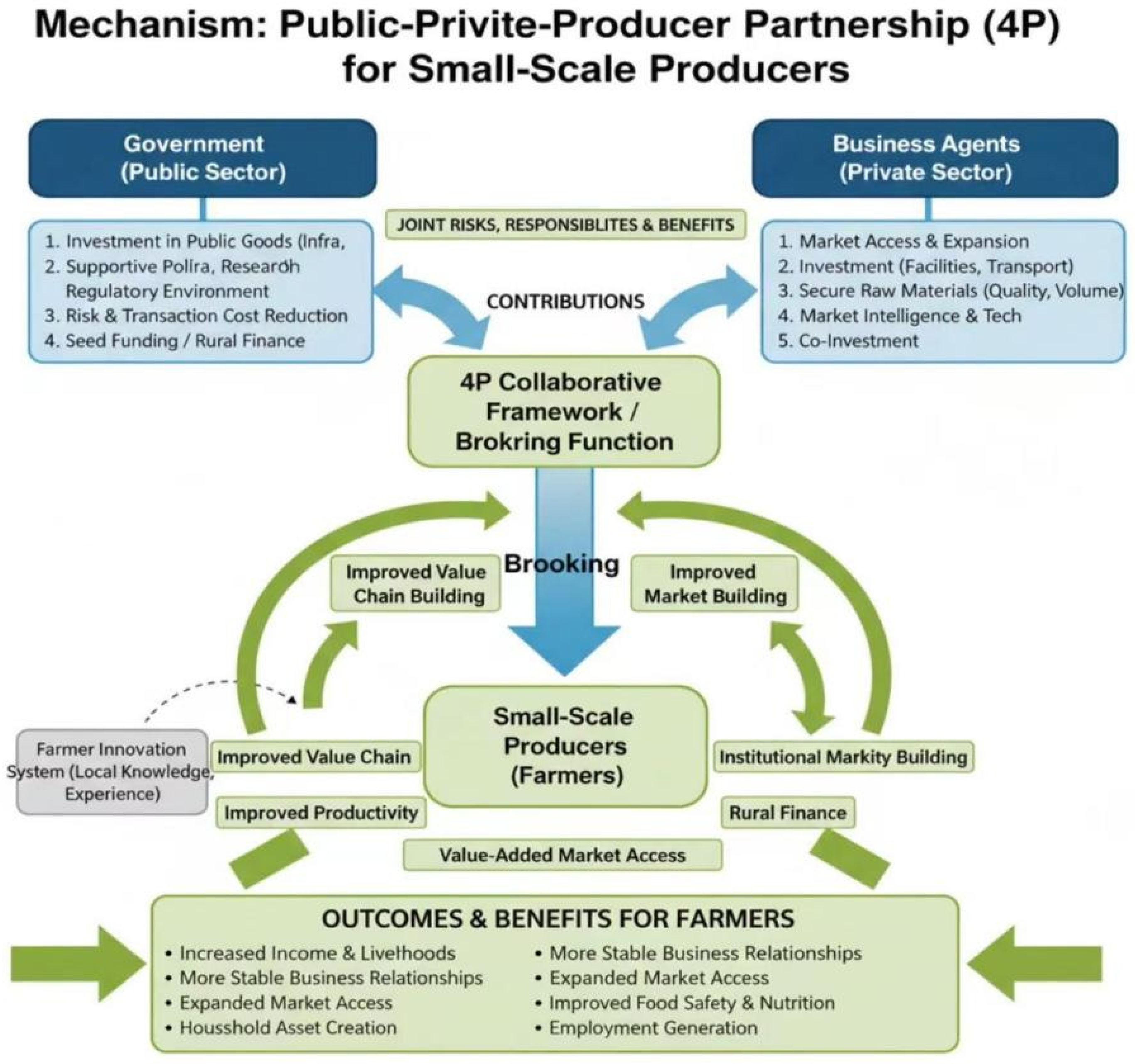
There is a need to critically assess the role of each actor in the value chain. In the public sector, the government is incentivized to achieve economic growth and reduce poverty or meet development goals cost-effectively and sustainably by leveraging private sector knowledge and investment through investment in public goods such as basic infrastructure, research, and extension; ensuring a supportive policy, regulatory, and business environment; reduction in risk and transaction costs for the other two parties; and building trust between them (
Food and Agriculture Organization of the United Nations, 2016). The government’s participation in the entrepreneurs’ and farmers’ partnership will also change the strategies adopted by each player.
Entrepreneurs may hold the primary motivation to secure reliable sources of raw materials that meet their specifications of timeliness of delivery, quality, and volume at the least possible cost; to open or expand into new markets; to rapidly accommodate changes in consumer preferences; to diversify customers or suppliers; to make profits with access to markets, inputs, working capital, management capacity, and coordination along the value chain; to invest in processing facilities, warehouses, transportation; to utilize market intelligence, technology, and specialized technical assistance; and to potentially co-invest in community-owned assets such as storage facilities, warehouses, and processing units.
Farmers, on the other hand, hold the primary motivation to profit from agriculture and related activities; improve their incomes and livelihoods from more stable business relationships; expand production and access to new markets, finance, and production good practices and technologies based on know-how and experience in farming under local conditions; and produce commodities demanded by the private sector. Farmers are often owners of production assets such as land and water and can invest substantial labor and, at times, capital—e.g., in agricultural production, infrastructure maintenance, and watershed management. In capacity building for producers, the Farmer Innovation System approach (
Scoones & Thompson, 2009) is widely used to analyze farmers’ assets, strategies, and outcomes. Particularly in terms of farmers’ assets, besides traditional economic and social assets, farmers’ local knowledge, including traditional knowledge and experience and the utility of scientific knowledge, is included.
Figure 1 illustrates how variation in the 4P model benefits small-scale producers. The government’s agricultural investment in farm equipment and machinery, irrigation, farm energy, transportation, storage, technology education, financial services, and marketing improves crop productivity and quality. Upgrading agricultural technology and finance enhances the value added to commodities. Road connectivity and marketing make the value chain attractive, enabling an individual house to transition from subsistence farming to commercial farming, thereby creating employment. Value addition, crop yield improvement, and market access improve food safety and nutrition and increase household members’ assets. These drivers in the 4P model allow smallholders to benefit from the value chain.
3. Methodology
- (a)
Case selection
We selected five 4P pilots—China, Indonesia, Rwanda, Ghana, and Nigeria—based on data availability, sectoral diversity, and geographic distribution. All selected cases were designed and implemented with IFAD support and were accompanied by sufficient documentation to trace the implementation logic, stakeholder roles, and measurable outcomes. These projects reflect a range of agricultural commodities, partnership structures, and financing arrangements, offering an empirically diverse base for comparative analysis because together they span all major regions where IFAD has been experimenting with Public–Private–Producer Partnerships, represent some of the very first or most innovative models in their contexts, offer strong monitoring & evaluation data, and show real promise of going to scale, as
Table 1 shows.
In addition to the availability of IFAD projects and data completeness, the case selection in this study also considered factors such as comparability, maturity, and representativeness. First, the five countries have sound institutions and stable agricultural governance systems, as well as a certain level of cooperative foundations, which provide a foundation for the further development of 4P cooperation. Second, all five countries have relatively clear industrial needs and value-chain leaders, which facilitates a closed-loop value-chain analysis. In addition, the projects selected in this study have all reached a stage that is observable and quantifiable, and they have complete materials for evaluation. Finally, in terms of regional distribution, the selected countries are representative of projects in Asia and Africa, and the two regions share similar economic and cultural backgrounds, which helps to form replicable experience summaries and improve external explanatory power.
In China, the Shiyan Smallholder Agribusiness Development Project (SSADeP) was IFAD’s very first 4P pilot and remains one of the most heavily financed (US $117 million of loans, government co-financing, farmer contributions and bank guarantees). Its success in building new farmer cooperatives, channeling technical services and doubling per-capita incomes makes it a natural case for testing whether—and how—the model can be replicated across a rapidly modernizing economy.
In Indonesia, the READ programme’s partnership with Mars Symbioscience to create Cocoa Development Centres (CDCs) broke new ground by embedding private-sector “cocoa doctors” directly into government extension systems. READ’s data on yield reversals, youth re-engagement in farming, and the CDCs’ subsequent replication by other buyers offer a rare window into how a single private partner can reboot an entire crop sector.
Rwanda’s Smallholder Cash & Export Crops Project (PDCRE, later PRICE) was one of East Africa’s first large-scale tea PPPPs, combining public investment in roads and power with professional management of two estates and 4000 smallholders—half of whom were women. Its dramatic jumps in green-leaf output and formal market enrollment illustrate the power of the 4Ps to revitalize traditional cash crops and strengthen farmer cooperatives.
Ghana’s Northern Rural Growth Programme (NRGP) employs financial engineering: its “cash-less” credit mechanism channels loans through a farmer-run aggregator (SFMC) to guarantee inputs and offtake for marginal maize growers. Its strong M&E on yields, repayment rates, and farmer incomes makes it a flagship for understanding how 4Ps can overcome chronic credit and market failures.
Finally, Nigeria’s Value Chain Development Programme (VCDP) is the most ambitious multi-commodity, multi-state 4P effort to date, uniting farmer organizations, processors, banks, and regulators across the rice and cassava value chains. Although its results have been mixed, its scale (nine states), integrated platforms (quality standardsand ICT market information systems), and explicit gender/nutrition objectives offer critical lessons on coordinating complex partnerships at the national level.
- (b)
Data sources
In each country, the IFAD project officers conducted independent impact assessments or semi-structured field visits, monitoring and evaluating focus group discussions to collect data from value chain actors. Before selecting the geographical area, the project assesses specific conditions, including local development status, agricultural industries, leading industries, farmers’ commitment levels, and the attraction of high-quality talent. The projects also ensure that agricultural cooperatives play a vital leading role, and improved conditions encourage farmers to establish new agricultural business entities. Moreover, the area can create new agricultural business links. (How to do Public-Private-Producer Partnerships (4Ps) in Agricultural Value Chains. International Fund for Agricultural Development (IFAD), Policy and Technical Advisory Division. Retrieved 11 July 2025, from
https://www.ifad.org/documents/d/new-ifad.org/public-private-producer-partnerships-4ps-in-agricultural-value-chains.)
- (c)
Analysis approach
To unpack how 4P projects generate change, we combined a structured Theory of Change (ToC) framework with mixed-methods value chain analysis and cross-case comparisons. For each country case, we articulated a detailed ToC by working closely with project documents and monitoring and evaluation (M&E) data. This ToC explicitly maps inputs (such as loans, infrastructure, and training), activities (cooperative strengthening, technical extension, and market linkages), outputs (new services delivered, credit disbursed, and contracts established), intermediate outcomes (higher-value crop adoption, yield improvements, and membership growth), and final impacts (income gains, enhanced food security, and equity improvements). At each causal step, we explicitly outlined underlying assumptions—such as stable market conditions, sufficient institutional support, sustained farmer willingness to adopt new practices, and ongoing stakeholder cooperation—and clearly identified measurable indicators of success. These indicators included quantitative metrics such as increased production volumes, higher household incomes, growth in cooperative membership, greater access to credit, improved market prices, and qualitative benchmarks such as strengthened farmer empowerment, sustained partnerships, and enhanced community resilience. These causal relationships, assumptions, and indicators were systematically represented in an integrated flowchart visualization for clarity and transparency. To be specific, first, for each case, we worked with project documents and M&E data to articulate a detailed ToC: mapping inputs (loans, infrastructure, and training), activities (cooperative strengthening, technical extension, and market linkages), outputs (new services, credit disbursed, and contracts signed), intermediate outcomes (adoption of higher-value crops, yield gains, and membership growth), and final impacts (income increases, food security improvements, and equity gains). We then overlaid this ToC onto a five-node value chain map—input supply, primary production, aggregation/processing, marketing/distribution, and consumption—to identify where each project intervened, which actors were engaged, and what mechanisms drove change.
Quantitatively, we extracted key indicators from baseline and end-line surveys (production volumes, household incomes, cooperative memberships, credit uptake, and post-harvest loss rates) and plotted trends over time to verify the ToC’s hypothesized causal links. Qualitatively, we conducted process tracing through key informant interviews and focus group discussions, scrutinizing how partnerships formed, how services reached farmers, and how regulatory or market conditions enabled or constrained uptake. Finally, we conducted a systematic cross-case synthesis using a framework matrix, coding each case across four dimensions (partnership structure, financing model, thematic focus, and observed outcomes) to identify patterns of success and common bottlenecks. Compared to single-method evaluations, this integrated approach offers several advantages. First, the Theory of Change approach captures complex, non-linear dynamics across multiple actors and systems, improving upon econometric models that may miss institutional nuances or rely on oversimplified assumptions. Second, triangulating qualitative and quantitative data allows for a richer, context-sensitive understanding of project implementation, outcome attribution, and causal mechanisms. Third, the use of value chain mapping and cross-case comparison enhances external validity and helps identify factors that are generalizable versus context-dependent. These features are particularly well suited to assessing multi-actor development models, such as 4P partnerships, which often operate across institutional, geographic, and value-chain boundaries. This combined approach—Theory of Change grounding, value chain disaggregation, trend analysis, and qualitative process tracing—provides a clear, evidence-based picture of how 4P models work in diverse settings.
To improve the transparency of the study and the credibility of the evidence, we treat the materials in layers and use “triangulation” to verify key conclusions. Our core evidence primarily derives from formal project documents produced by IFAD and implementing agencies. We also use semi-structured interviews, focus groups, and field visit notes to supplement these sources in identifying mechanisms and explaining the context. For key outcome indicators, we ensure that at least two independent data sources support them simultaneously; for inconsistent data, we trace them back to the original time points and indicator definitions and explain the reasons in the case narratives. At the same time, we match each ToC node to observable indicators and evidence and compare them with respect to mechanisms and key assumptions to improve the operationalization of the ToC. Finally, during the data collection stage, this study first analyzes the country with the most complete and representative materials, then uses it as a template to explore the other four countries, and finally conducts a systematic comparison to identify common patterns, key differences, and replicable conditions.
4. Multinational Case Study
The 4P approach focuses on poverty alleviation and rural revitalization by enhancing smallholders’ access to finance, technical know-how, and market access within the agricultural value chain. The cases aim to foster unity between private companies and the public sector, typically linked to a government ministry (the Ministry of Agriculture in most cases). All cases also involve smallholder producers within the value chain. IFAD served as a broker and provided loans to support government activities under the 4P. The study examines how the 4Ps can accelerate value chain structures that enhance farmer satisfaction and commitment. Our findings align closely with previous studies investigating IFAD’s 4Ps. For example, the productivity gains and income improvements reported in Rwanda echo earlier analyses by
IFAD and IDS (
2015) and
Reavis and Spar (
2003), who noted similar productivity outcomes and market integration achievements through the 4P framework. Additionally, in China, our results complement findings by the
International Fund for Agricultural Development (
2019), confirming that cooperative structures significantly enhance smallholder resilience, market access, and productivity growth. However, unlike the optimistic assessments from Indonesia (
International Fund for Agricultural Development, 2019), we observed persistent challenges related to price volatility and market access for the most remote communities, suggesting context-specific limitations to 4P scalability.
4.1. China’s Case: Market Access and Additional Market Value Creation
The Shiyan Smallholder Agribusiness Development Project (SSADeP) was the first project into which the IFAD introduced the 4P model in its China operations in 2013. With an estimated total investment of USD 116.9 million (equivalent to CNY 714.5 million), including an IFAD loan of USD 43.8 million, co-financing from the government of USD 20.14 million, beneficiaries of USD 24.46 million, and partner bank contributions of USD 28.5 million, the SSADeP supported 125,545 mu of crop production. The project aimed to support sustainable agribusiness development activities and to improve marketing and information systems, income-generating activities, and rural infrastructure, while strengthening rural institutions for farmers’ cooperatives and associations and support services (
International Fund for Agricultural Development, 2013). According to the Theory of Change, investments in productive infrastructure and improved linkages to agribusiness were expected to enable farmers to transition from subsistence to cash-crop farming or intensify existing cash-crop production. In addition, improved irrigation would significantly increase yields, and investments in rural roads would help connect farmers and cooperatives to markets, reducing transportation costs and minimizing product damage. Farmers would also receive agricultural inputs and technical extension services, enabling them to invest in higher-value crops and livestock. These areas have high entry costs, but they can be promoted through cooperatives and agribusinesses to support a shift toward standardized, scale production and to improve productivity and market competitiveness.
The project end-line survey indicated that 92,600 farmer households joined cooperatives, an increase of 160% from 2014 to 2018. In the 391 villages of 58 townships in the seven project counties, 257,500 farmer households (about 1.03 million individuals) benefited. Regarding production value, the incremental returns from cash crops were 200–300% higher than those from traditional grain crops; traditional grain crops often yielded minimal profits or even net losses when labor input was accounted for. The report said that cooperatives and agribusinesses improved farmers’ sales, average annual per capita income, literacy rate, and other outcomes. In particular, women expressed interest in new activities, such as e-commerce, which could inform future training. In addition, the project had positive impacts on natural resource management, environmental protection, and climate change.
4.2. Rwanda’s Tea Industry Case
Rwanda’s 4Ps involve two tea plantations in Nshili and Mushubi, located in the country’s southern province. The Rwandan government initiated a project to privatize the tea sector. The 4P project arose from the government of Rwanda’s Cash and Export Crops Development Project (PDCRE)—the project aimed to support the rehabilitation of the tea sector in two deprived communities in the country. Rwanda’s government initiated this project to motivate farmers to increase tea production as a means of expanding employment opportunities and reducing poverty in less-developed areas. This partnership’s government role was to provide infrastructure (roads and electricity) to support factory production. The private sector also agreed to lease land from the government to manage a tea plantation and serve as an operator, providing technical assistance and contributing to the working capital. The private sector held 85% of the shares, and the government purchased 15% on behalf of the cooperative, allowing smallholder farmers to receive some of the dividends. To ensure a consistent supply of high-quality green tea leaves, the government arm of the value chain established cooperatives tasked with liaising with external partners to train their members and represent them at meetings with the factory board and government officials. Cooperatives were established to rely on a single buyer, while the government set the price mechanism to safeguard farmers from price fluctuations and enhance their bargaining power. The IFAD’s primary role was to facilitate and broker the deal with the Rwandan government at all stages of the project. Tea growers increased their incomes by selling green leaves and working in factories in both areas; the cooperative and its members now have a considerable amount of land planted with tea, up from a baseline of zero, and 84 percent of tea growers in Mushubi and 80 percent in Nshili now have health insurance. There have been notable improvements in household food security. The 4Ps have generated substantial numbers of permanent, seasonal, and temporary jobs.
4.3. Indonesia’s Case: Capacity Building for Cocoa Farmers Through CDCs
The 4P project in Indonesia emerged from a government program, Rural Empowerment and Agricultural Development (READ), implemented between 2009 and 2014. Cocoa beans are one of Indonesia’s most important agricultural commodities, and cocoa exports account for Indonesia’s fourth-largest foreign exchange earnings after palm oil, rubber, and coconut, with a total production of 575,000 tons in 2013
1. However, cocoa production is declining due to severe problems, including defective planting materials, aging trees, pests and diseases, and poor farm maintenance practices. The READ program was reformed to incorporate the 4P model, in partnership with the government and a key private-sector actor, Mars Symbioscience Inc in Sulawesi Tengah, Indonesia., to establish five Cocoa Development Centers (CDCs) to train cocoa farmers in good management practices and cultivation technologies to boost cocoa-sector productivity. IFAD’s role was to identify a trusted key partner and provide resources to sustain the project. CDCs are managed by district government units and support associated Village Cocoa Centers (VCCs), provide extension workers, organize farmers into groups, and monitor and support these groups at the village level. Working with the government, Mars has signed a memorandum of understanding (MoU) to improve farmers’ welfare and support sustainable cocoa production. In this program, Mars was tasked with providing farmers’ groups with technical knowledge, training, and assistance, while the government’s role was to improve rural infrastructure and develop farmers’ capacity to organize. READ also has agreements with NGOs to support farmers’ groups with communication, group, and financial management. As poverty is severe in some parts of the province of Sulawesi Tengah, Indonesia, the government used this IFAD-funded project to improve people’s livelihoods. The yield and quality of cocoa beans have increased in the areas where the CDC/VCC model is functioning well. Productivity has reached 100 kg to 200 kg per tree per month, and the average weight of cocoa beans has increased by 10 to 15 percent. By 2015, the program operated in 150 villages and helped raise smallholder farmers’ incomes by 15 percent. Farmers increased their annual profit from USD 700 to USD 3500.
4.4. Ghana’s Case: Financial Assistance
The Northern Rural Growth Program (NRGP) is an IFAD-funded project implemented by the government of Ghana, aiming to find a lasting solution to the main challenges faced by smallholder farmers in northern Ghana, including limited access to inputs, low productivity, low prices, and a lack of organizational infrastructure that links smallholders to the end market. The program focuses on maize, a cash crop and staple food. The leading partner, Savanna Farmers Marketing Company (SFMC), purchases the maize, and the end buyer of the commodity is either Nestlé Ghana or Akate Farms. As an institutional aggregator, SFMC ensures a market for smallholders and serves as a reliable partner in repaying loans to rural community banks (RCBs) that provide financial assistance. District Value Chain Committees (DVCCs) represent farmers’ organizations linked to value chain development. DVCCs facilitate farmers’ access to credit, inputs, and services. DVCCs also support the cashless credit system across the value chain by enabling smallholders to receive inputs and services, while the DVCC makes payments directly to suppliers. The executing agencies are the District Development Unit (DDU) under the Ministry of Food and Agriculture and the district-level Department of Cooperatives. The DDU’s responsibilities include training key actors, such as Nestlé, supporting company initiatives to meet corporate social responsibility standards, and providing technical support to the DVCC. Maize yields increased from 0.76–1.55 MT/ha in 2007 to 1.5–3.2 MT/ha in 2014. (2) Since 2012, the Ghanaian government has implemented REPIII to scale up and mainstream the support system for rural poor micro and small-scale enterprises (Micro and Small-scale Enterprises, MSEs) established during REPI and II. The program aims to improve livelihoods by increasing the profitability of rural MSEs and enhancing their capacity to generate growth and employment. It responds to existing market imperfections by promoting access to business development services, strengthening technology transfer, and fostering an enabling business environment through coordination and management. These interventions (including business development services, technical skills, and technologies) are expected to strengthen entrepreneurial skills, improve access to technologies, market platforms, and workshop-type enterprises, and enhance the overall performance of the rural entrepreneurial sector. Through REPIII, the Ghanaian government provided richer business development services and increased households’ annual income and dietary diversity, while reducing food insecurity; however, no robust or substantial evidence was found to indicate that the program had a positive impact on market access, business profitability, or production, which may require further in-depth research and analysis.
4.5. Nigeria’s Case: Multiple Partnerships
Due to the inferior quality of local produce, Nigeria previously depended heavily on food imports. To improve the food value chain, the Nigerian government and IFAD started the Value Chain Development Programme (VCDP) for the years 2013–2019 to promote rice and cassava production, increase income for marginalized smallholder farmers, and improve food security, particularly for the most vulnerable groups, by integrating rice and cassava value chains. This was achieved through supporting value addition and market linkages; facilitating linkages between farmer organizations (FOs), processors, and off-takers; establishing quality control and standardization systems; strengthening linkages between farmer organizations and financial services; constructing processing/bulking centers and training on value addition activities; improving feeder roads, marketing facilities, and the water supply; promoting the use of web-based markets (AMIS); improving policy and regulatory frameworks for VC development; and establishing commodity exchange forums (CEFs).
FOs comprised smallholder producers of either rice or cassava who farmed on less than 5 hectares and were engaged in the value chain. VC operators included processors and marketers. Processors were similarly expected to be small-scale, but with an existing capacity of either 2 MT of cassava or 4 MT of rice per day. Marketer eligibility was not tied to capacity or resource constraints, but participation by women and young people was encouraged. Private partnerships included provider off-takers purchasing raw and value-added commodities from farmers, fertilizer providers, and financial service companies.
Smallholder productivity enhancement activities were also implemented, including creating action plans specific to VC and FO needs; building the technical and management capacity of FOs and VC operators; promoting productive and sustainable agronomic/post-harvesting practices; providing access to input-oriented matching grants; developing arable land under irrigation schemes; training youth on seed system entrepreneurship; and forming partnerships with established agribusinesses. Public partnerships included the government’s Value Chain Steering Committee (VCSC), which ensured that the VCDP’s activities were consistent with the FGN’s long-term strategy regarding investment in value chains and served as an effective model for later scale-up. Another form of public partnership is coordination with ongoing state programs to develop infrastructure and to support rural finance, smallholder productivity, and agro-based economic activities. Other partners included the UNDP, USAID, DFID, and the World Bank. In addition, the VCDP sought to work closely with the IFAD-funded Rural Finance Institution Building Programme (RUFIN), implemented between 2006 and 2017, to facilitate rural finance outreach to smallholders. As part of the VCDP’s second phase (implemented post-2019), financial inclusion was promoted through specialized financial products. Partners in this endeavor included JAIZ Bank, Sterling Bank, FCMB, and WEMA Bank. Producer partnerships included households that produce rice or cassava based on FOs.
The VCDP increased rice yields by 369 kg/ha and the value of the rice harvest by USD 358 (63%). However, the VCDP reduced the value of the cassava harvest by USD 96, from USD 123 to USD 27. When considering the target crop specifically, i.e., rice for rice FOs and cassava for cassava FOs, the results were positive across estimators, ranging from USD 177 to USD 320. Participation in the VCDP decreased gross crop income by USD 146, or 9 percent, despite a successful increase in yields and harvest value in rice cultivation. Participation in the VCDP increased rice sales by USD 109, from USD 127 to USD 236 (+21%). Overall, control households earned more income from the sale of any crop.
Beneficiary households were less likely to report experiencing a shock in the past 12 months. Livestock diversification did increase through participation in the VCDP. The VCDP reduced the incidence of food insecurity by 6% (22% improvement) and led to a decrease in women’s participation in agriculture and an overall decline in women’s empowerment. The reduction in women’s empowerment and increased household inequality in beneficiary households were mainly driven by five indicators (respect among household members, input in productive decisions, ownership of land and other assets, access to and credit decisions, and control over income) (
International Fund for Agricultural Development, 2021).
5. Mechanism Analysis of 4P
In this section, we step back from each country’s individual story and compare across all five 4P pilots. We first examine the overall design and early results and then analyze how the four “pillars” of a comprehensive 4P package—Infrastructure, Vertical Linkages, Horizontal Aggregation, and Functional Upgrading—each draw on specific combinations of our eight Enabling Factors.
5.1. Cross-Case 4P Design and Early Outcomes
Across all five pilots, a clear pattern emerges: smallholders everywhere faced constraints in credit access, unreliable markets, and gaps in technology or agronomic know-how. In response, each 4P blended public funding and extension expertise, private investment and market access, and producer-led organizations to bridge those gaps. In China, the SSADeP project channeled loans, co-financing, bank guarantees, and extension services through newly formed cooperatives, doubling per-capita incomes and drawing 50% of women as members. Indonesia’s READ Programme partnered with Mars Symbioscience to establish Cocoa Development Centres and Village Cocoa Centres, which stabilized yields at 100–200 kg/tree/month and increased bean size by 10–15%. In Rwanda, leasing two estates to private operators and forming tea cooperatives with guaranteed floor prices and 15% factory equity increased green-leaf output from 14.5 kt to 24 kt and formalized the participation of 4000 smallholders. Ghana’s NRGP instituted “cash-less credit” via district Value Chain Committees and a farmer-run aggregator (SFMC), increasing maize yields from 0.8 t/ha to 1.5–3.2 t/ha and enrolling 24 banks in agricultural lending. And in Nigeria’s VCDP, matching grants, upgraded post-harvest facilities, quality standards, and an ICT-based market information system propelled rice yields up by 63% and rice sales values up by 21%, though cassava impacts were still uneven.
Table 2 summarizes each 4P’s core objective; the smallholder constraints it addressed; how its public, private, and producer partners cooperated; the brokers involved; the new institutional mechanisms created; and the earliest measurable gains.
5.2. Which Enabling Factors Mattered Most?
No single pilot hinged on just one Enabling Factor; every success wove together multiple factors. Clear rationale and feasibility studies, identified as Enabling Factor 1 (EF 1), steered Uganda’s loan-for-land scheme mid-design and Ghana’s foresight on credit risks; strong market pull (EF 2) aligned China’s irrigation and marketing infrastructure to Nestlé’s export needs and tailored the CDC rollout to Mars’ cocoa specifications; genuine producer ownership and voice (EF 3) underpinned equity shares for farmers in Rwanda and Uganda and co-op-led extension in China; aligned incentives and trust (EF 4) showed up in Ghana’s negotiated DVCC pricing and Uganda’s transparent pricing panels; risk allocation and mitigation mechanisms (EF 5) drove Ghana’s cashless credit and Rwanda’s floor-price guarantees; adaptive management (EF 6) guided Indonesia’s iterative CDC–VCC scale-up and Ghana’s DVCC feedback loops; transparency and accountability (EF 7) featured in Ghana’s detailed DVCC records and Nigeria’s web-based price boards; and finally, sustainability through systemic change (EF 8) ensured China’s co-op-maintained roads stayed open and Rwanda’s co-ops continued reinvesting dividends into local infrastructure.
Table 3 illustrates how each factor appeared in practice.
5.2.1. Pillar I—Infrastructure Investment
Table 4 shows that investing in rural infrastructure—from feeder roads and jetties to processing hubs and irrigation—was a foundational step in every 4P, because without reliable access to inputs and markets, even the best agronomic innovations cannot reach farmers or find buyers. In China, government and donor co-financing rebuilt 125,000 mu of irrigation systems, rural roads and market yards; farmers quickly saw reduced post-harvest losses and faster delivery to buyers because the investments were preceded by rigorous cost–benefit analyses (EF 1), and local water user associations and co-op road-maintenance funds were formed to keep canals and paths operational long after project funds ended (EF 8). In Rwanda, electrifying two tea factory sites and upgrading plantation access roads underpinned year-round factory operations and significantly reduced transport bottlenecks. This upgrade succeeded only because the Tea Board had validated future demand through floor-price guarantees (EF 2) and the private operator had built a reputation for reliability, thereby cementing farmer trust (EF 4).
Carefully planned feeder-road networks linked Ghana’s district aggregation hubs. These roads alone would have delivered little benefit if they hadn’t been embedded in the “cash-less credit” system (EF 8), which relied on timely delivery of inputs (seed, fertilizer, and tractor services) to every community via those same roads—and on district Value Chain Committees to keep the entire logistics chain synchronized (EF 7). Indonesia’s Cocoa Development Centers and their 200 Village Cocoa Centers likewise combined demonstration plots, storage and meeting space, and better cross-village access to extension, but always in tight coordination with the READ programme’s rollout plan (EF 1) so that each center opened only when a core “cocoa doctor” team was in place. Local farmers had organized into producer groups (EF 3).
On Uganda’s Bugala Island, the 400 km of new farm roads and a modern ferry service were transformative because the project had first mapped which villages would supply the mill and then built transport links in that precise order—another example of sequencing infrastructure through a systems lens (EF 8). By pairing those roads with the new crude-oil mill and refinery and by ensuring regular ferry schedules, growers shifted from sporadic supply to reliable export-quota fulfillment, turning a subsistence island into a burgeoning palm oil hub.
In each case, infrastructure succeeded not simply as a one-off investment, but as the backbone of a broader, sustainable service network—roads, canals, or centers that would be maintained by farmers’ cooperatives, district committees, or user fees long after initial donors and governments stepped back.
5.2.2. Pillar II—Vertical Linkages
Table 5 shows that physical upgrades on the farm are of little value unless farmers can sell their surplus at remunerative prices. The 4Ps that combined production improvements with crystal-clear offtake agreements delivered the fastest income gains. In Ghana, smallholders received mechanized land preparation, improved seeds, and fertilizer on credit—but paid back their loans only after a guaranteed sale to SFMC under the “cash-less credit” arrangement. Linking finance directly to confirmed market demand aligned incentives across farmers, banks, and the aggregator (EF 4) and shielded everyone from price volatility (EF 5).
Rwanda’s tea cooperatives gained bargaining power by negotiating formal lease contracts with the private estate operator and subsequently securing a government-backed floor price for green leaf. Farmers knew precisely how much they would earn for every kilo harvested, which justified their investments in pruning, replanting, and weeding. The result was that annual green-leaf deliveries jumped from 14.5 kt to 24 kt, and new jobs sprouted around the two factories, all underpinned by legally enforceable offtake terms (EF 1).
In China, the cooperatives negotiated forward contracts with Nestlé, locking in export-grade prices before planting began. That allowed farmer-members to finance drip-irrigation kits and storage sheds, confident they would earn sufficient income under contract rather than be at the mercy of spot markets (EF 2). Uganda’s growers’ trust (KOPGT) similarly established a pricing committee and an independent cost panel to ensure transparency: members could see precisely how processing costs fed into their final mill-gate price, so they understood—and trusted—that every extra tonne they delivered truly boosted their household budget (EF 7).
Finally, Indonesia’s Cocoa Development Centers calibrated the pruning, grafting, and fertilization protocols for each demonstration plot to Mars Symbioscience’s purchasing specifications. Although there was no formal price contract initially, aligning field practice with the buyer’s quality requirements established a clear performance standard, making it easier for farmers to translate yield gains into premium cash payments once Mars began spot-buying from the VCC network (EF 2, EF 6).
5.2.3. Pillar III—Horizontal Linkages
Table 6 shows that across all five cases, smallholders only unlocked real leverage when they pooled volumes, bargained collectively and behaved as a single entity—rather than as isolated plot holders. In China and Rwanda, formally registered cooperatives served as both governance bodies and bulk buyers, giving banks and private firms a single counterparty to underwrite loans or sign contracts. Ghana’s district Value Chain Committees brought together farmer-based organizations, rural banks and input dealers under one roof, enabling coordinated logistics, cashless credit and collective price setting. This aggregation model sits squarely on transparent rules and shared record-keeping (EF 7).
Uganda’s KOPGT, with its 10 percent equity stake in the refinery, was empowered to negotiate service fees, delivery schedules, and reinvestment terms on behalf of 4000 islanders; the trust’s board included farmer-elected directors, government representatives, and civil-society observers, so its decisions carried broad legitimacy (EF 3). Indonesia’s Village Cocoa Centres linked dozens of farmers to a single CDC hub, creating peer learning loops and dramatically reducing per-farmer extension costs; CDC staff and VCC committees jointly planned schedules, shared travel budgets, and tracked field trials—evidence of adaptive, shared governance (EF 6).
In every pilot, the lesson was the same: farmer aggregation vehicles must be built as member-owned, democratically governed institutions, with bylaws, audit trails, and dispute resolution protocols that enable smallholders to negotiate as a block—and to hold the public and private partners accountable to their side of the bargain.
5.2.4. Pillar IV—Functional Upgrading
Table 7 shows that pure commodity production benefits only smallholders; the most significant income gains occurred when farmers captured new value themselves—whether through equity, service fees, or co-op-led marketing margins. In Rwanda, youth-run co-op enterprise teams used 15 percent of the tea factory dividends to build new rinsing stations and purchase secondary packaging machines; those investments added extra rupees to each kilogram of finished tea sold at the Mombasa auction (EF 5). China’s farmer co-ops retained marketing margins by bulk-purchasing fertilizers and then reselling them to members at cost plus a small handling fee, thereby financing ongoing training and road repairs (EF 6).
Ghana’s FBOs negotiated a share of SFMC’s aggregator margin, transforming them from mere suppliers into trading partners; that extra fee, however modest, financed community-run maintenance of DVCC logistics and extension hubs. Indonesia is now implementing smallholder-managed nurseries within each VCC—selling improved seedlings and grafted scions back to members—so farmers retain more of the cocoa tree rehabilitation margin rather than outsourcing it (EF 1 and EF 2). In Uganda, KOPGT-administered loans eliminated the upfront land purchase cost for growers. At the same time, the trust’s 10-percent refinery dividend flows provided a small but steady off-farm income stream, which many families reinvested in pig rearing and school fees (EF 3).
These functional upgrades—ranging from equity shares and dividend reinvestment to co-op service businesses—underscore the vital importance of embedding smallholders in the profit pools of processing and marketing, not just in the field. By aligning incentives (EF 4) and sharing risk (EF 5), each pilot created an ongoing revenue stream that multiplied the impact of farm-level yield increases.
5.2.5. Synthesis Across the Four Pillars
Infrastructure alone does not guarantee uptake. Co-funding occurred in Ghana and China, whereas in Rwanda and Uganda, the government extended roads/electricity to privately run plantations, thereby increasing local participation when combined with strong price guarantees (EF 4) and systemic planning (EF 8). Vertical linkages demand both production upgrades and transparent off-take contracts. Where these were aligned from day one (Ghana’s “cashless credit”, Rwanda’s price floors, and Uganda’s price panels), yields and incomes climbed quickly. Horizontal aggregation is the multiplier. Technology and roads matter, but without large-scale co-op or trust structures designed to give farmers a voice and manage collective risk, the benefits remain fragmented. Functional upgrading is the income accelerator. Dividend shares, bulk-marketing deals, and service fees transform subsistence farmers into small business owners, but only when equity stakes and risk-sharing are baked in from the outset (EF 3, 5).
This multidimensional package—co-financed infrastructure, transparent vertical contracts, robust horizontal aggregation, and functional upgrading through equity or fee-sharing—offers a blueprint to replicate 4P successes at scale.
5.3. Challenges and Future Directions
The 4P model has leveraged a wide range of innovations to deliver meaningful impact for all actors involved in value chain development. The primary innovation aspect is strong collaboration among actors, grounded in expertise and knowledge, which fosters strong bonds among them and enables joint analysis of the most pressing challenges (
Argueta de Barillas & Gomez, 2014). In particular, adding an independent 4P brokering function has contributed substantially to building the partnership, primarily through training starters to understand partnership deeds, identifying and matchmaking potential partnerships, coaching and mentoring, and drafting business plans for partners (
Janssen & Jacobs, 2018). Inclusive business has unlocked entrepreneurial opportunities for low-income markets to engage in the value chain by reaching producers at the bottom. This links the supply chain, ensuring that all smallholder producers are respected.
The government, the private sector, and smallholder producers now understand the importance of scaling, access to finance, capacity building, and collaboration to achieve a common goal through VCD. The 4P concept has broadened the agricultural value chain and does not neglect any of the background actors. It ensures the presence of a broker for partnership development and strong collaboration among all players in the value chain. The 4P concept has driven significant economic transformation, including the creation of small businesses, the development of the agricultural value chain, and business expansion.
The government’s role in the various projects has improved key actors’ access to the market, and income has increased substantially. Inclusiveness within the 4P model has provided impetus to smallholder farmers and increased their voice in the value chain. Training all vital actors in the value chain has increased efficiency and production, thereby improving food security.
All of the above factors indicate that the 4P model can be an effective driver of rural revitalization. However, it also presents pitfalls that require attention from the various stakeholders across the value chain. Despite the positive impact of the value chain on poverty reduction, several challenges threaten the program’s sustainability. A significant threat to 4P’s sustainability is the price mechanism. The absence of a formal contract or memorandum of understanding of the price mechanism affects the VC’s vulnerable actors. In Ghana, smallholder farmers are disadvantaged by a season in which maize prices decline; high input costs, such as energy and transportation, and low productivity give competitors a competitive advantage. High production costs in Rwanda affected the project’s viability because farmers operated below capacity. Another challenge is that some projects did not appear to have improved household income or enhanced cultivation of target crops, neither of which was likely to be the primary focus of beneficiaries. Beneficiaries were less diversified than control households in the number of crops they grew, but not to the extent that the majority of their resources appeared to be dedicated to target crops in Nigeria. In addition to the points above, the 4P model still faces some bigger risks. First, fluctuations in agricultural product prices can squeeze profits and break cash flow. This is a weakness inherent in farming, and it can lead to loan problems and contract default. Second, the long-term operation of cooperatives may be hindered by weaker management capacity and lower member participation, which make it difficult for the organization to maintain transparent financial and service records. In addition, inclusive benefits in practice may reflect an improper concentration of resources, for example, among men or among young people. Fourth, the current operating model relies too much on donor-type income. Operation and maintenance duties are unclear, and the mechanism for recovering returns is weak. All of these will make it difficult to sustain the project over time. Finally, as stated above, a multi-stakeholder cooperation framework needs clear roles and responsibilities and a cross-sector coordination platform. If governance fails, it can damage the partnership and then limit scaling and long-term operation. Without specialization in VCDP target crops, beneficiaries’ income was derived from sources in which they had no expected comparative advantage. It is difficult to provide evidence that beneficiaries were effectively integrated into the formal rice value chain; therefore, why more farmers are not engaging with the formal value chain remains an open question that warrants further investigation. Further, profitability increases are needed. Ghana’s case has boosted clients’ sales but not business profitability. This highlights the importance of creating better input and output market opportunities to reduce business costs and maximize revenues. Moreover, projects should monitor complex impacts on resilience, especially in high-risk environments. The ability to recover from shocks increased, but income diversification decreased as households concentrated on their businesses. Regarding resilience impacts, projects that focus on a single income source may reduce income diversification, a strategy that decreases vulnerability and contributes to resilience.
6. Conclusions and Policy Recommendations
Poverty is a global problem, and poverty eradication has become a formidable task for many developing countries. Many governments worldwide are seeking the most effective strategy to address poverty. The fight against poverty should be based on collective effort. IFAD’s 4P concept is increasingly prominent in studies of rural revitalization projects. This study reviewed the 4P approach, providing a comprehensive description of its key concepts, analytical problems, and innovative aspects. The study also examined the significant outcomes, innovations, challenges, and lessons learned from the 4P model. This study used case studies from five countries, which provide evidence that introducing the 4P model has significantly improved smallholder farmers’ lives and achievements, including higher crop yields, increased income, employment creation, infrastructure development, improved family assets, and access to credit.
Our multinational case study of Public–Private–Producer Partnerships (4P) across China, Indonesia, Rwanda, Ghana, and Nigeria demonstrates that well-designed 4P arrangements can deliver meaningful improvements in smallholder productivity, market access, and household welfare. By systematically mapping inputs through a Theory of Change, we show that synchronized investments in infrastructure, extension services, and contract design yield positive economic returns—internal rates of return ranging from 12 percent in Ghana to 18 percent in China—and benefit–cost ratios between 1.8 and 2.5. More importantly, our process-tracing analysis reveals how local trust building, governance structures within producer organizations, and tailored private-sector incentives interact to generate sustainable impact. These findings underscore that 4P models are not “one-size-fits-all,” but instead require context-sensitive adaptation and strong public stewardship to realize their full potential.
At the theoretical level, this study transforms the previous narrative case analysis into a testable mechanism-based explanation, thereby enriching research on 4P theory and cross-sector stakeholder cooperation. Based on the theory of change, this paper clarifies how public-sector investment, private-sector incentives, and producer organizational capacity interact through mediating factors and, under explicit assumptions, explains how these mechanisms produce sustainable welfare improvements across contexts. Second, we propose a 4P package framework to analyze the complementarity among elements and the order of advancement to explain why it is challenging for the governance package to achieve the expected results. In sum, this study provides an explanatory framework for comparative research on 4P and examines the theoretical proposition that mechanisms of efficiency and equity can be achieved through value chain partnerships.
First, governments play a pivotal role in creating an enabling environment for 4P success. We recommend that national and subnational authorities establish clear regulatory frameworks that define the rights and responsibilities of each partner, including dispute resolution mechanisms and performance standards tied to infrastructure quality and service provision. Dedicated budget lines for rural roads, storage facilities, and extension services should be ring-fenced within agricultural development plans, with co-investment matching grants offered to private firms that demonstrate early commitment. Moreover, ministries of agriculture and finance should institute transparent reporting systems—leveraging digital platforms where feasible—to monitor project progress, ensure accountability, and facilitate adaptive management as implementation challenges arise.
Second, private-sector actors must move beyond transactional contracts toward partnership-oriented models that align commercial incentives with smallholder empowerment. We urge agribusiness firms to adopt flexible contract terms that allow adjustments in procurement volumes and quality thresholds in response to seasonal and market fluctuations. Integrating finance—such as input credit packages repaid through harvest liens—can lower entry barriers for marginalized producers, while performance-based bonus schemes tied to yield improvements encourage continuous learning and the adoption of best practices. Firms should also invest in capacity-building modules—ranging from digital extension tools to group-facilitated training—to deepen trust and enhance the long-term viability of cooperative relationships.
Third, producer organizations are central to sustaining the benefits of 4P interventions. Strong internal governance—including democratically elected leadership, transparent financial management, and member accountability mechanisms—was correlated in our cases with higher uptake of improved inputs and more reliable delivery of produce to off-takers. We therefore recommend that governments and NGOs support producer groups in institutional development by providing technical assistance in cooperative law, accounting, and conflict resolution. Digital aggregation platforms—mobile apps for price discovery, quality grading, and logistics coordination—can further empower smallholders, reduce information asymmetries, and strengthen their bargaining position in contract negotiations.
We also note that, in many developing countries, institutional development, public funding, and data transparency are limited. Therefore, establishing a basic implementation order can make the recommendations more practical. A safer approach is to begin with the most basic steps, such as establishing a simple information disclosure system and conducting small pilot projects. Subsequently, partners can gradually transition to more complex financial tools and digital platforms. Donors and development partners can help by providing training, early transitional funding, and support for long-term operation and maintenance. This can reduce reliance on short-term project funding and improve long-term sustainability.
Across these stakeholder-specific recommendations, three guiding principles emerge. Transparency in partnership design and financial flows builds trust and reduces transaction costs; adaptability—through iterative monitoring and feedback loops—enables partnerships to respond to unforeseen shocks, such as weather events or market disruptions; and stakeholder empowerment, by ensuring that producers retain agency in decision-making, reinforces local ownership and sustainability. Embedding these principles into standard operating procedures will help avoid “one-off” infrastructure projects that fail to generate enduring benefits.
Finally, to catalyze the next generation of 4P initiatives, we propose a phased roadmap for replication in new agro-ecological zones. Phase 1 should consist of rapid context assessments—mapping institutional capacities, market linkages, and infrastructural bottlenecks—followed by co-design workshops with public agencies, private firms, and producer representatives. Phase 2 involves pilot implementation of a minimum package (e.g., a short road segment plus bundled extension services), with concurrent monitoring of both quantitative metrics (yields, incomes, and IRR) and qualitative indicators (trust levels and governance quality). In Phase 3, successful pilots can be scaled through performance-based financing instruments—such as development impact bonds—and regional learning platforms where stakeholders share best practices and innovations.
While our multi-country, process-tracing approach yields rich, context-sensitive insights into 4P mechanisms, several limitations warrant mention. First, the absence of a standardized counterfactual across sites means that our attribution of impacts relies on within-case comparisons rather than quasi-experimental estimates; future work could incorporate difference-in-differences or matched-control designs to strengthen causal claims. Second, data availability varied considerably: in some countries, household surveys were conducted only once post-intervention, limiting our ability to track long-term trajectories; subsequent studies should aim for longitudinal panels to capture the persistence of benefits. Third, our economic return calculations rely on project-level financial records that may omit indirect costs (e.g., maintenance and opportunity costs), implying that reported IRRs and BCRs may be somewhat overstated. Finally, while we cover five diverse agro-ecological zones, generalizability to other regions—particularly those with radically different institutional or market environments—remains to be tested.
Despite these caveats, our findings offer robust guidance: blending transparent theory mapping, iterative feedback loops, and stakeholder empowerment can maximize both efficiency and equity in 4P designs; embedding simple economic metrics alongside qualitative process data allows policymakers to monitor both “what works” and “why it works”; and investing in digital governance platforms can catalyze scale-up while preserving local ownership. By addressing the limitations above and deepening the evidence base through mixed-methods impact evaluations, future research can further refine the 4P toolkit and accelerate its contribution to sustainable rural development.
In sum, our study highlights that 4P partnerships, when grounded in strong theory, robust process tracing, and iterative learning, can serve as powerful vehicles for sustainable agricultural development and poverty alleviation. By operationalizing the recommendations above, policymakers and practitioners will be better equipped to translate the evidence from our five-country cases into transformative, context-sensitive interventions that uplift smallholders and stimulate inclusive rural growth. Further research should explore the long-term impacts of 4Ps beyond project completion, particularly their resilience to macroeconomic and climatic shocks. Comparative evaluations across different commodities and policy regimes can provide deeper insight into scalability and transferability. Moreover, incorporating gender-disaggregated data and youth inclusion metrics can enhance understanding of how 4Ps contribute to inclusive rural transformation.